

The DOI matches its Crossref record; 109 of the 110 references it cites were found in a registry or an index.
Centella asiatica and Its Metabolite Asiatic Acid: Wound Healing Effects and Therapeutic Potential
Open accessAbstract
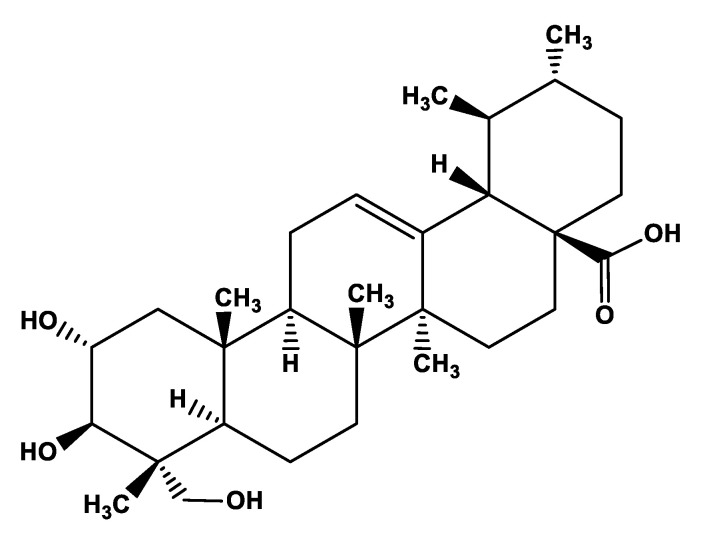
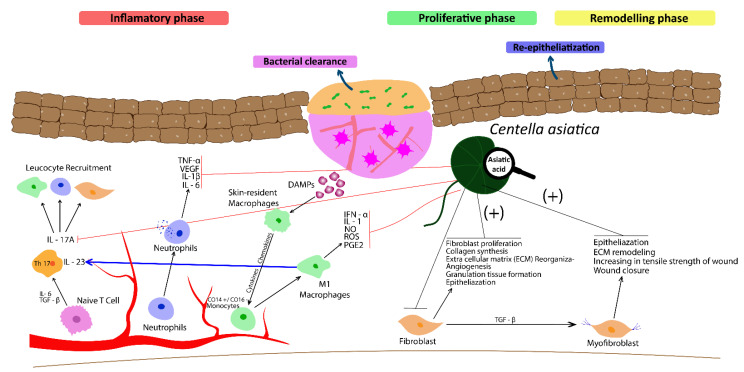
An intense effort has been focused on new therapeutic approaches and the development of technologies for more efficient and rapid wound healing. The research for plants used for long time in traditional medicine in the treatment of wound has become a promising strategy to obtain drugs therapeutically useful in the acute and chronic wound management. In this context, Centella asiatica (Apiaceae) has been used to treat a variety of skin diseases, such as leprosy, lupus, varicose ulcers, eczema and psoriasis, in Asiatic traditional medicine for thousands of years. Studies have shown that Centella asiatica extracts (CAE) display activity in tissue regeneration, cell migration and wound repair process by promoting fibroblast proliferation and collagen synthesis. Preliminary findings have shown that the asiatic acid is one of the main active constituents of C. asiatica, directly associated with its healing activity. Thus, this study discusses aspects of the effects of Centella asiatica and its active component, asiatic acid, in different stages of the healing process of cutaneous wounds, including phytochemical and antimicrobial aspects that contribute to its therapeutic potential.
Overview
The claims and statistics of this paper haven’t been checked yet.
Run the check — free, no account needed. It reads the open-access text and checks the sources it cites.
Integrity signals
Registry
Cites
Statistics
Figures
Verification
Claims the paper makes
The claims and statistics of this paper haven’t been checked yet.
Run the check — free, no account needed. It reads the open-access text and checks the sources it cites.
Claims other papers make about this one
Each is checked against this paper’s own text: does it say what the citing paper says it does?
The source backs part of the claim, not all of it — or backs it for a different population, condition or comparison.
In the citing paper
“Preclinical studies have demonstrated that these compounds exhibit potent antioxidant and anti-inflammatory activities, promote fibroblast proliferation, enhance collagen synthesis, and protect extracellular matrix integrity [16,17,19,22,23,24].”
From A Randomized, Double-Blind, Placebo-Controlled Trial Assessing the Effects of Oral Centella asiatica Extract on Skin Aging-Related Parameters in Middle-Aged Korean Women. (2026) · cites this paper as [17]
Experimental — accuracy not yet measuredThe source backs part of the claim, not all of it — or backs it for a different population, condition or comparison.
In the citing paper
“These constituents exert complementary actions relevant to skin biology, including stimulation of collagen synthesis and dermal matrix remodeling, modulation of pro-inflammatory signaling, and attenuation of oxidative and glycation stress that collectively underpin benefits in tissue repair and skin-barrier maintenance (Park 2021a; Diniz et al. 2023; Rashid et al. 2023).”
From Centella asiatica (L.) Urb. in skin health and cosmeceuticals: mechanisms, clinical evidence, and advanced delivery systems (2025) · cites this paper as Diniz et al. 2023
Experimental — accuracy not yet measuredThe cited source says what the claim attributes to it.
In the citing paper
“Centella asiatica (L.) Urb. is a medicinal plant traditionally used in Asian and Ayurvedic medicine for wound healing and various skin disorders [16,17,18].”
The cited source says what the claim attributes to it.
In the citing paper
“The pharmacological activity of C. asiatica is attributed primarily to its secondary metabolites.”
From Centella asiatica (L.) Urb. in skin health and cosmeceuticals: mechanisms, clinical evidence, and advanced delivery systems (2025) · cites this paper as Diniz et al. 2023
The cited source says what the claim attributes to it.
In the citing paper
“These constituents exert complementary actions relevant to skin biology, including stimulation of collagen synthesis and dermal matrix remodeling, modulation of pro-inflammatory signaling, and attenuation of oxidative and glycation stress that collectively underpin benefits in tissue repair and skin-barrier maintenance (Park 2021a; Diniz et al. 2023; Rashid et al. 2023).”
From Centella asiatica (L.) Urb. in skin health and cosmeceuticals: mechanisms, clinical evidence, and advanced delivery systems (2025) · cites this paper as Diniz et al. 2023
Self-check
Percentages, sums and reported differences re-computed from the paper’s own numbers.
The self-check needs the paper’s full text.
Citations
Cites
Singer, A. J., & Clark, R. A. F. (1999) · New England Journal of Medicine · doi:10.1056/nejm199909023411006 · Cited by 6,106
Wound Healing: A Cellular Perspective
Rodrigues, M., Kosaric, N., Bonham, C. A., & Gurtner, G. C. (2018) · Physiological Reviews · doi:10.1152/physrev.00067.2017 · Cited by 3,211
The Wound Healing Process: An Overview of the Cellular and Molecular Mechanisms
Velnar, T., Bailey, T. A., & Smrkolj, V. (2009) · Journal of International Medical Research · doi:10.1177/147323000903700531 · Cited by 2,446
Reinke, J. M., & Sorg, H. (2012) · European Surgical Research · doi:10.1159/000339613 · Cited by 1,898
Skin Wound Healing: An Update on the Current Knowledge and Concepts
Sorg, H., Tilkorn, D. J., Hager, S., Hauser, J., & Mirastschijski, U. (2016) · European Surgical Research · doi:10.1159/000454919 · Cited by 1,342
Ethnopharmacological approaches to wound healing—Exploring medicinal plants of India
Kumar, B., Vijayakumar, M., Govindarajan, R., & Pushpangadan, P. (2007) · Journal of Ethnopharmacology · doi:10.1016/j.jep.2007.08.010 · Cited by 532
Chemical, pharmacological and clinical profile of the East Asian medical plant Centella aslatica
Brinkhaus, B., Lindner, M., Schuppan, D., & Hahn, E. G. (2000) · Phytomedicine · doi:10.1016/s0944-7113(00)80065-3 · Cited by 525
In Vitro and in Vivo Wound Healing Activity of Asiaticoside Isolated from Centella Asiatica
Shukla, A., Rasik, A. M., Jain, G. K., Shankar, R., Kulshrestha, D. K., & Dhawan, B. N. (1999) · Journal of Ethnopharmacology · doi:10.1016/s0378-8741(98)00141-x · Cited by 428
Chronic wounds: Current status, available strategies and emerging therapeutic solutions
Las Heras, K., Igartua, M., Santos-Vizcaino, E., & Hernandez, R. M. (2020) · Journal of Controlled Release · doi:10.1016/j.jconrel.2020.09.039 · Cited by 370
Mr, Z., Rain, A. N., Ar, B., Adlin, A., Norazah, A., & Zakiah, I. (2005) · PubMed · Cited by 357
Cited by
Sorted by citations
Palani, N., Vijayakumar, P., Monisha, P., Ayyadurai, S., & Rajadesingu, S. (2024) · Journal of Nanobiotechnology · doi:10.1186/s12951-024-02491-8 · Cited by 125
Witkowska, K., Paczkowska-Walendowska, M., Garbiec, E., & Cielecka-Piontek, J. (2024) · Pharmaceutics · doi:10.3390/pharmaceutics16101252 · Cited by 78
Herbal bioactive-loaded biopolymeric formulations for wound healing applications
Jangra, N., Singla, A., Puri, V., Dheer, D., Chopra, H., Malik, T., & Sharma, A. (2025) · RSC Advances · doi:10.1039/d4ra08604j · Cited by 74
Zhang, W., Zhao, S., Guan, Q., Li, P., & Fan, Y. (2024) · ACS Applied Materials & Interfaces · doi:10.1021/acsami.3c14690 · Cited by 45
Novel Functional Dressing Materials for Intraoral Wound Care
Ding, Y., Zhu, Z., Zhang, X., & Wang, J. (2024) · Advanced Healthcare Materials · doi:10.1002/adhm.202400912 · Cited by 41
Metadata
- Authors
- Diniz, L. R. L., Calado, L. L., Duarte, A. B. S., & de Sousa, D. P.
- Affiliations
- Instituto Nacional do Semiárido (BR)
- Universidade Federal da Paraíba (BR)
- Departament of Pharmaceutical Sciences, Federal University of Paraíba, João Pessoa 58051-970, Paraíba, Brazil
- Venue
- Metabolites
- Publisher
- MDPI AG
- Published
- 2023-02-14
- Volume
- 13
- Issue
- 2
- Pages
- 276
- ISSN
- 2218-1989 (ISSN-L)
- PMC
- PMC9966672
- OpenAlex
- W4320919855
- Cited by
- 160
- References
- 110
- Citations by year
- 2026: 38 · 2025: 59 · 2024: 50 · 2023: 12
- FWCI
- 9.31
- Type
- journal article
- Language
- en
- Open access
- gold
- doi.org
- Licence
- Locations
- Metabolites (publishedVersion, cc-by)
- PubMed Central (publishedVersion, cc-by)
- PubMed (publishedVersion)
- DOAJ (DOAJ: Directory of Open Access Journals) (submittedVersion, cc-by-sa)
- Funders
- Brazilian agencies National Council for Scientific and Technological Development (CNPq) (306729/2019-9, PROEX TERMO AUXPE 0521/2019)
- Coordination for the Improvement of Higher Education Personnel (CAPES) (306729/2019-9, PROEX TERMO AUXPE 0521/2019)
- Topics
- Health Sciences › Medicine › Complementary and alternative medicine › Medicinal Plants and Neuroprotection
- Health Sciences › Medicine › Surgery › Wound Healing and Treatments
- Health Sciences › Medicine › Complementary and alternative medicine › Phytochemicals and Medicinal Plants
- Keywords
- Centella asiatica, asiatic acid, wound healing, skin wounds, traditional medicine, tissue regeneration, fibroblast proliferation, collagen synthesis, cell migration, phytochemicals, antimicrobial activity, chronic wounds
About these checks
Registry, retraction, Cites and statistics results are computed, not judged, with one exception: a printed reference that no index lists is read once by a model before it counts as a citation error. Claims are extracted by a model and kept only when their quote appears verbatim in the text; each cited source is then checked, with a model’s help, for whether it says what the claim relies on. Those verdicts can be wrong — read the claim’s quote and the cited source before relying on one.
Statistics and arithmetic are recomputed, not judged.
Confidence bands are shown only for fields calibrated on our annotated test set. None is calibrated yet, so no band is shown.
What counts as a claim ›How we measure confidence ›How we check this ›
Are you an author, or do you see a problem with this page? Request a review
