

Deep Eutectic Solvents as Novel and Effective Extraction Media for Quantitative Determination of Ochratoxin A in Wheat and Derived Products
Open accessThe DOI matches its Crossref record; 48 of the 48 references it cites were found in a registry or an index.
Abstract
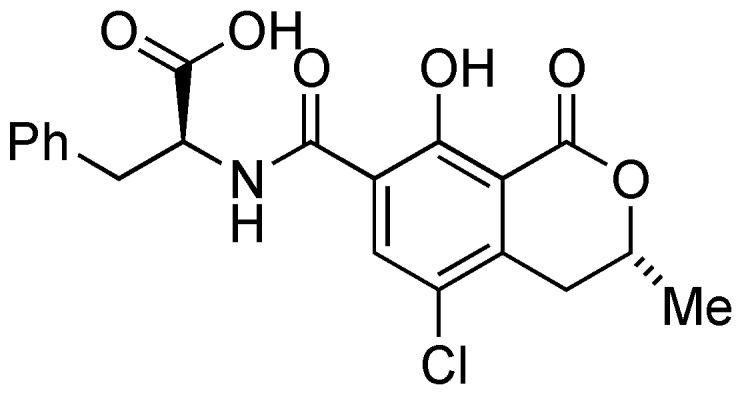
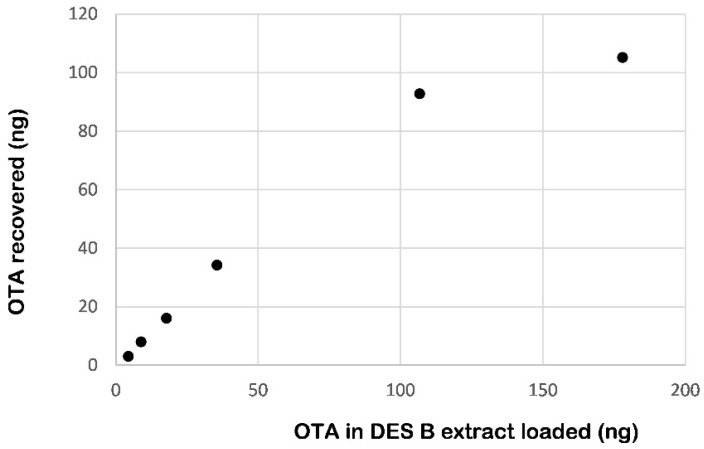
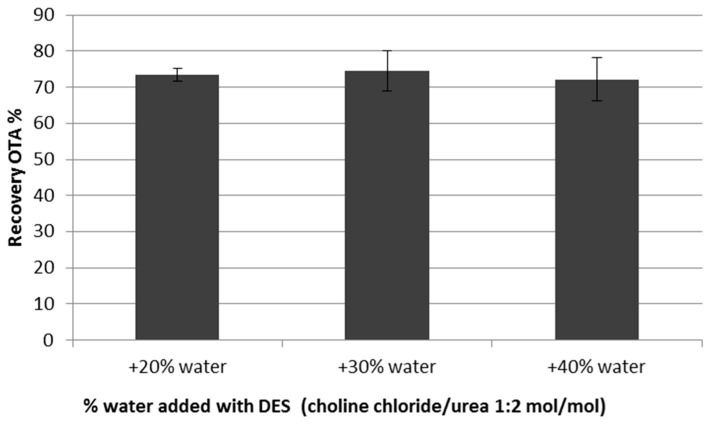
An unprecedented, environmentally friendly, and faster method for the determination of Ochratoxin A (OTA) (a mycotoxin produced by several species of Aspergillus and Penicillium and largely widespread in nature, in wheat and derived products) has, for the first time, been set up and validated using choline chloride (ChCl)-based deep eutectic solvents (DESs) (e.g., ChCl/glycerol (1:2) and ChCl/ urea (1:2) up to 40% (w/w) water) as privileged, green, and biodegradable extraction solvents. This also reduces worker exposure to toxic chemicals. Results are comparable to those obtained using conventional, hazardous and volatile organic solvents (VOCs) typical of the standard and official methods. OTA recovery from spiked durum wheat samples, in particular, was to up to 89% versus 93% using the traditional acetonitrile-water mixture with a repeatability of the results (RSDr) of 7%. Compatibility of the DES mixture with the antibodies of the immunoaffinity column was excellent as it was able to retain up to 96% of the OTA. Recovery and repeatability for durum wheat, bread crumbs, and biscuits proved to be within the specifications required by the current European Commission (EC) regulation. Good results in terms of accuracy and precision were achieved with mean recoveries between 70% (durum wheat) and 88% (bread crumbs) and an RSDr between 2% (biscuits) and 7% (bread).
Overview
The claims and statistics of this paper haven’t been checked yet.
Free: it reads the open-access text and checks the first 5 claims that cite a source we can check. Create a free account to check every claim.
Integrity signals
Registry
Cites
Statistics
Figures
Verification
Claims the paper makes
The claims and statistics of this paper haven’t been checked yet.
Free: it reads the open-access text and checks the first 5 claims that cite a source we can check. Create a free account to check every claim.
Claims other papers make about this one
Each is checked against this paper’s own text: does it say what the citing paper says it does?
The cited source says what the claim attributes to it.
In the citing paper
“Furthermore, choline chloride based NADES were effective in the extraction and solubilization of ochratoxin A, giving a recovery of up to 89% for spiked samples of durum wheat, bread crumbs and biscuits.”
From The perspectives of natural deep eutectic solvents in agri-food sector (2020) · cites this paper as Piemontese et al. (2017)
The cited source says what the claim attributes to it.
In the citing paper
“To reduce DES viscosity, especially for solid-phase samples analysis, water is added into the mixture [67 -69] or heating is also used.”
From Application of deep eutectic solvents in analytical chemistry. A review (2017) · cites this paper as [69]
Self-check
Percentages, sums and reported differences re-computed from the paper’s own numbers.
The self-check needs the paper’s full text.
Citations
Cites
Deep Eutectic Solvents (DESs) and Their Applications
Smith, E. L., Abbott, A. P., & Ryder, K. S. (2014) · Chemical Reviews · doi:10.1021/cr300162p · Cited by 7,378
Abbott, A. P., Capper, G., Davies, D. L., Rasheed, R. K., & Tambyrajah, V. (2003) · Chemical Communications · doi:10.1039/b210714g · Cited by 5,738
Deep eutectic solvents: syntheses, properties and applications
Zhang, Q., De Oliveira Vigier, K., Royer, S., & Jérôme, F. (2012) · Chemical Society Reviews · doi:10.1039/c2cs35178a · Cited by 4,899
Abbott, A. P., Boothby, D., Capper, G., Davies, D. L., & Rasheed, R. K. (2004) · Journal of the American Chemical Society · doi:10.1021/ja048266j · Cited by 4,340
Natural deep eutectic solvents as new potential media for green technology
Dai, Y., van Spronsen, J., Witkamp, G.-J., Verpoorte, R., & Choi, Y. H. (2013) · Analytica Chimica Acta · doi:10.1016/j.aca.2012.12.019 · Cited by 2,694
Natural Deep Eutectic Solvents – Solvents for the 21st Century
Paiva, A., Craveiro, R., Aroso, I., Martins, M., Reis, R. L., & Duarte, A. R. C. (2014) · ACS Sustainable Chemistry & Engineering · doi:10.1021/sc500096j · Cited by 2,458 · cited 1×
“), DESs are usually called NADES (natural deep eutectic solvents) [19].”
Low-transition-temperature mixtures (LTTMs): A new generation of designer solvents
Francisco, M., van den Bruinhorst, A., & Kroon, M. C. (2013) · Angewandte Chemie International Edition · doi:10.1002/anie.201207548 · Cited by 1,378
Choi, Y. H., van Spronsen, J., Dai, Y., Verberne, M., Hollmann, F., Arends, I. W. C. E., Witkamp, G.-J., & Verpoorte, R. (2011) · Plant Physiology · doi:10.1104/pp.111.178426 · Cited by 1,368
Eutectic‐Based Ionic Liquids with Metal‐Containing Anions and Cations
Abbott, A. P., Barron, J. C., Ryder, K. S., & Wilson, D. (2007) · Chemistry – A European Journal · doi:10.1002/chem.200601738 · Cited by 778
Deep-eutectic solvents playing multiple roles in the synthesis of polymers and related materials
Carriazo, D., Serrano, M. C., Gutiérrez, M. C., Ferrer, M. L., & del Monte, F. (2012) · Chemical Society Reviews · doi:10.1039/c2cs15353j · Cited by 717
Cited by
Application of deep eutectic solvents in analytical chemistry. A review
Shishov, A., Bulatov, A., Locatelli, M., Carradori, S., & Andruch, V. (2017) · Microchemical Journal · doi:10.1016/j.microc.2017.07.015 · Cited by 617
Application of deep eutectic solvents in biomass pretreatment and conversion
Chen, Y., & Mu, T. (2019) · Green Energy & Environment · doi:10.1016/j.gee.2019.01.012 · Cited by 458
The perspectives of natural deep eutectic solvents in agri-food sector
Mišan, A., Nađpal, J., Stupar, A., Pojić, M., Mandić, A., Verpoorte, R., & Choi, Y. H. (2020) · Critical Reviews in Food Science and Nutrition · doi:10.1080/10408398.2019.1650717 · Cited by 316
“Piemontese et al. (2017) used choline chloride:glycerol and choline chloride:urea solvents for the extraction of ochratoxin A which commonly contaminates food commodities including grains, nuts, spices, coffee beans, olives and grapes.”
MethodDeep eutectic solvents: Preparation, properties, and food applications
Negi, T., Kumar, A., Sharma, S. K., Rawat, N., Saini, D., Sirohi, R., Prakash, O., Dubey, A., Dutta, A., & Shahi, N. C. (2024) · Heliyon · doi:10.1016/j.heliyon.2024.e28784 · Cited by 179
“Keeping this point in mind, Piemontese, Perna, Logrieco, Capriati and Solfrizzo [95] conducted study for determining OTA in wheat by using ChCl-based DESs of two different types (ChCl: Gly and ChCl: Urea) in the same ratio of 1:2.”
BackgroundThe Future of Polar Organometallic Chemistry Written in Bio‐Based Solvents and Water
García‐Álvarez, J., Hevia, E., & Capriati, V. (2018) · Chemistry - A European Journal · doi:10.1002/chem.201802873 · Cited by 133
Self-citationA grand avenue to integrate deep eutectic solvents into biomass processing
Elgharbawy, A. A. M., Hayyan, M., Hayyan, A., Basirun, W. J., Salleh, H. M., & Mirghani, M. E. S. (2020) · Biomass and Bioenergy · doi:10.1016/j.biombioe.2020.105550 · Cited by 120
Wu, K., Ren, J., Wang, Q., Nuerjiang, M., Xia, X., & Bian, C. (2022) · Foods · doi:10.3390/foods11213528 · Cited by 116
A comprehensive review on the physicochemical properties of deep eutectic solvents
Yeow, A. T. H., Hayyan, A., Hayyan, M., Junaidi, M. U. M., Saleh, J., Basirun, W. J., Nor, M. R. M., Abdulmonem, W. A., Salleh, M. Z. M., Zuki, F. M., et al. (2024) · Results in Chemistry · doi:10.1016/j.rechem.2024.101378 · Cited by 129
Jafari, K., Fatemi, M. H., & Estellé, P. (2020) · Journal of Molecular Liquids · doi:10.1016/j.molliq.2020.114752 · Cited by 90
Liu, X., Ahlgren, S., Korthout, H. A. A. J., Salomé-Abarca, L. F., Bayona, L. M., Verpoorte, R., & Choi, Y. H. (2018) · Journal of Chromatography A · doi:10.1016/j.chroma.2017.12.009 · Cited by 78
Natural deep eutectic solvents and aqueous solutions as an alternative extraction media for propolis
Funari, C. S., Sutton, A. T., Carneiro, R. L., Fraige, K., Cavalheiro, A. J., Bolzani, V. D. S., Hilder, E. F., & Arrua, R. D. (2019) · Food Research International · doi:10.1016/j.foodres.2019.108559 · Cited by 75
Hamany Djande, C. Y., Piater, L. A., Steenkamp, P. A., Madala, N. E., & Dubery, I. A. (2018) · South African Journal of Botany · doi:10.1016/j.sajb.2018.01.009 · Cited by 66
Deep Eutectic Solvents in Solar Energy Technologies
Boldrini, C. L., Quivelli, A. F., Manfredi, N., Capriati, V., & Abbotto, A. (2022) · Molecules · doi:10.3390/molecules27030709 · Cited by 64
Self-citationBoldrini, C. L., Manfredi, N., Perna, F. M., Capriati, V., & Abbotto, A. (2018) · Chemistry – A European Journal · doi:10.1002/chem.201803668 · Cited by 58
Self-citationGioia, M. L. D., Nardi, M., Costanzo, P., Nino, A. D., Maiuolo, L., Oliverio, M., & Procopio, A. (2018) · Molecules · doi:10.3390/molecules23081891 · Cited by 57
Deep Eutectic Solvents Application in Food Analysis
Ortega-Zamora, C., González‐Sálamo, J., & Hernández‐Borges, J. (2021) · Molecules · doi:10.3390/molecules26226846 · Cited by 57
Menthol and Fatty Acid-Based Hydrophobic Deep Eutectic Solvents as Media for Enzyme Activation
Elgharbawy, A. A. M., Putra, S. S. S., Khan, H. W., Azmi, N. A. N., Sani, M. S. A., llah, N. A., Hayyan, A., Jewaratnam, J., & Basirun, W. J. (2023) · Processes · doi:10.3390/pr11020547 · Cited by 57
Are Deep Eutectic Solvents Useful in Chromatography? A Short Review
Płotka-Wasylka, J., Rutkowska, M., & de la Guardia, M. (2021) · Journal of Chromatography A · doi:10.1016/j.chroma.2021.461918 · Cited by 51
Natural Compounds for the Prevention and Treatment of Cardiovascular and Neurodegenerative Diseases
Leuci, R., Brunetti, L., Poliseno, V., Laghezza, A., Loiodice, F., Tortorella, P., & Piemontese, L. (2020) · Foods · doi:10.3390/foods10010029 · Cited by 54
Self-citationBrunetti, L., Leuci, R., Colonna, M. A., Carrieri, R., Celentano, F. E., Bozzo, G., Loiodice, F., Selvaggi, M., Tufarelli, V., & Piemontese, L. (2022) · Molecules · doi:10.3390/molecules27154735 · Cited by 52
Self-citationΚaur, K., Schmitt‐Kopplin, P., & Malik, A. K. (2024) · Food Chemistry · doi:10.1016/j.foodchem.2024.139500 · Cited by 60
Плетнев, И. В., Smirnova, S. V., Sharov, A. V., & Zolotov, Y. A. (2020) · Russian Chemical Reviews · doi:10.1070/rcr5007 · Cited by 42
Alavi, L., Seidi, S., Jabbari, A., & Baheri, T. (2017) · New Journal of Chemistry · doi:10.1039/c7nj00922d · Cited by 37
Pradanas-González, F., Álvarez-Rivera, G., Benito-Peña, E., Navarro-Villoslada, F., Cifuentes, A., Herrero, M., & Moreno-Bondi, M. C. (2021) · Journal of Chromatography A · doi:10.1016/j.chroma.2021.462180 · Cited by 37
Extracting mycotoxins from edible vegetable oils by using green, ecofriendly deep eutectic solvents
Pradanas-González, F., Aragoneses-Cazorla, R., Merino-Sierra, M. Á., Andrade-Bartolomé, E., Navarro-Villoslada, F., Benito‐Peña, E., & Moreno‐Bondi, M. C. (2023) · Food Chemistry · doi:10.1016/j.foodchem.2023.136846 · Cited by 36
Paradiso, V. M., Squeo, G., Pasqualone, A., Caponio, F., & Summo, C. (2019) · Food Chemistry · doi:10.1016/j.foodchem.2019.03.139 · Cited by 32
New approaches for prevention and treatment of Alzheimer's disease: a fascinating challenge
Piemontese, L. (2017) · Neural Regeneration Research · doi:10.4103/1673-5374.202942 · Cited by 30
Self-citationPiemontese, L., Sergio, R., Rinaldo, F., Brunetti, L., Perna, F. M., Santos, M. A., & Capriati, V. (2020) · Molecules · doi:10.3390/molecules25030574 · Cited by 28
Self-citationSaini, R., Kumar, S., Sharma, A. K., Kumar, V., Sharma, R., Janghu, S., & Suthar, P. (2021) · Journal of Food Processing and Preservation · doi:10.1111/jfpp.16250 · Cited by 27
Zhao, L., Liu, J., Bai, B., An, Y., Yang, Y., Wang, X., & Jing, X. (2024) · Food Control · doi:10.1016/j.foodcont.2024.110384 · Cited by 26
Wang, Q., Wei, N., Wang, Y., Hou, Y., Ren, X., & Wei, Q. (2020) · Journal of Applied Phycology · doi:10.1007/s10811-020-02239-5 · Cited by 27
Luque‐Uría, Á., González, F. P., Navarro-Villoslada, F., & Benito‐Peña, E. (2025) · Journal of Analysis and Testing · doi:10.1007/s41664-025-00383-w · Cited by 30
“Piemontese et al . developed a method to determine ochratoxin A (OTA) in wheat and derived products using a ChCl:urea NADES, with up to 40% water, as extraction solvent [159].”
Green pre-concentration techniques during pesticide analysis in food samples
Musarurwa, H., Chimuka, L., & Tavengwa, N. T. (2019) · Journal of Environmental Science and Health Part B · doi:10.1080/03601234.2019.1633213 · Cited by 24
One‐step deep eutectic solvent strategy for efficient analysis of aflatoxins in edible oils
He, T., Zhou, T., Wan, H., Han, Q., Ma, Y., Tan, T., & Wan, Y. (2020) · Journal of the Science of Food and Agriculture · doi:10.1002/jsfa.10544 · Cited by 14
Hartl, D. M., Frank, O., Dawid, C., & Hofmann, T. F. (2023) · Foods · doi:10.3390/foods12091877 · Cited by 14
“Other applications of NADES reported in the literature to ensuring food safety and quality include the extraction and determination of ochratoxin A from wheat samples, breadcrumbs, and biscuits [17,18], as well as the extraction and determination of different pesticides from fruit juices and vegetables [17,19].”
BackgroundKaribayev, M., Tugelbay, S., Amankeldiyeva, A., Akilbekov, B., Ibrayem, T., Zhengis, A., Shah, D., Nurgalieva, D., & Baisalova, G. (2026) · Talanta · doi:10.1016/j.talanta.2026.129800 · Cited by 9
Deep Eutectic Solvents in Extraction and Sorption Technology
Marcus, Y. (2018) · Springer eBooks · doi:10.1007/978-3-030-00608-2_5 · Cited by 11
Ochratoxin a levels in food and beverage samples from Turkey
Gazioğlu, I., & Kolak, U. (2018) · Acta Alimentaria · doi:10.1556/066.2018.47.2.7 · Cited by 8
Schincaglia, A., Pasti, L., Cavazzini, A., Purcaro, G., & Beccaria, M. (2024) · Journal of Agricultural and Food Chemistry · doi:10.1021/acs.jafc.4c05094 · Cited by 7
Pal, M., Behera, K., Yadav, A., & Pandey, S. (2018) · ChemistrySelect · doi:10.1002/slct.201802169 · Cited by 7
Roselli, V., Leuci, R., Pugliese, G., Barbarossa, A., Laghezza, A., Paparella, M., Carocci, A., Tufarelli, V., Gambacorta, L., & Piemontese, L. (2025) · Molecules · doi:10.3390/molecules30081855 · Cited by 5
Self-citationDeep Eutectic Solvents: An Overview of its Application as a “Green” Extractant
(2017) · International journal of advanced research in chemical sciences · doi:10.20431/2349-0403.0406003 · Cited by 8
“, [46] have compared the extraction efficiency of volatile organic solvents and deep eutectic solvents to extract ochratoxin A in wheat and derived products.”
BackgroundGreen solvents for the extraction of mycotoxins during the analysis of food products: A Mini-review
Abdelfattah, M. S. (2023) · Advances in Basic and Applied Sciences · doi:10.21608/abas.2023.210759.1021 · Cited by 3
“, wheat, bread crumbs, biscuits, and bran) using two eutectic mixtures of choline chloride/glycerol (1:2) and choline chloride/urea (1:2) combined with water [48].”
MethodExploration of the Physicochemical Properties of Deep Eutectic Solvents
Sharma, P., Vora, Y., & Sawant, A. (2026) · Environmental footprints and eco-design of products and processes · doi:10.1007/978-3-032-03801-2_2 · Cited by 1
Roselli, V., Leuci, R., Paparella, M., Pugliese, G., Luz, C., Cimbalo, A., Manyes, L., Tarricone, L., Tufarelli, V., Gambacorta, L., et al. (2026) · Molecules · doi:10.3390/molecules31101665 · Cited by 1
“For all NADEs, 40% of water content, calculated on the total weight of the solvent prepared, was used to minimize viscosity without significantly affecting the extraction of polar molecules [34].”
Self-citationChaganti, S. V., Kuo, Y.-S., Tsao, H., & Liu, Y.-H. (2026) · Journal of Energy Storage · doi:10.1016/j.est.2026.123168 · Cited by 1
Azadi, M., Habibi, N., Babakhanian, A., & Gharehyakheh, S. (2026) · Journal of Food Composition and Analysis · doi:10.1016/j.jfca.2026.109193
Aziz, Z. H. A., Uddin, A. B. M. H., Ahmed, Q. U., Begum, T., & Sabere, A. S. M. (2026) · Journal of Solution Chemistry · doi:10.1007/s10953-026-01619-8 · Cited by 1
“7 Synthesis of ribavirin with acetone–[BMIM]BF ₄ (90:10) mixture [122] that lead to eutectic behaviors [124, 125].”
Liang, Y., Liu, Y., Wang, W., Ma, W., & Zhang, H. (2026) · Journal of Food Process Engineering · doi:10.1111/jfpe.70673
Metadata
- Authors
- Piemontese, L., Perna, F., Logrieco, A., Capriati, V., & Solfrizzo, M.
- Affiliations
- Institute of Sciences of Food Production (IT)
- University of Bari Aldo Moro (IT)
- Corresponding author
- Capriati, Vito
- Solfrizzo, Michele
- Venue
- Molecules
- Publisher
- MDPI AG
- Published
- 2017-01-12
- Volume
- 22
- Issue
- 1
- Pages
- 121
- ISSN
- 1420-3049 (ISSN-L)
- PMC
- PMC6155845
- OpenAlex
- W2574226062
- Semantic Scholar
- 9e13913dc2eaf9a8d9c2557c85364f021c48eccb
- Cited by
- 49
- References
- 48
- Citations by year
- 2026: 7 · 2025: 2 · 2024: 5 · 2023: 4 · 2022: 3 · 2021: 4 · 2020: 7 · 2019: 5 · 2018: 7 · 2017: 5
- FWCI
- 6.46
- Type
- journal article
- Language
- en
- Open access
- gold
- doi.org
- Licence
- Locations
- Molecules (publishedVersion, cc-by)
- Europe PMC (PubMed Central) (publishedVersion, other-oa)
- PubMed Central (publishedVersion, cc-by)
- PubMed (publishedVersion)
- DOAJ (DOAJ: Directory of Open Access Journals) (submittedVersion, cc-by-sa)
- CINECA IRIS Institutional Research Information System (University of Bari Aldo Moro) (submittedVersion, other-oa)
- Zenodo (CERN European Organization for Nuclear Research) (submittedVersion, cc-by)
- Funders
- Mycokey – Horizon 2020 (678781)
- Future in Research (I2PCTF6)
- Topics
- Life Sciences › Agricultural and Biological Sciences › Plant Science › Mycotoxins in Agriculture and Food
- Physical Sciences › Chemistry › Analytical Chemistry › Analytical chemistry methods development
- Physical Sciences › Chemistry › Physical and Theoretical Chemistry › Ionic liquids properties and applications
- Keywords
- ochratoxin A, deep eutectic solvents, choline chloride, mycotoxin extraction, durum wheat, bread crumb, cookies, green solvents, immunoaffinity column, food safety, analytical method validation
- MeSH terms
- Aspergillus, Food Analysis, Humans, Ochratoxins, Penicillium, Solvents, Water, Triticum
About these checks
Registry, retraction, Cites and statistics results are computed, not judged, with one exception: a printed reference that no index lists is read once by a model before it counts as a citation error. Claims are extracted by a model and kept only when their quote appears verbatim in the text; each cited source is then checked, with a model’s help, for whether it says what the claim relies on. Those verdicts can be wrong — read the claim’s quote and the cited source before relying on one.
Statistics and arithmetic are recomputed, not judged.
Confidence bands are shown only for fields calibrated on our annotated test set. None is calibrated yet, so no band is shown.
What counts as a claim ›How we measure confidence ›How we check this ›
Are you an author, or do you see a problem with this page? Request a review
Data sources
Bibliographic data: Semantic Scholar, OpenAlex, Crossref.
Contains information from the Semantic Scholar Academic Graph Datasets, made available under the ODC Attribution License (ODC-BY 1.0).
Semantic Scholar’s data is described in: Kinney, R., et al. (2023). The Semantic Scholar Open Data Platform. arXiv:2301.10140.
