

The DOI matches its Crossref record; 294 of the 300 references it cites were found in a registry or an index, and 5 are not checked yet; none of the 125 sources its claims cite is checked for support yet.
Nutrition for Older Athletes: Focus on Sex-Differences
Open accessAbstract
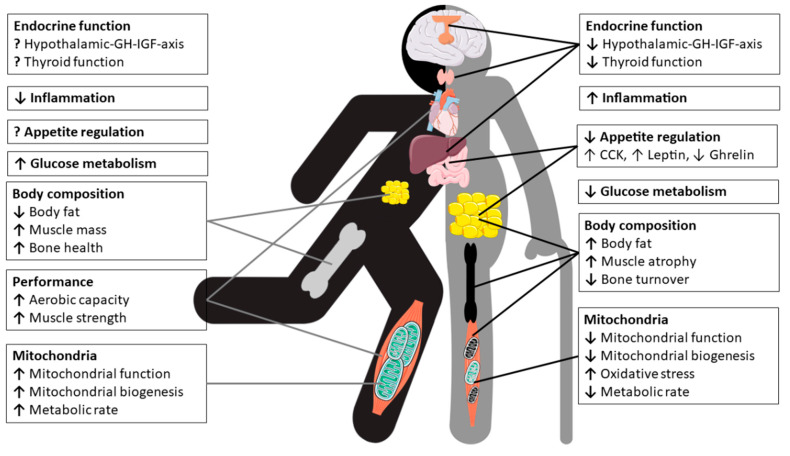
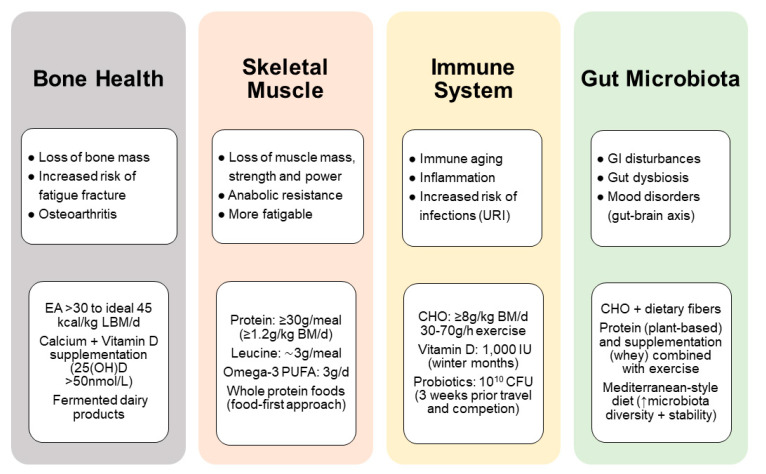
Regular physical exercise and a healthy diet are major determinants of a healthy lifespan. Although aging is associated with declining endurance performance and muscle function, these components can favorably be modified by regular physical activity and especially by exercise training at all ages in both sexes. In addition, age-related changes in body composition and metabolism, which affect even highly trained masters athletes, can in part be compensated for by higher exercise metabolic efficiency in active individuals. Accordingly, masters athletes are often considered as a role model for healthy aging and their physical capacities are an impressive example of what is possible in aging individuals. In the present review, we first discuss physiological changes, performance and trainability of older athletes with a focus on sex differences. Second, we describe the most important hormonal alterations occurring during aging pertaining regulation of appetite, glucose homeostasis and energy expenditure and the modulatory role of exercise training. The third part highlights nutritional aspects that may support health and physical performance for older athletes. Key nutrition-related concerns include the need for adequate energy and protein intake for preventing low bone and muscle mass and a higher demand for specific nutrients (e.g., vitamin D and probiotics) that may reduce the infection burden in masters athletes. Fourth, we present important research findings on the association between exercise, nutrition and the microbiota, which represents a rapidly developing field in sports nutrition.
Checked 2026-11-14 · 5 references not checked yet
Overview
CoChat Summary
TL;DR
This narrative review summarizes physiological, endocrine, bone, performance, and nutritional changes in older masters athletes, with emphasis on sex differences. It concludes that chronic exercise and adequate nutrition can favorably modify many age-related declines, but evidence specific to masters athletes remains limited and recommendations are often extrapolated from younger athletes and older non-athletes.
Key findings
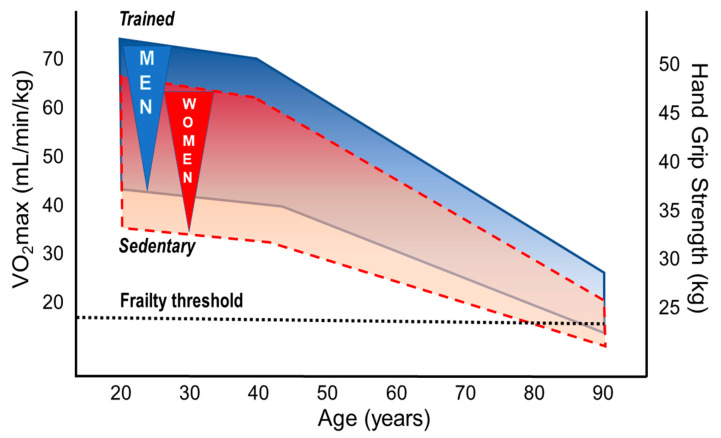
- Aging reduces VO2max by approximately 10% per decade after the third decade, but training modulates this; examples include 81-year-old male endurance athletes with VO2max 38 (±1) vs. 21 (±1) mL/min/kg in age-matched untrained persons, an 83-year-old female masters runner with VO2max 42.3 mL/min/kg, and a 101-year-old athlete improving VO2max from 31 to 35 mL/min/kg over 2 years.
- Masters athletes often show better body composition than non-athletes: among 156 masters athletes aged 40–79, none were categorized as sarcopenic, and individuals aged 40–81 training 4–5 times/week showed no decline in lean muscle mass or strength. Still, decline occurs: 71 track-and-field masters had calf muscle cross-section decrease of 0.6%/year in men but no significant change in women; 256 track-and-field masters had whole-body skeletal muscle mass reduction of 3.2% per decade in women and 2.8% in men, offset by fat gain. In bone, male power athletes preserved or increased tibia bone mass/strength, while male endurance athletes and female track-and-field masters lost tibia epiphyseal bone mass at approximately 5% per decade.
- Nutrition risks and targets: low energy availability is <30 kcal/kg lean body mass/day; masters triathletes’ post-exercise energy and protein intakes were −40% (22.7 kJ/kg) and −25% (19.6 g) below younger-athlete recommendations, and female masters consumed 0.7 g/kg carbohydrate post-exercise vs. 1.0–1.2 g/kg recommended. Protein recommendations include ≥30 g/meal or ≥1.2 g/kg/day for older adults, 35–40 g/meal and ~1.5–1.6 g/kg/day for masters athletes, and 1.6–2.5 g/kg/day during injury. Vitamin D insufficiency is <50 nmol/L, deficiency <30 nmol/L, and optimal 75 nmol/L, with daily 1000 IU vitamin D3 suggested in winter. Probiotic supplementation with 1 × 10^10 CFUs for 12 weeks limited exercise-induced drops in tryptophan and reduced upper respiratory tract infection incidence.
- Sex differences: relative VO2max differs by about 10% between male and female athletes; performance sex differences were 12% for running, swimming, and cycling and 17% for cross-country skiing. Ages at which performance declined to 50% of the 30–35-year maximum were walking 90/84, swimming 87/84, jumping 78/72, and weightlifting 74/60 years (male/female); 200-m sprint cycling performance halved at 80 years in men vs. 59 years in women. Strength differences between sexes are largely explained by muscle size, with similar relative strength and hypertrophy changes after resistance training.
Methods
- Narrative review; the authors state they collate relevant information to provide recommendations where evidence is available and to flag open questions, rather than conducting a systematic review or meta-analysis.
- Synthesizes cited literature across oxygen delivery/utilization, body composition and metabolism, endocrine aging, bone metabolism, performance/trainability, and nutrition/immune/microbiota in masters athletes and older adults, including human cross-sectional, longitudinal, and intervention studies plus rodent mitochondria studies.
- No primary data collection, and no systematic search strategy, inclusion criteria, or formal quality appraisal is described.
Limitations
- The authors state that limited evidence exists on nutritional requirements for masters athletes and that many open questions remain; future longitudinal studies are needed on diet and specific nutrients across the athletic lifespan.
- The authors note that some findings cannot be directly extrapolated to masters athletes, e.g., probiotic/immune results from young athletes due to age-related immune changes; GH/IGF-1 findings may be biased by short study duration, training motivation, inability to achieve sufficient absolute exercise intensity in the elderly, and sex-bias toward male participants; one bone study could not discern aging from menopause; and robust data on nutritional interventions in injured athletes are lacking.
- Evident from the text: as a narrative review, it lacks a systematic search, formal quality assessment, and meta-analytic synthesis, and recommendations often extrapolate from younger athletes and older non-athletic populations.
Model-written summary. Check it against the paper before relying on it.
Integrity signals
Registry
Cites
Statistics
Figures
Verification
Claims the paper makes
0 Valid · 1 Not valid · 92 Not checked · 43 Own results and interpretations
A check of a cited source is scheduled, or we don’t hold its full text yet; the claim is checked once it runs.
In the paper
“Data from our own study indicate that some of these effects appeared to be connected with alterations in tryptophan metabolism [287].”
§ Nutrition for Older Athletes: Focus on Sex-Differences > 4. Nutritional Considerations for Masters Athletes > 4.3. Immune Function and Risk of Infection
What the sources say
- Not checked yetcites [287] Strasser, B., Geiger, D., Schauer, M., Gostner, J.M., Gatterer, H., Burtscher, M., and Fuchs, D. (2016). Probiotic Supplements Beneficially Affect Tryptophan-Kynurenine Metabolism and Reduce the Incidence of Upper Respiratory Tract Infections in Trained Athletes: A Randomized, Double-Blinded, Placebo-Controlled Trial. Nutrients, 8. source
A check is scheduled.
hedgedstates an association- Asserted: passes — The authors put it forward as true.
- Checkable: passes — It can be checked against evidence.
- Load-bearing: unclear — It is unclear whether the paper’s conclusions depend on it.
- Based: passes — The paper gives a reason why it holds.
- Not checked yet
In the paper
“In athletes, the onset of declining power-lifting performance is more pronounced and progresses more rapidly than endurance performance, i.e., men’s and women’s power-lifting performance starts decreasing by 3% per year in the 4th decade and by 1% per year thereafter [152].”
§ Nutrition for Older Athletes: Focus on Sex-Differences > 3. Performance and Trainability of Older Athletes > 3.2. Sex Differences in Performance, Decline Rates, and Training Effects
What the sources say
- Not checked yetcites [152] Galloway, 2002, Effect of aging on male and female master athletes’ performance in strength versus endurance activities, Am. J. Orthop
plainstates a cause- Asserted: passes — The authors put it forward as true.
- Checkable: passes — It can be checked against evidence.
- Load-bearing: unclear — It is unclear whether the paper’s conclusions depend on it.
- Based: passes — The paper gives a reason why it holds.
In the paper
“Bone benefits acquired through exercise at young age can still persist several decades after cessation of exercise training [117].”
§ Nutrition for Older Athletes: Focus on Sex-Differences > 2. Physiological Changes in Older Athletes > 2.4. Bone and Bone Metabolism
What the sources say
- Not checked yetcites [117] Warden, 2014, Physical activity when young provides lifelong benefits to cortical bone size and strength in men, Proc. Natl. Acad. Sci. USA source
plainstates a cause- Asserted: passes — The authors put it forward as true.
- Checkable: passes — It can be checked against evidence.
- Load-bearing: passes — The paper’s conclusions depend on it.
- Based: passes — The paper gives a reason why it holds.
None of the sources cited for this claim have been checked yet.
In the paper
“However, the importance of mitochondrial integrity and efficiency for human health is well established and mitochondrial quality and biogenesis can be enhanced, e.g., by PA, in both men and women [180,181,182].”
§ Nutrition for Older Athletes: Focus on Sex-Differences > 3. Performance and Trainability of Older Athletes > 3.2. Sex Differences in Performance, Decline Rates, and Training Effects
What the sources say
- Not checked yetcites [180] Howald, 1985, Influences of endurance training on the ultrastructural composition of the different muscle fiber types in humans, Pflügers Arch. source
- Not checked yetcites [181] Howald, 2002, Content of intramyocellular lipids derived by electron microscopy, biochemical assays, and 1H-MR spectroscopy, J. Appl. Physiol. source
- Not checked yetcites [182] Tarnopolsky, 2007, Influence of endurance exercise training and sex on intramyocellular lipid and mitochondrial ultrastructure, substrate use, and mitochondrial enzyme activity, Am. J. Physiol. Regul. Integr. Comp. Physiol. source
boostedstates a cause- Asserted: passes — The authors put it forward as true.
- Checkable: passes — It can be checked against evidence.
- Load-bearing: unclear — It is unclear whether the paper’s conclusions depend on it.
- Based: passes — The paper gives a reason why it holds.
A check of a cited source is scheduled, or we don’t hold its full text yet; the claim is checked once it runs.
In the paper
“Low energy availability (<30 kcal/kg of lean body mass/day) is associated with a number of disorders seen in both female and male athletes, including reduced metabolic rate, hormonal changes (e.g., satiety hormones, reproductive hormones, GH and IGF-1), poor bone health and impairments of muscle protein synthesis, immune health and performance [185,186].”
§ Nutrition for Older Athletes: Focus on Sex-Differences > 4. Nutritional Considerations for Masters Athletes > 4.1. Dietary Protein and Energy Requirements
What the sources say
- Not checked yetcites [185] Melin, 2019, Energy Availability in Athletics: Health, Performance, and Physique, Int J. Sport Nutr. Exerc. Metab. source
A check is scheduled.
- Not checked yetcites [186] Mountjoy, 2018, IOC consensus statement on relative energy deficiency in sport (RED-S): 2018 update, Br. J. Sports Med. source
A check is scheduled.
plainstates an association- Asserted: passes — The authors put it forward as true.
- Checkable: passes — It can be checked against evidence.
- Load-bearing: unclear — It is unclear whether the paper’s conclusions depend on it.
- Based: passes — The paper gives a reason why it holds.
- Not checked yet
56 more claims
Create a free account to see all 136 claims and to verify the 125 references still open.
- Probably not a substantial claim. 20
- It may state two separate claims as one. 63
- The quote only partly states this claim. 1
Claims other papers make about this one
Each is checked against this paper’s own text: does it say what the citing paper says it does?
In the citing paper
“All groups had intakes of vitamins D and E, calcium, and potassium below the recommended levels.”
From Dietary Intake of Athletes at the World Masters Athletics Championships as Assessed by Single 24 h Recall (2024) · cites this paper as [2]
In the citing paper
“Protein intake was below the recommended levels for masters athletes, except for female athletes involved in power events (i.e., sprinters and jumpers).”
From Dietary Intake of Athletes at the World Masters Athletics Championships as Assessed by Single 24 h Recall (2024) · cites this paper as [2]
In the citing paper
“Fat and saturated fat intake were at acceptable levels, but omega-3 fatty acid intake was below the level recommended for masters athletes [2,3].”
From Dietary Intake of Athletes at the World Masters Athletics Championships as Assessed by Single 24 h Recall (2024) · cites this paper as [2]
In the citing paper
“All groups had intakes of vitamins D and E, calcium, and potassium below the recommended levels.”
From Dietary Intake of Athletes at the World Masters Athletics Championships as Assessed by Single 24 h Recall (2024) · cites this paper as [2]
In the citing paper
“Consuming adequate total kcal and water are important for middle‐aged endurance athletes not only for optimal athletic performance, but also for muscle maintenance and recovery, bone health, hormonal regulation, immune function, hydration, and overall healthy aging [14].”
From Dietary Intake of Canadian Middle‐Aged Endurance Athletes (2025) · cites this paper as [14]
5 more claims about this paper
Create a free account to see every claim other papers make about this one.
Self-check
Percentages, sums and reported differences re-computed from the paper’s own numbers.
Each contradiction between two passages listed here was confirmed by an independent check.
Rated minor: it would not touch a result — a value no result rests on, a p-value that stays on the same side of the significance level, or a conflict that is clerical, resolved elsewhere in the paper, or outside its own findings.
In the paper
§ Nutrition for Older Athletes: Focus on Sex-Differences > 2. Physiological Changes in Older Athletes > 2.3. Effects of Aging on the Endocrine System and Metabolic Pathways
“aging is associated with subclinical hypothyroidism, i.e., increased levels of thyroid-stimulating hormone (TSH) with free thyroxine (FT4) levels remaining in the normal range [51,52].”
§ Nutrition for Older Athletes: Focus on Sex-Differences > 2. Physiological Changes in Older Athletes > 2.3. Effects of Aging on the Endocrine System and Metabolic Pathways
“Some authors even ascribe a beneficial adaptation of physiological aging to these reduced TSH levels in the elderly by preventing excessive catabolism [53].”
Citations
Cites
Sarcopenia: European consensus on definition and diagnosis
Cruz-Jentoft, A. J., Baeyens, J. P., Bauer, J. M., Boirie, Y., Cederholm, T., Landi, F., Martin, F. C., Michel, J.-P., Rolland, Y., Schneider, S. M., et al. (2010) · Age and Ageing · doi:10.1093/ageing/afq034 · Cited by 11,601
Afshin, A., Sur, P. J., Fay, K. A., Cornaby, L., Ferrara, G., Salama, J. S., Mullany, E. C., Abate, K. H., Abbafati, C., Abebe, Z., et al. (2019) · The Lancet · doi:10.1016/s0140-6736(19)30041-8 · Cited by 5,811
Chronic inflammation in the etiology of disease across the life span
Furman, D., Campisi, J., Verdin, E., Carrera-Bastos, P., Targ, S., Franceschi, C., Ferrucci, L., Gilroy, D. W., Fasano, A., Miller, G. W., et al. (2019) · Nature Medicine · doi:10.1038/s41591-019-0675-0 · Cited by 4,915
Age-predicted maximal heart rate revisited
Tanaka, H., Monahan, K. D., & Seals, D. R. (2001) · Journal of the American College of Cardiology · doi:10.1016/s0735-1097(00)01054-8 · Cited by 3,775 · cited 1×
“7 × age) in healthy sedentary and trained subjects, probably due to the decrease in intrinsic heart rate [20].”
BackgroundExercise as medicine - evidence for prescribing exercise as therapy in 26 different chronic diseases
Pedersen, B. K., & Saltin, B. (2015) · Scandinavian Journal of Medicine & Science in Sports · doi:10.1111/sms.12581 · Cited by 3,514
Goodpaster, B. H., Park, S. W., Harris, T. B., Kritchevsky, S. B., Nevitt, M., Schwartz, A. V., Simonsick, E. M., Tylavsky, F. A., Visser, M., Newman, A. B., et al. (2006) · The Journals of Gerontology Series A: Biological Sciences and Medical Sciences · doi:10.1093/gerona/61.10.1059 · Cited by 3,083
Kodama, S. (2009) · JAMA · doi:10.1001/jama.2009.681 · Cited by 3,035
Gut microbiota functions: metabolism of nutrients and other food components
Rowland, I., Gibson, G., Heinken, A., Scott, K., Swann, J., Thiele, I., & Tuohy, K. (2018) · European Journal of Nutrition · doi:10.1007/s00394-017-1445-8 · Cited by 2,878 · cited 1×
“The intestinal microbiota plays an important role in many metabolic processes that are beneficial to the host such as synthesis of vitamins and production of short chain fatty acids (SCFA), but also in the development of the mucosal immune system [269].”
BackgroundEndocrine regulation of energy metabolism by the skeleton
Lee, N. K., Sowa, H., Hinoi, E., Ferron, M., Ahn, J. D., Confavreux, C., Dacquin, R., Mee, P. J., McKee, M. D., Jung, D. Y., et al. (2007) · Cell · doi:10.1016/j.cell.2007.05.047 · Cited by 2,554
Bauer, J., Biolo, G., Cederholm, T., Cesari, M., Cruz-Jentoft, A. J., Morley, J. E., Phillips, S., Sieber, C., Stehle, P., Teta, D., et al. (2013) · Journal of the American Medical Directors Association · doi:10.1016/j.jamda.2013.05.021 · Cited by 2,553 · cited 1×
“5 mg/kg body mass/day) than current recommendations [198], and also considered on a meal-by-meal (every 3–4 h) basis [199,200].”
Background
Research works printed but not linked: 1
- Bilezikian, J.P., Raisz, L.G., and Rodan, G.A. (2002). Chapter 19-Histomorphometric Analysis of Bone Remodeling. Principles of Bone Biology, Academic Press. [2nd ed.].
Cited by
Benefits of a plant-based diet and considerations for the athlete
Shaw, K. A., Zello, G. A., Rodgers, C. D., Warkentin, T. D., Baerwald, A., & Chilibeck, P. D. (2022) · European Journal of Applied Physiology · doi:10.1007/s00421-022-04902-w · Cited by 85
Graybeal, A. J., Kreutzer, A., Willis, J. L., Moss, K., Braun-Trocchio, R., & Shah, M. (2023) · Journal of Dietary Supplements · doi:10.1080/19390211.2022.2056670 · Cited by 19
Gorini, S., Camajani, E., Cava, E., Feraco, A., Armani, A., Amoah, I., Filardi, T., Wu, X., Strollo, R., Caprio, M., et al. (2025) · Journal of Translational Medicine · doi:10.1186/s12967-025-06311-x · Cited by 22
Biomarkers in immunology: Their impact on immune function and response
Kaushik, D., Xu, B., & Kumar, M. (2025) · Advances in Biomarker Sciences and Technology · doi:10.1016/j.abst.2025.03.001 · Cited by 14
Health challenges and acute sports injuries restrict weightlifting training of older athletes
Huebner, M., & Ma, W. (2022) · BMJ Open Sport & Exercise Medicine · doi:10.1136/bmjsem-2022-001372 · Cited by 13
Metadata
- Authors
- Strasser, B., Pesta, D., Rittweger, J., Burtscher, J., & Burtscher, M.
- Affiliations
- Sigmund Freud Privatuniversität Wien (AT)
- Universität Innsbruck (AT)
- Deutsches Zentrum für Luft- und Raumfahrt e. V. (DLR) (DE)
- University of Lausanne (CH)
- Corresponding author
- Strasser, Barbara
- Venue
- Nutrients
- Publisher
- MDPI AG
- Published
- 2021-04-22
- Volume
- 13
- Issue
- 5
- Pages
- 1409
- ISSN
- 2072-6643 (ISSN-L)
- PMC
- PMC8143537
- OpenAlex
- W3153566118
- Semantic Scholar
- f85c70c9a7bdce812c0da035ac443d5d8c777b7e
- Cited by
- 25
- References
- 300
- Citations by year
- 2026: 3 · 2025: 8 · 2024: 4 · 2023: 3 · 2022: 5 · 2021: 2
- FWCI
- 0.44
- Type
- journal article
- Language
- en
- Open access
- gold
- doi.org
- Licence
- Locations
- Nutrients (publishedVersion, cc-by)
- PubMed (publishedVersion)
- Kölner Universitäts PublikationsServer (Universität zu Köln) (publishedVersion)
- PubMed Central (publishedVersion, cc-by)
- SERVAL (Université de Lausanne) (acceptedVersion, cc-by)
- elib (German Aerospace Center) (acceptedVersion)
- IRIS (submittedVersion, cc-by)
- Funders
- Joint Programming Initiative A healthy diet for a healthy life
- Österreichische Forschungsförderungsgesellschaft
- Bundesministerium für Bildung, Wissenschaft und Forschung
- Topics
- Health Sciences › Nursing › Nutrition and Dietetics › Muscle metabolism and nutrition
- Health Sciences › Medicine › Physiology (medical) › Nutrition and Health in Aging
- Health Sciences › Medicine › Physiology (medical) › Exercise and Physiological Responses
- Keywords
- older athletes, masters athletes, sex differences, aging, exercise training, physical performance, body composition, metabolism, hormonal changes, appetite regulation, glucose homeostasis, energy expenditure, protein intake, energy intake, bone mass, muscle mass, vitamin D, probiotics, infection, gut microbiota, healthy aging
- MeSH terms
- Aging, Female, Humans, Male, Nutritional Physiological Phenomena, Publications, Sex Characteristics, Athletic Performance, Athletes
About these checks
Registry, retraction, Cites and statistics results are computed, not judged, with one exception: a printed reference that no index lists is read once by a model before it counts as a citation error. Claims are extracted by a model and kept only when their quote appears verbatim in the text; each cited source is then checked, with a model’s help, for whether it says what the claim relies on. Those verdicts can be wrong — read the claim’s quote and the cited source before relying on one.
A language model drew the claims from the paper on 2026-11-14, under version 3 of the claim definition (model deepseek-v4.1-flash, prompt extract-v3).
A second model labelled each claim on 2026-11-14 (model jev-1.13-20260917, definition revision gold-guideline-v0.2).
Statistics and arithmetic are recomputed, not judged.
Confidence bands are shown only for fields calibrated on our annotated test set. None is calibrated yet, so no band is shown.
What counts as a claim ›How we measure confidence ›How we check this ›
Are you an author, or do you see a problem with this page? Request a review
Data sources
Bibliographic data: Semantic Scholar, OpenAlex, Crossref.
Contains information from the Semantic Scholar Academic Graph Datasets, made available under the ODC Attribution License (ODC-BY 1.0).
Semantic Scholar’s data is described in: Kinney, R., et al. (2023). The Semantic Scholar Open Data Platform. arXiv:2301.10140.
