

The DOI matches its Crossref record; 108 of the 111 references it cites were found in a registry or an index.
Recent Advances in Neural Recording Microsystems
Open accessAbstract
The accelerating pace of research in neuroscience has created a considerable demand for neural interfacing microsystems capable of monitoring the activity of large groups of neurons. These emerging tools have revealed a tremendous potential for the advancement of knowledge in brain research and for the development of useful clinical applications. They can extract the relevant control signals directly from the brain enabling individuals with severe disabilities to communicate their intentions to other devices, like computers or various prostheses. Such microsystems are self-contained devices composed of a neural probe attached with an integrated circuit for extracting neural signals from multiple channels, and transferring the data outside the body. The greatest challenge facing development of such emerging devices into viable clinical systems involves addressing their small form factor and low-power consumption constraints, while providing superior resolution. In this paper, we survey the recent progress in the design and the implementation of multi-channel neural recording Microsystems, with particular emphasis on the design of recording and telemetry electronics. An overview of the numerous neural signal modalities is given and the existing microsystem topologies are covered. We present energy-efficient sensory circuits to retrieve weak signals from neural probes and we compare them. We cover data management and smart power scheduling approaches, and we review advances in low-power telemetry. Finally, we conclude by summarizing the remaining challenges and by highlighting the emerging trends in the field.
Overview
The claims and statistics of this paper haven’t been checked yet.
Run the check — free, no account needed. It reads the open-access text and checks the sources it cites.
Integrity signals
Registry
Cites
Statistics
Figures
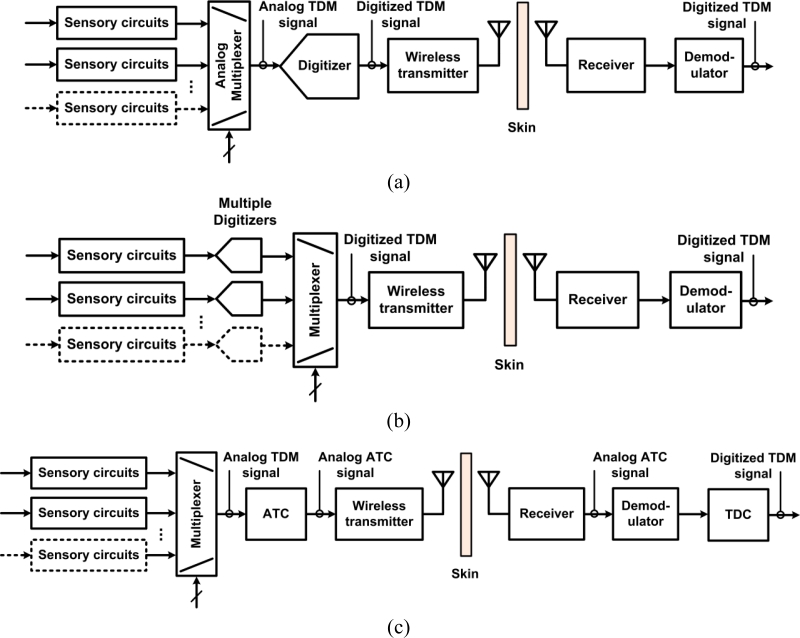
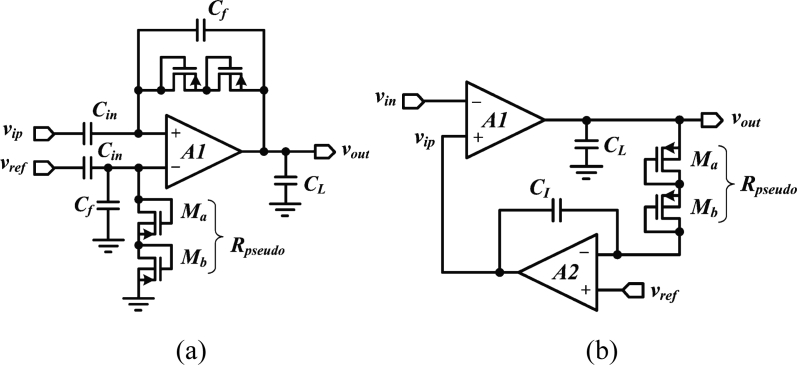
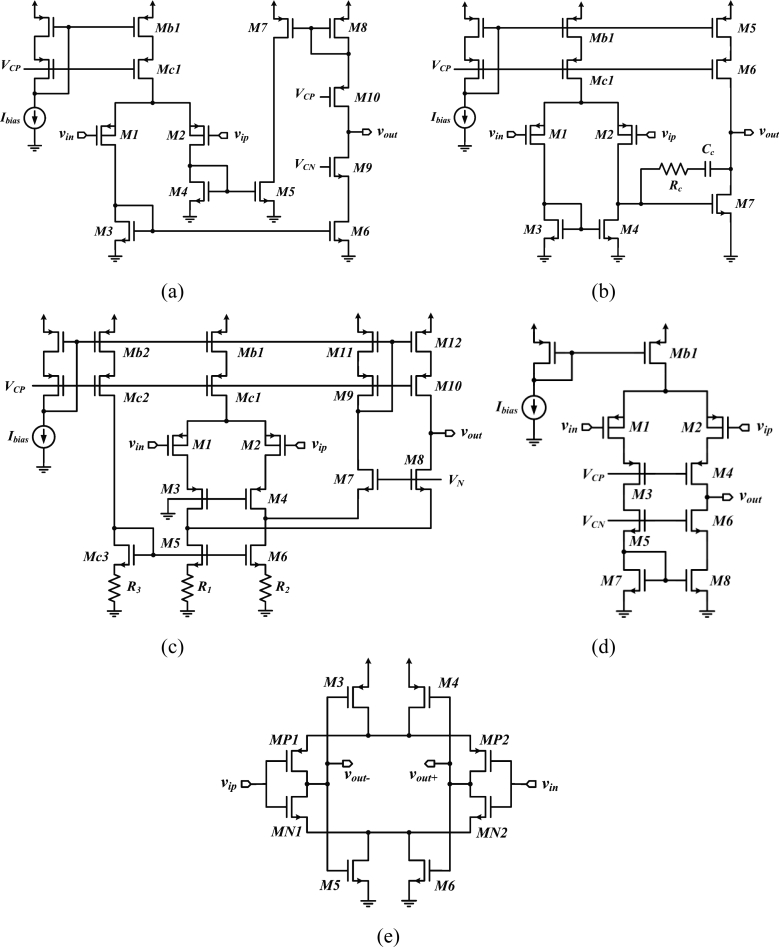
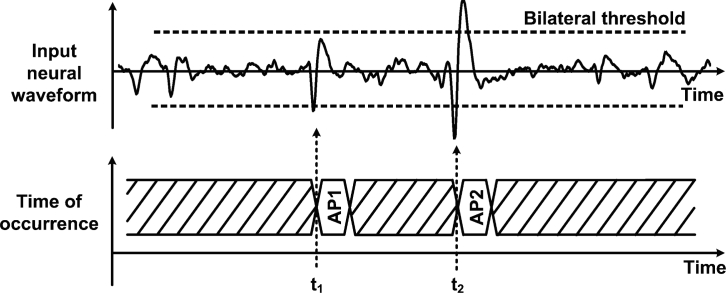
Verification
Claims the paper makes
The claims and statistics of this paper haven’t been checked yet.
Run the check — free, no account needed. It reads the open-access text and checks the sources it cites.
Claims other papers make about this one
Each is checked against this paper’s own text: does it say what the citing paper says it does?
The cited source says what the claim attributes to it.
In the citing paper
“In the dc-coupled topology shown in Fig. 6(b), the input offsets are removed via an active low-pass filter in the feedback path, forming a Miller integrator and avoiding the need for large input capacitors, which saves considerable area [159], [172].”
From Active Neural Interface Circuits and Systems for Selective Control of Peripheral Nerves: A Review (2024) · cites this paper as [159]
Self-check
Percentages, sums and reported differences re-computed from the paper’s own numbers.
The self-check needs the paper’s full text.
Citations
Cites
Hodgkin, A. L., & Huxley, A. F. (1952) · The Journal of Physiology · doi:10.1113/jphysiol.1952.sp004764 · Cited by 23,191
Receptive fields of single neurones in the cat's striate cortex
Hubel, D. H., & Wiesel, T. N. (1959) · The Journal of Physiology · doi:10.1113/jphysiol.1959.sp006308 · Cited by 4,653
Neuronal ensemble control of prosthetic devices by a human with tetraplegia
Hochberg, L. R., Serruya, M. D., Friehs, G. M., Mukand, J. A., Saleh, M., Caplan, A. H., Branner, A., Chen, D., Penn, R. D., & Donoghue, J. P. (2006) · Nature · doi:10.1038/nature04970 · Cited by 3,295
Neuronal Population Coding of Movement Direction
Georgopoulos, A. P., Schwartz, A. B., & Kettner, R. E. (1986) · Science · doi:10.1126/science.3749885 · Cited by 3,219
MODALITY AND TOPOGRAPHIC PROPERTIES OF SINGLE NEURONS OF CAT'S SOMATIC SENSORY CORTEX
Mountcastle, V. B. (1957) · Journal of Neurophysiology · doi:10.1152/jn.1957.20.4.408 · Cited by 2,411
A low-power low-noise cmos for amplifier neural recording applications
Harrison, R. R., & Charles, C. (2003) · IEEE Journal of Solid-State Circuits · doi:10.1109/jssc.2003.811979 · Cited by 1,695
Direct Cortical Control of 3D Neuroprosthetic Devices
Taylor, D. M., Tillery, S. I. H., & Schwartz, A. B. (2002) · Science · doi:10.1126/science.1070291 · Cited by 1,542
Real-time prediction of hand trajectory by ensembles of cortical neurons in primates
Wessberg, J., Stambaugh, C. R., Kralik, J. D., Beck, P. D., Laubach, M., Chapin, J. K., Kim, J., Biggs, S. J., Srinivasan, M. A., & Nicolelis, M. A. L. (2000) · Nature · doi:10.1038/35042582 · Cited by 1,491
A review of methods for spike sorting: the detection and classification of neural action potentials
Lewicki, M. S. (1998) · Network Computation in Neural Systems · doi:10.1088/0954-898x_9_4_001 · Cited by 1,372
RamRakhyani, A. K., Mirabbasi, S., & Chiao, M. (2010) · IEEE Transactions on Biomedical Circuits and Systems · doi:10.1109/tbcas.2010.2072782 · Cited by 950
Research works printed but not linked: 1
- Kandel, ER, Schwartz, JH, and Jessell, TM (2000). Principles of Neural Science, McGraw-Hill Medical.
Cited by
Sorted by citations
Revealing neuronal function through microelectrode array recordings
Obien, M. E. J., Deligkaris, K., Bullmann, T., Bakkum, D. J., & Frey, U. (2015) · Frontiers in Neuroscience · doi:10.3389/fnins.2014.00423 · Cited by 705
Implantable devices: issues and challenges
Bazaka, K., & Jacob, M. (2012) · Electronics · doi:10.3390/electronics2010001 · Cited by 358
Marx, U. (2016) · ALTEX · doi:10.14573/altex.1603161 · Cited by 295
Blind source identification from the multichannel surface electromyogram
Holobar, A., & Farina, D. (2014) · Physiological Measurement · doi:10.1088/0967-3334/35/7/r143 · Cited by 238
Dragas, J., Viswam, V., Shadmani, A., Chen, Y., Bounik, R., Stettler, A., Radivojević, M., Geissler, S. A., Obien, M. E. J., Müller, J., et al. (2017) · IEEE Journal of Solid-State Circuits · doi:10.1109/jssc.2017.2686580 · Cited by 207
Metadata
- Authors
- Gosselin, B.
- Affiliations
- Université Laval (CA)
- Corresponding author
- Gosselin, Benoit
- ORCID
- Gosselin, Benoit
- Venue
- Sensors
- Publisher
- MDPI AG
- Published
- 2011-04-27
- Volume
- 11
- Issue
- 5
- Pages
- 4572-4597
- ISSN
- 1424-8220 (ISSN-L)
- PMC
- PMC3231370
- OpenAlex
- W2153710474
- Cited by
- 138
- References
- 111
- Citations by year
- 2026: 4 · 2025: 2 · 2024: 7 · 2023: 7 · 2022: 10 · 2021: 9 · 2020: 8 · 2019: 5 · 2018: 9 · 2017: 12 · 2016: 12 · 2015: 21 · 2014: 19 · 2013: 5 · 2012: 7
- FWCI
- 0.82
- Type
- journal article
- Language
- en
- Open access
- gold
- doi.org
- Licence
- Locations
- Sensors (publishedVersion, cc-by)
- Europe PMC (PubMed Central) (publishedVersion, cc-by)
- PubMed Central (publishedVersion, cc-by)
- PubMed (publishedVersion)
- DOAJ (DOAJ: Directory of Open Access Journals) (submittedVersion, cc-by-sa)
- Funders
- CMC Microsystems
- Natural Sciences and Engineering Research Council of Canada
- Topics
- Physical Sciences › Engineering › Electrical and Electronic Engineering › Analog and Mixed-Signal Circuit Design
- Life Sciences › Neuroscience › Cellular and Molecular Neuroscience › Neuroscience and Neural Engineering
- Physical Sciences › Engineering › Biomedical Engineering › Wireless Body Area Networks
- Keywords
- neural interfaces, multichannel neural recording, neural probes, low-power circuits, data management, brain-computer interface, neural prostheses
- MeSH terms
- Equipment Design, Humans, Neurons, Telemetry, Biosensing Techniques
About these checks
Registry, retraction, Cites and statistics results are computed, not judged, with one exception: a printed reference that no index lists is read once by a model before it counts as a citation error. Claims are extracted by a model and kept only when their quote appears verbatim in the text; each cited source is then checked, with a model’s help, for whether it says what the claim relies on. Those verdicts can be wrong — read the claim’s quote and the cited source before relying on one.
Statistics and arithmetic are recomputed, not judged.
Confidence bands are shown only for fields calibrated on our annotated test set. None is calibrated yet, so no band is shown.
What counts as a claim ›How we measure confidence ›How we check this ›
Are you an author, or do you see a problem with this page? Request a review
