

The DOI matches its Crossref record; 108 of the 111 references it cites were found in a registry or an index.
Recent Advances in Neural Recording Microsystems
Open accessAbstract
The accelerating pace of research in neuroscience has created a considerable demand for neural interfacing microsystems capable of monitoring the activity of large groups of neurons. These emerging tools have revealed a tremendous potential for the advancement of knowledge in brain research and for the development of useful clinical applications. They can extract the relevant control signals directly from the brain enabling individuals with severe disabilities to communicate their intentions to other devices, like computers or various prostheses. Such microsystems are self-contained devices composed of a neural probe attached with an integrated circuit for extracting neural signals from multiple channels, and transferring the data outside the body. The greatest challenge facing development of such emerging devices into viable clinical systems involves addressing their small form factor and low-power consumption constraints, while providing superior resolution. In this paper, we survey the recent progress in the design and the implementation of multi-channel neural recording Microsystems, with particular emphasis on the design of recording and telemetry electronics. An overview of the numerous neural signal modalities is given and the existing microsystem topologies are covered. We present energy-efficient sensory circuits to retrieve weak signals from neural probes and we compare them. We cover data management and smart power scheduling approaches, and we review advances in low-power telemetry. Finally, we conclude by summarizing the remaining challenges and by highlighting the emerging trends in the field.
Overview
The claims and statistics of this paper haven’t been checked yet.
Run the check — free, no account needed. It reads the open-access text and checks the sources it cites.
Integrity signals
Registry
Cites
Statistics
Figures
Verification
Claims the paper makes
The claims and statistics of this paper haven’t been checked yet.
Run the check — free, no account needed. It reads the open-access text and checks the sources it cites.
Claims other papers make about this one
Each is checked against this paper’s own text: does it say what the citing paper says it does?
The cited source says what the claim attributes to it.
In the citing paper
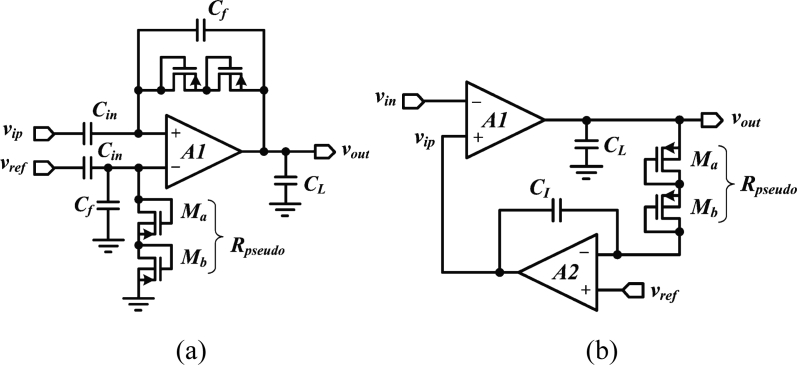
“In the dc-coupled topology shown in Fig. 6(b), the input offsets are removed via an active low-pass filter in the feedback path, forming a Miller integrator and avoiding the need for large input capacitors, which saves considerable area [159], [172].”
From Active Neural Interface Circuits and Systems for Selective Control of Peripheral Nerves: A Review (2024) · cites this paper as [159]
Self-check
Percentages, sums and reported differences re-computed from the paper’s own numbers.
The self-check needs the paper’s full text.
Citations
Cites
Hodgkin, A. L., & Huxley, A. F. (1952) · The Journal of Physiology · doi:10.1113/jphysiol.1952.sp004764 · Cited by 23,191
Receptive fields of single neurones in the cat's striate cortex
Hubel, D. H., & Wiesel, T. N. (1959) · The Journal of Physiology · doi:10.1113/jphysiol.1959.sp006308 · Cited by 4,653
Neuronal ensemble control of prosthetic devices by a human with tetraplegia
Hochberg, L. R., Serruya, M. D., Friehs, G. M., Mukand, J. A., Saleh, M., Caplan, A. H., Branner, A., Chen, D., Penn, R. D., & Donoghue, J. P. (2006) · Nature · doi:10.1038/nature04970 · Cited by 3,295
Neuronal Population Coding of Movement Direction
Georgopoulos, A. P., Schwartz, A. B., & Kettner, R. E. (1986) · Science · doi:10.1126/science.3749885 · Cited by 3,219
MODALITY AND TOPOGRAPHIC PROPERTIES OF SINGLE NEURONS OF CAT'S SOMATIC SENSORY CORTEX
Mountcastle, V. B. (1957) · Journal of Neurophysiology · doi:10.1152/jn.1957.20.4.408 · Cited by 2,411
A low-power low-noise cmos for amplifier neural recording applications
Harrison, R. R., & Charles, C. (2003) · IEEE Journal of Solid-State Circuits · doi:10.1109/jssc.2003.811979 · Cited by 1,695
Direct Cortical Control of 3D Neuroprosthetic Devices
Taylor, D. M., Tillery, S. I. H., & Schwartz, A. B. (2002) · Science · doi:10.1126/science.1070291 · Cited by 1,542
Real-time prediction of hand trajectory by ensembles of cortical neurons in primates
Wessberg, J., Stambaugh, C. R., Kralik, J. D., Beck, P. D., Laubach, M., Chapin, J. K., Kim, J., Biggs, S. J., Srinivasan, M. A., & Nicolelis, M. A. L. (2000) · Nature · doi:10.1038/35042582 · Cited by 1,491
A review of methods for spike sorting: the detection and classification of neural action potentials
Lewicki, M. S. (1998) · Network Computation in Neural Systems · doi:10.1088/0954-898x_9_4_001 · Cited by 1,372
RamRakhyani, A. K., Mirabbasi, S., & Chiao, M. (2010) · IEEE Transactions on Biomedical Circuits and Systems · doi:10.1109/tbcas.2010.2072782 · Cited by 950
Research works printed but not linked: 1
- Kandel, ER, Schwartz, JH, and Jessell, TM (2000). Principles of Neural Science, McGraw-Hill Medical.
Cited by
Sorted by citations
Revealing neuronal function through microelectrode array recordings
Obien, M. E. J., Deligkaris, K., Bullmann, T., Bakkum, D. J., & Frey, U. (2015) · Frontiers in Neuroscience · doi:10.3389/fnins.2014.00423 · Cited by 705
Implantable devices: issues and challenges
Bazaka, K., & Jacob, M. (2012) · Electronics · doi:10.3390/electronics2010001 · Cited by 358
Marx, U. (2016) · ALTEX · doi:10.14573/altex.1603161 · Cited by 295
Blind source identification from the multichannel surface electromyogram
Holobar, A., & Farina, D. (2014) · Physiological Measurement · doi:10.1088/0967-3334/35/7/r143 · Cited by 238
Dragas, J., Viswam, V., Shadmani, A., Chen, Y., Bounik, R., Stettler, A., Radivojević, M., Geissler, S. A., Obien, M. E. J., Müller, J., et al. (2017) · IEEE Journal of Solid-State Circuits · doi:10.1109/jssc.2017.2686580 · Cited by 207
Zaeimbashi, M., Nasrollahpour, M., Khalifa, A., Romano, A., Liang, X., Chen, H., Sun, N., Matyushov, A. D., Lin, H., Dong, C., et al. (2021) · Nature Communications · doi:10.1038/s41467-021-23256-z · Cited by 205
Flexible, Polarization-Diverse UWB Antennas for Implantable Neural Recording Systems
Bahrami, H., Mirbozorgi, S. A., Ameli, R., Rusch, L. A., & Gosselin, B. J. (2015) · IEEE Transactions on Biomedical Circuits and Systems · doi:10.1109/tbcas.2015.2393878 · Cited by 138
Self-citationA Smart Multicoil Inductively Coupled Array for Wireless Power Transmission
Mirbozorgi, S. A., Bahrami, H., Sawan, M., & Gosselin, B. J. (2014) · IEEE Transactions on Industrial Electronics · doi:10.1109/tie.2014.2308138 · Cited by 127
Self-citationApplications of Microwaves in Medicine
Chiao, J. ‐., Li, C., Lin, J., Caverly, R. H., Hwang, J. C. M., Rosen, H. D., & Rosen, A. (2022) · IEEE Journal of Microwaves · doi:10.1109/jmw.2022.3223301 · Cited by 94
Biological Channel Modeling and Implantable UWB Antenna Design for Neural Recording Systems
Bahrami, H., Mirbozorgi, S. A., Rusch, L. A., & Gosselin, B. J. (2014) · IEEE Transactions on Biomedical Engineering · doi:10.1109/tbme.2014.2339836 · Cited by 84
Self-citationLópez, C. M., Prodanov, D., Braeken, D., Gligorijević, I., Eberle, W., Bartic, C., Puers, R., & Gielen, G. E. (2012) · IEEE Transactions on Biomedical Circuits and Systems · doi:10.1109/tbcas.2011.2181842 · Cited by 74
Multi-Channel Neural Recording Implants: A Review
Hashemi Noshahr, F., Nabavi, M., & Sawan, M. (2020) · Sensors · doi:10.3390/s20030904 · Cited by 66
Mirbozorgi, S. A., Bahrami, H., Sawan, M., & Gosselin, B. J. (2015) · IEEE Transactions on Biomedical Circuits and Systems · doi:10.1109/tbcas.2015.2414276 · Cited by 66
Self-citationRibet, F., Stemme, G., & Roxhed, N. (2016) · Biosensors and Bioelectronics · doi:10.1016/j.bios.2016.10.007 · Cited by 61
A response surface model predicting thein vivoinsertion behavior of micromachined neural implants
Andrei, A., Welkenhuysen, M., Nuttin, B., & Eberle, W. (2011) · Journal of Neural Engineering · doi:10.1088/1741-2560/9/1/016005 · Cited by 58
An Implantable Antenna With Broadside Radiation for a Brain–Machine Interface
Rana, B., Shim, J.-Y., & Chung, J. (2019) · IEEE Sensors Journal · doi:10.1109/jsen.2019.2924948 · Cited by 54
A Survey of Neural Front End Amplifiers and Their Requirements toward Practical Neural Interfaces
Bharucha, E. A., Sepehrian, H., & Gosselin, B. J. (2014) · Journal of Low Power Electronics and Applications · doi:10.3390/jlpea4040268 · Cited by 49
Self-citationHosseini, S. N., Das, P. S., Lazarjan, V. K., Gagnon-Turcotte, G., Bouzid, K., & Gosselin, B. J. (2023) · IEEE Transactions on Biomedical Circuits and Systems · doi:10.1109/tbcas.2023.3252402 · Cited by 44
Self-citationA Wireless Optogenetic Headstage with Multichannel Electrophysiological Recording Capability
Gagnon-Turcotte, G., Kisomi, A. A., Ameli, R., Camaro, C.-O. D., LeChasseur, Y., Néron, J.-L., Bareil, P., Fortier, P., Bories, C., Koninck, Y. D., et al. (2015) · Sensors · doi:10.3390/s150922776 · Cited by 43
Self-citationA 0.8-V, 1-MS/s, 10-bit SAR ADC for Multi-Channel Neural Recording
Tao, Y., & Lian, Y. (2014) · IEEE Transactions on Circuits and Systems I Regular Papers · doi:10.1109/tcsi.2014.2360762 · Cited by 41
A Wideband Dual-Antenna Receiver for Wireless Recording From Animals Behaving in Large Arenas
Lee, S. B., Yin, M., Manns, J. R., & Ghovanloo, M. (2013) · IEEE Transactions on Biomedical Engineering · doi:10.1109/tbme.2013.2247603 · Cited by 39
Bahrami, H., Gosselin, B. J., & Rusch, L. A. (2012) · Annual International Conference of the IEEE Engineering in Medicine and Biology Society (EMBC) · doi:10.1109/embc.2012.6347365 · Cited by 36
Self-citationCulaclii, S., Kim, B., Lo, Y.-K., Li, L., & Liu, W. (2018) · IEEE Transactions on Biomedical Circuits and Systems · doi:10.1109/tbcas.2018.2816464 · Cited by 34
Hardware-Software Co-Design for Brain-Computer Interfaces
Karageorgos, I., Sriram, K., Veselý, J., Wu, M., Powell, M. P., Borton, D. A., Manohar, R., & Bhattacharjee, A. (2020) · Proceedings - International Symposium on Computer Architecture/Proceedings · doi:10.1109/isca45697.2020.00041 · Cited by 38
Ultra-low power signal conditioning system for effective biopotential signal recording
Thakur, D., Sharma, K., Kapila, S., & Sharma, R. (2021) · Journal of Micromechanics and Microengineering · doi:10.1088/1361-6439/ac3465 · Cited by 34
Design of high gain, high bandwidth neural amplifier IC considering noise-power trade-off
Laskar, N. M., Guha, K., Nath, S., Chanda, S., Baishnab, K. L., Paul, P. K., & Rao, K. S. (2018) · Microsystem Technologies · doi:10.1007/s00542-018-4142-5 · Cited by 33
Topography and Coating of Platinum Improve the Electrochemical Properties and Neuronal Guidance
Schlie-Wolter, S., Deiwick, A., Fadeeva, E., Paasche, G., Lenarz, T., & Chichkov, B. N. (2013) · ACS Applied Materials & Interfaces · doi:10.1021/am3028487 · Cited by 32
Challenges in Scaling Down of Free-Floating Implantable Neural Interfaces to Millimeter Scale
Yang, K.-W. K., Oh, K., & Ha, S. (2020) · IEEE Access · doi:10.1109/access.2020.3007517 · Cited by 32
Design considerations for effective neural signal sensing and amplification: a review
Sharma, K., & Sharma, R. (2019) · Biomedical Physics & Engineering Express · doi:10.1088/2057-1976/ab1674 · Cited by 33
Application of PEDOT‐CNT Microelectrodes for Neurotransmitter Sensing
Samba, R., Fuchsberger, K., Matiychyn, I., Epple, S., Kiesel, L., Stett, A., Schuhmann, W. W., & Stelzle, M. (2014) · Electroanalysis · doi:10.1002/elan.201300547 · Cited by 29
Sub 100 nW Volatile Nano-Metal-Oxide Memristor as Synaptic-Like Encoder of Neuronal Spikes
Gupta, I., Serb, A., Khiat, A., Zeitler, R., Vassanelli, S., & Prodromakis, T. (2018) · IEEE Transactions on Biomedical Circuits and Systems · doi:10.1109/tbcas.2018.2797939 · Cited by 26
Wireless Gigabit Data Telemetry for Large-Scale Neural Recording
Kuan, Y., Lo, Y., Kim, Y. R., Chang, M.-C. F., & Liu, W. (2015) · IEEE Journal of Biomedical and Health Informatics · doi:10.1109/jbhi.2015.2416202 · Cited by 26
Recent Advancements in Graphene-Based Implantable Electrodes for Neural Recording/Stimulation
Alahi, M. E. E., Rizu, M. I., Tina, F. W., Huang, Z., Nag, A., & Afsarimanesh, N. (2023) · Sensors · doi:10.3390/s23249911 · Cited by 26
Low-Power Low-Noise Pseudo-Open-Loop Preamplifier for Neural Interfaces
Chang, S.-I., Park, S., & Yoon, E. (2017) · IEEE Sensors Journal · doi:10.1109/jsen.2017.2717787 · Cited by 25
Towards miniaturized closed-loop optogenetic stimulation devices
Edward, E. S., Kouzani, A. Z., & Tye, S. J. (2018) · Journal of Neural Engineering · doi:10.1088/1741-2552/aa7d62 · Cited by 25
An Unsupervised Compressed Sensing Algorithm for Multi-Channel Neural Recording and Spike Sorting
Xiong, T., Zhang, J. J., Martínez‐Rubio, C., Thakur, C. S., Eskandar, E. N., Chin, P. S., Etienne‐Cummings, R., & Tran, T. D. (2018) · IEEE Transactions on Neural Systems and Rehabilitation Engineering · doi:10.1109/tnsre.2018.2830354 · Cited by 24
A Low Noise Amplifier for Neural Spike Recording Interfaces
Ruiz-Amaya, J., Rodriguez-Perez, A., & Delgado-Restituto, M. (2015) · Sensors · doi:10.3390/s151025313 · Cited by 23
Design of a miniaturized UWB antenna optimized for implantable neural recording systems
Bahrami, H., Gosselin, B. J., & Rusch, L. A. (2012) · IEEE Interregional NEWCAS Conference (NEWCAS) · doi:10.1109/newcas.2012.6329018 · Cited by 22
Self-citationSharma, P., Sharma, K., Jatana, H. S., Madan, J., Pandey, R., & Sharma, R. (2020) · Analog Integrated Circuits and Signal Processing · doi:10.1007/s10470-020-01623-y · Cited by 22
Area-Efficient Low-Power Bandpass Gm-C Filter for Epileptic Seizure Detection in 130nm CMOS
Sala, R. D., Monsurrò, P., Scotti, G., & Trifiletti, A. (2019) · IEEE International Conference on Electronics, Circuits and Systems (ICECS) · doi:10.1109/icecs46596.2019.8964753 · Cited by 19
Park, S., Cho, J., Lee, K., & Yoon, E. (2016) · IEEE Transactions on Biomedical Circuits and Systems · doi:10.1109/tbcas.2015.2501304 · Cited by 18
High-density neural recording system design
Lee, H.-S., Eom, K., Park, M., Ku, S.-B., Lee, K., & Lee, H.-M. (2022) · Biomedical Engineering Letters · doi:10.1007/s13534-022-00233-z · Cited by 17
Tasneem, N. T., & Mahbub, I. (2021) · Electronics · doi:10.3390/electronics10050590 · Cited by 17
Lee, H.-S., Eom, K., Park, M., Ku, S.-B., Lee, K., Kim, T., Kim, T.-K., Shon, Y., Park, H., & Lee, H. (2023) · IEEE Transactions on Circuits and Systems I Regular Papers · doi:10.1109/tcsi.2023.3268686 · Cited by 17
Culaclii, S., Kim, B., Lo, Y., & Liu, W. (2016) · Annual International Conference of the IEEE Engineering in Medicine and Biology Society (EMBC) · doi:10.1109/embc.2016.7592142 · Cited by 16
Yan, P., Akhoundi, A., Shah, N. P., Tandon, P., Muratore, D. G., Chichilnisky, E. J., & Murmann, B. (2023) · IEEE Transactions on Biomedical Circuits and Systems · doi:10.1109/tbcas.2023.3292058 · Cited by 15
Low power switched-resistor band-pass filter for neural recording channels in 130nm CMOS
Centurelli, F., Fava, A., Monsurrò, P., Scotti, G., Tommasino, P., & Trifiletti, A. (2020) · Heliyon · doi:10.1016/j.heliyon.2020.e04723 · Cited by 15
A Time-Domain Analog Spatial Compressed Sensing Encoder for Multi-Channel Neural Recording
Okazawa, T., & Akita, I. (2018) · Sensors · doi:10.3390/s18010184 · Cited by 14
Tateno, T., & Nishikawa, J. (2014) · Frontiers in Neuroengineering · doi:10.3389/fneng.2014.00039 · Cited by 14
System-Level Design of a Full-Duplex Wireless Transceiver for Brain–Machine Interfaces
Bahrami, H., Mirbozorgi, S. A., Nguyen, A. T., Gosselin, B. J., & Rusch, L. A. (2016) · IEEE Transactions on Microwave Theory and Techniques · doi:10.1109/tmtt.2016.2600301 · Cited by 13
Self-citationA digital multichannel neural signal processing system using compressed sensing
Li, N., Osborn, M., Wang, G., & Sawan, M. (2016) · Digital Signal Processing · doi:10.1016/j.dsp.2016.04.013 · Cited by 12
Active Neural Interface Circuits and Systems for Selective Control of Peripheral Nerves: A Review
Habibollahi, M., Jiang, D., Lancashire, H. T., & Demosthenous, A. (2024) · IEEE Transactions on Biomedical Circuits and Systems · doi:10.1109/tbcas.2024.3430038 · Cited by 11
“…of neural recording analog front-ends implemented using ( a ) an ac-coupled capacitive feedback network [155], ( b ) a dc-coupled amplifier with active low-frequency suppression [159], ( c ) a dc-coupled fully differential difference amplifier [170], and ( d ) a chopper-stabilised architecture [171].”
Integrated UWB Transmitter and Antenna Design for Interfacing High-Density Brain Microprobes
Bahrami, H., Mirbozorgi, S. A., Rusch, L. A., & Gosselin, B. J. (2015) · IEEE International Conference on Ubiquitous Wireless Broadband · doi:10.1109/icuwb.2015.7324465 · Cited by 11
Self-citationKumar, A., Tripathi, S. L., Verma, C., Raboacă, M. S., Enescu, F. M., & Mihălţan, T. C. (2022) · International Conference on Electronics, Computers and Artificial Intelligence (ECAI) · doi:10.1109/ecai54874.2022.9847492 · Cited by 10
Rodent Scope: A User-Configurable Digital Wireless Telemetry System for Freely Behaving Animals
Ball, D., Kliese, R., Windels, F., Nolan, C. R., Stratton, P. G., Sah, P., & Wiles, J. (2014) · PLoS ONE · doi:10.1371/journal.pone.0089949 · Cited by 10
A low-power current-reuse analog front-end for multi-channel neural signal recording
Sepehrian, H., Mirbozorgi, S. A., & Gosselin, B. J. (2014) · IEEE International New Circuits and Systems Conference (NEWCAS) · doi:10.1109/newcas.2014.6934077 · Cited by 9
Self-citationA low-power 2.4-GHz receiver for wireless implantable neural stimulators
Mirbozorgi, S. A., Bahrami, H., Rusch, L. A., & Gosselin, B. J. (2014) · IEEE International Symposium on Circuits and Systems proceedings · doi:10.1109/iscas.2014.6865327 · Cited by 9
Self-citationA transcutaneous power transfer interface based on a multicoil inductive link
Mirbozorgi, S. A., Gosselin, B. J., & Sawan, M. (2012) · Annual International Conference of the IEEE Engineering in Medicine and Biology Society (EMBC) · doi:10.1109/embc.2012.6346265 · Cited by 9
Self-citationElectromagnetic limits to radiofrequency (RF) neuronal telemetry
Díaz, R. E., & Sebastian, T. (2013) · Scientific Reports · doi:10.1038/srep03535 · Cited by 9
Park, W., Namgoong, G., Choi, E.-H., & Bien, F. D. (2023) · IEEE Transactions on Biomedical Circuits and Systems · doi:10.1109/tbcas.2023.3238740 · Cited by 8
BER performance of implant-to-air high-speed UWB data communications for neural recording systems
Bahrami, H., Mirbozorgi, S. A., Rusch, L. A., & Gosselin, B. J. (2014) · Annual International Conference of the IEEE Engineering in Medicine and Biology Society (EMBC) · doi:10.1109/embc.2014.6944491 · Cited by 8
Self-citationA High Performance Delta-Sigma Modulator for Neurosensing
Xu, J., Zhao, M., Wu, X., Islam, M., & Yang, Z. (2015) · Sensors · doi:10.3390/s150819466 · Cited by 8
Design and Implementation of Low Noise Amplifier in Neural Signal Analysis
Bansal, M., & Singh, D. (2019) · Communications in computer and information science · doi:10.1007/978-981-15-1384-8_2 · Cited by 7
An iEEG Recording and Adjustable Shunt-Current Conduction Platform for Epilepsy Treatment
You, C., Yao, L., Yao, P., Li, L., Ding, P., Liang, S., Liu, C., & Xue, N. (2022) · Biosensors · doi:10.3390/bios12040247 · Cited by 7
Rummens, F., Ygorra, S., Boussamba, H. C. M., Renaud, S., & Lewis, N. (2016) · International Journal of Circuit Theory and Applications · doi:10.1002/cta.2192 · Cited by 7
Introduction of Wireless Power Transfer
Lü, Y., & Ki, W. (2017) · Analog circuits and signal processing/Analog circuits and signal processing series · doi:10.1007/978-981-10-2615-7_1 · Cited by 7
A high temporal resolution multiscale recording system for in vivo neural studies
Angotzi, G. N., Malerba, M., Maccione, A., Boi, F., Crepaldi, M., Bonanno, A., & Berdondini, L. (2017) · IEEE International Symposium on Circuits and Systems proceedings · doi:10.1109/iscas.2017.8050617 · Cited by 7
Rotermund, D., Ernst, U. A., & Pawelzik, K. R. (2019) · HardwareX · doi:10.1016/j.ohx.2019.e00078 · Cited by 8
A wireless multichannel optogenetic headstage with on-the-fly spike detection
Turcotte, G. G., Camaro, C.-O. D., Kisomi, A. A., Ameli, R., & Gosselin, B. J. (2015) · IEEE International Symposium on Circuits and Systems proceedings · doi:10.1109/iscas.2015.7168994 · Cited by 7
Self-citationImplications for a Wireless, External Device System to Study Electrocorticography
Rotermund, D., Pistor, J., Hoeffmann, J., Schellenberg, T., Boll, D., Tolstosheeva, E., Gauck, D., Stemmann, H., Peters-Drolshagen, D., Kreiter, A. K., et al. (2017) · Sensors · doi:10.3390/s17040761 · Cited by 6
Developing Precision Invasive Neuromodulation for Psychiatry
Bormann, N. L., Trapp, N. T., Narayanan, N. S., & Boes, A. D. (2021) · Journal of Neuropsychiatry · doi:10.1176/appi.neuropsych.20100268 · Cited by 7
Lee, H.-S., Park, H., & Lee, H. (2020) · Annual International Conference of the IEEE Engineering in Medicine and Biology Society (EMBC) · doi:10.1109/embc44109.2020.9175670 · Cited by 6
A novel multichannel analog-to-time converter based on a multiplexed sigma delta converter
Rezaei, M., Maghsoudloo, E., Sawan, M., & Gosselin, B. J. (2015) · IEEE International New Circuits and Systems Conference (NEWCAS) · doi:10.1109/newcas.2015.7182053 · Cited by 5
Self-citationMoghaddam, K. R., & Mohammadi, A. R. (2017) · AEU - International Journal of Electronics and Communications · doi:10.1016/j.aeue.2017.04.011 · Cited by 5
Biological channel modeling and implantable UWB antenna design for neural recording systems
Bahrami, H., Rusch, L. A., & Gosselin, B. J. (2015) · Cambridge University Press eBooks · doi:10.1017/cbo9781139629539.037 · Cited by 5
Self-citationDesign of low noise amplifier for sensor applications
Jana, D., & Mal, A. K. (2017) · Devices for Integrated Circuit (DevIC) · doi:10.1109/devic.2017.8073990 · Cited by 5
Gallegos, S. A., & Huq, H. F. (2014) · IEEE International Midwest Symposium on Circuits and Systems (MWSCAS) · doi:10.1109/mwscas.2014.6908555 · Cited by 5
Introduction to biomaterials and implantable device design
Ivanova, E. P., Bazaka, K., & Crawford, R. J. (2014) · Elsevier eBooks · doi:10.1533/9781782422662.1 · Cited by 4
A low-power current-reuse dual-band analog front-end for multi-channel neural signal recording
Sepehrian, H., & Gosselin, B. J. (2014) · Annual International Conference of the IEEE Engineering in Medicine and Biology Society (EMBC) · doi:10.1109/embc.2014.6944818 · Cited by 4
Self-citationBiocompatibility of Microsystems
Singh, T., Rühe, J., & Biesalski, M. (2016) · Elsevier eBooks · doi:10.1016/b978-0-12-803581-8.00523-3 · Cited by 4
Open Loop Trans-conductance Amplifier design for Neural Signals
Gupta, L., & Kumar, A. (2021) · IOP Conference Series Materials Science and Engineering · doi:10.1088/1757-899x/1033/1/012036 · Cited by 4
Data Compression versus Signal Fidelity Trade-off in Wired-OR ADC Arrays for Neural Recording
Yan, P., Shah, N. P., Muratore, D. G., Tandon, P., Chichilnisky, E. J., & Murmann, B. (2022) · IEEE Biomedical Circuits and Systems Conference (BioCAS) · doi:10.1109/biocas54905.2022.9948677 · Cited by 4
Abdelghani, M., Abbas, J. J., Horch, K., & Jung, R. (2014) · Frontiers in Neuroscience · doi:10.3389/fnins.2014.00371 · Cited by 4
A 16-channel Si probe monolithically integrated with CMOS chips for neural recording
Gou, G., You, C., Yao, P., Guo, Y.-S., Liu, T.-Z., Song, Z., He, B.-Y., Yin, M., Zhang, X., Liu, C., et al. (2024) · Sensors and Actuators Reports · doi:10.1016/j.snr.2024.100206 · Cited by 3
A compact neural recording interface based on silicon microelectrode
Han, J., Zhang, X., Pei, W., Gui, Q., Liu, M., & Chen, H. (2013) · Science China Technological Sciences · doi:10.1007/s11431-013-5359-2 · Cited by 3
A wideband differential directional antenna for head implants
See, T. S. P., Liu, W. E. I., Qing, X., & Chen, Z. N. (2014) · International Workshop on Antenna Technology · doi:10.1109/iwat.2014.6958633 · Cited by 3
A Review on Neural Amplifier Design for Brain–Machine Interface
Nath, S., Guha, K., & Baishnab, K. L. (2023) · Lecture notes in electrical engineering · doi:10.1007/978-981-99-4495-8_28 · Cited by 3
Neural Recording Front-End Design
Liu, X., & der Spiegel, J. V. (2017) · Springer eBooks · doi:10.1007/978-3-319-67940-2_2 · Cited by 3
Savolainen, O. W., & Constandinou, T. G. (2021) · International IEEE/EMBS Conference on Neural Engineering · doi:10.1109/ner49283.2021.9441197 · Cited by 3
CMOS differential neural amplifier with high input impedance
Rummens, F., Renaud, S., & Lewis, N. (2015) · IEEE International New Circuits and Systems Conference (NEWCAS) · doi:10.1109/newcas.2015.7182037 · Cited by 3
Kmon, P. (2014) · International Conference Mixed Design of Integrated Circuits and Systems · doi:10.1109/mixdes.2014.6872181 · Cited by 3
A 24-channel implantable neural recording based on time and frequency-division multiplexing
Moghaddam, K. R., Maymandi‐Nejad, M., & Khoshbin, H. (2013) · Analog Integrated Circuits and Signal Processing · doi:10.1007/s10470-013-0182-z · Cited by 3
Low-Power Biomedical Interfaces
Yazıcıoğlu, R. F., Xu, J., Mohan, R., Raducanu, B., Helleputte, N. V., López, C. M., Mitra, S., Pettine, J., van Wegberg, R., & Konijnenburg, M. (2015) · Springer eBooks · doi:10.1007/978-3-319-21185-5_5 · Cited by 3
Implantable Neural Sensors for Brain Machine Interface
Jang, J., Lee, J.-H., Kang, M., & Song, Y. (2015) · KAIST research series · doi:10.1007/978-94-017-9981-2_3 · Cited by 3
A low power, low noise neural amplifier, using bulk-driven cascode current mirror load
Ghaderi, N., & Kazemi-Ghahfarokhi, S.-M. (2015) · National Conference on Electrical and Electronics Engineering (ELECO) · doi:10.1109/eleco.2015.7394558 · Cited by 3
An Efficient Approach to Design of EEG Preamplifier using Conventional Transconductance Amplifiers
Gupta, L., & Kumar, A. (2021) · International Conference on Advances in Electrical, Computing, Communication and Sustainable Technologies (ICAECT) · doi:10.1109/icaect49130.2021.9392473 · Cited by 3
NEMS magnetoelectric antennas: Physics, fabrication, and nanoscale wireless sensing paradigms
Al-Gburi, A. J. A. (2026) · Materials Science in Semiconductor Processing · doi:10.1016/j.mssp.2026.110832 · Cited by 2
Nath, S., Kumar, N., Guha, K., Baishnab, K. L., & Rao, K. S. (2024) · Microsystem Technologies · doi:10.1007/s00542-023-05588-6 · Cited by 2
A high precision analog multiplexer for multi-channel neural recording micro-systems
Naghavi, S., Sharifi, N., & Abrishamifar, A. (2017) · Microelectronics Journal · doi:10.1016/j.mejo.2017.11.003 · Cited by 2
Zjajo, A., Galuzzi, C., & van Leuken, R. (2015) · International IEEE/EMBS Conference on Neural Engineering · doi:10.1109/ner.2015.7146547 · Cited by 2
Metadata
- Authors
- Gosselin, B.
- Affiliations
- Université Laval (CA)
- Corresponding author
- Gosselin, Benoit
- ORCID
- Gosselin, Benoit
- Venue
- Sensors
- Publisher
- MDPI AG
- Published
- 2011-04-27
- Volume
- 11
- Issue
- 5
- Pages
- 4572-4597
- ISSN
- 1424-8220 (ISSN-L)
- PMC
- PMC3231370
- OpenAlex
- W2153710474
- Cited by
- 138
- References
- 111
- Citations by year
- 2026: 4 · 2025: 2 · 2024: 7 · 2023: 7 · 2022: 10 · 2021: 9 · 2020: 8 · 2019: 5 · 2018: 9 · 2017: 12 · 2016: 12 · 2015: 21 · 2014: 19 · 2013: 5 · 2012: 7
- FWCI
- 0.82
- Type
- journal article
- Language
- en
- Open access
- gold
- doi.org
- Licence
- Locations
- Sensors (publishedVersion, cc-by)
- Europe PMC (PubMed Central) (publishedVersion, cc-by)
- PubMed Central (publishedVersion, cc-by)
- PubMed (publishedVersion)
- DOAJ (DOAJ: Directory of Open Access Journals) (submittedVersion, cc-by-sa)
- Funders
- CMC Microsystems
- Natural Sciences and Engineering Research Council of Canada
- Topics
- Physical Sciences › Engineering › Electrical and Electronic Engineering › Analog and Mixed-Signal Circuit Design
- Life Sciences › Neuroscience › Cellular and Molecular Neuroscience › Neuroscience and Neural Engineering
- Physical Sciences › Engineering › Biomedical Engineering › Wireless Body Area Networks
- Keywords
- neural interfaces, multichannel neural recording, neural probes, low-power circuits, data management, brain-computer interface, neural prostheses
- MeSH terms
- Equipment Design, Humans, Neurons, Telemetry, Biosensing Techniques
About these checks
Registry, retraction, Cites and statistics results are computed, not judged, with one exception: a printed reference that no index lists is read once by a model before it counts as a citation error. Claims are extracted by a model and kept only when their quote appears verbatim in the text; each cited source is then checked, with a model’s help, for whether it says what the claim relies on. Those verdicts can be wrong — read the claim’s quote and the cited source before relying on one.
Statistics and arithmetic are recomputed, not judged.
Confidence bands are shown only for fields calibrated on our annotated test set. None is calibrated yet, so no band is shown.
What counts as a claim ›How we measure confidence ›How we check this ›
Are you an author, or do you see a problem with this page? Request a review
