

The DOI matches its Crossref record; 160 of the 161 references it cites were found in a registry or an index, and 1 are not checked yet; none of the 24 sources its claims cite is checked for support yet.
Smart Wearables for the Detection of Cardiovascular Diseases: A Systematic Literature Review
Open accessAbstract
Background: The advancement of information and communication technologies and the growing power of artificial intelligence are successfully transforming a number of concepts that are important to our daily lives. Many sectors, including education, healthcare, industry, and others, are benefiting greatly from the use of such resources. The healthcare sector, for example, was an early adopter of smart wearables, which primarily serve as diagnostic tools. In this context, smart wearables have demonstrated their effectiveness in detecting and predicting cardiovascular diseases (CVDs), the leading cause of death worldwide. Objective: In this study, a systematic literature review of smart wearable applications for cardiovascular disease detection and prediction is presented. After conducting the required search, the documents that met the criteria were analyzed to extract key criteria such as the publication year, vital signs recorded, diseases studied, hardware used, smart models used, datasets used, and performance metrics. Methods: This study followed the PRISMA guidelines by searching IEEE, PubMed, and Scopus for publications published between 2010 and 2022. Once records were located, they were reviewed to determine which ones should be included in the analysis. Finally, the analysis was completed, and the relevant data were included in the review along with the relevant articles. Results: As a result of the comprehensive search procedures, 87 papers were deemed relevant for further review. In addition, the results are discussed to evaluate the development and use of smart wearable devices for cardiovascular disease management, and the results demonstrate the high efficiency of such wearable devices. Conclusions: The results clearly show that interest in this topic has increased. Although the results show that smart wearables are quite accurate in detecting, predicting, and even treating cardiovascular disease, further research is needed to improve their use.
Checked 2026-10-09 · 1 reference not checked yet
Overview
AI snapshot
Written from the paper’s full text.
TL;DR
This PRISMA-guided systematic review synthesizes 87 studies (2010–2022) on smart wearables for detecting and predicting cardiovascular diseases, reporting high feasibility and accuracy but major gaps in explainability, privacy, and multimodal data use. Interest has grown sharply since 2019, yet the authors conclude further research is needed before broad clinical adoption.
Key findings
- The search identified 4002 records; after removing 1021 duplicates, 2981 remained, 599 were full-text screened, and 87 studies were included. 78% of included publications appeared in 2019 or later: 9 in 2019, 18 in 2020, 21 in 2021, and 21 in 2022, versus 19 in 2010–2018.
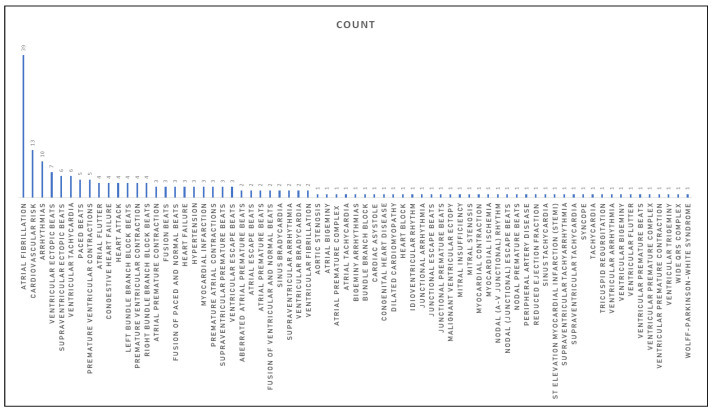
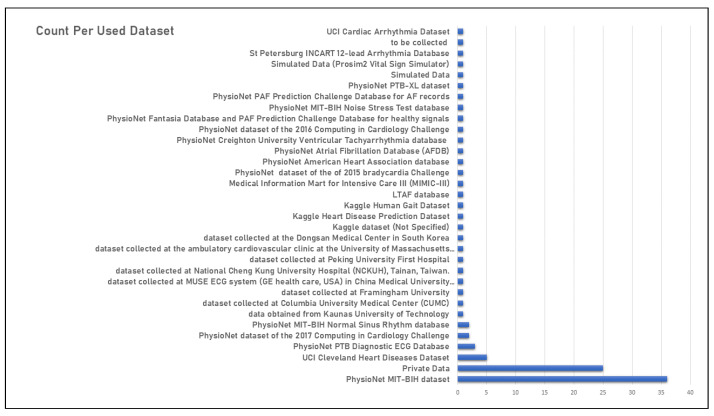
- ECG was used in 69 of the systems; atrial fibrillation was the most studied disease, addressed in 39 of 87 studies. The PhysioNet MIT-BIH dataset was the most popular, used by 36 of 87 studies, while 25 studies used researchers’ private data.
- 55 studies built custom devices; others used commercially available wearables or did not specify the device. One unspecified WBAN study achieved 96% accuracy, and the discussion notes several implementations reported accuracy over 99%.
- None of the reviewed studies implemented explainable AI, federated learning, or multimodal machine learning; the most commonly used models were convolutional neural networks, support vector machines, long short-term memories, and decision trees.
Methods
- Systematic literature review following PRISMA guidelines, searching IEEE, PubMed, and Scopus for peer-reviewed journal and conference papers in English, published between 2010 and 2022, addressing AI, smart wearables, healthcare, and cardiovascular diseases.
- Three database-specific queries combined four concept blocks: AI, health, wearables, and CVDs; records were screened first by title/abstract, then by full text, leaving 87 eligible studies.
- Data extracted from each study included publication year, diseases studied, vital signs recorded, wearable hardware, embedded intelligent models, datasets used, and performance metrics; results were analyzed descriptively by device type, year, vital signs, diseases, models, and datasets.
Limitations
- Stated: The authors conclude that further research is needed to improve smart wearables for CVD management, citing challenges in data privacy and confidentiality, noise and artifacts, data diversity and heterogeneity, and user technology adoption and engagement.
- Stated: None of the 87 reviewed studies used explainable AI, federated learning, or multimodal machine learning, which the authors argue limits trust, privacy protection, and the ability to analyze heterogeneous data.
- Evident in the text: The search was performed in October 2021, yet the review claims coverage through 2022 and includes 2022 publications; the Scopus query also limits publication years to 2010–2021, creating an inconsistency. No formal risk-of-bias or study-quality appraisal is described.
Model-written summary. Check it against the paper before relying on it.
Integrity signals
Registry
Cites
Statistics
Figures
Verification
Claims the paper makes
23 Own result · 19 Own interpretation · 16 Not checked yet · 12 No basis given · 4 Own method
A result the paper reports from its own data — it cites no other source for it, so there is none to check. The quote shows it is in the paper.
In the paper
“Throughout the analysis of the eligible documents, it was shown that 55 studies built their own devices using various vital sign sensors, power resources, storage resources, communications, and other technical components.”
§ Smart Wearables for the Detection of Cardiovascular Diseases: A Systematic Literature Review > 3. Results > 3.3. Results of Individual Studies
plain- Asserted: passes — The authors put it forward as true.
- Checkable: passes — It can be checked against evidence.
- Load-bearing: unclear — It is unclear whether the paper’s conclusions depend on it.
- Based: passes — The paper gives a reason why it holds.
A result the paper reports from its own data — it cites no other source for it, so there is none to check. The quote shows it is in the paper.
In the paper
“87 papers were deemed relevant for further review.”
- Also stated in: § 3.1. Study Selection · plain
“87 documents were deemed suitable for this review.”
§ Smart Wearables for the Detection of Cardiovascular Diseases: A Systematic Literature Review > Abstract
plain- Asserted: passes — The authors put it forward as true.
- Checkable: passes — It can be checked against evidence.
- Load-bearing: unclear — It is unclear whether the paper’s conclusions depend on it.
- Based: passes — The paper gives a reason why it holds.
- Also stated in: § 3.1. Study Selection · plain
A result the paper reports from its own data — it cites no other source for it, so there is none to check. The quote shows it is in the paper.
In the paper
“Thus, in [39,41,42,43,46,48,50,51,54,56,58,59,60,61,62,66,86,88,92,116,118,123], the authors proposed custom-built wearables with unspecified components.”
§ Smart Wearables for the Detection of Cardiovascular Diseases: A Systematic Literature Review > 3. Results > 3.3. Results of Individual Studies
plain- Asserted: passes — The authors put it forward as true.
- Checkable: passes — It can be checked against evidence.
- Load-bearing: unclear — It is unclear whether the paper’s conclusions depend on it.
- Based: passes — The paper gives a reason why it holds.
A result the paper reports from its own data — it cites no other source for it, so there is none to check. The quote shows it is in the paper.
In the paper
“These studies were able to detect various cardiovascular diseases such as atrial fibrillation, atrial flutter, atrial premature contraction, atrial tachycardia, cardiac asystole, cardiovascular risk, fusion beats, heart attack, heart failure, hypertension, myocardial infarction, myocardial ischemia, premature atrial contractions, and premature ventricular contractions.”
§ Smart Wearables for the Detection of Cardiovascular Diseases: A Systematic Literature Review > 3. Results > 3.3. Results of Individual Studies
plaindirect- Asserted: passes — The authors put it forward as true.
- Checkable: passes — It can be checked against evidence.
- Load-bearing: unclear — It is unclear whether the paper’s conclusions depend on it.
- Based: passes — The paper gives a reason why it holds.
None of the sources cited for this claim have been checked yet.
In the paper
“On the other hand, several studies used commercially available sensors to develop their wearable devices.”
§ Smart Wearables for the Detection of Cardiovascular Diseases: A Systematic Literature Review > 3. Results > 3.3. Results of Individual Studies
plain- Asserted: passes — The authors put it forward as true.
- Checkable: passes — It can be checked against evidence.
- Load-bearing: unclear — It is unclear whether the paper’s conclusions depend on it.
- Based: passes — The paper gives a reason why it holds.
In the paper
“The authors in [115] mentioned only that they used a wide body area network (WBAN) to record respiratory rate and blood oxygen levels to detect the presence of cardiovascular risk.”
§ Smart Wearables for the Detection of Cardiovascular Diseases: A Systematic Literature Review > 3. Results > 3.3. Results of Individual Studies
What the sources say
- Not checked yetcites [115] 2022, Nithiyanantham, J. Heuristic-based channel selection with enhanced deep learning for heart disease prediction under WBAN, Comput. Methods Biomech. Biomed. Eng.
plain- Asserted: passes — The authors put it forward as true.
- Checkable: passes — It can be checked against evidence.
- Load-bearing: unclear — It is unclear whether the paper’s conclusions depend on it.
- Based: passes — The paper gives a reason why it holds.
The paper states this without a source or data behind it here, so there is nothing to check it against. The quote shows it is in the paper.
In the paper
“In addition, none of the smart wearable CVD detection studies reviewed here explored the use of multimodal ML in their algorithms.”
§ Smart Wearables for the Detection of Cardiovascular Diseases: A Systematic Literature Review > 5. Results Discussion > 5.2. Latest Tech-Trends and Wearables in CVDs
plain- Asserted: passes — The authors put it forward as true.
- Checkable: passes — It can be checked against evidence.
- Load-bearing: unclear — It is unclear whether the paper’s conclusions depend on it.
- Based: passes — The paper gives a reason why it holds.
A result the paper reports from its own data — it cites no other source for it, so there is none to check. The quote shows it is in the paper.
In the paper
“In all 87 publications examined, at least one dataset was used to train the AI model, and this is consistently the case.”
§ Smart Wearables for the Detection of Cardiovascular Diseases: A Systematic Literature Review > 4. Results Analysis > 4.5. Datasets in Use
boosted- Asserted: passes — The authors put it forward as true.
- Checkable: passes — It can be checked against evidence.
- Load-bearing: unclear — It is unclear whether the paper’s conclusions depend on it.
- Based: passes — The paper gives a reason why it holds.
A result the paper reports from its own data — it cites no other source for it, so there is none to check. The quote shows it is in the paper.
In the paper
“Another 25 studies also used researchers’ private data.”
§ Smart Wearables for the Detection of Cardiovascular Diseases: A Systematic Literature Review > 4. Results Analysis > 4.5. Datasets in Use
plain- Asserted: passes — The authors put it forward as true.
- Checkable: passes — It can be checked against evidence.
- Load-bearing: unclear — It is unclear whether the paper’s conclusions depend on it.
- Based: passes — The paper gives a reason why it holds.
The paper states this without a source or data behind it here, so there is nothing to check it against. The quote shows it is in the paper.
In the paper
“Although each publication proposes a different method to detect the disease(s), all agree that some type of algorithm should be used to classify cardiac abnormalities.”
§ Smart Wearables for the Detection of Cardiovascular Diseases: A Systematic Literature Review > 4. Results Analysis > 4.4. Smart Models in Use
plain- Asserted: passes — The authors put it forward as true.
- Checkable: passes — It can be checked against evidence.
- Load-bearing: unclear — It is unclear whether the paper’s conclusions depend on it.
- Based: passes — The paper gives a reason why it holds.
- Probably not a substantial claim. 36
- It may state two separate claims as one. 25
The paper states this without a source or data behind it here, so there is nothing to check it against. The quote shows it is in the paper.
In the paper
“Depending on the type of device used, three categories can be distinguished, namely, wristband devices, belts, and others.”
§ Smart Wearables for the Detection of Cardiovascular Diseases: A Systematic Literature Review > 3. Results > 3.3. Results of Individual Studies
plain- Asserted: passes — The authors put it forward as true.
- Checkable: passes — It can be checked against evidence.
- Load-bearing: fails — The paper’s conclusions may not depend on it.
- Based: passes — The paper gives a reason why it holds.
Probably not a substantial claim. The paper’s conclusions may not depend on it.
A result the paper reports from its own data — it cites no other source for it, so there is none to check. The quote shows it is in the paper.
In the paper
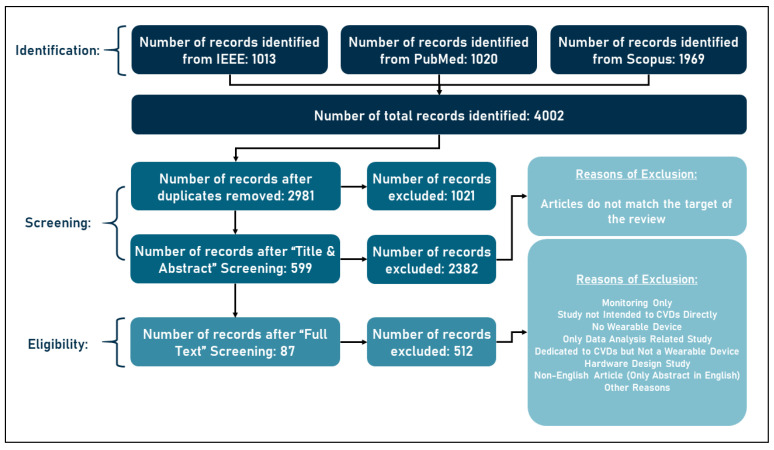
“Initially, 4002 documents were identified from the three libraries based on the above searches.”
§ Smart Wearables for the Detection of Cardiovascular Diseases: A Systematic Literature Review > 3. Results > 3.1. Study Selection
plain- Asserted: passes — The authors put it forward as true.
- Checkable: passes — It can be checked against evidence.
- Load-bearing: fails — The paper’s conclusions may not depend on it.
- Based: passes — The paper gives a reason why it holds.
Probably not a substantial claim. The paper’s conclusions may not depend on it.
None of the sources cited for this claim have been checked yet.
In the paper
“Their study achieved 96% accuracy in the classification algorithm, demonstrating high feasibility in detecting CVDs.”
§ Smart Wearables for the Detection of Cardiovascular Diseases: A Systematic Literature Review > 3. Results > 3.3. Results of Individual Studies
boosted- Asserted: passes — The authors put it forward as true.
- Checkable: passes — It can be checked against evidence.
- Load-bearing: unclear — It is unclear whether the paper’s conclusions depend on it.
- Based: passes — The paper gives a reason why it holds.
It may state two separate claims as one.
None of the sources cited for this claim have been checked yet.
In the paper
“For example, in [45,47,55,68,70,80,85,98,103,107,108,112], the authors used smartwatches and smart wristbands to record vital signs.”
§ Smart Wearables for the Detection of Cardiovascular Diseases: A Systematic Literature Review > 3. Results > 3.3. Results of Individual Studies
plain- Asserted: passes — The authors put it forward as true.
- Checkable: passes — It can be checked against evidence.
- Load-bearing: fails — The paper’s conclusions may not depend on it.
- Based: passes — The paper gives a reason why it holds.
Probably not a substantial claim. The paper’s conclusions may not depend on it.
A result the paper reports from its own data — it cites no other source for it, so there is none to check. The quote shows it is in the paper.
In the paper
“Then, the aforementioned selection procedure was applied, excluding 2382 documents on the basis of irrelevance and advancing 599 to the next stage.”
§ Smart Wearables for the Detection of Cardiovascular Diseases: A Systematic Literature Review > 3. Results > 3.1. Study Selection
plain- Asserted: passes — The authors put it forward as true.
- Checkable: passes — It can be checked against evidence.
- Load-bearing: fails — The paper’s conclusions may not depend on it.
- Based: passes — The paper gives a reason why it holds.
Probably not a substantial claim. The paper’s conclusions may not depend on it. It may state two separate claims as one.
A result the paper reports from its own data — it cites no other source for it, so there is none to check. The quote shows it is in the paper.
In the paper
“The search on IEEE yielded 1013 documents, on PubMed 1020, and on Scopus 1969”
§ Smart Wearables for the Detection of Cardiovascular Diseases: A Systematic Literature Review > 3. Results > 3.1. Study Selection
plain- Asserted: passes — The authors put it forward as true.
- Checkable: passes — It can be checked against evidence.
- Load-bearing: unclear — It is unclear whether the paper’s conclusions depend on it.
- Based: passes — The paper gives a reason why it holds.
It may state two separate claims as one.
None of the sources cited for this claim have been checked yet.
In the paper
“In addition, the authors in [40,44,49,63,64,76,78,83,91,93,96,102,110,120,121] used various wearable ECG devices such as smart vests and patches.”
§ Smart Wearables for the Detection of Cardiovascular Diseases: A Systematic Literature Review > 3. Results > 3.3. Results of Individual Studies
plain- Asserted: passes — The authors put it forward as true.
- Checkable: passes — It can be checked against evidence.
- Load-bearing: fails — The paper’s conclusions may not depend on it.
- Based: passes — The paper gives a reason why it holds.
Probably not a substantial claim. The paper’s conclusions may not depend on it.
A result the paper reports from its own data — it cites no other source for it, so there is none to check. The quote shows it is in the paper.
In the paper
“In this phase, 512 documents were excluded for various reasons”
§ Smart Wearables for the Detection of Cardiovascular Diseases: A Systematic Literature Review > 3. Results > 3.1. Study Selection
plain- Asserted: passes — The authors put it forward as true.
- Checkable: passes — It can be checked against evidence.
- Load-bearing: fails — The paper’s conclusions may not depend on it.
- Based: passes — The paper gives a reason why it holds.
Probably not a substantial claim. The paper’s conclusions may not depend on it.
None of the sources cited for this claim have been checked yet.
In the paper
“In addition, the authors in [52,57,65,67,69,71,72,74,75,77,79,81,89,94,100,101,113,122] used the AD8232 ECG sensor to collect vital signs data.”
§ Smart Wearables for the Detection of Cardiovascular Diseases: A Systematic Literature Review > 3. Results > 3.3. Results of Individual Studies
plain- Asserted: passes — The authors put it forward as true.
- Checkable: passes — It can be checked against evidence.
- Load-bearing: fails — The paper’s conclusions may not depend on it.
- Based: passes — The paper gives a reason why it holds.
Probably not a substantial claim. The paper’s conclusions may not depend on it.
None of the sources cited for this claim have been checked yet.
In the paper
“In addition, the authors in [90,99,105,106] used smart belts to collect ECG data.”
§ Smart Wearables for the Detection of Cardiovascular Diseases: A Systematic Literature Review > 3. Results > 3.3. Results of Individual Studies
plain- Asserted: passes — The authors put it forward as true.
- Checkable: passes — It can be checked against evidence.
- Load-bearing: fails — The paper’s conclusions may not depend on it.
- Based: passes — The paper gives a reason why it holds.
Probably not a substantial claim. The paper’s conclusions may not depend on it.
A result the paper reports from its own data — it cites no other source for it, so there is none to check. The quote shows it is in the paper.
In the paper
“Finally, in a single study, the device used was not specified.”
§ Smart Wearables for the Detection of Cardiovascular Diseases: A Systematic Literature Review > 3. Results > 3.3. Results of Individual Studies
plain- Asserted: passes — The authors put it forward as true.
- Checkable: passes — It can be checked against evidence.
- Load-bearing: fails — The paper’s conclusions may not depend on it.
- Based: passes — The paper gives a reason why it holds.
Probably not a substantial claim. The paper’s conclusions may not depend on it.
A result the paper reports from its own data — it cites no other source for it, so there is none to check. The quote shows it is in the paper.
In the paper
“Vital signs obtained for this purpose were radial artery audio signal, blood oxygen level, blood pressure, blood sugar level, body temperature, diastolic pressure, electrocardiogram, electroencephalogram, heart rate, motion data, oxygen saturation level, photoplethysmogram, respiratory rate, and skin temperature.”
§ Smart Wearables for the Detection of Cardiovascular Diseases: A Systematic Literature Review > 3. Results > 3.3. Results of Individual Studies
plain- Asserted: passes — The authors put it forward as true.
- Checkable: passes — It can be checked against evidence.
- Load-bearing: unclear — It is unclear whether the paper’s conclusions depend on it.
- Based: passes — The paper gives a reason why it holds.
It may state two separate claims as one.
The paper states this without a source or data behind it here, so there is nothing to check it against. The quote shows it is in the paper.
In the paper
“Contextually, the studies can be divided into three categories, for example, according to whether the measuring devices used are commercially available or not. Systems in the first group use components that are not commonly available; these components were custom-made by the researchers for the study. Systems that use readily available technology and commercially available devices comprise the”
§ Smart Wearables for the Detection of Cardiovascular Diseases: A Systematic Literature Review > 3. Results > 3.3. Results of Individual Studies
plain- Asserted: passes — The authors put it forward as true.
- Checkable: passes — It can be checked against evidence.
- Load-bearing: fails — The paper’s conclusions may not depend on it.
- Based: passes — The paper gives a reason why it holds.
Probably not a substantial claim. The paper’s conclusions may not depend on it.
The paper states this without a source or data behind it here, so there is nothing to check it against. The quote shows it is in the paper.
In the paper
“The other group of studies consists of studies that used commercially available devices. These devices were capable of recording various vital signs such as activity parameters, blood oxygen level, blood pressure, blood glucose level, cholesterol level, electrocardiogram, electroencephalogram, electromyogram, heart rate, oxygen saturation level, photoplethysmogram, pulse plethysmogram, and”
§ Smart Wearables for the Detection of Cardiovascular Diseases: A Systematic Literature Review > 3. Results > 3.3. Results of Individual Studies
plain- Asserted: passes — The authors put it forward as true.
- Checkable: passes — It can be checked against evidence.
- Load-bearing: fails — The paper’s conclusions may not depend on it.
- Based: passes — The paper gives a reason why it holds.
Probably not a substantial claim. The paper’s conclusions may not depend on it.
A result the paper reports from its own data — it cites no other source for it, so there is none to check. The quote shows it is in the paper.
In the paper
“after which duplicate entries were excluded, removing 1021 and leaving 2981 documents.”
§ Smart Wearables for the Detection of Cardiovascular Diseases: A Systematic Literature Review > 3. Results > 3.1. Study Selection
plaindirect- Asserted: passes — The authors put it forward as true.
- Checkable: passes — It can be checked against evidence.
- Load-bearing: fails — The paper’s conclusions may not depend on it.
- Based: passes — The paper gives a reason why it holds.
Probably not a substantial claim. The paper’s conclusions may not depend on it.
The paper states this without a source or data behind it here, so there is nothing to check it against. The quote shows it is in the paper.
In the paper
“ECG, BP, HR, and temperature were all reliable predictors of cardiovascular disease.”
§ Smart Wearables for the Detection of Cardiovascular Diseases: A Systematic Literature Review > 5. Results Discussion > 5.1. Performance, Usability, and Feasibility
plaincorrelational- Asserted: passes — The authors put it forward as true.
- Checkable: passes — It can be checked against evidence.
- Load-bearing: passes — The paper’s conclusions depend on it.
- Based: passes — The paper gives a reason why it holds.
It may state two separate claims as one.
A result the paper reports from its own data — it cites no other source for it, so there is none to check. The quote shows it is in the paper.
In the paper
“Atrial fibrillation (AFib) is the most commonly studied disease, with 39 of 87 studies addressing it.”
§ Smart Wearables for the Detection of Cardiovascular Diseases: A Systematic Literature Review > 4. Results Analysis > 4.3. Diseases Targeted
plain- Asserted: passes — The authors put it forward as true.
- Checkable: passes — It can be checked against evidence.
- Load-bearing: unclear — It is unclear whether the paper’s conclusions depend on it.
- Based: passes — The paper gives a reason why it holds.
It may state two separate claims as one.
The paper states this without a source or data behind it here, so there is nothing to check it against. The quote shows it is in the paper.
In the paper
“Studies have shown that smart watches such as the Samsung Active and Apple Watch have significant efficiency in capturing ECG signals, complementing the accuracy of ECGs performed in a doctor’s office, clinic, or hospital room.”
§ Smart Wearables for the Detection of Cardiovascular Diseases: A Systematic Literature Review > 4. Results Analysis > 4.2. Vital Signs in Use
boostedcorrelational- Asserted: passes — The authors put it forward as true.
- Checkable: passes — It can be checked against evidence.
- Load-bearing: passes — The paper’s conclusions depend on it.
- Based: fails — The paper may give no reason why it holds.
Probably not a substantial claim. The paper may give no reason why it holds. It may state two separate claims as one.
A result the paper reports from its own data — it cites no other source for it, so there is none to check. The quote shows it is in the paper.
In the paper
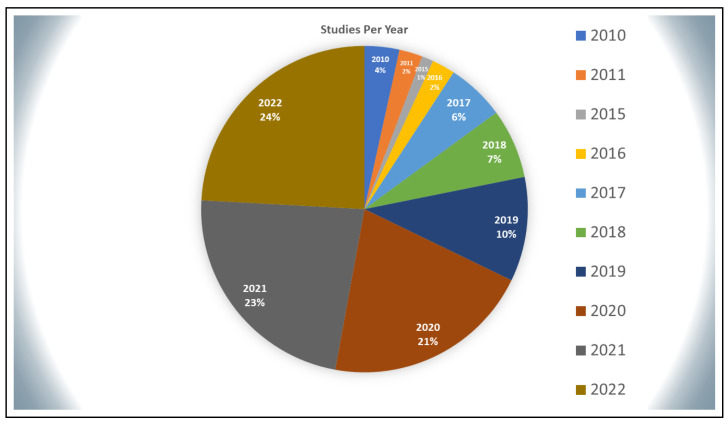
“There are nine in 2019, eighteen in 2020, twenty-one in 2021, and twenty-one in 2022.”
§ Smart Wearables for the Detection of Cardiovascular Diseases: A Systematic Literature Review > 4. Results Analysis > 4.1. Progress with Years
plain- Asserted: passes — The authors put it forward as true.
- Checkable: passes — It can be checked against evidence.
- Load-bearing: unclear — It is unclear whether the paper’s conclusions depend on it.
- Based: passes — The paper gives a reason why it holds.
It may state two separate claims as one.
A result the paper reports from its own data — it cites no other source for it, so there is none to check. The quote shows it is in the paper.
In the paper
“During those years, a total of 68 studies were published (compared to only 19 in 2010–2018).”
§ Smart Wearables for the Detection of Cardiovascular Diseases: A Systematic Literature Review > 4. Results Analysis > 4.1. Progress with Years
plain- Asserted: passes — The authors put it forward as true.
- Checkable: passes — It can be checked against evidence.
- Load-bearing: passes — The paper’s conclusions depend on it.
- Based: passes — The paper gives a reason why it holds.
It may state two separate claims as one.
The paper states this without a source or data behind it here, so there is nothing to check it against. The quote shows it is in the paper.
In the paper
“Other conditions are also being studied, including premature ventricular contractions (PVCs), ventricular ectopic beats, bradycardia, paced beat (PACE), and many others.”
§ Smart Wearables for the Detection of Cardiovascular Diseases: A Systematic Literature Review > 4. Results Analysis > 4.3. Diseases Targeted
plain- Asserted: passes — The authors put it forward as true.
- Checkable: passes — It can be checked against evidence.
- Load-bearing: fails — The paper’s conclusions may not depend on it.
- Based: passes — The paper gives a reason why it holds.
Probably not a substantial claim. The paper’s conclusions may not depend on it. It may state two separate claims as one.
What the paper did — it cites no source for this, so there is none to check. The quote shows it is in the paper.
In the paper
“In order to conduct a thorough search of the above materials, three queries were formulated. While these queries all follow the same logical structure, they use different syntaxes to comply with the different rules imposed by each data source. Targeted articles are found at the intersection of four query blocks, each defining a different topic of interest. AI, health, wearables, and CVDs (or”
§ Smart Wearables for the Detection of Cardiovascular Diseases: A Systematic Literature Review > 2. Research Methodology > 2.3. Search Strategy
plain- Asserted: passes — The authors put it forward as true.
- Checkable: passes — It can be checked against evidence.
- Load-bearing: fails — The paper’s conclusions may not depend on it.
- Based: passes — The paper gives a reason why it holds.
Probably not a substantial claim. The paper’s conclusions may not depend on it.
What the paper did — it cites no source for this, so there is none to check. The quote shows it is in the paper.
In the paper
“The data extracted from the records were selected in three steps to determine which files were relevant to this analysis. The first step was to review the titles and abstracts of all documents to determine if they were relevant to the topic of this study. The documents that passed this step were then downloaded. In a second step, we reviewed the downloaded files to quickly verify their content and”
§ Smart Wearables for the Detection of Cardiovascular Diseases: A Systematic Literature Review > 2. Research Methodology > 2.4. Selection Process
plain- Asserted: passes — The authors put it forward as true.
- Checkable: passes — It can be checked against evidence.
- Load-bearing: fails — The paper’s conclusions may not depend on it.
- Based: passes — The paper gives a reason why it holds.
Probably not a substantial claim. The paper’s conclusions may not depend on it. It may state two separate claims as one.
What the paper did — it cites no source for this, so there is none to check. The quote shows it is in the paper.
In the paper
“This study followed the PRISMA guidelines by searching IEEE, PubMed, and Scopus for publications published between 2010 and 2022.”
- Also stated in: § 2.2. Information Sources · plain
“Several academic abstract and citation databases for peer-reviewed literature were used, including IEEE, PubMed, and Scopus Elsevier, to ensure superior results and to cover the largest number of documents possible.”
§ Smart Wearables for the Detection of Cardiovascular Diseases: A Systematic Literature Review > Abstract
plain- Asserted: passes — The authors put it forward as true.
- Checkable: passes — It can be checked against evidence.
- Load-bearing: passes — The paper’s conclusions depend on it.
- Based: passes — The paper gives a reason why it holds.
Probably not a substantial claim.
- Also stated in: § 2.2. Information Sources · plain
What the paper did — it cites no source for this, so there is none to check. The quote shows it is in the paper.
In the paper
“To be considered reputable, a paper must address artificial intelligence or related fields, present a smart wearable solution, address healthcare, and focus on cardiovascular diseases. In addition, the material should have been published in a peer-reviewed journal or as a conference proceedings. In addition, only documents published between January 2010 and October 2022 were considered. As a final”
§ Smart Wearables for the Detection of Cardiovascular Diseases: A Systematic Literature Review > 2. Research Methodology > 2.1. Eligibility Criteria
plain- Asserted: passes — The authors put it forward as true.
- Checkable: passes — It can be checked against evidence.
- Load-bearing: passes — The paper’s conclusions depend on it.
- Based: passes — The paper gives a reason why it holds.
Probably not a substantial claim. It may state two separate claims as one.
None of the sources cited for this claim have been checked yet.
In the paper
“This study followed the PRISMA guidelines by searching IEEE, PubMed, and Scopus for publications published between 2010 and 2022.”
- Also stated in: § 2.1. Eligibility Criteria · plain
“In conducting this review, PRISMA (Preferred Reporting Items for Systematic Reviews and Meta-Analyses ) [37] was used as a guide for preparing a systematic literature review. The structure of this review was based on the latest PRISMA checklist (PRISMA Checklist 2020) [38].”
§ Smart Wearables for the Detection of Cardiovascular Diseases: A Systematic Literature Review > Abstract
What the sources say
- Not checked yetcites [37] Page, 2021, PRISMA 2020 explanation and elaboration: Updated guidance and exemplars for reporting systematic reviews, BMJ source
- Not checked yetcites [38] (2022, November 17). PRISMA. Available online: https://www.prisma-statement.org//PRISMAStatement/Checklist.aspx.
plain- Asserted: passes — The authors put it forward as true.
- Checkable: passes — It can be checked against evidence.
- Load-bearing: fails — The paper’s conclusions may not depend on it.
- Based: passes — The paper gives a reason why it holds.
Probably not a substantial claim. The paper’s conclusions may not depend on it. It may state two separate claims as one.
- Also stated in: § 2.1. Eligibility Criteria · plain
A conclusion the paper draws from its own results — it cites no other source for it, so there is none to check. The quote shows it is in the paper.
In the paper
“Therefore, combining multiple vital signs in the analysis process could allow for more accurate prediction of cardiovascular disease.”
§ Smart Wearables for the Detection of Cardiovascular Diseases: A Systematic Literature Review > 6. Challenges and Future Perspectives > 6.1. Challenges
hedgedconditional- Asserted: passes — The authors put it forward as true.
- Checkable: passes — It can be checked against evidence.
- Load-bearing: fails — The paper’s conclusions may not depend on it.
- Based: passes — The paper gives a reason why it holds.
Probably not a substantial claim. The paper’s conclusions may not depend on it.
- Rests on an assumption: Research in medicine has shown that the use of multiple vital signs may be more helpful in detecting a disease than the use of a single vital sign.
A conclusion the paper draws from its own results — it cites no other source for it, so there is none to check. The quote shows it is in the paper.
In the paper
“The number of publications addressing the use of smart wearables for cardiovascular disease management has jumped, reflecting both the growing interest in this area and the widespread acceptance of such devices.”
§ Smart Wearables for the Detection of Cardiovascular Diseases: A Systematic Literature Review > 4. Results Analysis > 4.1. Progress with Years
plaincorrelational- Asserted: passes — The authors put it forward as true.
- Checkable: passes — It can be checked against evidence.
- Load-bearing: unclear — It is unclear whether the paper’s conclusions depend on it.
- Based: passes — The paper gives a reason why it holds.
It may state two separate claims as one.
- Rests on an assumption: Publication counts reflect growing interest and widespread acceptance of smart wearables for CVD.
A conclusion the paper draws from its own results — it cites no other source for it, so there is none to check. The quote shows it is in the paper.
In the paper
“Although the results show that smart wearables are quite accurate in detecting, predicting, and even treating cardiovascular disease, further research is needed to improve their use.”
§ Smart Wearables for the Detection of Cardiovascular Diseases: A Systematic Literature Review > Abstract
plaindirect- Asserted: passes — The authors put it forward as true.
- Checkable: passes — It can be checked against evidence.
- Load-bearing: passes — The paper’s conclusions depend on it.
- Based: passes — The paper gives a reason why it holds.
It may state two separate claims as one.
A conclusion the paper draws from its own results — it cites no other source for it, so there is none to check. The quote shows it is in the paper.
In the paper
“The review of the research area showed the high practicality and effectiveness of such methods, reflecting the growing interest that has surged in recent years.”
§ Smart Wearables for the Detection of Cardiovascular Diseases: A Systematic Literature Review > 7. Conclusions
plaindirect- Asserted: passes — The authors put it forward as true.
- Checkable: passes — It can be checked against evidence.
- Load-bearing: passes — The paper’s conclusions depend on it.
- Based: fails — The paper may give no reason why it holds.
Probably not a substantial claim. The paper may give no reason why it holds. It may state two separate claims as one.
A conclusion the paper draws from its own results — it cites no other source for it, so there is none to check. The quote shows it is in the paper.
In the paper
“Consequently, smart wearables have proven to be viable in this area, providing both continuous and real-time monitoring without interfering with daily life routines.”
§ Smart Wearables for the Detection of Cardiovascular Diseases: A Systematic Literature Review > 6. Challenges and Future Perspectives > 6.2. Future Perspectives
boosteddirect- Asserted: passes — The authors put it forward as true.
- Checkable: passes — It can be checked against evidence.
- Load-bearing: passes — The paper’s conclusions depend on it.
- Based: fails — The paper may give no reason why it holds.
Probably not a substantial claim. The paper may give no reason why it holds. It may state two separate claims as one.
A conclusion the paper draws from its own results — it cites no other source for it, so there is none to check. The quote shows it is in the paper.
In the paper
“Smart watches and wristbands, on the other hand, are quite effective at capturing ECG signals and are also convenient for a number of other reasons.”
§ Smart Wearables for the Detection of Cardiovascular Diseases: A Systematic Literature Review > 5. Results Discussion > 5.1. Performance, Usability, and Feasibility
plaincorrelational- Asserted: passes — The authors put it forward as true.
- Checkable: passes — It can be checked against evidence.
- Load-bearing: passes — The paper’s conclusions depend on it.
- Based: fails — The paper may give no reason why it holds.
Probably not a substantial claim. The paper may give no reason why it holds.
In the paper
“AFib is the leading cause of death and morbidity due to stroke, heart failure, thromboembolism, and reduced quality of life, and accounts for the majority of these cases [127].”
§ Smart Wearables for the Detection of Cardiovascular Diseases: A Systematic Literature Review > 4. Results Analysis > 4.3. Diseases Targeted
What the sources say
- Not checked yetcites [127] Lip, 2007, Management of atrial fibrillation, Lancet source
plaindirect- Asserted: passes — The authors put it forward as true.
- Checkable: passes — It can be checked against evidence.
- Load-bearing: fails — The paper’s conclusions may not depend on it.
- Based: passes — The paper gives a reason why it holds.
Probably not a substantial claim. The paper’s conclusions may not depend on it. It may state two separate claims as one.
None of the sources cited for this claim have been checked yet.
In the paper
“FL is still in its infancy and is still vulnerable to various challenges [148,149].”
§ Smart Wearables for the Detection of Cardiovascular Diseases: A Systematic Literature Review > 5. Results Discussion > 5.2. Latest Tech-Trends and Wearables in CVDs
What the sources say
- Not checked yetcites [148] Bonawitz, K., Ivanov, V., Kreuter, B., Marcedone, A., McMahan, H.B., Patel, S., Ramage, D., Segal, A., and Seth, K. (November, January 30). Practical secure aggregation for privacy-preserving machine learning. Proceedings of the 2017 ACM SIGSAC Conference on Computer and Communications Security, Dallas, TX, USA. source
- Not checked yetcites [149] Zhang, 2022, Challenges and future directions of secure federated learning: A survey, Front. Comput. Sci. source
plain- Asserted: passes — The authors put it forward as true.
- Checkable: passes — It can be checked against evidence.
- Load-bearing: passes — The paper’s conclusions depend on it.
- Based: passes — The paper gives a reason why it holds.
It may state two separate claims as one.
A conclusion the paper draws from its own results — it cites no other source for it, so there is none to check. The quote shows it is in the paper.
In the paper
“Cardiovascular disease detection through smart wearables is now a reality.”
§ Smart Wearables for the Detection of Cardiovascular Diseases: A Systematic Literature Review > 6. Challenges and Future Perspectives > 6.2. Future Perspectives
plain- Asserted: passes — The authors put it forward as true.
- Checkable: passes — It can be checked against evidence.
- Load-bearing: fails — The paper’s conclusions may not depend on it.
- Based: fails — The paper may give no reason why it holds.
Probably not a substantial claim. The paper’s conclusions may not depend on it. The paper may give no reason why it holds.
A conclusion the paper draws from its own results — it cites no other source for it, so there is none to check. The quote shows it is in the paper.
In the paper
“the electrocardiogram (ECG) is considered the most effective indicator of cardiovascular disease due to its high accuracy in recording the presence of such disease and its practicality and reliability in detecting it.”
§ Smart Wearables for the Detection of Cardiovascular Diseases: A Systematic Literature Review > 5. Results Discussion > 5.1. Performance, Usability, and Feasibility
plaincorrelational- Asserted: passes — The authors put it forward as true.
- Checkable: passes — It can be checked against evidence.
- Load-bearing: passes — The paper’s conclusions depend on it.
- Based: fails — The paper may give no reason why it holds.
Probably not a substantial claim. The paper may give no reason why it holds.
None of the sources cited for this claim have been checked yet.
In the paper
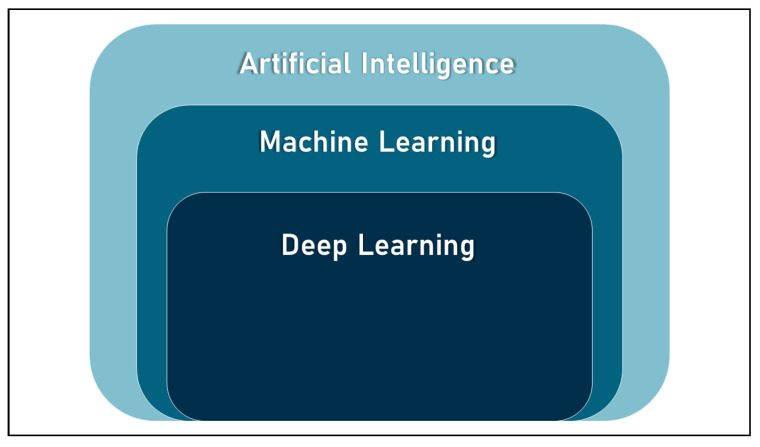
“The intelligent models of machine learning and deep learning are attracting much attention and are proving to be very practical [130,131] in the healthcare industry.”
§ Smart Wearables for the Detection of Cardiovascular Diseases: A Systematic Literature Review > 4. Results Analysis > 4.4. Smart Models in Use
What the sources say
plain- Asserted: passes — The authors put it forward as true.
- Checkable: fails — It may be too vague to check against evidence.
- Load-bearing: fails — The paper’s conclusions may not depend on it.
- Based: passes — The paper gives a reason why it holds.
Probably not a substantial claim. It may be too vague to check against evidence. The paper’s conclusions may not depend on it. It may state two separate claims as one.
A conclusion the paper draws from its own results — it cites no other source for it, so there is none to check. The quote shows it is in the paper.
In the paper
“Therefore, smart wearables that combine AI and ICT are expected to be very useful in cardiovascular disease detection and prediction.”
§ Smart Wearables for the Detection of Cardiovascular Diseases: A Systematic Literature Review > 1. Introduction > 1.2. CVDs Detection: From Classic to Technology-Assisted
hedgedconditional- Asserted: passes — The authors put it forward as true.
- Checkable: fails — It may be too vague to check against evidence.
- Load-bearing: passes — The paper’s conclusions depend on it.
- Based: fails — The paper may give no reason why it holds.
Probably not a substantial claim. It may be too vague to check against evidence. The paper may give no reason why it holds.
A conclusion the paper draws from its own results — it cites no other source for it, so there is none to check. The quote shows it is in the paper.
In the paper
“if the results are not explained, the medical community and patients will not have confidence in them, or at least be wary of adopting them.”
§ Smart Wearables for the Detection of Cardiovascular Diseases: A Systematic Literature Review > 5. Results Discussion > 5.2. Latest Tech-Trends and Wearables in CVDs
plainconditional- Asserted: passes — The authors put it forward as true.
- Checkable: fails — It may be too vague to check against evidence.
- Load-bearing: passes — The paper’s conclusions depend on it.
- Based: passes — The paper gives a reason why it holds.
Probably not a substantial claim. It may be too vague to check against evidence. It may state two separate claims as one.
A conclusion the paper draws from its own results — it cites no other source for it, so there is none to check. The quote shows it is in the paper.
In the paper
“In other words, greater trust and wider use of smart wearables as tools for predicting CVDs will result from improved accuracy, reliability, feasibility, privacy, and explainability of such devices.”
§ Smart Wearables for the Detection of Cardiovascular Diseases: A Systematic Literature Review > 6. Challenges and Future Perspectives > 6.2. Future Perspectives
hedgeddirect- Asserted: passes — The authors put it forward as true.
- Checkable: fails — It may be too vague to check against evidence.
- Load-bearing: passes — The paper’s conclusions depend on it.
- Based: fails — The paper may give no reason why it holds.
Probably not a substantial claim. It may be too vague to check against evidence. The paper may give no reason why it holds.
- Rests on an assumption: When it comes to health, users are only willing to use tools that are highly accurate, understandable, private, and reliable.
A conclusion the paper draws from its own results — it cites no other source for it, so there is none to check. The quote shows it is in the paper.
In the paper
“Although these regulations help protect private information, they pose new challenges to the traditional AI data processing model to varying degrees by making it more difficult to collect data to train models, which in turn makes it more difficult to improve the accuracy of model performance.”
§ Smart Wearables for the Detection of Cardiovascular Diseases: A Systematic Literature Review > 6. Challenges and Future Perspectives > 6.1. Challenges
plaindirect- Asserted: passes — The authors put it forward as true.
- Checkable: passes — It can be checked against evidence.
- Load-bearing: unclear — It is unclear whether the paper’s conclusions depend on it.
- Based: passes — The paper gives a reason why it holds.
It may state two separate claims as one.
A conclusion the paper draws from its own results — it cites no other source for it, so there is none to check. The quote shows it is in the paper.
In the paper
“However, by using this technology, researchers can evaluate many datasets simultaneously, which greatly improves the accuracy of their results.”
§ Smart Wearables for the Detection of Cardiovascular Diseases: A Systematic Literature Review > 5. Results Discussion > 5.2. Latest Tech-Trends and Wearables in CVDs
plaindirect- Asserted: passes — The authors put it forward as true.
- Checkable: passes — It can be checked against evidence.
- Load-bearing: fails — The paper’s conclusions may not depend on it.
- Based: fails — The paper may give no reason why it holds.
Probably not a substantial claim. The paper’s conclusions may not depend on it. The paper may give no reason why it holds. It may state two separate claims as one.
A conclusion the paper draws from its own results — it cites no other source for it, so there is none to check. The quote shows it is in the paper.
In the paper
“their ability to record a wide range of biometric data makes them an excellent, if not ideal, option for ECG capture devices and thus for predicting CVD parameters.”
§ Smart Wearables for the Detection of Cardiovascular Diseases: A Systematic Literature Review > 5. Results Discussion > 5.1. Performance, Usability, and Feasibility
plaincorrelational- Asserted: passes — The authors put it forward as true.
- Checkable: fails — It may be too vague to check against evidence.
- Load-bearing: passes — The paper’s conclusions depend on it.
- Based: fails — The paper may give no reason why it holds.
Probably not a substantial claim. It may be too vague to check against evidence. The paper may give no reason why it holds. It may state two separate claims as one.
A conclusion the paper draws from its own results — it cites no other source for it, so there is none to check. The quote shows it is in the paper.
In the paper
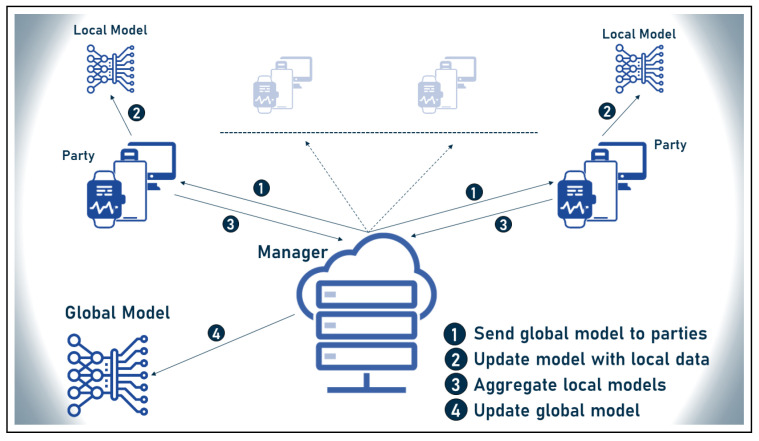
“It is expected that using FL to identify CVDs will make it easier to collect more data, which in turn will improve detection accuracy.”
§ Smart Wearables for the Detection of Cardiovascular Diseases: A Systematic Literature Review > 6. Challenges and Future Perspectives > 6.2. Future Perspectives
hedgedconditional- Asserted: passes — The authors put it forward as true.
- Checkable: passes — It can be checked against evidence.
- Load-bearing: fails — The paper’s conclusions may not depend on it.
- Based: fails — The paper may give no reason why it holds.
Probably not a substantial claim. The paper’s conclusions may not depend on it. The paper may give no reason why it holds. It may state two separate claims as one.
- Rests on an assumption: More data can lead to more accurate models.
None of the sources cited for this claim have been checked yet.
In the paper
“Federated machine learning has shown promising results in the healthcare industry, as indicated in [146,147].”
§ Smart Wearables for the Detection of Cardiovascular Diseases: A Systematic Literature Review > 5. Results Discussion > 5.2. Latest Tech-Trends and Wearables in CVDs
What the sources say
hedged- Asserted: passes — The authors put it forward as true.
- Checkable: passes — It can be checked against evidence.
- Load-bearing: fails — The paper’s conclusions may not depend on it.
- Based: passes — The paper gives a reason why it holds.
Probably not a substantial claim. The paper’s conclusions may not depend on it.
None of the sources cited for this claim have been checked yet.
In the paper
“In this context, and to address the challenges posed by the black-box nature of AI, ML, and DL models, explainable AI (XAI) is proposed as a viable solution.”
§ Smart Wearables for the Detection of Cardiovascular Diseases: A Systematic Literature Review > 5. Results Discussion > 5.2. Latest Tech-Trends and Wearables in CVDs
What the sources say
- Not checked yetcites [137] Xu, F., Uszkoreit, H., Du, Y., Fan, W., Zhao, D., and Zhu, J. (2019). Explainable AI: A brief survey on history, research areas, approaches and challenges. CCF International Conference on Natural Language Processing and Chinese Computing, Springer. source
- Not checked yetcites [138] Doran, D., Schulz, S., and Besold, T.R. (2017). Besold. What does explainable AI really mean? A new conceptualization of perspectives. arXiv.
- Not checked yetcites [139] Gunning, 2019, XAI—Explainable artificial intelligence, Sci. Robot. source
plain- Asserted: passes — The authors put it forward as true.
- Checkable: passes — It can be checked against evidence.
- Load-bearing: passes — The paper’s conclusions depend on it.
- Based: passes — The paper gives a reason why it holds.
Probably not a substantial claim.
A conclusion the paper draws from its own results — it cites no other source for it, so there is none to check. The quote shows it is in the paper.
In the paper
“Therefore, using the concept of multimodal ML to analyze different data such as ECG, EHR recordings, and MRI images can help increase the accuracy of CVD detection and prediction.”
§ Smart Wearables for the Detection of Cardiovascular Diseases: A Systematic Literature Review > 6. Challenges and Future Perspectives > 6.2. Future Perspectives
plainconditional- Asserted: passes — The authors put it forward as true.
- Checkable: passes — It can be checked against evidence.
- Load-bearing: fails — The paper’s conclusions may not depend on it.
- Based: passes — The paper gives a reason why it holds.
Probably not a substantial claim. The paper’s conclusions may not depend on it.
The paper relies on this without support.
Publication counts reflect growing interest and widespread acceptance of smart wearables for CVD.
“The number of publications addressing the use of smart wearables for cardiovascular disease management has jumped, reflecting both the growing interest in this area and the widespread acceptance of such devices.”
The paper relies on this without support.
The data extracted from the included papers accurately represent the studies' details.
“From each paper, the year of publication, disease(s) treated, vital signs recorded, hardware of the wearable device(s), embedded intelligent models, dataset(s) used, and outcome metrics were extracted.”
The paper relies on this without support.
The performance metrics reported in the included studies are valid and comparable across studies.
“In addition, the databases used for training and the performance metrics are detailed in Table 2.”
The paper relies on this without support.
More data can lead to more accurate models.
“it is generally accepted that more data can lead to more accurate models.”
The paper relies on this without support.
Research in medicine has shown that the use of multiple vital signs may be more helpful in detecting a disease than the use of a single vital sign.
“Research in the field of medicine has shown that the use of multiple vital signs may be more helpful in detecting a disease than the use of a single vital sign.”
The paper relies on this without support.
One of the major barriers to the use of smart wearables to detect and predict cardiovascular disease is user acceptance, adoption, and participation.
“One of the major barriers to the use of smart wearables to detect and predict cardiovascular disease is user acceptance, adoption, and participation.”
The paper relies on this without support.
When it comes to health, users are only willing to use tools that are highly accurate, understandable, private, and reliable.
“when it comes to health, users are only willing to use tools that are highly accurate, understandable, private, and reliable.”
Claims other papers make about this one
Each is checked against this paper’s own text: does it say what the citing paper says it does?
In the citing paper
“The study results suggest that wearable devices can effectively detect, predict, and treat cardiovascular disease.However, more research is needed to improve their use.”
From Edge AI for Early Detection of Chronic Diseases and the Spread of Infectious Diseases: Opportunities, Challenges, and Future Directions (2023) · cites this paper as [21]
Self-check
Percentages, sums and reported differences re-computed from the paper’s own numbers.
Each contradiction between two passages listed here was confirmed by an independent check.
Rated major: it would touch a result — a value a result rests on, reported and recomputed p-values on opposite sides of the significance level, two passages that conflict with no sign which is right, or a cited work retracted before this paper was published.
In the paper
§ Smart Wearables for the Detection of Cardiovascular Diseases: A Systematic Literature Review > 2. Research Methodology > 2.3. Search Strategy
“It is worth noting that the search was performed in October 2021.”
§ Smart Wearables for the Detection of Cardiovascular Diseases: A Systematic Literature Review > 4. Results Analysis > 4.1. Progress with Years
“There are nine in 2019, eighteen in 2020, twenty-one in 2021, and twenty-one in 2022.”
Rated minor: it would not touch a result — a value no result rests on, a p-value that stays on the same side of the significance level, or a conflict that is clerical, resolved elsewhere in the paper, or outside its own findings.
In the paper
§ Smart Wearables for the Detection of Cardiovascular Diseases: A Systematic Literature Review > 4. Results Analysis > 4.2. Vital Signs in Use
“Figure 3 shows the ECG signal in terms of these components.”
§ Smart Wearables for the Detection of Cardiovascular Diseases: A Systematic Literature Review > 3. Results > 3.1. Study Selection
“All these details are shown in Figure 3 below that matches the PRISMA diagram (information flow through the different phases of a systematic review) [37].”
Citations
Cites
Hochreiter, S., & Schmidhuber, J. (1997) · Neural Computation · doi:10.1162/neco.1997.9.8.1735 · Cited by 102,318
Communication-Efficient Learning of Deep Networks from Decentralized Data
McMahan, H. B., Moore, E., Ramage, D., Hampson, S., & Arcas, B. A. Y. (2016) · arXiv · doi:10.48550/arxiv.1602.05629 · Cited by 14,215
Page, M. J., Moher, D., Bossuyt, P. M., Boutron, I., Hoffmann, T. C., Mulrow, C. D., Shamseer, L., Tetzlaff, J. M., Akl, E. A., Brennan, S. E., et al. (2021) · BMJ · doi:10.1136/bmj.n160 · Cited by 13,262 · cited 2×
“All these details are shown in Figure 3 below that matches the PRISMA diagram (information flow through the different phases of a systematic review) [37].”
BackgroundMethodGlobal Burden of Cardiovascular Diseases and Risk Factors, 1990–2019
Roth, G. A., Mensah, G. A., Johnson, C. O., Addolorato, G., Ammirati, E., Baddour, L. M., Barengo, N. C., Beaton, A. Z., Benjamin, E. J., Benziger, C. P., et al. (2020) · Journal of the American College of Cardiology · doi:10.1016/j.jacc.2020.11.010 · Cited by 11,449
I.—COMPUTING MACHINERY AND INTELLIGENCE
TURING, A. M. (1950) · Mind · doi:10.1093/mind/lix.236.433 · Cited by 10,290 · cited 2×
“Smart Wearables: Brief History In 1950, Alan Turing asked the now famous question “Can machines think?” which marked the beginning of the era of “Smart Machines” [17].”
BackgroundCalibrating Noise to Sensitivity in Private Data Analysis
Dwork, C., McSherry, F., Nissim, K., & Smith, A. (2006) · Lecture Notes in Computer Science · doi:10.1007/11681878_14 · Cited by 7,272
Hearst, M. A., Dumais, S. T., Osuna, E., Platt, J., & Scholkopf, B. (1998) · IEEE Intelligent Systems and their Applications · doi:10.1109/5254.708428 · Cited by 7,243
Federated Machine Learning: Concept and Applications
Yang, Q., Liu, Y., Chen, T., & Tong, Y. (2019) · ACM Transactions on Intelligent Systems and Technology · doi:10.1145/3298981 · Cited by 6,322
Heart Disease and Stroke Statistics—2022 Update: A Report From the American Heart Association
Tsao, C. W., Aday, A. W., Almarzooq, Z. I., Alonso, A., Beaton, A. Z., Bittencourt, M. S., Boehme, A. K., Buxton, A. E., Carson, A. P., Commodore-Mensah, Y., et al. (2022) · Circulation · doi:10.1161/cir.0000000000001052 · Cited by 5,987
Multimodal Machine Learning: A Survey and Taxonomy
Baltrusaitis, T., Ahuja, C., & Morency, L.-P. (2019) · IEEE Transactions on Pattern Analysis and Machine Intelligence · doi:10.1109/tpami.2018.2798607 · Cited by 5,018
Membership Inference Attacks Against Machine Learning Models
Shokri, R., Stronati, M., Song, C., & Shmatikov, V. (2017) · 2017 IEEE Symposium on Security and Privacy (SP) · doi:10.1109/sp.2017.41 · Cited by 4,754
Practical Secure Aggregation for Privacy-Preserving Machine Learning
Bonawitz, K., Ivanov, V., Kreuter, B., Marcedone, A., McMahan, H. B., Patel, S., Ramage, D., Segal, A., & Seth, K. (2017) · Proceedings of the 2017 ACM SIGSAC Conference on Computer and Communications Security · doi:10.1145/3133956.3133982 · Cited by 3,956
Deep learning for healthcare: review, opportunities and challenges
Miotto, R., Wang, F., Wang, S., Jiang, X., & Dudley, J. T. (2018) · Briefings in Bioinformatics · doi:10.1093/bib/bbx044 · Cited by 3,076
Model Inversion Attacks that Exploit Confidence Information and Basic Countermeasures
Fredrikson, M., Jha, S., & Ristenpart, T. (2015) · Proceedings of the 22nd ACM SIGSAC Conference on Computer and Communications Security · doi:10.1145/2810103.2813677 · Cited by 2,961
XAI—Explainable artificial intelligence
Gunning, D., Stefik, M., Choi, J., Miller, T., Stumpf, S., & Yang, G.-Z. (2019) · Science Robotics · doi:10.1126/scirobotics.aay7120 · Cited by 2,053
A survey on federated learning
Zhang, C., Xie, Y., Bai, H., Yu, B., Li, W., & Gao, Y. (2021) · Knowledge-Based Systems · doi:10.1016/j.knosys.2021.106775 · Cited by 1,899
A review of applications in federated learning
Li, L., Fan, Y., Tse, M., & Lin, K.-Y. (2020) · Computers & Industrial Engineering · doi:10.1016/j.cie.2020.106854 · Cited by 1,559
Federated Learning for Healthcare Informatics
Xu, J., Glicksberg, B. S., Su, C., Walker, P., Bian, J., & Wang, F. (2021) · Journal of Healthcare Informatics Research · doi:10.1007/s41666-020-00082-4 · Cited by 1,542
Smart objects as building blocks for the Internet of things
Kortuem, G., Kawsar, F., Sundramoorthy, V., & Fitton, D. (2009) · IEEE Internet Computing · doi:10.1109/mic.2009.143 · Cited by 1,477
A Survey on Federated Learning Systems: Vision, Hype and Reality for Data Privacy and Protection
Li, Q., Wen, Z., Wu, Z., Hu, S., Wang, N., Li, Y., Liu, X., & He, B. (2023) · IEEE Transactions on Knowledge and Data Engineering · doi:10.1109/tkde.2021.3124599 · Cited by 1,407
Filtering the surface EMG signal: Movement artifact and baseline noise contamination
Luca, C. J. D., Gilmore, L., Kuznetsov, M., & Roy, S. H. (2010) · Journal of Biomechanics · doi:10.1016/j.jbiomech.2010.01.027 · Cited by 1,289
Artificial intelligence in cardiology
Johnson, K. W., Torres Soto, J., Glicksberg, B. S., Shameer, K., Miotto, R., Ali, M., Ashley, E., & Dudley, J. T. (2018) · Journal of the American College of Cardiology · doi:10.1016/j.jacc.2018.03.521 · Cited by 1,202
Artificial intelligence in medicine
Ramesh, A., Kambhampati, C., Monson, J. Q., & Drew, P. J. (2004) · Annals of The Royal College of Surgeons of England · doi:10.1308/147870804290 · Cited by 1,095
Ali, F., El–Sappagh, S., Islam, S. M. R., Kwak, D., Ali, A., Imran, M. A., & Kwak, K.-S. (2020) · Information Fusion · doi:10.1016/j.inffus.2020.06.008 · Cited by 840
Smart wearable devices in cardiovascular care: Where we are and how to move forward
Bayoumy, K., Gaber, M., Elshafeey, A., Mhaimeed, O., Dineen, E. H., Marvel, F. A., Martin, S. S., Muse, E. D., Turakhia, M. P., Tarakji, K. G., et al. (2021) · Nature Reviews Cardiology · doi:10.1038/s41569-021-00522-7 · Cited by 829
Explainable AI: A Brief Survey on History, Research Areas, Approaches and Challenges
Xu, F., Uszkoreit, H., Du, Y., Fan, W., Zhao, D., & Zhu, J. (2019) · Lecture Notes in Computer Science · doi:10.1007/978-3-030-32236-6_51 · Cited by 758
A review on deep convolutional neural networks
Aloysius, N., & Geetha, M. K. (2017) · International Conference on Communications and Signal Processing (ICCSP) · doi:10.1109/iccsp.2017.8286426 · Cited by 723
Bini, S. A. (2018) · The Journal of Arthroplasty · doi:10.1016/j.arth.2018.02.067 · Cited by 670
User acceptance of wearable devices: An extended perspective of perceived value
Yang, H., Yu, J., Zo, H., & Choi, M. (2015) · Telematics and Informatics · doi:10.1016/j.tele.2015.08.007 · Cited by 639
Yang (2019) · doi:10.1145/3339474 · Cited by 632
Artificial Intelligence Transforms the Future of Health Care
Noorbakhsh-Sabet, N., Zand, R., Zhang, Y., & Abedi, V. (2019) · The American Journal of Medicine · doi:10.1016/j.amjmed.2019.01.017 · Cited by 626
Multimodal machine learning in precision health: A scoping review
Kline, A., Wang, H., Li, Y., Dennis, S., Hutch, M., Xu, Z., Wang, F., Cheng, F., & Luo, Y. (2022) · npj Digital Medicine · doi:10.1038/s41746-022-00712-8 · Cited by 528
Introduction to Artificial Intelligence
Ertel, W. (2017) · Undergraduate Topics in Computer Science · doi:10.1007/978-3-319-58487-4 · Cited by 524
An acceptance model for smart watches
Kim, K. J., & Shin, D. (2015) · Internet Research · doi:10.1108/intr-05-2014-0126 · Cited by 488
Global evolution of research in artificial intelligence in health and medicine: a bibliometric study
Tran, B. X., Vu, G. T., Ha, G. H., Vuong, Q.-H., Ho, M.-T., Vuong, T.-T., La, V.-P., Ho, M.-T., Nghiem, K.-C. P., Nguyen, H. L. T., et al. (2019) · Journal of Clinical Medicine · doi:10.3390/jcm8030360 · Cited by 472
LSTM-Based ECG Classification for Continuous Monitoring on Personal Wearable Devices
Saadatnejad, S., Oveisi, M., & Hashemi, M. (2019) · IEEE Journal of Biomedical and Health Informatics · doi:10.1109/jbhi.2019.2911367 · Cited by 467
Multi-key privacy-preserving deep learning in cloud computing
Li, P., Li, J., Huang, Z., Li, T., Gao, C.-Z., Yiu, S., & Chen, K. (2017) · Future Generation Computer Systems · doi:10.1016/j.future.2017.02.006 · Cited by 462
Oresko, J., Jin, Z., Cheng, J., Huang, S., Sun, Y., Duschl, H., & Cheng, A. C. (2010) · IEEE Transactions on Information Technology in Biomedicine · doi:10.1109/titb.2010.2047865 · Cited by 455
How the GDPR Will Change the World
Albrecht, J. P. (2016) · European Data Protection Law Review · doi:10.21552/edpl/2016/3/4 · Cited by 408
Questions for artificial intelligence in health care
Maddox, T. M., Rumsfeld, J. S., & Payne, P. R. O. (2019) · JAMA · doi:10.1001/jama.2018.18932 · Cited by 385
Wearable Devices for Ambulatory Cardiac Monitoring
Sana, F., Isselbacher, E. M., Singh, J. P., Heist, E. K., Pathik, B., & Armoundas, A. A. (2020) · Journal of the American College of Cardiology · doi:10.1016/j.jacc.2020.01.046 · Cited by 362
Protecting Privacy Using k-Anonymity
Emam, K. E., & Dankar, F. K. (2008) · Journal of the American Medical Informatics Association · doi:10.1197/jamia.m2716 · Cited by 349
An IoT Framework for Heart Disease Prediction Based on MDCNN Classifier
Khan, M. A. (2020) · IEEE Access · doi:10.1109/access.2020.2974687 · Cited by 346
A Novel Approach for Motion Artifact Reduction in PPG Signals Based on AS-LMS Adaptive Filter
Ram, M. R., Madhav, K. V., Krishna, E. H., Komalla, N. R., & Reddy, K. A. (2011) · IEEE Transactions on Instrumentation and Measurement · doi:10.1109/tim.2011.2175832 · Cited by 345
Smart Textiles: Wearable Electronic Systems
Park, S., & Jayaraman, S. (2003) · MRS Bulletin · doi:10.1557/mrs2003.170 · Cited by 307
Independent Component Analysis as a Tool to Eliminate Artifacts in EEG: A Quantitative Study
Iriarte, J., Urrestarazu, E., Valencia, M., Alegre, M., Malanda, A., Viteri, C., & Artieda, J. (2003) · Journal of Clinical Neurophysiology · doi:10.1097/00004691-200307000-00004 · Cited by 290
Nguyen (2022) · doi:10.1145/3453476 · Cited by 286
White, F. E. (1991) · Defense Technical Information Center (DTIC) · doi:10.21236/ada529661 · Cited by 250
Wearable Technology: If the Tech Fits, Wear It
Wright, R., & Keith, L. (2014) · Journal of Electronic Resources in Medical Libraries · doi:10.1080/15424065.2014.969051 · Cited by 232
Management of atrial fibrillation
Lip, G. Y., & Tse, H.-F. (2007) · The Lancet · doi:10.1016/s0140-6736(07)61300-2 · Cited by 229
Niknejad, N., Ismail, W., Mardani, A., Liao, H., & Ghani, I. (2020) · Engineering Applications of Artificial Intelligence · doi:10.1016/j.engappai.2020.103529 · Cited by 227
The state of the art of deep learning models in medical science and their challenges
Bhatt, C., Kumar, I., Vijayakumar, V., Singh, K. U., & Kumar, A. (2021) · Multimedia Systems · doi:10.1007/s00530-020-00694-1 · Cited by 222
Domain-specific innovativeness and new product adoption: A case of wearable devices
Jeong, S. C., Kim, S., Park, J. Y., & Choi, B. (2016) · Telematics and Informatics · doi:10.1016/j.tele.2016.09.001 · Cited by 176
Apple watch, wearables, and heart rhythm: where do we stand?
Raja, J. M., Elsakr, C., Roman, S., Cave, B., Pour-Ghaz, I., Nanda, A., Maturana, M., & Khouzam, R. N. (2019) · Annals of Translational Medicine · doi:10.21037/atm.2019.06.79 · Cited by 175
An Intelligent Telecardiology System Using a Wearable and Wireless ECG to Detect Atrial Fibrillation
Lin, C., Chang, K., Lin, C., Chiang, C.-C., Lu, S.-W., Chang, S., Lin, B., Liang, H.-Y., Chen, R., Lee, Y., et al. (2010) · IEEE Transactions on Information Technology in Biomedicine · doi:10.1109/titb.2010.2047401 · Cited by 169
A deep learning approach to monitoring and detecting atrial fibrillation using wearable technology
Shashikumar, S. P., Shah, A. J., Qiao, L., Clifford, G. D., & Nemati, S. (2017) · IEEE-EMBS International Conference on Biomedical and Health Informatics (BHI ...) · doi:10.1109/bhi.2017.7897225 · Cited by 167
Kim, Y., Mahmood, M., Lee, Y.-K., Kim, N. K., Kwon, S., Herbert, R., Kim, D., Cho, H. C., & Yeo, W. (2019) · Advanced Science · doi:10.1002/advs.201900939 · Cited by 158
Real-Time Cloud-Based Patient-Centric Monitoring Using Computational Health Systems
Chakraborty, C., & Kishor, A. (2022) · IEEE Transactions on Computational Social Systems · doi:10.1109/tcss.2022.3170375 · Cited by 148
Monitoring and detecting atrial fibrillation using wearable technology
Nemati, S., Ghassemi, M. M., Ambai, V., Isakadze, N., Levantsevych, O. M., Shah, A. J., & Clifford, G. D. (2016) · Annual International Conference of the IEEE Engineering in Medicine and Biology Society (EMBC) · doi:10.1109/embc.2016.7591456 · Cited by 144
The Future of Wearables in Heart Failure Patients
DeVore, A. D., Wosik, J., & Hernandez, A. F. (2019) · JACC Heart Failure · doi:10.1016/j.jchf.2019.08.008 · Cited by 144
Mann, S. (1996) · Communications of the ACM · doi:10.1145/232014.232021 · Cited by 133
An Automatic Cardiac Arrhythmia Classification System With Wearable Electrocardiogram
Xia, Y., Zhang, H., Xu, L., Gao, Z., Zhang, H., Liu, H., & Li, S. (2018) · IEEE Access · doi:10.1109/access.2018.2807700 · Cited by 127
Challenges and future directions of secure federated learning: a survey
Zhang, K., Song, X., Zhang, C., & Yu, S. (2022) · Frontiers of Computer Science · doi:10.1007/s11704-021-0598-z · Cited by 127
Futuristic biosensors for cardiac health care: an artificial intelligence approach
Vashistha, R., Dangi, A. K., Kumar, A., Chhabra, D., & Shukla, P. (2018) · 3 Biotech · doi:10.1007/s13205-018-1368-y · Cited by 113
Cheng, J. W., & Mitomo, H. (2016) · Telematics and Informatics · doi:10.1016/j.tele.2016.09.010 · Cited by 105
Understanding the emergence of wearable devices as next-generation tools for health communication
Park, E., Kim, K. J., & Kwon, S. J. (2016) · Information Technology and People · doi:10.1108/itp-04-2015-0096 · Cited by 105
Sensor-based human activity recognition system with a multilayered model using time series shapelets
Liu, L., Peng, Y., Liu, M., & Huang, Z. (2015) · Knowledge-Based Systems · doi:10.1016/j.knosys.2015.09.024 · Cited by 102
Parasol, M. (2017) · Computer law & security review · doi:10.1016/j.clsr.2017.05.022 · Cited by 98
Manimurugan, S., Almutairi, S. M., Aborokbah, M. M., Narmatha, C., Ganesan, S., Chilamkurti, N., Alzaheb, R. A., & Almoamari, H. (2022) · Sensors · doi:10.3390/s22020476 · Cited by 93
Chen, E., Jiang, J., Su, R., Gao, M., Zhu, S., Zhou, J., & Huo, Y. (2020) · Heart Rhythm · doi:10.1016/j.hrthm.2020.01.034 · Cited by 90
Lee, S., Chu, Y., Ryu, J., Park, Y. J., Yang, S., & Koh, S. B. (2022) · Yonsei Medical Journal · doi:10.3349/ymj.2022.63.s93 · Cited by 88
A knowledge-based resource discovery for Internet of Things
Perera, C., & Vasilakos, A. V. (2016) · Knowledge-Based Systems · doi:10.1016/j.knosys.2016.06.030 · Cited by 78
On the Automated Removal of Artifacts Related to Head Movement From the EEG
Daly, I. P., Billinger, M., Scherer, R., & Muller-Putz, G. R. (2013) · IEEE Transactions on Neural Systems and Rehabilitation Engineering · doi:10.1109/tnsre.2013.2254724 · Cited by 77
Using PPG Signals and Wearable Devices for Atrial Fibrillation Screening
Yang, C., Veiga, C., Rodriguez-Andina, J. J., Fariña, J., Íñiguez, A., & Yin, S. (2019) · IEEE Transactions on Industrial Electronics · doi:10.1109/tie.2018.2889614 · Cited by 77
Rincon, J. A., Guerra‐Ojeda, S., Carrascosa, C., & Julián, V. (2020) · Sensors · doi:10.3390/s20247353 · Cited by 68
Quantifying the Causal Effect of Individual Mobility on Health Status in Urban Space
Zhang, Y., Xu, F., Xia, T., & Li, Y. (2021) · Proceedings of the ACM on Interactive, Mobile, Wearable and Ubiquitous Technologies · doi:10.1145/3494990 · Cited by 68
Smart Wearables for the Detection of Occupational Physical Fatigue: A Literature Review
Moshawrab, M., Adda, M., Bouzouane, A., Ibrahim, H., & Raad, A. (2022) · Sensors · doi:10.3390/s22197472 · Cited by 66
Self-citationClassification of Aortic Stenosis Using Time–Frequency Features From Chest Cardio-Mechanical Signals
Yang, C., Aranoff, N. D., Green, P., & Tavassolian, N. (2019) · IEEE Transactions on Biomedical Engineering · doi:10.1109/tbme.2019.2942741 · Cited by 64
Wearable Seismocardiography‐Based Assessment of Stroke Volume in Congenital Heart Disease
Ganti, V. G., Gazi, A. H., An, S., Srivatsa, A. V., Nevius, B. N., Nichols, C. J., Carek, A. M., Fares, M., Abdulkarim, M., Hussain, T., et al. (2022) · Journal of the American Heart Association · doi:10.1161/jaha.122.026067 · Cited by 58
Marsili, I. A., Biasiolli, L., Masè, M., Adami, A., Andrighetti, A. O., Ravelli, F., & Nollo, G. (2019) · Computers in Biology and Medicine · doi:10.1016/j.compbiomed.2019.103540 · Cited by 55
Deep learning based atrial fibrillation detection using wearable photoplethysmography sensor
Aliamiri, A., & Shen, Y. (2018) · IEEE EMBS International Conference on Biomedical & Health Informatics (BHI) · doi:10.1109/bhi.2018.8333463 · Cited by 54
Signal Artifacts and Techniques for Artifacts and Noise Removal
Islam, M. K., Rastegarnia, A., & Sanei, S. (2021) · Intelligent Systems Reference Library · doi:10.1007/978-3-030-54932-9_2 · Cited by 54
Atrial Fibrillation Detection and Atrial Fibrillation Burden Estimation via Wearables
Zhu, L., Nathan, V., Kuang, J., Kim, J., Avram, R., Olgin, J. E., & Gao, J. (2021) · IEEE Journal of Biomedical and Health Informatics · doi:10.1109/jbhi.2021.3131984 · Cited by 54
Kwon, J., Jo, Y., Lee, S. Y., Kang, S., Lim, S.-Y., Lee, M. S., & Kim, K. (2022) · Diagnostics · doi:10.3390/diagnostics12030654 · Cited by 53
Software for Wearable Devices: Challenges and Opportunities
Jiang, H., Chen, X., Zhang, S., Zhang, X., Kong, W., & Zhang, T. (2015) · IEEE Annual International Computer Software and Applications Conference (COMPSAC) · doi:10.1109/compsac.2015.269 · Cited by 49
Arrhythmia Evaluation in Wearable ECG Devices
Sadrawi, M., Lin, C., Lin, Y.-T., Hsieh, Y., Kuo, C.-C., Chien, J., Haraikawa, K., Abbod, M., & Shieh, J.-S. (2017) · Sensors · doi:10.3390/s17112445 · Cited by 49
General Principles of Civil Law of the People's Republic of China
Gray, W., & Zheng, H. R. (1986) · The American Journal of Comparative Law · doi:10.2307/840330 · Cited by 47
Tang, X., & Tang, W. (2021) · IEEE Transactions on Biomedical Circuits and Systems · doi:10.1109/tbcas.2021.3113665 · Cited by 47
Panganiban, E. B., Paglinawan, A. C., Chung, W. Y., & Paa, G. L. S. (2021) · Sensing and Bio-Sensing Research · doi:10.1016/j.sbsr.2021.100398 · Cited by 46
Arpaïa, P., Crauso, F., Benedetto, E. D., Duraccio, L., Improta, G., & Serino, F. (2022) · Sensors · doi:10.3390/s22020536 · Cited by 42
Automated recognition of hypertension through overnight continuous HRV monitoring
Ni, H., Cho, S., Mankoff, J. C., Yang, J., & Dey, A. K. (2017) · Journal of Ambient Intelligence and Humanized Computing · doi:10.1007/s12652-017-0471-y · Cited by 41
A Wireless Early Prediction System of Cardiac Arrest through IoT
ElSaadany, Y., Majumder, A. J. A., & Ucci, D. R. (2017) · IEEE Annual Computer Software and Applications Conference (COMPSAC) · doi:10.1109/compsac.2017.40 · Cited by 41
Artificial Intelligence of Things Wearable System for Cardiac Disease Detection
Lin, Y.-J., Chuang, C.-W., Yen, C.-Y., Huang, S.-H., Huang, P.-W., Chen, J., & Lee, S.-Y. (2019) · IEEE International Conference on Artificial Intelligence Circuits and Systems (AICAS) · doi:10.1109/aicas.2019.8771630 · Cited by 41
Fog-Computing-Based Heartbeat Detection and Arrhythmia Classification Using Machine Learning
Scirè, A., Tropeano, F., Anagnostopoulos, A., & Chatzigiannakis, I. (2019) · Algorithms · doi:10.3390/a12020032 · Cited by 40
Santala, O. E., Halonen, J., Martikainen, S., Jäntti, H., Rissanen, T. T., Tarvainen, M. P., Laitinen, T. P., Laitinen, T. M., Väliaho, E., Hartikainen, J. E. K., et al. (2021) · JMIR mhealth and uhealth · doi:10.2196/29933 · Cited by 40
A Low-cost, Low-energy Wearable ECG System with Cloud-Based Arrhythmia Detection
Huda, N., Khan, S. N., Abid, R., Shuvo, S. B., Labib, M. M., & Hasan, T. (2020) · IEEE Region 10 Symposium (TENSYMP) · doi:10.1109/tensymp50017.2020.9230619 · Cited by 38
Meng, L., Ge, K., Song, Y., Yang, D., & Lin, Z. (2021) · IEEE Transactions on Instrumentation and Measurement · doi:10.1109/tim.2021.3072144 · Cited by 36
Smart wearable model for predicting heart disease using machine learning
Rani, S. V. J., Chandran, K. R. S., Ranganathan, A., Chandrasekharan, M., Janani, B., & Deepsheka, G. (2022) · Journal of Ambient Intelligence and Humanized Computing · doi:10.1007/s12652-022-03823-y · Cited by 36
Design and Implementation of an Ultralow-Power ECG Patch and Smart Cloud-Based Platform
Baraeinejad, B., Shayan, M. F., Vazifeh, A. R., Rashidi, D., Hamedani, M. S., Tavolinejad, H., Gorji, P., Razmara, P., Vaziri, K., Vashaee, D., et al. (2022) · IEEE Transactions on Instrumentation and Measurement · doi:10.1109/tim.2022.3164151 · Cited by 36
A Wearable Mobile Electrocardiogram measurement device with novel dry polymer-based electrodes
Wang, I.-J., Liao, L., Wang, Y.-T., Chen, C., Lin, B., Lu, S.-W., & Lin, C. (2010) · IEEE Region 10 Conference (TENCON) · doi:10.1109/tencon.2010.5686658 · Cited by 34
Low Cost, Portable ECG Monitoring and Alarming System Based on Deep Learning
Ahsanuzzaman, S. M., Ahmed, T., & Rahman, M. A. (2020) · IEEE Region 10 Symposium (TENSYMP) · doi:10.1109/tensymp50017.2020.9231005 · Cited by 32
Hiraoka, D., Inui, T., Kawakami, E., Oya, M., Tsuji, A., Honma, K., Kawasaki, Y., Ozawa, Y., Shiko, Y., Ueda, H., et al. (2022) · JMIR Formative Research · doi:10.2196/35396 · Cited by 30
Security Challenges for Designing Wearable and IoT Solutions
Bhushan, D., & Agrawal, R. (2019) · Intelligent systems reference library · doi:10.1007/978-3-030-23983-1_5 · Cited by 28
Wearables in Cardiovascular Disease
Kumar, S., Victoria‐Castro, A. M., Melchinger, H. C., O’Connor, K. D., Psotka, M. A., Desai, N. R., Ahmad, T., & Wilson, F. P. (2022) · Journal of Cardiovascular Translational Research · doi:10.1007/s12265-022-10314-0 · Cited by 27
A Real-Time Cardiac Arrhythmia Classification System with Wearable Electrocardiogram
Hu, S. S., Shao, Z., & Tan, J. (2011) · doi:10.1109/bsn.2011.17 · Cited by 26
Elwahsh, H., El-Shafeiy, E., Alanazi, S., & Tawfeek, M. A. (2021) · PeerJ Computer Science · doi:10.7717/peerj-cs.646 · Cited by 26
A Heartbeat Classifier for Continuous Prediction Using a Wearable Device
Pramukantoro, E. S., & Gofuku, A. (2022) · Sensors · doi:10.3390/s22145080 · Cited by 25
Wearable and autonomous computing for future smart cities: Open challenges
Balsamo, D., Merrett, G. V., Zaghari, B., Wei, Y., Ramchurn, S. D., Stein, S., Weddell, A. S., & Beeby, S. (2017) · International Conference on Software, Telecommunications and Computer Networks (SoftCOM) · doi:10.23919/softcom.2017.8115596 · Cited by 24
Liu, X., Liu, T., Zhang, Z., Kuo, P., Xu, H., Yang, Z., Lan, K., Li, P., Ouyang, Z., Ng, Y. L., et al. (2021) · JMIR Medical Informatics · doi:10.2196/18803 · Cited by 23
Dami, S. (2022) · World Journal of Clinical Cases · doi:10.12998/wjcc.v10.i26.9207 · Cited by 22
Ganesh, V. M., & Janakiraman, N. (2022) · Computer Methods in Biomechanics & Biomedical Engineering · doi:10.1080/10255842.2021.2013828 · Cited by 21
How to read an electrocardiogram (ECG). Part 1: Basic principles of the ECG. The normal ECG
Price, D. J. A. (2010) · South Sudan Medical Journal · doi:10.4314/ssmj.v3i2 · Cited by 19
Edge-based Heart Disease Prediction Device using Internet of Things
Ancy Jenifer., J., Jeba, G., Paulraj, L., Nithish Kumar, K., Yuvaraj, T., Alen, G., Peter Rozario, F., & Amoli, R. (2022) · International Conference on Applied Artificial Intelligence and Computing (ICAAIC) · doi:10.1109/icaaic53929.2022.9793104 · Cited by 19
Aziz, S., Khan, M. U., Iqtidar, K., Ali, S., Remete, A. N., & Javid, M. A. (2022) · Expert Systems · doi:10.1111/exsy.13011 · Cited by 18
Shafi, J., Obaidat, M. S., Krishna, P. V., Sadoun, B., Pounambal, M., & Gitanjali, J. (2021) · Multimedia Tools and Applications · doi:10.1007/s11042-021-11346-5 · Cited by 17
Han, D., Bashar, S. K., Zieneddin, F., Ding, E., Whitcomb, C., McManus, D. D., & Chon, K. H. (2020) · Annual International Conference of the IEEE Engineering in Medicine and Biology Society (EMBC) · doi:10.1109/embc44109.2020.9176142 · Cited by 16
Koivisto, T., Lahdenoja, O., Hurnanen, T., Vasankari, T., Jaakkola, S., Kiviniemi, T., & Airaksinen, J. K. E. (2022) · Sensors · doi:10.3390/s22124384 · Cited by 16
Wearable technology: beyond augmented reality
Fernández, P. (2014) · Library Hi Tech News · doi:10.1108/lhtn-09-2014-0082 · Cited by 15
Zaen, J. V., Chételat, O., Lemay, M., Calvo, E. M., & Delgado-Gonzalo, R. (2019) · International Joint Conference on Biomedical Engineering Systems and Technologies (BIOSTEC) · doi:10.5220/0007347900330041 · Cited by 15
Towards Deep Learning-Based Detection Scheme with Raw ECG Signal for Wearable Telehealth Systems
Zhao, P. F., Quan, D., Yu, W., Yang, X., & Fu, X. (2019) · International Conference on Computer Communications and Networks (ICCCN) · doi:10.1109/icccn.2019.8847069 · Cited by 15
Sandberg, E. L., Grenne, B. L., Berge, T., Grimsmo, J., Atar, D., Halvorsen, S., Fensli, R. W., & Jortveit, J. (2021) · Journal of Healthcare Engineering · doi:10.1155/2021/5230947 · Cited by 15
Santala, O. E., Lipponen, J. A., Jäntti, H., Rissanen, T. T., Tarvainen, M. P., Laitinen, T. P., Laitinen, T. M., Castrén, M. K., Väliaho, E., Rantula, O., et al. (2022) · JMIR Cardio · doi:10.2196/31230 · Cited by 15
AI Assisted Portable ECG for Fast and Patient Specific Diagnosis
Chowdhuryy, M. H. I., Sultana, M., Ghosh, R., Ahamed, J. U., & Mahmood, M. (2018) · International Conference on Computer, Communication, Chemical, Materials and Electronic Engineering (IC4ME2) · doi:10.1109/ic4me2.2018.8465483 · Cited by 14
Panganiban, E. B., Chung, W., Tai, W.-C., Paglinawan, A. C., Lai, J.-S., Cheng, R.-W., Chang, M.-K., & Chang, P.-H. (2019) · World Congress on Medical Physics and Biomedical Engineering, September 7 - 12, 2009, Munich, Germany · doi:10.1007/978-3-030-30636-6_3 · Cited by 14
Bazi, Y., Rahhal, M. M. A., Alhichri, H. S., Ammour, N., Alajlan, N., & Zuair, M. (2019) · International Journal of Pattern Recognition and Artificial Intelligence · doi:10.1142/s0218001420580136 · Cited by 14
An AIoT Wearable ECG Patch with Decision Tree for Arrhythmia Analysis
Lin, Y.-J., Chuang, C.-W., Yen, C.-Y., Huang, S.-H., Chen, J., & Lee, S.-Y. (2019) · IEEE Biomedical Circuits and Systems Conference (BioCAS) · doi:10.1109/biocas.2019.8919141 · Cited by 14
Zhang, H., Zhu, L., Nathan, V., Kuang, J., Kim, J., Gao, J. A., & Olgin, J. E. (2021) · Proceedings of the ACM on Interactive Mobile Wearable and Ubiquitous Technologies · doi:10.1145/3463503 · Cited by 14
Mobile Embedded Health-Care System Working on Wireless Sensor Network
Lee, H.-J., Kim, D.-O., Kang, B.-J., & Ban, S.-W. (2011) · doi:10.1109/cmc.2011.118 · Cited by 13
Improving the safety of atrial fibrillation monitoring systems through human verification
Faust, O., Ciaccio, E. J., Majid, A., & Acharya, U. R. (2019) · Safety Science · doi:10.1016/j.ssci.2019.05.013 · Cited by 13
Motti, V. G. (2019) · ACM International Joint Conference on Pervasive and Ubiquitous Computing (UbiComp) · doi:10.1145/3341162.3349573 · Cited by 13
Sheeba, A., Padmakala, S., Subasini, C. A., & Karuppiah, S. P. (2022) · Computer Methods in Biomechanics & Biomedical Engineering · doi:10.1080/10255842.2022.2034795 · Cited by 13
IoT and Machine Learning Based Health Monitoring and Heart Attack Prediction System
Sahoo, S., Borthakur, P., Baruah, N., & Chutia, B. P. (2021) · Journal of Physics Conference Series · doi:10.1088/1742-6596/1950/1/012056 · Cited by 11
Frodi, D. M., Kolk, M. Z. H., Langford, J., Andersen, T. O., Knops, R. E., Tan, H. L., Svendsen, J. H., Tjong, F. V. Y., & Diederichsen, S. Z. (2021) · Cardiovascular Digital Health Journal · doi:10.1016/j.cvdhj.2021.10.002 · Cited by 11
ECG Data Analysis with IoT and Machine Learning
Shrestha, A. P., & Yu, C.-H. (2022) · IEEE Annual Computing and Communication Workshop and Conference (CCWC) · doi:10.1109/ccwc54503.2022.9720851 · Cited by 11
Sabbadini, R., Riccio, M., Maresca, L., Irace, A., & Breglio, G. (2022) · IEEE International Symposium on Medical Measurements and Applications (MeMeA) · doi:10.1109/memea54994.2022.9856438 · Cited by 11
Portable ECG Device for Remote Monitoring and Detection of Onset of Arrhythmia
Malepati, N., Fatima, R., Gupta, S., Ramsali, V., & R, S. K. (2020) · IEEE International Conference on Electronics, Computing and Communication Technologies (CONECCT) · doi:10.1109/conecct50063.2020.9198658 · Cited by 10
A Mobile Health System to Identify the Onset of Paroxysmal Atrial Fibrillation
Cheng, S., Tamil, L. S., & Levine, B. D. (2015) · IEEE International Conference on Healthcare Informatics (ICHI) · doi:10.1109/ichi.2015.29 · Cited by 9
A Conceptual Design of Intelligent Shoes for Pregnant Women
Dimou, E., Manavis, A., Papachristou, E., & Kyratsis, P. (2017) · Lecture notes in electrical engineering · doi:10.1007/978-3-319-48511-9_6 · Cited by 9
Wireless Heart Abnormality Monitoring Kit Based on Raspberry Pi
Alfarhan, K. A., Mashor, . Y., Saad, A. R. M., & Omar, M. I. (2018) · Journal of biomimetics, biomaterials and biomedical engineering · doi:10.4028/www.scientific.net/jbbbe.35.96 · Cited by 8
A Real-Time IoT Based Arrhythmia Classifier Using Convolutional Neural Networks
Bhat, T., Akanksha, A., Shrikara, Bhat, S., & Manoj, T. (2020) · IEEE International Conference on Distributed Computing, VLSI, Electrical Circuits and Robotics (DISCOVER) · doi:10.1109/discover50404.2020.9278059 · Cited by 8
Artificial Intelligence-Enabled ECG Algorithm Based on Improved Residual Network for Wearable ECG
Li, H., An, Z., Zuo, S., Zhu, W., Zhang, Z., Zhang, S., Zhang, C., Song, W., Mao, Q., Mu, Y., et al. (2021) · Sensors · doi:10.3390/s21186043 · Cited by 8
Development of an AI-based non-invasive Pulse AudioGram monitoring device for arrhythmia screening
Lin, C., Chang, Y., Lin, C. K., Tsai, L., & Chen, J. (2017) · IEEE Healthcare Innovations and Point of Care Technologies Conference (HI-POCT) · doi:10.1109/hic.2017.8227579 · Cited by 7
Real-time smart monitoring system for atrial fibrillation pathology
Pierleoni, P., Belli, A., Gentili, A., Incipini, L., Palma, L., Raggiunto, S., Sbrollini, A., & Burattini, L. (2019) · Journal of Ambient Intelligence and Humanized Computing · doi:10.1007/s12652-019-01602-w · Cited by 7
Detection of Arrhythmia in Real-time using ECG Signal Analysis and Convolutional Neural Networks
Reddy, S. V. R. A., Seshadri, S. B., Bothra, G. S., Suhas, T. G., & Thundiyil, S. (2020) · International Conference on Computational Problems of Electrical Engineering (CPEE) · doi:10.1109/cpee50798.2020.9238743 · Cited by 7
SR-ScatNet Algorithm for On-device ECG Time Series Anomaly Detection
Feng, H.-Y., Chen, H., & Hou, J. (2021) · Proceedings of IEEE Southeastcon · doi:10.1109/southeastcon45413.2021.9401872 · Cited by 7
Wearable Devices Acquired ECG Signals Detection Method Using 1D Convolutional Neural Network
Hui, Y., Yin, Z., Wu, M., & Li, D. (2021) · International Symposium on Medical Information and Communication Technology · doi:10.1109/ismict51748.2021.9434935 · Cited by 7
A real-time heartbeat monitoring using wearable device and machine learning
Pramukantoro, E. S., & Gofuku, A. (2022) · IEEE Global Conference on Life Sciences and Technologies (LifeTech) · doi:10.1109/lifetech53646.2022.9754747 · Cited by 7
Detection of Arrhythmia using ECG waves with Deep Convolutional Neural Networks
Gowtham, A., Anirudh, L., Sreeja, B. S., Aakash, B., & Adittya, S. (2020) · International Conference on Electronics, Communication and Aerospace Technology (ICECA) · doi:10.1109/iceca49313.2020.9297467 · Cited by 6
Ding, X., Wang, Y., Hao, Y., Lv, Y., Chen, R., & Yan, H. (2021) · Computational and Mathematical Methods in Medicine · doi:10.1155/2021/5597559 · Cited by 6
Roj, D., Wróbel, J., Matonia, A., Horoba, K., & Henzel, N. (2017) · International Conference Mixed Design of Integrated Circuits and Systems · doi:10.23919/mixdes.2017.8005281 · Cited by 5
Remote ECG Monitoring and Syncope Detection System Using Deep Learning
Rahman, M. A., Samin, M. J. A., & Hasan, Z. A. (2020) · doi:10.1109/icaict51780.2020.9333490 · Cited by 5
Heart Arrhythmia Detection & Monitoring Using Machine Learning & ECG Wearable Device
Afadar, Y., Akram, A., Alkeebali, A., & Majzoub, S. (2020) · International Conference on Information Technology Trends (ITT) · doi:10.1109/itt51279.2020.9320881 · Cited by 5
Sensing, Wireless Transmission, and Smart Processing of Heart Signals
mansoori, E., Siavashi, A., & Majidi, M. (2021) · doi:10.1109/iot52625.2021.9469710 · Cited by 5
The Automated Heart Disease Detection System with Dry-Electrode Based Outdoor Shirts
Park, E.-B., & Lee, J. (2018) · IEEE International Conference on Consumer Electronics-Asia (ICCE-Asia) · doi:10.1109/icce-asia.2018.8552115 · Cited by 3
Karboub, K., Tabaa, M., Dellagi, S., Dandache, A., & Moutaouakkil, F. (2019) · doi:10.1109/icm48031.2019.9021803 · Cited by 3
The Study of the Enhanced External Counterpulsation System Based on Smart Clothes
Wu, T.-K., Lin, C., Ku, W.-Y., Liou, Y.-S., Yang, C., Lee, M., Lin, W., & Tsai, T.-H. (2016) · IEEE/ACM Conference on Connected Health: Applications, Systems and Engineering Technologies · doi:10.1109/chase.2016.45 · Cited by 2
The Advent of Artificial Intelligence in Cardiology: The Current Applications and Future Prospects
Prashanth, K. M., Manjappa, M., & Srikar, C. (2020) · European Journal of Molecular & Clinical Medicine · Cited by 2
Automated cardiac condition diagnosis using AI based ECG analysis system for school children
Mohandas, P., Aswin, P., John, A., Madhu, M., Thomas, G., & Kurupath, V. (2021) · International Conference on Smart Computing and Communications (ICSCC) · doi:10.1109/icscc51209.2021.9528098 · Cited by 2
IoT and Big Data for ECG Signal Classification - A Quick Decision System
Virgeniya, S. C., & Ramaraj, E. (2021) · International Conference on Communication, Computing and Industry 4.0 (C2I4) · doi:10.1109/c2i454156.2021.9689420 · Cited by 2
Low-Cost Cloud-based Intelligent Remote Patient Monitoring for Heart Patient
Kadhim, O. R., Taha, Z. K., & Majeed, S. W. A. A. (2021) · doi:10.1109/icict52195.2021.9568458 · Cited by 1
Digital Tool for Prevention, Identification and Emergency Handling of Heart Attacks
Mihiranga, A., Shane, D., Indeewari, B., Udana, A., Nawinna, D. P., & Attanayaka, B. (2021) · IEEE Region Humanitarian Technology Conference · doi:10.1109/r10-htc53172.2021.9641730 · Cited by 1
Research works printed but not linked: 5
- Poslad, S. (2011). Ubiquitous Computing: Smart Devices, Environments and Interactions, John Wiley Sons.
- Thorp, E.O. (1998, January 19–20). The invention of the first wearable computer. Proceedings of the Digest of Papers. Second International Symposium on Wearable Computers (Cat. No. 98EX215), Pittsburgh, PA, USA.
- Myles, 2004, Brown. An introduction to decision tree modeling, J. Chemom. A J. Chemom. Soc., 18, 275
- Doran, D., Schulz, S., and Besold, T.R. (2017). Besold. What does explainable AI really mean? A new conceptualization of perspectives. arXiv.
- Mammen, P.M. (2021). Federated learning: Opportunities and challenges. arXiv.
Cited by
Sorted by citations
Machine Learning-Based Predictive Models for Detection of Cardiovascular Diseases
Ogunpola, A., Saeed, F., Basurra, S. S., Albarrak, A. M., & Qasem, S. N. (2024) · Diagnostics · doi:10.3390/diagnostics14020144 · Cited by 364
Moshawrab, M., Adda, M., Bouzouane, A., Ibrahim, H., & Raad, A. (2023) · Electronics · doi:10.3390/electronics12102287 · Cited by 176
Self-citationReviewing Federated Machine Learning and Its Use in Diseases Prediction
Moshawrab, M., Adda, M., Bouzouane, A., Ibrahim, H., & Raad, A. (2023) · Sensors · doi:10.3390/s23042112 · Cited by 114
Self-citationBadidi, E. (2023) · Future Internet · doi:10.3390/fi15110370 · Cited by 113
AI in Rehabilitation Medicine: Opportunities and Challenges
Lanotte, F., O’Brien, M. K., & Jayaraman, A. (2023) · Annals of Rehabilitation Medicine · doi:10.5535/arm.23131 · Cited by 122
Metadata
- Authors
- Moshawrab, M., Adda, M., Bouzouane, A., Ibrahim, H., & Raad, A.
- Affiliations
- Université du Québec à Rimouski (CA)
- Université du Québec à Chicoutimi (CA)
- Institut Technologique de Maintenance Industrielle, 175 Rue de la Vérendrye, Sept-Îles, QC G4R 5B7, Canada
- Islamic University of Lebanon (LB)
- Corresponding author
- Moshawrab, Mohammad
- Venue
- Sensors
- Publisher
- MDPI AG
- Published
- 2023-01-11
- Volume
- 23
- Issue
- 2
- Pages
- 828
- ISSN
- 1424-8220 (ISSN-L)
- PMC
- PMC9865666
- OpenAlex
- W4315572261
- Cited by
- 120
- References
- 161
- Citations by year
- 2026: 24 · 2025: 36 · 2024: 41 · 2023: 19
- FWCI
- 2.71
- Type
- journal article
- Language
- en
- Open access
- gold
- doi.org
- Licence
- Locations
- Sensors (publishedVersion, cc-by)
- PubMed Central (publishedVersion, cc-by)
- PubMed (publishedVersion)
- DOAJ (DOAJ: Directory of Open Access Journals) (submittedVersion, cc-by-sa)
- Funders
- Natural Sciences and Engineering Research Council of Canada (NSERC) (06351)
- Topics
- Physical Sciences › Engineering › Biomedical Engineering › Non-Invasive Vital Sign Monitoring
- Health Sciences › Medicine › Cardiology and Cardiovascular Medicine › ECG Monitoring and Analysis
- Health Sciences › Health Professions › Health Information Management › Artificial Intelligence in Healthcare
- Keywords
- wearable devices, cardiovascular disease detection, cardiovascular disease prediction, vital signs monitoring, wearable sensors, artificial intelligence in healthcare
- MeSH terms
- Wearable Electronic Devices, Artificial Intelligence, Cardiovascular Diseases, Humans
About these checks
Registry, retraction, Cites and statistics results are computed, not judged, with one exception: a printed reference that no index lists is read once by a model before it counts as a citation error. Claims are extracted by a model and kept only when their quote appears verbatim in the text; each cited source is then checked, with a model’s help, for whether it says what the claim relies on. Those verdicts can be wrong — read the claim’s quote and the cited source before relying on one.
A language model drew the claims from the paper on 2026-10-09, under version 3 of the claim definition (model deepseek-v4.1-flash, prompt extract-v3).
A second model labelled each claim on 2026-10-09 (model jev-1.13-20260917, definition revision gold-guideline-v0.2).
Statistics and arithmetic are recomputed, not judged.
Confidence bands are shown only for fields calibrated on our annotated test set. None is calibrated yet, so no band is shown.
What counts as a claim ›How we measure confidence ›How we check this ›
Are you an author, or do you see a problem with this page? Request a review
