

A Survey on Optimization Techniques for Edge Artificial Intelligence (AI)
Open accessThe DOI matches its Crossref record; 101 of the 101 references it cites were found in a registry or an index.
Abstract
Artificial Intelligence (Al) models are being produced and used to solve a variety of current and future business and technical problems. Therefore, AI model engineering processes, platforms, and products are acquiring special significance across industry verticals. For achieving deeper automation, the number of data features being used while generating highly promising and productive AI models is numerous, and hence the resulting AI models are bulky. Such heavyweight models consume a lot of computation, storage, networking, and energy resources. On the other side, increasingly, AI models are being deployed in IoT devices to ensure real-time knowledge discovery and dissemination. Real-time insights are of paramount importance in producing and releasing real-time and intelligent services and applications. Thus, edge intelligence through on-device data processing has laid down a stimulating foundation for real-time intelligent enterprises and environments. With these emerging requirements, the focus turned towards unearthing competent and cognitive techniques for maximally compressing huge AI models without sacrificing AI model performance. Therefore, AI researchers have come up with a number of powerful optimization techniques and tools to optimize AI models. This paper is to dig deep and describe all kinds of model optimization at different levels and layers. Having learned the optimization methods, this work has highlighted the importance of having an enabling AI model optimization framework.
Overview
The claims and statistics of this paper haven’t been checked yet.
Free: it reads the open-access text and checks the first 5 claims that cite a source we can check. Create a free account to check every claim.
Integrity signals
Registry
Cites
Statistics
Figures
Verification
Claims the paper makes
The claims and statistics of this paper haven’t been checked yet.
Free: it reads the open-access text and checks the first 5 claims that cite a source we can check. Create a free account to check every claim.
Claims other papers make about this one
Each is checked against this paper’s own text: does it say what the citing paper says it does?
The source backs part of the claim, not all of it — or backs it for a different population, condition or comparison.
In the citing paper
“Better Privacy/Security: Edge computing can assist in increasing confidentiality and security by lowering the quantity of information that has to be transferred over the Internet and by offering more command over the processes and storage of confidential documents [164].”
From Edge AI: A survey (2023) · cites this paper as [164]
Experimental — accuracy not yet measuredThe source backs part of the claim, not all of it — or backs it for a different population, condition or comparison.
In the citing paper
“The upshot of this is improved uptime and dependability for AI applications that are essential to business operations [164].”
From Edge AI: A survey (2023) · cites this paper as [164]
Experimental — accuracy not yet measuredThe cited source says what the claim attributes to it.
In the citing paper
“Edge AI has the potential to revolutionize industries by enabling intelligent and autonomous devices that can make real-time decisions based on sensor data [164].”
From Edge AI: A survey (2023) · cites this paper as [164]
Self-check
Percentages, sums and reported differences re-computed from the paper’s own numbers.
The self-check needs the paper’s full text.
Citations
Cites
MobileNets: Efficient Convolutional Neural Networks for Mobile Vision Applications
Howard, A. G., Zhu, M., Chen, B., Kalenichenko, D., Wang, W., Weyand, T., Andreetto, M., & Adam, H. (2017) · arXiv · doi:10.48550/arxiv.1704.04861 · Cited by 19,015
The MNIST Database of Handwritten Digit Images for Machine Learning Research [Best of the Web]
Deng, L. (2012) · IEEE Signal Processing Magazine · doi:10.1109/msp.2012.2211477 · Cited by 4,836
Han, S., Mao, H., & Dally, W. J. (2015) · arXiv · doi:10.48550/arxiv.1510.00149 · Cited by 4,662
XNOR-Net: ImageNet Classification Using Binary Convolutional Neural Networks
Rastegari, M., Ordonez, V., Redmon, J., & Farhadi, A. (2016) · Lecture Notes in Computer Science · doi:10.1007/978-3-319-46493-0_32 · Cited by 4,408
Efficient Processing of Deep Neural Networks: A Tutorial and Survey
Sze, V., Chen, Y.-H., Yang, T.-J., & Emer, J. S. (2017) · Proceedings of the IEEE · doi:10.1109/jproc.2017.2761740 · Cited by 4,215 · cited 1×
“So, the system has to access off-chip DRAM access which has latency and energy requirements higher than other computer operations [78].”
BackgroundChannel Pruning for Accelerating Very Deep Neural Networks
He, Y., Zhang, X., & Sun, J. (2017) · 2017 IEEE International Conference on Computer Vision (ICCV) · doi:10.1109/iccv.2017.155 · Cited by 2,647 · cited 1×
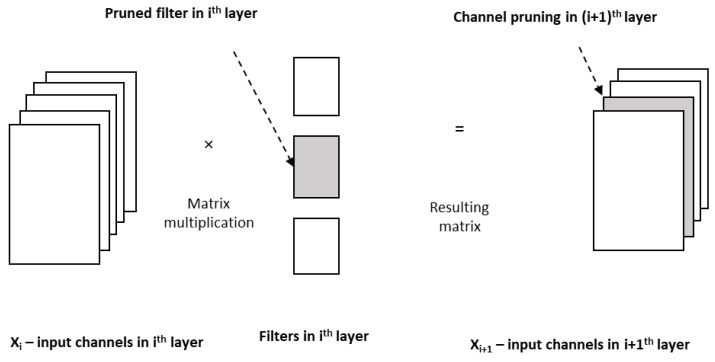
“So, filter pruning and channel pruning [48] are correlated [49].”
BackgroundEdge Intelligence: Paving the Last Mile of Artificial Intelligence With Edge Computing
Zhou, Z., Chen, X., Li, E., Zeng, L., Luo, K., & Zhang, J. (2019) · Proceedings of the IEEE · doi:10.1109/jproc.2019.2918951 · Cited by 2,455
ThiNet: A Filter Level Pruning Method for Deep Neural Network Compression
Luo, J.-H., Wu, J., & Lin, W. (2017) · 2017 IEEE International Conference on Computer Vision (ICCV) · doi:10.1109/iccv.2017.541 · Cited by 1,832
Automated Machine Learning: Methods, Systems, Challenges
(2019) · The Springer Series on Challenges in Machine Learning · doi:10.1007/978-3-030-05318-5 · Cited by 1,485
Learning both Weights and Connections for Efficient Neural Networks
Han, S., Pool, J., Tran, J., & Dally, W. J. (2015) · arXiv · doi:10.48550/arxiv.1506.02626 · Cited by 1,481 · cited 2×
“For example, in [45], the authors reduced the number of parameters of AlexNet from 61 million to 6.”
BackgroundFeurer, M., & Hutter, F. (2019) · The Springer Series on Challenges in Machine Learning · doi:10.1007/978-3-030-05318-5_1 · Cited by 1,414
A Survey on Federated Learning Systems: Vision, Hype and Reality for Data Privacy and Protection
Li, Q., Wen, Z., Wu, Z., Hu, S., Wang, N., Li, Y., Liu, X., & He, B. (2023) · IEEE Transactions on Knowledge and Data Engineering · doi:10.1109/tkde.2021.3124599 · Cited by 1,407 · cited 2×
“The works [19,20,25,26] presented a survey with a specific focus on federated learning.”
BackgroundDeep Learning with Limited Numerical Precision
Gupta, S., Agrawal, A., Gopalakrishnan, K., & Narayanan, P. (2015) · arXiv · doi:10.48550/arxiv.1502.02551 · Cited by 1,364 · cited 2×
“[50], the authors demonstrated that the accuracy of the deep neural network is not influenced when the 32-bit floating point values of weights are trimmed to 16-bit fixed point n mbers whe image classification has been performed using th MNIST database [51] and CIFAR10 database [52].”
MethodFBNet: Hardware-Aware Efficient ConvNet Design via Differentiable Neural Architecture Search
Wu, B., Keutzer, K., Dai, X., Zhang, P., Wang, Y., Sun, F., Wu, Y., Tian, Y., Vajda, P., & Jia, Y. (2019) · 2019 IEEE/CVF Conference on Computer Vision and Pattern Recognition (CVPR) · doi:10.1109/cvpr.2019.01099 · Cited by 1,261
An Overview on Edge Computing Research
Cao, K., Liu, Y., Meng, G., & Sun, Q. (2020) · IEEE Access · doi:10.1109/access.2020.2991734 · Cited by 1,254
Edge Intelligence: The Confluence of Edge Computing and Artificial Intelligence
Deng, S., Zhao, H., Fang, W., Yin, J., Dustdar, S., & Zomaya, A. Y. (2020) · IEEE Internet of Things Journal · doi:10.1109/jiot.2020.2984887 · Cited by 1,147
Federated learning on non-IID data: A survey
Zhu, H., Xu, J., Liu, S., & Jin, Y. (2021) · Neurocomputing · doi:10.1016/j.neucom.2021.07.098 · Cited by 1,062
Fog Computing: Helping the Internet of Things Realize Its Potential
Dastjerdi, A. V., & Buyya, R. (2016) · Computer · doi:10.1109/mc.2016.245 · Cited by 1,047
Compressing Neural Networks with the Hashing Trick
Chen, W., Wilson, J. T., Tyree, S., Weinberger, K. Q., & Chen, Y. (2015) · arXiv · doi:10.48550/arxiv.1504.04788 · Cited by 974
Federated Learning for Internet of Things: Recent Advances, Taxonomy, and Open Challenges
Khan, L. U., Saad, W., Han, Z., Hossain, E., & Hong, C. S. (2021) · IEEE Communications Surveys & Tutorials · doi:10.1109/comst.2021.3090430 · Cited by 892
Elsken, T., Metzen, J. H., & Hutter, F. (2019) · The Springer Series on Challenges in Machine Learning · doi:10.1007/978-3-030-05318-5_3 · Cited by 785
Wang, L., & Yoon, K.-J. (2022) · IEEE Transactions on Pattern Analysis and Machine Intelligence · doi:10.1109/tpami.2021.3055564 · Cited by 752
Federated Learning: A Survey on Enabling Technologies, Protocols, and Applications
Aledhari, M., Razzak, R., Parizi, R. M., & Saeed, F. (2020) · IEEE Access · doi:10.1109/access.2020.3013541 · Cited by 733 · cited 2×
“Federated learning is more appropriate for utilizing low-costing machine learning models on devices and sensors [28]”
MethodPersonalized Cross-Silo Federated Learning on Non-IID Data
Huang, Y., Chu, L., Zhou, Z., Wang, L., Liu, J., Pei, J., & Zhang, Y. (2021) · Proceedings of the AAAI Conference on Artificial Intelligence · doi:10.1609/aaai.v35i9.16960 · Cited by 723
A Comprehensive Overhaul of Feature Distillation
Heo, B., Kim, J., Yun, S., Park, H., Kwak, N., & Choi, J. Y. (2019) · 2019 IEEE/CVF International Conference on Computer Vision (ICCV) · doi:10.1109/iccv.2019.00201 · Cited by 706
Low-rank matrix factorization for Deep Neural Network training with high-dimensional output targets
Sainath, T. N., Kingsbury, B., Sindhwani, V., Arisoy, E., & Ramabhadran, B. (2013) · 2013 IEEE International Conference on Acoustics, Speech and Signal Processing · doi:10.1109/icassp.2013.6638949 · Cited by 593 · cited 2×
“[63], matrix decomposition has been employed for the weight matrix between the hidden and output layer with the intention to arrive at low-rank weight matrix, which in turn speeds up the performance of the neural network.”
MethodEdge Machine Learning for AI-Enabled IoT Devices: A Review
Merenda, M., Porcaro, C., & Iero, D. (2020) · Sensors · doi:10.3390/s20092533 · Cited by 523
Communication-efficient edge ai: algorithms and systems
Shi, Y., Yang, K., Jiang, T., Zhang, J., & Letaief, K. B. (2020) · IEEE Communications Surveys & Tutorials · doi:10.1109/comst.2020.3007787 · Cited by 488
Gradient-Based Optimization of Hyperparameters
Bengio, Y. (2000) · Neural Computation · doi:10.1162/089976600300015187 · Cited by 466
Incremental Network Quantization: Towards Lossless CNNs with Low-Precision Weights
Zhou, A., Yao, A., Guo, Y., Xu, L., & Chen, Y. (2017) · arXiv (Cornell University) · doi:10.48550/arxiv.1702.03044 · Cited by 439
A Survey of Recent Advances in Edge-Computing-Powered Artificial Intelligence of Things
Chang, Z., Liu, S., Xiong, X., Cai, Z., & Tu, G. (2021) · IEEE Internet of Things Journal · doi:10.1109/jiot.2021.3088875 · Cited by 418
Privacy preservation in federated learning: An insightful survey from the GDPR perspective
Truong, N., Sun, K., Wang, S., Guitton, F., & Guo, Y. (2021) · Computers & Security · doi:10.1016/j.cose.2021.102402 · Cited by 399
Lian, X., Zhang, C., Zhang, H., Hsieh, C., Zhang, W., & Liu, J. (2017) · arXiv (Cornell University) · doi:10.48550/arxiv.1705.09056 · Cited by 395
Federated Learning in Edge Computing: A Systematic Survey
Abreha, H. G., Hayajneh, M., & Serhani, M. A. (2022) · Sensors · doi:10.3390/s22020450 · Cited by 342
Survey of Personalization Techniques for Federated Learning
Kulkarni, V., Kulkarni, M., & Pant, A. (2020) · 2020 Fourth World Conference on Smart Trends in Systems, Security and Sustainability (WorldS4) · doi:10.1109/worlds450073.2020.9210355 · Cited by 338
A survey on application of machine learning for Internet of Things
Cui, L., Yang, S., Chen, F., Ming, Z., Lu, N., & Qin, J. (2018) · International Journal of Machine Learning and Cybernetics · doi:10.1007/s13042-018-0834-5 · Cited by 293
Population Based Training of Neural Networks
Jaderberg, M., Dalibard, V., Osindero, S., Czarnecki, W. M., Donahue, J., Razavi, A., Vinyals, O., Green, T., Dunning, I., Simonyan, K., et al. (2017) · arXiv · doi:10.48550/arxiv.1711.09846 · Cited by 284
A survey of federated learning for edge computing: Research problems and solutions
Xia, Q., Ye, W., Tao, Z., Wu, J., & Li, Q. (2021) · High-Confidence Computing · doi:10.1016/j.hcc.2021.100008 · Cited by 279
IEEE 802.11AH: the WiFi approach for M2M communications
Adame, T., Bel, A., Bellalta, B., Barcelo, J., & Oliver, M. (2014) · IEEE Wireless Communications · doi:10.1109/mwc.2014.7000982 · Cited by 268
Liu, L., Zhu, J., Li, Z., Lu, Y., Deng, Y., Han, J., Yin, S., & Wei, S. (2020) · ACM Computing Surveys · doi:10.1145/3357375 · Cited by 244
(2016) · Lecture Notes in Computer Science · doi:10.1007/978-3-319-46454-1 · Cited by 236
Capra, M., Bussolino, B., Marchisio, A., Masera, G., Martina, M., & Shafique, M. (2020) · IEEE Access · doi:10.1109/access.2020.3039858 · Cited by 222
A case for exploiting subarray-level parallelism (SALP) in DRAM
Kim, Y., Seshadri, V., Lee, D., Liu, J., & Mutlu, O. (2012) · 2012 39th Annual International Symposium on Computer Architecture (ISCA) · doi:10.1109/isca.2012.6237032 · Cited by 220
Quantization and Deployment of Deep Neural Networks on Microcontrollers
Novac, P.-E., Boukli Hacene, G., Pegatoquet, A., Miramond, B., & Gripon, V. (2021) · Sensors · doi:10.3390/s21092984 · Cited by 210
AutoCompress: An Automatic DNN Structured Pruning Framework for Ultra-High Compression Rates
Liu, N., Ma, X., Xu, Z., Wang, Y., Tang, J., & Ye, J. (2020) · Proceedings of the AAAI Conference on Artificial Intelligence · doi:10.1609/aaai.v34i04.5924 · Cited by 202
Umair, M., Cheema, M. A., Cheema, O., Li, H., & Lu, H. (2021) · Sensors · doi:10.3390/s21113838 · Cited by 192
Edge Computing: A Survey On the Hardware Requirements in the Internet of Things World
Capra, M., Peloso, R., Masera, G., Roch, M. R., & Martina, M. (2019) · Future Internet · doi:10.3390/fi11040100 · Cited by 189
Network Quantization with Element-wise Gradient Scaling
Lee, J., Kim, D., & Ham, B. (2021) · IEEE Computer Society Conference on Computer Vision and Pattern Recognition/Proceedings - IEEE Computer Society Conference on Computer Vision and Pattern Recognition/Proceedings · doi:10.1109/cvpr46437.2021.00638 · Cited by 182
Fan, K., Ren, Y., Wang, Y., Li, H., & Yang, Y. (2018) · IET Communications · doi:10.1049/iet-com.2017.0619 · Cited by 177 · cited 1×
“Lightweight, reliable encryption techniques are required for edge devices, and such solutions should be efficient enough to be integrated with an edge, 5G, and other emerging technologies [106].”
BackgroundA review of optimization methods for computation offloading in edge computing networks
Sadatdiynov, K., Cui, L., Zhang, L., Huang, J. Z., Salloum, S., & Mahmud, M. S. (2022) · Digital Communications and Networks · doi:10.1016/j.dcan.2022.03.003 · Cited by 176
A survey on deep transfer learning to edge computing for mitigating the COVID-19 pandemic
Sufian, A., Ghosh, A., Sadiq, A. S., & Smarandache, F. (2020) · Journal of Systems Architecture · doi:10.1016/j.sysarc.2020.101830 · Cited by 156 · cited 3×
“[36,37] Discuss about the difficulty in the direct implementation of deep learning models and propose deep transfer learning as an alternate”
BackgroundFederated Learning for Edge Computing: A Survey
Brecko, A., Kajati, E., Koziorek, J., & Zolotova, I. (2022) · Applied Sciences · doi:10.3390/app12189124 · Cited by 154
Performance Analysis and CPU vs GPU Comparison for Deep Learning
Buber, E., & Diri, B. (2018) · International Conference on Control, Engineering & Information Technology · doi:10.1109/ceit.2018.8751930 · Cited by 138
SmartShuttle: Optimizing off-chip memory accesses for deep learning accelerators
Li, J., Yan, G., Lü, W., Jiang, S., Gong, S., Wu, J., & Li, X. (2018) · Design, Automation, and Test in Europe · doi:10.23919/date.2018.8342033 · Cited by 115
Knowledge distillation in deep learning and its applications
Alkhulaifi, A., Alsahli, F., & Ahmad, I. (2021) · PeerJ Computer Science · doi:10.7717/peerj-cs.474 · Cited by 115
An Efficient Statistical-based Gradient Compression Technique for Distributed Training SystemsPreprint
Abdelmoniem, A. M., Elzanaty, A., Alouini, M., & Canini, M. (2021) · arXiv (Cornell University) · doi:10.48550/arxiv.2101.10761 · Cited by 107
Fed2: Feature-Aligned Federated Learning
Yu, F., Zhang, W., Qin, Z., Xu, Z., Wang, D., Liu, C., Tian, Z., & Chen, X. (2021) · ACM SIGKDD Conference on Knowledge Discovery and Data Mining (KDD) · doi:10.1145/3447548.3467309 · Cited by 106
Artificial Intelligence in the IoT Era: A Review of Edge AI Hardware and Software
Sipola, T., Alatalo, J., Kokkonen, T., & Rantonen, M. (2022) · 2022 31st Conference of Open Innovations Association (FRUCT) · doi:10.23919/fruct54823.2022.9770931 · Cited by 100
Loss-aware Weight Quantization of Deep Networks
Hou, L., & Kwok, J. T. (2018) · arXiv · doi:10.48550/arxiv.1802.08635 · Cited by 99
AI Based Energy Efficient Routing Protocol for Intelligent Transportation System
Goswami, P., Mukherjee, A., Hazra, R., Yang, L., Ghosh, U., Qi, Y., & Wang, H. (2021) · IEEE Transactions on Intelligent Transportation Systems · doi:10.1109/tits.2021.3107527 · Cited by 93
FBNet: Hardware-Aware Efficient ConvNet Design via Differentiable Neural Architecture SearchPreprint
Wu, B., Dai, X., Zhang, P., et al. (2018) · arXiv (Cornell University) · doi:10.48550/arxiv.1812.03443 · Cited by 89
Lee, Y.-L., Tsung, P.-K., & Wu, M. (2018) · 2018 International Symposium on VLSI Design, Automation and Test (VLSI-DAT) · doi:10.1109/vlsi-dat.2018.8373244 · Cited by 88
On-edge multi-task transfer learning: model and practice with data-driven task allocation
Chen, Q., Zheng, Z., Hu, C., Wang, D., & Liu, F. (2020) · IEEE Transactions on Parallel and Distributed Systems · doi:10.1109/tpds.2019.2962435 · Cited by 88
An Approach for Peer-to-Peer Federated Learning
Wink, T., & Nochta, Z. (2021) · International Conference on Dependable Systems and Networks workshops · doi:10.1109/dsn-w52860.2021.00034 · Cited by 85
Explicit Loss-Error-Aware Quantization for Low-Bit Deep Neural Networks
Zhou, A., Yao, A., Wang, K., & Chen, Y. (2018) · 2018 IEEE/CVF Conference on Computer Vision and Pattern Recognition · doi:10.1109/cvpr.2018.00982 · Cited by 84
Compressing deep neural networks using a rank-constrained topology
Nakkiran, P., Álvarez, R., Prabhavalkar, R., & Parada, C. (2015) · Interspeech (USB) · doi:10.21437/interspeech.2015-351 · Cited by 83
Nayak, S., Patgiri, R., Waikhom, L., & Ahmed, A. (2024) · Digital Communications and Networks · doi:10.1016/j.dcan.2022.10.016 · Cited by 81
A Generalized Framework for Population Based Training
Li, A., Spyra, O., Perel, S., Dalibard, V., Jaderberg, M., Gu, C., Budden, D., Harley, T., & Gupta, P. (2019) · ACM SIGKDD Conference on Knowledge Discovery and Data Mining (KDD) · doi:10.1145/3292500.3330649 · Cited by 80
Memory-Efficient Learning for Large-Scale Computational Imaging
Kellman, M., Zhang, K., Markley, E., Tamir, J. I., Bostan, E., Lustig, M. S., & Waller, L. (2020) · IEEE Transactions on Computational Imaging · doi:10.1109/tci.2020.3025735 · Cited by 79
Federated Learning Algorithm Based on Knowledge Distillation
Jiang, D., Chen, S., & Zhang, Z. (2020) · International Conference on Artificial Intelligence and Computer Engineering (ICAICE) · doi:10.1109/icaice51518.2020.00038 · Cited by 70
Review of second-order optimization techniques in artificial neural networks backpropagation
Tan, H. H., & Lim, K. H. (2019) · IOP Conference Series Materials Science and Engineering · doi:10.1088/1757-899x/495/1/012003 · Cited by 65
Dutta, A., Bergou, E. H., Abdelmoniem, A. M., Ho, C.-Y., Sahu, A. N., Canini, M., & Kalnis, P. (2020) · Proceedings of the AAAI Conference on Artificial Intelligence · doi:10.1609/aaai.v34i04.5793 · Cited by 61
An Evolutionary Secure Energy Efficient Routing Protocol in Internet of Things
Maddikunta, P. K. R., & Babu, M. R. (2017) · International journal of intelligent engineering and systems · doi:10.22266/ijies2017.0630.38 · Cited by 51
Performance Evaluation of Integrated Multi-Access Edge Computing and Fiber-Wireless Access Networks
Liu, J., Shou, G., Liu, Y., Hu, Y., & Guo, Z. (2018) · IEEE Access · doi:10.1109/access.2018.2833619 · Cited by 51
Energy-efficient deep learning inference on edge devices
Daghero, F., Pagliari, D. J., & Poncino, M. (2020) · Advances in computers · doi:10.1016/bs.adcom.2020.07.002 · Cited by 49
Variance-based Gradient Compression for Efficient Distributed Deep Learning
Tsuzuku, Y., Imachi, H., & Akiba, T. (2018) · arXiv (Cornell University) · doi:10.48550/arxiv.1802.06058 · Cited by 48
Putra, R. V. W., Hanif, M. A., & Shafique, M. (2021) · IEEE Transactions on Very Large Scale Integration (VLSI) Systems · doi:10.1109/tvlsi.2021.3060509 · Cited by 46
Edge intelligence computing for mobile augmented reality with deep reinforcement learning approach
Chen, M., Liu, W., Wang, T., Liu, A., & Zeng, Z. (2021) · Computer Networks · doi:10.1016/j.comnet.2021.108186 · Cited by 45
Optimal Gradient Checkpoint Search for Arbitrary Computation Graphs
Feng, J., & Huang, D. (2021) · IEEE Computer Society Conference on Computer Vision and Pattern Recognition/Proceedings - IEEE Computer Society Conference on Computer Vision and Pattern Recognition/Proceedings · doi:10.1109/cvpr46437.2021.01127 · Cited by 45
FedLearnSP: Preserving Privacy and Security Using Federated Learning and Edge Computing
Makkar, A., Ghosh, U., Rawat, D. B., & Abawajy, J. (2021) · IEEE Consumer Electronics Magazine · doi:10.1109/mce.2020.3048926 · Cited by 44
Putra, R. V. W., Hanif, M. A., & Shafique, M. (2020) · ACM/IEEE Design Automation Conference (DAC) · doi:10.1109/dac18072.2020.9218672 · Cited by 43
Architecture of neural processing unit for deep neural networks
Lee, K. J. (2020) · Advances in computers · doi:10.1016/bs.adcom.2020.11.001 · Cited by 43
Edge Network Optimization Based on AI Techniques: A Survey
Pooyandeh, M., & Sohn, I. (2021) · Electronics · doi:10.3390/electronics10222830 · Cited by 40
Personalized Federated Learning over non-IID Data for Indoor Localization
Wu, P., Imbiriba, T., Park, J., Kim, S., & Closas, P. (2021) · IEEE International Workshop on Signal Processing Advances in Wireless Communications (SPAWC) · doi:10.1109/spawc51858.2021.9593115 · Cited by 39
A Survey Comparing Specialized Hardware And Evolution In TPUs For Neural Networks
Shahid, A., & Mushtaq, M. (2020) · IEEE International Multitopic Conference (INMIC) · doi:10.1109/inmic50486.2020.9318136 · Cited by 33
EdgeAl: A Vision for Deep Learning in the IoT Era
Bhardwaj, K., Suda, N., & Mărculescu, R. (2019) · IEEE Design and Test · doi:10.1109/mdat.2019.2952350 · Cited by 27
Optimization of Edge Resources for Deep Learning Application with Batch and Model Management
Kum, S., Oh, S., Yeom, J., & Moon, J. (2022) · Sensors · doi:10.3390/s22176717 · Cited by 27
Krouka, M., Elgabli, A., Issaid, C. B., & Bennis, M. (2022) · IEEE Transactions on Green Communications and Networking · doi:10.1109/tgcn.2022.3173420 · Cited by 26
An efficient pruning scheme of deep neural networks for Internet of Things applications
Chen, Q., Shen, S., Li, R., Zhao, Z., Liu, Q., Liang, J., & Zhang, H. (2021) · EURASIP Journal on Advances in Signal Processing · doi:10.1186/s13634-021-00744-4 · Cited by 24
Algorithm/Accelerator Co-Design and Co-Search for Edge AI
Zhang, X., Li, Y., Pan, J., & Chen, D. (2022) · IEEE Transactions on Circuits & Systems II Express Briefs · doi:10.1109/tcsii.2022.3179229 · Cited by 22
Optimizing Off-Chip Memory Access for Deep Neural Network Accelerator
Zheng, Y., Yang, H., Shu, Y., Jia, Y., & Huang, Z. (2022) · IEEE Transactions on Circuits & Systems II Express Briefs · doi:10.1109/tcsii.2022.3150030 · Cited by 20
Deep Neural Network Model and FPGA Accelerator Co-Design: Opportunities and Challenges
Hao, C., & Chen, D. (2018) · 2018 14th IEEE International Conference on Solid-State and Integrated Circuit Technology (ICSICT) · doi:10.1109/icsict.2018.8564956 · Cited by 19 · cited 2×
“In this approach, both algorithm design alternatives and accelerator design alternatives are tried simultaneously to achieve the optimized solution, which has been discussed for the first time in [76].”
MethodA Partition Based Gradient Compression Algorithm for Distributed Training in AIoT
Guo, B., Liu, Y., & Zhang, C. (2021) · Sensors · doi:10.3390/s21061943 · Cited by 19
Heterogeneous Federated Learning Through Multi-Branch Network
Wang, C.-H., Huang, K.-Y., Chen, J.-C., Shuai, H.-H., & Cheng, W.-H. (2021) · IEEE International Conference on Multimedia and Expo (ICME) · doi:10.1109/icme51207.2021.9428189 · Cited by 16
RoCo-NAS: Robust and Compact Neural Architecture Search
Geraeinejad, V., Sinaei, S., Modarressi, M., & Daneshtalab, M. (2021) · International Joint Conference on Neural Networks (IJCNN) · doi:10.1109/ijcnn52387.2021.9534460 · Cited by 14
Channel Estimation and Equalization Algorithms for Long Range Bluetooth Signal Reception
Held, I., & Chen, A. (2010) · IEEE Vehicular Technology Conference · doi:10.1109/vetecs.2010.5493918 · Cited by 7
Re-training and parameter sharing with the Hash trick for compressing convolutional neural networks
Gou, X., Qing, L., Wang, Y., Xin, M., & Wang, X. (2020) · Applied Soft Computing · doi:10.1016/j.asoc.2020.106783 · Cited by 7
Neuron Manifold Distillation for Edge Deep Learning
Tao, Z., Xia, Q., & Li, Q. (2021) · International Workshop on Quality of Service · doi:10.1109/iwqos52092.2021.9521267 · Cited by 7
REAP: A Method for Pruning Convolutional Neural Networks with Performance Preservation
KAMMA, K., & Wada, T. (2020) · IEICE Transactions on Information and Systems · doi:10.1587/transinf.2020edp7049 · Cited by 6
Implementation of 16-Bit Hack CPU on FPGA
Kumar, S., Sharma, P., Shenoy, K. P., Naik, S. S., & Lewis, A. S. (2020) · International Conference on Intelligent Computing and Control Systems (ICICCS) · doi:10.1109/iciccs48265.2020.9120991 · Cited by 4
Network Compression via Cooperative Architecture Search and Distillation
Xue, F., & Xin, J. X. (2021) · International Conference on Artificial Intelligence for Industries (AI4I) · doi:10.1109/ai4i51902.2021.00018 · Cited by 2
Research works printed but not linked: 9
- Hsu, T.M.-H., Qi, H., and Brown, M. (2019). Measuring the effects of nonidentical data distribution for federated visual classification. arXiv.
- Li, D., and Wang, J. (2019). FedMD: Heterogenous federated learning via model distillation. arXiv.
- Courbariaux, M., Hubara, I., Soudry, D., El-Yaniv, R., and Bengio, Y. (2016). Binarized Neural Networks: Training Neural Networks with Weights and Activations Constrained to +1 or −1. arXiv.
- Burges, C.J., Bottou, L., Welling, M., Ghahramani, Z., and Weinberger, K.Q. (2013). Advances in Neural Information Processing Systems 26 (NIPS 2013), Proceedings of the Advances in Neural Information Processing Systems 26 (NIPS 2013), Lake Tahou, NV, USA, 5–10 December 2013, Curran Associates Inc.
- Van Leeuwen, J. (1976, January 20–23). On the construction of huffman trees. Proceedings of the Third International Colloquium on Automata, Languages and Programming, Edinburgh, UK.
- Sun, X., Wang, N., Chen, C.-y., Ni, J.-M., Agrawal, A., Cui, X., Venkataramani, S., El Maghraoui, K., Srinivasan, V., and Gopalakrishnan, K. (2020, January 6–12). Ultra-low precision 4-bit training of deep neural networks. Proceedings of the 34th International Conference on Neural Information Processing Systems, Vancouver, BC, Canada.
- Hutter, F., Kotthoff, L., and Vanschoren, J. (2019). Automated Machine Learning, Springer. · DOI · Paper page
- Alkadhmawee, 2016, An energy-efficient heuristic based routing protocol in wireless sensor networks, Int. J. Innov. Res. Inf. Secur., 3, 5
- Pleiss, G., Chen, D., Huang, G., Li, T., van der Maaten, L., and Weinberger, Q. (2017). Memory-Efficient Implementation of DenseNets. arXiv.
Cited by
Singh, R., & Gill, S. S. (2023) · Internet of Things and Cyber-Physical Systems · doi:10.1016/j.iotcps.2023.02.004 · Cited by 572
Fahim, Y. A., Hasani, I. W., Kabba, S., & Ragab, W. M. (2025) · European Journal of Medical Research · doi:10.1186/s40001-025-03196-w · Cited by 329
“Together, these approaches reduce latency, improve efficiency, and enhance the responsiveness of intelligent healthcare systems [146].”
Towards sustainable AI: a comprehensive framework for Green AI
Tabbakh, A., Al Amin, L., Islam, M., Mahmud, G. M. I., Chowdhury, I. K., & Mukta, M. S. H. (2024) · Discover Sustainability · doi:10.1007/s43621-024-00641-4 · Cited by 111
Deploying AI on Edge: Advancement and Challenges in Edge Intelligence
Wang, T., Guo, J., Zhang, B., Yang, G., & Li, D. (2025) · Mathematics · doi:10.3390/math13111878 · Cited by 121
AI and Computing Horizons: Cloud and Edge in the Modern Era
Prangon, N. F., & Wu, J. (2024) · Journal of Sensor and Actuator Networks · doi:10.3390/jsan13040044 · Cited by 82
Metadata
- Authors
- Surianarayanan, C., Lawrence, J. J., Chelliah, P. R., Prakash, E., & Hewage, C.
- Affiliations
- Bharathidasan University (IN)
- Cardiff Metropolitan University (GB)
- Edge AI Division, Reliance Jio Platforms Ltd., Bangalore 560103, Karnataka, India
- University for the Creative Arts (GB)
- Corresponding author
- Surianarayanan, Chellammal
- Venue
- Sensors
- Publisher
- MDPI AG
- Published
- 2023-01-22
- Volume
- 23
- Issue
- 3
- Pages
- 1279
- ISSN
- 1424-8220 (ISSN-L)
- PMC
- PMC9919555
- OpenAlex
- W4317727238
- Cited by
- 131
- References
- 95
- Citations by year
- 2026: 46 · 2025: 43 · 2024: 25 · 2023: 17
- FWCI
- 3.40
- Type
- journal article
- Language
- en
- Open access
- gold
- doi.org
- Licence
- Locations
- Sensors (publishedVersion, cc-by)
- PubMed Central (publishedVersion, cc-by)
- PubMed (publishedVersion)
- DOAJ (DOAJ: Directory of Open Access Journals) (submittedVersion, cc-by-sa)
- Figshare (submittedVersion, cc-by)
- Topics
- Physical Sciences › Computer Science › Computer Vision and Pattern Recognition › Advanced Neural Network Applications
- Physical Sciences › Computer Science › Computer Networks and Communications › IoT and Edge/Fog Computing
- Physical Sciences › Computer Science › Information Systems › Internet of Things and AI
- Keywords
- edge AI, model compression, lightweight AI models, IoT devices, on-device processing, real-time inference, optimization framework, energy efficiency
About these checks
Registry, retraction, Cites and statistics results are computed, not judged, with one exception: a printed reference that no index lists is read once by a model before it counts as a citation error. Claims are extracted by a model and kept only when their quote appears verbatim in the text; each cited source is then checked, with a model’s help, for whether it says what the claim relies on. Those verdicts can be wrong — read the claim’s quote and the cited source before relying on one.
Statistics and arithmetic are recomputed, not judged.
Confidence bands are shown only for fields calibrated on our annotated test set. None is calibrated yet, so no band is shown.
What counts as a claim ›How we measure confidence ›How we check this ›
Are you an author, or do you see a problem with this page? Request a review
Data sources
Bibliographic data: Semantic Scholar, OpenAlex, Crossref.
Contains information from the Semantic Scholar Academic Graph Datasets, made available under the ODC Attribution License (ODC-BY 1.0).
Semantic Scholar’s data is described in: Kinney, R., et al. (2023). The Semantic Scholar Open Data Platform. arXiv:2301.10140.
