

Sustainable Curriculum Planning for Artificial Intelligence Education: A Self-Determination Theory Perspective
Open accessThe DOI matches its Crossref record; 32 of the 32 references it cites were found in a registry or an index.
Abstract
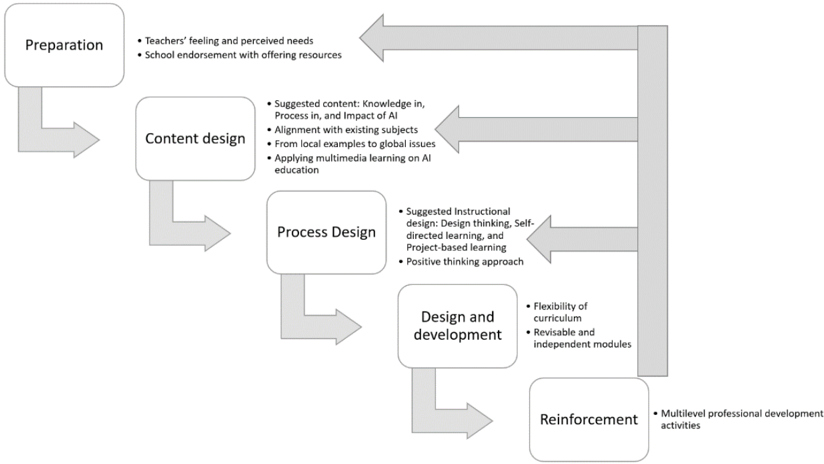
The teaching of artificial intelligence (AI) topics in school curricula is an important global strategic initiative in educating the next generation. As AI technologies are new to K-12 schools, there is a lack of studies that inform schools’ teachers about AI curriculum design. How to prepare and engage teachers, and which approaches are suitable for planning the curriculum for sustainable development, are unclear. Therefore, this case study aimed to explore the views of teachers with and without AI teaching experience on key considerations for the preparation, implementation and continuous refinement of a formal AI curriculum for K-12 schools. It drew on the self-determination theory (SDT) and four basic curriculum planning approaches—content, product, process and praxis—as theoretical frameworks to explain the research problems and findings. We conducted semi-structured interviews with 24 teachers—twelve with and twelve without experience in teaching AI—and used thematic analysis to analyze the interview data. Our findings revealed that genuine curriculum creation should encompass all four forms of curriculum design approach that are coordinated by teachers’ self-determination to be orchestrators of student learning experiences. This study also proposed a curriculum development cycle for teachers and curriculum officers.
Overview
The claims and statistics of this paper haven’t been checked yet.
Free: it reads the open-access text and checks the first 5 claims that cite a source we can check. Create a free account to check every claim.
Integrity signals
Registry
Cites
Statistics
Figures

Verification
Claims the paper makes
The claims and statistics of this paper haven’t been checked yet.
Free: it reads the open-access text and checks the first 5 claims that cite a source we can check. Create a free account to check every claim.
Claims other papers make about this one
Each is checked against this paper’s own text: does it say what the citing paper says it does?
The cited source doesn’t support the claim as written.
In the citing paper
“Teachers are key players for the integration of AI literacy in K-12, as proven by the numerous studies that examine this issue”
From AI literacy in K-12: a systematic literature review (2023) · cites this paper as Chiu & Chai, 2020
Checked by a reasoning model — may be wrong.
Experimental — accuracy not yet measuredThe source backs part of the claim, not all of it — or backs it for a different population, condition or comparison.
In the citing paper
“Although AI education in schools has become a global initiative, it is not seen as a traditional core subject, such as language, mathematics, and science (Chiu & Chai, 2020).”
From The impact of Generative AI (GenAI) on practices, policies and research direction in education: a case of ChatGPT and Midjourney (2024) · cites this paper as Chiu & Chai, 2020
Experimental — accuracy not yet measuredThe cited source says what the claim attributes to it.
In the citing paper
“Furthermore, the initial version of the instrument was developed by adapting a list of prior research such as Chiu & Chai (2020, Ng & Chu, 2021)'s and Ng & Chu (2021)'s questionnaire, the Motivational Strategies for Learning Questionnaire (MSLQ), Park et al. (2012)'s behavioural intention, Song and Keller (1999)'s confidence scale and ethical guidelines (Jobin et al., 2019;Microsoft, 2023).”
From Design and validation of the AI literacy questionnaire: The affective, behavioural, cognitive and ethical approach (2024) · cites this paper as Chiu & Chai (2020)
The check wasn’t confident either way, so it gives no verdict — never disputed.
In the citing paper
“Only a few of the studies have validated their questionnaires and even less retested them to ensure reliability in other settings (Chai et al., 2021;Chiu & Chai., 2020;Dai et al., 2020).”
From Design and validation of the AI literacy questionnaire: The affective, behavioural, cognitive and ethical approach (2024) · cites this paper as Chiu & Chai., 2020
Experimental — accuracy not yet measured
Self-check
Percentages, sums and reported differences re-computed from the paper’s own numbers.
The self-check needs the paper’s full text.
Citations
Cites
Using thematic analysis in psychology
Braun, V., & Clarke, V. (2006) · Qualitative Research in Psychology · doi:10.1191/1478088706qp063oa · Cited by 194,414 · cited 1×
“This offers a useful method for working within a participatory research paradigm to inform policy/curriculum development [21].”
MethodRyan, R. M., & Deci, E. L. (2000) · American Psychologist · doi:10.1037//0003-066x.55.1.68 · Cited by 54,599 · cited 4×
“This motivational process can be explained by the self-determination theory (SDT), which provides a theoretical framework to explain the teachers’ fundamental psychological needs—autonomy, relatedness and competence—for educational innovation [11,12].”
BackgroundMethodInfluentialZawacki-Richter, O., Marín, V. I., Bond, M., & Gouverneur, F. (2019) · International Journal of Educational Technology in Higher Education · doi:10.1186/s41239-019-0171-0 · Cited by 7,242 · cited 3×
“To date, very few studies on AI school teaching have been conducted [1,5,6].”
BackgroundPurposive sampling as a tool for informant selection
Tongco, M. D. C. (2007) · Ethnobotany Research and Applications · doi:10.17348/era.5.0.147-158 · Cited by 2,597 · cited 1×
“Therefore, we used purposeful sampling [19] to make sure that participants with all the conditions were recruited (broad categorization of the academic ability of students and AI teaching experience) from the pool of 48 partnership schools.”
MethodNiemiec, C. P., & Ryan, R. M. (2009) · Theory and Research in Education · doi:10.1177/1477878509104318 · Cited by 2,542
Teachers’ Perception of STEM Integration and Education: A Systematic Literature Review
Margot, K. C., & Kettler, T. (2019) · International Journal of STEM Education · doi:10.1186/s40594-018-0151-2 · Cited by 992 · cited 3×
“Therefore, schools should take immediate actions rather than make prolonged promises [10,25], and technology teachers prefer to receive direct, rather than indirect, support [9,25].”
BackgroundResultWang, Y.-Y., & Wang, Y.-S. (2022) · Interactive Learning Environments · doi:10.1080/10494820.2019.1674887 · Cited by 716 · cited 2×
“As machine learning becomes more powerful and narrow AI are performing more jobs, AI technologies and products are replacing jobs such as cashiers and proofreaders [17].”
BackgroundAchieving Saturation in Thematic Analysis: Development and Refinement of a Codebook
Ando, H., Cousins, R., & Young, C. (2014) · Comprehensive Psychology · doi:10.2466/03.cp.3.4 · Cited by 577 · cited 1×
“The sample size of 24 has been recommended by Ando, Cousins and Young [20] as sufficient to generate codes for thematic analysis.”
MethodHopes and fears for intelligent machines in fiction and reality
Cave, S., & Dihal, K. (2019) · Nature Machine Intelligence · doi:10.1038/s42256-019-0020-9 · Cited by 355 · cited 1×
“This is supported by the studies that generally find that peoples’ perceived worries of loss of control of AI, ethical concerns about AI and the negative impact of AI on work have grown in recent years [18,28].”
ResultWhat do engineering students learn in sustainability courses? The effect of the pedagogical approach
Segalàs, J., Ferrer-Balas, D., & Mulder, K. F. (2010) · Journal of Cleaner Production · doi:10.1016/j.jclepro.2009.09.012 · Cited by 302 · cited 1×
“This approach supports different types of students to better understand the complex world of AI by ensuring the participation of more students [34].”
Background
Research works printed but not linked: 1
- Glatthorn, A.A.; Boschee, F.; Whitehead, B.M.; Boschee, B.F. Curriculum Leadership: Strategies for Development and Implementation; SAGE: London, UK, 2018.
Cited by
Items 301–400 of 586
Ma, Q. (2025) · International Symposium on Innovative Approaches in Smart Technologies (ISAS) · doi:10.1109/isas66241.2025.11101814 · Cited by 3
“The educational systems can personalise their teaching methods and content by taking advantage of this capability to cater to each student’s needs and thus increase the efficacy and engagement towards the learning process [4][5].”
Clorion, F. D. D., Buatona, J. G., Estigoy, E. B., Gray, S. Z., Hu, X., Gamieldien, Y., Sun, X., & Zhang, Y. (2025) · Procedia Computer Science · doi:10.1016/j.procs.2025.07.175 · Cited by 3
Jogezai, N. A., Jaffar, M., Baloch, F. A., & Khilji, G. K. (2025) · International Journal of Information and Learning Technology · doi:10.1108/ijilt-10-2024-0229 · Cited by 3
Examining the Potential Benefits and Ethical Risks of GenAI in Lesson Planning: A TAM Approach
Estocapio, V., Bilog, R. M., Cacananta, J., Corpuz, J. M., Ibasan, B., Paneda, S., & Asuncion, R. J. R. (2025) · Journal of Teaching and Learning · doi:10.22329/jtl.v19i4.10056 · Cited by 3
Yu, H., Verspoor, M. H., & Peng, H. (2026) · Innovation in Language Learning and Teaching · doi:10.1080/17501229.2026.2618187 · Cited by 4
Mobile Professional Development for STEM Teachers Using AI
Shal, T., Ghamrawi, N., Ghamrawi, N. A. R., Abu-Tineh, A. M. H., & Alshaboul, Y. M. K. (2026) · Computers in the Schools · doi:10.1080/07380569.2026.2622712 · Cited by 4
Juma, L., Chavula, P., Kayusi, F., & Vallejo, R. G. (2026) · Región Científica · doi:10.58763/rc2026531 · Cited by 3
Alé-Silva, J., & Rodríguez-Donoso, M. (2026) · Discover Education · doi:10.1007/s44217-026-01131-7 · Cited by 3
Kaya, D., & Durak, H. Y. (2026) · European Journal of Psychology of Education · doi:10.1007/s10212-026-01085-2 · Cited by 5
Bhatta, R. P. (2026) · International Journal of Scientific Research in Computer Science Engineering and Information Technology · doi:10.32628/cseit26121335 · Cited by 3
Are university teachers ready for AI under anxiety? Self-efficacy mediation and gender moderation
Wu, H., Wenfu, L., He, J., & Wu, T. (2026) · Interactive Learning Environments · doi:10.1080/10494820.2026.2643795 · Cited by 5
“This psychological thwarting diminishes intrinsic motivation, leading to a form of amotivation where the teacher fails to develop the preparatory behaviours necessary for integration (Chiu & Chai, 2020).”
Lin, Q., Zhou, Q., Long, Q., Zhu, M., & Ma, H. (2026) · Education and Information Technologies · doi:10.1007/s10639-026-14036-7 · Cited by 5
Yaman, M. S., ÇAKIR, Z., Çatıkkaş, F., Türkmen, M., Şengönül, A., GÖNEN, M., Öktem, T., Güzel, S., & Yel, K. (2026) · SAGE Open · doi:10.1177/21582440261482059 · Cited by 3
Nguyen, H. T., & Tran, V.-T. (2023) · Revista de Gestão e Secretariado (Management and Administrative Professional Review) · doi:10.7769/gesec.v14i11.2914 · Cited by 5
“By staying informed about the latest research, teaching methodologies, and child development theories, educators can better understand the needs and interests of their students (Chiu & Chai, 2020; Knowles et al., 2014; Taylor & Boyer, 2020).”
BackgroundChen, Y., & Zhang, M. (2023) · International Conference on E-business, Management and Economics (ICEME) · doi:10.1145/3616712.3616715 · Cited by 3
“For example, by combining AI technology with the fields of psychology, education, and sociology, many AI teaching application apps have been developed, such as intelligent guidance systems [20].”
MethodEvans, S. Y. (2024) · Advances in educational technologies and instructional design book series · doi:10.4018/979-8-3693-1351-0.ch014 · Cited by 3
Wiese, L. J., Will, H., & Magana, A. J. (2024) · Computer Applications in Engineering Education · doi:10.1002/cae.22734 · Cited by 4
“Additionally, Chiu and Chai [6] explored perceptions toward AI from the teachers' point of view, proposing an AI ‐ curricula “ development lifecycle ” to prepare teachers to design AI/ML educational materials in their K ‐ 12 classrooms.”
Exploring AI Literacy in Swedish K-12 Education
Velander, J., Milrad, M., & Otero, N. (2024) · Routledge eBooks · doi:10.4324/9781003440192-12 · Cited by 3
ASSESSING STUDENT PERCEPTIONS OF ARTIFICIAL INTELLIGENCE WITHIN THE COMMUNITY COLLEGE SYSTEM
(2024) · Issues in Information Systems · doi:10.48009/2_iis_2024_109 · Cited by 3
“Research shows a sobering effect on students’ willingness to adopt and embrace AI in terms of assisted learning (Chiu & Chai, 2020).”
InfluentialOjetunde, S. M. (2024) · EUREKA Social and Humanities · doi:10.21303/2504-5571.2024.003458 · Cited by 3
Mupaikwa, E. (2025) · Advances in educational technologies and instructional design book series · doi:10.4018/979-8-3693-8191-5.ch020 · Cited by 5
Factors influencing students' adoption of AI research tools: A logistic regression analysis
Jonathan, N. D. (2025) · International Journal of Computing and Artificial Intelligence · doi:10.33545/27076571.2025.v6.i1a.132 · Cited by 3
Exploring Indonesian EFL Teachers’ Agency and Self-Efficacy in Using Artificial Intelligence Tools
Afreilyanti, E., & Kuswandono, P. (2024) · IDEAS Journal on English Language Teaching and Learning Linguistics and Literature · doi:10.24256/ideas.v12i2.5441 · Cited by 3
“…it becomes more obvious for teachers to have digital competencies to effectively integrate artificial intelligence as part of their proficiency (Chiu & Chai, 2020; Ayanwale et al., 2022) although some studies still found the absence of the use of artificial intelligence among EFL teachers…”
Al-Moray, N., Al-Tammar, J., Aljassar, S. A., & Al-Ebrahim, A. (2025) · Journal of Educational and Social Research · doi:10.36941/jesr-2025-0129 · Cited by 3
Arnone, K., Hutson, J., & Woodruff, K. (2023) · Journal of Innovation and Technology · doi:10.61453/joit.v2023no18 · Cited by 8
Understanding AI Integration Challenges in Education: A Brief Systematic Literature Review
Gouveia, A. J., Costa, R., Gomes, S., Abreu, R., & Briga, L. (2025) · Communications in computer and information science · doi:10.1007/978-3-032-02675-0_1 · Cited by 4
Zheng, H., Han, F., Yang, H., Xu, J., Wu, Y., Wu, J., & Li, T. (2026) · Behaviour and Information Technology · doi:10.1080/0144929x.2026.2711024 · Cited by 3
Shi, L. (2021) · International Conference on Computers, Information Processing and Advanced Education (CIPAE) · doi:10.1109/cipae53742.2021.00071 · Cited by 3
Gestión pedagógica: Calidad del servicio en educación inicial
Sosa, D., Medina, J. L. F., Bueno, R. O. A., Llerena, S. L. S., & Vílchez, F. E. E. (2023) · Revista de la Universidad del Zulia · doi:10.46925//rdluz.41.08 · Cited by 3
Saxena, A., Pancholi, G., Yadav, B., & Saini, R. (2024) · Advances in educational technologies and instructional design book series · doi:10.4018/979-8-3693-2440-0.ch010 · Cited by 3
Development of a Python Library to Generate Synthetic Datasets for Artificial Intelligence Education
Kim, S.-K., & Jeon, Y.-J. (2024) · International Journal on Advanced Science Engineering and Information Technology · doi:10.18517/ijaseit.14.3.18158 · Cited by 4
AI and Network Security Curricula: Minding the Gap
AlOmar, B., Trabelsi, Z., Qayyum, T., & Parambil, M. M. A. (2024) · IEEE Global Engineering Education Conference (EDUCON) · doi:10.1109/educon60312.2024.10578588 · Cited by 3
“The authors in [19], [20] explored incorporating AI into K-12 school curricula.”
BackgroundPromoting Accessibility and Personalizing Learning Experiences Through AI
Elshazly, E. (2024) · Advances in educational technologies and instructional design book series · doi:10.4018/979-8-3693-5538-1.ch005 · Cited by 9
Artificial Intelligence and Educational Robotics in Maker Education
Λαμπρόπουλος, Γ., López-Belmonte, J., & Marín, J. A. M. (2024) · Advances in educational technologies and instructional design book series · doi:10.4018/979-8-3693-9806-7.ch004 · Cited by 5
Pewangi, M., Ferdinan, & Jarong, K. (2024) · Lentera Pendidikan Jurnal Ilmu Tarbiyah dan Keguruan · doi:10.24252/lp.2024v27n2i13 · Cited by 3
Cu, B. H., & Fujimoto, T. (2023) · Lecture notes in networks and systems · doi:10.1007/978-3-031-27470-1_2 · Cited by 3
Explorando a IA generativa nas escolas: aprimorando habilidades de interpretação de dados
Lisiak, C., & Webber, C. G. (2024) · Scientia cum Industria · doi:10.18226/23185279.e241320 · Cited by 2
“O ensino de Inteligência Artificial (IA) tornou-se um tema central na Educação, sendo amplamente discutido por orga-nismos internacionais e pesquisadores da área [1 – 3].”
-, H., Kadarohman, A., & Anwar, S. (2025) · JCER (Journal of Chemistry Education Research) · doi:10.26740/jcer.v9n1.p5-12 · Cited by 2
Christin, S. H., Wahyuni, E. S., & Titin, T. (2025) · Research and Development in Education (RaDEn) · doi:10.22219/raden.v5i1.39050 · Cited by 2
Poulimenou, S. M., & Πανιτσίδου, Ε. (2025) · ADULT EDUCATION Critical Issues · doi:10.12681/haea.39378 · Cited by 3
Language teacher adaptive expertise: A case study of a volunteer EFL teacher
Sun, X. (2025) · Language Teaching Research · doi:10.1177/13621688251369608 · Cited by 4
Inclusive Education with AI : Supporting Special Needs and Overcoming Language Barriers
Fortis, A., Villarroya, M., Fazendeiro, P., Expósito, E., & Pedro, N. (2025) · Wiley eBooks · doi:10.1002/9781394352821.ch11 · Cited by 2
Understanding the interplay of cognitive factors and STEM achievement: implications for education
Bayaga, A. (2025) · Discover Education · doi:10.1007/s44217-025-01047-8 · Cited by 4
Guohua, W., & Jing-fang, L. (2025) · International Journal of Instruction · doi:10.29333/iji.2026.19131a · Cited by 2
“Pre-service teachers face AI education challenges, yet studies on their AI adoption are limited (Chiu & Chai, 2020 ) .”
The drivers and outcomes of adopting AI in FinTech education from students’ perspective
Alghusin, N. S., & Al-Omoush, K. S. (2025) · VINE Journal of Information and Knowledge Management Systems · doi:10.1108/vjikms-03-2025-0090 · Cited by 2
Moya-Arroyo, J. J., & Nije, L. D. (2026) · Revista Colombiana de Educación · doi:10.17227/rce.num98-22863 · Cited by 2
Transforming Education with AI: Sustainable Curriculum Development Approaches
Vaghjee, H. (2025) · Sustainable business development · doi:10.1007/978-3-032-10065-8_22 · Cited by 2
Dual Chatbots for K–12 Literature Education: A Serbian Case Study of AI-Powered Dialogue Systems
Škobo, M. (2026) · Advances in computational intelligence and robotics book series · doi:10.4018/979-8-3373-2637-5.ch011 · Cited by 2
Karagiorgou, C.-E., Koukis, N., Koundourou, C., & Tzovla, E. (2026) · Contemporary Educational Technology · doi:10.30935/cedtech/18149 · Cited by 2
Cao, J., Wang, S., Chen, X., & Schunn, C. D. (2026) · IEEE Transactions on Learning Technologies · doi:10.1109/tlt.2026.3675467 · Cited by 4
“The teacher-related shortcomings align with growing evidence of educators’ struggles with GenAI technology [55], [56], [57].”
Mezenceva, D. A. (2025) · Journal of Employment and Career · doi:10.56414/jeac.2024.4.90 · Cited by 3
Çokçalışkan, A., & Şener, S. (2026) · Advances in computational intelligence and robotics book series · doi:10.4018/979-8-3373-6325-7.ch013 · Cited by 3
Tipping Point in the Future Readiness of Artificial Intelligence and Chemistry Education
Khoo, J. Z. Y., Hollinger, F., Han, J. Y., Lin, C., Tsai, C., Poehlmann, J. S., Anzola, D., Choo, Y. S. L., & Fung, F. M. (2026) · Journal of Science Education and Technology · doi:10.1007/s10956-026-10330-8 · Cited by 2
Ghaluh, B. M. (2026) · International Journal of Early Childhood · doi:10.1007/s13158-026-00530-z · Cited by 3
Implementing Independent Learning Curricula: A Case Study from MAN 2 Kediri, Indonesia
Akrom, N. K., Aziz, A., Fitri, A. Z., & Hakizimana, V. (2023) · MANAGERIA Jurnal Manajemen Pendidikan Islam · doi:10.14421/manageria.2023.82-03 · Cited by 2
Wang, Z. (2024) · Applied Mathematics and Nonlinear Sciences · doi:10.2478/amns-2024-0910 · Cited by 2
Research on the Teaching Mode of Artificial Intelligence Course Based on CDIO Concept
Liu, X., Luo, L., & Ren, F. (2024) · Atlantis Highlights in Computer Sciences/Atlantis highlights in computer sciences · doi:10.2991/978-94-6463-502-7_69 · Cited by 2
Understanding AI Usage in Academics among Vocational High School Students
Sulistyono, N. J., Suparji, S., Wiyanto, T., Suhartini, R., & Ilham, I. (2024) · West Science Interdisciplinary Studies · doi:10.58812/wsis.v2i10.1318 · Cited by 3
“The text highlights a notable disparity in the availability and understanding of AI technology among urban and rural schools, as well as among schools with different levels of resources [12][13][14][15][16].”
BackgroundTraining of Kurikulum Merdeka Teaching Module Using Experiential Learning Cycle in Physics MGMP
Ermawati, I. R., Hartini, T. I., Sugianto, S., Sari, N. N., Widyanti, S. T., Wahyuni, P. S., & Ningsih, M. (2024) · International Journal of Community Service Learning · doi:10.23887/ijcsl.v8i2.78671 · Cited by 2
Singh, P., Chahal, S., Tushir, M., M, P. N. V. S. R., Kadyan, S., & Muthuperumal, S. (2024) · International Conference on Intelligent Systems and Advanced Applications (ICISAA) · doi:10.1109/icisaa62385.2024.10829171 · Cited by 2
Inteligência Artificial na abordagem europeia à Educação: Perspectivas, percepções e desconfiança
Nizzolino, S. (2024) · FORMAZIONE & INSEGNAMENTO. Rivista internazionale di Scienze dell'educazione e della formazione · doi:10.7346/-fei-xxii-02-24_08 · Cited by 2
AI EDUCATIONAL TOOLS AND BUSINESS SCHOOLS: A WEBSITES’ CONCEPTUAL CONTENT ANALYSIS
Dicataldo, M. C., & Dipace, A. (2024) · Giornale Italiano di Educazione alla Salute, Sport e Didattica Inclusiva · doi:10.32043/gsd.v8i2.1186 · Cited by 2
Artificial Intelligence in the DigiCraft Educational Program
González, M. C., & Martín, S. C. (2021) · Advances in human and social aspects of technology book series · doi:10.4018/978-1-7998-4156-2.ch005 · Cited by 2
Ye, F., & Cao, Z. (2025) · Research Square · doi:10.21203/rs.3.rs-7840482/v1 · Cited by 2
ASL Educators' Perspectives on AI for Enhancing Student Learning in American Sign Language Education
Hassan, S., Nourian, L., de Lacerda Pataca, C., M Olson, M., D'aurio, T., Agarwal, K., Asad, S. M. N., Tigwell, G. W., & Huenerfauth, M. (2026) · Proceedings of the 2026 CHI Conference on Human Factors in Computing Systems · doi:10.1145/3772318.3791928 · Cited by 1
Updating the Content of an AI Course for Students from the Robotics and Automation
Cojocaru, D., Florin Manta, L., Abagiu, M., Dragomir, A., & Marin Mariniuc, A. (2022) · 2022 31st Annual Conference of the European Association for Education in Electrical and Information Engineering (EAEEIE) · doi:10.1109/eaeeie54893.2022.9820433 · Cited by 1
Muhaimin, A., & Pahlevi, T. (2024) · SCAFFOLDING Jurnal Pendidikan Islam dan Multikulturalisme · doi:10.37680/scaffolding.v6i1.5067 · Cited by 3
“Thus, their content choices will suit the needs and interests of students (Chiu & Chai, 2020).”
BackgroundChertchom, P. (2024) · Economics and Business Administration Journal Thaksin University · doi:10.55164/ecbajournal.v16i3.268195 · Cited by 1
Artificial Intelligence Assisted Teaching and Learning and Research of Environmental Sciences
Khan, T., Mishra, P., Hashmi, K., Raza, S., Singh, M., Joshi, S., & Khan, A. R. (2024) · BENTHAM SCIENCE PUBLISHERS eBooks · doi:10.2174/9789815305180124010007 · Cited by 5
张, 可. (2024) · Advances in Education · doi:10.12677/ae.2024.14122236 · Cited by 1
Exploring the Lived Experience of Graduate Students in an Introductory AI Course
Shin, E., Jo, J., Kim, S., & Mun, K. (2024) · Institute of Brain-based Education Korea National University of Education · doi:10.31216/bdl.20240033 · Cited by 1
Game jams in schools: Teacher views
Aurava, R. (2025) · Teaching and Teacher Education · doi:10.1016/j.tate.2025.104978 · Cited by 3
Din, A. M. G. E. (2025) · Advances in computational intelligence and robotics book series · doi:10.4018/979-8-3693-7332-3.ch003 · Cited by 4
Bshartat, M., Mousa, A., & Salha, S. H. (2025) · An-Najah University Journal for Research - B (Humanities) · doi:10.35552/0247.39.8.2439 · Cited by 1
Balzotti, A., Gallelli, R., Renna, P., Ascione, A., Amati, I., Casolaro, M., & Depalo, L. (2025) · Studies in computational intelligence · doi:10.1007/978-3-031-82915-4_6 · Cited by 1
Mosae, T., & Kaushal, R. (2024) · ShodhKosh Journal of Visual and Performing Arts · doi:10.29121/shodhkosh.v5.i7.2024.4877 · Cited by 1
“Chiu and Chai (2020) also emphasize the importance of targeted training programs to address gaps in educators’ technological knowledge”
Dua, G. K. (2025) · Advances in computational intelligence and robotics book series · doi:10.4018/979-8-3373-0060-3.ch002 · Cited by 1
Omidi, M., & Beyraq, M. R. (2024) · Journal of Cognition Behavior Learning · doi:10.61838/jcbl.1.4.7 · Cited by 1
Emerging Trends and Big Ideas for the Future of Artificial Intelligence (AI) in Education
Venkateswaran, P. S., Kamatchi, S. D., & Ravikumar, V. (2025) · Advances in computational intelligence and robotics book series · doi:10.4018/979-8-3373-1827-1.ch012 · Cited by 1
The pedagogical support for early professional self-determination of schoolchildren
Kudysheva, A., Попандопуло, А., Ксембаева, С. К., Chsherbakova, Y., Khaimuldina, A., & Pshembayeva, E. (2025) · International Journal of Evaluation and Research in Education (IJERE) · doi:10.11591/ijere.v14i3.30176 · Cited by 1
Batalla, A. (2025) · International Journal for Research in Applied Science and Engineering Technology · doi:10.22214/ijraset.2025.72963 · Cited by 1
Albaik, M., Al-Qahtani, S. A., Mantargi, M. J. S., Alghamdi, A., Sindi, I. A., Sheikh, R. A., Kamel, M. S., & Kurdi, L. A. F. (2025) · PeerJ Computer Science · doi:10.7717/peerj-cs.3255 · Cited by 2
Peters, M. A., Jandrić, P., & Green, B. (2025) · Springer international handbooks of education · doi:10.1007/978-981-97-8101-0_83-1 · Cited by 4
Redefining the Role of Educators, Not Replacing Them: Strategies for Creating Content With AI
Terantino, J., Zaheer, S., & Zhu, Y. (2025) · Advances in computational intelligence and robotics book series · doi:10.4018/979-8-3373-0396-3.ch009 · Cited by 1
OPTIMIZING TEACHING STRATEGIES IN THE AGE OF AI A QUANTITATIVE ANALYSIS OF AI ADOPTION IN EDUCATION
Burayk, F. M. A. (2025) · Lex localis - Journal of Local Self-Government · doi:10.52152/jvxavf36 · Cited by 1
Engineering Education in a Sustainable Context, Based on AI
Peixoto, J. A., Machado, A. D. B., & Richter, M. F. (2025) · Contributions to environmental sciences & innovative business technology · doi:10.1007/978-981-96-8089-4_12 · Cited by 1
Artificial Intelligence Driven Curriculum Development: Challenges and Modalities
Paramesha, K., Hamsaveni, M., & Soumya, B. R. (2025) · Annual International Conference on Data Science, Machine Learning and Blockchain Technology (AICDMB) · doi:10.1109/aicdmb64359.2025.11277952 · Cited by 1
“…such as universities, online learning platforms, contents through AI search engines, etc., and industry insights, to generate data-driven recommendations for course offerings and its contents that align with program objectives and stakeholder needs (Chiu & Chai, 2020) (Mallik & Gangopadhyay, 2023).”
Adlani, N., Hanifah, M., & Alfarizi, S. (2024) · Transformation of Islamic Management and Education · doi:10.65663/timejournal.v1i1.8 · Cited by 4
Flores da Luz, P., & Zancanaro, A. (2025) · EDUCAÇÃO, FORMAÇÃO & TECNOLOGIAS · doi:10.5281/zenodo.16741187 · Cited by 1
Exploration of Students' Autonomous Learning Motivation in Educational Technology Environments
U., Z. W., Jampel, I. N., & Warpala, I. W. S. (2025) · Indonesian Journal of Instruction · doi:10.23887/iji.v6i2.103718 · Cited by 1
Hau, D., Reuter, R. A. P., Mariño, O., & Houssemand, C. (2025) · Springer eBooks · doi:10.1007/978-3-031-99804-1_3 · Cited by 2
İLETİŞİM VE MEDYA ALANINDA YENİ BİR GEREKLİLİK: YAPAY ZEKÂ OKURYAZARLIĞI
Eşidir, O. V., Altıntop, M., & Gökhan, B. A. K. (2025) · İnönü University International Journal of Social Sciences (INIJOSS) · doi:10.54282/inijoss.1760209 · Cited by 1
Babacan, T., & Güven, M. (2026) · SAGE Open · doi:10.1177/21582440251410372 · Cited by 1
“Drawing upon philosophical, psychological, theological, aesthetic, political, and sociological norms, curriculum theory explores the value-oriented nature of programs and policy decisions (Chiu & Chai, 2020; Pinar, 2019).”
Fidan, N. K., & Kaleli, F. (2026) · The Journal of Educational Research · doi:10.1080/00220671.2025.2607029 · Cited by 1
Feltrero, R., del Pozo, M. M., & Mena, J. (2026) · Springer eBooks · doi:10.1007/978-981-95-4871-2_21 · Cited by 1
The Integration of Artificial Intelligence (AI) in the Work of Educators
Stoica, C. M. (2026) · Anuarul Universitatii Petre Andrei din Iasi Fascicula Asistenta sociala sociologie psihologie · doi:10.63331/upasw/33/26 · Cited by 1
Meti, A., Patil, D. R., & Rane, N. L. (2025) · International Journal of Applied Resilience and Sustainability · doi:10.70593/deepsci.0101006 · Cited by 1
Wang, J., Sang, G., Wang, K., Hu, H., & Ruan, Q. (2026) · Journal for the Study of Education and Development Infancia y Aprendizaje · doi:10.1177/02103702251408953 · Cited by 1
“However, existing studies suggest that pre-service teachers encounter difficulties in utilizing AI to improve their pedagogical literacy, and research on their attitudes toward AI adoption, as well as the factors influencing these attitudes, remains scarce (Chiu & Chai, 2020).”
Tatipang, D. P., Irwan, A., Wasamba, L. R., Bora, B., Akil, M. A., Yusuf, N. A. A., & Yuningsi, N. (2026) · Theory and Practice in Language Studies · doi:10.17507/tpls.1602.35 · Cited by 1
“Furthermore, research by Chiu and Chai (2020) pointed out the risk of over-reliance on AI, potentially diminishing the role of teachers in providing the emotional and motivational support necessary for effective learning.”
Agrawal, A., Akshara, & Agrawal, V. (2026) · Lecture notes in electrical engineering · doi:10.1007/978-981-95-2680-2_49 · Cited by 1
Metadata
- Authors
- Chiu, T. K. F., & Chai, C.-S.
- Affiliations
- Chinese University of Hong Kong (HK)
- Corresponding author
- Chiu, Thomas K.F.
- Venue
- Sustainability
- Publisher
- MDPI AG
- Published
- 2020-07-10
- Volume
- 12
- Issue
- 14
- Pages
- 5568
- ISSN
- 2071-1050 (ISSN-L)
- OpenAlex
- W3041706899
- Cited by
- 448
- References
- 32
- Citations by year
- 2026: 98 · 2025: 133 · 2024: 102 · 2023: 62 · 2022: 36 · 2021: 16 · 2020: 1
- FWCI
- 27.05
- Type
- journal article
- Language
- en
- Open access
- gold
- dx.doi.org
- Licence
- Locations
- Sustainability (publishedVersion, cc-by)
- RePEc: Research Papers in Economics (submittedVersion)
- DOAJ (DOAJ: Directory of Open Access Journals) (submittedVersion)
- Topics
- Social Sciences › Education › Artificial Intelligence in Education
- Physical Sciences › Computer Science › Computer Science Applications › Teaching and Learning Programming
- Social Sciences › Education › Educational Curriculum and Learning Methods
- Keywords
- artificial intelligence in education, AI curriculum design, K-12 schools, self-determination theory, teacher perceptions, teacher preparation, sustainable development
About these checks
Registry, retraction, Cites and statistics results are computed, not judged, with one exception: a printed reference that no index lists is read once by a model before it counts as a citation error. Claims are extracted by a model and kept only when their quote appears verbatim in the text; each cited source is then checked, with a model’s help, for whether it says what the claim relies on. Those verdicts can be wrong — read the claim’s quote and the cited source before relying on one.
Statistics and arithmetic are recomputed, not judged.
Confidence bands are shown only for fields calibrated on our annotated test set. None is calibrated yet, so no band is shown.
What counts as a claim ›How we measure confidence ›How we check this ›
Are you an author, or do you see a problem with this page? Request a review
Data sources
Bibliographic data: Semantic Scholar, OpenAlex, Crossref.
Contains information from the Semantic Scholar Academic Graph Datasets, made available under the ODC Attribution License (ODC-BY 1.0).
Semantic Scholar’s data is described in: Kinney, R., et al. (2023). The Semantic Scholar Open Data Platform. arXiv:2301.10140.
