

Sustainable Curriculum Planning for Artificial Intelligence Education: A Self-Determination Theory Perspective
Open accessThe DOI matches its Crossref record; 32 of the 32 references it cites were found in a registry or an index.
Abstract
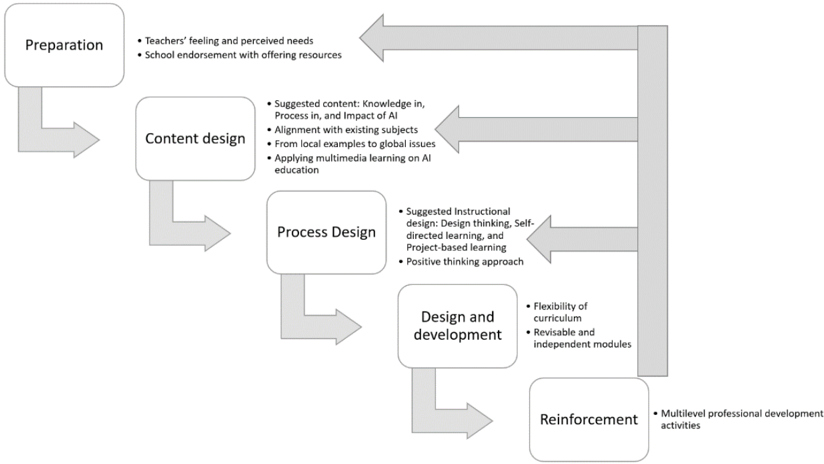
The teaching of artificial intelligence (AI) topics in school curricula is an important global strategic initiative in educating the next generation. As AI technologies are new to K-12 schools, there is a lack of studies that inform schools’ teachers about AI curriculum design. How to prepare and engage teachers, and which approaches are suitable for planning the curriculum for sustainable development, are unclear. Therefore, this case study aimed to explore the views of teachers with and without AI teaching experience on key considerations for the preparation, implementation and continuous refinement of a formal AI curriculum for K-12 schools. It drew on the self-determination theory (SDT) and four basic curriculum planning approaches—content, product, process and praxis—as theoretical frameworks to explain the research problems and findings. We conducted semi-structured interviews with 24 teachers—twelve with and twelve without experience in teaching AI—and used thematic analysis to analyze the interview data. Our findings revealed that genuine curriculum creation should encompass all four forms of curriculum design approach that are coordinated by teachers’ self-determination to be orchestrators of student learning experiences. This study also proposed a curriculum development cycle for teachers and curriculum officers.
Overview
The claims and statistics of this paper haven’t been checked yet.
Free: it reads the open-access text and checks the first 5 claims that cite a source we can check. Create a free account to check every claim.
Integrity signals
Registry
Cites
Statistics
Figures

Verification
Claims the paper makes
The claims and statistics of this paper haven’t been checked yet.
Free: it reads the open-access text and checks the first 5 claims that cite a source we can check. Create a free account to check every claim.
Claims other papers make about this one
Each is checked against this paper’s own text: does it say what the citing paper says it does?
The cited source doesn’t support the claim as written.
In the citing paper
“Teachers are key players for the integration of AI literacy in K-12, as proven by the numerous studies that examine this issue”
From AI literacy in K-12: a systematic literature review (2023) · cites this paper as Chiu & Chai, 2020
Checked by a reasoning model — may be wrong.
Experimental — accuracy not yet measuredThe source backs part of the claim, not all of it — or backs it for a different population, condition or comparison.
In the citing paper
“Although AI education in schools has become a global initiative, it is not seen as a traditional core subject, such as language, mathematics, and science (Chiu & Chai, 2020).”
From The impact of Generative AI (GenAI) on practices, policies and research direction in education: a case of ChatGPT and Midjourney (2024) · cites this paper as Chiu & Chai, 2020
Experimental — accuracy not yet measuredThe cited source says what the claim attributes to it.
In the citing paper
“Furthermore, the initial version of the instrument was developed by adapting a list of prior research such as Chiu & Chai (2020, Ng & Chu, 2021)'s and Ng & Chu (2021)'s questionnaire, the Motivational Strategies for Learning Questionnaire (MSLQ), Park et al. (2012)'s behavioural intention, Song and Keller (1999)'s confidence scale and ethical guidelines (Jobin et al., 2019;Microsoft, 2023).”
From Design and validation of the AI literacy questionnaire: The affective, behavioural, cognitive and ethical approach (2024) · cites this paper as Chiu & Chai (2020)
The check wasn’t confident either way, so it gives no verdict — never disputed.
In the citing paper
“Only a few of the studies have validated their questionnaires and even less retested them to ensure reliability in other settings (Chai et al., 2021;Chiu & Chai., 2020;Dai et al., 2020).”
From Design and validation of the AI literacy questionnaire: The affective, behavioural, cognitive and ethical approach (2024) · cites this paper as Chiu & Chai., 2020
Experimental — accuracy not yet measured
Self-check
Percentages, sums and reported differences re-computed from the paper’s own numbers.
The self-check needs the paper’s full text.
Citations
Cites
Using thematic analysis in psychology
Braun, V., & Clarke, V. (2006) · Qualitative Research in Psychology · doi:10.1191/1478088706qp063oa · Cited by 194,414 · cited 1×
“This offers a useful method for working within a participatory research paradigm to inform policy/curriculum development [21].”
MethodRyan, R. M., & Deci, E. L. (2000) · American Psychologist · doi:10.1037//0003-066x.55.1.68 · Cited by 54,599 · cited 4×
“This motivational process can be explained by the self-determination theory (SDT), which provides a theoretical framework to explain the teachers’ fundamental psychological needs—autonomy, relatedness and competence—for educational innovation [11,12].”
BackgroundMethodInfluentialZawacki-Richter, O., Marín, V. I., Bond, M., & Gouverneur, F. (2019) · International Journal of Educational Technology in Higher Education · doi:10.1186/s41239-019-0171-0 · Cited by 7,242 · cited 3×
“To date, very few studies on AI school teaching have been conducted [1,5,6].”
BackgroundPurposive sampling as a tool for informant selection
Tongco, M. D. C. (2007) · Ethnobotany Research and Applications · doi:10.17348/era.5.0.147-158 · Cited by 2,597 · cited 1×
“Therefore, we used purposeful sampling [19] to make sure that participants with all the conditions were recruited (broad categorization of the academic ability of students and AI teaching experience) from the pool of 48 partnership schools.”
MethodNiemiec, C. P., & Ryan, R. M. (2009) · Theory and Research in Education · doi:10.1177/1477878509104318 · Cited by 2,542
Teachers’ Perception of STEM Integration and Education: A Systematic Literature Review
Margot, K. C., & Kettler, T. (2019) · International Journal of STEM Education · doi:10.1186/s40594-018-0151-2 · Cited by 992 · cited 3×
“Therefore, schools should take immediate actions rather than make prolonged promises [10,25], and technology teachers prefer to receive direct, rather than indirect, support [9,25].”
BackgroundResultWang, Y.-Y., & Wang, Y.-S. (2022) · Interactive Learning Environments · doi:10.1080/10494820.2019.1674887 · Cited by 716 · cited 2×
“As machine learning becomes more powerful and narrow AI are performing more jobs, AI technologies and products are replacing jobs such as cashiers and proofreaders [17].”
BackgroundAchieving Saturation in Thematic Analysis: Development and Refinement of a Codebook
Ando, H., Cousins, R., & Young, C. (2014) · Comprehensive Psychology · doi:10.2466/03.cp.3.4 · Cited by 577 · cited 1×
“The sample size of 24 has been recommended by Ando, Cousins and Young [20] as sufficient to generate codes for thematic analysis.”
MethodHopes and fears for intelligent machines in fiction and reality
Cave, S., & Dihal, K. (2019) · Nature Machine Intelligence · doi:10.1038/s42256-019-0020-9 · Cited by 355 · cited 1×
“This is supported by the studies that generally find that peoples’ perceived worries of loss of control of AI, ethical concerns about AI and the negative impact of AI on work have grown in recent years [18,28].”
ResultWhat do engineering students learn in sustainability courses? The effect of the pedagogical approach
Segalàs, J., Ferrer-Balas, D., & Mulder, K. F. (2010) · Journal of Cleaner Production · doi:10.1016/j.jclepro.2009.09.012 · Cited by 302 · cited 1×
“This approach supports different types of students to better understand the complex world of AI by ensuring the participation of more students [34].”
Background
Research works printed but not linked: 1
- Glatthorn, A.A.; Boschee, F.; Whitehead, B.M.; Boschee, B.F. Curriculum Leadership: Strategies for Development and Implementation; SAGE: London, UK, 2018.
Cited by
Items 401–500 of 586
Handayani, N., Ismail, Rasyid, S., & Gulo, R. S. (2025) · Journal of Education Research and Evaluation · doi:10.23887/jere.v9i4.107557 · Cited by 1
Jose, J., Jose, B. J., & Sheidi, A. S. A. A. (2026) · Discover Artificial Intelligence · doi:10.1007/s44163-025-00786-9 · Cited by 1
Malakul, S., Sangkawetai, C., Painprasert, N., & Thongwichit, W. (2026) · Discover Education · doi:10.1007/s44217-026-01403-2 · Cited by 1
ChatGPT as a learning scaffold in critical theory education among Bangladeshi students
Chakraborty, K., Sweet, S. A., & Emon, M. N. K. (2026) · Discover Education · doi:10.1007/s44217-026-01425-w · Cited by 1
Pek, L. S., Yob, F. S. C., Jayaraman, S., Idris, N. I., Rahayu, P. S. E., & Waluyo, B. (2026) · International Journal of Learning Teaching and Educational Research · doi:10.26803/ijlter.25.3.38 · Cited by 1
Demeter, E., Rad, D., Bocoș, M. D., Roman, A., Egerău, A., Ignat, S., Dughi, T. S., Dughi, D., Costin, A., Toderici, O. F., et al. (2026) · Behavioral Sciences · doi:10.3390/bs16040493 · Cited by 2
“…developments in educational psychology and network science have encouraged a shift beyond strictly latent or linear approaches toward models that conceptualize psychological variables as interdependent nodes within complex systems (Howard et al., 2021; Beachboard et al., 2011; Chiu & Chai, 2020).”
Exploring intelligent-TPACK among university teachers: a two-phase mixed-methods study
Joshi, S. C. (2026) · Journal of Computers in Education · doi:10.1007/s40692-026-00395-0 · Cited by 1
Mubarok, I., & Nadhir, M. (2026) · Academia Open · doi:10.21070/acopen.11.2026.13515 · Cited by 1
Anshorudin, R., Rohman, D., Supriyatna, D., & Ruswandi, U. (2026) · Al Qodiri Jurnal Pendidikan Sosial dan Keagamaan · doi:10.53515/alqodiri.v24i2.48 · Cited by 1
“This finding expands dominant discussions in educational technology literature, which generally frame AI governance primarily through technical accountability, transparency, and data protection perspectives (Chiu & Chai, 2020; Pedro et al., 2019).”
Liu, J., An, J., Liu, D., Xu, S., & Zhang, W. (2026) · Frontiers in Psychology · doi:10.3389/fpsyg.2026.1854432 · Cited by 1
“From intelligent tutoring systems to adaptive learning platforms, from automated assessment tools to generative AI applications such as ChatGPT and DeepSeek, AI technology is reshaping teaching and learning at all levels (Celik, 2023; Chiu and Chai, 2020; Chiu et al., 2021).”
The Role of Artificial Intelligence in Personalized Learning From a Psychological Perspective
Wang, Y. (2026) · Education for Information · doi:10.1177/01678329261463736 · Cited by 2
Generative AI as an IELTS Tutor: The effects of AI-generated feedback on EFL students’ writing
Jitpaisarnwattana, N. (2026) · Language Education & Assessment · doi:10.29140/lea.2026.104046 · Cited by 1
“This scaffolded approach is crucial if generative AI tools are to be adopted as independent learning tools for writing development (Chiu & Chai, 2020).”
AI Competencies for Teaching: From Conceptual Frameworks to Enacted Practices
Ober, T., Tenison, C., Phelps, G., Renfrow-Symon, E., Mikeska, J. N., & Dean, V. (2026) · ETS Research Report Series · doi:10.64634/z5j3ts49 · Cited by 1
DEMİRTAŞ, Ç. (2026) · Acta Psychologica · doi:10.1016/j.actpsy.2026.107667 · Cited by 2
Integration of AI into Education: Teachers' Perspectives on Competencies, Challenges, and Needs
Erdoğmuş, F. U. (2026) · Participatory Educational Research · doi:10.17275/per.26.67.13.5 · Cited by 2
MOSES, P. Z. O., & MOSES-PROMISE, P. D. (2026) · Federal University Gusau Faculty of Education Journal · doi:10.64348/zije.2026531 · Cited by 1
Qin, D., Wu, Z., & Zhou, O. (2021) · International Conference on Management Science and Software Engineering (ICMSSE) · doi:10.1109/icmsse53595.2021.00056 · Cited by 1
SIGNIFICADOS QUE SUBYACEN EN LAS PRÁCTICAS DE ENSEÑANZA DE LOS ENFERMEROS DOCENTES
Castro, N. A. (2022) · Revista Iberoamericana de Educación e Investigación en Enfermería · doi:10.56104/aladafe.2022.12.1021000392 · Cited by 1
Facilitating Blended Learning in Underprivileged Contexts: A Self-Directed Curriculum as Praxis View
Verster, M., Laubscher, D. J., & Bosch, C. (2023) · Advances in educational technologies and instructional design book series · doi:10.4018/978-1-6684-6586-8.ch002 · Cited by 2
AI sebagai Tutor Cerdas bagi Guru Pemula pada Kegiatan Program Induksi
Badriah, B. (2023) · Pena Jurnal Ilmu Pengetahuan dan Teknologi · doi:10.31941/jurnalpena.v37i2.3345 · Cited by 1
Yu, W. (2024) · Applied Mathematics and Nonlinear Sciences · doi:10.2478/amns-2024-3068 · Cited by 1
Shinde, R. (2025) · Advances in educational technologies and instructional design book series · doi:10.4018/979-8-3693-7723-9.ch020 · Cited by 1
Zhang, Q., Qian, Y., Gao, S., Liu, Y., Shen, X., & Jiang, Q. F. (2025) · Behavioral Sciences · doi:10.3390/bs15030326 · Cited by 1
“…(NLP), deep learning, and machine learning, AI systems can extract valuable behavioral patterns and learning characteristics from vast amounts of learning data, thus providing technical support for personalizing and refining teaching methods (Chiu & Chai, 2020; Sanusi et al., 2024; W. Yang, 2022).”
Enhancing the Continuing Education of Science Teachers with Unplugged Machine Learning Activities
Alé-Silva, J., & Araya, R. (2025) · CLEI electronic journal · doi:10.19153/cleiej.28.2.13 · Cited by 1
Teaching Machine Learning as Adaptive Design Work
Delaney, V., & Selbach-Allen, M. E. (2025) · Proceedings. · doi:10.22318/icls2025.423443 · Cited by 1
Aliyyah, R. R., & Amalia, R. (2025) · Journal of Educational Management and Instruction (JEMIN) · doi:10.22515/jemin.v5i2.12003 · Cited by 5
Baskara, R. (2024) · International Journal of Digital Learning on Languages and Arts (IJODLLA) · doi:10.23887/ijodlla.v1i1.59332 · Cited by 3
Methodical aspects of studying artificial intelligence by future teachers
Kushnir, N. O., & Valko, N. (2023) · Workshop on Digital Transformation of Education (DigiTransfEd) · doi:10.55056/ceur-ws.org/vol-3553/paper25.pdf · Cited by 1
“The research by [10] authors indicates that in the development of such a course, educators should follow four main approaches to AI curriculum planning: content, product, process, and practice.”
BackgroundAnnoscia, S., Ladiana, S., & Colella, D. (2024) · FORMAZIONE & INSEGNAMENTO. Rivista internazionale di Scienze dell'educazione e della formazione · doi:10.7346/-feis-xxii-01-24_09 · Cited by 1
Artificial Intelligence-Related Programs Needs in Developing Countries: Case Study of BotswanaPreprint
Sheikh, S. M., Sithole, K., Nyachionjeka, K., Kgwadi, M., Ditshego, N. M. J., Ngebani, I. M., & Batane, R. N. (2025) · Research Square · doi:10.21203/rs.3.rs-6963820/v1 · Cited by 1
PeiQiao, L., & Fujimoto, T. (2023) · Lecture notes in networks and systems · doi:10.1007/978-3-031-40579-2_21
Li, L. (2023) · Applied Mathematics and Nonlinear Sciences · doi:10.2478/amns.2023.2.00656
Ho, J. C. F., Ng, R., & Lau, H. (2023) · International Association of Societies of Design Research Congress (IASDR) · doi:10.21606/iasdr.2023.365
BARAHMEH, D. H. M. (2024) · International Journal of Humanities and Educational Research · doi:10.47832/2757-5403.25.33 · Cited by 1
The Challenges of Learning Assessment in the Age of Artificial Intelligence
Gonçalves, B. F., Patrício, M. R., & Comiche, A. C. (2024) · Lecture notes in networks and systems · doi:10.1007/978-3-031-60224-5_3 · Cited by 1
Keshavarzi, M. H., Kohan, N., Koohestani, H. R., Mahmoudi, T., & Soltani, R. (2024) · SSRN Electronic Journal · doi:10.2139/ssrn.4865255
Ng, K., Li, S.-F., Lee, L., & Luk, L. (2024) · Lecture notes in computer science · doi:10.1007/978-981-97-4442-8_10
Empowering K-12 STEM Teachers to Be AI-ready: The Insights from a Bibliometrics Study
Ma, M., Ali, M., & Wong, G. K. W. (2024) · IEEE Global Engineering Education Conference (EDUCON) · doi:10.1109/educon60312.2024.10578830
“Some initiatives co-created AI curricula with teachers to address these issues, but mainly at secondary school levels [18, 19].”
BackgroundChandel, A., Sharma, A. R., Chowdary, A. P., & Saluja, S. (2024) · Advances in marketing, customer relationship management, and e-services book series · doi:10.4018/979-8-3693-6660-8.ch011
Beyond Traditional Language Learning: EFL Student Views on ChatGPT in Saudi ArabiaPreprint
Journal, A. W. E. (2024) · SocArXiv (OSF Preprints) · doi:10.31235/osf.io/7b34j
AI as a Contrivance in Education Sector: Exploring Its Impending Impact on Students’ Performance
Ghose, S., Sarwar, N., Kumar, R., Farooqui, N., Siddiqui, T. J., & Naseem, I. (2024) · Journal of Informatics Education and Research · doi:10.52783/jier.v4i3.1409
The Impact of AI Assistance on Student Learning: A Cross-Disciplinary Study in STEM Education
Fried, M., & Alshibli, M. (2024) · ASEE Middle Atlantic Section Spring Conference · doi:10.18260/1-2--49457
An Exploration of E-Teaching Preparedness of Pre-Service Teachers of Learners with Special Needs
Adigun, O. T., Quadri, G. O., Jacob, U. S., & Ngubane, S. A. (2024) · Africa Education Review · doi:10.1080/18146627.2024.2402767
Nassar, S. (2024) · SWS International Scientific Conference on Social Sciences · doi:10.35603/sws.iscss.2024/vs08/57
Facilitating English Language Teaching Through AI-Based Drama in Palestine
Bsharat, T. R. K., & Ahmad, I. S. (2025) · Advances in computational intelligence and robotics book series · doi:10.4018/979-8-3693-9811-1.ch009 · Cited by 1
الناصري, ع. ب. س. ب. ح., & النجار, ن. ب. أ. (2025) · مجلة دراسات الخليج والجزيرة العربية. · doi:10.34120/jgaps.v51i196.3243
Linking Curriculum Implementation to School Sustainability: A Systematic Review
Peng, Y., Alias, B. S., Wan, X., & Mansor, A. N. (2025) · Atlantis highlights in social sciences, education and humanities/Atlantis Highlights in Social Sciences, Education and Humanities · doi:10.2991/978-94-6463-686-4_31
EFL Students’ Use of AI Chatbots in Academic Writing
Schug, D. (2025) · Malaysian Journal of ELT Research · doi:10.52696/uepx3699
Preparing for Tomorrow: AI Literacy in English Language Teaching
Krsmanovic, I. M., & Archan, D. A. (2025) · Advances in computational intelligence and robotics book series · doi:10.4018/979-8-3693-5477-3.ch006 · Cited by 2
Sariwani, D., Kristiawan, M., & Suherman, S. (2025) · Journal of Social Work and Science Education · doi:10.52690/jswse.v6i2.1199
Issabayeva, D., Rakhimzhanova, L., Abdulkarimova, G., & Tulbassova, B. (2025) · International Journal of Innovative Research and Scientific Studies · doi:10.53894/ijirss.v8i5.8808
Şengül, B. C., Türkyılmaz, C. A., YILDIRIM, Y. O., & Pirtini, S. (2025) · R&S - Research Studies Anatolia Journal · doi:10.33723/rs.1708096
Does Artificial Intelligence help Teachers with Student Engagement?Preprint
Hinojosa, J. C. (2025) · Research Square · doi:10.21203/rs.3.rs-7257652/v1 · Cited by 1
Turkish Consumers’ Attitudes Towards Artificial Intelligence: a Quantitative Study
Akyüz, A., & Coşgun, A. T. (2025) · International Journal of Social Science Research and Review · doi:10.47814/ijssrr.v8i8.2903 · Cited by 1
Emerging Smart Cities Job Profiles and Competencies: A Framework for Digital and Green TransitionPreprint
Fitsilis, P., Damasiotis, V., Kyriatzis, V., & Tsoutsa, P. (2025) · SocArXiv (OSF Preprints) · doi:10.31235/osf.io/us7p4_v1
EDUCATIONAL REVOLUTION: THE IMPACT OF ARTIFICIAL INTELLIGENCE ON TEACHER TRAINING
Niebles, W., Guzmán, H., & Torres, J. (2025) · Lex localis - Journal of Local Self-Government · doi:10.52152/801949
Understanding AI Training Needs in Medical Education: An Alternative Perspective
Salimi, M., Gunansyah, G., & Riyadi, A. R. (2025) · Journal of Medical Education and Curricular Development · doi:10.1177/23821205251389393
Building AI Literacy from the Ground Up: A Holistic Approach to AI Integration in K‐12 Education
Obae, C. (2025) · Wiley eBooks · doi:10.1002/9781394352821.ch08
Does gender shape AI adoption? Evidence from Serbian primary and secondary school teachers
Škobo, M., & Šović, M. (2025) · Inovacije u nastavi · doi:10.5937/inovacije2503113s
Yuan, L. I., Heo, G., & Du-Gyu, K. I. M. (2025) · Journal of Fisheries and Marine Sciences Education · doi:10.13000/jfmse.2025.10.37.5.1136
How Do Mathematics Teachers Use ChatGPT in Their Classes?
Dertli, Z. G., & Kaya, Y. S. (2025) · Advances in computational intelligence and robotics book series · doi:10.4018/979-8-3373-7729-2.ch007
Data-driven Decision Making: AI’s Role in Business Strategy
Asiedu, E. (2025) · BENTHAM SCIENCE PUBLISHERS eBooks · doi:10.2174/9798898811440125010007
XingYuan, K. (2025) · International Journal of Apllied Mathematics · doi:10.12732/ijam.v38i8s.997
XingYuan, K. (2025) · International Journal of Apllied Mathematics · doi:10.12732/ijam.v38i5.1100
Editorial: Who is monitoring AI?
West, T. (2025) · Quarterly review of distance education · doi:10.1108/qrde-10-2025-012
González, S. J. G. (2025) · Research Square · doi:10.21203/rs.3.rs-8205345/v1
Reimagining roles and identity in the era of human - AI collaboration
(2025) · Frontiers research topics · doi:10.3389/978-2-8325-7250-4
Attitude of Secondary School Teachers Towards the Use of Artificial Intelligence
Manocha, S., & Kaur, M. (2025) · International Journal For Multidisciplinary Research · doi:10.36948/ijfmr.2025.v07i06.62988
“It is revolutionizing communication, lifestyle, work environments and education (Chiu et al., 2020).”
Fernández Ortega, J., & Fernandez-Revelles, A. B. (2025) · Institutional Repository of the University of Granada (University of Granada) · doi:10.5281/zenodo.15600880
Additional file 1 of AI literacy in K-12: a systematic literature review
Otero, L. C., Catala, A., Morante, C. F., Taboada, M., Cebreiro, B., & Barro, S. (2024) · Figshare · doi:10.6084/m9.figshare.26583390
Pedagogía sin IA generativa - Ciencias de la Computación sin Ciencias Humanas
Botelho, T. H. F., & Ett, G. (2025) · Dialnet (Universidad de la Rioja) · doi:10.5281/zenodo.15858121
Camacho Villanueva, M. (2021) · LA Referencia (Red Federada de Repositorios Institucionales de Publicaciones Científicas)
Hennoun, H. (2023) · Staffordshire Online Repository (Staffordshire University) · Cited by 1
Esteban Carrera, L. (2023) · LA Referencia (Red Federada de Repositorios Institucionales de Publicaciones Científicas)
Appelberg, B. (2025) · Uppsala University Publications (Uppsala University)
Molinari, I. (2023) · AMS Laurea Institutional Research Repository (University of Bologna)
استكشاف الدراسات عن الذكاء الاصطناعي ودورها في تطوير منهج اللغة العربية: مراجعة منهجية
Hattab, M. (2024) · eTheses of Maulana Malik Ibrahim State Islamic University (Maulana Malik Ibrahim State Islamic University)
Implementation of the Integrated Curriculum at Aisyiyah Bustanul Athfal 33 Kindergarten, Malang City
Nasikin, Khozin, & Sowe, S. (2025) · Classroom Experiences · doi:10.59535/care.v3i1.420
The Role of AI in Enhancing the Academic Achievement of Slow Learners in the Batticaloa District
Abilash, K., & Hassan, N. M. (2025) · Educational Science and Practice · doi:10.64229/aryhjn02
“…interviews and documents were subjected to quantitative and qualitative analysis based on the research questions and the obtained data were analysed using the SPSS 29.0 through grid diagrams, circular diagrams and three-dimensional maps, and interpretation and discussion were carried out [5].”
InfluentialChiu, T. K. F. (2026) · Springer eBooks · doi:10.1007/978-3-032-03296-6_10
Self-citationExploring English as a Foreign Language Teachers’ Competencies in using AI for Teaching and Learning
Hussain, A. G. (2026) · Cihan University-Erbil Journal of Humanities and Social Sciences · doi:10.24086/cuejhss.v10n1y2026.pp48-55
Tsutsumi, K., Amakawa, Y., & Yata, C. (2026) · Asia Pacific Journal of Education · doi:10.1080/02188791.2026.2619058 · Cited by 1
Bridging Theory and Practice in Machine Learning Education Through Mixed Reality Gamification
Zhang, G., & Lee, B. G. (2025) · IEEE International Conference on Teaching, Assessment, and Learning for Engineering · doi:10.1109/tale66047.2025.11346761
“Furthermore, resource limitations, including insufficient access to computational tools and relevant datasets, prevent institutions from providing effective ML education [13], [14].”
AI Literacy in Portuguese-Speaking Contexts: Validation of a Comprehensive Assessment Tool
Arantes, L., Sousa, B., & Santos, J. D. (2026) · Springer eBooks · doi:10.1007/978-3-031-99147-9_16
Independiente, E. I., & Zapata, R. I. Q. (2025) · Dominio de las Ciencias · doi:10.23857/dc.v11i4.4635
AI-Driven Curriculum Design for Higher Education Institutions
Jansirani, D., Rizwana, A. M., Rehana, A. N., Ramalakshmi, K., & Gopukumar, S. T. (2026) · Advances in computational intelligence and robotics book series · doi:10.4018/979-8-3373-2752-5.ch001
Asian Perspectives on AI in Teacher Education: A Post-Covid Research Synthesis
Chandra, A., Verma, A., & Handique, K. (2025) · i-manager’s Journal on Educational Psychology · doi:10.26634/jet.22.3.22352
Riadi, A., Royani, R., Trisna, B. N., & Ferita, R. A. (2026) · Education Achievement Journal of Science and Research · doi:10.51178/jsr.v7i001.3240
A Prototype for Developing Competency-based Virtual Learning in Mexico
Pulgarin-Herrera, A. G. (2026) · Emerald Group Publishing Limited eBooks · doi:10.1108/978-1-83662-602-220261016
Empowering Educators: The Role of AI in Engineering Education Faculty Professional Development
Chasokela, D., & Sarema, B. (2026) · Advances in computational intelligence and robotics book series · doi:10.4018/979-8-3373-9220-2.ch015
Lu, Y., Zhang, J., & Tian, J. (2025) · International Conference on Educational Technology (ICET) · doi:10.1109/icet67421.2025.11380506
“Chiu & Chai [13] and Chai et al. [14] contended that through delicate curriculum design students can be equipped with knowledge about AI, establish their confidence in using AI and mitigate their anxiety about it, while, from the well-being and sustainability of humans, AI-driven personalized…”
Public Policy generation: Enhancing AI Literacy in High School students
Guzmán-Segura, J. G. (2025) · International Workshop on Artificial Intelligence and Education (WAIE) · doi:10.1109/waie67422.2025.11381072
“This differs from AI education, which focuses on teaching students about AI using specific pedagogies [11].”
Environmental Anxiety among Students in Islamic Boarding Schools: A Comparative Study
Harahap, D., Baiduri, Cholily, Y. M., Rahardjanto, A., Susetyarini, R. E., Waluyo, L., & Hudha, A. M. (2026) · Jurnal Penelitian Pendidikan IPA · doi:10.29303/jppipa.v12i2.13720
“Many educational institutions produce graduates who are intellectually smart but lack ecological sensitivity (Chiu & Chai, 2020; Kondrla, 2023).”
Mi, N., & Fan, C. (2026) · Research Square · doi:10.21203/rs.3.rs-7939708/v1
Ethical AI, Faculty Readiness, and WellBeing: A Quantitative Study in Indian Higher Education
Ohri, B. K., Bains, A., & Kaur, H. (2026) · Journal of Emerging Technologies and Innovative Research · doi:10.56975/jetir.v13i3.577481
K-12 AI Curriculum Design: A Review of Frameworks, Approaches, and Evaluation
Lei, N., Zhao, Z., Li, Z., & Tian, X. (2026) · Information Systems Education Journal · doi:10.62273/giii1608
Defining an AI-Based K-12 Education System
Li, C., & Wangwan, H. (2026) · Advances in computational intelligence and robotics book series · doi:10.4018/979-8-3693-6346-1.ch004
A study on the Teachers’ Attitudes towards the Use of Artificial Intelligence (AI) in school.
Kundu, S. (2026) · International Journal of Social Science Research (IJSSR) · doi:10.70558/ijssr.2026.v3.i2.30932
Peters, M. A., Jandrić, P., & Green, B. (2026) · Springer international handbooks of education · doi:10.1007/978-981-95-2173-9_83
AI-supported Computational Thinking: An In-depth Analysis for Higher Education
Pramanik, D., & Banerjee, T. (2026) · Asian Journal of Education and Social Studies · doi:10.9734/ajess/2026/v52i42965
Metadata
- Authors
- Chiu, T. K. F., & Chai, C.-S.
- Affiliations
- Chinese University of Hong Kong (HK)
- Corresponding author
- Chiu, Thomas K.F.
- Venue
- Sustainability
- Publisher
- MDPI AG
- Published
- 2020-07-10
- Volume
- 12
- Issue
- 14
- Pages
- 5568
- ISSN
- 2071-1050 (ISSN-L)
- OpenAlex
- W3041706899
- Cited by
- 448
- References
- 32
- Citations by year
- 2026: 98 · 2025: 133 · 2024: 102 · 2023: 62 · 2022: 36 · 2021: 16 · 2020: 1
- FWCI
- 27.05
- Type
- journal article
- Language
- en
- Open access
- gold
- dx.doi.org
- Licence
- Locations
- Sustainability (publishedVersion, cc-by)
- RePEc: Research Papers in Economics (submittedVersion)
- DOAJ (DOAJ: Directory of Open Access Journals) (submittedVersion)
- Topics
- Social Sciences › Education › Artificial Intelligence in Education
- Physical Sciences › Computer Science › Computer Science Applications › Teaching and Learning Programming
- Social Sciences › Education › Educational Curriculum and Learning Methods
- Keywords
- artificial intelligence in education, AI curriculum design, K-12 schools, self-determination theory, teacher perceptions, teacher preparation, sustainable development
About these checks
Registry, retraction, Cites and statistics results are computed, not judged, with one exception: a printed reference that no index lists is read once by a model before it counts as a citation error. Claims are extracted by a model and kept only when their quote appears verbatim in the text; each cited source is then checked, with a model’s help, for whether it says what the claim relies on. Those verdicts can be wrong — read the claim’s quote and the cited source before relying on one.
Statistics and arithmetic are recomputed, not judged.
Confidence bands are shown only for fields calibrated on our annotated test set. None is calibrated yet, so no band is shown.
What counts as a claim ›How we measure confidence ›How we check this ›
Are you an author, or do you see a problem with this page? Request a review
Data sources
Bibliographic data: Semantic Scholar, OpenAlex, Crossref.
Contains information from the Semantic Scholar Academic Graph Datasets, made available under the ODC Attribution License (ODC-BY 1.0).
Semantic Scholar’s data is described in: Kinney, R., et al. (2023). The Semantic Scholar Open Data Platform. arXiv:2301.10140.
