

Sustainable Curriculum Planning for Artificial Intelligence Education: A Self-Determination Theory Perspective
Open accessThe DOI matches its Crossref record; 32 of the 32 references it cites were found in a registry or an index.
Abstract
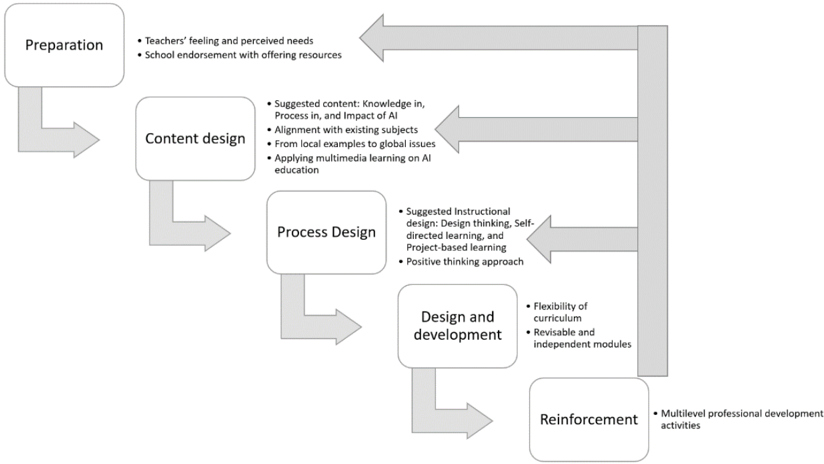
The teaching of artificial intelligence (AI) topics in school curricula is an important global strategic initiative in educating the next generation. As AI technologies are new to K-12 schools, there is a lack of studies that inform schools’ teachers about AI curriculum design. How to prepare and engage teachers, and which approaches are suitable for planning the curriculum for sustainable development, are unclear. Therefore, this case study aimed to explore the views of teachers with and without AI teaching experience on key considerations for the preparation, implementation and continuous refinement of a formal AI curriculum for K-12 schools. It drew on the self-determination theory (SDT) and four basic curriculum planning approaches—content, product, process and praxis—as theoretical frameworks to explain the research problems and findings. We conducted semi-structured interviews with 24 teachers—twelve with and twelve without experience in teaching AI—and used thematic analysis to analyze the interview data. Our findings revealed that genuine curriculum creation should encompass all four forms of curriculum design approach that are coordinated by teachers’ self-determination to be orchestrators of student learning experiences. This study also proposed a curriculum development cycle for teachers and curriculum officers.
Overview
The claims and statistics of this paper haven’t been checked yet.
Free: it reads the open-access text and checks the first 5 claims that cite a source we can check. Create a free account to check every claim.
Integrity signals
Registry
Cites
Statistics
Figures

Verification
Claims the paper makes
The claims and statistics of this paper haven’t been checked yet.
Free: it reads the open-access text and checks the first 5 claims that cite a source we can check. Create a free account to check every claim.
Claims other papers make about this one
Each is checked against this paper’s own text: does it say what the citing paper says it does?
The cited source doesn’t support the claim as written.
In the citing paper
“Teachers are key players for the integration of AI literacy in K-12, as proven by the numerous studies that examine this issue”
From AI literacy in K-12: a systematic literature review (2023) · cites this paper as Chiu & Chai, 2020
Checked by a reasoning model — may be wrong.
Experimental — accuracy not yet measuredThe source backs part of the claim, not all of it — or backs it for a different population, condition or comparison.
In the citing paper
“Although AI education in schools has become a global initiative, it is not seen as a traditional core subject, such as language, mathematics, and science (Chiu & Chai, 2020).”
From The impact of Generative AI (GenAI) on practices, policies and research direction in education: a case of ChatGPT and Midjourney (2024) · cites this paper as Chiu & Chai, 2020
Experimental — accuracy not yet measuredThe cited source says what the claim attributes to it.
In the citing paper
“Furthermore, the initial version of the instrument was developed by adapting a list of prior research such as Chiu & Chai (2020, Ng & Chu, 2021)'s and Ng & Chu (2021)'s questionnaire, the Motivational Strategies for Learning Questionnaire (MSLQ), Park et al. (2012)'s behavioural intention, Song and Keller (1999)'s confidence scale and ethical guidelines (Jobin et al., 2019;Microsoft, 2023).”
From Design and validation of the AI literacy questionnaire: The affective, behavioural, cognitive and ethical approach (2024) · cites this paper as Chiu & Chai (2020)
The check wasn’t confident either way, so it gives no verdict — never disputed.
In the citing paper
“Only a few of the studies have validated their questionnaires and even less retested them to ensure reliability in other settings (Chai et al., 2021;Chiu & Chai., 2020;Dai et al., 2020).”
From Design and validation of the AI literacy questionnaire: The affective, behavioural, cognitive and ethical approach (2024) · cites this paper as Chiu & Chai., 2020
Experimental — accuracy not yet measured
Self-check
Percentages, sums and reported differences re-computed from the paper’s own numbers.
The self-check needs the paper’s full text.
Citations
Cites
Using thematic analysis in psychology
Braun, V., & Clarke, V. (2006) · Qualitative Research in Psychology · doi:10.1191/1478088706qp063oa · Cited by 194,414 · cited 1×
“This offers a useful method for working within a participatory research paradigm to inform policy/curriculum development [21].”
MethodRyan, R. M., & Deci, E. L. (2000) · American Psychologist · doi:10.1037//0003-066x.55.1.68 · Cited by 54,599 · cited 4×
“This motivational process can be explained by the self-determination theory (SDT), which provides a theoretical framework to explain the teachers’ fundamental psychological needs—autonomy, relatedness and competence—for educational innovation [11,12].”
BackgroundMethodInfluentialZawacki-Richter, O., Marín, V. I., Bond, M., & Gouverneur, F. (2019) · International Journal of Educational Technology in Higher Education · doi:10.1186/s41239-019-0171-0 · Cited by 7,242 · cited 3×
“To date, very few studies on AI school teaching have been conducted [1,5,6].”
BackgroundPurposive sampling as a tool for informant selection
Tongco, M. D. C. (2007) · Ethnobotany Research and Applications · doi:10.17348/era.5.0.147-158 · Cited by 2,597 · cited 1×
“Therefore, we used purposeful sampling [19] to make sure that participants with all the conditions were recruited (broad categorization of the academic ability of students and AI teaching experience) from the pool of 48 partnership schools.”
MethodNiemiec, C. P., & Ryan, R. M. (2009) · Theory and Research in Education · doi:10.1177/1477878509104318 · Cited by 2,542
Teachers’ Perception of STEM Integration and Education: A Systematic Literature Review
Margot, K. C., & Kettler, T. (2019) · International Journal of STEM Education · doi:10.1186/s40594-018-0151-2 · Cited by 992 · cited 3×
“Therefore, schools should take immediate actions rather than make prolonged promises [10,25], and technology teachers prefer to receive direct, rather than indirect, support [9,25].”
BackgroundResultWang, Y.-Y., & Wang, Y.-S. (2022) · Interactive Learning Environments · doi:10.1080/10494820.2019.1674887 · Cited by 716 · cited 2×
“As machine learning becomes more powerful and narrow AI are performing more jobs, AI technologies and products are replacing jobs such as cashiers and proofreaders [17].”
BackgroundAchieving Saturation in Thematic Analysis: Development and Refinement of a Codebook
Ando, H., Cousins, R., & Young, C. (2014) · Comprehensive Psychology · doi:10.2466/03.cp.3.4 · Cited by 577 · cited 1×
“The sample size of 24 has been recommended by Ando, Cousins and Young [20] as sufficient to generate codes for thematic analysis.”
MethodHopes and fears for intelligent machines in fiction and reality
Cave, S., & Dihal, K. (2019) · Nature Machine Intelligence · doi:10.1038/s42256-019-0020-9 · Cited by 355 · cited 1×
“This is supported by the studies that generally find that peoples’ perceived worries of loss of control of AI, ethical concerns about AI and the negative impact of AI on work have grown in recent years [18,28].”
ResultWhat do engineering students learn in sustainability courses? The effect of the pedagogical approach
Segalàs, J., Ferrer-Balas, D., & Mulder, K. F. (2010) · Journal of Cleaner Production · doi:10.1016/j.jclepro.2009.09.012 · Cited by 302 · cited 1×
“This approach supports different types of students to better understand the complex world of AI by ensuring the participation of more students [34].”
Background
Research works printed but not linked: 1
- Glatthorn, A.A.; Boschee, F.; Whitehead, B.M.; Boschee, B.F. Curriculum Leadership: Strategies for Development and Implementation; SAGE: London, UK, 2018.
Cited by
Items 101–200 of 586
Mahrishi, M., Abbas, A., & Siddiqui, M. K. (2025) · Digital Government Research and Practice · doi:10.1145/3672462 · Cited by 55
Alfirević, N., Praničević, D. G., & Mabić, M. (2024) · Sustainability · doi:10.3390/su16124929 · Cited by 48
The AI-Atlas: Didactics for Teaching AI and Machine Learning On-Site, Online, and Hybrid
Stadelmann, T., Keuzenkamp, J., Grabner, H., & Würsch, C. (2021) · Education Sciences · doi:10.3390/educsci11070318 · Cited by 36
“Chiu and Chai [20] reflect AI curriculum development for K-12 [21] by teachers with and without prior exposure to AI training.”
BackgroundA worldwide study on language educators’ initial response to ChatGPT
Alm, A., & Ohashi, L. (2024) · Technology in Language Teaching & Learning · doi:10.29140/tltl.v6n1.1141 · Cited by 44
Zhao, L. (2022) · International Journal of Humanoid Robotics · doi:10.1142/s0219843622500128 · Cited by 40
Yuwono, E. I., Tjondronegoro, D., Riverola, C., & Loy, J. (2024) · Computers and Education Artificial Intelligence · doi:10.1016/j.caeai.2024.100272 · Cited by 46
Mah, D.-K., Knoth, N., & Egloffstein, M. (2025) · Frontiers in Education · doi:10.3389/feduc.2025.1484904 · Cited by 45
Abulibdeh, A. O. (2025) · Sustainable Futures · doi:10.1016/j.sftr.2025.101033 · Cited by 46
Exploring the Role of Artificial Intelligence in Education, Students Preferences and Perceptions
Herawati, A. A., Yusuf, S., Ilfiandra, I., Taufik, A., & Habibi, A. S. Y. (2024) · AL-ISHLAH Jurnal Pendidikan · doi:10.35445/alishlah.v16i2.4784 · Cited by 44
“Furthermore, it is essential to involve stakeholders, including students, in the development and implementation of AI technology in education (Bhimdiwala, Neri, & Gomez, 2021; Chiu & Chai, 2020).”
BackgroundKashif, M., Ammar, M., Sellami, A., Chiu, T. K. F., Abbasi, S. A., & Ahmad, Z. (2025) · Computers in the Schools · doi:10.1080/07380569.2025.2602507 · Cited by 44
Self-citationKim, S.-K., Kim, T., & Kim, K. (2025) · Scientific Reports · doi:10.1038/s41598-025-95802-4 · Cited by 48
“Comparative frequency analysis between groups empirically validates through competency comparisons that constructivism-based authentic activities in AI education are more effective for learning AI principles/concepts and enhancing thinking skills 8,14 .”
Islamic Education Curriculum in the Era of Society 5.0: Between Challenges and Innovation
Suhendi, S. (2024) · International Journal of Science and Society · doi:10.54783/ijsoc.v6i2.1073 · Cited by 37
“Both the curriculum as a substance and the curriculum as a curriculum system (Chiu & Chai, 2020).”
The Role of Artificial Intelligence in Shaping the Future of Education at Higher Secondary Level
Sarwar, M. A., Saima, & Gul, A. (2024) · Journal of Education and Social Studies · doi:10.52223/jess.2024.5104 · Cited by 44
Artificial Intelligence and the Modelling of Teachers’ Competencies
Simuț, R., Simuţ, C., Bădulescu, D., & Bădulescu, A. (2024) · Amfiteatru Economic · doi:10.24818/ea/2024/65/181 · Cited by 45
“The lack of technological knowledge on the part of educators (Chiu and Chai, 2020) is often exacerbated by the technical infrastructure in schools, often insufficient to support the implementation of AI in educational processes (McCarthy et al., 2016; Ozdemir and Tekin, 2016).”
BackgroundAI’s Role and Application in Education: Systematic Review
Alhazmi, A. K., Al-Hammadi, F., Zain, A. A., Kaed, E., & Ahmed, B. (2023) · Lecture notes in networks and systems · doi:10.1007/978-981-19-7660-5_1 · Cited by 36
Chou, C.-M., Shen, T.-C., Shen, T.-C., & Shen, C.-H. (2024) · Journal of Computers in Education · doi:10.1007/s40692-024-00332-z · Cited by 41
“Innovative intention (II) refers to teachers integrating and applying AI-supported technology into teaching and educational activities (Chiu & Chai, 2020; Guan et al., 2020).”
InfluentialTeachers' Perceptions and Continuance Usage Intention of Artificial Intelligence Technology in Tesl
Zulkarnain, N. S., & Yunus, M. M. (2023) · INTERNATIONAL JOURNAL OF MULTIDISCIPLINARY RESEARCH AND ANALYSIS · doi:10.47191/ijmra/v6-i5-34 · Cited by 37
“Personal variables such as a lack of digital literacy and abilities, nervousness, and interest can contribute to obstacles for teachers to utilise AI technology (Hameed & Hashim, 2022; Chiu & Chai, 2020).”
BackgroundRecommender systems in education: A literature review and bibliometric analysis
Λαμπρόπουλος, Γ. (2023) · Advances in Mobile Learning Educational Research · doi:10.25082/amler.2023.02.011 · Cited by 41
Petridou, E., & Lao, L. (2024) · International Journal of Lifelong Education · doi:10.1080/02601370.2024.2351076 · Cited by 33
“As Chiu and Chai (2020) noted, AI might not be inherently included in teacher education.”
InfluentialIrwanto, I. (2025) · Discover Artificial Intelligence · doi:10.1007/s44163-025-00389-4 · Cited by 35
“…for artificial intelligence education: A self-determination theory perspective ”, explores teachers’ views, both those with and without experience in AI instruction, on the critical elements of designing, implementing, and continuously improving a structured AI curriculum for K-12 education [50].”
InfluentialYau, K. W., Chai, C. S., Chiu, T. K. F., Meng, H., King, I., Wong, S. W.-H., & Yam, Y. (2022) · 2022 International Symposium on Educational Technology (ISET) · doi:10.1109/iset55194.2022.00020 · Cited by 27
Self-citationTen Essential Pillars in Artificial Intelligence for University Science Education: A Scoping Review
Deroncele-Acosta, Á., Valdiviezo, O. B., Trujillo, M. D. L. Á. S., Palacios-Núñez, M. L., Rueda-Garcés, H., & Brito-Garcías, J. G. (2024) · SAGE Open · doi:10.1177/21582440241272016 · Cited by 35
“This section recognizes the importance of integrating artificial intelligence topics into school curricula and how teachers can effectively design and implement curricula related to AI (Chiu & Chai, 2020).”
Ayanwale, M. A., Ntshangase, S. D., Adelana, O. P., Afolabi, O. W., Adam, U. A., & Olatunbosun, S. O. (2024) · Computers and Education Artificial Intelligence · doi:10.1016/j.caeai.2024.100330 · Cited by 37
“Teachers often struggle with the complex and abstract nature of AI concepts (Chiu & Chai, 2020; Kim & Kwon, 2023), which further complicates their ability to teach these topics effectively.”
Balasa, K. A., Dumagay, A. H., Alieto, E. O., & Vallejo, R. G. (2025) · Seminars in Medical Writing and Education · doi:10.56294/mw2025668 · Cited by 31
Validating student AI competency self-efficacy (SAICS) scale and its framework
Chiu, T. K. F., Çoban, M., Sanusi, I. T., & Ayanwale, M. A. (2025) · Educational Technology Research and Development · doi:10.1007/s11423-025-10512-y · Cited by 34
“These may neglect teacher perspectives and sense-making (Chiu & Chai, 2020); however, teachers’ beliefs and views will decide what AI learning and assessment look like.”
Self-citationChen, J. J., & Delaney, V. (2025) · Early Childhood Education Journal · doi:10.1007/s10643-025-02036-0 · Cited by 32
Yang, Y., Qin, J., Lei, J., & Liu, Y. (2023) · Sustainability · doi:10.3390/su15129335 · Cited by 28
Use of Artificial Intelligence in Teacher Training
Wu, W., Burdina, G., & Gura, A. (2024) · International Journal of Web-Based Learning and Teaching Technologies · doi:10.4018/ijwltt.331692 · Cited by 28
Artificial Intelligence in Education (AIEd): Publication Patterns, Keywords, and Research Focuses
Zhu, W., Wei, L., & Qin, Y. (2025) · Information · doi:10.3390/info16090725 · Cited by 34
Galindo‐Domínguez, H., Campo, L., Delgado, N., & de la Maza, M. S. (2025) · Interactive Learning Environments · doi:10.1080/10494820.2025.2457351 · Cited by 34
“Such debates across the entire university community on how to integrate and regulate AI as part of the institutional curriculum are considered essential (Chiu & Chai, 2020), given that AI could serve as a support tool providing scaffolding for students when facing challenges.”
AlGhamdi, A. A. (2022) · International Journal of Higher Education · doi:10.5430/ijhe.v11n4p80 · Cited by 37
“It allows students to grow accustomed to confrontation and keep up with modern technology (Chiu & Chai, 2020).”
BackgroundInfluentialHu, X., He, W., Chiu, T. K. F., & Zhao, L. (2022) · Education and Information Technologies · doi:10.1007/s10639-022-11556-w · Cited by 27
“The first challenge is related to the resources provided by regional governments and teacher training programs (e.g., higher education) (Chiu & Chai, 2020; Yau et al., 2022).”
BackgroundSelf-citationYuan, C., Xiao, N., Pei, Y., Bu, Y., & Cai, Y. (2025) · International Theory and Practice in Humanities and Social Sciences · doi:10.70693/itphss.v2i2.216 · Cited by 31
Kong, J., Liu, J., Chen, G., & Shang, W. (2025) · Education and Information Technologies · doi:10.1007/s10639-025-13753-9 · Cited by 35
“Chiu and Chai (2020) emphasize the critical role of culti - vating intrinsic motivation to not only deepen AI understanding but also encourage proactive use of AI technologies.”
Alashwal, M. (2024) · Docens Series in Education · doi:10.20319/dv.10.100111 · Cited by 31
Integration of AI helping teachers in traditional teaching roles
Jiménez, A. F. (2024) · European Public & Social Innovation Review · doi:10.31637/epsir-2024-664 · Cited by 32
“Tailored interventions ensure that each student receives the support they need to succeed, fostering engagement and motivation (Chiu & Chai, 2020).”
BackgroundThe Artificial Intelligence and Neural Network in Teaching
Luo, Q., & Yang, J. (2022) · Computational Intelligence and Neuroscience · doi:10.1155/2022/1778562 · Cited by 29
Wut, T.-M., Ka-man Sum, C., & Shun-mun Wong, H. (2025) · Education and Information Technologies · doi:10.1007/s10639-025-13685-4 · Cited by 24
“Adopting digital and AI technologies in teaching and learning requires school support and educators’ engagement (Chiu & Chai, 2020; Chiu et al., 2024; Hur, 2024; Lee et al., 2024).”
Gökçe, O. K., Kaya, D., & Kutluca, T. (2025) · Discourse and Communication for Sustainable Education · doi:10.2478/dcse-2025-0009 · Cited by 26
Education Management in the Independent Curriculum in Elementary Schools
Fransiska, J., Dumiyati, D., Mariam, P., Hikmah, N., & Haris, M. (2023) · al-fikrah Jurnal Manajemen Pendidikan · doi:10.31958/jaf.v11i1.8696 · Cited by 39
“The management that is regulated by the school starts from the basics, from the learning system, the media that will be provided, adequate facilities and infrastructure (Chiu & Chai, 2020; Fernandes & Adji Achmad Rinaldo, 2018; Rasyad dkk., 2019).”
BackgroundNg, D. T. K., Leung, J. K. L., Su, M. J., Yim, I. H. Y., Qiao, M. S., & Chu, S. K. W. (2022) · Springer eBooks · doi:10.1007/978-3-031-18880-0_2 · Cited by 28
Yıldırım, B., & Akcan, A. T. (2024) · Journal of Education in Science Environment and Health · doi:10.55549/jeseh.741 · Cited by 26
“In addition, many other studies emphasize the importance of similar supporting elements (Chiu & Chai, 2020; Salas-Pilco et al., 2022).”
BackgroundPrasetya, Y. Y., Reba, Y. A., Muttaqin, M. Z., Taufiqulloh, T., Susongko, P., Hartinah, S., Muslihati, M., Sudibyo, H., & Mataputun, Y. (2024) · doi:10.1109/icet64717.2024.10778448 · Cited by 25
“Teachers' varying experiences may have an impact on this picture; more experienced educators may have discovered methods that have the potential to effectively incorporate technology, including artificial intelligence, into their lesson plans [33].”
Teachers Perceptions & Attitudes towards Artificial Intelligence (AI) Integration in Suburban School
Mujahidah, M., Tarigan, F. N., Dj, M. Z., Husain, M. P. M., Sanjaya, D., & Yusuf, M. (2025) · Journal of Curriculum and Teaching · doi:10.5430/jct.v14n2p98 · Cited by 23
Nguyen, M., Agarwal, R., Malik, A., & Pandey, R. (2025) · Journal of Enterprise Information Management · doi:10.1108/jeim-08-2024-0433 · Cited by 23
Kazmaci, A., Çek, K., Altınay, F., Altınay, Z., & Dağlı, G. (2025) · Frontiers in Psychology · doi:10.3389/fpsyg.2025.1628557 · Cited by 26
Kuzu, Ç. İ. (2025) · BMC Psychology · doi:10.1186/s40359-025-03836-0 · Cited by 25
Adaptive Learning Framework (Alef) in UAE Public Schools from the Parents’ Perspective
Emara, N., Ali, N., & Khurma, O. A. (2023) · Social Sciences · doi:10.3390/socsci12050297 · Cited by 22
Elmas, R., Ulutaş, M. A., & Yılmaz, M. (2024) · Education and Information Technologies · doi:10.1007/s10639-024-12749-1 · Cited by 26
“Recognizing the considerable potential of AI, countries such as China and the United States are investing in educational AI applications (Chiu & Chai, 2020 ).”
Integrating artificial intelligence within South African higher learning institutions
Mogoale, P. D., Pretorius, A. B., Mogase, R. C., & Segooa, M. A. (2025) · South African journal of information management · doi:10.4102/sajim.v27i1.1939 · Cited by 25
Skalka, J., Przybyła‐Kasperek, M., Smyrnova‐Trybulska, E., Klimeš, C., Farana, R., Dagienė, V., & Dolgopolovas, V. (2025) · IEEE Access · doi:10.1109/access.2025.3573575 · Cited by 26
“While the complexity and continuous evolution of AI may inspire some students, it may intimidate others [40].”
AI literacy: A core practice in world language education
Lu, X., Zaitseva, A., & Troyan, F. J. (2025) · Foreign Language Annals · doi:10.1111/flan.70037 · Cited by 25
Abdulmunem, R. A. M., Jebreen, K., RADWAN, E. S., & Rebai, W. K. (2024) · Human Arenas · doi:10.1007/s42087-024-00399-1 · Cited by 21
Eyal, L. (2025) · Education Sciences · doi:10.3390/educsci15111452 · Cited by 27
“While TPACK provides a solid foundation for digital integration, it falls short with regard to AI, given the latter’s distinct attributes—such as autonomy, adaptability, and ethical complexity (Holmes et al., 2019; Selwyn, 2019).”
InfluentialTran, H., Crosthwaite, P. R., & Pham, Q. H. P. (2025) · Journal of English for Academic Purposes · doi:10.1016/j.jeap.2025.101578 · Cited by 25
Make-a-Thon for Middle School AI Educators
DiPaola, D., Moore, K. S., Ali, S., Perret, B., Zhou, X., Zhang, H., & Lee, I. A. (2023) · ACM Technical Symposium on Computer Science Education (SIGCSE) · doi:10.1145/3545945.3569743 · Cited by 24
“Many elementary and secondary school educators do not have formal training in AI [6, 25], and many of the teaching resources available are created by academic researchers and industry professionals.”
BackgroundDeveloping an AI literacy test for junior secondary students: The first stage
Yau, K. W., Chai, C. S., Chiu, T. K. F., Meng, H. M. L., King, I., Wong, S. W.-H., Saxena, C., & Yam, Y. (2022) · IEEE International Conference on Teaching, Assessment, and Learning for Engineering · doi:10.1109/tale54877.2022.00018 · Cited by 20
Self-citationWang, T., & Cheng, E. C. K. (2022) · Lecture notes on data engineering and communications technologies · doi:10.1007/978-981-16-7527-0_1 · Cited by 23
Lipovec, A., & Flogie, A. (2023) · Mediterranean Conference on Embedded Computing (MECO) · doi:10.1109/meco58584.2023.10155010 · Cited by 23
“Our results confirm the generally accepted claim in education that experiences with technology positively relate to attitudes [15].”
ResultZheng, H., & Dai, D. (2022) · Scientific Programming · doi:10.1155/2022/3199860 · Cited by 19
Asio, J. M. R. (2024) · Malaysian online journal of educational sciences · doi:10.22452/aldad.vol12no3.4 · Cited by 25
Topkaya, Y., Doğan, Y., Batdı, V., & Aydın, S. (2025) · Sustainability · doi:10.3390/su17073015 · Cited by 24
Artificial intelligence in pre-service teacher education: Bibliometrics analysis
Kuzu, S. (2025) · Pedagogical Research · doi:10.29333/pr/17402 · Cited by 18
“Four titles — Chiu (2023), Celik (2023), Chiu and Chai (2020), Lee et al. (2024) — appear in both lists: Each mixes classroom application with an explicit ethical or motivational lens.”
Optimizing Artificial Intelligence Usage among Academicians in Higher Education Institutions
Osman, Z., Alwi, N. H., Jodi, K. H. M., Khan, B. N. A., Ismail, M. N., & Yusoff, Y. (2024) · International Journal of Academic Research in Accounting Finance and Management Sciences · doi:10.6007/ijarafms/v14-i2/20935 · Cited by 27
“…of targeted interventions and strategies that bridge potential gaps between attitudes, intentions, and AI usage, ultimately fostering a seamless integration of AI for the enhancement of educational quality, efficiency, and competitiveness within higher education institutions (Chiu & Chai, 2020).”
BackgroundBeyond Traditional Language Learning: EFL Student Views on ChatGPT in Saudi Arabia
Alharthi, S. M. (2024) · Arab World English Journal · doi:10.24093/awej/call10.2 · Cited by 28
“But, how well these new ideas work relies mostly on how perceived needs, preferred use, and practical uses interact with each other (Chiu & Chai, 2020).”
BackgroundRizvi, S. (2023) · International Journal of Advanced Engineering Research and Science · doi:10.22161/ijaers.109.4 · Cited by 20
Rohana, D. D. A., Ardhiansyah, A. N., & Widodo, D. P. (2024) · International Conference on Aplied Social Sciences in Education · doi:10.31316/icasse.v1i1.6913 · Cited by 22
Classroom Design and Application of Art Design Education Based on Artificial Intelligence
Zhao, Y., & Gao, L. (2023) · International Journal of Information Technology and Web Engineering · doi:10.4018/ijitwe.334008 · Cited by 16
“At the same time, AI technology can also recognize human emotions and obtain relevant emotional information through face recognition technology to comprehensively reflect the emotional state of students in the classroom and help teachers grasp students’ classroom performance (Chiu & Chai, 2020).”
BackgroundDetermination of Teachers' Perceptions of Artificial Intelligence Concept: A Metaphor Analysis
Balıkçı, H. C., Alpsülün, M., & Hayoğlu, G. (2024) · Sakarya University Journal of Education · doi:10.19126/suje.1433360 · Cited by 19
Ethics, and the Future of Education in an AI-Driven World
Khine, M. S. (2024) · Springer eBooks · doi:10.1007/978-981-97-9350-1_6 · Cited by 19
ADAY ÖĞRETMENLERİN YAPAY ZEKÂ ALGILARI VE EĞİTİMDE YAPAY ZEKÂ KULLANIMINA İLİŞKİN DÜŞÜNCELERİ
COŞKUN, B. (2024) · Kapadokya eğitim dergisi. · doi:10.69643/kaped.1566047 · Cited by 18
Zhen, X. (2025) · Acta Psychologica · doi:10.1016/j.actpsy.2025.105960 · Cited by 16
A New Art Design Method Based on AIGC: Analysis from the Perspective of Creation Efficiency
Rao, J., & Xiong, M. (2023) · International Conference on Intelligent Design (ICID) · doi:10.1109/icid60307.2023.10396804 · Cited by 15
“…force leading the new round of technological revolution and industrial transformation, which is profoundly changing the way people produce, live, and learn and driving human society to usher in an intelligent era of human-machine collaboration, cross-border integration, co-creation and sharing [5].”
BackgroundYang, H. (2024) · Interactive Learning Environments · doi:10.1080/10494820.2024.2423175 · Cited by 19
“Teachers also express confidence in supporting students with AI and believe in their ability to master AI usage through appropriate training, resonating with the findings of Avidov-Ungar and Eshet-Alkalai (2011) and Chiu and Chai (2020).”
Lin, X., Shen, W., Huang, S., Wang, Y., Zhou, W. L., Ling, X., & Li, W. (2025) · Asia Pacific Education Review · doi:10.1007/s12564-024-10034-x · Cited by 15
“…proposed that teachers’ perceptions of the social good of teaching AI is a crucial factor between teachers’ knowledge and concerns about teaching AI because teachers who value social good have been found to perform more proactively when designing AI courses (Chiu & Chai, 2020; Lin et al., 2022).”
InfluentialEnhancing teachers’ job satisfaction through the artificial intelligence utilization
Bhojak, N. P., Momin, M. K., Jani, D., & Mathur, A. (2025) · Journal of Applied Research in Higher Education · doi:10.1108/jarhe-03-2024-0126 · Cited by 16
Teaching high school students about generative AI: Cases of teacher lesson design
Delaney, V., Adisa, I. O., Mah, C., & Lee, V. R. (2025) · The Journal of Educational Research · doi:10.1080/00220671.2025.2510415 · Cited by 19
“Many do not have well-developed knowledge or experience with GenAI tools as they relate to teaching within their subject discipline (Chiu & Chai, 2020).”
Artificial intelligence innovations challenges and emerging trends in engineering education
Rahman, A., Khandakar, A., Ayari, M. A., Naji, K. K., Al-Ali, A. K., Sellami, A., & Alhazbi, S. (2026) · Discover Education · doi:10.1007/s44217-026-01137-1 · Cited by 19
Fernandes, R. M., Nagata, V. D. M. N., Melo, A. C. S., & Martins, V. W. B. (2024) · Concilium · doi:10.53660/clm-2872-24c47 · Cited by 16
“Similarly, the incorporation of AI technologies like machine learning can be used as an instrument for sustainable data management, addressing environmental and energy-related issues (ANDEOBU; WIBOWO; GRANDHI, 2022; CHIU; CHAI, 2020).”
MethodJeon, I.-S., Kim, S.-Y., & Kang, S.-J. (2024) · Sustainability · doi:10.3390/su16124954 · Cited by 15
Alenezi, W. (2024) · International Journal of Education in Mathematics Science and Technology · doi:10.46328/ijemst.4177 · Cited by 17
“Regarding the teachers' preparedness for AI usage in education, Chiu and Chai (2020) derived their findings through the lens of self-administration theory and stated that amid the lack of teachers'' preparedness about AI integration into education, four major areas to be modified as a greater…”
BackgroundTeaching Leadership and Pedagogical Performance of the Teaching Staff
Núñez-Naranjo, A. F., Bustos, M. R. C., Parra-Real, S., & Moreno, A. G. Y. (2024) · Journal of Educational and Social Research · doi:10.36941/jesr-2024-0140 · Cited by 16
“Planning the curriculum requires selecting educational objectives and goals considering the context, as well as all factors that may impact their achievement (Chiu & Chai, 2020).”
BackgroundMykhaylenko, V., Safonova, N. V., Ilchenko, R., Іващук, А., & Babik, I. (2024) · Data & Metadata · doi:10.56294/dm2024.241 · Cited by 14
Fine-tuning AI models for enhanced consistency and precision in chemistry educational assessments
Yamtinah, S., Wiyarsi, A., Widarti, H. R., Shidiq, A. S., & Ramadhani, D. G. (2025) · Computers and Education Artificial Intelligence · doi:10.1016/j.caeai.2025.100399 · Cited by 16
Jorolan, J., Cabillo, F., Batucan, R. R., Camansi, C. M., Etoquilla, A., Gapo, J., Hallarte, D. K., Milano, M. L., Gonzales, R. R., & Gonzales, G. G. (2025) · Computers & Education · doi:10.1016/j.compedu.2025.105346 · Cited by 15
Schleiß, J., Johri, A., & Stober, S. (2024) · arXiv (Cornell University) · doi:10.5281/zenodo.14256877 · Cited by 21
Limna, P., & Kraiwanit, T. (2024) · Journal of University Teaching and Learning Practice · doi:10.53761/7zmssq60 · Cited by 13
Yalçın, S. U., & Dikmen, Y. (2025) · Nurse Education in Practice · doi:10.1016/j.nepr.2025.104610 · Cited by 13
Tomczyk, Ł. (2025) · Communications in computer and information science · doi:10.1007/978-3-031-95627-0_12 · Cited by 13
Tao, M., & Wang, X. (2023) · Sustainability · doi:10.3390/su15065024 · Cited by 16
Educational Collaboration : Teachers and Artificial Intelligence
Mujiono, M. (2023) · Jurnal Kependidikan: Jurnal Hasil Penelitian dan Kajian Kepustakaan di Bidang Pendidikan, Pengajaran dan Pembelajaran · doi:10.33394/jk.v9i2.7801 · Cited by 12
“By integrating AI into learning, students will become familiar with AI technology and be able to use it more effectively in the future (Chiu & Chai, 2020).”
BackgroundAsanre, A. A., Abiodun, T. O., & Odupe, T. A. A. (2024) · Jurnal Pendidikan Matematika dan Sains · doi:10.21831/jpms.v12i2.77349 · Cited by 13
“It is important for educators to acknowledge the ways in which their recently acquired information might aid students in their overall growth, including but not limited to creating links between academic material and practical applications, Thomas et al. (2020).”
A systematically derived AI-based framework for student-centered learning in higher education
Albasry, H., Carmona-Cejudo, E., Rauf, A., & Chen, D. (2025) · Social Sciences & Humanities Open · doi:10.1016/j.ssaho.2025.102085 · Cited by 15
Introduction to AI in Undergraduate Engineering Education
Flores-Alonso, S. I., Díaz, N. V. M., Kapphahn, J., Mott, O., Dworaczyk, D. A., Luna-García, R., & Paredes, A. S. R. (2023) · IEEE Frontiers in Education Conference (FIE) · doi:10.1109/fie58773.2023.10343187 · Cited by 12
“…level demonstrates a multidimensional approach encompassing diverse pedagogical strategies such as describing elements in the curriculum guide [8,9], defining the current state of AI in education as subject and tool [10,11], metrics designed to evaluate the students progress and assess the…”
BackgroundDay of AI: Innovating Pedagogical Practices to Bring AI Literacy to Classrooms at Scale
Breazeal, C., Du, X., Abelson, H., Klopfer, E. D., & Park, H. W. (2023) · Lecture notes on data engineering and communications technologies · doi:10.1007/978-981-99-7947-9_20 · Cited by 11
Impact of AI literacy professional development on teaching
Riggs, V. (2025) · American Journal of STEM Education · doi:10.32674/rbajg012 · Cited by 11
Ye, L., Ismail, H. H., & Aziz, A. B. A. (2025) · Arab World English Journal · doi:10.24093/awej/ai.4 · Cited by 11
“AI readiness refers to PSTs’ preparedness to incorporate AI tools into their teaching, shaped by their attitudes, behaviors, and existing competencies (Chiu & Chai, 2020).”
Accelerating Kitab Reading Skills Through Dzauq and Strategic Vocabulary Acquisition
Solehudin, M. (2025) · Lughawiyyat Jurnal Pendidikan Bahasa dan Sastra Arab · doi:10.38073/lughawiyyat.v8i1.2133 · Cited by 11
The Model and Curriculum Development of Nature School
Murwaningsih, T., & Fauziah, M. (2023) · Jurnal Ilmiah Sekolah Dasar · doi:10.23887/jisd.v7i1.55524 · Cited by 15
Ten Myths about Artificial Intelligence in Education
Giray, L. (2024) · Higher Learning Research Communications · doi:10.18870/hlrc.v14i1.1508 · Cited by 23
“Chiu and Chai (2020) underscored the teacher ’ s pivotal role in shaping student learning experiences, emphasizing the need for a balanced approach whereby AI complements rather than supplants human teaching.”
Background
Metadata
- Authors
- Chiu, T. K. F., & Chai, C.-S.
- Affiliations
- Chinese University of Hong Kong (HK)
- Corresponding author
- Chiu, Thomas K.F.
- Venue
- Sustainability
- Publisher
- MDPI AG
- Published
- 2020-07-10
- Volume
- 12
- Issue
- 14
- Pages
- 5568
- ISSN
- 2071-1050 (ISSN-L)
- OpenAlex
- W3041706899
- Cited by
- 448
- References
- 32
- Citations by year
- 2026: 98 · 2025: 133 · 2024: 102 · 2023: 62 · 2022: 36 · 2021: 16 · 2020: 1
- FWCI
- 27.05
- Type
- journal article
- Language
- en
- Open access
- gold
- dx.doi.org
- Licence
- Locations
- Sustainability (publishedVersion, cc-by)
- RePEc: Research Papers in Economics (submittedVersion)
- DOAJ (DOAJ: Directory of Open Access Journals) (submittedVersion)
- Topics
- Social Sciences › Education › Artificial Intelligence in Education
- Physical Sciences › Computer Science › Computer Science Applications › Teaching and Learning Programming
- Social Sciences › Education › Educational Curriculum and Learning Methods
- Keywords
- artificial intelligence in education, AI curriculum design, K-12 schools, self-determination theory, teacher perceptions, teacher preparation, sustainable development
About these checks
Registry, retraction, Cites and statistics results are computed, not judged, with one exception: a printed reference that no index lists is read once by a model before it counts as a citation error. Claims are extracted by a model and kept only when their quote appears verbatim in the text; each cited source is then checked, with a model’s help, for whether it says what the claim relies on. Those verdicts can be wrong — read the claim’s quote and the cited source before relying on one.
Statistics and arithmetic are recomputed, not judged.
Confidence bands are shown only for fields calibrated on our annotated test set. None is calibrated yet, so no band is shown.
What counts as a claim ›How we measure confidence ›How we check this ›
Are you an author, or do you see a problem with this page? Request a review
Data sources
Bibliographic data: Semantic Scholar, OpenAlex, Crossref.
Contains information from the Semantic Scholar Academic Graph Datasets, made available under the ODC Attribution License (ODC-BY 1.0).
Semantic Scholar’s data is described in: Kinney, R., et al. (2023). The Semantic Scholar Open Data Platform. arXiv:2301.10140.
