

Sustainable Curriculum Planning for Artificial Intelligence Education: A Self-Determination Theory Perspective
Open accessThe DOI matches its Crossref record; 32 of the 32 references it cites were found in a registry or an index.
Abstract
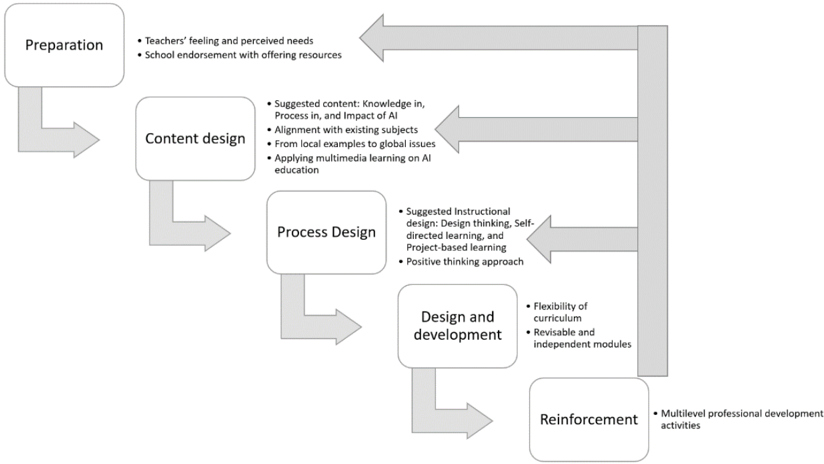
The teaching of artificial intelligence (AI) topics in school curricula is an important global strategic initiative in educating the next generation. As AI technologies are new to K-12 schools, there is a lack of studies that inform schools’ teachers about AI curriculum design. How to prepare and engage teachers, and which approaches are suitable for planning the curriculum for sustainable development, are unclear. Therefore, this case study aimed to explore the views of teachers with and without AI teaching experience on key considerations for the preparation, implementation and continuous refinement of a formal AI curriculum for K-12 schools. It drew on the self-determination theory (SDT) and four basic curriculum planning approaches—content, product, process and praxis—as theoretical frameworks to explain the research problems and findings. We conducted semi-structured interviews with 24 teachers—twelve with and twelve without experience in teaching AI—and used thematic analysis to analyze the interview data. Our findings revealed that genuine curriculum creation should encompass all four forms of curriculum design approach that are coordinated by teachers’ self-determination to be orchestrators of student learning experiences. This study also proposed a curriculum development cycle for teachers and curriculum officers.
Overview
The claims and statistics of this paper haven’t been checked yet.
Free: it reads the open-access text and checks the first 5 claims that cite a source we can check. Create a free account to check every claim.
Integrity signals
Registry
Cites
Statistics
Figures

Verification
Claims the paper makes
The claims and statistics of this paper haven’t been checked yet.
Free: it reads the open-access text and checks the first 5 claims that cite a source we can check. Create a free account to check every claim.
Claims other papers make about this one
Each is checked against this paper’s own text: does it say what the citing paper says it does?
The cited source doesn’t support the claim as written.
In the citing paper
“Teachers are key players for the integration of AI literacy in K-12, as proven by the numerous studies that examine this issue”
From AI literacy in K-12: a systematic literature review (2023) · cites this paper as Chiu & Chai, 2020
Checked by a reasoning model — may be wrong.
Experimental — accuracy not yet measuredThe source backs part of the claim, not all of it — or backs it for a different population, condition or comparison.
In the citing paper
“Although AI education in schools has become a global initiative, it is not seen as a traditional core subject, such as language, mathematics, and science (Chiu & Chai, 2020).”
From The impact of Generative AI (GenAI) on practices, policies and research direction in education: a case of ChatGPT and Midjourney (2024) · cites this paper as Chiu & Chai, 2020
Experimental — accuracy not yet measuredThe cited source says what the claim attributes to it.
In the citing paper
“Furthermore, the initial version of the instrument was developed by adapting a list of prior research such as Chiu & Chai (2020, Ng & Chu, 2021)'s and Ng & Chu (2021)'s questionnaire, the Motivational Strategies for Learning Questionnaire (MSLQ), Park et al. (2012)'s behavioural intention, Song and Keller (1999)'s confidence scale and ethical guidelines (Jobin et al., 2019;Microsoft, 2023).”
From Design and validation of the AI literacy questionnaire: The affective, behavioural, cognitive and ethical approach (2024) · cites this paper as Chiu & Chai (2020)
The check wasn’t confident either way, so it gives no verdict — never disputed.
In the citing paper
“Only a few of the studies have validated their questionnaires and even less retested them to ensure reliability in other settings (Chai et al., 2021;Chiu & Chai., 2020;Dai et al., 2020).”
From Design and validation of the AI literacy questionnaire: The affective, behavioural, cognitive and ethical approach (2024) · cites this paper as Chiu & Chai., 2020
Experimental — accuracy not yet measured
Self-check
Percentages, sums and reported differences re-computed from the paper’s own numbers.
The self-check needs the paper’s full text.
Citations
Cites
Using thematic analysis in psychology
Braun, V., & Clarke, V. (2006) · Qualitative Research in Psychology · doi:10.1191/1478088706qp063oa · Cited by 194,414 · cited 1×
“This offers a useful method for working within a participatory research paradigm to inform policy/curriculum development [21].”
MethodRyan, R. M., & Deci, E. L. (2000) · American Psychologist · doi:10.1037//0003-066x.55.1.68 · Cited by 54,599 · cited 4×
“This motivational process can be explained by the self-determination theory (SDT), which provides a theoretical framework to explain the teachers’ fundamental psychological needs—autonomy, relatedness and competence—for educational innovation [11,12].”
BackgroundMethodInfluentialZawacki-Richter, O., Marín, V. I., Bond, M., & Gouverneur, F. (2019) · International Journal of Educational Technology in Higher Education · doi:10.1186/s41239-019-0171-0 · Cited by 7,242 · cited 3×
“To date, very few studies on AI school teaching have been conducted [1,5,6].”
BackgroundPurposive sampling as a tool for informant selection
Tongco, M. D. C. (2007) · Ethnobotany Research and Applications · doi:10.17348/era.5.0.147-158 · Cited by 2,597 · cited 1×
“Therefore, we used purposeful sampling [19] to make sure that participants with all the conditions were recruited (broad categorization of the academic ability of students and AI teaching experience) from the pool of 48 partnership schools.”
MethodNiemiec, C. P., & Ryan, R. M. (2009) · Theory and Research in Education · doi:10.1177/1477878509104318 · Cited by 2,542
Teachers’ Perception of STEM Integration and Education: A Systematic Literature Review
Margot, K. C., & Kettler, T. (2019) · International Journal of STEM Education · doi:10.1186/s40594-018-0151-2 · Cited by 992 · cited 3×
“Therefore, schools should take immediate actions rather than make prolonged promises [10,25], and technology teachers prefer to receive direct, rather than indirect, support [9,25].”
BackgroundResultWang, Y.-Y., & Wang, Y.-S. (2022) · Interactive Learning Environments · doi:10.1080/10494820.2019.1674887 · Cited by 716 · cited 2×
“As machine learning becomes more powerful and narrow AI are performing more jobs, AI technologies and products are replacing jobs such as cashiers and proofreaders [17].”
BackgroundAchieving Saturation in Thematic Analysis: Development and Refinement of a Codebook
Ando, H., Cousins, R., & Young, C. (2014) · Comprehensive Psychology · doi:10.2466/03.cp.3.4 · Cited by 577 · cited 1×
“The sample size of 24 has been recommended by Ando, Cousins and Young [20] as sufficient to generate codes for thematic analysis.”
MethodHopes and fears for intelligent machines in fiction and reality
Cave, S., & Dihal, K. (2019) · Nature Machine Intelligence · doi:10.1038/s42256-019-0020-9 · Cited by 355 · cited 1×
“This is supported by the studies that generally find that peoples’ perceived worries of loss of control of AI, ethical concerns about AI and the negative impact of AI on work have grown in recent years [18,28].”
ResultWhat do engineering students learn in sustainability courses? The effect of the pedagogical approach
Segalàs, J., Ferrer-Balas, D., & Mulder, K. F. (2010) · Journal of Cleaner Production · doi:10.1016/j.jclepro.2009.09.012 · Cited by 302 · cited 1×
“This approach supports different types of students to better understand the complex world of AI by ensuring the participation of more students [34].”
Background
Research works printed but not linked: 1
- Glatthorn, A.A.; Boschee, F.; Whitehead, B.M.; Boschee, B.F. Curriculum Leadership: Strategies for Development and Implementation; SAGE: London, UK, 2018.
Cited by
Items 501–586 of 586
Ramos, H. J. P. F. (2026) · International Journal of Research and Innovation in Social Science · doi:10.47772/ijriss.2026.1026edu0187
Generativna umetna inteligenca v izobraževanju: preobrazba učenja v digitalni dobi
Aberšek, B., Radovan, M., Gradišek, A., Meden, E., Košmerl, T., Radovan, D. M., Flogie, A., Krabonja, M. V., Polanec, A., Konrad, S. Č., et al. (2026) · Založba Univerze v Ljubljani (University of Ljubljana Press) eBooks · doi:10.4312/9789612978174
Ogunode, N. J. (2025) · Aminu Kano Academic Scholars Association Multidisciplinary Journal · doi:10.64726/g2qsmf41
Aukkanit, N., Chopvitayakun, S., Sirichokworrakit, S., Chutrtong, J., Sangsuwon, C., & Kularbphettong, K. (2026) · Lecture notes in networks and systems · doi:10.1007/978-3-032-13153-9_5
A Vietnamese Case Study of Artificial Intelligence in K-12 Education
Ho, N. T. T., & Pham, L. T. K. (2026) · Acta Pedagogia Asiana · doi:10.53623/apga.v5isi.1047
“In addition,integrating AI into education faces two additional challenges: teachers' insufficient technological knowledge [16] and inadequate technical infrastructure in schools [17].”
Wei, Q., & Guo, X. (2026) · International Journal of Human-Computer Interaction · doi:10.1080/10447318.2026.2656818
Vergaray, M. P. (2024) · LA Referencia (Red Federada de Repositorios Institucionales de Publicaciones Científicas)
Vergaray, L. K. P. (2024) · LA Referencia (Red Federada de Repositorios Institucionales de Publicaciones Científicas)
Vildanov, A. N., & Devyatkin, E. M. (2026) · International Russian Smart Industry Conference (SmartIndustryCon) · doi:10.1109/smartindustrycon68821.2026.11493005
“…of fundamental concepts in AI, teachers can implement student-centered learning methodologies, such as research-based thinking, self-directed learning (goal setting and achievement), and research-based learning, which fosters critical thinking, creativity, and real-world problem-solving skills [4].”
Generativna umetna inteligenca v izobraževanju
(2026) · Repository of the University of Ljubljana (University of Ljubljana)
Phát triển chương trình bồi dưỡng năng lực dạy học STEM tích hợp AI cho sinh viên sư phạm
Truc, P. P. N., Van, H. B., Kim, O. N. T., & Van, D. D. (2026) · Technical Education Science/Giáo dục Kỹ thuật · doi:10.54644/jte.2026.2041
Nandwal, A., & Nandwal, P. (2026) · Lecture notes in networks and systems · doi:10.1007/978-3-032-18135-0_19
Teaching Artificial Intelligence and Machine Learning to Non-Majors: A Scoping Review
Köklü, O., ŞAHAL, M., & Dede, M. (2026) · IEEE Access · doi:10.1109/access.2026.3691617
“Existing research has primarily focused on AI/ML education within the realm of computer science [13], [14], [15], making it challenging to understand how to teach these subjects in broader educational contexts.”
Artificial Intelligence AND Implementation OF Science Education in Tertiary Institutions in Nigeria
Emeka, A. H. (2026) · Neliti
Burgos, G. J. E., & Constantinopla, S. J. P. (2026) · Journal for Research Scholars and Professionals of English Language Teaching · doi:10.54850/jrspelt.10.55.002
Abante, L. (2026) · Aloysian Interdisciplinary Journal of Social Sciences, Education, and Allied Fields · doi:10.5281/zenodo.20439992
AI, Learning Theories, and the Future of Teaching: A Critical Philosophical Analysis
Kahu, H. (2026) · International Journal of Research and Innovation in Applied Science · doi:10.51584/ijrias.2026.11050065
Trocado, A. E. B. D. S., Abar, C. A. A. P., Santos, J. M. D. S. D., & Lavicza, Z. (2026) · Vidya · doi:10.37781/vidya.v46i1.5636
Analysis of AI research project in first year English Composition
Dumin, L. (2026) · Journal of Teaching and Learning with Technology · doi:10.14434/jotlt.v14i1.41808 · Cited by 1
Huy, N. D. (2026) · Multidisciplinary Reviews · doi:10.31893/multirev.2026471 · Cited by 1
“Within this architecture, the needs analysis phase undergoes full automation, employing AI to mine global labor market data for the precise, real-time localization of skill gaps (Chiu & Chai, 2020; Tlili et al., 2023).”
Leading the Way: Strategic Leadership and Policy Frameworks for AI Integration in Higher Education
Mazid-Ul-Haque, M., & Emon, M. M. H. (2026) · Advances in computational intelligence and robotics book series · doi:10.4018/979-8-3373-1285-9.ch012
Villamora, K. H. P. (2026) · International Journal of Research Publications · doi:10.47119/ijrp1001981620269181
Wang, G., Xing, X., & Zhang, F. (2026) · International Journal of Instruction · doi:10.29333/iji.2026.19326a · Cited by 3
“Although the predictive roles of TPACK and self-efficacy in general technology adoption are well-established, empirical research specifically on K-12 teachers' adoption of GAI remains in its nascent stages, with limited studies and explanatory power (Chiu et al., 2020).”
Nagae, Y., Zhang, L., Nouri, J., & Mannila, L. (2026) · Lecture notes in computer science · doi:10.1007/978-3-032-29773-0_5
Olanrewaju, M. A., BUSARI, G. A., & Fabiyi, A. I. (2026) · International Journal of Innovative Science and Research Technology (IJISRT) · doi:10.38124/ijisrt/26jun1223
Perspectives on AI-Enabled Education for Sustainable Development
Chand, A., Sarthi, S., Aanchal, & R., G. C. (2026) · Springer eBooks · doi:10.1007/978-3-032-28217-0_11
DEMİRTAŞ, Ç. (2026) · Abant İzzet Baysal Üniversitesi Eğitim Fakültesi Dergisi · doi:10.17240/aibuefd.2026..-1912836
Orchestrating an AI-Supported Instagram Project as a Teacher
Narciandi-Rodríguez, D., Aveleira‐Mata, J., Bayón-Gutiérrez, M., Prieto-Fernández, N., Rubio-Martín, S., Corcoba, A. M., García-Ordás, M. T., Benavides, C., & Benítez‐Andrades, J. A. (2026) · International Conference on Higher Education Advances (HEAd) · doi:10.4995/head26.2026.21487
Theoretical foundations of training future teachers for school management
Khuangan, O. (2026) · Management in Education · doi:10.1177/08920206261462727
Doğan, A., & Soybaş, D. (2026) · DergiPark (Istanbul University)
Integrasi AI dalam Kurikulum Sekolah Menengah Berbasis Pembelajaran Abad 21
Mahmud, Fauzi, M. T. A., Hestianah, S., Anisiyah, D. M., & Rahmadani, R. M. (2025) · Dar El-Falah Jurnal Ilmu-ilmu Sosial Keagamaan dan Humaniora · doi:10.67409/xswmje10
Prompt Engineering for Organic Chemistry Education: A Digital Loom-Based Approach
Júnior, W. J. D. D. N., Santos, M. D. C., Mombelli, M. N., Miranda, P. C. M. L., & Júnior, G. G. (2026) · Methods in molecular biology · doi:10.1007/978-1-0716-5320-3_4
AI for All? Inclusive Learning Environments With and Through AI in Early Elementary Education
Plohmer, A., & Lange, S. (2026) · Communications in computer and information science · doi:10.1007/978-3-032-30552-7_59
Çelık, F. (2026) · Uluslararası Türk Eğitim Bilimleri Dergisi · doi:10.46778/goputeb.1813257
AI in Learning and Education: Implications for Faculty Careers in Higher Education
Kumar, S., & Kumar, P. (2026) · Advances in computational intelligence and robotics book series · doi:10.4018/979-8-2600-3204-6.ch003
An experimental study on the use of Markov chains to teach generative AI to high school students
Li, J. (2026) · The Journal of Educational Research · doi:10.1080/00220671.2025.2551595
“By promoting a balance between hands-on engagement, technical knowledge, and ethical reflection, educators can ensure that students are well-equipped to navigate the complexities of AI and contribute to its responsible development in the future (Chiu & Chai, 2020).”
Listari, A. W., Putra, A. N. A., Purnama, A. G., Herianti, H., & Ulandari, A. H. T. (2026) · Jurnal Pendidikan Teknologi · doi:10.65943/z7qshe41
“Several studies indicate that many information technology educators lack sufficient competence to systematically teach AI concepts (Chiu & Chai, 2020; Prasetyo & Sutopo, 2023).”
Othman, N. A. (2026) · Canadian Journal of Science Mathematics and Technology Education · doi:10.1007/s42330-026-00506-0
Mutlu, N. C., & GÜMÜŞ, F. Ö. (2026) · Open Praxis · doi:10.55982/openpraxis.18.3.936
Comparing ChatGPT’s and Teacher’s Feedback in Improving EFL Students' Narrative Writing
Go, P., & Sihombing, H. B. M. (2026) · JURNAL ILMIAH PENDIDIKAN KEBUDAYAAN DAN AGAMA · doi:10.59024/jipa.v4i3.1921
“Secondly, with the global momentum toward digital literacy and AI-integrated curricula (Bellas et al., 2023; Chiu & Chai, 2020; Ejjami, 2024; Lin & Van Brummelen, 2021), Indonesia is following suit.”
Liao, W., Lu, L., Liang, Y., Li, X., & Lin, M. (2026) · Teachers and Teaching · doi:10.1080/13540602.2026.2713117
Borsini, L., & Giaconi, C. (2025) · U-PAD Unimc - Open Digital Publications (University of Macerata) · doi:10.7346/sipes‐01‐2025‐02 · Cited by 4
Southworth, J., Migliaccio, K. W., & Hamerlinck, G. (2026) · Elsevier eBooks · doi:10.1016/b978-0-443-26741-3.00013-1
Student-Centered Learning and Teaching (SCLT)
Alkandari, K. (2026) · Education and human development · doi:10.5772/intechopen.1014999
Riggs, V., & Maukle, N. (2026) · Journal of Research on Technology in Education · doi:10.1080/15391523.2026.2704775
Yin, Y. (2026) · JJournal of natural science education. · doi:10.62517/jnse.202617301
Teaching With Intelligence, Not Automation
Mohidil, K., Aarthi, S., Ravikumar, R. N., Roximovna, B. K., Qizi, K. M. A., & Sadullaevich, S. R. (2026) · IGI Global eBooks · doi:10.4018/979-8-3373-9330-8.ch003
Karafil, B., & Uyar, A. (2026) · Batı anadolu eğitim bilimleri dergisi · doi:10.51460/baebd.1920930
AI Literacy and Convergence Competencies Among Pre-Service Teachers in Non-STEM Disciplines
Lee, J. (2026) · IAFOR Journal of Education · doi:10.22492/ije.14.2.06
Artificial intelligence and children's rights: a narrative review of the evidence
Jayadeva, S., & Livingstone, S. (2026) · London School of Economics and Political Science Research Online (London School of Economics and Political Science) · Cited by 3
Şan, İ., & Orhan-Karsak, H. G. (2026) · International Journal of Educational Technology in Higher Education · doi:10.1186/s41239-026-00621-w
“…students’ existing knowledge structures, in order to determine the manner in which said structures influence novel learning, and to identify the instructional bridges that are necessary (Sangwa et al., 2025; Aydın & Yurdugül, 2023; Chiu & Chai, 2020; Abu et al., 2025; Sakena et al., 2025).”
Caruana, I., Corbí, R. G., & Palomar, M. (2026) · Sustainability · doi:10.3390/su18178827 · Cited by 1
Altın, R., & Ak, N. Y. (2026) · Advances in computational intelligence and robotics book series · doi:10.4018/979-8-3373-8377-4.ch008
Pribadi, N. H., Rahadini, A. A., Kurwidaria, F., Wijayanti, K. D., Said, D. P., & Veronika, P. (2026) · Jurnal Pembelajaran Bimbingan dan Pengelolaan Pendidikan · doi:10.17977/um065.v7.i3.2027.2
Mining Online Learning Behavior Patterns of Digital Media Students Based on Clustering Algorithms
Huang, X. (2026) · International Conference on Machine Intelligence and Digital Applications (MIDA) · doi:10.1145/3801438.3806933
“These results underscore the direct practical utility of the K-means clustering framework as an operational intelligent educational tool deployable within existing institutional infrastructure [14].”
Rajaram, K. (2026) · Organizational Behavior Teaching Review · doi:10.1177/10525629261483734
Effiong, O. S., Orji Cyrus Ebere, M. C. P. N., Oluchi, A. M., & Tochukwu, U. J.-J. (2026) · British Journal of Contemporary Research · doi:10.67693/bjcr-2nfefbtn
Zamfara International Journal of Education (zije) 2025 Special Edition Vol 6 No 5
Sodangi, E.-I.-C.-C. D. U., BASHIR, S., Haruna, P. E. P. A. S., Abdullahi, A. P. E. D. Y. A., Shaibu, E. P. A., Bagudo, E. P. A. A., Lukman, E. D. S. A., Lawal, E. D. N. I., & Editorial Board: Yahaya Abdulkadir Ulama Secretary (2026) · Federal University Gusau Faculty of Education Journal · doi:10.64348/zije.2026559
Xu, Y., & Li, Z. (2026) · Humanities and Social Sciences Communications · doi:10.1057/s41599-026-09066-y
Fauzi, M. A., Aripin, N. M., & Alimin, N. S. N. (2026) · Asian Education and Development Studies · doi:10.1108/aeds-07-2025-0328
Riyana, C., Pratiwi, M. D., Sutisna, M. R., Mulyadi, D., Emilzoli, M., & Fadlillah, A. F. (2026) · JENTIK Jurnal Pendidikan Teknologi Informasi dan Komunikasi · doi:10.58723/jentik.v5i2.771
Questioning AI in the Classroom: A Professional Learning Resource for Pre-Service Teachers
Hart, K. (2026) · HARVEST (University of Saskatchewan)
Gaganao, R. D., Odon, M. G. B., & Discar, R. N. (2026) · Journal of Education and Learning (EduLearn) · doi:10.11591/edulearn.v20i4.27238
Connecting the dots: Designing curricula for understanding machine learning through mathematics
Oh, H., Li, C., Huang, R., & Xing, W. (2026) · Proceedings. · doi:10.22318/icls2026.903926
Mursi, N. B., & Alsaggaf, A. A. (2026) · University of Tabuk Journal for Humanities and Social Sciences · doi:10.68114/1658-8797.1018
Morifi, M. T., Nkosi, P. B., Kola, M. I., & Maeko, M. S. A. (2026) · E-Journal of Humanities Arts and Social Sciences · doi:10.38159/ehass.20267726
Towards Sustainable Vocational Education: An Explainable Green AI Ecosystem for Workforce Readiness
Novitasari, E., Rahman, K., Kalua, A. L., Viareco, H., Lestari, E., Amalia, R. R., Nuryati, N., & Wahrini, R. (2026) · F1000Research · doi:10.12688/f1000research.190135.1
Developing Pre-service teachers' Artificial Intelligence Literacy
Frimpong, E. K. (2022) · UEF eRepo (University of Eastern Finland) · Cited by 20
Putri, C. M., Ahmadi, A., & Hikmah, N. (2025) · Jurnal Kepemimpinan dan Pengurusan Sekolah · doi:10.34125/jkps.v10i4.1063
Pemanfaatan Teknologi Artificial Intelligence dalam Pengembangan Kurikulum
Devi, E. N. S., & Subiyantoro, S. (2026) · Kartika Jurnal Studi Keislaman
SMART LEARNING: THE IMPACT OF AI TECHNOLOGIES ON ENGLISH LANGUAGE PROFICIENCY IN THE DIGITAL ERA
Sabili, A. S., Nazri, M. A., Surayya, S. A., & Wati, L. (2024) · Jurnal Review Pendidikan dan Pengajaran · Cited by 6
Flogie, A., & Krabonja, M. V. (2026) · University of Maribor digital library (University of Maribor)
The Risks and Rewards of AI Dependence in Nigerian Education: A Critical Evaluation
Olatunji-Ishola, C. O., & Okanlawon, K. (2025) · Tech-Sphere Journal for Pure and Applied Sciences · Cited by 12
Liderança transformacional e sua relação com a implementação curricular em uma unidade educacional
Izquierdo, K. E. P., Villalba, L. G. R., Pazmiño, M. G. T., & Montufar, C. R. C. (2026) · Maestro y sociedad
Ezenwagu, S. A., Umeozor, U. J., & Umeh, N. C. (2025) · Scientific Journal of Educational Management, Research and law
Are Teachers Ready for AI? A Mixed-Methods Study
İÇEN, Z. E. (2026) · Language Education and Technology Journal
Hasil Kinerja AI dalam Penyelesaian Permasalahan Matematika pada Mata Kuliah Kalkulus
Ahmad, D. M., Niswah, F. M., Arum, T. S., Aufa, M. D. S., Dzaky, F. H., Ramadhan, C. D., Tasya, S. N., & Winata, A. (2024) · Journal of Education and Technology
Anwar, N. (2025) · Illinois Digital Environment for Access to Learning and Scholarship (University of Illinois at Urbana-Champaign)
GÜL, I., & Özgür, H. (2026) · Trakya Eğitim Dergisi · doi:10.24315/tred.1902835
Alqtifan, S. A. A. S., & Alodwan, T. A. A. S. (2026) · Journal of Humanities and Social Sciences Studies · doi:10.32996/jhsss.2026.8.10.8
Pu, S., & Shi, X. (2026) · International Journal of Educational Research · doi:10.1016/j.ijer.2026.103146
Greinke, L., Lange, L., & Richter, J. (2026) · World sustainability series · doi:10.1007/978-3-032-34574-5_26
Effah Miriam, A., Igboke, S. A., & Nwimo, I. O. (2026) · Nigerian Journal of Business Education (NIGJBED)
Artificial Intelligence through the Eyes of Future Educators: Trends and Disciplinary Differences
Türker, Ş., Türkoğlu, A. Y., & Serttaş, S. (2026) · Eğitim Bilim ve Araştırma Dergisi · doi:10.54637/vizetek.27579522.7.2.4
Ding, L., Liu, Y., & Xu, C. (2026) · Journal of Curriculum and Teaching · doi:10.5430/jct.v15n4p269
Metadata
- Authors
- Chiu, T. K. F., & Chai, C.-S.
- Affiliations
- Chinese University of Hong Kong (HK)
- Corresponding author
- Chiu, Thomas K.F.
- Venue
- Sustainability
- Publisher
- MDPI AG
- Published
- 2020-07-10
- Volume
- 12
- Issue
- 14
- Pages
- 5568
- ISSN
- 2071-1050 (ISSN-L)
- OpenAlex
- W3041706899
- Cited by
- 448
- References
- 32
- Citations by year
- 2026: 98 · 2025: 133 · 2024: 102 · 2023: 62 · 2022: 36 · 2021: 16 · 2020: 1
- FWCI
- 27.05
- Type
- journal article
- Language
- en
- Open access
- gold
- dx.doi.org
- Licence
- Locations
- Sustainability (publishedVersion, cc-by)
- RePEc: Research Papers in Economics (submittedVersion)
- DOAJ (DOAJ: Directory of Open Access Journals) (submittedVersion)
- Topics
- Social Sciences › Education › Artificial Intelligence in Education
- Physical Sciences › Computer Science › Computer Science Applications › Teaching and Learning Programming
- Social Sciences › Education › Educational Curriculum and Learning Methods
- Keywords
- artificial intelligence in education, AI curriculum design, K-12 schools, self-determination theory, teacher perceptions, teacher preparation, sustainable development
About these checks
Registry, retraction, Cites and statistics results are computed, not judged, with one exception: a printed reference that no index lists is read once by a model before it counts as a citation error. Claims are extracted by a model and kept only when their quote appears verbatim in the text; each cited source is then checked, with a model’s help, for whether it says what the claim relies on. Those verdicts can be wrong — read the claim’s quote and the cited source before relying on one.
Statistics and arithmetic are recomputed, not judged.
Confidence bands are shown only for fields calibrated on our annotated test set. None is calibrated yet, so no band is shown.
What counts as a claim ›How we measure confidence ›How we check this ›
Are you an author, or do you see a problem with this page? Request a review
Data sources
Bibliographic data: Semantic Scholar, OpenAlex, Crossref.
Contains information from the Semantic Scholar Academic Graph Datasets, made available under the ODC Attribution License (ODC-BY 1.0).
Semantic Scholar’s data is described in: Kinney, R., et al. (2023). The Semantic Scholar Open Data Platform. arXiv:2301.10140.
