

The DOI matches its Crossref record; 66 of the 66 references it cites were found in a registry or an index; none of the 27 sources its claims cite is checked for support yet.
Developing AI Literacy for Primary and Middle School Teachers in China: Based on a Structural Equation Modeling Analysis
Open accessAbstract
As smart technology promotes the development of various industries, artificial intelligence (AI) has also become an important driving force for innovation and transformation in education. For teachers, how to skillfully apply AI in teaching and improve their AI literacy has become a necessary goal for their sustainable professional development. This research examines the correlations among the dimensions of AI literacy of teachers in order to promote the effectiveness of class teaching and the adoption of artificial intelligence literacy (AIL). Our findings are based on the analysis of 1013 survey results, where we tested the level of AI literacy of teachers, including Knowing and Understanding AI (KUAI), Applying AI (AAI), Evaluating AI Application (EAIA), and AI Ethics (AIE). We find that AAI had a significant, positive effect on the other three dimensions. Thus, based on the analysis, the government should take action to cultivate teachers’ AI literacy. In order to improve teachers’ AI literacy, the choice of curriculum, content, methods, and practical resources for special training should be diverse and committed to making AI literacy an essential enabler for teachers’ sustainable future development.
Overview
AI snapshot
Written from the paper’s full text.
TL;DR
This study surveyed 1013 primary and middle school teachers in Jiangsu, China, to model relationships among four dimensions of AI literacy: Knowing and Understanding AI, Applying AI, Evaluating AI Application, and AI Ethics. Applying AI was the strongest positive predictor of the other dimensions, especially Knowing and Understanding AI.
Key findings
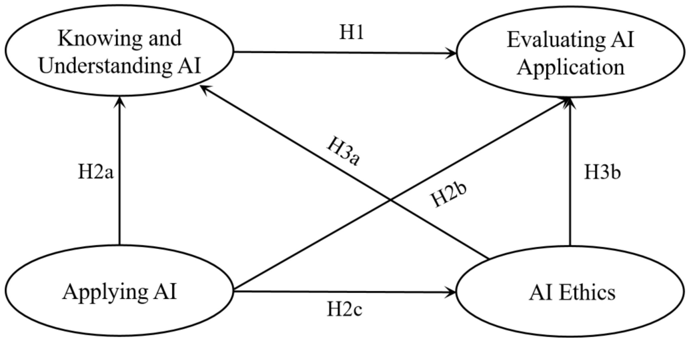
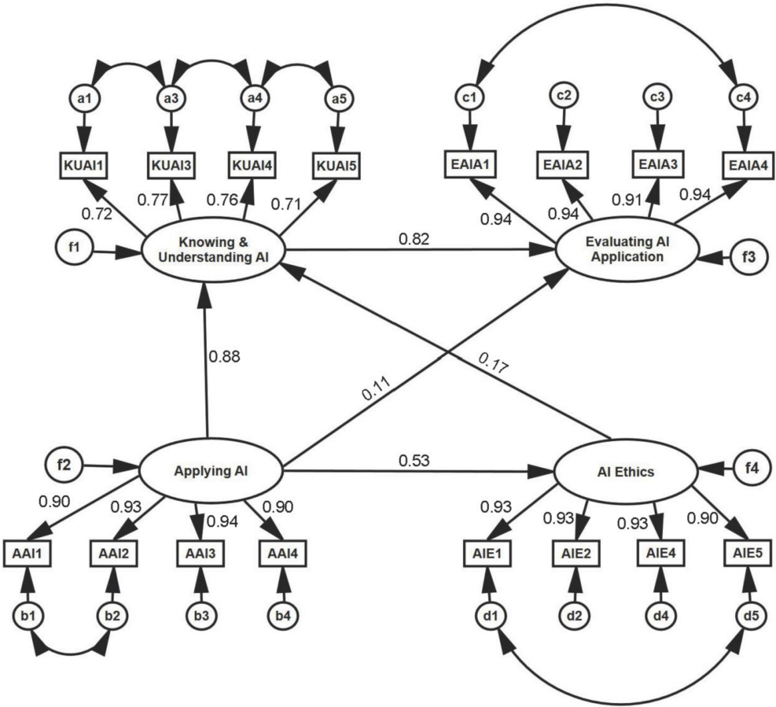
- Applying AI had a significant positive effect on Knowing and Understanding AI (β = 0.88, p < 0.001), Evaluating AI Application (β = 0.11, p < 0.001), and AI Ethics (β = 0.53, p < 0.001).
- Knowing and Understanding AI positively predicted Evaluating AI Application (β = 0.82, p < 0.001), and AI Ethics positively predicted Knowing and Understanding AI (β = 0.17, p < 0.001).
- The hypothesized path from AI Ethics to Evaluating AI Application (H3b) was not supported; the paper reports H3 as partially supported.
- Mean AI literacy ratings were above the neutral point: KUAI 3.636, AAI 3.457, EAIA 3.449, and AIE 4.007 on a 5-point scale; the structural model showed acceptable fit (CFI = 0.911, RMSEA = 0.079, SRMR = 0.060).
Methods
- A one-month 2022 survey of teachers in Jiangsu, China, working in formal schools from grade one to grade twelve with at least one year of teaching experience.
- From 1271 retrieved questionnaires, 56 invalid responses were removed, rural submissions were randomly trimmed, and 1013 samples were analyzed; participants were 57.5% primary (n = 581), 42.2% secondary (n = 429), and 0.3% higher education (n = 3).
- AI literacy was measured with 20 items across four dimensions using a 5-point Likert scale; reliability was high (Cronbach’s α = 0.963, McDonald’s ω = 0.967), and structural equation modeling was conducted in AMOS.
Limitations
- The paper states that the sample was not randomly selected and most teachers were from rural areas in China, so results should not be generalized to all Chinese teachers.
- The paper states that data were one-time and quantitative; future research should add qualitative and long-term data.
- Evident from the text: the study relies on self-reported Likert-scale responses and a cross-sectional design, so causal direction among the AI literacy dimensions is not established.
Model-written summary. Check it against the paper before relying on it.
Integrity signals
Registry
Cites
Statistics
Figures
Verification
Claims the paper makes
19 Not checked yet · 13 Own result · 11 Own method · 5 Own interpretation · 3 No basis given
A result the paper reports from its own data — it cites no other source for it, so there is none to check. The quote shows it is in the paper.
In the paper
“Wefind that AAI had a significant, positive effect on the other three dimensions.”
plaindirect- Asserted: passes — The authors put it forward as true.
- Checkable: passes — It can be checked against evidence.
- Load-bearing: passes — The paper’s conclusions depend on it.
- Based: passes — The paper gives a reason why it holds.
A result the paper reports from its own data — it cites no other source for it, so there is none to check. The quote shows it is in the paper.
In the paper
“AI Ethics positively affect Knowing and Understanding AI ( β = 0.17, p < 0.001).”
- Also stated in: § 5.1. Varying Impact on Knowing and Understanding AI · p. 10 · plain
“The fact that AI Ethics has only a moderate effect on Knowing and Understanding AI is not acceptable ( β = 0.17)”
plaindirect- Asserted: passes — The authors put it forward as true.
- Checkable: passes — It can be checked against evidence.
- Load-bearing: passes — The paper’s conclusions depend on it.
- Based: passes — The paper gives a reason why it holds.
- The authors state this as an assumption: The analyzed model assumes correlations among dimensions of AI literacy.
- Also stated in: § 5.1. Varying Impact on Knowing and Understanding AI · p. 10 · plain
A result the paper reports from its own data — it cites no other source for it, so there is none to check. The quote shows it is in the paper.
In the paper
“Appling AI had the least significant positive effects on evaluating and creating AI ( β = 0.11, p < 0.001) and was lower than that of AI Ethics ( β = 0.53, p < 0.001).”
plaindirect- Asserted: passes — The authors put it forward as true.
- Checkable: passes — It can be checked against evidence.
- Load-bearing: passes — The paper’s conclusions depend on it.
- Based: passes — The paper gives a reason why it holds.
- The authors state this as an assumption: The analyzed model assumes correlations among dimensions of AI literacy.
A result the paper reports from its own data — it cites no other source for it, so there is none to check. The quote shows it is in the paper.
In the paper
“Moreover, Applying AI had the most positive effect on Knowing and Understanding AI ( β = 0.88, p < 0.001).”
plaindirect- Asserted: passes — The authors put it forward as true.
- Checkable: passes — It can be checked against evidence.
- Load-bearing: passes — The paper’s conclusions depend on it.
- Based: passes — The paper gives a reason why it holds.
- The authors state this as an assumption: The analyzed model assumes correlations among dimensions of AI literacy.
The paper states this without a source or data behind it here, so there is nothing to check it against. The quote shows it is in the paper.
In the paper
“Resonably, the results obtained show that, as the level of education increases, the level decreases.”
hedgeddirect- Asserted: passes — The authors put it forward as true.
- Checkable: passes — It can be checked against evidence.
- Load-bearing: passes — The paper’s conclusions depend on it.
- Based: passes — The paper gives a reason why it holds.
A result the paper reports from its own data — it cites no other source for it, so there is none to check. The quote shows it is in the paper.
In the paper
“and those constructs were moderately correlated with each other.”
plaincorrelational- Asserted: passes — The authors put it forward as true.
- Checkable: passes — It can be checked against evidence.
- Load-bearing: unclear — It is unclear whether the paper’s conclusions depend on it.
- Based: passes — The paper gives a reason why it holds.
A result the paper reports from its own data — it cites no other source for it, so there is none to check. The quote shows it is in the paper.
In the paper
“the majority of the hypotheses were accepted except for a few non-significant paths (e.g., H3b).”
- Also stated in: § 4.4. Hypotheses Testing Results · p. 9 · plain
“Since the validity of H3b is lower than the standard, H3a was supported.”
plain- Asserted: passes — The authors put it forward as true.
- Checkable: passes — It can be checked against evidence.
- Load-bearing: passes — The paper’s conclusions depend on it.
- Based: passes — The paper gives a reason why it holds.
- The authors state this as an assumption: The analyzed model assumes correlations among dimensions of AI literacy.
- Also stated in: § 4.4. Hypotheses Testing Results · p. 9 · plain
A result the paper reports from its own data — it cites no other source for it, so there is none to check. The quote shows it is in the paper.
In the paper
“Compared to other demographic elements, the factors of age reported a stronger correlation with KUAI, AAI, and EAIA.”
plaincorrelational- Asserted: passes — The authors put it forward as true.
- Checkable: passes — It can be checked against evidence.
- Load-bearing: unclear — It is unclear whether the paper’s conclusions depend on it.
- Based: passes — The paper gives a reason why it holds.
A result the paper reports from its own data — it cites no other source for it, so there is none to check. The quote shows it is in the paper.
In the paper
“Appling AI had the least significant positive effects on evaluating and creating AI ( β = 0.11, p < 0.001) and was lower than that of AI Ethics ( β = 0.53, p < 0.001).”
plaindirect- Asserted: passes — The authors put it forward as true.
- Checkable: passes — It can be checked against evidence.
- Load-bearing: unclear — It is unclear whether the paper’s conclusions depend on it.
- Based: passes — The paper gives a reason why it holds.
- The authors state this as an assumption: The analyzed model assumes correlations among dimensions of AI literacy.
A result the paper reports from its own data — it cites no other source for it, so there is none to check. The quote shows it is in the paper.
In the paper
“Appling AI had the least significant positive effects on evaluating and creating AI ( β = 0.11, p < 0.001)”
plaindirect- Asserted: passes — The authors put it forward as true.
- Checkable: passes — It can be checked against evidence.
- Load-bearing: passes — The paper’s conclusions depend on it.
- Based: passes — The paper gives a reason why it holds.
- The authors state this as an assumption: The analyzed model assumes correlations among dimensions of AI literacy.
- It may state two separate claims as one. 16
- Probably not a substantial claim. 17
- The quote only partly states this claim. 1
A result the paper reports from its own data — it cites no other source for it, so there is none to check. The quote shows it is in the paper.
In the paper
“this study shows that the majority of teachers are at a moderate to high level of AI literacy and have a relatively in-depth understanding of the use of AI resources in the classroom.”
boosted- Asserted: passes — The authors put it forward as true.
- Checkable: passes — It can be checked against evidence.
- Load-bearing: unclear — It is unclear whether the paper’s conclusions depend on it.
- Based: passes — The paper gives a reason why it holds.
It may state two separate claims as one.
A result the paper reports from its own data — it cites no other source for it, so there is none to check. The quote shows it is in the paper.
In the paper
“The mean ratings for Knowing and Understanding AI (KUAI), Applying AI (AAI), Evaluating AI Application (EAIA), and AI Ethics (AIE) were all above the neutral point (i.e., 3 on the five-point Likert scale), ranging from 3.45 to 4.01”
plain- Asserted: passes — The authors put it forward as true.
- Checkable: passes — It can be checked against evidence.
- Load-bearing: unclear — It is unclear whether the paper’s conclusions depend on it.
- Based: passes — The paper gives a reason why it holds.
It may state two separate claims as one.
The paper states this without a source or data behind it here, so there is nothing to check it against. The quote shows it is in the paper.
In the paper
“most teachers in this study have not received AI education”
plain- Asserted: passes — The authors put it forward as true.
- Checkable: passes — It can be checked against evidence.
- Load-bearing: passes — The paper’s conclusions depend on it.
- Based: fails — The paper may give no reason why it holds.
Probably not a substantial claim. The paper may give no reason why it holds.
In the paper
“All the indices indicated good fit: CFI = 0.911, RMSEA = 0.079, and the Chi-square test ( p < 0.001), as is shown in Table 4. We also adopted the standardized root mean square residual (SRMR) to evaluate the model fit cautiously, and the value of SRMR was lower than 0.08, which was acceptable, according to Hair et al. (2017) [61].”
What the sources say
- Not checked yetcites [61] Hair, 2017, PLS-SEM or CB-SEM: Updated guidelines on which method to use, Int. J. Multivar. Data Anal. source
boosted- Asserted: passes — The authors put it forward as true.
- Checkable: passes — It can be checked against evidence.
- Load-bearing: passes — The paper’s conclusions depend on it.
- Based: passes — The paper gives a reason why it holds.
It may state two separate claims as one.
The paper states this without a source or data behind it here, so there is nothing to check it against. The quote shows it is in the paper.
In the paper
“educational background is closely related to AI literacy (where the better the educational background, the higher is the degree of AI literacy related to teachers' performance at class).”
plaincorrelational- Asserted: passes — The authors put it forward as true.
- Checkable: passes — It can be checked against evidence.
- Load-bearing: passes — The paper’s conclusions depend on it.
- Based: passes — The paper gives a reason why it holds.
It may state two separate claims as one.
A result the paper reports from its own data — it cites no other source for it, so there is none to check. The quote shows it is in the paper.
In the paper
“Hypothesis 1 is supported. Knowing and Understanding AI was a significant antecedent to evaluating and creating AI ( β = 0.82, p < 0.001).”
plaindirect- Asserted: passes — The authors put it forward as true.
- Checkable: passes — It can be checked against evidence.
- Load-bearing: passes — The paper’s conclusions depend on it.
- Based: passes — The paper gives a reason why it holds.
The quote only partly states this claim.
- The authors state this as an assumption: The analyzed model assumes correlations among dimensions of AI literacy.
In the paper
“Considering the predominance of female participants in this study, gender did not lead to bias in this survey, as women are the majority of practitioners in the social sciences, especially in education [56].”
What the sources say
- Not checked yetcites [56] Gialamas, 2013, Student teachers’ perceptions about the impact of internet usage on their learning and jobs, Comput. Educ. source
plain- Asserted: passes — The authors put it forward as true.
- Checkable: passes — It can be checked against evidence.
- Load-bearing: unclear — It is unclear whether the paper’s conclusions depend on it.
- Based: passes — The paper gives a reason why it holds.
It may state two separate claims as one.
What the paper did — it cites no source for this, so there is none to check. The quote shows it is in the paper.
In the paper
“The final scale consisted of 20 items divided into four dimensions, among different dimensions, and the correlation of items was lower than 0.4.”
plaincorrelational- Asserted: passes — The authors put it forward as true.
- Checkable: passes — It can be checked against evidence.
- Load-bearing: unclear — It is unclear whether the paper’s conclusions depend on it.
- Based: passes — The paper gives a reason why it holds.
It may state two separate claims as one.
In the paper
“Evaluating AI applications could be beneficial for enhancing their motivation and interest in teaching with AI [40].”
What the sources say
- Not checked yetcites [40] Rapanta, 2020, Online university teaching during and after the Covid-19 crisis: Refocusing teacher presence and learning activity, Postdigital Sci. Educ. source
hedgedconditional- Asserted: passes — The authors put it forward as true.
- Checkable: passes — It can be checked against evidence.
- Load-bearing: fails — The paper’s conclusions may not depend on it.
- Based: passes — The paper gives a reason why it holds.
Probably not a substantial claim. The paper’s conclusions may not depend on it.
None of the sources cited for this claim have been checked yet.
In the paper
“which found that teachers paid no attention to ethical concerns, such as biased decisions, lack of transparency, privacy issues, and the risk of invasion of privacy [52,53].”
What the sources say
- Not checked yetcites [52] Lee, H.S., and Lee, J. (2021). Applying Artificial Intelligence in physical education and future perspectives. Sustainability, 13. source
- Not checked yetcites [53] Shah, 2021, An iSchool approach to data science: Human-centered, socially responsible, and context-driven, J. Assoc. Inf. Sci. Technol. source
plain- Asserted: passes — The authors put it forward as true.
- Checkable: passes — It can be checked against evidence.
- Load-bearing: fails — The paper’s conclusions may not depend on it.
- Based: passes — The paper gives a reason why it holds.
Probably not a substantial claim. The paper’s conclusions may not depend on it.
In the paper
“As Ravinder suggested, when the McDonald's omega coefficient is greater than 0.9, it indicates a high quality of reliability of the study data [57].”
What the sources say
- Not checked yetcites [57] Ravinder, 2020, Literature Review of Cronbach alpha coefficient (A) And Mcdonald’s Omega Coefficient (Ω), Eur. J. Mol. Clin. Med.
hedgedcorrelational- Asserted: passes — The authors put it forward as true.
- Checkable: passes — It can be checked against evidence.
- Load-bearing: passes — The paper’s conclusions depend on it.
- Based: passes — The paper gives a reason why it holds.
Probably not a substantial claim.
What the paper did — it cites no source for this, so there is none to check. The quote shows it is in the paper.
In the paper
“A systematic random sampling of teachers was conducted, controlling for the number in the sample within different subjects.”
plain- Asserted: passes — The authors put it forward as true.
- Checkable: passes — It can be checked against evidence.
- Load-bearing: fails — The paper’s conclusions may not depend on it.
- Based: passes — The paper gives a reason why it holds.
Probably not a substantial claim. The paper’s conclusions may not depend on it. It may state two separate claims as one.
What the paper did — it cites no source for this, so there is none to check. The quote shows it is in the paper.
In the paper
“The Cronbach's alpha and McDonald's omega coefficients for this scale were tested to be 0.963 and 0.967, respectively.”
plain- Asserted: passes — The authors put it forward as true.
- Checkable: passes — It can be checked against evidence.
- Load-bearing: passes — The paper’s conclusions depend on it.
- Based: passes — The paper gives a reason why it holds.
It may state two separate claims as one.
What the paper did — it cites no source for this, so there is none to check. The quote shows it is in the paper.
In the paper
“The KMO test (Kaiser-Meyer-Olkin) was 0.968 and the Bartlett test was significant ( χ 2 = 28,200.756, p < 0.05).”
plain- Asserted: passes — The authors put it forward as true.
- Checkable: passes — It can be checked against evidence.
- Load-bearing: passes — The paper’s conclusions depend on it.
- Based: passes — The paper gives a reason why it holds.
It may state two separate claims as one.
In the paper
“Apart from the ethics of understanding and using AI, evaluating artificial intelligence applications is an important competency that enables teachers to judiciously evaluate AI technologies, commenting on the application of AI in teaching [41].”
What the sources say
- Not checked yetcites [41] Huang, 2021, Aims for cultivating students’ key competencies based on Artificial Intelligence education in China, Educ. Inf. Technol. source
plain- Asserted: passes — The authors put it forward as true.
- Checkable: fails — It may be too vague to check against evidence.
- Load-bearing: fails — The paper’s conclusions may not depend on it.
- Based: passes — The paper gives a reason why it holds.
Probably not a substantial claim. It may be too vague to check against evidence. The paper’s conclusions may not depend on it.
What the paper did — it cites no source for this, so there is none to check. The quote shows it is in the paper.
In the paper
“This study was conducted following ethical research codes and all respondents participated in the survey voluntarily.”
plain- Asserted: passes — The authors put it forward as true.
- Checkable: passes — It can be checked against evidence.
- Load-bearing: fails — The paper’s conclusions may not depend on it.
- Based: fails — The paper may give no reason why it holds.
Probably not a substantial claim. The paper’s conclusions may not depend on it. The paper may give no reason why it holds. It may state two separate claims as one.
None of the sources cited for this claim have been checked yet.
In the paper
“According to the study of Ng et al., AI literacy can be divided into four common dimensions to build structure”
- Also stated in: § 2.1.1. AI Literacy · p. 2 · plain
“While AI literacy is not equal to the applications of AI, following the conclusion of Bloom, it includes four dimensions: Knowing and Understanding AI, Applying AI, Evaluating AI Application and AI Ethics, as identified from previous studies [23-25].”
What the sources say
- Not checked yetcites [9] Ng, 2021, AI literacy: Definition, teaching, evaluation and ethical issues, Proc. Assoc. Inf. Sci. Technol. source
- Not checked yetcites [23] Cope, 2021, Artificial Intelligence for education: Knowledge and its assessment in AI-enabled learning ecologies, Educ. Philos. Theory source
- Not checked yetcites [24] Acemoglu, D., and Restrepo, P. (2018). Artificial Intelligence, automation, and work. The Economics of Artificial Intelligence: An Agenda, University of Chicago Press. source
- Not checked yetcites [25] Kong, 2021, Evaluation of an Artificial Intelligence literacy course for university students with diverse study backgrounds, Comput. Educ. Artif. Intell. source
plain- Asserted: passes — The authors put it forward as true.
- Checkable: passes — It can be checked against evidence.
- Load-bearing: passes — The paper’s conclusions depend on it.
- Based: passes — The paper gives a reason why it holds.
Probably not a substantial claim.
- Also stated in: § 2.1.1. AI Literacy · p. 2 · plain
None of the sources cited for this claim have been checked yet.
In the paper
“Meanwhile, a poor belief state in the potential of AI among teachers has also been proven [28,29].”
What the sources say
- Not checked yetcites [28] Vazhayil, A., Shetty, R., Bhavani, R.R., and Akshay, N. (2019, January 9–11). Focusing on teacher education to introduce AI in schools: Perspectives and illustrative findings. Proceedings of the 2019 IEEE Tenth International Conference on Technology for Education (T4E), Goa, India. source
- Not checked yetcites [29] Edwards, 2018, I, teacher: Using Artificial Intelligence (AI) and social robots in communication and instruction, Commun. Educ. source
boosted- Asserted: passes — The authors put it forward as true.
- Checkable: passes — It can be checked against evidence.
- Load-bearing: fails — The paper’s conclusions may not depend on it.
- Based: passes — The paper gives a reason why it holds.
Probably not a substantial claim. The paper’s conclusions may not depend on it.
In the paper
“According to Nunnally (1978), the α value above 0.7 indicates a high reliability of measurement.”
What the sources say
- Not checked yetcites [60] Nunnally, 1978, Psychometric theory, Am. J. Educ. Res.
plain- Asserted: passes — The authors put it forward as true.
- Checkable: passes — It can be checked against evidence.
- Load-bearing: passes — The paper’s conclusions depend on it.
- Based: passes — The paper gives a reason why it holds.
Probably not a substantial claim.
What the paper did — it cites no source for this, so there is none to check. The quote shows it is in the paper.
In the paper
“The sample from this study was not randomly selected and the majority of teachers were from rural areas in China.”
plain- Asserted: passes — The authors put it forward as true.
- Checkable: passes — It can be checked against evidence.
- Load-bearing: passes — The paper’s conclusions depend on it.
- Based: passes — The paper gives a reason why it holds.
It may state two separate claims as one.
A conclusion the paper draws from its own results — it cites no other source for it, so there is none to check. The quote shows it is in the paper.
In the paper
“thus their previous technological skills help them to know and understand AI better.”
plaindirect- Asserted: passes — The authors put it forward as true.
- Checkable: passes — It can be checked against evidence.
- Load-bearing: passes — The paper’s conclusions depend on it.
- Based: passes — The paper gives a reason why it holds.
Probably not a substantial claim.
A conclusion the paper draws from its own results — it cites no other source for it, so there is none to check. The quote shows it is in the paper.
In the paper
“which means except AI Ethics, there are other cultural or technical reasons behind the relationship.”
plaindirect- Asserted: passes — The authors put it forward as true.
- Checkable: passes — It can be checked against evidence.
- Load-bearing: passes — The paper’s conclusions depend on it.
- Based: passes — The paper gives a reason why it holds.
Probably not a substantial claim.
- Rests on an assumption: Many Chinese teachers have insufficient resources to develop the AI literacy of Knowing and Understanding AI.
- The authors state this as an assumption: The analyzed model assumes correlations among dimensions of AI literacy.
In the paper
“Such a discovery is consistent with Cetindamar's study [66], Knowing and Understanding AI is influenced by multiple factors, and AI Ethics can be seen as a factor contributing to its enhancement.”
What the sources say
- Not checked yetcites [66] Cetindamar, D., Kitto, K., Wu, M., Zhang, Y., Abedin, B., and Knight, S. (2022). Explicating AI literacy of employees at digital workplaces. IEEE Trans. Eng. Manag., 1–13.
plainconditional- Asserted: passes — The authors put it forward as true.
- Checkable: passes — It can be checked against evidence.
- Load-bearing: fails — The paper’s conclusions may not depend on it.
- Based: passes — The paper gives a reason why it holds.
Probably not a substantial claim. The paper’s conclusions may not depend on it. It may state two separate claims as one.
What the paper did — it cites no source for this, so there is none to check. The quote shows it is in the paper.
In the paper
“The other limitation of the study lies in the fact that the data collected were one-time and quantitative in nature.”
plain- Asserted: passes — The authors put it forward as true.
- Checkable: passes — It can be checked against evidence.
- Load-bearing: fails — The paper’s conclusions may not depend on it.
- Based: passes — The paper gives a reason why it holds.
Probably not a substantial claim. The paper’s conclusions may not depend on it. It may state two separate claims as one.
None of the sources cited for this claim have been checked yet.
In the paper
“the lack of teachers' AI literacy can be attributed to the over-intellectualization of primary education and the focus on achievement at the expense of the learning and teaching process, resulting in the neglect of teachers' AI literacy enhancement [76,77].”
What the sources say
- Not checked yetcites [76] Dilmurod, 2021, Prospects for the introduction of artificial intelligence technologies in higher education, ACADEMICIA: an international multidisciplinary research journal.
- Not checked yetcites [77] Papakonstantinou, A., Batsaris, M., Spondylidis, S., and Topouzelis, K. (2021). A citizen science unmanned aerial system data acquisition protocol and deep learning techniques for the automatic detection and mapping of marine litter concentrations in the coastal zone. Drones, 5. source
plaindirect- Asserted: passes — The authors put it forward as true.
- Checkable: fails — It may be too vague to check against evidence.
- Load-bearing: passes — The paper’s conclusions depend on it.
- Based: passes — The paper gives a reason why it holds.
Probably not a substantial claim. It may be too vague to check against evidence. It may state two separate claims as one.
What the paper did — it cites no source for this, so there is none to check. The quote shows it is in the paper.
In the paper
“ThestudywasconductedinaccordancewiththeDeclaration of Helsinki, and approved by the Medical Ethics Committee of Jiangnan University (protocol code JNU20220901IRB12 and date of approval 16 September 2022).”
plain- Asserted: passes — The authors put it forward as true.
- Checkable: passes — It can be checked against evidence.
- Load-bearing: fails — The paper’s conclusions may not depend on it.
- Based: passes — The paper gives a reason why it holds.
Probably not a substantial claim. The paper’s conclusions may not depend on it. It may state two separate claims as one.
What the paper did — it cites no source for this, so there is none to check. The quote shows it is in the paper.
In the paper
“Informedconsentwasobtainedfromallsubjectsinvolvedinthestudy.”
plain- Asserted: passes — The authors put it forward as true.
- Checkable: passes — It can be checked against evidence.
- Load-bearing: fails — The paper’s conclusions may not depend on it.
- Based: passes — The paper gives a reason why it holds.
Probably not a substantial claim. The paper’s conclusions may not depend on it.
In the paper
“In this study, all α values were greater than 0.7, suggesting an acceptable reliability for the questionnaire and its sub-sections [60].”
What the sources say
- Not checked yetcites [60] Nunnally, 1978, Psychometric theory, Am. J. Educ. Res.
hedged- Asserted: passes — The authors put it forward as true.
- Checkable: passes — It can be checked against evidence.
- Load-bearing: passes — The paper’s conclusions depend on it.
- Based: passes — The paper gives a reason why it holds.
It may state two separate claims as one.
The paper relies on this without support.
A large number of teachers have been exposed to AI-enabled appliances but do not understand fundamental AI concepts such as big data structures, computational thinking concepts, or ubiquitous computing approaches.
“A large number of teachers have been exposed to the technological environment with AI-enabled appliances, but in reality, they do not understand the fundamental concepts, such as big data structures, computational thinking concepts, or ubiquitous computing approaches.”
The paper relies on this without support.
The pyramid-shaped distribution of participants mirrors the teacher composition structure in China.
“Such pyramid-shaped distribution mirrors the teacher composition structure in China.”
The paper relies on this without support.
AI literacy in teacher education is in its infancy.
“Artificial Intelligence literacy in teacher education is in its infancy.”
The paper relies on this without support.
Many Chinese teachers have insufficient resources to develop the AI literacy of Knowing and Understanding AI.
“In fact, many Chinese teachers have insufficient resources to develop the AI literacy of Knowing and Understanding AI.”
The authors state this as an assumption.
The analyzed model assumes correlations among dimensions of AI literacy.
“the analyzed model assumes the correlations among dimensions of AI literacy”
Claims other papers make about this one
Each is checked against this paper’s own text: does it say what the citing paper says it does?
In the citing paper
“Teachers who understand AI concepts and applications are more likely to recognize the benefits of GenAI, such as personalized learning and efficient student assessment, and therefore perceive these technologies as more useful [45,51].”
From Modeling teachers’ acceptance of generative artificial intelligence use in higher education: the role of AI literacy, intelligent TPACK, and perceived trust (2024) · cites this paper as [45]
In the citing paper
“This suggests that AI literacy is a key component in equipping teachers with the necessary skills and knowledge to integrate GenAI effectively into their teaching [45,48].”
From Modeling teachers’ acceptance of generative artificial intelligence use in higher education: the role of AI literacy, intelligent TPACK, and perceived trust (2024) · cites this paper as [45]
In the citing paper
“The support for H10, which states that AI literacy positively influences the perceived value of ChatGPT, underscores the significance of students’ understanding of and familiarity with AI in appreciating the tool’s potential and contributions to their academic and personal endeavours.”
From ChatGPT in Learning: Assessing Students’ Use Intentions through the Lens of Perceived Value and the Influence of AI Literacy (2024) · cites this paper as [52]
Self-check
Percentages, sums and reported differences re-computed from the paper’s own numbers.
Each contradiction between two passages listed here was confirmed by an independent check.
Rated major: it would touch a result — a value a result rests on, reported and recomputed p-values on opposite sides of the significance level, two passages that conflict with no sign which is right, or a cited work retracted before this paper was published.
In the paper
§ 3.2. Participants · p. 5
“A systematic random sampling of teachers was conducted, controlling for the number in the sample within different subjects.”
§ 7. Limitations and Future Research · p. 12
“The sample from this study was not randomly selected and the majority of teachers were from rural areas in China.”
Rated minor: it would not touch a result — a value no result rests on, a p-value that stays on the same side of the significance level, or a conflict that is clerical, resolved elsewhere in the paper, or outside its own findings.
In the paper
§ 3.2. Participants · p. 5
“57.5% (n = 581) work in primary education, 42.2% (n = 429) work in secondary education”
§ 3.2. Participants · p. 6
“| Educational Stage | Primary | 581 | 57.4% | | | | Middle | 429 | 42.3% | 1013 |”
Rated minor: it would not touch a result — a value no result rests on, a p-value that stays on the same side of the significance level, or a conflict that is clerical, resolved elsewhere in the paper, or outside its own findings.
In the paper
§ 4.3. Structural Model · p. 8
“All the indices indicated good fit: CFI = 0.911, RMSEA = 0.079, and the Chi-square test ( p < 0.001), as is shown in Table 4.”
§ 3.4. Data Analysis · p. 7
“A non-significant Chi-square also indicates a good fit for the model.”
Rated minor: it would not touch a result — a value no result rests on, a p-value that stays on the same side of the significance level, or a conflict that is clerical, resolved elsewhere in the paper, or outside its own findings.
In the paper
§ 3.2. Participants · p. 5
“0.3% (n = 3) taught in higher education.”
§ 3.2. Participants · p. 6
“| | High | 3 | 0.3% | |”
Citations
Cites
Hu, L., & Bentler, P. M. (1999) · Structural Equation Modeling A Multidisciplinary Journal · doi:10.1080/10705519909540118 · Cited by 108,788
Nunnally, J. C., & Bernstein, I. H. (1994) · Cited by 9,325
Zawacki-Richter, O., Marín, V. I., Bond, M., & Gouverneur, F. (2019) · International Journal of Educational Technology in Higher Education · doi:10.1186/s41239-019-0171-0 · Cited by 7,242
PLS-SEM or CB-SEM: updated guidelines on which method to use
Jr., J. F. H., Matthews, L. M., Matthews, R. L., & Sarstedt, M. (2017) · International Journal of Multivariate Data Analysis · doi:10.1504/ijmda.2017.087624 · Cited by 5,441
What is AI Literacy? Competencies and Design Considerations
Long, D., & Magerko, B. (2020) · Proceedings of the 2020 CHI Conference on Human Factors in Computing Systems · doi:10.1145/3313831.3376727 · Cited by 3,241
Artificial Intelligence and Management: The Automation–Augmentation Paradox
Raisch, S., & Krakowski, S. (2021) · Academy of Management Review · doi:10.5465/amr.2018.0072 · Cited by 2,755
Conceptualizing AI literacy: An exploratory review
Ng, D. T. K., Leung, J. K. L., Chu, S. K. W., & Qiao, M. S. (2021) · Computers and Education: Artificial Intelligence · doi:10.1016/j.caeai.2021.100041 · Cited by 2,205
Rapanta, C., Botturi, L., Goodyear, P., Guàrdia, L., & Koole, M. (2020) · Postdigital Science and Education · doi:10.1007/s42438-020-00155-y · Cited by 2,130
Ethics of AI in Education: Towards a Community-Wide Framework
Holmes, W., Porayska-Pomsta, K., Holstein, K., Sutherland, E., Baker, T., Shum, S. B., Santos, O. C., Rodrigo, M. T., Cukurova, M., Bittencourt, I. I., et al. (2022) · International Journal of Artificial Intelligence in Education · doi:10.1007/s40593-021-00239-1 · Cited by 1,437
Steinert, Y., Mann, K., Centeno, A., Dolmans, D., Spencer, J., Gelula, M., & Prideaux, D. (2006) · Medical Teacher · doi:10.1080/01421590600902976 · Cited by 1,417
Research works printed but not linked: 8
- McBride, C. (2015). Children’s Literacy Development: A Cross-Cultural Perspective on Learning to Read and Write, Routledge.
- Zhang, 2021, Artificial Intelligence Empowers Education Evaluation: The New Concept and Core Elements of “Integration of Academic Evaluation”, China Distance Educ., 2, 1
- 2016, Students of Teaching Degrees: ICTs and disabilities, Rev. Electrónica Investig. Educ., 18, 106
- Hu, 2021, Construction of Intelligent Education Literacy Framework for K-12 Teachers, Open Educ. Res., 4, 59
- Wang, 2021, Factors Affecting the Adoption of AI-Based Applications in Higher Education, Educ. Technol. Soc., 24, 116
- Guo, 2021, Teachers’ role orientation and literacy framework in the age of intelligence, China Electron. Educ., 6, 121
- Liu, 2020, Exploration on the intelligent education literacy of teachers in the era of Artificial Intelligence, Mod. Educ. Technol., 11, 12
- Ravinder, 2020, Literature Review of Cronbach alpha coefficient (A) And Mcdonald’s Omega Coefficient (Ω), Eur. J. Mol. Clin. Med., 7, 2943
Cited by
Sorted by citations
In search of artificial intelligence (AI) literacy in teacher education: A scoping review
Sperling, K., Stenberg, C.-J., McGrath, C., Åkerfeldt, A., Heintz, F., & Stenliden, L. (2024) · Computers and Education Open · doi:10.1016/j.caeo.2024.100169 · Cited by 498
Artificial intelligence in teaching and teacher professional development: A systematic review
Tan, X., Cheng, G., & Ling, M. H. (2025) · Computers and Education: Artificial Intelligence · doi:10.1016/j.caeai.2024.100355 · Cited by 420
Almatrafi, O., Johri, A., & Lee, H. (2024) · Computers and Education Open · doi:10.1016/j.caeo.2024.100173 · Cited by 341
Examining artificial intelligence literacy among pre-service teachers for future classrooms
Ayanwale, M. A., Adelana, O. P., Molefi, R. R., Adeeko, O., & Ishola, A. M. (2024) · Computers and Education Open · doi:10.1016/j.caeo.2024.100179 · Cited by 238
Biagini, G. (2025) · International Journal of Artificial Intelligence in Education · doi:10.1007/s40593-025-00466-w · Cited by 269
Ding, A.-C. E., Shi, L., Yang, H., & Choi, I. (2024) · Computers and Education Open · doi:10.1016/j.caeo.2024.100178 · Cited by 228
Wang, Y., Derakhshan, A., & Ghiasvand, F. (2025) · System · doi:10.1016/j.system.2025.103791 · Cited by 199
Fu, Y., & Weng, Z. (2024) · Computers and Education Artificial Intelligence · doi:10.1016/j.caeai.2024.100306 · Cited by 195
Al-Abdullatif, A. M. (2024) · Education Sciences · doi:10.3390/educsci14111209 · Cited by 169
Karataş, F., Eriçok, B., & TANRIKULU, L. (2024) · British Educational Research Journal · doi:10.1002/berj.4068 · Cited by 164
AI ethics education: A systematic literature review
Wiese, L. J., Patil, I., Schiff, D. S., & Magana, A. J. (2025) · Computers and Education Artificial Intelligence · doi:10.1016/j.caeai.2025.100405 · Cited by 196
Chee, H., Ahn, S., & Lee, J. (2025) · British Journal of Educational Technology · doi:10.1111/bjet.13556 · Cited by 158
Ma, S., & Lei, L. (2024) · Asia Pacific Journal of Education · doi:10.1080/02188791.2024.2305155 · Cited by 148
Pan, Z., & Wang, Y. (2025) · European Journal of Education · doi:10.1111/ejed.70020 · Cited by 143
Navigating the landscape of AI literacy education: insights from a decade of research (2014–2024)
Yang, Y., Zhang, Y., Sun, D., He, W., & Wei, Y. (2025) · Humanities and Social Sciences Communications · doi:10.1057/s41599-025-04583-8 · Cited by 128
Al-Abdullatif, A. M., & Alsubaie, M. A. (2024) · Behavioral Sciences · doi:10.3390/bs14090845 · Cited by 126
“AI literacy refers to individuals’ ability to comprehend, utilise, monitor and critically evaluate AI applications, even without the ability to develop AI models themselves [22,52,55,56].”
InfluentialLan, Y. (2024) · Teaching and Teacher Education · doi:10.1016/j.tate.2024.104736 · Cited by 124
Molefi, R. R., Ayanwale, M. A., Kurata, L., & Chere-Masopha, J. (2024) · Computers and Education Open · doi:10.1016/j.caeo.2024.100191 · Cited by 125
Wijaya, T. T., Yu, Q., Cao, Y., He, Y., & Leung, F. K. S. (2024) · Behavioral Sciences · doi:10.3390/bs14111008 · Cited by 103
Teachers’ perspectives on artificial intelligence in education
Uygun, D. (2024) · Advances in Mobile Learning Educational Research · doi:10.25082/amler.2024.01.005 · Cited by 99
Meylani, R. (2024) · Journal of Computer and Education Research · doi:10.18009/jcer.1477709 · Cited by 113
Ghiasvand, F., & Seyri, H. (2025) · Teaching and Teacher Education · doi:10.1016/j.tate.2025.105022 · Cited by 93
Artificial intelligence literacy among university students—a comparative transnational survey
Mansoor, H. M. H., Bawazir, A., Alsabri, M. A., Alharbi, A., & Okela, A. H. (2024) · Frontiers in Communication · doi:10.3389/fcomm.2024.1478476 · Cited by 84
Koo, I., Zaman, U., Ha, H., & Nawaz, S. (2024) · Journal of Open Innovation Technology Market and Complexity · doi:10.1016/j.joitmc.2024.100455 · Cited by 95
THE READINESS TO USE AI IN TEACHING SCIENCE: SCIENCE TEACHERS' PERSPECTIVE
Alshorman, S. (2024) · Journal of Baltic Science Education · doi:10.33225/jbse/24.23.432 · Cited by 87
Generative Artificial Intelligence Literacy: Scale Development and Its Effect on Job Performance
Xin, L., Zhang, L., & Wei, X. (2025) · Behavioral Sciences · doi:10.3390/bs15060811 · Cited by 71
Pei, B., Lu, J., & Jing, X. (2025) · Computers and Education Artificial Intelligence · doi:10.1016/j.caeai.2025.100406 · Cited by 78
Preparing Educators to Teach and Create With Generative Artificial Intelligence
MacDowell, P., Moskalyk, K., Korchinski, K., & Morrison, D. (2024) · Canadian Journal of Learning and Technology · doi:10.21432/cjlt28606 · Cited by 66
Gökçe, A. T., Topal, A. D., Geçer, A. K., & Eren, C. D. (2024) · Education and Information Technologies · doi:10.1007/s10639-024-13081-4 · Cited by 69
Development and validation of the Artificial Intelligence Literacy Scale for Teachers (AILST)
Ning, Y., Zhang, W., Yao, D., Fang, B., Xu, B., & Wijaya, T. T. (2025) · Education and Information Technologies · doi:10.1007/s10639-025-13347-5 · Cited by 71
Ke, Q., Gong, Y., & Ke, C. (2025) · Humanities and Social Sciences Communications · doi:10.1057/s41599-025-05775-y · Cited by 67
Fakhar, H., Lamrabet, M., Echantoufi, N., khattabi, K. E., & Ajana, L. (2024) · International Journal of Advanced Computer Science and Applications · doi:10.14569/ijacsa.2024.0150450 · Cited by 67
Castro, A., Díaz, B., Aguilera, C., Prat, M., & Herting, D. C. (2025) · Sustainability · doi:10.3390/su17062748 · Cited by 66
A survey study of chinese teachers’ continuous intentions to teach artificial intelligence
Chai, C. S., Liang, S., & Wang, X. (2023) · Education and Information Technologies · doi:10.1007/s10639-023-12430-z · Cited by 50
Unveiling AI literacy in K-12 education: a systematic literature review of empirical research
Tan, Q., & Tang, X. (2025) · Interactive Learning Environments · doi:10.1080/10494820.2025.2482586 · Cited by 56
Al-Abdullatif, A. M. (2025) · Systems · doi:10.3390/systems13060490 · Cited by 49
Mosly, I. (2024) · Societies · doi:10.3390/soc14060089 · Cited by 48
K-12 teachers’ ethical competencies for AI literacy: Insights from a systematic literature review
Tagare, D., Karki, T., & Yu, W. (2025) · Computers & Education · doi:10.1016/j.compedu.2025.105435 · Cited by 57
Yue, M., Jong, M. S., Dai, Y., & Lau, W. W. F. (2025) · Journal of Research on Technology in Education · doi:10.1080/15391523.2025.2449942 · Cited by 49
Teacher Experiences with AI-based Educational Tools
Arvin, N., Hoseinabady, M., Bayat, B., & Zahmatkesh, E. (2023) · AI and Tech in Behavioral and Social Sciences · doi:10.61838/kman.aitech.1.2.5 · Cited by 68
Aksakallı, C. (2025) · SAGE Open · doi:10.1177/21582440251379712 · Cited by 52
Teachers’ artificial intelligence (AI) literacy: an exploratory study
Deshen, M., Harari, R., & Aharony, N. (2026) · Smart Learning Environments · doi:10.1186/s40561-026-00433-5 · Cited by 40
Xie, X., Teng, M. F., Zhang, L. J., & Alamer, A. (2025) · International Journal of Applied Linguistics · doi:10.1111/ijal.12798 · Cited by 31
Cao, X., Huang, Z., Li, M., & He, T. (2025) · Teaching and Teacher Education · doi:10.1016/j.tate.2025.105270 · Cited by 29
Unpacking the Factors Shaping TESOL Teachers' GenAI Literacy From an Ecological Perspective
Yang, L., & Derakhshan, A. (2026) · TESOL Quarterly · doi:10.1002/tesq.70095 · Cited by 30
Exploring teachers' artificial intelligence awareness
Uygun, D., AKTAŞ, İ., Duygulu, İ., & Köseer, N. (2024) · Advances in Mobile Learning Educational Research · doi:10.25082/amler.2024.02.004 · Cited by 33
Exploring emergent AI-TPACK competencies in a two-week AI literacy module for preservice teachers
Aldemir, T., Bicer, A., Kilinc, S., Moon, J., & Kwok, M. (2025) · Teaching and Teacher Education · doi:10.1016/j.tate.2025.105231 · Cited by 27
“This understanding builds confidence and readiness (Ding et al., 2024) and predicts overall AI literacy by positively influencing other dimensions (Ayanwale et al., 2024; Zhao et al., 2022).”
InfluentialDrivers of Chatbot Adoption among K–12 Teachers in Saudi Arabia
Al-Amri, N. A., & Al-Abdullatif, A. M. (2024) · Education Sciences · doi:10.3390/educsci14091034 · Cited by 31
Developing an AI literacy diagnostic tool for elementary school students
Chung, K., Kim, S.-H., Jang, Y., Choi, S., & Kim, H. (2024) · Education and Information Technologies · doi:10.1007/s10639-024-13097-w · Cited by 26
Exploring artificial intelligence literacy among basic school teachers in Ghana
Arkorful, V., Arthur, F., Boateng, E., Ofosu-Koranteng, M., Salifu, I., Attom, E. R., Tetteh, S. A., Quayson, E., Asare-Bediako, S., & Nortey, S. A. (2025) · Discover Education · doi:10.1007/s44217-025-00630-3 · Cited by 26
Zhou, X., Lavicza, Z., & Chiu, T. K. F. (2026) · Teaching and Teacher Education · doi:10.1016/j.tate.2026.105384 · Cited by 30
Formación Docente en IA Generativa: Impacto Ético y Retos en Educación Superior
López, F., Angulo-Alvarez, M., & Zuñiga, D. I. S. (2025) · Alteridad · doi:10.17163/alt.v20n2.2025.01 · Cited by 24
Feng, S., & Carolus, A. (2026) · Computers and Education Artificial Intelligence · doi:10.1016/j.caeai.2026.100551 · Cited by 27
Dalvi‐Esfahani, M., ahmadabadi, H. B., Ramayah, T., Turner, J. J., Iahad, N. A., & Azar, N. (2025) · Technological Forecasting and Social Change · doi:10.1016/j.techfore.2025.124291 · Cited by 23
Zhu, Y., & Siquan, X. (2025) · European Journal of Education · doi:10.1111/ejed.70160 · Cited by 23
Deshen, M., & Aharony, N. (2024) · Proceedings of the Association for Information Science and Technology · doi:10.1002/pra2.1128 · Cited by 22
Analysis of Artificial Intelligence Literacy in the Blended Learning Model in Higher Education
Fathahillah, F., Fakhri, M. M., & Ahmar, A. S. (2023) · EduLine Journal of Education and Learning Innovation · doi:10.35877/454ri.eduline2049 · Cited by 22
Seker, O., Kwon, K., & Kocak, O. (2025) · Information Development · doi:10.1177/02666669251336368 · Cited by 21
Heung, Y. M. E., Yin, H., English, L. D., & Chiu, T. K. F. (2025) · Computers & Education · doi:10.1016/j.compedu.2025.105492 · Cited by 25
Chen, R., Wu, Y., Chen, Z., & Zhou, P. (2025) · Frontiers in Psychology · doi:10.3389/fpsyg.2025.1588047 · Cited by 20
Prasetya, Y. Y., Reba, Y. A., Muttaqin, M. Z., Taufiqulloh, T., Susongko, P., Hartinah, S., Muslihati, M., Sudibyo, H., & Mataputun, Y. (2024) · doi:10.1109/icet64717.2024.10778448 · Cited by 22
Teacher AI literacy: a theoretical conceptualisation
Tikhonova, N., & Sabirova, D. R. (2025) · The Education and science journal · doi:10.17853/1994-5639-2025-6-180-206 · Cited by 20
Acosta-Enriquez, B. G., Huamaní-Jordan, O., Morales-Angaspilco, J. E., Heredia-Pérez, O., Ruiz-Carrillo, J. R., Blanco-García, L. E., & de Villalobos, S. M. V. P. (2025) · BMC Psychology · doi:10.1186/s40359-025-03367-8 · Cited by 16
Intelligent‑TPACK in practice: design and evidence from a three‑week teacher preparation module
Aldemir, T., Kılınç, S., Biçer, A., Grant, P., Davis, T. J., & Sweany, N. W. (2025) · Computers and Education Open · doi:10.1016/j.caeo.2025.100306 · Cited by 19
Kaplan, R., & Meylani, R. (2025) · Journal of Computer and Education Research · doi:10.18009/jcer.1648380 · Cited by 19
Zhai, Y., Chu, L., Liu, Y., Wang, D., & Wu, Y. (2024) · PeerJ Computer Science · doi:10.7717/peerj-cs.1844 · Cited by 18
A Psychometric Validation of the PAILQ-6: Perceived Artificial Intelligence Literacy Questionnaire
Grassini, S. (2024) · Nordic Conference on Human-Computer Interaction · doi:10.1145/3679318.3685359 · Cited by 23
Gao, Y., & Wang, X. (2026) · Language Teaching Research · doi:10.1177/13621688261416208 · Cited by 17
Avsec, S., & Rupnik, D. (2025) · Systems · doi:10.3390/systems13070562 · Cited by 18
Topal, A. D., Gökçe, A. T., Eren, C. D., & Geçer, A. K. (2024) · Journal of Learning and Teaching in Digital Age · doi:10.53850/joltida.1440845 · Cited by 15
Aridan, M., Irwandani, İ., Villarama, J. A., & Fuente, A. V. D. (2025) · Blockchain Artificial Intelligence and Future Research · doi:10.70211/bafr.v1i1.166 · Cited by 15
“Won’t somebody please (actually) think of the children?” AI Ethics for Children: A Scoping Review
Collyer-Hoar, G., & Rubegni, E. (2025) · ACM Journal on Responsible Computing · doi:10.1145/3745031 · Cited by 16
Segal, R., & Klemer, A. (2025) · International Journal of Mathematical Education in Science and Technology · doi:10.1080/0020739x.2025.2551363 · Cited by 15
A scoping review of empirical research on AI literacy assessments
Su, J., Chen, X., Chu, S. K. W., & Hu, X. (2025) · Educational Technology Research and Development · doi:10.1007/s11423-025-10515-9 · Cited by 16
Determination of Teachers' Perceptions of Artificial Intelligence Concept: A Metaphor Analysis
Balıkçı, H. C., Alpsülün, M., & Hayoğlu, G. (2024) · Sakarya University Journal of Education · doi:10.19126/suje.1433360 · Cited by 16
Arianti, C. A. L. E., Sama’, S., & Dewi, I. Y. M. (2025) · Journal Evaluation in Education (JEE) · doi:10.37251/jee.v6i3.1775 · Cited by 13
Canbeldek, M., Erol, A., Erol, M., & Budak, K. S. (2026) · International Journal of Human-Computer Interaction · doi:10.1080/10447318.2026.2619035 · Cited by 12
Blancia, G. V. V., Fetalvero, E. G., Baldera, P. R., & Catajay-Mani, M. P. (2024) · Problems of Education in the 21st Century · doi:10.33225/pec/24.82.616 · Cited by 12
Luo, J., Cao, J., & Chen, J. (2025) · Interactive Learning Environments · doi:10.1080/10494820.2025.2450658 · Cited by 13
Ding, N., Chen, M., & Hu, L. (2025) · Acta Psychologica · doi:10.1016/j.actpsy.2025.105650 · Cited by 11
Acosta-Enriquez, B. G., Huamaní Jordan, O., Morales-Angaspilco, J. E., Campoverde Ventura, G., Ruiz Carrillo, J. A., Blanco- García, L. E., & Huaranga Rivera, L. (2025) · Computers in Human Behavior Reports · doi:10.1016/j.chbr.2025.100829 · Cited by 11
Development and Validation of an AI Literacy Scale for Pre-Service Teachers in Thailand
Pingmuang, P., Koraneekij, P., & Khlaisang, J. (2025) · The Electronic Journal of e-Learning · doi:10.34190/ejel.24.1.3990 · Cited by 11
Basri, W. S. (2024) · El Profesional de la Informacion · doi:10.3145/epi.2024.ene.0325 · Cited by 11
Erol, M., Canbeldek Erol, M., Erol, A., & Gök Çolak, F. (2025) · European Journal of Education · doi:10.1111/ejed.70332 · Cited by 10
Cao, H. J., Lee, H. R., & Peng, W. (2025) · CHI Conference on Human Factors in Computing Systems · doi:10.1145/3706598.3713254 · Cited by 16
Lan, Y., Liu, S., & Xia, L. (2025) · Frontiers in Psychology · doi:10.3389/fpsyg.2025.1652934 · Cited by 10
Xiong, X. B., Cao, S., Gao, T., Feng, X., & Li, H. (2025) · IEEE Transactions on Learning Technologies · doi:10.1109/tlt.2025.3596125 · Cited by 9
Kavak, A., & Gültekin, V. (2026) · The journal of academic librarianship · doi:10.1016/j.acalib.2025.103191 · Cited by 3
Analysis on Concept of AI Literacy According and Future Education to the Result of Systematic Review
Zhang, K., Li, L., & Yu, H.-C. (2024) · Journal of Lifestyle and SDGs Review · doi:10.47172/2965-730x.sdgsreview.v5.n01.pe03293 · Cited by 9
Yapay Zekâ Okuryazarlık Ölçeği Geliştirme ve Doğrulama Çalışması
Tekin, Ö. G. (2025) · Batı anadolu eğitim bilimleri dergisi · doi:10.51460/baebd.1609636 · Cited by 9
Abedi, S. R., Divanpour, F., Molaee, S. R., & Gebremariam, H. T. (2025) · Language, Technology, and Social Media. · doi:10.70211/ltsm.v3i1.83 · Cited by 10
Integration of Artificial Intelligence in K-12: Analysis of a Three-Year Pilot Study
Lišnić, B., Zaharija, G., & Mladenović, S. (2025) · AI · doi:10.3390/ai6030049 · Cited by 10
Karimi, M. N., & Keshvari, Z. (2026) · Teaching and Teacher Education · doi:10.1016/j.tate.2026.105507 · Cited by 8
Unleashing the Potential of Every Child
Riapina, N. E. (2023) · Advances in educational technologies and instructional design book series · doi:10.4018/979-8-3693-1022-9.ch002 · Cited by 8
AI Literacy and Gen-AI Literacy Frameworks
O’Dea, X., & Ng, D. T. K. (2024) · Emerald Group Publishing Limited eBooks · doi:10.1108/978-1-83608-852-320241003 · Cited by 8
Ding, N., Chen, M., & Hu, L. (2025) · Acta Psychologica · doi:10.1016/j.actpsy.2025.105709 · Cited by 7
Uluğ, E., Öner, K., ARSLANTAŞ, S., & Tatli, S. (2025) · Education and Information Technologies · doi:10.1007/s10639-025-13597-3 · Cited by 7
Meylani, R. (2025) · International journal of Technology in Education Science · doi:10.46328/ijoftes.258 · Cited by 9
EFL Teachers’ Insights on Incorporating AI in Language Education
Karaoğlu, S. Ü., & Doğan, C. (2025) · Kuramsal Eğitimbilim · doi:10.30831/akukeg.1658985 · Cited by 7
La inteligencia artificial en educación primaria: una revisión sistemática (2000-2024)
Molina, O. E., Zapatero, J. L. R., Lacueva, P. R., Acosta, J. M. Z., & Chica, L. F. C. (2025) · Education in the Knowledge Society (EKS) · doi:10.14201/eks.32300 · Cited by 7
Metadata
- Authors
- Zhao, L., Wu, X., & Luo, H.
- Affiliations
- Jiangnan University (CN)
- Central China Normal University (CN)
- Corresponding author
- Wu, Xiaofan
- Luo, Heng
- Venue
- Sustainability
- Publisher
- MDPI AG
- Published
- 2022-11-05
- Volume
- 14
- Issue
- 21
- Pages
- 14549
- ISSN
- 2071-1050 (ISSN-L)
- OpenAlex
- W4308453112
- Semantic Scholar
- 37c6c922a4f85797f1c7462faaab43819c52c639
- Cited by
- 239
- References
- 66
- Citations by year
- 2026: 83 · 2025: 99 · 2024: 51 · 2023: 6
- FWCI
- 38.60
- Type
- journal article
- Language
- en
- Open access
- gold
- doi.org
- Licence
- Locations
- Sustainability (publishedVersion, cc-by)
- RePEc: Research Papers in Economics (submittedVersion)
- DOAJ (DOAJ: Directory of Open Access Journals) (submittedVersion, cc-by-sa)
- Funders
- China Children’s Center Children’s Artificial Intelligence Education Institute (CNCCYJY202202)
- Topics
- Social Sciences › Education › Artificial Intelligence in Education
- Social Sciences › Education › Digital literacy in education
- Social Sciences › Education › Teacher Education and Leadership Studies
- Keywords
- AI literacy, teacher professional development, primary school teachers, junior high school teachers, AI ethics, teacher education curriculum, China
About these checks
Registry, retraction, Cites and statistics results are computed, not judged, with one exception: a printed reference that no index lists is read once by a model before it counts as a citation error. Claims are extracted by a model and kept only when their quote appears verbatim in the text; each cited source is then checked, with a model’s help, for whether it says what the claim relies on. Those verdicts can be wrong — read the claim’s quote and the cited source before relying on one.
A language model drew the claims from the paper on 2026-10-06, under version 3 of the claim definition (model deepseek-v4.1-flash, prompt extract-v3).
A second model labelled each claim on 2026-10-06 (model jev-1.13-20260917, definition revision gold-guideline-v0.2).
Statistics and arithmetic are recomputed, not judged.
Confidence bands are shown only for fields calibrated on our annotated test set. None is calibrated yet, so no band is shown.
What counts as a claim ›How we measure confidence ›How we check this ›
Are you an author, or do you see a problem with this page? Request a review
