

Enhancing Intelligent Transport Systems Through Decentralized Security Frameworks in Vehicle-to-Everything Networks
Open accessThe DOI matches its Crossref record; 37 of the 41 references it cites were found in a registry or an index; 9 of the 15 sources its claims cite were checked for support.
Abstract
Vehicle Ad hoc Networks (VANETs) play an essential role in intelligent transportation systems (ITSs) by improving road safety and traffic management through robust decentralized communication between vehicles and infrastructure. Yet, decentralization introduces security vulnerabilities, including spoofing, tampering, and denial-of-service attacks, which can compromise the reliability and safety of vehicular communications. The novel D-CASBR framework integrates three essential components: hybrid machine learning methods for real-time anomaly detection, a consortium blockchain for secure information exchange, and a fog-enabled reputation system to manage trust.
Overview
CoChat Summary
TL;DR
The paper proposes D-CASBR, a decentralized intrusion detection framework for VANET/V2X that combines hybrid machine learning, consortium blockchain, fog computing, and privacy-preserving cryptography. It reports 95% anomaly detection accuracy with minimal false positives and improved simulation-based throughput and message-loss metrics.
Key findings
- D-CASBR achieved 95 percent anomaly detection accuracy with minimal false positives, according to the abstract.
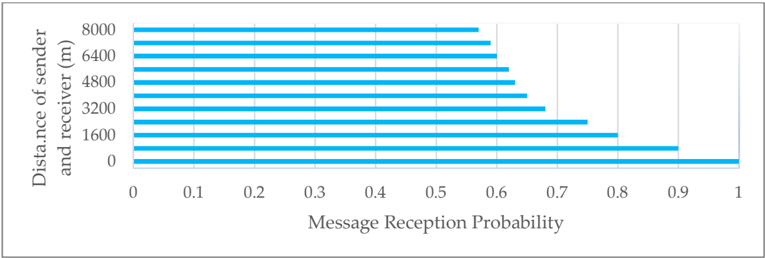
- Message loss rate increased with link length from 0.5 km to 2.5 km, escalating from 2.5% to 4.5%, with a reported peak of 5.0% in one 0.5 km iteration; LDPC error rates ranged from 0.3% to 1.5% across Table 4 iterations.
- The proposed V2V security protocol reported 40,613 signing messages per second and 40,613 verified messages per second, compared with 858/614 (Wang et al.), 357/255 (Nazih et al.), 89/47 (Peixoto et al.), 562/411 (Gaouar et al.), and 2579/655 (Zhan et al.).
- Higher node numbers improved spatial coverage, redundancy, peer-to-peer consensus, and reduced false positives and single points of failure, as described in the conclusions and Figure 5.
Methods
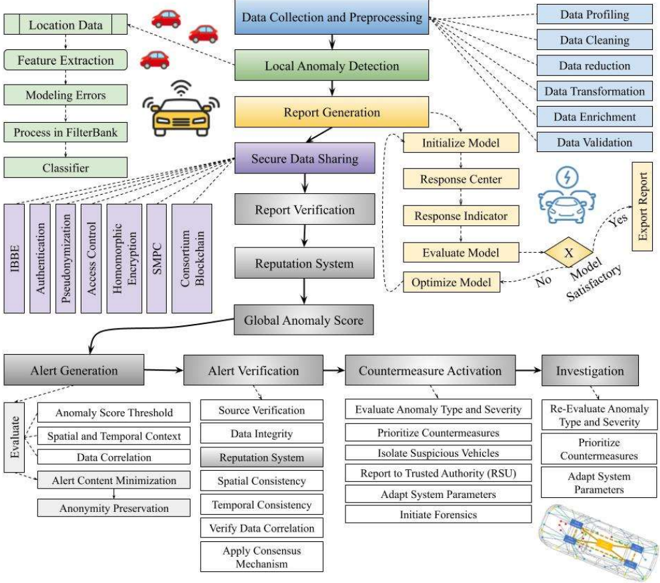
- The D-CASBR framework integrates decentralized intrusion detection with fog computing, consortium blockchain, SDN, identity-based broadcast encryption, anonymous V2V communication, hybrid ML using ElasticNet and Gradient Boosting, reputation scoring with PBFT/VRF, SMPC via SecureNN, homomorphic encryption, zk-SNARKs, Bloom filters, federated differential learning with GANs/SecAgg, and Isolation Forest.
- Simulation used ns-3 and a JiST/SWANS Ulm Highway model over an 8 × 8 km area for 24 h and 10 iterations, with densities from 1 to 2000 nodes, three lanes, maximum speed 40 m/s, average speed 25 m/s, 802.11p/DSRC at 5.9 GHz, maximum packet size 4096 bytes, and beacons at 10 Hz with 209-byte size.
- Scenarios included low/medium/high-density networks, rapid mobility changes, intermittent connectivity, high-speed highway movement, Sybil attacks, GPS spoofing, and replay attacks; evaluation covered message loss rate, anomaly detection ratio, signing/verification throughput, and alert communication cost.
Limitations
- Stated in the paper: computational intensity and overhead in real-time processing, difficulty detecting highly sophisticated stealth anomaly types, and resource consumption and latency issues in blockchain operations.
- Evident from the text: evaluation is simulation/emulation-based using ns-3 and JiST/SWANS rather than a real-world deployment.
- Evident from the text: some results appear in incomplete or fragmented tables and sections, which limits reproducibility and detailed verification of reported metrics.
Model-written summary. Check it against the paper before relying on it.
Integrity signals
Registry
Cites
Statistics
Figures





Verification
Claims the paper makes
3 Valid · 3 Not valid · 5 Not checked · 65 Own results and interpretations
The cited sources that could be checked couldn’t confirm or dispute this claim.
In the paper
“The use of advanced modulation and coding schemes (i.e., LDPC), along with strategically implemented network protocols (i.e., DARAS, DATPCP, and DPA-VN), significantly mitigated these effects.”
§ Enhancing Intelligent Transport Systems Through Decentralized Security Frameworks in Vehicle-to-Everything Networks > Message Loss Rate
What the sources say
- Not checked — no full text of the sourcecites [35] Zou, 2024, On Construction of Low-Density Parity-Check Codes for Ultra-Reliable and Low Latency Communications, IEEE Trans. Commun. source
- Could not verifycites [36] Wang, Y., Jia, Y.-H., Chen, W.-N., and Mei, Y. (2024). Distance-aware Attention Reshaping: Enhance Generalization of Neural Solver for Large-scale Vehicle Routing Problems. arXiv. sourceExperimental — accuracy not yet measured
Section 3.2 describes distance-aware attention reshaping for a neural vehicle-routing solver, and Section 4.5 evaluates its generalization on routing instances. Searches for LDPC, DARAS, DATPCP, DPA-VN, modulation, network protocols, and message loss found no passage addressing the claimed mitigation of link-length effects. (LLM, conf=0.78)
- Could not verifycites [37] Marydasan, 2023, An Energy-Conserved Stability and Density-Aware QoS-Enabled Topological Change Adaptable Multipath Routing in MANET, Int. J. Comput. Netw. Appl. sourceExperimental — accuracy not yet measured
The results passage under “Switch From Search to Exploitation” reports higher packet-delivery ratios for OESDQTMR, attributed to stable forwarding nodes and optimal disjoint paths. The conclusion likewise concerns OESDQTMR. Searches for LDPC, DARAS, DATPCP, DPA-VN, and link-length-related message loss found no passage addressing the claimed mitigation. (LLM, conf=0.77)
plainstates a cause- Asserted: passes — The authors put it forward as true.
- Checkable: passes — It can be checked against evidence.
- Load-bearing: passes — The paper’s conclusions depend on it.
- Based: passes — The paper gives a reason why it holds.
The cited sources support only part of this claim — read each source’s verdict below.
In the paper
“Utilized Byzantine Fault Tolerance (BFT) consensus algorithm 'PBFT' [28] with verifiable random functions (VRFs) to ensure data consistency even in presence of malicious actors attempting to manipulate reports.”
§ Enhancing Intelligent Transport Systems Through Decentralized Security Frameworks in Vehicle-to-Everything Networks > ■
What the sources say
- Partly supportedcites [28] Zhong, W., Yang, C., Liang, W., Cai, J., Chen, L., Liao, J., and Xiong, N. (2023). Byzantine Fault-Tolerant Consensus Algorithms: A Survey. Electronics, 12. sourceExperimental — accuracy not yet measured
Section 2.3 (PBFT Consensus Algorithm) supports the core attribution: PBFT (Castro & Liskov, ref. 31) tolerates f Byzantine nodes in a partially synchronous network of N ≥ 3f+1 and reaches agreement using public key signatures, hash functions and MACs (against replay/spoofing), i.e., consistency despite malicious nodes. However, our copy nowhere pairs PBFT with verifiable random functions — the only VRF mention (§3.5, Other Consensus Algorithms) credits the WRBFT protocol (ref. 99, Huang et al.) with using a VRF together with node consensus workload. No passage in our copy discusses 'reports' being manipulated, so that application-specific framing is also not attributable to this survey. (LLM, conf=0.78)
plainstates a cause- Asserted: passes — The authors put it forward as true.
- Checkable: passes — It can be checked against evidence.
- Load-bearing: passes — The paper’s conclusions depend on it.
- Based: passes — The paper gives a reason why it holds.
- Partly supported
The cited sources support only part of this claim — read each source’s verdict below.
In the paper
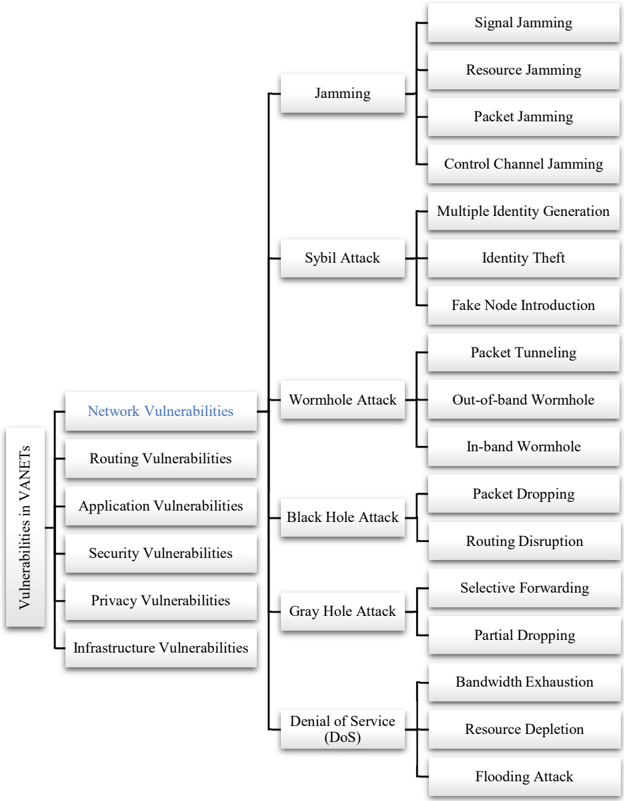
“This appendix provides a comprehensive list of vulnerabilities in VANETs categorized into six main groups.”
§ Enhancing Intelligent Transport Systems Through Decentralized Security Frameworks in Vehicle-to-Everything Networks > 6. Conclusions
What the sources say
- Partly supportedcites [2] AlMarshoud, 2024, Security, Privacy, and Decentralized Trust Management in VANETs: A Review of Current Research and Future Directions, ACM Comput. Surv. sourceExperimental — accuracy not yet measured
The “VANET security requirements” section lists attacks and vulnerabilities, supporting the general point that VANETs have identifiable vulnerabilities. It does not classify them into the six claimed groups; searches for the group names and for a six-group vulnerability taxonomy found no such classification in our copy. The indexed passages provide no page numbers. (LLM, conf=0.78)
- Partly supportedcites [6] Hussein, N.H., Koh, S.P., Yaw, C.T., Tiong, S.K., Benedict, F., Yusaf, T., Kadirgama, K., and Hong, T.C. (2024). SDN-Based VANET Routing: A Comprehensive Survey on Architectures, Protocols, Analysis, and Future Challenges. IEEE Access, 1–59. sourceExperimental — accuracy not yet measured
The survey discusses VANET privacy and data-security concerns in its network-challenges section and security threats to routing in Section D. It does not categorize vulnerabilities into the claimed six groups or identify network, routing, application, security, privacy, and infrastructure as a six-part taxonomy (page numbers unavailable in our copy). (LLM, conf=0.82)
- Partly supportedcites [12] Nazih, 2024, Toward Secure and Trustworthy Vehicular Fog Computing: A Survey, IEEE Access sourceExperimental — accuracy not yet measured
The Overview of the Existing VFC Works says the survey categorizes security vulnerabilities into six areas, but its six listed categories are security and trust requirements for vehicular fog computing—not the claimed network, routing, application, security, privacy, and infrastructure groups for VANET vulnerabilities. The Attacks in VFC section discusses attacks in VANET-like environments without supplying that classification. Page numbers were not available in our copy. (LLM, conf=0.84)
- Partly supportedcites [18] Amari, 2023, Trust Management in Vehicular Ad-Hoc Networks: Extensive Survey, IEEE Access sourceExperimental — accuracy not yet measured
The “Security Attacks in VANETs” section says VANETs have several vulnerabilities and lists attacks. Its “Layer Attack name” table organizes attacks by layers, including physical, data link, networking, transport, and application; it does not give the claimed six-group classification of vulnerabilities. (LLM, conf=0.86)
- Could not verifycites [28] Zhong, W., Yang, C., Liang, W., Cai, J., Chen, L., Liao, J., and Xiong, N. (2023). Byzantine Fault-Tolerant Consensus Algorithms: A Survey. Electronics, 12. sourceExperimental — accuracy not yet measured
Our copy of the BFT consensus survey contains no passage on VANETs or a six-group vulnerability taxonomy; searches for 'VANET vulnerabilities', 'network routing application security privacy infrastructure classification', and 'vehicular ad hoc network security threats classification' returned only reference-list entries (References, e.g. ref. 9 on roadside-unit authentication) and blockchain/consensus material (1. Introduction; 3.4-3.5; 4. Discussion; 5. Conclusions). The paper's scope is grouping/hierarchical, trusted-hardware and other BFT consensus algorithms, so it neither supports nor contradicts the attributed taxonomy. No alternative source is named in our copy for this point, so misattribution cannot be established. (LLM, conf=0.70)
plain- Asserted: passes — The authors put it forward as true.
- Checkable: passes — It can be checked against evidence.
- Load-bearing: unclear — It is unclear whether the paper’s conclusions depend on it.
- Based: passes — The paper gives a reason why it holds.
- Partly supported
A result the paper states — it cites no source for it, so there is none to check. The quote shows it is in the paper.
In the paper
“Each node served as a sensor that enhanced the overall detection capabilities.”
§ Enhancing Intelligent Transport Systems Through Decentralized Security Frameworks in Vehicle-to-Everything Networks > 6. Conclusions
plainstates a cause- Asserted: passes — The authors put it forward as true.
- Checkable: passes — It can be checked against evidence.
- Load-bearing: passes — The paper’s conclusions depend on it.
- Based: passes — The paper gives a reason why it holds.
A result the paper states — it cites no source for it, so there is none to check. The quote shows it is in the paper.
In the paper
“Augmentation in nodes also improved redundancy in data collection and anomaly detection.”
§ Enhancing Intelligent Transport Systems Through Decentralized Security Frameworks in Vehicle-to-Everything Networks > Message Loss Rate
plainstates a cause- Asserted: passes — The authors put it forward as true.
- Checkable: passes — It can be checked against evidence.
- Load-bearing: passes — The paper’s conclusions depend on it.
- Based: passes — The paper gives a reason why it holds.
30 more claims
Create a free account to see all 76 claims and to verify the 1 reference still open.
- It may state two separate claims as one. 32
- Probably not a substantial claim. 17
- The quote only partly states this claim. 3
Self-check
Percentages, sums and reported differences re-computed from the paper’s own numbers.
Each contradiction between two passages listed here was confirmed by an independent check.
Rated minor: it would not touch a result — a value no result rests on, a p-value that stays on the same side of the significance level, or a conflict that is clerical, resolved elsewhere in the paper, or outside its own findings.
In the paper
§ Enhancing Intelligent Transport Systems Through Decentralized Security Frameworks in Vehicle-to-Everything Networks > Message Loss Rate
“the message loss rate escalates progressively from 2.5% to 4.5%, peaking at 5.0% at the shortest link when network density is at its maximum.”
§ Enhancing Intelligent Transport Systems Through Decentralized Security Frameworks in Vehicle-to-Everything Networks > Message Loss Rate
“5 2.5 20 300 4.5 1.3 DPA-VN 6 0.5 30 100 5.0 1.5 DPA-VN”
Citations
Cites
The California Consumer Privacy Act (CCPA): An implementation guide
BUKATY, P. (2019) · IT Governance Publishing eBooks · doi:10.2307/j.ctvjghvnn · Cited by 238
Almehdhar, M., Albaseer, A. M., Khan, M. A., Abdallah, M. M., Menouar, H., Al-Kuwari, S. M., & Al‐Fuqaha, A. (2024) · IEEE Open Journal of Vehicular Technology · doi:10.1109/ojvt.2024.3422253 · Cited by 183
AlMarshoud, M., Sabir Kiraz, M., & H. Al-Bayatti, A. (2024) · ACM Computing Surveys · doi:10.1145/3656166 · Cited by 145 · cited 5×
“…more viable solution for broader ITS deployments and ensure it can keep pace with the rapid evolution of V2X network technologies. vulnerabilities [2,6,12,18,28]. respective vulnerabilities [2,6,12,18,28 This detailed taxonomy helped us in understanding and addressing the potential security risks…”
InfluentialInterpretable Anomaly Detection with DIFFI: Depth-based feature importance of Isolation Forest
Carletti, M., Terzi, M., & Susto, G. A. (2023) · Engineering Applications of Artificial Intelligence · doi:10.1016/j.engappai.2022.105730 · Cited by 118
Byzantine Fault-Tolerant Consensus Algorithms: A Survey
Zhong, W., Yang, C., Liang, W., Cai, J., Chen, L., Liao, J., & Xiong, N. (2023) · Electronics · doi:10.3390/electronics12183801 · Cited by 90
Building data management capabilities to address data protection regulations: Learnings from EU-GDPR
Labadie, C., & Legner, C. (2023) · Journal of Information Technology · doi:10.1177/02683962221141456 · Cited by 86
ul Hassan, M., Al-Awady, A. A., Ali, A., Sifatullah, Akram, M., Iqbal, M. M., Khan, J., & Abdelrahman Ali, Y. A. (2024) · Sensors · doi:10.3390/s24030818 · Cited by 71
Identity-Based Broadcast Proxy Re-Encryption for Flexible Data Sharing in VANETs
Zhang, J., Su, S., Zhong, H., Cui, J., & He, D. (2023) · IEEE Transactions on Information Forensics and Security · doi:10.1109/tifs.2023.3299466 · Cited by 63 · cited 1×
“IBBE [7] ensures that only authorized vehicles can decrypt transmitted messages, providing a robust mechanism for protecting privacy and integrity in group communication settings.”
Hameed Hussein, N., Siaw Paw Koh, J., Yaw, C. T., Kiong Tiong, S., Benedict, F., Yusaf, T., Kadirgama, K., & Chung Hong, T. (2025) · IEEE Access · doi:10.1109/access.2024.3355313 · Cited by 59
A traffic data clustering framework based on fog computing for VANETs
Peixoto, M. L. M., Maia, A., Mota, E., Rangel, E. O., Costa, D. G., Turgut, D., & Villas, L. A. (2021) · Vehicular Communications · doi:10.1016/j.vehcom.2021.100370 · Cited by 58
Fast and practical intrusion detection system based on federated learning for VANET
Chen, X., Qiu, W., Chen, L., Ma, Y., & Ma, J. (2024) · Computers & Security · doi:10.1016/j.cose.2024.103881 · Cited by 51
Trust Management in Vehicular Ad-Hoc Networks: Extensive Survey
Amari, H., Houda, Z. A. E., Khoukhi, L., & Belguith, L. H. (2023) · IEEE Access · doi:10.1109/access.2023.3268991 · Cited by 45 · cited 3×
“In our research context, trust management (TM) [18] includes assessing the integrity of data and the trustworthiness of message sources, creating models to predict vehicle behavior from past actions, adjusting trust levels according to the current context and environment, distributing the…”
Wang, M., Mao, J., Zhao, W., Han, X., Li, M., Liao, C., Sun, H., & Wang, K. (2024) · Journal of Grid Computing · doi:10.1007/s10723-024-09747-5 · Cited by 43
Detection of DDoS attacks in SDN-based VANET using optimized TabNet
Setitra, M. A., & Fan, M. (2024) · Computer Standards & Interfaces · doi:10.1016/j.csi.2024.103845 · Cited by 40
Zero knowledge proof and ZK-SNARK for private blockchains
Konkin, A., & Zapechnikov, S. V. (2023) · Journal of Computer Virology and Hacking Techniques · doi:10.1007/s11416-023-00466-1 · Cited by 38
Security Compliant and Cooperative Pseudonyms Swapping for Location Privacy Preservation in VANETs
Mdee, A. P., Khan, M. T. R., Seo, J., & Kim, D. (2023) · IEEE Transactions on Vehicular Technology · doi:10.1109/tvt.2023.3254660 · Cited by 35
Toward Secure and Trustworthy Vehicular Fog Computing: A Survey
Nazih, O., Benamar, N., Lamaazi, H., & Chaoui, H. (2024) · IEEE Access · doi:10.1109/access.2024.3371488 · Cited by 35 · cited 3×
“Despite the numerous advantages provided by cloud computing, cloud-assisted vehicular networks continue to encounter are primarily 12].”
An efficient privacy-preserving authentication scheme that mitigates TA dependency in VANETs
Su, H., Dong, S., Wang, N., & Zhang, T. (2024) · Vehicular Communications · doi:10.1016/j.vehcom.2024.100727 · Cited by 34
TLS-handshake for Plug and Charge in vehicular communications
Kilic, A. (2024) · Computer Networks · doi:10.1016/j.comnet.2024.110281 · Cited by 26
Provably secure fog-based authentication protocol for VANETs
Awais, S. M., Yucheng, W., Mahmood, K., Badar, H. M. S., Kharel, R., & Das, A. K. (2024) · Computer Networks · doi:10.1016/j.comnet.2024.110391 · Cited by 25
Ren, Y., Chen, C., Hu, M., Feng, G., & Zhang, X. (2023) · IEEE Internet of Things Journal · doi:10.1109/jiot.2023.3296906 · Cited by 23
Yerrathi, S., & Pakala, V. (2024) · PLOS ONE · doi:10.1371/journal.pone.0296331 · Cited by 15 · cited 1×
“The rapid advancement of ITSs is closely tied to the effectiveness of VANETs, which are crucial for secure and efficient vehicle-to-infrastructure communications [1].”
On Construction of Low-Density Parity-Check Codes for Ultra-Reliable and Low Latency Communications
Zou, L., Yan, H., Dong, J., Li, Y., Chen, P., & Lau, F. C. M. (2024) · IEEE Transactions on Communications · doi:10.1109/tcomm.2024.3392774 · Cited by 12 · cited 1×
“…link length significantly influences the reliability and stability of data transmissions To address these challenges, our experiments utilized advanced modulation and coding schemes (i.e., Low-Density Parity-Check (LDPC) [35]) with a design aim to enhance signal robustness across varied distances.”
Optimized Feature Selection for DDoS Attack Recognition and Mitigation in SD-VANETs
Tariq, U. (2024) · World Electric Vehicle Journal · doi:10.3390/wevj15090395 · Cited by 11
Self-citationZhuang, L., Guo, N., & Chen, Y. (2023) · Sensors · doi:10.3390/s23031164 · Cited by 10
A Secure Cloud-Edge Collaborative Logistic Regression Model
Wang, C., Xu, J., & Yin, L. (2021) · 2021 IEEE International Conferences on Internet of Things (iThings) and IEEE Green Computing & Communications (GreenCom) and IEEE Cyber, Physical & Social Computing (CPSCom) and IEEE Smart Data (SmartData) and IEEE Congress on Cybermatics (Cybermatics) · doi:10.1109/ithings-greencom-cpscom-smartdata-cybermatics53846.2021.00049 · Cited by 8
Gaouar, N., Lehsaini, M., & Nebbou, T. (2023) · Concurrency and Computation Practice and Experience · doi:10.1002/cpe.7686 · Cited by 8
Second-Order Statistics-Aided Channel Estimation for Multipath Massive MIMO-OFDM Systems
Mehrabani, M. R., Abolhassani, B., Haddadi, F., & Tellambura, C. (2023) · IEEE Access · doi:10.1109/access.2023.3247662 · Cited by 6
Tariq, U. (2024) · PeerJ Computer Science · doi:10.7717/peerj-cs.2419 · Cited by 5
Self-citationVeriRange: A Verifiable Range Query Model on Encrypted Geographic Data for IoT Environment
Ma, W., Peng, Y., Liu, X., & Cui, J. (2024) · IEEE Internet of Things Journal · doi:10.1109/jiot.2023.3294589 · Cited by 5
Zhan, Y., Xie, W., Shi, R., Huang, Y., & Zheng, X. (2024) · Sensors · doi:10.3390/s24061773 · Cited by 5
Marydasan, B. P., & Nadarajan, R. (2023) · International Journal of Computer Networks and Applications · doi:10.22247/ijcna/2023/223692 · Cited by 3
SMBF: Secure Data Transmission using Modified Bloom Filter for Vehicular Ad Hoc Networks
Kumar, R., Kumar, D., & Kumar, D. (2022) · Recent Advances in Computer Science and Communications · doi:10.2174/2666255815666220331154430 · Cited by 3
Proactive ransomware prevention in pervasive IoMT via hybrid machine learning
Tariq, U., & Tariq, B. (2024) · Indonesian Journal of Electrical Engineering and Computer Science · doi:10.11591/ijeecs.v34.i2.pp970-982 · Cited by 3
Self-citationWang, Y., Jia, Y.-H., Chen, W.-N., & Mei, Y. (2024) · arXiv · doi:10.48550/arxiv.2401.06979 · Cited by 2
Cited by
Smart Infrastructure and Additive Manufacturing: Synergies, Advantages, and Limitations
Kantaros, A., Zacharia, P. T., Drosos, C., Papoutsidakis, M. G., Pallis, E., & Ganetsos, T. K. (2025) · Applied Sciences · doi:10.3390/app15073719 · Cited by 47
Integrating Quantum Protocols in Blockchain Technology: A Paradigm Shift in Security and Efficiency
Raguvaran, S., Subramanian, S., Selvalakshmi, C., Pandiarajan, T., Kaviyaraj, R., & Perumal, U. (2025) · Blockchain technologies · doi:10.1007/978-981-96-9148-7_14 · Cited by 1
Evaluation of Trust‐Based Models for Enhancing Security and Efficiency in Vehicular Ad‐Hoc Networks
Gupta, A., & Sagar, A. K. (2025) · International Journal of Communication Systems · doi:10.1002/dac.70295 · Cited by 1
Metadata
- Authors
- Tariq, U., & Ahanger, T. A.
- Affiliations
- Prince Sattam Bin Abdulaziz University (SA)
- Corresponding author
- Tariq, Usman
- Venue
- World Electric Vehicle Journal
- Publisher
- MDPI AG
- Published
- 2025-01-03
- Volume
- 16
- Issue
- 1
- Pages
- 24
- ISSN
- 2032-6653 (ISSN-L)
- OpenAlex
- W4406026543
- Cited by
- 19
- References
- 41
- Citations by year
- 2026: 10 · 2025: 9
- FWCI
- 4.28
- Type
- journal article
- Language
- en
- Open access
- gold
- doi.org
- Licence
- Locations
- World Electric Vehicle Journal (publishedVersion, cc-by)
- DOAJ (DOAJ: Directory of Open Access Journals) (submittedVersion, cc-by-sa)
- Funders
- Prince Sattam Bin Abdulaziz University (2024/01/31056)
- Topics
- Physical Sciences › Engineering › Electrical and Electronic Engineering › Vehicular Ad Hoc Networks (VANETs)
- Physical Sciences › Computer Science › Information Systems › Blockchain Technology Applications and Security
- Physical Sciences › Computer Science › Computer Networks and Communications › Network Security and Intrusion Detection
- Keywords
- intelligent transportation systems, vehicular ad hoc networks, vehicle-to-everything communication, decentralized security, blockchain, secure multi-party computation, anomaly detection, spoofing attacks, denial-of-service attacks, fog computing, reputation systems, trust management, consortium blockchain, VANET security
About these checks
Registry, retraction, Cites and statistics results are computed, not judged, with one exception: a printed reference that no index lists is read once by a model before it counts as a citation error. Claims are extracted by a model and kept only when their quote appears verbatim in the text; each cited source is then checked, with a model’s help, for whether it says what the claim relies on. Those verdicts can be wrong — read the claim’s quote and the cited source before relying on one.
The claim verdicts this report counts are experimental: their accuracy is not yet measured.
A language model drew the claims from the paper on 2026-10-10, under version 3 of the claim definition (model deepseek-v4.1-flash, prompt extract-v3).
A second model labelled each claim on 2026-10-10 (model jev-1.13-20260917, definition revision gold-guideline-v0.2).
Cited sources are checked with a language model’s help (gpt-6-sol and qwen3.8-omni-flash).
Statistics and arithmetic are recomputed, not judged.
Confidence bands are shown only for fields calibrated on our annotated test set. None is calibrated yet, so no band is shown.
What counts as a claim ›How we measure confidence ›How we check this ›
Are you an author, or do you see a problem with this page? Request a review
Data sources
Bibliographic data: Semantic Scholar, OpenAlex, Crossref.
Contains information from the Semantic Scholar Academic Graph Datasets, made available under the ODC Attribution License (ODC-BY 1.0).
Semantic Scholar’s data is described in: Kinney, R., et al. (2023). The Semantic Scholar Open Data Platform. arXiv:2301.10140.
