

The DOI matches its Crossref record; 81 of the 81 references it cites were found in a registry or an index; 31 of the 55 sources its claims cite were checked for support.
Cognitive and academic benefits of music training with children: A multilevel meta-analysis
Open accessAbstract
Music training has repeatedly been claimed to positively impact children’s cognitive skills and academic achievement (literacy and mathematics). This claim relies on the assumption that engaging in intellectually demanding activities fosters particular domain-general cognitive skills, or even general intelligence. The present meta-analytic review ( N = 6,984, k = 254, m = 54) shows that this belief is incorrect. Once the quality of study design is controlled for, the overall effect of music training programs is null ( $$ \overline{g} $$ g ¯ ≈ 0) and highly consistent across studies ( τ 2 ≈ 0). Results of Bayesian analyses employing distributional assumptions (informative priors) derived from previous research in cognitive training corroborate these conclusions. Small statistically significant overall effects are obtained only in those studies implementing no random allocation of participants and employing non-active controls ( $$ \overline{g} $$ g ¯ ≈ 0.200, p < .001). Interestingly, music training is ineffective regardless of the type of outcome measure (e.g., verbal, non-verbal, speed-related, etc.), participants’ age, and duration of training. Furthermore, we note that, beyond meta-analysis of experimental studies, a considerable amount of cross-sectional evidence indicates that engagement in music has no impact on people’s non-music cognitive skills or academic achievement. We conclude that researchers’ optimism about the benefits of music training is empirically unjustified and stems from misinterpretation of the empirical data and, possibly, confirmation bias.
Overview
AI snapshot
Written from the paper’s full text.
TL;DR
This multilevel meta-analysis of 54 experimental studies (6,984 children, 254 effect sizes) finds that music training does not produce reliable domain-general cognitive or academic benefits once study design quality is controlled. Effects are near-zero in randomized studies and those using active controls, while small positive effects appear only in weaker designs.
Key findings
- The overall unadjusted effect was small: \(\bar{g} = 0.184\), \(SE = 0.041\), 95% CI [0.101, 0.268], with moderate heterogeneity (\(\tau^2 = 0.041\), \(I^2 = 43.16\%\)).
- Effects were near-zero in studies with active controls: \(\bar{g} = 0.056\), \(SE = 0.058\), \(p = .350\); sensitivity analysis gave \(\bar{g} = -0.021\), \(SE = 0.032\), \(\tau^2 = 0\), \(I^2 = 0\%\), with Bayes factors favoring the null (\(BF_g = 0.063\), \(BF_\tau = 0.006\)).
- Small positive effects remained in weaker designs: non-active controls \(\bar{g} = 0.228\), \(SE = 0.045\); non-randomized studies \(\bar{g} = 0.246\), \(SE = 0.049\), versus randomized studies \(\bar{g} = 0.064\), \(SE = 0.065\), \(p = .381\).
- No significant moderation was found for age, duration of training, or outcome type (memory, verbal, non-verbal, speed; all \(ps \ge .624\) for broad groups), and no difference between cognitive and academic outcomes (\(p = .981\)).
Methods
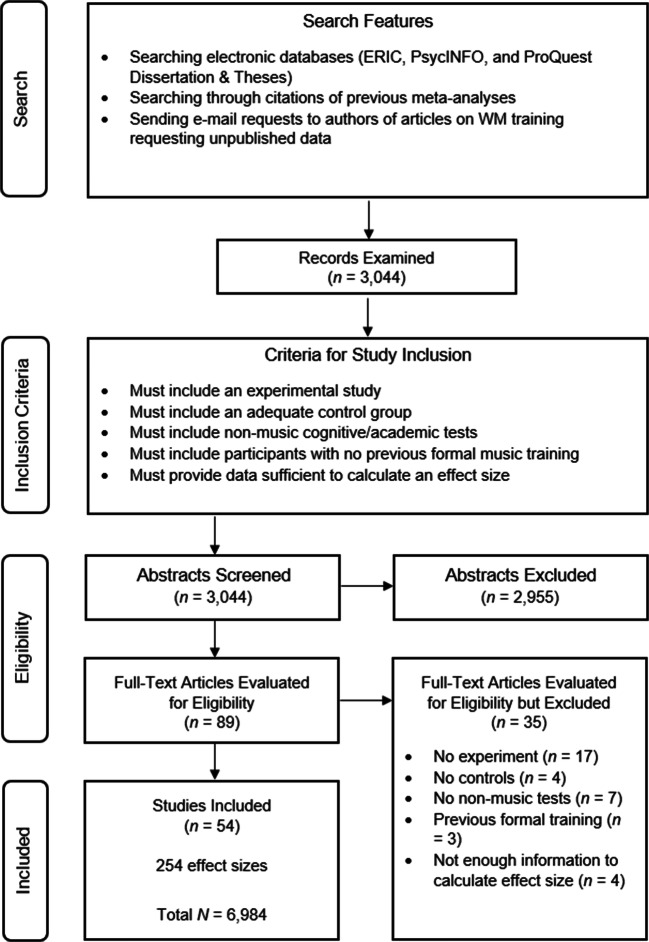
- Systematic meta-analysis of experimental music-training studies in children aged 3–16, searching ERIC, PsycINFO, and ProQuest Dissertation & Theses through 1 December 2019; 54 studies from 1986–2019 met inclusion criteria, yielding 254 effect sizes and 6,984 participants.
- Effect sizes were Hedges’s \(g\) for non-music cognitive or academic outcomes; main models used robust variance estimation with correlational weights, plus meta-regression on six moderators (baseline difference, randomization, control type, age, outcome measure, training duration).
- Sensitivity analyses excluded three studies with large baseline IQ differences and influential cases; publication bias was assessed with trim-and-fill and selection models; Bayesian analyses used informative priors derived from prior cognitive-training research.
Limitations
- The paper does not explicitly list limitations of its own meta-analysis; it notes that prior meta-analyses lacked multilevel modeling, had miscalculated effect sizes, left unexplained heterogeneity, and lacked thorough sensitivity analyses.
- Stated data constraints: pre-post correlations and test-retest reliabilities were rarely reported, so the authors imposed \(r_{xx} = r = .600\); some studies did not report mean age, which was imputed from median or school grade.
- Evident from the text: small publication bias remained in non-active/non-randomized models (adjusted estimates roughly 0.119–0.228 and 0.126–0.211), three studies with ~1 SD baseline IQ differences were excluded only in sensitivity analyses, and the active-control sensitivity model had \(df = 4.2\), indicating limited precision.
Model-written summary. Check it against the paper before relying on it.
Integrity signals
Registry
Cites
Statistics
Figures
Verification
Claims the paper makes
46 Own result · 30 Own interpretation · 15 No full text of the sources · 13 Partly supported · 8 Supported · 8 No basis given · 3 Own method · 2 Supported so far · 2 Not supported · 1 Mixed support · 1 Sources not found · accuracy not yet measured
Some cited sources support this claim and some don’t — read each source’s verdict below.
In the paper
“We can thus conclude that these findings convincingly refute all the theories claiming that music training causes improvements in any domain-general cognitive skill or academic achievement (e.g., Moreno et al., 2011; Patel, 2011; Saarikivi et al., 2019; Tierney & Kraus, 2013).”
§ Cognitive and academic benefits of music training with children: A multilevel meta-analysis > Discussion
What the sources say
- Disputedcites Moreno et al., 2011 sourceExperimental — accuracy not yet measured
The Discussion (page not provided) says the opposite: the authors conclude that their findings demonstrate a causal relationship between music training and improvements in language and executive functions. The Results also report improved verbal-intelligence scores in the music group. The paper does not claim a measured improvement in academic achievement, but it does not refute all such theories. (LLM, conf=0.90)
Checked by a reasoning model — may be wrong.
- Partly supportedcites Patel, 2011 sourceExperimental — accuracy not yet measured
The citation appears to identify Patel’s paper as an example of a theory predicting benefits from musical training, rather than to attribute the citing authors’ conclusion about refutation to Patel. In “Putting Opera to Work: Musical Training and Linguistic Reading Skills,” Patel discusses evidence of improved reading abilities after music lessons, and the Conclusion says OPERA predicts which training could benefit reading skills. The paper does not establish a broader claim about domain-general cognitive skills or academic achievement generally. (LLM, conf=0.79)
- Supportedcites Saarikivi et al., 2019 source
The citation identifies Saarikivi et al. as an example of work proposing that music training can improve a general cognitive skill; it does not attribute the citing authors’ conclusion about refuting such theories to this paper. In the Discussion (“Augmented Developmental Trajectories,” page unavailable), the source suggests that musical training may enhance working-memory maintenance or selective attention, while treating that explanation as tentative. (LLM, conf=0.90)
boosted- Asserted: passes — The authors put it forward as true.
- Checkable: passes — It can be checked against evidence.
- Load-bearing: passes — The paper’s conclusions depend on it.
- Based: passes — The paper gives a reason why it holds.
- Disputed
At least one cited source doesn’t support this claim or points to a different paper, and none confirmed it — see the verdicts below.
In the paper
“which makes their results uninterpretable”
§ Cognitive and academic benefits of music training with children: A multilevel meta-analysis > Discussion > The perception of music training effectiveness is biased
What the sources say
- Disputedcites Barbaroux et al.’s (2019) sourceExperimental — accuracy not yet measured
The Discussion’s Limitations section acknowledges that the lack of an active control group prevents the authors from establishing whether the effects are specific to music training. It does not call the results uninterpretable; instead, it says this limitation does not reduce their societal impact and argues that age-related change can be ruled out using normalized scores. (LLM, conf=0.83)
Checked by a reasoning model — may be wrong.
plain- Asserted: passes — The authors put it forward as true.
- Checkable: passes — It can be checked against evidence.
- Load-bearing: unclear — It is unclear whether the paper’s conclusions depend on it.
- Based: passes — The paper gives a reason why it holds.
- Disputed
The cited sources support only part of this claim — read each source’s verdict below.
In the paper
“The only comprehensive meta-analytic review performed so far about the benefits of music training is that by Sala and Gobet (2017b).”
§ Cognitive and academic benefits of music training with children: A multilevel meta-analysis > Introduction > Experimental evidence
What the sources say
- Partly supportedcites Sala and Gobet (2017b) sourceExperimental — accuracy not yet measured
Section 1.4 identifies Sala and Gobet’s paper as a meta-analysis of music training’s cognitive and academic benefits for children and young adolescents. Section 1.3 also cites earlier meta-analyses of particular academic outcomes. Our copy does not establish that this was the only comprehensive review performed so far, or support extending its scope to all benefits of music training. (LLM, conf=0.85)
plain- Asserted: passes — The authors put it forward as true.
- Checkable: passes — It can be checked against evidence.
- Load-bearing: passes — The paper’s conclusions depend on it.
- Based: passes — The paper gives a reason why it holds.
- Partly supported
The cited sources support only part of this claim — read each source’s verdict below.
In the paper
“In addition, the presence of a non-negligible amount of unexplained true heterogeneity (as in both Sala & Gobet, 2017b, and Cooper, 2019) makes the overall effect sizes hard to interpret because the sources of between-study variability remain hidden.”
§ Cognitive and academic benefits of music training with children: A multilevel meta-analysis > Introduction > The present meta-analysis
What the sources say
- Partly supportedcites Sala & Gobet, 2017b sourceExperimental — accuracy not yet measured
The Results section (page not provided) reports moderate between-effect-size heterogeneity (I² = 46.94), supporting the claim that variability was non-negligible. But §3.1 identifies significant moderators and reports that the model explained some variability (R² = 0.65). The paper does not say that hidden sources of variability made the overall effect size hard to interpret. (LLM, conf=0.82)
- Not checked — no full text of the sourcecites Cooper, 2019 source
plaindirect- Asserted: passes — The authors put it forward as true.
- Checkable: passes — It can be checked against evidence.
- Load-bearing: passes — The paper’s conclusions depend on it.
- Based: passes — The paper gives a reason why it holds.
- Partly supported
The cited sources support only part of this claim — read each source’s verdict below.
In the paper
“More broadly, these results establish once again that far transfer – due to the very nature of human cognition – is an extremely rare occurrence (Gobet & Simon, 1996; Sala & Gobet, 2019).”
§ Cognitive and academic benefits of music training with children: A multilevel meta-analysis > Discussion
What the sources say
- Partly supportedcites Gobet & Simon, 1996 sourceExperimental — accuracy not yet measured
The General Discussion reports that reflecting chess positions impaired players’ recall and links this to location-specific memory chunks. That supports a narrower point about difficulty transferring recognition across altered chess positions, but the paper does not establish that far transfer is extremely rare across human cognition or attribute its rarity to the nature of cognition. (LLM, conf=0.84)
- Not matchedcites Sala & Gobet, 2019
Couldn’t be matched to a paper in Crossref, so it can’t be checked.
boosted- Asserted: passes — The authors put it forward as true.
- Checkable: passes — It can be checked against evidence.
- Load-bearing: unclear — It is unclear whether the paper’s conclusions depend on it.
- Based: passes — The paper gives a reason why it holds.
- Partly supported
Every source the paper cites for this claim was checked and supports it.
In the paper
“The paper reports a barely significant effect [p = .044] in an auditory task that is obtained with an ANOVA performed on the mean pre-post-test gains.”
§ Cognitive and academic benefits of music training with children: A multilevel meta-analysis > Discussion > The perception of music training effectiveness is biased
What the sources say
- Supportedcites Nan et al. (2018) source
The Results report a word-discrimination group effect of P = 0.044 from a one-way ANOVA of delta d′ (posttest minus pretest). Table 1 lists the same P value for the groups’ pre–post word-discrimination gains. The copy does not provide page numbers for these passages. (LLM, conf=0.94)
plain- Asserted: passes — The authors put it forward as true.
- Checkable: passes — It can be checked against evidence.
- Load-bearing: unclear — It is unclear whether the paper’s conclusions depend on it.
- Based: passes — The paper gives a reason why it holds.
- Supported
Every source the paper cites for this claim was checked and supports it.
In the paper
“However, this study is not experimental because the participants were recruited after they had chosen what activity to take part in (i.e., self-selection of the sample).”
§ Cognitive and academic benefits of music training with children: A multilevel meta-analysis > Discussion > The perception of music training effectiveness is biased
What the sources say
- Supportedcites Tierney et al. (2015) source
The Methods state that students were told about the study after choosing their training program. The Discussion says the researchers could not randomly assign students to groups and that the groups differed in their motivation to begin training. These passages support the citing sentence’s characterization of the study as nonexperimental due to self-selection. (LLM, conf=0.92)
plain- Asserted: passes — The authors put it forward as true.
- Checkable: passes — It can be checked against evidence.
- Load-bearing: passes — The paper’s conclusions depend on it.
- Based: passes — The paper gives a reason why it holds.
- Supported
The cited sources support only part of this claim — read each source’s verdict below.
In the paper
“This type of near transfer is notoriously much easier to achieve (Gobet, 2016; Gobet & Simon, 1996).”
§ Cognitive and academic benefits of music training with children: A multilevel meta-analysis > Discussion > Conclusions and recommendations for future research
What the sources say
- Not checked — no full text of the sourcecites Gobet, 2016 source
- Partly supportedcites Gobet & Simon, 1996 sourceExperimental — accuracy not yet measured
The Results (page unavailable) show that normal and horizontally mirrored chess positions were recalled better than vertically or centrally mirrored ones, supporting the narrower point that performance varies with the degree of change. The paper treats sensitivity to transformed stimuli as an aspect of transfer, but it does not establish the broad claim that near transfer is generally much easier to achieve than far transfer. (LLM, conf=0.78)
boostedcorrelational- Asserted: passes — The authors put it forward as true.
- Checkable: passes — It can be checked against evidence.
- Load-bearing: unclear — It is unclear whether the paper’s conclusions depend on it.
- Based: passes — The paper gives a reason why it holds.
The cited sources support only part of this claim — read each source’s verdict below.
In the paper
“Tierney et al. (2015) report non-significant and inconsistent effects on language-related outcomes between a music training group and an active control group.”
§ Cognitive and academic benefits of music training with children: A multilevel meta-analysis > Discussion > The perception of music training effectiveness is biased
What the sources say
- Partly supportedcites Tierney et al. (2015) sourceExperimental — accuracy not yet measured
The Discussion (Fig. 3) reports no significant group-by-time effects for phonological memory or rapid naming. But it reports a significant advantage for the music group in phonological awareness (P = 0.026), so describing the language-related effects collectively as non-significant omits that result. (LLM, conf=0.88)
plain- Asserted: passes — The authors put it forward as true.
- Checkable: passes — It can be checked against evidence.
- Load-bearing: unclear — It is unclear whether the paper’s conclusions depend on it.
- Based: passes — The paper gives a reason why it holds.
- Partly supported
The cited sources support only part of this claim — read each source’s verdict below.
In the paper
“The same applies to action and nonaction videogame training and brain training (Duyck & Op de Beeck, 2019; Kassai, Futo, Demetrovics, & Takacs, 2019; Libertus et al., 2017; Lintern & Boot, 2019; Sala et al., 2019a; Sala, Tatlidil, & Gobet, 2018, 2019b; Simons et al., 2016).”
§ Cognitive and academic benefits of music training with children: A multilevel meta-analysis > Discussion > Beyond meta-analytic evidence
What the sources say
- Partly supportedcites Duyck & Op de Beeck, 2019 sourceExperimental — accuracy not yet measured
The Results and Discussion (Far transfer; page not provided) report no experimental-group-specific improvement after training with a visual-learning game compared with Candy Crush Saga. That supports a limited null finding for the games tested, not a general null effect for action and nonaction videogame training or brain training. The Discussion also notes evidence of benefits from action videogames. (LLM, conf=0.85)
- Not checked — no full text of the sourcecites Kassai, Futo, Demetrovics, & Takacs, 2019 source
- Partly supportedcites Libertus et al., 2017 sourceExperimental — accuracy not yet measured
The Discussion reports no significant improvement in attentional control and no effect on foundational number processing when action-game training was compared with nonaction-game training. But it also reports a small improvement in mathematical computation after action-game training, so a blanket null-effect claim overstates the findings. The paper does not test brain training. (LLM, conf=0.88)
plain- Asserted: passes — The authors put it forward as true.
- Checkable: passes — It can be checked against evidence.
- Load-bearing: unclear — It is unclear whether the paper’s conclusions depend on it.
- Based: passes — The paper gives a reason why it holds.
- Partly supported
- It may state two separate claims as one. 40
- Probably not a substantial claim. 14
- The quote only partly states this claim. 4
At least one cited source doesn’t support this claim or points to a different paper, and none confirmed it — see the verdicts below.
In the paper
“Nan et al. (2018) have found no significant effect of music training on any two music-related measures and no effect at all on the examined non-music outcome measures.”
§ Cognitive and academic benefits of music training with children: A multilevel meta-analysis > Discussion > The perception of music training effectiveness is biased
What the sources say
- Disputedcites Nan et al. (2018) sourceExperimental — accuracy not yet measured
The Discussion reports significantly enlarged neural responses to musical pitch after piano training, contrary to the claim of no effect on music-related measures. It also reports improved auditory word discrimination, a non-music outcome. The paper found no training effect on general cognitive measures such as IQ, attention, and working memory, but that does not extend to all non-music outcomes. (LLM, conf=0.92)
Checked by a reasoning model — may be wrong.
plain- Asserted: passes — The authors put it forward as true.
- Checkable: passes — It can be checked against evidence.
- Load-bearing: unclear — It is unclear whether the paper’s conclusions depend on it.
- Based: passes — The paper gives a reason why it holds.
It may state two separate claims as one.
- Disputed
Every source the paper cites for this claim was checked and supports it.
In the paper
“These findings confirm and extend the conclusions of the previous comprehensive meta-analysis in the field (Sala & Gobet, 2017b).”
§ Cognitive and academic benefits of music training with children: A multilevel meta-analysis > Discussion
What the sources say
- Supportedcites Sala & Gobet, 2017b source
The cited work is a meta-analysis of whether music training transfers to children’s and young adolescents’ cognitive and academic skills. Its Discussion and §4.3 state its conclusions, so the citation correctly identifies the prior meta-analysis. Whether the citing paper’s findings confirm or extend those conclusions is the citing authors’ own assessment, not a claim attributed to this source. (LLM, conf=0.92)
boosted- Asserted: passes — The authors put it forward as true.
- Checkable: passes — It can be checked against evidence.
- Load-bearing: fails — The paper’s conclusions may not depend on it.
- Based: passes — The paper gives a reason why it holds.
Probably not a substantial claim. The paper’s conclusions may not depend on it. It may state two separate claims as one.
- Supported
Every source the paper cites for this claim was checked and supports it.
In the paper
“This meta-analysis – which includes 38 studies, 118 effect sizes, and 3,085 participants – found an overall effect of d¯= 0.16.”
§ Cognitive and academic benefits of music training with children: A multilevel meta-analysis > Introduction > Experimental evidence
What the sources say
- Supportedcites Sala and Gobet (2017b) source
Section 2.2 (page not supplied) reports 38 included studies, 118 effect sizes, and 3,085 participants. Section 3 (page not supplied) reports an overall random-effects estimate of d = 0.16. (LLM, conf=0.95)
plainn = 3,085- Asserted: passes — The authors put it forward as true.
- Checkable: passes — It can be checked against evidence.
- Load-bearing: passes — The paper’s conclusions depend on it.
- Based: passes — The paper gives a reason why it holds.
It may state two separate claims as one.
- Supported
Every source the paper cites for this claim was checked and supports it.
In the paper
“Thus, compared to the previous most comprehensive meta-analysis in the field (i.e., Sala & Gobet, 2017b), the number of both effect sizes and participants was more than doubled.”
§ Cognitive and academic benefits of music training with children: A multilevel meta-analysis > Method > Inclusion criteria
What the sources say
- Supportedcites Sala & Gobet, 2017b source
Section 2.2 (page not specified) identifies Sala and Gobet’s meta-analysis as including 118 effect sizes and 3,085 participants. The citation supplies the baseline for the citing authors’ comparison; the claim that their own analysis more than doubled those counts is their calculation, not a result attributed to Sala and Gobet. (LLM, conf=0.88)
plainn = 6,984- Asserted: passes — The authors put it forward as true.
- Checkable: passes — It can be checked against evidence.
- Load-bearing: passes — The paper’s conclusions depend on it.
- Based: passes — The paper gives a reason why it holds.
It may state two separate claims as one.
- Supported
The cited sources support only part of this claim — read each source’s verdict below.
In the paper
“Gordon et al. (2015) reviewed 12 studies (n = 901) assessing the effects of music training on language-related skills. The overall effect was small but significant (d¯ = 0.20).”
§ Cognitive and academic benefits of music training with children: A multilevel meta-analysis > Introduction > Experimental evidence
What the sources say
- Partly supportedcites Gordon et al. (2015) sourceExperimental — accuracy not yet measured
The Literature search reports 12 qualifying papers, coded as 13 independent study samples; the participant counts in Table 1 sum to 901. The Results report a small, significant effect of d = 0.20 for phonological awareness, not for language-related skills overall. The Discussion says the separate reading-fluency effect was not significant. (LLM, conf=0.88)
plaindirectn = 901- Asserted: passes — The authors put it forward as true.
- Checkable: passes — It can be checked against evidence.
- Load-bearing: unclear — It is unclear whether the paper’s conclusions depend on it.
- Based: passes — The paper gives a reason why it holds.
It may state two separate claims as one.
- Partly supported
Every source the paper cites for this claim was checked and supports it.
In the paper
“It also highlighted that the impact of music training on cognitive skills and academic performance was a function of the quality of the study’s experimental design. Specifically, the magnitude of the music-induced effects was significantly smaller (around zero) in those studies implementing active controls and random allocation of the participants to groups.”
§ Cognitive and academic benefits of music training with children: A multilevel meta-analysis > Introduction > Experimental evidence
What the sources say
- Supportedcites Sala and Gobet (2017b) source
Split into 2 atoms — 2 confirmed, 0 partially supported, 0 disputed, 0 misattributed, 0 unverifiable. Expand the claim to see per-atom verdicts.
plaincorrelational- Asserted: passes — The authors put it forward as true.
- Checkable: passes — It can be checked against evidence.
- Load-bearing: passes — The paper’s conclusions depend on it.
- Based: passes — The paper gives a reason why it holds.
Probably not a substantial claim. It may state two separate claims as one.
- Supported
Every source the paper cites for this claim was checked and supports it.
In the paper
“For example, chess masters who are asked to recall or find the best move in positions coming from chess openings that do not fall into their repertoire exhibit a drastic (about 1 SD) reduction in performance (Bilalić, McLeod, & Gobet, 2009).”
§ Cognitive and academic benefits of music training with children: A multilevel meta-analysis > Introduction
What the sources say
- Supportedcites Bilalić, McLeod, & Gobet, 2009 source
The memory results (p. 24) say that players recalling positions outside their opening specialization performed at about the level of players one SD lower in chess skill. Section 3.2 reports better solutions within an opening specialization and says the problem-solving effect was similar, reaching one SD or more in skill-equivalent performance. The SD refers to chess skill, not a measured SD of recall or move-quality scores. (LLM, conf=0.93)
plaindirect- Asserted: passes — The authors put it forward as true.
- Checkable: passes — It can be checked against evidence.
- Load-bearing: fails — The paper’s conclusions may not depend on it.
- Based: passes — The paper gives a reason why it holds.
Probably not a substantial claim. The paper’s conclusions may not depend on it.
- Supported
The cited sources support only part of this claim — read each source’s verdict below.
In the paper
“Whereas near transfer – i.e., the transfer of skills within the same domain – is sometimes observed, far transfer – i.e., the transfer of skills across two distant domains – is rare or possibly inexistent (Melby-Lervåg, Redick, & Hulme, 2016, Sala et al., 2019a).”
§ Cognitive and academic benefits of music training with children: A multilevel meta-analysis > Introduction
What the sources say
- Partly supportedcites Melby-Lervåg, Redick, & Hulme, 2016 sourceExperimental — accuracy not yet measured
The Conclusions (page unavailable) report near transfer after working-memory training but no evidence of improvement on the far-transfer abilities examined. The citing sentence extends that finding to transfer between domains generally; this paper assesses working-memory training, not all forms of skill transfer. (LLM, conf=0.88)
- Not checked — no full text of the sourcecites Sala et al., 2019a source
hedged- Asserted: passes — The authors put it forward as true.
- Checkable: passes — It can be checked against evidence.
- Load-bearing: passes — The paper’s conclusions depend on it.
- Based: passes — The paper gives a reason why it holds.
Probably not a substantial claim. It may state two separate claims as one.
- Partly supported
Every source the paper cites for this claim was checked and supports it.
In the paper
“Since the number of participants and effect sizes are more than double, the current meta-analysis has a much higher power than the 2017 meta-analysis.”
§ Cognitive and academic benefits of music training with children: A multilevel meta-analysis > Introduction > The present meta-analysis
What the sources say
- Supportedcites Sala & Gobet, 2017b source
Section 2.2 (Inclusion/Exclusion Criteria) reports 3,085 participants and 118 effect sizes in the 2017 meta-analysis. The comparison with the current meta-analysis and the conclusion about its power are the citing authors’ own assessment, not a finding attributed to the 2017 source. (LLM, conf=0.90)
plaindirect- Asserted: passes — The authors put it forward as true.
- Checkable: passes — It can be checked against evidence.
- Load-bearing: passes — The paper’s conclusions depend on it.
- Based: passes — The paper gives a reason why it holds.
It may state two separate claims as one.
- Supported
The cited sources support only part of this claim — read each source’s verdict below.
In the paper
“Both studies report no effect of music training on any cognitive or academic skills.”
§ Cognitive and academic benefits of music training with children: A multilevel meta-analysis > Discussion > The perception of music training effectiveness is biased
What the sources say
- Partly supportedcites Aleman et al., 2017 sourceExperimental — accuracy not yet measured
The Discussion reports a lack of findings in cognitive skills in this El Sistema trial, and the Results report no significant effects on the listed cognitive measures. The Method section does not list academic achievement among its outcomes, and this paper cannot establish what the other trial found. Thus it supports the cognitive-skills portion for this trial, but not the full claim about both trials and academic skills. (LLM, conf=0.86)
- Not checked — no full text of the sourcecites Haywood et al., 2015
plain- Asserted: passes — The authors put it forward as true.
- Checkable: passes — It can be checked against evidence.
- Load-bearing: passes — The paper’s conclusions depend on it.
- Based: passes — The paper gives a reason why it holds.
It may state two separate claims as one.
- Partly supported
The sources with a verdict support this claim; the rest weren’t checked yet, have no full text we could read, or their verdicts aren’t rated yet.
In the paper
“By contrast, the two largest randomized controlled trials in the field have been either somewhat ignored (Aleman et al., 2017) or nearly completely overlooked (Haywood et al., 2015) by researchers involved in music training (and news outlets).”
§ Cognitive and academic benefits of music training with children: A multilevel meta-analysis > Discussion > The perception of music training effectiveness is biased
What the sources say
- Supportedcites Aleman et al., 2017 source
The Introduction identifies Alemán et al. as an experimental evaluation of musical training and says its sample was considerably larger than those of prior experiments: 2,914 children were assigned to early or delayed admission. The claim that the trial was subsequently ignored is the citing authors’ characterization of its reception, not a finding attributed to this trial. (LLM, conf=0.88)
- Not checked — no full text of the sourcecites Haywood et al., 2015
plain- Asserted: passes — The authors put it forward as true.
- Checkable: passes — It can be checked against evidence.
- Load-bearing: unclear — It is unclear whether the paper’s conclusions depend on it.
- Based: passes — The paper gives a reason why it holds.
It may state two separate claims as one.
- Supported
The sources with a verdict support this claim; the rest weren’t checked yet, have no full text we could read, or their verdicts aren’t rated yet.
In the paper
“Neither of them makes any overstatement about the benefits of music training on any domain-general cognitive or academic skill.”
§ Cognitive and academic benefits of music training with children: A multilevel meta-analysis > Discussion > The perception of music training effectiveness is biased
What the sources say
- Supportedcites Aleman et al., 2017 source
For this cited trial, the Results > Impacts report no significant benefits on the measured cognitive skills, and the Discussion explicitly calls these a “lack of findings.” Its Introduction frames possible cognitive improvements as a hypothesis rather than an established benefit. This verdict concerns Alemán et al. only, not the other trial mentioned in the citing sentence; our copy provides no page numbers for these passages. (LLM, conf=0.88)
- Not checked — no full text of the sourcecites Haywood et al., 2015
plain- Asserted: passes — The authors put it forward as true.
- Checkable: passes — It can be checked against evidence.
- Load-bearing: unclear — It is unclear whether the paper’s conclusions depend on it.
- Based: passes — The paper gives a reason why it holds.
It may state two separate claims as one.
- Supported
The cited sources support only part of this claim — read each source’s verdict below.
In the paper
“WM training does not enhance children’s domain-general cognitive skills or academic achievement (Aksayli, Sala, & Gobet, 2019; Melby-Lervåg et al., 2016; Sala & Gobet, 2020).”
§ Cognitive and academic benefits of music training with children: A multilevel meta-analysis > Discussion > Beyond meta-analytic evidence
What the sources say
- Partly supportedcites Aksayli, Sala, & Gobet, 2019 sourceExperimental — accuracy not yet measured
The Discussion reports no generalized effects on cognitive or academic outcomes regardless of age, which includes children; Section 5.1 likewise concludes that Cogmed does not foster core cognitive mechanisms or academic skills. The meta-analysis evaluates Cogmed specifically, so it does not establish the claim for working-memory training programs generally. (LLM, conf=0.85)
- Supportedcites Melby-Lervåg et al., 2016 source
The Discussion reports no convincing transfer from working-memory training to nonverbal and verbal ability, reading, or arithmetic. The Method includes studies of children, and the Discussion reports virtually no evidence that age moderated far-transfer effects. The paper does find improvements on similar working-memory tasks, but distinguishes those near-transfer effects from the broader skills in the claim. (LLM, conf=0.88)
- Supportedcites Sala & Gobet, 2020 source
The Abstract reports that far-transfer measures of cognitive ability and academic achievement were essentially unaffected by working-memory training in typically developing children, especially in studies with active controls. The Discussion likewise concludes that training does not produce generalized far-transfer effects in these children. The paper does report improvements on memory tasks, but those are near-transfer effects rather than the domain-general gains claimed here. (LLM, conf=0.94)
plain- Asserted: passes — The authors put it forward as true.
- Checkable: passes — It can be checked against evidence.
- Load-bearing: unclear — It is unclear whether the paper’s conclusions depend on it.
- Based: passes — The paper gives a reason why it holds.
It may state two separate claims as one.
- Partly supported
A result the paper reports from its own data — it cites no other source for it, so there is none to check. The quote shows it is in the paper.
In the paper
“adjusted estimates g¯ = 0.009, 95% CI [-0.095; 0.113]”
§ Cognitive and academic benefits of music training with children: A multilevel meta-analysis > Results > Sensitivity analyses
plain- Asserted: passes — The authors put it forward as true.
- Checkable: passes — It can be checked against evidence.
- Load-bearing: passes — The paper’s conclusions depend on it.
- Based: passes — The paper gives a reason why it holds.
The quote only partly states this claim.
A result the paper reports from its own data — it cites no other source for it, so there is none to check. The quote shows it is in the paper.
In the paper
“Age was not significant (p = .403), neither was Allocation (p = .518).”
§ Cognitive and academic benefits of music training with children: A multilevel meta-analysis > Results > Main analyses
plain- Asserted: passes — The authors put it forward as true.
- Checkable: passes — It can be checked against evidence.
- Load-bearing: unclear — It is unclear whether the paper’s conclusions depend on it.
- Based: passes — The paper gives a reason why it holds.
It may state two separate claims as one.
A result the paper reports from its own data — it cites no other source for it, so there is none to check. The quote shows it is in the paper.
In the paper
“Overall, the results showed a small and moderately heterogeneous overall effect of music training on cognitive and academic outcomes.”
§ Cognitive and academic benefits of music training with children: A multilevel meta-analysis > Results > Main analyses
plaindirect- Asserted: passes — The authors put it forward as true.
- Checkable: passes — It can be checked against evidence.
- Load-bearing: passes — The paper’s conclusions depend on it.
- Based: passes — The paper gives a reason why it holds.
It may state two separate claims as one.
A result the paper reports from its own data — it cites no other source for it, so there is none to check. The quote shows it is in the paper.
In the paper
“After excluding these effect sizes, the overall effect size was g¯ = 0.181, SE = 0.042, 95% CI [0.093; 0.268], m = 39, k = 134, df = 21.9, p < .001, τ2 = 0.018, I2 = 24.92%.”
§ Cognitive and academic benefits of music training with children: A multilevel meta-analysis > Results > Sensitivity analyses
plain- Asserted: passes — The authors put it forward as true.
- Checkable: passes — It can be checked against evidence.
- Load-bearing: unclear — It is unclear whether the paper’s conclusions depend on it.
- Based: passes — The paper gives a reason why it holds.
It may state two separate claims as one.
A result the paper reports from its own data — it cites no other source for it, so there is none to check. The quote shows it is in the paper.
In the paper
“Five missing studies were retrieved with the R0 estimator, and the adjusted estimate was g¯ = 0.170, 95% CI [0.064; 0.276].”
§ Cognitive and academic benefits of music training with children: A multilevel meta-analysis > Results > Main analyses
plain- Asserted: passes — The authors put it forward as true.
- Checkable: passes — It can be checked against evidence.
- Load-bearing: unclear — It is unclear whether the paper’s conclusions depend on it.
- Based: passes — The paper gives a reason why it holds.
It may state two separate claims as one.
A result the paper reports from its own data — it cites no other source for it, so there is none to check. The quote shows it is in the paper.
In the paper
“the overall effect size was g¯ = -0.021, SE = 0.032, 95% CI [-0.109; 0.068], m = 20, k = 96, df = 4.2, p = .558, τ2 = 0, I2 = 0%.”
§ Cognitive and academic benefits of music training with children: A multilevel meta-analysis > Results > Sensitivity analyses
plain- Asserted: passes — The authors put it forward as true.
- Checkable: passes — It can be checked against evidence.
- Load-bearing: passes — The paper’s conclusions depend on it.
- Based: passes — The paper gives a reason why it holds.
It may state two separate claims as one.
A result the paper reports from its own data — it cites no other source for it, so there is none to check. The quote shows it is in the paper.
In the paper
“Baseline difference and Type of controls were again the only two statistically significant moderators (p = .017 and p = .003, respectively) and accounted for part of the true heterogeneity (τ2 = 0.029, I2 = 29.70%).”
§ Cognitive and academic benefits of music training with children: A multilevel meta-analysis > Results > Sensitivity analyses
plaincorrelational- Asserted: passes — The authors put it forward as true.
- Checkable: passes — It can be checked against evidence.
- Load-bearing: unclear — It is unclear whether the paper’s conclusions depend on it.
- Based: passes — The paper gives a reason why it holds.
It may state two separate claims as one.
A result the paper reports from its own data — it cites no other source for it, so there is none to check. The quote shows it is in the paper.
In the paper
“No significant differences were found across the four broad groups of outcome measures (all ps ≥ .624; Holm’s correction for multiple comparisons), nor across the more fine-grained categorization (eight levels, all ps ≥ .362), and there was no difference between cognitive skills and measures of academic achievement (p = .981).”
§ Cognitive and academic benefits of music training with children: A multilevel meta-analysis > Results > Main analyses
plain- Asserted: passes — The authors put it forward as true.
- Checkable: passes — It can be checked against evidence.
- Load-bearing: unclear — It is unclear whether the paper’s conclusions depend on it.
- Based: passes — The paper gives a reason why it holds.
It may state two separate claims as one.
In the paper
“The selection model estimate was g¯ = 0.039.”
§ Cognitive and academic benefits of music training with children: A multilevel meta-analysis > Results > Main analyses
What the sources say
- Not checked — no full text of the sourcecites Vevea and Woods’ (2005) source
plain- Asserted: passes — The authors put it forward as true.
- Checkable: passes — It can be checked against evidence.
- Load-bearing: unclear — It is unclear whether the paper’s conclusions depend on it.
- Based: passes — The paper gives a reason why it holds.
The quote only partly states this claim.
A result the paper reports from its own data — it cites no other source for it, so there is none to check. The quote shows it is in the paper.
In the paper
“BFg was greater than 730,000, indicating that g¯ was far more likely to be non-null (H1: g¯ ≠ 0) than null (H0: g¯ = 0). Regarding the model’s true heterogeneity, BFτ was greater than 5,000, again indicating that τ was far more likely to be positive than null.”
§ Cognitive and academic benefits of music training with children: A multilevel meta-analysis > Results > Main analyses
hedged- Asserted: passes — The authors put it forward as true.
- Checkable: passes — It can be checked against evidence.
- Load-bearing: unclear — It is unclear whether the paper’s conclusions depend on it.
- Based: passes — The paper gives a reason why it holds.
It may state two separate claims as one.
A result the paper reports from its own data — it cites no other source for it, so there is none to check. The quote shows it is in the paper.
In the paper
“The Bayes factors were BFg = 1.231 and BFτ = 0.044.”
§ Cognitive and academic benefits of music training with children: A multilevel meta-analysis > Results > Main analyses
plain- Asserted: passes — The authors put it forward as true.
- Checkable: passes — It can be checked against evidence.
- Load-bearing: passes — The paper’s conclusions depend on it.
- Based: passes — The paper gives a reason why it holds.
It may state two separate claims as one.
A result the paper reports from its own data — it cites no other source for it, so there is none to check. The quote shows it is in the paper.
In the paper
“Also, some evidence of a small publication bias was found.”
§ Cognitive and academic benefits of music training with children: A multilevel meta-analysis > Results > Main analyses
hedged- Asserted: passes — The authors put it forward as true.
- Checkable: passes — It can be checked against evidence.
- Load-bearing: unclear — It is unclear whether the paper’s conclusions depend on it.
- Based: passes — The paper gives a reason why it holds.
The quote only partly states this claim.
A result the paper reports from its own data — it cites no other source for it, so there is none to check. The quote shows it is in the paper.
In the paper
“No missing study was retrieved with the L0 estimator, whereas the R0 estimator identified four missing studies and the adjusted estimate was g¯ = -0.020, 95% CI [-0.183; 0.142].”
§ Cognitive and academic benefits of music training with children: A multilevel meta-analysis > Results > Main analyses
plain- Asserted: passes — The authors put it forward as true.
- Checkable: passes — It can be checked against evidence.
- Load-bearing: passes — The paper’s conclusions depend on it.
- Based: passes — The paper gives a reason why it holds.
It may state two separate claims as one.
A result the paper reports from its own data — it cites no other source for it, so there is none to check. The quote shows it is in the paper.
In the paper
“g¯ = -0.034, 95% CI [-0.131; 0.063]”
§ Cognitive and academic benefits of music training with children: A multilevel meta-analysis > Results > Sensitivity analyses
plain- Asserted: passes — The authors put it forward as true.
- Checkable: passes — It can be checked against evidence.
- Load-bearing: unclear — It is unclear whether the paper’s conclusions depend on it.
- Based: passes — The paper gives a reason why it holds.
The quote only partly states this claim.
A result the paper reports from its own data — it cites no other source for it, so there is none to check. The quote shows it is in the paper.
In the paper
“Baseline difference and Type of controls were the only two statistically significant moderators (p = .031 and p = .035, respectively) and accounted for part of the true heterogeneity (τ2 = 0.038, I2 = 34.87%).”
§ Cognitive and academic benefits of music training with children: A multilevel meta-analysis > Results > Main analyses
plaincorrelational- Asserted: passes — The authors put it forward as true.
- Checkable: passes — It can be checked against evidence.
- Load-bearing: unclear — It is unclear whether the paper’s conclusions depend on it.
- Based: passes — The paper gives a reason why it holds.
It may state two separate claims as one.
A result the paper reports from its own data — it cites no other source for it, so there is none to check. The quote shows it is in the paper.
In the paper
“Similar results were obtained with the RE model, g¯ = 0.161, SE = 0.037, p < .001, τ2 = 0.013.”
§ Cognitive and academic benefits of music training with children: A multilevel meta-analysis > Results > Sensitivity analyses
plain- Asserted: passes — The authors put it forward as true.
- Checkable: passes — It can be checked against evidence.
- Load-bearing: unclear — It is unclear whether the paper’s conclusions depend on it.
- Based: passes — The paper gives a reason why it holds.
It may state two separate claims as one.
A result the paper reports from its own data — it cites no other source for it, so there is none to check. The quote shows it is in the paper.
In the paper
“The overall impact of music training programs on cognitive and academic outcomes is weak and moderately heterogeneous (g¯ = 0.184, SE = 0.041, τ2 = 0.041, I2 = 43.16%).”
§ Cognitive and academic benefits of music training with children: A multilevel meta-analysis > Discussion
plain- Asserted: passes — The authors put it forward as true.
- Checkable: passes — It can be checked against evidence.
- Load-bearing: passes — The paper’s conclusions depend on it.
- Based: passes — The paper gives a reason why it holds.
It may state two separate claims as one.
A result the paper reports from its own data — it cites no other source for it, so there is none to check. The quote shows it is in the paper.
In the paper
“In those studies that implemented active controls, the results showed a near-zero and slightly heterogeneous overall effect of music training on cognitive and academic outcomes. The overall effect size was g¯ = 0.056, SE = 0.058, 95% CI [-0.069; 0.182], m = 23, k = 110, df = 12.6, p = .350, τ2 = 0.025, I2 = 23.10%.”
§ Cognitive and academic benefits of music training with children: A multilevel meta-analysis > Results > Main analyses
plain- Asserted: passes — The authors put it forward as true.
- Checkable: passes — It can be checked against evidence.
- Load-bearing: passes — The paper’s conclusions depend on it.
- Based: passes — The paper gives a reason why it holds.
It may state two separate claims as one.
A result the paper reports from its own data — it cites no other source for it, so there is none to check. The quote shows it is in the paper.
In the paper
“The studies included 254 effect sizes and a total of 6,984 participants.”
§ Cognitive and academic benefits of music training with children: A multilevel meta-analysis > Method > Inclusion criteria
plainn = 6,984- Asserted: passes — The authors put it forward as true.
- Checkable: passes — It can be checked against evidence.
- Load-bearing: passes — The paper’s conclusions depend on it.
- Based: passes — The paper gives a reason why it holds.
It may state two separate claims as one.
A conclusion the paper draws from its own results — it cites no other source for it, so there is none to check. The quote shows it is in the paper.
In the paper
“The results of the Bayesian analyses corroborate the conclusions that the unbiased effect of music training on cognitive and academic skills is null and highly consistent across the studies (i.e., g¯ = 0 and τ2 = 0).”
§ Cognitive and academic benefits of music training with children: A multilevel meta-analysis > Discussion
plain- Asserted: passes — The authors put it forward as true.
- Checkable: passes — It can be checked against evidence.
- Load-bearing: passes — The paper’s conclusions depend on it.
- Based: passes — The paper gives a reason why it holds.
It may state two separate claims as one.
A conclusion the paper draws from its own results — it cites no other source for it, so there is none to check. The quote shows it is in the paper.
In the paper
“We conclude that researchers’ optimism about the benefits of music training is empirically unjustified and stems from misinterpretation of the empirical data and, possibly, confirmation bias.”
§ Cognitive and academic benefits of music training with children: A multilevel meta-analysis > Abstract
hedged- Asserted: passes — The authors put it forward as true.
- Checkable: passes — It can be checked against evidence.
- Load-bearing: passes — The paper’s conclusions depend on it.
- Based: passes — The paper gives a reason why it holds.
It may state two separate claims as one.
A conclusion the paper draws from its own results — it cites no other source for it, so there is none to check. The quote shows it is in the paper.
In the paper
“The null hypothesis was approximatively 16 times and 180 times more likely than the alternative hypothesis for g¯ and τ, respectively.”
§ Cognitive and academic benefits of music training with children: A multilevel meta-analysis > Results > Sensitivity analyses
plain- Asserted: passes — The authors put it forward as true.
- Checkable: passes — It can be checked against evidence.
- Load-bearing: unclear — It is unclear whether the paper’s conclusions depend on it.
- Based: passes — The paper gives a reason why it holds.
It may state two separate claims as one.
A conclusion the paper draws from its own results — it cites no other source for it, so there is none to check. The quote shows it is in the paper.
In the paper
“These results showed that – as indicated by the publication-bias-corrected estimates – g¯ was not convincingly more likely to be non-null than null (BFg < 3), and that τ was approximately 23 times more likely to be null than positive.”
§ Cognitive and academic benefits of music training with children: A multilevel meta-analysis > Results > Main analyses
hedged- Asserted: passes — The authors put it forward as true.
- Checkable: passes — It can be checked against evidence.
- Load-bearing: passes — The paper’s conclusions depend on it.
- Based: passes — The paper gives a reason why it holds.
It may state two separate claims as one.
A conclusion the paper draws from its own results — it cites no other source for it, so there is none to check. The quote shows it is in the paper.
In the paper
“In brief, all the analyses showed that the overall effect in studies implementing active controls is null and homogeneous across studies (i.e., g¯ = 0, τ2 = 0).”
§ Cognitive and academic benefits of music training with children: A multilevel meta-analysis > Results > Sensitivity analyses
plain- Asserted: passes — The authors put it forward as true.
- Checkable: passes — It can be checked against evidence.
- Load-bearing: passes — The paper’s conclusions depend on it.
- Based: passes — The paper gives a reason why it holds.
It may state two separate claims as one.
The paper states this without a source or data behind it here, so there is nothing to check it against. The quote shows it is in the paper.
In the paper
“In fact, while human cognition has been shown to be malleable to training, transfer of skills appears to be limited to the training domain and, at best, other similar domains.”
§ Cognitive and academic benefits of music training with children: A multilevel meta-analysis > Introduction
hedged- Asserted: passes — The authors put it forward as true.
- Checkable: passes — It can be checked against evidence.
- Load-bearing: passes — The paper’s conclusions depend on it.
- Based: fails — The paper may give no reason why it holds.
Probably not a substantial claim. The paper may give no reason why it holds. It may state two separate claims as one.
In the paper
“A systematic search strategy was implemented (Appelbaum et al., 2018).”
§ Cognitive and academic benefits of music training with children: A multilevel meta-analysis > Method > Literature search
What the sources say
- Not checked — no full text of the sourcecites Appelbaum et al., 2018 source
plain- Asserted: passes — The authors put it forward as true.
- Checkable: passes — It can be checked against evidence.
- Load-bearing: passes — The paper’s conclusions depend on it.
- Based: passes — The paper gives a reason why it holds.
Probably not a substantial claim.
A conclusion the paper draws from its own results — it cites no other source for it, so there is none to check. The quote shows it is in the paper.
In the paper
“Once the quality of study design is controlled for, the overall effect of music training programs is null (g¯ ≈ 0) and highly consistent across studies (τ2 ≈ 0).”
§ Cognitive and academic benefits of music training with children: A multilevel meta-analysis > Abstract
plainn = 6,984- Asserted: passes — The authors put it forward as true.
- Checkable: passes — It can be checked against evidence.
- Load-bearing: passes — The paper’s conclusions depend on it.
- Based: passes — The paper gives a reason why it holds.
It may state two separate claims as one.
A conclusion the paper draws from its own results — it cites no other source for it, so there is none to check. The quote shows it is in the paper.
In the paper
“Some evidence of a small publication bias was found, suggesting that the unbiased overall effect size is essentially null.”
§ Cognitive and academic benefits of music training with children: A multilevel meta-analysis > Results > Main analyses
hedged- Asserted: passes — The authors put it forward as true.
- Checkable: passes — It can be checked against evidence.
- Load-bearing: passes — The paper’s conclusions depend on it.
- Based: passes — The paper gives a reason why it holds.
It may state two separate claims as one.
A conclusion the paper draws from its own results — it cites no other source for it, so there is none to check. The quote shows it is in the paper.
In the paper
“While confirming that the overall effect size of music training in non-randomized samples and passive controls is positive (yet small)”
§ Cognitive and academic benefits of music training with children: A multilevel meta-analysis > Results > Sensitivity analyses
plaincorrelational- Asserted: passes — The authors put it forward as true.
- Checkable: passes — It can be checked against evidence.
- Load-bearing: passes — The paper’s conclusions depend on it.
- Based: passes — The paper gives a reason why it holds.
It may state two separate claims as one.
In the paper
“Analogously, Cooper (2019) analysed 21 studies (n = 1,767) and found an overall effect size of g¯ = 0.28 across several measures of cognitive ability (measures related to academic achievement were not included because they were considered too different from cognitive ability). Interestingly, the effect was maintained in studies employing active controls (g¯ = 0.21).”
§ Cognitive and academic benefits of music training with children: A multilevel meta-analysis > Introduction > Experimental evidence
What the sources say
- Not checked — no full text of the sourcecites Cooper (2019) source
plaindirectn = 1,767- Asserted: passes — The authors put it forward as true.
- Checkable: passes — It can be checked against evidence.
- Load-bearing: unclear — It is unclear whether the paper’s conclusions depend on it.
- Based: passes — The paper gives a reason why it holds.
It may state two separate claims as one.
A conclusion the paper draws from its own results — it cites no other source for it, so there is none to check. The quote shows it is in the paper.
In the paper
“In other words, since there is no phenomenon, there is nothing to explain.”
§ Cognitive and academic benefits of music training with children: A multilevel meta-analysis > Discussion
plain- Asserted: passes — The authors put it forward as true.
- Checkable: fails — It may be too vague to check against evidence.
- Load-bearing: passes — The paper’s conclusions depend on it.
- Based: passes — The paper gives a reason why it holds.
Probably not a substantial claim. It may be too vague to check against evidence.
A conclusion the paper draws from its own results — it cites no other source for it, so there is none to check. The quote shows it is in the paper.
In the paper
“Therefore, the results were pretty much the same as in the main analyses so far.”
§ Cognitive and academic benefits of music training with children: A multilevel meta-analysis > Results > Sensitivity analyses
plain- Asserted: passes — The authors put it forward as true.
- Checkable: passes — It can be checked against evidence.
- Load-bearing: fails — The paper’s conclusions may not depend on it.
- Based: passes — The paper gives a reason why it holds.
Probably not a substantial claim. The paper’s conclusions may not depend on it.
A conclusion the paper draws from its own results — it cites no other source for it, so there is none to check. The quote shows it is in the paper.
In the paper
“Both issues probably inflated the amount of between-study true heterogeneity, which tended to bias meta-analytic model estimates.”
§ Cognitive and academic benefits of music training with children: A multilevel meta-analysis > Introduction > The present meta-analysis
hedgedconditional- Asserted: passes — The authors put it forward as true.
- Checkable: passes — It can be checked against evidence.
- Load-bearing: passes — The paper’s conclusions depend on it.
- Based: passes — The paper gives a reason why it holds.
It may state two separate claims as one.
A conclusion the paper draws from its own results — it cites no other source for it, so there is none to check. The quote shows it is in the paper.
In the paper
“Therefore, the Bayes factors provided compelling evidence that both g¯ and τ are more likely to be null than non-null (approximatively 4 and 40 times, respectively).”
§ Cognitive and academic benefits of music training with children: A multilevel meta-analysis > Results > Sensitivity analyses
boosted- Asserted: passes — The authors put it forward as true.
- Checkable: passes — It can be checked against evidence.
- Load-bearing: passes — The paper’s conclusions depend on it.
- Based: passes — The paper gives a reason why it holds.
It may state two separate claims as one.
The paper states this without a source or data behind it here, so there is nothing to check it against. The quote shows it is in the paper.
In the paper
“Correlation is notoriously insufficient to establish causal links between variables”
§ Cognitive and academic benefits of music training with children: A multilevel meta-analysis > Discussion > The perception of music training effectiveness is biased
boosted- Asserted: passes — The authors put it forward as true.
- Checkable: passes — It can be checked against evidence.
- Load-bearing: passes — The paper’s conclusions depend on it.
- Based: passes — The paper gives a reason why it holds.
Probably not a substantial claim.
In the paper
“This finding upholds the idea that the correlation between intelligence and engagement in music is mediated by innate (as opposed to trained) music skills.”
§ Cognitive and academic benefits of music training with children: A multilevel meta-analysis > Discussion > Beyond meta-analytic evidence
What the sources say
- Not checked — no full text of the sourcecites Swaminathan, Schellenberg, and Khalil (2017) source
plaindirect- Asserted: passes — The authors put it forward as true.
- Checkable: passes — It can be checked against evidence.
- Load-bearing: fails — The paper’s conclusions may not depend on it.
- Based: passes — The paper gives a reason why it holds.
Probably not a substantial claim. The paper’s conclusions may not depend on it.
In the paper
“This study thus suggests that engaging in music has no effect on people’s IQ.”
§ Cognitive and academic benefits of music training with children: A multilevel meta-analysis > Discussion > Beyond meta-analytic evidence
What the sources say
- Not checked — no full text of the sourcecites Mosing, Madison, Pedersen, and Ullén (2016) source
hedged- Asserted: passes — The authors put it forward as true.
- Checkable: passes — It can be checked against evidence.
- Load-bearing: fails — The paper’s conclusions may not depend on it.
- Based: passes — The paper gives a reason why it holds.
Probably not a substantial claim. The paper’s conclusions may not depend on it.
The paper states this without a source or data behind it here, so there is nothing to check it against. The quote shows it is in the paper.
In the paper
“This is a well-known incorrect practice that inflates Type I error rates.”
§ Cognitive and academic benefits of music training with children: A multilevel meta-analysis > Discussion > The perception of music training effectiveness is biased
boosteddirect- Asserted: passes — The authors put it forward as true.
- Checkable: passes — It can be checked against evidence.
- Load-bearing: fails — The paper’s conclusions may not depend on it.
- Based: fails — The paper may give no reason why it holds.
Probably not a substantial claim. The paper’s conclusions may not depend on it. The paper may give no reason why it holds.
A conclusion the paper draws from its own results — it cites no other source for it, so there is none to check. The quote shows it is in the paper.
In the paper
“It is thus apparent that if all the results are considered and correctly interpreted, the whole music training literature depicts a very consistent mosaic.”
§ Cognitive and academic benefits of music training with children: A multilevel meta-analysis > Discussion > The perception of music training effectiveness is biased
boosted- Asserted: passes — The authors put it forward as true.
- Checkable: fails — It may be too vague to check against evidence.
- Load-bearing: passes — The paper’s conclusions depend on it.
- Based: passes — The paper gives a reason why it holds.
Probably not a substantial claim. It may be too vague to check against evidence.
A conclusion the paper draws from its own results — it cites no other source for it, so there is none to check. The quote shows it is in the paper.
In the paper
“The ineffectiveness of the practice is apparent and highly consistent across studies.”
§ Cognitive and academic benefits of music training with children: A multilevel meta-analysis > Discussion > Conclusions and recommendations for future research
boosted- Asserted: passes — The authors put it forward as true.
- Checkable: passes — It can be checked against evidence.
- Load-bearing: passes — The paper’s conclusions depend on it.
- Based: passes — The paper gives a reason why it holds.
It may state two separate claims as one.
In the paper
“What is mixed is how the same findings are described by different scholars (Schmidt, 2017).”
§ Cognitive and academic benefits of music training with children: A multilevel meta-analysis > Discussion > The perception of music training effectiveness is biased
What the sources say
- Not checked — no full text of the sourcecites Schmidt, 2017 source
plain- Asserted: passes — The authors put it forward as true.
- Checkable: fails — It may be too vague to check against evidence.
- Load-bearing: fails — The paper’s conclusions may not depend on it.
- Based: passes — The paper gives a reason why it holds.
Probably not a substantial claim. It may be too vague to check against evidence. The paper’s conclusions may not depend on it.
The authors state this as an assumption.
Engaging in intellectually demanding activities fosters particular domain-general cognitive skills, or even general intelligence.
“This claim relies on the assumption that engaging in intellectually demanding activities fosters particular domain-general cognitive skills, or even general intelligence.”
Claims other papers make about this one
Each is checked against this paper’s own text: does it say what the citing paper says it does?
The source backs part of the claim, not all of it — or backs it for a different population, condition or comparison.
In the citing paper
“only a third of the studies included in Sala and Gobet's meta-analysis had instrumental programs (19 out of 54)”
From Please don't stop the music: A meta-analysis of the cognitive and academic benefits of instrumental musical training in childhood and adolescence (2022) · cites this paper as Sala & Gobet, 2020
Experimental — accuracy not yet measuredThe cited source says what the claim attributes to it.
In the citing paper
“new studies have appeared since the publication of the most recent meta-analysis (Sala & Gobet, 2020) and we additionally found some studies that have never been included in any previous meta-analysis, including some from unpublished doctoral theses”
From Please don't stop the music: A meta-analysis of the cognitive and academic benefits of instrumental musical training in childhood and adolescence (2022) · cites this paper as Sala & Gobet, 2020
The cited source says what the claim attributes to it.
In the citing paper
“the most recent and comprehensive meta-analysis (i.e., Sala & Gobet, 2020), which included different musical interventions, found a positive small effect of musical training (g = 0.18, p < .001) that was reduced to null when characteristics of design quality (i.e., random allocation and active control) were taken into account (g ≈ 0).”
From Please don't stop the music: A meta-analysis of the cognitive and academic benefits of instrumental musical training in childhood and adolescence (2022) · cites this paper as Sala & Gobet, 2020
The check wasn’t confident either way, so it gives no verdict — never disputed.
In the citing paper
“only 27% of the randomized studies (6 out of 22), 36% of those using an active control group (9 out of 25), and 31% of those using both randomization and an active control group (4 out of 13), had instrumental training.”
From Please don't stop the music: A meta-analysis of the cognitive and academic benefits of instrumental musical training in childhood and adolescence (2022) · cites this paper as Sala & Gobet, 2020
Experimental — accuracy not yet measuredThe check wasn’t confident either way, so it gives no verdict — never disputed.
In the citing paper
“studies involving instrumental training were underrepresented among Sala and Gobet's studies with random assignment and/or with an active control group.”
From Please don't stop the music: A meta-analysis of the cognitive and academic benefits of instrumental musical training in childhood and adolescence (2022) · cites this paper as Sala & Gobet, 2020
Experimental — accuracy not yet measured
Self-check
Percentages, sums and reported differences re-computed from the paper’s own numbers.
Each contradiction between two passages listed here was confirmed by an independent check.
Rated minor: it would not touch a result — a value no result rests on, a p-value that stays on the same side of the significance level, or a conflict that is clerical, resolved elsewhere in the paper, or outside its own findings.
In the paper
§ Cognitive and academic benefits of music training with children: A multilevel meta-analysis > Method > Effect size calculation
“When the study implemented an only-post-test design (i.e., no pre-test assessment) we used the following formulas for effect size and sampling error variance, respectively:4 g=(Me_post−Mc_post)/SDpooledpre×(1−3/((4×N)−9))”
§ Cognitive and academic benefits of music training with children: A multilevel meta-analysis > Method > Effect size calculation
“SDpooled_pre is the pooled pre-test SDs in the experimental group and the control group”
Citations
Cites
Conducting Meta-Analyses in R with the metafor Package
Viechtbauer, W. (2010) · Journal of Statistical Software · doi:10.18637/jss.v036.i03 · Cited by 20,464
Duval, S., & Tweedie, R. (2000) · Biometrics · doi:10.1111/j.0006-341x.2000.00455.x · Cited by 14,099
Methods of Meta-Analysis: Correcting Error and Bias in Research Findings
Schmidt, F. L., & Hunter, J. E. (2015) · doi:10.4135/9781483398105 · Cited by 5,542
Outlier and influence diagnostics for meta-analysis
Viechtbauer, W., & Cheung, M. W.-L. (2010) · Research Synthesis Methods · doi:10.1002/jrsm.11 · Cited by 2,949
Improving fluid intelligence with training on working memory
Jaeggi, S. M., Buschkuehl, M., Jonides, J., & Perrig, W. J. (2008) · Proceedings of the National Academy of Sciences · doi:10.1073/pnas.0801268105 · Cited by 2,187
Robust variance estimation in meta‐regression with dependent effect size estimates
Hedges, L. V., Tipton, E., & Johnson, M. C. (2010) · Research Synthesis Methods · doi:10.1002/jrsm.5 · Cited by 2,086
When and where do we apply what we learn?: A taxonomy for far transfer
Barnett, S. M., & Ceci, S. J. (2002) · Psychological Bulletin · doi:10.1037/0033-2909.128.4.612 · Cited by 2,076
Appelbaum, M., Cooper, H., Kline, R. B., Mayo-Wilson, E., Nezu, A. M., & Rao, S. M. (2018) · American Psychologist · doi:10.1037/amp0000191 · Cited by 1,449
McGrew, K. S. (2009) · Intelligence · doi:10.1016/j.intell.2008.08.004 · Cited by 1,354
Do “brain-training” programs work?
Simons, D. J., Boot, W. R., Charness, N., Gathercole, S. E., Chabris, C. F., Hambrick, D. Z., & Stine-Morrow, E. A. L. (2016) · Psychological Science in the Public Interest · doi:10.1177/1529100616661983 · Cited by 1,183
Research works printed but not linked: 1
- Jaušovec, N., & Pahor, A. (2017). Boost your IQ with music. Retrieved from http://scitechconnect.elsevier.com/boost-your-iq-with-music/
Cited by
Sorted by citations
Items 101–200 of 234
The role of music education in enhancing cognitive flexibility, memory, and academic performance
Zhang, Y. (2025) · International Journal of Inclusive Education · doi:10.1080/13603116.2025.2544858 · Cited by 3
Wang, X., Shan, X., Wang, Y., & Zhang, H. (2026) · Acta Psychologica · doi:10.1016/j.actpsy.2026.107208 · Cited by 3
Eizaguirre, M. P., Vergara‐Moragues, E., & Privado, J. (2023) · International Journal of Music Education · doi:10.1177/02557614231211351 · Cited by 3
Leng, C. P., & Atan, N. A. (2023) · Innovative Teaching and Learning Journal · doi:10.11113/itlj.v7.130 · Cited by 3
An ecological theory of learning transfer in human activity
Lintern, G., Kugler, P. N., & Motavalli, A. (2024) · Theoretical Issues in Ergonomics Science · doi:10.1080/1463922x.2024.2365429 · Cited by 3
Using a Developmental-Ecological Approach to Understand the Relation Between Language and Music
Wojcik, E. H., Lassman, D. J., & Vuvan, D. T. (2022) · Frontiers in Psychology · doi:10.3389/fpsyg.2022.762018 · Cited by 4
Determine the impact of Emotive Intelligent Spaces on children’s behavioural and cognitive outcomes
Chen, S., Cerruti, M., Ghandi, M., Tsao, L., & Sermeno, R. (2023) · Cogent Education · doi:10.1080/2331186x.2023.2281850 · Cited by 3
Jerrim, J., López-Agudo, L. A., Sims, S., & Gutiérrez, Ó. D. M. (2024) · Learning and Individual Differences · doi:10.1016/j.lindif.2024.102609 · Cited by 2
Ground truths: challenges and opportunities in developing an AI guitar assistant
Rhodes, C., Garcia-Peguinho, N., Beesley, L., Fan, H., Jay, C., Allmendinger, R., & Climent, R. (2025) · Frontiers in Computer Science · doi:10.3389/fcomp.2025.1549335 · Cited by 2
Musical ability and emotion recognition in speech prosody: The role of pitch discrimination
Baldé, A. M. N., Schellenberg, E. G., & Lima, C. F. (2026) · Psychonomic Bulletin & Review · doi:10.3758/s13423-026-02865-z · Cited by 2
The arts as a global health resource: key priorities for future research
Sajnani, N. L., Ibáñez, A. M., Sonke, J. K., Vessel, E. A., Sacco, P. L., LAWLOR, B. A., Orkibi, H., Shaheed, A., Brinza, T., Bahr, E., et al. (2026) · The Lancet · doi:10.1016/s0140-6736(26)00610-0 · Cited by 2
Torregrosa, H. L., Machancoses, F. H., Buyse, K., & Mora, M. C. F. (2022) · International Journal of Multilingualism · doi:10.1080/14790718.2021.2025242 · Cited by 2
Implementasi Metode Coaching dalam Supervisi Akademik
Juhadira, J., Hasniati, H., Ririk, R., Lilianti, L., & Nasir, N. (2024) · Jurnal Ilmu Manajemen Sosial Humaniora (JIMSH) · doi:10.51454/jimsh.v6i1.404 · Cited by 2
Speech Perception in Noise and Cognitive Skills in Children With Varying Degrees of Music Training
Castleberry, K., Amato, A., & Benítez-Barrera, C. R. (2025) · Journal of Speech Language and Hearing Research · doi:10.1044/2024_jslhr-24-00370 · Cited by 3
Thomson, J. S. H., & Hedger, S. C. V. (2025) · Psychology International · doi:10.3390/psycholint7030060 · Cited by 6
7. Executive Functioning and Self-Regulation
Hallam, S., & Himonides, E. (2022) · Open Book Publishers · doi:10.11647/obp.0292.07 · Cited by 2
Gual, L. G., Gómez, N. B., & Sanchez-Azanza, V. A. (2023) · Revista Electrónica Complutense de Investigación en Educación Musical - RECIEM · doi:10.5209/reciem.83091 · Cited by 6
Musical Training Changes the Intra- and Inter-network Functional Connectivity
Hou, J., Chen, C., & Dong, Q. (2024) · Communications in computer and information science · doi:10.1007/978-981-97-0576-4_1 · Cited by 2
Future Directions of Music Cognition
(2021) · doi:10.18061/fdmc.2021 · Cited by 2
7. Possibilities of Transformation
Baker, G. (2021) · Open Book Publishers · doi:10.11647/obp.0243.07 · Cited by 1
4. Literacy and Related Language Skills
Hallam, S., & Himonides, E. (2022) · Open Book Publishers · doi:10.11647/obp.0292.04 · Cited by 1
12. Re-Engagement and Motivation
Hallam, S., & Himonides, E. (2022) · Open Book Publishers · doi:10.11647/obp.0292.12 · Cited by 1
Kundu, A., & Bej, T. (2025) · The Australian Journal of Language and Literacy · doi:10.1007/s44020-025-00091-z · Cited by 1
Tolmie, D. (2025) · International Journal of Music Education · doi:10.1177/02557614251393873 · Cited by 1
Relationship between singing and subjective well-being: The Singing Enjoyment Scale
Zhang, Q., & Suh, K. (2025) · Musicae Scientiae · doi:10.1177/10298649251385723 · Cited by 1
How is musical expertise related to executive functions? A systematic review and meta-analysis
Aryanto, C. B., Aisyah, A. R. K., Timmers, R., Blakey, E., & von Bastian, C. C. (2026) · Psychonomic Bulletin & Review · doi:10.3758/s13423-025-02769-4 · Cited by 2
Integrating Theoretical Perspectives: A Narrative Review of How Music Training Enhances Word Reading
Choi, W. (2026) · Education Sciences · doi:10.3390/educsci16030449 · Cited by 1
Eren, M. (2026) · Temel Eğitim · doi:10.52105/temelegitim.1832612 · Cited by 1
Active Learning in Music Education: A Systematic Review and Meta-Analysis
Veniel-Martí, F., Nicolás, A. M. B., Pruitt, N., & Pigott, T. (2026) · Update Applications of Research in Music Education · doi:10.1177/87551233261425936 · Cited by 2
5. Music, Spatial Reasoning and Mathematical Performance
Hallam, S., & Himonides, E. (2022) · Open Book Publishers · doi:10.11647/obp.0292.05 · Cited by 1
16. Music, Inclusion and Social Cohesion
Hallam, S., & Himonides, E. (2022) · Open Book Publishers · doi:10.11647/obp.0292.16 · Cited by 1
Music Training, Dance Training, and Multitasking
Wiseheart, M. (2022) · Springer eBooks · doi:10.1007/978-3-031-04760-2_12 · Cited by 1
Musical expertise shapes visual-melodic memory integration
Hoffmann, M., Schmidt, A., & Ploner, C. J. (2022) · Frontiers in Psychology · doi:10.3389/fpsyg.2022.973164 · Cited by 2
Ashori, M. (2023) · Current Psychology · doi:10.1007/s12144-023-05027-9 · Cited by 1
Audiovisual spatial ventriloquism is reduced in musicians
O'Donohue, M. P., Lacherez, P. F., & Yamamoto, N. (2023) · Hearing Research · doi:10.1016/j.heares.2023.108918 · Cited by 4
Investigating acoustic numerosity illusions in professional musicians
Pecunioso, A., Spoto, A., & Agrillo, C. (2024) · Psychonomic Bulletin & Review · doi:10.3758/s13423-024-02496-2 · Cited by 1
Music training influences online temporal order processing during reading comprehension
Ju, P., Zhou, Z., Xie, Y., Hui, J., & Yang, X. H. (2024) · Acta Psychologica · doi:10.1016/j.actpsy.2024.104340 · Cited by 1
Manley, G. A. (2025) · Hearing Research · doi:10.1016/j.heares.2025.109219 · Cited by 1
Chung, J. O. K., Li, W. H. C., Leung, Y.-P. D., Cheung, T. C. K., Chiu, S. Y., Pong, M. S. Y., & Chan, G. C. F. (2025) · European Journal of Oncology Nursing · doi:10.1016/j.ejon.2025.102851 · Cited by 1
Expressiveness and Sedation in Opera Music: Mathematical Perspectives
Chao, Y. (2021) · Música Hodie · doi:10.5216/mh.v21.69083 · Cited by 1
Derks‐Dijkman, M. W., Schaefer, R. S., & Kessels, R. P. C. (2021) · doi:10.31234/osf.io/mzhv3 · Cited by 1
Music Education, Child Development, and Academic Achievement: A Review of Recent Literature
Welsh, C. (2021) · doi:10.15760/honors.1067 · Cited by 1
Román-Caballero, R., Başkent, D., Caclin, A., Ferreri, L., Fiveash, A., Clément, F., Grassi, M., Harding, E. E., Lima, C. F., Overy, K., et al. (2026) · Advances in Methods and Practices in Psychological Science · doi:10.1177/25152459261445951 · Cited by 1
Brunet, L., Rémeau, M., Houdé, O., & Borst, G. (2026) · British Journal of Educational Psychology · doi:10.1111/bjep.70127
2. The Red Pushes Back: Tensions, Debates, and Resistance
Baker, G. (2021) · Open Book Publishers · doi:10.11647/obp.0243.02
3. The Red through a Social Lens
Baker, G. (2021) · Open Book Publishers · doi:10.11647/obp.0243.03
4. The New Image of Medellín to the World
Baker, G. (2021) · Open Book Publishers · doi:10.11647/obp.0243.04
1. Creating, Redirecting, and Reforming the Red
Baker, G. (2021) · Open Book Publishers · doi:10.11647/obp.0243.01
USING NURSETUNE SONG AS A MOTIVATIONAL AND COGNITIVE TECHNIQUE IN SCIENCE TEACHING
Diongco, M. E. E., Gonzales, M. A. S., & Trompeta, J. M. (2021) · International Journal of Research Publications · doi:10.47119/ijrp100781620211990
Neuromyths in the Light of the Theory of Systemic-Dynamic Brain Organization of Mental Functions
Semenova, O., & Kotik-Friedgut, B. (2021) · Lurian Journal · doi:10.15826/lurian.2020.2.2.2 · Cited by 1
L’efficacia della musica a scuola: una rassegna delle evidenze
Rizzo, A., & Pellegrini, M. (2021) · Journal of Educational Cultural and Psychological Studies (ECPS Journal) · doi:10.7358/ecps-2021-024-ripe · Cited by 1
Future Directions of Music Cognition 2021 Full Proceedings
(2021) · Future Directions of Music Cognition · doi:10.18061/fdmc.2021.0000
Jouer d’un instrument rend-il intelligent ?
Luerweg, F. (2021) · Cerveau & Psycho · doi:10.3917/cerpsy.132.0040
Baker, G. (2021) · Open Book Publishers · doi:10.11647/obp.0243.09
Baker, G. (2022) · Open Book Publishers · doi:10.11647/obp.0263.06
Baker, G. (2022) · Open Book Publishers · doi:10.11647/obp.0263.05
Baker, G. (2022) · Open Book Publishers · doi:10.11647/obp.0263.09
3. La Red a través de un Lente Social
Baker, G. (2022) · Open Book Publishers · doi:10.11647/obp.0263.03
2. La Red Reacciona: Tensiones, Debates y Resistencia
Baker, G. (2022) · Open Book Publishers · doi:10.11647/obp.0263.02
1. Creación, Redirección y Reforma de La Red
Baker, G. (2022) · Open Book Publishers · doi:10.11647/obp.0263.01
Baker, G. (2022) · Open Book Publishers · doi:10.11647/obp.0263.08
4. La Nueva Imagen de Medellín para el Mundo
Baker, G. (2022) · Open Book Publishers · doi:10.11647/obp.0263.04
7. Posibilidades de Transformación
Baker, G. (2022) · Open Book Publishers · doi:10.11647/obp.0263.07
Baker, G. (2021) · Open Book Publishers · doi:10.11647/obp.0243.06
Baker, G. (2021) · Open Book Publishers · doi:10.11647/obp.0243.05
Baker, G. (2021) · Open Book Publishers · doi:10.11647/obp.0243.08
Hallam, S., & Himonides, E. (2022) · Open Book Publishers · doi:10.11647/obp.0292.17
15. Music and Physical and Mental Health
Hallam, S., & Himonides, E. (2022) · Open Book Publishers · doi:10.11647/obp.0292.15
13. Personal, Social and Physical Development
Hallam, S., & Himonides, E. (2022) · Open Book Publishers · doi:10.11647/obp.0292.13
6. The Impact of Musical Engagement on Memory
Hallam, S., & Himonides, E. (2022) · Open Book Publishers · doi:10.11647/obp.0292.06
Hallam, S., & Himonides, E. (2022) · Open Book Publishers · doi:10.11647/obp.0292.09
Hallam, S., & Himonides, E. (2022) · Open Book Publishers · doi:10.11647/obp.0292.11
Hallam, S., & Himonides, E. (2022) · Open Book Publishers · doi:10.11647/obp.0292.10
Hallam, S., & Himonides, E. (2022) · Open Book Publishers · doi:10.11647/obp.0292.02
Reflections on an Exploration of the Evidence for the Power of Music
Hallam, S., & Himonides, E. (2022) · Open Book Publishers · doi:10.11647/obp.0292.18 · Cited by 1
3. Aural Perception and Language Skills
Hallam, S., & Himonides, E. (2022) · Open Book Publishers · doi:10.11647/obp.0292.03
Hallam, S., & Himonides, E. (2022) · Open Book Publishers · doi:10.11647/obp.0292.01
Lupu, S., Roden, I., Krone, M., Chantah, J., Bongard, S., & Kreutz, G. (2022) · Edition ZfE · doi:10.1007/978-3-658-35454-1_8
Influence of performance in Spanish language and literature on physical education and music grades
Clares, M. E. C., & Mármol, A. G. (2022) · Frontiers in Education · doi:10.3389/feduc.2022.1054024
The Influence of Musical Activities on Cognitive Control Mechanisms
Varga, Á., Marton, K., Jakab, Z., & Láng, S. (2022) · Gyermeknevelés Tudományos Folyóirat · doi:10.31074/gyntf.2022.3.166.189
Celenza, A. H. (2023) · Oxford University Press eBooks · doi:10.1093/oso/9780197646748.003.0001
Chagas, M., & Madalozzo, T. (2023) · Revista InCantare · doi:10.33871/2317417x.2020.13.2.4241
Haier, R. J., Colom, R., & Hunt, E. B. (2023) · Cambridge University Press eBooks · doi:10.1017/9781108569576.014
Working Memory and Executive Functions
Bortfeld, H., & Bunge, S. A. (2024) · Cambridge University Press eBooks · doi:10.1017/9781108595827.011
Music and Dance Training are not Uniquely Associated with Memory Skills
Sidhu, R. K., Ritchie, K., & Corrigall, K. A. (2024) · Music & Science · doi:10.1177/20592043231222124 · Cited by 2
James, C. E., Tingaud, M., Laera, G., Guedj, C., Zuber, S., Palazzi, R. D., Vukovic, S., Richiardi, J., Kliegel, M., & Marié, D. (2024) · Research Square · doi:10.21203/rs.3.rs-4018267/v1
Sagala, M. D., & Putra, Z. A. W. (2024) · Golden Age Jurnal Ilmiah Tumbuh Kembang Anak Usia Dini · doi:10.14421/jga.2024.91-05
Knyazeva, T. (2024) · Психологические исследования · doi:10.54359/ps.v17i94.1575
Music learning and skill development: a replication study of Hille and Schupp (2015)
Feldhaus, M., Koehler, F., Schurig, E., Saarikallio, S. H., & Kreutz, G. (2025) · Educational Psychology · doi:10.1080/01443410.2025.2477181
Impact of education and music training on the development of early abstraction abilitiesPreprint
Morfoisse, T., Becuwe, S., Palu, M., Watkins, C. P., Dehaene‐Lambertz, G., & Dehaene, S. (2025) · bioRxiv (Cold Spring Harbor Laboratory) · doi:10.1101/2025.03.28.645996
Music engagement in children with permanent hearing loss
Mark-George, M., Nassrallah, F., Comeau, G., Fitzpatrick, E. M., Lessard, C., Olds, J., Swirp, M., Whittingham, J., & Rourke, R. (2025) · Deafness & Education International · doi:10.1080/14643154.2025.2485510
Musicians are faster to process hierarchical Navon letters
Pomini, E., Pecunioso, A., & Agrillo, C. (2025) · Psychology of Music · doi:10.1177/03057356251320975
How music influences cognition
Garrido, S. (2025) · Elsevier eBooks · doi:10.1016/b978-0-443-24059-1.00005-x
Music Under the Lens of Neuroscience
Fullone, E., Lazzari, G., Lega, C., & Ferreri, L. (2025) · Neurocultural health and wellbeing · doi:10.1007/978-3-031-88578-5_3
Psychological Bases of Formation of Sense of Musical Rhythm in Preschool Age Children
Awopetu, A. (2025) · International Journal of Elementary Education · doi:10.11648/j.ijeedu.20251403.11
Kakaziani, T. E., de Rooij, A., & van Bakel, H. J. A. (2025) · Music & Science · doi:10.1177/20592043251364627 · Cited by 2
Ngoc, A. T., Meyer, J., & Meunier, F. (2025) · Speech Communication · doi:10.1016/j.specom.2025.103302
Leenaars, M. E. M., Evenhuis, T., & Leenaars, C. H. C. (2025) · Cogent Education · doi:10.1080/2331186x.2025.2560614
Music Training and Auditory-Visual Detection
O'Donohue, M. P., Lacherez, P. F., & Yamamoto, N. (2025) · Music Perception An Interdisciplinary Journal · doi:10.1525/mp.2025.2464530
Flüt Eğitiminde Dinleme Deneyimi
Natonski, Ö. O. (2025) · Özgür Yayınları eBooks · doi:10.58830/ozgur.pub883.c3615
Metadata
- Authors
- Sala, G., & Gobet, F.
- Affiliations
- Fujita Health University (JP)
- London School of Economics and Political Science (GB)
- Corresponding author
- Gobet, Fernand
- Venue
- Memory & Cognition
- Published
- 2020-07-29
- Volume
- 48
- Issue
- 8
- Pages
- 1429-1441
- ISSN
- 0090-502X (ISSN-L)
- 1532-5946
- PMC
- PMC7683441
- OpenAlex
- W3004591569
- Semantic Scholar
- b851ccdf60d0b49cfa3f74c1f0e5ef914eb1c3cc
- Cited by
- 235
- References
- 78
- Citations by year
- 2026: 37 · 2025: 34 · 2024: 30 · 2023: 30 · 2022: 64 · 2021: 37 · 2020: 3
- FWCI
- 369.69
- Type
- journal article
- Language
- en
- Open access
- hybrid
- doi.org
- Locations
- Memory & Cognition (publishedVersion, cc-by)
- PubMed Central (publishedVersion, cc-by)
- PubMed (publishedVersion)
- London School of Economics and Political Science Research Online (London School of Economics and Political Science) (submittedVersion, cc-by)
- London School of Economics and Political Science Theses Online (London School of Economics and Political Science) (submittedVersion, cc-by)
- OSF Preprints (OSF Preprints) (submittedVersion)
- Funders
- London School of Economics and Political Science
- Topics
- Social Sciences › Arts and Humanities › Music › Diverse Music Education Insights
- Social Sciences › Psychology › Experimental and Cognitive Psychology › Cognitive Abilities and Testing
- Life Sciences › Neuroscience › Cognitive Neuroscience › Neuroscience and Music Perception
- Keywords
- musical training, children, cognitive skills, academic performance, literacy, mathematics, study design quality, confirmation bias
- MeSH terms
- Bayes Theorem, Child, Cognition, Cross-Sectional Studies, Humans, Intelligence, Music
About these checks
Registry, retraction, Cites and statistics results are computed, not judged, with one exception: a printed reference that no index lists is read once by a model before it counts as a citation error. Claims are extracted by a model and kept only when their quote appears verbatim in the text; each cited source is then checked, with a model’s help, for whether it says what the claim relies on. Those verdicts can be wrong — read the claim’s quote and the cited source before relying on one.
A language model drew the claims from the paper on 2026-11-03, under version 3 of the claim definition (model deepseek-v4.1-flash, prompt extract-v3).
A second model labelled each claim on 2026-11-03 (model jev-1.13-20260917, definition revision gold-guideline-v0.2).
Cited sources are checked with a language model’s help (gpt-6-sol).
Statistics and arithmetic are recomputed, not judged.
Confidence bands are shown only for fields calibrated on our annotated test set. None is calibrated yet, so no band is shown.
What counts as a claim ›How we measure confidence ›How we check this ›
Are you an author, or do you see a problem with this page? Request a review
