

Measurements of the Hubble Constant: Tensions in Perspective
Open accessThe DOI matches its Crossref record; 110 of the 110 references it cites were found in a registry or an index.
Abstract
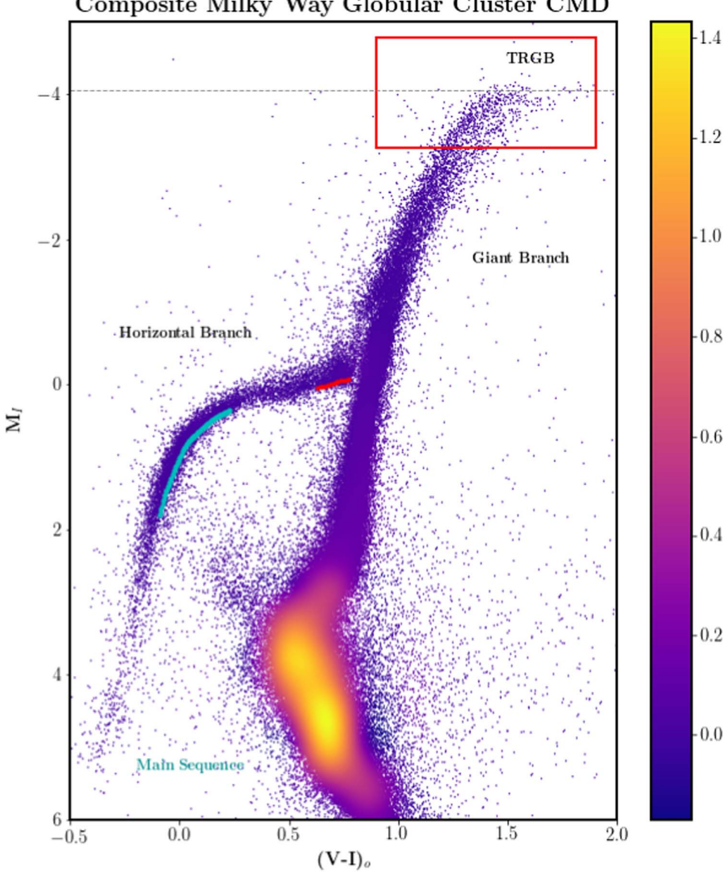
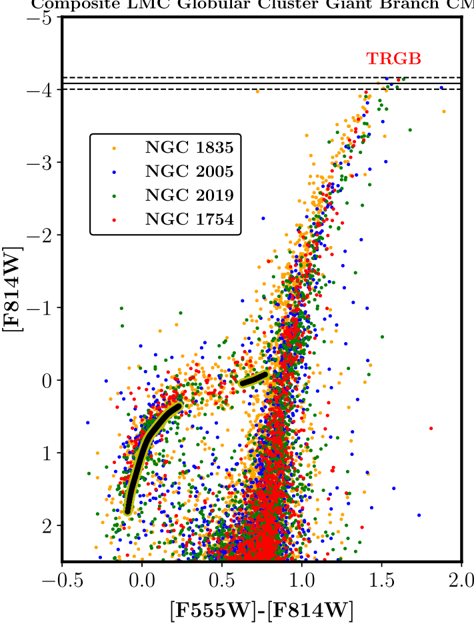
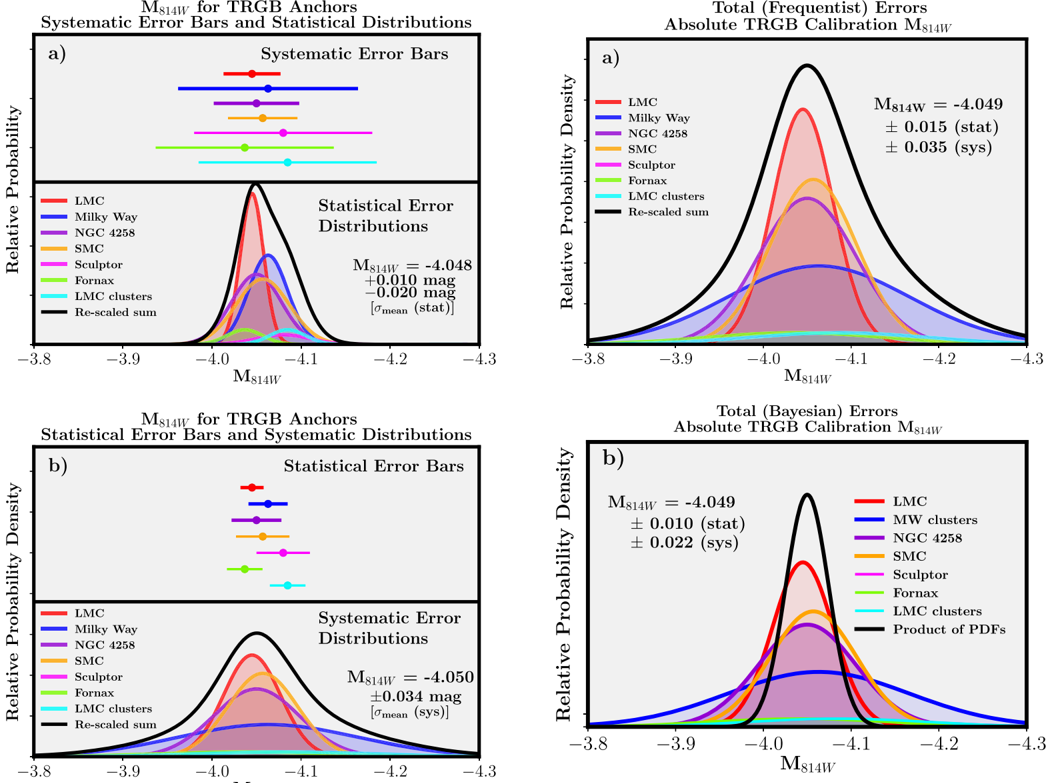
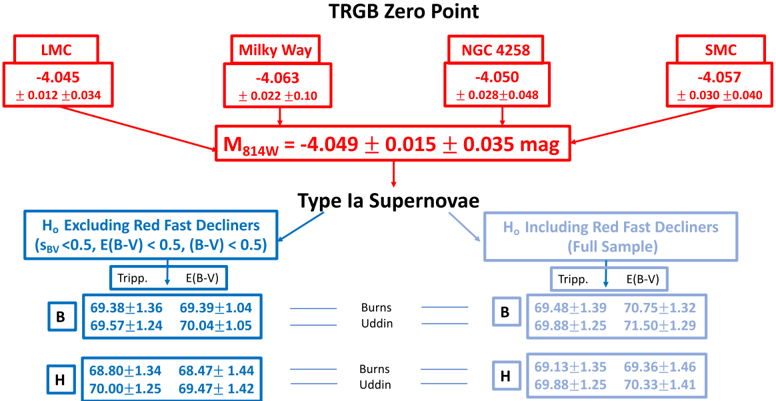
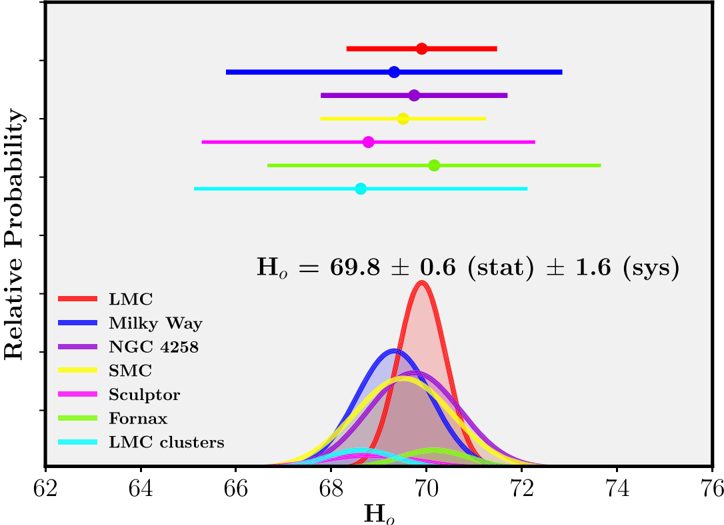
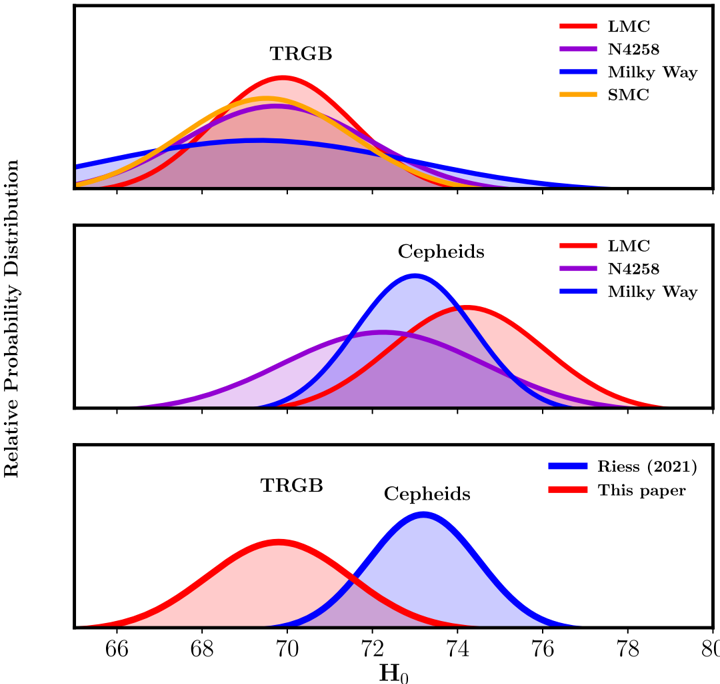
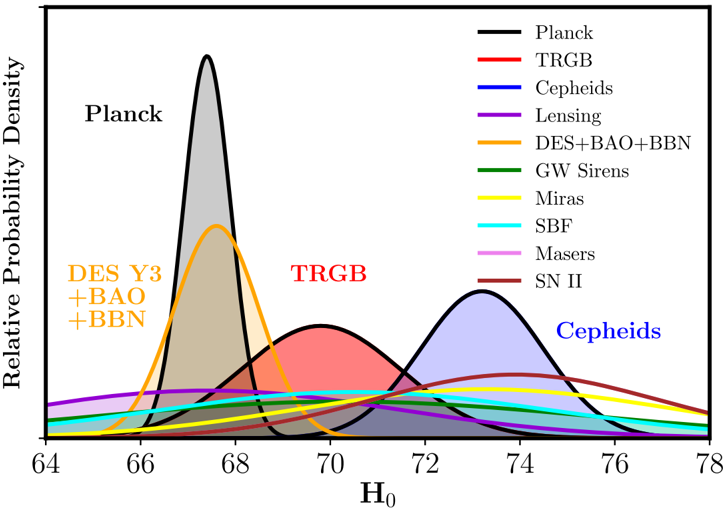
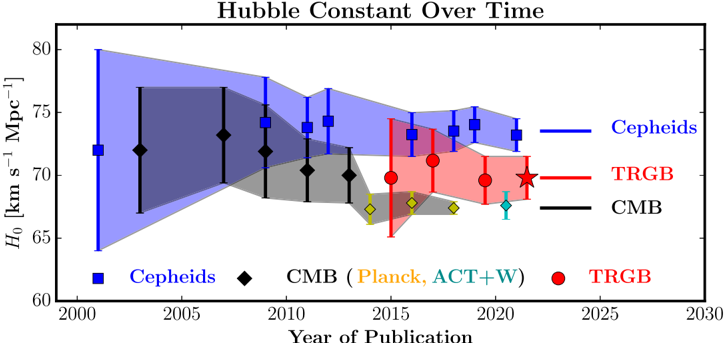
Measurement of the distances to nearby galaxies has improved rapidly in recent decades. The ever-present challenge is to reduce systematic effects, especially as greater distances are probed and the uncertainties become larger. In this paper, we combine several recent calibrations of the tip of the red giant branch (TRGB) method. These calibrations are internally self-consistent at the 1% level. New Gaia Early Data Release 3 data provide an additional consistency check at a (lower) 5% level of accuracy, a result of the well-documented Gaia angular covariance bias. The updated TRGB calibration applied to a sample of Type Ia supernovae from the Carnegie Supernova Project results in a value of the Hubble constant of H 0 = 69.8 ± 0.6 (stat) ± 1.6 (sys) km s−1 Mpc−1. No statistically significant difference is found between the value of H 0 based on the TRGB and that determined from the cosmic microwave background. The TRGB results are also consistent to within 2 σ with the SHoES and Spitzer plus Hubble Space Telescope (HST) Key Project Cepheid calibrations. The TRGB results alone do not demand additional new physics beyond the standard (ΛCDM) cosmological model. They have the advantage of simplicity of the underlying physics (the core He flash) and small systematic uncertainties (from extinction, metallicity, and crowding). Finally, the strengths and weaknesses of both the TRGB and Cepheids are reviewed, and prospects for addressing the current discrepancy with future Gaia, HST, and James Webb Space Telescope observations are discussed. Resolving this discrepancy is essential for ascertaining if the claimed tension in H 0 between the locally measured and CMB-inferred values is physically motivated.
Overview
The claims and statistics of this paper haven’t been checked yet.
Free: it reads the open-access text and checks the first 5 claims that cite a source we can check. Create a free account to check every claim.
Integrity signals
Registry
Cites
Statistics
Figures
Verification
Claims the paper makes
The claims and statistics of this paper haven’t been checked yet.
Free: it reads the open-access text and checks the first 5 claims that cite a source we can check. Create a free account to check every claim.
Claims other papers make about this one
Each is checked against this paper’s own text: does it say what the citing paper says it does?
The source backs part of the claim, not all of it — or backs it for a different population, condition or comparison.
In the citing paper
“there is the well-discussed Freedman 2021 [33] measurement which is exactly in between the Planck and SH0ES values of H 0 , i.e., in agreement with both sides within 1.5σ”
From Challenges of the Standard Cosmological Model (2022) · cites this paper as [33]
Experimental — accuracy not yet measured
Self-check
Percentages, sums and reported differences re-computed from the paper’s own numbers.
The self-check needs the paper’s full text.
Citations
Cites
Planck 2018 results: VI. Cosmological parameters
Planck Collaboration, Aghanim, N., Akrami, Y., Ashdown, M., Aumont, J., Baccigalupi, C., Ballardini, M., Banday, A. J., Barreiro, R. B., Bartolo, N., et al. (2020) · Astronomy & Astrophysics · doi:10.1051/0004-6361/201833910 · Cited by 14,258
Stan : A Probabilistic Programming Language
Carpenter, B., Gelman, A., Hoffman, M. D., Lee, D., Goodrich, B., Betancourt, M., Brubaker, M., Guo, J., Li, P., & Riddell, A. (2017) · Journal of Statistical Software · doi:10.18637/jss.v076.i01 · Cited by 7,754
MEASURING REDDENING WITH SLOAN DIGITAL SKY SURVEY STELLAR SPECTRA AND RECALIBRATING SFD
Schlafly, E. F., & Finkbeiner, D. P. (2011) · The Astrophysical Journal · doi:10.1088/0004-637x/737/2/103 · Cited by 7,531
Gaia Collaboration, Prusti, T., de Bruijne, J. H. J., Brown, A. G. A., Vallenari, A., Babusiaux, C., Bailer-Jones, C. A. L., Bastian, U., Biermann, M., Evans, D. W., et al. (2016) · Astronomy & Astrophysics · doi:10.1051/0004-6361/201629272 · Cited by 6,946
DAOPHOT - A computer program for crowded-field stellar photometry
Stetson, P. B. (1987) · Publications of the Astronomical Society of the Pacific · doi:10.1086/131977 · Cited by 4,694 · cited 1×
“Cerny et al. expanded the Stetson catalog to incorporate nine additional low-reddening clusters with BVI photometry alone, archived at the CADC, and analyzed with the same DAOPHOT/ALLFRAME software (Stetson 1987, 1994).”
MethodA Catalog of Parameters for Globular Clusters in the Milky Way
Harris, W. E. (1996) · The Astronomical Journal · doi:10.1086/118116 · Cited by 4,500 · cited 1×
“Preliminary E(B− V ) reddening estimates and initial distance estimates were taken from Harris (1996, 2010).”
BackgroundBressan, A., Marigo, P., Girardi, L., Salasnich, B., Dal Cero, C., Rubele, S., & Nanni, A. (2012) · Monthly Notices of the Royal Astronomical Society · doi:10.1111/j.1365-2966.2012.21948.x · Cited by 4,174
Final Results from the Hubble Space Telescope Key Project to Measure the Hubble Constant
Freedman, W. L., Madore, B. F., Gibson, B. K., Ferrarese, L., Kelson, D. D., Sakai, S., Mould, J. R., Kennicutt, Jr., Ford, H. C., Graham, J. A., et al. (2001) · The Astrophysical Journal · doi:10.1086/320638 · Cited by 3,298
Self-citationScolnic, D. M., Jones, D. O., Rest, A., Pan, Y. C., Chornock, R., Foley, R. J., Huber, M. E., Kessler, R., Narayan, G., Riess, A. G., et al. (2018) · The Astrophysical Journal · doi:10.3847/1538-4357/aab9bb · Cited by 2,700
A 2.4% DETERMINATION OF THE LOCAL VALUE OF THE HUBBLE CONSTANT*
Riess, A. G., Macri, L. M., Hoffmann, S. L., Scolnic, D., Casertano, S., Filippenko, A. V., Tucker, B. E., Reid, M. J., Jones, D. O., Silverman, J. M., et al. (2016) · The Astrophysical Journal · doi:10.3847/0004-637x/826/1/56 · Cited by 2,242
Research works printed but not linked: 11
- Bellazzini, M. 2008, MmSAI, 79, 440
- Carretta, E., & Bragaglia, A. 1998, A&A, 329, 937
- DES Collaboration, Abbott, T. M. C., Aguena, M., et al. 2021, arXiv:2105. 13549
- Freedman, W. L., Madore, B. F., Hoyt, T., et al. 2021, JWST Proposal Cycle 1, 1995
- Madore, B. F. 1976, The Galaxy and the Local Group, Vol. 182 (Greenwich: Royal Greenwich Observatory), 153
- Mortsell, E., Goobar, A., Johansson, J., & Dhawan, S. 2021, arXiv:2105.11461 · arXiv
- Oakes, E., Hoyt, T., Freedman, W., et al. 2021, ApJ, in press
- Owens, K., Freedman, W. L., Madore, B. F., et al. 2021, ApJ, in press
- Tran, Q., Hoyt, T., Freedman, W., et al. 2021, ApJ, in press
- Tripp, R. 1998, A&A, 331, 815
- Ulaczyk, K., Szymański, M. K., Udalski, A., et al. 2012, AcA, 62, 247
Cited by
Items 101–200 of 682
Precision cosmological constraints on atomic dark matter
Bansal, S., Barron, J., Curtin, D. Y., & Tsai, Y. (2023) · Journal of High Energy Physics · doi:10.1007/jhep10(2023)095 · Cited by 60
“The distance ladder method uses Type Ia supernovae as standard candles, calibrated using either Cepheid variables, as by the SH0ES collaboration [2], or the tip of the red giant branch (TRGB), as by the Carnegie-Chicago Hubble Program (CCHP) [3–5].”
MethodPutting flat ΛCDM in the (Redshift) bin
Colgáin, E. Ó., Sheikh-Jabbari, M. M., Solomon, R. M., Dainotti, M. G., & Stojković, D. (2024) · Physics of the Dark Universe · doi:10.1016/j.dark.2024.101464 · Cited by 62
Hahn, C., Lemos, P., Parker, L., Blancard, B. R.-S., Eickenberg, M., Ho, S., Hou, J., Massara, E., Modi, C., Dizgah, A. M., et al. (2024) · Nature Astronomy · doi:10.1038/s41550-024-02344-2 · Cited by 63
DESI constraints on the varying electron mass model and axionlike early dark energy
Seto, O., & Toda, Y. (2024) · Physical review. D/Physical review. D. · doi:10.1103/physrevd.110.083501 · Cited by 61
Testing the cosmological principle with the Pantheon+ sample and the region-fitting method
Hu, J.-P., Wang, Y., Hu, J., & Wang, F. Y. (2023) · Astronomy and Astrophysics · doi:10.1051/0004-6361/202347121 · Cited by 61
Updated constraints on omnipotent dark energy: A comprehensive analysis with CMB and BAO data
Specogna, E., Adil, S. A., Özülker, E., Valentino, E. D., Nunes, R. C., Akarsu, Ö., & Sen, A. A. (2026) · Physical review. D/Physical review. D. · doi:10.1103/b7ht-lx26 · Cited by 62
Neural network reconstruction of late-time cosmology and null tests
Dialektopoulos, K. F., Said, J. L., Mifsud, J., Sultana, J., & Adami, K. Z. (2022) · Journal of Cosmology and Astroparticle Physics · doi:10.1088/1475-7516/2022/02/023 · Cited by 60
“Figure 1 : The general structure of the adopted ANN, where the input is the redshift of a cosmological parameter Υ( z ), and the outputs are the corresponding value and error of Υ( z ).”
BackgroundShajib, A. J., Wong, K. C., Birrer, S., Suyu, S. H., Treu, T., Buckley‐Geer, E., Lin, H., Rusu, C. E., Poh, J., Palmese, A., et al. (2022) · Astronomy and Astrophysics · doi:10.1051/0004-6361/202243401 · Cited by 61
Perivolaropoulos, L., & Skara, F. (2022) · Universe · doi:10.3390/universe8100502 · Cited by 54
No Need to Know: Toward Astrophysics-free Gravitational-wave Cosmology
Farah, A. M., Callister, T. A., Ezquiaga, J. M., Zevin, M., & HOLZ, D. E. (2025) · The Astrophysical Journal · doi:10.3847/1538-4357/ad9253 · Cited by 59
The Cosmological ParametersPreprint
Lahav, O., & Liddle, A. R. (2003) · arXiv (Cornell University) · doi:10.48550/arxiv.astro-ph/0406681 · Cited by 56
Pierra, G., Mastrogiovanni, S., Perriès, S., & Mapelli, M. (2024) · Physical review. D/Physical review. D. · doi:10.1103/physrevd.109.083504 · Cited by 52
Anand, G. S., Riess, A. G., Yuan, W., Beaton, R. L., Casertano, S., Li, S., Makarov, D. I., Makarova, L. N., Tully, R. B., Anderson, R. I., et al. (2024) · The Astrophysical Journal · doi:10.3847/1538-4357/ad2e0a · Cited by 51
Measuring the Hubble constant using localized and nonlocalized fast radio bursts
Gao, D. H., Wu, Q., Hu, J.-P., Yi, S.-X., Zhou, X., Wang, F. Y., & Dai, Z. G. (2025) · Astronomy and Astrophysics · doi:10.1051/0004-6361/202453006 · Cited by 55
Benisty, D., Mifsud, J., Said, J. L., & Staicova, D. (2022) · Physics of the Dark Universe · doi:10.1016/j.dark.2022.101160 · Cited by 56
Hubble speed from first principles
Renzi, F., & Silvestri, A. (2023) · Physical review. D/Physical review. D. · doi:10.1103/physrevd.107.023520 · Cited by 53
Ginolin, M., Rigault, M., Smith, M., Copin, Y., Ruppin, F., Dimitriadis, G., Goobar, A., Johansson, J., Maguire, K., Nordin, J., et al. (2025) · Astronomy and Astrophysics · doi:10.1051/0004-6361/202450378 · Cited by 50
dos Santos, F. B. M., Morais, J., Pan, S., Yang, W., & Valentino, E. D. (2026) · Journal of Cosmology and Astroparticle Physics · doi:10.1088/1475-7516/2026/07/022 · Cited by 62
Early-Universe Model BuildingPreprint
Asadi, P., Bansal, S., Berlin, A., Co, R. T., Croon, D. L., Cui, Y., Curtin, D. Y., Cyr-Racine, F.-Y., Davoudiasl, H., Rose, L. D., et al. (2022) · arXiv (Cornell University) · doi:10.48550/arxiv.2203.06680 · Cited by 62
Measurements of the Hubble Constant with a Two-rung Distance Ladder: Two Out of Three Ain’t Bad
Kenworthy, W. D., Riess, A. G., Scolnic, D. M., Yuan, W., Bernal, J. L., Brout, D., Casertano, S., Jones, D. O., Macri, L. M., & Peterson, E. R. (2022) · The Astrophysical Journal · doi:10.3847/1538-4357/ac80bd · Cited by 59
“However, the most precise measurements in the literature have come from the use of a three-rung distance ladder using Type Ia supernovae (SNe Ia; Riess et al. 2022; Freedman 2021).”
MethodSimulating the LOcal Web (SLOW): I. Anomalies in the local density field
Dolag, K., Sorce, J. G., Pilipenko, S., Hernández-Martínez, E., Valentini, M., Gottlöber, S., Aghanim, N., & Khabibullin, I. I. (2023) · Astronomy and Astrophysics · doi:10.1051/0004-6361/202346213 · Cited by 49
GW190521: A binary black hole merger inside an active galactic nucleus?
Morton, S. L., Rinaldi, S., Torres-Orjuela, A., Derdzinski, A., Vaccaro, M. P., & Pozzo, W. D. (2023) · Physical review. D/Physical review. D. · doi:10.1103/physrevd.108.123039 · Cited by 51
Kinetic model for dark energy—dark matter interaction: Scenario for the hubble tension
Montani, G., Carlevaro, N., Escamilla, L. A., & Valentino, E. D. (2025) · Physics of the Dark Universe · doi:10.1016/j.dark.2025.101848 · Cited by 56
Yajima, H., Abe, M., Fukushima, H., Ono, Y., Harikane, Y., Ouchi, M., Hashimoto, T., & Khochfar, S. (2023) · Monthly Notices of the Royal Astronomical Society · doi:10.1093/mnras/stad2497 · Cited by 48
Jia, X. D., Hu, J.-P., Yi, S.-X., & Wang, F. Y. (2025) · The Astrophysical Journal Letters · doi:10.3847/2041-8213/ada94d · Cited by 52
ZTF SN Ia DR2: Colour standardisation of type Ia supernovae and its dependence on the environment
Ginolin, M., Rigault, M., Copin, Y., Popovic, B., Dimitriadis, G., Goobar, A., Johansson, J., Maguire, K., Nordin, J., Smith, M., et al. (2025) · Astronomy and Astrophysics · doi:10.1051/0004-6361/202450943 · Cited by 48
The Hubble Constant from Strongly Lensed Supernovae with Standardizable Magnifications
Birrer, S., Dhawan, S., & Shajib, A. J. (2022) · The Astrophysical Journal · doi:10.3847/1538-4357/ac323a · Cited by 42
“Another distance ladder analysis based on calibration using the tip of the red giant branch (TRGB) stars results in a consistent measurement with the CMB (Freedman et al. 2020; Freedman 2021).”
MethodValentino, E. D., Giarè, W., MELCHIORRI, A., & Silk, J. I. (2022) · Physical review. D/Physical review. D. · doi:10.1103/physrevd.106.103506 · Cited by 51
The mass effect — variations of the electron mass and their impact on cosmology
Schöneberg, N., & Vacher, L. (2025) · Journal of Cosmology and Astroparticle Physics · doi:10.1088/1475-7516/2025/03/004 · Cited by 50
Ling, J.-L., Du, G., Li, T.-N., Zhang, J.-F., Wang, S.-J., & Zhang, X. (2025) · Physical review. D/Physical review. D. · doi:10.1103/p8nz-djjm · Cited by 51
No-go guide for late-time solutions to the Hubble tension: Matter perturbations
Cai, R.-G., Guo, Z., Wang, S.-J., Yu, W.-W., & Zhou, Y. (2022) · Physical review. D/Physical review. D. · doi:10.1103/physrevd.106.063519 · Cited by 57
Vogl, C., Taubenberger, S., Csörnyei, G., LEIBUNDGUT, B., Kerzendorf, W., Sim, S. A., Peterson, E. R., Courtois, H. M., Blondin, S., Flörs, A., et al. (2025) · Astronomy and Astrophysics · doi:10.1051/0004-6361/202452910 · Cited by 57
Modified recombination and the Hubble tension
Mirpoorian, S. H., Jedamzik, K., & Pogosian, L. (2025) · Physical review. D/Physical review. D. · doi:10.1103/physrevd.111.083519 · Cited by 49
Son, J., Lee, Y., Chung, C., Park, S., & Cho, H. (2025) · Monthly Notices of the Royal Astronomical Society · doi:10.1093/mnras/staf1685 · Cited by 63
Assessing the robustness of sound horizon-free determinations of the Hubble constant
Smith, T. L., Poulin, V., & Simon, T. (2023) · Physical review. D/Physical review. D. · doi:10.1103/physrevd.108.103525 · Cited by 48
Stepped partially acoustic dark matter, large scale structure, and the Hubble tension
Buen-Abad, M. A., Chacko, Z., Kılıç, C., Marques-Tavares, G., & Youn, T. (2023) · Journal of High Energy Physics · doi:10.1007/jhep06(2023)012 · Cited by 48
Quantifying the energetics of molecular superbubbles in PHANGS galaxies
Watkins, E. J., Kreckel, K., Groves, B. A., Glover, S. C. O., Whitmore, B. C., Leroy, A. K., Schinnerer, E., Meidt, S. E., Egorov, O. V., Barnes, A. T., et al. (2023) · Astronomy and Astrophysics · doi:10.1051/0004-6361/202346075 · Cited by 48
Hoyt, T. J., Rubin, D., Aldering, G., Perlmutter, S., Cuceu, A., & Gupta, R. (2026) · The Astrophysical Journal · doi:10.48550/arxiv.2601.19424 · Cited by 53
Ruchika, R., Rathore, H., Choudhury, S. R., & Rentala, V. (2024) · Journal of Cosmology and Astroparticle Physics · doi:10.1088/1475-7516/2024/06/056 · Cited by 48
“0 km s − 1 − 1 • The possibility of a sharp transition in the gravitational constant was also discussed as an 𝑇”
New LZ and PW(Z) relations of RR Lyrae stars calibrated withGaiaEDR3 parallaxes
Garofalo, A., Delgado, H. E., Sarro, L. M., Clementini, G., Muraveva, T., Marconi, M., & Ripepi, V. (2022) · Monthly Notices of the Royal Astronomical Society · doi:10.1093/mnras/stac735 · Cited by 53
Tensions with the flat ΛCDM model from high-redshift cosmography
Bargiacchi, G., Dainotti, M. G., & Capozziello, S. (2023) · Monthly Notices of the Royal Astronomical Society · doi:10.1093/mnras/stad2326 · Cited by 45
Ward, S. M., Thorp, S., Mandel, K. S., Dhawan, S., Jones, D. O., Taggart, K., Foley, R. J., Narayan, G., Chambers, K. C., Coulter, D. A., et al. (2023) · The Astrophysical Journal · doi:10.3847/1538-4357/acf7bb · Cited by 48
“Type Ia supernovae ( SNe Ia ) are standardizable candles, used to measure luminosity distances and constrain cosmological parameters ( Riess et al. 1998, 2022; Perlmutter et al. 1999; Abbott et al. 2019; Freedman 2021; Stahl et al. 2021; Brout et al. 2022; Jones et al. 2022 ) .”
BackgroundWatkins, L. L., van der Marel, R. P., & Bennet, P. (2024) · The Astrophysical Journal · doi:10.3847/1538-4357/ad1f58 · Cited by 48
Exploring the Hubble tension with a late time Modified Gravity scenario
Escamilla, L. A., Fiorucci, D., Montani, G., & Valentino, E. D. (2024) · Physics of the Dark Universe · doi:10.1016/j.dark.2024.101652 · Cited by 46
Lee, A. J., Freedman, W. L., Madore, B. F., Jang, I. S., Owens, K. A., & Hoyt, T. J. (2025) · The Astrophysical Journal · doi:10.3847/1538-4357/adc8a1 · Cited by 49
“This H 0 = 69.8 ± 1.7 km s − 1 Mpc − 1 , measured by the Chicago – Carnegie Hubble Program ( CCHP ) , was based on the tip of the red giant branch ( TRGB; W. L. Freedman et al. 2019; W. L. Freedman 2021 ) calibration of the Carnegie Supernova Project ( CSP ) SN Ia sample.”
InfluentialSelf-citationRapidly descending dark energy and the end of cosmic expansion
Andrei, C., Ijjas, A., & Steinhardt, P. J. (2022) · Proceedings of the National Academy of Sciences · doi:10.1073/pnas.2200539119 · Cited by 47
Dark matter trigger for early dark energy coincidence
Lin, M., McDonough, E., Hill, J. C., & Hu, W. (2023) · Physical review. D/Physical review. D. · doi:10.1103/physrevd.107.103523 · Cited by 44
Cosmicflows-4: the baryonic Tully–Fisher relation providing ∼10 000 distances
Kourkchi, E., Tully, R. B., Courtois, H. M., Dupuy, A., & Guinet, D. (2022) · Monthly Notices of the Royal Astronomical Society · doi:10.1093/mnras/stac303 · Cited by 42
Khodadi, M., & Schreck, M. (2023) · Physics of the Dark Universe · doi:10.1016/j.dark.2023.101170 · Cited by 43
Completeness of the NASA/IPAC Extragalactic Database (NED) Local Volume Sample
Cook, D., Mazzarella, J. M., Helou, G. X., Alcala, A., Chen, X., Ebert, R., Frayer, C., Kim, J., Lo, T., Madore, B. F., et al. (2023) · The Astrophysical Journal Supplement Series · doi:10.3847/1538-4365/acdd06 · Cited by 46
An updated measurement of the Hubble constant from near-infrared observations of Type Ia supernovae
Galbany, L., de Jaeger, T., Riess, A. G., Müller-Bravo, T. E., Dhawan, S., Phan, K., Stritzinger, M. D., Karamehmetoglu, E., LEIBUNDGUT, B., Burns, C. R., et al. (2023) · Astronomy and Astrophysics · doi:10.1051/0004-6361/202244893 · Cited by 46
Dhawan, S., Goobar, A., Johansson, J., Jang, I. S., Rigault, M., Harvey, L., Maguire, K., Freedman, W. L., Madore, B. F., Smith, M., et al. (2022) · The Astrophysical Journal · doi:10.3847/1538-4357/ac7ceb · Cited by 42
“A summary of the various absolute calibrations in the literature are provided in Blakeslee et al. (2021), Freedman (2021).”
BackgroundSelf-citationNo-go guide for the Hubble tension: Late-time or local-scale new physics
Huang, L., Wang, S.-J., & Yu, W.-W. (2024) · Science China Physics Mechanics and Astronomy · doi:10.1007/s11433-024-2528-8 · Cited by 45
“If not caused by any of the early-time or late-time systematics, the above Hubble-constant tension [11–15] could be a promising clue to the new physics.”
BackgroundReduced Hubble tension in dark radiation models after DESI 2024
Allali, I. J., Notari, A., & Rompineve, F. (2025) · Journal of Cosmology and Astroparticle Physics · doi:10.1088/1475-7516/2025/03/023 · Cited by 46
“…motivates a reassessment of whether such simple one parameter extensions of the ΛCDM model can reconcile the value of the Hubble expansion parameter H 0 inferred from fitting to cosmological datasets, with the larger value measured from supernovae [42] (see also [43–45] for other measurements).”
Qu, F. J., Surrao, K. M., Bolliet, B., Hill, J. C., Sherwin, B. D., Jense, H. T., & Posta, A. L. (2025) · Physical review. D/Physical review. D. · doi:10.1103/xhh6-9v62 · Cited by 41
Updated observational constraints on spatially flat and nonflat Λ CDM and XCDM cosmological models
Pérez, J. D. C., Park, C., & Ratra, B. (2024) · Physical review. D/Physical review. D. · doi:10.1103/physrevd.110.023506 · Cited by 43
Ghosh, S., Kumar, S., & Tsai, Y. (2022) · Journal of Cosmology and Astroparticle Physics · doi:10.1088/1475-7516/2022/05/014 · Cited by 45
“1There are other local H0 measurements, for instance, based on the TRGB distance ladder measurement [39] or measurements using strong gravitational lensing systems [40, 41].”
MethodA cosmological underdensity does not solve the Hubble tension
Castello, S., Högås, M., & Mörtsell, E. (2022) · Journal of Cosmology and Astroparticle Physics · doi:10.1088/1475-7516/2022/07/003 · Cited by 44
Bulla, M., Coughlin, M. W., Dhawan, S., & Dietrich, T. (2022) · Universe · doi:10.3390/universe8050289 · Cited by 42
“The tip of the red giant branch (TRGB; [24]) and Cepheid [3] distance scales yield values of 69.”
Yashiki, M. (2025) · Physical review. D/Physical review. D. · doi:10.1103/qw1d-mdrz · Cited by 48
New constraints on anisotropic expansion from supernovae Type Ia
Rahman, W., Trotta, R., Boruah, S. S., Hudson, M. J., & van Dyk, D. A. (2022) · Monthly Notices of the Royal Astronomical Society · doi:10.1093/mnras/stac1223 · Cited by 44
Planetary nebula luminosity function distances for 19 galaxies observed by PHANGS–MUSE
Scheuermann, F., Kreckel, K., Anand, G. S., Blanc, G. A., Congiu, E., Santoro, F., Dyk, S. D. V., Barnes, A. T., Bigiel, F., Glover, S. C. O., et al. (2022) · Monthly Notices of the Royal Astronomical Society · doi:10.1093/mnras/stac110 · Cited by 39
Gamma-Ray Burst Constraints on Cosmological Models from the Improved Amati Correlation
Liu, Y., Liang, N., Xie, X., Yuan, Z., Yu, H., & Wu, P. (2022) · The Astrophysical Journal · doi:10.3847/1538-4357/ac7de5 · Cited by 41
“…lenses have been used to discuss this H0 tension, its origin is not yet determined (Chen et al. 2017; Wu et al. 2017; Abbott et al. 2018; Birrer et al. 2020; Efstathiou 2020; Cao et al. 2021a; Freedman 2021; Khetan et al. 2021; Lin & Ishak 2021; Cao & Ratra 2022b; Colgáin et al. 2022a, 2022b).”
MethodComparison of dark energy models using late-universe observations
Wu, P.-J. (2025) · Physical review. D/Physical review. D. · doi:10.1103/mcgb-ntwr · Cited by 41
I. Linear interacting dark energy: Analytical solutions and theoretical pathologies
van der Westhuizen, M. A., Abebe, A., & Valentino, E. D. (2025) · Physics of the Dark Universe · doi:10.1016/j.dark.2025.102119 · Cited by 48
Abdalla, E., Abellán, G. F., Aboubrahim, A., Agnello, A., Akarsu, Ö., Akrami, Y., Alestas, G., Aloni, D., Amendola, L., Anchordoqui, L. A., et al. (2022) · Journal of High Energy Astrophysics · doi:10.1016/j.jheap.2022.04.002 · Cited by 37
Self-citationA New Master Supernovae Ia sample and the investigation of the Hubble tension
Dainotti, M. G., Simone, B. D., Garg, A., Kohri, K., Bashyal, A., Aich, A., Mondal, A., Nagataki, S., Montani, G., Jareen, T., et al. (2025) · Journal of High Energy Astrophysics · doi:10.1016/j.jheap.2025.100405 · Cited by 52
Chaudhary, H., Capozzıello, S., Praharaj, S., Pacif, S. K. J., & Mustafa, G. (2025) · Journal of High Energy Astrophysics · doi:10.1016/j.jheap.2025.100507 · Cited by 45
“The most prominent is the Hubble tension, a discrepancy ≥ 5 σ between the Hubble constant H 0 inferred from CMB+ Λ CDM analyses ( ∼ 67 km/s/Mpc) and local measurements ( ∼ 73 km/s/Mpc) [35–38].”
Corsi, A., Barsotti, L., Berti, E., Evans, M., Gupta, I., Kritos, K., Kuns, K. A., Nitz, A., Owen, B. J., Rajbhandari, B., et al. (2024) · Frontiers in Astronomy and Space Sciences · doi:10.3389/fspas.2024.1386748 · Cited by 38
“While this measurement is not sufficiently precise to significantly impact the current debate on the tension between different measurements of H 0 (Freedman, 2021; Kamionkowski and Riess, 2023; Freedman and Madore, 2023), its importance as a measurement completely independent of both the Planck…”
BackgroundPerformance of non-parametric reconstruction techniques in the late-time universe
Escamilla‐Rivera, C., Said, J. L., & Mifsud, J. (2021) · Journal of Cosmology and Astroparticle Physics · doi:10.1088/1475-7516/2021/10/016 · Cited by 36
Gómez-Valent, A. (2022) · Physical review. D/Physical review. D. · doi:10.1103/physrevd.105.043528 · Cited by 36
Gao, J., Zhou, Z., Du, M., Zou, R., Hu, J.-P., & Xu, L. (2023) · Monthly Notices of the Royal Astronomical Society · doi:10.1093/mnras/stad3708 · Cited by 38
Gravitational wave standard sirens: A brief review of cosmological parameter estimation
Jin, S.-J., Song, J.-Y., Sun, T.-Y., Xiao, S.-R., Wang, H., Wang, L.-F., Zhang, J., & Zhang, X. (2026) · Science China Physics Mechanics and Astronomy · doi:10.1007/s11433-025-2829-9 · Cited by 39
The Hubble Tension: A Decade Review
Cai, R.-G., & Wang, S.-J. (2026) · Research in Astronomy and Astrophysics · doi:10.1088/1674-4527/ae842f · Cited by 57
Cosmological constraints from H ii starburst galaxy, quasar angular size, and other measurements
Cao, S., Ryan, J., & Ratra, B. (2021) · Monthly Notices of the Royal Astronomical Society · doi:10.1093/mnras/stab3304 · Cited by 39
Pérez, J. D. C., Park, C., & Ratra, B. (2023) · Physical review. D/Physical review. D. · doi:10.1103/physrevd.107.063522 · Cited by 37
Sanders, J. L. (2023) · Monthly Notices of the Royal Astronomical Society · doi:10.1093/mnras/stad1431 · Cited by 41
Prada, F., Ereza, J., Smith, A., Lasker, J., Vaisakh, R., Kehoe, R., Dong-Páez, C. A., Siudek, M., Wang, M. S., Alam, S., et al. (2025) · Astronomy and Astrophysics · doi:10.1051/0004-6361/202451022 · Cited by 37
Dimitriadis, G., Foley, R. J., Arendse, N., Coulter, D. A., Jacobson-Galán, W. V., Siebert, M. R., Izzo, L., Jones, D. O., Kilpatrick, C. D., Pan, Y. C., et al. (2022) · The Astrophysical Journal · doi:10.3847/1538-4357/ac4780 · Cited by 34
“SNe Ia are also key to measuring the local expansion rate (Riess et al. 2016; Freedman et al. 2019), and those measurements differ from inferences from early universe probes that may indicate unaccounted physics in the current cosmological model (Freedman 2021).”
BackgroundYe, G., & Piao, Y.-S. (2022) · Physical review. D/Physical review. D. · doi:10.1103/physrevd.106.043536 · Cited by 36
“[12] W. L. Freedman (2021), 2106.15656.”
InfluentialDark energy by natural evolution: Constraining dark energy using Approximate Bayesian Computation
Bernardo, R. C., Grandón, D., Said, J. L., & Cárdenas, V. H. (2023) · Physics of the Dark Universe · doi:10.1016/j.dark.2023.101213 · Cited by 37
A new binning method to choose a standard set of Quasars
Dainotti, M. G., Lenart, A. Ł., Yengejeh, M. G., Chakraborty, S., Fraija, N. I., Valentino, E. D., & Montani, G. (2024) · Physics of the Dark Universe · doi:10.1016/j.dark.2024.101428 · Cited by 36
Towards a possible solution to the Hubble tension with Horndeski gravity
Tiwari, Y., Ghosh, B., & Jain, R. K. (2024) · The European Physical Journal C · doi:10.1140/epjc/s10052-024-12577-0 · Cited by 35
“A comprehensive summary of these approaches can be found in [10,20–27], most of which can be categorised either as an early-time or a late-time modification.”
Trentin, E., Ripepi, V., Catanzaro, G., Storm, J., Marconi, M., Somma, G. D., Testa, V., & Musella, I. (2022) · Monthly Notices of the Royal Astronomical Society · doi:10.1093/mnras/stac2459 · Cited by 33
“This discrepancy, known as the 𝐻0 tension, has still unknown origins, in spite of many observational and theoretical efforts to study the possible causes as well as residual systematics(see e.g. Dainotti et al. 2021; Freedman 2021; Riess et al. 2021a, and reference therein).”
BackgroundDhawan, S., Thorp, S., Mandel, K. S., Ward, S. M., Narayan, G., Jha, S. W., & Chant, T. (2023) · Monthly Notices of the Royal Astronomical Society · doi:10.1093/mnras/stad1590 · Cited by 33
Hubble Constant Measurement from Three Large-separation Quasars Strongly Lensed by Galaxy Clusters
Napier, K., Sharon, K., Dahle, H., Bayliss, M. B., Gladders, M. D., Mahler, G., Rigby, J. R., & Florian, M. (2023) · The Astrophysical Journal · doi:10.3847/1538-4357/ad045a · Cited by 38
“Freedman (2021) applied an updated Tip of the Red Giant Branch (TRGB) calibration to a distant sample of Type Ia supernovae from the Carnegie Su-pernova Project and obtained H 0 = 69.8 ± 0.6 (stat) ± 1.6 (sys) km s − 1 Mpc − 1 , consistent with the CMB value, and within 2 σ of the SH0ES value,…”
MethodInfluentialTowards a new model-independent calibration of Gamma-Ray Bursts
Favale, A., Dainotti, M. G., Gómez-Valent, A., & Migliaccio, M. (2024) · Journal of High Energy Astrophysics · doi:10.1016/j.jheap.2024.10.010 · Cited by 40
“…the Amati relation, something that has been further exploited using GP (Li et al., 2023; Kumar et al., 2023) and other techniques, such as the Bézier parametric curve obtained through the linear combination of Bernstein basis polynomials (Montiel et al., 2020; Luongo and Muccino, 2020, 2021, 2022).”
MethodDoes nonstationary noise in LIGO and Virgo affect the estimation of H0 ?
Mozzon, S., Ashton, G., Nuttall, L. K., & Williamson, A. R. (2022) · Physical review. D/Physical review. D. · doi:10.1103/physrevd.106.043504 · Cited by 33
Neural network reconstruction of H'(z) and its application in teleparallel gravity
Mukherjee, P., Said, J. L., & Mifsud, J. (2022) · Journal of Cosmology and Astroparticle Physics · doi:10.1088/1475-7516/2022/12/029 · Cited by 33
Accretion disks, quasars and cosmology: meandering towards understanding
Czerny, B., Cao, S., Jaiswal, V. K., Karas, V., Khadka, N., Martínez‐Aldama, M. L., Naddaf, M.-H., Panda, S., Núñez, F. P., Prince, R., et al. (2023) · Astrophysics and Space Science · doi:10.1007/s10509-023-04165-7 · Cited by 32
“On the other hand, some local measurements indicate much less tension, if any, when compared with the CMB measurements (e.g. Freedman 2021).”
ResultKreisch, C. D., Park, M., Calabrese, E., Cyr-Racine, F.-Y., An, R., Bond, J. R., Doré, O., Dunkley, J., Gallardo, P. A., Gluscevic, V., et al. (2024) · Physical review. D/Physical review. D. · doi:10.1103/physrevd.109.043501 · Cited by 39
Effects of Type Ia Supernovae Absolute Magnitude Priors on the Hubble Constant Value
Chen, Y., Kumar, S., Ratra, B., & Xu, T. (2024) · The Astrophysical Journal Letters · doi:10.3847/2041-8213/ad2e97 · Cited by 37
“7 km s − 1 Mpc − 1 from SNe Ia calibrated using tip of the red-giant branch data (Freedman 2021) or the flat ΛCDM model value provided in Cao & Ratra (2023), H 0 = 69 .”
MethodWojtak, R., & Hjorth, J. (2024) · Monthly Notices of the Royal Astronomical Society · doi:10.1093/mnras/stae1977 · Cited by 33
“…constant determinations based on alternative distance calibrations to Cepheids, e.g. the Tip of Red Giant Branch (TRGB; Freed-man et al. 2019; Freedman 2021), surface brightness fluctuations (SBF; Khetan et al. 2021; Jensen et al. 2021), or different choices of filters to measure supernova…”
BackgroundThe Improved Amati Correlations from Gaussian Copula
Liu, Y., Chen, F., Liang, N., Yuan, Z., Yu, H., & Wu, P. (2022) · The Astrophysical Journal · doi:10.3847/1538-4357/ac66d3 · Cited by 31
Suppression of scalar power on large scales and associated bispectra
Ragavendra, H. V., Chowdhury, D., & Sriramkumar, L. (2022) · Physical review. D/Physical review. D. · doi:10.1103/physrevd.106.043535 · Cited by 32
Smith, A., Özülker, E., Valentino, E. D., & van de Bruck, C. (2025) · arXiv (Cornell University) · doi:10.48550/arxiv.2510.21931 · Cited by 45
Ohlson, D., Seth, A. C., Gallo, E., Baldassare, V., & Greene, J. E. (2023) · The Astronomical Journal · doi:10.3847/1538-3881/acf7bc · Cited by 31
Toward alleviating the H 0 and S 8 tensions with early dark energy-dark matter drag
Simon, T., Adi, T., Bernal, J. L., Kovetz, E. D., Poulin, V., & Smith, T. L. (2025) · Physical review. D/Physical review. D. · doi:10.1103/physrevd.111.023523 · Cited by 33
“Though the possibility of unknown systematic effects explaining these discrepancies is extensively studied (see e.g. , [2–5] for discussion), it is possible that these “cosmic tensions” indicate departure from the consensus ΛCDM paradigm, with new dynamical effects sourcing these apparent…”
BackgroundA New Master Supernovae Ia sample and the investigation of the H_0 tension
Dainotti, M. G., Garg, A., Valletta, A., Navone, I., & Montani, G. (2026) · Corfu Summer Institute School and Workshops on Elementary Particle Physics and Gravity (CORFU) · doi:10.22323/1.509.0218 · Cited by 31
Radial velocities and stellar population properties of 56 MATLAS dwarf galaxies observed with MUSE
Heesters, N., Müller, O., Marleau, F. R., Duc, P., Sánchez-Janssen, R., Poulain, M., Habas, R. A., Lim, S., & Durrell, P. R. (2023) · Astronomy and Astrophysics · doi:10.1051/0004-6361/202346441 · Cited by 32
Metadata
- Authors
- Freedman, W. L.
- Affiliations
- University of Chicago (US)
- Corresponding author
- Freedman, Wendy L.
- ORCID
- Freedman, Wendy L.
- Venue
- The Astrophysical Journal
- Publisher
- American Astronomical Society
- Published
- 2021-09-01
- Volume
- 919
- Issue
- 1
- Pages
- 16
- ISSN
- 0004-637X (ISSN-L)
- 1538-4357
- OpenAlex
- W3176418170
- Cited by
- 577
- References
- 105
- Citations by year
- 2026: 63 · 2025: 109 · 2024: 122 · 2023: 123 · 2022: 134 · 2021: 24
- FWCI
- 54.16
- Type
- journal article
- Language
- en
- Open access
- hybrid
- doi.org
- Licence
- cc-by
- creativecommons.org/licenses/by/4.0/ (vor, 16 d)
- iopscience.iop.org/info/page/text-and-data-mining (tdm, 16 d)
- Locations
- The Astrophysical Journal (publishedVersion, cc-by)
- arXiv (Cornell University) (submittedVersion)
- arXiv (Cornell University) (cc-by)
- Funders
- National Aeronautics and Space Administration (NAS 526555, 526555)
- Space Telescope Science Institute (NAS5- 26555, 5-26555, 26555, 13691)
- Topics
- Physical Sciences › Physics and Astronomy › Astronomy and Astrophysics › Cosmology and Gravitation Theories
- Physical Sciences › Physics and Astronomy › Astronomy and Astrophysics › Stellar, planetary, and galactic studies
- Physical Sciences › Physics and Astronomy › Astronomy and Astrophysics › Galaxies: Formation, Evolution, Phenomena
- Keywords
- Hubble constant, Hubble tension, tip of the red giant branch, Type Ia supernovae, Cepheid calibration, cosmic microwave background, core helium flash, local distance ladder, systematic uncertainties
About these checks
Registry, retraction, Cites and statistics results are computed, not judged, with one exception: a printed reference that no index lists is read once by a model before it counts as a citation error. Claims are extracted by a model and kept only when their quote appears verbatim in the text; each cited source is then checked, with a model’s help, for whether it says what the claim relies on. Those verdicts can be wrong — read the claim’s quote and the cited source before relying on one.
Statistics and arithmetic are recomputed, not judged.
Confidence bands are shown only for fields calibrated on our annotated test set. None is calibrated yet, so no band is shown.
What counts as a claim ›How we measure confidence ›How we check this ›
Are you an author, or do you see a problem with this page? Request a review
Data sources
Bibliographic data: Semantic Scholar, OpenAlex, Crossref.
Contains information from the Semantic Scholar Academic Graph Datasets, made available under the ODC Attribution License (ODC-BY 1.0).
Semantic Scholar’s data is described in: Kinney, R., et al. (2023). The Semantic Scholar Open Data Platform. arXiv:2301.10140.
