

Measurements of the Hubble Constant: Tensions in Perspective
Open accessThe DOI matches its Crossref record; 110 of the 110 references it cites were found in a registry or an index.
Abstract
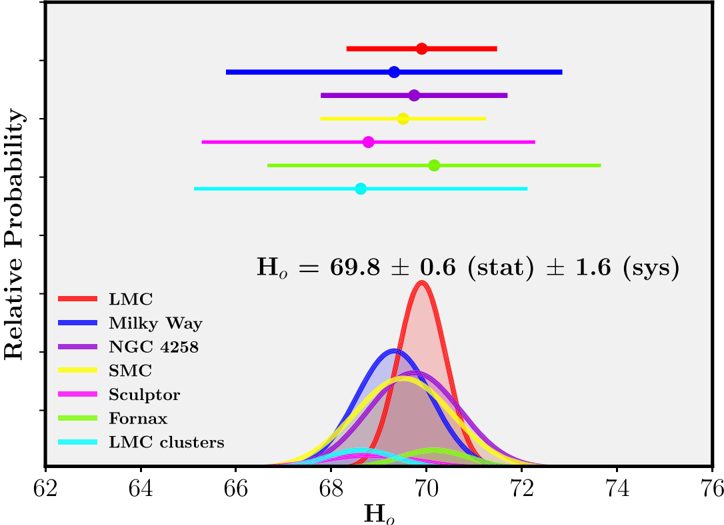
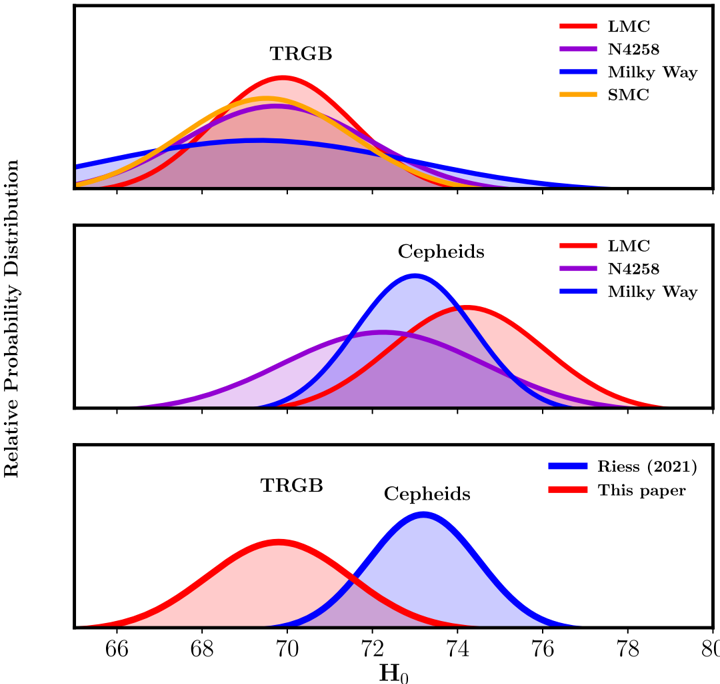
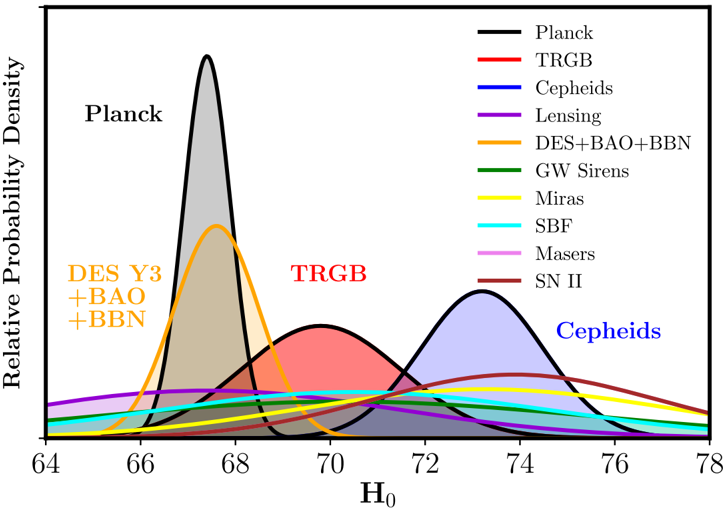
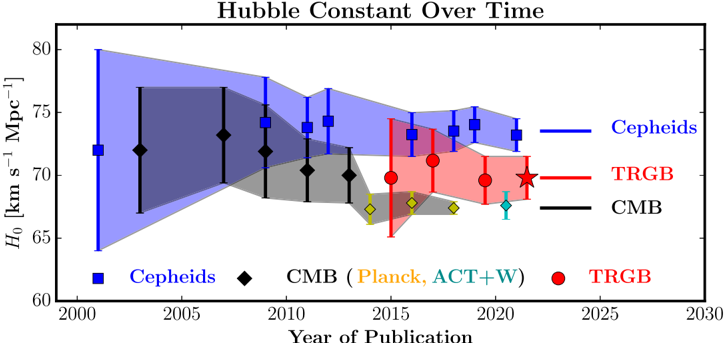
Measurement of the distances to nearby galaxies has improved rapidly in recent decades. The ever-present challenge is to reduce systematic effects, especially as greater distances are probed and the uncertainties become larger. In this paper, we combine several recent calibrations of the tip of the red giant branch (TRGB) method. These calibrations are internally self-consistent at the 1% level. New Gaia Early Data Release 3 data provide an additional consistency check at a (lower) 5% level of accuracy, a result of the well-documented Gaia angular covariance bias. The updated TRGB calibration applied to a sample of Type Ia supernovae from the Carnegie Supernova Project results in a value of the Hubble constant of H 0 = 69.8 ± 0.6 (stat) ± 1.6 (sys) km s−1 Mpc−1. No statistically significant difference is found between the value of H 0 based on the TRGB and that determined from the cosmic microwave background. The TRGB results are also consistent to within 2 σ with the SHoES and Spitzer plus Hubble Space Telescope (HST) Key Project Cepheid calibrations. The TRGB results alone do not demand additional new physics beyond the standard (ΛCDM) cosmological model. They have the advantage of simplicity of the underlying physics (the core He flash) and small systematic uncertainties (from extinction, metallicity, and crowding). Finally, the strengths and weaknesses of both the TRGB and Cepheids are reviewed, and prospects for addressing the current discrepancy with future Gaia, HST, and James Webb Space Telescope observations are discussed. Resolving this discrepancy is essential for ascertaining if the claimed tension in H 0 between the locally measured and CMB-inferred values is physically motivated.
Overview
The claims and statistics of this paper haven’t been checked yet.
Free: it reads the open-access text and checks the first 5 claims that cite a source we can check. Create a free account to check every claim.
Integrity signals
Registry
Cites
Statistics
Figures
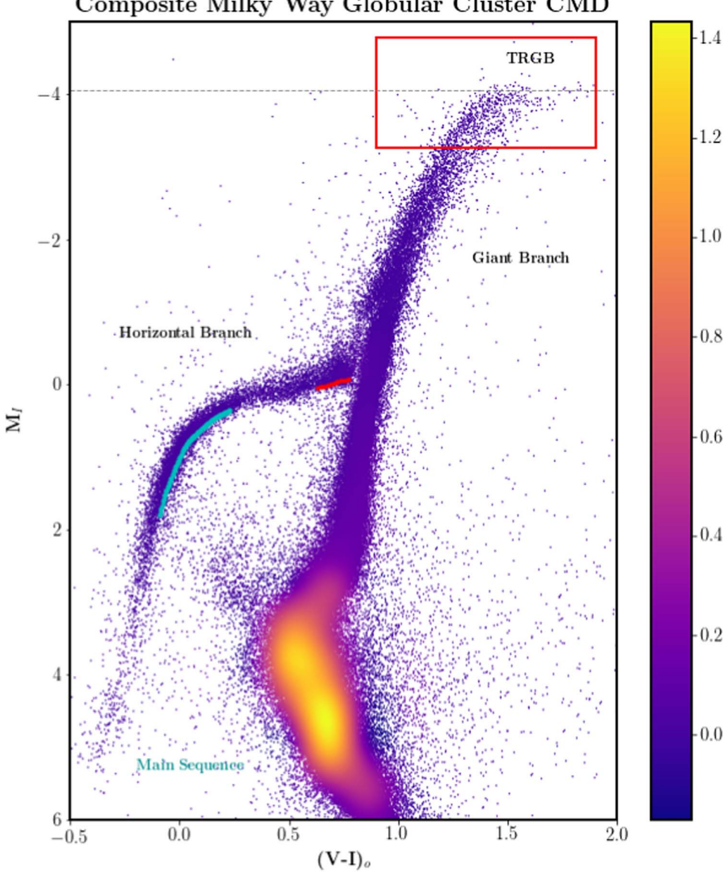
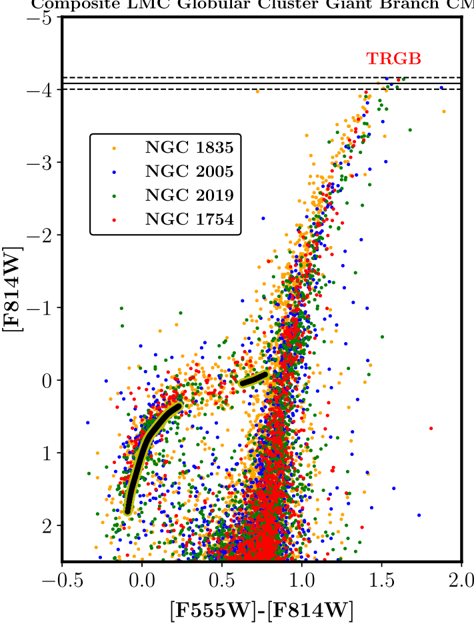
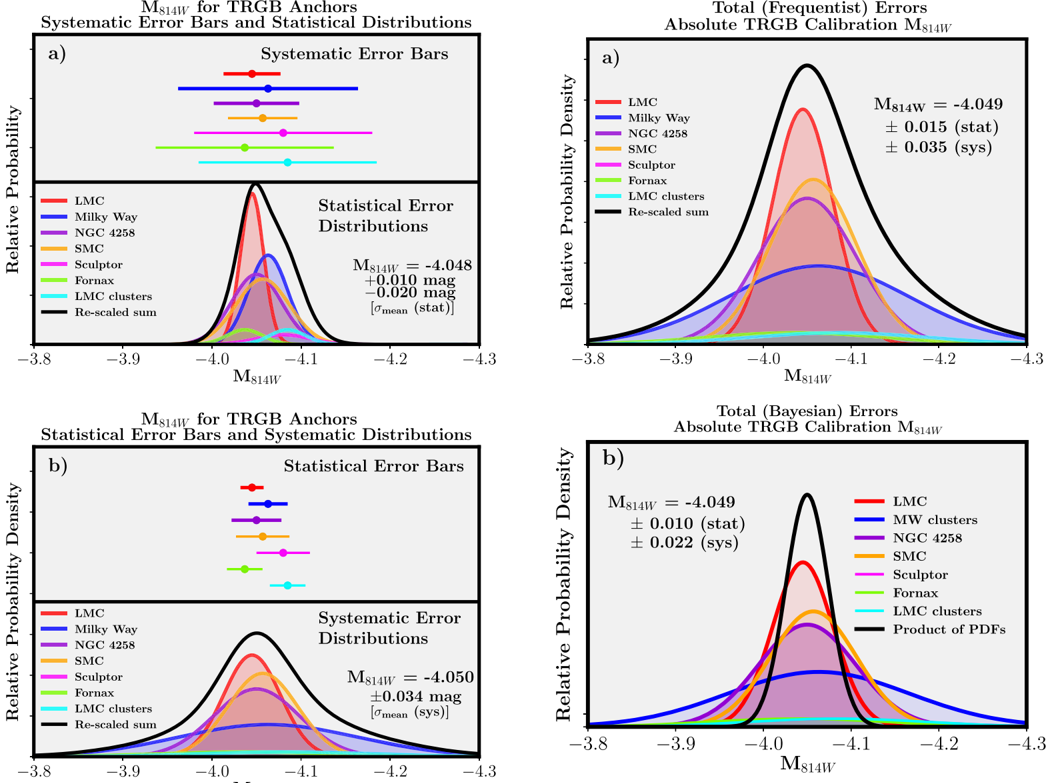
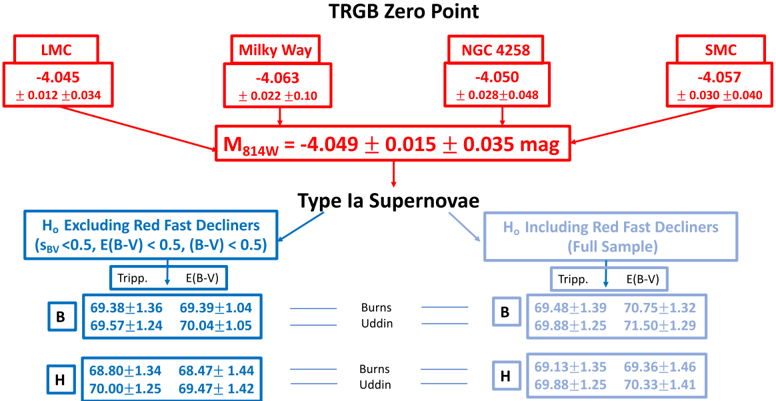
Verification
Claims the paper makes
The claims and statistics of this paper haven’t been checked yet.
Free: it reads the open-access text and checks the first 5 claims that cite a source we can check. Create a free account to check every claim.
Claims other papers make about this one
Each is checked against this paper’s own text: does it say what the citing paper says it does?
The source backs part of the claim, not all of it — or backs it for a different population, condition or comparison.
In the citing paper
“there is the well-discussed Freedman 2021 [33] measurement which is exactly in between the Planck and SH0ES values of H 0 , i.e., in agreement with both sides within 1.5σ”
From Challenges of the Standard Cosmological Model (2022) · cites this paper as [33]
Experimental — accuracy not yet measured
Self-check
Percentages, sums and reported differences re-computed from the paper’s own numbers.
The self-check needs the paper’s full text.
Citations
Cites
Planck 2018 results: VI. Cosmological parameters
Planck Collaboration, Aghanim, N., Akrami, Y., Ashdown, M., Aumont, J., Baccigalupi, C., Ballardini, M., Banday, A. J., Barreiro, R. B., Bartolo, N., et al. (2020) · Astronomy & Astrophysics · doi:10.1051/0004-6361/201833910 · Cited by 14,258
Stan : A Probabilistic Programming Language
Carpenter, B., Gelman, A., Hoffman, M. D., Lee, D., Goodrich, B., Betancourt, M., Brubaker, M., Guo, J., Li, P., & Riddell, A. (2017) · Journal of Statistical Software · doi:10.18637/jss.v076.i01 · Cited by 7,754
MEASURING REDDENING WITH SLOAN DIGITAL SKY SURVEY STELLAR SPECTRA AND RECALIBRATING SFD
Schlafly, E. F., & Finkbeiner, D. P. (2011) · The Astrophysical Journal · doi:10.1088/0004-637x/737/2/103 · Cited by 7,531
Gaia Collaboration, Prusti, T., de Bruijne, J. H. J., Brown, A. G. A., Vallenari, A., Babusiaux, C., Bailer-Jones, C. A. L., Bastian, U., Biermann, M., Evans, D. W., et al. (2016) · Astronomy & Astrophysics · doi:10.1051/0004-6361/201629272 · Cited by 6,946
DAOPHOT - A computer program for crowded-field stellar photometry
Stetson, P. B. (1987) · Publications of the Astronomical Society of the Pacific · doi:10.1086/131977 · Cited by 4,694 · cited 1×
“Cerny et al. expanded the Stetson catalog to incorporate nine additional low-reddening clusters with BVI photometry alone, archived at the CADC, and analyzed with the same DAOPHOT/ALLFRAME software (Stetson 1987, 1994).”
MethodA Catalog of Parameters for Globular Clusters in the Milky Way
Harris, W. E. (1996) · The Astronomical Journal · doi:10.1086/118116 · Cited by 4,500 · cited 1×
“Preliminary E(B− V ) reddening estimates and initial distance estimates were taken from Harris (1996, 2010).”
BackgroundBressan, A., Marigo, P., Girardi, L., Salasnich, B., Dal Cero, C., Rubele, S., & Nanni, A. (2012) · Monthly Notices of the Royal Astronomical Society · doi:10.1111/j.1365-2966.2012.21948.x · Cited by 4,174
Final Results from the Hubble Space Telescope Key Project to Measure the Hubble Constant
Freedman, W. L., Madore, B. F., Gibson, B. K., Ferrarese, L., Kelson, D. D., Sakai, S., Mould, J. R., Kennicutt, Jr., Ford, H. C., Graham, J. A., et al. (2001) · The Astrophysical Journal · doi:10.1086/320638 · Cited by 3,298
Self-citationScolnic, D. M., Jones, D. O., Rest, A., Pan, Y. C., Chornock, R., Foley, R. J., Huber, M. E., Kessler, R., Narayan, G., Riess, A. G., et al. (2018) · The Astrophysical Journal · doi:10.3847/1538-4357/aab9bb · Cited by 2,700
A 2.4% DETERMINATION OF THE LOCAL VALUE OF THE HUBBLE CONSTANT*
Riess, A. G., Macri, L. M., Hoffmann, S. L., Scolnic, D., Casertano, S., Filippenko, A. V., Tucker, B. E., Reid, M. J., Jones, D. O., Silverman, J. M., et al. (2016) · The Astrophysical Journal · doi:10.3847/0004-637x/826/1/56 · Cited by 2,242
Research works printed but not linked: 11
- Bellazzini, M. 2008, MmSAI, 79, 440
- Carretta, E., & Bragaglia, A. 1998, A&A, 329, 937
- DES Collaboration, Abbott, T. M. C., Aguena, M., et al. 2021, arXiv:2105. 13549
- Freedman, W. L., Madore, B. F., Hoyt, T., et al. 2021, JWST Proposal Cycle 1, 1995
- Madore, B. F. 1976, The Galaxy and the Local Group, Vol. 182 (Greenwich: Royal Greenwich Observatory), 153
- Mortsell, E., Goobar, A., Johansson, J., & Dhawan, S. 2021, arXiv:2105.11461 · arXiv
- Oakes, E., Hoyt, T., Freedman, W., et al. 2021, ApJ, in press
- Owens, K., Freedman, W. L., Madore, B. F., et al. 2021, ApJ, in press
- Tran, Q., Hoyt, T., Freedman, W., et al. 2021, ApJ, in press
- Tripp, R. 1998, A&A, 331, 815
- Ulaczyk, K., Szymański, M. K., Udalski, A., et al. 2012, AcA, 62, 247
Cited by
Items 301–400 of 682
Gravitational waves in higher-order R2 gravity
Vilhena, S. G., Medeiros, L. G., & Cuzinatto, R. R. (2021) · Physical review. D/Physical review. D. · doi:10.1103/physrevd.104.084061 · Cited by 16
Intertwined constraints in extended cosmologies: Dark energy, curvature, neutrinos, and inflation
Giarè, W., Lee, D. H., & Valentino, E. D. (2026) · New Astronomy Reviews · doi:10.1016/j.newar.2026.101759 · Cited by 27
Sicignano, T., Ripepi, V., Marconi, M., Molinaro, R., Bhardwaj, A., Cioni, M.-R. L., de Grijs, R., Storm, J., Groenewegen, M. A. T., Ivanov, V. D., et al. (2024) · Astronomy and Astrophysics · doi:10.1051/0004-6361/202348650 · Cited by 19
Constructing black holes from multi-polytropic equations of state
Sajadi, S. N., Ponglertsakul, S., & Luongo, O. (2025) · Physics of the Dark Universe · doi:10.1016/j.dark.2025.101938 · Cited by 15
Liu, Y., & Oguri, M. (2025) · Physical review. D/Physical review. D. · doi:10.1103/v857-ylw5 · Cited by 15
Stochastic Siren: Astrophysical Gravitational-Wave Background Measurements of the Hubble Constant
Cousins, B., Schumacher, K., Chung, A. K.-W., Talbot, C., Callister, T. A., HOLZ, D. E., & Yunes, N. (2026) · Physical Review Letters · doi:10.1103/4lzh-bm7y · Cited by 17
A Preliminary Calibration of the JAGB Method Using Gaia EDR3
Lee, A. J., Freedman, W. L., Madore, B. F., Owens, K. A., & Jang, I. S. (2021) · The Astrophysical Journal · doi:10.3847/1538-4357/ac2f4c · Cited by 17
“…of H0 measured by the Supernovae and H0 for the Equation of State (SHoES) Group via the Leavitt law (Riess et al. 2016, 2019, 2021) and by the Carnegie–Chicago Hubble Program (CCHP) via the tip of the red giant branch (TRGB) method (Freedman et al. 2019, 2020; Freedman 2021) differ by about 2σ.”
MethodSelf-citationDeepZipper: A Novel Deep-learning Architecture for Lensed Supernovae Identification
Morgan, R., Nord, B., Bechtol, K., González, S. J., Buckley‐Geer, E., Möller, A., Park, J. W., Kim, A., Birrer, S., Aguena, M., et al. (2022) · The Astrophysical Journal · doi:10.3847/1538-4357/ac5178 · Cited by 22
“There is currently a significant tension amongst the probes (Freedman 2021), particularly between early-Universe probes like the CMB (Planck Collaboration et al. 2020) and late-Universe probes like the type-Ia SNe distance ladder anchored with Cepheid variable stars (Riess et al. 2021).”
BackgroundOakes, E. K., Hoyt, T. J., Freedman, W. L., Madore, B. F., Tran, Q. H., Cerny, W., Beaton, R. L., & Seibert, M. (2022) · The Astrophysical Journal · doi:10.3847/1538-4357/ac5b07 · Cited by 22
“We note that this new method provides an update to that cited in Freedman (2021b); the resulting distance modulus is 0.04 mag farther (2% in distance).”
BackgroundMethodInfluentialSelf-citationHubble distancing: focusing on distance measurements in cosmology
Greene, K., & Cyr-Racine, F.-Y. (2022) · Journal of Cosmology and Astroparticle Physics · doi:10.1088/1475-7516/2022/06/002 · Cited by 18
“On the other hand, an alternative calibration of the local distance ladder based on the tip of the giant branch (TRGB) [38–48] leads to a Hubble constant value that is somewhat intermediate between that inferred from the CMB and the Cepheid-calibrated ladder, while strong-lensing time delays…”
Using host galaxy spectroscopy to explore systematics in the standardization of Type Ia supernovae
Dixon, M. E., Lidman, C. E., Mould, J. R., Kelsey, L., Brout, D., Möller, A., Wiseman, P., Sullivan, M., Galbany, L., Davis, T. M., et al. (2022) · Monthly Notices of the Royal Astronomical Society · doi:10.1093/mnras/stac2994 · Cited by 15
Cosmological Fisher forecasts for next-generation spectroscopic surveys
d'Assignies, W., Zhao, C., Yu, J., & Kneib, J. (2023) · Monthly Notices of the Royal Astronomical Society · doi:10.1093/mnras/stad611 · Cited by 19
Tracking the validity of the quasi-static and sub-horizon approximations in modified gravity
Orjuela-Quintana, J. B., & Nesseris, S. (2023) · Journal of Cosmology and Astroparticle Physics · doi:10.1088/1475-7516/2023/08/019 · Cited by 17
Stability analysis of warm quintessential dark energy model
Das, S., Hussain, S., Nandi, D., Ramos, R. O., & Silva, R. (2023) · Physical review. D/Physical review. D. · doi:10.1103/physrevd.108.083517 · Cited by 14
Liu, X., Tsujikawa, S., & Ichiki, K. (2024) · Physical review. D/Physical review. D. · doi:10.1103/physrevd.109.043533 · Cited by 17
Joint analysis of constraints on f ( R ) parametrization from recent cosmological observations
Kumar, D., Dhankar, P. K., Ray, S., & Zhang, F. (2025) · Physics of the Dark Universe · doi:10.1016/j.dark.2025.101989 · Cited by 24
Multicomponent DHOST analysis in galaxy clusters
Laudato, E., Salzano, V., & Umetsu, K. (2022) · Monthly Notices of the Royal Astronomical Society · doi:10.1093/mnras/stac180 · Cited by 15
Spatial curvature and thermodynamics
Banerjee, N., Mukherjee, P., & Pavón, D. (2023) · Monthly Notices of the Royal Astronomical Society · doi:10.1093/mnras/stad921 · Cited by 15
Liu, Y., Oguri, M., & Cao, S. (2023) · Physical review. D/Physical review. D. · doi:10.1103/physrevd.108.083532 · Cited by 14
SPH Methods in the Modelling of Compact ObjectsPreprint
Rosswog, S. (2014) · arXiv (Cornell University) · doi:10.48550/arxiv.1406.4224 · Cited by 17
Simulating the LOcal Web (SLOW)
Hernández-Martínez, E., Dolag, K., Seidel, B., Sorce, J. G., Aghanim, N., Pilipenko, S., Gottlöber, S., Lebeau, T., & Valentini, M. (2024) · Springer Link (Chiba Institute of Technology) · doi:10.1051/0004-6361/202449460/pdf · Cited by 13
Lee, A. J., Monson, A. J., Freedman, W. L., Madore, B. F., Owens, K. A., Beaton, R. L., Espinoza, C., Ren, T., & Ren, Y. (2024) · The Astrophysical Journal · doi:10.3847/1538-4357/ad32c7 · Cited by 13
Self-citationBhagat, R., & Mishra, B. (2024) · Astroparticle Physics · doi:10.1016/j.astropartphys.2024.103011 · Cited by 13
The Hubble Constant from Blue Type Ia Supernovae
Gall, C., Izzo, L., Wojtak, R., & Hjorth, J. (2026) · The Astrophysical Journal · doi:10.3847/1538-4357/ae52f4 · Cited by 13
“Measurements that are not in tension with the CMB value, e.g., H 0 of 69.85 ± 1.75 ( stat ) ± 1.54 ( sys ) km s − 1 Mpc − 1 is reached using the Tip of the Red Giant Branch method ( B. F. Madore & W. L. Freedman 1995; W. L. Freedman et al. 2019, 2025; W. L. Freedman 2021; S. A. Uddin et al. 2020 ) .”
InfluentialMeasuring the matter fluctuations in the Local Universe with the ALFALFA catalogue
Franco, C., Oliveira, J., Lopes, M., Avila, F., & Bernui, A. (2025) · Monthly Notices of the Royal Astronomical Society · doi:10.1093/mnras/staf088 · Cited by 14
Forconi, M., & Valentino, E. D. (2025) · Physics of the Dark Universe · doi:10.1016/j.dark.2025.101904 · Cited by 15
Large-scale peculiar velocities in the universe
Tsagas, C. G., Perivolaropoulos, L., & Asvesta, K. (2026) · Physics Reports · doi:10.1016/j.physrep.2026.03.001 · Cited by 20
Quantum cosmological backreactions. I. Cosmological space adiabatic perturbation theory
Schander, S., & Thiemann, T. (2022) · Physical review. D/Physical review. D. · doi:10.1103/physrevd.105.106009 · Cited by 13
The Hubble tension in the non-flat Super− Λ CDM model
Adhikari, S. (2022) · Physics of the Dark Universe · doi:10.1016/j.dark.2022.101005 · Cited by 14
“These measurements of the Hubble constant, H0, from the early and late universe disagree at more than 4σ [4]; see also [5], however.”
BackgroundRetrospective Search for Strongly Lensed Supernovae in the DESI Legacy Imaging Surveys
Sheu, W., Huang, X., Cikota, A., Suzuki, N., Schlegel, D. J., & Storfer, C. (2023) · The Astrophysical Journal · doi:10.3847/1538-4357/acd1e4 · Cited by 13
“Thus if this inconsistency is not due to systematic effects (e.g., Freedman 2021), then at a minimum, ΛCDM needs revision.”
BackgroundTheoretical priors and the dark energy equation of state
Ben-Dayan, I., & Kumar, U. (2024) · The European Physical Journal C · doi:10.1140/epjc/s10052-024-12488-0 · Cited by 14
“Various solutions have been proposed to solve both tensions individually [31,53,54,58,64–71 , 73– Recently, we have suggested an emerging DE model.”
Li, S., & Beaton, R. L. (2024) · Springer Series in Astrophysics and Cosmology · doi:10.1007/978-981-99-0177-7_8 · Cited by 13
Discord in Concordance Cosmology and Anomalously Massive Early Galaxies
McGaugh, S. (2024) · Universe · doi:10.3390/universe10010048 · Cited by 15
“This subject is the focus of much research with frequent updates to essentially the same result, e.g., Freedman et al. [14] and Freedman [28], so we restrict Fig.”
ResultForeground biases in strong gravitational lensing
Johnson, D., Fleury, P., Larena, J., & Marchetti, L. (2024) · Journal of Cosmology and Astroparticle Physics · doi:10.1088/1475-7516/2024/10/055 · Cited by 14
Variational inference for acceleration of SN Ia photometric distance estimation with BayeSN
Uzsoy, A. S. M., Thorp, S., Grayling, M., & Mandel, K. S. (2024) · Monthly Notices of the Royal Astronomical Society · doi:10.1093/mnras/stae2465 · Cited by 15
Free streaming of warm wave dark matter in modified expansion histories
Long, A. J., & Venegas, M. (2025) · Journal of Cosmology and Astroparticle Physics · doi:10.1088/1475-7516/2025/06/043 · Cited by 12
“Some of these include discrepant measurements of the present-day cosmological expansion rate (i.e. the Hubble tension) [28, 29] and evidence for evolving dark energy inferred from observations made by the Dark Energy Spectroscopic Instrument (DESI) and others [30].”
Space astrometry with Gaia: Advances in understanding our Galaxy
Perryman, M. A. C. (2025) · Physics Reports · doi:10.1016/j.physrep.2025.09.004 · Cited by 15
Li, S., Riess, A. G., Scolnic, D. M., Anand, G. S., Wu, J., Casertano, S., Yuan, W., Beaton, R. L., & Anderson, R. I. (2023) · The Astrophysical Journal · doi:10.3847/1538-4357/acf4fb · Cited by 14
Improving constraints on models addressing the Hubble tension with CMB delensing
Ange, J., & Meyers, J. (2023) · Journal of Cosmology and Astroparticle Physics · doi:10.1088/1475-7516/2023/10/045 · Cited by 12
“Similarly, local measurements other than those based on Cepheid-calibrated supernovae can be used to constrain H0 [25].”
MethodThe Pursuit of the Hubble Constant Using Type II Supernovae
de Jaeger, T., & Galbany, L. (2024) · Springer Series in Astrophysics and Cosmology · doi:10.1007/978-981-99-0177-7_10 · Cited by 12
Late-time anisotropy sourced by a 2-form field non-minimally coupled to cold dark matter
Orjuela-Quintana, J. B., Palacios-Córdoba, J. L., & Valenzuela-Toledo, C. A. (2024) · Physics of the Dark Universe · doi:10.1016/j.dark.2024.101575 · Cited by 13
Huber, S., & Suyu, S. H. (2024) · Astronomy and Astrophysics · doi:10.1051/0004-6361/202449952 · Cited by 14
Quantum cosmological backreactions. II. Purely homogeneous quantum cosmology
Neuser, J., Schander, S., & Thiemann, T. (2022) · Physical review. D/Physical review. D. · doi:10.1103/physrevd.105.106010 · Cited by 12
Possible resolution of the Hubble tension with Weyl invariant gravity
Shimon, M. (2022) · Journal of Cosmology and Astroparticle Physics · doi:10.1088/1475-7516/2022/04/048 · Cited by 12
“However, a recent independent tip of the red giant branch (TRGB) based local inference of H0 yields results which are consistent with both the Planck 2018 (P18) and SH0ES results in better than 2σ confidence level [21, 22].”
ResultWhen dark energy turns on: Constraints on a critical emergence model
Najafi, M., Habibollahi, M., Reyhani, M., Valentino, E. D., Pan, S., Firouzjaee, J. T., & Yang, W. (2026) · Physical review. D/Physical review. D. · doi:10.48550/arxiv.2603.13137 · Cited by 17
Cai, R.-G., Li, L., & Wang, S.-J. (2023) · Acta Physica Sinica · doi:10.7498/aps.72.20231270 · Cited by 15
Zhang, J.-C., Hu, Y., Jiao, K., Wang, H.-F., Xie, Y., Yu, B., Zhao, L.-L., & Zhang, T.-J. (2024) · The Astrophysical Journal Supplement Series · doi:10.3847/1538-4365/ad0f1e · Cited by 16
Testing the consistency of early and late cosmological parameters with BAO and CMB data
Liu, G., Wang, Y., & Zhao, W. K. (2024) · Physics Letters B · doi:10.1016/j.physletb.2024.138717 · Cited by 13
Toda, Y., & Seto, O. (2025) · Physical review. D/Physical review. D. · doi:10.1103/physrevd.111.083551 · Cited by 11
Primordial sharp features through the nonlinear regime of structure formation
Stahl, C., Werth, D., & Poulin, V. (2025) · Physical review. D/Physical review. D. · doi:10.1103/physrevd.111.123514 · Cited by 11
Nonlinear matter power spectrum from relativistic N -body simulations: Λ s CDM versus Λ CDM
Akarsu, Ö., Valentino, E. D., Vyskocil, J., Y𝚤lmaz, E., Yükselci, A. E., & Zhuk, A. (2026) · Physical review. D/Physical review. D. · doi:10.1103/lmt4-hshz · Cited by 17
Dark sirens and the impact of redshift precision
Cross-Parkin, M. L., Howlett, C., Davis, T. M., & Khetan, N. (2025) · Publications of the Astronomical Society of Australia · doi:10.1017/pasa.2025.10111 · Cited by 12
Hubble tension and the G -step model: Reexamination of recent constraints on modified local physics
Perivolaropoulos, L., & Ruchika (2026) · Physical review. D/Physical review. D. · doi:10.1103/mgyd-6cf2 · Cited by 12
Newman, M. J. B., Larison, C., Jha, S. W., McQuinn, K. B. W., Skillman, E. D., Dolphin, A. E., Dai, M., Howell, D. A., McCully, C., Bostroem, K. A., et al. (2026) · The Astrophysical Journal · doi:10.3847/1538-4357/ae8090 · Cited by 13
“…branch ( TRGB; e.g., M. G. Lee et al. 1993; S. Sakai et al. 1997; M. Bellazzini et al. 2001; D. Makarov et al. 2006; L. Rizzi et al. 2007; I. S. Jang & M. G. Lee 2017; W. L. Freedman et al. 2019; W. L. Freedman 2021; D. Scolnic et al. 2023; W. L. Freedman et al. 2025; S. Li et al. 2026 ) .”
InfluentialForecast of Observing Time Delay of Strongly Lensed Quasars with the Muztagh-Ata 1.93 m Telescope
Zhu, S., Shu, Y., Yuan, H., Fu, J.-N., Gao, J., Wu, J., He, X.-T., Liao, K., Li, G., Er, X., et al. (2022) · Research in Astronomy and Astrophysics · doi:10.1088/1674-4527/acaf4e · Cited by 11
Silk, J. I., & Cassé, M. (2022) · Foundations of Physics · doi:10.1007/s10701-022-00601-w · Cited by 11
“[34] using Cepheid-based indicators, or by other competitive methods, most notably CMB-based [35] and those using red giant branch calibrators [36], the competing results differ by far more than the quoted errors.”
Measuring distances to galaxies with globular cluster velocity dispersions
Beasley, M. A., Fahrion, K., & Gvozdenko, A. (2023) · Monthly Notices of the Royal Astronomical Society · doi:10.1093/mnras/stad3541 · Cited by 11
Khurana, M., Chaudhary, H., Debnath, U., Sardar, A., & Mustafa, G. (2024) · Fortschritte der Physik · doi:10.1002/prop.202300238 · Cited by 11
“Additionally, techniques like the red giant branch tip method (TRGS) [31–33] and baryon acoustic oscillations (BAOs) [34] have been employed to refine our estimates.”
MethodRadial Tully–Fisher relation and the local variance of Hubble parameter
Haridasu, B. S., Salucci, P., & Sharma, G. (2024) · Monthly Notices of the Royal Astronomical Society · doi:10.1093/mnras/stae1467 · Cited by 11
On Cepheid Distances in the $${H}_{0}$$ Measurement
Anderson, R. I. (2024) · Springer Series in Astrophysics and Cosmology · doi:10.1007/978-981-99-0177-7_6 · Cited by 11
Hoyt, T. J., Jang, I. S., Freedman, W. L., Madore, B. F., Lee, A. J., & Owens, K. A. (2024) · The Astrophysical Journal · doi:10.3847/1538-4357/ad7952 · Cited by 11
“…(with a small, near-zero residual variance observed for metal-poor TRGB stars) manifestation when observed with bands that have effective wavelengths between 800 and 900 nm (Lee et al. 1993; Bellazzini et al. 2001; Jang & Lee 2017; McQuinn et al. 2019; Freedman 2021; Hoyt 2023; Anand et al. 2024).”
BackgroundSelf-citationConsequences of using a smooth cosmic distance in a lumpy universe. I.
Umeh, O. (2022) · Physical review. D/Physical review. D. · doi:10.1103/physrevd.106.023514 · Cited by 11
“According to [76], the best-fit H0 depends crucially on the accuracy with which the absolute magnitude of the SNIa is calibrated M = m− μTRGB 0 , (52) where m is the apparent magnitude of the peak of the SNIa light curve for a given subsample of SNIa co-located with the TRGB, μTRGB 0 is the true calibrator distance mo…”
BackgroundConstraining modified gravity scenarios with the 6dFGS and SDSS galaxy peculiar velocity data sets
Lyall, S., Blake, C., & Turner, R. J. (2024) · Monthly Notices of the Royal Astronomical Society · doi:10.1093/mnras/stae1718 · Cited by 15
Gallego-Cano, E., Izzo, L., Domínguez-Tagle, C., Prada, F., Pérez, E., Khetan, N., & Jang, I. S. (2022) · Astronomy and Astrophysics · doi:10.1051/0004-6361/202243988 · Cited by 10
Exploring bulk viscous unified scenarios with gravitational waves standard sirens
Yang, W., Pan, S., Valentino, E. D., Escamilla‐Rivera, C., & Paliathanasis, A. (2023) · Monthly Notices of the Royal Astronomical Society · doi:10.1093/mnras/stad115 · Cited by 10
Constrained transit cosmological models in f(R,Lm,T)-gravity
Maurya, D. C. (2024) · International Journal of Geometric Methods in Modern Physics · doi:10.1142/s0219887825500288 · Cited by 11
“Most recently, researchers in [157] measured H 0 = 69 .”
BackgroundBianchi, M., Dibitetto, G., & Morales, J. F. (2024) · Journal of Cosmology and Astroparticle Physics · doi:10.1088/1475-7516/2024/12/040 · Cited by 13
“…the present Hubble constant H 0 measured by Planck, based on the CMB, H 0 ∼ 68 km s − 1 Mpc − 1 [7] and by Dark Energy Spectroscopic Instrument (DESI) Collaboration [8, 9] or based on supernova surveys such as SH0ES (Supernova H0 for the Equation of State) [10], of about H 0 ∼ 74 km s − 1 Mpc − 1 .”
On measuring the Hubble constant with X-ray reverberation mapping of active galactic nuclei
Ingram, A., Mastroserio, G., van der Klis, M., Nathan, E., Connors, R., Dauser, T., García, J. A., Kara, E., König, O., Lucchini, M., et al. (2021) · Monthly Notices of the Royal Astronomical Society · doi:10.1093/mnras/stab2950 · Cited by 10
Quantum cosmological backreactions. III. Deparametrized quantum cosmological perturbation theory
Schander, S., & Thiemann, T. (2022) · Physical review. D/Physical review. D. · doi:10.1103/physrevd.105.106011 · Cited by 11
The hubble rate trouble: an effective field theory of dark matter
de Jesus, Á. S., Pinto-Neto, N., Queiroz, F. S., Silk, J. I., & da Silva, D. R. (2023) · The European Physical Journal C · doi:10.1140/epjc/s10052-023-11366-5 · Cited by 11
Бисноватый-Коган, Г. С., & Nikishin, A. M. (2023) · Astronomy Reports · doi:10.1134/s1063772923020038 · Cited by 10
Gravitational wave luminosity distance-weighted anisotropies
Begnoni, A., Dall'Armi, L. V., Bertacca, D., & Raccanelli, A. (2024) · Journal of Cosmology and Astroparticle Physics · doi:10.1088/1475-7516/2024/10/087 · Cited by 9
“In particular, we could obtain competitive and independent constraints w.r.t. Type-Ia Supernovae on the Hubble constant [11, 12], which could shed lights on the tension [13, 14] between early-[15] and late-[16–23] time measurements.”
Stuck, M., Pratt, J., Baraffe, I., Guzik, J. A., Dethero, M. G., Vlaykov, D. G., Goffrey, T., & Saux, A. L. (2025) · Astronomy and Astrophysics · doi:10.1051/0004-6361/202555172 · Cited by 12
“…structure of the Milky Way (e.g. Majaess et al. 2009; Dambis et al. 2015), extra-galactic distances (see reviews Feast & Walker 1987; Feast 1999), and estimation of the Hubble constant (Ngeow & Kanbur 2006; Van Leeuwen et al. 2007; Tammann et al. 2008; Freed-man & Madore 2010; Freedman 2021).”
A geometric calibration of the tip of the red giant branch in the Milky Way using Gaia DR3
Dixon, M. E., Mould, J. R., Flynn, C., Taylor, E. N., Lidman, C. E., & Duffy, A. R. (2023) · Monthly Notices of the Royal Astronomical Society · doi:10.1093/mnras/stad1500 · Cited by 9
Dynamical dark energy can amplify the expansion rate of the Universe
Zhang, H. (2023) · Physical review. D/Physical review. D. · doi:10.1103/physrevd.107.103529 · Cited by 9
Generalized emergent dark energy in the late-time Universe
Torres, J. A. L. (2024) · Monthly Notices of the Royal Astronomical Society · doi:10.1093/mnras/stae1920 · Cited by 11
Gallenne, A., Evans, N. R., Kervella, P., Monnier, J. D., Proffitt, C. R., Schaefer, G. H., Winston, E., Kuraszkiewicz, J., Mérand, A., Pietrzyński, G., et al. (2024) · Astronomy and Astrophysics · doi:10.1051/0004-6361/202452346 · Cited by 9
The Planetary Nebula Luminosity Function in the Era of Precision Cosmology
Ciardullo, R. (2022) · Frontiers in Astronomy and Space Sciences · doi:10.3389/fspas.2022.896326 · Cited by 9
“PNLF measurements could then, in theory, help probe the current “tension” between the measurements of H0 locally and that from the microwave background (Freedman, 2021).”
BackgroundTests of photometry: the case of the NGC 3370 ACS field
Jang, I. S. (2023) · Monthly Notices of the Royal Astronomical Society · doi:10.1093/mnras/stad619 · Cited by 11
Mukherjee, P., Rodrigues, G., & Bengaly, C. A. P. (2023) · Physics of the Dark Universe · doi:10.1016/j.dark.2023.101380 · Cited by 9
The ages of the oldest astrophysical objects in an ellipsoidal universe
Binici, S. S., Deliduman, C., & Dilsiz, F. Ş. (2024) · Physics of the Dark Universe · doi:10.1016/j.dark.2024.101600 · Cited by 12
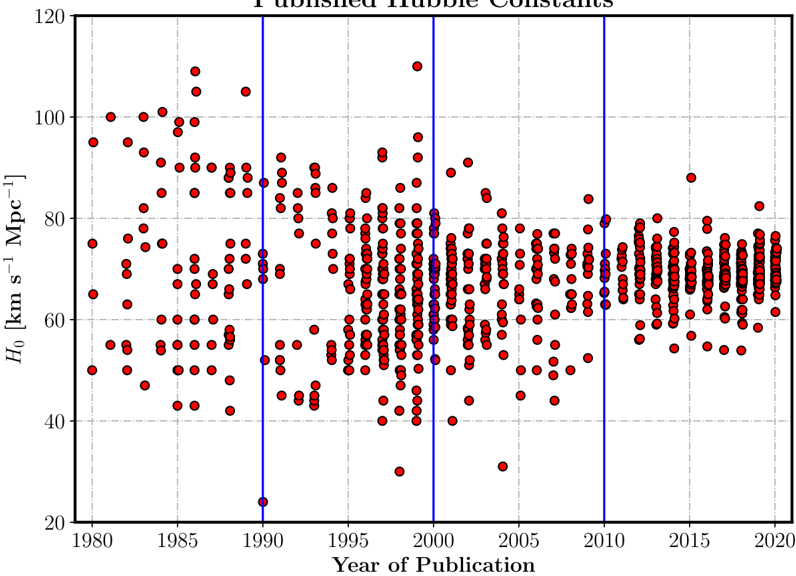
“As the observations improved the value of the Hubble constant was constrained between values 40 100 km/s/Mpc in the 1980’s and 90’s [3].”
BackgroundParametrized post-Newtonian formalism in higher-order Teleparallel Gravity
Gonzalez-Espinoza, M., Otalora, G., Kraiselburd, L., & Landau, S. J. (2022) · Journal of Cosmology and Astroparticle Physics · doi:10.1088/1475-7516/2022/05/010 · Cited by 9
Mirror dark sector solution of the Hubble tension with time-varying fine-structure constant
Zhang, J., & Frieman, J. A. (2023) · Physical Review D · doi:10.1103/physrevd.107.043529 · Cited by 8
“6 km/sec/Mpc [6, 7], consistent with both sets of measurements.”
BackgroundA Targeted Search for Variable Gravitationally Lensed Quasars
Sheu, W., Huang, X., Cikota, A., Suzuki, N., Palmese, A., Schlegel, D. J., & Storfer, C. (2024) · The Astrophysical Journal · doi:10.3847/1538-4357/ad5dad · Cited by 8
“7 km/s/Mpc (Freedman 2021), there remains potentially strong ambiguity with respect to the true value of H 0 .”
Determination of Hubble constant from Megamaser Cosmology Project using profile likelihood
Barua, S., Ramakrishnan, V., & Desai, S. (2025) · Astrophysics and Space Science · doi:10.1007/s10509-025-04454-3 · Cited by 8
“…0 ) based on measurements based on the cosmic microwave background and those based on low redshift probes such as Cepheid calibrated Type Ia supernovae (Ab-dalla et al. 2022; Verde et al. 2019; Bethapudi and Desai 2017; Shah et al. 2021; Freedman 2021; Di Valentino et al. 2021; Verde et al. 2024).”
Singh, K. P., Sabanam, S., Yadav, A. K., & Meitei, A. J. (2025) · Nuclear Physics B · doi:10.1016/j.nuclphysb.2025.117061 · Cited by 9
Mukherjee, S., Pandey, S. S., & Majumdar, A. S. (2025) · Physical review. D/Physical review. D. · doi:10.1103/w1wp-tqz2 · Cited by 8
Dark matter-dark radiation interactions and the Hubble tension
Buen-Abad, M. A., Chacko, Z., Flood, I., Kılıç, C., Marques-Tavares, G., & Youn, T. (2026) · Journal of Cosmology and Astroparticle Physics · doi:10.1088/1475-7516/2026/10/074 · Cited by 11
“It has been proposed that the tension between these two measurements, which exceeds 5 σ , could stem from some unknown systematics in the supernovae measurements [3, 4].”
Sheu, W., Treu, T., Millon, M., Dux, F., Williams, D. M., Knabel, S., Birrer, S., Mozumdar, P., Queirolo, G., Shajib, A. J., et al. (2026) · Physical review. D/Physical review. D. · doi:10.1103/rlrr-pzck · Cited by 10
Huang, J., Liu, T., & Shao, C.-G. (2026) · The European Physical Journal C · doi:10.1140/epjc/s10052-026-16300-z · Cited by 8
Boyd, N. M., Baerdemaeker, S. D., Heng, K., & Matarese, V. (2023) · Synthese Library/Synthese library · doi:10.1007/978-3-031-26618-8 · Cited by 9
Big Bang Nucleosynthesis with f(R) Gravity Scalarons and Astrophysical Consequences
Talukdar, A., & Kalita, S. (2024) · The Astrophysical Journal · doi:10.3847/1538-4357/ad5843 · Cited by 8
Pal, S., & Saha, R. (2024) · Physica Scripta · doi:10.1088/1402-4896/ad804d · Cited by 8
“Interestingly, using the red giant branch (TRGB) calibration to a sample of Type Ia Supernovae, Freedman (2021) [11] reports H 0 = 69 .”
MethodEarly dark energy effects on the 21-cm signal
Adi, T., Flitter, J., & Kovetz, E. D. (2025) · Physical review. D/Physical review. D. · doi:10.1103/physrevd.111.043515 · Cited by 9
Quantum cosmological backreactions. IV. Constrained quantum cosmological perturbation theory
Schander, S., & Thiemann, T. (2022) · Physical review. D/Physical review. D. · doi:10.1103/physrevd.105.106012 · Cited by 8
The art of building a smooth cosmic distance ladder in a perturbed universe
Umeh, O. (2022) · Journal of Cosmology and Astroparticle Physics · doi:10.1088/1475-7516/2022/08/023 · Cited by 8
Xiao, S., Renzini, A. I., & Weinstein, A. J. (2023) · Physical review. D/Physical review. D. · doi:10.1103/physrevd.107.122002 · Cited by 8
Pure gravitational wave estimation of Hubble’s constant using neutron star–black hole mergers
Fung, L. W. H., Broadhurst, T. J., & Smoot, G. F. (2025) · Monthly Notices of the Royal Astronomical Society · doi:10.1093/mnras/staf316 · Cited by 9
Constraints on Bianchi-I type universe with SH0ES anchored Pantheon+ SNIa data
Verma, A., Patel, S. K., Aluri, P. K., Panda, S., & Mota, D. F. (2024) · Journal of Cosmology and Astroparticle Physics · doi:10.1088/1475-7516/2024/06/071 · Cited by 11
“The (mean) Hubble parameter value ( h 0 ) we obtained in this Bianchi-I model analysis with various anisotropic sources doesn’t elleviate the ‘Hubble tension’ [67–69].”
ZTF SN Ia DR2: Exploring SN Ia properties in the vicinity of under-dense environments
Aubert, M., Rosnet, P., Popovic, B., Ruppin, F., Smith, M., Rigault, M., Dimitriadis, G., Goobar, A., Johansson, J., Barjou-Delayre, C., et al. (2025) · Astronomy and Astrophysics · doi:10.1051/0004-6361/202450951 · Cited by 8
“…1999) and remain as of today a key probe to constrain deviations from the standard model of cosmology through the estimation of the Hubble constant (Freedman 2021; Riess ⋆ Corresponding author : marie.aubert@clermont.in2p3.fr et al. 2022), or the Dark Energy equation of state (Brout et al. 2022;…”
Metadata
- Authors
- Freedman, W. L.
- Affiliations
- University of Chicago (US)
- Corresponding author
- Freedman, Wendy L.
- ORCID
- Freedman, Wendy L.
- Venue
- The Astrophysical Journal
- Publisher
- American Astronomical Society
- Published
- 2021-09-01
- Volume
- 919
- Issue
- 1
- Pages
- 16
- ISSN
- 0004-637X (ISSN-L)
- 1538-4357
- OpenAlex
- W3176418170
- Cited by
- 577
- References
- 105
- Citations by year
- 2026: 63 · 2025: 109 · 2024: 122 · 2023: 123 · 2022: 134 · 2021: 24
- FWCI
- 54.16
- Type
- journal article
- Language
- en
- Open access
- hybrid
- doi.org
- Licence
- cc-by
- creativecommons.org/licenses/by/4.0/ (vor, 16 d)
- iopscience.iop.org/info/page/text-and-data-mining (tdm, 16 d)
- Locations
- The Astrophysical Journal (publishedVersion, cc-by)
- arXiv (Cornell University) (submittedVersion)
- arXiv (Cornell University) (cc-by)
- Funders
- National Aeronautics and Space Administration (NAS 526555, 526555)
- Space Telescope Science Institute (NAS5- 26555, 5-26555, 26555, 13691)
- Topics
- Physical Sciences › Physics and Astronomy › Astronomy and Astrophysics › Cosmology and Gravitation Theories
- Physical Sciences › Physics and Astronomy › Astronomy and Astrophysics › Stellar, planetary, and galactic studies
- Physical Sciences › Physics and Astronomy › Astronomy and Astrophysics › Galaxies: Formation, Evolution, Phenomena
- Keywords
- Hubble constant, Hubble tension, tip of the red giant branch, Type Ia supernovae, Cepheid calibration, cosmic microwave background, core helium flash, local distance ladder, systematic uncertainties
About these checks
Registry, retraction, Cites and statistics results are computed, not judged, with one exception: a printed reference that no index lists is read once by a model before it counts as a citation error. Claims are extracted by a model and kept only when their quote appears verbatim in the text; each cited source is then checked, with a model’s help, for whether it says what the claim relies on. Those verdicts can be wrong — read the claim’s quote and the cited source before relying on one.
Statistics and arithmetic are recomputed, not judged.
Confidence bands are shown only for fields calibrated on our annotated test set. None is calibrated yet, so no band is shown.
What counts as a claim ›How we measure confidence ›How we check this ›
Are you an author, or do you see a problem with this page? Request a review
Data sources
Bibliographic data: Semantic Scholar, OpenAlex, Crossref.
Contains information from the Semantic Scholar Academic Graph Datasets, made available under the ODC Attribution License (ODC-BY 1.0).
Semantic Scholar’s data is described in: Kinney, R., et al. (2023). The Semantic Scholar Open Data Platform. arXiv:2301.10140.
