

Measurements of the Hubble Constant: Tensions in Perspective
Open accessThe DOI matches its Crossref record; 110 of the 110 references it cites were found in a registry or an index.
Abstract
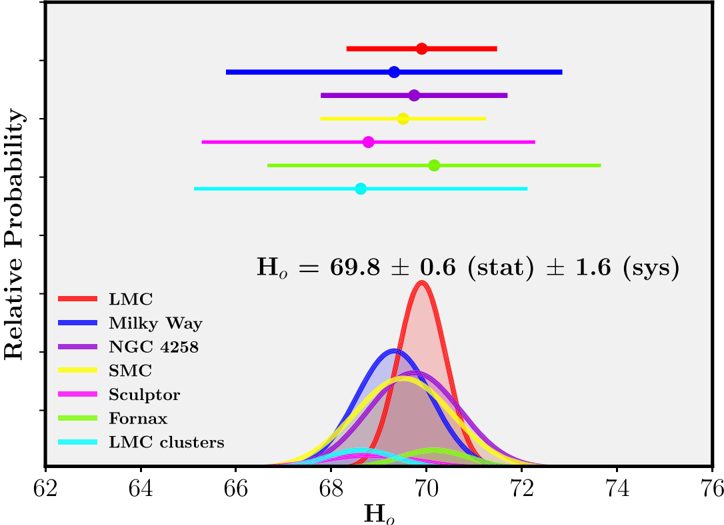
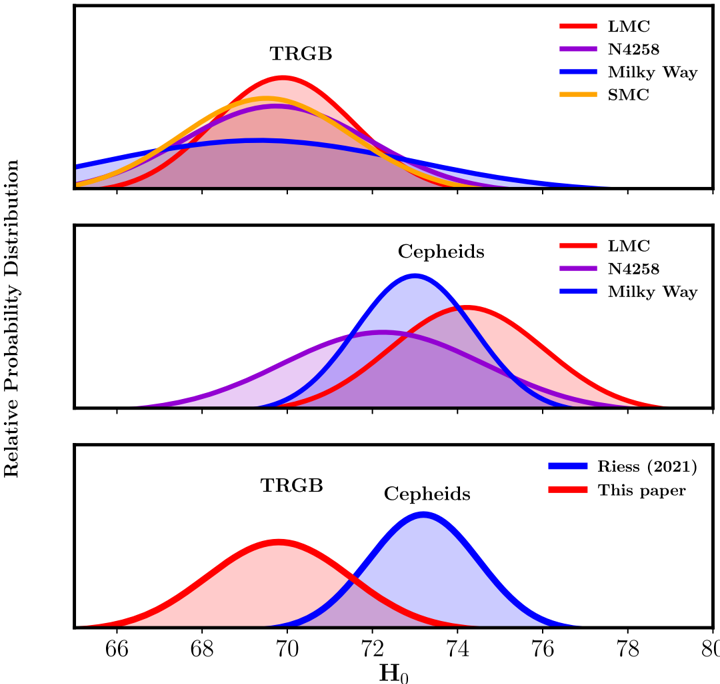
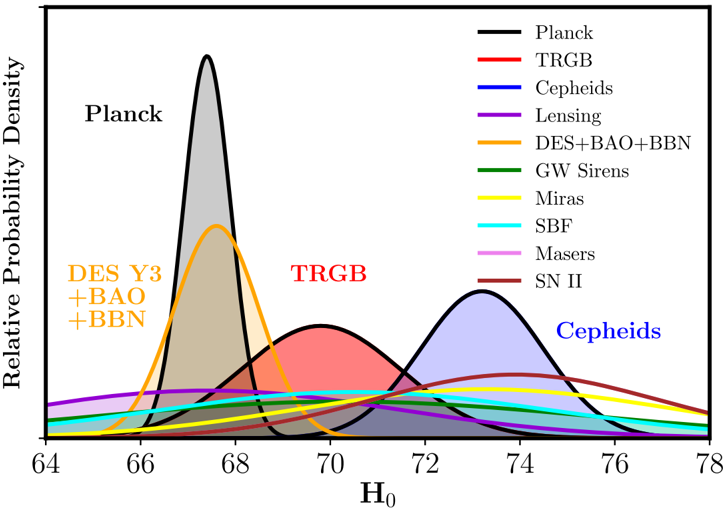
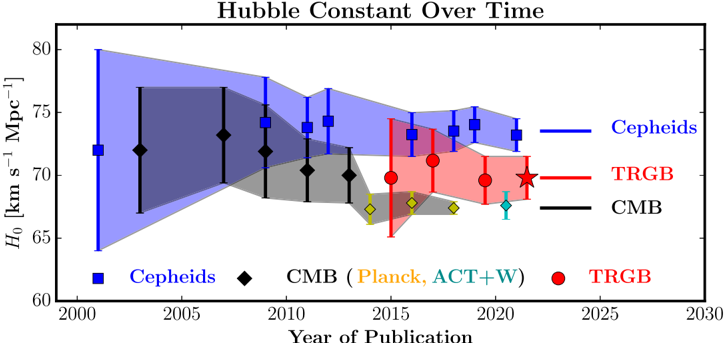
Measurement of the distances to nearby galaxies has improved rapidly in recent decades. The ever-present challenge is to reduce systematic effects, especially as greater distances are probed and the uncertainties become larger. In this paper, we combine several recent calibrations of the tip of the red giant branch (TRGB) method. These calibrations are internally self-consistent at the 1% level. New Gaia Early Data Release 3 data provide an additional consistency check at a (lower) 5% level of accuracy, a result of the well-documented Gaia angular covariance bias. The updated TRGB calibration applied to a sample of Type Ia supernovae from the Carnegie Supernova Project results in a value of the Hubble constant of H 0 = 69.8 ± 0.6 (stat) ± 1.6 (sys) km s−1 Mpc−1. No statistically significant difference is found between the value of H 0 based on the TRGB and that determined from the cosmic microwave background. The TRGB results are also consistent to within 2 σ with the SHoES and Spitzer plus Hubble Space Telescope (HST) Key Project Cepheid calibrations. The TRGB results alone do not demand additional new physics beyond the standard (ΛCDM) cosmological model. They have the advantage of simplicity of the underlying physics (the core He flash) and small systematic uncertainties (from extinction, metallicity, and crowding). Finally, the strengths and weaknesses of both the TRGB and Cepheids are reviewed, and prospects for addressing the current discrepancy with future Gaia, HST, and James Webb Space Telescope observations are discussed. Resolving this discrepancy is essential for ascertaining if the claimed tension in H 0 between the locally measured and CMB-inferred values is physically motivated.
Overview
The claims and statistics of this paper haven’t been checked yet.
Free: it reads the open-access text and checks the first 5 claims that cite a source we can check. Create a free account to check every claim.
Integrity signals
Registry
Cites
Statistics
Figures
Verification
Claims the paper makes
The claims and statistics of this paper haven’t been checked yet.
Free: it reads the open-access text and checks the first 5 claims that cite a source we can check. Create a free account to check every claim.
Claims other papers make about this one
Each is checked against this paper’s own text: does it say what the citing paper says it does?
The source backs part of the claim, not all of it — or backs it for a different population, condition or comparison.
In the citing paper
“there is the well-discussed Freedman 2021 [33] measurement which is exactly in between the Planck and SH0ES values of H 0 , i.e., in agreement with both sides within 1.5σ”
From Challenges of the Standard Cosmological Model (2022) · cites this paper as [33]
Experimental — accuracy not yet measured
Self-check
Percentages, sums and reported differences re-computed from the paper’s own numbers.
The self-check needs the paper’s full text.
Citations
Cites
Planck 2018 results: VI. Cosmological parameters
Planck Collaboration, Aghanim, N., Akrami, Y., Ashdown, M., Aumont, J., Baccigalupi, C., Ballardini, M., Banday, A. J., Barreiro, R. B., Bartolo, N., et al. (2020) · Astronomy & Astrophysics · doi:10.1051/0004-6361/201833910 · Cited by 14,258
Stan : A Probabilistic Programming Language
Carpenter, B., Gelman, A., Hoffman, M. D., Lee, D., Goodrich, B., Betancourt, M., Brubaker, M., Guo, J., Li, P., & Riddell, A. (2017) · Journal of Statistical Software · doi:10.18637/jss.v076.i01 · Cited by 7,754
MEASURING REDDENING WITH SLOAN DIGITAL SKY SURVEY STELLAR SPECTRA AND RECALIBRATING SFD
Schlafly, E. F., & Finkbeiner, D. P. (2011) · The Astrophysical Journal · doi:10.1088/0004-637x/737/2/103 · Cited by 7,531
Gaia Collaboration, Prusti, T., de Bruijne, J. H. J., Brown, A. G. A., Vallenari, A., Babusiaux, C., Bailer-Jones, C. A. L., Bastian, U., Biermann, M., Evans, D. W., et al. (2016) · Astronomy & Astrophysics · doi:10.1051/0004-6361/201629272 · Cited by 6,946
DAOPHOT - A computer program for crowded-field stellar photometry
Stetson, P. B. (1987) · Publications of the Astronomical Society of the Pacific · doi:10.1086/131977 · Cited by 4,694 · cited 1×
“Cerny et al. expanded the Stetson catalog to incorporate nine additional low-reddening clusters with BVI photometry alone, archived at the CADC, and analyzed with the same DAOPHOT/ALLFRAME software (Stetson 1987, 1994).”
MethodA Catalog of Parameters for Globular Clusters in the Milky Way
Harris, W. E. (1996) · The Astronomical Journal · doi:10.1086/118116 · Cited by 4,500 · cited 1×
“Preliminary E(B− V ) reddening estimates and initial distance estimates were taken from Harris (1996, 2010).”
BackgroundBressan, A., Marigo, P., Girardi, L., Salasnich, B., Dal Cero, C., Rubele, S., & Nanni, A. (2012) · Monthly Notices of the Royal Astronomical Society · doi:10.1111/j.1365-2966.2012.21948.x · Cited by 4,174
Final Results from the Hubble Space Telescope Key Project to Measure the Hubble Constant
Freedman, W. L., Madore, B. F., Gibson, B. K., Ferrarese, L., Kelson, D. D., Sakai, S., Mould, J. R., Kennicutt, Jr., Ford, H. C., Graham, J. A., et al. (2001) · The Astrophysical Journal · doi:10.1086/320638 · Cited by 3,298
Self-citationScolnic, D. M., Jones, D. O., Rest, A., Pan, Y. C., Chornock, R., Foley, R. J., Huber, M. E., Kessler, R., Narayan, G., Riess, A. G., et al. (2018) · The Astrophysical Journal · doi:10.3847/1538-4357/aab9bb · Cited by 2,700
A 2.4% DETERMINATION OF THE LOCAL VALUE OF THE HUBBLE CONSTANT*
Riess, A. G., Macri, L. M., Hoffmann, S. L., Scolnic, D., Casertano, S., Filippenko, A. V., Tucker, B. E., Reid, M. J., Jones, D. O., Silverman, J. M., et al. (2016) · The Astrophysical Journal · doi:10.3847/0004-637x/826/1/56 · Cited by 2,242
Research works printed but not linked: 11
- Bellazzini, M. 2008, MmSAI, 79, 440
- Carretta, E., & Bragaglia, A. 1998, A&A, 329, 937
- DES Collaboration, Abbott, T. M. C., Aguena, M., et al. 2021, arXiv:2105. 13549
- Freedman, W. L., Madore, B. F., Hoyt, T., et al. 2021, JWST Proposal Cycle 1, 1995
- Madore, B. F. 1976, The Galaxy and the Local Group, Vol. 182 (Greenwich: Royal Greenwich Observatory), 153
- Mortsell, E., Goobar, A., Johansson, J., & Dhawan, S. 2021, arXiv:2105.11461 · arXiv
- Oakes, E., Hoyt, T., Freedman, W., et al. 2021, ApJ, in press
- Owens, K., Freedman, W. L., Madore, B. F., et al. 2021, ApJ, in press
- Tran, Q., Hoyt, T., Freedman, W., et al. 2021, ApJ, in press
- Tripp, R. 1998, A&A, 331, 815
- Ulaczyk, K., Szymański, M. K., Udalski, A., et al. 2012, AcA, 62, 247
Cited by
Items 401–500 of 682
Madore, B. F., Freedman, W. L., & Lee, A. J. (2022) · The Astrophysical Journal · doi:10.3847/1538-4357/ac426a · Cited by 8
“…differ significantly from values inferred by indirect methods, such as from the modeling of the cosmic microwave background (e.g., Planck Collaboration et al. 2020), although other direct measurements result in better agreement (e.g., Freedman et al. 2019; Freedman & Madore 2020; Freedman 2021).”
MethodSelf-citationUsing 44Ti emission to differentiate between thermonuclear supernova progenitors
Kosakowski, D., Ugalino, M. I., Fisher, R., Graur, O., Bobrick, A., & Perets, H. B. (2022) · Monthly Notices of the Royal Astronomical Society Letters · doi:10.1093/mnrasl/slac152 · Cited by 8
The Origin of Cosmic Structures Part 5— Resolution of the Hubble Tension Problem
Botke, J. C. (2023) · Journal of High Energy Physics Gravitation and Cosmology · doi:10.4236/jhepgc.2023.91007 · Cited by 8
Serebrov, A. P., Samoilov, R. M., Chaikovskii, M. E., & Zherebtsov, O. M. (2023) · arXiv (Cornell University) · doi:10.48550/arxiv.2302.09958 · Cited by 8
The Possibility of a Multi-fold Time-Varying Hubble ConstantPreprint
Maes, S. H. (2023) · OSF Preprints (OSF Preprints) · doi:10.31219/osf.io/rxk8n · Cited by 8
Dark Energy and the Symbiosis Between Micro-physics and Cosmology (Naturally)Preprint
Burgess, C. P. (2025) · arXiv (Cornell University) · doi:10.48550/arxiv.2509.00688 · Cited by 8
Sabogal, M. A., Escamilla, L. A., Pedrotti, D., Selimaj, E., & Vagnozzi, S. (2026) · Physical review. D/Physical review. D. · doi:10.48550/arxiv.2607.21244 · Cited by 11
Measuring the Hubble Constant through the Galaxy Pairwise Peculiar Velocity
Zhang, W., Chu, M. C., Liao, S., Yeung, S., & Hu, H. (2024) · The Astrophysical Journal Letters · doi:10.3847/2041-8213/ad9aa7 · Cited by 7
Li, H.-H., Zhang, X.-Z., Qiu, T., & Xia, J.-Q. (2025) · Journal of Cosmology and Astroparticle Physics · doi:10.1088/1475-7516/2025/07/056 · Cited by 7
Tilted spatially nonflat inflation
Ratra, B. (2022) · Physical review. D/Physical review. D. · doi:10.1103/physrevd.106.123524 · Cited by 9
Early-time spectroscopic modelling of the transitional Type Ia Supernova 2021rhu with tardis
Harvey, L., Maguire, K., Magee, M., Bulla, M., Dhawan, S., Schulze, S., Sollerman, J., Deckers, M., Dimitriadis, G., Reusch, S., et al. (2023) · Monthly Notices of the Royal Astronomical Society · doi:10.1093/mnras/stad1226 · Cited by 7
Madore, B. F., Freedman, W. L., & Owens, K. A. (2023) · The Astronomical Journal · doi:10.3847/1538-3881/ad022c · Cited by 7
Self-citationKoblischke, N. W., & Anderson, R. I. (2024) · The Astrophysical Journal · doi:10.3847/1538-4357/ad7095 · Cited by 7
“…the TRGB a useful tool for measuring the Hubble constant via an extragalactic distance ladder, either as calibrators of type-Ia super-novae (e.g., Freedman 2021; Anand et al. 2022; Scolnic et al. 2023) or of surface brightness fluctuations (Anand et al. 2024), cf. also the recent review by Li &…”
MethodThe Hubble constant from galaxy cluster scaling-relation and SNe Ia observations: a consistency test
Bora, K., & Holanda, R. F. L. (2023) · The European Physical Journal C · doi:10.1140/epjc/s10052-023-11424-y · Cited by 7
Ciardullo, R., Bond, H. E., Davis, B. D., & Siegel, M. H. (2022) · The Astrophysical Journal · doi:10.3847/1538-4357/ac674d · Cited by 7
“However, care must be taken to avoid the systematic effects introduced by image crowding (Freedman 2021), and the fading of the I-band RGB tip with metallicity (e.g., Beaton et al. 2018).”
BackgroundTran, Q. H., Hoyt, T. J., Freedman, W. L., Madore, B. F., Oakes, E. K., Cerny, W., Hatt, D., & Beaton, R. L. (2022) · The Astrophysical Journal · doi:10.3847/1538-4357/ac6fe0 · Cited by 7
“We note that this method provides an update to that cited in Freedman (2021); the resulting distance modulus is 0.02 mag closer (1% in distance).”
MethodInfluentialSelf-citationData-driven predictive modeling of Hubble parameter
Saltı, M., Ciger, E., Kangal, E. E., & Zengin, B. (2022) · Physica Scripta · doi:10.1088/1402-4896/ac807c · Cited by 7
Late time cosmology in $$f(R,{{\mathcal {G}}})$$ gravity with exponential interactions
Chanda, A., Halder, A., Majumdar, A. S., & Paul, B. C. (2023) · The European Physical Journal C · doi:10.1140/epjc/s10052-022-11116-z · Cited by 8
Scrutinizing coupled vector dark energy in light of data
Cardona, W., Palacios-Córdoba, J. L., & Valenzuela-Toledo, C. A. (2024) · Journal of Cosmology and Astroparticle Physics · doi:10.1088/1475-7516/2024/04/016 · Cited by 8
Cosmological Viability of Exponential Infrared $f(T)$ GravityPreprint
Hashim, M., Valentino, E. D., Said, J. L., & Hanafy, W. E. (2026) · arXiv (Cornell University) · doi:10.48550/arxiv.2606.31324 · Cited by 8
Leonessa: An Extremely Metal-poor Galaxy Undergoing Secular Chemical Evolution *
Breneman, J., McQuinn, K. B. W., Menchaca, A., Berg, D. A., Telford, O. G., Newman, M. J. B., Dolphin, A. E., & Zeimann, G. R. (2025) · The Astrophysical Journal · doi:10.3847/1538-4357/adf84b · Cited by 6
“038); Freedman 2021) results in a distance modulus value of 31 .”
Carnegie Supernova Project: Fast-declining Type Ia Supernovae as Cosmological Distance Indicators*
Phillips, M. M., Uddin, S. A., Burns, C. R., Suntzeff, N. B., Ashall, C., Baron, E., Galbany, L., Hoêflich, P., Hsiao, E. Y., Morrell, N., et al. (2026) · The Astrophysical Journal · doi:10.3847/1538-4357/ae2fef · Cited by 6
Self-citationGaia GraL: The GraL catalogue of gravitationally lensed quasars
Ducourant, C., Teixeira, R., Vale-Cunha, P. H., Delchambre, L., Krone-Martins, A., Braine, J., Galluccio, L., Lecampion, J. F., Krinski-Moreira, O. S., Scarano, S., et al. (2026) · Astronomy and Astrophysics · doi:10.1051/0004-6361/202558049 · Cited by 8
A Review on Resolving the Hubble Tension via Late-Universe Physics
Jia, X.-D., Dai, X.-Y., Yang, Y., & Wang, F. Y. (2026) · Galaxies · doi:10.3390/galaxies14030055 · Cited by 10
“Based on the same set of HST I band TRGB observations combined with the Carnegie Supernova Project (CSP) SNIa dataset, Freedman [90] and Anand et al. [83] adopted discrepant absolute TRGB calibrations and measurement methodologies, yielding H 0 = 69.8 ± 0.6 ( stat ) ± 1.6 ( sys ) km s − 1 Mpc − 1…”
InfluentialHubble Tension: A Short Review of Theoretical Explanations
Wang, J.-Q., & Guo, Z. (2026) · Research in Astronomy and Astrophysics · doi:10.1088/1674-4527/ae842d · Cited by 8
“Other late-time probes are generally less precise or have different systematics, but several lie closer to the local distance-ladder scale than to the Planck Λ CDM inference ( Blakeslee et al. 2021; Pesce et al. 2020; Wong et al. 2020; Tully et al. 2023 ) .”
Turner, R. J., & Blake, C. (2023) · Monthly Notices of the Royal Astronomical Society · doi:10.1093/mnras/stad2713 · Cited by 6
Cosmological Inference from within the Peculiar Local Universe
Mohayaee, R., Rameez, M., & Sarkar, S. (2024) · Universe · doi:10.3390/universe10050209 · Cited by 6
“…due to the significant tension between the value of the present expansion rate H 0 ( ≡ 100 h km s − 1 Mpc, h ≃ 0.7) determined using the ‘cosmic distance ladder’ anchored in the local universe, and the value inferred from the Cosmic Microwave Background (CMB) in the Λ CDM model framework [2].”
MethodInfluentialInfrared surface brightness technique applied to RR Lyrae stars from the solar neighborhood
Zgirski, B., Gieren, W., Pietrzyński, G., Górski, M., Wielgórski, P., Storm, J., Bras, G., Kervella, P., Nardetto, N., Hajdu, G., et al. (2024) · Astronomy and Astrophysics · doi:10.1051/0004-6361/202449850 · Cited by 6
Field equations in Chern-Simons-Gauss-Bonnet gravity
Ortega, A., Daniel, T., & Koushiappas, S. M. (2025) · Physical review. D/Physical review. D. · doi:10.1103/physrevd.111.063506 · Cited by 6
Late time phenomena in $$f(T,{\mathcal {T}})$$ gravity framework: role of $$H_0$$ priors
Duchaniya, L. K., & Mishra, B. (2025) · The European Physical Journal C · doi:10.1140/epjc/s10052-025-14187-w · Cited by 7
Cosmological Model with Interconnection between Dark Energy and Matter
Бисноватый-Коган, Г. С. (2021) · Universe · doi:10.3390/universe7110412 · Cited by 6
Shao, Z., Wang, S. M., Jiang, B., Wang, X., Ge, Z., & 祝, H. 海. Z. (2025) · The Astrophysical Journal · doi:10.3847/1538-4357/adae8e · Cited by 6
Gravitational anomalies, axions and a string-inspired running vacuum model in Cosmology
Mavromatos, N. E. (2023) · The Ninth Marcel Grossmann Meeting · doi:10.1142/9789811269776_0134 · Cited by 6
“26, 27, we have discussed several scenarios which lead to the creation of GW in a pre-RVM-inflationary era of our string-inspired cosmology.”
BackgroundMethodInfluentialEquality scale-based and sound horizon-based analysis of the Hubble tension
Zhou, Z., Mu, Y., Liu, G., Xu, L., & Lu, J. (2023) · Physical review. D/Physical review. D. · doi:10.1103/physrevd.107.063536 · Cited by 7
Viscous attenuation of gravitational waves propagating through an inhomogeneous background
Pandey, S. S., Sarkar, A., Ali, A., & Majumdar, A. S. (2023) · The European Physical Journal C · doi:10.1140/epjc/s10052-023-11605-9 · Cited by 6
“Recently, the Hubble tension [50, 51] arising from a discrepancy in the inferred value of the Hubble parameter from local measurements compared to that from early Universe physics, has attracted a lot of attention.”
ResultSupernova calibration by gravitational waves
Lu, X., & Gong, Y. (2023) · The European Physical Journal C · doi:10.1140/epjc/s10052-023-12134-1 · Cited by 6
Roy, B. C., Chanda, A., & Paul, B. C. (2024) · Classical and Quantum Gravity · doi:10.1088/1361-6382/ad6525 · Cited by 6
Cosmological Evolution with Negative Energy Densities
SAHARIAN, A. A., Avagyan, R. M., de Mello, E. R. B., Kotanjyan, V. K., Petrosyan, T. A., & Babujyan, H. G. (2022) · Astrophysics · doi:10.1007/s10511-022-09751-1 · Cited by 7
Proposed method of combining continuum mechanics with Einstein Field Equations
Ogonowski, P. (2022) · International Journal of Modern Physics D · doi:10.1142/s0218271823500104 · Cited by 6
“It may also help with unexplained phenomena related to very massive objects that elude the currently used description of gravity [49], [50], [51], [52] or help with explanation of Hubble tension problem [53], [54], [55].”
BackgroundA Crack in the Track of the Hubble Constant
Gueguen, M. (2023) · Synthese Library/Synthese library · doi:10.1007/978-3-031-26618-8_3 · Cited by 7
Future deceleration due to backreaction in a Universe with multiple inhomogeneous domains
Halder, A., Pandey, S. S., & Majumdar, A. S. (2023) · Journal of Cosmology and Astroparticle Physics · doi:10.1088/1475-7516/2023/08/064 · Cited by 6
“However, the ΛCDM model is afflicted by certain observational discrepancies, such as the Hubble tension [43, 44] which has attracted a lot of attention recently.”
BackgroundPutting Flat Λcdm in the (Redshift) BinPreprint
Colgáin, E. Ó., Sheikh-Jabbari, M. M., Solomon, R. M., Dainotti, M. G., & Stojković, D. (2023) · SSRN Electronic Journal · doi:10.2139/ssrn.4646868 · Cited by 6
The Possibility of a Multi-fold Time-Varying Hubble ConstantPreprint
Maes, S. H. (2023) · doi:10.22541/au.170319478.88971866/v1 · Cited by 6
Baltasar, S., Ratier-Werbin, N., Huang, X., Sheu, W., Storfer, C., Hsu, Y. M., Xu, S., & Schlegel, D. J. (2026) · arXiv (Cornell University) · doi:10.48550/arxiv.2601.18787 · Cited by 6
Knabel, S., Treu, T., Cappellari, M., Birrer, S., Huang, X., Shajib, A. J., & Sheu, W. (2026) · arXiv (Cornell University) · doi:10.48550/arxiv.2604.12155 · Cited by 7
Martin, B., Lidman, C. E., Brout, D., Tucker, C., Dixon, M. E., & Armstrong, P. (2024) · Monthly Notices of the Royal Astronomical Society · doi:10.1093/mnras/stae1996 · Cited by 5
Cosmological constraints from angular homogeneity scale measurements
Shao, X., Bengaly, C. A. P., Gonçalves, R. S., Carvalho, G. C., & Alcaniz, J. S. (2025) · The European Physical Journal C · doi:10.1140/epjc/s10052-025-13987-4 · Cited by 5
“With such precision, we also showed that it is possible to improve further the degeneracy breaking on the Hubble constant by combining SN and BAO observations with θ H data.”
A Hubble Constant Determination Through Quasar Time Delays and Type Ia Supernovae
Colaço, L. R. (2025) · Universe · doi:10.3390/universe11030089 · Cited by 6
“Local measurements use methods like the distance ladder, which extends to Type Ia Supernovae (SNe Ia) [3–5], calibrated through geometric distances, Cepheid variables, the tip of the red giant branch (TRGB) [6,7], and using gravitational wave (GW) measurements [8].”
The Tip of Red Giant Branch Distances to Nearby Dwarf Galaxies WLM and Sextans A with JWST
Yan, Z., Wang, S. M., Chen, X., & Deng, L. (2025) · The Astrophysical Journal · doi:10.3847/1538-4357/add52e · Cited by 6
“TRGB has become a reliable method for measuring the distances of nearby galaxies (Freedman et al. 2019; Freedman 2021).”
Hayes, E. E., Dhawan, S., Mandel, K. S., Jones, D. O., Foley, R. J., Thorp, S., Grayling, M., Ward, S. M., Do, A., Langeroodi, D., et al. (2025) · Monthly Notices of the Royal Astronomical Society · doi:10.1093/mnras/staf1056 · Cited by 9
Yamanaka, M., & Nagayama, T. (2025) · The Astrophysical Journal Letters · doi:10.3847/2041-8213/adfe5f · Cited by 5
“8 km s − 1 Mpc − 1 (Freedman 2021).”
Can future CMB data discriminate between a cosmological constant and dynamical dark energy?
Ferri, A. C., & MELCHIORRI, A. (2025) · Journal of High Energy Astrophysics · doi:10.1016/j.jheap.2025.100504 · Cited by 5
Late-time acceleration and structure formation in interacting α -attractor dark energy models
Duchaniya, L. K., Mishra, B., Otalora, G., & Gonzalez-Espinoza, M. (2025) · Journal of Cosmology and Astroparticle Physics · doi:10.1088/1475-7516/2025/12/010 · Cited by 5
“Furthermore, the ΛCDM model shows potential discrepancies at the phenomenological level, particularly regarding the Hubble constant H 0 [5–7] and the σ 8 [8] (See also Ref.”
Bevins, H. T. J. (2026) · The Astrophysical Journal Letters · doi:10.3847/2041-8213/ae356b · Cited by 5
“Furthermore, a discrepancy has arisen between measurements of the expansion rate of the universe, known as the Hubble constant, from early time (CMB) and late time (Type Ia supernova) probes of cosmology (see W. L. Freedman 2021).”
Ginolin, M., Grayling, M., Mandel, K. S., Autenrieth, M., Boyd, B. M., Do, A., Kelsey, L., & O’Callaghan, M. J. (2026) · Monthly Notices of the Royal Astronomical Society · doi:10.1093/mnras/stag1785 · Cited by 5
Strong gravitational lensing with the James Webb Space Telescope
Zitrin, A. (2026) · Contemporary Physics · doi:10.1080/00107514.2026.2677410 · Cited by 5
“As such, it has been of great importance adding to the ‘Hubble tension’ between low-redshift distance ladder measurements of the Hubble constant [92, 93] and those obtained by Planck observations of the Cosmic Microwave Background [94].”
Everything is Probabilistic Spacetime: An Integrative Theory
Doren, D. M. (2021) · International Journal of Cosmology Astronomy and Astrophysics · doi:10.18689/ijcaa-1000127 · Cited by 5
Revisiting the Hubble Constant, Sound Horizon, and Cosmography from Late-time Universe Observations
Yang, Z., Liu, T., & Li, X. (2025) · The Astrophysical Journal · doi:10.3847/1538-4357/adb7e5 · Cited by 5
Quasar cosmology II: Joint analyses with cosmic microwave background
Benetti, M., Bargiacchi, G., Risaliti, G., Capozzıello, S., Lusso, E., & Signorini, M. (2025) · Physics of the Dark Universe · doi:10.1016/j.dark.2025.101983 · Cited by 6
Supernovae and their cosmological implications
Cappellaro, E. (2022) · Rivista Del Nuovo Cimento · doi:10.1007/s40766-022-00034-1 · Cited by 5
Inference of the linear matter power spectrum at z = 0 using DESI DR1 Full-Shape data
Cereskaite, R., Mueller, E.-M., Howlett, C., Davis, T. M., Aguilar, J., Ahlen, S. P., Bianchi, D., Brooks, D., Castander, F. J., Claybaugh, T., et al. (2026) · Journal of Cosmology and Astroparticle Physics · doi:10.1088/1475-7516/2026/04/080 · Cited by 7
Climbing out of the shadows: Building the distance ladder with black hole images
Renzi, F., & Martinelli, M. (2022) · Physics of the Dark Universe · doi:10.1016/j.dark.2022.101104 · Cited by 5
“using the TRGB, independent from [10, 11], show however very good agreement with both the SH0ES and CCHP results [21, 22], supporting the possibility that the discrepancy in calibrating SNIa distances may be due to some internal systematics of the TRGB”
MethodResultInfluentialReconstructing the parameter space of nonanalytical cosmological fixed points
García-Serna, S., Orjuela-Quintana, J. B., Valenzuela-Toledo, C. A., & Durán, H. O. (2023) · International Journal of Modern Physics D · doi:10.1142/s0218271823500736 · Cited by 5
Bjerrum-Bohr, N. E. J., Planté, L., & Vanhove, P. (2023) · Springer eBooks · doi:10.1007/978-981-19-3079-9_3-1 · Cited by 7
Chishtie, F. (2025) · arXiv (Cornell University) · doi:10.48550/arxiv.2502.18524 · Cited by 5
Cosmological anatomy of interacting dark energyPreprint
Sabogal, M. A., Vagnozzi, S., & Valentino, E. D. (2026) · arXiv (Cornell University) · doi:10.48550/arxiv.2609.18288 · Cited by 10
Binary neutron stars from the moon: early warnings and precision science for the Artemis era
Yelikar, A. B., & Jani, K. (2026) · Classical and Quantum Gravity · doi:10.1088/1361-6382/ae7173 · Cited by 4
Addressing the Hubble tension: Insights from reversible and irreversible thermodynamic processes
Gohar, H. (2026) · Physical review. D/Physical review. D. · doi:10.1103/m4f8-4dj3 · Cited by 4
The dark sector of the Universe as a scalar field in Horndeski Gravity
Oliveira, M. S., Brito, F. A., & Campos, J. A. V. (2026) · Journal of Cosmology and Astroparticle Physics · doi:10.1088/1475-7516/2026/04/035 · Cited by 4
“Although extensive discussions have sought to determine whether this tension can be attributed to unidentified systematic errors, several observations with other alternative methods have also indicated a tension in H 0 inferred from ΛCDM [6–10].”
Cosmic evolution from Lorentz-violating bumblebee dynamics and Tsallis holographic dark energy
Siquieri, E. M., Cabral, D. S., & Santos, A. F. (2026) · The European Physical Journal C · doi:10.1140/epjc/s10052-026-15394-9 · Cited by 4
“[51].”
Fundamental physics in 2025: status, decisive targets, and path forward
Turyshev, S. G. (2026) · The European Physical Journal Plus · doi:10.1140/epjp/s13360-026-07733-2 · Cited by 4
“As of 2025, two major areas are actively discussed: [18].”
Dyk, S. D. V., Szalai, T., Anand, G. S., Brink, T. G., Zimmer, N., Milisavljevic, D., Fox, O. D., Jencson, J. E., Zheng, W., Filippenko, A. V., et al. (2026) · The Astrophysical Journal · doi:10.3847/1538-4357/ae74cb · Cited by 4
“We also show the inferred levels of the TRGB, if the host distance were the weighted mean of the galaxy-based distance estimates ( see Section 3.5 ) , assuming the I -band absolute brightness of the TRGB is M 4.05 I 0 = mag ( W. L. Freedman 2021 ) .”
InfluentialWilensky, M. J., Kennedy, F., Bull, P., Dillon, J. S., Abdurashidova, Z., Adams, T., Aguirre, J., Alexander, P. E., Ali, Z. S., Baartman, R., et al. (2022) · Monthly Notices of the Royal Astronomical Society · doi:10.1093/mnras/stac3484 · Cited by 4
A test for the redshift dependence of $$\sigma _8$$ using $$f\sigma _8$$ measurements
Manna, S., & Desai, S. (2024) · The European Physical Journal C · doi:10.1140/epjc/s10052-024-13031-x · Cited by 4
Can Hubble tension be eased by invoking a finite range for gravity?
Rebecca, L., Sivaram, C., Sebastian, D., & Arun, K. (2024) · Modern Physics Letters A · doi:10.1142/s0217732324500731 · Cited by 4
Jung, T. H., & Kawamura, J. (2024) · Journal of High Energy Physics · doi:10.1007/jhep07(2024)145 · Cited by 5
Torres, J. A. L. (2024) · Galaxies · doi:10.3390/galaxies12040048 · Cited by 5
“In the opposite directions, many observational studies have been made to provide estimates of the expansion rate, such as quasar lensing [21,22], gravitational-wave events [23–25], fast radio bursts (FRBs) [26,27], Megamaser [28–30], red giant branch tip method (TRGs) [31–33], BAOs [34], etc. [35].”
BackgroundResultInfluentialAnalyzing the 21-cm signal brightness temperature in the Universe with inhomogeneities
Pandey, S. S., Halder, A., & Majumdar, A. S. (2024) · Physical review. D/Physical review. D. · doi:10.1103/physrevd.110.043531 · Cited by 4
“Although the ΛCDM model has been highly successful in establishing the basic tenets of standard cosmology, it has been confronted with certain discordant observations in recent times, notably among them the so-called Hubble tension [19, 20].”
MethodAmaral, D. W. P., Liang, S., Qin, J., & Tunnell, C. D. (2025) · Machine Learning Science and Technology · doi:10.1088/2632-2153/adb3ed · Cited by 6
“Following this, the live point with the lowest likelihood value, L 1 , is removed, and a new live point is sampled from the restricted parameter space, where the likelihood for the parameters in this space must be higher.”
Testing γ δ CDM model in the redshift bins
Dilsiz, F. Ş., Deliduman, C., & Binici, S. S. (2025) · Physics of the Dark Universe · doi:10.1016/j.dark.2025.101943 · Cited by 4
Bisabr, Y. (2025) · Physica Scripta · doi:10.1088/1402-4896/adf51e · Cited by 4
The luminosity of the unseen: luminosity function in dark sirens
Turski, C., Brozzetti, M. L., Dálya, G., Punturo, M., & Ghosh, A. (2026) · Monthly Notices of the Royal Astronomical Society · doi:10.1093/mnras/stag218 · Cited by 5
Learning theory informed priors for Bayesian inference: A case study with early dark energy
Toomey, M. W., Ivanov, M. M., & McDonough, E. (2025) · Physical review. D/Physical review. D. · doi:10.1103/1wr4-x5dy · Cited by 4
Testing Cosmic Acceleration from the Late-Time Universe
Torres, J. A. L. (2023) · Astronomy · doi:10.3390/astronomy2040020 · Cited by 5
“…case, many studies have been made to provide estimates of the Hubble constant based on other observations, such as quasar lensing [21,22], gravitational-wave events [23–25], fast radio bursts (FRBs) [26,27], megamasers [28–30], the red giant branch tip method (TRGS) [31–33], BAOs [34], etc. [35].”
When “replicability” is more than just “reliability”: The Hubble constant controversy
Matarese, V., & McCoy, C. D. (2024) · Studies in History and Philosophy of Science Part A · doi:10.1016/j.shpsa.2024.07.005 · Cited by 7
“A2 in (Freedman, 2021) under the terms of the Creative Commons Attribution 4.”
BackgroundInfluentialUncertainties in the Hubble constant from peculiar velocities
Hollinger, A. M., & Hudson, M. J. (2025) · Journal of Cosmology and Astroparticle Physics · doi:10.1088/1475-7516/2025/08/021 · Cited by 4
Thermonuclear diversity and the Hubble tension
Miller, R. S. (2025) · Physical review. D/Physical review. D. · doi:10.1103/physrevd.111.l081305 · Cited by 4
Sarkar, A., Ali, A., Nayak, R. K., & Majumdar, A. S. (2023) · Physical review. D/Physical review. D. · doi:10.1103/physrevd.107.084038 · Cited by 4
Attractor solutions in interacting dark energy models
Bisabr, Y. (2023) · Annals of Physics · doi:10.1016/j.aop.2023.169443 · Cited by 4
Robust analysis of the growth of structure
Wang, D., & Mena, O. (2024) · Physical review. D/Physical review. D. · doi:10.1103/physrevd.109.083539 · Cited by 5
Dynamics of late time universe in $f(Q)$ gravityPreprint
Roy, B. C., Beesham, A., & Paul, B. C. (2025) · arXiv (Cornell University) · doi:10.48550/arxiv.2504.15680 · Cited by 5
A solid unification of the dark sectorPreprint
Jiménez, J. B., Garrote, M. P., Pannia, F. A. T., & Tsujikawa, S. (2026) · arXiv (Cornell University) · doi:10.48550/arxiv.2606.27290 · Cited by 5
Lahav, O., & Silk, J. I. (2021) · Nature Astronomy · doi:10.1038/s41550-021-01460-7 · Cited by 3
Grupa, J., Taubenberger, S., Suyu, S. H., Huber, S., Vogl, C., & Sluse, D. (2025) · Astronomy and Astrophysics · doi:10.1051/0004-6361/202451824 · Cited by 3
Yano-Schrödinger hyperfluid: Cosmological implications
Chaudhary, H., & Hussain, S. (2025) · Journal of High Energy Astrophysics · doi:10.1016/j.jheap.2025.100447 · Cited by 3
“Additionally, independent techniques such as gravitational wave events [17–19], fast radio bursts (FRBs) [20, 21], Megamaser [22–24], Quasar Lensing [25, 26], the red giant branch tip method (TRGs) [27–29], and Baryon Acoustic Oscillations (BAOs) [30] provide alternative ways to estimate H 0 .”
Probing decaying dark matter using the post-reionization HI 21-cm signal
Yadav, M., & Sarkar, T. G. (2025) · The European Physical Journal C · doi:10.1140/epjc/s10052-025-15055-3 · Cited by 3
Clustering effects on the dark siren determination of H 0: a simulation study
Kalomenopoulos, M., Barbieri, R., Khochfar, S., Gair, J. R., & McGibbon, R. J. (2026) · Monthly Notices of the Royal Astronomical Society · doi:10.1093/mnras/stag1662 · Cited by 3
A Quenched and Relatively Isolated Dwarf Galaxy in the Local Volume
Hai, T. N., McQuinn, K. B. W., Mao, Y.-Y., Cohen, R. E., Shih, D., Tollerud, E. J., Breneman, J., Dolphin, A. E., Newman, M. J. B., & Smercina, A. (2026) · The Astrophysical Journal · doi:10.3847/1538-4357/ae30e4 · Cited by 3
“To obtain a distance modulus from F814W TRGB , we used the F814W TRGB zeropoint provided in W. L. Freedman (2021), M TRGB = − 4 .”
Self-consistent Nonlinear Classical Cepheid Pulsations during Stellar Evolution with MESA
Farag, E., Bellinger, E. P., Mocz, P., Kalici, S., Smolec, R., Kanbur, S. M., Bettwy, K., & Lindsay, C. J. (2026) · The Astrophysical Journal · doi:10.3847/1538-4357/ae4de4 · Cited by 4
“…has become one of the primary systematics on which almost all extragalactic distance indicators depend (Madore & Freedman 1991; Riess et al. 1998; Freedman et al. 2001; Turner & Burke 2002; Freedman & Madore 2010; Freed-man et al. 2012; Riess et al. 2016, 2019; Freedman 2021; Riess et al. 2022).”
Statistical consistency of a sign-switching vacuum energy with cosmological observations
Khandelwal, S., Capistrano, A. J. S., & Kumar, S. (2026) · Physical review. D/Physical review. D. · doi:10.1103/sbdm-9vxz · Cited by 3
Metadata
- Authors
- Freedman, W. L.
- Affiliations
- University of Chicago (US)
- Corresponding author
- Freedman, Wendy L.
- ORCID
- Freedman, Wendy L.
- Venue
- The Astrophysical Journal
- Publisher
- American Astronomical Society
- Published
- 2021-09-01
- Volume
- 919
- Issue
- 1
- Pages
- 16
- ISSN
- 0004-637X (ISSN-L)
- 1538-4357
- OpenAlex
- W3176418170
- Cited by
- 577
- References
- 105
- Citations by year
- 2026: 63 · 2025: 109 · 2024: 122 · 2023: 123 · 2022: 134 · 2021: 24
- FWCI
- 54.16
- Type
- journal article
- Language
- en
- Open access
- hybrid
- doi.org
- Licence
- cc-by
- creativecommons.org/licenses/by/4.0/ (vor, 16 d)
- iopscience.iop.org/info/page/text-and-data-mining (tdm, 16 d)
- Locations
- The Astrophysical Journal (publishedVersion, cc-by)
- arXiv (Cornell University) (submittedVersion)
- arXiv (Cornell University) (cc-by)
- Funders
- National Aeronautics and Space Administration (NAS 526555, 526555)
- Space Telescope Science Institute (NAS5- 26555, 5-26555, 26555, 13691)
- Topics
- Physical Sciences › Physics and Astronomy › Astronomy and Astrophysics › Cosmology and Gravitation Theories
- Physical Sciences › Physics and Astronomy › Astronomy and Astrophysics › Stellar, planetary, and galactic studies
- Physical Sciences › Physics and Astronomy › Astronomy and Astrophysics › Galaxies: Formation, Evolution, Phenomena
- Keywords
- Hubble constant, Hubble tension, tip of the red giant branch, Type Ia supernovae, Cepheid calibration, cosmic microwave background, core helium flash, local distance ladder, systematic uncertainties
About these checks
Registry, retraction, Cites and statistics results are computed, not judged, with one exception: a printed reference that no index lists is read once by a model before it counts as a citation error. Claims are extracted by a model and kept only when their quote appears verbatim in the text; each cited source is then checked, with a model’s help, for whether it says what the claim relies on. Those verdicts can be wrong — read the claim’s quote and the cited source before relying on one.
Statistics and arithmetic are recomputed, not judged.
Confidence bands are shown only for fields calibrated on our annotated test set. None is calibrated yet, so no band is shown.
What counts as a claim ›How we measure confidence ›How we check this ›
Are you an author, or do you see a problem with this page? Request a review
Data sources
Bibliographic data: Semantic Scholar, OpenAlex, Crossref.
Contains information from the Semantic Scholar Academic Graph Datasets, made available under the ODC Attribution License (ODC-BY 1.0).
Semantic Scholar’s data is described in: Kinney, R., et al. (2023). The Semantic Scholar Open Data Platform. arXiv:2301.10140.
