

Measurements of the Hubble Constant: Tensions in Perspective
Open accessThe DOI matches its Crossref record; 110 of the 110 references it cites were found in a registry or an index.
Abstract
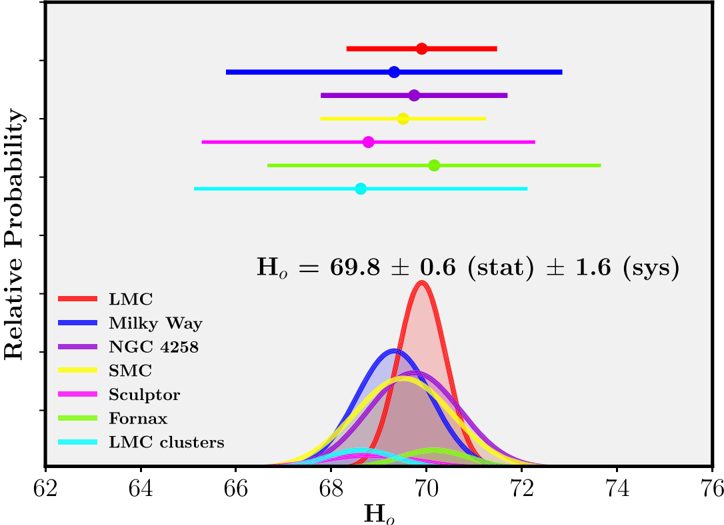
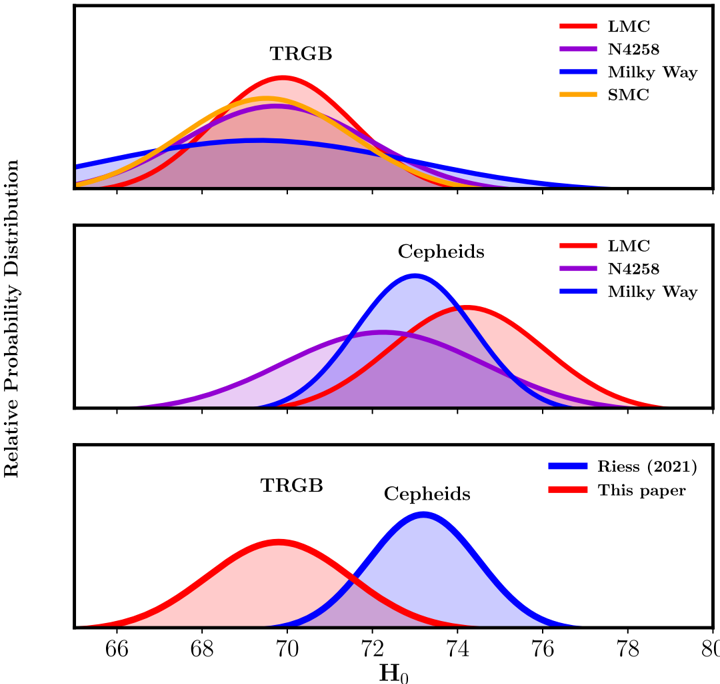
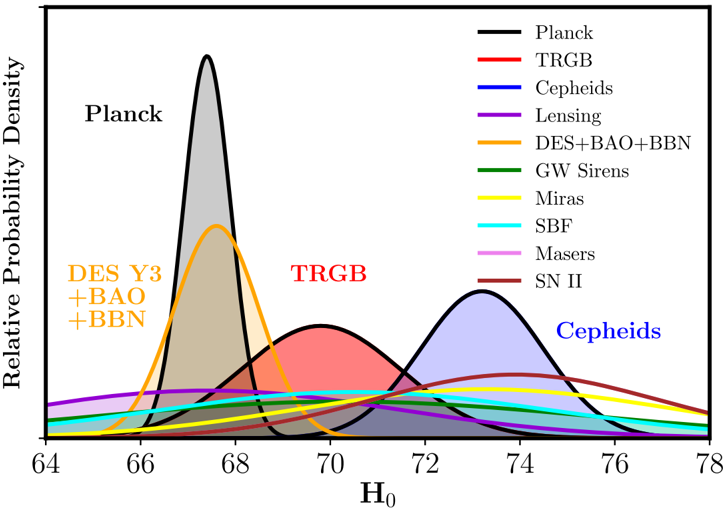
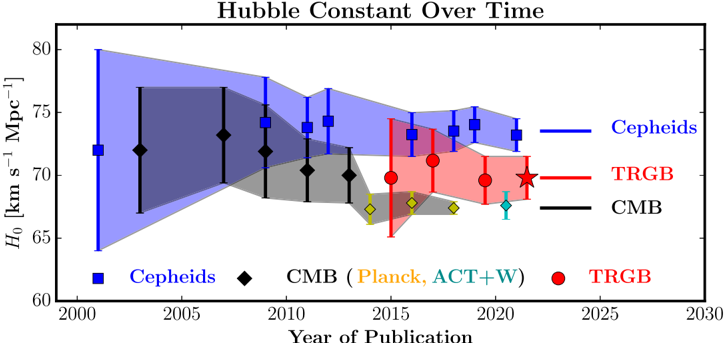
Measurement of the distances to nearby galaxies has improved rapidly in recent decades. The ever-present challenge is to reduce systematic effects, especially as greater distances are probed and the uncertainties become larger. In this paper, we combine several recent calibrations of the tip of the red giant branch (TRGB) method. These calibrations are internally self-consistent at the 1% level. New Gaia Early Data Release 3 data provide an additional consistency check at a (lower) 5% level of accuracy, a result of the well-documented Gaia angular covariance bias. The updated TRGB calibration applied to a sample of Type Ia supernovae from the Carnegie Supernova Project results in a value of the Hubble constant of H 0 = 69.8 ± 0.6 (stat) ± 1.6 (sys) km s−1 Mpc−1. No statistically significant difference is found between the value of H 0 based on the TRGB and that determined from the cosmic microwave background. The TRGB results are also consistent to within 2 σ with the SHoES and Spitzer plus Hubble Space Telescope (HST) Key Project Cepheid calibrations. The TRGB results alone do not demand additional new physics beyond the standard (ΛCDM) cosmological model. They have the advantage of simplicity of the underlying physics (the core He flash) and small systematic uncertainties (from extinction, metallicity, and crowding). Finally, the strengths and weaknesses of both the TRGB and Cepheids are reviewed, and prospects for addressing the current discrepancy with future Gaia, HST, and James Webb Space Telescope observations are discussed. Resolving this discrepancy is essential for ascertaining if the claimed tension in H 0 between the locally measured and CMB-inferred values is physically motivated.
Overview
The claims and statistics of this paper haven’t been checked yet.
Free: it reads the open-access text and checks the first 5 claims that cite a source we can check. Create a free account to check every claim.
Integrity signals
Registry
Cites
Statistics
Figures
Verification
Claims the paper makes
The claims and statistics of this paper haven’t been checked yet.
Free: it reads the open-access text and checks the first 5 claims that cite a source we can check. Create a free account to check every claim.
Claims other papers make about this one
Each is checked against this paper’s own text: does it say what the citing paper says it does?
The source backs part of the claim, not all of it — or backs it for a different population, condition or comparison.
In the citing paper
“there is the well-discussed Freedman 2021 [33] measurement which is exactly in between the Planck and SH0ES values of H 0 , i.e., in agreement with both sides within 1.5σ”
From Challenges of the Standard Cosmological Model (2022) · cites this paper as [33]
Experimental — accuracy not yet measured
Self-check
Percentages, sums and reported differences re-computed from the paper’s own numbers.
The self-check needs the paper’s full text.
Citations
Cites
Planck 2018 results: VI. Cosmological parameters
Planck Collaboration, Aghanim, N., Akrami, Y., Ashdown, M., Aumont, J., Baccigalupi, C., Ballardini, M., Banday, A. J., Barreiro, R. B., Bartolo, N., et al. (2020) · Astronomy & Astrophysics · doi:10.1051/0004-6361/201833910 · Cited by 14,258
Stan : A Probabilistic Programming Language
Carpenter, B., Gelman, A., Hoffman, M. D., Lee, D., Goodrich, B., Betancourt, M., Brubaker, M., Guo, J., Li, P., & Riddell, A. (2017) · Journal of Statistical Software · doi:10.18637/jss.v076.i01 · Cited by 7,754
MEASURING REDDENING WITH SLOAN DIGITAL SKY SURVEY STELLAR SPECTRA AND RECALIBRATING SFD
Schlafly, E. F., & Finkbeiner, D. P. (2011) · The Astrophysical Journal · doi:10.1088/0004-637x/737/2/103 · Cited by 7,531
Gaia Collaboration, Prusti, T., de Bruijne, J. H. J., Brown, A. G. A., Vallenari, A., Babusiaux, C., Bailer-Jones, C. A. L., Bastian, U., Biermann, M., Evans, D. W., et al. (2016) · Astronomy & Astrophysics · doi:10.1051/0004-6361/201629272 · Cited by 6,946
DAOPHOT - A computer program for crowded-field stellar photometry
Stetson, P. B. (1987) · Publications of the Astronomical Society of the Pacific · doi:10.1086/131977 · Cited by 4,694 · cited 1×
“Cerny et al. expanded the Stetson catalog to incorporate nine additional low-reddening clusters with BVI photometry alone, archived at the CADC, and analyzed with the same DAOPHOT/ALLFRAME software (Stetson 1987, 1994).”
MethodA Catalog of Parameters for Globular Clusters in the Milky Way
Harris, W. E. (1996) · The Astronomical Journal · doi:10.1086/118116 · Cited by 4,500 · cited 1×
“Preliminary E(B− V ) reddening estimates and initial distance estimates were taken from Harris (1996, 2010).”
BackgroundBressan, A., Marigo, P., Girardi, L., Salasnich, B., Dal Cero, C., Rubele, S., & Nanni, A. (2012) · Monthly Notices of the Royal Astronomical Society · doi:10.1111/j.1365-2966.2012.21948.x · Cited by 4,174
Final Results from the Hubble Space Telescope Key Project to Measure the Hubble Constant
Freedman, W. L., Madore, B. F., Gibson, B. K., Ferrarese, L., Kelson, D. D., Sakai, S., Mould, J. R., Kennicutt, Jr., Ford, H. C., Graham, J. A., et al. (2001) · The Astrophysical Journal · doi:10.1086/320638 · Cited by 3,298
Self-citationScolnic, D. M., Jones, D. O., Rest, A., Pan, Y. C., Chornock, R., Foley, R. J., Huber, M. E., Kessler, R., Narayan, G., Riess, A. G., et al. (2018) · The Astrophysical Journal · doi:10.3847/1538-4357/aab9bb · Cited by 2,700
A 2.4% DETERMINATION OF THE LOCAL VALUE OF THE HUBBLE CONSTANT*
Riess, A. G., Macri, L. M., Hoffmann, S. L., Scolnic, D., Casertano, S., Filippenko, A. V., Tucker, B. E., Reid, M. J., Jones, D. O., Silverman, J. M., et al. (2016) · The Astrophysical Journal · doi:10.3847/0004-637x/826/1/56 · Cited by 2,242
Research works printed but not linked: 11
- Bellazzini, M. 2008, MmSAI, 79, 440
- Carretta, E., & Bragaglia, A. 1998, A&A, 329, 937
- DES Collaboration, Abbott, T. M. C., Aguena, M., et al. 2021, arXiv:2105. 13549
- Freedman, W. L., Madore, B. F., Hoyt, T., et al. 2021, JWST Proposal Cycle 1, 1995
- Madore, B. F. 1976, The Galaxy and the Local Group, Vol. 182 (Greenwich: Royal Greenwich Observatory), 153
- Mortsell, E., Goobar, A., Johansson, J., & Dhawan, S. 2021, arXiv:2105.11461 · arXiv
- Oakes, E., Hoyt, T., Freedman, W., et al. 2021, ApJ, in press
- Owens, K., Freedman, W. L., Madore, B. F., et al. 2021, ApJ, in press
- Tran, Q., Hoyt, T., Freedman, W., et al. 2021, ApJ, in press
- Tripp, R. 1998, A&A, 331, 815
- Ulaczyk, K., Szymański, M. K., Udalski, A., et al. 2012, AcA, 62, 247
Cited by
Items 501–600 of 682
Yadav, S. (2025) · Cosmological and Astrobiological Review Journal for the Study of the Universe Life and the Natural Sciences · doi:10.65932/car-2025-1-5 · Cited by 3
Adil, S. A., Alam, S., Sen, S., & Vazquez, J. A. (2026) · The European Physical Journal C · doi:10.1140/epjc/s10052-026-16412-6 · Cited by 4
Quintessence model in the late universe
Duchaniya, L. K., Said, J. L., Mishra, B., & Shi, Y. (2026) · Journal of High Energy Astrophysics · doi:10.1016/j.jheap.2026.100727 · Cited by 3
Bjerrum-Bohr, N. E. J., Planté, L., & Vanhove, P. (2024) · Springer eBooks · doi:10.1007/978-981-99-7681-2_3 · Cited by 3
RTFAST-Spectra: emulation of X-ray reverberation mapping for active galactic nuclei
Ricketts, B., Huppenkothen, D., Lucchini, M., Ingram, A., Mastroserio, G., Ho, M., & Wandelt, B. D. (2025) · Monthly Notices of the Royal Astronomical Society · doi:10.1093/mnras/staf337 · Cited by 3
The Hubble tension: Relativistic dark matter production from long-lived particles
de Jesus, Á. S., Paixão, M. M. A., da Silva, D. R., Queiroz, F. S., & Pinto-Neto, N. (2025) · Nuclear Physics B · doi:10.1016/j.nuclphysb.2025.116889 · Cited by 5
Hubble tension and small-scale inhomogeneities on light propagation
Kraiselburd, L., Pigozzo, C., Landau, S. J., & Alcaniz, J. S. (2026) · Astronomy and Astrophysics · doi:10.1051/0004-6361/202660282 · Cited by 4
“2 σ away from the SH0ES and CMB values, respectively (for recent reviews on the H 0 tension, we refer the reader to Freedman (2021); Di Valentino et al. (2021); Efstathiou (2025a)).”
Dark Energy from Virtual Gravitons (GCDM Model vs. ΛCDM Model)
Marochnik, L. S., & Usikov, D. A. (2022) · Universe · doi:10.3390/universe8090464 · Cited by 3
Measurement science meets the reproducibility challenge
Possolo, A. M. (2023) · Metrologia · doi:10.1088/1681-7575/acdef7 · Cited by 3
Benisty, D. (2023) · Corfu Summer Institute School and Workshops on Elementary Particle Physics and Gravity (CORFU) · doi:10.22323/1.436.0259 · Cited by 3
Gao, C. (2024) · Universe · doi:10.3390/universe10060235 · Cited by 3
“The phenomenological implications of the constant-roll condition for the K-essence inflation is investigated by Odintsov and Oikonomou [18].”
Chanda, A., Roy, B. C., Bamba, K., & Paul, B. C. (2024) · The European Physical Journal C · doi:10.1140/epjc/s10052-024-13006-y · Cited by 3
Netchitailo, V. S. (2022) · Journal of High Energy Physics Gravitation and Cosmology · doi:10.4236/jhepgc.2022.82030 · Cited by 3
An S -matrix approach to gravitational-wave physics
Vanhove, P. (2022) · Philosophical Transactions of the Royal Society A Mathematical Physical and Engineering Sciences · doi:10.1098/rsta.2021.0181 · Cited by 3
“‘We wouldn’t call it a tension or a problem, but rather a crisis’, commented the Nobel prize winner David Gross, about the different measurements of the expansion rate of the Universe from local and cosmological observations [6].”
BackgroundInfluentialGathering Galaxy Distances in Abundance with Roman Wide-Area DataPreprint
Blakeslee, J. P., Cantiello, M., Hudson, M. J., Ferrarese, L., Hazra, N., Jensen, J. B., Peng, E. W., & Raimondo, G. (2023) · arXiv (Cornell University) · doi:10.48550/arxiv.2306.15170 · Cited by 3
Geometric Interpretation of the Redshift Evolution of H_0(z)Preprint
Lee, S. (2025) · arXiv (Cornell University) · doi:10.48550/arxiv.2511.07454 · Cited by 3
Early- and Late-Time Modifications to $Λ$CDM: Implications for the Hubble TensionPreprint
Dhyani, R., Mukherjee, P., Chatterjee, A., & Sen, A. A. (2026) · arXiv (Cornell University) · doi:10.48550/arxiv.2605.26050 · Cited by 3
A reanalysis of the megamaser Hubble constant: from spot catalogues to peculiar velocitiesPreprint
Stiskalek, R., & Desmond, H. (2026) · arXiv (Cornell University) · doi:10.48550/arxiv.2609.17684 · Cited by 4
Probing dark energy using anisotropies in the clustering of post-EoR H i distribution
Dash, C. B. V., & Sarkar, T. G. (2025) · Journal of Cosmology and Astroparticle Physics · doi:10.1088/1475-7516/2025/01/070 · Cited by 2
“Given the immense diversity of dark energy models spanning the theoretical landscape [21], and the critical observational crisis [22– 26], it is imperative to measure the expansion history over a much wider redshift range and with greater level of precision.”
Brans–Dicke-like field for co-varying G and c : observational constraints
Bezerra-Sobrinho, J., Cuzinatto, R. R., Medeiros, L. G., & Pompeia, P. J. (2026) · Monthly Notices of the Royal Astronomical Society · doi:10.1093/mnras/stag391 · Cited by 2
“As established in the literature [7, 68, 69], there exists a significant discrepancy in the inferred values of H 0 from different combinations of datasets.”
Goray, M., & Saha, B. (2026) · Nuclear Physics B · doi:10.1016/j.nuclphysb.2026.117468 · Cited by 2
Hierarchical Cosmological Constraints through a Strong-lensing Distance Ratio
Geng, S., Cao, S., Biesiada, M., Jiang, X., Nan, Y., & Zheng, C. (2026) · The Astrophysical Journal Supplement Series · doi:10.3847/1538-4365/ae6782 · Cited by 2
“One example is the Hubble tension ( W. L. Freedman 2021; E. Di Valentino et al. 2021 ) , the persistent discrepancy between early Universe inferences and late Universe distance ladder measurements of H 0 .”
Distance-ladder Measurements of the Hubble Constant: Recent Progress, Systematics, and Prospect
Chen, X., & Wang, S. M. (2026) · Research in Astronomy and Astrophysics · doi:10.1088/1674-4527/ae842e · Cited by 2
A Better Reconciliation of Hubble Tension in the Dark Energy Scalar Field
Fu, L., Chen, L., Yang, M., Wang, J., & Zhang, M.-J. (2023) · Research in Astronomy and Astrophysics · doi:10.1088/1674-4527/acafc6 · Cited by 2
Can the late dark energy parameterization reconcile the Hubble tension?*
Zhang, M.-J., 陈, L. 丽. C., Yang, M., & 王, J. 俊. W. (2024) · Chinese Physics C · doi:10.1088/1674-1137/ad3f95 · Cited by 2
Dynamical dark energy from spacetime-symmetry breaking — Late-time behaviour and phantom crossing
Nilsson, A. (2024) · Physics of the Dark Universe · doi:10.1016/j.dark.2024.101515 · Cited by 2
“…local Universe generally lead to determinations of the Hubble constant which are lower than that of Λ CDM [23, 24], thus exacerbating the mismatch of the Hubble parameter as measured with local probes as compared to its cosmological value, known as the Hubble tension (see for example [3, 25–27]).”
BackgroundDistance ladders and the Hubble constant crisis
Chen, X., & Shu, W. A. N. G. (2024) · Zhongguo kexue. Wulixue Lixue Tianwenxue · doi:10.1360/sspma-2024-0210 · Cited by 2
Chaudhary, H., Debnath, U., Rahaman, F., Mustafa, G., & Atamurotov, F. (2024) · Physica Scripta · doi:10.1088/1402-4896/ad7178 · Cited by 2
Dark energy from a gas of thin tubes of a massless scalar field
Lelyakov, A. P., & Lelyakov, S. A. (2024) · International Journal of Modern Physics A · doi:10.1142/s0217751x25500010 · Cited by 2
Marconi, M., Molinaro, R., Ripepi, V., Somma, G. D., Sicignano, T., Deka, M., Criscienzo, M. D., Luongo, E., Musella, I., & Trentin, E. (2025) · Astronomy and Astrophysics · doi:10.1051/0004-6361/202556458 · Cited by 5
M33 Cepheids from CFHT/MegaCam Survey
Adair, S., & Lee, C. (2022) · The Astronomical Journal · doi:10.3847/1538-3881/aca151 · Cited by 2
“There has been efforts on both fronts, for example, from the distance ladder methods (Riess et al. 2022 using Cepheids, and Freedman 2021 using TRGB stars), the strong lensing time-delays (Wong et al. 2020), and results from cosmic microwave background experiments such as Planck (Planck…”
MethodNgeow, C., Ou, J., Bhardwaj, A., Purdum, J. N., Rusholme, B., & Wold, A. (2023) · The Astronomical Journal · doi:10.3847/1538-3881/ace7b4 · Cited by 2
“In light of the recent “Hubble Tension” (for general reviews, see Verde et al. 2019; Di Valentino et al. 2021; Freedman 2021; Shah et al. 2021; Riess et al. 2022), Miras offer an independent route to determine the H0 via the local distance scale ladder, with several advantages being mentioned in…”
BackgroundSilva, C. A. S. (2025) · Classical and Quantum Gravity · doi:10.1088/1361-6382/ae2416 · Cited by 3
“In recent years, a controversy has arisen in cosmology, known as the Hubble tension [1–3].”
Seven Novel Observational Tests of General RelativityPreprint
Loeb, A. (2022) · arXiv (Cornell University) · doi:10.48550/arxiv.2205.02746 · Cited by 2
The Nonsymmetric Kaluza-Klein(Jordan-Thirry) Theory and Modern Physics.A novel approach.IIPreprint
Kalinowski, M. W. (2003) · arXiv (Cornell University) · doi:10.48550/arxiv.hep-th/0307135 · Cited by 2
Dynamical dark energy from spacetime-symmetry breaking -- late-time behaviour and phantom crossingPreprint
Nilsson, A. (2023) · arXiv (Cornell University) · doi:10.48550/arxiv.2307.10290 · Cited by 2
“…local Universe generally lead to determinations of the Hubble constant which are lower than that of Λ CDM [23, 24], thus exacerbating the mismatch of the Hubble parameter as measured with local probes as compared to its cosmological value, known as the Hubble tension (see for example [3, 25–27]).”
BackgroundA Sizable Discrepancy in Ground-Based JAGB Distances to Nearby GalaxiesPreprint
Anand, G. S. (2025) · arXiv (Cornell University) · doi:10.48550/arxiv.2502.07882 · Cited by 2
Over-Luminous Type Ia Supernovae and Standard Candle CosmologyPreprint
Ravi, A., Govindarajan, T. R., & Kalita, S. (2025) · arXiv (Cornell University) · doi:10.48550/arxiv.2503.13904 · Cited by 2
A Prediction for DESI Full-Shape: Increasing Tomographic $Ω_m(z)$ TrendPreprint
Colgáin, E. Ó., & Sheikh-Jabbari, M. M. (2026) · arXiv (Cornell University) · doi:10.48550/arxiv.2608.19883 · Cited by 3
“Unsurprisingly, the claims of redshift dependent Λ CDM parameters begin with the parameters at the heart of H 0 [3, 7, 8] (see also [9–12]) and S 8 tensions [13–18].”
Large Knowledge Model: A Knowledge Foundation for Agentic Science at ScalePreprint
Huang, Y., Hu, S., Gu, H., Ma, C., Zhang, J., Zou, Z., Fan, C., Xiao, Y., Xu, M., Xie, C., et al. (2026) · arXiv (Cornell University) · doi:10.48550/arxiv.2609.27297 · Cited by 2
Cosmology with strong gravitational lensesPreprint
Treu, T. (2026) · arXiv (Cornell University) · doi:10.48550/arxiv.2610.19598 · Cited by 2
Chaudhary, H., Pacif, S. K. J., Debnath, U., Rahaman, F., & Mustafa, G. (2024) · Chinese Physics C · doi:10.1088/1674-1137/ad6419 · Cited by 1
An Infinitely Old Universe with Planck Fields Before and After the Big Bang
Pilipović, D. (2024) · Universe · doi:10.3390/universe10100400 · Cited by 1
“Not only are we often trying to understand the theory behind the various cosmological parameters of interest, but often, even our experimental observations have trouble obtaining scientific community consensus [19,20].”
A Bayesian Analysis of the Hubble Tension
Fano, V., & Sanchioni, M. (2024) · Foundations of Science · doi:10.1007/s10699-024-09967-8 · Cited by 1
“This historical trend, she suggests, indicates that future measurements will likely reconcile the differences between global and local estimates of H 0 (Freedman, 2021).”
InfluentialPractical applications of a relativistic theory including tensor and scalar gravitation
Zhang, H. (2025) · Physical review. D/Physical review. D. · doi:10.1103/physrevd.111.084030 · Cited by 1
The Challenges for $$\Lambda $$CDM and the Physics Transition Approaches
Perivolaropoulos, L. (2025) · Astrophysics and space science proceedings · doi:10.1007/978-3-031-85527-6_13 · Cited by 1
Testing influence of Hubble tension on the early Universe
Zhang, M.-J., Yang, M., & Wang, J. (2025) · The European Physical Journal C · doi:10.1140/epjc/s10052-025-14491-5 · Cited by 1
The Hubble Constant in Four-Dimensional Space
Tokarev, V. A. (2025) · Journal of High Energy Physics Gravitation and Cosmology · doi:10.4236/jhepgc.2025.114099 · Cited by 1
Automated Identification of the Tip of the Red Giant Branch in Globular Clusters with Gaia Data
Yang, Y., Shao, Z., Wang, X., & Zheng, X. (2025) · Research in Astronomy and Astrophysics · doi:10.1088/1674-4527/ae31d7 · Cited by 1
Verma, S., Dixit, A., Pradhan, A., & Barak, M. S. (2026) · Journal of High Energy Astrophysics · doi:10.1016/j.jheap.2026.100581 · Cited by 6
Christodoulou, D. M., Kazanas, D., & Laycock, S. (2026) · Galaxies · doi:10.3390/galaxies14020016 · Cited by 1
“In Table 6, we summarize the γ Λ CDM values of H 0 ( γ ) in comparison to the results of the two leading sets of local CDL measurements [15–17].”
InfluentialThe TRGB-SBF Project. IV. A Color Calibration of the TRGB in the JWST F090W+F150W Filters
Chazov, M. I., Makarov, D. I., Tully, R. B., Anand, G. S., Makarova, L. N., Cohen, Y., Blakeslee, J. P., Cantiello, M., Jensen, J. B., & Raimondo, G. (2026) · The Astrophysical Journal · doi:10.3847/1538-4357/ae50ed · Cited by 1
“36 mag 1 based on the HST calibration of the TRGB at F814W by Freedman (2021) and distances to the two Local Group dwarfs WLM and Sextans A.”
Time delay measurements with broken power-law model
Rui, G., Hu, B., & Du, W. (2026) · Monthly Notices of the Royal Astronomical Society · doi:10.1093/mnras/stag796 · Cited by 1
Knezevic, S. (2024) · Cosmological and Astrobiological Review Journal for the Study of the Universe Life and the Natural Sciences · doi:10.65932/car-2024-1-1 · Cited by 1
Dark energy and a new realization of the matter Lagrangian
Shahidi, S., & Farahzad, S. (2026) · Physics of the Dark Universe · doi:10.1016/j.dark.2026.102372 · Cited by 1
Grupa, J., Taubenberger, S., Suyu, S. H., Sluse, D., Huber, S., & Vogl, C. (2026) · Astronomy and Astrophysics · doi:10.1051/0004-6361/202555795 · Cited by 1
Christodoulou, D. M., Kazanas, D., & Laycock, S. (2026) · Galaxies · doi:10.3390/galaxies14050090 · Cited by 1
Trouble with Hubble? A brief philosophical assessment of the $$H_0$$ tension
Wolf, W. J. (2026) · European Journal for Philosophy of Science · doi:10.1007/s13194-026-00761-w · Cited by 1
“To this point, the results in Freedman (2021); Freedman et al. (2019) suggest that there may yet still be unidentified systematics plaguing at least one, if not both, meth - ods of determining H 0 .”
Gadbail, G. N., & Bamba, K. (2026) · Physical review. D/Physical review. D. · doi:10.1103/29rq-lgby · Cited by 1
Environmental dependence of Type Ia supernova standardisation on the local luminosity-weighted age
Zhang, Y., Meng, X., Luo, J., Li, X., Han, Y., & Zhang, F. (2026) · Astronomy and Astrophysics · doi:10.1051/0004-6361/202659049 · Cited by 1
Gao, J., Chen, Y., Xu, L., Hu, J., & Cao, X. (2026) · Physical review. D/Physical review. D. · doi:10.1103/f5rg-k1y7 · Cited by 1
The Cosmic Black Hole as a Solution of the Relativistic Quantum Mechanical DIRAC Equation
Vegt, W. (2022) · European Journal of Applied Physics · doi:10.24018/ejphysics.2022.4.3.172 · Cited by 1
Experiment with a laser and a mirror to accurately measure the Hubble constant
Yanchilina, F., & Yanchilin, V. L. (2022) · Modern Physics Letters A · doi:10.1142/s0217732322501486 · Cited by 1
The General Property of Tracking and Thawing Models and Their Observational Constraints
You, Y., Qiang, Q.-C., & Gao, Q. (2023) · Universe · doi:10.3390/universe9030146 · Cited by 1
Astronomical measurements 1923–2023: a century of astonishing progress
Edmunds, M. G. (2023) · Measurement Science and Technology · doi:10.1088/1361-6501/acf1bc · Cited by 1
Multipoint Detection of GRB221009A’s Propagation through the Heliosphere
Voshchepynets, A., Agapitov, O. V., Wilson, L. B., III, Angelopoulos, V., Al‐Nussirat, S., Balikhin, M. A., Hlebena, M., Korol, I., Larson, D. E., Mitchell, D. L., et al. (2023) · The Astrophysical Journal Letters · doi:10.3847/2041-8213/acf933 · Cited by 1
Bayesian multi-band fitting of alerts for kilonovae detection
Biswas, B., Lao, J., Aubourg, É., Boucaud, A., Guinot, A., Ishida, É. E. O., & Roucelle, C. (2023) · HAL · doi:10.48550/arxiv.2311.04845 · Cited by 1
The Tip of the Red Giant Branch as a Cosmological Tool
Lee, M. G. (2022) · Proceedings of the International Astronomical Union · doi:10.1017/s1743921323002685 · Cited by 1
Changing CO bands in near-IR spectra of CP Cephei
Call, S. G., Hintz, E. G., Ardern, S., Scowcroft, V., & Morrell, T. D. (2024) · Monthly Notices of the Royal Astronomical Society · doi:10.1093/mnras/stae2224 · Cited by 1
Freedman, W. L., Madore, B. F., Hoyt, T. J., Jang, I. S., Lee, A. J., & Owens, K. A. (2025) · The Astronomical Journal · doi:10.3847/1538-3881/adbf97 · Cited by 1
Self-citationGrowth index in the γδCDM model
Deliduman, C., Dilsiz, F. Ş., & Binici, S. S. (2025) · Physics of the Dark Universe · doi:10.1016/j.dark.2025.102201 · Cited by 1
“The so-called Hubble tension is more than 5 σ difference [5–7] between the early universe model dependent derivation and the late universe measurements of the Hubble constant.”
Vegt, W. (2021) · OSF Preprints (OSF Preprints) · doi:10.31219/osf.io/w4gra · Cited by 1
The Fundamental Discussion between Newton, Maxwell, Bohr and EinsteinPreprint
Vegt, W. (2021) · OSF Preprints (OSF Preprints) · doi:10.31219/osf.io/yjxza · Cited by 1
Vegt, W. (2022) · OSF Preprints (OSF Preprints) · doi:10.31219/osf.io/uk64z · Cited by 1
Vegt, W. (2022) · OSF Preprints (OSF Preprints) · doi:10.31219/osf.io/rzv5k · Cited by 1
Gravity. The generation of a Gravitational Field around a Laser BeamPreprint
Vegt, W. (2022) · OSF Preprints (OSF Preprints) · doi:10.31219/osf.io/6qjcm · Cited by 1
The Determination of Cosmological Parameters
Longair, M. S. (2022) · Astronomy and astrophysics library · doi:10.1007/978-3-662-65891-8_8 · Cited by 1
Quintessence models in the late UniversePreprint
Duchaniya, L. K., Said, J. L., & Mishra, B. (2025) · Research Square · doi:10.21203/rs.3.rs-6817456/v1 · Cited by 2
Wegener, G. H. (2025) · SSRN Electronic Journal · doi:10.2139/ssrn.6094587 · Cited by 1
Wegener, G. H. (2025) · SSRN Electronic Journal · doi:10.2139/ssrn.6095126 · Cited by 1
Dutra, V. P. (2026) · Preprints.org · doi:10.20944/preprints202603.0279.v2 · Cited by 1
The Cepheid distance scale : from the local Gaia calibration to distant galaxies
Breuval, L. (2021) · theses.fr (ABES) · doi:10.70675/a6976025z6decz4ab2zbb29za4337014e0d3 · Cited by 1
Dixon, M., Jones, D. O., Drakos, N. E., Carreres, B., Tweddle, J. W., Murakami, Y. S., Ashall, C., Brout, D., de Jaeger, T., Do, A., et al. (2026) · arXiv (Cornell University) · doi:10.48550/arxiv.2606.14962 · Cited by 1
Cosmology as Representation: Informational Invariance and the Limits of Scientific RealismPreprint
Profumo, S. (2026) · arXiv (Cornell University) · doi:10.48550/arxiv.2606.21586 · Cited by 1
“…contrast, is the output of a different inference pipeline—one involving Cepheid calibration, Type Ia supernova standardization, and tip-of-the-red-giant-branch photometry—with its own systematic error budget and its own implicit model assumptions (Riess et al. 2022; Freedman 2021; Efstathiou 2021).”
The road towards precision measurements of $H_0$ with bright sirens in the Einstein Telescope eraPreprint
Leo, C. D., Teixeira, E. M., & Poulin, V. (2026) · HAL · doi:10.48550/arxiv.2607.20413 · Cited by 1
The Observer and the Cosmological Datum: On the Ontological Invariance of the Observing Domain [P4]Preprint
Zhong, J. (2026) · SSRN Electronic Journal · doi:10.2139/ssrn.7380381 · Cited by 1
Jiang, B.-H., Wang, G.-J., & Yang, T. (2026) · arXiv (Cornell University) · doi:10.48550/arxiv.2609.24203 · Cited by 1
“H 0 degeneracy, and is therefore more likely a consequence of M B calibration systematics than a true violation of the CDDR. Recent studies have increasingly focused on the role of M B in cosmological analyses [66, 67].”
Теория Стационарной Самосогласованной ВселеннойPreprint
Авшалумов, А. (2020) · doi:10.24108/preprints-3112155
Talbot, P. (2022) · OSF Preprints (OSF Preprints) · doi:10.31219/osf.io/yuhw7
L’histoire de l’expansion de l’Univers dévoilée
Burtin, E. (2022) · Reflets de la physique · doi:10.1051/refdp/202271022
Stávek, J. (2022) · European Journal of Applied Physics · doi:10.24018/ejphysics.2022.4.2.164 · Cited by 1
Parametric separation of variables and the complete propagation lawPreprint
Guruprasad, V. (2022) · doi:10.36227/techrxiv.19620477.v1
Parametric separation of variables and the complete propagation lawPreprint
Guruprasad, V. (2022) · TechRxiv · doi:10.36227/techrxiv.19620477
Quantum gravity phenomenology at the dawn of the multi-messenger era -- A reviewPreprint
Wallet, J.-C., Addazi, A., Alvarez-Muniz, J., Batista, R. A., Amelino-Camelia, G., Antonelli, V., Arzano, M., Asorey, M., Atteia, J. L., Bahamonde, S., et al. (2021) · HAL · Cited by 8
Searching for Multimessenger Transients and Lensed Supernovae with the Dark Energy Survey
Morgan, R. [. U. (2022) · OSTI OAI (U.S. Department of Energy Office of Scientific and Technical Information)
Singh, R. (2022) · Research Square · doi:10.21203/rs.3.rs-1983970/v1
Cosmological Evolution With Negative Energy Densities
SAHARIAN, A. A., Avagyan, R. M., de Mello, E. R. B., Kotanjyan, V. K., Petrosyan, T. A., & Babujyan, H. G. (2022) · Astrophysics · doi:10.54503/0571-7132-2022.65.3-443
DVAR HASHEM OHRPreprint
Vegt, W. (2022) · OSF Preprints (OSF Preprints) · doi:10.31219/osf.io/7nsgh
Parametric separation of variables and the complete propagation lawPreprint
Guruprasad, V. (2022) · doi:10.36227/techrxiv.19620477.v2
Vegt, W. (2022) · International Research Journal of Pure and Applied Physics · doi:10.37745/irjpap.13/vol9n11252
Metadata
- Authors
- Freedman, W. L.
- Affiliations
- University of Chicago (US)
- Corresponding author
- Freedman, Wendy L.
- ORCID
- Freedman, Wendy L.
- Venue
- The Astrophysical Journal
- Publisher
- American Astronomical Society
- Published
- 2021-09-01
- Volume
- 919
- Issue
- 1
- Pages
- 16
- ISSN
- 0004-637X (ISSN-L)
- 1538-4357
- OpenAlex
- W3176418170
- Cited by
- 577
- References
- 105
- Citations by year
- 2026: 63 · 2025: 109 · 2024: 122 · 2023: 123 · 2022: 134 · 2021: 24
- FWCI
- 54.16
- Type
- journal article
- Language
- en
- Open access
- hybrid
- doi.org
- Licence
- cc-by
- creativecommons.org/licenses/by/4.0/ (vor, 16 d)
- iopscience.iop.org/info/page/text-and-data-mining (tdm, 16 d)
- Locations
- The Astrophysical Journal (publishedVersion, cc-by)
- arXiv (Cornell University) (submittedVersion)
- arXiv (Cornell University) (cc-by)
- Funders
- National Aeronautics and Space Administration (NAS 526555, 526555)
- Space Telescope Science Institute (NAS5- 26555, 5-26555, 26555, 13691)
- Topics
- Physical Sciences › Physics and Astronomy › Astronomy and Astrophysics › Cosmology and Gravitation Theories
- Physical Sciences › Physics and Astronomy › Astronomy and Astrophysics › Stellar, planetary, and galactic studies
- Physical Sciences › Physics and Astronomy › Astronomy and Astrophysics › Galaxies: Formation, Evolution, Phenomena
- Keywords
- Hubble constant, Hubble tension, tip of the red giant branch, Type Ia supernovae, Cepheid calibration, cosmic microwave background, core helium flash, local distance ladder, systematic uncertainties
About these checks
Registry, retraction, Cites and statistics results are computed, not judged, with one exception: a printed reference that no index lists is read once by a model before it counts as a citation error. Claims are extracted by a model and kept only when their quote appears verbatim in the text; each cited source is then checked, with a model’s help, for whether it says what the claim relies on. Those verdicts can be wrong — read the claim’s quote and the cited source before relying on one.
Statistics and arithmetic are recomputed, not judged.
Confidence bands are shown only for fields calibrated on our annotated test set. None is calibrated yet, so no band is shown.
What counts as a claim ›How we measure confidence ›How we check this ›
Are you an author, or do you see a problem with this page? Request a review
Data sources
Bibliographic data: Semantic Scholar, OpenAlex, Crossref.
Contains information from the Semantic Scholar Academic Graph Datasets, made available under the ODC Attribution License (ODC-BY 1.0).
Semantic Scholar’s data is described in: Kinney, R., et al. (2023). The Semantic Scholar Open Data Platform. arXiv:2301.10140.
