

Measurements of the Hubble Constant: Tensions in Perspective
Open accessThe DOI matches its Crossref record; 110 of the 110 references it cites were found in a registry or an index.
Abstract
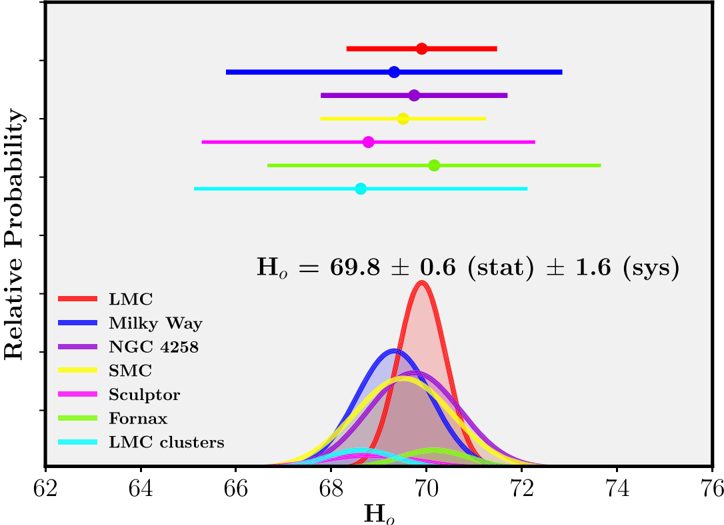
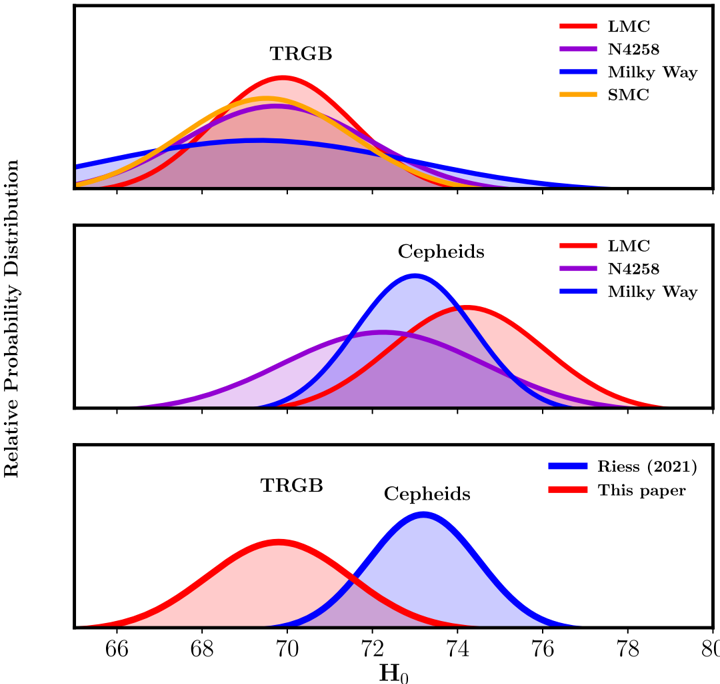
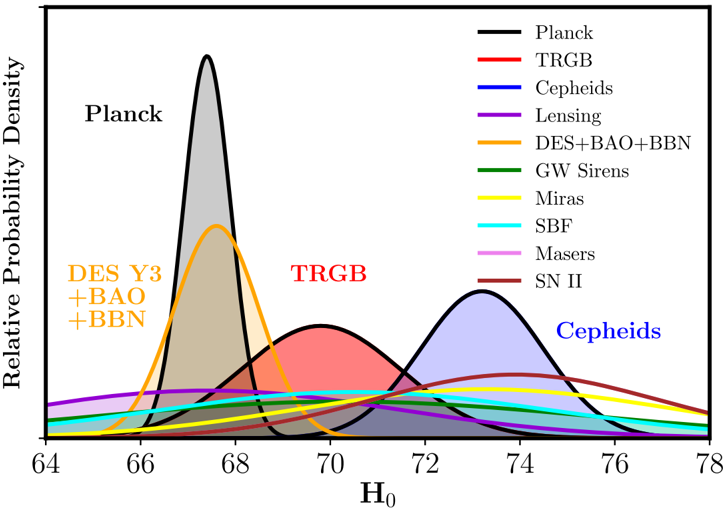
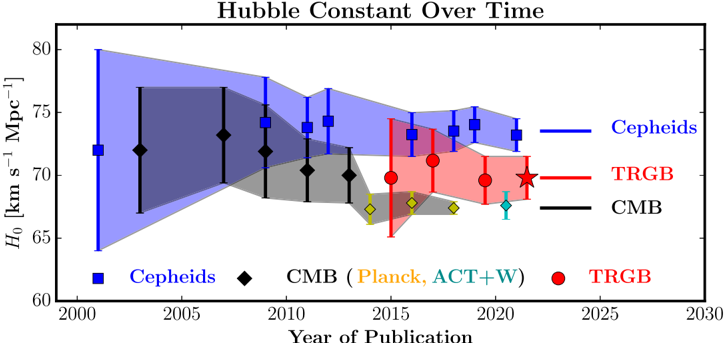
Measurement of the distances to nearby galaxies has improved rapidly in recent decades. The ever-present challenge is to reduce systematic effects, especially as greater distances are probed and the uncertainties become larger. In this paper, we combine several recent calibrations of the tip of the red giant branch (TRGB) method. These calibrations are internally self-consistent at the 1% level. New Gaia Early Data Release 3 data provide an additional consistency check at a (lower) 5% level of accuracy, a result of the well-documented Gaia angular covariance bias. The updated TRGB calibration applied to a sample of Type Ia supernovae from the Carnegie Supernova Project results in a value of the Hubble constant of H 0 = 69.8 ± 0.6 (stat) ± 1.6 (sys) km s−1 Mpc−1. No statistically significant difference is found between the value of H 0 based on the TRGB and that determined from the cosmic microwave background. The TRGB results are also consistent to within 2 σ with the SHoES and Spitzer plus Hubble Space Telescope (HST) Key Project Cepheid calibrations. The TRGB results alone do not demand additional new physics beyond the standard (ΛCDM) cosmological model. They have the advantage of simplicity of the underlying physics (the core He flash) and small systematic uncertainties (from extinction, metallicity, and crowding). Finally, the strengths and weaknesses of both the TRGB and Cepheids are reviewed, and prospects for addressing the current discrepancy with future Gaia, HST, and James Webb Space Telescope observations are discussed. Resolving this discrepancy is essential for ascertaining if the claimed tension in H 0 between the locally measured and CMB-inferred values is physically motivated.
Overview
The claims and statistics of this paper haven’t been checked yet.
Free: it reads the open-access text and checks the first 5 claims that cite a source we can check. Create a free account to check every claim.
Integrity signals
Registry
Cites
Statistics
Figures
Verification
Claims the paper makes
The claims and statistics of this paper haven’t been checked yet.
Free: it reads the open-access text and checks the first 5 claims that cite a source we can check. Create a free account to check every claim.
Claims other papers make about this one
Each is checked against this paper’s own text: does it say what the citing paper says it does?
The source backs part of the claim, not all of it — or backs it for a different population, condition or comparison.
In the citing paper
“there is the well-discussed Freedman 2021 [33] measurement which is exactly in between the Planck and SH0ES values of H 0 , i.e., in agreement with both sides within 1.5σ”
From Challenges of the Standard Cosmological Model (2022) · cites this paper as [33]
Experimental — accuracy not yet measured
Self-check
Percentages, sums and reported differences re-computed from the paper’s own numbers.
The self-check needs the paper’s full text.
Citations
Cites
Planck 2018 results: VI. Cosmological parameters
Planck Collaboration, Aghanim, N., Akrami, Y., Ashdown, M., Aumont, J., Baccigalupi, C., Ballardini, M., Banday, A. J., Barreiro, R. B., Bartolo, N., et al. (2020) · Astronomy & Astrophysics · doi:10.1051/0004-6361/201833910 · Cited by 14,258
Stan : A Probabilistic Programming Language
Carpenter, B., Gelman, A., Hoffman, M. D., Lee, D., Goodrich, B., Betancourt, M., Brubaker, M., Guo, J., Li, P., & Riddell, A. (2017) · Journal of Statistical Software · doi:10.18637/jss.v076.i01 · Cited by 7,754
MEASURING REDDENING WITH SLOAN DIGITAL SKY SURVEY STELLAR SPECTRA AND RECALIBRATING SFD
Schlafly, E. F., & Finkbeiner, D. P. (2011) · The Astrophysical Journal · doi:10.1088/0004-637x/737/2/103 · Cited by 7,531
Gaia Collaboration, Prusti, T., de Bruijne, J. H. J., Brown, A. G. A., Vallenari, A., Babusiaux, C., Bailer-Jones, C. A. L., Bastian, U., Biermann, M., Evans, D. W., et al. (2016) · Astronomy & Astrophysics · doi:10.1051/0004-6361/201629272 · Cited by 6,946
DAOPHOT - A computer program for crowded-field stellar photometry
Stetson, P. B. (1987) · Publications of the Astronomical Society of the Pacific · doi:10.1086/131977 · Cited by 4,694 · cited 1×
“Cerny et al. expanded the Stetson catalog to incorporate nine additional low-reddening clusters with BVI photometry alone, archived at the CADC, and analyzed with the same DAOPHOT/ALLFRAME software (Stetson 1987, 1994).”
MethodA Catalog of Parameters for Globular Clusters in the Milky Way
Harris, W. E. (1996) · The Astronomical Journal · doi:10.1086/118116 · Cited by 4,500 · cited 1×
“Preliminary E(B− V ) reddening estimates and initial distance estimates were taken from Harris (1996, 2010).”
BackgroundBressan, A., Marigo, P., Girardi, L., Salasnich, B., Dal Cero, C., Rubele, S., & Nanni, A. (2012) · Monthly Notices of the Royal Astronomical Society · doi:10.1111/j.1365-2966.2012.21948.x · Cited by 4,174
Final Results from the Hubble Space Telescope Key Project to Measure the Hubble Constant
Freedman, W. L., Madore, B. F., Gibson, B. K., Ferrarese, L., Kelson, D. D., Sakai, S., Mould, J. R., Kennicutt, Jr., Ford, H. C., Graham, J. A., et al. (2001) · The Astrophysical Journal · doi:10.1086/320638 · Cited by 3,298
Self-citationScolnic, D. M., Jones, D. O., Rest, A., Pan, Y. C., Chornock, R., Foley, R. J., Huber, M. E., Kessler, R., Narayan, G., Riess, A. G., et al. (2018) · The Astrophysical Journal · doi:10.3847/1538-4357/aab9bb · Cited by 2,700
A 2.4% DETERMINATION OF THE LOCAL VALUE OF THE HUBBLE CONSTANT*
Riess, A. G., Macri, L. M., Hoffmann, S. L., Scolnic, D., Casertano, S., Filippenko, A. V., Tucker, B. E., Reid, M. J., Jones, D. O., Silverman, J. M., et al. (2016) · The Astrophysical Journal · doi:10.3847/0004-637x/826/1/56 · Cited by 2,242
Research works printed but not linked: 11
- Bellazzini, M. 2008, MmSAI, 79, 440
- Carretta, E., & Bragaglia, A. 1998, A&A, 329, 937
- DES Collaboration, Abbott, T. M. C., Aguena, M., et al. 2021, arXiv:2105. 13549
- Freedman, W. L., Madore, B. F., Hoyt, T., et al. 2021, JWST Proposal Cycle 1, 1995
- Madore, B. F. 1976, The Galaxy and the Local Group, Vol. 182 (Greenwich: Royal Greenwich Observatory), 153
- Mortsell, E., Goobar, A., Johansson, J., & Dhawan, S. 2021, arXiv:2105.11461 · arXiv
- Oakes, E., Hoyt, T., Freedman, W., et al. 2021, ApJ, in press
- Owens, K., Freedman, W. L., Madore, B. F., et al. 2021, ApJ, in press
- Tran, Q., Hoyt, T., Freedman, W., et al. 2021, ApJ, in press
- Tripp, R. 1998, A&A, 331, 815
- Ulaczyk, K., Szymański, M. K., Udalski, A., et al. 2012, AcA, 62, 247
Cited by
Items 201–300 of 682
Blanchard, A., Héloret, J.-Y., Ilić, S., Lamine, B., & Tutusaus, I. (2024) · The Open Journal of Astrophysics · doi:10.33232/001c.117170 · Cited by 32
Camilleri, R., Davis, T. M., Hinton, S. R., Armstrong, P., Brout, D., Galbany, L., Glazebrook, K., Lee, J., Lidman, C. E., Möller, A., et al. (2025) · Monthly Notices of the Royal Astronomical Society · doi:10.1093/mnras/staf122 · Cited by 29
The Hubble Tension Resolved by the DESI Baryon Acoustic Oscillations Measurements
Jia, X. D., Hu, J.-P., Gao, D.-Y., Yi, S.-X., & Wang, F. Y. (2025) · The Astrophysical Journal Letters · doi:10.3847/2041-8213/ae1965 · Cited by 32
“For the local universe phenomena, these models attempt to explain the larger local H 0 through local either inhomogeneities (Mazurenko et al. 2025; Banik & Kalaitzidis 2025) or unaccounted systematic errors in the local distance ladder (Freedman 2021; Mörtsell et al. 2022).”
RR Lyrae and Type II Cepheid Variables in Globular Clusters: Optical and Infrared Properties
Bhardwaj, A. (2022) · Universe · doi:10.3390/universe8020122 · Cited by 34
“The Hubble constant measurements in the late and early Universe are currently in tension, implying that the Universe is expanding faster than the predictions of the standard cosmological model (see [130–132] for details).”
Toward a realistic model of dark atoms to resolve the Hubble tension
Blinov, N., Krnjaic, G., & Li, S. W. (2022) · Physical review. D/Physical review. D. · doi:10.1103/physrevd.105.095005 · Cited by 32
Dhawan, S., Borderies, A., Macpherson, H. J., & Heinesen, A. (2022) · Monthly Notices of the Royal Astronomical Society · doi:10.1093/mnras/stac3812 · Cited by 29
Weyl type f ( Q , T ) gravity observational constrained cosmological models
Bhagat, R., Narawade, S. A., & Mishra, B. (2023) · Physics of the Dark Universe · doi:10.1016/j.dark.2023.101250 · Cited by 31
The Unsettled Number: Hubble’s Tension
Cervantes–Cota, J. L., Uribarri, S. G., & Smoot, G. F. (2023) · Universe · doi:10.3390/universe9120501 · Cited by 38
Bjerrum-Bohr, N. E. J., Planté, L., & Vanhove, P. (2022) · HAL · doi:10.48550/arxiv.2212.08957 · Cited by 30
“Planned space-based gravitational wave interferometers will even bring this a step further and have the capacity to address questions associated with gravitational attraction and the expansion of the Universe.”
BackgroundInfluentialMinimal theory of massive gravity and constraints on the graviton mass
Felice, A. D., Mukohyama, S., & Pookkillath, M. C. (2021) · Journal of Cosmology and Astroparticle Physics · doi:10.1088/1475-7516/2021/12/011 · Cited by 28
Li, S., Casertano, S., & Riess, A. G. (2022) · The Astrophysical Journal · doi:10.3847/1538-4357/ac7559 · Cited by 29
“Measurements ofH0, which include the use of TRGB vary from 70–77 km s−1 Mpc−1, depend on the calibration of the TRGB and other components of the distance ladder (Freedman 2021; Anand et al. 2022; Soltis et al. 2021; Jones et al. 2022; Dhawan et al. 2022; Blakeslee et al. 2021).”
MethodColgáin, E. Ó., Pourojaghi, S., Sheikh-Jabbari, M. M., & Sherwin, D. (2025) · The European Physical Journal C · doi:10.1140/epjc/s10052-024-13727-0 · Cited by 28
Illustrating the consequences of a misuse of σ 8 in cosmology
Forconi, M., Favale, A., & Gómez-Valent, A. (2025) · Physical review. D/Physical review. D. · doi:10.1103/rpf5-ldks · Cited by 30
Atomic dark matter, interacting dark radiation, and the Hubble tension
Buen-Abad, M. A., Chacko, Z., Flood, I., Kılıç, C., Marques-Tavares, G., & Youn, T. (2025) · Journal of High Energy Physics · doi:10.1007/jhep07(2025)084 · Cited by 27
Hoyt, T. J., Jang, I. S., Freedman, W. L., Madore, B. F., Owens, K. A., & Lee, A. J. (2026) · The Astrophysical Journal · doi:10.3847/1538-4357/ae29eb · Cited by 32
“…geometric anchor NGC 4258 ( HST-GO-16743; T. Hoyt et al. 2021b ) and recovered a TRGB magnitude in 1% agreement with the CCHP value, which has remained stable over the years ( M. G. Lee et al. 1993; W. L. Freedman et al. 2019, 2020; W. L. Freedman 2021; I. S. Jang et al. 2021; T. J. Hoyt 2023 ) .”
InfluentialSelf-citationVacuum energy density measured from cosmological data
Prat, J., Hogan, C. J., Chang, C., & Frieman, J. A. (2022) · Journal of Cosmology and Astroparticle Physics · doi:10.1088/1475-7516/2022/06/015 · Cited by 30
Neural network reconstruction of cosmology using the Pantheon compilation
Dialektopoulos, K. F., Mukherjee, P., Said, J. L., & Mifsud, J. (2023) · The European Physical Journal C · doi:10.1140/epjc/s10052-023-12124-3 · Cited by 29
“9 km Mpc−1 s−1 [59] via the Tip of the Red Giant Branch (TRGB) calibration technique (hereafter referred to as TRGB) and the most precise early-time determination of H0 = 67.”
MethodMavromatos, N. E. (2022) · Philosophical Transactions of the Royal Society A Mathematical Physical and Engineering Sciences · doi:10.1098/rsta.2021.0188 · Cited by 30
The Cosmological Parameters (2023)Preprint
Lahav, O., & Liddle, A. R. (2024) · arXiv (Cornell University) · doi:10.48550/arxiv.2403.15526 · Cited by 29
$Λ$CDM is alive and wellPreprint
Blanchard, A., Héloret, J.-Y., Ilić, S., Lamine, B., & Tutusaus, I. (2022) · arXiv (Cornell University) · doi:10.48550/arxiv.2205.05017 · Cited by 28
Tyagi, U. K., Haridasu, S., & Basak, S. (2024) · Physical review. D/Physical review. D. · doi:10.1103/physrevd.110.063503 · Cited by 30
Reionization and the Hubble constant: correlations in the Cosmic Microwave Background
Allali, I. J., Singh, P., Fan, J., & Li, L. (2025) · Journal of Cosmology and Astroparticle Physics · doi:10.1088/1475-7516/2025/08/082 · Cited by 28
“Given the long-standing tension in the determination of H 0 from CMB observations versus more direct observations of distance ladder methods [17–24], the precise value of τ reio may be of interest.”
Can phantom transition at z ∼ 1 restore the Cosmic concordance?
Zhou, Z., Liu, G., Mu, Y., & Xu, L. (2022) · Monthly Notices of the Royal Astronomical Society · doi:10.1093/mnras/stac053 · Cited by 27
Stepped partially acoustic dark matter: likelihood analysis and cosmological tensions
Buen-Abad, M. A., Chacko, Z., Kılıç, C., Marques-Tavares, G., & Youn, T. (2023) · Journal of Cosmology and Astroparticle Physics · doi:10.1088/1475-7516/2023/11/005 · Cited by 30
Liu, Y., Yu, H., & Wu, P. (2024) · Physical review. D/Physical review. D. · doi:10.1103/physrevd.110.l021304 · Cited by 26
Testing f(R) gravity models with quasar x-ray and UV fluxes
Leizerovich, M., Kraiselburd, L., Landau, S. J., & Scóccola, C. G. (2022) · Physical review. D/Physical review. D. · doi:10.1103/physrevd.105.103526 · Cited by 25
Two Sides of the Same Coin: Sterile Neutrinos and Dark Radiation, Status and Perspectives
Archidiacono, M., & Gariazzo, S. (2022) · Universe · doi:10.3390/universe8030175 · Cited by 27
A Critical Discussion on the H0 Tension
Capozzıello, S., Sarracino, G., & Somma, G. D. (2024) · Universe · doi:10.3390/universe10030140 · Cited by 31
“For example, studies by [127,138,139] derived a value of H 0 = 69.6 ± 1.9 km/(s Mpc) at a 68% confidence level, which falls between the values from SH0ES and Planck collaborations.”
InfluentialCosmological inference from within the peculiar local universePreprint
Mohayaee, R., Rameez, M., & Sarkar, S. (2020) · arXiv (Cornell University) · doi:10.48550/arxiv.2003.10420 · Cited by 25
“…due to the significant tension between the value of the present expansion rate H 0 ( ≡ 100 h km s − 1 Mpc, h ≃ 0.7) determined using the ‘cosmic distance ladder’ anchored in the local universe, and the value inferred from the Cosmic Microwave Background (CMB) in the Λ CDM model framework [2].”
MethodInfluentialRevisiting CPL with sign-switching density: To cross or not to cross the NECB
Gökçen, M., Akarsu, Ö., & Valentino, E. D. (2026) · Physics of the Dark Universe · doi:10.1016/j.dark.2026.102273 · Cited by 34
Pseudoscalar sterile neutrino self-interactions in light of Planck, SPT and ACT data
Corona, M. A., Murgia, R., Cadeddu, M., Archidiacono, M., Gariazzo, S., Giunti, C., & Hannestad, S. (2022) · Journal of Cosmology and Astroparticle Physics · doi:10.1088/1475-7516/2022/06/010 · Cited by 27
Lee, A. J., Rousseau-Nepton, L., Freedman, W. L., Madore, B. F., Cioni, M.-R. L., Hoyt, T. J., Jang, I. S., Javadi, A., & Owens, K. A. (2022) · The Astrophysical Journal · doi:10.3847/1538-4357/ac7321 · Cited by 27
“Using JWST, the infrared TRGB can be extended out to > 40 Mpc (i.e. a volume five times greater than currently possible with HST; Freedman 2021).”
BackgroundMethodSelf-citationTransit cosmological models in $$F(R,{\bar{T}})$$ gravity theory
Maurya, D. C., & Myrzakulov, R. (2024) · The European Physical Journal C · doi:10.1140/epjc/s10052-024-12904-5 · Cited by 25
“8 km s − 1 Mpc − 1 and most recently, Freedman [91] has estimated H 0 = 69 .”
Hoyt, T. J. (2023) · Nature Astronomy · doi:10.1038/s41550-023-01913-1 · Cited by 30
Hints of New Physics for the Hubble Tension: Violation of Cosmological Principle
Hu, J.-P., Jia, X. D., Hu, J., & Wang, F. Y. (2024) · The Astrophysical Journal Letters · doi:10.3847/2041-8213/ad85cf · Cited by 26
“…et al. 2020b); (b) independent observational ar-bitration (Wong et al. 2020; Shajib et al. 2023; Pesce et al. 2020; Mooley et al. 2018; Freedman 2021; Wu et al. 2022; Gao et al. 2024); and (c) new physics beyond the standard cosmological model (Di Valentino et al. 2021; Hu & Wang…”
BackgroundDixon, M. E., Mould, J. R., Lidman, C. E., Taylor, E. N., Flynn, C., Duffy, A. R., Galbany, L., Scolnic, D. M., Davis, T. M., Möller, A., et al. (2025) · Monthly Notices of the Royal Astronomical Society · doi:10.1093/mnras/staf266 · Cited by 25
Cosmic tensions indirectly correlate with reionization optical depth
Allali, I. J., Li, L., Singh, P., & Fan, J. (2026) · Physical review. D/Physical review. D. · doi:10.1103/14tf-4nk2 · Cited by 23
Quantifying Uncertainties on the Tip of the Red Giant Branch Method
Madore, B. F., Freedman, W. L., Owens, K. A., & Jang, I. S. (2023) · The Astronomical Journal · doi:10.3847/1538-3881/acd3f3 · Cited by 23
“This would correspond toMI=−4.05 mag, which closely matches the value currently adopted by the Chicago-Carnegie Hubble Program (CCHP; Freedman 2021).”
MethodResultInfluentialSelf-citationEmergent Unparticles Dark Energy can restore cosmological concordance
Ben-Dayan, I., & Kumar, U. (2023) · Journal of Cosmology and Astroparticle Physics · doi:10.1088/1475-7516/2023/12/047 · Cited by 28
Exploring the growth index γL : Insights from different CMB dataset combinations and approaches
Specogna, E., Valentino, E. D., Said, J. L., & Nguyen, N.-M. (2024) · Physical review. D/Physical review. D. · doi:10.1103/physrevd.109.043528 · Cited by 25
Generating mock galaxy catalogues for flux-limited samples like the DESI Bright Galaxy Survey
Smith, A., Grove, C., Cole, S., Norberg, P., Zarrouk, P., Yuan, S., Aguilar, J., Ahlen, S. P., Brooks, D., Claybaugh, T., et al. (2024) · Monthly Notices of the Royal Astronomical Society · doi:10.1093/mnras/stae1503 · Cited by 33
Cosmological probes of Dark Radiation from Neutrino Mixing
Allali, I. J., Aloni, D., & Schöneberg, N. (2024) · Journal of Cosmology and Astroparticle Physics · doi:10.1088/1475-7516/2024/09/019 · Cited by 27
Yarahmadi, M., & Salehi, A. (2024) · Monthly Notices of the Royal Astronomical Society · doi:10.1093/mnras/stae2257 · Cited by 32
Newman, M. J. B., McQuinn, K. B. W., Skillman, E. D., Boyer, M. L., Cohen, R. E., Dolphin, A. E., & Telford, O. G. (2024) · The Astrophysical Journal · doi:10.3847/1538-4357/ad79f8 · Cited by 27
“After measuring the TRGB’s apparent magnitude, we adopted M TRGBF814W from Freedman (2021) to calculate distance moduli for each target.”
MethodInfluentialLi, S., Anand, G. S., Riess, A. G., Casertano, S., Yuan, W., Breuval, L., Macri, L. M., Scolnic, D. M., Beaton, R. L., & Anderson, R. I. (2024) · The Astrophysical Journal · doi:10.3847/1538-4357/ad84f3 · Cited by 29
“…et al. 2022; Lee et al. 2022; Madore & Freedman 2024; Anand et al. 2024a,b), and the Hubble constant (e.g. Freedman et al. 2019; Kim et al. 2020; Freedman 2021a; Blakeslee et al. 2021; Dhawan et al. 2022; Anand et al. 2022; Dhawan et al. 2023; Scolnic et al. 2023, see also review in Valentino &…”
InfluentialFurther support for S8 increasing with effective redshift
Akarsu, Ö., Colgáin, E. Ó., Sen, A. A., & Sheikh-Jabbari, M. M. (2025) · Monthly Notices of the Royal Astronomical Society Letters · doi:10.1093/mnrasl/slaf041 · Cited by 25
Classical Cepheids in the Milky WayPreprint
Pietrukowicz, P., Soszyński, I., & Udalski, A. (2021) · arXiv (Cornell University) · doi:10.48550/arxiv.2112.03284 · Cited by 23
Modified f(Q,C) gravity dark energy models with observational constraints
Maurya, D. C. (2024) · Modern Physics Letters A · doi:10.1142/s0217732324500342 · Cited by 22
Dark sectors with mass thresholds face cosmological datasets
Allali, I. J., Rompineve, F., & Hertzberg, M. P. (2023) · Physical review. D/Physical review. D. · doi:10.1103/physrevd.108.023527 · Cited by 24
“Interestingly, any model that succeeds in alleviating the ∆Neff constraint may simultaneously prove promising to address the & 5σ tension between inferrals [1, 5, 6] and local measurements [7–9] (see however [10, 11] for alternative takes) of the Hubble expansion rate H0 (barring underestimated systematics in any of t…”
BackgroundOde to Bayesian methods in metrology
Meija, J., Bodnar, O., & Possolo, A. M. (2023) · Metrologia · doi:10.1088/1681-7575/acf66b · Cited by 22
“…interval for τ ranges from 0.79 km s − 1 Mpc − 1 to 8.2 km s − 1 Mpc − 1 , thus corroborating the presence of dark uncertainty, which quantifies the ‘ten-sion between competing values of the Hubble constant ( H 0 ) [ ... ] between the local values of H 0 and those derived from the CMB’ [28].”
BackgroundInfluentialMadore, B. F., & Freedman, W. L. (2024) · The Astrophysical Journal · doi:10.3847/1538-4357/acfaea · Cited by 22
“…line-blanketing effects that shift the color of the tip of the RGB to the red with increasing metallicity, but with only a slight, color-correlated decrease in the luminosity of the tip, that is well calibrated (e.g., Rizzi et al. 2007, Freedman 2021, Hoyt 2022) as measured in the I band.”
BackgroundSelf-citationRatio-preserving approach to cosmological concordance
Greene, K., & Cyr-Racine, F.-Y. (2024) · Physical review. D/Physical review. D. · doi:10.1103/physrevd.110.043524 · Cited by 23
Trentin, E., Catanzaro, G., Ripepi, V., Alonso-Santiago, J., Molinaro, R., Storm, J., Somma, G. D., Marconi, M., Bhardwaj, A., Gatto, M., et al. (2024) · Astronomy and Astrophysics · doi:10.1051/0004-6361/202450376 · Cited by 22
Geometry versus growth: Internal consistency of the flat ΛCDM model with KiDS-1000
Ruiz-Zapatero, J., Stölzner, B., Joachimi, B., Asgari, M., Bilicki, M., Dvornik, A., Giblin, B., Heymans, C., Hildebrandt, H., Kannawadi, A., et al. (2021) · Astronomy and Astrophysics · doi:10.1051/0004-6361/202141350 · Cited by 26
Nagpal, R., Chaudhary, H., Gupta, H., & Pacif, S. K. J. (2025) · Journal of High Energy Astrophysics · doi:10.1016/j.jheap.2025.100396 · Cited by 33
Efstratiou, D., Paraskevas, E. A., & Perivolaropoulos, L. (2026) · Physical review. D/Physical review. D. · doi:10.1103/zdcg-4sdf · Cited by 25
Enabling the discovery of fast transients: A kilonova science module for the Fink broker
Biswas, B., Ishida, É. E. O., Peloton, J., Möller, A., Pruzhinskaya, M. V., de Souza, R. S., & Muthukrishna, D. (2023) · Astronomy and Astrophysics · doi:10.1051/0004-6361/202245340 · Cited by 21
The Scavenger Hunt for Quasar Samples to Be Used as Cosmological Tools
Dainotti, M. G., Bargiacchi, G., Lenart, A. Ł., & Capozzıello, S. (2024) · Galaxies · doi:10.3390/galaxies12010004 · Cited by 21
“…H 0 value derived from the CMB [10], time delay and strong lensing from Quasars (QSOs) favor the H 0 from SNe Ia [11], while QSOs [12], the Tip of the Red-Giant Branch [13], and Gamma-Ray Bursts (GRBs) [14,15] hint at an intermediate value of H 0 between the one of the CMB and the H 0 of SNe Ia.”
BackgroundThe Cepheid Extragalactic Distance Scale: Past, Present and Future
Freedman, W. L., & Madore, B. F. (2022) · Proceedings of the International Astronomical Union · doi:10.1017/s1743921323003459 · Cited by 23
Self-citationda Costa, S. S., da Silva, D. R., de Jesus, Á. S., Pinto-Neto, N., & Queiroz, F. S. (2024) · Journal of Cosmology and Astroparticle Physics · doi:10.1088/1475-7516/2024/04/035 · Cited by 25
“6 (sys) km s − 1 Mpc − 1 [3].”
FLRW cosmology in metric-affine F(R,Q) gravity*
Maurya, D. C., Yesmakhanova, K., Myrzakulov, R., & Nugmanova, G. (2024) · Chinese Physics C · doi:10.1088/1674-1137/ad6e62 · Cited by 21
Narrowing down the Hubble tension to the first two rungs of distance ladders
Huang, L., Cai, R.-G., Wang, S.-J., Liu, J., & Yao, Y.-H. (2025) · Science China Physics Mechanics and Astronomy · doi:10.1007/s11433-025-2641-2 · Cited by 24
“…B of SN apparent magnitude-logarithmic distance relation, has been previously identified with a significant ( ∼ 4 σ ) tension [20] between local and late-time Universes, which is just another reflection of H 0 tension [39–43] and M B tension [44–53] independent of sound horizon r d tension [39–42].”
Effective field theory of coupled dark energy and dark matter
Aoki, K., Jiménez, J. B., Pookkillath, M. C., & Tsujikawa, S. (2026) · Physical review. D/Physical review. D. · doi:10.1103/5wsb-1vk6 · Cited by 24
“…measured by the parameter σ 8 , shows some tension within Λ CDM, between the CMB observations and low-redshift probes like shear-lensing [17, 36, 37] and redshift-space distortions of galaxies [38, 39] (see e.g. [26, 35] for a comprehensive review), a discrepancy that can be up to 3 σ .”
Xie, Y., Chatterjee, D., Holder, G. P., HOLZ, D. E., Perkins, S., Yagi, K., & Yunes, N. (2023) · Physical review. D/Physical review. D. · doi:10.1103/physrevd.107.043010 · Cited by 21
“For BBH coalescences, the GW signal is described by 15 parameters (when one neglects eccentricity), which include intrinsic ones, such as the masses mA and the spin vectors aA, and extrinsic ones, such as the luminosity distance DL and the inclination angle ι (see, for example, Refs.”
BackgroundInfluentialNeural network reconstruction of scalar-tensor cosmology
Dialektopoulos, K. F., Mukherjee, P., Said, J. L., & Mifsud, J. (2023) · Physics of the Dark Universe · doi:10.1016/j.dark.2023.101383 · Cited by 20
“The structure of the spacetime is considered to be a homogeneous and isotropic, spatially flat Friedmann–Lemaître–Robertson–Walker (FLRW) Universe of the form where a ( t ) is the scale factor, on which the Hubble parameter H ( t ) = ˙ a ( t ) /a ( t ) is built.”
BackgroundTensions in cosmology: A discussion of statistical tools to determine inconsistencies
Leizerovich, M., Landau, S. J., & Scóccola, C. G. (2024) · Physics Letters B · doi:10.1016/j.physletb.2024.138844 · Cited by 24
“This issue has been extensively discussed in the literature but there is no agreement within the community about the source of the discrepancy (Freedman, 2021; Riess and Breuval, 2023; Sch¨oneberg et al., 2022; Vagnozzi, 2023).”
BackgroundThe subtle statistics of the distance ladder: on the distance prior and selection effects
Desmond, H., Stiskalek, R., Nájera, J. A., & Banik, I. (2026) · Monthly Notices of the Royal Astronomical Society · doi:10.1093/mnras/stag1144 · Cited by 19
Reducing the $$H_0$$ tension with exponential acoustic dark energy
Yin, L. (2022) · The European Physical Journal C · doi:10.1140/epjc/s10052-022-10020-w · Cited by 19
Prospects of Searching for Type Ia Supernovae with 2.5-m Wide Field Survey Telescope
Hu, M., Hu, L., Jiang, J.-A., Xiao, L., Fan, L., Wei, J.-J., & Wu, X.-F. (2022) · Universe · doi:10.3390/universe9010007 · Cited by 19
Torres-Orjuela, A., & Chen, X. (2023) · Physical review. D/Physical review. D. · doi:10.1103/physrevd.107.043027 · Cited by 20
Parada, J., Heyl, J., Richer, H. B., Ripoche, P., & Rousseau-Nepton, L. (2023) · Monthly Notices of the Royal Astronomical Society · doi:10.1093/mnras/stad965 · Cited by 19
Chan, J. H. H., Wong, K. C., Ding, X., Chao, D. C.-Y., Chiu, I.-N. T., Jaelani, A. T., Kayo, I., More, A., Oguri, M., & Suyu, S. H. (2023) · Monthly Notices of the Royal Astronomical Society · doi:10.1093/mnras/stad2953 · Cited by 19
Maurya, D. C. (2024) · Astronomy and Computing · doi:10.1016/j.ascom.2024.100798 · Cited by 23
Newman, M. J. B., McQuinn, K. B. W., Skillman, E. D., Boyer, M. L., Cohen, R. E., Dolphin, A. E., & Telford, O. G. (2024) · The Astrophysical Journal · doi:10.3847/1538-4357/ad306d · Cited by 20
“From the photometric catalogs we measured TRGB-based distances in the F814W filter using the empirical QT calibration from (Jang & Lee 2017) and zero point from (Freedman 2021) to anchor our calibration on a uniform distance scale.”
MethodInfluentialSpatially Resolved Kinematics of SLACS Lens Galaxies. I. Data and Kinematic Classification
Knabel, S., Treu, T., Cappellari, M., Shajib, A. J., Chen, C.-F., Birrer, S., & Bennert, V. N. (2025) · The Astrophysical Journal · doi:10.3847/1538-4357/adea94 · Cited by 21
“…lenses will help to achieve precision of H 0 that is independent of the best current determinations of H 0 based on the local distance ladder (Freedman 2021; Riess et al. 2022) and comparably precise (1.9%, using the same methodology as Birrer & Treu (2021) and updated based on ongoing and…”
InfluentialCosmological search for sterile neutrinos after Planck 2018
Feng, L., Guo, R.-Y., Zhang, J., & Zhang, X. (2022) · Physics Letters B · doi:10.1016/j.physletb.2022.136940 · Cited by 20
Two Dynamical Scenarios for Binned Master Sample Interpretation
Montani, G., Fazzari, E., Carlevaro, N., & Dainotti, M. G. (2025) · Entropy · doi:10.3390/e27090895 · Cited by 19
Visual tool for assessing tension-resolving models in the H0−σ8 plane
Pedreira, I. D. O. C., Benetti, M., Ferreira, E. G. M., Graef, L. L., & Herold, L. (2024) · Physical review. D/Physical review. D. · doi:10.1103/physrevd.109.103525 · Cited by 19
The TRGB–SBF Project. II. Resolving the Virgo Cluster with JWST
Anand, G. S., Tully, R. B., Cohen, Y., Shaya, E. J., Makarov, D. I., Makarova, L. N., Chazov, M. I., Blakeslee, J. P., Cantiello, M., Jensen, J. B., et al. (2025) · The Astrophysical Journal · doi:10.3847/1538-4357/adb399 · Cited by 22
Measurement Uncertainty: A Reintroduction
Possolo, A. M., & Meija, J. (2022) · NPARC · doi:10.4224/1tqz-b038 · Cited by 23
Cardona, W., Orjuela-Quintana, J. B., & Valenzuela-Toledo, C. A. (2022) · Journal of Cosmology and Astroparticle Physics · doi:10.1088/1475-7516/2022/08/059 · Cited by 21
Cardona, W., & Sabogal, M. A. (2023) · Journal of Cosmology and Astroparticle Physics · doi:10.1088/1475-7516/2023/02/045 · Cited by 20
Dissecting the Hubble tension: Insights from a diverse set of sound-horizon-free H 0 measurements
Anonymous, & Perivolaropoulos, L. (2026) · Physical review. D/Physical review. D. · doi:10.1103/9pbn-13q8 · Cited by 17
TDCOSMO: VIII. A key test of systematics in the hierarchical method of time-delay cosmography
Gomer, M. R., Sluse, D., de Vyvere, L. V., Birrer, S., & Courbin, F. (2022) · Astronomy and Astrophysics · doi:10.1051/0004-6361/202244324 · Cited by 20
f ( T , B ) Gravity in the late Universe in the context of local measurements
Briffa, R., Escamilla‐Rivera, C., Said, J. L., & Mifsud, J. (2022) · Physics of the Dark Universe · doi:10.1016/j.dark.2022.101153 · Cited by 19
“04 km s−1Mpc−1 (R21) based on SN in the Hubble flow, and the measurement using the tip of the red giant branch (TRGB) as a standard candle [21] with H0 = 69.”
Csörnyei, G., Anderson, R. I., Vogl, C., Taubenberger, S., Blondin, S., LEIBUNDGUT, B., & Hillebrandt, W. (2023) · Astronomy and Astrophysics · doi:10.1051/0004-6361/202346971 · Cited by 17
First JWST Observations of JAGB Stars in the SN Ia Host Galaxies: NGC 7250, NGC 4536, NGC 3972
Lee, A. J., Freedman, W. L., Jang, I. S., Madore, B. F., & Owens, K. A. (2024) · The Astrophysical Journal · doi:10.3847/1538-4357/ad12c7 · Cited by 19
“Our research program, the CCHP, will provide a path to H 0 based on these three independent methods, aiming to decrease the systematic uncertainties below the 2% level for each method.”
MethodSelf-citationOptical Spectroscopy of Type Ia Supernovae by the Carnegie Supernova Projects I and II
Morrell, N., Phillips, M. M., Folatelli, G., Stritzinger, M. D., Hamuy, M., Suntzeff, N. B., Hsiao, E. Y., Taddia, F., Burns, C. R., Hoêflich, P., et al. (2024) · The Astrophysical Journal · doi:10.3847/1538-4357/ad38af · Cited by 17
Self-citationBanik, I., & Samaras, N. (2025) · Astronomy · doi:10.3390/astronomy4040024 · Cited by 19
Cosmic Inflation: Background dynamics, Quantum fluctuations and ReheatingPreprint
Mishra, S. S. (2024) · arXiv (Cornell University) · doi:10.48550/arxiv.2403.10606 · Cited by 20
Crosschecking cosmic distances from DESI BAO and DES SNe
Lopez-Hernandez, M., Colgáin, E. Ó., Pourojaghi, S., & Sheikh-Jabbari, M. M. (2026) · Physical review. D/Physical review. D. · doi:10.1103/ty2b-j64k · Cited by 16
Dark forces suppress structure growth
Costa, M., Creque‐Sarbinowski, C., Simon, O., & Weiner, Z. J. (2026) · Journal of Cosmology and Astroparticle Physics · doi:10.1088/1475-7516/2026/06/055 · Cited by 22
Screening mechanism and late-time cosmology: Role of a Chameleon–Brans–Dicke scalar field
Chakrabarti, S., Dutta, K., & Said, J. L. (2022) · Monthly Notices of the Royal Astronomical Society · doi:10.1093/mnras/stac1321 · Cited by 19
f(R) gravity in an ellipsoidal universe
Deliduman, C., Kaşıkçı, O., & Tuğyanoğlu, V. K. (2024) · Physics of the Dark Universe · doi:10.1016/j.dark.2024.101469 · Cited by 17
“The discrepancy is on the order of 5 σ [1–3] and it has been called a “crisis” [4].”
BackgroundZTF SN Ia DR2: An environmental study of Type Ia supernovae using host galaxy image decomposition
Senzel, R., Maguire, K., Burgaz, U., Dimitriadis, G., Rigault, M., Goobar, A., Johansson, J., Smith, M., Deckers, M., Galbany, L., et al. (2024) · Astronomy and Astrophysics · doi:10.1051/0004-6361/202451239 · Cited by 22
Toda, Y., & Seto, O. (2025) · Physics of the Dark Universe · doi:10.1016/j.dark.2025.102035 · Cited by 17
Predictions for new physics in the CMB damping tail
Smith, T. L., & Schöneberg, N. (2025) · Physical review. D/Physical review. D. · doi:10.1103/sp34-j91r · Cited by 19
Li, S., Riess, A. G., Anand, G. S., Scolnic, D. M., Murakami, Y. S., Brout, D., & Peterson, E. R. (2026) · The Astrophysical Journal · doi:10.3847/1538-4357/ae1f17 · Cited by 18
“We also apply Poisson weighting to the Sobel filter output to be consistent with F19, F25, and W. L. Freedman ( 2021 ) , but acknowledge criticism that this can bias measurements in some cases, see R. I. Anderson et al. 2024; G. S. Anand et al. 2024a.”
Relativistic corrections for measuring Hubble’s constant to 1% using stellar standard candles
Anderson, R. I. (2021) · Astronomy and Astrophysics · doi:10.1051/0004-6361/202141644 · Cited by 16
Investigating the Hubble Tension Through Hubble Parameter Data
Thakur, R. K., Gupta, S., Nigam, R., & Thiruvikraman, P. K. (2023) · Research in Astronomy and Astrophysics · doi:10.1088/1674-4527/acd0e8 · Cited by 24
Metadata
- Authors
- Freedman, W. L.
- Affiliations
- University of Chicago (US)
- Corresponding author
- Freedman, Wendy L.
- ORCID
- Freedman, Wendy L.
- Venue
- The Astrophysical Journal
- Publisher
- American Astronomical Society
- Published
- 2021-09-01
- Volume
- 919
- Issue
- 1
- Pages
- 16
- ISSN
- 0004-637X (ISSN-L)
- 1538-4357
- OpenAlex
- W3176418170
- Cited by
- 577
- References
- 105
- Citations by year
- 2026: 63 · 2025: 109 · 2024: 122 · 2023: 123 · 2022: 134 · 2021: 24
- FWCI
- 54.16
- Type
- journal article
- Language
- en
- Open access
- hybrid
- doi.org
- Licence
- cc-by
- creativecommons.org/licenses/by/4.0/ (vor, 16 d)
- iopscience.iop.org/info/page/text-and-data-mining (tdm, 16 d)
- Locations
- The Astrophysical Journal (publishedVersion, cc-by)
- arXiv (Cornell University) (submittedVersion)
- arXiv (Cornell University) (cc-by)
- Funders
- National Aeronautics and Space Administration (NAS 526555, 526555)
- Space Telescope Science Institute (NAS5- 26555, 5-26555, 26555, 13691)
- Topics
- Physical Sciences › Physics and Astronomy › Astronomy and Astrophysics › Cosmology and Gravitation Theories
- Physical Sciences › Physics and Astronomy › Astronomy and Astrophysics › Stellar, planetary, and galactic studies
- Physical Sciences › Physics and Astronomy › Astronomy and Astrophysics › Galaxies: Formation, Evolution, Phenomena
- Keywords
- Hubble constant, Hubble tension, tip of the red giant branch, Type Ia supernovae, Cepheid calibration, cosmic microwave background, core helium flash, local distance ladder, systematic uncertainties
About these checks
Registry, retraction, Cites and statistics results are computed, not judged, with one exception: a printed reference that no index lists is read once by a model before it counts as a citation error. Claims are extracted by a model and kept only when their quote appears verbatim in the text; each cited source is then checked, with a model’s help, for whether it says what the claim relies on. Those verdicts can be wrong — read the claim’s quote and the cited source before relying on one.
Statistics and arithmetic are recomputed, not judged.
Confidence bands are shown only for fields calibrated on our annotated test set. None is calibrated yet, so no band is shown.
What counts as a claim ›How we measure confidence ›How we check this ›
Are you an author, or do you see a problem with this page? Request a review
Data sources
Bibliographic data: Semantic Scholar, OpenAlex, Crossref.
Contains information from the Semantic Scholar Academic Graph Datasets, made available under the ODC Attribution License (ODC-BY 1.0).
Semantic Scholar’s data is described in: Kinney, R., et al. (2023). The Semantic Scholar Open Data Platform. arXiv:2301.10140.
