

Measurements of the Hubble Constant: Tensions in Perspective
Open accessThe DOI matches its Crossref record; 110 of the 110 references it cites were found in a registry or an index.
Abstract
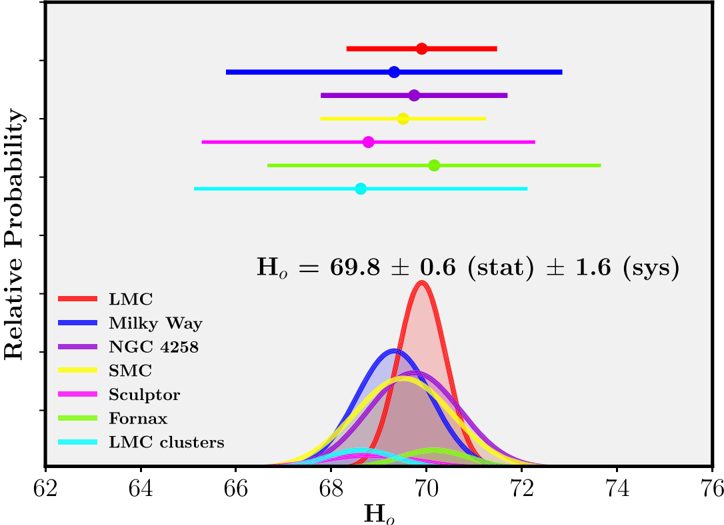
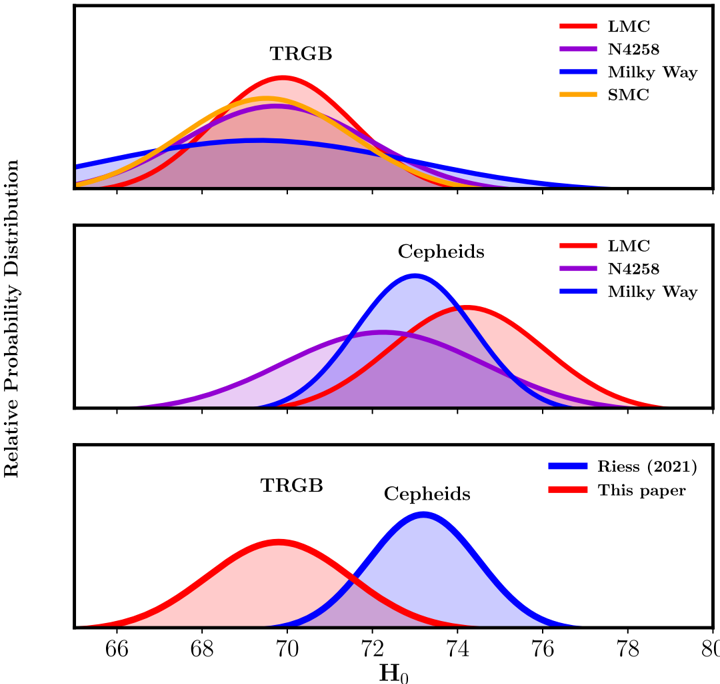
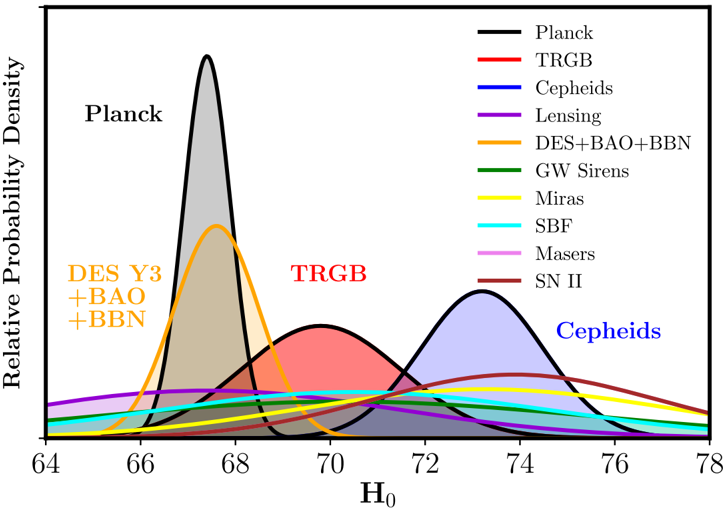
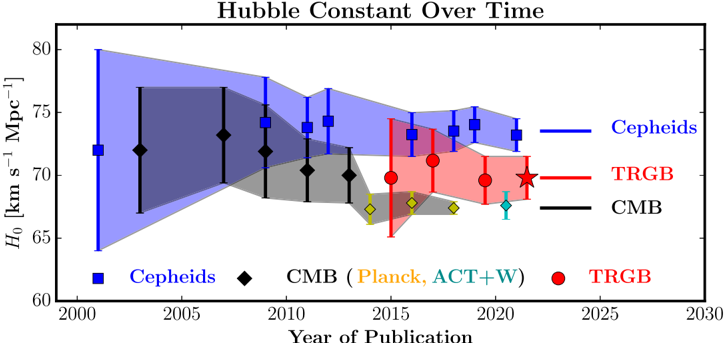
Measurement of the distances to nearby galaxies has improved rapidly in recent decades. The ever-present challenge is to reduce systematic effects, especially as greater distances are probed and the uncertainties become larger. In this paper, we combine several recent calibrations of the tip of the red giant branch (TRGB) method. These calibrations are internally self-consistent at the 1% level. New Gaia Early Data Release 3 data provide an additional consistency check at a (lower) 5% level of accuracy, a result of the well-documented Gaia angular covariance bias. The updated TRGB calibration applied to a sample of Type Ia supernovae from the Carnegie Supernova Project results in a value of the Hubble constant of H 0 = 69.8 ± 0.6 (stat) ± 1.6 (sys) km s−1 Mpc−1. No statistically significant difference is found between the value of H 0 based on the TRGB and that determined from the cosmic microwave background. The TRGB results are also consistent to within 2 σ with the SHoES and Spitzer plus Hubble Space Telescope (HST) Key Project Cepheid calibrations. The TRGB results alone do not demand additional new physics beyond the standard (ΛCDM) cosmological model. They have the advantage of simplicity of the underlying physics (the core He flash) and small systematic uncertainties (from extinction, metallicity, and crowding). Finally, the strengths and weaknesses of both the TRGB and Cepheids are reviewed, and prospects for addressing the current discrepancy with future Gaia, HST, and James Webb Space Telescope observations are discussed. Resolving this discrepancy is essential for ascertaining if the claimed tension in H 0 between the locally measured and CMB-inferred values is physically motivated.
Overview
The claims and statistics of this paper haven’t been checked yet.
Free: it reads the open-access text and checks the first 5 claims that cite a source we can check. Create a free account to check every claim.
Integrity signals
Registry
Cites
Statistics
Figures
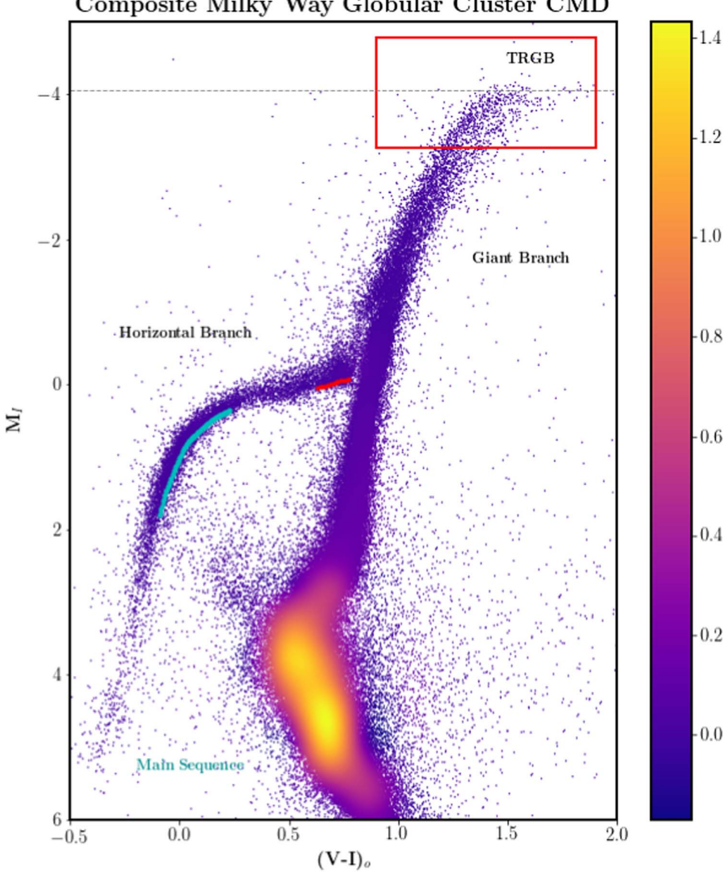
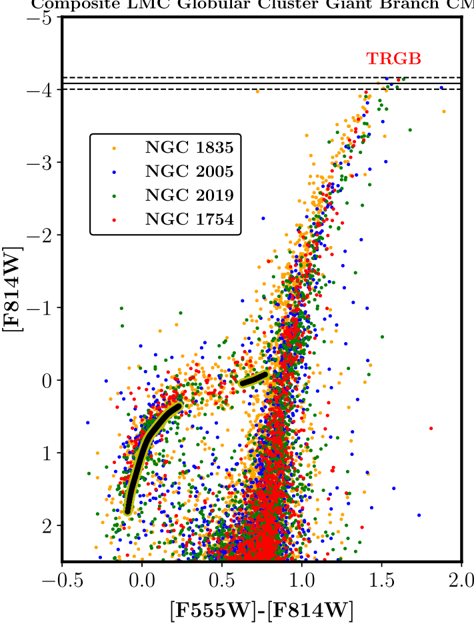
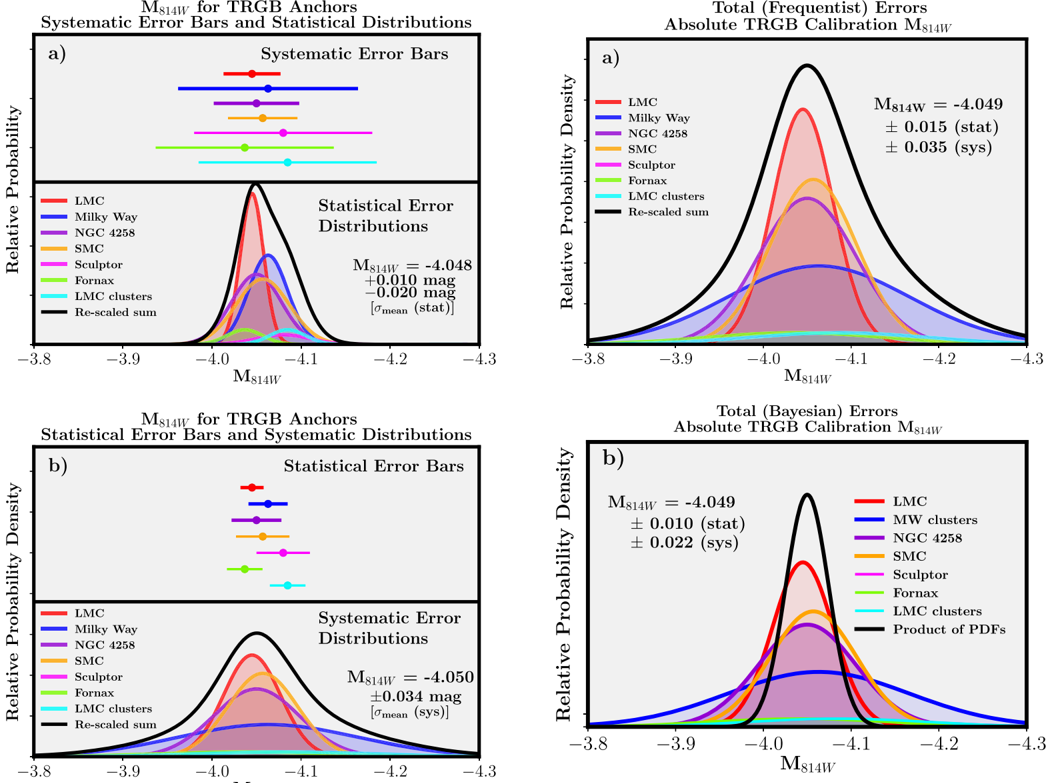
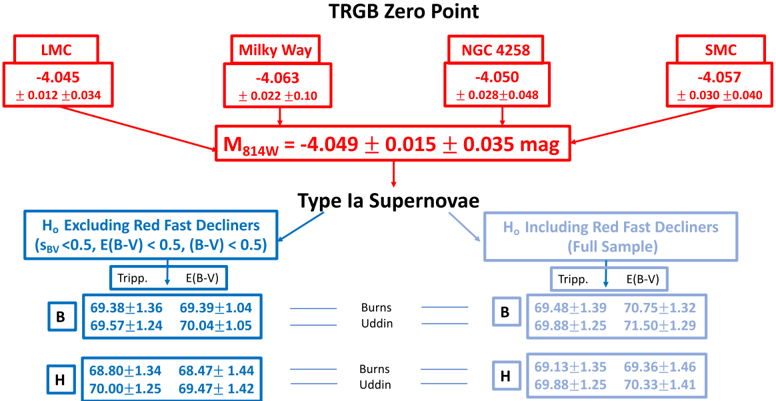
Verification
Claims the paper makes
The claims and statistics of this paper haven’t been checked yet.
Free: it reads the open-access text and checks the first 5 claims that cite a source we can check. Create a free account to check every claim.
Claims other papers make about this one
Each is checked against this paper’s own text: does it say what the citing paper says it does?
The source backs part of the claim, not all of it — or backs it for a different population, condition or comparison.
In the citing paper
“there is the well-discussed Freedman 2021 [33] measurement which is exactly in between the Planck and SH0ES values of H 0 , i.e., in agreement with both sides within 1.5σ”
From Challenges of the Standard Cosmological Model (2022) · cites this paper as [33]
Experimental — accuracy not yet measured
Self-check
Percentages, sums and reported differences re-computed from the paper’s own numbers.
The self-check needs the paper’s full text.
Citations
Cites
Planck 2018 results: VI. Cosmological parameters
Planck Collaboration, Aghanim, N., Akrami, Y., Ashdown, M., Aumont, J., Baccigalupi, C., Ballardini, M., Banday, A. J., Barreiro, R. B., Bartolo, N., et al. (2020) · Astronomy & Astrophysics · doi:10.1051/0004-6361/201833910 · Cited by 14,258
Stan : A Probabilistic Programming Language
Carpenter, B., Gelman, A., Hoffman, M. D., Lee, D., Goodrich, B., Betancourt, M., Brubaker, M., Guo, J., Li, P., & Riddell, A. (2017) · Journal of Statistical Software · doi:10.18637/jss.v076.i01 · Cited by 7,754
MEASURING REDDENING WITH SLOAN DIGITAL SKY SURVEY STELLAR SPECTRA AND RECALIBRATING SFD
Schlafly, E. F., & Finkbeiner, D. P. (2011) · The Astrophysical Journal · doi:10.1088/0004-637x/737/2/103 · Cited by 7,531
Gaia Collaboration, Prusti, T., de Bruijne, J. H. J., Brown, A. G. A., Vallenari, A., Babusiaux, C., Bailer-Jones, C. A. L., Bastian, U., Biermann, M., Evans, D. W., et al. (2016) · Astronomy & Astrophysics · doi:10.1051/0004-6361/201629272 · Cited by 6,946
DAOPHOT - A computer program for crowded-field stellar photometry
Stetson, P. B. (1987) · Publications of the Astronomical Society of the Pacific · doi:10.1086/131977 · Cited by 4,694 · cited 1×
“Cerny et al. expanded the Stetson catalog to incorporate nine additional low-reddening clusters with BVI photometry alone, archived at the CADC, and analyzed with the same DAOPHOT/ALLFRAME software (Stetson 1987, 1994).”
MethodA Catalog of Parameters for Globular Clusters in the Milky Way
Harris, W. E. (1996) · The Astronomical Journal · doi:10.1086/118116 · Cited by 4,500 · cited 1×
“Preliminary E(B− V ) reddening estimates and initial distance estimates were taken from Harris (1996, 2010).”
BackgroundBressan, A., Marigo, P., Girardi, L., Salasnich, B., Dal Cero, C., Rubele, S., & Nanni, A. (2012) · Monthly Notices of the Royal Astronomical Society · doi:10.1111/j.1365-2966.2012.21948.x · Cited by 4,174
Final Results from the Hubble Space Telescope Key Project to Measure the Hubble Constant
Freedman, W. L., Madore, B. F., Gibson, B. K., Ferrarese, L., Kelson, D. D., Sakai, S., Mould, J. R., Kennicutt, Jr., Ford, H. C., Graham, J. A., et al. (2001) · The Astrophysical Journal · doi:10.1086/320638 · Cited by 3,298
Self-citationScolnic, D. M., Jones, D. O., Rest, A., Pan, Y. C., Chornock, R., Foley, R. J., Huber, M. E., Kessler, R., Narayan, G., Riess, A. G., et al. (2018) · The Astrophysical Journal · doi:10.3847/1538-4357/aab9bb · Cited by 2,700
A 2.4% DETERMINATION OF THE LOCAL VALUE OF THE HUBBLE CONSTANT*
Riess, A. G., Macri, L. M., Hoffmann, S. L., Scolnic, D., Casertano, S., Filippenko, A. V., Tucker, B. E., Reid, M. J., Jones, D. O., Silverman, J. M., et al. (2016) · The Astrophysical Journal · doi:10.3847/0004-637x/826/1/56 · Cited by 2,242
Research works printed but not linked: 11
- Bellazzini, M. 2008, MmSAI, 79, 440
- Carretta, E., & Bragaglia, A. 1998, A&A, 329, 937
- DES Collaboration, Abbott, T. M. C., Aguena, M., et al. 2021, arXiv:2105. 13549
- Freedman, W. L., Madore, B. F., Hoyt, T., et al. 2021, JWST Proposal Cycle 1, 1995
- Madore, B. F. 1976, The Galaxy and the Local Group, Vol. 182 (Greenwich: Royal Greenwich Observatory), 153
- Mortsell, E., Goobar, A., Johansson, J., & Dhawan, S. 2021, arXiv:2105.11461 · arXiv
- Oakes, E., Hoyt, T., Freedman, W., et al. 2021, ApJ, in press
- Owens, K., Freedman, W. L., Madore, B. F., et al. 2021, ApJ, in press
- Tran, Q., Hoyt, T., Freedman, W., et al. 2021, ApJ, in press
- Tripp, R. 1998, A&A, 331, 815
- Ulaczyk, K., Szymański, M. K., Udalski, A., et al. 2012, AcA, 62, 247
Cited by
Items 601–682 of 682
Zhou, L. (2023) · Highlights in Science Engineering and Technology · doi:10.54097/hset.v38i.5817
The Hubble Tension Produces New PhysicsPreprint
Baruch, J. E. F. (2023) · Research Square · doi:10.21203/rs.3.rs-2800023/v1
Теория Стационарной Самосогласованной ВселеннойPreprint
Авшалумов, А. (2023) · doi:10.24108/preprints-3112783
Talbot, P. (2023) · Physics International · doi:10.3844/pisp.2023.1.5
“The observed values are more or less precise and oscillate between 70 and 74 km s Mpc, depending on the techniques used (Riess et al., 2022; Freedman, 2021; Khetan et al., 2021; Liao et al., 2019; Pesce et al., 2020; Yang et al., 2020).”
MethodYang, T. Z., Zhang, M., Shen, T., Jiang, J., Faison, M. D., Warrener, M., & Zheng, T. (2023) · Astrophysics and Space Science · doi:10.1007/s10509-023-04250-x
The Schwarzschild solution contains three problems, which can be easily solved
Yanchilina, F., & Yanchilin, V. L. (2023) · Journal of King Saud University - Science · doi:10.1016/j.jksus.2023.103059
A relação velocidade-distância para as galáxias estabelecida por Edwin Hubble
Machado, D. I. (2024) · Cadernos de Astronomia · doi:10.47456/cad.astro.v5n1.43115
Бисноватый-Коган, Г. С., & Nikishin, A. M. (2023) · Astronomicheskii Zhurnal · doi:10.31857/s0004629923020032
Ravoux, C. (2022) · theses.fr (ABES) · doi:10.70675/96c317d0z0755z47d2z9abfz68419df18468 · Cited by 1
Nash, G. (2024) · SSRN Electronic Journal · doi:10.2139/ssrn.4849629
Cosmological Models with Negative $$\varLambda $$
Sen, A. A. (2024) · Springer Series in Astrophysics and Cosmology · doi:10.1007/978-981-99-0177-7_28
A summary of instruments proposed for observing pulsating variables from the Mt. Abu Observatory
Mishra, A. K., Sarkar, D. R., Prajapati, P., Singh, A., Kasarla, P. K., & Ganesh, S. (2024) · Journal of Astrophysics and Astronomy · doi:10.1007/s12036-024-10019-7
Concluding Remarks to the IWARA 2024
Horvath, J. E. (2024) · Astronomische Nachrichten · doi:10.1002/asna.20240137
On a free Dirac–Born–Infeld interacting vacuum model
Gregoris, D. (2025) · The European Physical Journal C · doi:10.1140/epjc/s10052-025-14068-2
“The former refers to the different and seemingly inconsistent estimates of the Hubble constant H 0 from early and late time astrophysical probes [4,5], while the latter deals with the development of matter inhomogeneities and their clustering properties [6].”
Evidence for a Steady-State Universe
Dunstan, D. E. (2025) · Journal of Modern Physics · doi:10.4236/jmp.2025.164029
Hubble's relation and It's exponential generalization with Cosmological ApplicationsPreprint
Islam, A. (2025) · SSRN Electronic Journal · doi:10.2139/ssrn.5262889
The vertical structure of the stellar disk in NGC 551
Raut, H., Patra, N. N., Biswas, P., Roy, N., Kalinova, V., Dzib, S. A., Colombo, D., Villanueva, V., & Sánchez, S. F. (2025) · Astronomy and Astrophysics · doi:10.1051/0004-6361/202450431
Hubble Tension Test Using the Artificial Neural NetworksPreprint
Zhang, M., Yang, M., & Wang, J. (2025) · SSRN Electronic Journal · doi:10.2139/ssrn.5372838
Fourniere, B. D. L. (2025) · SSRN Electronic Journal · doi:10.2139/ssrn.5360587
da Rocha, N. M. N., Ribeiro, A. L. B., & Oliveira, F. B. S. (2025) · Universe · doi:10.3390/universe11090303
“The persistent nature of this tension has led to numerous investigations of potential systematic errors in early or late universe measurements [13,14].”
Growth Index in the γδCDM modelPreprint
Deliduman, C., Dilsiz, F. Ş., & Binici, S. S. (2025) · SSRN Electronic Journal · doi:10.2139/ssrn.5500663
Evolution of superhorizon perturbations in early Universe with anisotropic solid remnant
Mészáros, P., & Račko, D. (2025) · The European Physical Journal C · doi:10.1140/epjc/s10052-025-14738-1
“The most important problem is the tension between the local value of the Hubble constant and its value from the cosmic microwave background (CMB) [9–12], and there are also anomalies of the CMB anisotropies for low multipole moments [13,14].”
Cosmographic constraints on a Gödel-type rotating universe
Verma, A., Aluri, P. K., Mota, D. F., & Obukhov, Y. N. (2026) · Journal of Cosmology and Astroparticle Physics · doi:10.1088/1475-7516/2026/06/047
“[44, 45, 46, 47]).”
The Big Bang: Origins and initial conditions from Self-Regulating Cosmology (SRC) model
Mbonye, M. R. (2025) · International Journal of Modern Physics D · doi:10.1142/s0218271825500890
Between Nothing and Everything: The Cosmic Equilibrium and Its Interdisciplinary InsightsPreprint
Srivastava, P. K. (2025) · SSRN Electronic Journal · doi:10.2139/ssrn.5690982
ALTERING THE PRE-RECOMBINATION EXPANSION HISTORY WITH HIDDEN SECTOR PHYSICS
Sobotka, A. C. (2025) · Carolina Digital Repository (University of North Carolina at Chapel Hill) · doi:10.17615/4ph4-hh59
Aspects of Inflation and Cosmology in Non-Minimally Coupled and R² Palatini Gravity
Lloyd-Stubbs, K. (2022) · Lancaster EPrints (Lancaster University) · doi:10.17635/lancaster/thesis/1829
Q-Matter coupling in modified gravity
Correia, F. G. P. D. R. (2024) · Portuguese National Funding Agency for Science, Research and Technology (RCAAP Project by FCT)
Generalized tension metrics for multiple cosmological datasetsPreprint
Leizerovich, M., Landau, S. J., & Scóccola, C. G. (2025) · arXiv (Cornell University) · doi:10.48550/arxiv.2512.06086
Hubble’s Law and It’s Exponential Generalization with Cosmological Applications
Islam, A. (2025) · East European Journal of Physics · doi:10.26565/2312-4334-2025-4-02
Menin, B. M. (2026) · Journal of Applied Mathematics and Physics · doi:10.4236/jamp.2026.141005
Employing dark matter and phantom-like fluids to alleviate the Hubble tension
da Silva, D. R. (2023) · LA Referencia (Red Federada de Repositorios Institucionales de Publicaciones Científicas)
Black-hole dynamics and their environments
Gangardt, D. (2024) · University of Birmingham Institutional Research Archive (University of Birmingham)
Nguyen, H. K. (2026) · arXiv (Cornell University) · doi:10.48550/arxiv.2601.05512
“…Matter (ΛCDM) model, has been very successful in explaining a wide range of observations—from the cosmic microwave background to large-scale structure formation—yet it fundamentally relies on the existence of an enigmatic form of dark energy (DE), represented by the cosmological constant Λ [1–4].”
π as a Structural Constant in Vacuum-Dominated Cosmology
Acha, S. (2026) · Reports in Advances of Physical Sciences · doi:10.1142/s2424942426500052
Almeida, J. (2026) · Preprints.org · doi:10.20944/preprints202603.0762.v1
Initial conditions and backreaction effects in quantum cosmology
Schander, S. (2022) · theses.fr (ABES) · doi:10.70675/4853890dz9adcz4519zb7eeze0fb80a180e8
Cosmologie à partir des observations Sunyaev-Zeldovich d’amas de galaxies avec NIKA2
Kéruzoré, F. (2021) · theses.fr (ABES) · doi:10.70675/9c19f7b8za476z4b97zbc8cz30ff778a7005 · Cited by 2
Searching for new physics with CMB precision cosmology
Abellán, G. F. (2022) · theses.fr (ABES) · doi:10.70675/2a1a0ae5zedfbz4400z9df3zb6db149b4c4c
Posta, A. L. (2023) · theses.fr (ABES) · doi:10.70675/db157fb0zeb7ez4d8dzbcf9z09f379bf6180
McINTYRE, J. L. (2026) · Philosophy of Science · doi:10.1017/psa.2026.10210
Lee, T.-K. (2026) · Monthly Notices of the Royal Astronomical Society · doi:10.1093/mnras/stag726
Chung, C., Lee, Y., Yoon, S.-J., Kim, Y. C., Han, S.-I., Cho, H., Lim, D., Kim, Y.-L., Jang, S., Hong, S. S., et al. (2026) · The Astrophysical Journal · doi:10.3847/1538-4357/ae5d3e
Inferences for f ( R ) Models from Late-time Megamaser Observational Data
Habib, A. D., & Rani, N. (2026) · Research in Astronomy and Astrophysics · doi:10.1088/1674-4527/ae7403
Redshift-Dependent Intrinsic Dispersion in the Quasar UV/X-ray Luminosity RelationPreprint
Gao, Hu, J., Chen, Y., Zhao, B., & Xu, L. (2026) · arXiv (Cornell University) · doi:10.48550/arxiv.2606.27173
Cosmology from HI galaxy surveys with the SKAPreprint
Nasirudin, A., Bull, P., Sakr, Z., Mayor, J., Bahr-Kalus, B., Pan, H., Camera, S., Fonseca, J., Randrianjanahary, L. F., Lucia, G. D., et al. (2026) · arXiv (Cornell University) · doi:10.48550/arxiv.2607.00827
Kumar, D., & Torres-Orjuela, A. (2026) · arXiv (Cornell University) · doi:10.48550/arxiv.2607.03672
Evaluating the Universe’s Growth Rate via Overlapping Redshift Hubble DataPreprint
Sandler, L. (2026) · Research Square · doi:10.21203/rs.3.rs-10370378/v1
Concluding Remarks to the MAGIC 2025
Horvath, J. E. (2026) · Astronomische Nachrichten · doi:10.1002/asna.70117
New generalization of the Barboza-Alcaniz parametrization of Dark energyPreprint
Shahidi, S. (2026) · arXiv (Cornell University) · doi:10.48550/arxiv.2607.21064
Semiresolved Stellar Populations as Distance Indicators
Martín-Navarro, I., Iglesias-Navarro, P., Barbera, F. L., Vazdekis, A., Beasley, M. A., Hahn, C., de Arriba, L. P., Asensio, I. A., Angeloudi, E., Cerviño, M., et al. (2026) · The Astrophysical Journal Letters · doi:10.3847/2041-8213/ae8d10
“In addition, different cosmological distance indicators have different applicability ranges with limited overlap between them, hindering comprehensive comparisons and cross-checks ( e.g., W. L. Freedman 2021a ) .”
An Empirical Constraint on the Hubble Constant from the Relation Ωᵧ = α²Preprint
Kulangiev, B. (2026) · Qeios · doi:10.32388/qd6z0n
Theoretical Analysis of Barrow Holographic Dark Energy in Fractal Cosmology
Zhao, H., & Yang, W. (2026) · Symmetry · doi:10.3390/sym18081327
An Empirical Constraint on the Hubble Constant from the Relation Ωᵧ = α²Preprint
Kulangiev, B. (2026) · Qeios · doi:10.32388/qd6z0n.2
Ćirković, M. M., & Perović, S. (2026) · The European Physical Journal H · doi:10.1140/epjh/s13129-026-00122-4
“(The controversy about the value of Hubble’s constant in the real universe did not cease with the parametrization, of course; as mentioned above, it is now usually referred to under the fancy name of the “Hubble tension,” cf. Freedman (2021); Kamionkowski & Riess 2023).”
Strong Lensing Cosmology with Population-level Calibrated Neural Ratio EstimationPreprint
Jarugula, S., Nord, B., Ćiprijanović, A., & Trivedi, S. (2026) · arXiv (Cornell University) · doi:10.48550/arxiv.2608.23534
A bayesian determination of the Hubble constant using 126 fast radio bursts
Piratova-Moreno, E. F. (2026) · Frontiers in Astronomy and Space Sciences · doi:10.3389/fspas.2026.1753671
“6 ( sys ) kms − 1 Mpc − 1 , with no statistically significant difference with the CMB-based result (Freedman, 2021); early-dark-energy scenarios have identified regions of parameter space in which the H 0 inferred from Planck data agrees with the SH0ES local measurement (Poulin et al., 2019); and a…”
Limits on the inferred Hubble constant bias from a local McVittie gravitational field
Gregoris, D. (2026) · Physics Letters B · doi:10.1016/j.physletb.2026.140877
“Consequently, while spatial inhomogeneity undeniably introduces an observer-dependent geometric bias, its quantitative contribution on galactic scales is far too small to resolve or account for the ∼ 8% Hubble tension [45, 46].”
InfluentialMach's Principle: The Alternative to Dark Energy for Cosmological Inflation
Biswas, S. (2026) · Fortschritte der Physik · doi:10.1002/prop.70147
Identification of cosmic chronometers in the GAMA survey
Hunt, L., Pimbblet, K. A., & Benoit, D. M. (2026) · Monthly Notices of the Royal Astronomical Society · doi:10.1093/mnras/stag1736
Aspects of Inflation and Cosmology in Non-Minimally Coupled and $R^{2}$ Palatini GravityPreprint
Lloyd-Stubbs, K. (2022) · arXiv (Cornell University) · doi:10.48550/arxiv.2212.06749
Martínez-Vázquez, C. E., Mullen, J. P., Marengo, M., Giuseppe, B., Braga, V. F., Cassisi, S., Chaboyer, B., Dall’Ora, M., D’Orazi, V., Fabrizio, M., et al. (2026) · arXiv (Cornell University) · doi:10.48550/arxiv.2609.27119
GEO-Hubble Geometric Projection: A Reproducible Projective Mapping of the Hubble ScalePreprint
torreblanca, L. (2026) · doi:10.14293/pr2199.004491.v1
Bansal, A., Taylor, E. N., Cluver, M., & Colless, M. (2026) · Monthly Notices of the Royal Astronomical Society · doi:10.1093/mnras/stag1867
Understanding Λ with the Aid of Biconformal Gravity
Mittelman, W. (2023) · Prespacetime journal
Brown, A. (2025) · Cosmological and Astrobiological Review Journal for the Study of the Universe Life and the Natural Sciences · doi:10.65932/car-2025-2-3
Schumacher, K. (2025) · Illinois Digital Environment for Access to Learning and Scholarship (University of Illinois at Urbana-Champaign)
Population II PAGB Stars. I. Methodology, Initial Results, and the First Luminosity Function
Feeser, S. J., Ciardullo, R., Siegel, M. H., Hapich, C. J., & Chaturvedi, A. S. (2026) · The Astrophysical Journal · doi:10.3847/1538-4357/aeae23
Dark energy in non-linear f(Q,Lm) gravity with exponential parametrization of Hubble parameter
Bayaskara, S. N., Vishwakarma, A. D., Qadeer, S. A. A., Praveen, J., & Darunde, S. C. (2026) · Physics Letters B · doi:10.1016/j.physletb.2026.141073
Thippeswamy, K. R., Nirani, L., & Narasimhamurthy, S. K. (2026) · Monthly Notices of the Royal Astronomical Society · doi:10.1093/mnras/stag1872
A cosmological intercept tension in local distance laddersPreprint
Dong, H., Biesiada, M., Cao, Z., & Wang, S.-J. (2026) · arXiv (Cornell University) · doi:10.48550/arxiv.2610.31181
Matarese, V. (2026) · Elsevier eBooks · doi:10.1016/b978-0-443-40622-5.00015-3
Testing Schouten--Codazzi Gravity: Cosmological Constraints and Deviations from $Λ$CDMPreprint
Fontanet, A., Valencia, A., Adil, S. A., Nájera, S., Sussman, R. A., Vazquez, J. A., & Hidalgo, J. C. (2026) · arXiv (Cornell University) · doi:10.48550/arxiv.2610.36002
Weighted Averages with Statistical and Systematic Uncertainties
Livadiotis, G. (2026) · Stats · doi:10.3390/stats9060120
An obstruction to cosmic acceleration from shift-symmetric dark sector interactionsPreprint
Jiménez, J. B., Garay, L. J., Jensko, E., & Garrote, M. P. (2026) · arXiv (Cornell University) · doi:10.48550/arxiv.2611.05560
Zhang, X. (2026) · Science China Physics Mechanics and Astronomy · doi:10.1007/s11433-026-3116-4 · Cited by 2
The 10 Mpc VolumePreprint
Tully, R. B., Anand, G. S., Courtois, H. M., Karachentsev, I. D., Karachentseva, V. E., Kourkchi, E., Makarov, D. I., Makarova, L. N., Pomarede, D., & Shaya, E. J. (2026) · arXiv (Cornell University) · doi:10.48550/arxiv.2611.07284
Constraints on Quintom Dark Energy Model with Matter InteractionPreprint
Kaeonikhom, C., Rukpakawong, T., & Burikham, P. (2026) · arXiv (Cornell University) · doi:10.48550/arxiv.2611.08523
Metadata
- Authors
- Freedman, W. L.
- Affiliations
- University of Chicago (US)
- Corresponding author
- Freedman, Wendy L.
- ORCID
- Freedman, Wendy L.
- Venue
- The Astrophysical Journal
- Publisher
- American Astronomical Society
- Published
- 2021-09-01
- Volume
- 919
- Issue
- 1
- Pages
- 16
- ISSN
- 0004-637X (ISSN-L)
- 1538-4357
- OpenAlex
- W3176418170
- Cited by
- 577
- References
- 105
- Citations by year
- 2026: 63 · 2025: 109 · 2024: 122 · 2023: 123 · 2022: 134 · 2021: 24
- FWCI
- 54.16
- Type
- journal article
- Language
- en
- Open access
- hybrid
- doi.org
- Licence
- cc-by
- creativecommons.org/licenses/by/4.0/ (vor, 16 d)
- iopscience.iop.org/info/page/text-and-data-mining (tdm, 16 d)
- Locations
- The Astrophysical Journal (publishedVersion, cc-by)
- arXiv (Cornell University) (submittedVersion)
- arXiv (Cornell University) (cc-by)
- Funders
- National Aeronautics and Space Administration (NAS 526555, 526555)
- Space Telescope Science Institute (NAS5- 26555, 5-26555, 26555, 13691)
- Topics
- Physical Sciences › Physics and Astronomy › Astronomy and Astrophysics › Cosmology and Gravitation Theories
- Physical Sciences › Physics and Astronomy › Astronomy and Astrophysics › Stellar, planetary, and galactic studies
- Physical Sciences › Physics and Astronomy › Astronomy and Astrophysics › Galaxies: Formation, Evolution, Phenomena
- Keywords
- Hubble constant, Hubble tension, tip of the red giant branch, Type Ia supernovae, Cepheid calibration, cosmic microwave background, core helium flash, local distance ladder, systematic uncertainties
About these checks
Registry, retraction, Cites and statistics results are computed, not judged, with one exception: a printed reference that no index lists is read once by a model before it counts as a citation error. Claims are extracted by a model and kept only when their quote appears verbatim in the text; each cited source is then checked, with a model’s help, for whether it says what the claim relies on. Those verdicts can be wrong — read the claim’s quote and the cited source before relying on one.
Statistics and arithmetic are recomputed, not judged.
Confidence bands are shown only for fields calibrated on our annotated test set. None is calibrated yet, so no band is shown.
What counts as a claim ›How we measure confidence ›How we check this ›
Are you an author, or do you see a problem with this page? Request a review
Data sources
Bibliographic data: Semantic Scholar, OpenAlex, Crossref.
Contains information from the Semantic Scholar Academic Graph Datasets, made available under the ODC Attribution License (ODC-BY 1.0).
Semantic Scholar’s data is described in: Kinney, R., et al. (2023). The Semantic Scholar Open Data Platform. arXiv:2301.10140.
