

Measurements of the Hubble Constant: Tensions in Perspective
Open accessThe DOI matches its Crossref record; 110 of the 110 references it cites were found in a registry or an index.
Abstract
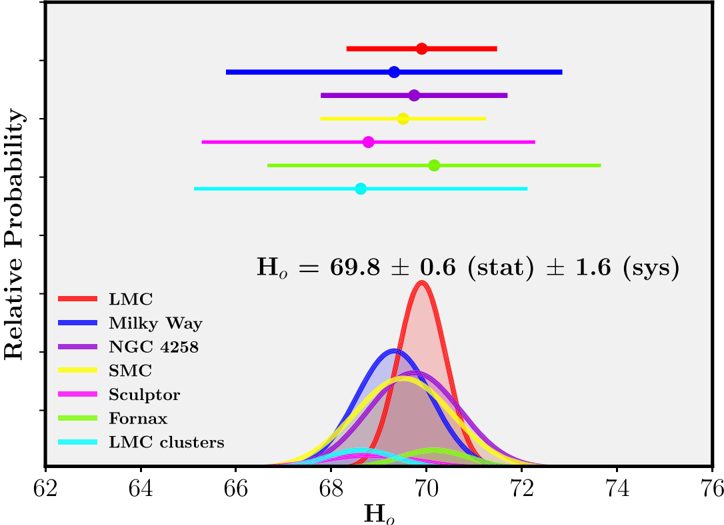
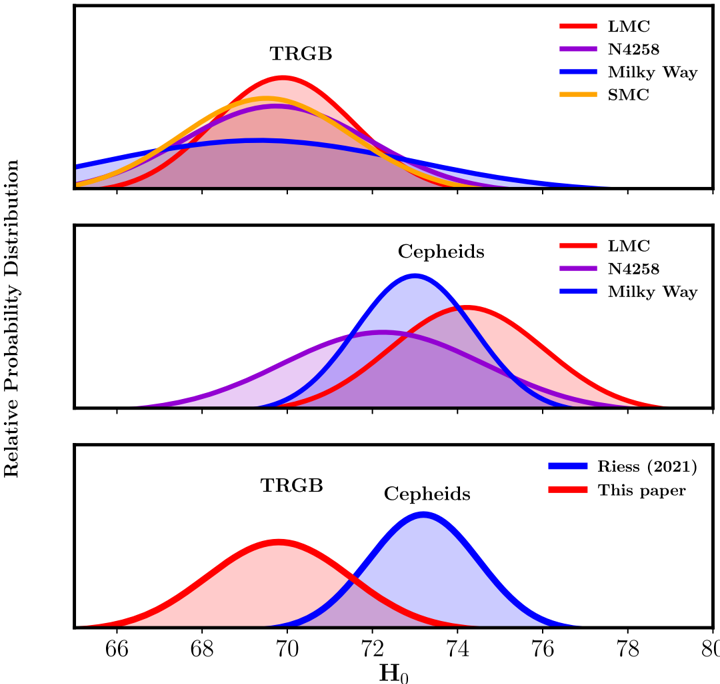
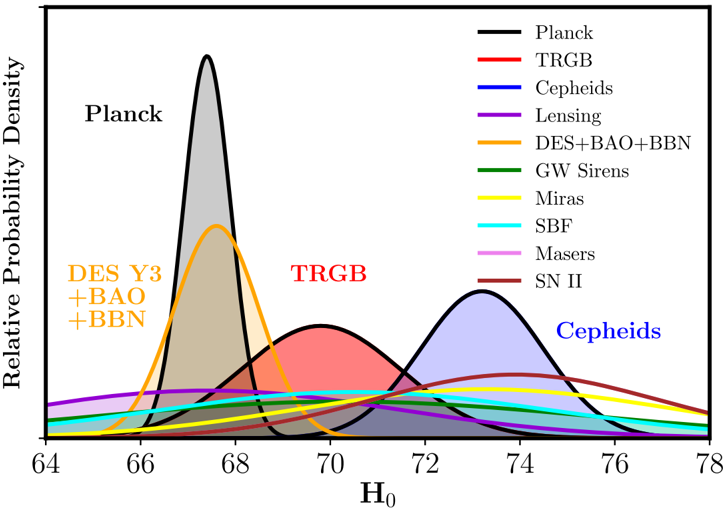
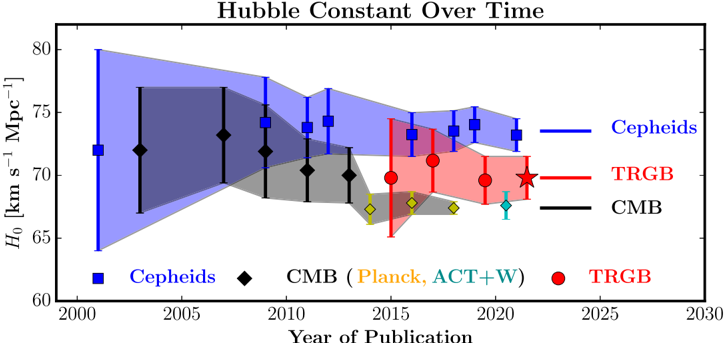
Measurement of the distances to nearby galaxies has improved rapidly in recent decades. The ever-present challenge is to reduce systematic effects, especially as greater distances are probed and the uncertainties become larger. In this paper, we combine several recent calibrations of the tip of the red giant branch (TRGB) method. These calibrations are internally self-consistent at the 1% level. New Gaia Early Data Release 3 data provide an additional consistency check at a (lower) 5% level of accuracy, a result of the well-documented Gaia angular covariance bias. The updated TRGB calibration applied to a sample of Type Ia supernovae from the Carnegie Supernova Project results in a value of the Hubble constant of H 0 = 69.8 ± 0.6 (stat) ± 1.6 (sys) km s−1 Mpc−1. No statistically significant difference is found between the value of H 0 based on the TRGB and that determined from the cosmic microwave background. The TRGB results are also consistent to within 2 σ with the SHoES and Spitzer plus Hubble Space Telescope (HST) Key Project Cepheid calibrations. The TRGB results alone do not demand additional new physics beyond the standard (ΛCDM) cosmological model. They have the advantage of simplicity of the underlying physics (the core He flash) and small systematic uncertainties (from extinction, metallicity, and crowding). Finally, the strengths and weaknesses of both the TRGB and Cepheids are reviewed, and prospects for addressing the current discrepancy with future Gaia, HST, and James Webb Space Telescope observations are discussed. Resolving this discrepancy is essential for ascertaining if the claimed tension in H 0 between the locally measured and CMB-inferred values is physically motivated.
Overview
The claims and statistics of this paper haven’t been checked yet.
Free: it reads the open-access text and checks the first 5 claims that cite a source we can check. Create a free account to check every claim.
Integrity signals
Registry
Cites
Statistics
Figures
Verification
Claims the paper makes
The claims and statistics of this paper haven’t been checked yet.
Free: it reads the open-access text and checks the first 5 claims that cite a source we can check. Create a free account to check every claim.
Claims other papers make about this one
Each is checked against this paper’s own text: does it say what the citing paper says it does?
The source backs part of the claim, not all of it — or backs it for a different population, condition or comparison.
In the citing paper
“there is the well-discussed Freedman 2021 [33] measurement which is exactly in between the Planck and SH0ES values of H 0 , i.e., in agreement with both sides within 1.5σ”
From Challenges of the Standard Cosmological Model (2022) · cites this paper as [33]
Experimental — accuracy not yet measured
Self-check
Percentages, sums and reported differences re-computed from the paper’s own numbers.
The self-check needs the paper’s full text.
Citations
Cites
Planck 2018 results: VI. Cosmological parameters
Planck Collaboration, Aghanim, N., Akrami, Y., Ashdown, M., Aumont, J., Baccigalupi, C., Ballardini, M., Banday, A. J., Barreiro, R. B., Bartolo, N., et al. (2020) · Astronomy & Astrophysics · doi:10.1051/0004-6361/201833910 · Cited by 14,258
Stan : A Probabilistic Programming Language
Carpenter, B., Gelman, A., Hoffman, M. D., Lee, D., Goodrich, B., Betancourt, M., Brubaker, M., Guo, J., Li, P., & Riddell, A. (2017) · Journal of Statistical Software · doi:10.18637/jss.v076.i01 · Cited by 7,754
MEASURING REDDENING WITH SLOAN DIGITAL SKY SURVEY STELLAR SPECTRA AND RECALIBRATING SFD
Schlafly, E. F., & Finkbeiner, D. P. (2011) · The Astrophysical Journal · doi:10.1088/0004-637x/737/2/103 · Cited by 7,531
Gaia Collaboration, Prusti, T., de Bruijne, J. H. J., Brown, A. G. A., Vallenari, A., Babusiaux, C., Bailer-Jones, C. A. L., Bastian, U., Biermann, M., Evans, D. W., et al. (2016) · Astronomy & Astrophysics · doi:10.1051/0004-6361/201629272 · Cited by 6,946
DAOPHOT - A computer program for crowded-field stellar photometry
Stetson, P. B. (1987) · Publications of the Astronomical Society of the Pacific · doi:10.1086/131977 · Cited by 4,694 · cited 1×
“Cerny et al. expanded the Stetson catalog to incorporate nine additional low-reddening clusters with BVI photometry alone, archived at the CADC, and analyzed with the same DAOPHOT/ALLFRAME software (Stetson 1987, 1994).”
MethodA Catalog of Parameters for Globular Clusters in the Milky Way
Harris, W. E. (1996) · The Astronomical Journal · doi:10.1086/118116 · Cited by 4,500 · cited 1×
“Preliminary E(B− V ) reddening estimates and initial distance estimates were taken from Harris (1996, 2010).”
BackgroundBressan, A., Marigo, P., Girardi, L., Salasnich, B., Dal Cero, C., Rubele, S., & Nanni, A. (2012) · Monthly Notices of the Royal Astronomical Society · doi:10.1111/j.1365-2966.2012.21948.x · Cited by 4,174
Final Results from the Hubble Space Telescope Key Project to Measure the Hubble Constant
Freedman, W. L., Madore, B. F., Gibson, B. K., Ferrarese, L., Kelson, D. D., Sakai, S., Mould, J. R., Kennicutt, Jr., Ford, H. C., Graham, J. A., et al. (2001) · The Astrophysical Journal · doi:10.1086/320638 · Cited by 3,298
Self-citationScolnic, D. M., Jones, D. O., Rest, A., Pan, Y. C., Chornock, R., Foley, R. J., Huber, M. E., Kessler, R., Narayan, G., Riess, A. G., et al. (2018) · The Astrophysical Journal · doi:10.3847/1538-4357/aab9bb · Cited by 2,700
A 2.4% DETERMINATION OF THE LOCAL VALUE OF THE HUBBLE CONSTANT*
Riess, A. G., Macri, L. M., Hoffmann, S. L., Scolnic, D., Casertano, S., Filippenko, A. V., Tucker, B. E., Reid, M. J., Jones, D. O., Silverman, J. M., et al. (2016) · The Astrophysical Journal · doi:10.3847/0004-637x/826/1/56 · Cited by 2,242
Research works printed but not linked: 11
- Bellazzini, M. 2008, MmSAI, 79, 440
- Carretta, E., & Bragaglia, A. 1998, A&A, 329, 937
- DES Collaboration, Abbott, T. M. C., Aguena, M., et al. 2021, arXiv:2105. 13549
- Freedman, W. L., Madore, B. F., Hoyt, T., et al. 2021, JWST Proposal Cycle 1, 1995
- Madore, B. F. 1976, The Galaxy and the Local Group, Vol. 182 (Greenwich: Royal Greenwich Observatory), 153
- Mortsell, E., Goobar, A., Johansson, J., & Dhawan, S. 2021, arXiv:2105.11461 · arXiv
- Oakes, E., Hoyt, T., Freedman, W., et al. 2021, ApJ, in press
- Owens, K., Freedman, W. L., Madore, B. F., et al. 2021, ApJ, in press
- Tran, Q., Hoyt, T., Freedman, W., et al. 2021, ApJ, in press
- Tripp, R. 1998, A&A, 331, 815
- Ulaczyk, K., Szymański, M. K., Udalski, A., et al. 2012, AcA, 62, 247
Cited by
Riess, A. G., Yuan, W., Macri, L. M., Scolnic, D., Brout, D., Casertano, S., Jones, D. O., Murakami, Y., Anand, G. S., Breuval, L., et al. (2022) · The Astrophysical Journal Letters · doi:10.3847/2041-8213/ac5c5b · Cited by 2,380
“The 9 SNe in 7 EDD TRGB hosts are brighter than the 33 SNe Ia in 30 hosts without EDD and CCHP TRGB by 0.08± 0.05 mag as measured by Cepheids, which is consistent at 1.6σ with the sampling noise of the two sets (0.04 mag and 0.02 mag random error, respectively).”
BackgroundMethodInfluentialChallenges for Λ CDM: An update
Perivolaropoulos, L., & Skara, F. (2022) · New Astronomy Reviews · doi:10.1016/j.newar.2022.101659 · Cited by 902
The H 0 Olympics: A fair ranking of proposed models
Schöneberg, N., Abellán, G. F., Sánchez, A. P., Witte, S. J., Poulin, V., & Lesgourgues, J. (2022) · Physics Reports · doi:10.1016/j.physrep.2022.07.001 · Cited by 462
“6 (sys)) km/s/Mpc [3, 4], in between the Planck CMB prediction and the SH0ES calibration measurement.”
Di Valentino, E., Said, J. L., Riess, A., Pollo, A., Poulin, V., Gómez-Valent, A., Weltman, A., Palmese, A., Huang, C. D., Bruck, C. V. D., et al. (2025) · Physics of the Dark Universe · doi:10.1016/j.dark.2025.101965 · Cited by 319
Union through UNITY: Cosmology with 2000 SNe Using a Unified Bayesian Framework
Rubin, D., Aldering, G., Betoule, M., Fruchter, A., Huang, X., Kim, A. G., Lidman, C., Linder, E., Perlmutter, S., Ruiz-Lapuente, P., et al. (2025) · The Astrophysical Journal · doi:10.3847/1538-4357/adc0a5 · Cited by 246
Quantum gravity phenomenology at the dawn of the multi-messenger era—A review
Addazi, A., Alvarez-Muniz, J., Alves Batista, R., Amelino-Camelia, G., Antonelli, V., Arzano, M., Asorey, M., Atteia, J.-L., Bahamonde, S., Bajardi, F., et al. (2022) · Progress in Particle and Nuclear Physics · doi:10.1016/j.ppnp.2022.103948 · Cited by 440
The $H_0$ Olympics: A fair ranking of proposed models
Schöneberg, N., Abellán, G. F., Sánchez, A. P., Witte, S. J., Poulin, V., & Lesgourgues, J. (2021) · arXiv · doi:10.48550/arxiv.2107.10291 · Cited by 463
“6 (sys)) km/s/Mpc [3, 4], in between the Planck CMB prediction and the SH0ES calibration measurement.”
Seven Hints That Early-Time New Physics Alone Is Not Sufficient to Solve the Hubble Tension
Vagnozzi, S. (2023) · Universe · doi:10.3390/universe9090393 · Cited by 343
Rock ‘n’ roll solutions to the Hubble tension
Agrawal, P., Cyr-Racine, F.-Y., Pinner, D., & Randall, L. (2023) · Physics of the Dark Universe · doi:10.1016/j.dark.2023.101347 · Cited by 219
“The discrepancy of the present day Hubble parameter H 0 derived from local measurements [ 1– 22 ] and from cosmic microwave background Through the positions and spacing of the acoustic peaks present in CMB power spectra, the CMB is sensitive to H 0 via the well-measured angle θ s = r s /D M ( z ∗…”
BackgroundPoulin, V., Smith, T. L., & Karwal, T. (2023) · Physics of the Dark Universe · doi:10.1016/j.dark.2023.101348 · Cited by 230
“6 (sys)) km/s/Mpc [15, 26], in between the Planck CMB prediction and the SH0ES calibration measurement, and a re-analysis of the CCHP data by Anand et al.”
MethodHubble Tension: The Evidence of New Physics
Hu, J.-P., & Wang, F.-Y. (2023) · Universe · doi:10.3390/universe9020094 · Cited by 251
Is the observable Universe consistent with the cosmological principle?
Kumar Aluri, P., Cea, P., Chingangbam, P., Chu, M.-C., Clowes, R. G., Hutsemékers, D., Kochappan, J. P., Lopez, A. M., Liu, L., Martens, N. C. M., et al. (2023) · Classical and Quantum Gravity · doi:10.1088/1361-6382/acbefc · Cited by 238
Freedman, W. L., Madore, B. F., Hoyt, T. J., Jang, I. S., Lee, A. J., & Owens, K. A. (2025) · The Astrophysical Journal · doi:10.3847/1538-4357/adce78 · Cited by 164
“Of the 20 SNe Ia in W. L. Freedman ( 2021 ) and the 10 galaxies in the current study with JWST TRGB distances, there are six galaxies in common to both studies: M101, NGC 1365, NGC 4038, NGC 4424, NGC 4536, and NGC 5643.”
InfluentialSelf-citationDainotti, M. G., De Simone, B., Schiavone, T., Montani, G., Rinaldi, E., Lambiase, G., Bogdan, M., & Ugale, S. (2022) · Galaxies · doi:10.3390/galaxies10010024 · Cited by 220
“[117] test seven cosmological models through the constraints of SNe Ia, BAO, CMB, Planck lensing, and Cosmic Chronometers with the outcome that in the ΛCDM scenario a flat universe is favored.”
MethodInfluentialA non-linear solution to the S 8 tension?
Amon, A., & Efstathiou, G. (2022) · Monthly Notices of the Royal Astronomical Society · doi:10.1093/mnras/stac2429 · Cited by 179
Verde, L., Schöneberg, N., & Gil-Marín, H. (2024) · Annual Review of Astronomy and Astrophysics · doi:10.1146/annurev-astro-052622-033813 · Cited by 244
Astrophysical Axion Bounds: The 2024 Edition
Raffelt, G. G., & Caputo, A. (2024) · General Meeting and Training School of the COST Action COSMIC WISPers (COSMICWISPers) · doi:10.22323/1.454.0041 · Cited by 240
A buyer’s guide to the Hubble constant
Shah, P., Lemos, P., & Lahav, O. (2021) · The Astronomy and Astrophysics Review · doi:10.1007/s00159-021-00137-4 · Cited by 196
“More recently, an updated value of H0 1⁄4 69:8 0:6 (stat) 1:6 (sys) kms 1 Mpc 1 was published by Freedman (2021). New and updated values for MI based on the anchors of the LMC, SMC, NGC 4258 and galactic globular clusters are derived.”
InfluentialSALT3: An Improved Type Ia Supernova Model for Measuring Cosmic Distances
Kenworthy, W. D., Jones, D. O., Dai, M., Kessler, R., Scolnic, D., Brout, D., Siebert, M. R., Pierel, J. D. R., Dettman, K. G., Dimitriadis, G., et al. (2021) · The Astrophysical Journal · doi:10.3847/1538-4357/ac30d8 · Cited by 148
“The Hubble constant is currently the subject of a 4− 6σ tension when multiple independent late-time measurements are combined (Verde et al. 2019; Di Valentino et al. 2021), although measurements by Freedman (2021) do not find a significant discrepancy.”
BackgroundMethodInfluentialPark, C., Pérez, J. D. C., & Ratra, B. (2024) · Physical review. D/Physical review. D. · doi:10.1103/physrevd.110.123533 · Cited by 178
“From the P18+lensing+non-CMB data set in the flat ± from TRGB and SNIa data [54], but is in tension with the local H 0 = 73 .”
Riess, A. G., Scolnic, D. M., Anand, G. S., Breuval, L., Casertano, S., Macri, L. M., Li, S., Yuan, W., Huang, C. D., Jha, S. W., et al. (2024) · The Astrophysical Journal · doi:10.3847/1538-4357/ad8c21 · Cited by 201
“We also make use of HST I -band TRGB measurements in SN Ia hosts given by Freedman (2021) calibrated to NGC 4258 and Miras measured in SN Ia hosts calibrated to NGC 4258 (Huang et al. 2024).”
Riess, A. G., Breuval, L., Yuan, W., Casertano, S., Macri, L. M., Bowers, J. B., Scolnic, D. M., Cantat-Gaudin, T., Anderson, R. I., & Reyes, M. C. (2022) · The Astrophysical Journal · doi:10.3847/1538-4357/ac8f24 · Cited by 159
“While the limited precision of these calibrations still make them consistent with non-Gaia based results (e.g., Freedman 2021 at −4.05 and Anand et al. 2021 at MI=−4.00), they offer an important indicator as subsequent releases from Gaia offer the only route to beat the 1.5% precision of the best…”
BackgroundInfluentialIs local H0at odds with dark energy EFT?
Lee, B.-H., Lee, W., Colgáin, E. Ó., Sheikh-Jabbari, M. M., & Thakur, S. (2022) · Journal of Cosmology and Astroparticle Physics · doi:10.1088/1475-7516/2022/04/004 · Cited by 164
“The Planck H0 determination alongside local determinations based on Cepheids [10], TRGB [11], Miras [12], Masers [12], Tully-Fisher [13] and SBF [14].”
MethodInfluentialArcones, A., & Thielemann, F. ‐. (2022) · The Astronomy and Astrophysics Review · doi:10.1007/s00159-022-00146-x · Cited by 159
Implications for the Hubble tension from the ages of the oldest astrophysical objects
Vagnozzi, S., Pacucci, F., & Loeb, A. (2022) · Journal of High Energy Astrophysics · doi:10.1016/j.jheap.2022.07.004 · Cited by 162
A structured jet explains the extreme GRB 221009A
O’Connor, B., Troja, E., Ryan, G., Beniamini, P., van Eerten, H., Granot, J., Dichiara, S., Ricci, R., Lipunov, V., Gillanders, J. H., et al. (2023) · Science Advances · doi:10.1126/sciadv.adi1405 · Cited by 144
A 5 per cent measurement of the Hubble–Lemaître constant from Type II supernovae
de Jaeger, T., Galbany, L., Riess, A. G., Stahl, B. E., Shappee, B. J., Filippenko, A. V., & Zheng, W. (2022) · Monthly Notices of the Royal Astronomical Society · doi:10.1093/mnras/stac1661 · Cited by 160
Neutrino self-interactions: A white paper
Berryman, J. M., Blinov, N., Brdar, V., Brinckmann, T., Bustamante, M., Cyr-Racine, F.-Y., Das, A., de Gouvêa, A., Denton, P. B., Dev, P. S. B., et al. (2023) · Physics of the Dark Universe · doi:10.1016/j.dark.2023.101267 · Cited by 153
The cosmological constant problem and running vacuum in the expanding universe
Solà, J. (2022) · Philosophical Transactions of the Royal Society A Mathematical Physical and Engineering Sciences · doi:10.1098/rsta.2021.0182 · Cited by 147
Larger H 0 values in the CMB dipole direction
Luongo, O., Muccino, M., Colgáin, E. Ó., Sheikh-Jabbari, M. M., & Yin, L. (2022) · Physical review. D/Physical review. D. · doi:10.1103/physrevd.105.103510 · Cited by 133
Line-intensity mapping: theory review with a focus on star-formation lines
Bernal, J. L., & Kovetz, E. D. (2022) · The Astronomy and Astrophysics Review · doi:10.1007/s00159-022-00143-0 · Cited by 147
“2016), which will weigh in on the Hubble constant tension (Freedman 2021).”
Challenges of the Standard Cosmological Model
Di Valentino, E. (2022) · Universe · doi:10.3390/universe8080399 · Cited by 125
Hints of early dark energy in Planck , SPT, and ACT data: New physics or systematics?
Smith, T. L., Lucca, M., Poulin, V., Abellán, G. F., Balkenhol, L., Benabed, K., Galli, S., & Murgia, R. (2022) · Physical review. D/Physical review. D. · doi:10.1103/physrevd.106.043526 · Cited by 131
“[18, 19]), numerous models have been suggested as a potential resolution (see e.”
BackgroundAtacama Cosmology Telescope: Constraints on prerecombination early dark energy
Hill, J. C., Calabrese, E., Aiola, S., Battaglia, N., Bolliet, B., Choi, S. K., Devlin, M. J., Duivenvoorden, A. J., Dunkley, J., Ferraro, S., et al. (2022) · Physical Review D · doi:10.1103/physrevd.105.123536 · Cited by 122
Akarsu, Ö., Kumar, S., Özülker, E., Vazquez, J. A., & Yadav, A. (2023) · Physical review. D/Physical review. D. · doi:10.1103/physrevd.108.023513 · Cited by 135
“Thus, the resolution of this discrepancy within a different model calls for a reduced 11 0 = 73.04±1.04 km s−1 Mpc−1 [18], HTRGB0 = 69.8± 0.8 km s−1 Mpc−1 [118], and MB = −19.244± 0.037 mag (SH0ES) [124].”
InfluentialA Step in understanding the Hubble tension
Aloni, D., Berlin, A., Joseph, M., Schmaltz, M., & Weiner, N. (2022) · Physical review. D/Physical review. D. · doi:10.1103/physrevd.105.123516 · Cited by 121
On redshift evolution and negative dark energy density in Pantheon + Supernovae
Malekjani, M., Conville, R. M., Colgáin, E. Ó., Pourojaghi, S., & Sheikh-Jabbari, M. M. (2024) · The European Physical Journal C · doi:10.1140/epjc/s10052-024-12667-z · Cited by 123
DESI and SNe: dynamical dark energy, Ωm tension or systematics?
Colgáin, E. Ó., & Sheikh-Jabbari, M. M. (2025) · Monthly Notices of the Royal Astronomical Society Letters · doi:10.1093/mnrasl/slaf042 · Cited by 124
Dark energy at early times and ACT data: A larger Hubble constant without late-time priors
Poulin, V., Smith, T. L., & Bartlett, A. (2021) · Physical Review D · doi:10.1103/physrevd.104.123550 · Cited by 112
“[13, 14] for recent interesting discussions about poten-”
The DESI DR1/DR2 evidence for dynamical dark energy is biased by low-redshift supernovae
Huang, L., Cai, R.-G., & Wang, S.-J. (2025) · Science China Physics Mechanics and Astronomy · doi:10.1007/s11433-025-2754-5 · Cited by 112
“…a recent review) including the ∼ 5 σ Hubble tension (J. L. Bernal et al. 2016; L. Verde et al. 2019; L. Knox & M. Millea 2020; A. G. Riess 2019; W. L. Freedman 2021), a ∼ 3 σ S 8 tension (E. Di Valentino et al. 2021; E. Abdalla et al. 2022), and a ∼ 4 σ γ tension (N.-M. Nguyen et al. 2023) as…”
Anand, G. S., Tully, R. B., Rizzi, L., Riess, A. G., & Yuan, W. (2022) · The Astrophysical Journal · doi:10.3847/1538-4357/ac68df · Cited by 109
$Λ_{\rm s}$CDM model: A promising scenario for alleviation of cosmological tensionsPreprint
Akarsu, Ö., Valentino, E. D., Kumar, S., Nunes, R. C., Vazquez, J. A., & Yadav, A. (2023) · arXiv (Cornell University) · doi:10.48550/arxiv.2307.10899 · Cited by 132
CATS: The Hubble Constant from Standardized TRGB and Type Ia Supernova Measurements
Scolnic, D. M., Riess, A. G., Wu, J., Li, S., Anand, G. S., Beaton, R. L., Casertano, S., Anderson, R. I., Dhawan, S., & Ke, X. (2023) · The Astrophysical Journal Letters · doi:10.3847/2041-8213/ace978 · Cited by 122
Shajib, A. J., Mozumdar, P., Chen, G. C.-F., Treu, T., Cappellari, M., Knabel, S., Suyu, S. H., Bennert, V. N., Frieman, J. A., Sluse, D., et al. (2023) · Astronomy & Astrophysics · doi:10.1051/0004-6361/202345878 · Cited by 104
Alleviating both H0 and S8 tensions: Early dark energy lifts the CMB-lockdown on ultralight axion
Ye, G., Zhang, J., & Piao, Y.-S. (2023) · Physics Letters B · doi:10.1016/j.physletb.2023.137770 · Cited by 112
Progress in direct measurements of the Hubble constant
Freedman, W. L., & Madore, B. F. (2023) · Journal of Cosmology and Astroparticle Physics · doi:10.1088/1475-7516/2023/11/050 · Cited by 116
“Over time, the program was expanded to include not only Cepheids, but also TRGB [24, 25] and J-region Asymptotic Giant Branch (JAGB) stars [26– 28], each of these being independent means of calibrating Type Ia supernovae (SNe Ia) and thereby, H0.”
InfluentialSelf-citationMassive neutrinos and cosmic composition
Loverde, M., & Weiner, Z. J. (2024) · Journal of Cosmology and Astroparticle Physics · doi:10.1088/1475-7516/2024/12/048 · Cited by 114
Optical and X-ray GRB Fundamental Planes as cosmological distance indicators
Dainotti, M. G., Nielson, V., Sarracino, G., Rinaldi, E., Nagataki, S., Capozzıello, S., Gnedin, O. Y., & Bargiacchi, G. (2022) · Monthly Notices of the Royal Astronomical Society · doi:10.1093/mnras/stac1141 · Cited by 105
“…that are reasonably consistent with the Planck 2018 value (Chen et al. 2017; Abbott et al. 2018; Birrer et al. 2020; Efstathiou 2020; Cao et al. 2021b; Freedman 2021; Khetan et al. 2021; Lin & Ishak 2021), to further try to resolve the issue of the Hubble tension, it is crucial to develop new…”
BackgroundSolà, J., Gómez-Valent, A., Pérez, J. D. C., & Moreno-Pulido, C. (2023) · Universe · doi:10.3390/universe9060262 · Cited by 102
“An alternative calibration method of the absolute magnitude of SNIa based on the tip of the red giant branch [159,160] instead of Cepheids yields a measurement of H 0 somewhat in the middle of those provided by Planck [15] and SH0ES [153], H 0 = 69.8 ± 1.7 km/s/Mpc 8 .”
MethodInfluentialOmnipotent dark energy: A phenomenological answer to the Hubble tension
Adil, S. A., Akarsu, Ö., Valentino, E. D., Nunes, R. C., Özülker, E., Sen, A. A., & Specogna, E. (2024) · Physical review. D/Physical review. D. · doi:10.1103/physrevd.109.023527 · Cited by 110
Uddin, S. A., Burns, C. R., Phillips, M. M., Suntzeff, N. B., Freedman, W. L., Brown, P. J., Morrell, N., Hamuy, M., Krisciunas, K., Wang, L., et al. (2024) · The Astrophysical Journal · doi:10.3847/1538-4357/ad3e63 · Cited by 115
Self-citationImprints of cosmological tensions in reconstructed gravity
Pogosian, L., Raveri, M., Koyama, K., Martinelli, M., Silvestri, A., Zhao, G., Li, J., Peirone, S., & Zucca, A. (2022) · Nature Astronomy · doi:10.1038/s41550-022-01808-7 · Cited by 109
“Most actively discussed is the “Hubble tension”, referring to the 4.2σ disagreement between the value of the Hubble constant predicted by the ΛCDM model fit to cosmic microwave background (CMB) measurements [6] and that determined directly from Cepheid calibrated type IA Supernova (SN) [7].”
ResultInfluentialHubble tension or a transition of the Cepheid SnIa calibrator parameters?
Perivolaropoulos, L., & Skara, F. (2021) · Physical Review D · doi:10.1103/physrevd.104.123511 · Cited by 86
Late-transition versus smooth H(z) -deformation models for the resolution of the Hubble crisis
Alestas, G., Camarena, D., Valentino, E. D., Kazantzidis, L., Marra, V., Nesseris, S., & Perivolaropoulos, L. (2022) · Physical review. D/Physical review. D. · doi:10.1103/physrevd.105.063538 · Cited by 101
“[23] Gagandeep S. Anand, R. Brent Tully, Luca Rizzi, Adam G. Riess, and Wenlong Yuan, “Comparing Tip of the Red Giant Branch Distance Scales: An Independent Reduction of the Carnegie-Chicago Hubble Program and the Value of the Hubble Constant,” (2021), arXiv:2108.00007 [astro-ph.”
MethodInfluentialCheng, H., Valentino, E. D., Escamilla, L. A., Sen, A. A., & Visinelli, L. (2025) · Journal of Cosmology and Astroparticle Physics · doi:10.1088/1475-7516/2025/09/031 · Cited by 111
A non-linear solution to the S 8 tension – II. Analysis of DES Year 3 cosmic shear
Preston, C., Amon, A., & Efstathiou, G. (2023) · Monthly Notices of the Royal Astronomical Society · doi:10.1093/mnras/stad2573 · Cited by 104
Anchordoqui, L. A., Valentino, E. D., Pan, S., & Yang, W. (2021) · Journal of High Energy Astrophysics · doi:10.1016/j.jheap.2021.08.001 · Cited by 98
Simon, T., Abellán, G. F., Du, P., Poulin, V., & Tsai, Y. (2022) · Physical review. D/Physical review. D. · doi:10.1103/physrevd.106.023516 · Cited by 98
“[2, 6, 11] for discussion), these discrepancies might be the first clue about the intrinsic nature of the ΛCDM dark sector.”
BackgroundDark sector interaction and the supernova absolute magnitude tension
Nunes, R. C., & Valentino, E. D. (2021) · Physical review. D/Physical review. D. · doi:10.1103/physrevd.104.063529 · Cited by 94
Gómez-Valent, A. (2022) · Physical review. D/Physical review. D. · doi:10.1103/physrevd.106.063506 · Cited by 92
On the homogeneity of SnIa absolute magnitude in the Pantheon+ sample
Perivolaropoulos, L., & Skara, F. (2023) · Monthly Notices of the Royal Astronomical Society · doi:10.1093/mnras/stad451 · Cited by 96
Kaniadakis-holographic dark energy: observational constraints and global dynamics
Hernández-Almada, A., León, G., Magaña, J. A., García-Aspeitia, M. A., Motta, V., Saridakis, E. N., & Yesmakhanova, K. (2022) · Monthly Notices of the Royal Astronomical Society · doi:10.1093/mnras/stac255 · Cited by 97
No-go guide for the Hubble tension: Late-time solutions
Cai, R.-G., Guo, Z.-K., Wang, S.-J., Yu, W.-W., & Zhou, Y. (2022) · Physical Review D · doi:10.1103/physrevd.105.l021301 · Cited by 67
“, “Measurements of the Temperature and E-Mode Polarization of the CMB from 500 Square Degrees of SPTpol Data,” Astrophys. J. 852 no. 2, (2018) 97, arXiv:1707.09353 [astro-ph.CO]. [2] Planck Collaboration, N. Aghanim et al., “Planck 2018 results. VI. Cosmological parameters,” Astron. Astrophys. 641 (2020) A6, arXiv:180…”
BackgroundInfluentialGoldstein, S., Hill, J. C., Iršič, V., & Sherwin, B. D. (2023) · Physical Review Letters · doi:10.1103/physrevlett.131.201001 · Cited by 94
Simon, T., Zhang, P., Poulin, V., & Smith, T. L. (2023) · Physical review. D/Physical review. D. · doi:10.1103/physrevd.107.063505 · Cited by 89
“6 (sys) km/s/Mpc [19, 20], in between the Planck CMB prediction and”
BackgroundMeasurement of gravitational lensing of the cosmic microwave background using SPT-3G 2018 data
Pan, Z., Bianchini, F., Wu, W. L. K., Ade, P. A. R., Ahmed, Z., Anderes, E., Anderson, A. J., Ansarinejad, B., Archipley, M., Aylor, K., et al. (2023) · Physical review. D/Physical review. D. · doi:10.1103/physrevd.108.122005 · Cited by 94
“1051/0004-6361/201833910 [35] Freedman, W.”
Hubble tension or distance ladder crisis?
Perivolaropoulos, L. (2024) · Physical review. D/Physical review. D. · doi:10.1103/physrevd.110.123518 · Cited by 96
“Recent analyses have made significant progress in addressing these systematics, leading to more robust H 0 measurements [15, 103].”
Niedermann, F., & Sloth, M. S. (2022) · Physical Review D · doi:10.1103/physrevd.105.063509 · Cited by 56
“At present, the significance of the tension is contested by the Chicago-Carnegie Hubble program, which, instead of Cepheids, uses stars at the tip of the red giant branch to calibrate the distance ladder and finds a value which is still compatible with the CMB-inferred value [7, 8], although alternative studies using…”
ResultReview of Hubble tension solutions with new SH0ES and SPT-3G data
Khalife, A. R., Zanjani, M. B., Galli, S., Günther, S., Lesgourgues, J., & Benabed, K. (2024) · Journal of Cosmology and Astroparticle Physics · doi:10.1088/1475-7516/2024/04/059 · Cited by 80
The Road to Precision Cosmology
Turner, M. S. (2022) · Annual Review of Nuclear and Particle Science · doi:10.1146/annurev-nucl-111119-041046 · Cited by 93
Putting Flat $Λ$CDM In The (Redshift) BinPreprint
Colgáin, E. Ó., Sheikh-Jabbari, M. M., Solomon, R. M., Dainotti, M. G., & Stojković, D. (2022) · arXiv (Cornell University) · doi:10.48550/arxiv.2206.11447 · Cited by 84
BAO+BBN revisited — growing the Hubble tension with a 0.7 km/s/Mpc constraint
Schöneberg, N., Verde, L., Gil-Marín, H., & Brieden, S. (2022) · Journal of Cosmology and Astroparticle Physics · doi:10.1088/1475-7516/2022/11/039 · Cited by 85
Toda, Y., Giarè, W., Özülker, E., Valentino, E. D., & Vagnozzi, S. (2024) · Physics of the Dark Universe · doi:10.1016/j.dark.2024.101676 · Cited by 86
Late-time interacting cosmologies and the Hubble constant tension
Gariazzo, S., Valentino, E. D., Mena, O., & Nunes, R. C. (2022) · Physical review. D/Physical review. D. · doi:10.1103/physrevd.106.023530 · Cited by 80
Symmetry of Cosmological Observables, a Mirror World Dark Sector, and the Hubble Constant
Cyr-Racine, F.-Y., Ge, F., & Knox, L. (2022) · Physical Review Letters · doi:10.1103/physrevlett.128.201301 · Cited by 75
A Bias-free Cosmological Analysis with Quasars Alleviating H 0 Tension
Lenart, A. Ł., Bargiacchi, G., Dainotti, M. G., Nagataki, S., & Capozzıello, S. (2023) · The Astrophysical Journal Supplement Series · doi:10.3847/1538-4365/aca404 · Cited by 79
“In Freedman (2021), the authors use a different methodology due to a local characteristic of the red giants.”
BackgroundΛCDM Tensions: Localising Missing Physics through Consistency Checks
Akarsu, Ö., Colgáin, E. Ó., Sen, A. A., & Sheikh-Jabbari, M. M. (2024) · Universe · doi:10.3390/universe10080305 · Cited by 86
Challenges to the ΛCDM cosmology
Efstathiou, G. (2025) · Philosophical Transactions of the Royal Society A Mathematical Physical and Engineering Sciences · doi:10.1098/rsta.2024.0022 · Cited by 87
“These two numbers differ by more than 5 σ , a discrepancy that has become known as the ’Hubble tension’—for recent reviews see [16–19]. r o y a l s o c i e t y p u b l i s h i n g . o r g / j o u r n a l / r s t a P h il .”
Early dark energy in the pre- and postrecombination epochs
Gómez-Valent, A., Zheng, Z., Amendola, L., Pettorino, V., & Wetterich, C. (2021) · Physical Review D · doi:10.1103/physrevd.104.083536 · Cited by 50
Bargiacchi, G., Dainotti, M. G., Nagataki, S., & Capozziello, S. (2023) · Monthly Notices of the Royal Astronomical Society · doi:10.1093/mnras/stad763 · Cited by 81
Neutrino Mass Bounds in the Era of Tension Cosmology
Di Valentino, E., & Melchiorri, A. (2022) · The Astrophysical Journal Letters · doi:10.3847/2041-8213/ac6ef5 · Cited by 71
“…is also useful in view of the reported tensions present on the values of the Hubble constant (Verde et al. 2019; Di Valentino et al. 2021c, 2021d; Freedman 2021; Perivolaropoulos & Skara 2021; Shah et al. 2021) and the S8 parameter (Di Valentino et al. 2021e; Perivolaropoulos & Skara 2021)…”
BackgroundJones, D. O., Mandel, K. S., Kirshner, R., Thorp, S., Challis, P., Avelino, A., Brout, D., Burns, C. R., Foley, R. J., Pan, Y. C., et al. (2022) · The Astrophysical Journal · doi:10.3847/1538-4357/ac755b · Cited by 81
Self-citationCao, S., & Ratra, B. (2023) · Physical review. D/Physical review. D. · doi:10.1103/physrevd.107.103521 · Cited by 68
S 8 increases with effective redshift in ΛCDM cosmology
Adil, S. A., Akarsu, Ö., Malekjani, M., Colgáin, E. Ó., Pourojaghi, S., Sen, A. A., & Sheikh-Jabbari, M. M. (2023) · Monthly Notices of the Royal Astronomical Society Letters · doi:10.1093/mnrasl/slad165 · Cited by 66
Anderson, R. I., Koblischke, N. W., & Eyer, L. (2024) · The Astrophysical Journal Letters · doi:10.3847/2041-8213/ad284d · Cited by 78
“A TRGB-based DL calibration by the Carnegie Chicago Hubble Program ( CCHP; Freedman et al. 2019; Freedman 2021 ) has yielded a lower H 0 , compatible with both Cepheids and Planck, inspiring further improvements to the TRGB calibration ( Jang et al. 2021; Anand et al. 2022; Li et al. 2022, 2023b;…”
BackgroundMethodResultInfluentialProbing elastic interactions in the dark sector and the role of S8
Beltrán Jiménez, J., Bettoni, D., Figueruelo, D., Teppa Pannia, F. A., & Tsujikawa, S. (2021) · Physical Review D · doi:10.1103/physrevd.104.103503 · Cited by 54
Observational constraints on early dark energy
McDonough, E., Hill, J. C., Ivanov, M. M., Posta, A. L., & Toomey, M. W. (2024) · International Journal of Modern Physics D · doi:10.1142/s0218271824300039 · Cited by 70
Dainotti, M. G., Bargiacchi, G., Bogdan, M., Capozzıello, S., & Nagataki, S. (2024) · Journal of High Energy Astrophysics · doi:10.1016/j.jheap.2024.01.001 · Cited by 73
Cosmology with varying fundamental constants from hyperlight, coupled scalars
Baryakhtar, M., Simon, O., & Weiner, Z. J. (2024) · Physical review. D/Physical review. D. · doi:10.1103/physrevd.110.083505 · Cited by 65
Mirror twin Higgs cosmology: constraints and a possible resolution to the H0 and S8 tensions
Bansal, S., Kim, J. H., Kolda, C., Low, M., & Tsai, Y. (2022) · Journal of High Energy Physics · doi:10.1007/jhep05(2022)050 · Cited by 67
The Hubble constant tension: current status and future perspectives through new cosmological probes
Dainotti, M. G., Simone, B. D., Montani, G., Schiavone, T., & Lambiase, G. (2023) · Corfu Summer Institute School and Workshops on Elementary Particle Physics and Gravity (CORFU) · doi:10.22323/1.436.0235 · Cited by 66
The Mira–Titan Universe – IV. High-precision power spectrum emulation
Moran, K. R., Heitmann, K., Lawrence, E., Habib, S., Bingham, D., Upadhye, A., Kwan, J., Higdon, D., & Payne, R. (2022) · Monthly Notices of the Royal Astronomical Society · doi:10.1093/mnras/stac3452 · Cited by 70
Dainotti, M. G., Bargiacchi, G., Bogdan, M., Lenart, A. Ł., Iwasaki, K., Capozzıello, S., Zhang, B., & Fraija, N. I. (2023) · The Astrophysical Journal · doi:10.3847/1538-4357/acd63f · Cited by 68
“Other probes, such as QSOs (Risaliti & Lusso 2019; Lusso et al. 2020; Lenart et al. 2023), the tip of the red giant branch (TRGB; Freedman 2021), and gammaray bursts (GRBs; Cardone et al. 2009, 2010; Dainotti et al. 2013a; Postnikov et al. 2014; Dainotti et al. 2021b, 2022c, 2022g, 2023b), hint at…”
BackgroundΛsCDM cosmology from a type-II minimally modified gravity
Akarsu, Ö., Felice, A. D., Valentino, E. D., Kumar, S., Nunes, R. C., Özülker, E., Vazquez, J. A., & Yadav, A. (2025) · Monthly Notices of the Royal Astronomical Society · doi:10.1093/mnras/staf2276 · Cited by 64
Zhu, L.-G., Xie, L., Hu, Y.-M., Liu, S., Li, E.-K., Napolitano, N. R., Tang, B., Zhang, J.-D., & Mei, J. (2022) · Science China Physics Mechanics and Astronomy · doi:10.1007/s11433-021-1859-9 · Cited by 62
Mukherjee, P., & Banerjee, N. (2022) · Physics of the Dark Universe · doi:10.1016/j.dark.2022.100998 · Cited by 64
The resilience of the Etherington–Hubble relation
Renzi, F., Hogg, N. B., & Giarè, W. (2022) · Monthly Notices of the Royal Astronomical Society · doi:10.1093/mnras/stac1030 · Cited by 63
Detecting strongly lensed type Ia supernovae with LSST
Arendse, N., Dhawan, S., Carracedo, A. S., Peiris, H. V., Goobar, A., Wojtak, R., Alves, C. S., Biswas, R., Huber, S., & Birrer, S. (2024) · Monthly Notices of the Royal Astronomical Society · doi:10.1093/mnras/stae1356 · Cited by 73
The Zwicky Transient Facility Type Ia supernova survey: first data release and results
Dhawan, S., Goobar, A., Smith, M., Johansson, J., Rigault, M., Nordin, J., Biswas, R., Goldstein, D. A., Nugent, P., Kim, Y.-L., et al. (2021) · Monthly Notices of the Royal Astronomical Society · doi:10.1093/mnras/stab3093 · Cited by 58
Synergy between cosmological and laboratory searches in neutrino physics
Gerbino, M., Grohs, E., Lattanzi, M., Abazajian, K. N., Blinov, N., Brinckmann, T., Chen, M., Djurčić, Z., Du, P., Escudero, M., et al. (2023) · Physics of the Dark Universe · doi:10.1016/j.dark.2023.101333 · Cited by 58
Metadata
- Authors
- Freedman, W. L.
- Affiliations
- University of Chicago (US)
- Corresponding author
- Freedman, Wendy L.
- ORCID
- Freedman, Wendy L.
- Venue
- The Astrophysical Journal
- Publisher
- American Astronomical Society
- Published
- 2021-09-01
- Volume
- 919
- Issue
- 1
- Pages
- 16
- ISSN
- 0004-637X (ISSN-L)
- 1538-4357
- OpenAlex
- W3176418170
- Cited by
- 577
- References
- 105
- Citations by year
- 2026: 63 · 2025: 109 · 2024: 122 · 2023: 123 · 2022: 134 · 2021: 24
- FWCI
- 54.16
- Type
- journal article
- Language
- en
- Open access
- hybrid
- doi.org
- Licence
- cc-by
- creativecommons.org/licenses/by/4.0/ (vor, 16 d)
- iopscience.iop.org/info/page/text-and-data-mining (tdm, 16 d)
- Locations
- The Astrophysical Journal (publishedVersion, cc-by)
- arXiv (Cornell University) (submittedVersion)
- arXiv (Cornell University) (cc-by)
- Funders
- National Aeronautics and Space Administration (NAS 526555, 526555)
- Space Telescope Science Institute (NAS5- 26555, 5-26555, 26555, 13691)
- Topics
- Physical Sciences › Physics and Astronomy › Astronomy and Astrophysics › Cosmology and Gravitation Theories
- Physical Sciences › Physics and Astronomy › Astronomy and Astrophysics › Stellar, planetary, and galactic studies
- Physical Sciences › Physics and Astronomy › Astronomy and Astrophysics › Galaxies: Formation, Evolution, Phenomena
- Keywords
- Hubble constant, Hubble tension, tip of the red giant branch, Type Ia supernovae, Cepheid calibration, cosmic microwave background, core helium flash, local distance ladder, systematic uncertainties
About these checks
Registry, retraction, Cites and statistics results are computed, not judged, with one exception: a printed reference that no index lists is read once by a model before it counts as a citation error. Claims are extracted by a model and kept only when their quote appears verbatim in the text; each cited source is then checked, with a model’s help, for whether it says what the claim relies on. Those verdicts can be wrong — read the claim’s quote and the cited source before relying on one.
Statistics and arithmetic are recomputed, not judged.
Confidence bands are shown only for fields calibrated on our annotated test set. None is calibrated yet, so no band is shown.
What counts as a claim ›How we measure confidence ›How we check this ›
Are you an author, or do you see a problem with this page? Request a review
Data sources
Bibliographic data: Semantic Scholar, OpenAlex, Crossref.
Contains information from the Semantic Scholar Academic Graph Datasets, made available under the ODC Attribution License (ODC-BY 1.0).
Semantic Scholar’s data is described in: Kinney, R., et al. (2023). The Semantic Scholar Open Data Platform. arXiv:2301.10140.
