

The DOI matches its Crossref record; 61 of the 61 references it cites were found in a registry or an index.
Probiotics as Complementary Treatment for Metabolic Disorders
Open accessAbstract
Recent studies have demonstrated beneficial effects of specific probiotics on alleviating obesity-related disorders.Here we aimed to identify probiotics with potential antiobesity activity among 88 lactic acid bacterial strains via in vitro screening assays, and a Lactobacillus plantarum strain K21 was found to harbor abilities required for hydrolyzing bile salt, reducing cholesterol, and inhibiting the accumulation of lipid in 3T3-L1 preadipocytes.Furthermore, effects of K21 on diet-induced obese (DIO) mice were examined.Male C57Bl/6J mice received a normal diet, high-fat diet (HFD), or HFD with K21 administration (10 9 CFU in 0.2 mL PBS/day) for eight weeks.Supplementation of K21, but not placebo, appeared to alleviate body weight gain and epididymal fat mass accumulation, reduce plasma leptin levels, decrease cholesterol and triglyceride levels, and mitigate liver damage in DIO mice.Moreover, the hepatic expression of peroxisome proliferator-activated receptor-𝛾 (PPAR-𝛾) related to adipogenesis was significantly downregulated in DIO mice by K21 intervention.We also found that K21 supplementation strengthens intestinal permeability and modulates the amount of Lactobacillus spp., Bifidobacterium spp., and Clostridium perfringens in the cecal contents of DIO mice.In conclusion, our results suggest that dietary intake of K21 protects against the onset of HFD-induced obesity through multiple mechanisms of action.
Overview
The claims and statistics of this paper haven’t been checked yet.
Run the check — free, no account needed. It reads the open-access text and checks the sources it cites.
Integrity signals
Registry
Cites
Statistics
Figures
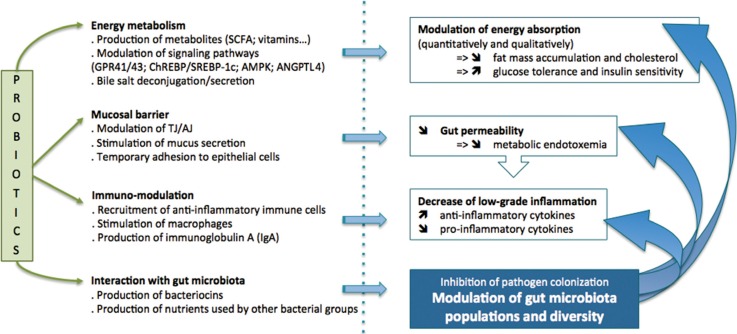
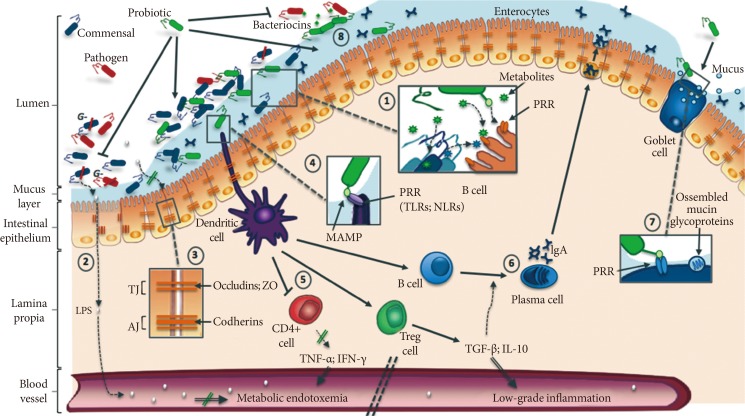
Verification
Claims the paper makes
The claims and statistics of this paper haven’t been checked yet.
Run the check — free, no account needed. It reads the open-access text and checks the sources it cites.
Claims other papers make about this one
Each is checked against this paper’s own text: does it say what the citing paper says it does?
The source backs part of the claim, not all of it — or backs it for a different population, condition or comparison.
In the citing paper
“Although the effects of probiotic and prebiotic supplementation on metabolic health have been examined in previous studies, the results are inconsistent due to the choice of probiotic strain, formulation of the probiotic, outcome of interest, and duration of the intervention [12,13,14].”
From Effects of Regular Kefir Consumption on Gut Microbiota in Patients with Metabolic Syndrome: A Parallel-Group, Randomized, Controlled Study (2019) · cites this paper as [13]
Experimental — accuracy not yet measured
Self-check
Percentages, sums and reported differences re-computed from the paper’s own numbers.
The self-check needs the paper’s full text.
Citations
Cites
An obesity-associated gut microbiome with increased capacity for energy harvest
Turnbaugh, P. J., Ley, R. E., Mahowald, M. A., Magrini, V., Mardis, E. R., & Gordon, J. I. (2006) · Nature · doi:10.1038/nature05414 · Cited by 12,444
Diet rapidly and reproducibly alters the human gut microbiome
David, L. A., Maurice, C. F., Carmody, R. N., Gootenberg, D. B., Button, J. E., Wolfe, B. E., Ling, A. V., Devlin, A. S., Varma, Y., Fischbach, M. A., et al. (2014) · Nature · doi:10.1038/nature12820 · Cited by 10,100
Hill (2014) · doi:10.1038/nrgastro.2014.66 · Cited by 9,592
The gut microbiota as an environmental factor that regulates fat storage
Bäckhed, F., Ding, H., Wang, T., Hooper, L. V., Koh, G. Y., Nagy, A., Semenkovich, C. F., & Gordon, J. I. (2004) · Proceedings of the National Academy of Sciences · doi:10.1073/pnas.0407076101 · Cited by 6,245
The Microbial Metabolites, Short-Chain Fatty Acids, Regulate Colonic T reg Cell Homeostasis
Smith, P. M., Howitt, M. R., Panikov, N., Michaud, M., Gallini, C. A., Bohlooly-Y, M., Glickman, J. N., & Garrett, W. S. (2013) · Science · doi:10.1126/science.1241165 · Cited by 5,413
Cani, P. D., Bibiloni, R., Knauf, C., Waget, A., Neyrinck, A. M., Delzenne, N. M., & Burcelin, R. (2008) · Diabetes · doi:10.2337/db07-1403 · Cited by 4,819
Cross-talk between Akkermansia muciniphila and intestinal epithelium controls diet-induced obesity
Everard, A., Belzer, C., Geurts, L., Ouwerkerk, J. P., Druart, C., Bindels, L. B., Guiot, Y., Derrien, M., Muccioli, G. G., Delzenne, N. M., et al. (2013) · Proceedings of the National Academy of Sciences · doi:10.1073/pnas.1219451110 · Cited by 4,511
Intestinal mucosal barrier function in health and disease
Turner, J. R. (2009) · Nature reviews. Immunology · doi:10.1038/nri2653 · Cited by 3,952
Human nutrition, the gut microbiome and the immune system
Kau, A. L., Ahern, P. P., Griffin, N. W., Goodman, A. L., & Gordon, J. I. (2011) · Nature · doi:10.1038/nature10213 · Cited by 2,588
Cani, P. D., Neyrinck, A. M., Fava, F., Knauf, C., Burcelin, R., Tuohy, K. M., Gibson, G. R., & Delzenne, N. M. (2007) · Diabetologia · doi:10.1007/s00125-007-0791-0 · Cited by 1,770
Research works printed but not linked: 4
- Wu, 2015, Evid Based Complement Alternat Med, 2015, 391767
- Hariri, 2015, ARYA Atheroscler, 11, 74
- Quevrain, 2015, Gut
- Dudonne, 2015, PharmaNutrition
Cited by
Sorted by citations
Benefaction of probiotics for human health: A review
George Kerry, R., Patra, J. K., Gouda, S., Park, Y., Shin, H.-S., & Das, G. (2018) · Journal of Food and Drug Analysis · doi:10.1016/j.jfda.2018.01.002 · Cited by 898
Role of Metabolic Endotoxemia in Systemic Inflammation and Potential Interventions
Mohammad, S., & Thiemermann, C. (2021) · Frontiers in Immunology · doi:10.3389/fimmu.2020.594150 · Cited by 585
Kristensen, N. B., Bryrup, T., Allin, K. H., Nielsen, T., Hansen, T. H., & Pedersen, O. (2016) · Genome Medicine · doi:10.1186/s13073-016-0300-5 · Cited by 561
Immunomodulatory Effects of Probiotics on Cytokine Profiles
Azad, M. A. K., Sarker, M., & Wan, D. (2018) · BioMed Research International · doi:10.1155/2018/8063647 · Cited by 521
Microbiota-gut-brain axis: Modulator of host metabolism and appetite
van de Wouw, M., Schellekens, H., Dinan, T. G., & Cryan, J. F. (2017) · The Journal of Nutrition · doi:10.3945/jn.116.240481 · Cited by 461
Metadata
- Authors
- Le Barz, M., Anhê, F. F., Varin, T. V., Desjardins, Y., Levy, E., Roy, D., Urdaci, M. C., & Marette, A.
- Affiliations
- Department of Medicine, Faculty of Medicine, Cardiology Axis of the Québec Heart and Lung Institute, Québec, QC, Canada.
- Institut universitaire de cardiologie et de pneumologie de Québec (CA)
- Université Laval (CA)
- Centre Hospitalier Universitaire Sainte-Justine (CA)
- University of Bordeaux, UMR 5248, CBMN, Bordeaux, France.
- Corresponding author
- Marette, André
- Venue
- Diabetes & Metabolism Journal
- Publisher
- Korean Diabetes Association
- Published
- 2015
- Volume
- 39
- Issue
- 4
- Pages
- 291
- ISSN
- 2233-6079 (ISSN-L)
- 2233-6087
- PMC
- PMC4543192
- OpenAlex
- W2167419149
- Cited by
- 142
- References
- 61
- Citations by year
- 2026: 8 · 2025: 18 · 2024: 10 · 2023: 9 · 2022: 14 · 2021: 7 · 2020: 15 · 2019: 14 · 2018: 14 · 2017: 15 · 2016: 15 · 2015: 3
- FWCI
- 2.01
- Type
- journal article
- Language
- en
- Update notices
- erratum (2015-10-22)
- Open access
- gold
- doi.org
- Licence
- Locations
- Diabetes & Metabolism Journal (publishedVersion, cc-by-nc)
- Europe PMC (PubMed Central) (publishedVersion, cc-by-nc)
- PubMed Central (publishedVersion, cc-by-nc)
- PubMed (publishedVersion)
- DOAJ (DOAJ: Directory of Open Access Journals) (submittedVersion, cc-by-sa)
- Oskar-Bordeaux (Universite de Bordeaux) (submittedVersion)
- Topics
- Life Sciences › Agricultural and Biological Sciences › Food Science › Probiotics and Fermented Foods
- Life Sciences › Biochemistry, Genetics and Molecular Biology › Molecular Biology › Gut microbiota and health
- Health Sciences › Nursing › Nutrition and Dietetics › Microbial Metabolites in Food Biotechnology
- Keywords
- probiotics, Lactobacillus plantarum, anti-obesity, diet-induced obesity, high-fat diet, bile salt hydrolysis, cholesterol lowering, leptin, hepatic steatosis, PPARγ, intestinal permeability, gut microbiota, 3T3-L1 preadipocytes, metabolic disorders
About these checks
Registry, retraction, Cites and statistics results are computed, not judged, with one exception: a printed reference that no index lists is read once by a model before it counts as a citation error. Claims are extracted by a model and kept only when their quote appears verbatim in the text; each cited source is then checked, with a model’s help, for whether it says what the claim relies on. Those verdicts can be wrong — read the claim’s quote and the cited source before relying on one.
Statistics and arithmetic are recomputed, not judged.
Confidence bands are shown only for fields calibrated on our annotated test set. None is calibrated yet, so no band is shown.
What counts as a claim ›How we measure confidence ›How we check this ›
Are you an author, or do you see a problem with this page? Request a review
