

The DOI matches its Crossref record; 140 of the 140 references it cites were found in a registry or an index.
The IRF family of transcription factors: Inception, impact and implications in oncogenesis
Open accessAbstract
Members of the interferon-regulatory factor (IRF) proteins family were originally identified as transcriptional regulators of the Type I interferon system. Thanks to consistent advances made in our understanding of the immunobiology of innate receptors, it is now clear that several IRFs are critical for the elicitation of innate pattern recognition receptors, and-as a consequence-for adaptive immunity. In addition, IRFs have attracted great attentions as they modulate cellular responses that are involved in tumorigenesis. The regulation of oncogenesis by IRFs has important implications for understanding the host susceptibility to several Types of cancers, their progression, as well as the potential for therapeutic interventions.
Overview
The claims and statistics of this paper haven’t been checked yet.
Run the check — free, no account needed. It reads the open-access text and checks the sources it cites.
Integrity signals
Registry
Cites
Statistics
Figures
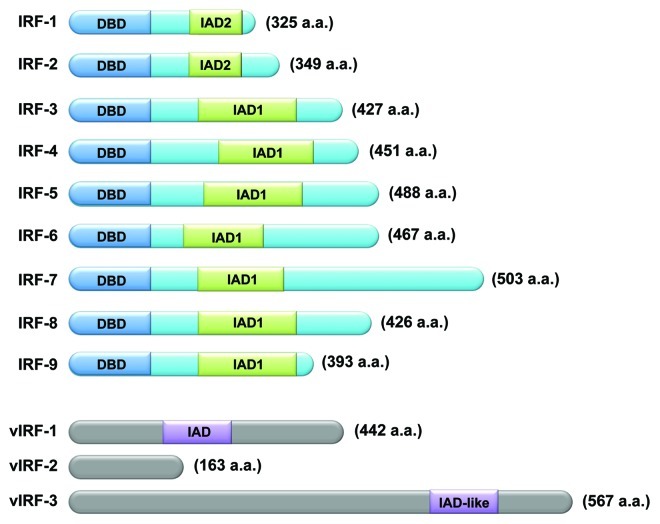
Verification
Claims the paper makes
The claims and statistics of this paper haven’t been checked yet.
Run the check — free, no account needed. It reads the open-access text and checks the sources it cites.
Claims other papers make about this one
Each is checked against this paper’s own text: does it say what the citing paper says it does?
The check wasn’t confident either way, so it gives no verdict — never disputed.
In the citing paper
“Borzoi correctly predicts the upregulation of SHTN1 expression owing to the creation of a CEBP binding motif69–72 (see Supplementary Fig. 9a and Extended Data Fig. 6a,b for additional examples).”
From Predicting RNA-seq coverage from DNA sequence as a unifying model of gene regulation (2025) · cites this paper as [71]
Experimental — accuracy not yet measured
Self-check
Percentages, sums and reported differences re-computed from the paper’s own numbers.
The self-check needs the paper’s full text.
Citations
Cites
Darnell, J. E., Kerr, L. M., & Stark, G. R. (1994) · Science · doi:10.1126/science.8197455 · Cited by 6,080
Papillomaviruses and cancer: from basic studies to clinical application
Hausen, H. Z. (2002) · Nature reviews. Cancer · doi:10.1038/nrc798 · Cited by 4,031
IRF-7 is the master regulator of type-I interferon-dependent immune responses
Honda, K., Yanai, H., Negishi, H., Asagiri, M., Sato, M., Mizutani, T., Shimada, N., Ohba, Y., Takaoka, A., Yoshida, N., et al. (2005) · Nature · doi:10.1038/nature03464 · Cited by 2,229
Self-citationHonda, K., & Taniguchi, T. (2006) · Nature reviews. Immunology · doi:10.1038/nri1900 · Cited by 1,716
Self-citationIRF Family of Transcription Factors as Regulators of Host Defense
Taniguchi, T., Ogasawara, K., Takaoka, A., & Tanaka, N. (2001) · Annual Review of Immunology · doi:10.1146/annurev.immunol.19.1.623 · Cited by 1,658
Self-citationGuichard, C., Amaddeo, G., Imbeaud, S., Ladeiro, Y., Pelletier, L., Benmaad, I., Caldéraro, J., Bioulac‐Sage, P., Letexier, M., Degos, F., et al. (2012) · Nature Genetics · doi:10.1038/ng.2256 · Cited by 1,522
Nucleotide sequence of the Kaposi sarcoma-associated herpesvirus (HHV8)
Russo, J. J., Bohenzky, R. A., Chien, M.-C., Chen, J., Yan, M., Maddalena, D., Parry, J. P., Peruzzi, D., Edelman, I. S., Chang, Y., et al. (1996) · Proceedings of the National Academy of Sciences · doi:10.1073/pnas.93.25.14862 · Cited by 1,457
Inflammation meets cancer, with NF-κB as the matchmaker
Ben‐Neriah, Y., & Karin, M. (2011) · Nature Immunology · doi:10.1038/ni.2060 · Cited by 1,408
Sato, M., Suemori, H., Hata, N., Asagiri, M., Ogasawara, K., Nakao, K., Nakaya, T., Katsuki, M., Noguchi, S., Tanaka, N., et al. (2000) · Immunity · doi:10.1016/s1074-7613(00)00053-4 · Cited by 1,342
Self-citationThe IRF Family Transcription Factors in Immunity and Oncogenesis
Tamura, T., Yanai, H., Savitsky, D., & Taniguchi, T. (2008) · Annual Review of Immunology · doi:10.1146/annurev.immunol.26.021607.090400 · Cited by 1,259
Self-citation
Research works printed but not linked: 9
- Tan RS, 1996, Cancer Res, 56, 2417
- Harada H, 1994, Oncogene, 9, 3313
- Tamura G, 1996, Cancer Res, 56, 612
- Nguyen H, 1995, Oncogene, 11, 537
- Yamamoto H, 1994, Oncogene, 9, 1423
- Oshita F, 2006, Oncol Rep, 16, 817
- Duguay D, 2002, Cancer Res, 62, 5148
- Barnes BJ, 2003, Cancer Res, 63, 6424
- Burysek L, 1999, J Hum Virol, 2, 19
Cited by
Sorted by citations
Negishi, H., Taniguchi, T., & Yanai, H. (2017) · Cold Spring Harbor Perspectives in Biology · doi:10.1101/cshperspect.a028423 · Cited by 447
Self-citationRegulating IRFs in IFN Driven Disease
Jefferies, C. A. (2019) · Frontiers in Immunology · doi:10.3389/fimmu.2019.00325 · Cited by 364
Chistiakov, D. A., Myasoedova, V. A., Revin, V. V., Orekhov, A. N., & Bobryshev, Y. V. (2018) · Immunobiology · doi:10.1016/j.imbio.2017.10.005 · Cited by 311
Predicting RNA-seq coverage from DNA sequence as a unifying model of gene regulation
Linder, J., Srivastava, D., Yuan, H., Agarwal, V., & Kelley, D. R. (2025) · Nature Genetics · doi:10.1038/s41588-024-02053-6 · Cited by 265
The IRF Family Transcription Factors at the Interface of Innate and Adaptive Immune ResponsesPreprint
Ikushima, H., Negishi, H., & Taniguchi, T. (2013) · Cold Spring Harbor Symposia on Quantitative Biology · doi:10.1101/sqb.2013.78.020321 · Cited by 273
Self-citation
Metadata
- Authors
- Yanai, H., Negishi, H., & Taniguchi, T.
- Affiliations
- Japan Science and Technology Agency (JP)
- Corresponding author
- Taniguchi, Tadatsugu
- Venue
- OncoImmunology
- Publisher
- Informa UK Limited
- Published
- 2012-11
- Volume
- 1
- Issue
- 8
- Pages
- 1376-1386
- ISSN
- 2162-4011 (ISSN-L)
- 2162-402X
- PMC
- PMC3518510
- OpenAlex
- W2031904443
- Cited by
- 261
- References
- 140
- Citations by year
- 2026: 15 · 2025: 18 · 2024: 24 · 2023: 22 · 2022: 32 · 2021: 29 · 2020: 25 · 2019: 26 · 2018: 21 · 2017: 14 · 2016: 8 · 2015: 9 · 2014: 12 · 2013: 6
- FWCI
- 3.78
- Type
- journal article
- Language
- en
- Open access
- gold
- doi.org
- Licence
- cc-by-nc
- Locations
- OncoImmunology (publishedVersion, cc-by-nc)
- Europe PMC (PubMed Central) (publishedVersion, cc-by-nc)
- PubMed Central (publishedVersion, cc-by-nc)
- PubMed (publishedVersion)
- Funders
- Core Research for Evolutional Science and Technology
- Topics
- Life Sciences › Immunology and Microbiology › Immunology › interferon and immune responses
- Life Sciences › Immunology and Microbiology › Immunology › Immune Response and Inflammation
- Life Sciences › Immunology and Microbiology › Immunology › Immunotherapy and Immune Responses
- Keywords
- interferon regulatory factors, transcription factors, type I interferon, innate immunity, pattern recognition receptors, adaptive immunity, carcinogenesis, cancer susceptibility, tumor progression, cancer therapy
About these checks
Registry, retraction, Cites and statistics results are computed, not judged, with one exception: a printed reference that no index lists is read once by a model before it counts as a citation error. Claims are extracted by a model and kept only when their quote appears verbatim in the text; each cited source is then checked, with a model’s help, for whether it says what the claim relies on. Those verdicts can be wrong — read the claim’s quote and the cited source before relying on one.
Statistics and arithmetic are recomputed, not judged.
Confidence bands are shown only for fields calibrated on our annotated test set. None is calibrated yet, so no band is shown.
What counts as a claim ›How we measure confidence ›How we check this ›
Are you an author, or do you see a problem with this page? Request a review
