

More Reviews May Not Help: Evidence from Incentivized First Reviews on Airbnb
Open accessThe DOI matches its DataCite record; 48 of the 48 references it cites were found in a registry or an index; none of the 20 sources its claims cite is checked for support yet.
Abstract
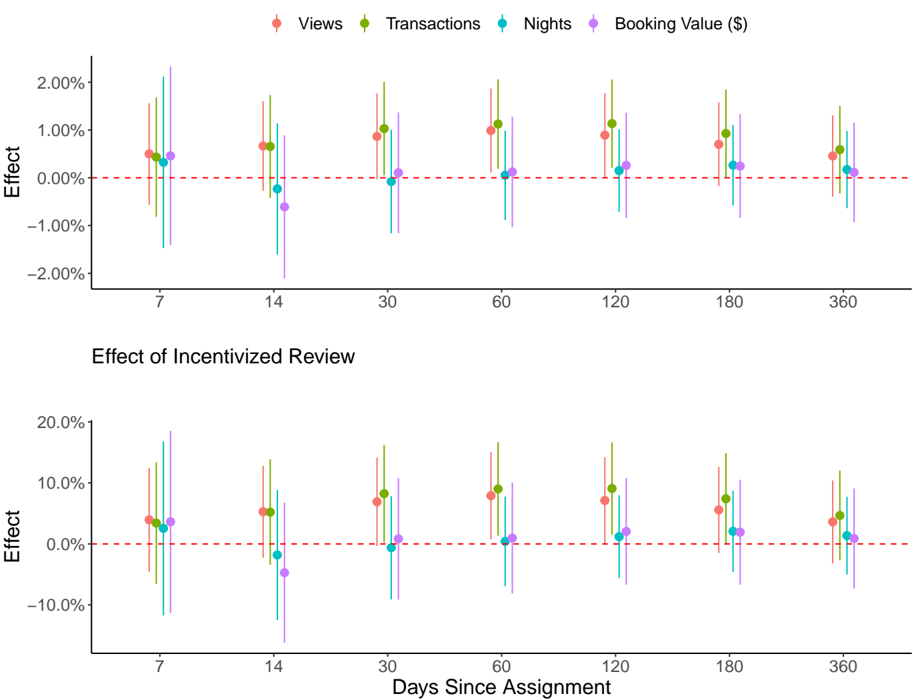
Online reviews are typically written by volunteers and, as a consequence, information about seller quality may be under-provided in digital marketplaces. We study the extent of this under-provision in a large-scale randomized experiment conducted by Airbnb. In this experiment, buyers are offered a coupon to review listings that have no prior reviews. The treatment induces additional reviews and these reviews tend to be more negative than reviews in the control group, consistent with selection bias in reviewing. Reviews induced by the treatment result in a temporary increase in transactions but these transactions are for fewer nights, on average. The effects on transactions and nights per transaction cancel out so that there is no detectable effect on total nights sold and revenue. Measures of transaction quality in the treatment group fall, suggesting that incentivized reviews do not improve matching. We show how market conditions and the design of the reputation system can explain our findings.
Overview
CoChat Summary
TL;DR
Airbnb’s randomized experiment offering a $25 coupon for first reviews increased review rates and lowered average ratings, but induced reviews produced only transitory transaction increases and no detectable total nights or revenue gains. The paper attributes the small effects to listings obtaining other reviews quickly and to Airbnb displaying ratings only as rounded averages after three reviews.
Key findings
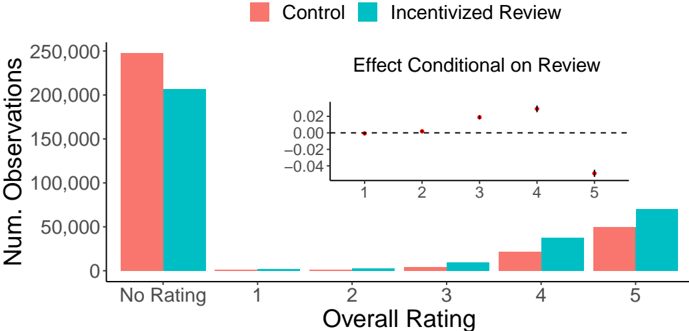
- The treatment increased the review rate by 12.85 percentage points, from 24.17% to 37.01% (p < 2.2 × 10⁻¹⁶); conditional on a review, average rating fell by 0.07 stars, from 4.48 to 4.41. Positive text sentiment was 94.1% in control vs. 93.2% in treatment.
- A 2SLS estimate shows an induced review increased views by 7.1% and transactions by 9.1% at 120 days (0.326 additional transactions), but nights per trip fell by 1% and effects on total nights and booking value were close to 0 and statistically indistinguishable from 0. Trip revenue effect was −3.473 and not statistically significant.
- Transaction quality did not improve: complaint rate was not statistically different; subsequent review star rating was 0.0060 lower; guest nights post-checkout fell by 0.0766 nights (1.6%) (with controls, −0.0548). Host listing changes were precisely estimated null effects.
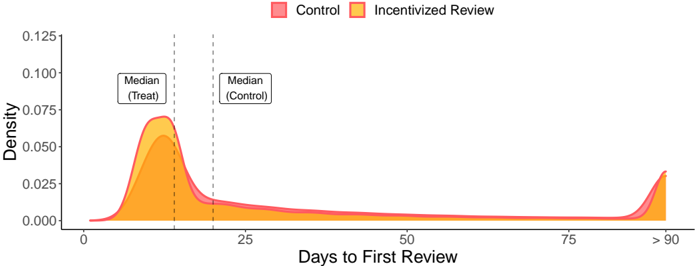
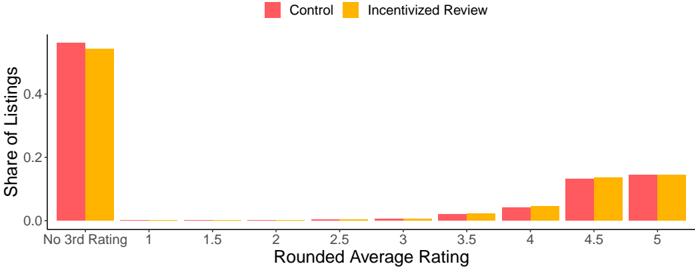
- Most control listings eventually received a review (72.8% vs. 78.4% treatment); median first-review timing differed by just 6 days; treatment listings were 1.7 percentage points more likely to reach three ratings. Calibration suggests naive observational estimates of review effects are mostly explained by selection bias.
Methods
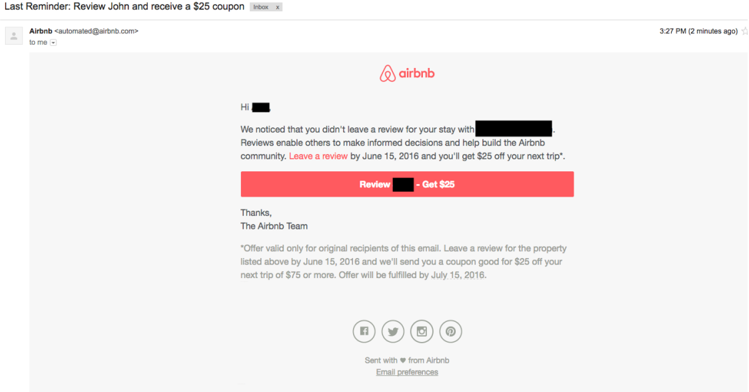
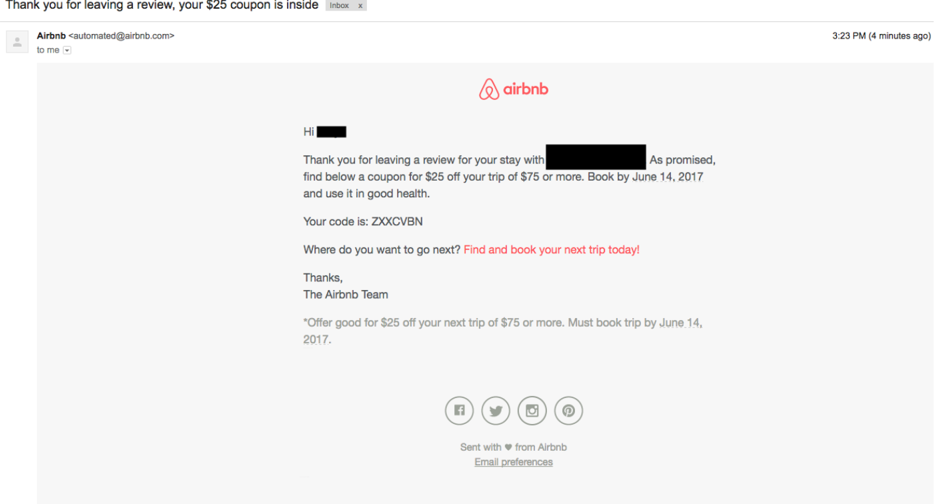
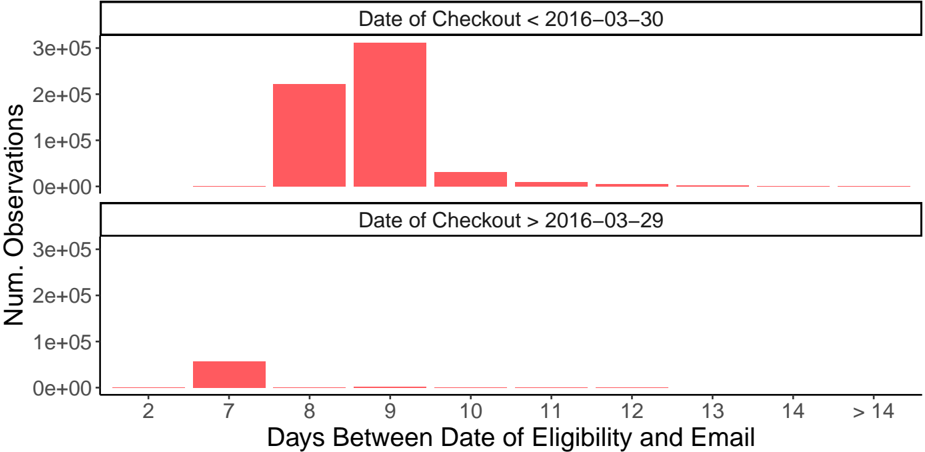
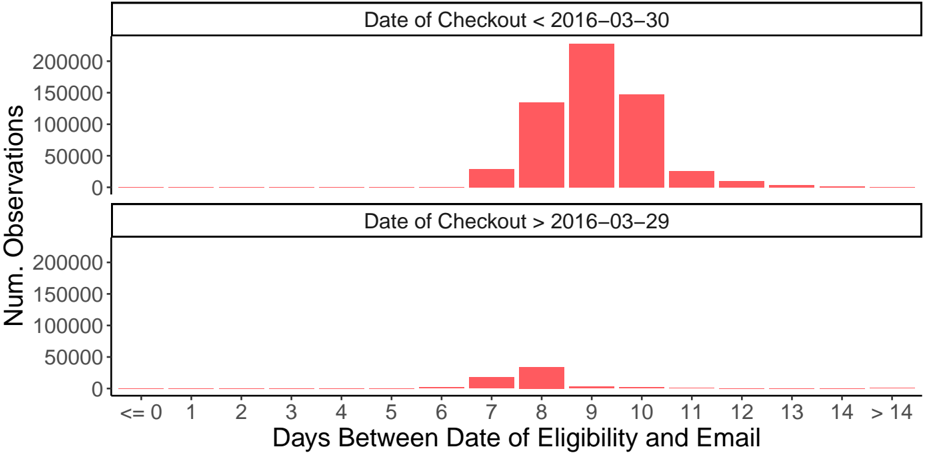
- Listing-level randomized field experiment on Airbnb from April 12, 2014 to May 17, 2016. Eligible listings had been booked, had no prior reviews, and the guest had not reviewed within a threshold (typically 8 or 9 days). Treatment: email offering a $25 coupon for a review; control: standard review reminder. There were 326,515 control listings and 328,080 treatment listings.
- Outcomes included review rates, ratings, text sentiment (DistilBERT), views, transactions, nights, booking value, price, lead time, complaints, subsequent reviews, guest return nights, and host listing changes. Main analysis used linear intent-to-treat regressions, 2SLS with treatment assignment as an instrument for review, transaction-level regressions clustered at the listing level, heterogeneity tests, and calibration.
- Sample sizes include 2,389,288 observations for trip characteristics, 2,431,085 for transaction quality, and 640,936 for heterogeneity by predicted outcomes.
Limitations
- Stated: results are specific to Airbnb’s 2014–2016 reputation-system design (ratings shown only after three reviews and rounded to the nearest half-star) and market conditions; there was imperfect compliance (37.01% of treated transactions resulted in a review); the policy targets listings that could transact without reviews, so it does not solve the cold-start problem; alternative incentive designs could have different effects.
- Stated: the authors were employed by Airbnb for part of the time the paper was written and held stock that may constitute a material financial position; the views expressed are the authors’ and do not necessarily reflect Airbnb’s.
- Evident from the text: the experiment predates Airbnb’s later switch to two-decimal rounding, limiting external validity to current or other reputation systems; treatment effects are short-horizon and transitory, and the paper cannot rule out different effects for other transaction subsets or more targeted, higher-stakes incentives.
Model-written summary. Check it against the paper before relying on it.
Integrity signals
Registry
Cites
Statistics
Figures
Verification
Claims the paper makes
0 Valid · 3 Not valid · 14 Not checked · 159 Own results and interpretations
A result the paper reports from its own data — it cites no other source for it, so there is none to check. The quote shows it is in the paper.
In the paper
“Columns (3) and (4) show statistically insignificant effects on price per night and lead time, which is the number of days between a reservation and checkin.”
plain- Asserted: passes — The authors put it forward as true.
- Checkable: passes — It can be checked against evidence.
- Load-bearing: unclear — It is unclear whether the paper’s conclusions depend on it.
- Based: passes — The paper gives a reason why it holds.
A result the paper reports from its own data — it cites no other source for it, so there is none to check. The quote shows it is in the paper.
In the paper
“The treatment induces additional reviews and these reviews tend to be more negative than reviews in the control group, consistent with selection bias in reviewing.”
- Also stated in: § 5 Effects of Experiment on Reviews · p. 12 · plain
“the treatment is effective at increasing the rate at which guests leave reviews”
plainstates a cause- Asserted: passes — The authors put it forward as true.
- Checkable: passes — It can be checked against evidence.
- Load-bearing: passes — The paper’s conclusions depend on it.
- Based: passes — The paper gives a reason why it holds.
- Also stated in: § 5 Effects of Experiment on Reviews · p. 12 · plain
A result the paper reports from its own data — it cites no other source for it, so there is none to check. The quote shows it is in the paper.
In the paper
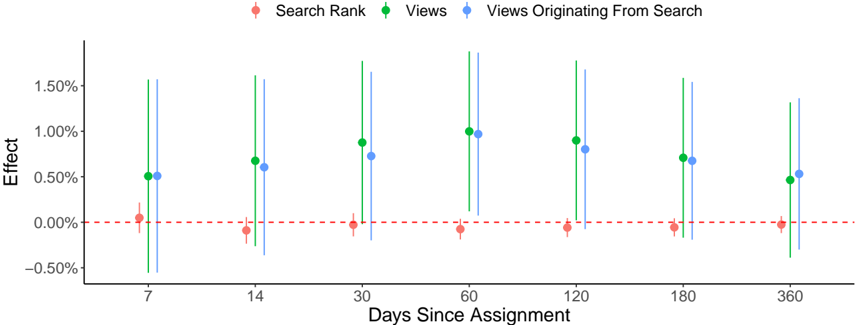
“In subsection B.4 we show that this effect is driven by the fact that the number of reviews is displayed on the search page rather than by changes to the algorithmic ranking of a listing.”
plainstates a cause- Asserted: passes — The authors put it forward as true.
- Checkable: passes — It can be checked against evidence.
- Load-bearing: passes — The paper’s conclusions depend on it.
- Based: passes — The paper gives a reason why it holds.
A result the paper reports from its own data — it cites no other source for it, so there is none to check. The quote shows it is in the paper.
In the paper
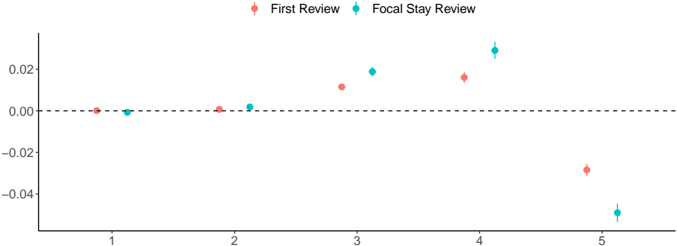
“Reviews for treated listings are more negative than for control listings.”
plainstates an association- Asserted: passes — The authors put it forward as true.
- Checkable: passes — It can be checked against evidence.
- Load-bearing: passes — The paper’s conclusions depend on it.
- Based: passes — The paper gives a reason why it holds.
A result the paper reports from its own data — it cites no other source for it, so there is none to check. The quote shows it is in the paper.
In the paper
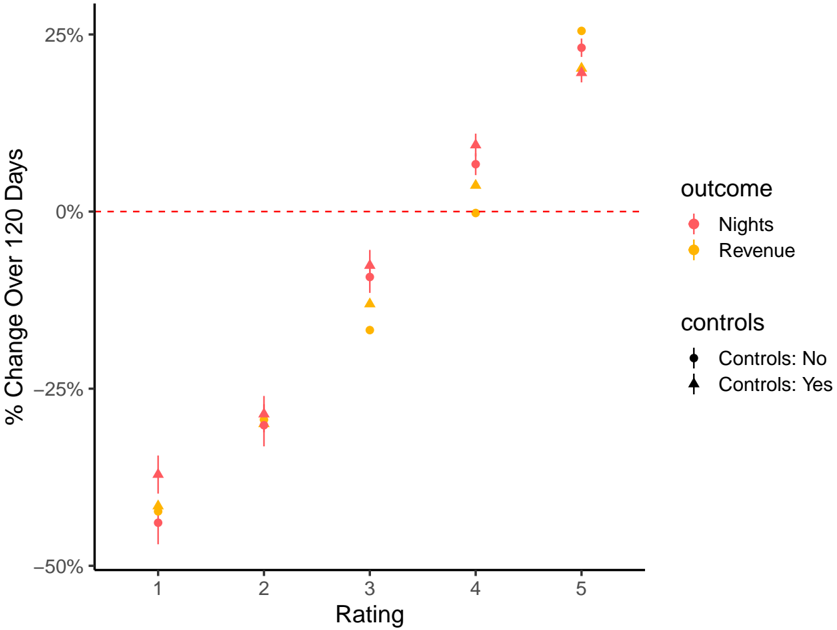
“The effect sizes for first reviews are smaller in magnitude for each rating.”
plain- Asserted: passes — The authors put it forward as true.
- Checkable: passes — It can be checked against evidence.
- Load-bearing: passes — The paper’s conclusions depend on it.
- Based: passes — The paper gives a reason why it holds.
90 more claims
Create a free account to see all 176 claims and to verify the 11 references still open.
- It may state two separate claims as one. 51
- The quote only partly states this claim. 3
- Probably not a substantial claim. 37
Self-check
Percentages, sums and reported differences re-computed from the paper’s own numbers.
Each contradiction between two passages listed here was confirmed by an independent check.
Rated major: it would touch a result — a value a result rests on, reported and recomputed p-values on opposite sides of the significance level, two passages that conflict with no sign which is right, or a cited work retracted before this paper was published.
In the paper
§ 6.2 Effects on Transaction Quality · p. 19
“for each listing, l , we consider all transactions that occur within 120 days after the checkout of the focal stay, do not have a cancelation, and have an observed payment.”
§ 6.2 Effects on Transaction Quality · p. 19
“The set of transactions considered for this regression includes all transactions for which the checkout date was between the checkout date of the focal transaction and 360 days after.”
Citations
Cites
BERT: Pre-training of Deep Bidirectional Transformers for Language Understanding
Devlin, J., Chang, M.-W., Lee, K., & Toutanova, K. (2018) · arXiv · doi:10.48550/arxiv.1810.04805 · Cited by 73,173 · cited 1×
“B.2 Effects on Textual Reviews In order to measure changes in the textual content of the reviews left by guests, we estimated the sentiment of each review in our sample using DistilBERT (Sanh et al., 2019), which is a lightweight version of BERT, a widely used language model (Devlin et al., 2018).”
MethodBERT: Pre-training of Deep Bidirectional Transformers for Language Understanding
Devlin, J., Chang, M.-W., Lee, K., & Toutanova, K. (2019) · Proceedings of the 2019 Conference of the North American Chapter of the Association for Computational Linguistics: Human Language Technologies, Volume 1 (Long and Short Papers) · doi:10.18653/v1/n19-1423 · Cited by 54,325 · cited 1×
“B.2 Effects on Textual Reviews In order to measure changes in the textual content of the reviews left by guests, we estimated the sentiment of each review in our sample using DistilBERT (Sanh et al., 2019), which is a lightweight version of BERT, a widely used language model (Devlin et al., 2018).”
MethodDistilBERT, a distilled version of BERT: smaller, faster, cheaper and lighter
Sanh, V., Debut, L., Chaumond, J., & Wolf, T. (2019) · arXiv · doi:10.48550/arxiv.1910.01108 · Cited by 13,823 · cited 1×
“B.2 Effects on Textual Reviews In order to measure changes in the textual content of the reviews left by guests, we estimated the sentiment of each review in our sample using DistilBERT (Sanh et al., 2019), which is a lightweight version of BERT, a widely used language model (Devlin et al., 2018).”
MethodRecursive Deep Models for Semantic Compositionality Over a Sentiment Treebank
Socher, R., Perelygin, A., Wu, J., Chuang, J., Manning, C. D., Ng, A., & Potts, C. (2013) · Proceedings of the 2013 Conference on Empirical Methods in Natural Language Processing · doi:10.18653/v1/d13-1170 · Cited by 6,878
Fake It Till You Make It: Reputation, Competition, and Yelp Review Fraud
Luca, M., & Zervas, G. (2016) · Management Science · doi:10.1287/mnsc.2015.2304 · Cited by 1,263
Promotional Reviews: An Empirical Investigation of Online Review Manipulation
Mayzlin, D., Dover, Y., & Chevalier, J. (2014) · American Economic Review · doi:10.1257/aer.104.8.2421 · Cited by 937
Social Influence Bias: A Randomized Experiment
Muchnik, L., Aral, S., & Taylor, S. J. (2013) · Science · doi:10.1126/science.1240466 · Cited by 892
Agnostic notes on regression adjustments to experimental data: Reexamining Freedman’s critique
Lin, W. (2013) · The Annals of Applied Statistics · doi:10.1214/12-aoas583 · Cited by 641 · cited 1×
“To test for heterogeneity, we estimate a regression of the following form (as suggested by Lin (2013)):13 yl = β0 + β1Tl + β2Xl + β3Tl(Xl − X̄) + l (3) In the above regression, yl is a listing outcome (reservations, nights, and booking value) within 120 days of the focal stay checkout and Tl is the…”
MethodReputation and Feedback Systems in Online Platform Markets
Tadelis, S. (2016) · Annual Review of Economics · doi:10.1146/annurev-economics-080315-015325 · Cited by 524
The Sound of Silence in Online Feedback: Estimating Trading Risks in the Presence of Reporting Bias
Dellarocas, C., & Wood, C. A. (2008) · Management Science · doi:10.1287/mnsc.1070.0747 · Cited by 451
Ineffiient Hiring in Entry-Level Labor MarketsPreprint
Pallais, A. (2012) · SSRN Electronic Journal · doi:10.2139/ssrn.2012131 · Cited by 413 · cited 7×
“…Hui, Liu and Zhang, 2020; Garg and Johari, 2021; Pallais, 2014).3 One existing piece of research that is particularly closely related to our work is Pallais (2014), which experimentally measures the effects of an intervention in which new sellers are both hired and 2A related literature studies…”
InfluentialStimulating Online Reviews by Combining Financial Incentives and Social Norms
Burtch, G., Hong, Y., Bapna, R., & Griskevicius, V. (2018) · Management Science · doi:10.1287/mnsc.2016.2715 · Cited by 405 · cited 4×
“Burtch et al. (2018), Marinescu et al. (2021), and Karaman (2020) document that monetary incentives, non-monetary incentives, and review solicitation emails all reduce review bias caused by selection and bring the observed distribution of ratings closer to the distribution of experiences that buyers have.”
BackgroundInfluentialInefficient Hiring in Entry-Level Labor Markets
Pallais, A. (2014) · American Economic Review · doi:10.1257/aer.104.11.3565 · Cited by 305
Cui, R., Li, J., & Zhang, D. J. (2020) · Management Science · doi:10.1287/mnsc.2018.3273 · Cited by 290
Avery, C., Resnick, P., & Zeckhauser, R. (1999) · American Economic Review · doi:10.1257/aer.89.3.564 · Cited by 267
He, S., Hollenbeck, B., & Proserpio, D. (2020) · ACM Conference on Economics and Computation · doi:10.2139/ssrn.3664992 · Cited by 257
The Limits of Reputation in Platform Markets: An Empirical Analysis and Field Experiment
Nosko, C., & Tadelis, S. (2015) · doi:10.3386/w20830 · Cited by 229
Cui, R., Li, J., & Zhang, D. J. (2016) · SSRN Electronic Journal · doi:10.2139/ssrn.2882982 · Cited by 222
The limits of reputation in platform markets: An empirical analysis and field experiment
Nosko, C., & Tadelis, S. (2026) · Quantitative Marketing and Economics · doi:10.1007/s11129-026-09313-1 · Cited by 195
The Economic Value of Online Reviews
Wu, C., Che, H., Chan, T. Y., & Lu, X. (2015) · Marketing Science · doi:10.1287/mksc.2015.0926 · Cited by 184 · cited 2×
“Indeed, prior work has shown that reputation systems substantially increase consumer surplus (Lewis and Zervas (2016), Reimers and Waldfogel (2021), and Wu et al. (2015)).”
BackgroundCan Reputation Discipline the Gig Economy? Experimental Evidence from an Online Labor Market
Benson, A. M., Sojourner, A., & Umyarov, A. (2019) · Management Science · doi:10.1287/mnsc.2019.3303 · Cited by 179
Bias and Reciprocity in Online Reviews: Evidence From Field Experiments on Airbnb
Fradkin, A., Grewal, E., Holtz, D., & Pearson, M. (2015) · Proceedings of the Sixteenth ACM Conference on Economics and Computation · doi:10.1145/2764468.2764528 · Cited by 163 · cited 1×
“We argue that this is due to market conditions in the markets where 3A preliminary analysis of this experiment was presented in Fradkin et al. (2015).”
BackgroundSelf-citationA Dollar for Your Thoughts: Feedback-Conditional Rebates on eBay
Cabral, L., & Li, L. (. (2015) · Management Science · doi:10.1287/mnsc.2014.2074 · Cited by 156
Papanastasiou, Y., Bimpikis, K., & Savva, N. (2018) · Management Sciences · doi:10.1287/mnsc.2016.2697 · Cited by 129
Reciprocity and Unveiling in Two-sided Reputation Systems: Evidence from an Experiment on Airbnb
Fradkin, A., Grewal, E., & Holtz, D. (2021) · Marketing Science · doi:10.1287/mksc.2021.1311 · Cited by 113
Self-citationBuying reputation as a signal of quality: Evidence from an online marketplace
Li, L., Tadelis, S., & Zhou, X. (2020) · The RAND Journal of Economics · doi:10.1111/1756-2171.12346 · Cited by 109
Reimers, I., & Waldfogel, J. (2021) · American Economic Review · doi:10.1257/aer.20200153 · Cited by 109
Bayesian Social Learning from Consumer Reviews
Ifrach, B., Maglaras, C., Scarsini, M., & Zseleva, A. (2019) · Operational Research · doi:10.1287/opre.2019.1861 · Cited by 106 · cited 1×
“Finally, there is an emerging research literature that aims to model the dynamics with which consumers learn about seller quality under different ratings systems (Papanastasiou, Bimpikis and Savva, 2018; Besbes and Scarsini, 2018; Acemoglu et al., 2019; Ifrach et al., 2019).”
BackgroundKaraman, H. (2020) · Management Science · doi:10.1287/mnsc.2020.3758 · Cited by 98
Consumer Protection in an Online World: An Analysis of Occupational Licensing
Farronato, C., Fradkin, A., Larsen, B., & Brynjolfsson, E. (2020) · National Bureau of Economic Research · doi:10.3386/w26601 · Cited by 96
Self-citationMarket Transparency, Adverse Selection, and Moral Hazard
Klein, T. J., Lambertz, C., & Stahl, K. O. (2016) · Journal of Political Economy · doi:10.1086/688875 · Cited by 89
On Information Distortions in Online Ratings
Besbes, O., & Scarsini, M. (2018) · Operational Research · doi:10.1287/opre.2017.1676 · Cited by 77
Learning From Reviews: The Selection Effect and the Speed of Learning
Acemoğlu, D., Makhdoumi, A., Malekian, A., & Ozdaglar, A. (2022) · Econometrica · doi:10.3982/ecta15847 · Cited by 67 · cited 16×
“…reviews induced by Airbnb’s incentivized first review program failed to have a measurable impact on market outcomes is the design of Airbnb’s review system, which has characteristics of the “summary statistics only” systems discussed in both Acemoglu et al. (2019) and Besbes and Scarsini (2018).”
BackgroundMethodInfluentialMoney Talks: Rebate Mechanisms in Reputation System Design
Li, L. (., & Xiao, E. (2014) · Management Science · doi:10.1287/mnsc.2013.1848 · Cited by 65
Karaman, H. (2020) · Management Sciences · doi:10.2139/ssrn.3656246 · Cited by 65 · cited 1×
“Burtch et al. (2018), Marinescu et al. (2021), and Karaman (2020) document that monetary incentives, non-monetary incentives, and review solicitation emails all reduce review bias caused by selection and bring the observed distribution of ratings closer to the distribution of experiences that…”
BackgroundReputation, Trust, and Rebates: How Online Auction Markets Can Improve Their Feedback Mechanisms
Li, L. (. (2010) · Journal of Economics & Management Strategy · doi:10.1111/j.1530-9134.2010.00253.x · Cited by 50
Can Information Reduce Ethnic Discrimination? Evidence from Airbnb
Laouénan, M., & Rathelot, R. (2022) · American Economic Journal: Applied Economics · doi:10.1257/app.20190188 · Cited by 49
Machine Learning for Variance Reduction in Online ExperimentsPreprint
Guo, Y., Coey, D., Konutgan, M., Li, W., Schoener, C., & Goldman, M. (2021) · Neural Information Processing Systems · doi:10.48550/arxiv.2106.07263 · Cited by 48 · cited 2×
“This avoids having to conduct sample splitting procedures as in Guo et al. (2021), who propose a similar way to reduce variance and estimate heterogeneous treatment effects for the purpose of analyzing digital experiments.”
MethodDesigning Informative Rating Systems: Evidence from an Online Labor Market
Garg, N., & Johari, R. (2018) · ACM Conference on Economics and Computation · doi:10.1145/3391403.3399455 · Cited by 42
Filippas, A., Horton, J. J., & Golden, J. (2018) · Proceedings of the 2018 ACM Conference on Economics and Computation · doi:10.1145/3219166.3219222 · Cited by 41
The Fateful First Consumer Review
Park, S., Shin, W., & Xie, J.-H. (2021) · Marketing science (Providence, R.I.) · doi:10.1287/mksc.2020.1264 · Cited by 40
What Drives Extremity Bias in Online Reviews? Theory and Experimental EvidencePreprint
Brandes, L., Godes, D., & Mayzlin, D. (2019) · Social Science Research Network · doi:10.2139/ssrn.3449159 · Cited by 38 · cited 2×
“Prior work starting with Dellarocas and Wood (2007) has identified that those with positive or more extreme experiences review at rates above average and that incentives to review reduce the extent of this selection based on quality (Burtch et al. (2018); Marinescu et al. (2021)).”
Incentives can reduce bias in online employer reviews.
Marinescu, I., Chamberlain, A., Smart, M., & Klein, N. (2021) · Journal of Experimental Psychology: Applied · doi:10.1037/xap0000342 · Cited by 34
Incentives can reduce bias in online employer reviews
Marinescu, I., Klein, N., Chamberlain, A., & Smart, M. (2018) · Academy of Management Proceedings · doi:10.5465/ambpp.2018.11189abstract · Cited by 34 · cited 2×
“Burtch et al. (2018), Marinescu et al. (2021), and Karaman (2020) document that monetary incentives, non-monetary incentives, and review solicitation emails all reduce review bias caused by selection and bring the observed distribution of ratings closer to the distribution of experiences that…”
BackgroundAdverse Selection or Moral Hazard, An Empirical Study
Hui, X., Saeedi, M., & Sundaresan, N. (2018) · The Journal of Industrial Economics · doi:10.1111/joie.12183 · Cited by 25 · cited 2×
“Hui et al. (2021) show that the decision to review depends on the change in buyers beliefs about seller quality before and after a transaction.2 There is also a growing research literature that uses field experiments to study the impacts of changes to reputation system design on subsequent market outcomes, rather than…”
BackgroundWhen and Why Do Buyers Rate in Online Markets?Preprint
Hui, X., Klein, T., & Stahl, K. O. (2022) · Social Science Research Network · doi:10.2139/ssrn.4033599 · Cited by 6 · cited 2×
“11Another reason, proposed by Hui et al. (2021), is that low ratings may be autocorrelated due to belief updating dynamics that affect review rates.”
BackgroundMitigating the Cold-start Problem in Reputation Systems: Evidence from a Field Experiment
Hui, X., Liu, Z.-K., & Zhang, W. (2020) · Social Science Research Network · doi:10.2139/ssrn.3731169 · Cited by 4
Can Reputation Discpline the Gig Economy? Experimental Evidence from an Online Labor MarketPreprint
Benson, A. M., Sojourner, A., & Umyarov, A. (2018) · doi:10.21034/iwp.16 · Cited by 3
Cited by
Crowds Can Effectively Identify Misinformation at Scale
Martel, C., Allen, J., Pennycook, G., & Rand, D. G. (2024) · Perspectives on Psychological Science · doi:10.1177/17456916231190388 · Cited by 84
“Conversely, partisanship and political considerations may be a helpful motivational tool for boosting participation in voluntary fact-checking systems (Allen et al., 2022; Shi et al., 2019), where underprovisioning of reviews is often a major problem (Fradkin & Holtz, 2021).”
BackgroundThe Impact of Fake Reviews on Demand and Welfare
Akesson, J., Hahn, R., Metcalfe, R., & Monti-Nussbaum, M. (2023) · Social Science Research Network · doi:10.3386/w31836 · Cited by 11
“14Our paper is also related to the broader literature on customer reviews and advertising, which includes studies on the number of reviews and review inflation (Aral, 2014; Filippas et al., 2018; Fradkin and Holtz, 2021), customer reviews and discrimination (Botelho and Gertsberg, 2021; Cui et al.”
BackgroundWhen and Why Do Buyers Rate in Online Markets?Preprint
Hui, X., Klein, T., & Stahl, K. O. (2022) · Social Science Research Network · doi:10.2139/ssrn.4033599 · Cited by 6
“Fradkin and Holtz (2021) study an two-year-long experiment where Airbnb gives financial incentives to buyers to review listings without existing ratings.”
Background
Metadata
- Authors
- Fradkin, A., & Holtz, D.
- Venue
- arXiv
- Publisher
- arXiv
- Published
- 2021
- arXiv
- 2112.09783
- OpenAlex
- W4225552220
- Semantic Scholar
- cb0f953b35d81df34dd061f9148ade8bb00666b9
- Cited by
- 1
- References
- 47
- Citations by year
- 2023: 1
- Type
- posted content
- Language
- en
- Open access
- green
- arxiv.org
- Licence
- Locations
- RePEc: Research Papers in Economics (submittedVersion)
- arXiv (submittedVersion, cc-by)
- Topics
- Social Sciences › Business, Management and Accounting › Marketing › Sharing Economy and Platforms
- Social Sciences › Business, Management and Accounting › Marketing › Digital Marketing and Social Media
- Social Sciences › Business, Management and Accounting › Strategy and Management › Digital Platforms and Economics
- Keywords
- online reviews, Airbnb, online marketplaces, seller quality, reputation systems, matching, short-term rentals
About these checks
Registry, retraction, Cites and statistics results are computed, not judged, with one exception: a printed reference that no index lists is read once by a model before it counts as a citation error. Claims are extracted by a model and kept only when their quote appears verbatim in the text; each cited source is then checked, with a model’s help, for whether it says what the claim relies on. Those verdicts can be wrong — read the claim’s quote and the cited source before relying on one.
A language model drew the claims from the paper on 2026-11-28, under version 3 of the claim definition (model deepseek-v4.1-flash, prompt extract-v3).
A second model labelled each claim on 2026-11-28 (model jev-1.13-20260917, definition revision gold-guideline-v0.2).
Statistics and arithmetic are recomputed, not judged.
Confidence bands are shown only for fields calibrated on our annotated test set. None is calibrated yet, so no band is shown.
What counts as a claim ›How we measure confidence ›How we check this ›
Are you an author, or do you see a problem with this page? Request a review
Data sources
Bibliographic data: Semantic Scholar, OpenAlex, Crossref.
Contains information from the Semantic Scholar Academic Graph Datasets, made available under the ODC Attribution License (ODC-BY 1.0).
Semantic Scholar’s data is described in: Kinney, R., et al. (2023). The Semantic Scholar Open Data Platform. arXiv:2301.10140.
