

The DOI matches its DataCite record; 34 of the 34 references it cites were found in a registry or an index.
Towards Accurate Differential Diagnosis with Large Language Models
Open accessAbstract
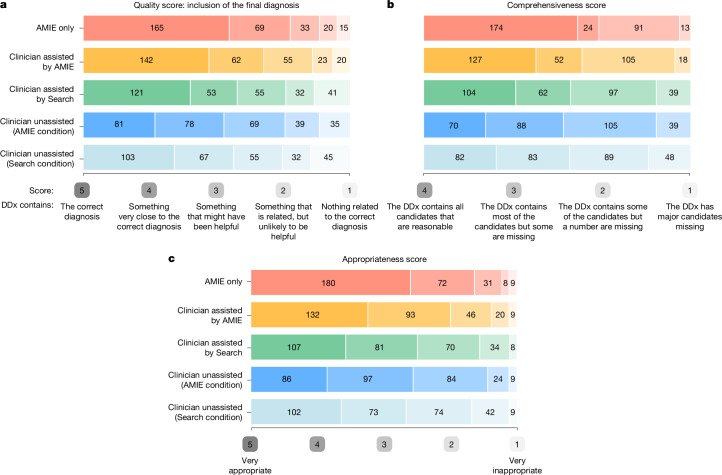
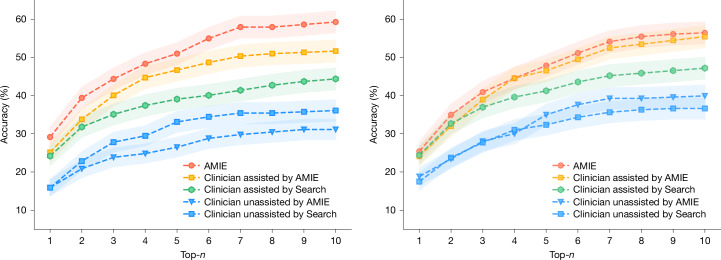
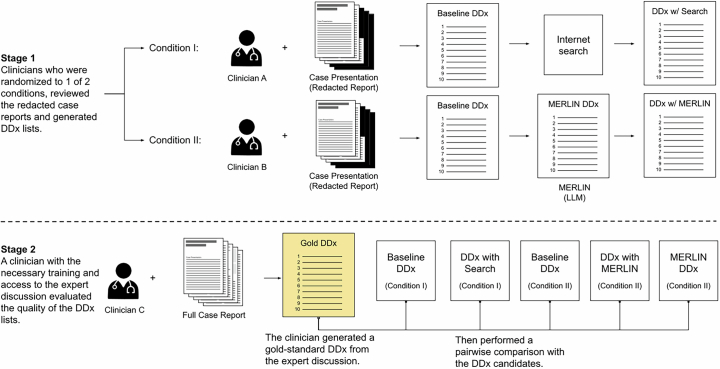
An accurate differential diagnosis (DDx) is a cornerstone of medical care, often reached through an iterative process of interpretation that combines clinical history, physical examination, investigations and procedures. Interactive interfaces powered by Large Language Models (LLMs) present new opportunities to both assist and automate aspects of this process. In this study, we introduce an LLM optimized for diagnostic reasoning, and evaluate its ability to generate a DDx alone or as an aid to clinicians. 20 clinicians evaluated 302 challenging, real-world medical cases sourced from the New England Journal of Medicine (NEJM) case reports. Each case report was read by two clinicians, who were randomized to one of two assistive conditions: either assistance from search engines and standard medical resources, or LLM assistance in addition to these tools. All clinicians provided a baseline, unassisted DDx prior to using the respective assistive tools. Our LLM for DDx exhibited standalone performance that exceeded that of unassisted clinicians (top-10 accuracy 59.1% vs 33.6%, [p = 0.04]). Comparing the two assisted study arms, the DDx quality score was higher for clinicians assisted by our LLM (top-10 accuracy 51.7%) compared to clinicians without its assistance (36.1%) (McNemar's Test: 45.7, p < 0.01) and clinicians with search (44.4%) (4.75, p = 0.03). Further, clinicians assisted by our LLM arrived at more comprehensive differential lists than those without its assistance. Our study suggests that our LLM for DDx has potential to improve clinicians' diagnostic reasoning and accuracy in challenging cases, meriting further real-world evaluation for its ability to empower physicians and widen patients' access to specialist-level expertise.
Overview
The claims and statistics of this paper haven’t been checked yet.
Run the check — free, no account needed. It reads the open-access text and checks the sources it cites.
Integrity signals
Registry
Cites
Statistics
Figures
Verification
Claims the paper makes
The claims and statistics of this paper haven’t been checked yet.
Run the check — free, no account needed. It reads the open-access text and checks the sources it cites.
Claims other papers make about this one
Each is checked against this paper’s own text: does it say what the citing paper says it does?
The source backs part of the claim, not all of it — or backs it for a different population, condition or comparison.
In the citing paper
“An unexpected secondary result was that the LLM alone performed significantly better than both groups of humans, similar to a recent study with different LLM technology.31”
From Large Language Model Influence on Diagnostic Reasoning: A Randomized Clinical Trial (2024) · cites this paper as [31]
Experimental — accuracy not yet measuredThe check wasn’t confident either way, so it gives no verdict — never disputed.
In the citing paper
“Our study included 6 cases that could feasibly be completed within a single study session while remaining comparable to standard practices in national licensing and objective structured clinical examinations to use a small, but broad sample of clinical cases.6,46,47,48,49”
From Large Language Model Influence on Diagnostic Reasoning: A Randomized Clinical Trial (2024) · cites this paper as [46]
Experimental — accuracy not yet measured
Self-check
Percentages, sums and reported differences re-computed from the paper’s own numbers.
The self-check needs the paper’s full text.
Citations
Cites
The Measurement of Observer Agreement for Categorical Data
Landis, J. R., & Koch, G. G. (1977) · Biometrics · doi:10.2307/2529310 · Cited by 81,148
MIMIC-III, a freely accessible critical care database
Johnson, A. E. W., Pollard, T. J., Shen, L., Lehman, L.-W. H., Feng, M., Ghassemi, M., Moody, B., Szolovits, P., Anthony Celi, L., & Mark, R. G. (2016) · Scientific Data · doi:10.1038/sdata.2016.35 · Cited by 8,141
Dissecting racial bias in an algorithm used to manage the health of populations
Obermeyer, Z., Powers, B., Vogeli, C., & Mullainathan, S. (2019) · Science · doi:10.1126/science.aax2342 · Cited by 7,137
Large language models encode clinical knowledge
Singhal, K., Azizi, S., Tu, T., Mahdavi, S. S., Wei, J., Chung, H. W., Scales, N., Tanwani, A., Cole-Lewis, H., Pfohl, S., et al. (2023) · Nature · doi:10.1038/s41586-023-06291-2 · Cited by 4,083
Self-citationLlama 2: Open Foundation and Fine-Tuned Chat Models
Touvron, H., Martin, L., Stone, K., Albert, P., Almahairi, A., Babaei, Y., Bashlykov, N., Batra, S., Bhargava, P., Bhosale, S., et al. (2023) · arXiv · doi:10.48550/arxiv.2307.09288 · Cited by 2,604
Reasoning Foundations of Medical Diagnosis
Ledley, R. S., & Lusted, L. B. (1959) · Science · doi:10.1126/science.130.3366.9 · Cited by 998
LLaVA-Med: Training a Large Language-and-Vision Assistant for Biomedicine in One Day
Li, C., Wong, C., Zhang, S., Usuyama, N., Liu, H., Yang, J., Naumann, T., Poon, H., & Gao, J. (2023) · Advances in Neural Information Processing Systems 36 · doi:10.52202/075280-1240 · Cited by 986
Seyyed-Kalantari, L., Zhang, H., McDermott, M. B. A., Chen, I. Y., & Ghassemi, M. (2021) · Nature Medicine · doi:10.1038/s41591-021-01595-0 · Cited by 928
A deep learning system for differential diagnosis of skin diseases
Liu, Y., Jain, A., Eng, C., Way, D. H., Lee, K., Bui, P., Kanada, K., de Oliveira Marinho, G., Gallegos, J., Gabriele, S., et al. (2020) · Nature Medicine · doi:10.1038/s41591-020-0842-3 · Cited by 853
Self-citationAnil, R., Dai, A. M., Firat, O., Johnson, M., Lepikhin, D., Passos, A., Shakeri, S., Taropa, E., Bailey, P., Chen, Z., et al. (2023) · arXiv · doi:10.48550/arxiv.2305.10403 · Cited by 834
Self-citation
Research works printed but not linked: 5
- [6]6. OpenAI. GPT-4 Technical Report 2023. arXiv: 2303.08774 [cs.CL] . · arXiv
- [13]13. Buckley, T., Diao, J. A., Rodman, A. & Manrai, A. K. Accuracy of a Vision-Language Model on Challenging Medical Cases 2023. arXiv: 2311.05591 [cs.CV] . · arXiv
- [17]17. Hong, J., Levine, S. & Dragan, A. Zero-Shot Goal-Directed Dialogue via RL on Imagined Conversations. arXiv preprint arXiv:2311.05584 (2023). · arXiv
- [21]21. Miller, R. A., Pople Jr, H. E. & Myers, J. D. in Computer-assisted medical decision making 139-158 (Springer, 1985).
- [30]30. Umapathi, L. K., Pal, A. & Sankarasubbu, M. Med-halt: Medical domain hallucination test for large language models. arXiv preprint arXiv:2307.15343 (2023). · arXiv
Cited by
Sorted by citations
Items 101–200 of 315
Further Reflections on the Use of Large Language Models in Pediatrics
Rader, B. M., Hswen, Y., & Brownstein, J. S. (2024) · Archives of Pediatrics and Adolescent Medicine · doi:10.1001/jamapediatrics.2024.0729 · Cited by 5
The effect of medical explanations from large language models on diagnostic decisions in radiologyPreprint
Spitzer, P., Hendriks, D., Rudolph, J., Schlaeger, S., Ricke, J., Kühl, N., Hoppe, B. F., & Feuerriegel, S. (2025) · medRxiv · doi:10.1101/2025.03.04.25323357 · Cited by 5
Quo Vadis, AI-Empowered Doctor?
Takahashi, G., von Liechti, L., & Tarshizi, E. (2025) · JMIR Medical Education · doi:10.2196/70079 · Cited by 4
Tekchandani, N., Mukherjee, A., Poonthottam, N., & Boussios, S. (2025) · Cureus · doi:10.7759/cureus.92089 · Cited by 4
The rise of large language models in wearable health sensing
Farrahi, V. (2025) · Intelligent Medicine · doi:10.1016/j.imed.2025.12.003 · Cited by 5
Large language models in neuropsychology: Emerging applications and ethical considerations
Kronenberger, O. R., Gottlieb, M. C., & Cullum, C. M. (2025) · The Clinical Neuropsychologist · doi:10.1080/13854046.2025.2604094 · Cited by 4
Artificial intelligence in orthopedics: current applications, challenges, and future directions
Kim, S. Y., Choi, B. S., Han, H., & Ro, D. H. (2026) · Knee Surgery and Related Research · doi:10.1186/s43019-026-00317-5 · Cited by 4
Zhang, Z., & Yan, B. (2025) · Analytical Chemistry · doi:10.1021/acs.analchem.5c04807 · Cited by 4
Natural language generation in healthcare: A review of methods and applications
Lyu, M., Li, X., Chen, Z., Pan, J., Peng, C., Talankar, S., & Wu, Y. (2026) · Journal of Biomedical Informatics · doi:10.1016/j.jbi.2026.104997 · Cited by 14
Schramm, S., Guellec, B. L., Topka, M., Svec, M., Backhaus, P., Eisenkolb, V. M., Riedel, E. O., Beyrle, M., Platzek, P., Ramschütz, C., et al. (2026) · Radiology · doi:10.1148/radiol.253477 · Cited by 4
Rapport 24-03. Systèmes d’IA générative en santé : enjeux et perspectives
Nordlinger, B., Kirchner, C., & de Fresnoye, O. (2024) · Bulletin de l Académie Nationale de Médecine · doi:10.1016/j.banm.2024.03.005 · Cited by 4
Qazi, I. A., Ali, A., Khawaja, A. U., Akhtar, M. J., Sheikh, A. Z., & Alizai, M. H. (2025) · medRxiv · doi:10.1101/2025.06.06.25329104 · Cited by 5
AI vs Human Performance in Conversational Hospital-Based Neurological DiagnosisPreprint
Sorka, M., Gorenshtein, A., Abramovitch, H., Soontrapa, P., Shelly, S., & Aran, D. (2025) · medRxiv · doi:10.1101/2025.08.13.25333529 · Cited by 4
The Effect of LLM Assistance on Diagnostic Accuracy: A Systematic Review and Meta-AnalysisPreprint
Tretow, I., Ergon, E., Schwebel, M., Treffers, T., Welpe, I. M., & Feuerriegel, S. (2025) · medRxiv · doi:10.64898/2025.12.11.25341476 · Cited by 4
He, Y., Wang, Y., Lai, L., Liu, N., Hong, Y., Chen, P., & Zhang, Z. (2025) · Scientific Reports · doi:10.1038/s41598-025-20210-7 · Cited by 3
Yum, J.-E. I., Naqvi, S. A. A., Zhou, B., & Riaz, I. B. (2025) · JCO Clinical Cancer Informatics · doi:10.1200/cci-25-00134 · Cited by 4
Wen, R., Assalif, A., Lee, A. S.-H., Kamadod, R., Behdinan, A., Carshon-Marsh, R., Meh, C., Ng, T. K. S., Brown, P., Jha, P. N., et al. (2025) · BMC Medicine · doi:10.1186/s12916-025-04584-z · Cited by 4
Tang, W., Chen, R., Long, X., Yu, D., Zhao, S., & Chen, B. (2026) · Journal of Orthopaedic Translation · doi:10.1016/j.jot.2026.101050 · Cited by 5
Mustafa, M., Shahnawaz, A., Ammara, U., Abrar, M., Ahtisham, B., Qureshi, F. U., Shahin, M. A., & Ahmed, B. (2026) · Proceedings of the ACM on Interactive Mobile Wearable and Ubiquitous Technologies · doi:10.1145/3790115 · Cited by 4
Pan, J., Jian, B., Hager, P., Zhang, Y., Liu, C., Jungmann, F., Li, H., Canisius, J., You, C., Wu, J., et al. (2026) · Nature Health · doi:10.1038/s44360-026-00152-8 · Cited by 25
Self-citationSafety and security of large language models in healthcare
Clusmann, J., Freyer, O., Ostermann, M., Ferber, D., Laleh, N. G., Hilgers, L., Kolbinger, F. R., Schneider, C. V., Downing, A., Wekenborg, M., et al. (2026) · Nature · doi:10.1038/s41586-026-10687-1 · Cited by 5
TeF-SAM: Prototype memory for medical lesion segmentation with text-free inference
Liang, J., Liu, X., Zang, Z., Wang, X., Qi, Y., & Li, X. (2026) · Computerized Medical Imaging and Graphics · doi:10.1016/j.compmedimag.2026.102816 · Cited by 4
Toward a future space-based, highly scalable AI infrastructure system design
y Arcas, B. A., Beals, T. R., Biggs, M., Bloom, J. V., Fischbacher, T., Gromov, K., Köster, U., Pravahan, R., & Manyika, J. (2026) · Joule · doi:10.1016/j.joule.2026.102678 · Cited by 3
Promises and challenges of artificial intelligence in haematological diagnostics
Eckardt, J., & Middeke, J. M. (2025) · British Journal of Haematology · doi:10.1111/bjh.70055 · Cited by 4
Tinajero, C. A. C. (2025) · European Journal of Pediatric Surgery · doi:10.1055/a-2722-3871 · Cited by 3
MedMobile: a mobile-sized language model with clinical capabilities
Vishwanath, K., Stryker, J., Alyakin, A., Alber, D. A., & Oermann, E. K. (2025) · BMJ Digital Health & AI · doi:10.1136/bmjdhai-2025-000068 · Cited by 10
A federated graph learning method to realize multi-party collaboration for molecular discovery
Zhang, L., Zhang, J., Huang, R., Wang, Y., Liu, L., Zhang, Y., Chen, K., Jiang, J., & Wu, Y. (2026) · Nature Machine Intelligence · doi:10.1038/s42256-026-01184-1 · Cited by 4
Murphy, K. B., Schilder, B. M., & Skene, N. (2024) · medRxiv · doi:10.1101/2024.06.10.24308475 · Cited by 3
Steinbuch, S., de Vos‐Hillebrand, L., O'Neill-Dee, C., Wu, I., Steinbuch, H., Kulcsár, Z., Ranjan, A., Verma, A., Landsberg, J., Dietrich, D., et al. (2026) · medRxiv · doi:10.64898/2026.01.23.26344723 · Cited by 3
Structured reasoning failures compromise LLM interpretation of clinical oncology notes
Kenaston, M. W., Ayub, U., Parmar, M., Kumar, P., Anjum, M. U., Naqvi, S. A. A., Chaudhuri, A. A., Zakharia, Y., Heath, E. I., Bekaii-Saab, T. S., et al. (2026) · npj Digital Medicine · doi:10.1038/s41746-026-02951-5 · Cited by 2
sLLM: Accelerating LLM Inference using Semantic Load Balancing with Shared Memory Data Structures
Lin, J., Zhang, S. Q., & Leon‐Garcia, A. (2024) · International Symposium on Quality Electronic Design (ISQED) · doi:10.1109/isqed60706.2024.10528703 · Cited by 3
Kułakowski, P., Alarcón, A., Škorić, T., Seoni, S., O’Sullivan, M., & O’Toole, J. M. (2025) · The Journal of Pediatrics · doi:10.1016/j.jpeds.2025.114708 · Cited by 2
Wang, M., Sushil, M., Williams, C. Y. K., Miao, B. Y., Kim, S., Masharani, U. B., Ku, G., Hsiao, V. C., Shah, A., Koliwad, S. K., et al. (2025) · Clinical Diabetes · doi:10.2337/cd25-0015 · Cited by 3
Advancing rheumatic disease care through generative artificial intelligence
Mahajan, A., Bates, D. W., Liao, K. P., & Sparks, J. A. (2025) · Nature Reviews Rheumatology · doi:10.1038/s41584-025-01310-0 · Cited by 3
Artificial intelligence in forensic psychiatry: potential applications and key considerations
Blott, H., Hind, E., Brown, C., & Forrester, A. (2025) · Journal of Forensic and Legal Medicine · doi:10.1016/j.jflm.2025.103016 · Cited by 4
Physician Perspectives on Large Language Models in Health Care: A Cross-Sectional Survey Study
Hong, H. J., Shah, N. H., Pfeffer, M. A., & Lehmann, L. S. (2025) · Applied Clinical Informatics · doi:10.1055/a-2735-0527 · Cited by 2
Chu, Y.-C., Chen, Y., Hsu, C., Kuo, C.-T., Cheng, Y., Lin, K., & Liao, W. (2025) · Digital Health · doi:10.1177/20552076251395449 · Cited by 4
Self-citationCheema, M. N., Nazir, A., Harmanci, A. O., Harmanci, A. O., Cheema, Y., Masood, S., & Khokhar, F. A. (2026) · The Visual Computer · doi:10.1007/s00371-026-04385-2 · Cited by 2
EpidemIQs: Prompt-to-Paper LLM Agents for Epidemic Modeling and Analysis
Samaei, M. H., Sahneh, F. D., Cohnstaedt, L. W., & Scoglio, C. (2026) · IEEE Transactions on Artificial Intelligence · doi:10.1109/tai.2026.3666830 · Cited by 7
Song, C. W., Baek, B. H., Kim, S. K., Yoon, W., Lee, Y. Y., Park, I., Park, J. H., Park, S. B., & Choi, I. W. (2026) · Journal of Clinical Medicine · doi:10.3390/jcm15041673 · Cited by 2
Li, X., Wu, X. T., Wang, Q., Zhu, Y., Zhang, L., Song, Y., Lv, B., Chen, J., Fan, W., Chai, G., et al. (2026) · ACS Sensors · doi:10.1021/acssensors.5c03495 · Cited by 2
Chen, A., & Lu, Y. (2026) · Journal of Management Information Systems · doi:10.1080/07421222.2025.2602395 · Cited by 2
Tandon, U. (2026) · Frontiers in Digital Health · doi:10.3389/fdgth.2026.1772345 · Cited by 2
The physician as a catalyst: Reimagining medical education for an AI era
Patel, M. S., Dee, E. C., Toby, S., Ramos, M., & Celi, L. A. (2026) · Medical Teacher · doi:10.1080/0142159x.2026.2653205 · Cited by 2
Metzger, A., Patil, S., Sugarmann, L., Karabacak, M., & Margetis, K. D. (2026) · JMIR AI · doi:10.2196/81134 · Cited by 2
CNS-Obsidian: A Neurosurgical Vision-Language Model Built From Scientific Publications
Alyakin, A., Stryker, J., Alber, D. A., Lee, J. V., Sangwon, K. L., Duderstadt, B., Save, A., Kurland, D. B., Frome, S., Singh, S., et al. (2026) · Neurosurgery · doi:10.1227/neu.0000000000004070 · Cited by 2
Generative Artificial Intelligence and Large Language Models in Clinical Oncology
Yu, Y., Zhao, Z., Wang, Z., Lin, R., Tan, Y., Chen, Y., Li, T., Baptista‐Hon, D. T., Zhang, X., Wu, C., et al. (2026) · MedComm · doi:10.1002/mco2.70833 · Cited by 2
Dinc, R., & Ardic, N. (2026) · JMIR Medical Informatics · doi:10.2196/92584 · Cited by 2
Klinisches Denken, ärztliche Kunst und Artificial Intelligence
Bassetti, S., Hirsch, M. C., & Battegay, E. J. (2024) · DMW - Deutsche Medizinische Wochenschrift · doi:10.1055/a-2201-5412 · Cited by 2
Artificial intelligence-enabled precision medicine for inflammatory skin diseasesPreprint
Tang, A., Wei, M. L., Haemel, A. K., La, C., Sirota, M., & Lee, E. Y. (2025) · PubMed · doi:10.48550/arxiv.2505.09527 · Cited by 5
Roemer, A., Schlicker, N., Kernder, A. L., Albe, B., Hack, J., Hirsch, M., Mayr, A. J., Kühn, S., & Knitza, J. (2025) · doi:10.2196/preprints.79716 · Cited by 2
Sesen, M. B., Yeung, J. A., & Asgari, E. (2026) · BMJ Digital Health & AI · doi:10.1101/2025.11.25.25341010 · Cited by 2
The value of doubt: training LLMs to consider diagnostic uncertainty may improve clinical utility
Sui, M., Rosen, K. L., Heydari, K., Enichen, E. J., & Kvedar, J. C. (2026) · npj Digital Medicine · doi:10.1038/s41746-025-02307-5 · Cited by 2
Artificial Intelligence Applications in Oral and Maxillofacial Medicine
Uribe, S. E. (2025) · Springer eBooks · doi:10.1007/978-3-031-84047-0_3 · Cited by 3
Conversational AI in Medicine: Redefining Diagnostics with AMIE
Lin, Z., Du, Y., Yang, W., Qian, Y., & Li, J. J. (2025) · BIO Integration · doi:10.15212/bioi-2025-0085 · Cited by 2
Impact of LLM assistance on physician decision-making: a multi-country randomized controlled trial
Rounding, N., Arif, L. S., Berg, J., Cals, J., de Boer, D. P., de Bont, E. G. P. M., Dijksman, S., Findyartini, A., Fouarge, D. J. A. G., Fregin, M.-C., et al. (2026) · npj Digital Medicine · doi:10.1038/s41746-026-03111-5 · Cited by 1
Krumsvik, R. J. (2025) · Nordic Journal of Digital Literacy · doi:10.18261/njdl.20.2.5 · Cited by 1
BioSage: Human-Agent Collaboration Platform for Cross-Disciplinary Knowledge Discovery and Synthesis
Klinefelter, Z. P., Erickson, I., Ganberg, G., Abele, N., Engberson, G., Penafiel, L., Kao, H.-T., Hiriyanna, A., Bautista, P., & Volkova, S. (2025) · Proceedings of the Human Factors and Ergonomics Society Annual Meeting · doi:10.1177/10711813251369365 · Cited by 1
Artificial Intelligence (AI) in Patient–Healthcare Relationships: Psychosocial Perspective
Saikia, M. J., & Borthakur, D. (2025) · IEEE Access · doi:10.1109/access.2025.3611818 · Cited by 2
New Frontiers in Human-Agent Team Modeling and Evaluation in the Era of Agentic AI
Bruni, S., Volkova, S., Cassani, L., Neville, K., & Cooke, N. J. (2025) · Proceedings of the Human Factors and Ergonomics Society Annual Meeting · doi:10.1177/10711813251369392 · Cited by 1
Generative AI: A Disruptor to Health Professions Learner Assessment
Morjaria, L., Gandhi, B., Burns, L., & Sibbald, M. (2025) · Cureus · doi:10.7759/cureus.96034 · Cited by 1
Fujita, W., Sakamoto, A., Sato, E., KANEKO, T., & Kagiyama, N. (2025) · Juntendō Igaku/Juntendo igaku · doi:10.14789/ejmj.jmj25-0019-r · Cited by 12
Kulkarni Kale, U., & Vemulapalli, G. (2025) · The Cancer Journal · doi:10.1097/ppo.0000000000000799 · Cited by 1
Künstliche Intelligenz: Chancen und Grenzen
Clusmann, J., Schneider, C. V., Foersch, S., Truhn, D., & Kather, J. N. (2025) · Forum · doi:10.1007/s12312-025-01520-3 · Cited by 1
Winkel, A. F., Myrick, O., Smith, M., & Triola, M. M. (2025) · Clinical Obstetrics & Gynecology · doi:10.1097/grf.0000000000000982 · Cited by 1
Hierarchical agent reflection for aligning LLM reasoning with clinical diagnostic processes
Wang, X., Li, X., Zhao, D., Feng, K., Liang, L., Zhang, Z., Ding, K., Chen, H., Wan, B., & Zhang, Q. (2026) · Health Information Science and Systems · doi:10.1007/s13755-025-00410-1 · Cited by 1
Lu, J., Chiu, K. W.-H., Chan, C., Cheng, H.-M., Zhou, J., Justin Christopher, N. G., Tang, F. F. Y., Kan, W. K., Yu, P. L. H., & Seto, W. (2026) · European Journal of Radiology · doi:10.1016/j.ejrad.2026.112689 · Cited by 1
Brivá-Iglesias, V., & O’Brien, S. (2026) · International Journal of Human-Computer Interaction · doi:10.1080/10447318.2026.2622588 · Cited by 4
MedBLINK: Probing Basic Perception in Multimodal Language Models for Medicine
Bigverdi, M., Ikezogwo, W. O., Zhang, K., Jeong, H., Lu, M., Cho, S., Shapiro, L. G., & Krishna, R. (2025) · IEEE International Conference on Computer Vision Workshops · doi:10.1109/iccvw69036.2025.00132 · Cited by 1
Xu, Y., Prentice, C., Rueda, S. T., Meczner, A., Multmeier, J., Wickham, A. P., Kelly, L., Klepchukova, A., Stsefanovich, H., & Zhaunova, L. (2026) · npj Digital Medicine · doi:10.1038/s41746-025-02332-4 · Cited by 3
AI on Trial: LLM-as-a-Judge for Private and Reliable Clinical Decision-Making
Khan, T. A., Rafiq, M., & Michalas, A. (2025) · Annual Computer Security Applications Conference Workshops (ACSAC Workshops) · doi:10.1109/acsacw69556.2025.00033 · Cited by 2
Physicians’ expectations of the use of conversational agents in healthcare: a qualitative study
Wutz, M., Söling, S., & Köberlein-Neu, J. (2026) · BMC Health Services Research · doi:10.1186/s12913-026-14321-8 · Cited by 1
Xiong, X., Xiao, M., Liu, H., Jiang, C., Li, M., Song, Y., Zhou, J., & Xu, B. (2026) · BMC Medical Education · doi:10.1186/s12909-026-08951-z · Cited by 2
Paging the algorithm: applying the Best Available Human principle to graduate medical education
Stamos, D. B., & Dharod, A. (2026) · Academic Medicine · doi:10.1093/acamed/wvag119 · Cited by 2
Limitations of Large Language Models in Clinical Diagnostic Reasoning
Tordjman, M., & Mei, X. (2026) · JAMA Network Open · doi:10.1001/jamanetworkopen.2026.4014 · Cited by 1
Four Aspirations for Evaluating AI-Infused Technologies: A Narrative Review
Morey, D. A., Jalaeian, M., Reynolds, M. E., McGeorge, N., Oldham, H. K., & Rayo, M. F. (2026) · Journal of Cognitive Engineering and Decision Making · doi:10.1177/15553434261443032 · Cited by 1
How can we prevent clinical deskilling when using AI?
Scott, I., van der Vegt, A. H., & Douglas, P. (2026) · BMJ Quality & Safety · doi:10.1136/bmjqs-2026-020130 · Cited by 1
Basu, S., Patel, S., Sheth, P., Arevalo, B., Schifberg, J., Morgan, J., & Batniji, R. (2026) · BMC Medical Informatics and Decision Making · doi:10.1186/s12911-026-03763-z · Cited by 1
Self-citationYan, B., Zhang, R., Chen, L., Song, X. Z., Cao, Z., & Li, Y. (2026) · Journal of Medical Internet Research · doi:10.2196/96304 · Cited by 1
A roadmap for medical large language models: a review of foundations, applications, and challenges
Sha, Y.-Y., Yu, L., Lin, Z.-H., Kaur, A., Lou, Y., Gornale, S. S., Zhang, T., Wong, L. S., Wang, Z., Yan, Y., et al. (2026) · Military Medical Research · doi:10.1016/j.mmr.2026.100050 · Cited by 3
From Where to What: The Geo-Intervention Modelling Framework
Wen, R., & Li, S. (2026) · ISPRS International Journal of Geo-Information · doi:10.3390/ijgi15070292
AI and actor-specific decisions
Felin, T., Sako, M., & Hullman, J. (2026) · AI & Society · doi:10.1007/s00146-026-03202-7 · Cited by 7
Human-AI Collaboration in Radiology: The Blind Spots
Kim, S. H., Adams, L. C., Wiestler, B., & Hedderich, D. M. (2026) · Radiology Artificial Intelligence · doi:10.1148/ryai.260325 · Cited by 1
Samsel, K., Dharma, C., Rezaie, A. H. H. M., Bahakim, A., Ravikumar, K., Bhat, V., Kamaleddin, M. A., & Abad, Z. S. H. (2026) · Artificial Intelligence in Medicine · doi:10.1016/j.artmed.2026.103516 · Cited by 1
Toma, M., & YUSUPOV, D. (2026) · Bioengineering · doi:10.3390/bioengineering13091034 · Cited by 1
Li, J., Xiao, L., Qu, X., Du, L., Gong, T., Yu, Y., Li, Y., 谢鹏飞, Chu, G., Li, H., et al. (2026) · Radiology · doi:10.1148/radiol.253579 · Cited by 1
Exploratory models of human-AI teams
Nguyen, D., Cohen, M. C., Kao, H.-T., Engberson, G., Penafiel, L., Lynch, S., McCormack, R., Cassani, L., & Volkova, S. (2025) · Interaction Studies Social Behaviour and Communication in Biological and Artificial Systems · doi:10.1075/is.24052.ngu · Cited by 1
Harnessing Internet Search Data as a Potential Tool for Medical DiagnosisPreprint
Downing, G. J., Tramontozzi, L. M., Garcia, J., & Villanueva, E. (2024) · medRxiv · doi:10.1101/2024.05.03.24305695 · Cited by 1
Is Strong Artificial Intelligence Skepticism Justified or Counterproductive?
Hänscheid, T., & Grobusch, M. P. (2024) · Clinical Infectious Diseases · doi:10.1093/cid/ciae443 · Cited by 1
Beyond Scaling Laws: Towards Scientific Reasoning-Driven LLM ArchitecturesPreprint
Chen, F. (2025) · Preprints.org · doi:10.20944/preprints202504.2088.v1
Probing Hidden States for Calibrated, Alignment-Resistant Predictions in LLMsPreprint
Berkowitz, J. S., Kivelson, S., Srinivasan, A., Gisladottir, U., Tsang, K. K., Cortina, J. M. A., Kuchi, A., Patock, J. R., Czarny, R., & Tatonetti, N. P. (2025) · medRxiv · doi:10.1101/2025.09.17.25336018 · Cited by 2
How Large Language Models Can Affect Clinical Reasoning: A Randomized Clinical TrialPreprint
Levels, M., Levels, M., Rounding, Dijksman, Fouarge, D. J. A. G., Fregin, Steens, Velasco, Boer, D., Bont, D., et al. (2025) · medRxiv · doi:10.64898/2025.12.17.25342338 · Cited by 1
Jin, K. W., Abadi, Y. R., Chaudhary, P., Garrett, M. A., Huang, A. S., Montelongo, M., Nagpal, C., Shei, J., Weathers, J., Zhang, J. S., et al. (2026) · medRxiv · doi:10.64898/2026.02.03.26345402 · Cited by 2
Shimelash, N., Rutunda, S., Menon, V., Emmanuel-Fabula, M., Uwimbabazi, A., Rugege, C., Nshimiyimana, C., Rwema, I. S., Kandekwe, M., Berhe, D. F., et al. (2026) · medRxiv · doi:10.64898/2026.02.16.26346409 · Cited by 1
Hassoon, A., Peng, X., Irimia, R. M., Lianjie, A., Leo, H., Bandeira, A., Woo, H., Dredze, M., Abdulnour, R.-E. E., McDonald, K. M., et al. (2026) · medRxiv · doi:10.64898/2026.02.22.26346832 · Cited by 1
Me-LLaMA: Medical Foundation Large Language Models for Comprehensive Text Analysis and BeyondPreprint
Xie, Q., Chen, Q., Chen, A., Cheng, P., Hu, Y., Lin, F., Peng, X., Huang, J., Zhang, J., Keloth, V. K., et al. (2024) · SSRN Electronic Journal · doi:10.2139/ssrn.4943761
Zhao, Y. (2025) · Research Square · doi:10.21203/rs.3.rs-6124845/v1 · Cited by 1
The role of large language models in medical genetics
Merdler-Rabinowicz, R., Omar, M., Ganesh, J., Morava, É., Nadkarni, G. N., & Klang, E. (2025) · Molecular Genetics and Metabolism · doi:10.1016/j.ymgme.2025.109098
Computerized diagnostic decision support systems—Isabel Pro versus ChatGPT-4 part II
Bridges, J. M., Jiang, X., Ige, M., & Toyobo, O. (2025) · JAMIA Open · doi:10.1093/jamiaopen/ooaf048 · Cited by 1
Metadata
- Authors
- McDuff, D., Schaekermann, M., Tu, T., Palepu, A., Wang, A., Garrison, J., Singhal, K., Sharma, Y., Azizi, S., Kulkarni, K., Hou, L., Cheng, Y., Liu, Y., Mahdavi, S. S., Prakash, S., Pathak, A., Semturs, C., Patel, S., Webster, D. R., Dominowska, E., Gottweis, J., Barral, J., Chou, K., Corrado, G. S., Matias, Y., Sunshine, J., Karthikesalingam, A., & Natarajan, V.
- Affiliations
- Google (United States) (US)
- Google (Switzerland) (CH)
- Google (United Kingdom) (GB)
- Corresponding author
- McDuff, Daniel
- Schaekermann, Mike
- Karthikesalingam, Alan
- Natarajan, Vivek
- ORCID
- McDuff, Daniel
- Schaekermann, Mike
- Tu, Tao
- Palepu, Anil
- Wang, Amy
- Singhal, Karan
- Azizi, Shekoofeh
- Cheng, Yong
- Liu, Yun
- Mahdavi, S Sara
- Prakash, Sushant
- Pathak, Anupam
- Semturs, Christopher
- Patel, Shwetak
- Webster, Dale R
- Dominowska, Ewa
- Gottweis, Juraj
- Barral, Joelle
- Chou, Katherine
- Corrado, Greg S
- Matias, Yossi
- Karthikesalingam, Alan
- Natarajan, Vivek
- Venue
- arXiv
- Publisher
- arXiv
- Published
- 2023
- Volume
- 642
- Issue
- 8067
- Pages
- 451-457
- ISSN
- 0028-0836 (ISSN-L)
- arXiv
- 2312.00164
- PMC
- PMC12158753
- OpenAlex
- W4409283616
- Cited by
- 311
- References
- 34
- Citations by year
- 2026: 172 · 2025: 108 · 2024: 31
- FWCI
- 67.40
- Type
- journal article
- Language
- en
- Open access
- hybrid
- doi.org
- Licence
- Locations
- Nature (publishedVersion, cc-by)
- PubMed Central (publishedVersion, cc-by)
- PubMed (publishedVersion)
- arXiv (Cornell University) (submittedVersion, other-oa)
- arXiv (Cornell University)
- Funders
- Massachusetts Medical Society
- DeepMind
- Topics
- Health Sciences › Medicine › Health Informatics › Artificial Intelligence in Healthcare and Education
- Physical Sciences › Computer Science › Artificial Intelligence › Machine Learning in Healthcare
- Health Sciences › Health Professions › Health Information Management › Artificial Intelligence in Healthcare
- Keywords
- differential diagnosis, large language models, diagnostic reasoning, clinical decision support, clinician performance, AI-assisted diagnosis, medical knowledge retrieval
- MeSH terms
- Case Reports as Topic, Large Language Models, Artificial Intelligence, Diagnosis, Differential, Humans, Language
About these checks
Registry, retraction, Cites and statistics results are computed, not judged, with one exception: a printed reference that no index lists is read once by a model before it counts as a citation error. Claims are extracted by a model and kept only when their quote appears verbatim in the text; each cited source is then checked, with a model’s help, for whether it says what the claim relies on. Those verdicts can be wrong — read the claim’s quote and the cited source before relying on one.
Statistics and arithmetic are recomputed, not judged.
Confidence bands are shown only for fields calibrated on our annotated test set. None is calibrated yet, so no band is shown.
What counts as a claim ›How we measure confidence ›How we check this ›
Are you an author, or do you see a problem with this page? Request a review
