

Chronos: Learning the Language of Time Series
Open accessThe DOI matches its DataCite record; 95 of the 95 references it cites were found in a registry or an index; none of the 21 sources its claims cite is checked for support yet.
Abstract
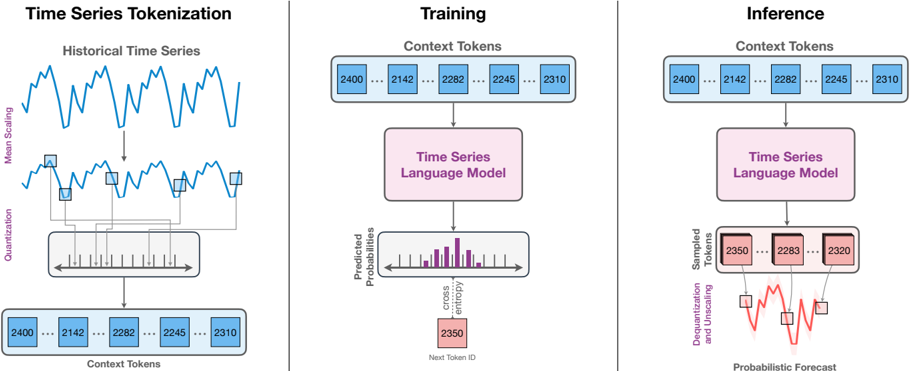
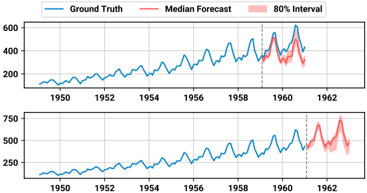
We introduce Chronos, a simple yet effective framework for pretrained probabilistic time series models. Chronos tokenizes time series values using scaling and quantization into a fixed vocabulary and trains existing transformer-based language model architectures on these tokenized time series via the cross-entropy loss. We pretrained Chronos models based on the T5 family (ranging from 20M to 710M parameters) on a large collection of publicly available datasets, complemented by a synthetic dataset that we generated via Gaussian processes to improve generalization. In a comprehensive benchmark consisting of 42 datasets, and comprising both classical local models and deep learning methods, we show that Chronos models: (a) significantly outperform other methods on datasets that were part of the training corpus; and (b) have comparable and occasionally superior zero-shot performance on new datasets, relative to methods that were trained specifically on them. Our results demonstrate that Chronos models can leverage time series data from diverse domains to improve zero-shot accuracy on unseen forecasting tasks, positioning pretrained models as a viable tool to greatly simplify forecasting pipelines.
Overview
CoChat Summary
TL;DR
Chronos adapts language-model architectures to probabilistic time series forecasting by scaling and quantizing values into tokens and training T5/GPT-2 models with cross-entropy. Across 42 benchmark datasets, it achieves strong in-domain and zero-shot forecasting, often matching or beating task-specific models.
Key findings
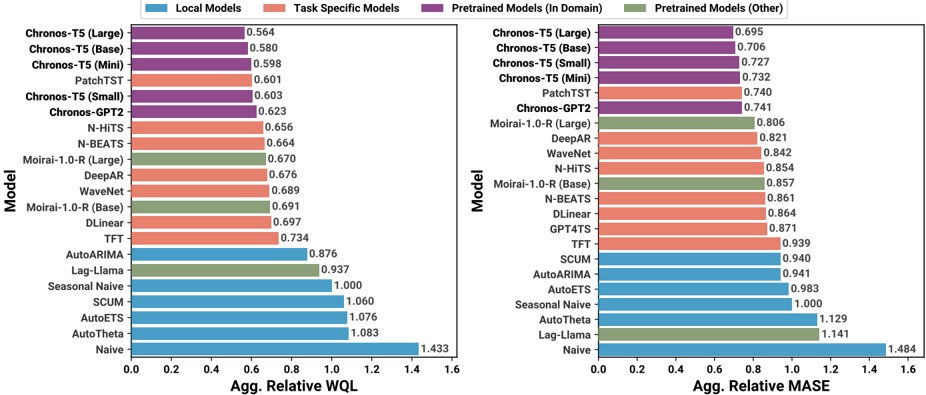
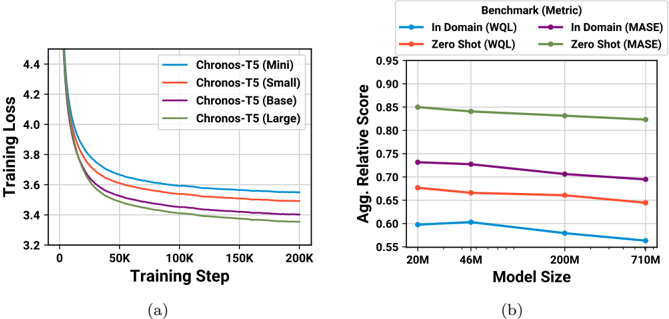
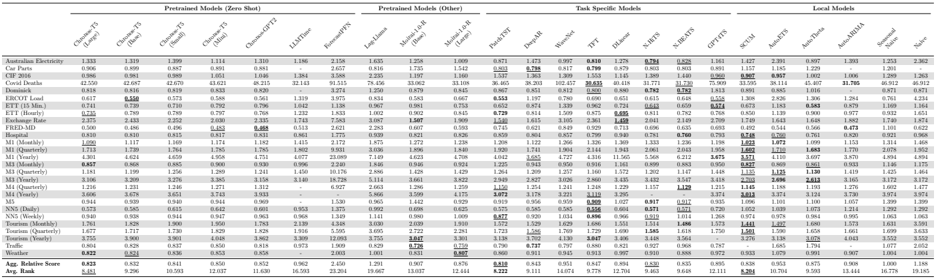
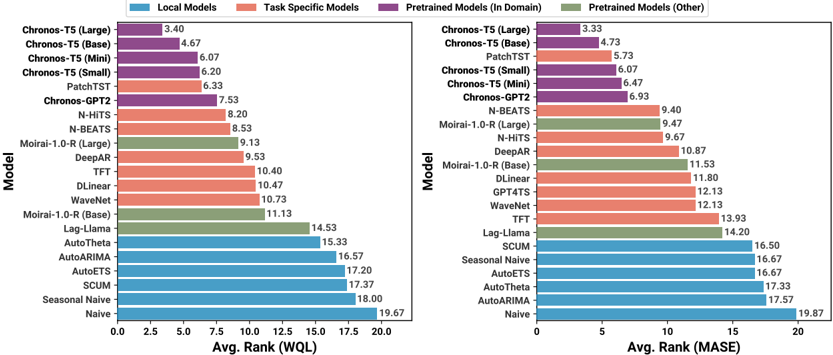
- On in-domain Benchmark I (15 datasets), Chronos-T5 Base/Large obtain the best aggregated relative scores: WQL 0.580/0.564 and MASE 0.706/0.695 versus Seasonal Naive 1.000, outperforming local, task-specific, and other pretrained baselines.
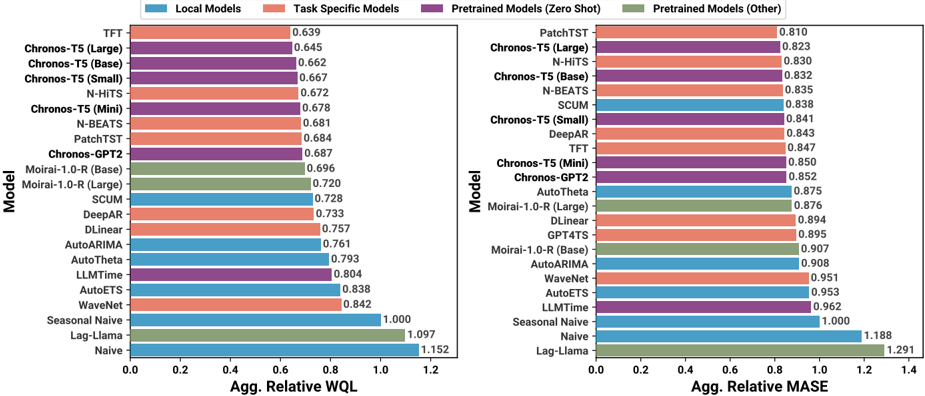
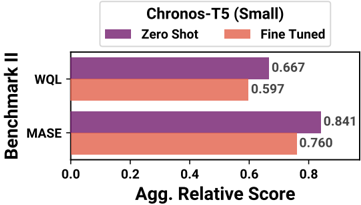
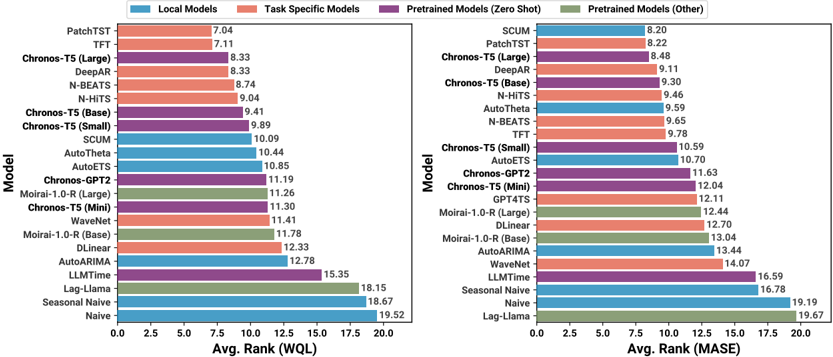
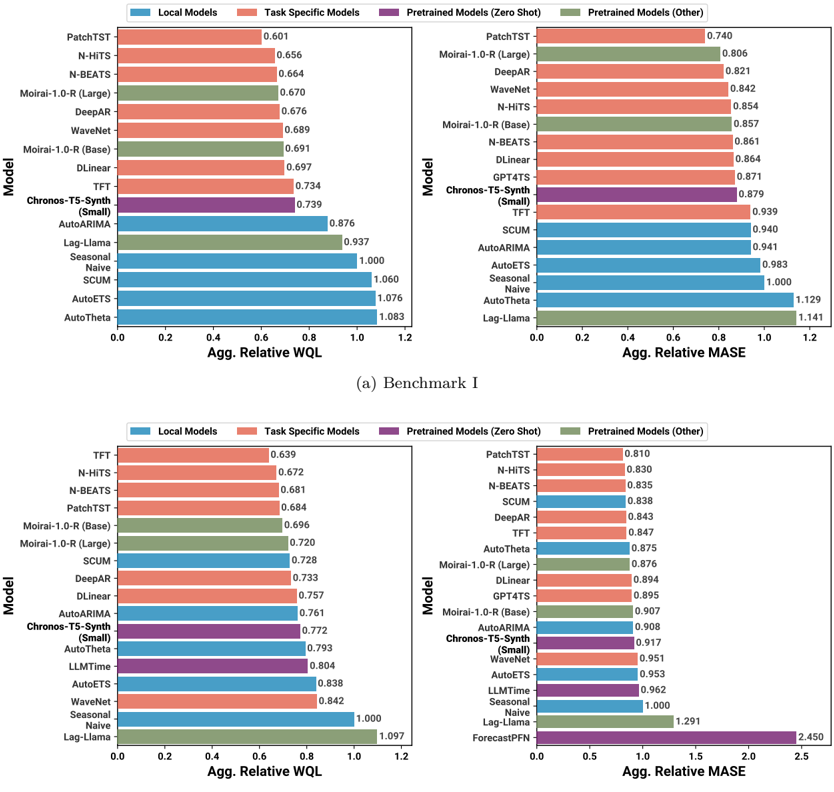
- On zero-shot Benchmark II (27 datasets), Chronos models rank 2nd–4th on WQL and Chronos-T5 Large ranks 2nd on MASE; aggregated relative WQL is 0.645 (Large), 0.662 (Base), 0.667 (Small), 0.678 (Mini), and MASE is 0.823, 0.832, 0.841, 0.850 versus Seasonal Naive 1.000. Fine-tuned Chronos-T5 Small becomes the best model on Benchmark II.
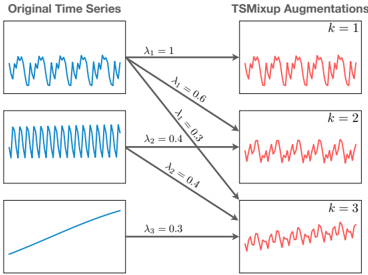
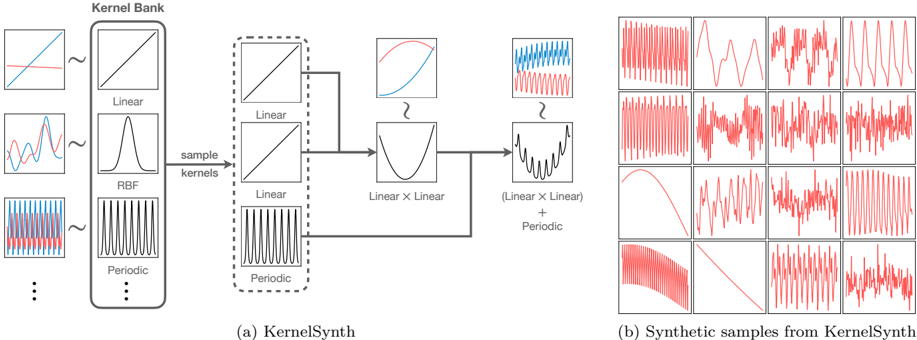
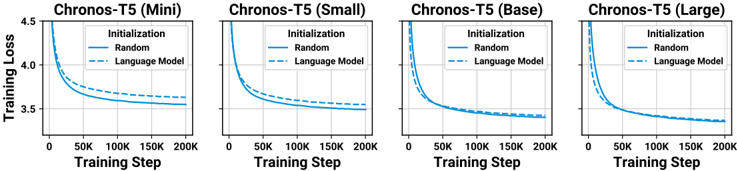
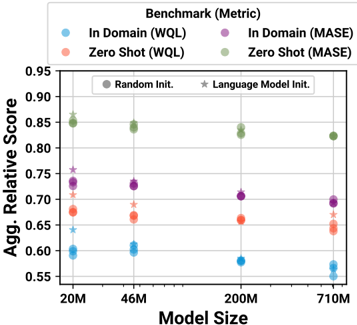
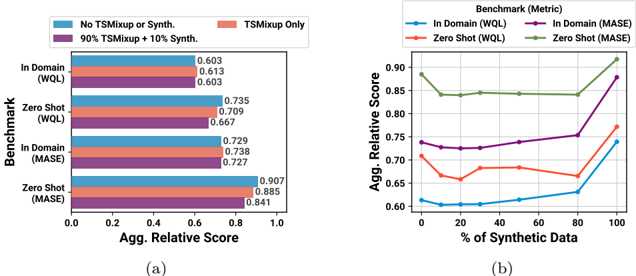
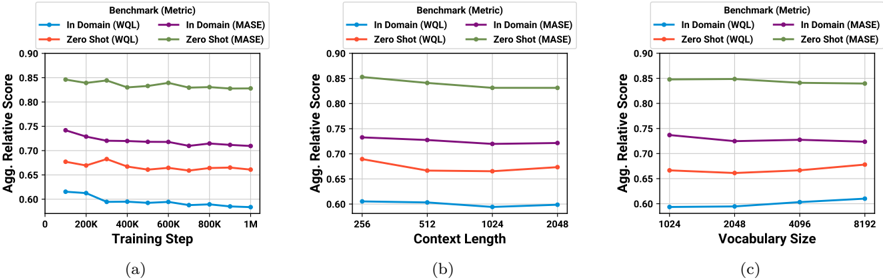
- Ablations show performance improves with model size; language-model-weight initialization offers little/no advantage over random initialization; TSMixup improves zero-shot performance; about 10% KernelSynth synthetic data is best; context length up to 1024 helps; larger vocabulary improves MASE but WQL deteriorates.
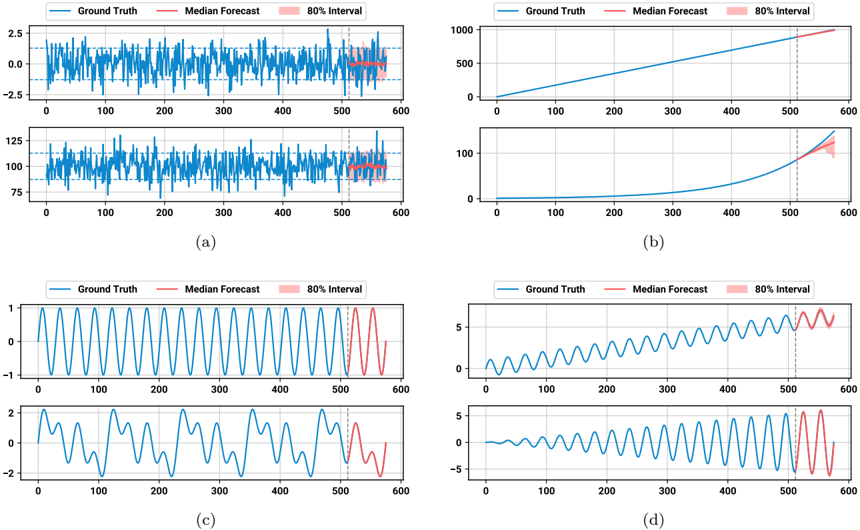
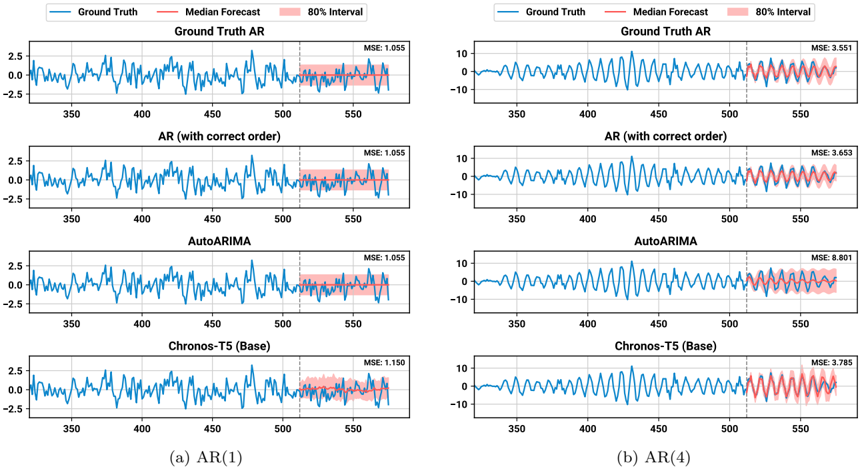
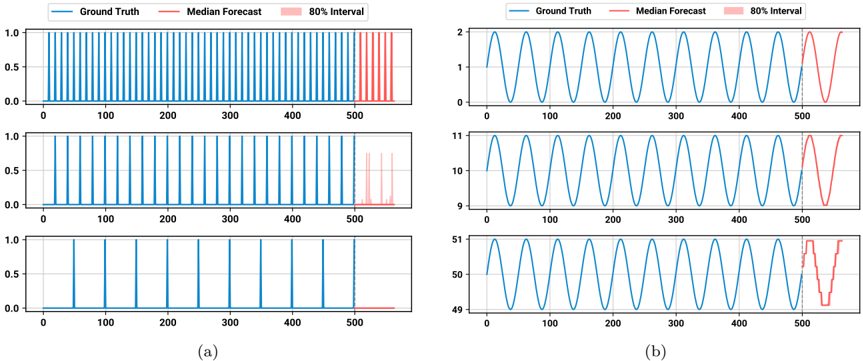
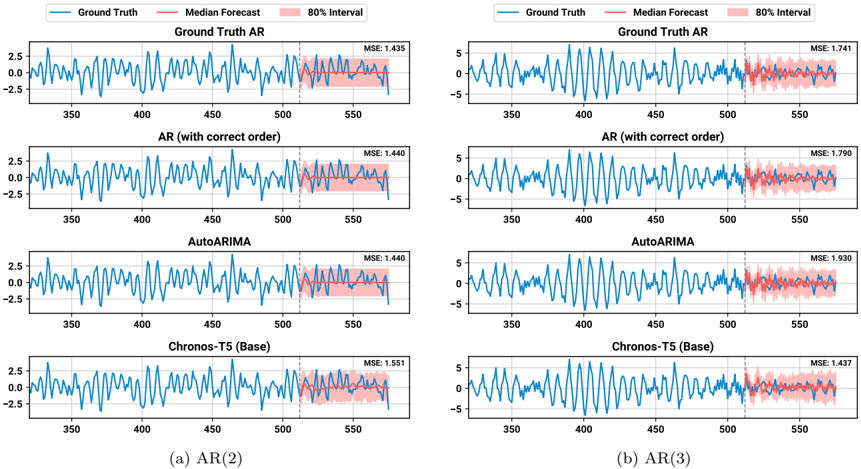
- Qualitatively, Chronos handles Gaussian noise, seasonality, additive/multiplicative trend+seasonality, and AR processes, but struggles with exponential trends and underestimates trend when context is short.
Methods
- Chronos mean-scales time series, uniformly quantizes values into B=4094 bins plus PAD/EOS (V_ts=4096), and trains off-the-shelf transformer language models with categorical cross-entropy; forecasts are produced by autoregressively sampling token paths and dequantizing/unscaling them.
- Training used 55 datasets total: 13 pretraining-only, 15 Benchmark I in-domain, and 27 Benchmark II zero-shot; 28 training datasets comprised about 890K univariate series and approximately 84B observations/tokens. Models included T5 Mini 20M, Small 46M, Base 200M, Large 710M, and GPT-2 90M, trained with 10M TSMixup augmentations plus 1M KernelSynth GP synthetic series, context length 512, prediction length 64, and 200K AdamW steps.
- Evaluation used 42 benchmark datasets with WQL (9 quantiles) and MASE; relative scores versus Seasonal Naive were aggregated by geometric mean and compared against local, task-specific, and pretrained baselines, plus a fine-tuning experiment on Benchmark II.
Limitations
- The paper states tokenization limits: representable values are in [-15s, 15s] where s is the mean absolute scale; small s relative to range causes overflow, while large s relative to variance causes precision loss. It also notes poor exponential-trend forecasts, trend underestimation with short context, and that categorical cross-entropy is not distance-aware; ordinal modeling is left as future work.
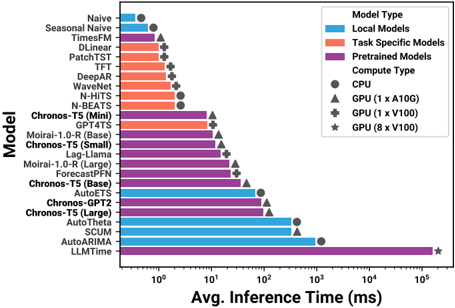
- The paper states scope limits: only univariate, uniformly spaced forecasting is studied; exogenous covariates, multivariate forecasting, and irregular sampling are not handled. Larger models were not explored due to slow inference, inference is slower than task-specific models, evaluation lacks enough high-frequency datasets to study long contexts, and public time series data remain limited.
- Text-evident: the zero-shot comparison may favor Moirai-1.0-R because many Benchmark II datasets were part of its pretraining corpus, as the paper notes; Chronos also ignores time and frequency information by design.
Model-written summary. Check it against the paper before relying on it.
Integrity signals
Registry
Cites
Statistics
Figures

Verification
Claims the paper makes
0 Valid · 4 Not valid · 14 Not checked · 146 Own results and interpretations
A result the paper reports from its own data — it cites no other source for it, so there is none to check. The quote shows it is in the paper.
In the paper
“Between the two baseline pretrained models studied in this experiment, Moirai-1.0-Rclearly outperforms Lag-Llama.”
§ Chronos: Learning the Language of Time Series > 5.5 Main Results
boosted- Asserted: passes — The authors put it forward as true.
- Checkable: passes — It can be checked against evidence.
- Load-bearing: unclear — It is unclear whether the paper’s conclusions depend on it.
- Based: passes — The paper gives a reason why it holds.
A result the paper reports from its own data — it cites no other source for it, so there is none to check. The quote shows it is in the paper.
In the paper
“Unsurprisingly, the training loss improves with the model capacity, as shown in Figure 7a.”
§ Chronos: Learning the Language of Time Series > Model size.
plainstates a cause- Asserted: passes — The authors put it forward as true.
- Checkable: passes — It can be checked against evidence.
- Load-bearing: unclear — It is unclear whether the paper’s conclusions depend on it.
- Based: passes — The paper gives a reason why it holds.
A result the paper reports from its own data — it cites no other source for it, so there is none to check. The quote shows it is in the paper.
In the paper
“Our comprehensive evaluation across 42 datasets establishes Chronos as a benchmark for both in-domain and zero-shot forecasting, surpassing both traditional models and task-specific deep learning approaches.”
§ Chronos: Learning the Language of Time Series > Time Series Tokenization Training Inference
plain- Asserted: passes — The authors put it forward as true.
- Checkable: passes — It can be checked against evidence.
- Load-bearing: passes — The paper’s conclusions depend on it.
- Based: passes — The paper gives a reason why it holds.
A result the paper reports from its own data — it cites no other source for it, so there is none to check. The quote shows it is in the paper.
In the paper
“consistent improvement is observed around the 10% synthetic data proportion.”
§ Chronos: Learning the Language of Time Series > Model size.
plainstates an association- Asserted: passes — The authors put it forward as true.
- Checkable: passes — It can be checked against evidence.
- Load-bearing: unclear — It is unclear whether the paper’s conclusions depend on it.
- Based: passes — The paper gives a reason why it holds.
A result the paper states — it cites no source for it, so there is none to check. The quote shows it is in the paper.
In the paper
“Further increasing the proportion of synthetic data tends to worsen performance.”
§ Chronos: Learning the Language of Time Series > Model size.
hedgedstates a possible cause- Asserted: passes — The authors put it forward as true.
- Checkable: passes — It can be checked against evidence.
- Load-bearing: unclear — It is unclear whether the paper’s conclusions depend on it.
- Based: passes — The paper gives a reason why it holds.
- Rests on an assumption not shown here.
94 more claims
Create a free account to see all 164 claims and to verify the 17 references still open.
- It may state two separate claims as one. 42
- Probably not a substantial claim. 30
Self-check
Percentages, sums and reported differences re-computed from the paper’s own numbers.
Each contradiction between two passages listed here was confirmed by an independent check.
Rated minor: it would not touch a result — a value no result rests on, a p-value that stays on the same side of the significance level, or a conflict that is clerical, resolved elsewhere in the paper, or outside its own findings.
In the paper
§ Chronos: Learning the Language of Time Series > Additional information
“Dominick (Godahewa et al., 2021) contains weekly time series representing the profit of individual stock keeping units from a retailer.”
§ Chronos: Learning the Language of Time Series > Covid Deaths
“Dominick retail 1D 100014 201 296 399 8”
Rated minor: it would not touch a result — a value no result rests on, a p-value that stays on the same side of the significance level, or a conflict that is clerical, resolved elsewhere in the paper, or outside its own findings.
In the paper
§ Chronos: Learning the Language of Time Series > C Baselines
“We considered a total of 17 baseline methods for benchmarking Chronos.”
§ Chronos: Learning the Language of Time Series > Chronos-GPT2 Chronos-T5 (Mini)
“Figure: Naive, SeasonalNaive, AutoETS, Auto-Theta, SCUM, AutoARIMA, DeepAR, TFT, PatchTST, DLinear, WaveNet, N-BEATS, N-HiTS, GPT4TS, Lag-Llama, Moirai-1.evaluationAll the above, LLMTime and ForecastPFN”
Citations
Cites
Exploring the Limits of Transfer Learning with a Unified Text-to-Text Transformer
Raffel, C., Shazeer, N., Roberts, A., Lee, K., Narang, S., Matena, M., Zhou, Y., Li, W., & Liu, P. J. (2019) · arXiv · doi:10.48550/arxiv.1910.10683 · Cited by 31,859
LoRA: Low-Rank Adaptation of Large Language Models
Hu, E. J., Shen, Y., Wallis, P., Allen-Zhu, Z., Li, Y., Wang, S., Wang, L., & Chen, W. (2021) · arXiv · doi:10.48550/arxiv.2106.09685 · Cited by 13,453
LightGBM: A Highly Efficient Gradient Boosting Decision Tree
(2017) · HAL · Cited by 10,512
Lewis, M., Liu, Y., Goyal, N., Ghazvininejad, M., Mohamed, A., Levy, O., Stoyanov, V., & Zettlemoyer, L. (2020) · Proceedings of the 58th Annual Meeting of the Association for Computational Linguistics · doi:10.18653/v1/2020.acl-main.703 · Cited by 8,821
Lewis, M., Liu, Y., Goyal, N., Ghazvininejad, M., Mohamed, A., Levy, O., Stoyanov, V., & Zettlemoyer, L. (2019) · arXiv · doi:10.48550/arxiv.1910.13461 · Cited by 8,816
Transformers: State-of-the-Art Natural Language Processing
Wolf, T., Debut, L., Sanh, V., Chaumond, J., Delangue, C., Moi, A., Cistac, P., Rault, T., Louf, R., Funtowicz, M., et al. (2020) · Proceedings of the 2020 Conference on Empirical Methods in Natural Language Processing: System Demonstrations · doi:10.18653/v1/2020.emnlp-demos.6 · Cited by 8,741
Informer: Beyond Efficient Transformer for Long Sequence Time-Series Forecasting
Zhou, H., Zhang, S., Peng, J., Zhang, S., Li, J., Xiong, H., & Zhang, W. (2021) · Proceedings of the AAAI Conference on Artificial Intelligence · doi:10.1609/aaai.v35i12.17325 · Cited by 7,752
mixup: Beyond Empirical Risk Minimization
Zhang, H., Cisse, M., Dauphin, Y. N., & Lopez-Paz, D. (2017) · arXiv · doi:10.48550/arxiv.1710.09412 · Cited by 5,831
Strictly Proper Scoring Rules, Prediction, and Estimation
Gneiting, T., & Raftery, A. E. (2007) · Journal of the American Statistical Association · doi:10.1198/016214506000001437 · Cited by 5,793
Another look at measures of forecast accuracy
Hyndman, R. J., & Koehler, A. B. (2006) · International Journal of Forecasting · doi:10.1016/j.ijforecast.2006.03.001 · Cited by 5,757
Research works printed but not linked: 8
- George Athanasopoulos, Rob J. Hyndman, Haiyan Song, and Doris C. Wu. The tourism forecasting compe- tition. International Journal of Forecasting, 27(3):822-844, 2011.
- Tom B. Brown, Benjamin Mann, Nick Ryder, Melanie Subbiah, Jared Kaplan, Prafulla Dhariwal, Arvind Neelakantan, Pranav Shyam, Girish Sastry, Amanda Askell, Sandhini Agarwal, Ariel Herbert-Voss, Gretchen Krueger, Tom Henighan, Rewon Child, Aditya Ramesh, Daniel M. Ziegler, Jeffrey Wu, Clemens Winter, Christopher Hesse, Mark Chen, Eric Sigler, Mateusz Litwin, Scott Gray, Benjamin Chess, Jack Clark, Christopher Berner, Sam McCandlish, Alec Radford, Ilya Sutskever, and Dario Amodei. Language models are few-shot learners. In Advances in Neural Information Processing Systems, 2020. 2, 3, 4
- Rob Hyndman, Anne B Koehler, J Keith Ord, and Ralph D Snyder. Forecasting with exponential smoothing: the state space approach. Springer Science & Business Media, 2008. 3, 9
- Alec Radford, Jeffrey Wu, Rewon Child, David Luan, Dario Amodei, Ilya Sutskever, et al. Language models are unsupervised multitask learners. OpenAI blog, 1(8):9, 2019. 4, 6
- Yaniv Romano, Evan Patterson, and Emmanuel Candes. Conformalized quantile regression. Advances in neural information processing systems, 32, 2019.
- Kai Ming Ting and Ian H Witten. Stacking bagged and dagged models. In Proceedings of the Fourteenth International Conference on Machine Learning, 1997. 20
- Ashish Vaswani, Noam Shazeer, Niki Parmar, Jakob Uszkoreit, Llion Jones, Aidan N. Gomez, Lukasz Kaiser, and Illia Polosukhin. Attention Is All You Need. In Advances in Neural Information Processing Systems, 2017.
- Yun Zhou, Liwen You, Wenzhen Zhu, and Panpan Xu. Improving time series forecasting with mixup data augmentation. In ECML PKDD 2023 International Workshop on Machine Learning for Irregular Time Series, 2023b. 7
Cited by
TimeXer: Empowering Transformers for Time Series Forecasting with Exogenous Variables
Wang, Y., Wu, H., Dong, J., Guo, Q., Zhang, H., Liu, Y., Qiu, Y., Wang, J., & Long, M. (2024) · neural information processing systems · doi:10.52202/079017-0015 · Cited by 994
Self-citationChronos-2: From Univariate to Universal ForecastingPreprint
Ansari, A. F., Shchur, O., Küken, J., Auer, A., Han, B., Mercado, P., Rangapuram, S. S., Shen, H., Stella, L., Zhang, X., et al. (2025) · arXiv · doi:10.48550/arxiv.2510.15821 · Cited by 528
“We evaluated the base Chronos-2 model with 120M parameters on three comprehensive forecasting benchmarks: fev-bench (Shchur et al., 2025), GIFT-Eval (Aksu et al., 2024), and Chronos Benchmark II (Ansari et al., 2024).”
InfluentialSelf-citationAre Language Models Actually Useful for Time Series Forecasting?
Tan, M., Merrill, M. A., Gupta, V., Althoff, T., & Hartvigsen, T. (2024) · neural information processing systems · doi:10.52202/079017-1922 · Cited by 525
TabICL: A Tabular Foundation Model for In-Context Learning on Large Data
Qu, J., Holzmüller, D., Varoquaux, G., & Morvan, M. L. (2025) · arXiv · doi:10.48550/arxiv.2502.05564
Timer: Generative Pre-trained Transformers Are Large Time Series Models
Liu, Y., Zhang, H., Li, C., Huang, X., Wang, J., & Long, M. (2024) · International Conference on Machine Learning · doi:10.48550/arxiv.2402.02368 · Cited by 485
Deep Time Series Models: A Comprehensive Survey and Benchmark
Wang, Y., Wu, H., Dong, J., Liu, Y. H., Wang, C., Long, M., & Wang, J. (2026) · IEEE Transactions on Pattern Analysis and Machine Intelligence · doi:10.1109/tpami.2026.3690845 · Cited by 394
Self-citationEkambaram, V., Jati, A., Dayama, P. S., Mukherjee, S., Nguyen, N. H., Gifford, W. M., Reddy, C., & Kalagnanam, J. (2024) · neural information processing systems · doi:10.52202/079017-2359 · Cited by 361
GIFT-Eval: A Benchmark For General Time Series Forecasting Model EvaluationPreprint
Aksu, T., Woo, G., Liu, J., Liu, X., Liu, C., Savarese, S., Xiong, C., & Sahoo, D. (2024) · arXiv · doi:10.48550/arxiv.2410.10393 · Cited by 339
Large Language Models for Time Series: A Survey
Zhang, X., Chowdhury, R. R., Gupta, R. K., & Shang, J. (2024) · International Joint Conference on Artificial Intelligence · doi:10.24963/ijcai.2024/921 · Cited by 320
Self-citationTime-MoE: Billion-Scale Time Series Foundation Models with Mixture of ExpertsPreprint
Shi, X., Wang, S., Nie, Y., Li, D., Zhou, Y., Wen, Q., & Jin, M. (2024) · arXiv · doi:10.48550/arxiv.2409.16040 · Cited by 317
Sundial: A Family of Highly Capable Time Series Foundation Models
Liu, Y., Guo, Q., Shi, Z., Chen, Z., Yang, C., Huang, X., Wang, J., & Long, M. (2025) · International Conference on Machine Learning · doi:10.48550/arxiv.2502.00816 · Cited by 265
Kim, J., Kim, H., Kim, H., Lee, D., & Yoon, S. (2025) · Artificial Intelligence Review · doi:10.1007/s10462-025-11223-9 · Cited by 263
Large Models for Time Series and Spatio-Temporal Data: A Survey and Outlook
Jin, M., Kong, Y., Liang, Y., Zhang, C., Xue, S., Wang, X., Zhang, J., Wang, Y., Chen, H., Li, X., et al. (2026) · ACM Computing Surveys · doi:10.1145/3821637 · Cited by 248
Self-citationTime-MMD: Multi-Domain Multimodal Dataset for Time Series Analysis
Liu, H., Xu, S., Zhao, Z., Kong, L., Kamarthi, H., Sasanur, A. B., Sharma, M., Cui, J., Wen, Q., Zhang, C., et al. (2024) · neural information processing systems · doi:10.52202/079017-2476 · Cited by 243
Foundation Models for Time Series Analysis: A Tutorial and Survey
Liang, Y., Wen, H., Nie, Y., Jiang, Y., Jin, M., Song, D., Pan, S., & Wen, Q. (2024) · Proceedings of the 30th ACM SIGKDD Conference on Knowledge Discovery and Data Mining · doi:10.1145/3637528.3671451 · Cited by 225
Moirai-MoE: Empowering Time Series Foundation Models with Sparse Mixture of Experts
Liu, X., Liu, J., Woo, G., Aksu, T., Liang, Y., Zimmermann, R., Liu, C., Savarese, S., Xiong, C., & Sahoo, D. (2025) · International Conference on Machine Learning · doi:10.48550/arxiv.2410.10469 · Cited by 222
Deep learning for time series forecasting: a survey
Kong, X., Chen, Z., Liu, W., Ning, K., Zhang, L., Muhammad Marier, S., Liu, Y., Chen, Y., & Xia, F. (2025) · International Journal of Machine Learning and Cybernetics · doi:10.1007/s13042-025-02560-w · Cited by 211
ChatTime: A Unified Multimodal Time Series Foundation Model Bridging Numerical and Textual Data
Wang, C., Qi, Q., Wang, J., Sun, H., Zhuang, Z., Wu, J., Zhang, L., & Liao, J. (2025) · Proceedings of the AAAI Conference on Artificial Intelligence · doi:10.1609/aaai.v39i12.33384 · Cited by 203
Foundation models and intelligent decision-making: Progress, challenges, and perspectives
Huang, J., Xu, Y., Wang, Q., Wang, Q., Liang, X., Wang, F., Zhang, Z., Wei, W., Zhang, B., Huang, L., et al. (2025) · The Innovation · doi:10.1016/j.xinn.2025.100948 · Cited by 194
Self-citationTiRex: Zero-Shot Forecasting Across Long and Short Horizons with Enhanced In-Context Learning
Auer, A., Podest, P., Klotz, D., Böck, S., Klambauer, G., & Hochreiter, S. (2025) · neural information processing systems · doi:10.52202/085713-1929 · Cited by 190
Timer-XL: Long-Context Transformers for Unified Time Series Forecasting
Liu, Y., Guo, Q., Huang, X., Wang, J., & Long, M. (2025) · International Conference on Learning Representations · doi:10.48550/arxiv.2410.04803 · Cited by 176
From Tables to Time: Extending TabPFN-v2 to Time Series Forecasting
Hoo, S. B., Müller, S., Salinas, D., & Hutter, F. (2026) · Transactions on machine learning research · doi:10.48550/arxiv.2501.02945 · Cited by 158
Empowering Time Series Analysis with Large Language Models: A Survey
Jiang, Y., Pan, Z., Zhang, X., Garg, S., Schneider, A., Nevmyvaka, Y., & Song, D. (2024) · International Joint Conference on Artificial Intelligence · doi:10.24963/ijcai.2024/895 · Cited by 154
Self-citationMoirai 2.0: When Less Is More for Time Series ForecastingPreprint
Liu, C., Aksu, T., Liu, J., Liu, X., Yan, H., Pham, Q., Savarese, S., Sahoo, D., Xiong, C., & Li, J. (2025) · arXiv · doi:10.48550/arxiv.2511.11698 · Cited by 153
“Others adopt a hybrid encoder–decoder architecture, such as Kairos [11], Chronos, Chronos-Bolt [2], and FlowState [15].”
InfluentialTSFM-Bench: A Comprehensive and Unified Benchmark of Foundation Models for Time Series Forecasting
Li, Z., Qiu, X., Chen, P., Wang, Y., Cheng, H., Shu, Y., Hu, J., Guo, C., Zhou, A., Jensen, C. S., et al. (2025) · ACM SIGKDD Conference on Knowledge Discovery and Data Mining (KDD) · doi:10.1145/3711896.3737442 · Cited by 153
Self-citationSMART: Scalable Multi-agent Real-time Motion Generation via Next-token Prediction
Wu, W., Feng, X., Gao, Z., & Kan, Y. (2024) · neural information processing systems · doi:10.52202/079017-3622 · Cited by 153
Time-MoE: Billion-Scale Time Series Foundation Models with Mixture of Experts
Xiaoming, S., Shiyu, W., Nie, Y., Dianqi, L., Zhou, Y., Qingsong, W., & Jin, M. (2025) · International Conference on Learning Representations · Cited by 153
SensorLLM: Aligning Large Language Models with Motion Sensors for Human Activity Recognition
Li, Z., Deldari, S., Chen, L., Xue, H., & Salim, F. D. (2025) · Conference on Empirical Methods in Natural Language Processing (EMNLP) · doi:10.18653/v1/2025.emnlp-main.19 · Cited by 139
TAB: Unified Benchmarking of Time Series Anomaly Detection Methods
Qiu, X., Li, Z., Qiu, W., Hu, S., Zhou, L., Wu, X., Li, Z., Guo, C., Zhou, A., Sheng, Z., et al. (2025) · Proceedings of the VLDB Endowment · doi:10.14778/3746405.3746407 · Cited by 138
VisionTS: Visual Masked Autoencoders Are Free-Lunch Zero-Shot Time Series Forecasters
Chen, M., Shen, L., Li, Z., Wang, X. J., Sun, J., & Liu, C. (2025) · International Conference on Machine Learning · doi:10.48550/arxiv.2408.17253 · Cited by 127
Context is Key: A Benchmark for Forecasting with Essential Textual InformationPreprint
Williams, A., Ashok, A., Marcotte, É., Zantedeschi, V., Subramanian, J., Riachi, R., Requeima, J., Lacoste, A., Rish, I., Chapados, N., et al. (2024) · arXiv · doi:10.48550/arxiv.2410.18959 · Cited by 120
PaPaGei: Open Foundation Models for Optical Physiological Signals
Pillai, A., Spathis, D., Kawsar, F., & Malekzadeh, M. (2025) · International Conference on Learning Representations · doi:10.48550/arxiv.2410.20542 · Cited by 117
This Time is Different: An Observability Perspective on Time Series Foundation Models
Cohen, B., Khwaja, E., Doubli, Y., Lemaachi, S., Lettieri, C., Masson, C., Miccinilli, H., Ramé, E., Ren, Q., Rostamizadeh, A., et al. (2025) · neural information processing systems · doi:10.52202/085713-1698 · Cited by 113
Low-Rank Adaptation for Foundation Models: A Comprehensive ReviewPreprint
Yang, M., Chen, J., Tao, J., Zhang, Y., Liu, J., Zhang, J., Ma, Q., Verma, H., Zhang, R., Zhou, M., et al. (2025) · arXiv · doi:10.48550/arxiv.2501.00365 · Cited by 110
fev-bench: A Realistic Benchmark for Time Series ForecastingPreprint
Shchur, O., Ansari, A. F., Türkmen, A. C., Stella, L., Erickson, N., Guerron, P., Bohlke‐Schneider, M., & Wang, Y. (2025) · arXiv · doi:10.48550/arxiv.2509.26468 · Cited by 110
“Geometric mean relative error (GMRE) (Ansari et al., 2024; Aksu et al., 2024) yields rankings identical to skill scores since GMRE j = 1 − S j .”
InfluentialSelf-citationNing, K., Pan, Z., Liu, Y., Jiang, Y., Zhang, J. Y., Rasul, K., Schneider, A., Ma, L., Nevmyvaka, Y., & Song, D. (2025) · neural information processing systems · doi:10.52202/085713-5448 · Cited by 105
Qiu, X., Cheng, H., Wu, X., Lu, J., Hu, J., Guo, C., Jensen, C. S., & Yang, B. (2026) · International Joint Conference on Artificial Intelligence · doi:10.24963/ijcai.2026/887 · Cited by 104
TimeRAG: Boosting LLM Time Series Forecasting via Retrieval-Augmented Generation
Yang, S., Wang, D., Zheng, H., & Jin, R. (2025) · IEEE International Conference on Acoustics Speech and Signal Processing · doi:10.1109/icassp49660.2025.10889933 · Cited by 100
Foundation Models for Time Series: A SurveyPreprint
Kottapalli, S. R. K., Hubli, K., Chandrashekhara, S., Jain, G., Hubli, S., Botla, G., & Doddaiah, R. (2025) · arXiv · doi:10.48550/arxiv.2504.04011 · Cited by 100
TOTEM: TOkenized Time Series EMbeddings for General Time Series Analysis
Talukder, S., Yue, Y., & Gkioxari, G. (2024) · Transactions on machine learning research · doi:10.48550/arxiv.2402.16412 · Cited by 97
Shahid, A., Kliks, A., Al-Tahmeesschi, A., Elbakary, A., Nikou, A., Maatouk, A., Mokh, A., Kazemi, A., Domenico, A. D., Karapantelakis, A., et al. (2025) · Enlighten: Publications (University of Glasgow) · doi:10.48550/arxiv.2503.04184 · Cited by 96
MTBench: A Multimodal Time Series Benchmark for Temporal Reasoning and Question AnsweringPreprint
Chen, J., Feng, A., Zhao, Z., Garza, J., Nurbek, G., Qin, C., Maatouk, A., Tassiulas, L., Gao, Y., & Ying, R. (2025) · arXiv · doi:10.48550/arxiv.2503.16858 · Cited by 93
A foundation model for continuous glucose monitoring data
Lutsker, G., Sapir, G., Shilo, S., Merino, J., Godneva, A., Greenfield, J. R., Samocha‐Bonet, D., Dhir, R., Gudé, F., Mannor, S., et al. (2026) · Nature · doi:10.1038/s41586-025-09925-9 · Cited by 89
“…have demonstrated that binning real-valued observations into categories can provide both stability in training and improved predictive accuracy across different architectures, even though it discards both the continuous and the ordinal nature of the raw data in favour of discrete labels 37 .”
InfluentialEmpowering time series analysis with foundation models: A comprehensive survey
Ye, J., Yu, Y., Zhang, W., Wang, L., Li, J., & Tsung, F. (2026) · Information Fusion · doi:10.1016/j.inffus.2026.104601 · Cited by 89
Lee, G., Yu, W., Shin, K., Cheng, W., & Chen, H. (2025) · Proceedings of the AAAI Conference on Artificial Intelligence · doi:10.1609/aaai.v39i17.33989 · Cited by 88
A survey of transformer networks for time series forecasting
Zhao, J., Chu, F., Xie, L., Che, Y., Wu, Y., & Burke, A. F. (2025) · Computer Science Review · doi:10.1016/j.cosrev.2025.100883 · Cited by 86
Saha, M., Xu, M. A., Mao, W., Neupane, S., Rehg, J. M., & Kumar, S. (2025) · Proceedings of the ACM on Interactive Mobile Wearable and Ubiquitous Technologies · doi:10.1145/3749494 · Cited by 85
TabReD: Analyzing Pitfalls and Filling the Gaps in Tabular Deep Learning Benchmarks
Rubachev, I., Kartashev, N. K., Gorishniy, Y., & Babenko, A. (2025) · International Conference on Learning Representations · doi:10.48550/arxiv.2406.19380 · Cited by 79
Battling the Non-stationarity in Time Series Forecasting via Test-time Adaptation
Kim, H., Kim, S., Mok, J., & Yoon, S. (2025) · Proceedings of the AAAI Conference on Artificial Intelligence · doi:10.1609/aaai.v39i17.33965 · Cited by 78
TimeXL: Explainable Multi-modal Time Series Prediction with LLM-in-the-Loop
Jiang, Y., Yu, W., Lee, G., Song, D., Shin, K., Cheng, W., Liu, Y., & Chen, H. (2025) · neural information processing systems · doi:10.52202/085713-4520 · Cited by 77
Time-MQA: Time Series Multi-Task Question Answering with Context EnhancementPreprint
Kong, Y., Yang, Y., Hwang, Y., Du, W., Zohren, S., Wang, Z., Jin, M., & Wen, Q. (2025) · arXiv · doi:10.48550/arxiv.2503.01875 · Cited by 75
TimeDiT: General-purpose Diffusion Transformers for Time Series Foundation ModelPreprint
Cao, D., Ye, W., Zhang, Y., & Liu, Y. (2024) · arXiv · doi:10.48550/arxiv.2409.02322 · Cited by 74
Time-MQA: Time Series Multi-Task Question Answering with Context Enhancement
Kong, Y., Yang, Y., Hwang, Y., Du, W., Zohren, S., Wang, Z., Jin, M., & Wen, Q. (2025) · Proceedings of the conference - Association for Computational Linguistics. Meeting · doi:10.18653/v1/2025.acl-long.1437 · Cited by 73
Estimating the Hallucination Rate of Generative AI
Jesson, A., Beltran-Velez, N., Chu, Q., Karlekar, S., Kossen, J., Gal, Y., Cunningham, J. P., & Blei, D. M. (2024) · neural information processing systems · doi:10.52202/079017-0982 · Cited by 73
FreEformer: Frequency Enhanced Transformer for Multivariate Time Series Forecasting
Yue, W., Liu, Y., Ying, X., Xing, B., Guo, R., & Shi, J. (2025) · International Joint Conference on Artificial Intelligence · doi:10.24963/ijcai.2025/401 · Cited by 73
A Comprehensive Survey on Deep Learning-based Predictive Maintenance
Khan, U., Cheng, D. S., Setti, F., Fummi, F., Cristani, M., & Capogrosso, L. (2026) · ACM Transactions on Embedded Computing Systems · doi:10.1145/3732287 · Cited by 72
Time-Series Large Language Models: A Systematic Review of State-of-the-Art
Abdullahi, S., Danyaro, K. U., Zakari, A., Aziz, I. A., Zawawi, N. A. W. A., & Adamu, S. (2025) · IEEE Access · doi:10.1109/access.2025.3535782 · Cited by 72
Retrieval Augmented Time Series Forecasting
Tire, K., Taga, E. O., Ildiz, M. E., & Oymak, S. (2026) · International Conference on Artificial Intelligence and Statistics · doi:10.48550/arxiv.2411.08249 · Cited by 71
TimeRAF: Retrieval-Augmented Foundation Model for Zero-Shot Time Series Forecasting
Zhang, H., Xu, C., Zhang, Y., Zhang, Z., Wang, L., & Bian, J. (2025) · IEEE Transactions on Knowledge and Data Engineering · doi:10.1109/tkde.2025.3579137 · Cited by 71
TimePFN: Effective Multivariate Time Series Forecasting with Synthetic Data
Taga, E. O., Ildiz, M. E., & Oymak, S. (2025) · Proceedings of the AAAI Conference on Artificial Intelligence · doi:10.1609/aaai.v39i19.34288 · Cited by 71
Can Large Language Models be Anomaly Detectors for Time Series?
Alnegheimish, S., Nguyen, L., Berti‐Équille, L., & Veeramachaneni, K. K. (2024) · IEEE International Conference on Data Science and Advanced Analytics (DSAA) · doi:10.1109/dsaa61799.2024.10722786 · Cited by 70
TimeSeriesExam: A time series understanding examPreprint
Cai, Y.-F., Choudhry, A., Goswami, M., & Dubrawski, A. W. (2024) · arXiv · doi:10.48550/arxiv.2410.14752 · Cited by 70
Large language models can be zero-shot anomaly detectors for time series?Preprint
Alnegheimish, S., Nguyen, L., Berti‐Équille, L., & Veeramachaneni, K. K. (2024) · HAL · doi:10.48550/arxiv.2405.14755 · Cited by 70
From RNNs to Transformers: benchmarking deep learning architectures for hydrologic prediction
Liu, J., Shen, C., O’Donncha, F., Song, Y., Zhi, W., Beck, H. E., Bindas, T., Kraabel, N., & Lawson, K. (2025) · Hydrology and earth system sciences · doi:10.5194/hess-29-6811-2025 · Cited by 69
Bridging the Gap: A Decade Review of Time-Series Clustering MethodsPreprint
Paparrizos, J., Yang, F., & Li, H. (2024) · arXiv · doi:10.48550/arxiv.2412.20582 · Cited by 68
Wu, X., Wu, X., Yang, B., Zhou, L., Guo, C., Qiu, X., Hu, J., Sheng, Z., & Jensen, C. S. (2024) · The VLDB Journal · doi:10.1007/s00778-024-00872-x · Cited by 67
Transformer-Based Models for Probabilistic Time Series Forecasting with Explanatory Variables
Caetano, R., Oliveira, J. M., & Ramos, P. (2025) · Mathematics · doi:10.3390/math13050814 · Cited by 64
Harnessing Vision Models for Time Series Analysis: A Survey
Ni, J., Zhao, Z., Shen, C., Tong, H., Song, D., Cheng, W. D., Luo, D., & Chen, H. (2025) · International Joint Conference on Artificial Intelligence · doi:10.24963/ijcai.2025/1178 · Cited by 64
AAD-LLM: Adaptive Anomaly Detection Using Large Language Models
Russell-Gilbert, A., Sommers, A., Thompson, A., Cummins, L., Mittal, S., Rahimi, S., Seale, M. A., Jaboure, J., Arnold, T., & Church, J. (2024) · IEEE International Conference on Big Data (BigData) · doi:10.1109/bigdata62323.2024.10825679 · Cited by 63
Large language models for explainable fault diagnosis of machines
Qaid, H. A. A. M., Zhang, B., Su, S., Li, D., Ng, S.-K., & Li, W. (2025) · Engineering Applications of Artificial Intelligence · doi:10.1016/j.engappai.2025.113131 · Cited by 63
Toto: Time Series Optimized Transformer for ObservabilityPreprint
Cohen, B., Khwaja, E., Wang, K., Masson, C., Ramé, E., Doubli, Y., & Abou-Amal, O. (2024) · arXiv · doi:10.48550/arxiv.2407.07874 · Cited by 63
Toward Foundation Model for Multivariate Wearable Sensing of Physiological Signals
Luo, Y., Chen, Y., Salekin, A., & Rahman, T. (2026) · ACM Transactions on Computing for Healthcare · doi:10.1145/3803808 · Cited by 60
Deep Learning and Foundation Models for Weather Prediction: A Survey
Shi, J., Shirali, A., Jin, B., Zhou, S., Hu, W., Rangaraj, R., Wang, Z., Wu, Y., Bobadilla, L., Lall, U., et al. (2026) · International Joint Conference on Artificial Intelligence · doi:10.24963/ijcai.2026/890 · Cited by 60
Foundation models for clean energy forecasting: A comprehensive review
Ferdaus, M. M., Dam, T., Sarkar, M. R., Uddin, M., & Anavatti, S. G. (2025) · Renewable and Sustainable Energy Reviews · doi:10.1016/j.rser.2025.116452 · Cited by 59
Benchmarking Time Series Foundation Models for Short-Term Household Electricity Load Forecasting
Meyer, M., Gonzalez, D. Z., Kaltenpoth, S., & Müller, O. (2025) · IEEE Access · doi:10.1109/access.2025.3648056 · Cited by 59
It's TIME: Towards the Next Generation of Time Series Forecasting Benchmarks
Qiao, Z., Pan, S. K., Wang, A., Zhukova, V., Liu, Y., Jiang, X., Wen, Q., Long, M., Jin, M., & Liu, C. (2026) · International Conference on Machine Learning · doi:10.48550/arxiv.2602.12147 · Cited by 59
“Their rise drives the creation of large-scale benchmarks designed for zero-shot evaluation, characterized by diverse domains and extensive data coverage to assess universal forecasting capabilities (Aksu et al., 2024; Ansari et al., 2024; Li et al., 2025; Cohen et al., 2025; Shchur et al., 2025).”
InfluentialTimeSeriesScientist: A General-Purpose AI Agent for Time Series AnalysisPreprint
Zhao, H., Zhang, X. D., Wei, J., Xu, Y., He, Y., Sun, S., & You, C. (2025) · arXiv · doi:10.48550/arxiv.2510.01538 · Cited by 58
“…prompt-based adaptations (Zhang et al., 2025a) of LLMs (e.g., GPT4TS, Time-LLM) have demonstrated zero-shot and few-shot forecasting capabilities (Ansari et al., 2024; Das et al., 2024; Zhang et al., 2023b; Rasul et al., 2023; Zhou et al., 2023; Jin et al., 2023), treating time series as…”
Self-citationLightGTS: A Lightweight General Time Series Forecasting Model
Wang, Y., Qiu, Y., Chen, P., Shu, Y., Rao, Z., Pan, L., Yang, B., & Guo, C. (2025) · International Conference on Machine Learning · doi:10.48550/arxiv.2506.06005 · Cited by 58
Self-citationGu, X., Tang, W., Han, J., Sangha, V., Liu, F., Gowda, S. N., Ribeiro, A. L. P., Schwab, P., Branson, K., Clifton, L., et al. (2026) · Nature Machine Intelligence · doi:10.1038/s42256-026-01180-5 · Cited by 55
A comprehensive and practical benchmark for financial time series forecasting
Hu, Y., Li, Y., Liu, P., Zhu, Y., Li, N., Dai, T., Xia, S., Cheng, D., & Jiang, C. (2026) · Frontiers of Computer Science · doi:10.1007/s11704-026-51064-5 · Cited by 55
Large Pre-trained time series models for cross-domain Time series analysis tasks
Kamarthi, H., & Prakash, B. A. (2024) · neural information processing systems · doi:10.52202/079017-1788 · Cited by 53
TS-Reasoner: Domain-Oriented Time Series Inference Agents for Reasoning and Automated Analysis
Wen, Y., Yang, W., Cao, D., Zhang, Y., Tang, L., Cai, J., & Liu, Y. (2026) · Transactions on machine learning research · doi:10.48550/arxiv.2410.04047 · Cited by 53
CMamba: Channel Correlation Enhanced State Space Models for Multivariate Time Series ForecastingPreprint
Zeng, C., Liu, Z., Zheng, G., & Kong, L. (2024) · arXiv · doi:10.48550/arxiv.2406.05316 · Cited by 53
Gradient-Free Generation for Hard-Constrained Systems
Cheng, C., Han, B., Maddix, D. C., Ansari, A. F., Stuart, A. M., Mahoney, M. W., & Wang, Y. (2025) · International Conference on Learning Representations · doi:10.48550/arxiv.2412.01786 · Cited by 53
Self-citationOLinear: A Linear Model for Time Series Forecasting in Orthogonally Transformed Domain
Yue, W., Liu, Y., Wang, H., Li, H., Ying, X., Guo, R., Xing, B., & Shi, J. (2025) · neural information processing systems · doi:10.52202/085713-2025 · Cited by 53
Self-citationToto 2.0: Time Series Forecasting Enters the Scaling EraPreprint
Khwaja, E., Lettieri, C., Woo, G., Belouadah, E., Cenac, M., Jarry, G., Paquin, E., Zhao, X., Zhukov, V., Abou-Amal, O., et al. (2026) · arXiv · doi:10.48550/arxiv.2605.20119 · Cited by 52
Towards a General Time Series Forecasting Model with Unified Representation and Adaptive Transfer
Wang, Y., Qiu, Y., Chen, P., Zhao, K., Shu, Y., Rao, Z., Pan, L., Yang, B., & Guo, C. (2025) · International Conference on Machine Learning · doi:10.48550/arxiv.2405.17478 · Cited by 52
Self-citationMLZero: A Multi-Agent System for End-to-end Machine Learning Automation
Fang, H., Han, B., Erickson, N., Zhang, X., Zhou, S., Dagar, A., Zhang, J., Türkmen, A. C., Hu, C., Rangwala, H., et al. (2025) · neural information processing systems · doi:10.52202/085713-2322 · Cited by 52
Self-citationCan LLMs Serve As Time Series Anomaly Detectors?Preprint
Dong, M., Huang, H., & Cao, L. (2024) · arXiv · doi:10.48550/arxiv.2408.03475 · Cited by 51
MIRA: Medical Time Series Foundation Model for Real-World Health Data
Li, H., Deng, B., Xu, C., Feng, Z., Schlegel, V., Huang, Y.-H., Sun, Y., Sun, J., Yang, K., Yu, Y., et al. (2025) · neural information processing systems · doi:10.52202/085713-3296 · Cited by 51
TimeOmni-1: Incentivizing Complex Reasoning with Time Series in Large Language Models
Guan, T., Meng, Z., Li, D., Wang, S., Yang, C.-H. H., Wen, Q., Liu, Z., Siniscalchi, S. M., Jin, M., & Pan, S. (2026) · International Conference on Learning Representations · doi:10.48550/arxiv.2509.24803 · Cited by 50
Miraki, A., Parviainen, P., & Arghandeh, R. (2025) · Energy and AI · doi:10.1016/j.egyai.2024.100459 · Cited by 49
TSGM: A Flexible Framework for Generative Modeling of Synthetic Time Series
Nikitin, A., Iannucci, L., & Kaski, S. (2024) · neural information processing systems · doi:10.52202/079017-4098 · Cited by 48
Towards Urban General Intelligence: A Review and Outlook of Urban Foundation Models
Zhang, W., Han, J., Xu, Z., Ni, H., Lyu, T., Liu, H., & Xiong, H. (2026) · ACM Transactions on Intelligent Systems and Technology · doi:10.1145/3821528 · Cited by 47
LSM-2: Learning from Incomplete Wearable Sensor DataPreprint
Xu, M. A., Narayanswamy, G., Ayush, K., Spathis, D., Liao, S., Tailor, S. A., Metwally, A. A., Heydari, A. A., Zhang, Y., Garrison, J., et al. (2025) · arXiv · doi:10.48550/arxiv.2506.05321 · Cited by 46
A Survey on Time-Series Distance MeasuresPreprint
Paparrizos, J., Li, H., Yang, F., Wu, K., d’Hondt, J. E., & Papapetrou, O. (2024) · arXiv · doi:10.48550/arxiv.2412.20574 · Cited by 45
Mamba4Cast: Efficient Zero-Shot Time Series Forecasting with State Space ModelsPreprint
Bhethanabhotla, S. K., Swelam, O., Siems, J., Salinas, D., & Hutter, F. (2024) · arXiv · doi:10.48550/arxiv.2410.09385 · Cited by 43
Lai, Y., Wu, Z., Chen, M., Liu, C., & Shao, H. (2025) · Reliability Engineering & System Safety · doi:10.1016/j.ress.2025.112091 · Cited by 42
A Mamba Foundation Model for Time Series ForecastingPreprint
Ma, H., Chen, Y., Zhao, W., Yang, J., Ji, Y., Xu, X., Liu, X., Jing, H., Liu, S., & Yang, G. (2024) · arXiv · doi:10.48550/arxiv.2411.02941 · Cited by 42
MOMENT: a family of open time-series foundation models
Goswami, M., Szafer, K., Choudhry, A., Cai, Y., Li, S., & Dubrawski, A. (2024) · arXiv · doi:10.48550/arxiv.2402.03885 · Cited by 41
Metadata
- Authors
- Ansari, A. F., Stella, L., Turkmen, C., Zhang, X., Mercado, P., Shen, H., Shchur, O., Rangapuram, S. S., Arango, S. P., Kapoor, S., Zschiegner, J., Maddix, D. C., Wang, H., Mahoney, M. W., Torkkola, K., Wilson, A. G., Bohlke-Schneider, M., & Wang, Y.
- Affiliations
- Amazon (United States) (US)
- University of California San Diego (US)
- University of Freiburg (DE)
- Rutgers, The State University of New Jersey (US)
- ORCID
- Venue
- arXiv
- Publisher
- arXiv
- Published
- 2024
- ISSN
- 2835-8856 (ISSN-L)
- arXiv
- 2403.07815
- OpenAlex
- W4392781393
- Cited by
- 2,046
- References
- 92
- Citations by year
- 2026: 1398 · 2025: 520 · 2024: 126
- FWCI
- 245.30
- Type
- journal article
- Language
- en
- Open access
- diamond
- openreview.net
- Licence
- Locations
- Transactions on machine learning research (publishedVersion, cc-by)
- arXiv (submittedVersion, public-domain)
- Topics
- Physical Sciences › Computer Science › Signal Processing › Time Series Analysis and Forecasting
- Social Sciences › Decision Sciences › Management Science and Operations Research › Forecasting Techniques and Applications
- Social Sciences › Decision Sciences › Management Science and Operations Research › Stock Market Forecasting Methods
- Keywords
- time series forecasting, transformer language models, T5, zero-shot forecasting, Chronos
About these checks
Registry, retraction, Cites and statistics results are computed, not judged, with one exception: a printed reference that no index lists is read once by a model before it counts as a citation error. Claims are extracted by a model and kept only when their quote appears verbatim in the text; each cited source is then checked, with a model’s help, for whether it says what the claim relies on. Those verdicts can be wrong — read the claim’s quote and the cited source before relying on one.
A language model drew the claims from the paper on 2026-11-28, under version 3 of the claim definition (model deepseek-v4.1-flash, prompt extract-v3).
A second model labelled each claim on 2026-11-28 (model jev-1.13-20260917, definition revision gold-guideline-v0.2).
Statistics and arithmetic are recomputed, not judged.
Confidence bands are shown only for fields calibrated on our annotated test set. None is calibrated yet, so no band is shown.
What counts as a claim ›How we measure confidence ›How we check this ›
Are you an author, or do you see a problem with this page? Request a review
Data sources
Bibliographic data: Semantic Scholar, OpenAlex, Crossref.
Contains information from the Semantic Scholar Academic Graph Datasets, made available under the ODC Attribution License (ODC-BY 1.0).
Semantic Scholar’s data is described in: Kinney, R., et al. (2023). The Semantic Scholar Open Data Platform. arXiv:2301.10140.
