

Chronos: Learning the Language of Time Series
Open accessThe DOI matches its DataCite record; 95 of the 95 references it cites were found in a registry or an index; none of the 21 sources its claims cite is checked for support yet.
Abstract
We introduce Chronos, a simple yet effective framework for pretrained probabilistic time series models. Chronos tokenizes time series values using scaling and quantization into a fixed vocabulary and trains existing transformer-based language model architectures on these tokenized time series via the cross-entropy loss. We pretrained Chronos models based on the T5 family (ranging from 20M to 710M parameters) on a large collection of publicly available datasets, complemented by a synthetic dataset that we generated via Gaussian processes to improve generalization. In a comprehensive benchmark consisting of 42 datasets, and comprising both classical local models and deep learning methods, we show that Chronos models: (a) significantly outperform other methods on datasets that were part of the training corpus; and (b) have comparable and occasionally superior zero-shot performance on new datasets, relative to methods that were trained specifically on them. Our results demonstrate that Chronos models can leverage time series data from diverse domains to improve zero-shot accuracy on unseen forecasting tasks, positioning pretrained models as a viable tool to greatly simplify forecasting pipelines.
Overview
CoChat Summary
TL;DR
Chronos adapts language-model architectures to probabilistic time series forecasting by scaling and quantizing values into tokens and training T5/GPT-2 models with cross-entropy. Across 42 benchmark datasets, it achieves strong in-domain and zero-shot forecasting, often matching or beating task-specific models.
Key findings
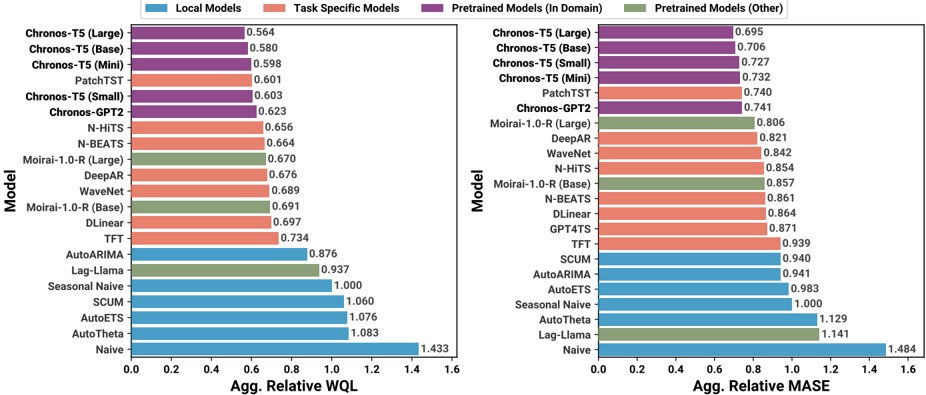
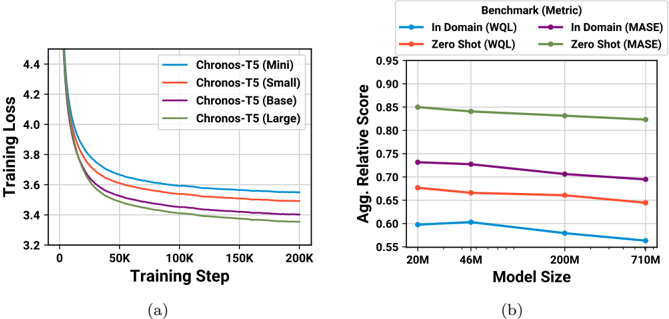
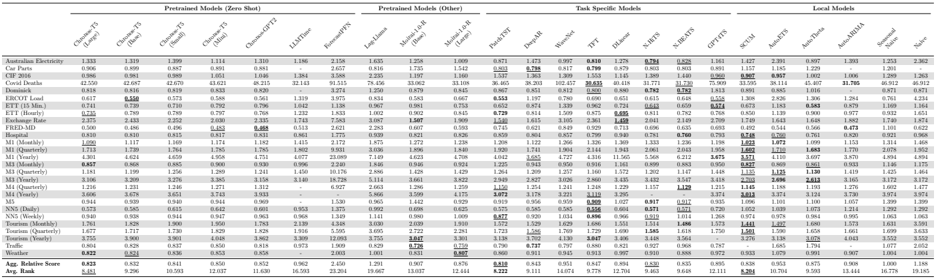
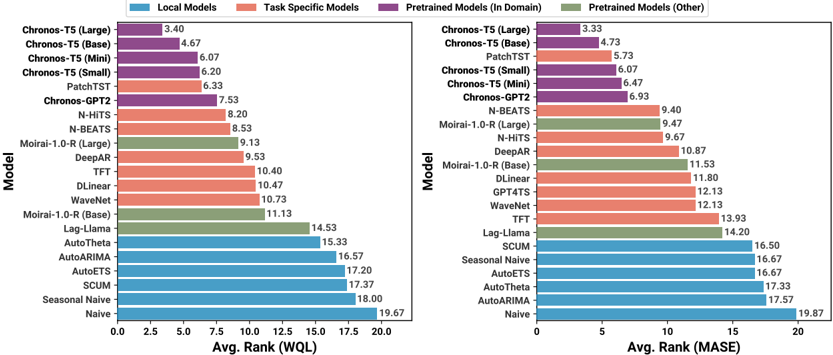
- On in-domain Benchmark I (15 datasets), Chronos-T5 Base/Large obtain the best aggregated relative scores: WQL 0.580/0.564 and MASE 0.706/0.695 versus Seasonal Naive 1.000, outperforming local, task-specific, and other pretrained baselines.
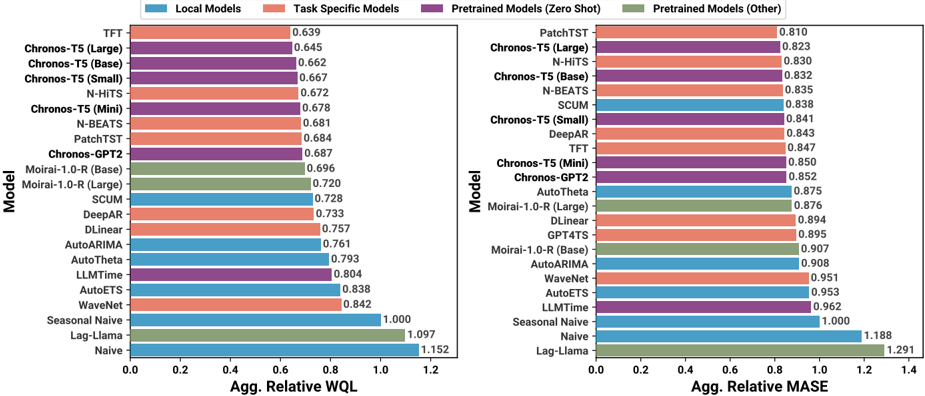
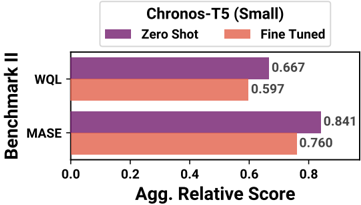
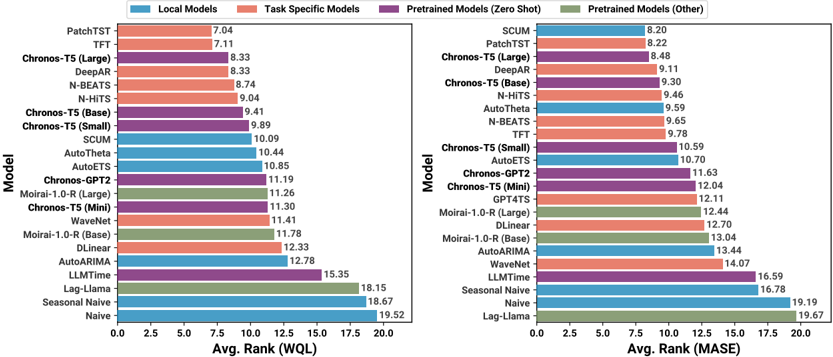
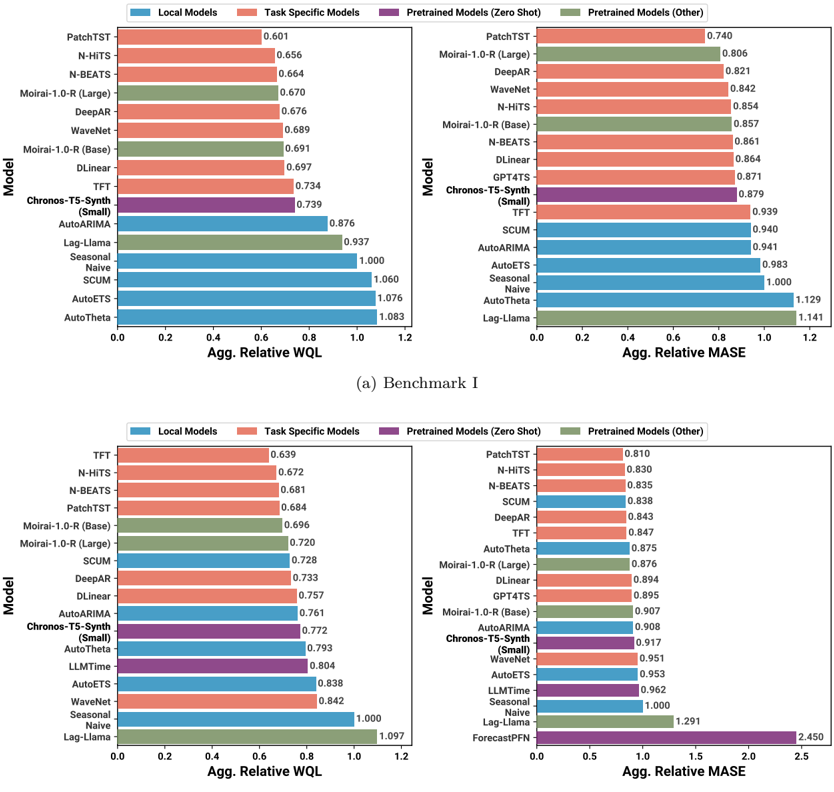
- On zero-shot Benchmark II (27 datasets), Chronos models rank 2nd–4th on WQL and Chronos-T5 Large ranks 2nd on MASE; aggregated relative WQL is 0.645 (Large), 0.662 (Base), 0.667 (Small), 0.678 (Mini), and MASE is 0.823, 0.832, 0.841, 0.850 versus Seasonal Naive 1.000. Fine-tuned Chronos-T5 Small becomes the best model on Benchmark II.
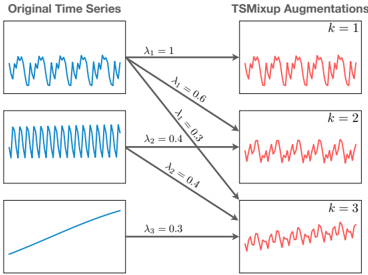
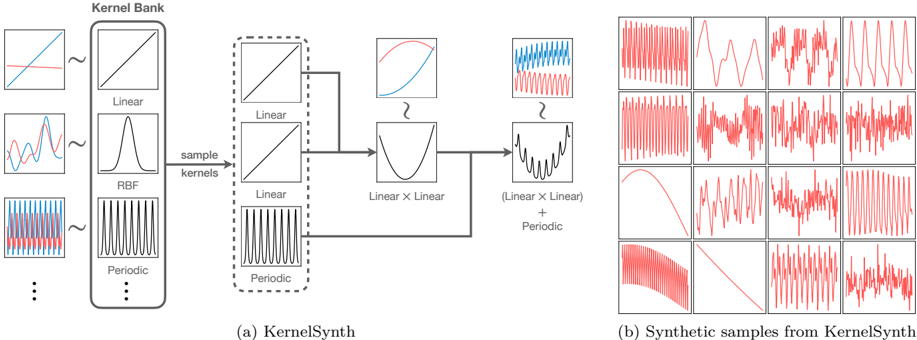
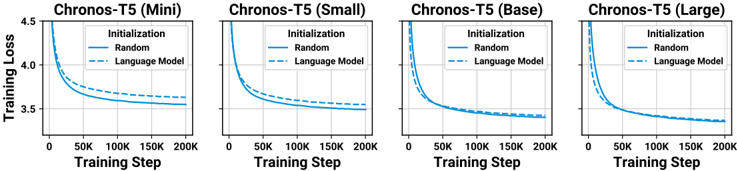
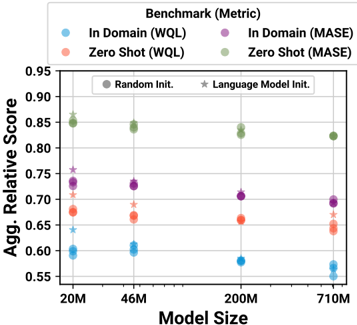
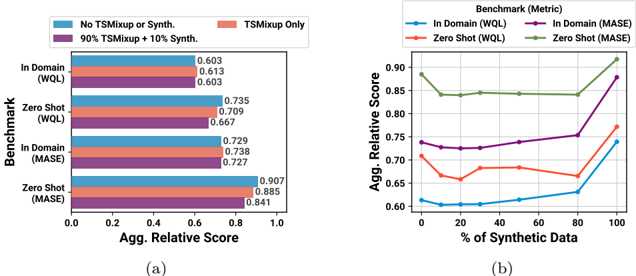
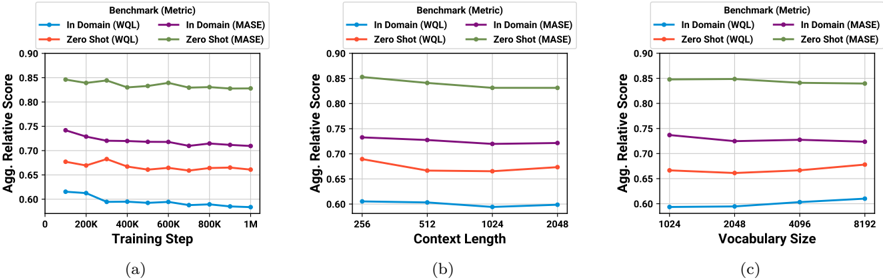
- Ablations show performance improves with model size; language-model-weight initialization offers little/no advantage over random initialization; TSMixup improves zero-shot performance; about 10% KernelSynth synthetic data is best; context length up to 1024 helps; larger vocabulary improves MASE but WQL deteriorates.
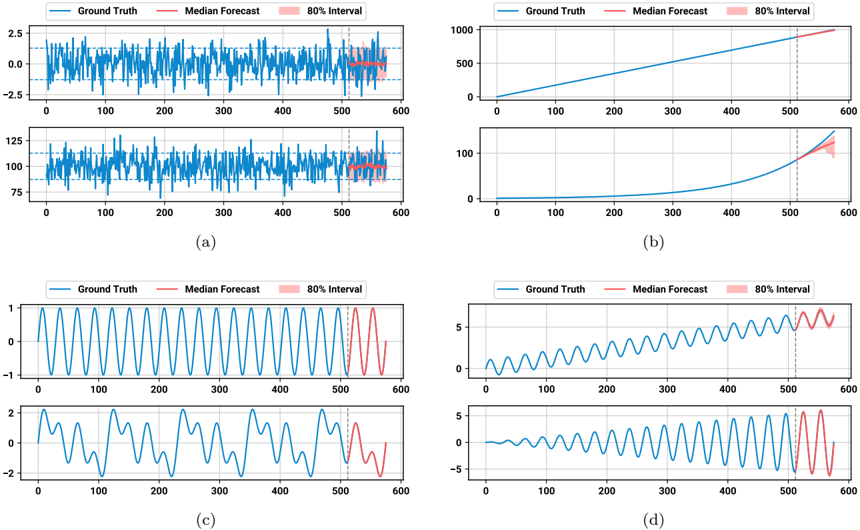
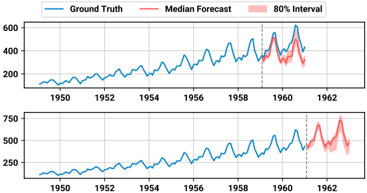
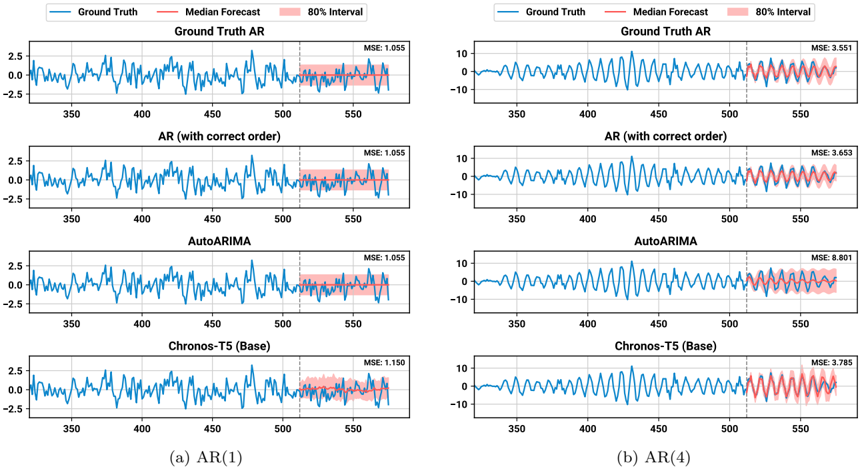
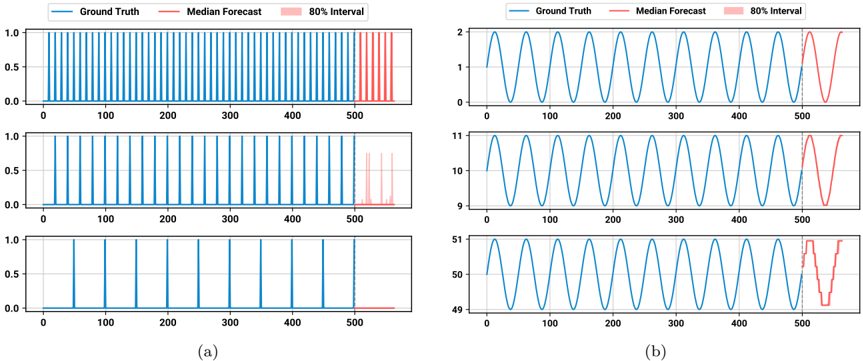
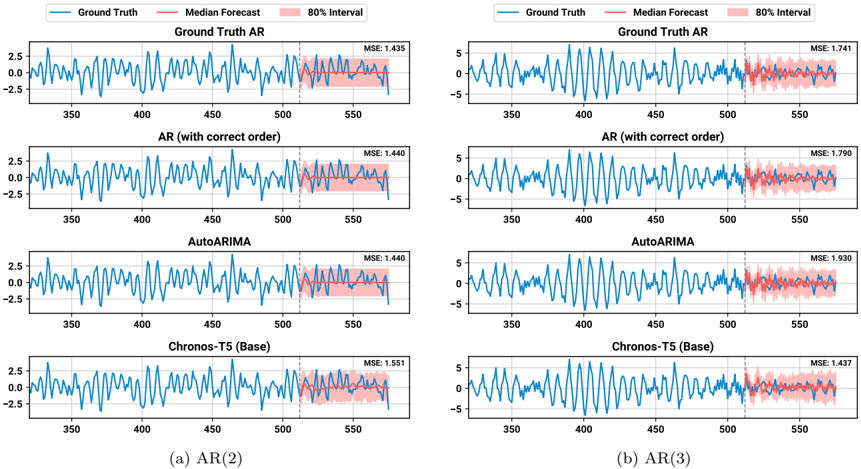
- Qualitatively, Chronos handles Gaussian noise, seasonality, additive/multiplicative trend+seasonality, and AR processes, but struggles with exponential trends and underestimates trend when context is short.
Methods
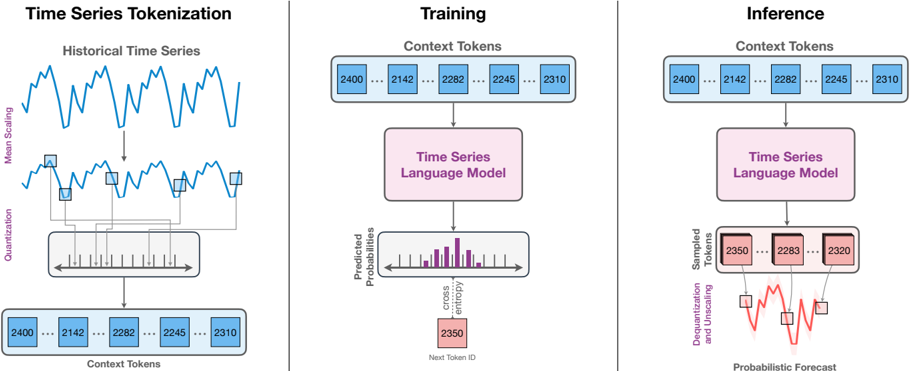
- Chronos mean-scales time series, uniformly quantizes values into B=4094 bins plus PAD/EOS (V_ts=4096), and trains off-the-shelf transformer language models with categorical cross-entropy; forecasts are produced by autoregressively sampling token paths and dequantizing/unscaling them.
- Training used 55 datasets total: 13 pretraining-only, 15 Benchmark I in-domain, and 27 Benchmark II zero-shot; 28 training datasets comprised about 890K univariate series and approximately 84B observations/tokens. Models included T5 Mini 20M, Small 46M, Base 200M, Large 710M, and GPT-2 90M, trained with 10M TSMixup augmentations plus 1M KernelSynth GP synthetic series, context length 512, prediction length 64, and 200K AdamW steps.
- Evaluation used 42 benchmark datasets with WQL (9 quantiles) and MASE; relative scores versus Seasonal Naive were aggregated by geometric mean and compared against local, task-specific, and pretrained baselines, plus a fine-tuning experiment on Benchmark II.
Limitations
- The paper states tokenization limits: representable values are in [-15s, 15s] where s is the mean absolute scale; small s relative to range causes overflow, while large s relative to variance causes precision loss. It also notes poor exponential-trend forecasts, trend underestimation with short context, and that categorical cross-entropy is not distance-aware; ordinal modeling is left as future work.
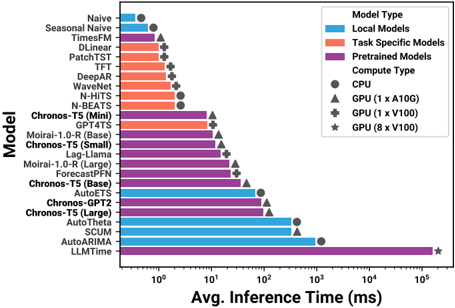
- The paper states scope limits: only univariate, uniformly spaced forecasting is studied; exogenous covariates, multivariate forecasting, and irregular sampling are not handled. Larger models were not explored due to slow inference, inference is slower than task-specific models, evaluation lacks enough high-frequency datasets to study long contexts, and public time series data remain limited.
- Text-evident: the zero-shot comparison may favor Moirai-1.0-R because many Benchmark II datasets were part of its pretraining corpus, as the paper notes; Chronos also ignores time and frequency information by design.
Model-written summary. Check it against the paper before relying on it.
Integrity signals
Registry
Cites
Statistics
Figures

Verification
Claims the paper makes
0 Valid · 4 Not valid · 14 Not checked · 146 Own results and interpretations
A result the paper reports from its own data — it cites no other source for it, so there is none to check. The quote shows it is in the paper.
In the paper
“Between the two baseline pretrained models studied in this experiment, Moirai-1.0-Rclearly outperforms Lag-Llama.”
§ Chronos: Learning the Language of Time Series > 5.5 Main Results
boosted- Asserted: passes — The authors put it forward as true.
- Checkable: passes — It can be checked against evidence.
- Load-bearing: unclear — It is unclear whether the paper’s conclusions depend on it.
- Based: passes — The paper gives a reason why it holds.
A result the paper reports from its own data — it cites no other source for it, so there is none to check. The quote shows it is in the paper.
In the paper
“Unsurprisingly, the training loss improves with the model capacity, as shown in Figure 7a.”
§ Chronos: Learning the Language of Time Series > Model size.
plainstates a cause- Asserted: passes — The authors put it forward as true.
- Checkable: passes — It can be checked against evidence.
- Load-bearing: unclear — It is unclear whether the paper’s conclusions depend on it.
- Based: passes — The paper gives a reason why it holds.
A result the paper reports from its own data — it cites no other source for it, so there is none to check. The quote shows it is in the paper.
In the paper
“Our comprehensive evaluation across 42 datasets establishes Chronos as a benchmark for both in-domain and zero-shot forecasting, surpassing both traditional models and task-specific deep learning approaches.”
§ Chronos: Learning the Language of Time Series > Time Series Tokenization Training Inference
plain- Asserted: passes — The authors put it forward as true.
- Checkable: passes — It can be checked against evidence.
- Load-bearing: passes — The paper’s conclusions depend on it.
- Based: passes — The paper gives a reason why it holds.
A result the paper reports from its own data — it cites no other source for it, so there is none to check. The quote shows it is in the paper.
In the paper
“consistent improvement is observed around the 10% synthetic data proportion.”
§ Chronos: Learning the Language of Time Series > Model size.
plainstates an association- Asserted: passes — The authors put it forward as true.
- Checkable: passes — It can be checked against evidence.
- Load-bearing: unclear — It is unclear whether the paper’s conclusions depend on it.
- Based: passes — The paper gives a reason why it holds.
A result the paper states — it cites no source for it, so there is none to check. The quote shows it is in the paper.
In the paper
“Further increasing the proportion of synthetic data tends to worsen performance.”
§ Chronos: Learning the Language of Time Series > Model size.
hedgedstates a possible cause- Asserted: passes — The authors put it forward as true.
- Checkable: passes — It can be checked against evidence.
- Load-bearing: unclear — It is unclear whether the paper’s conclusions depend on it.
- Based: passes — The paper gives a reason why it holds.
- Rests on an assumption not shown here.
94 more claims
Create a free account to see all 164 claims and to verify the 17 references still open.
- It may state two separate claims as one. 42
- Probably not a substantial claim. 30
Self-check
Percentages, sums and reported differences re-computed from the paper’s own numbers.
Each contradiction between two passages listed here was confirmed by an independent check.
Rated minor: it would not touch a result — a value no result rests on, a p-value that stays on the same side of the significance level, or a conflict that is clerical, resolved elsewhere in the paper, or outside its own findings.
In the paper
§ Chronos: Learning the Language of Time Series > Additional information
“Dominick (Godahewa et al., 2021) contains weekly time series representing the profit of individual stock keeping units from a retailer.”
§ Chronos: Learning the Language of Time Series > Covid Deaths
“Dominick retail 1D 100014 201 296 399 8”
Rated minor: it would not touch a result — a value no result rests on, a p-value that stays on the same side of the significance level, or a conflict that is clerical, resolved elsewhere in the paper, or outside its own findings.
In the paper
§ Chronos: Learning the Language of Time Series > C Baselines
“We considered a total of 17 baseline methods for benchmarking Chronos.”
§ Chronos: Learning the Language of Time Series > Chronos-GPT2 Chronos-T5 (Mini)
“Figure: Naive, SeasonalNaive, AutoETS, Auto-Theta, SCUM, AutoARIMA, DeepAR, TFT, PatchTST, DLinear, WaveNet, N-BEATS, N-HiTS, GPT4TS, Lag-Llama, Moirai-1.evaluationAll the above, LLMTime and ForecastPFN”
Citations
Cites
Exploring the Limits of Transfer Learning with a Unified Text-to-Text Transformer
Raffel, C., Shazeer, N., Roberts, A., Lee, K., Narang, S., Matena, M., Zhou, Y., Li, W., & Liu, P. J. (2019) · arXiv · doi:10.48550/arxiv.1910.10683 · Cited by 31,859
LoRA: Low-Rank Adaptation of Large Language Models
Hu, E. J., Shen, Y., Wallis, P., Allen-Zhu, Z., Li, Y., Wang, S., Wang, L., & Chen, W. (2021) · arXiv · doi:10.48550/arxiv.2106.09685 · Cited by 13,453
LightGBM: A Highly Efficient Gradient Boosting Decision Tree
(2017) · HAL · Cited by 10,512
Lewis, M., Liu, Y., Goyal, N., Ghazvininejad, M., Mohamed, A., Levy, O., Stoyanov, V., & Zettlemoyer, L. (2020) · Proceedings of the 58th Annual Meeting of the Association for Computational Linguistics · doi:10.18653/v1/2020.acl-main.703 · Cited by 8,821
Lewis, M., Liu, Y., Goyal, N., Ghazvininejad, M., Mohamed, A., Levy, O., Stoyanov, V., & Zettlemoyer, L. (2019) · arXiv · doi:10.48550/arxiv.1910.13461 · Cited by 8,816
Transformers: State-of-the-Art Natural Language Processing
Wolf, T., Debut, L., Sanh, V., Chaumond, J., Delangue, C., Moi, A., Cistac, P., Rault, T., Louf, R., Funtowicz, M., et al. (2020) · Proceedings of the 2020 Conference on Empirical Methods in Natural Language Processing: System Demonstrations · doi:10.18653/v1/2020.emnlp-demos.6 · Cited by 8,741
Informer: Beyond Efficient Transformer for Long Sequence Time-Series Forecasting
Zhou, H., Zhang, S., Peng, J., Zhang, S., Li, J., Xiong, H., & Zhang, W. (2021) · Proceedings of the AAAI Conference on Artificial Intelligence · doi:10.1609/aaai.v35i12.17325 · Cited by 7,752
mixup: Beyond Empirical Risk Minimization
Zhang, H., Cisse, M., Dauphin, Y. N., & Lopez-Paz, D. (2017) · arXiv · doi:10.48550/arxiv.1710.09412 · Cited by 5,831
Strictly Proper Scoring Rules, Prediction, and Estimation
Gneiting, T., & Raftery, A. E. (2007) · Journal of the American Statistical Association · doi:10.1198/016214506000001437 · Cited by 5,793
Another look at measures of forecast accuracy
Hyndman, R. J., & Koehler, A. B. (2006) · International Journal of Forecasting · doi:10.1016/j.ijforecast.2006.03.001 · Cited by 5,757
Research works printed but not linked: 8
- George Athanasopoulos, Rob J. Hyndman, Haiyan Song, and Doris C. Wu. The tourism forecasting compe- tition. International Journal of Forecasting, 27(3):822-844, 2011.
- Tom B. Brown, Benjamin Mann, Nick Ryder, Melanie Subbiah, Jared Kaplan, Prafulla Dhariwal, Arvind Neelakantan, Pranav Shyam, Girish Sastry, Amanda Askell, Sandhini Agarwal, Ariel Herbert-Voss, Gretchen Krueger, Tom Henighan, Rewon Child, Aditya Ramesh, Daniel M. Ziegler, Jeffrey Wu, Clemens Winter, Christopher Hesse, Mark Chen, Eric Sigler, Mateusz Litwin, Scott Gray, Benjamin Chess, Jack Clark, Christopher Berner, Sam McCandlish, Alec Radford, Ilya Sutskever, and Dario Amodei. Language models are few-shot learners. In Advances in Neural Information Processing Systems, 2020. 2, 3, 4
- Rob Hyndman, Anne B Koehler, J Keith Ord, and Ralph D Snyder. Forecasting with exponential smoothing: the state space approach. Springer Science & Business Media, 2008. 3, 9
- Alec Radford, Jeffrey Wu, Rewon Child, David Luan, Dario Amodei, Ilya Sutskever, et al. Language models are unsupervised multitask learners. OpenAI blog, 1(8):9, 2019. 4, 6
- Yaniv Romano, Evan Patterson, and Emmanuel Candes. Conformalized quantile regression. Advances in neural information processing systems, 32, 2019.
- Kai Ming Ting and Ian H Witten. Stacking bagged and dagged models. In Proceedings of the Fourteenth International Conference on Machine Learning, 1997. 20
- Ashish Vaswani, Noam Shazeer, Niki Parmar, Jakob Uszkoreit, Llion Jones, Aidan N. Gomez, Lukasz Kaiser, and Illia Polosukhin. Attention Is All You Need. In Advances in Neural Information Processing Systems, 2017.
- Yun Zhou, Liwen You, Wenzhen Zhu, and Panpan Xu. Improving time series forecasting with mixup data augmentation. In ECML PKDD 2023 International Workshop on Machine Learning for Irregular Time Series, 2023b. 7
Cited by
Items 601–700 of 2,048
Rating Quality of Diverse Time Series Data by Meta-learning from LLM Judgment
Wu, S., Li, D., Feng, W., Ye, H., Lou, J., & Ng, S.-K. (2026) · International Conference on Learning Representations · doi:10.48550/arxiv.2506.01290 · Cited by 4
Dr-CiK: A Benchmark testing Deep Research for Context-Aided ForecastingPreprint
Tang, Y., Williams, A., Ashok, A., Zheng, V. Z., Gupta, S., Sun, L., Drouin, A., Laradji, I. H., Marcotte, É., & Zantedeschi, V. (2026) · arXiv · doi:10.48550/arxiv.2605.27904 · Cited by 4
Liang, A., Sun, Y., Shi, X., & Li, K. (2025) · arXiv · doi:10.48550/arxiv.2505.15151 · Cited by 4
Leveraging Generic Time Series Foundation Models for EEG ClassificationPreprint
Gnassounou, T., Moakher, Y., Xie, S., Feofanov, V., & Redko, I. (2025) · arXiv · doi:10.48550/arxiv.2510.27522 · Cited by 4
“Some focus on forecasting (Ansari et al., 2024; Auer et al., 2025), others on classification (Feofanov et al., 2025), also with some attempts to unify multiple time series tasks (Goswami et al., 2024).”
Time-Aware Prior Fitted Networks for Zero-Shot Forecasting with Exogenous Variables
Potapczynski, A., Selvam, R. K., Konstantinova, T., Wolff, M., Olivares, K. G., Ma, R., Mahoney, M. W., Wilson, A., Oreshkin, B. N., & Efimov, D. (2026) · Transactions on machine learning research · doi:10.48550/arxiv.2603.15802 · Cited by 4
Self-citationZhong, S., Qiu, J., Wu, Y., Liu, Y., He, Y., Rao, Z., Yang, B., Guo, C., Xu, H., & Liang, Y. (2026) · arXiv · doi:10.48550/arxiv.2601.12083 · Cited by 4
“Conversely, Time Series FMs (e.g., TimesFM [81], Chronos [82], Rose [83]) achieve efficiency via pure temporal pretraining but lack spatial awareness.”
OmniFuser: Adaptive Multimodal Fusion for Service-Oriented Predictive MaintenancePreprint
Wang, Z., Zhao, H., Yang, Y., Hu, D., Bao, C., Liu, M., Di, K., Dustdar, S., Wang, Z., & Deng, S. (2025) · arXiv · doi:10.48550/arxiv.2511.01320 · Cited by 4
“Third, we benchmark against recent multimodal large forecasting models, including Chronos [31], TimesFM [32], Moirai [33], and Lag-Llama [34], which represent the state of the art in foundation-model-based time series prediction.”
DIM-SUM: Dynamic IMputation for Smart Utility Management
Hildebrant, R., Bhope, R. A., Mehrotra, S., Tull, C., & Venkatasubramanian, N. (2025) · Proceedings of the VLDB Endowment · doi:10.14778/3749646.3749705 · Cited by 4
Shu, A., Wu, W., Ibikunle, G., & He, F. (2026) · arXiv · doi:10.48550/arxiv.2602.03981 · Cited by 4
Sonnet: Spectral Operator Neural Network for Multivariable Time Series Forecasting
Shu, Y., & Lampos, V. (2026) · Proceedings of the AAAI Conference on Artificial Intelligence · doi:10.1609/aaai.v40i30.39736 · Cited by 4
Why Do Time Series Models Need Long Context Windows?Preprint
Butera, L., Felice, G. D., Cini, A., & Alippi, C. (2026) · arXiv · doi:10.48550/arxiv.2606.01999 · Cited by 4
“Ansari et al. [54] drew inspiration from large language models, using a next-token prediction formulation by quantizing input patches and training via classification loss instead of regression.”
A Foundation Model for Instruction-Conditioned In-Context Time Series TasksPreprint
Saha, A., & Shmakov, K. (2026) · arXiv · doi:10.48550/arxiv.2603.22586 · Cited by 4
“0 (Woo et al., 2024), TabPFN-TS (Hoo et al., 2025), and Chronos-Bolt (Ansari et al., 2024).”
InfluentialSanyal, D., Nagpal, A., Kumar, D., Mandal, M., & Deshpande, S. (2025) · arXiv · doi:10.48550/arxiv.2509.05801 · Cited by 4
KAIROS: Unified Training for Universal Non-Autoregressive Time Series ForecastingPreprint
Ding, K., Fan, F., Wang, Z., Li, H., Wang, Y., Wang, L., Luo, C., & Zhan, J. (2025) · arXiv · doi:10.48550/arxiv.2510.02084 · Cited by 4
“Most existing TSFMs adopt an AR paradigm [3, 8, 35, 36, 39, 48, 51], which provides strong modeling capacity and has led to significant performance gains.”
InfluentialSelf-citationEstimating Time Series Foundation Model Transferability via In-Context LearningPreprint
Yao, Q., Jin, M., Zhang, C., Yang, C.-H. H., Qi, J., & Pan, S. (2025) · arXiv · doi:10.48550/arxiv.2509.23695 · Cited by 4
Forecast2Anomaly (F2A): Adapting Multivariate Time Series Foundation Models for Anomaly PredictionPreprint
Hassan, A., Kumar, T., Mishra, A., Serebryakov, S., Mopur, S. K., Koganti, P., Chelankuri, M., Vogety, R., Bhattacharya, S., & Foltín, M. (2025) · arXiv · doi:10.48550/arxiv.2511.03149 · Cited by 4
Ponyuenyong, K., Tu, P., Tan, J., Cheong, W. S., Ling, J. N. S., & Jiang, L. (2026) · arXiv · doi:10.48550/arxiv.2602.05430 · Cited by 4
“Studies have shown that TSFMs often match or even surpass traditional methods across a variety of tasks, such as electricity transformer temperature prediction, electricity load forecasting, weather prediction, and exchange trend analysis (Montet, Pasquier, and Wolf 2025; Ansari et al. 2024).”
Position: Universal Time Series Foundation Models Rest on a Category ErrorPreprint
Dai, X., Cai, W., Xu, Z., & Xu, Q. (2026) · arXiv · doi:10.48550/arxiv.2602.05287 · Cited by 4
“Chronos (Ansari et al., 2024) and Chronos-2 (Ansari et al., 2025) formulates time series forecasting as a language modeling problem via value quantization.”
EIDOS: Latent-Space Predictive Learning for Time Series Foundation ModelsPreprint
Zhou, X., Yao, Q., Zhao, Y., Liu, C., Salim, F., Yuan, X., Wen, Y., & Jin, M. (2026) · arXiv · doi:10.48550/arxiv.2602.14024 · Cited by 4
“8 ), E IDOS attains lower CRPS than Chronos-2, indicating stronger robustness under severe stochastic perturbations.”
InfluentialPotosnak, W., Wolff, M., Cao, M., Ma, R., Konstantinova, T., Efimov, D., Mahoney, M. W., Oreshkin, B. N., & Olivares, K. G. (2026) · Transactions on machine learning research · doi:10.48550/arxiv.2510.04487 · Cited by 4
Self-citationWhat Drives Multi-Chain Crypto Forecasting: Model Choice, Feature Selection, and Transferability
Wang, M., Xiao, Y., Braslavski, P., & Ignatov, D. I. (2026) · Mathematics · doi:10.3390/math14081286 · Cited by 4
Yu, X., Fan, L., Qiu, X., Dong, N., Huang, Y. H. Y., Qi, H., Pu, G., Ouyang, W., Chen, X., & Hu, J. (2026) · ACM SIGKDD Conference on Knowledge Discovery and Data Mining (KDD) · doi:10.1145/3770855.3818032 · Cited by 4
“In contrast to Large Language Models (LLMs) that capture semantic commonalities in text [3, 34, 46], TSFMs aim to learn “universal” temporal patterns—such as trend, seasonality, and autocorr-elation—from massive cross-domain datasets [1, 11, 12].”
Do we really need Foundation Models for multi-step-ahead Epidemic Forecasting?
Dey, M., Chakrabartty, A., Sarkar, D., & Chakraborty, T. (2024) · HAL · Cited by 4
A More Realistic Evaluation of Cross-Frequency Transfer Learning and Foundation Forecasting ModelsPreprint
Olivares, K. G., Wolff, M., Konstantinova, T., Ramasubramanian, S., Oreshkin, B. N., Wilson, A., Potapczynski, A., Potosnak, W., Mahoney, M. W., Cao, M., et al. (2025) · arXiv · doi:10.48550/arxiv.2509.19465 · Cited by 4
Self-citationRetrieval of Chlorophyll-a Concentration in Nanyi Lake Using the AutoGluon Framework
Gu, W., Liang, J., Yang, L., Guo, S., & Jia, R. (2025) · Water · doi:10.3390/w17152190 · Cited by 4
Zhu, S., Hurley, N., & Malazi, H. T. (2025) · IEEE/ACM International Conference on Utility and Cloud Computing (UCC) · doi:10.1145/3773274.3774929 · Cited by 4
“We containerize and deploy MobileNet-v2 [13] (Image classification), Chronos-bolt-small [2] (Time-series forecasting), and Opus-mt [19] (LLM translation) models as serverless functions in the cluster.”
A dual large language model framework for forecasting maritime greenhouse gas emissions
Xu, S., Zhu, K., Zeng, F., Guo, M., Tan, B., & Tian, Y. (2026) · Transportation Research Part D Transport and Environment · doi:10.1016/j.trd.2025.105202 · Cited by 4
DROPS: Managing Serverless Resource Pools in Microsoft Azure Functions
Alquraan, A., Baba, A., da Silva, R. M., Elnikety, S., Batum, P., Chen, Y., Safi, H. H., Fine, S., & Al-Kiswany, S. (2026) · European Conference on Computer Systems · doi:10.1145/3767295.3769350 · Cited by 4
“We evaluate Chronos [17], a foundation model pre-trained on massive datasets, enabling zero-shot forecasting without task-speci ! c ! ne-tuning.”
Compositional zero-shot demand forecasting in retail via disentangled demand drivers
Mayaluri, Z. L., & Mishra, S. (2026) · International Journal of Forecasting · doi:10.1016/j.ijforecast.2026.07.010 · Cited by 4
Text2Freq: Learning Series Patterns from Text via Frequency DomainPreprint
Lo, M.-C., Chang, C., & Peng, W.-C. (2024) · arXiv · doi:10.48550/arxiv.2411.00929 · Cited by 4
Arab, I., & Benitez, R. (2025) · arXiv · doi:10.48550/arxiv.2502.03395 · Cited by 4
Post-Training Corrections for Improved Time-Series ForecastingPreprint
Cherkaoui, H., Tiomoko, M., Paolo, G., Yili, Z., Meng, Y., Keli, Z., & Ali, H. T. (2025) · arXiv · doi:10.48550/arxiv.2505.15354 · Cited by 4
Amortized In-Context Mixed Effect Transformer Models: A Zero-Shot Approach for PharmacokineticsPreprint
Marin, C. A. O., Huisinga, W., Kavwele, P. K., Sánchez, R. J., & Hartung, N. (2025) · arXiv · doi:10.48550/arxiv.2508.15659 · Cited by 4
Measuring Time Series Forecast Stability for Demand PlanningPreprint
Klee, S., & Xia, Y. (2025) · arXiv · doi:10.48550/arxiv.2508.10063 · Cited by 4
EventCast: Hybrid Demand Forecasting in E-Commerce with LLM-Based Event KnowledgePreprint
Hu, C., Shi, Y., Huang, F., Xiang, Y., Ye, Z., Jin, M., & Wang, S. (2026) · arXiv · doi:10.48550/arxiv.2602.07695 · Cited by 4
Benchmarking State Space Models, Transformers, and Recurrent Networks for US Grid ForecastingPreprint
Hong, S., & lee, J. (2026) · arXiv · doi:10.48550/arxiv.2602.21415 · Cited by 4
“We do not include foundation models (Chronos [27], TimesFM [26]) or recent architectures (TimeMixer [35], hybrid Mamba-Transformer models).”
Does Few-Shot Learning Help LLM Performance in Code Synthesis?
Xu, D., Xie, T., Xia, B., Li, H., Bai, Y., Sun, Y., & Wang, W. (2024) · arXiv · doi:10.48550/arxiv.2412.02906 · Cited by 3
“…capabilities outside of natural language processing, including in mathematics (Touvron et al., 2023; Luo et al., 2023), time series forecasting (Ansari et al., 2024; Woo et al., 2024; Das et al., 2023), tabular data understanding (Hegselmann et al., 2023; Hollmann et al., 2022; Xu et al.,…”
Fusing Narrative Semantics for Financial Volatility Forecasting
Kong, Y., Hwang, Y., Kaiser, M., Vryonides, C., Oomen, R., & Zohren, S. (2025) · Proceedings of the 6th ACM International Conference on AI in Finance · doi:10.1145/3768292.3771256 · Cited by 3
A Survey on Foundation Models for Structured Data: Tabular, Time Series, and Graphs
Sun, Q., Yuan, H., Huang, Y., Zhang, Z., Fu, X., Wang, R. T., Zhou, H., Li, J., Wu, J., & Yu, P. S. (2026) · IEEE Transactions on Knowledge and Data Engineering · doi:10.1109/tkde.2026.3717198 · Cited by 3
Zero-shot traffic flow prediction with foundation models: a comparison with deep learning approaches
Li, Y., Zhao, Q., & Wang, M. (2026) · Scientific Reports · doi:10.1038/s41598-026-50464-8 · Cited by 3
“We select three widely used deep learning models for time series analysis, CNN 97 , LSTM 98 and the transformer-based model Informe 18 , as well as two recently developed time series foundation models, Lag-Llama 46 and Chronos 23 , to assess the performance of traffic flow prediction.”
InfluentialFoundation Forecasting in IoE Networks: When Generative AI Meets Programmable Edge Nodes
Marchetti, F., Picano, B., Seidenari, L., & Fantacci, R. (2025) · IEEE Internet of Things Journal · doi:10.1109/jiot.2025.3595465 · Cited by 3
“Restrictions apply. recent years have been used, including Chronos [30] and TimesFM [31].”
MoHETS: Long-term Time Series Forecasting with Mixture-of-Heterogeneous-ExpertsPreprint
Ortigossa, E. S., Lutsker, G., & Segal, E. (2026) · arXiv · doi:10.48550/arxiv.2601.21866 · Cited by 3
“Specifically, we include Timer-XL, and all versions of Time-MoE, Moirai, MOMENT, and Chronos (see Section A.2).”
InfluentialLi, C., Liu, Y., Zhang, S., Denison, T., & Zhu, T. (2026) · arXiv · doi:10.48550/arxiv.2603.04478 · Cited by 3
Foundation Models and Fine-Tuning: Toward a New Generation of Models for Time Series ForecastingPreprint
Laglil, M., Pracca, B., Devijver, É., & Gaussier, É. (2026) · arXiv · doi:10.48550/arxiv.2607.23146 · Cited by 3
“Chronos (Ansari and et al., 2024) is pre-trained by minimizing the cross-entropy loss over tokens generated autoregressively for a fixed prediction horizon.”
Li, J., & Wang, H. (2026) · Applied Energy · doi:10.1016/j.apenergy.2026.128296 · Cited by 3
“• Chronos: A pre-trained model based on T5 language model architecture [62].”
Self-citationBrini, A. (2026) · arXiv · doi:10.48550/arxiv.2607.05291 · Cited by 3
“Chronos-Bolt Chronos-Bolt (Ansari et al., 2024).”
Zhu, L., & Cai, M. (2026) · arXiv · doi:10.48550/arxiv.2609.04917 · Cited by 3
“Chronos tokenizes numerical values and uses language-model-style training for probabilistic forecasting (Ansari et al., 2024).”
Predicting Power-System Dynamic Trajectories with Foundation ModelsPreprint
Li, H., Mai, L., Xiao, C., Blasch, E., & Weng, Y. (2026) · arXiv · doi:10.48550/arxiv.2604.14991 · Cited by 3
“We compare LASS-ODE with TimesFM [50], Chronos [51], and TimerXL [52].”
Research Progress and Prospect of Radar Data Intelligent Processing
Cui, Y., He, Y., Xia, S., Xiong, W., Xu, P., Liu, Y., Wang, Z., Gu, X., Sun, W., Jianjuan, X., et al. (2025) · Chinese journal of information fusion. · doi:10.62762/cjif.2025.861974 · Cited by 3
“…sequence (Lag-Llama [94], TEST [92]), sequence patch (One Fits All [95], TEMPO [96], LLM4TS [97], Time-LLM [93]), and quantized sequence (Chronos [98]); and the time series pre-trained foundation model can be divided into original sequence (Voice2Series [99], TF-C [100], TS2Vec [101]) and…”
Olivia: Harmonizing Time Series Foundation Models with Power Spectral Density
费璟如, Yi, K., Wang, A. X., Wen, Q., Zhu, X., & Fan, W. (2026) · International Conference on Machine Learning · doi:10.48550/arxiv.2605.17340 · Cited by 3
Unlocking the Path Towards AI-Native Networks with Optimized Lightweight Large Language Models
Samaras, G., Mertiri, M., Xezonaki, M.-E., Theodorou, V., Chartsias, P.-K., & Bozios, T. (2024) · IEEE International Mediterranean Conference on Communications and Networking (MeditCom) · doi:10.1109/meditcom61057.2024.10621076 · Cited by 3
Ma, B., & Du, Y. (2026) · Mathematics · doi:10.3390/math14020207 · Cited by 3
CMA: A Unified Contextual Meta-Adaptation Methodology for Time-Series Denoising and Prediction
Jiang, H., Ding, Y., Pan, C., Huang, A., Chen, R.-S., & Fan, C. (2025) · ACM SIGKDD Conference on Knowledge Discovery and Data Mining (KDD) · doi:10.1145/3711896.3736881 · Cited by 3
“Time Series Foundation models [18–20] have demonstrated zero-shot generalization across diverse settings.”
Anomaly Detection For Vietnamese Financial Market
Huynh, Q. T., Nguyen, T. H., Vu, D. T., & Ngo, M. M. (2024) · International Conference on Advanced Computing and Analytics (ACOMPA) · doi:10.1109/acompa64883.2024.00016 · Cited by 3
Liang, R. S., Deng, Y., Liu, Y., Zhao, D., Mulayim, O. B., Taniguchi, I., & Wang, D. (2026) · ACM International Conference on Future Energy Systems (e-Energy) · doi:10.1145/3744255.3811745 · Cited by 3
DimAug-TimesFM: Dimension Augmentation for Long-Term Cloud Demand Forecasting in Few-Shot Scenarios
Yang, X., Zheng, Q.-M., Zhu, X., Luo, M., Hou, Z., Zhang, J., & Lan, Y. (2025) · Applied Sciences · doi:10.3390/app15073450 · Cited by 3
Analyzing inference workloads for spatiotemporal modeling
Jain, M., Agostini, N. B., Ghosh, S., & Tumeo, A. (2024) · Future Generation Computer Systems · doi:10.1016/j.future.2024.107513 · Cited by 3
DelphAI: A human-centered approach to time-series forecasting
Kupferschmidt, K. L., Skorburg, J. A., & Taylor, G. W. (2022) · IEEE International Conference on Big Data (BigData) · doi:10.1109/bigdata55660.2022.10020676 · Cited by 3
A Study of Foundation Models for Large-scale Time-series Forecasting
Chen, H., Rossi, R. A., Kim, S., Mahadik, K., & Eldardiry, H. (2024) · IEEE International Conference on Big Data (BigData) · doi:10.1109/bigdata62323.2024.10825153 · Cited by 3
Pang, C., Jiayong, D., Jiang, D., Wang, Y., Li, N., & Ren, D. (2026) · Scientific Reports · doi:10.1038/s41598-026-37913-0 · Cited by 3
Self-citationDNAMite: Interpretable Calibrated Survival Analysis with Discretized Additive Models
Ness, M. V., Block, B., & Udell, M. R. (2025) · Proceedings of Machine Learning Research · doi:10.48550/arxiv.2411.05923 · Cited by 3
Foundation models for time series forecasting: Application in conformal predictionPreprint
Achour, S., Bouher, Y., Nguyen, D., & Chesneau, N. (2025) · arXiv · doi:10.48550/arxiv.2507.08858 · Cited by 3
“TSFM is a very active research and development domain with the introduction of seveval foundation models, such as Chronos (Ansari et al., 2024), Lag-Llama (Rasul et al., 2024), MOMENT (Goswami et al., 2024), MOIRAI (Woo et al., 2024b), TimesFM (Das et al., 2023).”
InfluentialBùi, C., Mascarenhas, M. M., Verstraeten, A., & Kazmi, H. (2026) · International Conference on the European Energy Market (EEM) · doi:10.1109/eem68581.2026.11589673 · Cited by 3
“A key innovation in Chronos is the transformation of continuous time series into discrete token sequences by applying quantization to map numerical values to discrete bins defined by learned or fixed scaling rules [10], [16].”
Causal Graph Fuzzy LLMs: A First Introduction and Applications in Time Series Forecasting
Orang, O., Lucas, P. D. O., de Paiva, G. I. F., Silva, P. C. D. L. E., Silva, F. A. R., Veloso, A. A., & Guimarães, F. B. A. P. (2025) · Congresso Brasileiro de Inteligência Computacional (CBIC) · doi:10.21528/cbic2025-1187477 · Cited by 3
LCMF: A LLM-enhanced cross-modal fusion framework for universal temporal forecasting
Du, S., Jiang, J., Shi, H., Yang, Y. Z., Zhang, J., Li, T., & Zheng, Y. (2026) · Knowledge-Based Systems · doi:10.1016/j.knosys.2026.115804 · Cited by 3
Learning Latent Spaces for Domain Generalization in Time Series ForecastingPreprint
Deng, S., & de Rijke, M. (2024) · arXiv · doi:10.48550/arxiv.2412.11171 · Cited by 3
LLM-Driven Stock Prediction: Capturing Market Trends with LLaMA
Tak, R., & Pele, D. T. (2025) · Proceedings of the ... International Conference on Business Excellence · doi:10.2478/picbe-2025-0043 · Cited by 3
“Such specific purpose LLMs that are trained on time series data include Chronos (Ansari et al., 2024) and TimeGPT (Garza et al., 2024; Liao et al., 2024) are better suited for capturing temporal dependencies and patterns in historical price data.”
Modeling heterogeneous normality in time series anomaly detection
Zhou, X., Wang, Y., Xu, H., & Li, Y. (2026) · Information Processing & Management · doi:10.1016/j.ipm.2026.104644 · Cited by 3
Self-citationA Three-Phase Foundation Model for Tax-Aware Personalized Portfolio ManagementPreprint
Pishehvar, R. (2026) · arXiv · doi:10.48550/arxiv.2606.30997 · Cited by 3
“[2] introduced Chronos, a T5-based model pretrained on over 100 billion time series data points from diverse domains.”
Reconciling deep learning with tabular data
Grinsztajn, L. (2024) · theses.fr (ABES) · doi:10.70675/0c50c60dzd4edz4e4azb669zcbe0051b1dbe · Cited by 3
Shan, C., Liu, S., Peng, S., Huang, Z., Zuo, Y., Zhang, W., & Xiao, J. (2025) · Energies · doi:10.3390/en18112902 · Cited by 3
RAMSeS: Robust and Adaptive Model Selection for Time-Series Anomaly Detection Algorithms
Abdelmaksoud, M., Ding, S., Morozov, A. S., & Abedjan, Z. (2026) · IEEE International Conference on Data Engineering (ICDE) · doi:10.1109/icde65706.2026.00161 · Cited by 3
A Survey of Deep Learning for Non-Invasive Fetal Electrocardiogram Analysis
Malekifar, M., Cao, S., Phan, K., Vo, K., Zeng, F.-G., & Cao, H. (2025) · IEEE Access · doi:10.1109/access.2025.3621737 · Cited by 3
Graph Transformers for Query Plan Representation: Potentials and Challenges
Lyu, C., Lachaud, G., Lozano, G., & Diao, Y. (2025) · Proceedings of the VLDB Endowment · doi:10.14778/3773731.3773745 · Cited by 3
“Our work is inspired by recent machine learning practices for domain-specific models [4, 75], where limited training data can be enhanced with carefully crafted synthetic data to boost model performance.”
InfluentialFactoryNet: A Large-Scale Dataset toward Industrial Time-Series Foundation ModelsPreprint
Petersen, J., Jawahar, P., Maggioni, R., Huou, A., Othman, K., Mazzoleni, C., Cozzi, M., Gajewski, M., Paloschi, D., Lombardi, G.-A., et al. (2026) · arXiv · doi:10.48550/arxiv.2605.09081 · Cited by 3
“Si-multaneously, in the structured time-series domain, models such as Chronos (Ansari et al., 2024), TimesFM (Das et al., 2024), Moirai (Woo et al., 2024), MOMENT (Goswami et al., 2024), Timer (Liu et al., 2024), Lag-Llama (Rasul et al., 2023), and TabPFN-TS (Hoo et al., 2025) leverage pretraining…”
Karami, M., Jalali, M., & Ghassemi, F. (2025) · arXiv · doi:10.48550/arxiv.2510.11141 · Cited by 3
“(2) Foundation Models : Assess recent pre-trained models (Chronos, Moirai) that leverage large-scale pre-training for zero-shot anomaly detection [65], [66].”
LLM-Rank: A Graph Theoretical Approach to Pruning Large Language ModelsPreprint
Hoffmann, D., Budhathoki, K., & Kleindessner, M. (2024) · arXiv · doi:10.48550/arxiv.2410.13299 · Cited by 3
Huang, Y., Jiang, L., & Liu, Z. Y. (2026) · Research Square · doi:10.21203/rs.3.rs-10412882/v1 · Cited by 3
Compute-optimal data scaling for neural surrogates via multi-fidelity trainingPreprint
Setinek, P., Paischer, F., Thuerey, N., Brandstetter, J., & Koehler, F. (2026) · arXiv · doi:10.48550/arxiv.2610.17221 · Cited by 3
Large Language Models: A Mathematical FormulationPreprint
Baptista, R., Stuart, A. M., & Tran, S. (2026) · arXiv · doi:10.48550/arxiv.2601.22170 · Cited by 3
Crypto x AI, AI x Crypto: A SurveyPreprint
Allen, S., Anchuri, P., Austgen, J., Bahrani, M., Breckenridge, S., Buchwald, A., Cachin, C., Fábrega, A., Fernandez, J., Chiang, J. H.-Y., et al. (2026) · arXiv · doi:10.48550/arxiv.2606.13892 · Cited by 3
Mystakidis, A., & Tjortjis, C. (2026) · International Journal of Machine Learning and Cybernetics · doi:10.1007/s13042-026-03122-4 · Cited by 3
KINLI: Time Series Forecasting for Monitoring Poultry Health in Complex Pen Environments
Pack, C. I., Zeiser, T., Beecks, C., & Lutz, T. (2025) · Animals · doi:10.3390/ani15213180 · Cited by 3
“…by creating a time series tokenizer and proposing a Language-TS transformer which combines the forecasting prompt with the tokenized time series data, which is further refined with dynamic prompt adaptation in Time-FFM [45], with further improvements to time series tokenization by Chronos [46].”
Aionoscope: Debugging Latent-State Accessibility in Time-Series RepresentationsPreprint
Chemeris, A., Jin, M., & Balestriero, R. (2026) · arXiv · doi:10.48550/arxiv.2607.00956 · Cited by 3
TimEE: End-to-end Time Series Classification via In-Context LearningPreprint
Küken, J., Hoo, S. B., Mráz, M., Hutter, F., & Purucker, L. (2026) · arXiv · doi:10.48550/arxiv.2607.07500 · Cited by 3
“Additionally, we apply a mixup scheme [Ansari et al., 2024, Auer et al., 2025b], to generate convex combinations of synthetic time series across the dataset level.”
MILM: Large Language Models for Multimodal Irregular Time Series with Informative SamplingPreprint
Chung, H.-H., Li, S., Wald, Y., Han, X., Saria, S., & Ghosh, J. (2026) · arXiv · doi:10.48550/arxiv.2605.13711 · Cited by 3
Sarfati, R., Tiwari, P. R., Boppana, S., Earls, C., Varadaraj, S., & Ho, E. (2026) · arXiv · doi:10.48550/arxiv.2607.08046 · Cited by 3
TimeRFT: Stimulating Generalizable Time Series Forecasting for TSFMs via Reinforcement FinetuningPreprint
Li, S., Chen, Y., Zhu, Z., Pan, Y., Guo, Y., Huang, M., & Xiong, H. (2026) · arXiv · doi:10.48550/arxiv.2605.00015 · Cited by 3
GraphMend: Code Transformations for Fixing Graph Breaks in PyTorch 2Preprint
Kashmira, S., Dantanarayana, J. L., Sathiyalogeswaran, T., Flautner, K., Tang, L., & Mars, J. (2025) · arXiv · doi:10.48550/arxiv.2509.16248 · Cited by 3
“%) as where T break is the per-forward-pass latency for the bench-marked model with graph breaks, and T fixed is the latency after applying G RAPH M END fixes.”
CardioState-JEPA: Delay-Aware Cross-Modal Learning of a Shared Cardiac RepresentationPreprint
Shafiq, H., Pham, H. M., Zhu, B., Zhou, P., Hu, J., & Saeed, A. (2026) · arXiv · doi:10.48550/arxiv.2608.12944 · Cited by 3
“Therefore, in For PPG, we compare against PaPaGei-S, PaPaGei-P [35], AnyPPG [31], PulsePPG [37], and ChronosBolt [2].”
FactoryBench: Evaluating Industrial Machine UnderstandingPreprint
Merzouki, Y., Izquierdo, C., Ignuta-Ciuncanu, M. C., Gómez-Bracamonte, M., Maggioni, R., Lombardi, A., Mazzoleni, C., Martelli, F., Gunther, B., Petersen, J., et al. (2026) · arXiv · doi:10.48550/arxiv.2605.07675 · Cited by 3
“B OLT [17] ( ∼ 200 M parameters), a pretrained probabilistic time-series forecaster, as a non-LLM baseline in the same zero-shot setting (no fine-tuning, prompting, or context-window engineering on either side).”
STAMP: Spatial-Temporal Adapter with Multi-Head Pooling
Shook, B., Turner, A., Chen, J., Wiliński, M., Goswami, M., Elmer, J., & Dubrawski, A. W. (2026) · Proceedings of Machine Learning Research · doi:10.48550/arxiv.2511.10848 · Cited by 3
“TSFMs gained traction by demonstrating that large-scale pretraining in this modality unlocks abilities that transfer across various time series tasks and diverse domains (Rasul et al., 2023; Das et al., 2024; Ansari et al., 2024; Goswami et al., 2024).”
Wang, M., Kataria, S., Ni, J., Buchman, T. G., Grunwell, J. R., Mai, M. V., Jin, W., Clark, M. P. A., Brown, S., Fundora, M. P., et al. (2025) · arXiv · doi:10.48550/arxiv.2509.16348 · Cited by 3
“Hence, others adapted the successful recipe of pretraining LLMs to train time series FMs from scratch including Chronos [2], MOMENT [15], PatchTST [31].”
A Systematic Evaluation of Sample-Level Tokenization Strategies for MEG Foundation ModelsPreprint
Cho, S., Gohil, C., Huang, R., Jones, Ō. P., & Woolrich, M. W. (2026) · arXiv · doi:10.48550/arxiv.2602.16626 · Cited by 3
“…having the foundation model output as a discrete probability distribution circumvents restrictive assumptions regarding the shape of the distribution (i.e., we avoid parametric distributions) and allows for the expression of arbitrary, potentially multimodal data distributions [17], [37].”
InfluentialGustafsson, F., Gu, X., Carletti, M., Palo, P., Eyre, D. W., & Clifton, D. A. (2026) · arXiv · doi:10.48550/arxiv.2603.09940 · Cited by 3
Kaas, B., Treutlein, M., Gerber, H., Neumann, O., Phatthanakhuha, C., Resch, O., Mikut, R., & Hagenmeyer, V. (2026) · arXiv · doi:10.48550/arxiv.2607.01966 · Cited by 3
A robust PPG foundation model using multimodal physiological supervision
Geenjaar, E., Calhoun, V., Daly, S., Gouthaman, K. V., Lu, L., Mittal, T., & Darcy, D. P. (2026) · International Conference on Machine Learning · doi:10.48550/arxiv.2606.07365 · Cited by 3
“For Chronos, we use the Chronos-T5-base (200M) backbone (Ansari et al., 2024), and for MOMENT we use MOMENT-1-Large (385M) (Goswami et al., 2024).”
HEPA: A Self-Supervised Horizon-Conditioned Event Predictive Architecture for Time SeriesPreprint
Petersen, J., Lombardi, G.-A., Maggioni, R., Mazzoleni, C., Martelli, F., & Petersen, P. (2026) · arXiv · doi:10.48550/arxiv.2605.11130 · Cited by 3
“Value-forecasting approaches, whether supervised [5] or pretrained on large corpora [6, 7], shape representations around all variation in the signal, including noise irrelevant to the downstream event.”
Forecast-Then-Optimize Deep Learning MethodsPreprint
Jiang, J., Wu, N., Liu, B., Mei, F., Ji, X., & Srinivasan, K. K. (2025) · arXiv · doi:10.48550/arxiv.2506.13036 · Cited by 3
Speaking Numbers to LLMs: Multi-Wavelet Number Embeddings for Time Series Forecasting
Cao, D., Lei, Z., Weng, M., Sun, J., & Liu, Y. (2026) · International Joint Conference on Artificial Intelligence · doi:10.24963/ijcai.2026/464 · Cited by 3
Metadata
- Authors
- Ansari, A. F., Stella, L., Turkmen, C., Zhang, X., Mercado, P., Shen, H., Shchur, O., Rangapuram, S. S., Arango, S. P., Kapoor, S., Zschiegner, J., Maddix, D. C., Wang, H., Mahoney, M. W., Torkkola, K., Wilson, A. G., Bohlke-Schneider, M., & Wang, Y.
- Affiliations
- Amazon (United States) (US)
- University of California San Diego (US)
- University of Freiburg (DE)
- Rutgers, The State University of New Jersey (US)
- ORCID
- Venue
- arXiv
- Publisher
- arXiv
- Published
- 2024
- ISSN
- 2835-8856 (ISSN-L)
- arXiv
- 2403.07815
- OpenAlex
- W4392781393
- Cited by
- 2,046
- References
- 92
- Citations by year
- 2026: 1398 · 2025: 520 · 2024: 126
- FWCI
- 245.30
- Type
- journal article
- Language
- en
- Open access
- diamond
- openreview.net
- Licence
- Locations
- Transactions on machine learning research (publishedVersion, cc-by)
- arXiv (submittedVersion, public-domain)
- Topics
- Physical Sciences › Computer Science › Signal Processing › Time Series Analysis and Forecasting
- Social Sciences › Decision Sciences › Management Science and Operations Research › Forecasting Techniques and Applications
- Social Sciences › Decision Sciences › Management Science and Operations Research › Stock Market Forecasting Methods
- Keywords
- time series forecasting, transformer language models, T5, zero-shot forecasting, Chronos
About these checks
Registry, retraction, Cites and statistics results are computed, not judged, with one exception: a printed reference that no index lists is read once by a model before it counts as a citation error. Claims are extracted by a model and kept only when their quote appears verbatim in the text; each cited source is then checked, with a model’s help, for whether it says what the claim relies on. Those verdicts can be wrong — read the claim’s quote and the cited source before relying on one.
A language model drew the claims from the paper on 2026-11-28, under version 3 of the claim definition (model deepseek-v4.1-flash, prompt extract-v3).
A second model labelled each claim on 2026-11-28 (model jev-1.13-20260917, definition revision gold-guideline-v0.2).
Statistics and arithmetic are recomputed, not judged.
Confidence bands are shown only for fields calibrated on our annotated test set. None is calibrated yet, so no band is shown.
What counts as a claim ›How we measure confidence ›How we check this ›
Are you an author, or do you see a problem with this page? Request a review
Data sources
Bibliographic data: Semantic Scholar, OpenAlex, Crossref.
Contains information from the Semantic Scholar Academic Graph Datasets, made available under the ODC Attribution License (ODC-BY 1.0).
Semantic Scholar’s data is described in: Kinney, R., et al. (2023). The Semantic Scholar Open Data Platform. arXiv:2301.10140.
