

Chronos: Learning the Language of Time Series
Open accessThe DOI matches its DataCite record; 95 of the 95 references it cites were found in a registry or an index; none of the 21 sources its claims cite is checked for support yet.
Abstract
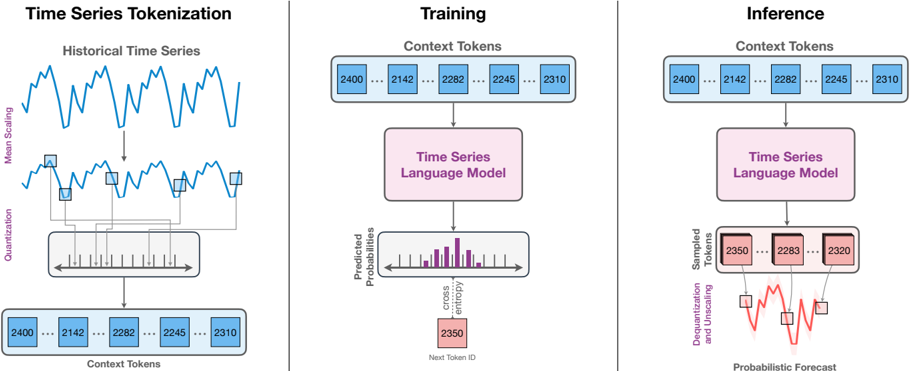
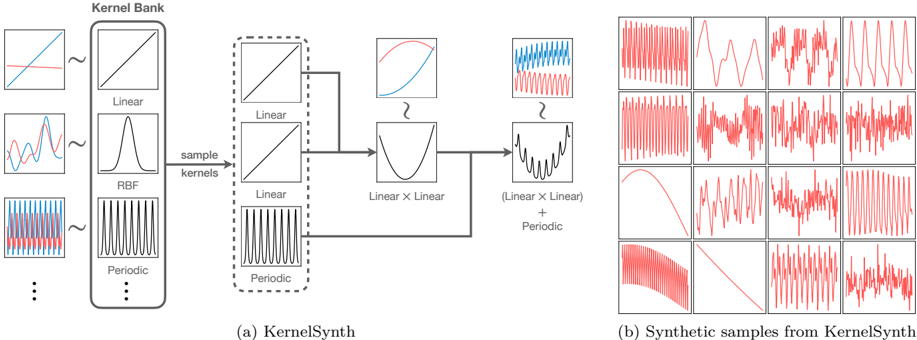
We introduce Chronos, a simple yet effective framework for pretrained probabilistic time series models. Chronos tokenizes time series values using scaling and quantization into a fixed vocabulary and trains existing transformer-based language model architectures on these tokenized time series via the cross-entropy loss. We pretrained Chronos models based on the T5 family (ranging from 20M to 710M parameters) on a large collection of publicly available datasets, complemented by a synthetic dataset that we generated via Gaussian processes to improve generalization. In a comprehensive benchmark consisting of 42 datasets, and comprising both classical local models and deep learning methods, we show that Chronos models: (a) significantly outperform other methods on datasets that were part of the training corpus; and (b) have comparable and occasionally superior zero-shot performance on new datasets, relative to methods that were trained specifically on them. Our results demonstrate that Chronos models can leverage time series data from diverse domains to improve zero-shot accuracy on unseen forecasting tasks, positioning pretrained models as a viable tool to greatly simplify forecasting pipelines.
Overview
CoChat Summary
TL;DR
Chronos adapts language-model architectures to probabilistic time series forecasting by scaling and quantizing values into tokens and training T5/GPT-2 models with cross-entropy. Across 42 benchmark datasets, it achieves strong in-domain and zero-shot forecasting, often matching or beating task-specific models.
Key findings
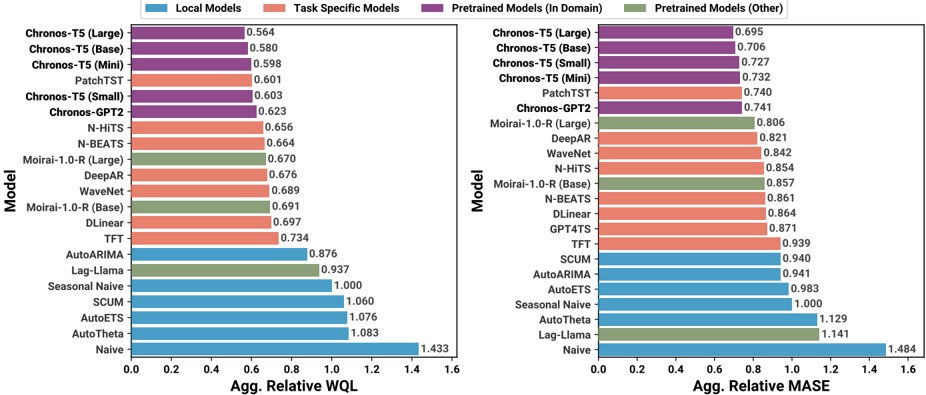
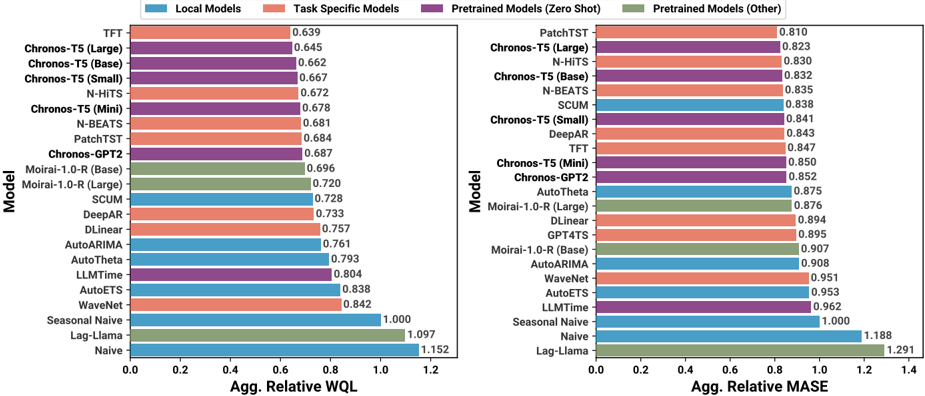
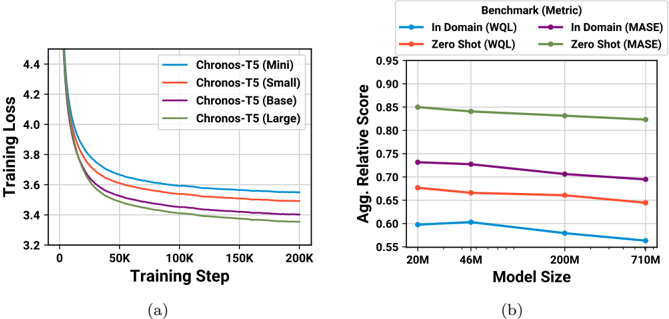
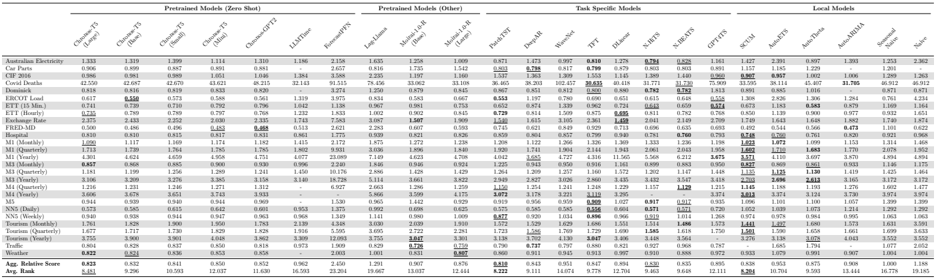
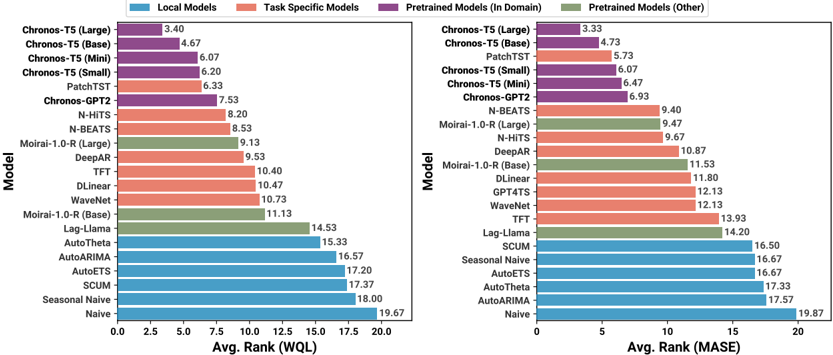
- On in-domain Benchmark I (15 datasets), Chronos-T5 Base/Large obtain the best aggregated relative scores: WQL 0.580/0.564 and MASE 0.706/0.695 versus Seasonal Naive 1.000, outperforming local, task-specific, and other pretrained baselines.
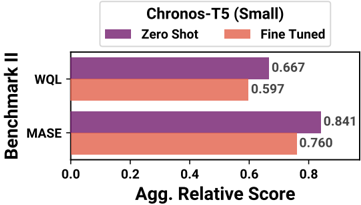
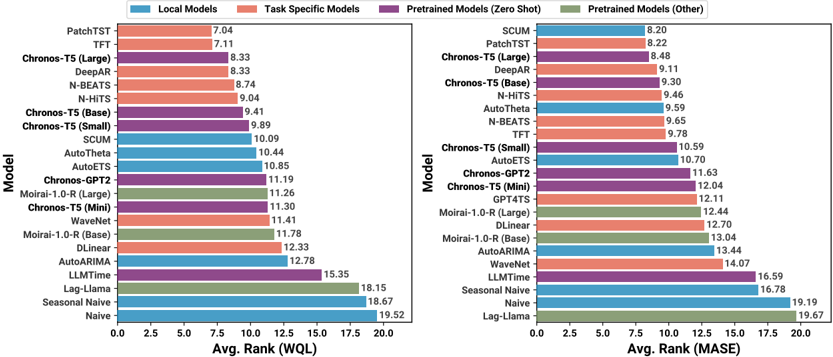
- On zero-shot Benchmark II (27 datasets), Chronos models rank 2nd–4th on WQL and Chronos-T5 Large ranks 2nd on MASE; aggregated relative WQL is 0.645 (Large), 0.662 (Base), 0.667 (Small), 0.678 (Mini), and MASE is 0.823, 0.832, 0.841, 0.850 versus Seasonal Naive 1.000. Fine-tuned Chronos-T5 Small becomes the best model on Benchmark II.
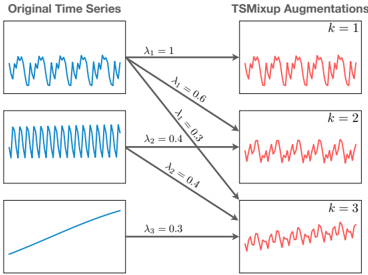
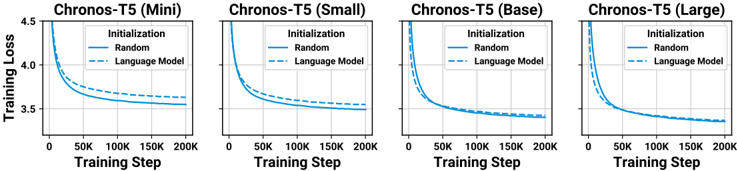
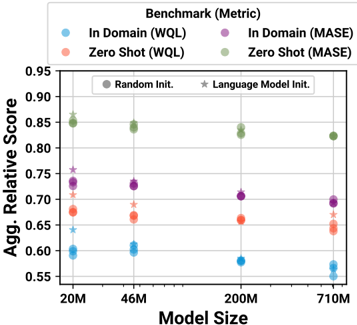
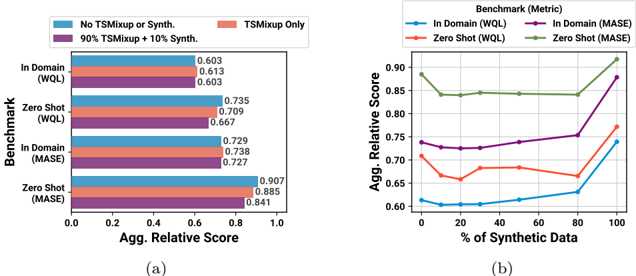
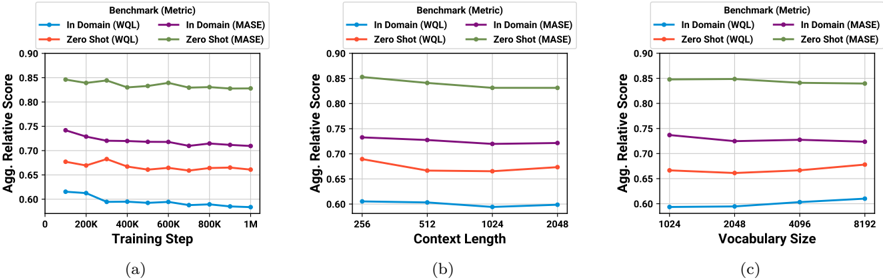
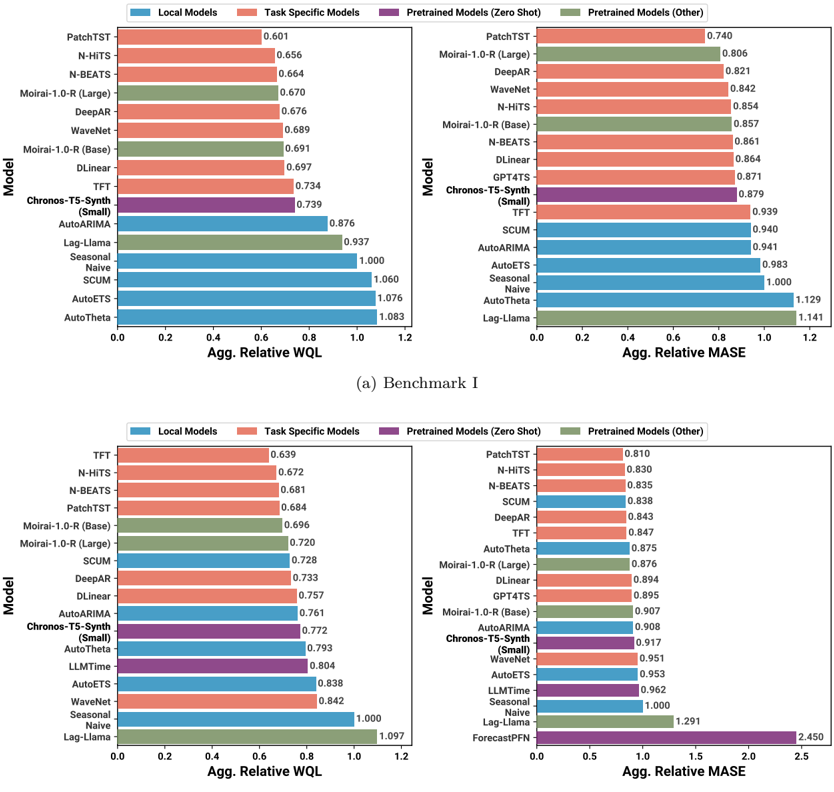
- Ablations show performance improves with model size; language-model-weight initialization offers little/no advantage over random initialization; TSMixup improves zero-shot performance; about 10% KernelSynth synthetic data is best; context length up to 1024 helps; larger vocabulary improves MASE but WQL deteriorates.
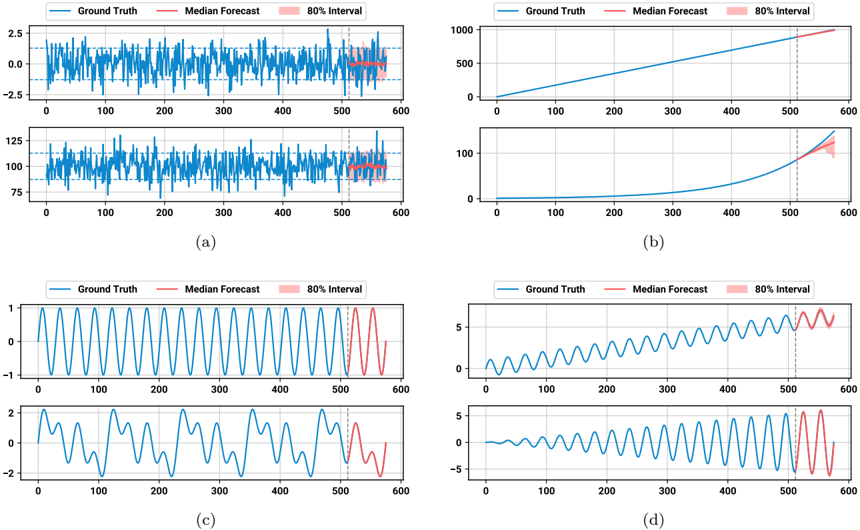
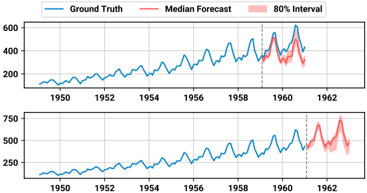
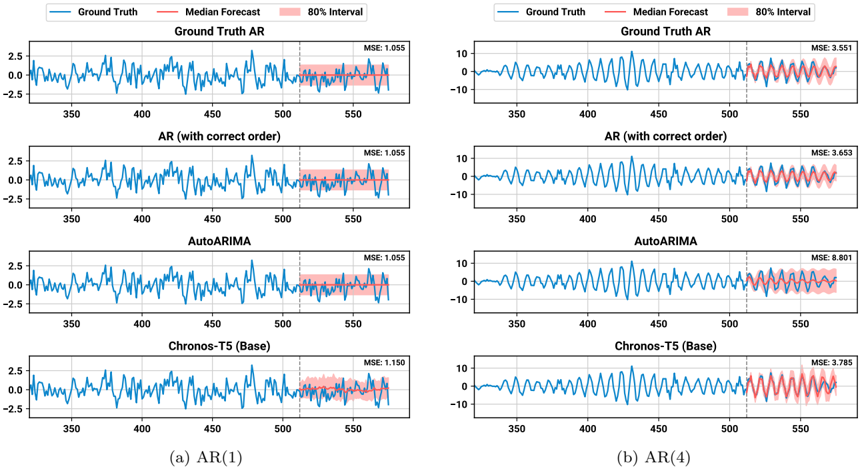
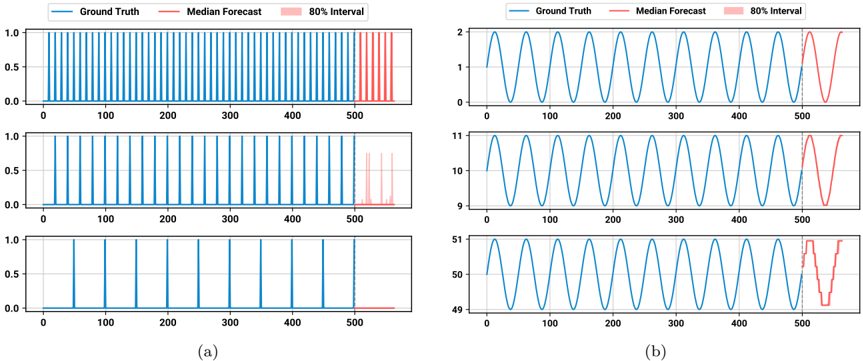
- Qualitatively, Chronos handles Gaussian noise, seasonality, additive/multiplicative trend+seasonality, and AR processes, but struggles with exponential trends and underestimates trend when context is short.
Methods
- Chronos mean-scales time series, uniformly quantizes values into B=4094 bins plus PAD/EOS (V_ts=4096), and trains off-the-shelf transformer language models with categorical cross-entropy; forecasts are produced by autoregressively sampling token paths and dequantizing/unscaling them.
- Training used 55 datasets total: 13 pretraining-only, 15 Benchmark I in-domain, and 27 Benchmark II zero-shot; 28 training datasets comprised about 890K univariate series and approximately 84B observations/tokens. Models included T5 Mini 20M, Small 46M, Base 200M, Large 710M, and GPT-2 90M, trained with 10M TSMixup augmentations plus 1M KernelSynth GP synthetic series, context length 512, prediction length 64, and 200K AdamW steps.
- Evaluation used 42 benchmark datasets with WQL (9 quantiles) and MASE; relative scores versus Seasonal Naive were aggregated by geometric mean and compared against local, task-specific, and pretrained baselines, plus a fine-tuning experiment on Benchmark II.
Limitations
- The paper states tokenization limits: representable values are in [-15s, 15s] where s is the mean absolute scale; small s relative to range causes overflow, while large s relative to variance causes precision loss. It also notes poor exponential-trend forecasts, trend underestimation with short context, and that categorical cross-entropy is not distance-aware; ordinal modeling is left as future work.
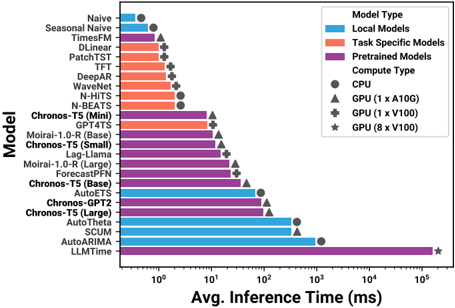
- The paper states scope limits: only univariate, uniformly spaced forecasting is studied; exogenous covariates, multivariate forecasting, and irregular sampling are not handled. Larger models were not explored due to slow inference, inference is slower than task-specific models, evaluation lacks enough high-frequency datasets to study long contexts, and public time series data remain limited.
- Text-evident: the zero-shot comparison may favor Moirai-1.0-R because many Benchmark II datasets were part of its pretraining corpus, as the paper notes; Chronos also ignores time and frequency information by design.
Model-written summary. Check it against the paper before relying on it.
Integrity signals
Registry
Cites
Statistics
Figures

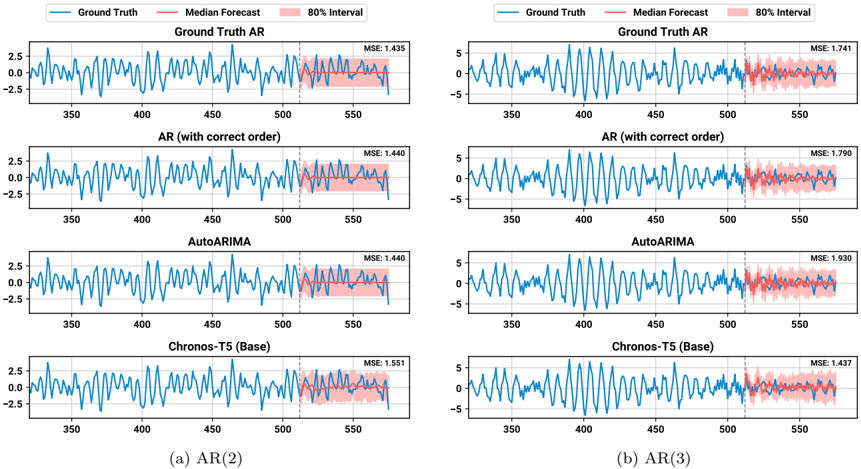
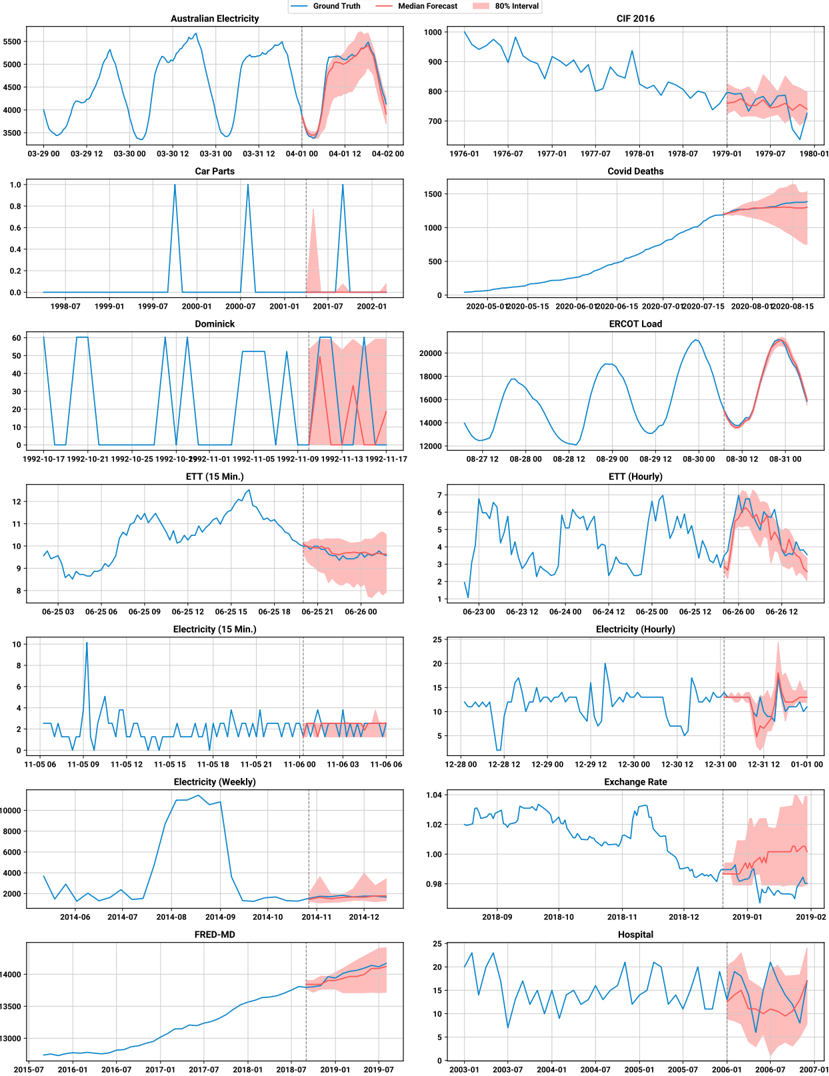
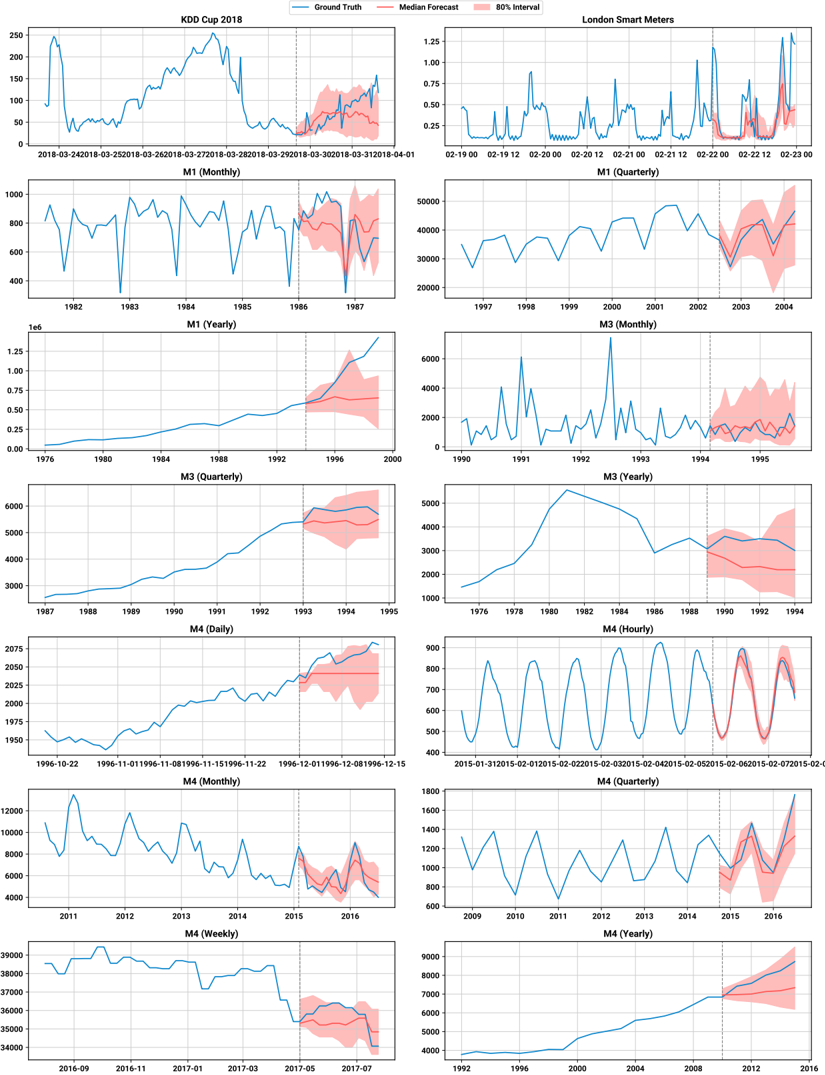
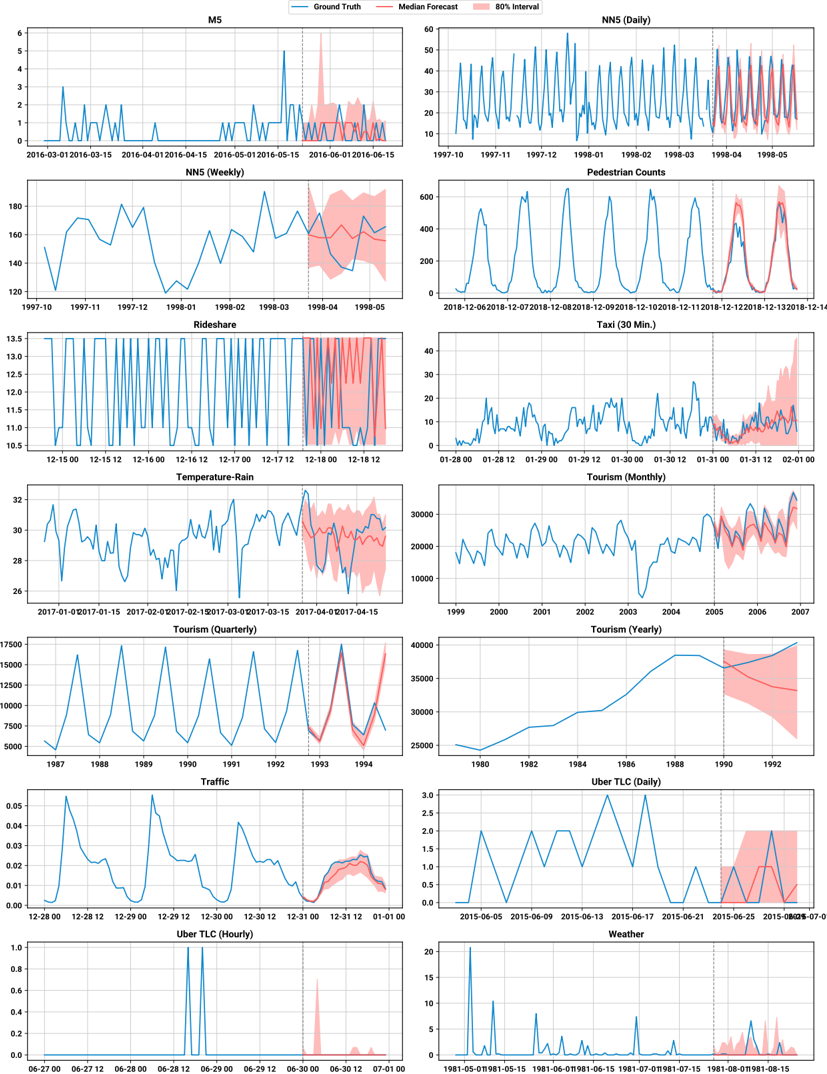
Verification
Claims the paper makes
0 Valid · 4 Not valid · 14 Not checked · 146 Own results and interpretations
A result the paper reports from its own data — it cites no other source for it, so there is none to check. The quote shows it is in the paper.
In the paper
“Between the two baseline pretrained models studied in this experiment, Moirai-1.0-Rclearly outperforms Lag-Llama.”
§ Chronos: Learning the Language of Time Series > 5.5 Main Results
boosted- Asserted: passes — The authors put it forward as true.
- Checkable: passes — It can be checked against evidence.
- Load-bearing: unclear — It is unclear whether the paper’s conclusions depend on it.
- Based: passes — The paper gives a reason why it holds.
A result the paper reports from its own data — it cites no other source for it, so there is none to check. The quote shows it is in the paper.
In the paper
“Unsurprisingly, the training loss improves with the model capacity, as shown in Figure 7a.”
§ Chronos: Learning the Language of Time Series > Model size.
plainstates a cause- Asserted: passes — The authors put it forward as true.
- Checkable: passes — It can be checked against evidence.
- Load-bearing: unclear — It is unclear whether the paper’s conclusions depend on it.
- Based: passes — The paper gives a reason why it holds.
A result the paper reports from its own data — it cites no other source for it, so there is none to check. The quote shows it is in the paper.
In the paper
“Our comprehensive evaluation across 42 datasets establishes Chronos as a benchmark for both in-domain and zero-shot forecasting, surpassing both traditional models and task-specific deep learning approaches.”
§ Chronos: Learning the Language of Time Series > Time Series Tokenization Training Inference
plain- Asserted: passes — The authors put it forward as true.
- Checkable: passes — It can be checked against evidence.
- Load-bearing: passes — The paper’s conclusions depend on it.
- Based: passes — The paper gives a reason why it holds.
A result the paper reports from its own data — it cites no other source for it, so there is none to check. The quote shows it is in the paper.
In the paper
“consistent improvement is observed around the 10% synthetic data proportion.”
§ Chronos: Learning the Language of Time Series > Model size.
plainstates an association- Asserted: passes — The authors put it forward as true.
- Checkable: passes — It can be checked against evidence.
- Load-bearing: unclear — It is unclear whether the paper’s conclusions depend on it.
- Based: passes — The paper gives a reason why it holds.
A result the paper states — it cites no source for it, so there is none to check. The quote shows it is in the paper.
In the paper
“Further increasing the proportion of synthetic data tends to worsen performance.”
§ Chronos: Learning the Language of Time Series > Model size.
hedgedstates a possible cause- Asserted: passes — The authors put it forward as true.
- Checkable: passes — It can be checked against evidence.
- Load-bearing: unclear — It is unclear whether the paper’s conclusions depend on it.
- Based: passes — The paper gives a reason why it holds.
- Rests on an assumption not shown here.
94 more claims
Create a free account to see all 164 claims and to verify the 17 references still open.
- It may state two separate claims as one. 42
- Probably not a substantial claim. 30
Self-check
Percentages, sums and reported differences re-computed from the paper’s own numbers.
Each contradiction between two passages listed here was confirmed by an independent check.
Rated minor: it would not touch a result — a value no result rests on, a p-value that stays on the same side of the significance level, or a conflict that is clerical, resolved elsewhere in the paper, or outside its own findings.
In the paper
§ Chronos: Learning the Language of Time Series > Additional information
“Dominick (Godahewa et al., 2021) contains weekly time series representing the profit of individual stock keeping units from a retailer.”
§ Chronos: Learning the Language of Time Series > Covid Deaths
“Dominick retail 1D 100014 201 296 399 8”
Rated minor: it would not touch a result — a value no result rests on, a p-value that stays on the same side of the significance level, or a conflict that is clerical, resolved elsewhere in the paper, or outside its own findings.
In the paper
§ Chronos: Learning the Language of Time Series > C Baselines
“We considered a total of 17 baseline methods for benchmarking Chronos.”
§ Chronos: Learning the Language of Time Series > Chronos-GPT2 Chronos-T5 (Mini)
“Figure: Naive, SeasonalNaive, AutoETS, Auto-Theta, SCUM, AutoARIMA, DeepAR, TFT, PatchTST, DLinear, WaveNet, N-BEATS, N-HiTS, GPT4TS, Lag-Llama, Moirai-1.evaluationAll the above, LLMTime and ForecastPFN”
Citations
Cites
Exploring the Limits of Transfer Learning with a Unified Text-to-Text Transformer
Raffel, C., Shazeer, N., Roberts, A., Lee, K., Narang, S., Matena, M., Zhou, Y., Li, W., & Liu, P. J. (2019) · arXiv · doi:10.48550/arxiv.1910.10683 · Cited by 31,859
LoRA: Low-Rank Adaptation of Large Language Models
Hu, E. J., Shen, Y., Wallis, P., Allen-Zhu, Z., Li, Y., Wang, S., Wang, L., & Chen, W. (2021) · arXiv · doi:10.48550/arxiv.2106.09685 · Cited by 13,453
LightGBM: A Highly Efficient Gradient Boosting Decision Tree
(2017) · HAL · Cited by 10,512
Lewis, M., Liu, Y., Goyal, N., Ghazvininejad, M., Mohamed, A., Levy, O., Stoyanov, V., & Zettlemoyer, L. (2020) · Proceedings of the 58th Annual Meeting of the Association for Computational Linguistics · doi:10.18653/v1/2020.acl-main.703 · Cited by 8,821
Lewis, M., Liu, Y., Goyal, N., Ghazvininejad, M., Mohamed, A., Levy, O., Stoyanov, V., & Zettlemoyer, L. (2019) · arXiv · doi:10.48550/arxiv.1910.13461 · Cited by 8,816
Transformers: State-of-the-Art Natural Language Processing
Wolf, T., Debut, L., Sanh, V., Chaumond, J., Delangue, C., Moi, A., Cistac, P., Rault, T., Louf, R., Funtowicz, M., et al. (2020) · Proceedings of the 2020 Conference on Empirical Methods in Natural Language Processing: System Demonstrations · doi:10.18653/v1/2020.emnlp-demos.6 · Cited by 8,741
Informer: Beyond Efficient Transformer for Long Sequence Time-Series Forecasting
Zhou, H., Zhang, S., Peng, J., Zhang, S., Li, J., Xiong, H., & Zhang, W. (2021) · Proceedings of the AAAI Conference on Artificial Intelligence · doi:10.1609/aaai.v35i12.17325 · Cited by 7,752
mixup: Beyond Empirical Risk Minimization
Zhang, H., Cisse, M., Dauphin, Y. N., & Lopez-Paz, D. (2017) · arXiv · doi:10.48550/arxiv.1710.09412 · Cited by 5,831
Strictly Proper Scoring Rules, Prediction, and Estimation
Gneiting, T., & Raftery, A. E. (2007) · Journal of the American Statistical Association · doi:10.1198/016214506000001437 · Cited by 5,793
Another look at measures of forecast accuracy
Hyndman, R. J., & Koehler, A. B. (2006) · International Journal of Forecasting · doi:10.1016/j.ijforecast.2006.03.001 · Cited by 5,757
Research works printed but not linked: 8
- George Athanasopoulos, Rob J. Hyndman, Haiyan Song, and Doris C. Wu. The tourism forecasting compe- tition. International Journal of Forecasting, 27(3):822-844, 2011.
- Tom B. Brown, Benjamin Mann, Nick Ryder, Melanie Subbiah, Jared Kaplan, Prafulla Dhariwal, Arvind Neelakantan, Pranav Shyam, Girish Sastry, Amanda Askell, Sandhini Agarwal, Ariel Herbert-Voss, Gretchen Krueger, Tom Henighan, Rewon Child, Aditya Ramesh, Daniel M. Ziegler, Jeffrey Wu, Clemens Winter, Christopher Hesse, Mark Chen, Eric Sigler, Mateusz Litwin, Scott Gray, Benjamin Chess, Jack Clark, Christopher Berner, Sam McCandlish, Alec Radford, Ilya Sutskever, and Dario Amodei. Language models are few-shot learners. In Advances in Neural Information Processing Systems, 2020. 2, 3, 4
- Rob Hyndman, Anne B Koehler, J Keith Ord, and Ralph D Snyder. Forecasting with exponential smoothing: the state space approach. Springer Science & Business Media, 2008. 3, 9
- Alec Radford, Jeffrey Wu, Rewon Child, David Luan, Dario Amodei, Ilya Sutskever, et al. Language models are unsupervised multitask learners. OpenAI blog, 1(8):9, 2019. 4, 6
- Yaniv Romano, Evan Patterson, and Emmanuel Candes. Conformalized quantile regression. Advances in neural information processing systems, 32, 2019.
- Kai Ming Ting and Ian H Witten. Stacking bagged and dagged models. In Proceedings of the Fourteenth International Conference on Machine Learning, 1997. 20
- Ashish Vaswani, Noam Shazeer, Niki Parmar, Jakob Uszkoreit, Llion Jones, Aidan N. Gomez, Lukasz Kaiser, and Illia Polosukhin. Attention Is All You Need. In Advances in Neural Information Processing Systems, 2017.
- Yun Zhou, Liwen You, Wenzhen Zhu, and Panpan Xu. Improving time series forecasting with mixup data augmentation. In ECML PKDD 2023 International Workshop on Machine Learning for Irregular Time Series, 2023b. 7
Cited by
Items 901–1,000 of 2,048
Fin-DR: Learning DeepResearch Agent for Financial Time-Series ForecastingPreprint
Duan, J., Zhang, Y., Junfu, Z., Zou, Y., & Feng, K. (2026) · SSRN Electronic Journal · doi:10.2139/ssrn.7422697 · Cited by 1
Foundation models for dynamical systems: A unified survey of estimation, control, and forecasting
Wang, L., Li, X., Shi, T., Zhang, N., Zhan, G., Gao, H., Yang, R., Zeng, N., & Liu, Q. (2026) · Neurocomputing · doi:10.1016/j.neucom.2026.135322 · Cited by 1
MambaNet0: Mamba-Based Sustainable Cloud Resource Prediction Framework Towards Net Zero Goals
Chevaphatrakul, T., Wang, H., & Gill, S. S. (2025) · Future Internet · doi:10.3390/fi17100480 · Cited by 1
“Chronos is a set of pre-trained time-series forecasting models that utilise transformer-based architecture, taking a probabilistic approach to time-series forecasting and tokenising their inputs similar to Large Language Models (LLMs) [28].”
Self-citationGLM-WPP: Leveraging generative large model for accurate water pressure prediction
Tao, Y., Dai, J., Xu, X., Ma, L., Tian, J., Meng, E., & Yan, D. (2025) · Journal of Information and Intelligence · doi:10.1016/j.jiixd.2025.07.001 · Cited by 1
Lynch, N. S. J., Hugh, M. M., Loughran, R., McCaffery, F., & Kowalski, D. (2026) · Communications in computer and information science · doi:10.1007/978-3-032-25809-0_7 · Cited by 1
PGA-LLM: A Probability-Guided Alignment Large Language Model Framework for Fault Diagnosis
Wang, T., Di, Y., Feng, S., Liu, Q., Haohao, C., & Liu, Q. (2026) · Technologies · doi:10.3390/technologies14080494 · Cited by 1
“Chronos [19], MOMENT [20], and AutoTimes [21] further illustrate that time series data can establish direct linkage with the language model paradigm through tokenization, foundation model pre-training, and autoregressive generation mechanisms.”
Kantheti, B., & de Araújo, C. A. P. (2026) · AI · doi:10.3390/ai7090340 · Cited by 1
Huang, Y. (2026) · SSRN Electronic Journal · doi:10.2139/ssrn.6699179 · Cited by 1
Sequence-of-Returns Risk Revisited: Can Time-Series Foundation Models Detect Danger Zones?
Vadalkar, H. (2026) · Financial Services Review · doi:10.61190/et356m79 · Cited by 1
“Chronos (Ansari et al., 2024), the model used here, tokenizes scaled-and-quantized series and trains language-model architectures on the resulting tokens; critically for this application, it produces probabilistic forecasts by sampling multiple trajectories, yielding both a forecast mean and a…”
Singh, P., & Raman, B. (2026) · Chaos Solitons & Fractals · doi:10.1016/j.chaos.2026.118796 · Cited by 1
Tan, P., Xie, L., Zhi, C., Tu, D., & Shi, C. (2025) · arXiv · doi:10.48550/arxiv.2510.25091 · Cited by 1
Chen, T., Stoffregen, T., Xu, M., Kaar, T., Maritsch, M., Pompei, G., Zumarraga, N., Jakob, R., Schmiedmayer, P., Langer, P., et al. (2026) · arXiv · doi:10.48550/arxiv.2609.40265 · Cited by 1
“Numerical time-series foundation models (TSFMs) learn to forecast across datasets through large-scale pretraining (Das et al., 2024; Ansari et al., 2024; Woo et al., 2024), while time-series language models (TSLMs) connect observations with instructions, context, and analytical questions (Langer et…”
GeoGNN: Time Series Geo-Localization using Two-Tower Graph Neural NetworksPreprint
Tran, T., Abebe, W. M., Potnis, A. V., Chinthavali, S., Shahabi, C., Xiong, L., & Lunga, D. (2026) · arXiv · doi:10.48550/arxiv.2606.08303 · Cited by 1
CENTILE: A Telemetry Foundation Model Evaluated by the Decisions It DrivesPreprint
Zhang, Z., Hou, Z., Ji, T., & Liu, Y. (2026) · arXiv · doi:10.48550/arxiv.2608.01725 · Cited by 1
“Furthermore, the native quantile grid of Chronos-Bolt [12] ends at 0 .”
InfluentialTinyCast: Probabilistic Zero-Shot Forecasting with Computed PeriodicityPreprint
Steinhauser, A. (2026) · arXiv · doi:10.48550/arxiv.2608.15767 · Cited by 1
“We train on Chronos’s KernelSynth corpus and evaluate against its zero-shot task selection (Ansari et al., 2024).”
InfluentialHow Good Can Linear Models Be for Time-Series Forecasting?Preprint
Huang, L., Xu, J., & Darlow, L. N. (2026) · arXiv · doi:10.48550/arxiv.2606.27282 · Cited by 1
“A more recent line proposes general-purpose forecasters trained on large corpora and applied zero-shot, including Chronos [3], TimesFM [1], Moirai [23], and DAM [8].”
Adaptive Latent Decomposition for Domain Generalization in Time Series Forecasting
Deng, S., Xiao, Z., & de Rijke, M. (2026) · ACM Transactions on Knowledge Discovery from Data · doi:10.1145/3819822 · Cited by 1
“In a more general setting than the time series domain, Shi et al. [70] proposed IDGM, which aligns gradients across domains to achieve DG. Invariant learning approaches are also widely used for DG.”
TIMBRE: Teaching Time Series Forecasters to Read, Remember, and ReconcilePreprint
Guan, X., Zhang, Z., Liu, H., Xu, P., Sun, Y., Song, C., & Zhao, Q. (2026) · arXiv · doi:10.48550/arxiv.2610.04795 · Cited by 1
“Pretraining approaches include tokenized values in Chronos [16], patch autoregression in TimesFM [17], masked reconstruction in MOMENT [18], mixture-distribution prediction in Moirai [19], and lag-conditioned decoding in Lag-Llama [20].”
Choi, I., Koh, W., Kang, G., Jang, Y., & Kim, W. C. (2026) · Engineering Applications of Artificial Intelligence · doi:10.1016/j.engappai.2026.115832 · Cited by 1
Grounding Time-Series Foundation Models in Digital Twin Topology for Predictive MaintenancePreprint
Ma, S., Flanigan, K. A., & Berges, M. E. (2026) · arXiv · doi:10.48550/arxiv.2609.40071 · Cited by 1
Lin, L., Lin, Z., Zhang, Q., Xia, K., Wang, S., & Qiao, J. (2026) · arXiv · doi:10.48550/arxiv.2609.22836 · Cited by 1
“We compare U NI TIMS against four state-of-the-art TSFM baselines: Sundial (Liu et al., 2025), MOIRAI (Woo et al., 2024), Chronos (Ansari et al., 2024) and TimesFM (Das et al., 2024).”
InfluentialExplaining Time Series Forecasting with Horizon-Resolved AttributionPreprint
Lee, S., Seo, J., Lee, J., Kang, J., Han, S., Yoo, S., Kim, M., Lim, T. Y., Kang, D., Choi, H., et al. (2026) · arXiv · doi:10.48550/arxiv.2609.12639 · Cited by 1
“The widely used families are Chronos (Ansari et al., 2024), TimesFM (Das et al., 2024), Moirai (Woo et al., 2024), Timer (Liu et al., 2024b), TimeMoE (Shi et al., 2025), and TinyTimeMixer (Ekambaram et al., 2024).”
Learning to Difference: Adaptive Reversible Differencing (AdaRDiff) for Time Series ForecastingPreprint
Laglil, M., Hlal, Y., Hadari, M. E., Devijver, É., & Gaussier, É. (2026) · arXiv · doi:10.48550/arxiv.2608.28134 · Cited by 1
Sharma, A., Auluck, N., & Azim, A. (2026) · arXiv · doi:10.48550/arxiv.2608.01290 · Cited by 1
“Models such as Chronos [4], Lag-Llama [5], TimesFM [6], and TimeGPT [7] re-purpose transformer architectures [8] for temporal prediction, pre-training on large and diverse time-series corpora to learn general temporal patterns.”
InfluentialHu, H., & Ai, X.-S. (2026) · arXiv · doi:10.48550/arxiv.2607.05452 · Cited by 1
“More recent work has explored MLP-based architectures Ekambaram et al. [2023], Das et al. [2023] and foundation model approaches Ansari et al. [2024], Liang et al. [2024].”
Evaluating Temporal Plasticity in Foundation Time Series Models for Incremental Fine-Tuning
Liu, J. J., Cheng, J., Xia, F., Ma, Z., & Wu, Y. (2025) · International Joint Conference on Neural Networks (IJCNN) · doi:10.1109/ijcnn64981.2025.11229355 · Cited by 1
Foundation Models for Time Series Forecasting: Evidence from the Fuel Sector
Krause, J., Lopes, A. C. D., Castro, L. G. M., Ribeiro, A. G. R., Mochinski, M. A., Paraíso, E. C., Enembreck, F., Barddal, J. P., Britto, A. D. S., & Souza, V. M. A. (2026) · Journal of the Brazilian Computer Society · doi:10.5753/jbcs.2026.6840 · Cited by 1
“Chronos [Ansari et al ., 2024] utilizes a Transformer-based architecture specifically engineered for temporal forecasting.”
Wen, Z., Wang, Y., Li, Q., & Shao, H. (2026) · IEEE Internet of Things Journal · doi:10.1109/jiot.2026.3681700 · Cited by 1
“1-R-Large [6] and Chronos-T5-Large [7].”
Self-citationAutomated Model Selection for Multivariate Time Series Forecasting
Fan, X., Sun, J., Deng, X., Zhang, Q., Xiang, W., Liu, S., & Yi, L. (2026) · International World Wide Web Conference (WWW) · doi:10.1145/3774904.3792332 · Cited by 1
“We also compare the forecasting performance of AutoMTSF with existing large time series models, including MOMENT (large) [16], MOMENT_T (fine-tuned), TEMPO (80M params) [8], GPT4TS (fine-tuned) [63], and Chronos-T5 (base) [1].”
Assessment of machine learning methods for urban air pollution forecasting
Chisilev, B.-I., & Pelican, E. (2026) · Stochastic Environmental Research and Risk Assessment · doi:10.1007/s00477-026-03331-x · Cited by 1
“Most recently, time-series foundation models— Chronos (Ansari, et al. 2024), TimesFM (Das, et al. 2024), Moirai (Woo, et al. 2024), Lag-Llama (Rasul, et al. 2024) and LLM-adapted forecasters (Jin, et al. 2024)—pursue large-scale pretraining for zero-shot and transfer forecasting, including emerging…”
Convergent Emergence of In-Context Learning Across ModalitiesPreprint
Breslow, N., Han, S., Lee, D. H., Mishra, A., Liu, A., & Khashabi, D. (2026) · arXiv · doi:10.48550/arxiv.2609.14011 · Cited by 1
“We distinguish this from the ability to effectively predict next tokens under the training distribution, as exhibited by low-perplexity language and time-series models (Ansari et al., 2024; Das et al., 2024).”
Data-Driven Forecasting of three-Component Seismograms Using Transformer ArchitecturesPreprint
Esmail, W., Russell, S., Klinge, J., Kappes, A., & Thomas, C. (2026) · arXiv · doi:10.48550/arxiv.2606.02912 · Cited by 1
“Despite this simplicity, GPT-style architectures have proven remarkably effective at learning complex sequential structures across domains well beyond text, including audio synthesis [49], time-series forecasting [33], and protein sequence modeling [50].”
Wearable AI in the Era of Large Sensor ModelsPreprint
Cai, Y., Guo, B., Shen, G., & Hong, Z. (2026) · arXiv · doi:10.48550/arxiv.2604.10172 · Cited by 1
“More recently, advanced time-series methods such as TimesFM (Das et al., 2024), Chronos (Ansari et al., 2024), and TimeGPT (Garza et al., 2023) have extended FMs to time-series analysis, demonstrating that general time-series data can also support general-purpose modeling under sufficient scale.”
LASS-ODE: Scaling ODE Computations to Connect Foundation Models with Dynamical Physical SystemsPreprint
Li, H., Xiao, C., Mai, L., Weng, Y., & Blasch, E. (2026) · arXiv · doi:10.48550/arxiv.2602.01009 · Cited by 1
“This section provides a qualitative visualization of how LASS-ODE progressively learns the underlying dynamics of ODE-governed time-series during training.”
Song, X., Huang, H., Zhang, L., & Guan, J. (2025) · Geomorphology · doi:10.1016/j.geomorph.2025.110138 · Cited by 1
Agentic AI CPE: Traffic Steering Via Small Language Models and Zero-Shot Forecasting
Sguotti, G., Troìa, S., & Maier, G. A. (2026) · IEEE International Conference on Network Softwarization (NetSoft) · doi:10.1109/netsoft70012.2026.11603511 · Cited by 1
“Inspired by Large Language Models (LLMs), architectures such as Amazon Chronos [6] and Google TimesFM [7] model time series as token sequences and are pre-trained on large, heterogeneous datasets.”
ChronosRL: embeddings-based reinforcement learning agent for financial trading
Lima, A. M. D. A., Oliveira, A. L. I., & Zanchettin, C. (2025) · Procedia Computer Science · doi:10.1016/j.procs.2025.07.132 · Cited by 1
Flow Prediction of Water Supply Network Based on Time Series Large Language Model
Li, J., Huang, B., Gui, H., Liu, X., & Xu, J. (2025) · International Conference on Computer and Communication Systems (ICCCS) · doi:10.1109/icccs65393.2025.11069945 · Cited by 1
Spatiotemporal forecasting of the edge localized modes in tokamak plasmas using neural networks
Samaddar, A., Gong, Q., Madireddy, S., Hansen, C. J., Joung, S., Smith, D. R., Sun, Y., Ebrahimi, F., Balaprakash, P., & Nelson, A. O. (2025) · Machine Learning Science and Technology · doi:10.1088/2632-2153/adfb41 · Cited by 1
Human-aligned AI Model Cards with Weighted Hierarchy Architecture
Yang, P., Jin, H., Zeng, Q., Wen, J., Rao, H., & Chen, H. (2026) · ACM Joint European Software Engineering Conference and Symposium on the Foundations of Software Engineering (ESEC/FSE) · doi:10.1145/3803437.3805265 · Cited by 1
Shao, Z., Lei, L., Wang, P., Zheng, L., Dong, W., & Li, T. (2026) · Electronics · doi:10.3390/electronics15173894 · Cited by 1
Good portfolios from bad forecasts: The anatomy of LLM volatility estimates
Yatawara, A. (2026) · Finance research letters · doi:10.1016/j.frl.2026.110572 · Cited by 1
Dash, R., Sagar, K. G., & Jenamani, M. (2025) · International Conference on Communication Systems & Networks (COMSNETS) · doi:10.1109/comsnets63942.2025.10885642 · Cited by 1
Large language models as versatile predictive engines for notifiable infectious diseases
Wu, X., Wu, J., Wang, Z., Feng, X., Yao, Y., Ong, J. J., & Zou, H. (2026) · PLOS Digital Health · doi:10.1371/journal.pdig.0001527 · Cited by 1
“Similarly, time-series foundation-model studies emphasise that addressing data scarcity and the limitations of small training datasets via large-scale pretraining and synthetic data can enhance generalisation [29].”
Liu, P., Xu, M., Gu, J., Xu, C., Cao, W., & Ming, Z. (2026) · IEEE International Conference on Web Services (ICWS) · doi:10.1109/icws72778.2026.00127 · Cited by 1
“Recently, foundation models (Large Language Models, LLMs) have also been introduced to cloud telemetry [13]–[16].”
On Cost-Effectiveness of Language Models for Time Series Anomaly Detection
Yassine, A., Cagliero, L., & Vassio, L. (2026) · Information · doi:10.3390/info17010072 · Cited by 1
Filterformer: enhancing time series forecasting through filter
Zeng, G., Dong, Y., Ni, Y., & Zhang, J.-X. (2026) · Advanced Engineering Informatics · doi:10.1016/j.aei.2026.104667 · Cited by 1
Benchmarking Synthetic Time Series Generation Methods for Privacy-Preserving Forecasting
Amorim, L., Cerqueira, V., Santos, M., Soares, C., & Azevedo, P. J. (2026) · Lecture notes in computer science · doi:10.1007/978-3-032-41086-3_34 · Cited by 1
Bao, Z., Benezeth, Y., Yang, F., Zhang, Y., Wang, H., & Li, C. (2026) · IEEE International Conference on Acoustics Speech and Signal Processing · doi:10.1109/icassp55912.2026.11461042 · Cited by 1
Self-citationKunić, Z., Dakić, V., Radovan, A., & Furko, F. (2026) · Applied Sciences · doi:10.3390/app16125804 · Cited by 1
Leveraging Language Models for Human Activity Recognition for Intelligent Lighting
Mahmoudi, A., Özçelebi, T., & Meratnia, N. (2024) · IEEE Sustainable Smart Lighting World Conference & Expo (LS) · doi:10.1109/ls2463127.2024.10881660 · Cited by 1
GNSS-DispFM: A Self-Supervised Foundation Model for Daily GNSS Displacement Time Series
Teutschmann, N., Crocetti, L., Lehmann, F., Trentini, L., & Soja, B. S. (2026) · IEEE Journal of Selected Topics in Applied Earth Observations and Remote Sensing · doi:10.1109/jstars.2026.3740122 · Cited by 1
Benchmarking time-series foundation models for multitask predictive maintenance in digital twins
Ma, S., Flanigan, K. A., & Berges, M. E. (2026) · Frontiers in Aerospace Engineering · doi:10.3389/fpace.2026.1937868 · Cited by 1
“Most existing TSFMs are domain-agnostic forecasting backbones, generalizing across data domains but remaining specialized to a single objective, forecasting (Rasul et al., 2023; Ansari et al., 2024; Shi et al., 2024).”
Efficient Test-Time Scaling for LLM-based Time Series Forecasting
Le, X.-M., Tran, M.-T., Luo, L., Aickelin, U., Phung, D., & Le, T. (2026) · ACM SIGKDD Conference on Knowledge Discovery and Data Mining (KDD) · doi:10.1145/3770855.3818201 · Cited by 1
GPD4TS: A generative pretrained diffusion paradigm for time series forecasting
Yang, J., Dai, T., Liu, P., Wu, J., Li, N., Bao, J., Zhang, H., & Xia, S. (2026) · Pattern Recognition · doi:10.1016/j.patcog.2026.114817 · Cited by 1
When Does Self-Supervised Learning Transfer to Time-Series Tasks?Preprint
Major, N., Razmadze, K., & Shavit, Y. (2026) · arXiv · doi:10.48550/arxiv.2605.19462 · Cited by 1
“…success of self-supervised learning (SSL) in natural language processing (Devlin et al., 2019) and computer vision (Caron et al., 2021; Assran et al., 2023) has motivated its widespread adoption for time-series analysis (Nie et al., 2023; Wang et al., 2025; Das et al., 2024; Ansari et al., 2024).”
What Neuroscience Can Teach AI About Learning in Continuously Changing EnvironmentsPreprint
Durstewitz, D., Averbeck, B. B., & Koppe, G. (2025) · arXiv · doi:10.48550/arxiv.2507.02103 · Cited by 1
“For example, in testing foundation models for time series forecasting, 164,165 initial segments of a time series are provided as context, and the model is then tasked with predicting the future evolution of the time series.”
Liu, Y., Guo, J., 葛咏梅, Wang, D., Zheng, X., & Peng, X. (2026) · BMC Public Health · doi:10.1186/s12889-026-26562-7 · Cited by 1
Unnikkannan, V., Sonia, Kartik, & Negi, D. (2026) · International Conference on Computing for Sustainable Global Development · doi:10.23919/indiacom70271.2026.11526107 · Cited by 1
“Foundation models for time series, like Chronos [16] and TimeGPT [17], are good for zero-shot forecasting.”
Advancing Alzheimer’s Disease Detection via Multimodal Fusion of Speech and Eye Movement Data
Favaro, A., Guo, Y., Thebaud, T., Villalba, J., & Moro-Velázquez, L. (2025) · Annual International Conference of the IEEE Engineering in Medicine and Biology Society (EMBC) · doi:10.1109/embc58623.2025.11253038 · Cited by 1
“Furthermore, we assess the cross-domain zero-shot capabilities of Chronos [21], a pretrained probabilistic time-series model, by using it to extract features from raw eye-tracking data without prior modality and task-specific fine-tuning.”
InfluentialGrasynda: Graph-Based Synthetic Time Series Generation
Amorim, L., Santos, M., Azevedo, P. J., Soares, C., & Cerqueira, V. (2026) · Lecture notes in computer science · doi:10.1007/978-3-032-23833-7_29 · Cited by 1
Feng, X., Xie, Y., Zhang, C., Li, R., Ling, W., Li, Z., & Liu, C. (2026) · arXiv · doi:10.48550/arxiv.2608.05238 · Cited by 1
Multi-scale Semantic Reprogramming for Time Series Forecasting with Large Language Models
Ye, S., Lyu, S., Lu, T., Tian, Y., & Gao, M. (2026) · Lecture notes of the Institute for Computer Sciences, Social Informatics and Telecommunications Engineering · doi:10.1007/978-3-032-21168-2_1 · Cited by 1
Li, Y. (2026) · Enlighten: Theses (The University of Glasgow) · doi:10.5525/gla.thesis.86073 · Cited by 1
Closing the Loop: A Control-Theoretic Framework for Time Series Forecasting with LLMs
Zhang, X., Wang, J., Song, Z., Zhang, J., & Qiang, W. (2026) · ACM International Conference on Multimedia (ACM MM) · doi:10.48550/arxiv.2602.12756 · Cited by 1
Self-citationSpeQNet: Query-Enhanced Spectral Graph Filtering for Spatiotemporal Forecasting
Feng, Z., & Markov, K. (2026) · Applied Sciences · doi:10.3390/app16031176 · Cited by 1
Carpinelli, C., Broucke, S. V., Baesens, B., Íslind, A. S., & Óskarsdóttir, M. (2025) · Lecture notes in information systems and organisation · doi:10.1007/978-3-032-01697-3_8 · Cited by 1
Pan, X., Wang, H., Guo, J., Zhao, Z., Dong, S., & Lu, J. (2026) · arXiv · doi:10.48550/arxiv.2608.02157 · Cited by 1
“Foundation models across scientific domains incorporate 3D atomic geometry in materials science [37–39], temporal order in forecasting [40, 41], and spectral and spatial relationships in remote sensing [42, 43].”
Self-citationRetrieval-Augmented Generation with Covariate Time Series
Liang, K. Y., Pei, Z., Zhang, H., Liu, Y., Song, S., & Wang, J. (2026) · ACM SIGKDD Conference on Knowledge Discovery and Data Mining (KDD) · doi:10.1145/3770855.3818471 · Cited by 1
“The Chronos family [6], including the recent Chronos-Bolt and Chronos-2 [5], quantizes continuous values into discrete tokens to leverage cross-entropy objectives similar to language modeling.”
Learning to Predict, Discover, and Reason in High-Cardinality Event SequencesPreprint
Math, H. (2026) · arXiv · doi:10.48550/arxiv.2603.16313 · Cited by 1
SurF: A Generative Model for Multivariate Irregular Time Series ForecastingPreprint
Rezaei, M. R., Balaji, T., & Krishnan, R. G. (2026) · arXiv · doi:10.48550/arxiv.2605.14069 · Cited by 1
“Foundation models have advanced rapidly in language [Brown et al., 2020, Touvron et al., 2023], vision [Radford et al., 2021, Oquab et al., 2023], and regularly sampled time series (TimesFM [Das et al., 2024], Chronos [Ansari et al., 2024], Lag-Llama [Rasul et al., 2024], Moirai [Woo et al., 2024]).”
Hu, X., Zheng, L., & Zhang, R. (2024) · IEEE International Conference on Big Data (BigData) · doi:10.1109/bigdata62323.2024.10825932 · Cited by 1
Time-FLM: Universal large model for fed-batch process time series forecasting
Sun, Y., & Yan, X. (2026) · Knowledge-Based Systems · doi:10.1016/j.knosys.2026.115580 · Cited by 1
Bolboacă, R., & Haller, P. (2026) · Chaos Solitons & Fractals · doi:10.1016/j.chaos.2026.118779 · Cited by 1
REDNet: Two-stage knowledge distillation for robust edge time series forecasting
Fu, D., Zuo, Y., Yuan, S., Lin, H., Liu, Y., & Wu, J. (2026) · Pattern Recognition Letters · doi:10.1016/j.patrec.2026.08.011 · Cited by 1
Forecasting Company Fundamentals
Divo, F., Endress, E., Endler, K., Kersting, K., & Dhami, D. S. (2025) · Transactions on machine learning research · doi:10.48550/arxiv.2411.05791 · Cited by 1
Robust Short-Term OEE Forecasting in Industry 4.0 via Topological Data AnalysisPreprint
Anapa, K., Güzel, İ., & Yozgatlıgil, C. (2025) · arXiv · doi:10.48550/arxiv.2507.02890 · Cited by 1
RAVEN: A Regime-Aware Variable-context Expert Network for Financial Time Series ForecastingPreprint
He, C., Guan, Z., Liang, X., Lian, D., Li, J., Chen, E., Lee, P. P. C., Hu, G., & Chen, Z. (2026) · arXiv · doi:10.48550/arxiv.2606.24062 · Cited by 1
“Unlike fixed-context models [2], [32] and predefined multi-scale methods [1], [5], [42], RAVEN performs sample-dependent context selection via CIT-thresholded routing; unlike token-level MoE [21], [31], [33] that specializes experts by patch content, RAVEN specializes by temporal scale through…”
Time Series Forecasting Through the Lens of Dynamics
Brachet, A.-R., Richard, P.-Y., & Hudelot, C. (2026) · International Conference on Machine Learning · doi:10.48550/arxiv.2507.15774 · Cited by 1
“In this context, we identify three families of TSF models, based on their design and learning principles: pattern-recognition models , which focus on identifying and extrapolating temporal patterns without explicitly modeling the underlying physical dynamics, either from a single dataset as Informer or iTransformer (f…”
Structured Noise Modeling for Enhanced Time-Series ForecastingPreprint
Koohfar, S. (2025) · arXiv · doi:10.48550/arxiv.2511.19657 · Cited by 1
“As time-series foundation models continue to evolve Das et al. (2024); Ansari et al. (2024); Woo et al. (2024), this flexibility allows our approach to complement and enhance modern architectures without modifying their core design.”
Na, S., Cho, Y., & Baek, Y. (2026) · IEEE Access · doi:10.1109/access.2026.3667131 · Cited by 1
Enhancing Long-Term Forecasting Stability in Smart Grids: A Hybrid Mamba-LSTM-Attention Framework
Chen, F., Lei, C. F., Guo, T., & Chu, C. (2026) · Energies · doi:10.3390/en19081855 · Cited by 1
Tabby: An Open Pretraining Recipe for Time Series Foundation ModelsPreprint
Xie, S., Abdessalem, B., Xiao, Z., Hili, Y. A. E., Odonnat, A., Dong, Z., Zan, L., Palpanas, T., Zhang, J., Pan, L., et al. (2026) · arXiv · doi:10.48550/arxiv.2609.13956 · Cited by 1
Understanding Key Features of Time Series Foundation Models from Epidemic ForecastingPreprint
Jafari, A., Fox, J., Fox, G., Marathe, M. V., & Adiga, A. (2026) · arXiv · doi:10.48550/arxiv.2606.19560 · Cited by 1
“Chronos [5] Pretrained checkpoint Used as pretrained zero-shot or lightly adapted foundation models rather than models trained from scratch with user-defined architecture hyperparameters.”
InfluentialKonat, K., & Sarwas, G. (2026) · Progress in Applied Electrical Engineering (PAEE) · doi:10.1109/paee71887.2026.11660673 · Cited by 1
“Representative approaches include Chronos [1], TimesFM [2], and Lag-Llama [3], which report strong zero-shot forecasting performance on standard benchmarks such as ETT, Weather, and M4 [18].”
Evaluating Time-Series Foundation Models and Multimodal Dietary Context for CGM ForecastingPreprint
Zhang, B., Cheng, H.-W., Yang, H., Shen, E. L., Vansomphone, J., Li, Y., Zhou, K., Qu, Z., Zhao, S., Deng, X., et al. (2026) · arXiv · doi:10.48550/arxiv.2609.11872 · Cited by 1
“…foundation models: Chronos-Bolt-Tiny and Chronos-Bolt-Mini , lightweight encoder–decoder Transformers that differ primarily in model capacity [18]; Chronos2-Small , a compact pretrained Transformer from the Chronos family that operates directly in the continuous value space [19]; and TimesFM…”
GHGbench: A Unified Multi-Entity, Multi-Task Benchmark for Carbon Emission PredictionPreprint
Duan, Y., Zheng, S., Li, L., Xue, C., & Salim, F. D. (2026) · arXiv · doi:10.48550/arxiv.2605.13743 · Cited by 1
“…testing, and short-horizon forecasting; we evaluate tuned gradient-boosted trees, TabPFN v2 [22], MLP, FT-Transformer [17], time-series foundation models [1, 11, 40], and an LLM panel under multi-seed runs, bootstrap confidence intervals, and 1000-resample paired bootstrap on shared test rows.”
TSRBench: Benchmarking Time-Series Retrieval
Hu, C., Cui, H., Wang, Z., Bao, J., Yang, J., Li, J., Pei, C., Pei, D., & Xie, G. (2026) · ACM SIGKDD Conference on Knowledge Discovery and Data Mining (KDD) · doi:10.1145/3770855.3817598 · Cited by 1
Cerutti, F. (2025) · arXiv · doi:10.48550/arxiv.2509.07036 · Cited by 1
“Recent work has proposed adapting large-scale language models to the domain of probabilistic time series forecasting by redefining the input representation and training paradigm in a way that preserves architectural compatibility [1].”
InfluentialPeräkylä, L. (2025) · Tampere University Institutional Repository (Tampere University) · Cited by 1
Variational Streaming Flow: Probabilistic Forecasting in Physical TimePreprint
Hsu, H. H.-H., Gwak, M., Lim, S. H., Li, P., & Erichson, N. B. (2026) · arXiv · doi:10.48550/arxiv.2610.00976 · Cited by 1
“Lag-Llama provides a probabilistic decoder-only model (Rasul et al., 2023), while Chronos models scaled and quantized time-series values with language-model architectures (Ansari et al., 2024).”
Empowering VLMs for Few-Shot Multimodal Time Series Classification via Tailored Agentic Reasoning
Li, L., Huang, J., Quan, Q., Li, D., Li, B., Zhang, X., Meng, E., Feng, W., Lou, J., & Ng, S.-K. (2026) · ACM International Conference on Multimedia (ACM MM) · doi:10.48550/arxiv.2605.09395 · Cited by 1
“Although the aforementioned foundation models show satisfactory classification results, they cannot handle multimodal data and lack the reasoning ability to explicitly explain the thinking process.”
Self-citationProbabilistic and Generative Approaches to Continuous Time Series Forecasting
Habiba, M., Pearlmutter, B. A., & Maleki, M. (2026) · Springer eBooks · doi:10.1007/978-3-032-18022-3_6 · Cited by 1
Jheng, S.-L., Tak, R., Gaman, S., Mazurencu-Marinescu-Pele, M., & Pele, D. T. (2026) · ECONOMIC COMPUTATION AND ECONOMIC CYBERNETICS STUDIES AND RESEARCH · doi:10.24818/18423264/60.2.26.14 · Cited by 1
Resolution-Aware Retrieval Augmented Zero-Shot ForecastingPreprint
Deznabi, I., Kumar, P., & Fiterau, M. (2025) · arXiv · doi:10.48550/arxiv.2510.16695 · Cited by 1
Gebregergis, B. T., Yhdego, H. G., & Teklu, T. (2026) · bioRxiv (Cold Spring Harbor Laboratory) · doi:10.64898/2026.08.19.745052 · Cited by 1
Enabling Intrinsic Reasoning over Dense Geospatial Embeddings with DFR-GemmaPreprint
Zhang, X., Slobodkin, A., Paul, J., Sharma, M., Oymak, S., Shetty, S., & Prasad, G. (2026) · arXiv · doi:10.48550/arxiv.2604.07490 · Cited by 1
“…work has explored extending LLMs to structured modalities such as tabular and time-series data using serialization, quantization, or modality-specific encoders Ansari et al. (2024); Bandara and Patel (2024); Gardner et al. (2024); Jiang et al.; Jin et al.; Zhang et al. (2024); Zhou et al. (2023).”
Self-citationAutoregressive Flow Matching for Motion PredictionPreprint
Xie, J., Stojanov, S., Eyzaguirre, C., Yamins, D. L. K., & Wu, J. (2025) · arXiv · doi:10.48550/arxiv.2512.22688 · Cited by 1
Transformer Based Cross Modal Multivariate Enhanced Time Series Forecasting
Zhang, X., Chen, Y., Mo, J., Dai, W., Zheng, J., Bai, C., & Su, J. (2025) · IEEE International Conference on Pattern Recognition and Machine Learning (PRML) · doi:10.1109/prml66062.2025.11160291 · Cited by 1
Self-citationLiu, C., Zhao, B., Ding, J., & Li, Y. (2026) · International Conference on Machine Learning · doi:10.48550/arxiv.2509.21802 · Cited by 1
“…models with different parameter sizes, including Panda (Lai et al., 2025), Time-MoE (Shi et al., 2024), TimesFM (Das et al., 2024), Chronos (Ansari et al., 2024), Moirai-MoE (Liu et al., 2024a), Timer-XL (Liu et al., 2024b), DynaMix (Hemmer & Durstewitz, 2025), Parrot (Zhang & Gilpin,…”
Metadata
- Authors
- Ansari, A. F., Stella, L., Turkmen, C., Zhang, X., Mercado, P., Shen, H., Shchur, O., Rangapuram, S. S., Arango, S. P., Kapoor, S., Zschiegner, J., Maddix, D. C., Wang, H., Mahoney, M. W., Torkkola, K., Wilson, A. G., Bohlke-Schneider, M., & Wang, Y.
- Affiliations
- Amazon (United States) (US)
- University of California San Diego (US)
- University of Freiburg (DE)
- Rutgers, The State University of New Jersey (US)
- ORCID
- Venue
- arXiv
- Publisher
- arXiv
- Published
- 2024
- ISSN
- 2835-8856 (ISSN-L)
- arXiv
- 2403.07815
- OpenAlex
- W4392781393
- Cited by
- 2,046
- References
- 92
- Citations by year
- 2026: 1398 · 2025: 520 · 2024: 126
- FWCI
- 245.30
- Type
- journal article
- Language
- en
- Open access
- diamond
- openreview.net
- Licence
- Locations
- Transactions on machine learning research (publishedVersion, cc-by)
- arXiv (submittedVersion, public-domain)
- Topics
- Physical Sciences › Computer Science › Signal Processing › Time Series Analysis and Forecasting
- Social Sciences › Decision Sciences › Management Science and Operations Research › Forecasting Techniques and Applications
- Social Sciences › Decision Sciences › Management Science and Operations Research › Stock Market Forecasting Methods
- Keywords
- time series forecasting, transformer language models, T5, zero-shot forecasting, Chronos
About these checks
Registry, retraction, Cites and statistics results are computed, not judged, with one exception: a printed reference that no index lists is read once by a model before it counts as a citation error. Claims are extracted by a model and kept only when their quote appears verbatim in the text; each cited source is then checked, with a model’s help, for whether it says what the claim relies on. Those verdicts can be wrong — read the claim’s quote and the cited source before relying on one.
A language model drew the claims from the paper on 2026-11-28, under version 3 of the claim definition (model deepseek-v4.1-flash, prompt extract-v3).
A second model labelled each claim on 2026-11-28 (model jev-1.13-20260917, definition revision gold-guideline-v0.2).
Statistics and arithmetic are recomputed, not judged.
Confidence bands are shown only for fields calibrated on our annotated test set. None is calibrated yet, so no band is shown.
What counts as a claim ›How we measure confidence ›How we check this ›
Are you an author, or do you see a problem with this page? Request a review
Data sources
Bibliographic data: Semantic Scholar, OpenAlex, Crossref.
Contains information from the Semantic Scholar Academic Graph Datasets, made available under the ODC Attribution License (ODC-BY 1.0).
Semantic Scholar’s data is described in: Kinney, R., et al. (2023). The Semantic Scholar Open Data Platform. arXiv:2301.10140.
