

Chronos: Learning the Language of Time Series
Open accessThe DOI matches its DataCite record; 95 of the 95 references it cites were found in a registry or an index; none of the 21 sources its claims cite is checked for support yet.
Abstract
We introduce Chronos, a simple yet effective framework for pretrained probabilistic time series models. Chronos tokenizes time series values using scaling and quantization into a fixed vocabulary and trains existing transformer-based language model architectures on these tokenized time series via the cross-entropy loss. We pretrained Chronos models based on the T5 family (ranging from 20M to 710M parameters) on a large collection of publicly available datasets, complemented by a synthetic dataset that we generated via Gaussian processes to improve generalization. In a comprehensive benchmark consisting of 42 datasets, and comprising both classical local models and deep learning methods, we show that Chronos models: (a) significantly outperform other methods on datasets that were part of the training corpus; and (b) have comparable and occasionally superior zero-shot performance on new datasets, relative to methods that were trained specifically on them. Our results demonstrate that Chronos models can leverage time series data from diverse domains to improve zero-shot accuracy on unseen forecasting tasks, positioning pretrained models as a viable tool to greatly simplify forecasting pipelines.
Overview
CoChat Summary
TL;DR
Chronos adapts language-model architectures to probabilistic time series forecasting by scaling and quantizing values into tokens and training T5/GPT-2 models with cross-entropy. Across 42 benchmark datasets, it achieves strong in-domain and zero-shot forecasting, often matching or beating task-specific models.
Key findings
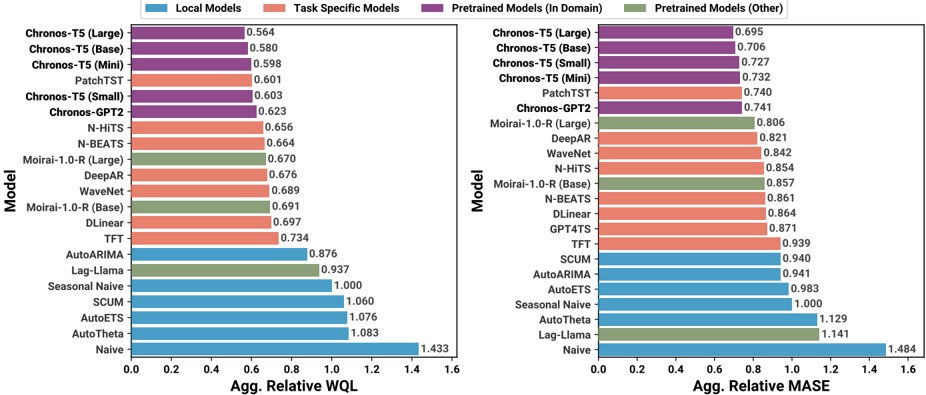
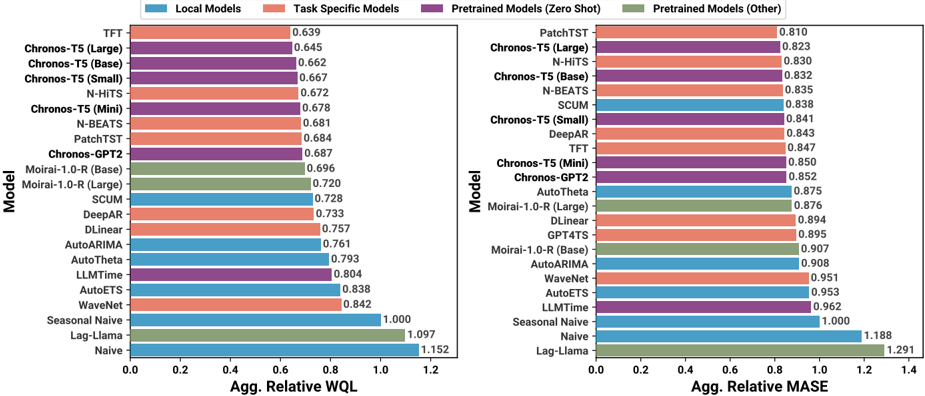
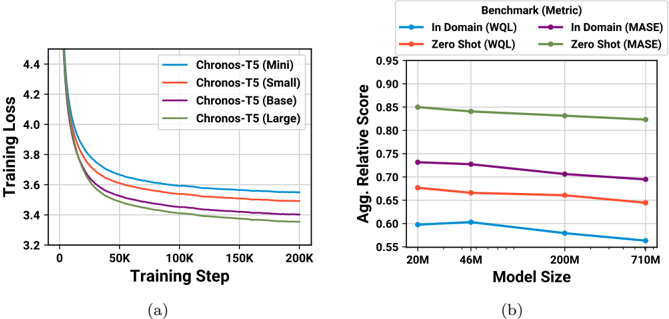
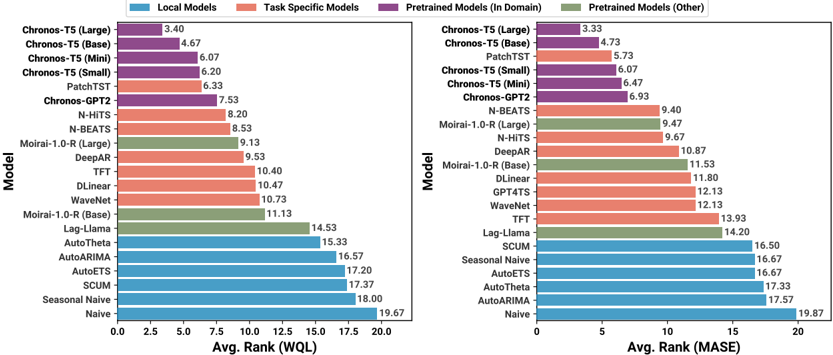
- On in-domain Benchmark I (15 datasets), Chronos-T5 Base/Large obtain the best aggregated relative scores: WQL 0.580/0.564 and MASE 0.706/0.695 versus Seasonal Naive 1.000, outperforming local, task-specific, and other pretrained baselines.
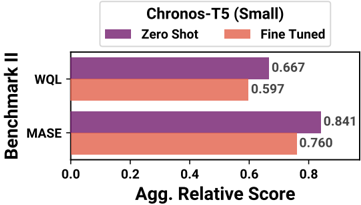
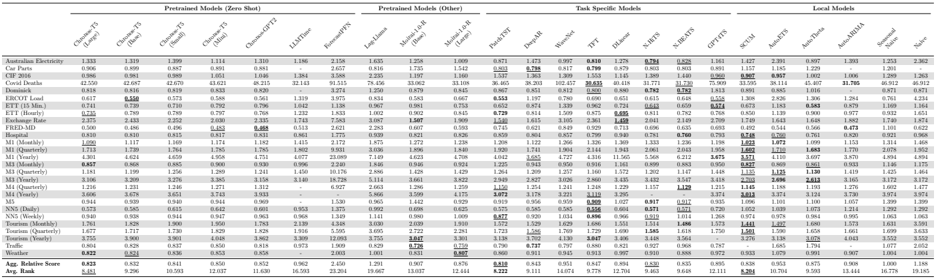
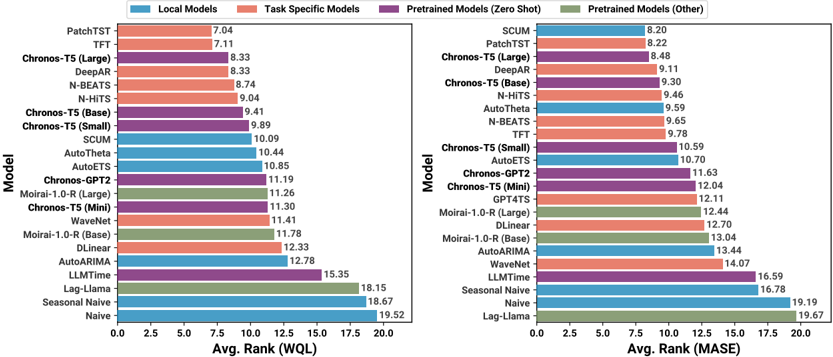
- On zero-shot Benchmark II (27 datasets), Chronos models rank 2nd–4th on WQL and Chronos-T5 Large ranks 2nd on MASE; aggregated relative WQL is 0.645 (Large), 0.662 (Base), 0.667 (Small), 0.678 (Mini), and MASE is 0.823, 0.832, 0.841, 0.850 versus Seasonal Naive 1.000. Fine-tuned Chronos-T5 Small becomes the best model on Benchmark II.
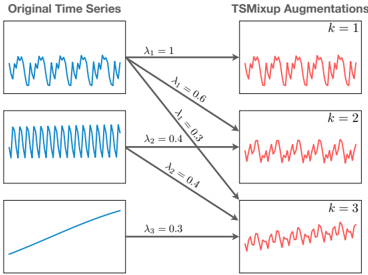
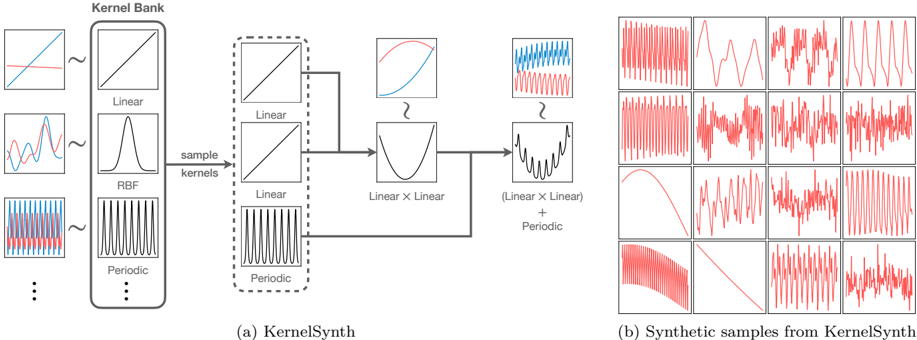
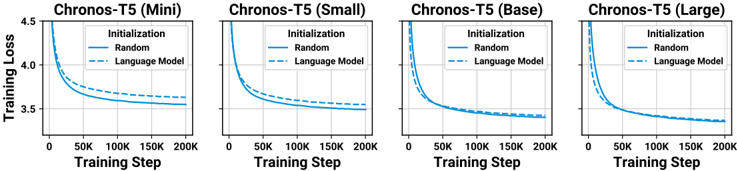
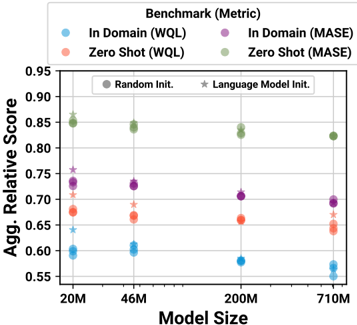
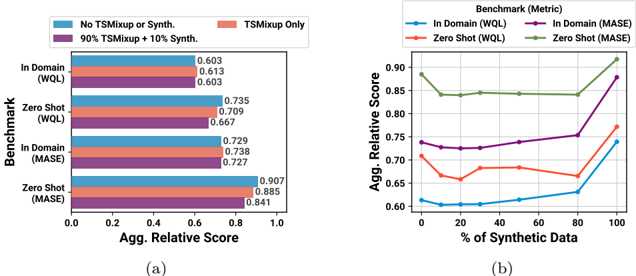
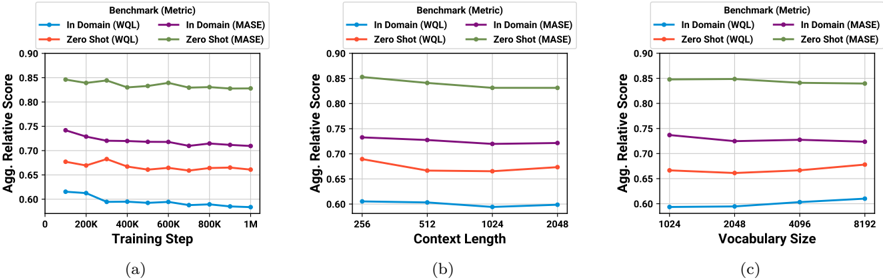
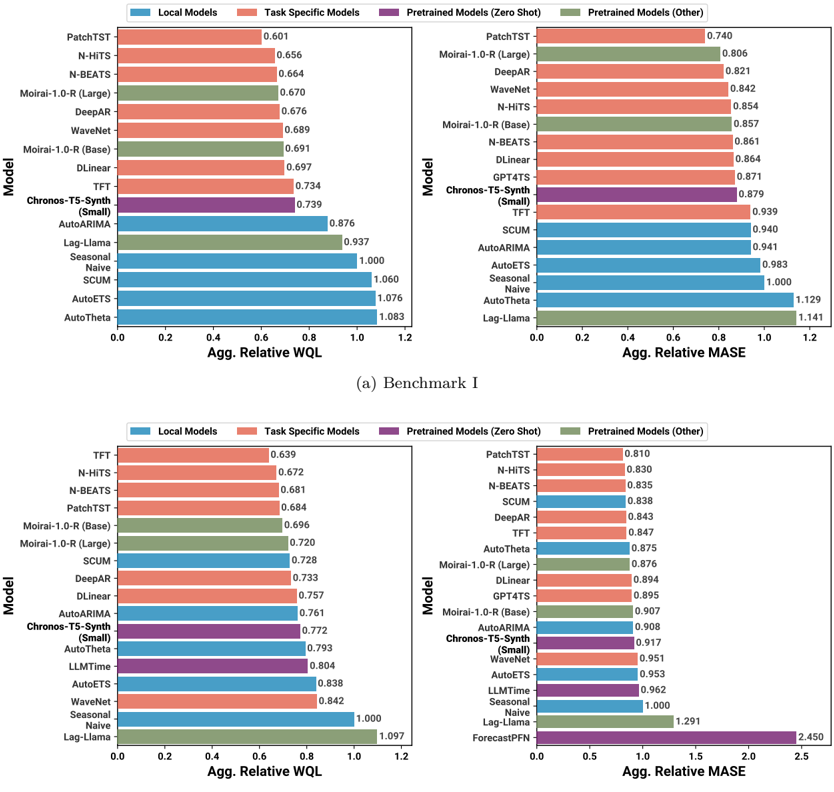
- Ablations show performance improves with model size; language-model-weight initialization offers little/no advantage over random initialization; TSMixup improves zero-shot performance; about 10% KernelSynth synthetic data is best; context length up to 1024 helps; larger vocabulary improves MASE but WQL deteriorates.
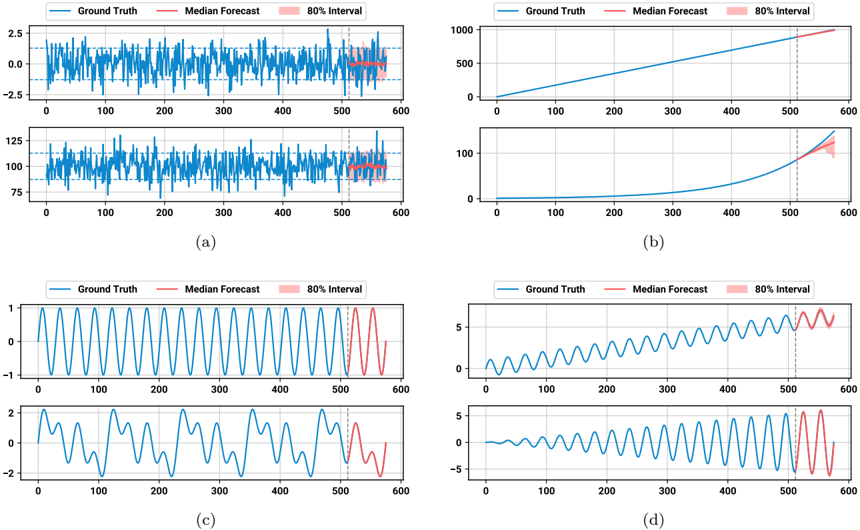
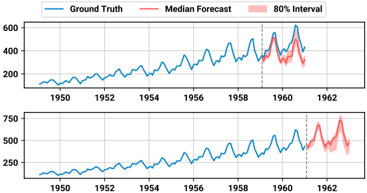
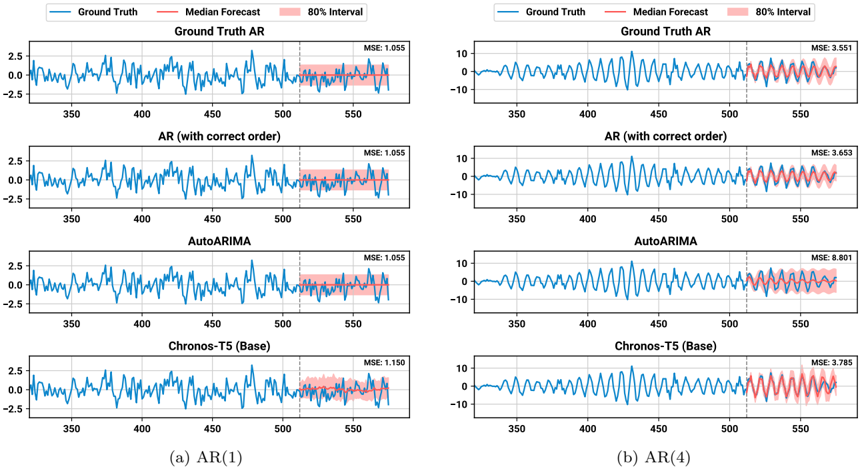
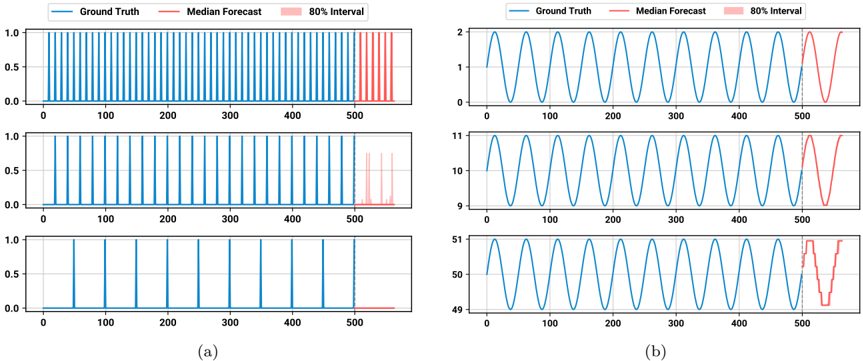
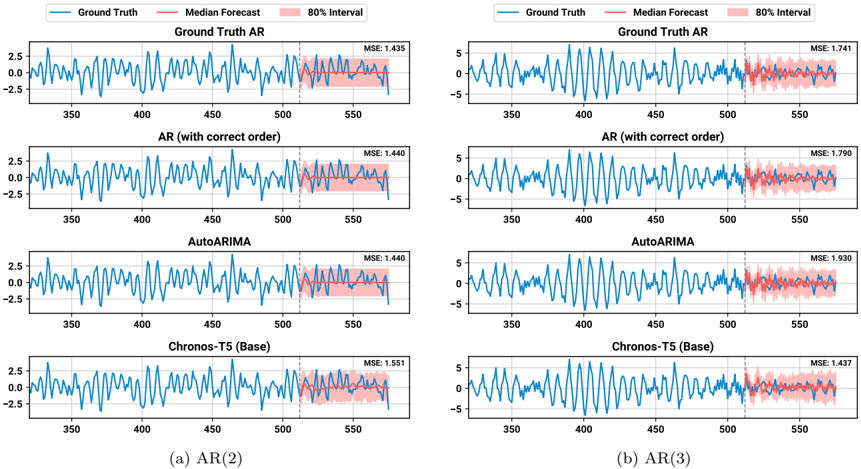
- Qualitatively, Chronos handles Gaussian noise, seasonality, additive/multiplicative trend+seasonality, and AR processes, but struggles with exponential trends and underestimates trend when context is short.
Methods
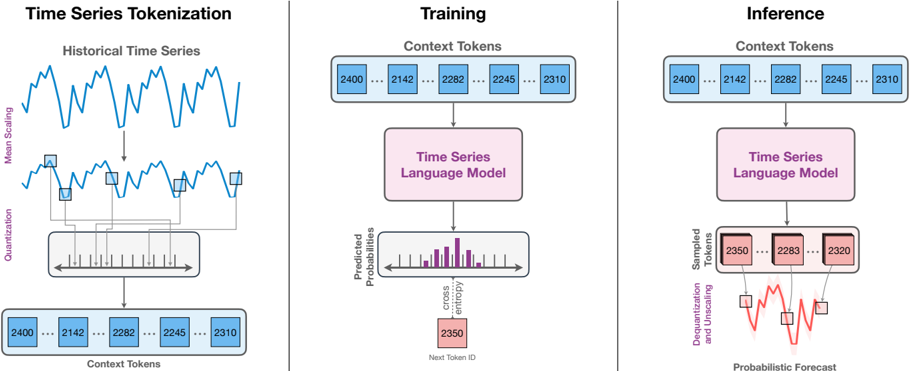
- Chronos mean-scales time series, uniformly quantizes values into B=4094 bins plus PAD/EOS (V_ts=4096), and trains off-the-shelf transformer language models with categorical cross-entropy; forecasts are produced by autoregressively sampling token paths and dequantizing/unscaling them.
- Training used 55 datasets total: 13 pretraining-only, 15 Benchmark I in-domain, and 27 Benchmark II zero-shot; 28 training datasets comprised about 890K univariate series and approximately 84B observations/tokens. Models included T5 Mini 20M, Small 46M, Base 200M, Large 710M, and GPT-2 90M, trained with 10M TSMixup augmentations plus 1M KernelSynth GP synthetic series, context length 512, prediction length 64, and 200K AdamW steps.
- Evaluation used 42 benchmark datasets with WQL (9 quantiles) and MASE; relative scores versus Seasonal Naive were aggregated by geometric mean and compared against local, task-specific, and pretrained baselines, plus a fine-tuning experiment on Benchmark II.
Limitations
- The paper states tokenization limits: representable values are in [-15s, 15s] where s is the mean absolute scale; small s relative to range causes overflow, while large s relative to variance causes precision loss. It also notes poor exponential-trend forecasts, trend underestimation with short context, and that categorical cross-entropy is not distance-aware; ordinal modeling is left as future work.
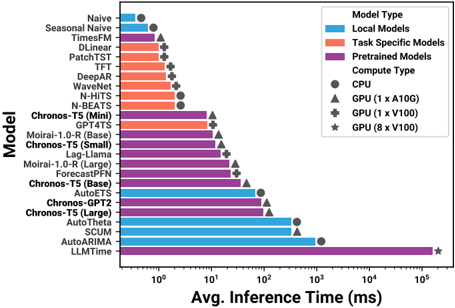
- The paper states scope limits: only univariate, uniformly spaced forecasting is studied; exogenous covariates, multivariate forecasting, and irregular sampling are not handled. Larger models were not explored due to slow inference, inference is slower than task-specific models, evaluation lacks enough high-frequency datasets to study long contexts, and public time series data remain limited.
- Text-evident: the zero-shot comparison may favor Moirai-1.0-R because many Benchmark II datasets were part of its pretraining corpus, as the paper notes; Chronos also ignores time and frequency information by design.
Model-written summary. Check it against the paper before relying on it.
Integrity signals
Registry
Cites
Statistics
Figures

Verification
Claims the paper makes
0 Valid · 4 Not valid · 14 Not checked · 146 Own results and interpretations
A result the paper reports from its own data — it cites no other source for it, so there is none to check. The quote shows it is in the paper.
In the paper
“Between the two baseline pretrained models studied in this experiment, Moirai-1.0-Rclearly outperforms Lag-Llama.”
§ Chronos: Learning the Language of Time Series > 5.5 Main Results
boosted- Asserted: passes — The authors put it forward as true.
- Checkable: passes — It can be checked against evidence.
- Load-bearing: unclear — It is unclear whether the paper’s conclusions depend on it.
- Based: passes — The paper gives a reason why it holds.
A result the paper reports from its own data — it cites no other source for it, so there is none to check. The quote shows it is in the paper.
In the paper
“Unsurprisingly, the training loss improves with the model capacity, as shown in Figure 7a.”
§ Chronos: Learning the Language of Time Series > Model size.
plainstates a cause- Asserted: passes — The authors put it forward as true.
- Checkable: passes — It can be checked against evidence.
- Load-bearing: unclear — It is unclear whether the paper’s conclusions depend on it.
- Based: passes — The paper gives a reason why it holds.
A result the paper reports from its own data — it cites no other source for it, so there is none to check. The quote shows it is in the paper.
In the paper
“Our comprehensive evaluation across 42 datasets establishes Chronos as a benchmark for both in-domain and zero-shot forecasting, surpassing both traditional models and task-specific deep learning approaches.”
§ Chronos: Learning the Language of Time Series > Time Series Tokenization Training Inference
plain- Asserted: passes — The authors put it forward as true.
- Checkable: passes — It can be checked against evidence.
- Load-bearing: passes — The paper’s conclusions depend on it.
- Based: passes — The paper gives a reason why it holds.
A result the paper reports from its own data — it cites no other source for it, so there is none to check. The quote shows it is in the paper.
In the paper
“consistent improvement is observed around the 10% synthetic data proportion.”
§ Chronos: Learning the Language of Time Series > Model size.
plainstates an association- Asserted: passes — The authors put it forward as true.
- Checkable: passes — It can be checked against evidence.
- Load-bearing: unclear — It is unclear whether the paper’s conclusions depend on it.
- Based: passes — The paper gives a reason why it holds.
A result the paper states — it cites no source for it, so there is none to check. The quote shows it is in the paper.
In the paper
“Further increasing the proportion of synthetic data tends to worsen performance.”
§ Chronos: Learning the Language of Time Series > Model size.
hedgedstates a possible cause- Asserted: passes — The authors put it forward as true.
- Checkable: passes — It can be checked against evidence.
- Load-bearing: unclear — It is unclear whether the paper’s conclusions depend on it.
- Based: passes — The paper gives a reason why it holds.
- Rests on an assumption not shown here.
94 more claims
Create a free account to see all 164 claims and to verify the 17 references still open.
- It may state two separate claims as one. 42
- Probably not a substantial claim. 30
Self-check
Percentages, sums and reported differences re-computed from the paper’s own numbers.
Each contradiction between two passages listed here was confirmed by an independent check.
Rated minor: it would not touch a result — a value no result rests on, a p-value that stays on the same side of the significance level, or a conflict that is clerical, resolved elsewhere in the paper, or outside its own findings.
In the paper
§ Chronos: Learning the Language of Time Series > Additional information
“Dominick (Godahewa et al., 2021) contains weekly time series representing the profit of individual stock keeping units from a retailer.”
§ Chronos: Learning the Language of Time Series > Covid Deaths
“Dominick retail 1D 100014 201 296 399 8”
Rated minor: it would not touch a result — a value no result rests on, a p-value that stays on the same side of the significance level, or a conflict that is clerical, resolved elsewhere in the paper, or outside its own findings.
In the paper
§ Chronos: Learning the Language of Time Series > C Baselines
“We considered a total of 17 baseline methods for benchmarking Chronos.”
§ Chronos: Learning the Language of Time Series > Chronos-GPT2 Chronos-T5 (Mini)
“Figure: Naive, SeasonalNaive, AutoETS, Auto-Theta, SCUM, AutoARIMA, DeepAR, TFT, PatchTST, DLinear, WaveNet, N-BEATS, N-HiTS, GPT4TS, Lag-Llama, Moirai-1.evaluationAll the above, LLMTime and ForecastPFN”
Citations
Cites
Exploring the Limits of Transfer Learning with a Unified Text-to-Text Transformer
Raffel, C., Shazeer, N., Roberts, A., Lee, K., Narang, S., Matena, M., Zhou, Y., Li, W., & Liu, P. J. (2019) · arXiv · doi:10.48550/arxiv.1910.10683 · Cited by 31,859
LoRA: Low-Rank Adaptation of Large Language Models
Hu, E. J., Shen, Y., Wallis, P., Allen-Zhu, Z., Li, Y., Wang, S., Wang, L., & Chen, W. (2021) · arXiv · doi:10.48550/arxiv.2106.09685 · Cited by 13,453
LightGBM: A Highly Efficient Gradient Boosting Decision Tree
(2017) · HAL · Cited by 10,512
Lewis, M., Liu, Y., Goyal, N., Ghazvininejad, M., Mohamed, A., Levy, O., Stoyanov, V., & Zettlemoyer, L. (2020) · Proceedings of the 58th Annual Meeting of the Association for Computational Linguistics · doi:10.18653/v1/2020.acl-main.703 · Cited by 8,821
Lewis, M., Liu, Y., Goyal, N., Ghazvininejad, M., Mohamed, A., Levy, O., Stoyanov, V., & Zettlemoyer, L. (2019) · arXiv · doi:10.48550/arxiv.1910.13461 · Cited by 8,816
Transformers: State-of-the-Art Natural Language Processing
Wolf, T., Debut, L., Sanh, V., Chaumond, J., Delangue, C., Moi, A., Cistac, P., Rault, T., Louf, R., Funtowicz, M., et al. (2020) · Proceedings of the 2020 Conference on Empirical Methods in Natural Language Processing: System Demonstrations · doi:10.18653/v1/2020.emnlp-demos.6 · Cited by 8,741
Informer: Beyond Efficient Transformer for Long Sequence Time-Series Forecasting
Zhou, H., Zhang, S., Peng, J., Zhang, S., Li, J., Xiong, H., & Zhang, W. (2021) · Proceedings of the AAAI Conference on Artificial Intelligence · doi:10.1609/aaai.v35i12.17325 · Cited by 7,752
mixup: Beyond Empirical Risk Minimization
Zhang, H., Cisse, M., Dauphin, Y. N., & Lopez-Paz, D. (2017) · arXiv · doi:10.48550/arxiv.1710.09412 · Cited by 5,831
Strictly Proper Scoring Rules, Prediction, and Estimation
Gneiting, T., & Raftery, A. E. (2007) · Journal of the American Statistical Association · doi:10.1198/016214506000001437 · Cited by 5,793
Another look at measures of forecast accuracy
Hyndman, R. J., & Koehler, A. B. (2006) · International Journal of Forecasting · doi:10.1016/j.ijforecast.2006.03.001 · Cited by 5,757
Research works printed but not linked: 8
- George Athanasopoulos, Rob J. Hyndman, Haiyan Song, and Doris C. Wu. The tourism forecasting compe- tition. International Journal of Forecasting, 27(3):822-844, 2011.
- Tom B. Brown, Benjamin Mann, Nick Ryder, Melanie Subbiah, Jared Kaplan, Prafulla Dhariwal, Arvind Neelakantan, Pranav Shyam, Girish Sastry, Amanda Askell, Sandhini Agarwal, Ariel Herbert-Voss, Gretchen Krueger, Tom Henighan, Rewon Child, Aditya Ramesh, Daniel M. Ziegler, Jeffrey Wu, Clemens Winter, Christopher Hesse, Mark Chen, Eric Sigler, Mateusz Litwin, Scott Gray, Benjamin Chess, Jack Clark, Christopher Berner, Sam McCandlish, Alec Radford, Ilya Sutskever, and Dario Amodei. Language models are few-shot learners. In Advances in Neural Information Processing Systems, 2020. 2, 3, 4
- Rob Hyndman, Anne B Koehler, J Keith Ord, and Ralph D Snyder. Forecasting with exponential smoothing: the state space approach. Springer Science & Business Media, 2008. 3, 9
- Alec Radford, Jeffrey Wu, Rewon Child, David Luan, Dario Amodei, Ilya Sutskever, et al. Language models are unsupervised multitask learners. OpenAI blog, 1(8):9, 2019. 4, 6
- Yaniv Romano, Evan Patterson, and Emmanuel Candes. Conformalized quantile regression. Advances in neural information processing systems, 32, 2019.
- Kai Ming Ting and Ian H Witten. Stacking bagged and dagged models. In Proceedings of the Fourteenth International Conference on Machine Learning, 1997. 20
- Ashish Vaswani, Noam Shazeer, Niki Parmar, Jakob Uszkoreit, Llion Jones, Aidan N. Gomez, Lukasz Kaiser, and Illia Polosukhin. Attention Is All You Need. In Advances in Neural Information Processing Systems, 2017.
- Yun Zhou, Liwen You, Wenzhen Zhu, and Panpan Xu. Improving time series forecasting with mixup data augmentation. In ECML PKDD 2023 International Workshop on Machine Learning for Irregular Time Series, 2023b. 7
Cited by
Items 501–600 of 2,048
Muhammad, H. M., Li, Z., Salim, F., & Metwally, A. A. (2026) · arXiv · doi:10.48550/arxiv.2605.00933 · Cited by 6
“Recent time-series foundation models [1, 8, 10, 12, 17, 19, 31] and self-supervised learning approaches [4, 6, 13, 14, 32] reduce reliance on labels, but most are evaluated within a single domain or modality and do not target the clinically realistic regime where supervision and deployment differ…”
Beyond Data Scarcity: A Frequency-Driven Framework for Zero-Shot ForecastingPreprint
Nochumsohn, L., Moshkovitz, M., Avner, O., Castro, D. D., & Azencot, O. (2024) · arXiv · doi:10.48550/arxiv.2411.15743 · Cited by 6
AnomaMind: Coarse-to-Fine Agentic Diagnosis via Hybrid Inference for Time Series Anomaly DetectionPreprint
Tao, X., Wu, Y., Cheng, M., Guo, Z., & Wu, M. (2026) · arXiv · doi:10.48550/arxiv.2602.13807 · Cited by 6
TS-ICL: A Flexible Time-Indexed Foundation Model for Time Series via In-Context LearningPreprint
Naour, É. L., Nabil, T., & Petralia, A. (2026) · arXiv · doi:10.48550/arxiv.2606.05878 · Cited by 6
“The latter includes in particular the synthetic generators from ForecastPFN [12], Chronos [2] and CauKer [45].”
Mishra, A. (2026) · arXiv · doi:10.48550/arxiv.2603.10071 · Cited by 6
“Activations are collected by registering forward hooks at each target layer during Chronos-T5 inference.”
InfluentialTime-Prompt: Integrated Heterogeneous Prompts for Unlocking LLMs in Time Series Forecasting
Wang, Z., Li, Y., & Lan, L. (2026) · International Joint Conference on Neural Networks (IJCNN) · doi:10.1109/ijcnn69854.2026.11728816 · Cited by 6
“As pre-trained models advance, research is increasingly split between harnessing LLMs for time series forecasting [12]–[14] and training time series foundation models [15], [16].”
Widener, M. ’., Lakkaraju, K., Aydin, J. A., & Srivastava, B. (2025) · Proceedings of the AAAI Symposium Series · doi:10.1609/aaaiss.v7i1.36896 · Cited by 6
Empowering Time Series Analysis with Large-Scale Multimodal PretrainingPreprint
Chen, P., Wang, S., Shiyan, H. U., Wu, X., Shu, Y., Rao, Z., Wang, M., Li, Y., Yang, B., & Guo, C. (2026) · arXiv · doi:10.48550/arxiv.2602.05646 · Cited by 6
“Recently, time series foundation models (TSFMs) have at-tracted increasing attention (Ansari et al., 2024; Das et al., 2024; Goswami et al., 2024; Ekambaram et al., 2024; Chen et al., 2024a; 2025b; Shi et al., 2025; Anonymous Au-thors, 2026).”
TimeSage-MT: A Multi-Turn Benchmark for Evaluating Agentic Time Series ReasoningPreprint
Kong, Y., Yao, Q., Nie, Y., Li, Y., Shao, Y., Zohren, S., Vettoruzzo, A., Vanschoren, J., Jin, M., & Wen, Q. (2026) · arXiv · doi:10.48550/arxiv.2606.01498 · Cited by 6
“First, LLM-based time series models such as LLM-TIME [24], PromptCast [25], Time-LLM [26], Chronos [27], TimesFM [28], and Moirai [29] show that language-model style architectures can capture temporal structure, while UniTS [30] moves toward unified multi-task modeling.”
Patch-based Memory Gate Model in Time Series Foundation Model
Yoon, S., Kim, J., Ha, J., & Ko, Y. M. (2026) · Transactions on machine learning research · doi:10.48550/arxiv.2509.18751 · Cited by 6
“First, most TFMs, such as MOIRAI (Woo et al., 2024), TimesFM (Das et al., 2024), Chronos (Ansari et al., 2024), Time-MoE (Shi et al., 2024), and Sundial (Liu et al., 2025) are primarily designed for time series forecasting.”
CTF4Nuclear: Common Task Framework for Nuclear Fission and Fusion ModelsPreprint
Riva, S., Introini, C., Cammi, A., Price, D., Yermakov, A., Zhao, Y., Wyder, P. M., Goldfeder, J., Williams, J., Rude, A., et al. (2026) · arXiv · doi:10.48550/arxiv.2605.15549 · Cited by 6
“We evaluate: Chronos-T5 [3], Chronos-2 [2], DeepONet [56], FNO [49], KAN [53], LLMTime [33], LSTM [36], Moirai-MoE [51], Moirai-2 [50], NeuralODE [77], ODE-LSTM [18], Opt DMD [5], Panda [46], PyKoopman [11, 66], Reservoir [41, 58, 67], SINDy [12, 24], SpaceTime [86], Sundial [52], and TabPFN [37].”
Baguan-TS: A Sequence-Native In-Context Learning Model for Time Series Forecasting with Covariates
Yang, L., Jiang, X. (., Xu, G., Zhou, T., Yang, M., Zhu, Z., Geng, L., Zeng, Z., Chen, Q., Gu, X., et al. (2026) · International Conference on Machine Learning · doi:10.48550/arxiv.2603.17439 · Cited by 6
“On the other hand, end-to-end sequence models excel at learning representations directly from raw time series but typically lack ICL-style, gradient-free adaptation (Ansari et al., 2024; 1 DAMO Academy, Alibaba Group, Hangzhou, China.”
InfluentialImproving high-frequency demand forecasts for omnichannel grocery retail
Gerum, P. C. L., Rubio‐Herrero, J., Chung, M., & Giaretti, M. (2026) · International Journal of Forecasting · doi:10.1016/j.ijforecast.2025.10.003 · Cited by 6
Kundu, R. K., & Hoque, K. A. (2025) · IEEE Conference on Virtual Reality and 3D User Interfaces Abstracts and Workshops (VRW) · doi:10.1109/vrw66409.2025.00268 · Cited by 6
CPiRi: Channel Permutation-Invariant Relational Interaction for Multivariate Time Series Forecasting
Xu, J., Zhang, W., Jing, X., Chen, S., Zhang, S., & Nie, J. (2026) · International Conference on Learning Representations · doi:10.48550/arxiv.2601.20318 · Cited by 6
“Finally, to benchmark data and parameter efficiency, we compare against large foundation models like Chronos-Bolt (Ansari et al., 2024) and Timer-XL (Liu et al., 2024b) using their official pre-trained weights.”
Bridging the Last Mile of Time Series Forecasting with LLM AgentsPreprint
Liao, Y., Wang, Z., Nie, Q., & Zhang, Z. (2026) · arXiv · doi:10.48550/arxiv.2606.02497 · Cited by 6
“These advances have made it increasingly practical to obtain strong numerical baselines from historical observations alone (Rasul et al., 2023; Das et al., 2023; Ansari et al., 2024; Liang et al., 2024).”
Time Series Foundation Models for Process Model Forecasting
Yu, Y., Peeperkorn, J., Smedt, J. D., & Weerdt, J. D. (2026) · Lecture notes in computer science · doi:10.1007/978-3-032-28110-4_5 · Cited by 5
A Novel Human Activity Recognition Framework Based on Pre-Trained Foundation Model
Xiong, F., Wang, J., Liu, Y.-S., Yan, X., Ivanov, K., Wang, L., & Yan, Y. (2024) · IEEE International Conference on Bioinformatics and Biomedicine (BIBM) · doi:10.1109/bibm62325.2024.10822159 · Cited by 5
Grosjean, P., Shevade, K., Nguyen, C., Ancheta, S., Mader, K., Franco, I., Heo, S.-J., Lewis, G. R., Zhao, D., Tolani, B., et al. (2025) · Nature Machine Intelligence · doi:10.1038/s42256-025-01156-x · Cited by 5
Reasoning through Verifiable Forecast Actions: Consistency-Grounded RL for Financial LLMsPreprint
Chen, J., Feng, A., Verma, H., Gu, S., Wang, H., Maatouk, A., He, Y., Gao, Y., Tassiulas, L., & Ying, R. (2026) · arXiv · doi:10.48550/arxiv.2605.21975 · Cited by 5
“We conduct a comprehensive evaluation of S TOCK -R1 on the time-series forecast task against three distinct categories of baselines: (1) Time Series Foundation Models evaluated in a zero-shot setting ( e.g., Moirai [38], Chronos [39]); (2) Time Series Models trained from scratch.”
Self-citationLLM-based Agents for Forecasting and Prediction: Methods, Training, Evaluation, and ApplicationsPreprint
Xu, X., Tang, J., Chen, J., Yan, Y., Tang, Z., Zhou, X., Hu, X., Wei, W., Jin-feng, W., Chen, Q., et al. (2026) · arXiv · doi:10.48550/arxiv.2608.23058 · Cited by 5
“…Live evidence NSW-EPNews[16]• IoT streams[125] Statistical hybrids soybean LSTM[14]• regime ICL[10]• Kalman[184] Foundation models Chronos[8]• Moirai[196]• MOMENT[60]• Time-MoE[172] Training & Adaptation §4 Efficient tuning GPT4TS[237]• Time-LLM[76]• TEMPO[25]• S2IP-LLM[146] RL and…”
InfluentialHidayat, F., Nasution, A. H., Ambia, F., Putra, D. F., & Mulyandri (2025) · IEEE Access · doi:10.1109/access.2025.3560254 · Cited by 5
Tong, S., Liu, H., Guo, R., Tian, X., Wang, W., Xin, J., Liu, D., & Zhang, Y. M. (2026) · Control Engineering Practice · doi:10.1016/j.conengprac.2026.107208 · Cited by 5
A foundation model-based framework for unsupervised gaze anomaly detection
Johari, K., Kim, J., Yow, W. Q., & Tan, U.-X. (2025) · Knowledge-Based Systems · doi:10.1016/j.knosys.2025.113774 · Cited by 5
ScientistTwo: Pioneering the Human Knowledge Frontier with Autonomous AI
Nam, J., Yoon, J., Pan, Y., Wang, Y., Meng, R., Ranganathan, P., & Pfister, T. (2026) · SuperIntelligence - Robotics - Safety & Alignment · doi:10.70777/si.v3i3.18734 · Cited by 5
Self-citationYashwante, P., & Yu, R. (2026) · International Conference on Machine Learning · doi:10.48550/arxiv.2602.19367 · Cited by 5
Januschowski, T., Wang, Y., Gasthaus, J. A., Rangapuram, S. S., Türkmen, A. C., Zschiegner, J., Stella, L., Bohlke‐Schneider, M., Maddix, D. C., Benidis, K., et al. (2024) · Proceedings of the VLDB Endowment · doi:10.14778/3685800.3685813 · Cited by 5
Self-citationZhang, L., Diallo, D., Delpha, C., & Benbouzid, M. (2026) · Energy and AI · doi:10.1016/j.egyai.2026.100771 · Cited by 5
Chen, Y., Wu, Y., & Xie, H. (2026) · Knowledge-Based Systems · doi:10.1016/j.knosys.2026.116089 · Cited by 5
Zhou, Z., Li, Y., Yu, X., Liu, R., Guo, Z., Yan, Z., Chow, M., Yang, Y., & Xu, Y. (2026) · IEEE Transactions on Smart Grid · doi:10.1109/tsg.2026.3714202 · Cited by 5
“…their parameter scale compared to leading commercial LLMs. • Adaptation of Time Series Foundation Models (TSFMs) : Advanced time-series foundation models like TimeGPT [10] and Chronos [11] are built upon massive-scale numerical pre-training to achieve remarkable data analytics capabilities.”
LAST SToP For Modeling Asynchronous Time Series
Gupta, S., Durand, T., Taylor, G., & Bialokozowicz, L. W. (2025) · International Conference on Machine Learning · doi:10.48550/arxiv.2502.01922 · Cited by 5
A mechanistic analysis of transformers for dynamical systems
Duthé, G., Evangelou, N., Liu, W., Kevrekidis, I. G., & Chatzi, E. (2026) · Journal of Computational Physics · doi:10.1016/j.jcp.2026.115423 · Cited by 5
RATFM: Retrieval-augmented Time Series Foundation Model for Anomaly DetectionPreprint
Maru, C., & Sato, S. (2025) · arXiv · doi:10.48550/arxiv.2506.02081 · Cited by 5
ML-IAM v1.0: Emulating Integrated Assessment Models With Machine LearningPreprint
Shin, Y., Lee, C., Kim, E., Myung, J., Park, K., Ha, J., Choi, M.-Y., Kim, B., Ka, H. W., Woo, J., et al. (2026) · doi:10.5194/egusphere-2025-5305 · Cited by 5
Unified long-term time series forecasting benchmark
Cyranka, J., & Haponiuk, S. (2026) · Neurocomputing · doi:10.1016/j.neucom.2026.134091 · Cited by 5
Bustarviejo-Munoz, J., & Bousoño‐Calzón, C. (2026) · Machine Learning with Applications · doi:10.1016/j.mlwa.2026.100840 · Cited by 5
Towards Interpretable Time Series Foundation ModelsPreprint
Boileau, M., Helluy, P., Pawlus, J., & Vyetrenko, S. (2025) · arXiv · doi:10.48550/arxiv.2507.07439 · Cited by 5
WaveletDiff: Multilevel Wavelet Diffusion For Time Series Generation
Wang, Y.-H., & Milenković, O. (2026) · Transactions on machine learning research · doi:10.48550/arxiv.2510.11839 · Cited by 5
Self-citationGCT: A Granger-Causal Transformer for Multivariate Traffic Analysis in Smart Villages
Durán-López, A., Bolaños-Martinez, D., De, S., & Bermúdez-Edo, M. (2026) · ACM Transactions on Intelligent Systems and Technology · doi:10.1145/3787462 · Cited by 5
“Some, such as Lag-Llama [50] and Chronos [3], are designed for probabilistic forecasting, outputting predictive distributions rather than single point forecasts.”
Zero and few shot load forecasting with large language models
Liao, W., Zhang, C., Yang, Z., Jia, M., Rehtanz, C., Fang, J., & Porté‐Agel, F. (2026) · International Journal of Electrical Power & Energy Systems · doi:10.1016/j.ijepes.2026.111792 · Cited by 5
To See Far, Look Close: Evolutionary Forecasting for Long-term Time SeriesPreprint
Ma, J., Mu, S., Tang, R., Ma, H., Huang, Q., Zhou, Z., Wang, P., Wang, B., & Wang, Y. (2026) · arXiv · doi:10.48550/arxiv.2601.23114 · Cited by 5
“…of autoregressive principles is most prominently validated by the emerging wave of Foundation Models in LTSF, where the generative paradigm has effectively become the mainstream (Jin et al., 2023; Cao et al., 2023; Liu et al., 2024b; Wang et al., 2024b; Ansari et al., 2024; Das et al., 2024).”
Self-citationJanßen, N., Schaller, M., & Rosenhahn, B. (2025) · arXiv · doi:10.48550/arxiv.2510.04900 · Cited by 5
“More recently, deep learning architectures ranging from Transformer-based methods [17]–[19], state-space models [20]–[22] or simple linear approaches [23], [24] to larger foundational models [25]–[27], have achieved state-of-the-art results across a wide range of datasets.”
Global Deep Forecasting with Patient-Specific Pharmacokinetics
Potosnak, W., Challú, C., Olivares, K. G., Dufendach, K. A., & Dubrawski, A. (2025) · Proceedings of Machine Learning Research · doi:10.48550/arxiv.2309.13135 · Cited by 5
On the Internal Semantics of Time-Series Foundation ModelsPreprint
Pandey, A., Neog, A., & Jajoo, G. (2025) · arXiv · doi:10.48550/arxiv.2511.15324 · Cited by 5
“…domains, their systematic application to a controlled, diverse suite of time-series concepts offers new insights into the inductive biases and limitations of modern TSFMs [Das et al., 2023, Ansari et al., 2024, Goswami et al., 2024, Woo et al., 2024, Garza et al., 2023, Wili´nski et al., 2024].”
RefineBridge: Generative Bridge Models Improve Financial Forecasting by Foundation Models
Bolton, A., Zhou, W., Chen, Z., Iacovides, G., & Mandic, D. P. (2026) · IEEE International Conference on Acoustics Speech and Signal Processing · doi:10.1109/icassp55912.2026.11463629 · Cited by 5
Liu, X., Fu, Q., Chen, J., Liu, K., Liu, L., Wang, Y., & Lu, Y. (2026) · Building Simulation · doi:10.1007/s12273-026-1403-6 · Cited by 5
“Ansari et al. (2024) proposed a language-model-based pretraining framework, Chronos, which quantizes continuous time series into discrete “time tokens” to enable zero-shot transfer forecasting.”
Self-citationRetrieval-Augmented Foundation Models for Water Level Prediction in the Everglades
Rangaraj, R., Shi, J., Paudel, R., Narasimhan, G., & Wu, Y. (2026) · ACM SIGKDD Conference on Knowledge Discovery and Data Mining (KDD) · doi:10.1145/3770855.3818897 · Cited by 5
“Retrieval-augmented forecasts use a pre-trained Chronos model without fine-tuning.”
InfluentialChronosAD: Leveraging Time Series Foundation Models for Accurate Anomaly Detection
Khan, U., Capogrosso, L., Biondani, F., Magno, M., Fummi, F., Setti, F., & Cristani, M. (2026) · IEEE International Conference on Industrial Informatics (INDIN) · doi:10.48550/arxiv.2606.01300 · Cited by 5
“The time series of each channel X c ∈ N × l is an input to the same instance of Chronos [10], which outputs a fixed-dimensional embedding vector:”
InfluentialChabane, B., Abdul-Nour, G., & Komljenović, D. (2025) · Sustainability · doi:10.3390/su18010132 · Cited by 5
Optimizing Time Series Forecasting Architectures: A Hierarchical Neural Architecture Search Approach
Deng, D., & Lindauer, M. (2025) · Transactions on machine learning research · doi:10.48550/arxiv.2406.05088 · Cited by 5
Safe and Certifiable AI Systems: Concepts, Challenges, and Lessons LearnedPreprint
Schweighofer, K., Brune, B., Gruber, L., Schmid, S., Aufreiter, A., Gruber, A., Doms, T., Eder, S., Mayer, F., Stadlbauer, X.-P., et al. (2025) · arXiv · doi:10.48550/arxiv.2509.08852 · Cited by 5
OATS: Online Data Augmentation for Time Series Foundation ModelsPreprint
Deng, J., Xu, C., Ma, J., Jin, M., Liu, C., Zhang, X., Zhao, L., & Bian, J. (2026) · arXiv · doi:10.48550/arxiv.2601.19040 · Cited by 5
“Examples of such techniques include smoothing, jittering (Um et al., 2017; Moroshan et al., 2025), and TSMixup (Ansari et al., 2024, 2025; Moroshan et al., 2025).”
InfluentialSelf-citationFrom Pre-training to Post-training: A Survey on Time Series Foundation ModelsPreprint
Liu, Z., Li, B., Huang, H., Sun, Y., Wang, Y., Wu, M., & Ma, Q. (2026) · TechRxiv · doi:10.36227/techrxiv.176978429.90235801/v2 · Cited by 5
Self-citationDing, K., Fan, F., Hou, C., Wang, Z., Wang, L., Yang, Z., & Zhan, J. (2025) · arXiv · doi:10.48550/arxiv.2509.19406 · Cited by 5
Expectations vs. Realities: The Cost of MSE-Optimal Forecasting Under Conditional Uncertainty
Green, R., Abdallah, Z. S., & Filho, T. M. S. (2026) · ACM SIGKDD Conference on Knowledge Discovery and Data Mining (KDD) · doi:10.1145/3770855.3818087 · Cited by 5
Forging Time Series with Language: A Large Language Model Approach to Synthetic Data GenerationPreprint
Rousseau, C., Boschi, T., Cornacchia, G., Salwala, D., Pascale, A., & Moreno, J. B. (2025) · arXiv · doi:10.48550/arxiv.2505.17103 · Cited by 5
Assessing Electricity Demand Forecasting with Exogenous Data in Time Series Foundation ModelsPreprint
Cheong, W. S., Jiang, L. L., & Ling, J. N. S. (2026) · arXiv · doi:10.48550/arxiv.2602.05390 · Cited by 5
Into the ORBIT for Time Series: Training Regimes for Foundation ModelsPreprint
Xia, H., Liu, Y., Hu, Y., Liu, P., & Dong, Z. (2026) · arXiv · doi:10.48550/arxiv.2608.13262 · Cited by 5
“The GIFT-Eval pre-training split (Aksu et al., 2024b) Two Chronos procedures further augment this pool (Ansari et al., 2024).”
Learning Transferable Sensor Models via Language-Informed PretrainingPreprint
Chen, Y., Pillai, A., Wu, Y. Y., Regmi, S., Griffin, T. Z., Marsch, L. A., Heinz, M. V., Jacobson, N. C., & Campbell, A. (2026) · arXiv · doi:10.48550/arxiv.2603.11950 · Cited by 5
Ahmed, I., Krompaß, D., Feng, C., & Tresp, V. (2026) · IEEE International Conference on Acoustics Speech and Signal Processing · doi:10.1109/icassp55912.2026.11464422 · Cited by 5
EXAONE Finance 1.0: An Attention-free Time Series Foundation Model for Financial Time SeriesPreprint
Lee, S., Lee, J., Seo, J., Lim, T. Y., Kang, D., Choi, H., Kim, M., Yoo, S., Kang, J., Han, S., et al. (2026) · arXiv · doi:10.48550/arxiv.2609.04239 · Cited by 5
“It combines a domain-agnostic source, KernelSynth [3], with a synthetic financial source whose sampling process we design so that the generated series carry the statistical regularities of financial markets.”
InfluentialRDIT: Residual-based Diffusion Implicit Models for Probabilistic Time Series ForecastingPreprint
Lai, C.-Y., Ning, Y.-C., & Boning, D. S. (2025) · arXiv · doi:10.48550/arxiv.2509.02341 · Cited by 5
“(iii) Foundation models [44].”
VITA: Variational Pretraining of Transformers for Climate-Robust Crop Yield Forecasting
Hasan, A., Roozbehani, M., & Dahleh, M. A. (2026) · Proceedings of the AAAI Conference on Artificial Intelligence · doi:10.1609/aaai.v40i45.41197 · Cited by 5
A Divide-and-Conquer Approach for Modeling Arrival Times in Business Process Simulation
Kirchdorfer, L., Özdemir, K., Kusenic, S., van der Aa, H., & Stuckenschmidt, H. (2025) · Lecture notes in computer science · doi:10.1007/978-3-032-02867-9_20 · Cited by 5
Efficient Personalized Adaptation for Physiological Signal Foundation Model
Wu, C., Wang, H., Zhang, X., Zhang, C., & Bu, J. (2025) · International Conference on Machine Learning · Cited by 5
Self-citationDey, R., Matin, A. W., Orwick, N., Zhang, Y., Pallickara, S., & Pallickara, S. L. (2026) · ACM SIGKDD Conference on Knowledge Discovery and Data Mining (KDD) · doi:10.1145/3770855.3819018 · Cited by 5
Continuous Evolution Pool: Taming Recurring Concept Drift in Online Time Series ForecastingPreprint
Zhan, T., Jin, M., He, Y., Liang, Y., & Pan, S. (2025) · arXiv · doi:10.48550/arxiv.2506.14790 · Cited by 5
Liu, D., Ślepaczuk, R., & Tang, Z. (2025) · arXiv · doi:10.48550/arxiv.2512.12727 · Cited by 5
Modi, D. D., & Pan, R. (2025) · arXiv · doi:10.48550/arxiv.2508.16641 · Cited by 5
“Chronos treats time series as tokens via scaling and quantization to repurpose T5-like language models for forecasting and quantiles [Ansari et al., 2024, Jiang et al., 2024].”
Pulido, J., & Rodrigues, F. (2026) · arXiv · doi:10.48550/arxiv.2602.24238 · Cited by 5
“Representative approaches include Time-LLM [8], PromptCast [9], TimesFM [10], Lag-Llama [11], and the Chronos family [12], [13].”
Investigating simple target-covariate relationships for Chronos-2 and TabPFN-TSPreprint
Berthelier, G., Baranova, M., Pantea, A.-T., Naour, É. L., Petralia, A., Nabil, T., & Palpanas, T. (2026) · arXiv · doi:10.48550/arxiv.2605.12200 · Cited by 5
“The first generation of TSFMs (Das et al., 2024; Ansari et al., 2024) lacked native covariate handling, with the exception of MOIRAI (Woo et al., 2024) which was superseded by MOIRAI 2.0 for improved univariate performance (Liu et al., 2025).”
InfluentialMLZero: A Multi-Agent System for End-to-end Machine Learning Automation
Fang, H., Han, B., Erickson, N., Zhang, X., Zhou, S., Dagar, A., Zhang, J., Turkmen, A. C., Hu, C., Rangwala, H., et al. (2025) · arXiv · doi:10.48550/arxiv.2505.13941 · Cited by 4
Self-citationWu, C., Wu, G. H., Cai, R., Liu, Y., & Zhang, K. (2026) · Advanced Engineering Informatics · doi:10.1016/j.aei.2026.104442 · Cited by 4
Large language model-based multi-agent systems for financial markets simulation: a survey
Liu, Q., Yao, L., Wang, Z., Yang, Y., Tang, Y. J., Cheng, D., & Jiang, C. (2026) · Science China Information Sciences · doi:10.1007/s11432-026-4986-x · Cited by 4
“Complementing these modalities, time-series LLMs, such as TimeGPT [59], Chronos [60], and Lag-LLaMA [61], are specifically designed to analyze sequential financial data and to model trends and anomalies across stock prices and macroeconomic indicators.”
Thermal-GEMs: Generalized Models for Building Thermal Dynamics
Koch, F., Raisch, F., & Tischler, B. (2026) · ACM International Conference on Systems for Energy-Efficient Buildings, Cities, and Transportation (BuildSys) · doi:10.1145/3744256.3812565 · Cited by 4
Machine learning in stock market forecasting: a comprehensive review
Khemka, M., Haddad, K., Redwan, T., & Ahmed, M. (2026) · Discover Computing · doi:10.1007/s10791-026-10491-5 · Cited by 4
Zhou, S., Liu, R., Su, B., Wang, J., Wang, Y., & Jiang, B. (2026) · Chinese Control and Decision Conference (CCDC) · doi:10.1109/ccdc69976.2026.11560033 · Cited by 4
“…deep learning models for battery diagnostics (BatteryBERT [16], DyAD [7]), general-purpose anomaly detection methods (AE, GDN, SVDD), time-series foundation models (TimesFM [17], Chronos [18], Time-LLM [19]), and traditional statistical approaches (Gaussian Process (GP), Variation Evaluation (VE)).”
Self-citationSolarFM: Spatio-temporal solar irradiance forecasting based on time series foundation model
Shan, S., Dou, W., Sreeram, V., Li, C., Wang, K., Zhang, K., & Wei, H. (2026) · Applied Energy · doi:10.1016/j.apenergy.2026.127532 · Cited by 4
Security Risks and Mitigation Strategies for Large Language Models in Power Systems: A Review
Chen, X., Shi, J., & Lu, H. (2026) · Electricity · doi:10.3390/electricity7020054 · Cited by 4
Seg-MoE: Multi-Resolution Segment-wise Mixture-of-Experts for Time Series Forecasting TransformersPreprint
Ortigossa, E. S., & Segal, E. (2026) · arXiv · doi:10.48550/arxiv.2601.21641 · Cited by 4
“• Large pre-trained (foundation) models: Timer-XL (Liu et al., 2024b), Time-MoE (Shi et al., 2024), Moirai (Woo et al., 2024), MOMENT (Goswami et al., 2024), and Chronos (Ansari et al., 2024).”
Koval, R., Andrews, N., & Yan, X. (2025) · arXiv · doi:10.48550/arxiv.2509.19628 · Cited by 4
“We learn embeddings (TSEmb) for each bin (Rabanser et al., 2020; Ansari et al., 2024) with quantile binning to ensure a well-calibrated distribution.”
A Survey of Post-Training in Time Series Foundation ModelsPreprint
Xie, S., Odonnat, A., Xiao, Z., Zan, L., Tiomoko, M., Pan, L., Palpanas, T., Oreshkin, B. N., Liu, C., & Zhang, K. (2026) · arXiv · doi:10.48550/arxiv.2607.20002 · Cited by 4
“For covariate-aware forecasting, ChronosX (Arango et al., 2025), UniCA (Han et al., 2026), and covariate-aware CoRA (Qin et al., 2025) incorporate past, future, or heterogeneous covariates through modular injection and fusion mechanisms.”
InfluentialTime series foundation model chronos enhances nitrogen forecasting under data scarcity
Zheng, K., Cui, G., Xie, Y., Liu, Y., & Du, X. (2025) · Water Research X · doi:10.1016/j.wroa.2025.100469 · Cited by 4
STARE: Predicting Decision Making Based on Spatio-Temporal Eye MovementsPreprint
Unger, M., Tuzhilin, A., & Wedel, M. (2025) · arXiv · doi:10.48550/arxiv.2508.04148 · Cited by 4
“Our method builds on the Chronos deep learning architecture for time series [8] that adapts the Transformer architecture to time series data by tokenizing the data into discrete bins via scaling and quantization.”
InfluentialTest-Time Efficient Pretrained Model Portfolios for Time Series Forecasting
Kayaalp, M., Türkmen, A. C., Shchur, O., Mercado, P., Ansari, A. F., Schneider, M., & Wang, B. (2026) · International Conference on Learning Representations · doi:10.48550/arxiv.2510.06419 · Cited by 4
“Building on this observation, recent work has focused on scaling up both model size and training data to build better zero-shot forecasters (Das et al., 2024; Woo et al., 2024; Ansari et al., 2024a; Shi et al., 2024a; Edwards et al., 2025).”
Self-citationThe Few Govern the Many:Unveiling Few-Layer Dominance for Time Series Models
Qiu, X., Tong, J., Sun, Y., Ma, Y., & Shen, X. (2026) · International Conference on Machine Learning · doi:10.48550/arxiv.2511.07237 · Cited by 4
“We extend the method to four LLM4TS models: F SCA (Hu et al., 2025), C ALF (Liu et al., 2025b), T IME -LLM(G) (GPT-2 as backbone)(Jin et al., 2023), and O FA (Zhou et al., 2023), and four TSFMs models: S UNDIAL Large (Liu et al., 2025c), C HRONOS Base (Ansari et al., 2024), M OIRAI Large (Woo et al., 2024a) and T IMES…”
InfluentialMixForecast: Mixer-Enhanced Foundation Model for Load Forecasting
Kumar, A., Saravanan, H. K., Dwivedi, S., & Arjunan, P. (2025) · doi:10.1145/3722565.3727193 · Cited by 4
BForTFin: A Financial Domain-Aware Multiscale Evaluation Method for Time-Series Foundation Models
Cheong, N., Hsuen, L. W., Satapathy, R., Cambria, E., Goh, R. S. M., & Chattoraj, J. (2025) · ACM International Conference on AI in Finance (ICAIF) · doi:10.1145/3768292.3770402 · Cited by 4
MUFASA: Fast and Accurate Multivariate Time-Series Clustering
Li, H., & Paparrizos, J. (2026) · Proceedings of the ACM on Management of Data · doi:10.1145/3802090 · Cited by 4
AgentHPOBench: A Benchmark For Evaluating LLM Agents as Sequential Hyperparameter OptimizersPreprint
Huai, T., Fan, T., Chen, X., Zheng, Y., Wang, Y., Chen, S., Zhou, J., & Huang, X. (2026) · arXiv · doi:10.48550/arxiv.2607.29626 · Cited by 4
Self-citationTime Series Forecasting Methods: A Systematic Review from Classical Models to Deep Learning
Emmert‐Streib, F., Tripathi, S., & Yli-Harja, O. P. (2026) · ACM Computing Surveys · doi:10.1145/3828164 · Cited by 4
“Important examples of foundation models for time series forecasting include Chronos [8], Lag-Llama [156], Moirai [190], and TimesFM [32].”
Sonata: A Hybrid World Model for Inertial Kinematics under Clinical Data ScarcityPreprint
Delaney, B., Patel, S. H., Xing, Y., Dootson, D., Sevegnani, K., & Antoniades, C. A. (2026) · arXiv · doi:10.48550/arxiv.2604.18058 · Cited by 4
Xun, H., Zhou, W., Tao, L., & Zhong, Y. (2025) · Journal of Intelligent Information Systems · doi:10.1007/s10844-025-01015-6 · Cited by 4
Nguyen, Q. A., Guo, C., & Luk, W. W. (2025) · ACM International Conference on AI in Finance (ICAIF) · doi:10.1145/3768292.3770386 · Cited by 4
Can we generate portable representations for clinical time series data using LLMs?
Ji, Z., Sun, Y., Amaral, A. C. K.-B., Goldenberg, A., & Krishnan, R. G. (2026) · International Conference on Learning Representations · doi:10.48550/arxiv.2603.23987 · Cited by 4
A Foundation Model for Electrodermal Activity DataPreprint
Alchieri, L., Garzon, M., Alecci, L., Bona, F. B. D., Gjoreski, M., Felice, G. D., & Santini, S. (2026) · arXiv · doi:10.48550/arxiv.2603.16878 · Cited by 4
“In particular, generalist foundation models for time series , like Mantis [35] or Chronos [8, 9], have been proposed recently.”
InfluentialCan Transformers Predict Crises and Collapse in Nonlinear Dynamical Systems?
Zhai, Z.-M., Grebogi, C., & Lai, Y.-C. (2026) · PRX Intelligence · doi:10.1103/c7rz-79j1 · Cited by 4
Creating a Cooperative AI Policymaking Platform through Open Source CollaborationPreprint
Lewington, A., Vittalam, A., Singh, A., Uppuluri, A., Ashok, A., Athmaram, A. M., Milt, A. W., Smith, B. D., Weinberger, C., Sarin, C., et al. (2024) · arXiv · doi:10.48550/arxiv.2412.06936 · Cited by 4
Designing a reliable lateral movement detector using a graph foundation modelPreprint
Larroche, C. (2025) · arXiv · doi:10.48550/arxiv.2504.13527 · Cited by 4
Benchmarking Generalist and Specialist Time-Series Foundation Models for PPG-Based Health AssessmentPreprint
Kataria, S., Wu, Y., Chen, Z., Kwak, H. G., Xu, Y., Panchumarthi, L. Y., Xiao, R., Lu, J., Ermis, A., Zhao, A., et al. (2025) · arXiv · doi:10.48550/arxiv.2510.14254 · Cited by 4
Metadata
- Authors
- Ansari, A. F., Stella, L., Turkmen, C., Zhang, X., Mercado, P., Shen, H., Shchur, O., Rangapuram, S. S., Arango, S. P., Kapoor, S., Zschiegner, J., Maddix, D. C., Wang, H., Mahoney, M. W., Torkkola, K., Wilson, A. G., Bohlke-Schneider, M., & Wang, Y.
- Affiliations
- Amazon (United States) (US)
- University of California San Diego (US)
- University of Freiburg (DE)
- Rutgers, The State University of New Jersey (US)
- ORCID
- Venue
- arXiv
- Publisher
- arXiv
- Published
- 2024
- ISSN
- 2835-8856 (ISSN-L)
- arXiv
- 2403.07815
- OpenAlex
- W4392781393
- Cited by
- 2,046
- References
- 92
- Citations by year
- 2026: 1398 · 2025: 520 · 2024: 126
- FWCI
- 245.30
- Type
- journal article
- Language
- en
- Open access
- diamond
- openreview.net
- Licence
- Locations
- Transactions on machine learning research (publishedVersion, cc-by)
- arXiv (submittedVersion, public-domain)
- Topics
- Physical Sciences › Computer Science › Signal Processing › Time Series Analysis and Forecasting
- Social Sciences › Decision Sciences › Management Science and Operations Research › Forecasting Techniques and Applications
- Social Sciences › Decision Sciences › Management Science and Operations Research › Stock Market Forecasting Methods
- Keywords
- time series forecasting, transformer language models, T5, zero-shot forecasting, Chronos
About these checks
Registry, retraction, Cites and statistics results are computed, not judged, with one exception: a printed reference that no index lists is read once by a model before it counts as a citation error. Claims are extracted by a model and kept only when their quote appears verbatim in the text; each cited source is then checked, with a model’s help, for whether it says what the claim relies on. Those verdicts can be wrong — read the claim’s quote and the cited source before relying on one.
A language model drew the claims from the paper on 2026-11-28, under version 3 of the claim definition (model deepseek-v4.1-flash, prompt extract-v3).
A second model labelled each claim on 2026-11-28 (model jev-1.13-20260917, definition revision gold-guideline-v0.2).
Statistics and arithmetic are recomputed, not judged.
Confidence bands are shown only for fields calibrated on our annotated test set. None is calibrated yet, so no band is shown.
What counts as a claim ›How we measure confidence ›How we check this ›
Are you an author, or do you see a problem with this page? Request a review
Data sources
Bibliographic data: Semantic Scholar, OpenAlex, Crossref.
Contains information from the Semantic Scholar Academic Graph Datasets, made available under the ODC Attribution License (ODC-BY 1.0).
Semantic Scholar’s data is described in: Kinney, R., et al. (2023). The Semantic Scholar Open Data Platform. arXiv:2301.10140.
