

Chronos: Learning the Language of Time Series
Open accessThe DOI matches its DataCite record; 95 of the 95 references it cites were found in a registry or an index; none of the 21 sources its claims cite is checked for support yet.
Abstract
We introduce Chronos, a simple yet effective framework for pretrained probabilistic time series models. Chronos tokenizes time series values using scaling and quantization into a fixed vocabulary and trains existing transformer-based language model architectures on these tokenized time series via the cross-entropy loss. We pretrained Chronos models based on the T5 family (ranging from 20M to 710M parameters) on a large collection of publicly available datasets, complemented by a synthetic dataset that we generated via Gaussian processes to improve generalization. In a comprehensive benchmark consisting of 42 datasets, and comprising both classical local models and deep learning methods, we show that Chronos models: (a) significantly outperform other methods on datasets that were part of the training corpus; and (b) have comparable and occasionally superior zero-shot performance on new datasets, relative to methods that were trained specifically on them. Our results demonstrate that Chronos models can leverage time series data from diverse domains to improve zero-shot accuracy on unseen forecasting tasks, positioning pretrained models as a viable tool to greatly simplify forecasting pipelines.
Overview
CoChat Summary
TL;DR
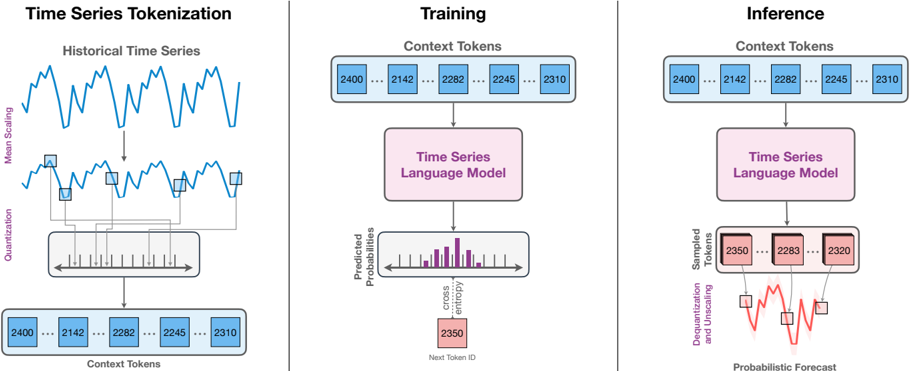
Chronos adapts language-model architectures to probabilistic time series forecasting by scaling and quantizing values into tokens and training T5/GPT-2 models with cross-entropy. Across 42 benchmark datasets, it achieves strong in-domain and zero-shot forecasting, often matching or beating task-specific models.
Key findings
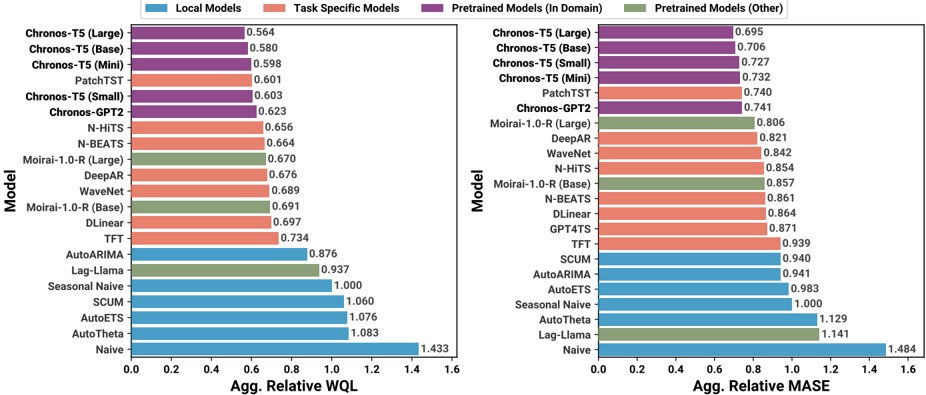
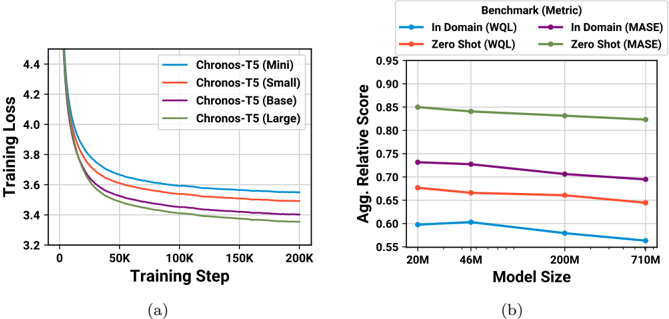
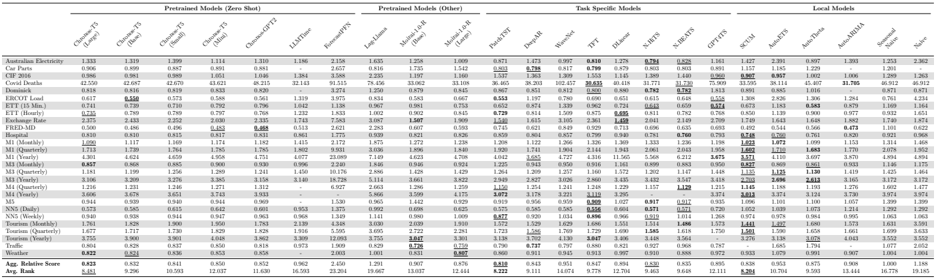
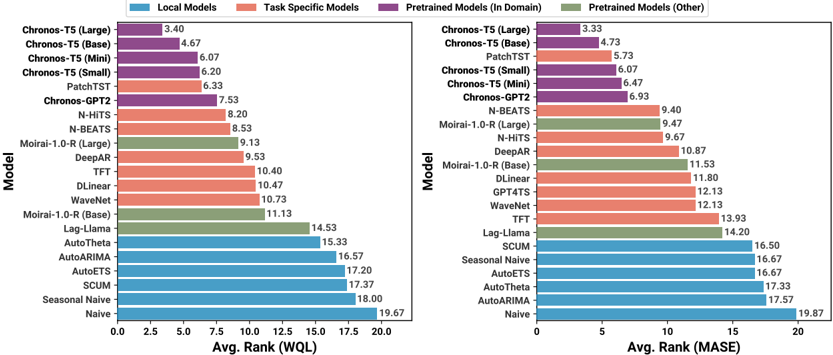
- On in-domain Benchmark I (15 datasets), Chronos-T5 Base/Large obtain the best aggregated relative scores: WQL 0.580/0.564 and MASE 0.706/0.695 versus Seasonal Naive 1.000, outperforming local, task-specific, and other pretrained baselines.
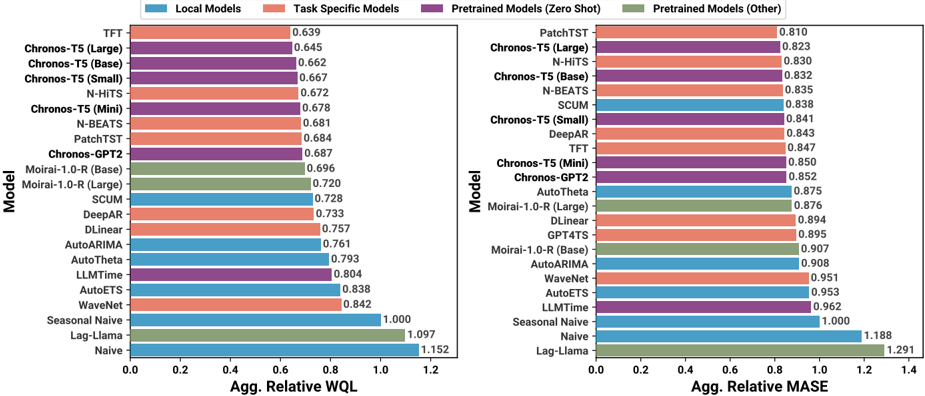
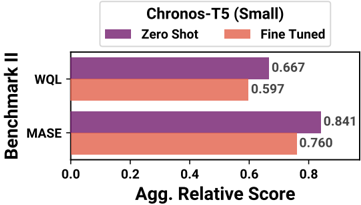
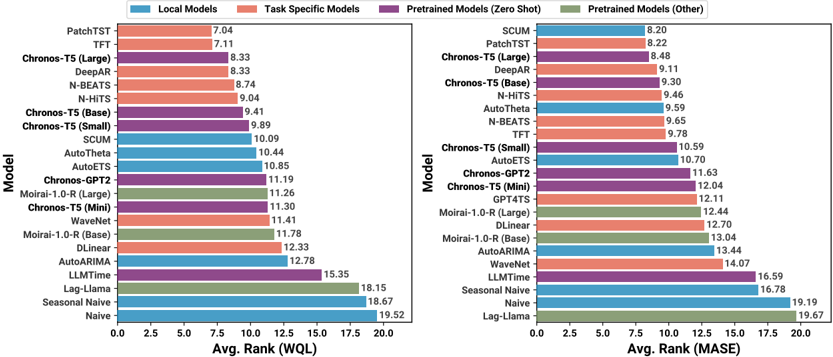
- On zero-shot Benchmark II (27 datasets), Chronos models rank 2nd–4th on WQL and Chronos-T5 Large ranks 2nd on MASE; aggregated relative WQL is 0.645 (Large), 0.662 (Base), 0.667 (Small), 0.678 (Mini), and MASE is 0.823, 0.832, 0.841, 0.850 versus Seasonal Naive 1.000. Fine-tuned Chronos-T5 Small becomes the best model on Benchmark II.
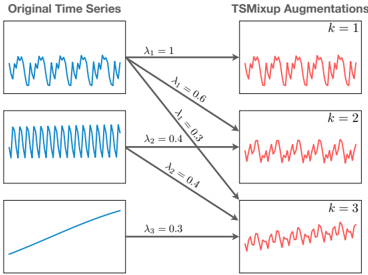
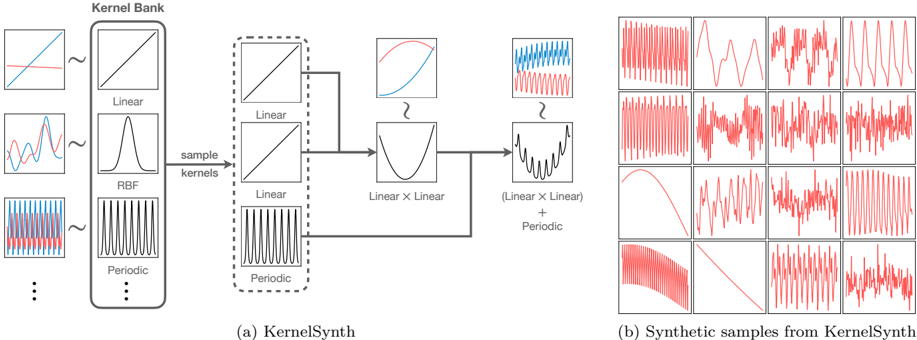
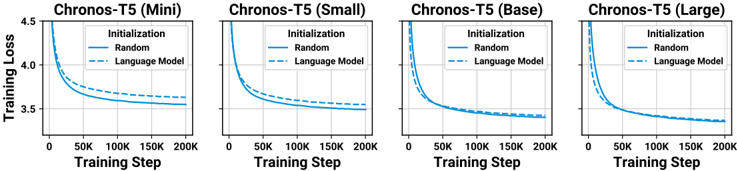
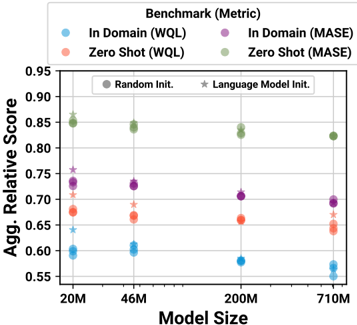
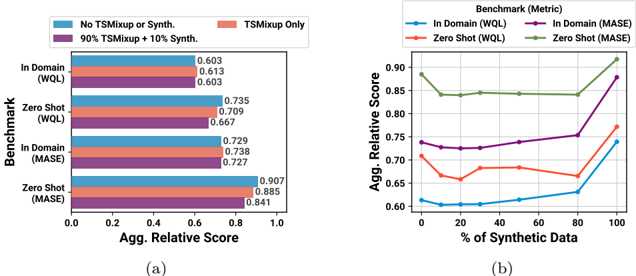
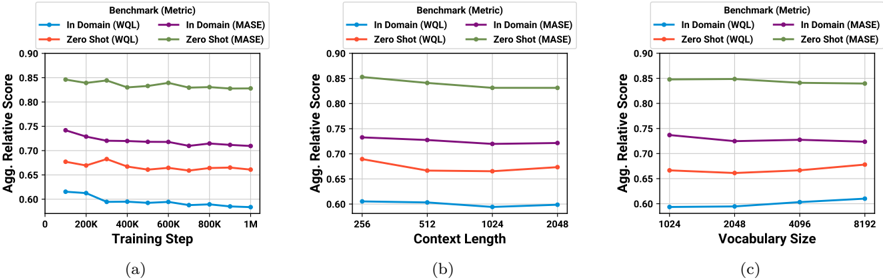
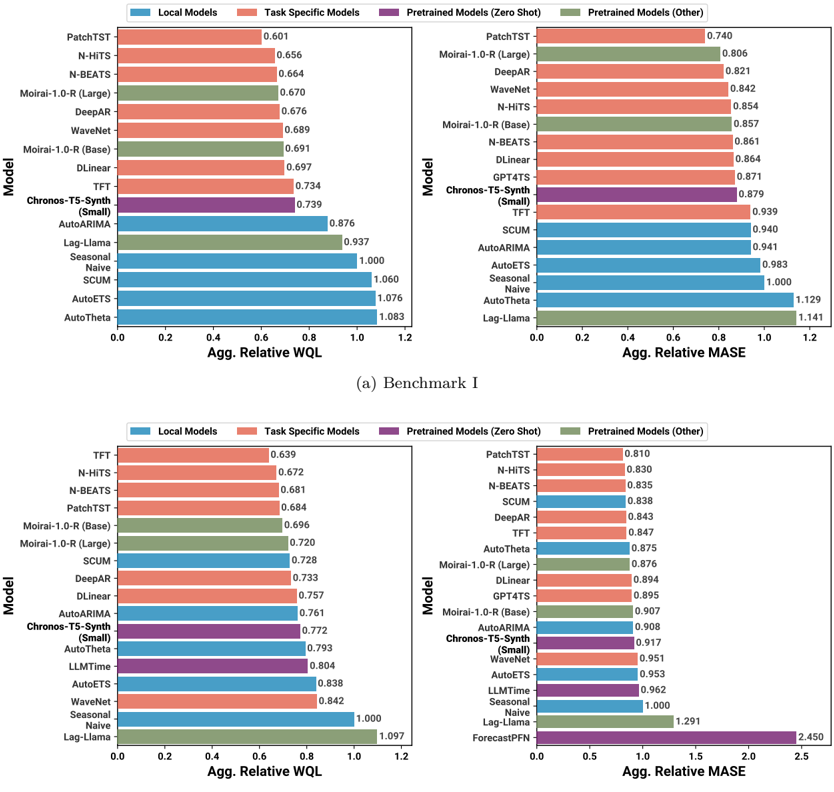
- Ablations show performance improves with model size; language-model-weight initialization offers little/no advantage over random initialization; TSMixup improves zero-shot performance; about 10% KernelSynth synthetic data is best; context length up to 1024 helps; larger vocabulary improves MASE but WQL deteriorates.
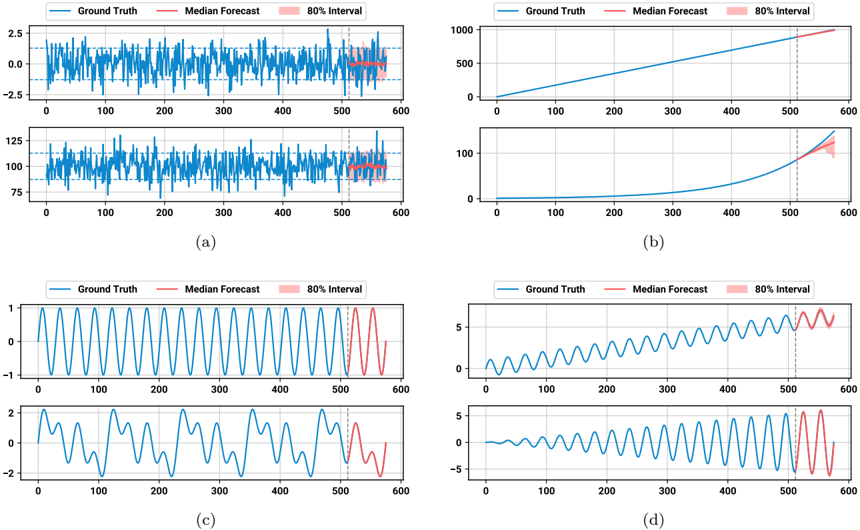
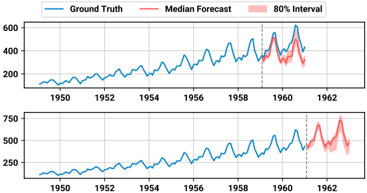
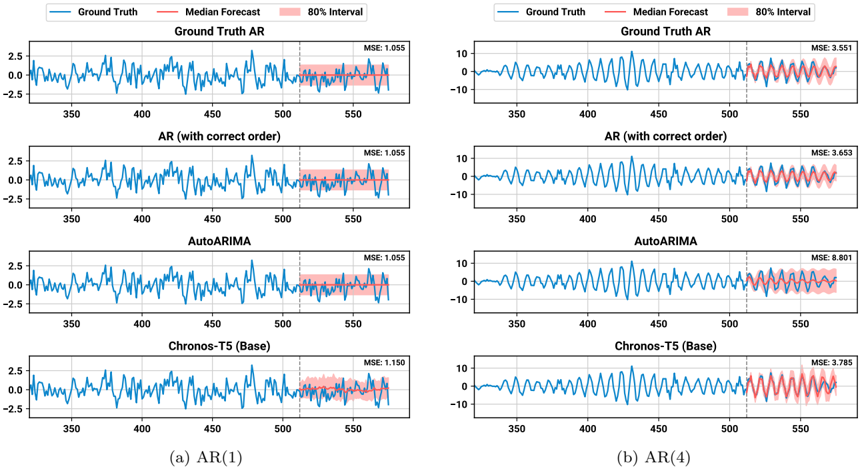
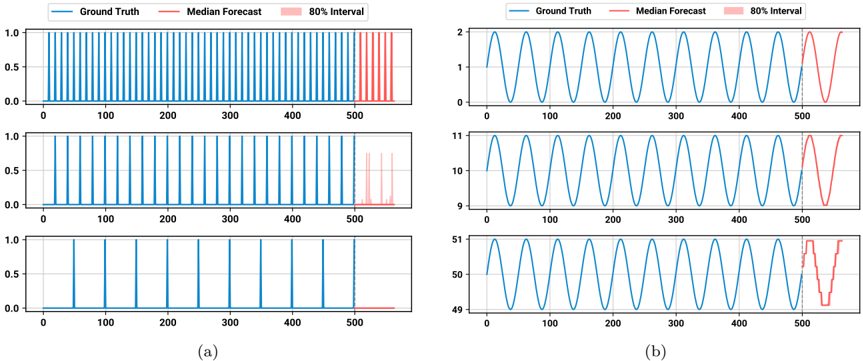
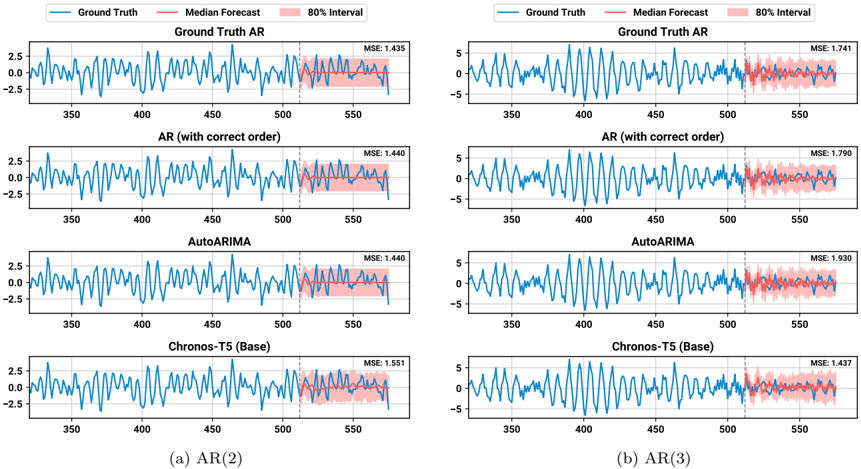
- Qualitatively, Chronos handles Gaussian noise, seasonality, additive/multiplicative trend+seasonality, and AR processes, but struggles with exponential trends and underestimates trend when context is short.
Methods
- Chronos mean-scales time series, uniformly quantizes values into B=4094 bins plus PAD/EOS (V_ts=4096), and trains off-the-shelf transformer language models with categorical cross-entropy; forecasts are produced by autoregressively sampling token paths and dequantizing/unscaling them.
- Training used 55 datasets total: 13 pretraining-only, 15 Benchmark I in-domain, and 27 Benchmark II zero-shot; 28 training datasets comprised about 890K univariate series and approximately 84B observations/tokens. Models included T5 Mini 20M, Small 46M, Base 200M, Large 710M, and GPT-2 90M, trained with 10M TSMixup augmentations plus 1M KernelSynth GP synthetic series, context length 512, prediction length 64, and 200K AdamW steps.
- Evaluation used 42 benchmark datasets with WQL (9 quantiles) and MASE; relative scores versus Seasonal Naive were aggregated by geometric mean and compared against local, task-specific, and pretrained baselines, plus a fine-tuning experiment on Benchmark II.
Limitations
- The paper states tokenization limits: representable values are in [-15s, 15s] where s is the mean absolute scale; small s relative to range causes overflow, while large s relative to variance causes precision loss. It also notes poor exponential-trend forecasts, trend underestimation with short context, and that categorical cross-entropy is not distance-aware; ordinal modeling is left as future work.
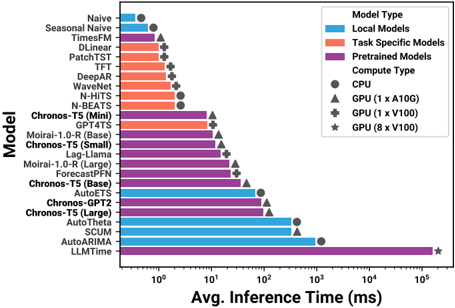
- The paper states scope limits: only univariate, uniformly spaced forecasting is studied; exogenous covariates, multivariate forecasting, and irregular sampling are not handled. Larger models were not explored due to slow inference, inference is slower than task-specific models, evaluation lacks enough high-frequency datasets to study long contexts, and public time series data remain limited.
- Text-evident: the zero-shot comparison may favor Moirai-1.0-R because many Benchmark II datasets were part of its pretraining corpus, as the paper notes; Chronos also ignores time and frequency information by design.
Model-written summary. Check it against the paper before relying on it.
Integrity signals
Registry
Cites
Statistics
Figures

Verification
Claims the paper makes
0 Valid · 4 Not valid · 14 Not checked · 146 Own results and interpretations
A result the paper reports from its own data — it cites no other source for it, so there is none to check. The quote shows it is in the paper.
In the paper
“Between the two baseline pretrained models studied in this experiment, Moirai-1.0-Rclearly outperforms Lag-Llama.”
§ Chronos: Learning the Language of Time Series > 5.5 Main Results
boosted- Asserted: passes — The authors put it forward as true.
- Checkable: passes — It can be checked against evidence.
- Load-bearing: unclear — It is unclear whether the paper’s conclusions depend on it.
- Based: passes — The paper gives a reason why it holds.
A result the paper reports from its own data — it cites no other source for it, so there is none to check. The quote shows it is in the paper.
In the paper
“Unsurprisingly, the training loss improves with the model capacity, as shown in Figure 7a.”
§ Chronos: Learning the Language of Time Series > Model size.
plainstates a cause- Asserted: passes — The authors put it forward as true.
- Checkable: passes — It can be checked against evidence.
- Load-bearing: unclear — It is unclear whether the paper’s conclusions depend on it.
- Based: passes — The paper gives a reason why it holds.
A result the paper reports from its own data — it cites no other source for it, so there is none to check. The quote shows it is in the paper.
In the paper
“Our comprehensive evaluation across 42 datasets establishes Chronos as a benchmark for both in-domain and zero-shot forecasting, surpassing both traditional models and task-specific deep learning approaches.”
§ Chronos: Learning the Language of Time Series > Time Series Tokenization Training Inference
plain- Asserted: passes — The authors put it forward as true.
- Checkable: passes — It can be checked against evidence.
- Load-bearing: passes — The paper’s conclusions depend on it.
- Based: passes — The paper gives a reason why it holds.
A result the paper reports from its own data — it cites no other source for it, so there is none to check. The quote shows it is in the paper.
In the paper
“consistent improvement is observed around the 10% synthetic data proportion.”
§ Chronos: Learning the Language of Time Series > Model size.
plainstates an association- Asserted: passes — The authors put it forward as true.
- Checkable: passes — It can be checked against evidence.
- Load-bearing: unclear — It is unclear whether the paper’s conclusions depend on it.
- Based: passes — The paper gives a reason why it holds.
A result the paper states — it cites no source for it, so there is none to check. The quote shows it is in the paper.
In the paper
“Further increasing the proportion of synthetic data tends to worsen performance.”
§ Chronos: Learning the Language of Time Series > Model size.
hedgedstates a possible cause- Asserted: passes — The authors put it forward as true.
- Checkable: passes — It can be checked against evidence.
- Load-bearing: unclear — It is unclear whether the paper’s conclusions depend on it.
- Based: passes — The paper gives a reason why it holds.
- Rests on an assumption not shown here.
94 more claims
Create a free account to see all 164 claims and to verify the 17 references still open.
- It may state two separate claims as one. 42
- Probably not a substantial claim. 30
Self-check
Percentages, sums and reported differences re-computed from the paper’s own numbers.
Each contradiction between two passages listed here was confirmed by an independent check.
Rated minor: it would not touch a result — a value no result rests on, a p-value that stays on the same side of the significance level, or a conflict that is clerical, resolved elsewhere in the paper, or outside its own findings.
In the paper
§ Chronos: Learning the Language of Time Series > Additional information
“Dominick (Godahewa et al., 2021) contains weekly time series representing the profit of individual stock keeping units from a retailer.”
§ Chronos: Learning the Language of Time Series > Covid Deaths
“Dominick retail 1D 100014 201 296 399 8”
Rated minor: it would not touch a result — a value no result rests on, a p-value that stays on the same side of the significance level, or a conflict that is clerical, resolved elsewhere in the paper, or outside its own findings.
In the paper
§ Chronos: Learning the Language of Time Series > C Baselines
“We considered a total of 17 baseline methods for benchmarking Chronos.”
§ Chronos: Learning the Language of Time Series > Chronos-GPT2 Chronos-T5 (Mini)
“Figure: Naive, SeasonalNaive, AutoETS, Auto-Theta, SCUM, AutoARIMA, DeepAR, TFT, PatchTST, DLinear, WaveNet, N-BEATS, N-HiTS, GPT4TS, Lag-Llama, Moirai-1.evaluationAll the above, LLMTime and ForecastPFN”
Citations
Cites
Exploring the Limits of Transfer Learning with a Unified Text-to-Text Transformer
Raffel, C., Shazeer, N., Roberts, A., Lee, K., Narang, S., Matena, M., Zhou, Y., Li, W., & Liu, P. J. (2019) · arXiv · doi:10.48550/arxiv.1910.10683 · Cited by 31,859
LoRA: Low-Rank Adaptation of Large Language Models
Hu, E. J., Shen, Y., Wallis, P., Allen-Zhu, Z., Li, Y., Wang, S., Wang, L., & Chen, W. (2021) · arXiv · doi:10.48550/arxiv.2106.09685 · Cited by 13,453
LightGBM: A Highly Efficient Gradient Boosting Decision Tree
(2017) · HAL · Cited by 10,512
Lewis, M., Liu, Y., Goyal, N., Ghazvininejad, M., Mohamed, A., Levy, O., Stoyanov, V., & Zettlemoyer, L. (2020) · Proceedings of the 58th Annual Meeting of the Association for Computational Linguistics · doi:10.18653/v1/2020.acl-main.703 · Cited by 8,821
Lewis, M., Liu, Y., Goyal, N., Ghazvininejad, M., Mohamed, A., Levy, O., Stoyanov, V., & Zettlemoyer, L. (2019) · arXiv · doi:10.48550/arxiv.1910.13461 · Cited by 8,816
Transformers: State-of-the-Art Natural Language Processing
Wolf, T., Debut, L., Sanh, V., Chaumond, J., Delangue, C., Moi, A., Cistac, P., Rault, T., Louf, R., Funtowicz, M., et al. (2020) · Proceedings of the 2020 Conference on Empirical Methods in Natural Language Processing: System Demonstrations · doi:10.18653/v1/2020.emnlp-demos.6 · Cited by 8,741
Informer: Beyond Efficient Transformer for Long Sequence Time-Series Forecasting
Zhou, H., Zhang, S., Peng, J., Zhang, S., Li, J., Xiong, H., & Zhang, W. (2021) · Proceedings of the AAAI Conference on Artificial Intelligence · doi:10.1609/aaai.v35i12.17325 · Cited by 7,752
mixup: Beyond Empirical Risk Minimization
Zhang, H., Cisse, M., Dauphin, Y. N., & Lopez-Paz, D. (2017) · arXiv · doi:10.48550/arxiv.1710.09412 · Cited by 5,831
Strictly Proper Scoring Rules, Prediction, and Estimation
Gneiting, T., & Raftery, A. E. (2007) · Journal of the American Statistical Association · doi:10.1198/016214506000001437 · Cited by 5,793
Another look at measures of forecast accuracy
Hyndman, R. J., & Koehler, A. B. (2006) · International Journal of Forecasting · doi:10.1016/j.ijforecast.2006.03.001 · Cited by 5,757
Research works printed but not linked: 8
- George Athanasopoulos, Rob J. Hyndman, Haiyan Song, and Doris C. Wu. The tourism forecasting compe- tition. International Journal of Forecasting, 27(3):822-844, 2011.
- Tom B. Brown, Benjamin Mann, Nick Ryder, Melanie Subbiah, Jared Kaplan, Prafulla Dhariwal, Arvind Neelakantan, Pranav Shyam, Girish Sastry, Amanda Askell, Sandhini Agarwal, Ariel Herbert-Voss, Gretchen Krueger, Tom Henighan, Rewon Child, Aditya Ramesh, Daniel M. Ziegler, Jeffrey Wu, Clemens Winter, Christopher Hesse, Mark Chen, Eric Sigler, Mateusz Litwin, Scott Gray, Benjamin Chess, Jack Clark, Christopher Berner, Sam McCandlish, Alec Radford, Ilya Sutskever, and Dario Amodei. Language models are few-shot learners. In Advances in Neural Information Processing Systems, 2020. 2, 3, 4
- Rob Hyndman, Anne B Koehler, J Keith Ord, and Ralph D Snyder. Forecasting with exponential smoothing: the state space approach. Springer Science & Business Media, 2008. 3, 9
- Alec Radford, Jeffrey Wu, Rewon Child, David Luan, Dario Amodei, Ilya Sutskever, et al. Language models are unsupervised multitask learners. OpenAI blog, 1(8):9, 2019. 4, 6
- Yaniv Romano, Evan Patterson, and Emmanuel Candes. Conformalized quantile regression. Advances in neural information processing systems, 32, 2019.
- Kai Ming Ting and Ian H Witten. Stacking bagged and dagged models. In Proceedings of the Fourteenth International Conference on Machine Learning, 1997. 20
- Ashish Vaswani, Noam Shazeer, Niki Parmar, Jakob Uszkoreit, Llion Jones, Aidan N. Gomez, Lukasz Kaiser, and Illia Polosukhin. Attention Is All You Need. In Advances in Neural Information Processing Systems, 2017.
- Yun Zhou, Liwen You, Wenzhen Zhu, and Panpan Xu. Improving time series forecasting with mixup data augmentation. In ECML PKDD 2023 International Workshop on Machine Learning for Irregular Time Series, 2023b. 7
Cited by
Items 401–500 of 2,048
TimeSAE: Causal Sparse Decoding for Faithful Explanations of Black-Box Time Series Models
Oublal, K., Bouniot, Q., Gan, Q., Clémençon, S., & Akata, Z. (2026) · International Conference on Machine Learning · doi:10.48550/arxiv.2601.09776 · Cited by 8
“Chronos Ansari et al. (2024) introduces a large pretrained time series model leveraging transformer architectures pretrained on massive multivariate time series datasets across domains such as energy, finance, and healthcare.”
TimeSeriesExamAgent: Creating Time Series Reasoning Benchmarks at Scale
Gwiazda, M., Cai, Y., Goswami, M., Choudhry, A., & Dubrawski, A. W. (2026) · International Conference on Learning Representations · doi:10.48550/arxiv.2604.10291 · Cited by 8
“Recent studies have successfully applied Large Language Models (LLMs) to time series analysis tasks including forecasting, anomaly detection, and classification [1, 13, 8, 19, 50, 51].”
Transformers and Their Roles as Time Series Foundation ModelsPreprint
Wu, D., He, Y., Cao, Y. W., Fan, J., & Liu, H. (2025) · arXiv · doi:10.48550/arxiv.2502.03383 · Cited by 8
UniCast: A Unified Framework for Instance-Conditioned Multimodal Time-Series ForecastingPreprint
Park, S., Han, S. C., & Hovy, E. H. (2025) · arXiv · doi:10.48550/arxiv.2508.11954 · Cited by 8
Dange, A., & Sarawagi, S. (2025) · ACM International Conference on Information and Knowledge Management (CIKM) · doi:10.1145/3746252.3761272 · Cited by 8
“Chronos [2] utilizes T5 architecture [22] and quantizes continuous time series values into discrete tokens us-ing uniform binning.”
Tailored forecasting from short time series via meta-learning
Norton, D. A., Ott, E., Pomerance, A., Hunt, B. R., & Girvan, M. (2026) · Science Advances · doi:10.1126/sciadv.ady7216 · Cited by 8
Toward World Modeling of Physiological Signals with Chaos-Theoretic Balancing and Latent DynamicsPreprint
Luo, Y., Chen, X., Chen, Y., Zhang, L., Islam, M. M., Zhao, S., Kotanko, P., Dasgupta, S., Campbell, A., Malhotra, R., et al. (2026) · arXiv · doi:10.48550/arxiv.2605.15465 · Cited by 8
Slim attention: cut your context memory in half without loss -- K-cache is all you need for MHAPreprint
Graef, N., Zahiri, K., & Wasielewski, A. (2025) · arXiv · doi:10.48550/arxiv.2503.05840 · Cited by 8
Wang, L., & Zhang, B. (2026) · arXiv · doi:10.48550/arxiv.2601.06371 · Cited by 8
Training neural networks on mechanistic simulations improves scientific inference
Dudley, C., Magdaleno, R., Harding, C., & Eisenberg, M. C. (2026) · Scientific Reports · doi:10.1038/s41598-026-64106-6 · Cited by 8
TrustEnergy: A Unified Framework for Accurate and Reliable User-level Energy Usage Prediction
Yu, D., Xu, R., Zhuang, D., Bu, Y., Wang, S., & Wang, G. (2026) · Proceedings of the AAAI Conference on Artificial Intelligence · doi:10.1609/aaai.v40i46.41307 · Cited by 8
SynTSBench: Rethinking Temporal Pattern Learning in Deep Learning Models for Time Series
Tan, Q., Chen, Y., Li, M., Gu, R., Su, Y., & Zhang, X.-P. (. (2025) · neural information processing systems · doi:10.52202/085713-4860 · Cited by 8
Self-citationSartipi, A., Fernández, J. D., Menci, S. P., & Magitteri, A. (2025) · arXiv · doi:10.48550/arxiv.2501.07276 · Cited by 8
HGTS-Former: Hierarchical HyperGraph Transformer for Multivariate Time Series AnalysisPreprint
Si, H., Wang, X., Zhang, F., Zhou, X., Sun, D., Lyu, W., Yang, Q., & Tang, J. L. (2025) · arXiv · doi:10.48550/arxiv.2508.02411 · Cited by 8
“Afterwards, the field has seen a shift towards pre-trained large models [29]–[31], with decoder-only Transformers gaining attention.”
Alnegheimish, S., He, Z., Reimherr, M. L., Chandrayan, A., Pradhan, A., & D'Angelo, L. (2025) · International Conference on Artificial Intelligence and Statistics · doi:10.48550/arxiv.2504.15225 · Cited by 8
Zero-shot Safety Prediction for Autonomous Robots with Foundation World ModelsPreprint
Mao, Z., Dai, S., Geng, Y., & Ruchkin, I. (2024) · arXiv · doi:10.48550/arxiv.2404.00462 · Cited by 8
TS-Memory: Plug-and-Play Memory for Time Series Foundation ModelsPreprint
Lyu, S., Zhong, S., Chen, T., Ruan, W., Liu, Q., Lv, T., Wen, Q., Wong, R. C.-W., & Liang, Y. (2026) · arXiv · doi:10.48550/arxiv.2602.11550 · Cited by 8
TimeSqueeze: Dynamic Patching for Efficient Time Series ForecastingPreprint
Ankireddy, S. K., Seleznev, N. V., Nguyen, N. H., Wu, Y., Kumar, S., Huang, F., & Bruss, C. B. (2026) · arXiv · doi:10.48550/arxiv.2603.11352 · Cited by 8
“Subsequent foundation models, including TimesFM (Das et al., 2024), Moment (Goswami et al., 2024), Moirai (Woo et al., 2024), and Timer-XL (Liu et al., 2024), have adopted this paradigm, collectively demonstrating that patching enables more efficient training and inference.”
InfluentialSuper-Linear: A Lightweight Pretrained Mixture of Linear Experts for Time Series Forecasting
Nochumsohn, L., Marshanski, R., Zisling, H., & Azencot, O. (2026) · Transactions on machine learning research · doi:10.48550/arxiv.2509.15105 · Cited by 8
“Large pretrained models such as Timer-XL, TimeMoE, and TimesFM (Liu et al., 2024c; Shi et al., 2024; Das et al., 2024) employ transformer-based backbones, input patching, and masked pretraining to achieve strong zero-shot performance across domains.”
InfluentialForecasting Time Series with LLMs via Patch-Based Prompting and DecompositionPreprint
Bumb, M., Vemulapalli, A., Jella, S. H. V. P., Gupta, A., La, A., Rossi, R. A., Chen, H., Dernoncourt, F., Ahmed, N. K., & Wang, Y. (2025) · arXiv · doi:10.48550/arxiv.2506.12953 · Cited by 8
Self-citationTimePoint: Accelerated Time Series Alignment via Self-Supervised Keypoint and Descriptor Learning
Weber, R. S., Ishay, S. B., Lavrinenko, A., Finder, S. E., & Freifeld, O. (2025) · International Conference on Machine Learning · doi:10.48550/arxiv.2505.23475 · Cited by 8
Lu, J. (2025) · International Conference on Digital Economy and Computer Science (DECS) · doi:10.1145/3785706.3785728 · Cited by 8
Zhang, J., Zhang, Z., Zheng, S., Wen, X., Li, J., & Bian, J. (2025) · arXiv · doi:10.48550/arxiv.2505.19397 · Cited by 8
Spectral Predictability as a Fast Reliability Indicator for Time Series Forecasting Model SelectionPreprint
Wang, O., Quan, P., Yang, K., & Srivastava, M. B. (2025) · arXiv · doi:10.48550/arxiv.2511.08884 · Cited by 8
NetBurst: Event-Centric Forecasting of Bursty, Intermittent Time SeriesPreprint
Guthula, S., Daneshamooz, J., Fleming, C., Wu, K. J., Willinger, W., & Gupta, A. (2025) · arXiv · doi:10.48550/arxiv.2510.22397 · Cited by 8
“Foundation models—Chronos [4], Lag-Llama [58], S2P2 [12], and others [18,26,42,71]—share three structural limitations: uniform tokenization erases tails, fixed 512-token contexts waste capacity on sparse traces, and instance normalization [41] attenuates heavy-tailed structure.”
InfluentialTempusBench: An Evaluation Framework for Time-Series ForecastingPreprint
Goktas, D., Riaño‐Briceño, G., Tekawade, O., Abdullah, A., Jamal, M. Y., Shaik, V., Singh, A., Nair, A., Shen, C., de Lucio, B., et al. (2026) · arXiv · doi:10.48550/arxiv.2604.11529 · Cited by 8
“[4] • Input: Accepts a univariate time series context window.”
Not All Retrievals are Useful: Cross-Attention for Input-Aware RAG in Time Series ForecastingPreprint
Lee, S., Lee, J., Seo, J., Yoo, S., Kim, M., Lim, T. Y., Kang, D., Choi, H., Lee, S., & Ahn, W. (2026) · arXiv · doi:10.48550/arxiv.2603.14709 · Cited by 8
ProbTS: Benchmarking Point and Distributional Forecasting across Diverse Prediction HorizonsPreprint
Zhang, J., Wen, X., Zhang, Z., Zheng, S., Li, J., & Bian, J. (2023) · arXiv · doi:10.48550/arxiv.2310.07446 · Cited by 8
Not All Data are Good Labels: On the Self-supervised Labeling for Time Series Forecasting
Yang, Y., Zhang, D., Liang, Y., Lu, H. C., Chen, G., & Li, H. (2025) · neural information processing systems · doi:10.52202/085713-2802 · Cited by 8
Enhancing the Prediction of Dam Deformations: A Novel Data-Driven Approach
Ziemer, J., Stein, G., Wicker, C., Jänichen, J., Klöpper, D., Last, K., Denzler, J., Schmullius, C., Shadaydeh, M., & Dubois, C. (2025) · Remote Sensing · doi:10.3390/rs17061026 · Cited by 8
Liang, R., Deng, Y., Xie, D., He, F., & Wang, D. (2024) · arXiv · doi:10.48550/arxiv.2412.17285 · Cited by 8
Select, then Balance: Exploring Exogenous Variable Modeling of Spatio-Temporal ForecastingPreprint
Chen, W., Wu, Y., Zhu, Y., Hao, X., Wang, S., Zhou, X., & Liang, Y. (2025) · arXiv · doi:10.48550/arxiv.2509.05779 · Cited by 8
“We attribute this instability to the inherent design of the underlying Chronos-type foundation models (Ansari et al., 2024).”
Machine Learning-Enhanced Pairs Trading
Hadad, E., Hodarkar, S., Lemeneh, B., & Shasha, D. E. (2024) · Forecasting · doi:10.3390/forecast6020024 · Cited by 7
Exploring the application of Time Series Foundation Models to network monitoring tasks
Wehner, N., Casas, P., Dietz, K., Geißler, S., Hoßfeld, T., & Seufert, M. (2025) · Computer Networks · doi:10.1016/j.comnet.2025.111395 · Cited by 7
Guo, W., Jin, X., Jiang, H., Xia, Y., Zhu, J., Qu, B., Zhong, W., Jiang, L., & Lin, X. (2026) · Renewable and Sustainable Energy Reviews · doi:10.1016/j.rser.2026.116928 · Cited by 7
A survey On large language models for medical time series
Liu, X., Zhou, F., Xiao, H., Li, Z., Liu, S., & Qian, L. (2026) · Expert Systems with Applications · doi:10.1016/j.eswa.2026.131364 · Cited by 7
Protein evolution as a complex system
Gall, B., Pulsford, S. B., Matthews, D. S., Spence, M. A., Kaczmarski, J. A., Chen, J. Z., Sandhu, M., Stone, E. A., Nichols, J., & Jackson, C. J. (2025) · Nature Chemical Biology · doi:10.1038/s41589-025-01977-2 · Cited by 7
Fernandez-de-Retana, M., Matanzas-de-Luis, P., Peña, J., & Almeida, A. (2025) · Neuroscience · doi:10.1016/j.neuroscience.2025.10.004 · Cited by 7
PRESAGE: Uncertainty-Aware Predictive Elastic Scheduling for Cloud Analytics and GenAI Inference
Wang, Y., Zou, X., Zhou, L., Wei, K., & Rhee, M. (2026) · IEEE Access · doi:10.1109/access.2026.3734498 · Cited by 7
Self-citationUnify and Anchor: A Context-Aware Transformer for Cross-Domain Time Series ForecastingPreprint
Hong, X., Zhang, J., Li, W., Lu, S., & Li, J. (2025) · arXiv · doi:10.48550/arxiv.2503.01157 · Cited by 7
Diversified Scaling Inference in Time Series Foundation ModelsPreprint
Hua, R., Liu, Z., Zhang, K., & Yang, Y. (2026) · arXiv · doi:10.48550/arxiv.2601.17376 · Cited by 7
“The recent advancement of TSFMs have demonstrated the efficacy of large-scale pre-training for cross-domain temporal representation learning (Li et al., 2025; Ansari et al., 2024; Woo et al., 2024).”
InfluentialUrbanFM: Scaling Urban Spatio-Temporal Foundation Models
Chen, W., Wu, Y., Chen, J., Zhou, X., & Liang, Y. (2026) · ACM SIGKDD Conference on Knowledge Discovery and Data Mining (KDD) · doi:10.1145/3770855.3819055 · Cited by 7
“We believe this work marks a pivotal paradigm shift, offering a blueprint for future research in large-scale urban spatio-temporal intelligence and bringing us closer to a universal understanding of complex city dynamics.”
Gong, P., Eldele, E., Wu, M., Chen, Z., Li, X., & Zhang, D. (2026) · IEEE Transactions on Neural Networks and Learning Systems · doi:10.1109/tnnls.2026.3673975 · Cited by 7
Augur: Modeling Covariate Causal Associations in Time Series via Large Language Models
Cui, Z., Wang, B., Liu, Q., Wang, Y., Zhou, Z., Liang, Y., & Wang, Y. (2026) · Proceedings of the conference - Association for Computational Linguistics. Meeting · doi:10.18653/v1/2026.acl-long.32 · Cited by 7
Self-citationTime-Series Foundation Models for ISP Traffic Forecasting
Liu, F., Farkiani, B., & Crowley, P. (2026) · IEEE/IFIP Network Operations and Management Symposium (NOMS) · doi:10.1109/noms69089.2026.11668147 · Cited by 7
“Furthermore, the majority of existing time-series foundation models, such as TimesFM [8], Chronos [9], and TTM [10], are pretrained on large-scale datasets drawn primarily from non-networking domains, including energy consumption, financial transactions, and environmental measurements.”
Reservoir computing for system identification and model predictive control
Williams, J. P., Kutz, J. N., & Manohar, K. (2026) · Neural Networks · doi:10.1016/j.neunet.2026.109031 · Cited by 7
TSFMAudit: Data Contamination Auditing in Forecasting Time Series Foundation ModelsPreprint
Li, H., Xie, S., Shen, L., Li, Z., Chen, M., Zhang, X., Fu, H., Sun, J., Ren, X., & Liu, C. (2026) · arXiv · doi:10.48550/arxiv.2605.26161 · Cited by 7
“Official sources describe training on large collections of public datasets together with synthetic data [Ansari et al., 2024].”
Self-citationZero-shot forecasting of streamflow using time series foundation models: are we there yet?
Sun, A. Y., & Sun, A. A. (2026) · Machine Learning Earth · doi:10.1088/3049-4753/ae4982 · Cited by 7
Devireddy, A., & Huang, S. (2025) · arXiv · doi:10.48550/arxiv.2508.21273 · Cited by 7
“Similarly, Chronos tokenizes time-series values via quantization into a fixed vocabulary, treating forecasting as a pure language modeling problem within a decoder-only framework [Ansari et al., 2024].”
Evaluating Time Series Foundation Models on Noisy Periodic Time SeriesPreprint
Gupta, S. D. (2025) · arXiv · doi:10.48550/arxiv.2501.00889 · Cited by 7
ChatMacro: Evaluating Inflation Forecasts of Generative AI
Alam, M. J., Boyle, S., Francisco, F. R. B. O. S., Li, H., Francisco, F. R. B. O. S., & Sekhposyan, T. (2026) · Federal Reserve Bank of San Francisco, Working Paper Series · doi:10.24148/wp2026-04 · Cited by 7
“…Models (TSFMs) and Time Series Language Models (TSLMs), such as Google’s TimesFM (Das et al., 2024), Salesforce’s Moirari (Liu et al., 2024), and Amazon’s Chronos (Ansari et al., 2024), have gained traction and are built on pre-trained models similar to those used in large language models (LLMs).”
Sonnet: Spectral Operator Neural Network for Multivariable Time Series ForecastingPreprint
Shu, Y., & Lampos, V. (2025) · AAAI Publications (The Association for the Advancement of Artificial Intelligence (AAAI)) · doi:10.48550/arxiv.2505.15312 · Cited by 7
Impermanent: A Live Benchmark for Temporal Generalization in Time Series ForecastingPreprint
Garza, A., Rosillo, R., Mendoza-Smith, R., Salinas, D., Williams, A., Ashok, A., Goswami, M., & Juárez, J. M. (2026) · arXiv · doi:10.48550/arxiv.2603.08707 · Cited by 7
Phase-driven Domain Generalizable Learning for Nonstationary Time Series
Mohapatra, P., Wang, L., & Zhu, Q. (2025) · Transactions on machine learning research · doi:10.48550/arxiv.2402.05960 · Cited by 7
TwinWeaver: An LLM-Based Foundation Model Framework for Pan-Cancer Digital Twins
Makarov, N., Bordukova, M., von Voithenberg, L. V., Pivel-Villanueva, E., Mielke, S. J., Wickes, J., Wang, H., Ma, M. D., Choi, K., Cho, K., et al. (2026) · International Conference on Machine Learning · doi:10.48550/arxiv.2601.20906 · Cited by 7
“TiDE, Chronos and Chronos Bolt are all implemented in AutoGluon (Erickson et al., 2020).”
InfluentialSelf-citationSynthetic Series-Symbol Data Generation for Time Series Foundation Models
Wang, W., Wu, K., Li, Y., Wang, D., & Zhang, X. (2025) · neural information processing systems · doi:10.52202/085713-0352 · Cited by 7
Self-citationKairosAgent: Agentic Time Series Forecasting with Fused Semantic Reasoning
Feng, K., Shan, Z., Fang, Y., Tan, Y., Lu, S., Gu, S., Lu, X., Ma, L., & Ren, K. (2026) · Conference on Empirical Methods in Natural Language Processing (EMNLP) · doi:10.18653/2026.emnlp-main.1343 · Cited by 7
Foundation Models for Demand Forecasting via Dual-Strategy EnsemblingPreprint
Yang, W., Cao, D., & Liu, Y. (2025) · arXiv · doi:10.48550/arxiv.2507.22053 · Cited by 7
Zhu, X., Carpentier, L., & Verbeke, M. (2026) · International Conference on Learning Representations · Cited by 7
Building Bridges between Regression, Clustering, and ClassificationPreprint
Stewart, L., Bach, F., & Berthet, Q. (2025) · arXiv · doi:10.48550/arxiv.2502.02996 · Cited by 7
Learning Reconfigurable Representations for Multimodal Federated Learning with Missing Data
Nguyen, D., Hoang, N., Huynh, T. T., Nguyen, Q. V. H., & Nguyen, P. L. (2025) · neural information processing systems · doi:10.52202/085713-0968 · Cited by 7
PINFDiT: Energy-Based Physics-Informed Diffusion Transformers for General-purpose Time Series Tasks
Cao, D., Ye, W., Zhang, Y., Griesemer, S., & Liu, Y. (2026) · International Conference on Learning Representations · Cited by 7
Vehicle Rebalancing Under Adherence UncertaintyPreprint
Brar, A. S., Su, R., Cassandras, C. G., Ng, M., Li, Y., & Zardini, G. (2024) · arXiv · doi:10.48550/arxiv.2412.16632 · Cited by 7
Phien, N. N. (2026) · IEEE Access · doi:10.1109/access.2026.3706582 · Cited by 7
Are Time Series Foundation Models Ready for Vital Sign Forecasting in Healthcare?
Gu, X., Liu, Y., Mohsin, Z., Bedford, J., Thakur, A., Watkinson, P., Clifton, L., Zhu, T., & Clifton, D. (2025) · Proceedings of Machine Learning Research · Cited by 7
Time Series Forecastability MeasuresPreprint
Wang, R., Klee, S., & Roos, A. (2025) · arXiv · doi:10.48550/arxiv.2507.13556 · Cited by 7
Scaling Wearable Foundation Models
Narayanswamy, G., Liu, X., Ayush, K., Yang, Y., Xu, X., Liao, S., Garrison, J., Tailor, S., Sunshine, J., Liu, Y., et al. (2024) · arXiv · doi:10.48550/arxiv.2410.13638 · Cited by 6
Zong, Y., Jia, R., Li, K., Xue, D., Zhang, L., & He, D. (2026) · Neural Networks · doi:10.1016/j.neunet.2026.109055 · Cited by 6
Ding, S., Cai, Z., Wu, Y., Zhang, H., & Shen, X. (2024) · Knowledge-Based Systems · doi:10.1016/j.knosys.2024.112591 · Cited by 6
What If TSF: Evaluating Scenario-Guided Multimodal Time Series ForecastingPreprint
Jang, J., Jin, H., Park, H., Chae, K., & Kim, T. (2026) · arXiv · doi:10.48550/arxiv.2601.08509 · Cited by 6
Zeus: Towards Tuning-Free Foundation Model for Time Series Analysis
Fu, Y., Shao, Z., Yu, C. S., Li, Y., Xu, Y., Cheng, X., & Wang, F. (2026) · International Conference on Machine Learning · doi:10.48550/arxiv.2607.01918 · Cited by 6
“The real-world data are mainly sourced from the Chronos datasets (Ansari et al., 2024) and the GiftEvalPretrain datasets (Aksu et al., 2024).”
InfluentialDigital twin enabled robot collision detection using time series forecasting
Kalach, F. E., Farahani, M. A., Samaha, P., Wuest, T., & Harik, R. (2026) · Journal of Intelligent Manufacturing · doi:10.1007/s10845-026-02803-9 · Cited by 6
LLM4cast: Repurposed LLM for Viral Disease Forecasting
Saeed, F., Aldosari, M., Arpinar, I. B., & Miller, J. A. (2024) · IEEE International Conference on Big Data (BigData) · doi:10.1109/bigdata62323.2024.10826009 · Cited by 6
GTM: A General Time-series Model for Enhanced Representation Learning of Time-Series Data
He, C., Huang, X., Jiang, G., Li, Z., Lian, D., Hong, X., Chen, E., Liang, X., Zheng, Z., & Lee, P. P. C. (2026) · International Conference on Learning Representations · doi:10.48550/arxiv.2502.03264 · Cited by 6
Bio-Inspired Self-Supervised Learning for Wrist-worn Accelerometer Data
Tarale, P., Chu, K., Varghese, A., Liu, K.-C., Xu, M. A., Iyyer, M., & Lee, S. I. (2026) · International Conference on Machine Learning · doi:10.48550/arxiv.2603.10961 · Cited by 6
Deep learning foundation and pattern models: Challenges in hydrological time series
He, J., Chen, Y.-J., Jafari, A., Idamekorala, A., & Fox, G. (2025) · The International Journal of High Performance Computing Applications · doi:10.1177/10943420251380008 · Cited by 6
Tong, S., Liu, H., Guo, R., Zhang, L., Wang, W., Liu, D., & Zhang, Y. M. (2026) · Journal of Process Control · doi:10.1016/j.jprocont.2026.103660 · Cited by 6
Shan, S., Sreeram, V., Li, C., Dou, W., Wang, K., Zhang, K., & Wei, H. (2025) · Journal of Renewable and Sustainable Energy · doi:10.1063/5.0254162 · Cited by 6
DANet: A RAG-inspired Dual Attention Model for Few-shot Time Series Prediction
Wen, Z., Hu, H., Fang, N., Qian, S., & Cao, J. (2025) · ACM International Conference on Information and Knowledge Management (CIKM) · doi:10.1145/3746252.3761012 · Cited by 6
Time to Embed: Unlocking Foundation Models for Time Series with Channel DescriptionsPreprint
Dutta, U., Pakazad, S. K., & Ohlsson, H. (2025) · arXiv · doi:10.48550/arxiv.2505.14543 · Cited by 6
Adaptive Conformal Anomaly Detection with Time Series Foundation Models for Signal Monitoring
Gil, N. M., O’Donncha, F., Gifford, W. M., Zhou, N., Patel, D., & Vaculín, R. (2026) · International Conference on Learning Representations · doi:10.48550/arxiv.2604.20122 · Cited by 6
“We integrate W 1 -ACAS with three pre-trained TSFMs: Tiny Time Mix-ers (TTM) (Ekambaram et al., 2024), Chronos-Bolt-Small (Chronos) (Ansari et al., 2024), and TiRex (Auer et al., 2025).”
Koval, R., Andrews, N., & Yan, X. (2025) · International Joint Conference on Natural Language Processing and Conference of the Asia-Pacific Chapter of the Association for Computational Linguistics (IJCNLP-AACL) · doi:10.18653/v1/2025.ijcnlp-long.54 · Cited by 6
Towards Transparent Time Series Analysis: Exploring Methods and Enhancing Interpretability
Park, Y., Tong, A., SeHyun, L. E. E., Seong, J., Xie, Q., & Choi, J. (2026) · ACM Computing Surveys · doi:10.1145/3794839 · Cited by 6
Toward a user-centric Kubernetes-based architecture for green cloud computing
Zanotto, M., Vicentini, L., Vreto, R., Lumpp, F., Braga, D., & Fiore, S. (2026) · Future Generation Computer Systems · doi:10.1016/j.future.2026.108749 · Cited by 6
Heterogeneous Scientific Foundation Model CollaborationPreprint
Li, Z., Zou, J., Fang, F., Ning, X., Ai, M., Wei, T., Chen, S., Yang, X., & He, J. (2026) · arXiv · doi:10.48550/arxiv.2604.27351 · Cited by 6
Towards Long-Context Time Series Foundation ModelsPreprint
Żukowska, N., Goswami, M., Wiliński, M., Potosnak, W., & Dubrawski, A. W. (2024) · arXiv · doi:10.48550/arxiv.2409.13530 · Cited by 6
März, A., & Rasul, K. (2026) · International Journal of Forecasting · doi:10.1016/j.ijforecast.2026.09.004 · Cited by 6
LEAF: Large Language Diffusion Model for Time Series Forecasting
Pei, Y., Ren, T., Wang, Y., Sun, Z., Ju, W., Chen, C., Hua, X., & Luo, X. (2025) · Findings of the Association for Computational Linguistics: EMNLP (Findings of EMNLP) · doi:10.18653/v1/2025.findings-emnlp.58 · Cited by 6
Self-citationConTSG-Bench: A Unified Benchmark for Conditional Time Series Generation
Lan, S., Gu, S., Xiong, Z., & Ren, K. (2026) · International Conference on Machine Learning · doi:10.48550/arxiv.2603.04767 · Cited by 6
FinSTaR: Towards Financial Reasoning with Time Series Reasoning Models
Lee, S., Seo, J., Lee, J., Yoo, S., Kim, M., Lim, T. Y., Kang, D., Choi, H., Lee, S., & Ahn, W. (2026) · Conference on Empirical Methods in Natural Language Processing (EMNLP) · doi:10.18653/2026.emnlp-industry.35 · Cited by 6
Lakkaraju, K., Kaur, R., Zehtabi, P., Patra, S., Zeng, Z., Valluru, S. L., Srivastava, B., & Valtorta, M. (2025) · arXiv · doi:10.48550/arxiv.2502.12226 · Cited by 6
TimeClaw: A Time-Series AI Agent with Exploratory Execution LearningPreprint
Liu, H., Li, D., Jiang, R., Deng, J., Ye, W., & Sekimoto, Y. (2026) · arXiv · doi:10.48550/arxiv.2605.10038 · Cited by 6
“For TimeClaw, exploration uses a disjoint MTBench corpus to build hierarchical distilled experience with exploration-only branch generation and ground-truth comparison, while test-time evaluation allows experience reuse without online adaptation [44–52].”
FETS Benchmark: Foundation Models Enable Scalable and Generalizable Energy Time Series Forecasting
Obermeier, M., Pruckner, M., Haselbeck, F., & Zeiselmair, A. (2026) · Energy and AI · doi:10.1016/j.egyai.2026.100867 · Cited by 6
LLMs for Time Series: an Application for Single Stocks and Statistical ArbitragePreprint
Valeyre, S., & Aboura, S. (2024) · RePEc: Research Papers in Economics · doi:10.48550/arxiv.2412.09394 · Cited by 6
CarbonX: An Open-Source Tool for Computational Decarbonization Using Time Series Foundation Models
Maji, D., Yang, K., Shenoy, P. J., Sitaraman, R. K., & Srivastava, M. B. (2026) · ACM International Conference on Future Energy Systems (e-Energy) · doi:10.1145/3744255.3798120 · Cited by 6
“MOMENT [15] Large ( AutonLab/MOMENT-1-large ) 385M Chronos [2] Large ( amazon/chronos-t5-large ) 710M TimesFM [6] TimesFM-2.”
Lyu, B., Yin, Q., Tommelein, I. D., Liu, H., Ranka, K., Yeluripati, K., & Shi, J. (2026) · Journal of Construction Engineering and Management · doi:10.1061/jcemd4.coeng-18794 · Cited by 6
“%) sets, with the test set comprising the most recent observations.”
Investigating Compositional Reasoning in Time Series Foundation ModelsPreprint
Potosnak, W., Challú, C., Goswami, M., Olivares, K. G., Wiliński, M., Żukowska, N., & Dubrawski, A. W. (2025) · arXiv · doi:10.48550/arxiv.2502.06037 · Cited by 6
Thoth: Mid-Training Bridges LLMs to Time Series UnderstandingPreprint
Lin, J., Wang, Y., Wu, J., Luo, H., Pei, Z., & Wang, J. (2026) · arXiv · doi:10.48550/arxiv.2603.01042 · Cited by 6
“We employ KernelSynth (Ansari et al., 2024), a Gaussian-process–based method, to synthesize time series with rich and diverse temporal patterns.”
Self-citationContext is Key: A Benchmark for Forecasting with Essential Textual Information
Ashok, A., Williams, A., Marcotte, É., Zantedeschi, V., Subramanian, J., Riachi, R., Requeima, J., Lacoste, A., Rish, I., Chapados, N., et al. (2024) · PolyPublie (École Polytechnique de Montréal) · Cited by 6
Zou, M., Chen, J., Luo, A., Dai, J., Zhang, C., Sun, D., & Xu, Z. (2026) · arXiv · doi:10.48550/arxiv.2602.00948 · Cited by 6
“Data-driven agents employ modern sequence models: TCN and N-BEATS for long-horizon forecasting (Oreshkin et al., 2019), Informer and FEDformer for efficient attention (Zhou et al., 2021; 2022), and foundation-style models such as TimeGPT and Chronos for zero-shot transfer (Garza et al., 2023; Ansari et al., 2024).”
Metadata
- Authors
- Ansari, A. F., Stella, L., Turkmen, C., Zhang, X., Mercado, P., Shen, H., Shchur, O., Rangapuram, S. S., Arango, S. P., Kapoor, S., Zschiegner, J., Maddix, D. C., Wang, H., Mahoney, M. W., Torkkola, K., Wilson, A. G., Bohlke-Schneider, M., & Wang, Y.
- Affiliations
- Amazon (United States) (US)
- University of California San Diego (US)
- University of Freiburg (DE)
- Rutgers, The State University of New Jersey (US)
- ORCID
- Venue
- arXiv
- Publisher
- arXiv
- Published
- 2024
- ISSN
- 2835-8856 (ISSN-L)
- arXiv
- 2403.07815
- OpenAlex
- W4392781393
- Cited by
- 2,046
- References
- 92
- Citations by year
- 2026: 1398 · 2025: 520 · 2024: 126
- FWCI
- 245.30
- Type
- journal article
- Language
- en
- Open access
- diamond
- openreview.net
- Licence
- Locations
- Transactions on machine learning research (publishedVersion, cc-by)
- arXiv (submittedVersion, public-domain)
- Topics
- Physical Sciences › Computer Science › Signal Processing › Time Series Analysis and Forecasting
- Social Sciences › Decision Sciences › Management Science and Operations Research › Forecasting Techniques and Applications
- Social Sciences › Decision Sciences › Management Science and Operations Research › Stock Market Forecasting Methods
- Keywords
- time series forecasting, transformer language models, T5, zero-shot forecasting, Chronos
About these checks
Registry, retraction, Cites and statistics results are computed, not judged, with one exception: a printed reference that no index lists is read once by a model before it counts as a citation error. Claims are extracted by a model and kept only when their quote appears verbatim in the text; each cited source is then checked, with a model’s help, for whether it says what the claim relies on. Those verdicts can be wrong — read the claim’s quote and the cited source before relying on one.
A language model drew the claims from the paper on 2026-11-28, under version 3 of the claim definition (model deepseek-v4.1-flash, prompt extract-v3).
A second model labelled each claim on 2026-11-28 (model jev-1.13-20260917, definition revision gold-guideline-v0.2).
Statistics and arithmetic are recomputed, not judged.
Confidence bands are shown only for fields calibrated on our annotated test set. None is calibrated yet, so no band is shown.
What counts as a claim ›How we measure confidence ›How we check this ›
Are you an author, or do you see a problem with this page? Request a review
Data sources
Bibliographic data: Semantic Scholar, OpenAlex, Crossref.
Contains information from the Semantic Scholar Academic Graph Datasets, made available under the ODC Attribution License (ODC-BY 1.0).
Semantic Scholar’s data is described in: Kinney, R., et al. (2023). The Semantic Scholar Open Data Platform. arXiv:2301.10140.
