

Chronos: Learning the Language of Time Series
Open accessThe DOI matches its DataCite record; 95 of the 95 references it cites were found in a registry or an index; none of the 21 sources its claims cite is checked for support yet.
Abstract
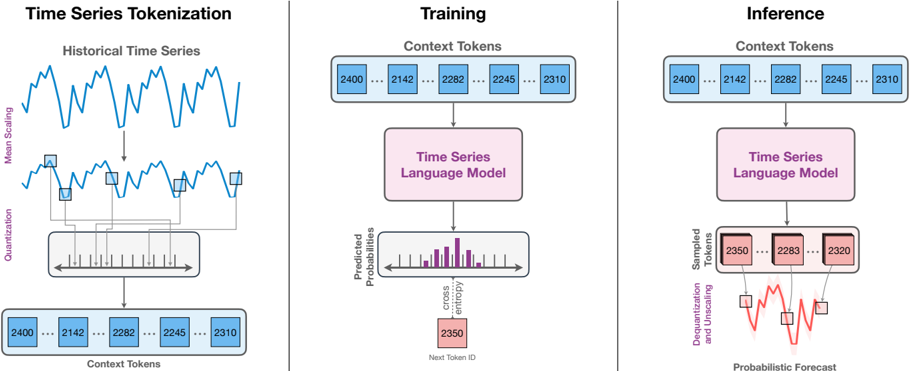
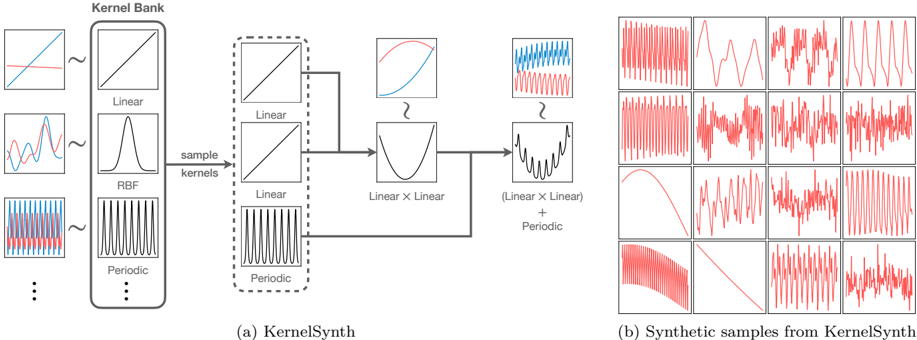
We introduce Chronos, a simple yet effective framework for pretrained probabilistic time series models. Chronos tokenizes time series values using scaling and quantization into a fixed vocabulary and trains existing transformer-based language model architectures on these tokenized time series via the cross-entropy loss. We pretrained Chronos models based on the T5 family (ranging from 20M to 710M parameters) on a large collection of publicly available datasets, complemented by a synthetic dataset that we generated via Gaussian processes to improve generalization. In a comprehensive benchmark consisting of 42 datasets, and comprising both classical local models and deep learning methods, we show that Chronos models: (a) significantly outperform other methods on datasets that were part of the training corpus; and (b) have comparable and occasionally superior zero-shot performance on new datasets, relative to methods that were trained specifically on them. Our results demonstrate that Chronos models can leverage time series data from diverse domains to improve zero-shot accuracy on unseen forecasting tasks, positioning pretrained models as a viable tool to greatly simplify forecasting pipelines.
Overview
CoChat Summary
TL;DR
Chronos adapts language-model architectures to probabilistic time series forecasting by scaling and quantizing values into tokens and training T5/GPT-2 models with cross-entropy. Across 42 benchmark datasets, it achieves strong in-domain and zero-shot forecasting, often matching or beating task-specific models.
Key findings
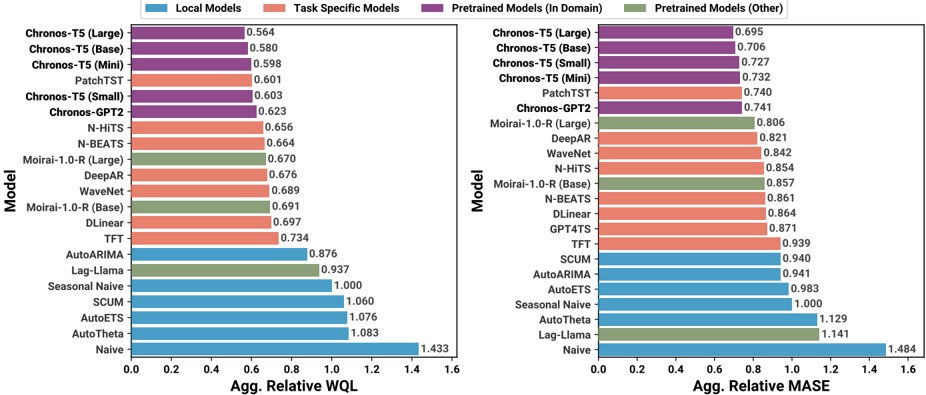
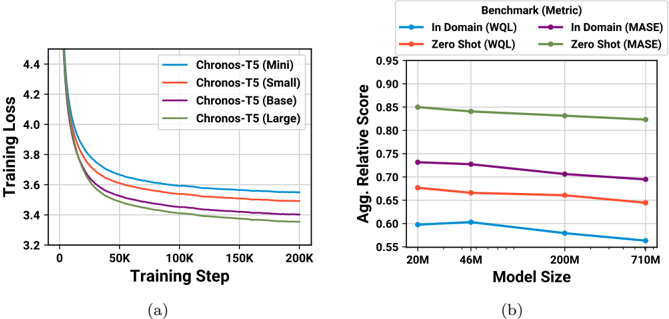
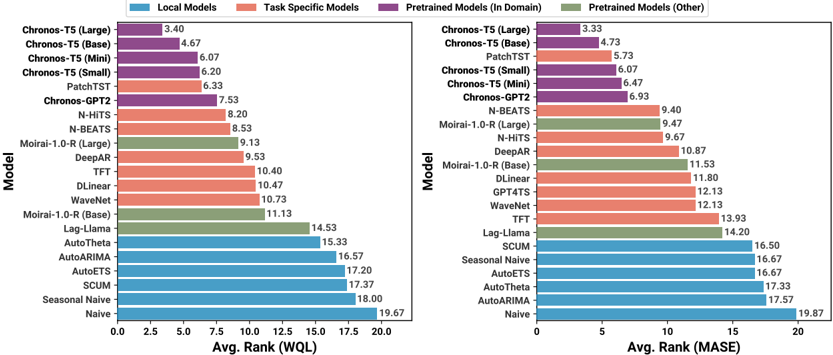
- On in-domain Benchmark I (15 datasets), Chronos-T5 Base/Large obtain the best aggregated relative scores: WQL 0.580/0.564 and MASE 0.706/0.695 versus Seasonal Naive 1.000, outperforming local, task-specific, and other pretrained baselines.
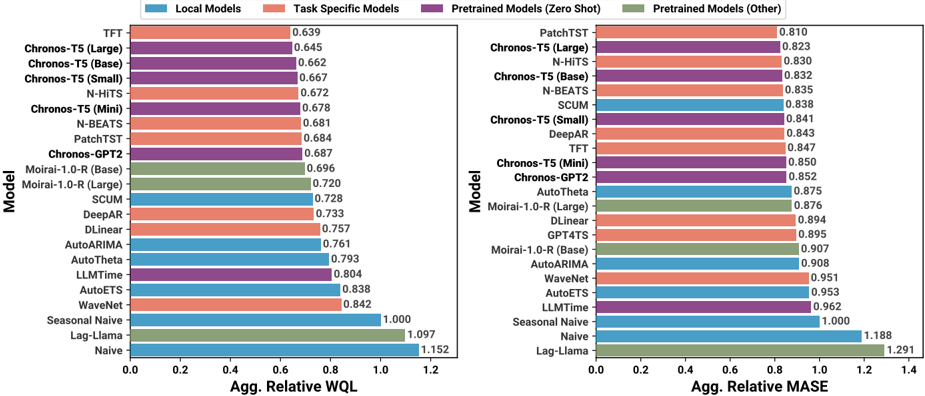
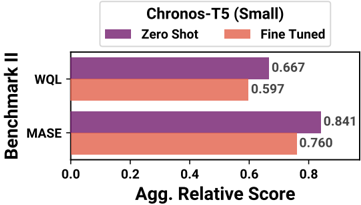
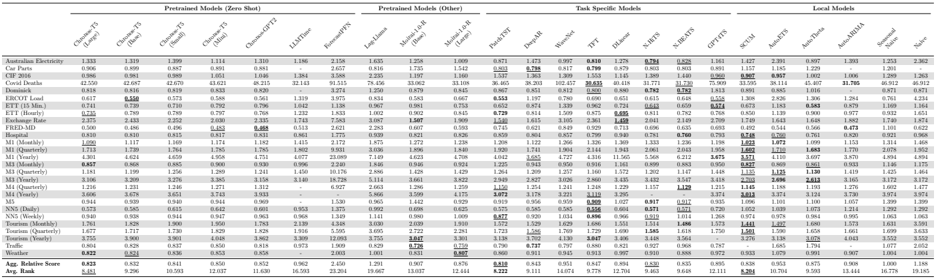
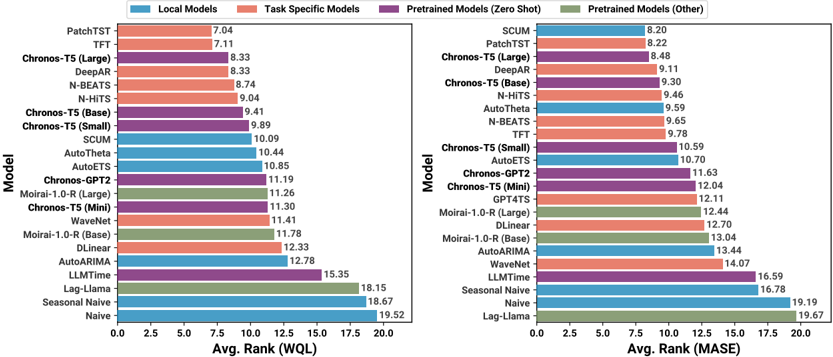
- On zero-shot Benchmark II (27 datasets), Chronos models rank 2nd–4th on WQL and Chronos-T5 Large ranks 2nd on MASE; aggregated relative WQL is 0.645 (Large), 0.662 (Base), 0.667 (Small), 0.678 (Mini), and MASE is 0.823, 0.832, 0.841, 0.850 versus Seasonal Naive 1.000. Fine-tuned Chronos-T5 Small becomes the best model on Benchmark II.
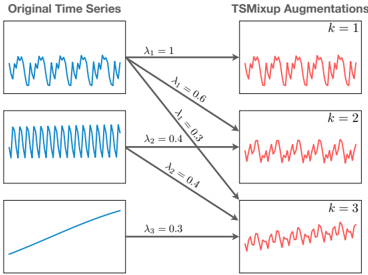
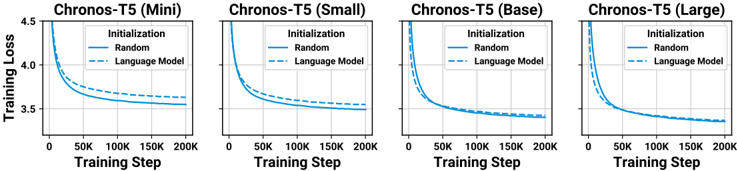
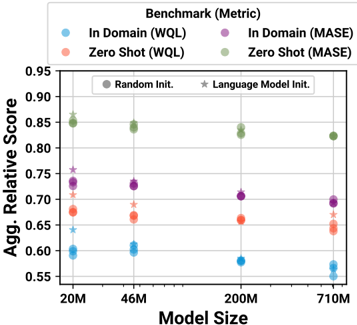
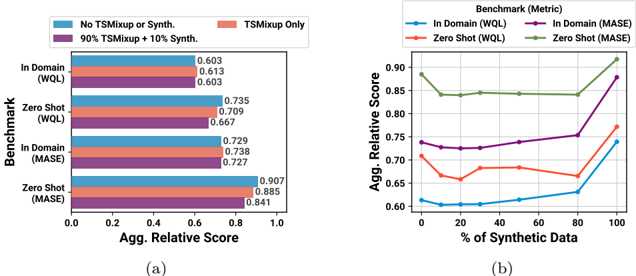
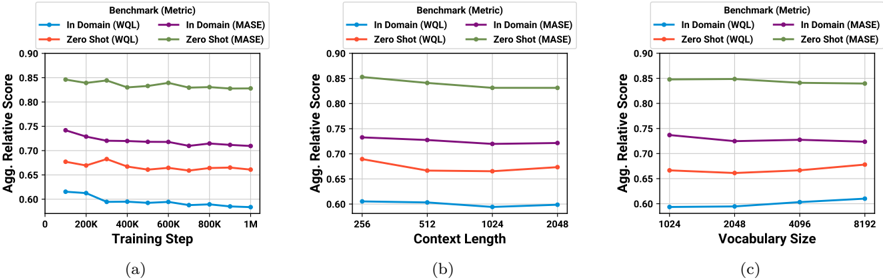
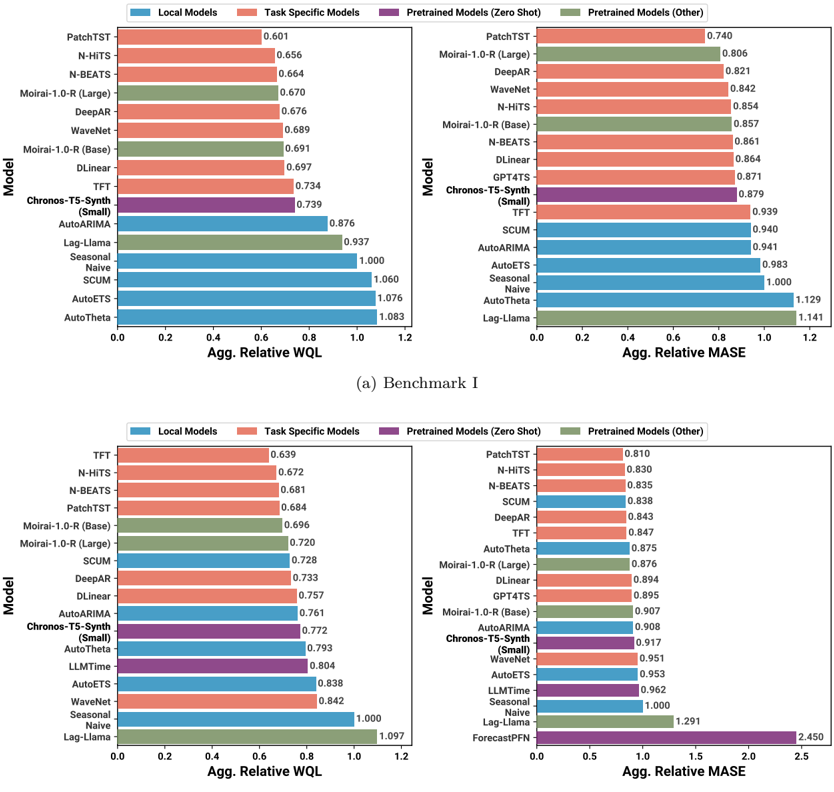
- Ablations show performance improves with model size; language-model-weight initialization offers little/no advantage over random initialization; TSMixup improves zero-shot performance; about 10% KernelSynth synthetic data is best; context length up to 1024 helps; larger vocabulary improves MASE but WQL deteriorates.
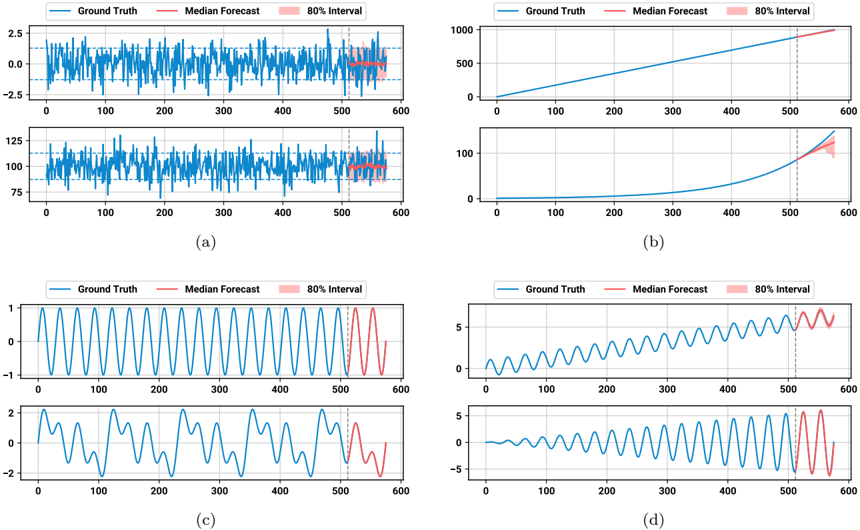
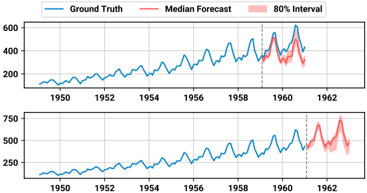
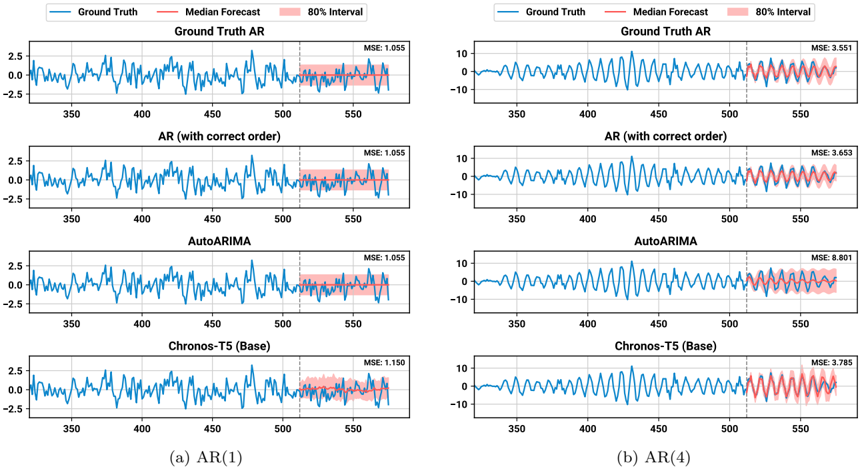
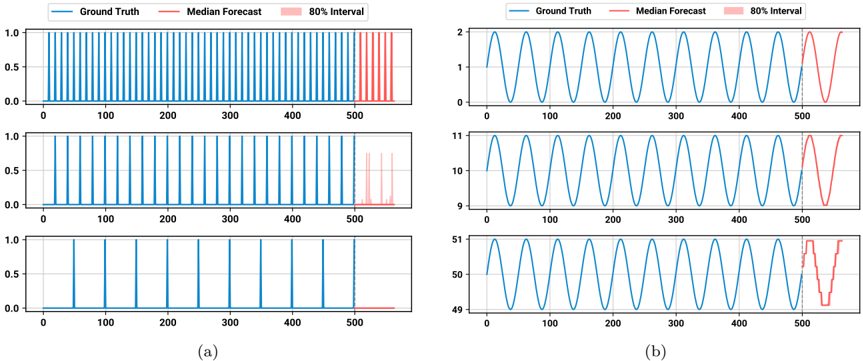
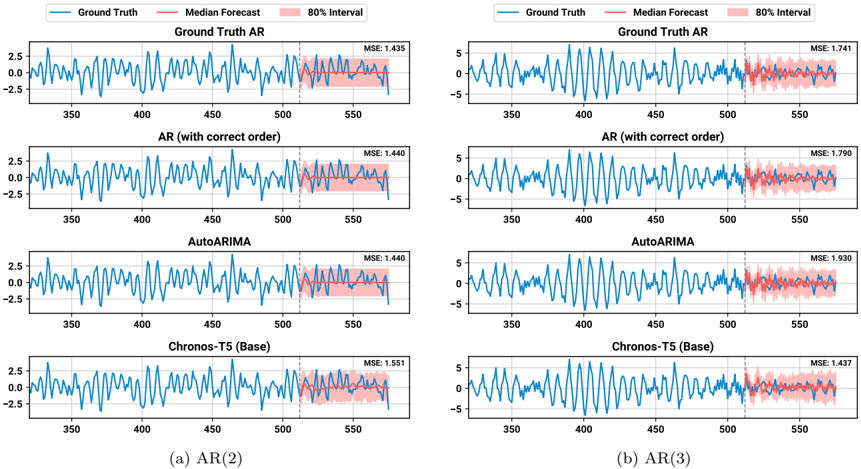
- Qualitatively, Chronos handles Gaussian noise, seasonality, additive/multiplicative trend+seasonality, and AR processes, but struggles with exponential trends and underestimates trend when context is short.
Methods
- Chronos mean-scales time series, uniformly quantizes values into B=4094 bins plus PAD/EOS (V_ts=4096), and trains off-the-shelf transformer language models with categorical cross-entropy; forecasts are produced by autoregressively sampling token paths and dequantizing/unscaling them.
- Training used 55 datasets total: 13 pretraining-only, 15 Benchmark I in-domain, and 27 Benchmark II zero-shot; 28 training datasets comprised about 890K univariate series and approximately 84B observations/tokens. Models included T5 Mini 20M, Small 46M, Base 200M, Large 710M, and GPT-2 90M, trained with 10M TSMixup augmentations plus 1M KernelSynth GP synthetic series, context length 512, prediction length 64, and 200K AdamW steps.
- Evaluation used 42 benchmark datasets with WQL (9 quantiles) and MASE; relative scores versus Seasonal Naive were aggregated by geometric mean and compared against local, task-specific, and pretrained baselines, plus a fine-tuning experiment on Benchmark II.
Limitations
- The paper states tokenization limits: representable values are in [-15s, 15s] where s is the mean absolute scale; small s relative to range causes overflow, while large s relative to variance causes precision loss. It also notes poor exponential-trend forecasts, trend underestimation with short context, and that categorical cross-entropy is not distance-aware; ordinal modeling is left as future work.
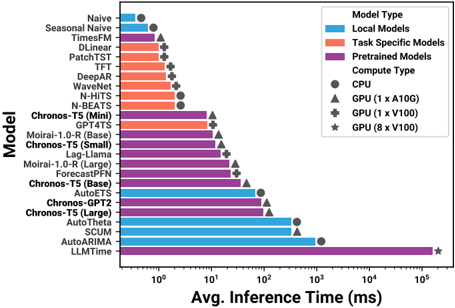
- The paper states scope limits: only univariate, uniformly spaced forecasting is studied; exogenous covariates, multivariate forecasting, and irregular sampling are not handled. Larger models were not explored due to slow inference, inference is slower than task-specific models, evaluation lacks enough high-frequency datasets to study long contexts, and public time series data remain limited.
- Text-evident: the zero-shot comparison may favor Moirai-1.0-R because many Benchmark II datasets were part of its pretraining corpus, as the paper notes; Chronos also ignores time and frequency information by design.
Model-written summary. Check it against the paper before relying on it.
Integrity signals
Registry
Cites
Statistics
Figures

Verification
Claims the paper makes
0 Valid · 4 Not valid · 14 Not checked · 146 Own results and interpretations
A result the paper reports from its own data — it cites no other source for it, so there is none to check. The quote shows it is in the paper.
In the paper
“Between the two baseline pretrained models studied in this experiment, Moirai-1.0-Rclearly outperforms Lag-Llama.”
§ Chronos: Learning the Language of Time Series > 5.5 Main Results
boosted- Asserted: passes — The authors put it forward as true.
- Checkable: passes — It can be checked against evidence.
- Load-bearing: unclear — It is unclear whether the paper’s conclusions depend on it.
- Based: passes — The paper gives a reason why it holds.
A result the paper reports from its own data — it cites no other source for it, so there is none to check. The quote shows it is in the paper.
In the paper
“Unsurprisingly, the training loss improves with the model capacity, as shown in Figure 7a.”
§ Chronos: Learning the Language of Time Series > Model size.
plainstates a cause- Asserted: passes — The authors put it forward as true.
- Checkable: passes — It can be checked against evidence.
- Load-bearing: unclear — It is unclear whether the paper’s conclusions depend on it.
- Based: passes — The paper gives a reason why it holds.
A result the paper reports from its own data — it cites no other source for it, so there is none to check. The quote shows it is in the paper.
In the paper
“Our comprehensive evaluation across 42 datasets establishes Chronos as a benchmark for both in-domain and zero-shot forecasting, surpassing both traditional models and task-specific deep learning approaches.”
§ Chronos: Learning the Language of Time Series > Time Series Tokenization Training Inference
plain- Asserted: passes — The authors put it forward as true.
- Checkable: passes — It can be checked against evidence.
- Load-bearing: passes — The paper’s conclusions depend on it.
- Based: passes — The paper gives a reason why it holds.
A result the paper reports from its own data — it cites no other source for it, so there is none to check. The quote shows it is in the paper.
In the paper
“consistent improvement is observed around the 10% synthetic data proportion.”
§ Chronos: Learning the Language of Time Series > Model size.
plainstates an association- Asserted: passes — The authors put it forward as true.
- Checkable: passes — It can be checked against evidence.
- Load-bearing: unclear — It is unclear whether the paper’s conclusions depend on it.
- Based: passes — The paper gives a reason why it holds.
A result the paper states — it cites no source for it, so there is none to check. The quote shows it is in the paper.
In the paper
“Further increasing the proportion of synthetic data tends to worsen performance.”
§ Chronos: Learning the Language of Time Series > Model size.
hedgedstates a possible cause- Asserted: passes — The authors put it forward as true.
- Checkable: passes — It can be checked against evidence.
- Load-bearing: unclear — It is unclear whether the paper’s conclusions depend on it.
- Based: passes — The paper gives a reason why it holds.
- Rests on an assumption not shown here.
94 more claims
Create a free account to see all 164 claims and to verify the 17 references still open.
- It may state two separate claims as one. 42
- Probably not a substantial claim. 30
Self-check
Percentages, sums and reported differences re-computed from the paper’s own numbers.
Each contradiction between two passages listed here was confirmed by an independent check.
Rated minor: it would not touch a result — a value no result rests on, a p-value that stays on the same side of the significance level, or a conflict that is clerical, resolved elsewhere in the paper, or outside its own findings.
In the paper
§ Chronos: Learning the Language of Time Series > Additional information
“Dominick (Godahewa et al., 2021) contains weekly time series representing the profit of individual stock keeping units from a retailer.”
§ Chronos: Learning the Language of Time Series > Covid Deaths
“Dominick retail 1D 100014 201 296 399 8”
Rated minor: it would not touch a result — a value no result rests on, a p-value that stays on the same side of the significance level, or a conflict that is clerical, resolved elsewhere in the paper, or outside its own findings.
In the paper
§ Chronos: Learning the Language of Time Series > C Baselines
“We considered a total of 17 baseline methods for benchmarking Chronos.”
§ Chronos: Learning the Language of Time Series > Chronos-GPT2 Chronos-T5 (Mini)
“Figure: Naive, SeasonalNaive, AutoETS, Auto-Theta, SCUM, AutoARIMA, DeepAR, TFT, PatchTST, DLinear, WaveNet, N-BEATS, N-HiTS, GPT4TS, Lag-Llama, Moirai-1.evaluationAll the above, LLMTime and ForecastPFN”
Citations
Cites
Exploring the Limits of Transfer Learning with a Unified Text-to-Text Transformer
Raffel, C., Shazeer, N., Roberts, A., Lee, K., Narang, S., Matena, M., Zhou, Y., Li, W., & Liu, P. J. (2019) · arXiv · doi:10.48550/arxiv.1910.10683 · Cited by 31,859
LoRA: Low-Rank Adaptation of Large Language Models
Hu, E. J., Shen, Y., Wallis, P., Allen-Zhu, Z., Li, Y., Wang, S., Wang, L., & Chen, W. (2021) · arXiv · doi:10.48550/arxiv.2106.09685 · Cited by 13,453
LightGBM: A Highly Efficient Gradient Boosting Decision Tree
(2017) · HAL · Cited by 10,512
Lewis, M., Liu, Y., Goyal, N., Ghazvininejad, M., Mohamed, A., Levy, O., Stoyanov, V., & Zettlemoyer, L. (2020) · Proceedings of the 58th Annual Meeting of the Association for Computational Linguistics · doi:10.18653/v1/2020.acl-main.703 · Cited by 8,821
Lewis, M., Liu, Y., Goyal, N., Ghazvininejad, M., Mohamed, A., Levy, O., Stoyanov, V., & Zettlemoyer, L. (2019) · arXiv · doi:10.48550/arxiv.1910.13461 · Cited by 8,816
Transformers: State-of-the-Art Natural Language Processing
Wolf, T., Debut, L., Sanh, V., Chaumond, J., Delangue, C., Moi, A., Cistac, P., Rault, T., Louf, R., Funtowicz, M., et al. (2020) · Proceedings of the 2020 Conference on Empirical Methods in Natural Language Processing: System Demonstrations · doi:10.18653/v1/2020.emnlp-demos.6 · Cited by 8,741
Informer: Beyond Efficient Transformer for Long Sequence Time-Series Forecasting
Zhou, H., Zhang, S., Peng, J., Zhang, S., Li, J., Xiong, H., & Zhang, W. (2021) · Proceedings of the AAAI Conference on Artificial Intelligence · doi:10.1609/aaai.v35i12.17325 · Cited by 7,752
mixup: Beyond Empirical Risk Minimization
Zhang, H., Cisse, M., Dauphin, Y. N., & Lopez-Paz, D. (2017) · arXiv · doi:10.48550/arxiv.1710.09412 · Cited by 5,831
Strictly Proper Scoring Rules, Prediction, and Estimation
Gneiting, T., & Raftery, A. E. (2007) · Journal of the American Statistical Association · doi:10.1198/016214506000001437 · Cited by 5,793
Another look at measures of forecast accuracy
Hyndman, R. J., & Koehler, A. B. (2006) · International Journal of Forecasting · doi:10.1016/j.ijforecast.2006.03.001 · Cited by 5,757
Research works printed but not linked: 8
- George Athanasopoulos, Rob J. Hyndman, Haiyan Song, and Doris C. Wu. The tourism forecasting compe- tition. International Journal of Forecasting, 27(3):822-844, 2011.
- Tom B. Brown, Benjamin Mann, Nick Ryder, Melanie Subbiah, Jared Kaplan, Prafulla Dhariwal, Arvind Neelakantan, Pranav Shyam, Girish Sastry, Amanda Askell, Sandhini Agarwal, Ariel Herbert-Voss, Gretchen Krueger, Tom Henighan, Rewon Child, Aditya Ramesh, Daniel M. Ziegler, Jeffrey Wu, Clemens Winter, Christopher Hesse, Mark Chen, Eric Sigler, Mateusz Litwin, Scott Gray, Benjamin Chess, Jack Clark, Christopher Berner, Sam McCandlish, Alec Radford, Ilya Sutskever, and Dario Amodei. Language models are few-shot learners. In Advances in Neural Information Processing Systems, 2020. 2, 3, 4
- Rob Hyndman, Anne B Koehler, J Keith Ord, and Ralph D Snyder. Forecasting with exponential smoothing: the state space approach. Springer Science & Business Media, 2008. 3, 9
- Alec Radford, Jeffrey Wu, Rewon Child, David Luan, Dario Amodei, Ilya Sutskever, et al. Language models are unsupervised multitask learners. OpenAI blog, 1(8):9, 2019. 4, 6
- Yaniv Romano, Evan Patterson, and Emmanuel Candes. Conformalized quantile regression. Advances in neural information processing systems, 32, 2019.
- Kai Ming Ting and Ian H Witten. Stacking bagged and dagged models. In Proceedings of the Fourteenth International Conference on Machine Learning, 1997. 20
- Ashish Vaswani, Noam Shazeer, Niki Parmar, Jakob Uszkoreit, Llion Jones, Aidan N. Gomez, Lukasz Kaiser, and Illia Polosukhin. Attention Is All You Need. In Advances in Neural Information Processing Systems, 2017.
- Yun Zhou, Liwen You, Wenzhen Zhu, and Panpan Xu. Improving time series forecasting with mixup data augmentation. In ECML PKDD 2023 International Workshop on Machine Learning for Irregular Time Series, 2023b. 7
Cited by
Items 801–900 of 2,048
RareCP: Regime-Aware Retrieval for Efficient Conformal PredictionPreprint
Heurich, M., Granz, M., & Landgraf, T. (2026) · arXiv · doi:10.48550/arxiv.2605.08857 · Cited by 2
Sessa: Selective State Space AttentionPreprint
Horbatko, L. (2026) · arXiv · doi:10.48550/arxiv.2604.18580 · Cited by 2
Regularization of ML models for Earth systems by using longer model timestepsPreprint
Parthipan, R., Anand, M., Christensen, H. M., Vitart, F., Wischik, D., & Zscheischler, J. (2025) · arXiv · doi:10.48550/arxiv.2503.18023 · Cited by 2
Zhong, X., Zhou, Y., Bao, Y., & Shi, Q. (2026) · Symmetry · doi:10.3390/sym18030516 · Cited by 2
Ramp-Aware Photovoltaic Power Interval Forecasting Using a Temporal Fusion Transformer
Zhao, J. Q., Mu, Y., Qian, X., Wang, B., & Xiao, H. (2026) · Applied Sciences · doi:10.3390/app16168261 · Cited by 2
Farahani, M. A., Kalach, F. E., Harper, A., McCormick, M. R., Harik, R., & Wuest, T. (2024) · arXiv · doi:10.48550/arxiv.2411.17499 · Cited by 2
Chain-of-thought Reviewing and Correction for Time Series Question AnsweringPreprint
Su, C., Tian, Y., & Song, Y. (2025) · arXiv · doi:10.48550/arxiv.2512.22627 · Cited by 2
“The other converts the time series data directly into the textual input (Xue and Salim, 2023; Ansari et al., 2024; Luo et al., 2025), and some studies (Kojima et al., a r X i v : 2512 .”
InfluentialA framework using large time series model for early warning of infectious diseases
Liu, Y., Wang, X., Cao, Z., Luo, T., Yang, P., & Wang, Q. (2025) · Infectious Disease Modelling · doi:10.1016/j.idm.2025.08.006 · Cited by 2
“Based on T5 architecture, the Chronos model (Ansari et al., 2024) tokenizes time points and achieves comparable zero-shot performance to specific models.”
xTime: Extreme Event Prediction with Hierarchical Knowledge Distillation and Expert Fusion
Li, Q., Yu, W., Wang, S., Lin, M., Chen, L., Cheng, W. D., & Chen, H. (2025) · Proceedings · doi:10.1109/icdm65498.2025.00147 · Cited by 2
“…rarity level.. 3) Baselines: We compare xTime with 8 state-of-the-art baselines, including 3 well-known time series models: Arima [1], LSTM [24], and PatchTST [4]; 3 models specified for extreme events: NEC+ [18], SaDI [15], and EPL [16]; and 2 large time series models: Time-MoE [6], Chronos [5].”
Utilising fuzzy reinforcement learning for prediction in volatile stock markets
Ghorbani, F., Helić, D., & Dan, D. (2026) · Array · doi:10.1016/j.array.2026.100741 · Cited by 2
Wu, Z. W., Shi, Y., Guo, T., & Xia, M. (2026) · Applied Sciences · doi:10.3390/app16157470 · Cited by 2
Kirchdorfer, L., Özdemir, K., van der Aa, H., & Stuckenschmidt, H. (2026) · Process Science · doi:10.1007/s44311-026-00041-z · Cited by 2
A Comparative Study of Adaptation Strategies for Time Series Foundation Models in Anomaly Detection
Park, M., & Yoon, K. (2026) · Lecture notes in computer science · doi:10.1007/978-3-032-31397-3_42 · Cited by 2
E4GEN: Event-level Explainable Extreme-Enhanced Time-series GenerationPreprint
Jiang, L., Yu, D., Li, X., & Wang, G. (2026) · arXiv · doi:10.48550/arxiv.2606.01634 · Cited by 2
Customizing the Inductive Biases of Softmax Attention using Structured Matrices
Kuang, Y., Amsel, N., Lotfi, S., Qiu, S., Potapczynski, A., & Wilson, A. (2025) · International Conference on Machine Learning · doi:10.48550/arxiv.2509.07963 · Cited by 2
“For this experiment, we trained a Chronos model on the data mixture from Ansari et al. (2024) using a combination of synthetic kernel data and real data.”
InfluentialSelf-citationReview of Passenger Flow Modelling Approaches Based on a Bibliometric AnalysisPreprint
Hecht, J., Li, W., Li, Z., & Dehbi, Y. (2025) · arXiv · doi:10.48550/arxiv.2511.13742 · Cited by 2
“Consequently, models such as Chronos [35], Moirai [36], Lag-LLama [37], or TimesFM [38] may also be applicable.”
Leveraging Intermediate Representations of Time Series Foundation Models for Anomaly DetectionPreprint
Han, C. S., & Lee, K. M. (2025) · arXiv · doi:10.48550/arxiv.2509.12650 · Cited by 2
GPT Meets Game Theory: Training and Optimizing Generative AI Models
Tembiné, H. (2026) · Chapman & Hall/CRC eBooks · doi:10.1201/9781003664581 · Cited by 2
Advanced simulation paradigm of human behaviour unveils complex financial systemic projectionPreprint
Wang, C., Wang, C., Zeng, S., Liu, J., & Jiang, C. (2025) · RePEc: Research Papers in Economics · doi:10.48550/arxiv.2503.20787 · Cited by 2
Time's Up!: Robust Watermarking in Large Language Models for Time Series Generation
van Schaik, N. (2024) · Research Repository (Delft University of Technology) · Cited by 2
Towards Resilient and Autonomous Networks: A BlueSky Vision on AI-Native 6GPreprint
Wu, L., Wan, K., Darbari, M., & Hong, L. (2026) · arXiv · doi:10.48550/arxiv.2605.21395 · Cited by 2
“…TSFM training corpora contain negligible quantities of telecommunications-originsignals,andthestatistical propertiesofnetworktraffic—bursty, non-stationary, and driven by the superposition of many simultaneous user behaviors—differ markedly from the low-dimensional, smooth time series these…”
Pythia: Toward Foundation World Models for Multimodal Time SeriesPreprint
Dai, X., Chen, H., Hu, Y., Liu, Y., Dong, Z., & Yang, J.-M. (2026) · arXiv · doi:10.48550/arxiv.2610.05240 · Cited by 2
“Large-scale pretraining on heterogeneous series produces reusable forecasting priors, as demonstrated by Chronos, TimesFM, and Moirai (Ansari et al., 2024; Das et al., 2024; Woo et al., 2024).”
MotifDisco: Motif Causal Discovery For Time Series MotifsPreprint
Lamp, J., Derdzinski, M., Hannemann, C., Hatfield, S., & van der Linden, J. (2024) · arXiv · doi:10.48550/arxiv.2409.15219 · Cited by 2
HouseTS: A Large-Scale, Multimodal Spatiotemporal U.S. Housing Dataset and BenchmarkPreprint
Wang, S., Sun, Y., Chen, F., Wang, L., Ramakrishnan, N., Lu, C., & Chen, Y. (2025) · arXiv · doi:10.48550/arxiv.2506.00765 · Cited by 2
Towards Intrusion Detection Systems for RPL-based IoT Networks using Foundation ModelsPreprint
Lunderbye, E., Banerjee, S., Rohner, C., & Johnsson, A. (2026) · arXiv · doi:10.48550/arxiv.2606.03530 · Cited by 2
“Other notable time-series foundation models include MOIRAI [12], TimeGPT [13], Chronos [14], and Tiny Time Mixers (TTM) [15].”
SURGE: An Event-Centric Social Media Sentiment Time Series Benchmark with Interaction StructurePreprint
Su, C., Cheng, P., Tian, Y., & Song, Y. (2026) · arXiv · doi:10.48550/arxiv.2605.21198 · Cited by 2
“Generic TSF [57–67] is typically designed around stable sources with physically regular dynamics such as sensor or meteorological data, whereas SURGE is driven by the interplay of event development, social organization, opinion steering, and information diffusion, which has no counterpart in…”
Echoes of the hidden: Uncovering coordination beyond network structurePreprint
Somin, S., Cohen, T., Kepner, J., & Pentland, A. (2025) · arXiv · doi:10.48550/arxiv.2504.02757 · Cited by 2
Sartipi, A., Fernández, J. D., Menci, S. P., & Magitteri, A. (2025) · IEEE PowerTech Conference · doi:10.1109/powertech59965.2025.11180477 · Cited by 2
Time Series Analysis in Machine LearningPreprint
Pagliaro, A., & Anzalone, A. (2026) · arXiv · doi:10.48550/arxiv.2606.11746 · Cited by 2
“Notable examples include TimesFM [17], a decoder-only Transformer pre-trained on a large corpus of real-world and synthetic time series, and Chronos [3], which tokenizes time series values and trains a language model architecture on them.”
A Theoretical Analysis of Detecting Large Model-Generated Time Series
Hou, J., Zhao, J., Zhang, S., & Wang, P. (2026) · Proceedings of the AAAI Conference on Artificial Intelligence · doi:10.1609/aaai.v40i26.39330 · Cited by 2
UTICA: Multi-Objective Self-Distllation Foundation Model Pretraining for Time Series ClassificationPreprint
Moakher, Y., Hili, Y. A. E., & Feofanov, V. (2026) · arXiv · doi:10.48550/arxiv.2603.01348 · Cited by 2
A Causal DAG Prior for Synthetic Time-Series Classification DatasetsPreprint
O'Rourke, F. M., Trišović, A., & Bertsimas, D. (2026) · arXiv · doi:10.48550/arxiv.2606.21776 · Cited by 2
“KernelSynth (Ansari et al., 2024) and CauKer (Xie et al., 2025) both sample time series from random Gaussian-process kernels (composed via a structural causal model in CauKer), but neither emits a class label, so neither produces a complete labelled classification dataset.”
InfluentialWhen Does Context Routing Help? A Systematic Study of Multi-Modal Fusion in Time Series ForecastingPreprint
Zhou, R., Du, G., Liu, X., Yao, H., Chakrabarti, D., Lin, J., & Shen, Y. (2026) · arXiv · doi:10.48550/arxiv.2608.25128 · Cited by 2
RMISC: A Large-scale Real-world Multivariate Corpus for Time Series Foundation ModelsPreprint
Sun, Q., Tian, Y.-M., Huang, J.-W., Feng, C., & Zhang, S.-Q. (2026) · arXiv · doi:10.48550/arxiv.2607.06504 · Cited by 2
“For example, the Chronos family uses synthetic time series generated by AR and ETS models, TSI, and KernelSynth [30, 31, 32, 33].”
Qiu, Y., Cen, Z., Pei, Z., Wang, C., & Wang, J. (2026) · International Conference on Learning Representations · doi:10.48550/arxiv.2603.00629 · Cited by 2
“Chronos used a patch len of 512 and num samples of 3.”
InfluentialLi, Y., Gao, P., & Li, X. (2026) · IEEE Access · doi:10.1109/access.2026.3697488 · Cited by 2
A Time-Series Foundation Model by Universal Delay EmbeddingPreprint
Wang, Z., Peng, T., Shi, J., Bao, R., Liu, R., & Chen, L. (2025) · arXiv · doi:10.48550/arxiv.2509.12080 · Cited by 2
“To enhance cross-domain generalization, time-series foundation models leveraging universal Transformer architectures have emerged 23–25 .”
MACROCAST: A Vintage-Consistent Time Series Foundation Model for Real-Time Macroeconomic ForecastingPreprint
Carriero, A., Pettenuzzo, D., & Shekhar, S. (2026) · arXiv · doi:10.48550/arxiv.2606.28670 · Cited by 2
ISOMORPH: A Supply Chain Digital Twin for Simulation, Dataset Generation, and Forecasting BenchmarksPreprint
Zhang, Z. D., Gu, H., Zhang, B. J., Elenius, D., Tyrrell, M., Bourdais, T., Owhadi, H., Katsoulakis, M. A., & Sahai, T. (2026) · arXiv · doi:10.48550/arxiv.2605.12768 · Cited by 2
“However, it has no logistics network characteristics that include inventory state, transportation edges, or capacities.”
InfluentialAION: Next-Generation Tasks and Practical Harness for Time SeriesPreprint
Zhan, T., Song, X., Guan, T., Pan, S., & Jin, M. (2026) · arXiv · doi:10.48550/arxiv.2605.25045 · Cited by 2
“…(Du, 2023; Wang et al., 2024a), and anomaly detection (Wenig et al., 2022), with clean datasets (Zhou et al., 2021; Makridakis et al., 2020), various model families (Jin et al., 2024; Ansari et al., 2024), and benchmark toolkits (Aksu et al., 2024; Shao et al., 2025) supporting this line of work.”
LLM as Forecasting Planner: Training-Free Text Conditioning for Time-Series Foundation ModelsPreprint
Nguyen, H. H., Nguyen, D., Nguyen, M. H., Do, D., & Le, H. (2026) · arXiv · doi:10.48550/arxiv.2607.24892 · Cited by 2
“Chronos [Ansari et al., 2024] discretises scaled values and trains a T5-based autoregressive model.”
InfluentialTime Series as Language: A Universal Tokenizer for General-Purpose Time Series Foundation ModelsPreprint
Zhang, Y., Qi, R., Zheng, J., Zhang, J., Pan, L., & Yan, J. (2026) · arXiv · doi:10.48550/arxiv.2606.09861 · Cited by 2
“The work most relevant to ours is Chronos [3].”
InfluentialLarge Language Models for Time Series Analysis: Methodologies, Applications, and Emerging ChallengesPreprint
Yu, W., Zhu, L., Cheng, D., & Jiang, C. (2025) · TechRxiv · doi:10.36227/techrxiv.176703979.99494698/v2 · Cited by 2
Nagpal, A., Sanyal, D., Mandal, M., Kumar, D., & Deshpande, S. (2026) · arXiv · doi:10.48550/arxiv.2606.09912 · Cited by 2
“We train Chronos-T5-Mini (Ansari et al., 2024) and Moirai-Small (Woo et al., 2024) from scratch on each corpus under matched training budgets.”
InfluentialBang, T., Roumpos, I., Matusevych, S., Christofidi, G., Tian, Y., & Doudali, T. D. (2025) · doi:10.1145/3737412.3743491 · Cited by 2
VFEM: Visual Feature Empowered Multivariate Time Series Forecasting with Cross-Modal Fusion
Wang, Y., Yu, H., Xu, J., Ma, F., Zhang, H., Feng, T., Zhang, Z., Huang, S., Sun, D., & Zhang, X.-P. (2026) · Transactions on machine learning research · doi:10.48550/arxiv.2510.03244 · Cited by 2
“The emergence of large foundation models (Ansari et al., 2024; Woo et al., 2024; Liu et al., 2024b; Goswami et al., 2024; Darlow et al., 2024) has further advanced the field, leveraging pretrained architectures to achieve strong zero-shot or few-shot forecasting performance.”
Self-citationWan, S. C., Wang, Y., Hou, T., Chang, X., & Jan, A. (2026) · Conference on Empirical Methods in Natural Language Processing (EMNLP) · doi:10.18653/2026.emnlp-main.290 · Cited by 2
“…et al. , 2017], and fine-tuning time series foundation models including Timer [Liu et al. , 2024], Moment [Goswami et al. , 2024] and Chronos [Ansari et al. , 2024]; (iii) Few-shot/Zero-shot LLM/VLM solutions , including Numeric, which directly inputs time series data as digits, and VL-Time…”
Self-citationSantamaria-Valenzuela, I., Rodríguez-Fernández, V., Tato, J. H., Park, J. H., & Camacho, D. (2026) · International Journal of Interactive Multimedia and Artificial Intelligence · doi:10.9781/ijimai.2026.6658 · Cited by 2
MoTM: Towards a Foundation Model for Time Series Imputation based on Continuous ModelingPreprint
Naour, É. L., Nabil, T., & Agoua, G. (2025) · arXiv · doi:10.48550/arxiv.2507.13207 · Cited by 2
“We generate three synthetic datasets summarized in Table 2, using Gaussian Processes (GP) via KernelSynth [1].”
Time Series Forecasting via Direct Per-Step Probability Distribution ModelingPreprint
Kong, L., & Hong, X. (2025) · arXiv · doi:10.48550/arxiv.2511.23260 · Cited by 2
Bi-level Heterogeneous Learning for Time Series Foundation Models: A Federated Learning ApproachPreprint
Chen, S., Long, G., Liu, D., & Jiang, J. (2026) · arXiv · doi:10.48550/arxiv.2604.06727 · Cited by 2
“More recent advances such as MOMENT (Goswami et al., 2024), Moirai (Woo et al., 2024), TimeFM (Das et al., 2024), Chronos (Ansari et al., 2024), Timer (Liu et al., 2024b), and Time-MoE (Shi et al., 2024) scale pretraining to ultra-large datasets, achieving strong cross-task transfer.”
InfluentialFinVerse: Toward More Realistic Evaluation for Financial Time-Series ForecastingPreprint
Lee, J., Seo, J., Lee, S., Lim, T. Y., Kang, D., Choi, H., Kim, M., Yoo, S., Kang, J., Han, S., et al. (2026) · arXiv · doi:10.48550/arxiv.2608.03259 · Cited by 2
UNDERSTANDING TRANSFORMERS FOR TIME SERIES FORECASTING: A CASE STUDY ON MOIRAI
Wu, Y.-H., He, Y., Cao, Y., Fan, J., & Liu, H. (2026) · International Conference on Learning Representations · Cited by 2
The Impact of Covariates on Zero-Shot Building Energy Forecasting Using Chronos-2 Foundation Model
Buonanno, A., Fabozzi, S., Valenti, M., & Graditi, G. (2026) · Electronics · doi:10.3390/electronics15153474 · Cited by 2
Jenko, J., Costa, J. P., Vladušič, D., Bavčar, U., & Čabarkapa, R. (2024) · Annals of Computer Science and Information Systems · doi:10.15439/2024f2959 · Cited by 2
Li, Y., Shao, Z., Yu, C., Fu, Y., Zhu, W., Du, Y., Hu, J., Yang, B., Xu, Y., & Wang, F. (2026) · arXiv · doi:10.48550/arxiv.2609.20156 · Cited by 2
“Representative models such as Chronos [3], MOIRAI [64], and Sundial [39] all perform large-scale pre-training based on different Transformer architectures and have achieved state-of-the-art performance.”
InfluentialRui, Y. (2026) · arXiv · doi:10.48550/arxiv.2606.28446 · Cited by 2
“• Chronos (General-purpose Time-series SOTA) [Fatir Ansari et al., 2024]: In this work, we use the latest version of Chronos model, Chronos-2, together with Chronos-tiny-bolt, which is used in StarEmbed benchmark, as the baseline for general-purpose time series foundation model.”
Accelerating Time Series Foundation Models with Speculative DecodingPreprint
Subbaraman, P., Sun, F., Yu, J., Yao, Y., Tang, H., Luo, X., & Sun, Y. (2025) · arXiv · doi:10.48550/arxiv.2511.18191 · Cited by 2
Phien, N. N., Khiem, H. A., & Tran, P. (2026) · IEEE Access · doi:10.1109/access.2026.3729127 · Cited by 2
XCTFormer: Leveraging Cross-Channel and Cross-Time Dependencies for Enhanced Time-Series Analysis
Zexer, I., & Azencot, O. (2026) · Transactions on machine learning research · doi:10.48550/arxiv.2605.18534 · Cited by 2
How Effective Are Time Series Foundation Models for Epidemiological Data Analysis?
Ribeiro, L. M., Luz, E. J. D. S., & Gertrudes, J. C. (2025) · IEEE-EMBS International Conference on Biomedical and Health Informatics (BHI ...) · doi:10.1109/bhi67747.2025.11269524 · Cited by 2
“For probabilistic models, 20 samples were used, consistent with the approach used by [12] in their evaluations.”
Kim, T., Park, E., & Park, J. (2026) · ESS Open Archive · doi:10.22541/essoar.15009801/v1 · Cited by 2
SKETCH: Semantic Key-Point Conditioning for Long-Horizon Vessel Trajectory Prediction
Gan, L., Li, Z., Xu, W., Li, X., Huang, J. Z., Tu, E., & Chen, S. (2026) · International Conference on Machine Learning · doi:10.48550/arxiv.2601.18537 · Cited by 2
“…next token conditioned on previous tokens: Originally designed for natural language, decoder-only Transformers have also been successfully applied to sequential data in computer vision (Ramesh et al., 2021), audio generation (Wang et al., 2023a), and time series forecasting (Ansari et al., 2024).”
TimeCAP: A Channel-Aware Pre-Training Framework for Multivariate Time Series Forecasting
Ren, C., Lu, Y., Huang, T., Zheng, H., Zhu, H., Li, Y., Li, H., & Liu, L. (2026) · Proceedings of the AAAI Conference on Artificial Intelligence · doi:10.1609/aaai.v40i30.39700 · Cited by 2
“Compared to point-wise tokenization (Ansari et al. 2024), this method mitigates the impact of outliers and random noise, preserving more representative information.”
Foundations without Fundamentals: Zero-Shot Blind Spots in Time Series FMsPreprint
Ghoroghchian, N., Zhang, H., Han, S., Labach, A., & Stein, G. (2026) · arXiv · doi:10.48550/arxiv.2610.02058 · Cited by 2
“Notably, Chronos (Fatir Ansari et al., 2024) acknowledges inherent difficulties in forecasting unbounded trends due to its specific scaling and normalization logic.”
Assessing the Operational Viability of Foundation Models for Time Series ForecastingPreprint
Soni, K., Das, D., & Guduguntla, V. (2026) · arXiv · doi:10.48550/arxiv.2605.24381 · Cited by 2
FAME: Forecastability-Aware Mixture of Experts for Heterogeneous Time Series ForecastingPreprint
li, Q., Zhang, X., Wang, S., Peng, T., & Wei, J. (2026) · arXiv · doi:10.48550/arxiv.2606.08896 · Cited by 2
Self-citationFinBench: Time-Gated Calibration and Uncertainty Benchmarking for Agentic Financial ForecastingPreprint
Ghosh, R. A., & Devarakonda, V. (2026) · arXiv · doi:10.48550/arxiv.2607.16229 · Cited by 2
“Recent forecasting models such as Chronos and Moirai, as well as decoder-only foundation approaches for time-series forecasting, target universal numerical forecasting from time-series inputs (Ansari et al., 2024; Woo et al., 2024; Das et al., 2024).”
Zero-shot Demand Forecasting for Products with Limited Sales Periods
Nagai, S., Inaba, R., Oishi, R., Aikawa, S., Mibuchi, Y., Moriyama, H., Kobayashi, K., & Nakata, K. (2024) · IEEE International Conference on Big Data (BigData) · doi:10.1109/bigdata62323.2024.10825549 · Cited by 2
Mix-BEATS: Mixer-enhanced Basis Expansion Analysis for Load Forecasting
Kumar, A., Saravanan, H. K., Dwivedi, S., & Arjunan, P. (2025) · ACM International Conference on Future Energy Systems (e-Energy) · doi:10.1145/3679240.3734632 · Cited by 2
Large Language Models for Spatio-Temporal Mobile Traffic Predictions
Madi, R., Elayoubi, S. E., Lago, R. C. D., & Estanislau, V. (2025) · IEEE International Mediterranean Conference on Communications and Networking (MeditCom) · doi:10.1109/meditcom64437.2025.11104439 · Cited by 2
“As shown in [7], when the available context is too short, the model tends to underestimate the trend of the time series, leading to flatter and less accurate predictions.”
Zhang, Q., Li, J., Li, X., Bao, J., & Zhang, D. (2025) · Expert Systems with Applications · doi:10.1016/j.eswa.2025.130830 · Cited by 2
Robust Long-Term Spatial–Temporal Forecasting for Dynamic Networks: The MDETST Model
Wenjing, F., Li, L., Zhou, H., Xie, B., Zhao, D., Zhang, Y., & Wang, F. (2026) · Mathematics · doi:10.3390/math14040661 · Cited by 2
“Notable examples include TimesFM [17], a decoder-only architecture trained on extensive real-world corpora, and Chronos [18], which tokenizes time series values to leverage language model architectures.”
Aligning Textual Information with Time Series via Cross-Modal Attention for Time Series Forecasting
Anh, L. H., Vu, D. T., Yu, G. H., Oh, S., An, J. J., & Kim, J. (2026) · Electronics · doi:10.3390/electronics15081734 · Cited by 2
PULSE: Generative Phase Evolution for Non-Stationary Time Series Forecasting
Liu, Y., Shao, Z., Chen, X., Chen, H., Wang, F., & Wu, Y. (2026) · International Conference on Machine Learning · doi:10.48550/arxiv.2605.16793 · Cited by 2
Position: Time-Series Foundation Models Require Explicit Domain-Level Benchmarks
Syed, M. A. B., Ahamed, M. Y., & Wasi, A. T. (2026) · International Conference on Machine Learning · Cited by 2
Dynamic-Equalized-Loss Based Learning Framework for Identifying the Behavior of Pair-Trawlers
Liao, J., Zhao, Y., Xia, J., Gu, Y., Hu, Z., & Wu, W. (2024) · Lecture notes in computer science · doi:10.1007/978-981-97-5591-2_29 · Cited by 2
Subsystem Discovery in High-Dimensional Time-Series Using Masked Autoencoders
Sarapisto, T., Wei, H., Heljanko, K., Klami, A., & Ruotsalainen, L. (2024) · Frontiers in artificial intelligence and applications · doi:10.3233/faia240844 · Cited by 2
Assessing the Optimistic Bias in the Natural Inflow Forecasts: A Call for Model Monitoring in Brazil
Brigatto, A., Street, A., Fernandes, C. A. C., Valladão, D., Bodin, G., & Garcia, J. D. (2025) · IEEE Transactions on Energy Markets Policy and Regulation · doi:10.1109/tempr.2025.3588313 · Cited by 2
Fine-Tuning a Time Series Foundation Model with Wasserstein LossPreprint
Chernov, A. (2024) · arXiv · doi:10.48550/arxiv.2409.15367 · Cited by 2
Operator Flow Matching for Timeseries ForecastingPreprint
Lee, Y. Y. R., & Flouris, K. (2025) · arXiv · doi:10.48550/arxiv.2510.15101 · Cited by 2
Benchmarking Probabilistic Time Series Forecasting Models on Neural ActivityPreprint
Lu, Z., Li, A. J., Ladd, A., Matveev, P., Deole, A., Shea‐Brown, E., Kutz, J. N., & Steinmetz, N. A. (2025) · PubMed Central · doi:10.48550/arxiv.2510.18037 · Cited by 2
“Chronos[48].”
InfluentialEvaluating Temporal Plasticity in Foundation Time Series Models for Incremental Fine-tuningPreprint
Liu, J., Cheng, J., Fang, X., Ma, Z., & Wu, Y. (2025) · arXiv · doi:10.48550/arxiv.2504.14677 · Cited by 2
Retrieval-Augmented Generation with Covariate Time SeriesPreprint
Liang, K. Y., Pei, Z., Zhang, H., Liu, Y., Song, S., & Wang, J. (2026) · arXiv · doi:10.48550/arxiv.2603.04951 · Cited by 2
“The Chronos family [6], including the recent Chronos-Bolt and Chronos-2 [5], quantizes continuous values into discrete tokens to leverage cross-entropy objectives similar to language modeling.”
Multivariate Financial Forecasting using the Chronos Time Series Foundation ModelsPreprint
Das, S. R., Goyal, T., & Yadav, M. (2026) · arXiv · doi:10.48550/arxiv.2605.21504 · Cited by 2
ROAR: Retrieval Opportunity-Aware Refinement for Zero-Shot Time Series ForecastingPreprint
Chi, J., Feng, L., Wang, Y., Zhang, L., Wang, Y., Li, X., & Li, X. (2026) · arXiv · doi:10.48550/arxiv.2605.24911 · Cited by 2
“We compare ROAR with 7 TSFMs: Chronos (Ansari et al., 2024), Chronos-Bolt (Ansari et al., 2024), MOMENT (Goswami et al., 2024), TTM (Ekambaram et al., 2024), Moirai (Woo et al., 2024), TimesFM (Das et al., 2024), and Time-MoE (Shi et al., 2025).”
Self-citationAME-TS: Anchored Mixture-of-Experts for Time Series ForecastingPreprint
Wang, R., Xue, R., Razi, R., Song, H., & Marlowe, H. (2026) · arXiv · doi:10.48550/arxiv.2605.25166 · Cited by 2
“Second, we incorporate several unique datasets from the Chronos pre-training corpus [3], including a one-million-series synthetic KernelSynth corpus and several real-world datasets not otherwise available in LOTSA.”
CITRAS-FM: Tiny Time Series Foundation Model for Covariate-Informed Zero-Shot ForecastingPreprint
Yamaguchi, Y., Suemitsu, I., Kajihara, Y., & Wei, W. (2026) · arXiv · doi:10.48550/arxiv.2606.10798 · Cited by 2
“Although lightweight TSFMs exist, they typically lag behind larger models in forecasting accuracy [6] and often require fine-tuning to achieve competitive performance [7].”
Pradhan, S., Bahadori, N., & Amini, P. (2026) · arXiv · doi:10.48550/arxiv.2606.11553 · Cited by 2
“TimesFM (Das et al., 2024), Chronos (Ansari et al., 2024), and Toto (Cohen et al., 2024) AIOps and network anomaly detection.”
InfluentialPeak-Aware Short-Term Load Forecasting Across Distribution Grid Aggregation LevelsPreprint
Chattopadhyay, S., Oelhaf, J., Schoening, A., Deuschel, J., Bhattacharyya, B., Bergler, C., Maier, A., & Bayer, S. (2026) · arXiv · doi:10.48550/arxiv.2609.18588 · Cited by 2
“Foundation Models: We further evaluate Chronos-Bolt and Chronos-2 as pretrained probabilistic time-series FMs [13], [14].”
WorldTS: World Modeling for Multimodal Covariate-aware Time Series ForecastingPreprint
Zhu, Y., Qiu, X., Cheng, H., Shen, W., Guo, C., Yang, B., Hu, J., & Jensen, C. S. (2026) · arXiv · doi:10.48550/arxiv.2609.31162 · Cited by 2
“Finally, we report Chronos-Bolt (Ansari et al., 2024), TimesFM (Das et al., 2024), and Time-MoE (Shi et al., 2025) equipped with UniCA, which supplies a common covariate-adaptation interface to otherwise heterogeneous time-series foundation models.”
Enhancing Foundation Models for Time Series Forecasting via Wavelet-based Tokenization
Masserano, L., Ansari, A. F., Han, B., Zhang, X., Faloutsos, C., Mahoney, M. W., Wilson, A. G., Park, Y., Rangapuram, S., Maddix, D. C., et al. (2024) · arXiv · doi:10.48550/arxiv.2412.05244 · Cited by 1
Self-citationMarket analytics beyond big data: pretrained AI models for industrial order forecasting in Germany
Muth, M., Engel, J., & Nufer, G. (2026) · Journal of Marketing Analytics · doi:10.1057/s41270-026-00489-9 · Cited by 1
Kim, H., Moon, J., & Baik, N. (2026) · Electronics · doi:10.3390/electronics15163643 · Cited by 1
Yin, C., Zheng, Y., & Kong, Z. (2026) · Sustainability · doi:10.3390/su18157642 · Cited by 1
The Impact of Occupancy Dynamics on Indoor CO2 Forecasting: A Cross-Scenario Evaluation
Pinilla, P. G., Jurío, A., Figols, M., & Paternain, D. (2026) · Forecasting · doi:10.3390/forecast8020026 · Cited by 1
“For the foundation models, the observed gap between LLM-ZS and LLM-FT supports the role of fine-tuning for capturing building-specific dynamics, especially in complex scenarios and longer horizons, as also reported in [31].”
Zhan, Y., He, T., Zhang, Y., Chen, G., Zhang, F., & Ma, G. (2026) · Neurocomputing · doi:10.1016/j.neucom.2026.133056 · Cited by 1
FlightLLM: few-shot interval forecasting for airline passenger and baggage demand
Gao, Y., Li, C., Zhong, Z., & Ma, W. (2026) · Transportation Research Part C Emerging Technologies · doi:10.1016/j.trc.2026.105941 · Cited by 1
Pucher, G., Dada, A., Agbodoyetin, A., Nensa, F., Schuler, M., Reinhardt, H. C., Kleesiek, J., & Sauer, C. M. (2026) · Artificial Intelligence in Medicine · doi:10.1016/j.artmed.2026.103473 · Cited by 1
Metadata
- Authors
- Ansari, A. F., Stella, L., Turkmen, C., Zhang, X., Mercado, P., Shen, H., Shchur, O., Rangapuram, S. S., Arango, S. P., Kapoor, S., Zschiegner, J., Maddix, D. C., Wang, H., Mahoney, M. W., Torkkola, K., Wilson, A. G., Bohlke-Schneider, M., & Wang, Y.
- Affiliations
- Amazon (United States) (US)
- University of California San Diego (US)
- University of Freiburg (DE)
- Rutgers, The State University of New Jersey (US)
- ORCID
- Venue
- arXiv
- Publisher
- arXiv
- Published
- 2024
- ISSN
- 2835-8856 (ISSN-L)
- arXiv
- 2403.07815
- OpenAlex
- W4392781393
- Cited by
- 2,046
- References
- 92
- Citations by year
- 2026: 1398 · 2025: 520 · 2024: 126
- FWCI
- 245.30
- Type
- journal article
- Language
- en
- Open access
- diamond
- openreview.net
- Licence
- Locations
- Transactions on machine learning research (publishedVersion, cc-by)
- arXiv (submittedVersion, public-domain)
- Topics
- Physical Sciences › Computer Science › Signal Processing › Time Series Analysis and Forecasting
- Social Sciences › Decision Sciences › Management Science and Operations Research › Forecasting Techniques and Applications
- Social Sciences › Decision Sciences › Management Science and Operations Research › Stock Market Forecasting Methods
- Keywords
- time series forecasting, transformer language models, T5, zero-shot forecasting, Chronos
About these checks
Registry, retraction, Cites and statistics results are computed, not judged, with one exception: a printed reference that no index lists is read once by a model before it counts as a citation error. Claims are extracted by a model and kept only when their quote appears verbatim in the text; each cited source is then checked, with a model’s help, for whether it says what the claim relies on. Those verdicts can be wrong — read the claim’s quote and the cited source before relying on one.
A language model drew the claims from the paper on 2026-11-28, under version 3 of the claim definition (model deepseek-v4.1-flash, prompt extract-v3).
A second model labelled each claim on 2026-11-28 (model jev-1.13-20260917, definition revision gold-guideline-v0.2).
Statistics and arithmetic are recomputed, not judged.
Confidence bands are shown only for fields calibrated on our annotated test set. None is calibrated yet, so no band is shown.
What counts as a claim ›How we measure confidence ›How we check this ›
Are you an author, or do you see a problem with this page? Request a review
Data sources
Bibliographic data: Semantic Scholar, OpenAlex, Crossref.
Contains information from the Semantic Scholar Academic Graph Datasets, made available under the ODC Attribution License (ODC-BY 1.0).
Semantic Scholar’s data is described in: Kinney, R., et al. (2023). The Semantic Scholar Open Data Platform. arXiv:2301.10140.
