

Chronos: Learning the Language of Time Series
Open accessThe DOI matches its DataCite record; 95 of the 95 references it cites were found in a registry or an index; none of the 21 sources its claims cite is checked for support yet.
Abstract
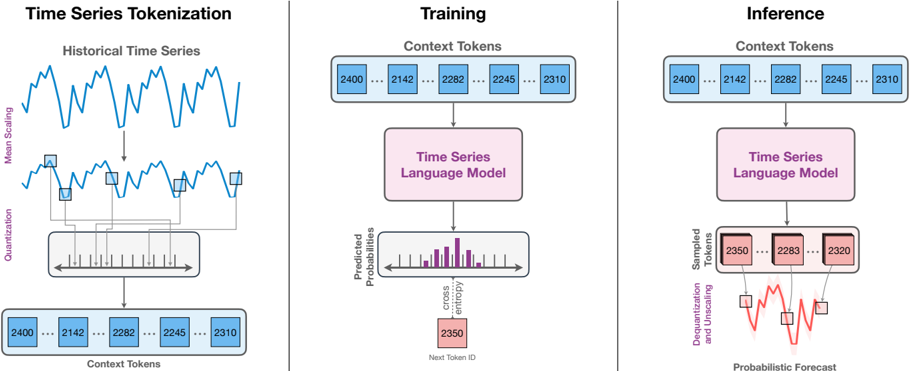
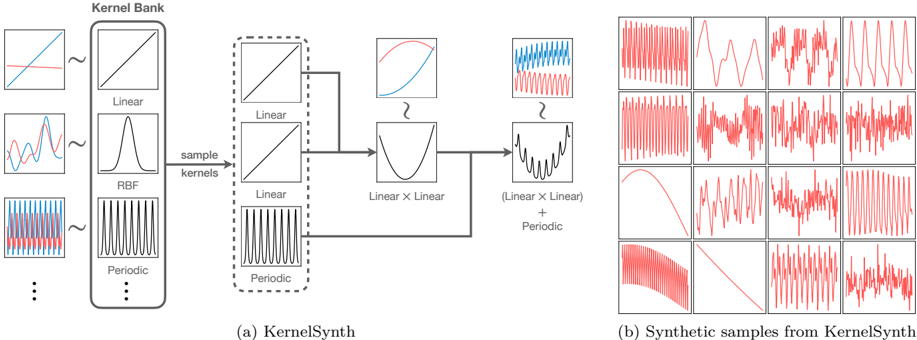
We introduce Chronos, a simple yet effective framework for pretrained probabilistic time series models. Chronos tokenizes time series values using scaling and quantization into a fixed vocabulary and trains existing transformer-based language model architectures on these tokenized time series via the cross-entropy loss. We pretrained Chronos models based on the T5 family (ranging from 20M to 710M parameters) on a large collection of publicly available datasets, complemented by a synthetic dataset that we generated via Gaussian processes to improve generalization. In a comprehensive benchmark consisting of 42 datasets, and comprising both classical local models and deep learning methods, we show that Chronos models: (a) significantly outperform other methods on datasets that were part of the training corpus; and (b) have comparable and occasionally superior zero-shot performance on new datasets, relative to methods that were trained specifically on them. Our results demonstrate that Chronos models can leverage time series data from diverse domains to improve zero-shot accuracy on unseen forecasting tasks, positioning pretrained models as a viable tool to greatly simplify forecasting pipelines.
Overview
CoChat Summary
TL;DR
Chronos adapts language-model architectures to probabilistic time series forecasting by scaling and quantizing values into tokens and training T5/GPT-2 models with cross-entropy. Across 42 benchmark datasets, it achieves strong in-domain and zero-shot forecasting, often matching or beating task-specific models.
Key findings
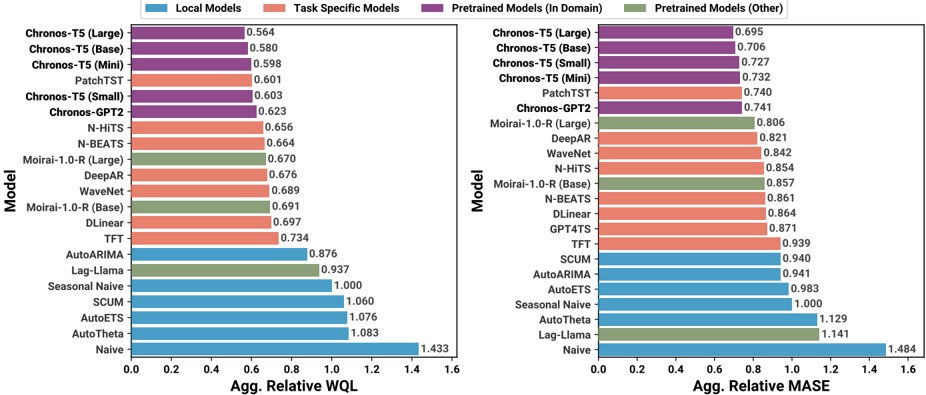
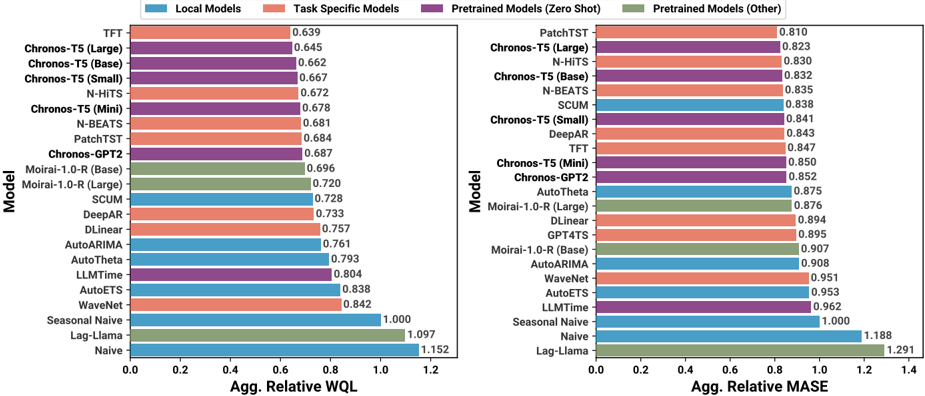
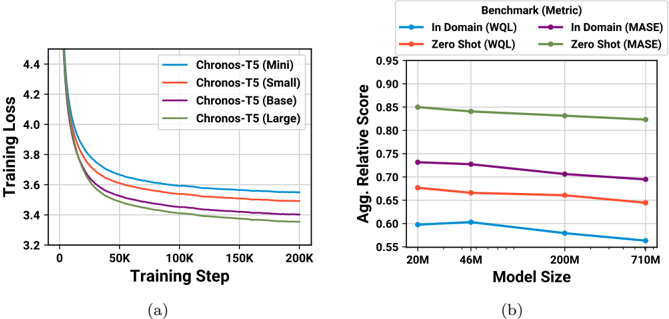
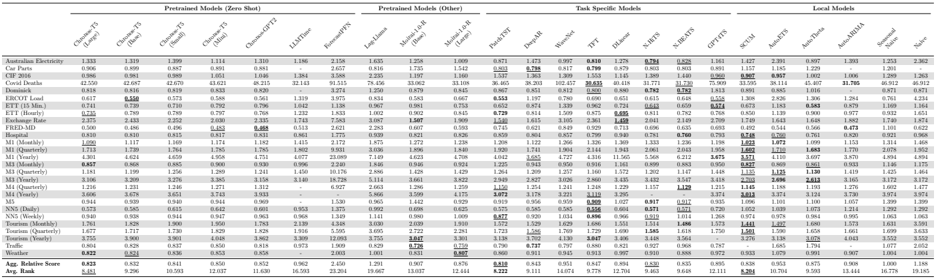
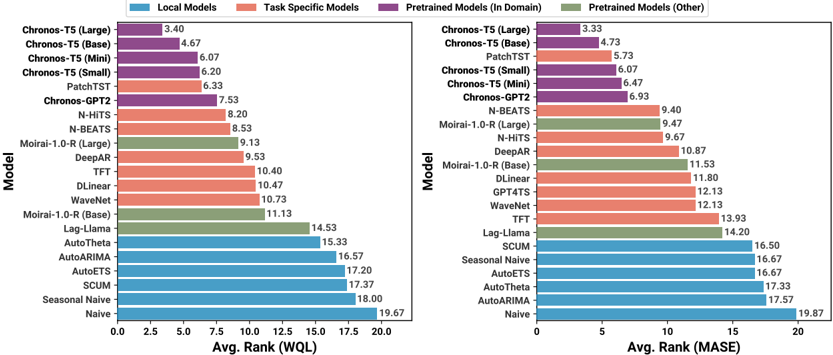
- On in-domain Benchmark I (15 datasets), Chronos-T5 Base/Large obtain the best aggregated relative scores: WQL 0.580/0.564 and MASE 0.706/0.695 versus Seasonal Naive 1.000, outperforming local, task-specific, and other pretrained baselines.
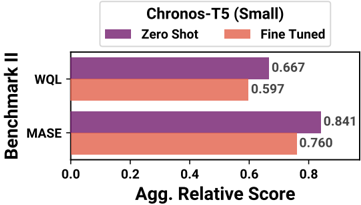
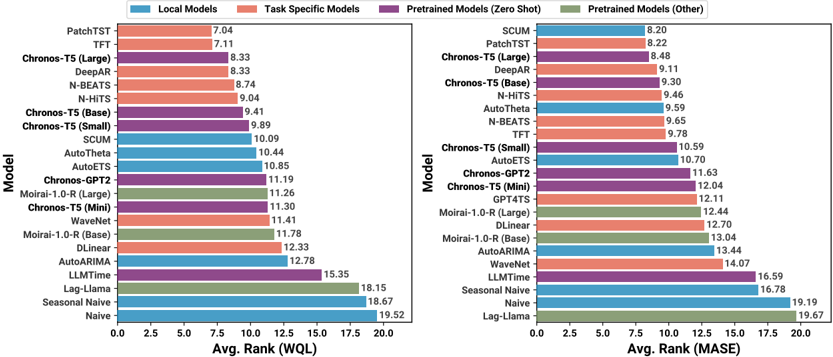
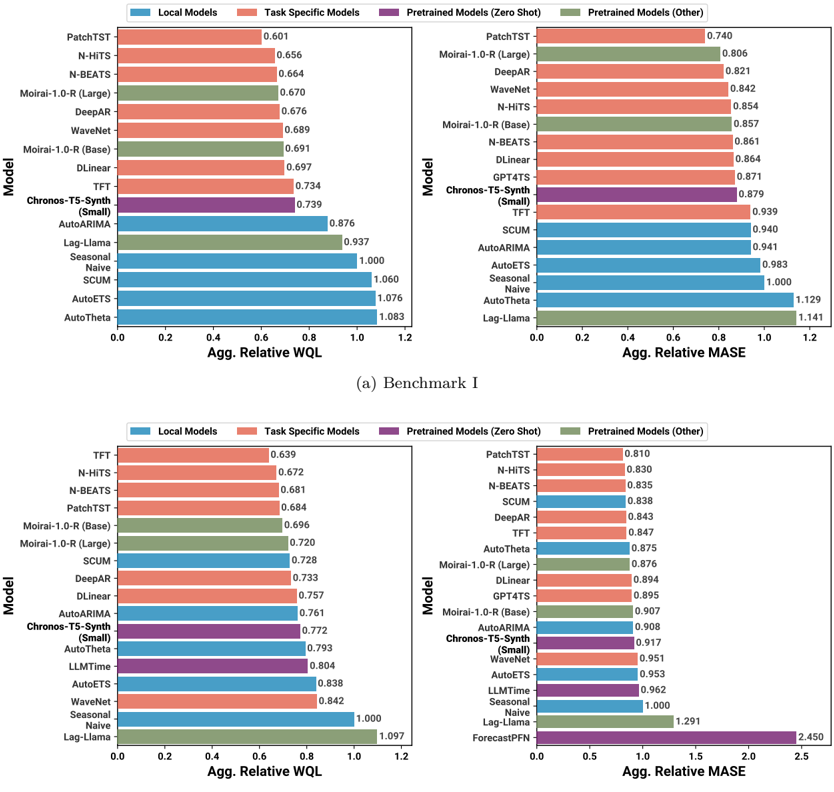
- On zero-shot Benchmark II (27 datasets), Chronos models rank 2nd–4th on WQL and Chronos-T5 Large ranks 2nd on MASE; aggregated relative WQL is 0.645 (Large), 0.662 (Base), 0.667 (Small), 0.678 (Mini), and MASE is 0.823, 0.832, 0.841, 0.850 versus Seasonal Naive 1.000. Fine-tuned Chronos-T5 Small becomes the best model on Benchmark II.
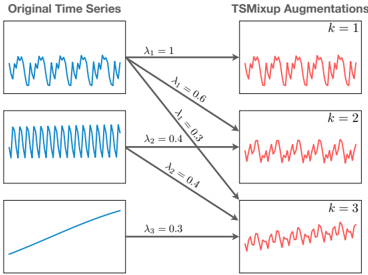
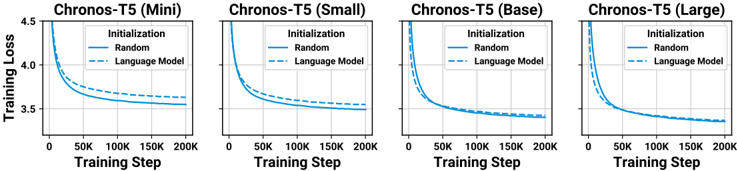
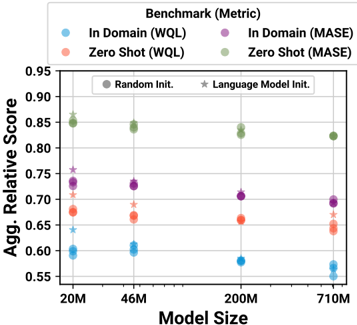
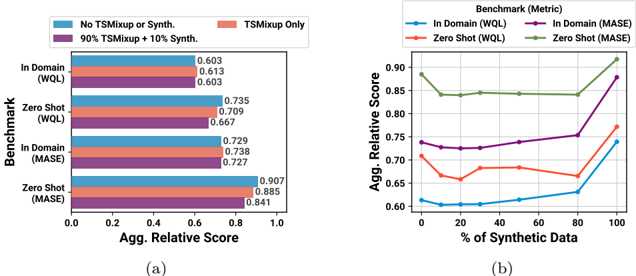
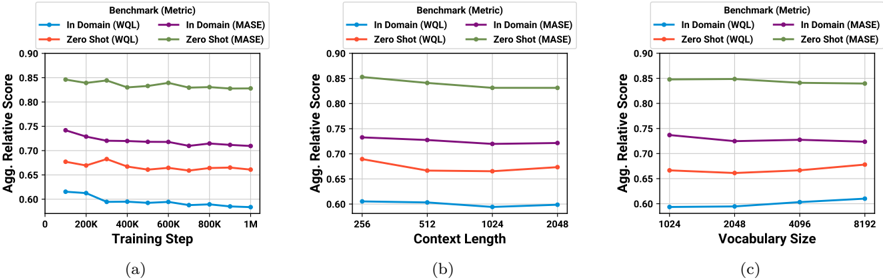
- Ablations show performance improves with model size; language-model-weight initialization offers little/no advantage over random initialization; TSMixup improves zero-shot performance; about 10% KernelSynth synthetic data is best; context length up to 1024 helps; larger vocabulary improves MASE but WQL deteriorates.
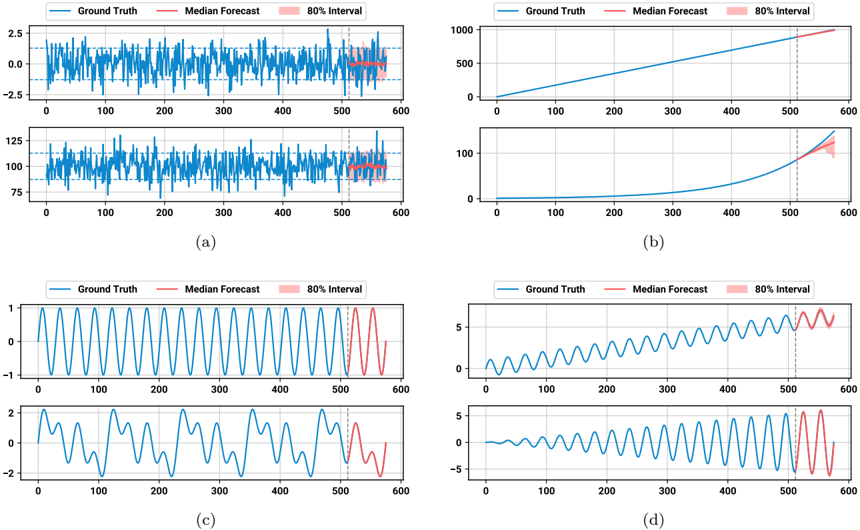
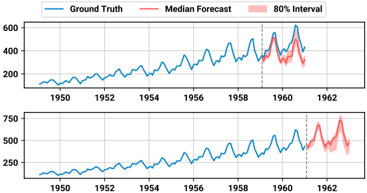
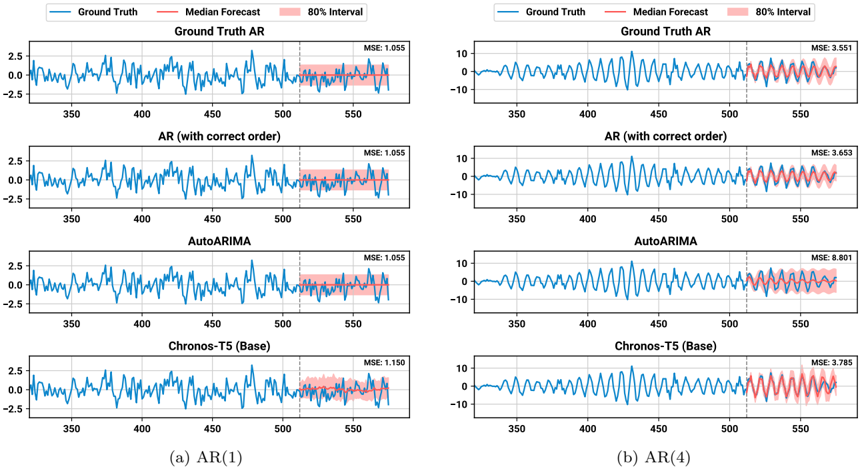
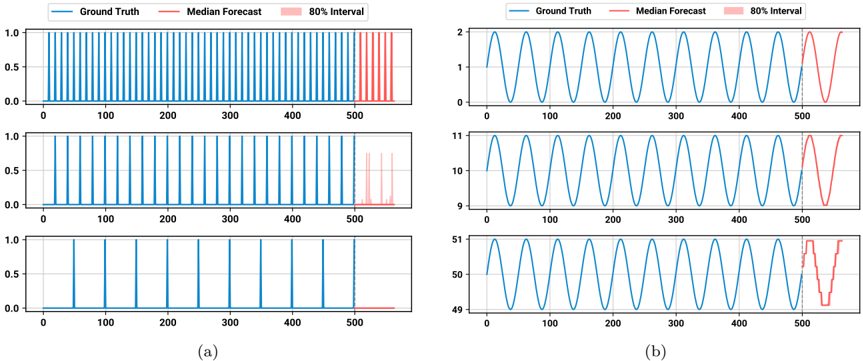
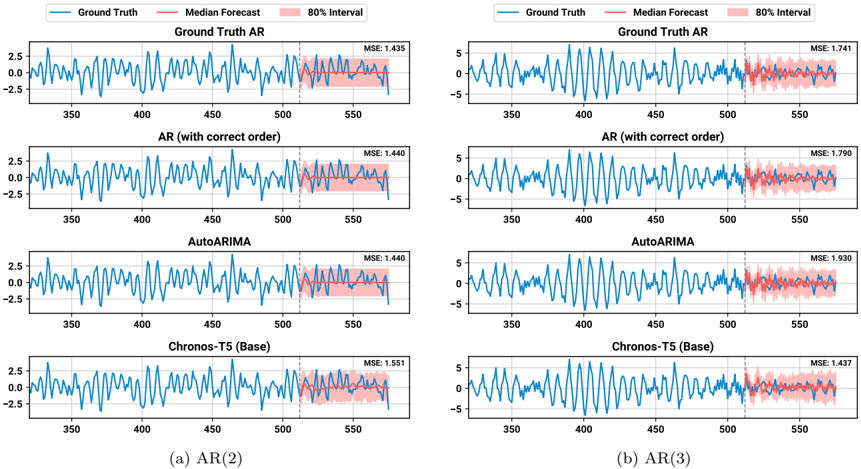
- Qualitatively, Chronos handles Gaussian noise, seasonality, additive/multiplicative trend+seasonality, and AR processes, but struggles with exponential trends and underestimates trend when context is short.
Methods
- Chronos mean-scales time series, uniformly quantizes values into B=4094 bins plus PAD/EOS (V_ts=4096), and trains off-the-shelf transformer language models with categorical cross-entropy; forecasts are produced by autoregressively sampling token paths and dequantizing/unscaling them.
- Training used 55 datasets total: 13 pretraining-only, 15 Benchmark I in-domain, and 27 Benchmark II zero-shot; 28 training datasets comprised about 890K univariate series and approximately 84B observations/tokens. Models included T5 Mini 20M, Small 46M, Base 200M, Large 710M, and GPT-2 90M, trained with 10M TSMixup augmentations plus 1M KernelSynth GP synthetic series, context length 512, prediction length 64, and 200K AdamW steps.
- Evaluation used 42 benchmark datasets with WQL (9 quantiles) and MASE; relative scores versus Seasonal Naive were aggregated by geometric mean and compared against local, task-specific, and pretrained baselines, plus a fine-tuning experiment on Benchmark II.
Limitations
- The paper states tokenization limits: representable values are in [-15s, 15s] where s is the mean absolute scale; small s relative to range causes overflow, while large s relative to variance causes precision loss. It also notes poor exponential-trend forecasts, trend underestimation with short context, and that categorical cross-entropy is not distance-aware; ordinal modeling is left as future work.
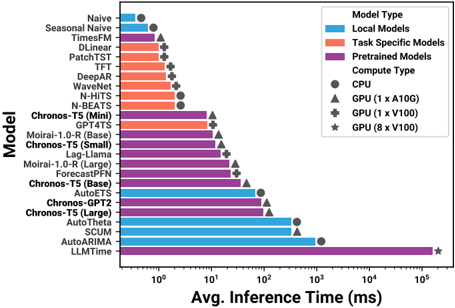
- The paper states scope limits: only univariate, uniformly spaced forecasting is studied; exogenous covariates, multivariate forecasting, and irregular sampling are not handled. Larger models were not explored due to slow inference, inference is slower than task-specific models, evaluation lacks enough high-frequency datasets to study long contexts, and public time series data remain limited.
- Text-evident: the zero-shot comparison may favor Moirai-1.0-R because many Benchmark II datasets were part of its pretraining corpus, as the paper notes; Chronos also ignores time and frequency information by design.
Model-written summary. Check it against the paper before relying on it.
Integrity signals
Registry
Cites
Statistics
Figures

Verification
Claims the paper makes
0 Valid · 4 Not valid · 14 Not checked · 146 Own results and interpretations
A result the paper reports from its own data — it cites no other source for it, so there is none to check. The quote shows it is in the paper.
In the paper
“Between the two baseline pretrained models studied in this experiment, Moirai-1.0-Rclearly outperforms Lag-Llama.”
§ Chronos: Learning the Language of Time Series > 5.5 Main Results
boosted- Asserted: passes — The authors put it forward as true.
- Checkable: passes — It can be checked against evidence.
- Load-bearing: unclear — It is unclear whether the paper’s conclusions depend on it.
- Based: passes — The paper gives a reason why it holds.
A result the paper reports from its own data — it cites no other source for it, so there is none to check. The quote shows it is in the paper.
In the paper
“Unsurprisingly, the training loss improves with the model capacity, as shown in Figure 7a.”
§ Chronos: Learning the Language of Time Series > Model size.
plainstates a cause- Asserted: passes — The authors put it forward as true.
- Checkable: passes — It can be checked against evidence.
- Load-bearing: unclear — It is unclear whether the paper’s conclusions depend on it.
- Based: passes — The paper gives a reason why it holds.
A result the paper reports from its own data — it cites no other source for it, so there is none to check. The quote shows it is in the paper.
In the paper
“Our comprehensive evaluation across 42 datasets establishes Chronos as a benchmark for both in-domain and zero-shot forecasting, surpassing both traditional models and task-specific deep learning approaches.”
§ Chronos: Learning the Language of Time Series > Time Series Tokenization Training Inference
plain- Asserted: passes — The authors put it forward as true.
- Checkable: passes — It can be checked against evidence.
- Load-bearing: passes — The paper’s conclusions depend on it.
- Based: passes — The paper gives a reason why it holds.
A result the paper reports from its own data — it cites no other source for it, so there is none to check. The quote shows it is in the paper.
In the paper
“consistent improvement is observed around the 10% synthetic data proportion.”
§ Chronos: Learning the Language of Time Series > Model size.
plainstates an association- Asserted: passes — The authors put it forward as true.
- Checkable: passes — It can be checked against evidence.
- Load-bearing: unclear — It is unclear whether the paper’s conclusions depend on it.
- Based: passes — The paper gives a reason why it holds.
A result the paper states — it cites no source for it, so there is none to check. The quote shows it is in the paper.
In the paper
“Further increasing the proportion of synthetic data tends to worsen performance.”
§ Chronos: Learning the Language of Time Series > Model size.
hedgedstates a possible cause- Asserted: passes — The authors put it forward as true.
- Checkable: passes — It can be checked against evidence.
- Load-bearing: unclear — It is unclear whether the paper’s conclusions depend on it.
- Based: passes — The paper gives a reason why it holds.
- Rests on an assumption not shown here.
94 more claims
Create a free account to see all 164 claims and to verify the 17 references still open.
- It may state two separate claims as one. 42
- Probably not a substantial claim. 30
Self-check
Percentages, sums and reported differences re-computed from the paper’s own numbers.
Each contradiction between two passages listed here was confirmed by an independent check.
Rated minor: it would not touch a result — a value no result rests on, a p-value that stays on the same side of the significance level, or a conflict that is clerical, resolved elsewhere in the paper, or outside its own findings.
In the paper
§ Chronos: Learning the Language of Time Series > Additional information
“Dominick (Godahewa et al., 2021) contains weekly time series representing the profit of individual stock keeping units from a retailer.”
§ Chronos: Learning the Language of Time Series > Covid Deaths
“Dominick retail 1D 100014 201 296 399 8”
Rated minor: it would not touch a result — a value no result rests on, a p-value that stays on the same side of the significance level, or a conflict that is clerical, resolved elsewhere in the paper, or outside its own findings.
In the paper
§ Chronos: Learning the Language of Time Series > C Baselines
“We considered a total of 17 baseline methods for benchmarking Chronos.”
§ Chronos: Learning the Language of Time Series > Chronos-GPT2 Chronos-T5 (Mini)
“Figure: Naive, SeasonalNaive, AutoETS, Auto-Theta, SCUM, AutoARIMA, DeepAR, TFT, PatchTST, DLinear, WaveNet, N-BEATS, N-HiTS, GPT4TS, Lag-Llama, Moirai-1.evaluationAll the above, LLMTime and ForecastPFN”
Citations
Cites
Exploring the Limits of Transfer Learning with a Unified Text-to-Text Transformer
Raffel, C., Shazeer, N., Roberts, A., Lee, K., Narang, S., Matena, M., Zhou, Y., Li, W., & Liu, P. J. (2019) · arXiv · doi:10.48550/arxiv.1910.10683 · Cited by 31,859
LoRA: Low-Rank Adaptation of Large Language Models
Hu, E. J., Shen, Y., Wallis, P., Allen-Zhu, Z., Li, Y., Wang, S., Wang, L., & Chen, W. (2021) · arXiv · doi:10.48550/arxiv.2106.09685 · Cited by 13,453
LightGBM: A Highly Efficient Gradient Boosting Decision Tree
(2017) · HAL · Cited by 10,512
Lewis, M., Liu, Y., Goyal, N., Ghazvininejad, M., Mohamed, A., Levy, O., Stoyanov, V., & Zettlemoyer, L. (2020) · Proceedings of the 58th Annual Meeting of the Association for Computational Linguistics · doi:10.18653/v1/2020.acl-main.703 · Cited by 8,821
Lewis, M., Liu, Y., Goyal, N., Ghazvininejad, M., Mohamed, A., Levy, O., Stoyanov, V., & Zettlemoyer, L. (2019) · arXiv · doi:10.48550/arxiv.1910.13461 · Cited by 8,816
Transformers: State-of-the-Art Natural Language Processing
Wolf, T., Debut, L., Sanh, V., Chaumond, J., Delangue, C., Moi, A., Cistac, P., Rault, T., Louf, R., Funtowicz, M., et al. (2020) · Proceedings of the 2020 Conference on Empirical Methods in Natural Language Processing: System Demonstrations · doi:10.18653/v1/2020.emnlp-demos.6 · Cited by 8,741
Informer: Beyond Efficient Transformer for Long Sequence Time-Series Forecasting
Zhou, H., Zhang, S., Peng, J., Zhang, S., Li, J., Xiong, H., & Zhang, W. (2021) · Proceedings of the AAAI Conference on Artificial Intelligence · doi:10.1609/aaai.v35i12.17325 · Cited by 7,752
mixup: Beyond Empirical Risk Minimization
Zhang, H., Cisse, M., Dauphin, Y. N., & Lopez-Paz, D. (2017) · arXiv · doi:10.48550/arxiv.1710.09412 · Cited by 5,831
Strictly Proper Scoring Rules, Prediction, and Estimation
Gneiting, T., & Raftery, A. E. (2007) · Journal of the American Statistical Association · doi:10.1198/016214506000001437 · Cited by 5,793
Another look at measures of forecast accuracy
Hyndman, R. J., & Koehler, A. B. (2006) · International Journal of Forecasting · doi:10.1016/j.ijforecast.2006.03.001 · Cited by 5,757
Research works printed but not linked: 8
- George Athanasopoulos, Rob J. Hyndman, Haiyan Song, and Doris C. Wu. The tourism forecasting compe- tition. International Journal of Forecasting, 27(3):822-844, 2011.
- Tom B. Brown, Benjamin Mann, Nick Ryder, Melanie Subbiah, Jared Kaplan, Prafulla Dhariwal, Arvind Neelakantan, Pranav Shyam, Girish Sastry, Amanda Askell, Sandhini Agarwal, Ariel Herbert-Voss, Gretchen Krueger, Tom Henighan, Rewon Child, Aditya Ramesh, Daniel M. Ziegler, Jeffrey Wu, Clemens Winter, Christopher Hesse, Mark Chen, Eric Sigler, Mateusz Litwin, Scott Gray, Benjamin Chess, Jack Clark, Christopher Berner, Sam McCandlish, Alec Radford, Ilya Sutskever, and Dario Amodei. Language models are few-shot learners. In Advances in Neural Information Processing Systems, 2020. 2, 3, 4
- Rob Hyndman, Anne B Koehler, J Keith Ord, and Ralph D Snyder. Forecasting with exponential smoothing: the state space approach. Springer Science & Business Media, 2008. 3, 9
- Alec Radford, Jeffrey Wu, Rewon Child, David Luan, Dario Amodei, Ilya Sutskever, et al. Language models are unsupervised multitask learners. OpenAI blog, 1(8):9, 2019. 4, 6
- Yaniv Romano, Evan Patterson, and Emmanuel Candes. Conformalized quantile regression. Advances in neural information processing systems, 32, 2019.
- Kai Ming Ting and Ian H Witten. Stacking bagged and dagged models. In Proceedings of the Fourteenth International Conference on Machine Learning, 1997. 20
- Ashish Vaswani, Noam Shazeer, Niki Parmar, Jakob Uszkoreit, Llion Jones, Aidan N. Gomez, Lukasz Kaiser, and Illia Polosukhin. Attention Is All You Need. In Advances in Neural Information Processing Systems, 2017.
- Yun Zhou, Liwen You, Wenzhen Zhu, and Panpan Xu. Improving time series forecasting with mixup data augmentation. In ECML PKDD 2023 International Workshop on Machine Learning for Irregular Time Series, 2023b. 7
Cited by
Items 101–200 of 2,048
xLSTM-Mixer: Multivariate Time Series Forecasting by Mixing via Scalar Memories
Kraus, M., Divo, F., Dhami, D. S., & Kersting, K. (2025) · neural information processing systems · doi:10.52202/085713-0228 · Cited by 41
Low-Rank Adaptation of Time Series Foundational Models for Out-of-Domain Modality Forecasting
Gupta, D., Bhatti, A., Parmar, S., Dan, C., Liu, Y., Shen, B., & Lee, S. (2024) · INTERNATIONAL CONFERENCE ON MULTIMODAL INTERACTION · doi:10.1145/3678957.3685724 · Cited by 41
Can Multimodal LLMs Perform Time Series Anomaly Detection?
Xu, X., Wang, H., Liang, Y., Yu, P. S., Zhao, Y., & Shu, K. (2026) · International World Wide Web Conference (WWW) · doi:10.1145/3774904.3792376 · Cited by 41
Self-citationIn-Context Fine-Tuning for Time-Series Foundation ModelsPreprint
Das, A., Faw, M., Sen, R. S., & Zhou, Y. (2024) · arXiv · doi:10.48550/arxiv.2410.24087 · Cited by 41
FlowState: Sampling-Rate-Equivariant Time-Series Forecasting
Graf, L., Ortner, T., Woźniak, S., & Pantazi, A. (2026) · International Conference on Machine Learning · doi:10.48550/arxiv.2508.05287 · Cited by 41
“…each SSM block is further processed by an MLP layer, see Figure 1b. Note, in contrast to several other SOTA works (Auer et al., 2025; Ekambaram et al., 2024; Ansari et al., 2024; Cohen et al., 2024; Das et al., 2024), FlowState processes data as-is and doesn’t perform any quantization or patching.”
Intervention-Aware Forecasting: Breaking Historical Limits from a System PerspectivePreprint
Xu, Z., Wang, H., & Xu, Q. (2024) · arXiv · doi:10.48550/arxiv.2405.13522 · Cited by 41
Self-citationTowards Neural Scaling Laws for Time Series Foundation Models
Yao, Q., Yang, C.-H. H., Jiang, R., Liang, Y., Jin, M., & Pan, S. (2025) · International Conference on Learning Representations · doi:10.48550/arxiv.2410.12360 · Cited by 40
Yang, Y.-C., Dou, J., Merghadi, A., Liang, W., Dong, A., Xiong, D., & Zhang, L. (2024) · IEEE Transactions on Geoscience and Remote Sensing · doi:10.1109/tgrs.2024.3504241 · Cited by 40
Probabilistic forecasting for building energy systems using time-series foundation models
Park, Y., Germain, F. G., Liu, J., Wang, Y., Koike–Akino, T., Wichern, G., Azizan, N., Laughman, C. R., & Chakrabarty, A. (2025) · Energy and Buildings · doi:10.1016/j.enbuild.2025.116446 · Cited by 40
Self-citationBeyond Sensor Data: Foundation Models of Behavioral Data from Wearables Improve Health Predictions
Erturk, E., Kamran, F., Abbaspourazad, S., Jewell, S., Sharma, H., Li, Y., Williamson, S. A., Foti, N. J., & Futoma, J. (2025) · International Conference on Machine Learning · doi:10.48550/arxiv.2507.00191 · Cited by 40
“Foundation models for time series are an active area of research, particularly for forecasting and anomaly detection tasks in domains such as finance, energy, and climate (Woo et al., 2024; Garza & Mergenthaler-Canseco, 2023; Ansari et al., 2024; Rasul et al., 2023).”
TiRex-2: Generalizing TiRex to Multivariate Data and StreamingPreprint
Podest, P., Pichler, M., Bürger, E., Zólyomi, L., Voggenberger, B., Berghammer, W., Klotz, D., Böck, S., Klambauer, G., & Hochreiter, S. (2026) · arXiv · doi:10.48550/arxiv.2607.01204 · Cited by 40
“Probabilistic accuracy is measured with the Continuous Ranked Probability Score (CRPS) on GIFT-Eval and with the Scaled Quantile Loss (SQL) on fev-bench, following the protocol of each benchmark (Aksu et al., 2024; Shchur et al., 2025).”
Fox, B., Jiang, J. X., Wickramaratne, S., Kovatch, P., Suárez‐Fariñas, M., Shah, N. A., Parekh, A., & Nadkarni, G. N. (2025) · SLEEP · doi:10.1093/sleep/zsaf061 · Cited by 39
Population Transformer: Learning Population-level Representations of Neural Activity
Chau, G., Wang, C., Talukder, S., Subramaniam, V., Soedarmadji, S., Yue, Y., Katz, B., & Barbu, A. (2025) · International Conference on Learning Representations · doi:10.48550/arxiv.2406.03044 · Cited by 39
Sun, W., Chengke, W., Xie, C., Wang, X., Guo, Y., Tang, Y., Zhang, Y., Li, K., Du, G., Yang, Z., et al. (2025) · Energy · doi:10.1016/j.energy.2024.134177 · Cited by 39
Farahani, M. A., Kalach, F. E., Harper, A., McCormick, M. R., Harik, R., & Wuest, T. (2025) · Robotics and Computer-Integrated Manufacturing · doi:10.1016/j.rcim.2025.103010 · Cited by 39
Zero-shot forecasting of chaotic systems
Zhang, Y., & Gilpin, W. (2025) · International Conference on Learning Representations · doi:10.48550/arxiv.2409.15771 · Cited by 39
RelCon: Relative Contrastive Learning for a Motion Foundation Model for Wearable Data
Xu, M. A., Narain, J., Darnell, G., Hallgrímsson, H. T., Jeong, H., Forde, D., Fineman, R. A., Raghuram, K. S., Rehg, J. M., & Ren, S. (2025) · International Conference on Learning Representations · doi:10.48550/arxiv.2411.18822 · Cited by 39
Panda: A pretrained forecast model for chaotic dynamics
Lai, J., Bao, A., & Gilpin, W. (2026) · International Conference on Learning Representations · doi:10.48550/arxiv.2505.13755 · Cited by 38
CauKer: Classification Time Series Foundation Models Can Be Pretrained on Synthetic Data
Xie, S., Feofanov, V., Odonnat, A., Zan, L., Alonso, M., Zhang, J., Palpanas, T., Pan, L., Zhang, K., & Redko, I. (2026) · International Conference on Learning Representations · doi:10.48550/arxiv.2508.02879 · Cited by 38
ChronosX: Adapting Pretrained Time Series Models with Exogenous Variables
Arango, S. P., Mercado, P., Kapoor, S., Ansari, A. F., Stella, L., Shen, H., Senetaire, H., Türkmen, A. C., Shchur, O., Maddix, D. C., et al. (2025) · International Conference on Artificial Intelligence and Statistics · doi:10.48550/arxiv.2503.12107 · Cited by 38
Self-citationMeyer, M., Kaltenpoth, S., Zalipski, K., & Müller, O. (2025) · arXiv · doi:10.48550/arxiv.2510.13654 · Cited by 37
“…fundamentally from its NLP counterpart: while LLMs generalize to entirely different tasks (Brown et al., 2020), TSFMs generalize across domains, series, input lengths, and horizons, extending to new time series rather than new problem types (Ansari et al., 2024; Das et al., 2024; Woo et al., 2024).”
InfluentialOut-of-Distribution Generalization in Time Series: A Survey
Wu, X., Teng, F., Li, X., Zhang, J., Duan, Q., & Li, T. (2026) · Information Fusion · doi:10.1016/j.inffus.2026.104336 · Cited by 36
Scaling-laws for Large Time-series ModelsPreprint
Edwards, T., Alvey, J., Alsing, J., Nguyen, N. H., & Wandelt, B. D. (2024) · arXiv · doi:10.48550/arxiv.2405.13867 · Cited by 36
Timer-S1: A Billion-Scale Time Series Foundation Model with Serial ScalingPreprint
Liu, Y., Su, X., Wang, S., Zhang, H., Liu, H., Wang, Y., Ye, Z., Xiang, Y., Wang, J., & Long, M. (2026) · arXiv · doi:10.48550/arxiv.2603.04791 · Cited by 36
“We also adopt KernelSynth [2] to sample from random-instantiated temporal causal models.”
InfluentialSelf-citationZARA: Training-Free Motion Time-Series Reasoning via Evidence-Grounded LLM Agents
Li, Z., Chen, B., Xue, H., & Salim, F. D. (2026) · Proceedings of the conference - Association for Computational Linguistics. Meeting · doi:10.18653/v1/2026.acl-long.684 · Cited by 35
“Chronos (Ansari et al., 2024) tokenizes TS via scaling and quantization to enable text-style encoder–decoder training; Moment (Goswami et al., 2024) pre-trains transformers with masked-value prediction; and Mantis (Feofanov et al., 2025) uses a contrastively pre-trained Vision Trans-former…”
Macroeconomic Forecasting with Large Language ModelsPreprint
Carriero, A., Pettenuzzo, D., & Shekhar, S. (2024) · RePEc: Research Papers in Economics · doi:10.48550/arxiv.2407.00890 · Cited by 35
TempoPFN: Synthetic Pre-training of Linear RNNs for Zero-shot Time Series ForecastingPreprint
Moroshan, V., Siems, J., Zela, A., Carstensen, T., & Hutter, F. (2025) · arXiv · doi:10.48550/arxiv.2510.25502 · Cited by 34
“Most successful approaches employ transformers: Chronos (Ansari et al., 2024), TimesFM (Das et al., 2024), and MOIRAI (Woo et al., 2024) use patching, frequency-specific projections, and masked modeling to handle heterogeneous data.”
InfluentialLightweight Online Adaption for Time Series Foundation Model Forecasts
Lee, T., Toner, W., Singh, R., Joosen, A., & Asenov, M. (2025) · International Conference on Machine Learning · doi:10.48550/arxiv.2502.12920 · Cited by 34
Haresamudram, H., Tang, C. I., Suh, S., Lukowicz, P., & Plötz, T. (2025) · Proceedings of the ACM on Interactive Mobile Wearable and Ubiquitous Technologies · doi:10.1145/3729467 · Cited by 33
Transfer Learning with Foundational Models for Time Series Forecasting using Low-Rank Adaptations
Germán-Morales, M., Rivera-Rivas, A. J., Díaz, M. J. D. J., & Carmona, C. J. (2025) · Information Fusion · doi:10.1016/j.inffus.2025.103247 · Cited by 33
TimesBERT: A BERT-Style Foundation Model for Time Series Understanding
Zhang, H., Liu, Y., Qiu, Y., Liu, H., Pei, Z., Wang, J., & Long, M. (2025) · ACM International Conference on Multimedia (ACM MM) · doi:10.1145/3746027.3755238 · Cited by 33
FinCast: A Foundation Model for Financial Time-Series Forecasting
Zhu, Z., Chen, H., Qu, Q., & Chung, Y. Y. (2025) · ACM International Conference on Information and Knowledge Management (CIKM) · doi:10.1145/3746252.3761261 · Cited by 33
Are Time Series Foundation Models Ready to Revolutionize Predictive Building Analytics?
Mulayim, O. B., Quan, P., Han, L., Ouyang, X., Hong, D., Berges, M. E., & Srivastava, M. B. (2024) · ACM International Conference on Systems for Energy-Efficient Buildings, Cities, and Transportation (BuildSys) · doi:10.1145/3671127.3698177 · Cited by 33
There are no Champions in Supervised Long-Term Time Series Forecasting
Brigato, L., Morand, R., Strømmen, K. J., Panagiotou, M., Schmidt, M. H., & Mougiakakou, S. G. (2026) · Transactions on machine learning research · doi:10.48550/arxiv.2502.14045 · Cited by 33
Embracing Large Language Models in Traffic Flow Forecasting
Zhao, Y., Luo, X., Wen, H., Xiao, Z., Ju, W., & Zhang, M. (2025) · Findings of the Association for Computational Linguistics: ACL (Findings of ACL) · doi:10.18653/v1/2025.findings-acl.424 · Cited by 33
Feng, C., Huang, L., & Krompaß, D. (2024) · ACM International Conference on Information and Knowledge Management (CIKM) · doi:10.1145/3627673.3679931 · Cited by 33
Fan, H., Li, M., Zhang, Z., Cheng, L., Ye, Y., Liu, W., & Liu, D. (2025) · Information Fusion · doi:10.1016/j.inffus.2025.103541 · Cited by 32
Paparrizos, J., & Bogireddy, S. P. T. R. (2025) · Proceedings of the VLDB Endowment · doi:10.14778/3749646.3749700 · Cited by 32
A Comprehensive Survey of Time Series Forecasting: Concepts, Challenges, and Future Directions
Cheng, M., Liu, Z., Tao, X., Liu, Q., Zhang, J., Pan, T., Zhang, S., He, P., Zhang, X., Wang, D., et al. (2026) · IEEE Transactions on Knowledge and Data Engineering · doi:10.1109/tkde.2026.3736707 · Cited by 32
Self-citationLiu, X., Aksu, T., Liu, J., Wen, Q., Liang, Y., Xiong, C., Savarese, S., Sahoo, D., Li, J., & Liu, C. (2025) · arXiv · doi:10.48550/arxiv.2503.11411 · Cited by 32
TSPulse: Tiny Pre-Trained Models with Disentangled Representations for Rapid Time-Series Analysis
Ekambaram, V., Kumar, S., Jati, A., Mukherjee, S., Sakai, T., Dayama, P. S., Gifford, W. M., & Kalagnanam, J. (2026) · International Conference on Learning Representations · doi:10.48550/arxiv.2505.13033 · Cited by 32
Foundation Models for CPS-IoT: Opportunities and ChallengesPreprint
Baris, O., Chen, Y., Dong, G., Han, L., Kimura, T., Quan, P., Wang, R., Wang, T., Abdelzaher, T., Berges, M. E., et al. (2025) · arXiv · doi:10.48550/arxiv.2501.16368 · Cited by 31
How Can Time Series Analysis Benefit From Multiple Modalities? A Survey and OutlookPreprint
Liu, H., Kamarthi, H., Zhao, Z., Xu, S., Wang, S., Wen, Q., Hartvigsen, T., Wang, F., & Prakash, B. A. (2025) · arXiv · doi:10.48550/arxiv.2503.11835 · Cited by 31
He, S., Nie, J., & Li, C. (2026) · Journal of Technology Informatics and Engineering · doi:10.51903/jtie.v5i1.548 · Cited by 31
Lee, S. A., Tanade, C., Zhou, H., Lee, J., Thukral, M., Han, M., Choi, R., Khan, M. S. H., Lu, B., Gwak, M., et al. (2026) · International Conference on Learning Representations · doi:10.48550/arxiv.2510.25785 · Cited by 30
Benchmarking Physics-Informed Time-Series Models for Operational Global Station Weather Forecasting
Han, T., Wen, Z., Chen, Z., Xu, W., Guo, S., & Bai, L. (2026) · International Conference on Machine Learning · doi:10.48550/arxiv.2406.14399 · Cited by 30
BLAST: Balanced Sampling Time Series Corpus for Universal Forecasting Models
Shao, Z., Li, Y., Wang, F., Yu, C., Fu, Y., Qian, T., Xu, B., Diao, B., Xu, Y., & Cheng, X. (2025) · ACM SIGKDD Conference on Knowledge Discovery and Data Mining (KDD) · doi:10.1145/3711896.3736860 · Cited by 30
TSB-AutoAD: Towards Automated Solutions for Time-Series Anomaly Detection
Liu, Q., Lee, S., & Paparrizos, J. (2025) · Proceedings of the VLDB Endowment · doi:10.14778/3749646.3749699 · Cited by 29
Weng, M., Cao, D., Yang, W., Sharma, Y., & Liu, Y. (2026) · ACM SIGKDD Conference on Knowledge Discovery and Data Mining (KDD) · doi:10.1145/3770855.3817485 · Cited by 29
Kronos: A Foundation Model for the Language of Financial Markets
Shi, Y., Fu, Z., Chen, S., Zhao, B., Xu, W., Zhang, C., & Li, J. (2026) · Proceedings of the AAAI Conference on Artificial Intelligence · doi:10.1609/aaai.v40i30.39730 · Cited by 29
“These base-lines are carefully selected to represent the state-of-the-art across four distinct paradigms: non-pre-trained full-shot models (e.g., iTransformer (Liu et al. 2023), DLin-ear (Zeng et al. 2023)), zero-shot time series foundation models (e.g., TimeMOE (Xiaoming et al. 2025), Chronos (Ansari et al. 2024)), e…”
Forecasting severe respiratory disease hospitalizations using machine learning algorithms
Albrecht, S., Broderick, D. T. J., Dost, K., Cheung, I. M. Y., Nghiem, N., Wu, M., Zhu, J., Poonawala-Lohani, N., Jamison, S., Rasanathan, D., et al. (2024) · BMC Medical Informatics and Decision Making · doi:10.1186/s12911-024-02702-0 · Cited by 29
Suh, N., Yang, Y., Hsieh, D. H., Luan, Q., Xu, S., Zhu, S., & Cheng, G. (2025) · Transactions on machine learning research · doi:10.48550/arxiv.2406.16028 · Cited by 29
Fuse, Y., Murphy, S. N., Ikari, H., Takahashi, A., Fuse, K., & Kawakami, E. (2025) · Allergology International · doi:10.1016/j.alit.2025.06.005 · Cited by 28
Teng, X., Zhang, L., Gao, P., Yu, C., & Sun, S. (2024) · Applied Soft Computing · doi:10.1016/j.asoc.2024.112627 · Cited by 28
How Much Can Time-related Features Enhance Time Series Forecasting?Preprint
Zeng, C., Tian, Y., Zheng, G., & Gao, Y. (2024) · arXiv · doi:10.48550/arxiv.2412.01557 · Cited by 28
Distilling Time Series Foundation Models for Efficient Forecasting
Li, Y., Ding, K., Yang, C., Chen, S.-Y., & Tian, Y. (2026) · IEEE International Conference on Acoustics Speech and Signal Processing · doi:10.1109/icassp55912.2026.11460474 · Cited by 28
Luo, J., Kumbara, A., Shomali, M. E., Han, R., Iyer, A. K., Aleppo, G., Agarwal, R., & Gao, G. G. (2025) · npj Health Systems · doi:10.1038/s44401-025-00039-y · Cited by 27
Kairos: Toward Adaptive and Parameter-Efficient Time Series Foundation ModelsPreprint
Feng, K., Lan, S., Fang, Y., He, W., Lu, S., Gu, S., Lu, X., Ma, L., & Ren, K. (2025) · arXiv · doi:10.48550/arxiv.2509.25826 · Cited by 27
“Therefore, ElasTST (Zhang et al., 2024) proposed a tunable RoPE to better adapt to time series data.”
InfluentialTripCraft: A Benchmark for Spatio-Temporally Fine Grained Travel Planning
Chaudhuri, S., Purkar, P., Raghav, R. B., Mallick, S., Gupta, M., Jana, A., & Ghosh, S. (2025) · Proceedings of the conference - Association for Computational Linguistics. Meeting · doi:10.18653/v1/2025.acl-long.834 · Cited by 27
Kronos: A Foundation Model for the Language of Financial MarketsPreprint
Shi, Y., Fu, Z., Chen, S., Zhao, B., Xu, W., Zhang, C., & Li, J. (2025) · arXiv · doi:10.48550/arxiv.2508.02739 · Cited by 27
“These base-lines are carefully selected to represent the state-of-the-art across four distinct paradigms: non-pre-trained full-shot models (e.g., iTransformer (Liu et al. 2023), DLin-ear (Zeng et al. 2023)), zero-shot time series foundation models (e.g., TimeMOE (Xiaoming et al. 2025), Chronos (Ansari et al. 2024)), e…”
PhaseFormer: From Patches to Phases for Efficient and Effective Time Series Forecasting
Niu, Y., Deng, J., & Tong, Y. (2026) · International Conference on Learning Representations · doi:10.48550/arxiv.2510.04134 · Cited by 27
Koeshidayatullah, A. I., Al‐Fakih, A., & Kaka, S. I. (2026) · Energy Geoscience · doi:10.1016/j.engeos.2026.100536 · Cited by 27
PriceFM: Foundation Model for Probabilistic Electricity Price ForecastingPreprint
Yu, R., Gu, C., Stiasny, J., Wen, Q., Dilov, W. S., Qi, L., & Cremer, J. L. (2025) · arXiv · doi:10.48550/arxiv.2508.04875 · Cited by 27
“These models are pretrained on diverse datasets, including weather, transportation, and also European electricity datasets [15], [16].”
Decision-informed neural network with large language model integration for portfolio optimization
Hwang, Y., Kong, Y., Zohren, S., & Lee, Y. (2026) · Expert Systems with Applications · doi:10.1016/j.eswa.2026.134389 · Cited by 26
Zheng, L. N., Dong, C. G., Zhang, W. E., Yue, L., Xu, M., Maennel, O., & Chen, W. (2025) · ACM SIGKDD Conference on Knowledge Discovery and Data Mining (KDD) · doi:10.1145/3711896.3737169 · Cited by 26
Context Matters: Leveraging Contextual Features for Time Series ForecastingPreprint
Chattopadhyay, S., Paliwal, P., Narasimhan, S. S., Agarwal, S., & Chinchali, S. (2024) · arXiv · doi:10.48550/arxiv.2410.12672 · Cited by 26
Breaking Silos: Adaptive Model Fusion Unlocks Better Time Series Forecasting
Liu, Z., Yang, Z., Xiao, L., Qiu, R., Wei, T., Zhu, Y., Hamann, H. F., He, J., & Tong, H. (2025) · International Conference on Machine Learning · doi:10.48550/arxiv.2505.18442 · Cited by 26
Li, H., Huang, Y.-H., Xu, C., Schlegel, V., Jiang, R., Batista-Navarro, R., Nenadić, G., & Bian, J. (2025) · International Conference on Machine Learning · doi:10.48550/arxiv.2503.02445 · Cited by 26
RAAD-LLM: Adaptive Anomaly Detection Using LLMs and RAG IntegrationPreprint
Russell-Gilbert, A., Mittal, S., Rahimi, S., Seale, M. A., Jabour, J. E., Arnold, T., & Church, J. (2025) · arXiv · doi:10.48550/arxiv.2503.02800 · Cited by 26
Fan, Y., Song, T., Feng, C., Liu, C., & Jiang, D. (2025) · Applied Energy · doi:10.1016/j.apenergy.2025.126535 · Cited by 25
Foundation Models for Spatio-Temporal Data Science: A Tutorial and SurveyPreprint
Liang, Y., Wen, H., Xia, Y., Jin, M., Yang, B., Salim, F., Wen, Q., Pan, S., & Cong, G. (2025) · arXiv · doi:10.48550/arxiv.2503.13502 · Cited by 25
Re(Visiting) Time Series Foundation Models in FinancePreprint
Rahimikia, E., Ni, H., & Wang, W. (2025) · arXiv · doi:10.48550/arxiv.2511.18578 · Cited by 25
ElasTST: Towards Robust Varied-Horizon Forecasting with Elastic Time-Series Transformer
Zhang, J., Zheng, S., Wen, X., Zhou, X., Bian, J., & Li, J. (2024) · neural information processing systems · doi:10.52202/079017-3786 · Cited by 25
True Zero-Shot Inference of Dynamical Systems Preserving Long-Term Statistics
Hemmer, C. J., & Durstewitz, D. (2025) · neural information processing systems · doi:10.52202/085713-0455 · Cited by 25
AdaPTS: Adapting Univariate Foundation Models to Probabilistic Multivariate Time Series Forecasting
Benechehab, A., Feofanov, V., Paolo, G., Thomas, A., Filippone, M., & Kégl, B. (2025) · International Conference on Machine Learning · doi:10.48550/arxiv.2502.10235 · Cited by 25
Benchmarking Pre-Trained Time Series Models for Electricity Price Forecasting
Hornek, T., Sartipi, A., Tchappi, I., & Fridgen, G. (2025) · International Conference on the European Energy Market (EEM) · doi:10.1109/eem64765.2025.11050326 · Cited by 25
TS-Reasoner: Aligning Time Series Foundation Models with LLM Reasoning
Yu, F., Zhao, H., & Zhou, T. (2026) · Transactions on machine learning research · doi:10.48550/arxiv.2510.03519 · Cited by 24
“Specifically, we collect time series from two sources: (Merrill et al., 2024), which includes contextual information, and synthetic data from Chronos (Ansari et al., 2024), which provides pure numerical time series.”
Zhang, Y., & Gilpin, W. (2026) · International Conference on Learning Representations · doi:10.48550/arxiv.2505.11349 · Cited by 24
Wang, X., Zhou, T., Gao, J., Ding, B., & Zhou, J. (2025) · arXiv · doi:10.48550/arxiv.2506.11029 · Cited by 24
Li, Y., Ding, K., Yang, C., Wang, H., Wang, H., Duan, H., Liu, J., & Tian, Y. (2025) · arXiv · doi:10.48550/arxiv.2511.16715 · Cited by 24
Self-citationMulti-Scale Finetuning for Encoder-based Time Series Foundation Models
Qiao, Z., Liu, C., Zhang, Y., Jin, M., Pham, Q., Wen, Q., Suganthan, P. N., Jiang, X., & Ramasamy, S. (2025) · neural information processing systems · doi:10.52202/085713-0753 · Cited by 24
Macroeconomic Forecasting with Large Language ModelsPreprint
Carriero, A., Pettenuzzo, D., & Shekhar, S. (2024) · SSRN Electronic Journal · doi:10.2139/ssrn.4881094 · Cited by 23
Wang, P., Liu, H., Shi, Y., Liu, A., Zhu, Q., Albu, I., Pacholec, M., Cheng, L. L., Sun, X. S., & Chi, X. (2025) · Med Research · doi:10.1002/mdr2.70017 · Cited by 23
PaAno: Patch-Based Representation Learning for Time-Series Anomaly Detection
Park, J., & Kang, S. (2026) · International Conference on Learning Representations · doi:10.48550/arxiv.2602.01359 · Cited by 23
“Chronos (Ansari et al., 2024) and MOMENT (Goswami et al., 2024) are based on T5-style encoder-decoder architectures.”
A City-scale and Harmonized Dataset for Global Electric Vehicle Charging Demand Analysis
Guo, Z., You, L., Zhu, R., Zhang, Y., & Yuen, C. (2025) · Scientific Data · doi:10.1038/s41597-025-05584-7 · Cited by 23
Foundation models for time series forecasting and policy evaluation in infectious disease epidemics
Kalahasti, S., Faucher, B., Wang, B., Ascione, C., Carbajal, R., Enault, M., Vincent‐Cassy, C., Launay, T., Guerrisi, C., Boëlle, P., et al. (2026) · Epidemics · doi:10.1016/j.epidem.2026.100916 · Cited by 22
Fan, S., Wang, H., & Zhang, F. (2025) · Knowledge-Based Systems · doi:10.1016/j.knosys.2025.113846 · Cited by 22
Self-citationHierarchical Multimodal LLMs with Semantic Space Alignment for Enhanced Time Series Classification
Tao, X., Pan, T., Cheng, M., Luo, Y., Liu, Q., & Chen, E. (2025) · ACM Transactions on Intelligent Systems and Technology · doi:10.1145/3785505 · Cited by 22
TempoGPT: Enhancing time series reasoning in multi-modal language model via quantizing embedding
Zhang, H., Yang, C., Han, J., Qin, L., & Wang, X. (2025) · Neurocomputing · doi:10.1016/j.neucom.2025.132035 · Cited by 22
TimeFound: A Foundation Model for Time Series ForecastingPreprint
Xiao, C., Zhou, J., Xiao, Y., Lu, X., Zhang, L., & Xiong, H. (2025) · arXiv · doi:10.48550/arxiv.2503.04118 · Cited by 22
Time Series Language Model for descriptive caption generation
Trabelsi, M., Boyd, A., Cao, J., & Uzunalioğlu, H. (2025) · Engineering Applications of Artificial Intelligence · doi:10.1016/j.engappai.2025.112673 · Cited by 21
Teixeira, M., Oliveira, J. M., & Ramos, P. (2024) · Machine Learning and Knowledge Extraction · doi:10.3390/make6040128 · Cited by 21
LTSM-Bundle: A Toolbox and Benchmark on Large Language Models for Time Series Forecasting
Chuang, Y.-N., Li, S., Yuan, J., Wang, G., Lai, K.-H., Sui, S., Yu, L., Ding, S., Chang, C.-Y., Reyes, A. C., et al. (2025) · ACM SIGKDD Explorations Newsletter · doi:10.1145/3787470.3787475 · Cited by 21
Harnessing Vision-Language Models for Time Series Anomaly Detection
He, Z., Alnegheimish, S., & Reimherr, M. L. (2026) · Proceedings of the AAAI Conference on Artificial Intelligence · doi:10.1609/aaai.v40i26.39319 · Cited by 21
When Does Multimodality Lead to Better Time Series Forecasting?
Zhang, X., Han, B., Fang, H., Ansari, A. F., Zhang, S., Maddix, D. C., Hu, C., Wilson, A., Mahoney, M. W., Wang, H., et al. (2026) · Transactions on machine learning research · doi:10.48550/arxiv.2506.21611 · Cited by 21
“We also evaluate both unimodal and aligning-based MMTS using different time series models (Chronos, Informer, FEDformer, PatchTST, iTransformer, DLinear), as well as additional aligning-24 Preprint based models (Time-LLM, TimeCMA, LeRet) as detailed in Table 11.”
InfluentialSelf-citationLaT-PFN: A Joint Embedding Predictive Architecture for In-context Time-series ForecastingPreprint
Verdenius, S., Zerio, A., & Wang, R. L. M. (2024) · arXiv · doi:10.48550/arxiv.2405.10093 · Cited by 21
Common Task Framework For a Critical Evaluation of Scientific Machine Learning Algorithms
Wyder, P. M., Goldfeder, J., Yermakov, A., Zhao, Y., Riva, S., Williams, J., Zoro, D., Rude, A., Tomasetto, M., Germany, J., et al. (2025) · neural information processing systems · doi:10.52202/085713-5677 · Cited by 21
SEMPO: Lightweight Foundation Models for Time Series Forecasting
He, H., Yi, K., Ma, Y., Zhang, Q., Niu, Z., & Pang, G. (2025) · neural information processing systems · doi:10.52202/085713-5405 · Cited by 21
Time-Series Foundation Models for Forecasting Soil Moisture Levels in Smart AgriculturePreprint
Deforce, B., Baesens, B., & Serral, E. (2024) · arXiv · doi:10.48550/arxiv.2405.18913 · Cited by 20
Decision-focused fine-tuning of time series foundation models for dispatchable feeder optimization
Beichter, M., Friederich, N., Pinter, J., Werling, D., Phipps, K., Beichter, S., Neumann, O., Mikut, R., Hagenmeyer, V., & Heidrich, B. (2025) · Energy and AI · doi:10.1016/j.egyai.2025.100533 · Cited by 20
Metadata
- Authors
- Ansari, A. F., Stella, L., Turkmen, C., Zhang, X., Mercado, P., Shen, H., Shchur, O., Rangapuram, S. S., Arango, S. P., Kapoor, S., Zschiegner, J., Maddix, D. C., Wang, H., Mahoney, M. W., Torkkola, K., Wilson, A. G., Bohlke-Schneider, M., & Wang, Y.
- Affiliations
- Amazon (United States) (US)
- University of California San Diego (US)
- University of Freiburg (DE)
- Rutgers, The State University of New Jersey (US)
- ORCID
- Venue
- arXiv
- Publisher
- arXiv
- Published
- 2024
- ISSN
- 2835-8856 (ISSN-L)
- arXiv
- 2403.07815
- OpenAlex
- W4392781393
- Cited by
- 2,046
- References
- 92
- Citations by year
- 2026: 1398 · 2025: 520 · 2024: 126
- FWCI
- 245.30
- Type
- journal article
- Language
- en
- Open access
- diamond
- openreview.net
- Licence
- Locations
- Transactions on machine learning research (publishedVersion, cc-by)
- arXiv (submittedVersion, public-domain)
- Topics
- Physical Sciences › Computer Science › Signal Processing › Time Series Analysis and Forecasting
- Social Sciences › Decision Sciences › Management Science and Operations Research › Forecasting Techniques and Applications
- Social Sciences › Decision Sciences › Management Science and Operations Research › Stock Market Forecasting Methods
- Keywords
- time series forecasting, transformer language models, T5, zero-shot forecasting, Chronos
About these checks
Registry, retraction, Cites and statistics results are computed, not judged, with one exception: a printed reference that no index lists is read once by a model before it counts as a citation error. Claims are extracted by a model and kept only when their quote appears verbatim in the text; each cited source is then checked, with a model’s help, for whether it says what the claim relies on. Those verdicts can be wrong — read the claim’s quote and the cited source before relying on one.
A language model drew the claims from the paper on 2026-11-28, under version 3 of the claim definition (model deepseek-v4.1-flash, prompt extract-v3).
A second model labelled each claim on 2026-11-28 (model jev-1.13-20260917, definition revision gold-guideline-v0.2).
Statistics and arithmetic are recomputed, not judged.
Confidence bands are shown only for fields calibrated on our annotated test set. None is calibrated yet, so no band is shown.
What counts as a claim ›How we measure confidence ›How we check this ›
Are you an author, or do you see a problem with this page? Request a review
Data sources
Bibliographic data: Semantic Scholar, OpenAlex, Crossref.
Contains information from the Semantic Scholar Academic Graph Datasets, made available under the ODC Attribution License (ODC-BY 1.0).
Semantic Scholar’s data is described in: Kinney, R., et al. (2023). The Semantic Scholar Open Data Platform. arXiv:2301.10140.
