

InternVL3: Exploring Advanced Training and Test-Time Recipes for Open-Source Multimodal Models
Open accessThe DOI matches its DataCite record; 145 of the 145 references it cites were found in a registry or an index; none of the 38 sources its claims cite is checked for support yet.
Abstract
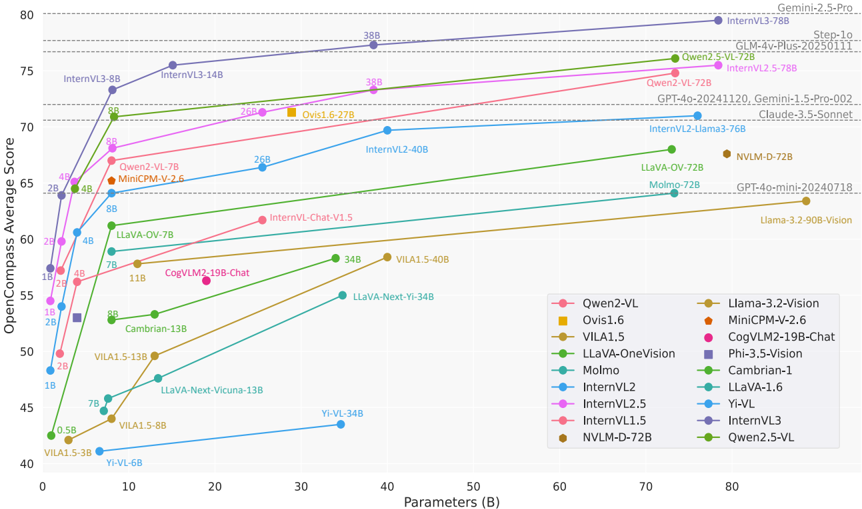
We introduce InternVL3, a significant advancement in the InternVL series featuring a native multimodal pre-training paradigm. Rather than adapting a text-only large language model (LLM) into a multimodal large language model (MLLM) that supports visual inputs, InternVL3 jointly acquires multimodal and linguistic capabilities from both diverse multimodal data and pure-text corpora during a single pre-training stage. This unified training paradigm effectively addresses the complexities and alignment challenges commonly encountered in conventional post-hoc training pipelines for MLLMs. To further improve performance and scalability, InternVL3 incorporates variable visual position encoding (V2PE) to support extended multimodal contexts, employs advanced post-training techniques such as supervised fine-tuning (SFT) and mixed preference optimization (MPO), and adopts test-time scaling strategies alongside an optimized training infrastructure. Extensive empirical evaluations demonstrate that InternVL3 delivers superior performance across a wide range of multi-modal tasks. In particular, InternVL3-78B achieves a score of 72.2 on the MMMU benchmark, setting a new state-of-the-art among open-source MLLMs. Its capabilities remain highly competitive with leading proprietary models, including ChatGPT-4o, Claude 3.5 Sonnet, and Gemini 2.5 Pro, while also maintaining strong pure-language proficiency. In pursuit of open-science principles, we will publicly release both the training data and model weights to foster further research and development in next-generation MLLMs.
Overview
CoChat Summary
TL;DR
InternVL3 introduces a native multimodal pre-training paradigm that jointly learns language and multimodal capabilities in one stage, plus V2PE, SFT/MPO post-training, test-time scaling, and infrastructure optimizations. InternVL3-78B reaches 72.2 on MMMU, setting a new state of the art among open-source MLLMs while remaining competitive with proprietary models.
Key findings
- InternVL3-78B achieves 72.2 on MMMU, 906 on OCRBench, 96.0/98.6 on VCR-EN-Easy (EM/Jaccard), and 89.0/88.7 on MMBench English/Chinese; the paper reports it as a new open-source MLLM state of the art and competitive with ChatGPT-4o, Claude 3.5 Sonnet, and Gemini 2.5 Pro.
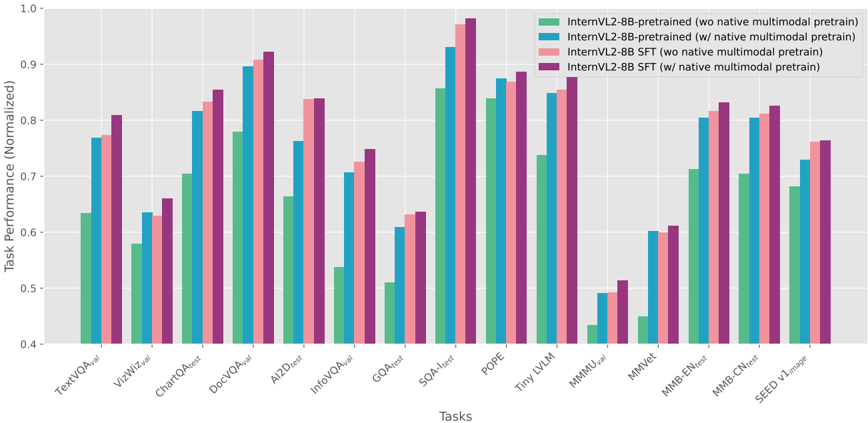
- Native multimodal pre-training is effective: replacing InternVL2-8B’s MLP warmup with native multimodal pre-training yields performance on most benchmarks comparable to the fully multi-stage-trained InternVL2-8B baseline, with further gains after instruction tuning on higher-quality data.
- MPO improves multimodal reasoning across seven benchmarks: InternVL3-78B and InternVL3-38B outperform their non-MPO counterparts by 4.1 and 4.5 points overall, respectively, even though MPO training data is a subset of SFT data.
- Test-time scaling with Best-of-8 and VisualPRM improves reasoning: on the Vision-Only split of MathVerse, best-of-8 gives increases of approximately 6.0 and 3.2 percentage points for InternVL3-38B and InternVL3-78B, respectively.
Methods
- Architecture follows “ViT-MLP-LLM”: vision encoder options are InternViT-300M and InternViT-6B; language models are pre-trained Qwen2.5 series and InternLM3-8B base models; the MLP is a two-layer randomly initialized network; pixel unshuffle reduces each 448×448 image tile to 256 visual tokens.
- Native multimodal pre-training jointly optimizes all parameters on multimodal and pure-language corpora, computes loss only on text tokens, and uses square averaging for token weights. Data combines InternVL2.5 pre-training corpus with GUI, tool usage, 3D scene, and video data, plus InternLM2.5 and open-source text data; the chosen language:multimodal ratio is 1:3, totaling about 200B tokens (50B language, 150B multimodal).
- Post-training uses SFT followed by MPO. SFT grows from 16.3M samples in InternVL2.5 to 21.7M in InternVL3; MPO uses about 300K preference samples and combines DPO preference loss, BCO quality loss, and LM generation loss. Test-time scaling uses Best-of-N with VisualPRM-8B as critic; infrastructure extends InternEVO, yielding a 50% to 200% training speedup for comparable-size models under the same compute budget.
Limitations
- The paper states a noticeable performance gap remains between InternVL3 and models like Qwen2.5-VL on certain benchmarks, such as MuirBench, implying future work may need better training data curation and model refinements.
- The paper reports minor declines on some benchmarks, such as MMHal, and states that optimizing data and training strategies for more consistent improvements remains an important future direction.
- The paper states visual grounding gains plateau at larger scales: InternVL2.5-78B reaches an average score of 92.3 while InternVL3-78B shows 91.4; it speculates this is because InternVL3’s training data expansion did not include additional grounding-specific data and the relative reduction in grounding-targeted data may have restricted localization capabilities.
Model-written summary. Check it against the paper before relying on it.
Integrity signals
Registry
Cites
Statistics
Figures
Verification
Claims the paper makes
0 Valid · 1 Not valid · 14 Not checked · 83 Own results and interpretations
A result the paper reports from its own data — it cites no other source for it, so there is none to check. The quote shows it is in the paper.
In the paper
“When compared with other competitive models, such as Qwen2-VL-72B and Qwen2.5-VL-72B, the InternVL3 series-especially the 78B variant-offers a consistent performance advantage on the multimodal understanding benchmarks.”
§ InternVL3: Exploring Advanced Training and Test-Time Recipes for Open-Source Multimodal Models > 3.6 Comprehensive Multimodal Evaluation
plainstates an association- Asserted: passes — The authors put it forward as true.
- Checkable: passes — It can be checked against evidence.
- Load-bearing: passes — The paper’s conclusions depend on it.
- Based: unclear — It is unclear why the paper says it holds.
A result the paper states — it cites no source for it, so there is none to check. The quote shows it is in the paper.
In the paper
“As a result, the number of training samples grows from 16.3M in InternVL2.5 to 21.7M in InternVL3.”
§ InternVL3: Exploring Advanced Training and Test-Time Recipes for Open-Source Multimodal Models > Data.
plainstates a cause- Asserted: passes — The authors put it forward as true.
- Checkable: passes — It can be checked against evidence.
- Load-bearing: unclear — It is unclear whether the paper’s conclusions depend on it.
- Based: passes — The paper gives a reason why it holds.
A result the paper states — it cites no source for it, so there is none to check. The quote shows it is in the paper.
In the paper
“while also maintaining strong pure-language proficiency.”
§ InternVL3: Exploring Advanced Training and Test-Time Recipes for Open-Source Multimodal Models > Abstract
boosted- Asserted: passes — The authors put it forward as true.
- Checkable: passes — It can be checked against evidence.
- Load-bearing: unclear — It is unclear whether the paper’s conclusions depend on it.
- Based: passes — The paper gives a reason why it holds.
A result the paper reports from its own data — it cites no other source for it, so there is none to check. The quote shows it is in the paper.
In the paper
“Compared with previous models, InternVL3 demonstrates substantial improvements across a wide range of task categories.”
§ InternVL3: Exploring Advanced Training and Test-Time Recipes for Open-Source Multimodal Models > 3.1 Overall Comparison to Other Advanced MLLMs
boosted- Asserted: passes — The authors put it forward as true.
- Checkable: passes — It can be checked against evidence.
- Load-bearing: passes — The paper’s conclusions depend on it.
- Based: passes — The paper gives a reason why it holds.
A result the paper reports from its own data — it cites no other source for it, so there is none to check. The quote shows it is in the paper.
In the paper
“Its capabilities remain highly competitive with leading proprietary models, including ChatGPT-4o, Claude 3.5 Sonnet, and Gemini 2.5 Pro, while also maintaining strong pure-language proficiency.”
§ InternVL3: Exploring Advanced Training and Test-Time Recipes for Open-Source Multimodal Models > Abstract
plain- Asserted: passes — The authors put it forward as true.
- Checkable: passes — It can be checked against evidence.
- Load-bearing: passes — The paper’s conclusions depend on it.
- Based: passes — The paper gives a reason why it holds.
45 more claims
Create a free account to see all 98 claims and every source verdict.
- It may state two separate claims as one. 42
- Probably not a substantial claim. 6
- The quote only partly states this claim. 1
Self-check
Percentages, sums and reported differences re-computed from the paper’s own numbers.
Each contradiction between two passages listed here was confirmed by an independent check.
Rated minor: it would not touch a result — a value no result rests on, a p-value that stays on the same side of the significance level, or a conflict that is clerical, resolved elsewhere in the paper, or outside its own findings.
In the paper
§ InternVL3: Exploring Advanced Training and Test-Time Recipes for Open-Source Multimodal Models > 3.8 Visual Grounding
“InternVL3-8B, InternVL3-9B, and InternVL3-14B yield average scores around 88.2-89.6,reflecting a consistent trend of performance gains as the model size increases.”
§ InternVL3: Exploring Advanced Training and Test-Time Recipes for Open-Source Multimodal Models > 3.6 Comprehensive Multimodal Evaluation
“InternVL3-8B 92.5 94.6 88.0 88.2 92.5 81.8 89.6 90.0 89.6 InternVL3-9B 91.8 93.2 86.6 86.4 91.0 79.9 88.0 88.5 88.2”
Rated minor: it would not touch a result — a value no result rests on, a p-value that stays on the same side of the significance level, or a conflict that is clerical, resolved elsewhere in the paper, or outside its own findings.
In the paper
§ InternVL3: Exploring Advanced Training and Test-Time Recipes for Open-Source Multimodal Models > GPT-4o Gemini 2.0 Claude Aguvis-72B Qwen2.5-VL-72B UI-TARS-72B InternVL3-8B -38B -72B
“The 8B variant (81.4%) already surpasses UI-TARS-72B”
§ InternVL3: Exploring Advanced Training and Test-Time Recipes for Open-Source Multimodal Models > GPT-4o Gemini 2.0 Claude Aguvis-72B Qwen2.5-VL-72B UI-TARS-72B InternVL3-8B -38B -72B
“InternVL3-72B achieves 90.9%, outperforming UI-TARS-72B (90.3%).”
Citations
Cites
Fei-Fei, L., Fergus, R., & Perona, P. (2005) · 2004 Conference on Computer Vision and Pattern Recognition Workshop · doi:10.1109/cvpr.2004.383 · Cited by 2,502
Liu, H., Li, C., Wu, Q., & Lee, Y. J. (2023) · Advances in Neural Information Processing Systems 36 · doi:10.52202/075280-1516 · Cited by 2,428
Making the V in VQA Matter: Elevating the Role of Image Understanding in Visual Question Answering
Goyal, Y., Khot, T., Summers-Stay, D., Batra, D., & Parikh, D. (2017) · 2017 IEEE Conference on Computer Vision and Pattern Recognition (CVPR) · doi:10.1109/cvpr.2017.670 · Cited by 2,287
Chen, Z., Wang, W., Cao, Y., Liu, Y., Gao, Z., Cui, E., Zhu, J., Ye, S., Tian, H., Liu, Z., et al. (2024) · arXiv · doi:10.48550/arxiv.2412.05271 · Cited by 2,204
Self-citationGrounding DINO: Marrying DINO with Grounded Pre-training for Open-Set Object Detection
Liu, S., Zeng, Z., Ren, T., Li, F., Zhang, H., Yang, J., Jiang, Q., Li, C., Yang, J., Su, H., et al. (2025) · Lecture Notes in Computer Science · doi:10.1007/978-3-031-72970-6_3 · Cited by 2,074
Self-citationNatural Questions: A benchmark for question answering research
Kwiatkowski, T., Palomaki, J., Redfield, O., Collins, M., Parikh, A., Alberti, C., Epstein, D., Polosukhin, I., Devlin, J., Lee, K., et al. (2019) · Transactions of the Association for Computational Linguistics · doi:10.1162/tacl_a_00276 · Cited by 2,069
MiniCPM-V: A GPT-4V Level MLLM on Your PhonePreprint
Yao, Y., Yu, T., Zhang, A., Wang, C., Cui, J., Zhu, H., Cai, T., Li, H., Zhao, W., He, Z., et al. (2024) · arXiv · doi:10.48550/arxiv.2408.01800 · Cited by 1,695
Self-citationTriviaQA: A Large Scale Distantly Supervised Challenge Dataset for Reading Comprehension
Joshi, M., Choi, E., Weld, D., & Zettlemoyer, L. (2017) · Proceedings of the 55th Annual Meeting of the Association for Computational Linguistics (Volume 1: Long Papers) · doi:10.18653/v1/p17-1147 · Cited by 1,690
Math-Shepherd: Verify and Reinforce LLMs Step-by-step without Human Annotations
Wang, P., Li, L., Shao, Z., Xu, R., Dai, D., Li, Y., Chen, D., Wu, Y., & Sui, Z. (2024) · Proceedings of the conference - Association for Computational Linguistics. Meeting · doi:10.18653/v1/2024.acl-long.510 · Cited by 1,665
TriviaQA: A Large Scale Distantly Supervised Challenge Dataset for Reading Comprehension
Joshi, M., Choi, E., Weld, D. S., & Zettlemoyer, L. (2017) · arXiv · doi:10.48550/arxiv.1705.03551 · Cited by 1,650
Research works printed but not linked: 6
- Anonymous. CG-bench: Clue-grounded question answering benchmark for long video understanding. In Submitted to The Thirteenth International Conference on Learning Representations, 2024. under review. 14, 15
- Shuai Bai, Keqin Chen, Xuejing Liu, Jialin Wang, Wenbin Ge, Sibo Song, Kai Dang, Peng Wang, Shijie Wang, Jun Tang, et al. Qwen2.5-vl technical report. arXiv preprint arXiv:2502.13923, 2025. 1, 2, 9, 10, 15 · arXiv
- Jie Cao and Jing Xiao. An augmented benchmark dataset for geometric question answering through dual parallel text encoding. In Proceedings of the 29th International Conference on Computational Linguistics, pages 1511-1520, 2022. 6
- Zhe Chen, Weiyun Wang, Hao Tian, Shenglong Ye, Zhangwei Gao, Erfei Cui, Wenwen Tong, Kongzhi Hu, Jiapeng Luo, Zheng Ma, et al. How far are we to gpt-4v? closing the gap to commercial multimodal models with open-source suites. arXiv preprint arXiv:2404.16821, 2024. 2, 3 · arXiv
- Hunter Lightman, Vineet Kosaraju, Yuri Burda, Harrison Edwards, Bowen Baker, Teddy Lee, Jan Leike, John Schulman, Ilya Sutskever, and Karl Cobbe. Let's verify step by step. In The Twelfth International Conference on Learning Representations, 2023. 7
- Minesh Mathew, Viraj Bagal, Rubèn Tito, Dimosthenis Karatzas, Ernest Valveny, and CV Jawahar. Infographicvqa. In Proceedings of the IEEE/CVF Winter Conference on Applications of Computer Vision, pages 1697-1706, 2022. 6, 7, 8, 10
Cited by
Items 2,501–2,600 of 2,641
Beyond Modality Preference: Controlling Multimodal Arbitration under Modality Conflict in MLLMsPreprint
Pan, Z., Lu, S., Wong, J. H., Chai, J., & Wang, X. (2026) · arXiv · doi:10.48550/arxiv.2611.12883
“5-VL-7B [2], Qwen3-VL-8B [1], LLaVA-OneVision-7B [17] and InternVL3-8B [41].”
Self-citationHe, Y., Huang, X., & Liu, Y. (2026) · arXiv · doi:10.48550/arxiv.2611.10559
“Besides the primary model we test InternVL3-8B [38], LLaVA-OneVision-7B [15], ShotVL-7B v1.”
Self-citationCan MLLMs Reason over Surround-View Driving Videos? A Multi-View Autonomous Driving QA BenchmarkPreprint
Liu, S., Peng, J., Li, C., Hou, L., Huang, P., Sun, Y., & Liu, H. (2026) · arXiv · doi:10.48550/arxiv.2611.15225
“5-VL-72B [30], InternVL3-78B [29], Qwen2.”
InfluentialBack to the Question: Tracing Visual Distraction Through Text TokensPreprint
Huynh, M. A., Cohen, R., Yeung, S. Y., & Doveh, S. (2026) · arXiv · doi:10.48550/arxiv.2611.15039
Keep Images in Sight: Visual Position Re-Anchoring for Long-Context MLLMsPreprint
Xu, J., Zhao, Q., Sun, R., Jiang, Z., Wu, S., Li, Z., Ma, K., & Liu, Y. (2026) · arXiv · doi:10.48550/arxiv.2611.15100
“…short-context answer, “Tongue in cheek,” becomes “Sign in protest” in a long context, confusing the subtitle with the headline. ternVL, support long multimodal inputs [1, 2, 30, 36], but retaining an image within the context window does not by itself ensure that the model can still use it reliably.”
Self-citationVAC-Bench: From Text Similarity to Norm Conformance in Video Aesthetic Captioning Evaluation
Shi, T., Wu, Z., Qiao, Q., Mo, H., Song, W., Wang, X., Huang, H., Bo, Y., Sun, H., Jin, X., et al. (2026) · ACM International Conference on Multimedia (ACM MM) · doi:10.1145/3767308.3834988
“5-VL 7B [2], LLaVA-OneVision 7B[13],LLaVA-NeXT8B[19],InternVL38B[44],Llama-3.”
Self-citationFlashCodec: Unleash All Decoding Resources for Low-Latency Video Decoding in MLLM Inference
Zhao, L., Zhou, H., Che, Y., Luo, R., & Cheng, D. (2026) · doi:10.1145/3828523.3857057
“MLLMs, such as Gemini [43], GPT-4o [18], and open-source series like LLaVA [17, 23, 24], Qwen-VL [1, 2, 46], and In-ternVL [47, 58] extend the intelligence of LLMs from text to diverse input modalities, unlocking new possibilities for real-world scenarios.”
Do VLMs Really Look at the Road? A Diagnostic Evaluation for Autonomous DrivingPreprint
Gangisetty, S., Singh, M., & Jawahar, C. V. (2026) · arXiv · doi:10.48550/arxiv.2611.19184
“5-VL 7B [2], InternVL3 8B [19], LLaVA-OV 8B [7].”
Visual Marking as a Native Reasoning Capability for Multimodal LLMsPreprint
Liu, J., Wang, Y., Tan, C., & Chen, L. (2026) · arXiv · doi:10.48550/arxiv.2611.20278
Self-citationContrast Where It Matters: Visual Evidence-Guided Decoding for Mitigating Hallucinations in LVLMsPreprint
Li, Y., Wang, W., Li, X., Jia, M., Tan, Z., Tang, Y., Lei, Z., & Yang, Y. (2026) · arXiv · doi:10.48550/arxiv.2611.25524
“More recent models [3, 19, 45] scale multimodal pretraining to higher-resolution images, multiple images, videos, and broader reasoning tasks.”
Self-citationHSGG: Training-Free Hierarchical Scene Graph Generation with Geometry-Guided Relation Reasoning
Liu, Y., Liu, W., Cen, L., Qu, Z., Cen, Y., Liang, Y., Xie, Y., & Kan, S. (2026) · International Conference on Machine Learning
Self-citationFrom Diagrams to Code: Multilingual Programming with Visual Design
Chai, L., Yang, J., Liu, S., Zhang, W., Wang, L., Jin, K., Sun, T., Liu, C., Zhang, C., Zhu, H., et al. (2026) · International Conference on Machine Learning
Self-citationEAKV: An Entropy-Driven Adaptive KV Compression Framework for Long Video Understanding
Hu, H., Li, J., Liang, J., Chen, G., & Zhang, L. (2026) · International Conference on Machine Learning
Inspect Before You Decide: Evidence-Guided Visual Search for Industrial Anomaly DetectionPreprint
Chen, P., Huang, C., Liu, Y., Wu, M., Xu, J., Yang, M., Cao, Y., & Huang, F. (2026) · arXiv · doi:10.48550/arxiv.2611.29551
“The general-purpose open-source baselines include models from the Qwen [2], LLaVA [19], InternVL [39], GLM [12], and Kimi-VL [17] families, along with MiMo-VL-7B-RL [33].”
Self-citationLoopSeek: Decoupling System One Search from System Two Answering for Long Video UnderstandingPreprint
Wang, C., Lin, L., Liu, X., Yin, Y., Zhou, M., & An, S. (2026) · arXiv · doi:10.48550/arxiv.2611.28635
“Long Video Understanding with MLLMs. Video MLLMs [3, 4, 43, 60, 62] typically answer from a fixed number of uniformly sampled frames.”
Wu, P., Sun, F., Li, Z., Tan, Z., Zhang, J., Chen, W., & Yang, Y. (2026) · Robotics and Autonomous Systems · doi:10.1016/j.robot.2026.105870
DiasR: Dual-Modal Identity-Anchored Sparse Routing for Efficient Multi-Subject Video Generation
Li, Y.-Y., Liu, W., Li, J., Liu, X., Zhang, Y., & Jin, G. (2026) · International Conference on Machine Learning
PortraitAes: Intent-Conditioned Structured Portrait Aesthetic AssessmentPreprint
Xie, J., Xiong, H., Tian, X., Du, K., Yu, T., Li, Q., Liu, W., Liu, J., Huang, R., Shi, Y., et al. (2026) · arXiv · doi:10.48550/arxiv.2610.05010
“Full optimization settings, reward weights, and compute details are provided in Appendix E. (Zhu et al., 2025), and specialized aesthetic or perceptual assessment systems, including PortraitCraft (Sha et al., 2026; Bai et al., 2025), Ar-tiMuse (Cao et al., 2026), UniPercept (Cao et al., 2025),…”
Cognitive Action Reasoning for Proactive Robots from Human-Centered Multimodal ObservationsPreprint
Gu, Z., Zhu, K., Wu, Y., Liu, M., Shaw, A. K., Hong, C., Chen, X., Mei, D., Tianyi, X., & Wang, L. (2026) · arXiv · doi:10.48550/arxiv.2609.23486
“We further include representative open-source models from InternVL [36], [38], Video-Llama [39], Video-Llama2 [41], Llama-Omni [32], LLaVA-Video [37], GLM [31], Ming-Omni [40] and Qwen2.”
Self-citationPOLIA: Policy Optimization with Visual-Object-Level Intrinsic Advantage for Multimodal Reasoning
Zeng, Y., Chen, D., Mao, H., Zhang, Y., Wan, P., & Zhao, M. (2026) · International Conference on Machine Learning
Context-Aware Reasoner: Enhancing Contextual Reasoning in Multimodal Large Language Models
Zheng, Z., Zhang, W., Zhou, X., Hou, G., Mei, X., Mao, T., Piao, A., Jiang, S., Shen, Y., Zhuang, Y., et al. (2026) · International Conference on Machine Learning
Fu, Y.-B., Xie, H.-D., Niu, Y.-H., Ji, W., Dong, H.-M., Wang, Z.-Y., Chen, J.-Y., Zhao, J., Hu, H.-Y., Shan, H., et al. (2026) · arXiv · doi:10.48550/arxiv.2611.29305
“6-Sol, InternVL3 [49], and the Qwen series [29, 32, 42].”
MultiFlow: Vision-Driven Multimodal fMRI Encoding via Stimulus-Informed Source Flow Matching
Hùng, B., Vo, H.-S., Huy, M. D. M., Vu, D. T., & Kim, S.-H. (2026) · British Machine Vision Conference (BMVC) · doi:10.5244/c.40.210
Charts Are Beyond Pixels: Probing for Layer-Wise Chart Understanding and EditingPreprint
Zhong, X., Hou, Y., Pang, C., & Cui, S. (2026) · arXiv · doi:10.48550/arxiv.2609.08657
“5 (Qwen Team, 2026; Bai et al., 2025; Zhu et al., 2025; Yu et al., 2026b).”
What Stays in the Picture? From Redundant Instructions to Dependency-Aware Image EditingPreprint
Wang, Z.-J., Lin, Y., & Zhao, Z. (2026) · arXiv · doi:10.48550/arxiv.2611.27388
“IntentEdit [41] uses InternVL3-14B [43] for instruction processing, with FLUX.1-Kontext [18] configured for 20 steps and a guidance scale of 3.5, and BAGEL [9] for 35 timesteps with text and image guidance scales of 4 and 2.”
InfluentialA unified vision-language framework for multi-task pavement crack assessment
Chen, M., Huang, J., Ding, R., Zhu, S., Hu, J., & Peng, J. (2026) · Engineering Applications of Artificial Intelligence · doi:10.1016/j.engappai.2026.116684
Seeing isn't Hearing: Benchmarking Vision Language Models at Interpreting SpectrogramsPreprint
Loakman, T., James, J., & Lin, C. (2025) · arXiv · doi:10.48550/arxiv.2511.13225
“Specifically, we selected: Qwen 2.5-VL (7B and 32B) (Bai et al., 2025), Llava 1.6 (7B and 34B) (Liu et al., 2024), and InternVL 3 (8B and 38B) (Zhu et al., 2025a).”
InfluentialJaumann, C., Friedrich, A., & Lienhart, R. (2025) · arXiv · doi:10.48550/arxiv.2507.02357
Ma, X., Zhang, H., Li, W., & Lu, S. (2025) · arXiv · doi:10.48550/arxiv.2511.19856
“Crucially, main-stream vision models [37, 50, 85] are exclusively pretrained on authentic natural image datasets (e.g., ImageNet [15], LAION [56] and COYO [42]).”
Self-citationQiao, J., Li, S., Liu, J., Yu, H., Xiao, Y., Yu, H., & Zheng, Y. (2025) · IEEE International Conference on Bioinformatics and Biomedicine (BIBM) · doi:10.1109/bibm66473.2025.11356359
“1 [20], Gemini 2.5 [21], InternVL-3 [18], Kimi-k1.”
InfluentialSelf-citationQ-Former-based vision-language alignment for multimodal understanding of endoscopic surgery scenes
Wang, C., Hayashi, Y., Oda, M., & Mori, K. (2026) · SPIE Medical Imaging: Image-Guided Procedures, Robotic Interventions, and Modeling · doi:10.1117/12.3087423
Vision-Language Model-Based Face Verification for Preventing Unauthorized Access
Lim, J., & Yoon, H. (2025) · International Conference on Information and Communication Technology Convergence (ICTC) · doi:10.1109/ictc66702.2025.11388231
“To verify the face verification performance of Vision-Language Models without additional training, we conducted Zero-Shot tests on both InternVL3 [5] and Qwen2.”
InfluentialLanguage as a supervisor: a text-driven visual learning approach for general purpose meter reading
He, W., Mao, Y., & Xiang, W. (2026) · International Conference on Graphics and Image Processing (ICGIP) · doi:10.1117/12.3095244
“To validate the effectiveness of the proposed method in the multimodal pointer-type meter reading task, the method is compared with several state-of-the-art open-source multimodal large language models, including Gemma3-12B [26], Janus-pro-7B [27], InterVL3-8B [28], and Qwen2.”
Beyond Single-Sample: Reliable Multi-Sample Distillation for Video UnderstandingPreprint
Li, S., Zhu, X., Guan, Z., Chen, P., & Yao, J. (2026) · arXiv · doi:10.48550/arxiv.2603.11423
Self-citationSeeing isn’t Hearing: Benchmarking Vision Language Models at Interpreting Spectrograms
Loakman, T., James, J., & Lin, C. (2025) · International Joint Conference on Natural Language Processing and Conference of the Asia-Pacific Chapter of the Association for Computational Linguistics (IJCNLP-AACL) · doi:10.18653/v1/2025.ijcnlp-short.7
SaSaSaSa2VA: 2nd Place of the 5th PVUW MeViS-Text TrackPreprint
Gong, D., Niu, Q., Chen, S., Wu, Y., Zhou, Y., Zhang, T., Yuan, H., Qi, L., & Ji, S. (2026) · arXiv · doi:10.48550/arxiv.2603.27241
“With the advancement of multi-modal large language models (MLLMs) [1–3, 6–8, 30–32, 45, 46], research in this area has shifted from static feature matching to deeper semantic understanding of complex visual and linguistic interactions.”
InfluentialChao, L., Zhang, K., Li, X., Yin, L., Cai, H., Wu, S., & Shan, D. (2026) · Engineering Applications of Artificial Intelligence · doi:10.1016/j.engappai.2026.114848
Self-citationCAER: Conflict-Aware Evidence Routing with Dual Prefix Experts for Multimodal Large Language ModelsPreprint
Liu, Z., Cai, J., Cai, X., Wang, H., & Bu, J. (2026) · arXiv · doi:10.48550/arxiv.2607.28991
Self-citationMulti-modal LLM Based Image Captioning in ICT: Bridging the Gap Between General and Industry Domain
Chao, L., Cai, H., Li, X., Zhang, K., Wu, S., & Xu, R. (2026) · Communications in computer and information science · doi:10.1007/978-981-95-8447-5_21
Self-citationIterCAD: Iterative Program Repair for CAD Code Generation from Orthographic Views
Wu, Y., Niu, K., Yu, H., Chen, Z., Xue, X., & Li, B. (2026) · ACM International Conference on Multimedia (ACM MM) · doi:10.1145/3767308.3836503
Self-citationDICS: Exploring Data Intrinsic Consistency for Visual Instruction Selection
hong, Y., Guo, J., Gu, J., Fan, L., Wang, R., Ding, K., Wu, Y., Xiang, S., & Ye, J. (2026) · Findings of the Association for Computational Linguistics: EMNLP (Findings of EMNLP) · doi:10.18653/2026.findings-emnlp.163
Evaluating zero-shot anomaly detection in videos using large vision-language models
Alsubaie, N. M., Khuzayem, L. A., & Alhothali, A. (2026) · International Conference on Image Processing and Machine Vision (IPMV) · doi:10.1117/12.3111524
手順動画における詳細な間違い検出ベンチマークの構築と MLLM の評価
Takashige, S. (2026) · Institutional Repositories DataBase (IRDB)
AstroVLM: Expert Multi-agent Collaborative Reasoning for Astronomical Imaging Quality DiagnosisPreprint
Han, Y., Wang, T., Zhao, Z., Zhu, Z., Ren, S., Yiru, 王. W., Fu, R., Chen, T., & Ho, T.-Y. (2026) · arXiv · doi:10.48550/arxiv.2604.16024
“…in astronomical imaging quality diagnosis, we equipped several existing state-of-the-art VLMs with our As-troVLM framework, including GPT-4o [Hurst et al. , 2024], Claude Sonnet 4 [Anthropic, 2024], Qwen3-VL [Bai et al. , 2025], InternVL3 [Zhu et al. , 2025], and Deepseek-VL2 [Wu et al. , 2024].”
GLaSS-VLM: A Wearable Generative Vision Language System for Intraoperative Monitoring
Yuan, S., Zou, Y., Li, K., Xu, C., Zhu, T., & Yang, L. (2026) · IEEE International Conference on Acoustics Speech and Signal Processing · doi:10.1109/icassp55912.2026.11462931
Robust Grounding with MLLMs Against Occlusion and Small Objects via Language-Guided Semantic CuesPreprint
Park, B., Kim, S., Kim, H., Park, S., & Ro, Y. M. (2026) · arXiv · doi:10.48550/arxiv.2604.24036
Allegory of the Cave: Measurement-Grounded Vision-Language LearningPreprint
Xu, K., Xu, L. F., He, G., & Yu, W. (2026) · arXiv · doi:10.48550/arxiv.2605.11727
“Contemporary VLMs are built largely on post-ISP RGB corpora and RGB-pretrained visual encoders (Radford et al., 2021; Alayrac et al., 2022; Li et al., 2023a; Liu et al., 2023a; Wang et al., 2024; Bai et al., 2025b,a; Zhu et al., 2025; Wang et al., 2025).”
Molinaro, P., Presta, M., & Fortino, G. (2026) · IEEE Conference on Artificial Intelligence (CAI) · doi:10.1109/cai68641.2026.11536321
Fine-Tuning Vision-Language Models for Video Question Answering in Livestock Monitoring
Kim, V. V., 이성훈, Jeong, W., Park, H., Park, J., & Jo, J.-J. (2026) · International Conference on Intelligent Environments (IE) · doi:10.1109/ie69249.2026.11539032
“0 (38B) [4] as our baseline because its Variable Visual Position Encoding (V2PE) natively supports video inputs, and its LLM backbone enables chain-of-thought reasoning beyond simple classification.”
Encoded but Not Routed: Explaining the Table-Chart Gap in Scientific Claim Verification
Kumar, S., Ho, X., Schopf, T., Greiner-Petter, A., Boudin, F., & Aizawa, A. (2026) · doi:10.18653/2026.findings-aacl.185
PlanBench-V: A Spatial Planning Map Benchmark for Vision-Language ModelsPreprint
Chen, M., Zhu, H., Su, J., Wang, W., Deng, Y., & Zhang, W. (2026) · arXiv · doi:10.48550/arxiv.2606.05744
“VLMs have demonstrated remarkable progress in general multimodal tasks, including image understanding (Hurst et al. 2024, DeepMind 2023), visual reasoning (Zhu et al. 2025c, Guo et al. 2025), and multimodal dialogue (Liu et al. 2023, Wang et al. 2024a).”
Self-citationWhen Correct Decisions Hide Internal Stress: Decision-State Probing in Multimodal Language ModelsPreprint
Zhao, H., Han, S. C., & Hovy, E. H. (2026) · arXiv · doi:10.48550/arxiv.2606.08394
Kadri, N. T., Paheding, S., & Oommen, T. (2026) · SPIE Pattern Recognition and Prediction · doi:10.1117/12.3094978
“The InternVL 3 model, 26 featuring 78 billion parameters, incorporates advanced vision-language integration techniques and is anticipated to yield high-quality captions.”
He, Y., Zhang, M., Sun, H., Wang, J., Lin, K., Wang, J., Xu, C., Ren, P., Qi, Q., & Wang, J. (2026) · Proceedings of the conference - Association for Computational Linguistics. Meeting · doi:10.18653/v1/2026.acl-long.56
Self-citationDunhuang-Bench: How Well Do MLLMs Understand Cultural Heritage?
Yuan, J., Zhang, J., Yu, T., Zhou, Y., Jin, X., Wang, Q., & Wu, F. (2026) · Findings of the Association for Computational Linguistics: ACL (Findings of ACL) · doi:10.18653/v1/2026.findings-acl.888
Li, J., Xue, W., Yao, Y., Li, Q., Chenchong, Li, Z., Wang, P., & Zhao, H. (2026) · Proceedings of the conference - Association for Computational Linguistics. Meeting · doi:10.18653/v1/2026.acl-long.997
Yu, J., Wang, R., Chu, D., Wang, C., Feng, R., & Lu, L. (2026) · arXiv · doi:10.48550/arxiv.2607.13926
“InternVL3-2B [20], the VLM baseline exhibits systematic geometric deviations during high-curvature turns and at intersections (red circles in Fig.”
InfluentialSelf-citationPyakurel, B., & Murshed, M. G. S. (2026) · arXiv · doi:10.48550/arxiv.2607.15517
“The four open-source models span the systems that lead recent fingerprint and face benchmarks: InternVL3-8B-Instruct [16] (bfloat16, ∼ 16 GB), a top open-source performer in FPBench; Qwen2.”
RecoReward: Recommender-Guided Multimodal Description Generation for RecommendationPreprint
Mu, G.-H., Liu, Y.-Y., Cao, J., Lao, C.-X., Zhuang, Z.-J., Zhang, Y.-H., Feng, J.-Q., Yang, R.-C., Yang, S., Liu, Z.-J., et al. (2026) · arXiv.org · doi:10.48550/arxiv.2607.25901
Self-citationSepPrune:A Separator-based Pruning Framework for Efficient Multimodal Large Language ModelsPreprint
Wang, Y., Zhu, Q., Liu, Y., Sun, X., & Wu, S. (2026) · arXiv · doi:10.48550/arxiv.2607.25818
Self-citationSafeBuild-Bench: A Temporal-Robust Construction Safety Benchmark with Graph-Enhanced Data Mining
Cui, Y., Wang, Z., Xu, Y., Cai, Q., Yao, H., Jiang, S., Zhong, B., & Xiong, H. (2026) · ACM SIGKDD Conference on Knowledge Discovery and Data Mining (KDD) · doi:10.1145/3770855.3817581
Li, Z., Zhang, F., Liu, Z., & Cheng, J. (2026) · ACM SIGKDD Conference on Knowledge Discovery and Data Mining (KDD) · doi:10.1145/3770855.3817959
Self-citationReGraph: Learning to Generate Recipe Graphs from Food ImagesPreprint
Liu, G., Zhu, B., Jiao, P., Chen, J., Ngo, C., & Jiang, Y. (2026) · arXiv · doi:10.48550/arxiv.2608.06917
“During supervised fine-tuning ( RGL-SFT ), both Qwen3-VL-8B and InternVL3-8B are trained for one epoch with a learning rate of 1 × 10 − 4 , a global batch size of 8, and a warmup ratio of 0 .”
InfluentialSelf-citationGazePruning: Gaze-Guided Token Pruning for LVLMs in Virtual Reality
Ren, Y., Li, N., Zhang, P., Gu, N., & Lu, T. (2026) · ACM International Conference on Multimedia (ACM MM) · doi:10.1145/3767308.3836502
“5 [6] (8B) and InternVL3 [36] (8B)), and the Qwen series (e.g., Qwen2-VL [27] (7B) and Qwen2.”
Self-citationWorld-Model Inspired Emotion-aware Token Refinement for Training-Free Multimodal Emotion Recognition
Liu, K., Chen, Z., Liu, Y., Wang, K., Zhan, Y., Xiang, W., & Zhang, H. (2026) · International Conference on Machine Learning
Self-citationJiang, X., Dong, P., Yang, C., Yang, X., & Cheng, K.-T. (2026) · arXiv · doi:10.48550/arxiv.2611.29489
ADOPD: Reference-Privileged On-Policy Distillation for MLLM-Based Industrial Anomaly DetectionPreprint
He, J., Meng, S., Meng, W., & Yang, Q. (2026) · arXiv · doi:10.48550/arxiv.2608.09789
“(Zhu et al., 2025), and GLM-4.”
Self-citationSynWeaver: Website-Prior Task and Trajectory Co-Synthesis for Web AgentsPreprint
Wang, R., Hao, Y., & Yang, M. (2026) · arXiv · doi:10.48550/arxiv.2608.12429
Mei, Y., Shi, Q., Wu, C., Rao, J., Ji, J., & Cao, L. (2026) · arXiv · doi:10.48550/arxiv.2608.12920
ChainSpace: A Chained-Reasoning Paradigm for Spatial IntelligencePreprint
Zhang, X., Gu, F., Rao, X., Pan, X., Wei, T., Pan, Z., & Zhan, K. (2026) · arXiv · doi:10.48550/arxiv.2608.15788
“However, despite rapid progress in multimodal foundation models [40, 49, 21], spatial intelligence remains a major challenge [7].”
InfluentialSelf-citationGeoLogVQA: A Borehole Log Documents Dataset for Explicit and Implicit Spatial Reasoning
Bagnol, S., Barrere, K., Églin, V., Egyed‐Zsigmond, E., Pitaval, D., & Côme, J.-M. (2026) · Lecture notes in computer science · doi:10.1007/978-3-032-36023-6_3
Aligning Multi-Trajectory Supervision with Policy Optimization for VLA DrivingPreprint
Zhang, T., Huang, Z., Ye, H., Wu, Y., Wang, Z., & Zhou, K. (2026) · arXiv · doi:10.48550/arxiv.2608.30122
Ding, S., Song, L., & Suo, D. (2026) · Conference on Empirical Methods in Natural Language Processing (EMNLP) · doi:10.18653/2026.emnlp-main.1518
Controllable Image Captioning with Prompt-Conditioned Scene Rewards
Hyun, J., Kim, T., & Kim, H. (2026) · Conference on Empirical Methods in Natural Language Processing (EMNLP) · doi:10.18653/2026.emnlp-main.2622
Poveda-Gutiérrez, S., Nakayama, H., & Bono, M. (2026) · arXiv · doi:10.48550/arxiv.2609.03788
“Given a sign-level clip, an open-weight large vision– language model (LVLM; InternVL3, 8B [6]) is prompted to produce a procedural description: how the sign is performed (e.g., hand shape, location, movement).”
Two-Stage Mixture-of-LoRA for Multi-Task Medical Vision-Language LearningPreprint
Chen, Z., Li, Y., Lu, Z., Gao, S., Zhou, G., & Zhang, Y. (2026) · arXiv · doi:10.48550/arxiv.2609.14350
“5-VL-7B [3], Hulu-Med-7B [7], Lingshu-7B [15], InternVL3-8B [17], Qwen3.”
Self-citationEvaluating Open-source Vision-Language Models for Automated Quality Assessment of Food DonationsPreprint
Singh, A., & Ayanlade, T. T. (2026) · SSRN Electronic Journal · doi:10.2139/ssrn.7463399
Pu, B., Liu, C., Lu, Z., & Xie, H. (2026) · IEEE Transactions on Multimedia · doi:10.1109/tmm.2026.3734753
RCVLA: 4D Radar-Grounded Semantic Reasoning and Trajectory Arbitration for Autonomous DrivingPreprint
Zheng, L., Bai, X., Luo, Y., Guan, R., Liu, M., Wei, Z., Shen, H.-L., 朱西产, & Ma, Z. (2026) · arXiv · doi:10.48550/arxiv.2609.32681
“5-8B (Chen et al., 2024), InternVL3-8B (Zhu et al., 2025), OmniDrive (Wang et al., 2025), Constant-Velo, BEV-Planner (Li et al., 2024), and UniAD (Hu et al., 2023).”
Uruqi: Learning Spatial Cognition from Visual ExperiencePreprint
Li, S., Wang, M., Su, F., & Zhao, Z. (2026) · arXiv · doi:10.48550/arxiv.2609.39195
“• URUQI Syn -8B : initialized from InternVL3-8B (Zhu et al., 2025) and post-trained only on our synthesized visual-experience supervision.”
InfluentialSelf-citationUnlocking Fine-Grained Perception in CLIP via Structurally-Aware Latent Masked ModelingPreprint
Li, J., Dang, L., Wu, H., Qiu, Z., Xiao, Q., & Wu, Q. (2026) · arXiv · doi:10.48550/arxiv.2610.07689
“This deficiency in fine-grained perception not only limits performance in tasks such as dense prediction [66, 65] but also constitutes a bottleneck for Multimodal Large Language Models (MLLMs) [37, 33, 2, 74] aiming for refined visual understanding [16, 38].”
Yang, Z., Ding, W., Feng, S., & Tsvetkov, Y. (2026) · arXiv · doi:10.48550/arxiv.2610.07774
Matching Object or Relation? Tracing Abstract Reasoning Inside VLMsPreprint
Minegishi, G., Furuta, H., Kojima, T., Iwasawa, Y., & Matsuo, Y. (2026) · arXiv · doi:10.48550/arxiv.2610.07646
AdaC-GRPO: Towards Mastering Long-Horizon Visual Sudoku Puzzles via Adaptive Curriculum Learning
Li, S., Liu, Y., Yao, L., Li, S., Sun, X., Bai, H., & Li, X. (2026) · Findings of the Association for Computational Linguistics: EMNLP (Findings of EMNLP) · doi:10.18653/2026.findings-emnlp.2255
Self-citationPang, Y., Yang, B., Wang, S., Cao, Y., & He, C. (2026) · IEEE Transactions on Multimedia · doi:10.1109/tmm.2026.3744099
Self-citationYuan, X., Yao, B., Yang, L., Chen, R., & Wang, Z. (2026) · arXiv · doi:10.48550/arxiv.2610.26401
“5-VL-7B [1] and InternVL3-8B [39] on page images with greedy decoding, Qwen3-4B-Instruct-2507 [35] on the page text with masked lines replaced by [masked] , and GPT-6.”
Gautam, S., & Harit, G. (2026) · arXiv · doi:10.48550/arxiv.2610.32423
“Although OCR-free VLMs, such as LayoutLMv3 [21], Pix2Struct [22], PaLI-X [23], LLaVA [24], Llama [25], Flamingo [26], InternVL [27], Qwen2-VL [28], Qwen2.”
DiffAuction: An Auction-Driven Framework for Generative Image AdvertisingPreprint
Su, Y., Si, R., & Wang, T. (2026) · arXiv · doi:10.48550/arxiv.2610.34917
Suresh, A. K., Dayal, A., Gouthaman, K. V., Pola, A., & Balasubramanian, V. N. (2026) · arXiv · doi:10.48550/arxiv.2610.37430
“5-VL-7B [14, 15].”
AGE-Sampler: Adaptive-granularity Graph-enhanced Event Sampling for Long-Video Understanding
Wang, Y., Dai, T., Zha, Y., & Xia, S. (2026) · Conference on Empirical Methods in Natural Language Processing (EMNLP) · doi:10.18653/2026.emnlp-main.2383
Self-citationThe Prestige: Benchmarking Cognitive Visual Reasoning using Magic TricksPreprint
Wen, S., Du, B., Meriaux, E., Shi, J., Si, C., Meger, D., Precup, D., & Dudek, G. (2026) · arXiv · doi:10.48550/arxiv.2610.38103
“5-VL [ 3], Qwen3VL [2], InternVL3 [43], GLM-4.”
Toward Counterfactual Learning for Selective Re-Examination in Agentic Visual SearchPreprint
Chen, A., Chen, S., & Luximon, Y. (2026) · arXiv · doi:10.48550/arxiv.2611.00848
Machine-oriented Visual Media Quality Assessment
Li, C., Qing, R., Zhang, J., Han, Y., Liu, S., Zhang, Y., Zhang, Z., Duan, H., Zhou, W., Zimmermann, R., et al. (2026) · ACM International Conference on Multimedia (ACM MM) · doi:10.1145/3767308.3836624
Li, Y., Wang, C., Zeng, Z., & Müller, S. (2026) · Communications in Transportation Research · doi:10.26599/commtr.2026.9640061
SAGE: Typographic Adversarial Defense for Large Vision-Language Models via Scene-Aware Guard Engine
Huang, D., Liu, J., Sun, J., Xinyue, F., & Ge, S. S. (2026) · ACM International Conference on Multimedia (ACM MM) · doi:10.1145/3767308.3835834
“6-34b [20], InternVL3-38b [37], Qwen2.”
DxG-Fuse: Description-Guided Fusion for Multimodal Fake News Detection via MLLMs
Yu, Z., Zhu, G., Fan, Z., Li, X., Luo, X., & Wu, L. (2026) · IEEE Transactions on Information Forensics and Security · doi:10.1109/tifs.2026.3751583
Self-citationSurgAgents: A Multi-agent Framework for Embodied Cataract Surgical Intent Prediction
Wang, S., Ji, Y., Yao, Y., Qin, Z., & Liu, Y. (2026) · International Joint Conference on Natural Language Processing and Conference of the Asia-Pacific Chapter of the Association for Computational Linguistics (IJCNLP-AACL) · doi:10.18653/2026.aacl-long.135
Self-citationChang, H., Li, X., Liu, H., Zhang, F., & Yin, Y. (2026) · International Joint Conference on Natural Language Processing and Conference of the Asia-Pacific Chapter of the Association for Computational Linguistics (IJCNLP-AACL) · doi:10.18653/2026.aacl-long.226
Ma, B., Yan, W., & Wu, J. (2026) · arXiv · doi:10.48550/arxiv.2611.11873
Frame Alignment Redirects Person-State Attribution Toward the Wrong Person in Vision-Language ModelsPreprint
Inoshita, K. (2026) · SSRN Electronic Journal · doi:10.2139/ssrn.7685781
Metadata
- Authors
- Zhu, J., Wang, W., Chen, Z., Liu, Z., Ye, S., Gu, L., Tian, H., Duan, Y., Su, W., Shao, J., Gao, Z., Cui, E., Wang, X., Cao, Y., Liu, Y., Wei, X., Zhang, H., Wang, H., Xu, W., Li, H., Wang, J., Deng, N., Li, S., He, Y., Jiang, T., Luo, J., Wang, Y., He, C., Shi, B., Zhang, X., Shao, W., He, J., Xiong, Y., Qu, W., Sun, P., Jiao, P., Lv, H., Wu, L., Zhang, K., Deng, H., Ge, J., Chen, K., Wang, L., Dou, M., Lu, L., Zhu, X., Lu, T., Lin, D., Qiao, Y., Dai, J., & Wang, W.
- Affiliations
- Shanghai Artificial Intelligence Laboratory (CN)
- Chinese University of Hong Kong (HK)
- Sensetime (China) (CN)
- Shanghai Jiao Tong University (CN)
- ORCID
- Venue
- arXiv
- Publisher
- arXiv
- Published
- 2025
- ISSN
- 2331-8422 (ISSN-L)
- arXiv
- 2504.10479
- OpenAlex
- W4416053382
- Cited by
- 2,644
- References
- 138
- Citations by year
- 2026: 1999 · 2025: 638
- Type
- posted content
- Language
- en
- Open access
- green
- arxiv.org
- Licence
- Locations
- arXiv (submittedVersion, cc-by)
- Topics
- Physical Sciences › Computer Science › Computer Vision and Pattern Recognition › Multimodal Machine Learning Applications
- Physical Sciences › Computer Science › Artificial Intelligence › Domain Adaptation and Few-Shot Learning
- Physical Sciences › Computer Science › Computer Vision and Pattern Recognition › Advanced Neural Network Applications
- Keywords
- multimodal large language models, multimodal pre-training, supervised fine-tuning, test-time scaling
About these checks
Registry, retraction, Cites and statistics results are computed, not judged, with one exception: a printed reference that no index lists is read once by a model before it counts as a citation error. Claims are extracted by a model and kept only when their quote appears verbatim in the text; each cited source is then checked, with a model’s help, for whether it says what the claim relies on. Those verdicts can be wrong — read the claim’s quote and the cited source before relying on one.
A language model drew the claims from the paper on 2026-11-28, under version 3 of the claim definition (model deepseek-v4.1-flash, prompt extract-v3).
A second model labelled each claim on 2026-11-28 (model jev-1.13-20260917, definition revision gold-guideline-v0.2).
Statistics and arithmetic are recomputed, not judged.
Confidence bands are shown only for fields calibrated on our annotated test set. None is calibrated yet, so no band is shown.
What counts as a claim ›How we measure confidence ›How we check this ›
Are you an author, or do you see a problem with this page? Request a review
Data sources
Bibliographic data: Semantic Scholar, OpenAlex, Crossref.
Contains information from the Semantic Scholar Academic Graph Datasets, made available under the ODC Attribution License (ODC-BY 1.0).
Semantic Scholar’s data is described in: Kinney, R., et al. (2023). The Semantic Scholar Open Data Platform. arXiv:2301.10140.
