

InternVL3: Exploring Advanced Training and Test-Time Recipes for Open-Source Multimodal Models
Open accessThe DOI matches its DataCite record; 145 of the 145 references it cites were found in a registry or an index; none of the 38 sources its claims cite is checked for support yet.
Abstract
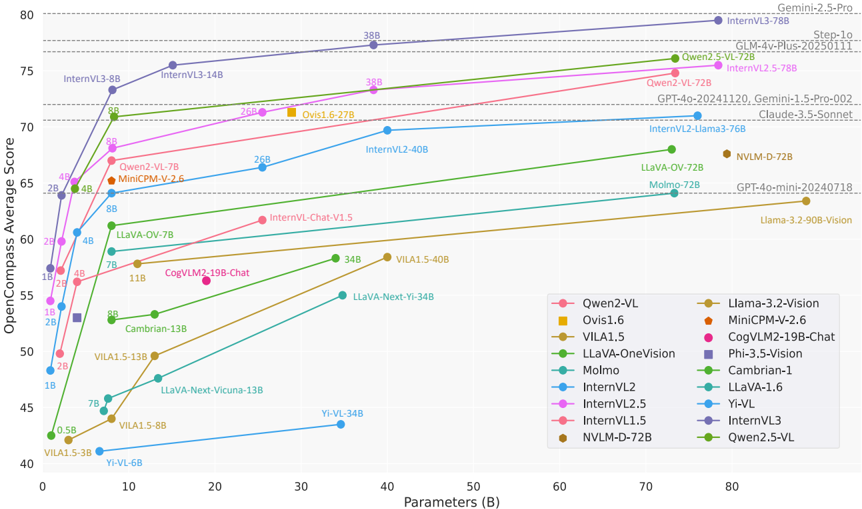
We introduce InternVL3, a significant advancement in the InternVL series featuring a native multimodal pre-training paradigm. Rather than adapting a text-only large language model (LLM) into a multimodal large language model (MLLM) that supports visual inputs, InternVL3 jointly acquires multimodal and linguistic capabilities from both diverse multimodal data and pure-text corpora during a single pre-training stage. This unified training paradigm effectively addresses the complexities and alignment challenges commonly encountered in conventional post-hoc training pipelines for MLLMs. To further improve performance and scalability, InternVL3 incorporates variable visual position encoding (V2PE) to support extended multimodal contexts, employs advanced post-training techniques such as supervised fine-tuning (SFT) and mixed preference optimization (MPO), and adopts test-time scaling strategies alongside an optimized training infrastructure. Extensive empirical evaluations demonstrate that InternVL3 delivers superior performance across a wide range of multi-modal tasks. In particular, InternVL3-78B achieves a score of 72.2 on the MMMU benchmark, setting a new state-of-the-art among open-source MLLMs. Its capabilities remain highly competitive with leading proprietary models, including ChatGPT-4o, Claude 3.5 Sonnet, and Gemini 2.5 Pro, while also maintaining strong pure-language proficiency. In pursuit of open-science principles, we will publicly release both the training data and model weights to foster further research and development in next-generation MLLMs.
Overview
CoChat Summary
TL;DR
InternVL3 introduces a native multimodal pre-training paradigm that jointly learns language and multimodal capabilities in one stage, plus V2PE, SFT/MPO post-training, test-time scaling, and infrastructure optimizations. InternVL3-78B reaches 72.2 on MMMU, setting a new state of the art among open-source MLLMs while remaining competitive with proprietary models.
Key findings
- InternVL3-78B achieves 72.2 on MMMU, 906 on OCRBench, 96.0/98.6 on VCR-EN-Easy (EM/Jaccard), and 89.0/88.7 on MMBench English/Chinese; the paper reports it as a new open-source MLLM state of the art and competitive with ChatGPT-4o, Claude 3.5 Sonnet, and Gemini 2.5 Pro.
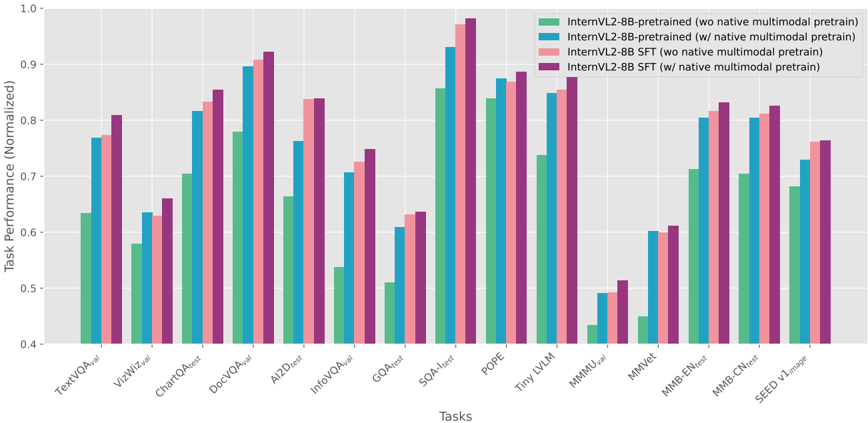
- Native multimodal pre-training is effective: replacing InternVL2-8B’s MLP warmup with native multimodal pre-training yields performance on most benchmarks comparable to the fully multi-stage-trained InternVL2-8B baseline, with further gains after instruction tuning on higher-quality data.
- MPO improves multimodal reasoning across seven benchmarks: InternVL3-78B and InternVL3-38B outperform their non-MPO counterparts by 4.1 and 4.5 points overall, respectively, even though MPO training data is a subset of SFT data.
- Test-time scaling with Best-of-8 and VisualPRM improves reasoning: on the Vision-Only split of MathVerse, best-of-8 gives increases of approximately 6.0 and 3.2 percentage points for InternVL3-38B and InternVL3-78B, respectively.
Methods
- Architecture follows “ViT-MLP-LLM”: vision encoder options are InternViT-300M and InternViT-6B; language models are pre-trained Qwen2.5 series and InternLM3-8B base models; the MLP is a two-layer randomly initialized network; pixel unshuffle reduces each 448×448 image tile to 256 visual tokens.
- Native multimodal pre-training jointly optimizes all parameters on multimodal and pure-language corpora, computes loss only on text tokens, and uses square averaging for token weights. Data combines InternVL2.5 pre-training corpus with GUI, tool usage, 3D scene, and video data, plus InternLM2.5 and open-source text data; the chosen language:multimodal ratio is 1:3, totaling about 200B tokens (50B language, 150B multimodal).
- Post-training uses SFT followed by MPO. SFT grows from 16.3M samples in InternVL2.5 to 21.7M in InternVL3; MPO uses about 300K preference samples and combines DPO preference loss, BCO quality loss, and LM generation loss. Test-time scaling uses Best-of-N with VisualPRM-8B as critic; infrastructure extends InternEVO, yielding a 50% to 200% training speedup for comparable-size models under the same compute budget.
Limitations
- The paper states a noticeable performance gap remains between InternVL3 and models like Qwen2.5-VL on certain benchmarks, such as MuirBench, implying future work may need better training data curation and model refinements.
- The paper reports minor declines on some benchmarks, such as MMHal, and states that optimizing data and training strategies for more consistent improvements remains an important future direction.
- The paper states visual grounding gains plateau at larger scales: InternVL2.5-78B reaches an average score of 92.3 while InternVL3-78B shows 91.4; it speculates this is because InternVL3’s training data expansion did not include additional grounding-specific data and the relative reduction in grounding-targeted data may have restricted localization capabilities.
Model-written summary. Check it against the paper before relying on it.
Integrity signals
Registry
Cites
Statistics
Figures
Verification
Claims the paper makes
0 Valid · 1 Not valid · 14 Not checked · 83 Own results and interpretations
A result the paper reports from its own data — it cites no other source for it, so there is none to check. The quote shows it is in the paper.
In the paper
“When compared with other competitive models, such as Qwen2-VL-72B and Qwen2.5-VL-72B, the InternVL3 series-especially the 78B variant-offers a consistent performance advantage on the multimodal understanding benchmarks.”
§ InternVL3: Exploring Advanced Training and Test-Time Recipes for Open-Source Multimodal Models > 3.6 Comprehensive Multimodal Evaluation
plainstates an association- Asserted: passes — The authors put it forward as true.
- Checkable: passes — It can be checked against evidence.
- Load-bearing: passes — The paper’s conclusions depend on it.
- Based: unclear — It is unclear why the paper says it holds.
A result the paper states — it cites no source for it, so there is none to check. The quote shows it is in the paper.
In the paper
“As a result, the number of training samples grows from 16.3M in InternVL2.5 to 21.7M in InternVL3.”
§ InternVL3: Exploring Advanced Training and Test-Time Recipes for Open-Source Multimodal Models > Data.
plainstates a cause- Asserted: passes — The authors put it forward as true.
- Checkable: passes — It can be checked against evidence.
- Load-bearing: unclear — It is unclear whether the paper’s conclusions depend on it.
- Based: passes — The paper gives a reason why it holds.
A result the paper states — it cites no source for it, so there is none to check. The quote shows it is in the paper.
In the paper
“while also maintaining strong pure-language proficiency.”
§ InternVL3: Exploring Advanced Training and Test-Time Recipes for Open-Source Multimodal Models > Abstract
boosted- Asserted: passes — The authors put it forward as true.
- Checkable: passes — It can be checked against evidence.
- Load-bearing: unclear — It is unclear whether the paper’s conclusions depend on it.
- Based: passes — The paper gives a reason why it holds.
A result the paper reports from its own data — it cites no other source for it, so there is none to check. The quote shows it is in the paper.
In the paper
“Compared with previous models, InternVL3 demonstrates substantial improvements across a wide range of task categories.”
§ InternVL3: Exploring Advanced Training and Test-Time Recipes for Open-Source Multimodal Models > 3.1 Overall Comparison to Other Advanced MLLMs
boosted- Asserted: passes — The authors put it forward as true.
- Checkable: passes — It can be checked against evidence.
- Load-bearing: passes — The paper’s conclusions depend on it.
- Based: passes — The paper gives a reason why it holds.
A result the paper reports from its own data — it cites no other source for it, so there is none to check. The quote shows it is in the paper.
In the paper
“Its capabilities remain highly competitive with leading proprietary models, including ChatGPT-4o, Claude 3.5 Sonnet, and Gemini 2.5 Pro, while also maintaining strong pure-language proficiency.”
§ InternVL3: Exploring Advanced Training and Test-Time Recipes for Open-Source Multimodal Models > Abstract
plain- Asserted: passes — The authors put it forward as true.
- Checkable: passes — It can be checked against evidence.
- Load-bearing: passes — The paper’s conclusions depend on it.
- Based: passes — The paper gives a reason why it holds.
45 more claims
Create a free account to see all 98 claims and every source verdict.
- It may state two separate claims as one. 42
- Probably not a substantial claim. 6
- The quote only partly states this claim. 1
Self-check
Percentages, sums and reported differences re-computed from the paper’s own numbers.
Each contradiction between two passages listed here was confirmed by an independent check.
Rated minor: it would not touch a result — a value no result rests on, a p-value that stays on the same side of the significance level, or a conflict that is clerical, resolved elsewhere in the paper, or outside its own findings.
In the paper
§ InternVL3: Exploring Advanced Training and Test-Time Recipes for Open-Source Multimodal Models > 3.8 Visual Grounding
“InternVL3-8B, InternVL3-9B, and InternVL3-14B yield average scores around 88.2-89.6,reflecting a consistent trend of performance gains as the model size increases.”
§ InternVL3: Exploring Advanced Training and Test-Time Recipes for Open-Source Multimodal Models > 3.6 Comprehensive Multimodal Evaluation
“InternVL3-8B 92.5 94.6 88.0 88.2 92.5 81.8 89.6 90.0 89.6 InternVL3-9B 91.8 93.2 86.6 86.4 91.0 79.9 88.0 88.5 88.2”
Rated minor: it would not touch a result — a value no result rests on, a p-value that stays on the same side of the significance level, or a conflict that is clerical, resolved elsewhere in the paper, or outside its own findings.
In the paper
§ InternVL3: Exploring Advanced Training and Test-Time Recipes for Open-Source Multimodal Models > GPT-4o Gemini 2.0 Claude Aguvis-72B Qwen2.5-VL-72B UI-TARS-72B InternVL3-8B -38B -72B
“The 8B variant (81.4%) already surpasses UI-TARS-72B”
§ InternVL3: Exploring Advanced Training and Test-Time Recipes for Open-Source Multimodal Models > GPT-4o Gemini 2.0 Claude Aguvis-72B Qwen2.5-VL-72B UI-TARS-72B InternVL3-8B -38B -72B
“InternVL3-72B achieves 90.9%, outperforming UI-TARS-72B (90.3%).”
Citations
Cites
Fei-Fei, L., Fergus, R., & Perona, P. (2005) · 2004 Conference on Computer Vision and Pattern Recognition Workshop · doi:10.1109/cvpr.2004.383 · Cited by 2,502
Liu, H., Li, C., Wu, Q., & Lee, Y. J. (2023) · Advances in Neural Information Processing Systems 36 · doi:10.52202/075280-1516 · Cited by 2,428
Making the V in VQA Matter: Elevating the Role of Image Understanding in Visual Question Answering
Goyal, Y., Khot, T., Summers-Stay, D., Batra, D., & Parikh, D. (2017) · 2017 IEEE Conference on Computer Vision and Pattern Recognition (CVPR) · doi:10.1109/cvpr.2017.670 · Cited by 2,287
Chen, Z., Wang, W., Cao, Y., Liu, Y., Gao, Z., Cui, E., Zhu, J., Ye, S., Tian, H., Liu, Z., et al. (2024) · arXiv · doi:10.48550/arxiv.2412.05271 · Cited by 2,204
Self-citationGrounding DINO: Marrying DINO with Grounded Pre-training for Open-Set Object Detection
Liu, S., Zeng, Z., Ren, T., Li, F., Zhang, H., Yang, J., Jiang, Q., Li, C., Yang, J., Su, H., et al. (2025) · Lecture Notes in Computer Science · doi:10.1007/978-3-031-72970-6_3 · Cited by 2,074
Self-citationNatural Questions: A benchmark for question answering research
Kwiatkowski, T., Palomaki, J., Redfield, O., Collins, M., Parikh, A., Alberti, C., Epstein, D., Polosukhin, I., Devlin, J., Lee, K., et al. (2019) · Transactions of the Association for Computational Linguistics · doi:10.1162/tacl_a_00276 · Cited by 2,069
MiniCPM-V: A GPT-4V Level MLLM on Your PhonePreprint
Yao, Y., Yu, T., Zhang, A., Wang, C., Cui, J., Zhu, H., Cai, T., Li, H., Zhao, W., He, Z., et al. (2024) · arXiv · doi:10.48550/arxiv.2408.01800 · Cited by 1,695
Self-citationTriviaQA: A Large Scale Distantly Supervised Challenge Dataset for Reading Comprehension
Joshi, M., Choi, E., Weld, D., & Zettlemoyer, L. (2017) · Proceedings of the 55th Annual Meeting of the Association for Computational Linguistics (Volume 1: Long Papers) · doi:10.18653/v1/p17-1147 · Cited by 1,690
Math-Shepherd: Verify and Reinforce LLMs Step-by-step without Human Annotations
Wang, P., Li, L., Shao, Z., Xu, R., Dai, D., Li, Y., Chen, D., Wu, Y., & Sui, Z. (2024) · Proceedings of the conference - Association for Computational Linguistics. Meeting · doi:10.18653/v1/2024.acl-long.510 · Cited by 1,665
TriviaQA: A Large Scale Distantly Supervised Challenge Dataset for Reading Comprehension
Joshi, M., Choi, E., Weld, D. S., & Zettlemoyer, L. (2017) · arXiv · doi:10.48550/arxiv.1705.03551 · Cited by 1,650
Research works printed but not linked: 6
- Anonymous. CG-bench: Clue-grounded question answering benchmark for long video understanding. In Submitted to The Thirteenth International Conference on Learning Representations, 2024. under review. 14, 15
- Shuai Bai, Keqin Chen, Xuejing Liu, Jialin Wang, Wenbin Ge, Sibo Song, Kai Dang, Peng Wang, Shijie Wang, Jun Tang, et al. Qwen2.5-vl technical report. arXiv preprint arXiv:2502.13923, 2025. 1, 2, 9, 10, 15 · arXiv
- Jie Cao and Jing Xiao. An augmented benchmark dataset for geometric question answering through dual parallel text encoding. In Proceedings of the 29th International Conference on Computational Linguistics, pages 1511-1520, 2022. 6
- Zhe Chen, Weiyun Wang, Hao Tian, Shenglong Ye, Zhangwei Gao, Erfei Cui, Wenwen Tong, Kongzhi Hu, Jiapeng Luo, Zheng Ma, et al. How far are we to gpt-4v? closing the gap to commercial multimodal models with open-source suites. arXiv preprint arXiv:2404.16821, 2024. 2, 3 · arXiv
- Hunter Lightman, Vineet Kosaraju, Yuri Burda, Harrison Edwards, Bowen Baker, Teddy Lee, Jan Leike, John Schulman, Ilya Sutskever, and Karl Cobbe. Let's verify step by step. In The Twelfth International Conference on Learning Representations, 2023. 7
- Minesh Mathew, Viraj Bagal, Rubèn Tito, Dimosthenis Karatzas, Ernest Valveny, and CV Jawahar. Infographicvqa. In Proceedings of the IEEE/CVF Winter Conference on Applications of Computer Vision, pages 1697-1706, 2022. 6, 7, 8, 10
Cited by
Items 2,401–2,500 of 2,641
Deng, X., Chen, B., Liu, Y., Cai, S., Lu, G., & Wen, J. (2026) · ACM International Conference on Multimedia (ACM MM) · doi:10.1145/3767308.3835012
“5-VL-7B-Instruct [5]andInternVL3-8B[51].”
Self-citationWhy MLLMs Struggle to Determine Object OrientationsPreprint
Gopinath, A., Krishnaswamy, N., & Draper, B. A. (2026) · arXiv · doi:10.48550/arxiv.2604.13321
“…(VSI-Bench), Yang et al. discovered that MLLMs performed near or below chance-level performance and [45] report the highest score of 46.3 for a proprietary model and 43.3 for an open source model (7B parameters) vs. 39.5 (78B parameters) for relative directional tasks among 11 MLLMs [35, 45] .”
InfluentialMind the Rarities: Can Rare Skin Diseases Be Reliably Diagnosed via Diagnostic Reasoning?Preprint
Liu, Y., Yang, J., Zhao, H., Li, X., Ji, Y., Li, X., Jiang, R., Wang, T., Anwar, S., Kim, D., et al. (2026) · arXiv · doi:10.48550/arxiv.2603.18418
“5 [32] and InternVL3 [45] employ Mixed Preference Optimization (MPO) combining DPO [21] and Binary Classifier Optimization (BCO) [10] for multimodal CoT; InternVL3.”
Self-citationUnleashing Video Language Models for Fine-Grained HRCT Report Generation
Fang, Y., Zhou, H., Lee, K., Wang, Y., Zhang, Z., Huang, J., & Yang, G. (2026) · Lecture notes in computer science · doi:10.1007/978-3-032-38062-3_60
Self-citationHou, G., Fu, Y., Wu, C., Huang, X. L., Zheng, Z., Zhang, W., Shen, Y., & Lu, W. (2026) · Proceedings of the AAAI Conference on Artificial Intelligence · doi:10.1609/aaai.v40i3.37162
Semantic Router: On the Feasibility of Hijacking MLLMs via a Single Adversarial Perturbation
Li, C., Li, J., Yuan, Y., He, J., Huang, Z., & He, P. (2026) · International Conference on Machine Learning · doi:10.48550/arxiv.2511.20002
“5-VL-7B-Instruct (Qwen) (Bai et al., 2025), known for advanced instruction-following; and (3) InternVL3-8B (Intern) (Zhu et al., 2025), a strong general-purpose model.”
Self-citationHarnessing the Gradient: Enhanced Cross-Prompt Attacks on Large Vision-Language Models
Liu, C., Wang, Y. B., Cao, H., Li, X., Liu, B., & Jiang, D. (2026) · IEEE International Conference on Acoustics Speech and Signal Processing · doi:10.1109/icassp55912.2026.11461238
Self-citationPrivMark: Pixel-Space Steering against Privacy Leakage in Vision-Language ModelsPreprint
Xing, R., Akbari, A., Lin, W., Zhu, Y., & Zhang, X. (2026) · arXiv · doi:10.48550/arxiv.2611.10528
“5-VL-7B (Bai et al., 2025), and InternVL3-8B (Zhu et al., 2025); no information is shared across source models.”
Self-citationCAPA: Contribution-Aware Pruning and FFN Approximation for Efficient Large Vision-Language ModelsPreprint
Jha, S., & Kim, J. (2026) · arXiv · doi:10.48550/arxiv.2602.00247
Content-Aware Adaptive Token Pruning for Video-Language ModelsPreprint
Regmi, P., Chen, Q., Zhang, C., Aly, H., Kim, Y., & Mao, H. (2026) · arXiv · doi:10.48550/arxiv.2608.03112
“Next, we extend this comparison to other popular VLMs: InternVL3 [32] and Qwen2.”
Image-based question, answer, and distractor generation: A novel multiple-choice VQA task
Ding, W., Zhang, Y., Wang, J., Jatowt, A., Yang, Z., Sun, Z., & Cichocki, A. S. (2026) · Knowledge-Based Systems · doi:10.1016/j.knosys.2026.116831
Self-citationZhao, S., Tan, H., Yang, F., Wang, H., Chen, F., Ma, Y., Zhao, C., Tang, M., & Wang, J. (2026) · arXiv · doi:10.48550/arxiv.2611.22415
Self-citationAdShot: Benchmarking Multimodal Large Language Models for Video Advertisement ClippingPreprint
Xie, W., Rastogi, O., Rangoju, S. S. V. D., Overgoor, G., Bart, Y., & Ostadabbas, S. (2026) · arXiv · doi:10.48550/arxiv.2610.33377
Toward self-directed optimization by rethinking multimodal imbalanced learning
Kou, Y., Wu, K., Liu, H., & Xu, Z. (2026) · Information Fusion · doi:10.1016/j.inffus.2026.104982
Words Speak Louder? Exploring the Language Shortcut of LLM-Driven Incomplete Multimodal LearningPreprint
Wang, Q., Xiao, C., Bai, X., He, R., Qi, Z., Liang, X., Wu, Z., & Li, W. (2026) · arXiv · doi:10.48550/arxiv.2611.20349
EmoGenie: Benchmarking and Evaluating Expressed and Evoked Emotion in T2I Generation with MLLMsPreprint
Xing, Z., Gao, L., Li, S., Duan, H., Cai, Z., Zhai, G., & Min, X. (2026) · arXiv · doi:10.48550/arxiv.2610.18455
“InternVL3-8B-Instruct (Zhu et al., 2025)”
Self-citationA Principled Optimal Transport Framework for Frame Selection in Long Video UnderstandingPreprint
Zhao, Z., & Liu, Y. (2026) · arXiv · doi:10.48550/arxiv.2610.27692
“This mismatch between video length and model capacity makes visual compression necessary in practical systems [32, 21, 39, 27, 29, 41, 16, 36, 50, 52].”
Self-citationTimeTraveler: Temporal Strategy Planning with Time Dictionary for Streaming Video UnderstandingPreprint
Kim, M., Kim, J., & Kim, S. T. (2026) · arXiv · doi:10.48550/arxiv.2611.10337
“Subsequent models improve this paradigm by scaling model and data, refining visual tokenization, and strengthening vision-language alignment [2, 32, 5, 1].”
Human and Machine Annotations Predict Brain Responses to Naturalistic Movies Across DevelopmentPreprint
Huang, Y., Zhang, Z., Rahman, R., Biswal, B., Di, X., & Xu, M. (2026) · arXiv · doi:10.48550/arxiv.2611.13637
“We evaluated two MLLMs and two socio-affective dimensions (ToM and valence), so future studies could extend this framework to a broader range of multimodal models (such as InternVL3 [76] and GLM-4.”
Practice in Text, Act in Pixels: Correcting Where Perception FailsPreprint
Xu, Z., & Wang, H. (2026) · arXiv · doi:10.48550/arxiv.2611.22722
“For a reader from a second model family, InternVL3-8B [35], misreads also recur clearly more often than independent errors, but with a much smaller margin.”
Self-citationVL-Dedup: Graded Multimodal Entity Resolution for Image-Text Data DeduplicationPreprint
Liu, Z., Chen, G., Yu, D., Wang, X., Hou, B., Li, C., Ma, T., Wang, K., & Yuan, G. (2026) · arXiv · doi:10.48550/arxiv.2611.03080
Self-citationCP-VLM: Causal Prompting for Human Intention Inference with Vision–Language Models
Osamura, K., Uchida, H., & Abe, N. (2026) · International Conference on Automatic Face and Gesture Recognition · doi:10.1109/fg67764.2026.11557045
“Recent large-scale VLMs [1], [2], [16], [32], [36] excel at descriptive tasks(e.g., VQA), but struggle with inferential ones, particularly discerning the intentions behind human actions.”
RiSE-Drive: Risk-Sensitive Long-Horizon Candidate Evaluation for End-to-End Autonomous Driving
Zhao, Y., Duan, H., Yin, M., Zhang, H., Yang, F., Wang, H., & Liang, X. (2026) · ACM International Conference on Multimedia (ACM MM) · doi:10.1145/3767308.3836337
“The compared methods span CNN-and ViT-based planners with backbones such as InternImage-Tiny [45], V2-99 [19], and DINOv2 ViT-S [35], as well as larger multimodal backbones including Emu3-8B [46] and InternVL3-2B [57].”
Self-citationFrom language to world states: a survey of world models in multimodal reasoning
Fu, H., Chen, J., Mei, L., Lin, M., Shi, T., Kong, X., Zheng, J., Zhang, D., Wang, Y., Xu, M., et al. (2026) · Foundations and Trends® in Computer Graphics and Vision · doi:10.1108/ftcgv-10-2025-0121
Self-citationMLLMCLIP: Feature-Level Distillation of MLLM for Robust Vision-Language Representations
Kim, J., Wu, Q., Mao, Z., Wakaki, H., Kim, J., & Mitsufuji, Y. (2026) · Conference on Empirical Methods in Natural Language Processing (EMNLP) · doi:10.18653/2026.emnlp-main.1187
InstructTable: Improving Table Structure Recognition Through Instructions
Chen, B., Wang, Z., Guo, Z., Liu, J., Duan, C., Gu, Y., Zhou, K., & Yan, P. (2026) · doi:10.1109/cvprf71909.2026.00267
Heading Hierarchy Reconstruction for Complex and Long Documents with Level-Wise Multimodal MemoryPreprint
Chen, Q., Zhang, X., Guo, L., & Zhang, C. (2026) · arXiv · doi:10.48550/arxiv.2610.18238
“Open-source models such as the Qwen collection (Wang et al., 2024b; Bai et al., 2025) and the InternVL family (Zhu et al., 2025; Wang et al., 2025) also show considerable promise for OCR applications.”
Self-citationTraceKV: Policy-Preserving Low-Rank KV Cache Compression for Reasoning Vision-Language ModelsPreprint
Li, K., Shao, Z., & Chen, Y. (2026) · arXiv · doi:10.48550/arxiv.2611.15569
“5-VL-7B-Instruct [4], InternVL3-8B [33], and Qwen3-VL-8B/32B-Thinking [3].”
Curvature-Guided Mixing for MLLM Adaptation
Yang, J., He, J., Huang, W., Zhuang, Z., & Zhang, J. (2026) · Lecture notes in computer science · doi:10.1007/978-3-032-37261-1_20
Self-citationOn-Screen Text: A Double-Edged Sword for Video LLMs
Ohira, S., Hirasawa, T., & Komachi, M. (2026) · IEEE Access · doi:10.1109/access.2026.3746737
Xu, D., Cheng, H., Lin, X., Xie, Z., & Wang, H. H. (2025) · Findings of the Association for Computational Linguistics: EMNLP (Findings of EMNLP) · doi:10.18653/v1/2025.findings-emnlp.701
Self-citationTagLLM: A Fine-Grained Tag Generation Approach for Note Recommendation
Chen, Z., Wang, L., Chen, L., YaGuang, D. O. U., Shi, J., Qi, T., Hao, D., Lu, M., Ye, C., & Wei, C. (2026) · ACM International Conference on Information and Knowledge Management (CIKM) · doi:10.1145/3799682.3840088
“We select five small models from the InternVL3 [43], In-ternVL3.”
Self-citationWords Before Pixels: Selective Modality Routing for Vision-Language Model UnlearningPreprint
Yao, L., Zhang, H., Duan, J., Liu, S., & Chen, T. (2026) · arXiv · doi:10.48550/arxiv.2611.00608
“5.7B [26], ModRoute has a 49.6% improvement over random switching and with InternVL3-8B [27], ModRoute has a 72.5% improvement over random switching on performance score.”
InfluentialSelf-citationStepPrune: Adaptive Sequential Visual Token Selection across Multimodal Large Language ModelsPreprint
Zhang, H., He, L., Yao, M., & Xu, L. (2026) · arXiv · doi:10.48550/arxiv.2609.13804
“5-VL [ Bai et al. , 2025 ] , and the multi-tile representation of InternVL3 [Zhu et al. , 2025].”
Self-citationFireWorldBench: Benchmarking Complex Physical World Intelligence through Coupled-Field Fire DynamicsPreprint
Chen, Q., Guo, H., Zhu, H., Huang, T., Cao, Y., Xu, H., Huang, K., Li, H., Chen, Y., & Su, X. (2026) · arXiv · doi:10.48550/arxiv.2609.23064
Self-citationLuo, G., Ren, Y., Wang, H., Zheng, S., & Yang, M. (2026) · ACM International Conference on Multimedia (ACM MM) · doi:10.1145/3767308.3836237
“While Multimodal Large Language Models (MLLMs) [3, 21, 39] excel at general VQA, they often require external augmentation for knowledge-intensive queries.”
Self-citationMin, H., & Guo, H. (2026) · doi:10.1109/icsip70099.2026.11744287
“We freeze the pre-trained foundation model InternVL3-2B [11] to function as a sensory perception encoder, bypassing the need for full-parameter fine-tuning.”
Shallow to Deep: Aligning Token Pruning with Stage-wise Roles in LVLMs
Zhang, S., Tong, J., Zou, Y., Li, Y., & Li, R. (2026) · Conference on Empirical Methods in Natural Language Processing (EMNLP) · doi:10.18653/2026.emnlp-main.1226
“5-7B (Liu et al., 2024a) and LLaVA-NeXT-7B (Liu et al., 2024b)), Qwen2-VL (Wang et al., 2024), and the recent InternVL3-8B (Zhu et al., 2025) and Qwen3-VL-8B-Instruct (Bai et al., 2025) models.”
ReTrace: Visual Backtracking for Efficient Multimodal Large Language Models
Si, G., Wang, D., Yu, Y., Liu, M., Pan, P., & Zhu, W. (2026) · Findings of the Association for Computational Linguistics: EMNLP (Findings of EMNLP) · doi:10.18653/2026.findings-emnlp.182
Beyond Redundancy: Information-Conserving Semantic Packaging for Vision-Language Models
Xiao, X., & Zhong, J. (2026) · Findings of the Association for Computational Linguistics: EMNLP (Findings of EMNLP) · doi:10.18653/2026.findings-emnlp.848
SIEVE: Preserving Cross-Image Evidence via Depth-Aware Token CompressionPreprint
Shukla, N., Jandial, S., Bui, N.-T., & Ross, A. A. (2026) · arXiv · doi:10.48550/arxiv.2611.00351
Benchmarking Answer-Grounding Consistency in Remote Sensing Visual Question AnsweringPreprint
Guo, P., Huang, Z., Li, X., Yu, L., Pei, J., & Seiichiro, K. (2026) · arXiv · doi:10.48550/arxiv.2610.13636
Benfenati, D., Rinaldi, A. M., & Tommasino, C. (2026) · arXiv · doi:10.48550/arxiv.2611.02096
XLSAR-Bench: Towards Extremely Large SAR Imagery Understanding of MLLMsPreprint
Jiang, L., Chen, L., Zhu, J., Guo, F., Zhang, J., Panhe, H. U., Liu, L., & Liu, Z. (2026) · arXiv · doi:10.48550/arxiv.2611.19364
Self-citationLatentWeave: Test-Time Latent Optimization for Multimodal ReasoningPreprint
Meng, F., Wang, K., Zhang, G., Yu, X., Zhang, J., Li, M., & Wang, Y. (2026) · arXiv · doi:10.48550/arxiv.2610.39557
“To improve the test-time performance of multimodal reasoning (Zhu et al., 2025; Jiang et al., 2026b), existing studies have explored intervention strategies from three core dimensions: ❶ Output-level refinement: Focuses on answer post-processing and self-correction (Madaan et al., 2023),…”
Self-citationPreserving Structural Irreplaceability in Token Pruning Through Local Representation Complexity
Li, C., Lu, S., & Wang, H. (2026) · IEEE Transactions on Image Processing · doi:10.1109/tip.2026.3744689
“InternVL3 [46] follows a ViT–MLP–LLM architecture and uses dynamic-resolution tiling for high-resolution inputs.”
Self-citationC$^2$-Routing: Complementary Cropping and Compression for Efficient Vision-Language InferencePreprint
Lu, G., & Chen, Q. (2026) · arXiv · doi:10.48550/arxiv.2611.14469
“5-VL [1] aligns processed dimensions to multiples of 28; InternVL3 [40] uses 256 tokens per tile.”
Improving OOD Detection, Recognition, and Understanding via Multi-Modal Feature Alignment
Wang, Y. (2026) · UWSpace (University of Waterloo)
Self-citationEyes in the Update? Learning Where Rewards Land in Multimodal ReasoningPreprint
He, L.-X., Chu, T.-Z., Tian, S.-L., Zheng, S.-K., Chen, F., & Ma, Y. (2026) · arXiv · doi:10.48550/arxiv.2611.22438
MaRiO: Multi-agent Collaborative Reasoning via Shared Observations in MLLMsPreprint
Redmond, N., Cruz, F. O. T., Sharma, D., Azad, S., Mitra, S., Vyas, S., & Rawat, Y. S. (2026) · arXiv · doi:10.48550/arxiv.2611.10344
“Multimodal Large Language Models (MLLMs) achieve strong performance across diverse visual tasks [1–5].”
VIGOR: Benchmarking Visual Rationale Correctness in Multimodal Large Language ModelsPreprint
Chen, Y., Li, T., & Peng, X. (2026) · arXiv · doi:10.48550/arxiv.2611.13150
“We evaluate representative open-source MLLMs from the InternVL [62, 51], Qwen-VL [50, 2, 1], Gemma [14], and Ministral [31] families, spanning model scales from 1B to 38B.”
Not All Evidence Is Admissible: Evidence Governance for Tool-Augmented Medical AgentsPreprint
Zhang, R., Catalano, O. A., Wang, J., & Wei, J. (2026) · arXiv · doi:10.48550/arxiv.2611.22169
“(i) General multimodal LLMs : Qwen3-VL-4B, Qwen3-VL-8B (our backbone) [2], and InternVL3-8B [58].”
Self-citationPolicy-Adaptive Credit Assignment for Spatial Reasoning with Verifiable RewardsPreprint
Yang, H.-L., & Chen, S.-C. (2026) · arXiv · doi:10.48550/arxiv.2610.26410
Bits, Not Boxes: Label-Free Layer Selection for Visual Localization in VLMsPreprint
Fu, H., Huang, G., Zhao, H., Liang, J., Fang, Z., Han, J., & Li, X. (2026) · arXiv · doi:10.48550/arxiv.2611.23432
“We study six VLMs from four families: SmolVLM-256M and -500M [30], InternVL3-1B [50], Qwen3-VL-2B and -8B [2], and LLaVA-1.”
HRCoach: multimodal human-in-the-loop evolution for resilient robotic assembly and disassembly
Tong, X., Yuan, Y., Bao, J., Nee, A. Y. C., & Ong, S. K. (2026) · Robotics and Computer-Integrated Manufacturing · doi:10.1016/j.rcim.2026.103458
Teng, J., Duan, H., Wu, S., Wang, J., Zhu, X., Jin, J., Shen, W., Min, X., & Zhai, G. (2026) · International Conference on Learning Representations
Self-citationGeo3R: Mitigating Spatial Reasoning Hallucination in Multimodal Large Language Models
Wang, M., Jin, W., Li, W., Huang, H., Jia, T., & Li, Y. (2026) · ACM International Conference on Multimedia (ACM MM) · doi:10.1145/3767308.3835914
“GeoCalib [27] estimates the focal length 𝑓 , from which we construct the intrinsic matrix 𝐾 : where ( 𝑐 𝑥 𝑦 ) is the image center.”
AgriScope: Pixel-Grounded Multimodal Understanding for Agricultural ImagesPreprint
Boudiaf, A., Alansari, M., Hussain, I., & Javed, S. (2026) · SSRN Electronic Journal · doi:10.2139/ssrn.7498281
Jin, Z., Zhang, H., Tang, Y., Hu, F., Dong, Z., & Shao, Y. (2026) · arXiv · doi:10.13140/rg.2.2.24501.03047
Self-citationA Multi-Modal Generative Model for Tomato Disease Leaves UnderstandingPreprint
Quoc, K. N., Tran, M.-P., Truong, G.-H., & Quach, L.-D. (2026) · arXiv · doi:10.48550/arxiv.2609.19555
“First, to assess out-of-the-box generalization, we tested a cohort of FMs and domain-specific VLMs without task-specific fine-tuning, comprising InternVL3 (1B and 2B) [41], Qwen2.”
Wang, W., Li, Z., Luo, J., Wang, F. L., Lee, L., & Yang, Z. (2026) · arXiv · doi:10.48550/arxiv.2610.03016
Self-citationAPS: Adaptive Partitioning-Based Frame Selection for Long Video UnderstandingPreprint
Wen, J., Zhao, Y., Chen, J., Hu, J., Wang, L., Qin, Z., & Deng, S. (2026) · arXiv · doi:10.48550/arxiv.2611.24079
“5-VL-7B [2], InternVL3-8B [43], and MiniCPM V4.”
Self-citationCueKFS: Agentic Cue-Driven Keyframe Selection for Long Video UnderstandingPreprint
Kang, W., Deilamsalehy, H., Xu, Y., Sultania, D., Cellat, S., & Yan, Y. (2026) · arXiv · doi:10.48550/arxiv.2609.31873
“5-VL-7B (Bai et al., 2025) and InternVL3-8B (Zhu et al., 2025) for comparison with prior KFS work.”
Read Together, Answer Apart: How Earlier Questions Help Vision-Language Models LookPreprint
Guo, X., Huang, K., Ling, X., He, M., Zheng, C., Xu, J., He, C., & Song, D. (2026) · arXiv · doi:10.48550/arxiv.2611.24785
“Evaluated on Densely Captioned Images (DCI) [40] across 22 open-weight VLMs from seven model families ( 1 B to 35 B parameters) [3, 4, 8, 11, 13, 25, 31, 41, 47, 55], net accuracy shifts over asking alone span − 12 .”
Self-citationThinking Beyond Labels: Vocabulary-Free Fine-Grained Recognition using Reasoning-Augmented LMMsPreprint
Demidov, D., Zaheer, Z., Han, Z., Thawakar, O., & Anwer, R. M. (2025) · arXiv · doi:10.48550/arxiv.2512.18897
“While these reasoning-specialised LMMs have previously been dominated by the private solutions, multiple public counterparts with on-par performance have recently become available [3, 21].”
Video-Language Entailment for Video Similarity Estimation
Liberatori, B., Vaquero, L., Ricci, E., & Rota, P. (2026) · Findings of the Association for Computational Linguistics: EMNLP (Findings of EMNLP) · doi:10.18653/2026.findings-emnlp.1673
Yan, X., Wang, J., Su, X., & Feng, S. (2026) · International Journal of Computer Vision · doi:10.1007/s11263-026-03108-3
Self-citationFrom Foundation VLM to Versatile Driving VLM: A Triplet Incremental Training ApproachPreprint
Wu, S., Dong, Z., Qiao, W., Liu, X., Zhan, X., Chen, J., & Zhu, J. (2026) · arXiv · doi:10.48550/arxiv.2611.16727
“General Vision-Language Models (VLMs) [1, 2, 3, 4, 5] have emerged as powerful backbones for autonomous driving (AD) [6, 7, 8], offering strong open-world semantic reasoning to overcome the brittleness of traditional task-specific pipelines [9, 10].”
Self-citationWang, J., Li, G., Huang, Z., Li, J., Dang, C., Ye, H., Han, Y., & Chen, L. (2026) · arXiv · doi:10.48550/arxiv.2610.25734
“Recent advances in large-scale Vision-Language Models (VLMs) [8– 10] have introduced new opportunities for addressing long-tail scenario understanding and complex semantic reasoning in autonomous driving [11–13].”
Self-citation北村, 要., & Kanezaki, A. (2026) · arXiv · doi:10.48550/arxiv.2609.33288
“6 Sol [29], InternVL3-78B [42], or Llama 4 Scout [26] as the answer model, our method also outperforms Multi-Frame VLMs and RAG with BLIP.”
Beyond Selection: Token Parameterization for Extreme Visual Token CompressionPreprint
Zhong, R., Li, Y., Yan, Z., & Zhuo, C. (2026) · arXiv · doi:10.48550/arxiv.2609.35232
“Vision–language models (VLMs) encode images as visual-token sequences, enabling strong multi-modal reasoning [Bai et al., 2025, GLM-V Team et al., 2025, Wu et al., 2024, Zhu et al., 2025] but incurring costs linear in token count.”
Xing, Y., Gordon, W., Wang, J., Zhang, Y., Zhai, G., & Xu, Y. (2026) · arXiv · doi:10.48550/arxiv.2611.04498
Self-citationTuringPAI: A Foundation for On-Device Physical AIPreprint
Wu, Q., Chen, H., Wei, Y., Wang, M., Tang, S., Li, M., Xin, R., Liu, X., Yang, Z., Yu, Y., et al. (2026) · arXiv · doi:10.48550/arxiv.2611.25474
“We then evaluate driving performance through open-loop trajectory prediction and XPeng’s in-house CCES suite, with particular emphasis on comparing HybridViT and HybridViT-MLQ to assess the impact of MLQ-based visual token compression.”
Self-citationWhat Does the Visual Encoder Buy? Visual Information Gain in Encoder-Free Multimodal PretrainingPreprint
Ge, Z., Li, A., & Qiu, W. (2026) · arXiv · doi:10.48550/arxiv.2611.26917
“Recent models with a visual encoder, InternVL3 [65], Qwen2.”
Min, H., Song, Z., Zhang, Z., Tang, R., Zhang, H., Xue, H., Xu, J., Feng, F., & Feng, P. (2026) · IEEE/RSJ International Conference on Intelligent Robots and Systems (IROS) · doi:10.1109/iros61738.2026.11777580
Self-citationMotionEnhancer: Leveraging Video Diffusion for Motion-Enhanced Vision-Language ModelsPreprint
Xu, Y., Zhang, C., Ma, R., Gao, F., Yang, Z., Qi, J., & Chen, Z. (2026) · arXiv · doi:10.48550/arxiv.2606.06853
“5-VL [2], InternVL3 [37], and CogVideoX-1.”
Self-citationYang, W., Zhu, Y., Li, Z., Zhang, X., Xia, J., & Wang, H. (2025) · arXiv · doi:10.48550/arxiv.2511.18415
“5-8B [5], InternVL3-8B [30], and Qwen2.”
Self-citationVNU-Bench: A Benchmarking Dataset for Multi-Source Multimodal News Video UnderstandingPreprint
Liu, Z., Li, M., Jiang, Z., & Chen, S. (2026) · arXiv · doi:10.48550/arxiv.2601.03434
Self-citationPedagogyBench: A Cognitive-Driven Benchmark for Multimodal Instructional Video Understanding
Jin, X., Zhu, J., Liu, J., Shi, Y., Guan, J., Chen, H., & Meo, P. D. (2026) · Findings of the Association for Computational Linguistics: ACL (Findings of ACL) · doi:10.18653/v1/2026.findings-acl.614
Self-citationCoCoA: A Color Cue-guided Adaptive Cropping Framework for Fine-grained Perception in MLLMsPreprint
Park, J., Ha, J., Park, E., & Kim, H. Y. (2026) · SSRN Electronic Journal · doi:10.2139/ssrn.6235688
Wang, H. H., Murata, E., Zhang, L., Sato, A., Fukuda, S., Yin, Z., Hu, W., Nakao, K., Nakamura, Y., Zwirner, S., et al. (2026) · Proceedings of the AAAI Conference on Artificial Intelligence · doi:10.1609/aaai.v40i12.37938
Self-citationPrompt-Guided Prefiltering for VLM Image CompressionPreprint
Azizian, B., & Bajić, I. V. (2026) · arXiv · doi:10.48550/arxiv.2604.00314
“We further assessed generalization across two VLMs: LLaVA One Vision [3] (7B) and InternVL3 [4] (9B).”
Dewen, Z. (2026) · Institutional Repositories DataBase (IRDB) · doi:10.18952/0002000966
Wu, Y., Luo, X., Zhu, Y., Fang, M., Xue, X., & Li, B. (2026) · arXiv · doi:10.48550/arxiv.2608.24011
DementiaCare-Bench: A Modality-Validated Video BenchmarkPreprint
Sheikholeslami, A., Qi, Y., Zhang, X., Zhou, L., Beheshti, A., Sheng, Q. Z., & Yang, M.-H. (2026) · arXiv · doi:10.48550/arxiv.2609.12929
Self-citationThe Host Is Not Idle: Computational SSDs for Host-Free Checkpointing in Multimodal LLM Training
Kang, S., Ko, H., Lee, H. D., Park, M., Kim, J., & Jung, M. (2026) · ACM Workshop on Hot Topics in Storage and File Systems (HotStorage) · doi:10.1145/3837053.3837337
Zhang, Y., Wang, Y., He, Q., Li, X., Wang, X., & Chen, G. (2026) · Knowledge-Based Systems · doi:10.1016/j.knosys.2026.117087
Self-citationThe Alignment Illusion in Multimodal Large Language ModelsPreprint
Wang, H.-H., Wang, Y., & Ding, H. (2026) · arXiv · doi:10.48550/arxiv.2609.30210
“We study MLLMs built on the projector vLLM design [13, 12, 3, 25], which is typical of current MLLMs.”
Self-citationMaestroV: Toward Unified Video Understanding, Generation and Editing
Shu, Y., Qiu, Z., Long, F., Yao, T., & Mei, T. (2026) · IEEE Transactions on Multimedia · doi:10.1109/tmm.2026.3746101
Rotated, but How Far? Diagnosing and Improving Object-Rotation Reasoning in VLMsPreprint
Wang, Z., Cai, Y., Zou, H., Yang, H., Dong, N., Xu, M., & Ling, H. (2026) · arXiv · doi:10.48550/arxiv.2610.05715
EgoExo-Next:Benchmarking Vision-Language Models on Visual-Option Next-State and Cross-View ReasoningPreprint
Li, Y., Wang, M., Li, X., Fang, Y., Dong, D., & Ye, Z. (2026) · arXiv · doi:10.48550/arxiv.2610.04506
Why MLLMS Struggle to Determine Object Orientations
Gopinath, A., Krishnaswamy, N., & Draper, B. A. (2026) · doi:10.1109/cvprf71909.2026.00941
“…(VSI-Bench), Yang et al. discovered that MLLMs performed near or below chance-level performance and [45] report the highest score of 46.3 for a proprietary model and 43.3 for an open source model (7B parameters) vs. 39.5 (78B parameters) for relative directional tasks among 11 MLLMs [35, 45] .”
InfluentialATLAS: Learning to Adapt LVLM Attention for Reasoning Video SegmentationPreprint
Dastmalchi, H., Cheraghian, A., An, A., Khamis, A., & Petersson, L. (2026) · arXiv · doi:10.48550/arxiv.2610.24783
“Recent advances in LVLMs [2, 3, 6, 23–25, 34, 39] have significantly improved multimodal reasoning and reliability [7, 9, 33], enabling robust understanding of complex expressions and establishing them as a”
RECAP: Looking Once Is Not Enough for Vision-Language ReasoningPreprint
Kang, Z., Luo, T., Li, C., He, Y., Yu, Z., Zhou, F., Qian, J., Wei, L., Chen, S., Li, J., et al. (2026) · arXiv · doi:10.48550/arxiv.2610.30834
“5-VL-7B [15], InternVL3-8B [16], and LLaVA-OneVision-7B [17]; a larger Qwen2. are tuned on held-out splits for the baselines and then frozen for RECAP; full training, compute, and seed details are in Appendix E.”
Self-citationDiscerning Culturally-Aware Hate Framings for Hate Speech Identification in Memes
Ailneni, R. R., & Harabagiu, S. M. (2026) · Conference on Empirical Methods in Natural Language Processing (EMNLP) · doi:10.18653/2026.emnlp-main.2538
Deng, J., Jin, Z., Chen, Y., He, F., Li, S., & Zeng, D. (2026) · arXiv · doi:10.48550/arxiv.2610.41705
Self-citationThink Before You Locate: Clinical Chain-of-Though Supervision for Sequential Medical Image GroundingPreprint
Dukre, A., Kolli, G., Lu, Y.-F., Zou, Z.-Y., Wasi, A. T., Atito, S., Bozorgtabar, B., Mahapatra, D., Awais, M., & Razzak, I. (2026) · arXiv · doi:10.48550/arxiv.2611.00041
“…background. the MedSeq : [0, Chain R1 (Ours) 😊 😢 view of lung parenchyma, characterized by a 😊 Med Chain R1 (Ours) 😢 view of lung parenchyma, characterized by a 😊 Med Chain R1 (Ours) To locate this in the second image, which is an axial CT slice of the chest, I need to find the…”
CreaTrace: Video Creative Plagiarism Detection and Evidence TracingPreprint
Liu, C., Sheng, L., Qian, Z., & Zhang, X. (2026) · arXiv · doi:10.48550/arxiv.2611.19976
“Meanwhile, InternVL3 [36] employs native multimodal pretraining and variable visual position encoding to support extended multimodal contexts.”
InfluentialSelf-citation
Metadata
- Authors
- Zhu, J., Wang, W., Chen, Z., Liu, Z., Ye, S., Gu, L., Tian, H., Duan, Y., Su, W., Shao, J., Gao, Z., Cui, E., Wang, X., Cao, Y., Liu, Y., Wei, X., Zhang, H., Wang, H., Xu, W., Li, H., Wang, J., Deng, N., Li, S., He, Y., Jiang, T., Luo, J., Wang, Y., He, C., Shi, B., Zhang, X., Shao, W., He, J., Xiong, Y., Qu, W., Sun, P., Jiao, P., Lv, H., Wu, L., Zhang, K., Deng, H., Ge, J., Chen, K., Wang, L., Dou, M., Lu, L., Zhu, X., Lu, T., Lin, D., Qiao, Y., Dai, J., & Wang, W.
- Affiliations
- Shanghai Artificial Intelligence Laboratory (CN)
- Chinese University of Hong Kong (HK)
- Sensetime (China) (CN)
- Shanghai Jiao Tong University (CN)
- ORCID
- Venue
- arXiv
- Publisher
- arXiv
- Published
- 2025
- ISSN
- 2331-8422 (ISSN-L)
- arXiv
- 2504.10479
- OpenAlex
- W4416053382
- Cited by
- 2,644
- References
- 138
- Citations by year
- 2026: 1999 · 2025: 638
- Type
- posted content
- Language
- en
- Open access
- green
- arxiv.org
- Licence
- Locations
- arXiv (submittedVersion, cc-by)
- Topics
- Physical Sciences › Computer Science › Computer Vision and Pattern Recognition › Multimodal Machine Learning Applications
- Physical Sciences › Computer Science › Artificial Intelligence › Domain Adaptation and Few-Shot Learning
- Physical Sciences › Computer Science › Computer Vision and Pattern Recognition › Advanced Neural Network Applications
- Keywords
- multimodal large language models, multimodal pre-training, supervised fine-tuning, test-time scaling
About these checks
Registry, retraction, Cites and statistics results are computed, not judged, with one exception: a printed reference that no index lists is read once by a model before it counts as a citation error. Claims are extracted by a model and kept only when their quote appears verbatim in the text; each cited source is then checked, with a model’s help, for whether it says what the claim relies on. Those verdicts can be wrong — read the claim’s quote and the cited source before relying on one.
A language model drew the claims from the paper on 2026-11-28, under version 3 of the claim definition (model deepseek-v4.1-flash, prompt extract-v3).
A second model labelled each claim on 2026-11-28 (model jev-1.13-20260917, definition revision gold-guideline-v0.2).
Statistics and arithmetic are recomputed, not judged.
Confidence bands are shown only for fields calibrated on our annotated test set. None is calibrated yet, so no band is shown.
What counts as a claim ›How we measure confidence ›How we check this ›
Are you an author, or do you see a problem with this page? Request a review
Data sources
Bibliographic data: Semantic Scholar, OpenAlex, Crossref.
Contains information from the Semantic Scholar Academic Graph Datasets, made available under the ODC Attribution License (ODC-BY 1.0).
Semantic Scholar’s data is described in: Kinney, R., et al. (2023). The Semantic Scholar Open Data Platform. arXiv:2301.10140.
