

The DOI matches its Crossref record; 32 of the 32 references it cites were found in a registry or an index; 6 of the 43 sources its claims cite were checked for support.
Effect of Three Different Topical Fluoride Varnishes on Streptococcus mutans Count in Biofilm Samples of Children Aged 6–10 Years: A Randomized Controlled Trial
Open accessAbstract
the remineralization potential of saliva are constrained by the availability of calcium and phosphate ions.As a result, to boost the effectiveness of fluoride varnish in preventing cavities, calcium and phosphate ions have been added to improve the retention of both fluoride and calcium ions in the mouth.9,10 Mankind's quest for novel materials to overcome caries led to casein phosphopeptide-amorphous calcium phosphate IntroductIonDental plaque is a soft, sticky material that forms on the surface of teeth.The oral microorganisms present in dental plaque play a crucial role in the onset and development of dental caries. 1 These microorganisms consist of mutans streptococci (Streptococcus mutans and Streptococcus sobrinus), Lactobacillus species, Actinomyces species, nonmutans streptococci, and yeast.They become pathogenic under conditions causing prolonged plaque acidification.S. mutans adapts to low pH and increases acid production, resulting in cariogenic plaque. 2 There are different ways to manage tooth decay by stopping the interaction between risk factors like diet, bacteria, and weak teeth.These methods include changing eating habits, practicing good oral hygiene, and using fluoride and sealants.All these actions aim to affect the bacteria in the mouth, either directly or indirectly.3,4 Fluoride varnishes are designed to extend the contact time between fluoride and tooth enamel.They create a thin coating that clings to the tooth's surface for a prolonged period, preventing the rapid loss of fluoride after it is applied and acting as reservoirs that gradually release fluoride.Fluoride varnish can reduce the number of bacteria by interfering with how oral bacteria process carbohydrates.5,6 This varnish usually has 5% sodium fluoride (NaF) and is often used to prevent cavities.Studies show that applying it twice a year can greatly lower the risk of cavities by keeping a high level of fluoride on teeth for a long time.7,8 Fluoride alone does not offer a comprehensive solution for caries prevention, as the formation of fluoride reservoirs and 1,2,
Overview
AI snapshot
Written from the paper’s full text.
TL;DR
In a randomized controlled trial in children aged 6–10 years, three topical fluoride varnishes significantly reduced plaque *Streptococcus mutans* counts over 6 months. GC MI Varnish (CPP–ACP) produced the greatest and most consistent reductions, especially at 1 and 3 months.
Key findings
- All three varnishes reduced *S. mutans* CFU/mL from baseline to 6 months: GC MI Varnish 7.64 ± 0.18 to 5.76 ± 2.05 (mean difference 1.88 ± 1.54; 24.6% change), Ultradent 7.79 ± 0.18 to 6.02 ± 1.30 (1.77 ± 1.26; 22.7%), and Fluor Protector S 7.83 ± 0.17 to 6.14 ± 1.85 (1.69 ± 1.46; 21.5%).
- Between-group differences were significant at 1 month (p < 0.0001) and 3 months (p = 0.015), but not at 6 months (p = 0.55).
- GC MI Varnish differed significantly from both Ultradent and Fluor Protector S at 1 month (p < 0.0001) and 3 months (p = 0.01); Ultradent vs Fluor Protector S was not significant (p = 0.22 at 3 months; p = 0.94 at 6 months).
- Within-group reductions were significant for all groups (repeated-measures ANOVA p = 0.0001); GC MI Varnish showed a significant baseline-to-1-month reduction (p = 0.004), whereas Ultradent and Fluor Protector S did not (p = 0.30 and p = 0.75, respectively).
Methods
- Randomized controlled trial in children aged 6–10 years who were healthy, free from systemic disorders, and had noncarious primary maxillary molar teeth with intact tooth structure; exclusions included artificial fluoride supplementation or antimicrobial therapy within the preceding 3 months, orthodontic treatment, or dental fluorosis. Children were randomly assigned via colored paper chits to GC MI Varnish, Ultradent Enamelast, or Ivoclar Fluor Protector S.
- Plaque samples were collected from the right permanent maxillary first molar at baseline and at 1, 3, and 6 months after ultrasonic scaling and varnish application; samples were transported in reduced transport fluid within 3 hours and cultured using the Westergren and Krasse method, with *S. mutans* colonies counted by automated colony counter and expressed as CFU/mL.
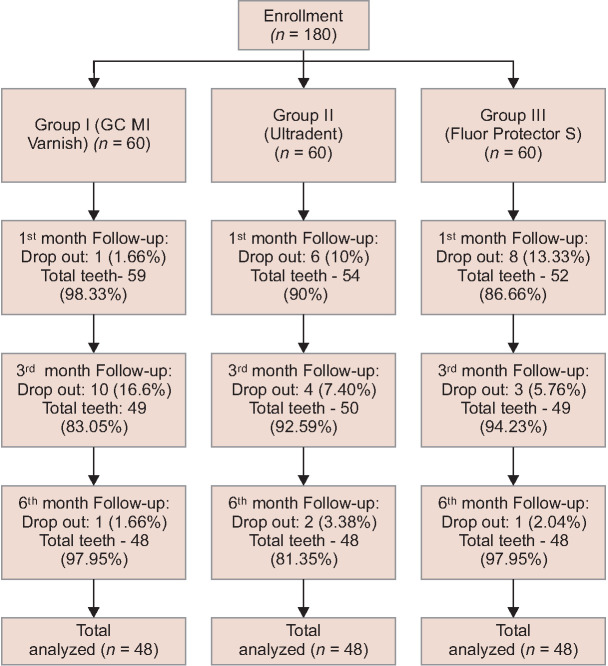
- Analysis used SPSS 26.0 with significance at p < 0.05; Shapiro–Wilk tested normality, one-way ANOVA with Bonferroni post hoc tested between-group differences, and repeated-measures ANOVA with post hoc tested within-group changes. Final analyzed sample was 48 per group (144 total) after dropouts; the text also reports 180 initially enrolled.
Limitations
- The paper states the study used a small group from a single geographic location, lacked long-term follow-up, may have been affected by observer bias and differences in patient adherence, and did not include socioeconomic status in the analysis.
- The paper states that microbial culture was used to measure *S. mutans*; molecular methods such as qPCR may provide higher sensitivity and specificity, and long-term clinical outcomes such as caries incidence were not assessed.
- Evident from the text: enrollment/analysis numbers are inconsistent—the abstract says 144 children were divided into three groups, while the Results section says 180 were initially enrolled and 144 ultimately analyzed (48 per group) after dropouts.
Model-written summary. Check it against the paper before relying on it.
Integrity signals
Registry
Cites
Statistics
Figures
Verification
Claims the paper makes
16 Own result · 11 Own method · 10 Not checked yet · 6 Sources not found · 4 Partly supported · 3 No full text of the sources · 2 Own interpretation · 2 No basis given · 1 Supported so far · accuracy not yet measured
The cited sources support only part of this claim — read each source’s verdict below.
In the paper
“Attiguppe et al.38 showed that MI Varnish works better against S. mutans than NaF varnish.”
§ Effect of Three Different Topical Fluoride Varnishes on Streptococcus mutans Count in Biofilm Samples of Children Aged 6–10 Years: A Randomized Controlled Trial > Discussion
What the sources say
- Not matchedcites Attiguppe et al.
Couldn’t be matched to a paper in Crossref, so it can’t be checked.
- Partly supportedcites [38] 38. Attiguppe P, Malik N, Ballal S, et al. CPP–ACP and fluoride: a synergism to combat caries. Int J Clin Pediatr Dent 2019;12(2):120–125. sourceExperimental — accuracy not yet measured
The Discussion reports significantly greater inhibition of S. mutans with MI Varnish than with the comparator. However, the Materials and Methods identify that comparator as Fluor Protector varnish, and the passages do not establish that it is a NaF varnish. (LLM, conf=0.85)
plaindirect- Asserted: passes — The authors put it forward as true.
- Checkable: passes — It can be checked against evidence.
- Load-bearing: unclear — It is unclear whether the paper’s conclusions depend on it.
- Based: passes — The paper gives a reason why it holds.
- Not matched
The sources with a verdict support this claim; the rest weren’t checked yet, have no full text we could read, or their verdicts aren’t rated yet.
In the paper
“Fluoride varnish can reduce the number of bacteria by interfering with how oral bacteria process carbohydrates.5,6”
§ Effect of Three Different Topical Fluoride Varnishes on Streptococcus mutans Count in Biofilm Samples of Children Aged 6–10 Years: A Randomized Controlled Trial > Introduction
What the sources say
- Supportedcites [5] 5. Yadav S, Sachdev V, Malik M, et al. Effect of three different compositions of topical fluoride varnishes with and without prior oral prophylaxis on iStreptococcus mutans/i count in biofilm samples of children aged 2-8 years: a randomized controlled trial. J Indian Soc Pedod Prev Dent 2019;37(3):286–291. source
The Introduction directly states that fluoride varnish reduces colony-forming unit counts by inhibiting carbohydrate metabolism in oral streptococci. This supports the citing sentence’s paraphrase. (LLM, conf=0.94)
- Not checked — no full text of the sourcecites [6] 6. Chau NPT, Pandit S, Jung JE, et al. Evaluation of iStreptococcus mutans/i adhesion to fluoride varnishes and subsequent change in biofilm accumulation and acidogenicity. J Dent 2014;42(6):726–734. source
plaindirect- Asserted: passes — The authors put it forward as true.
- Checkable: passes — It can be checked against evidence.
- Load-bearing: passes — The paper’s conclusions depend on it.
- Based: passes — The paper gives a reason why it holds.
- Supported
The cited sources support only part of this claim — read each source’s verdict below.
In the paper
“In vitro data suggest that additives in fluoride varnishes can potentially enhance or diminish fluoride ion release, influencing the anticariogenicity of the product.15,16”
§ Effect of Three Different Topical Fluoride Varnishes on Streptococcus mutans Count in Biofilm Samples of Children Aged 6–10 Years: A Randomized Controlled Trial > Introduction
What the sources say
- Supportedcites [15] 15. Cochrane NJ, Shen P, Yuan Y, et al. Ion release from calcium and fluoride containing dental varnishes. Aust Dent J 2014;59(1):100–105. source
The Introduction explains that calcium and phosphate additives may improve fluoride retention but can also reduce fluoride bioavailability. The Discussion reports differences in fluoride release among varnishes and links fluoride availability to caries-preventive efficacy. This supports the claim as a potential effect, not a demonstrated change in clinical outcomes. (LLM, conf=0.88)
- Partly supportedcites [16] 16. Pontigo-Loyola AP, Mendoza-Rodriguez M, de la Rosa-Santillana R, et al. Control of dental caries in children and adolescents using fluoride: an overview of community-level fluoridation methods. Pediatr Rep 2024;16(2):243–253. sourceExperimental — accuracy not yet measured
Section 2.1 says fluoride acts against caries when it is in solution, supporting the general link between available fluoride and anticariogenicity. It does not report in vitro findings that additives in fluoride varnishes enhance or diminish fluoride ion release; a search for varnish found no such passage. No page number is available in our copy. (LLM, conf=0.79)
hedgedconditional- Asserted: passes — The authors put it forward as true.
- Checkable: passes — It can be checked against evidence.
- Load-bearing: passes — The paper’s conclusions depend on it.
- Based: passes — The paper gives a reason why it holds.
- Supported
A result the paper reports from its own data — it cites no other source for it, so there is none to check. The quote shows it is in the paper.
In the paper
“At baseline, the mean CFU/mL values were relatively similar, with GC MI Varnish at 7.64 ± 0.18, Ultradent at 7.79 ± 0.18, and Fluor Protector S at 7.83 ± 0.17.”
§ Effect of Three Different Topical Fluoride Varnishes on Streptococcus mutans Count in Biofilm Samples of Children Aged 6–10 Years: A Randomized Controlled Trial > Results
plain- Asserted: passes — The authors put it forward as true.
- Checkable: passes — It can be checked against evidence.
- Load-bearing: unclear — It is unclear whether the paper’s conclusions depend on it.
- Based: passes — The paper gives a reason why it holds.
A result the paper reports from its own data — it cites no other source for it, so there is none to check. The quote shows it is in the paper.
In the paper
“All three fluoride varnishes significantly reduced S. mutans counts over the 6-month period.”
- Also stated in: § Discussion · plain
“Overall, all three treatments successfully reduced microbial counts over the 6-month period”
§ Effect of Three Different Topical Fluoride Varnishes on Streptococcus mutans Count in Biofilm Samples of Children Aged 6–10 Years: A Randomized Controlled Trial > Abstract > Results
plaindirect- Asserted: passes — The authors put it forward as true.
- Checkable: passes — It can be checked against evidence.
- Load-bearing: passes — The paper’s conclusions depend on it.
- Based: passes — The paper gives a reason why it holds.
- Also stated in: § Discussion · plain
A result the paper reports from its own data — it cites no other source for it, so there is none to check. The quote shows it is in the paper.
In the paper
“with GC MI Varnish showing the most significant and consistent reductions over time.”
- Also stated in: § Discussion · hedged
“The GC MI Varnish group also showed minimal standard deviation, indicating consistent antimicrobial efficacy.”
§ Effect of Three Different Topical Fluoride Varnishes on Streptococcus mutans Count in Biofilm Samples of Children Aged 6–10 Years: A Randomized Controlled Trial > Abstract > Conclusion
plaindirect- Asserted: passes — The authors put it forward as true.
- Checkable: passes — It can be checked against evidence.
- Load-bearing: passes — The paper’s conclusions depend on it.
- Based: passes — The paper gives a reason why it holds.
- Also stated in: § Discussion · hedged
A result the paper reports from its own data — it cites no other source for it, so there is none to check. The quote shows it is in the paper.
In the paper
“All treatments exhibited significant reductions in CFU/mL over time, with overall p-values indicating substantial changes.”
§ Effect of Three Different Topical Fluoride Varnishes on Streptococcus mutans Count in Biofilm Samples of Children Aged 6–10 Years: A Randomized Controlled Trial > Results
plaindirect- Asserted: passes — The authors put it forward as true.
- Checkable: passes — It can be checked against evidence.
- Load-bearing: passes — The paper’s conclusions depend on it.
- Based: passes — The paper gives a reason why it holds.
A result the paper reports from its own data — it cites no other source for it, so there is none to check. The quote shows it is in the paper.
In the paper
“In our study, Ultradent varnish demonstrated moderate antimicrobial effectiveness.”
§ Effect of Three Different Topical Fluoride Varnishes on Streptococcus mutans Count in Biofilm Samples of Children Aged 6–10 Years: A Randomized Controlled Trial > Discussion
boosteddirect- Asserted: passes — The authors put it forward as true.
- Checkable: passes — It can be checked against evidence.
- Load-bearing: passes — The paper’s conclusions depend on it.
- Based: passes — The paper gives a reason why it holds.
A result the paper reports from its own data — it cites no other source for it, so there is none to check. The quote shows it is in the paper.
In the paper
“While comparisons between Ultradent and Fluor Protector S yielded no significant differences (p = 0.22 at 3 months and p = 0.94 at 6 months)”
§ Effect of Three Different Topical Fluoride Varnishes on Streptococcus mutans Count in Biofilm Samples of Children Aged 6–10 Years: A Randomized Controlled Trial > Results
plain- Asserted: passes — The authors put it forward as true.
- Checkable: passes — It can be checked against evidence.
- Load-bearing: unclear — It is unclear whether the paper’s conclusions depend on it.
- Based: passes — The paper gives a reason why it holds.
A result the paper reports from its own data — it cites no other source for it, so there is none to check. The quote shows it is in the paper.
In the paper
“The 6-month mark did not yield significant differences (p = 0.55).”
§ Effect of Three Different Topical Fluoride Varnishes on Streptococcus mutans Count in Biofilm Samples of Children Aged 6–10 Years: A Randomized Controlled Trial > Results
plain- Asserted: passes — The authors put it forward as true.
- Checkable: passes — It can be checked against evidence.
- Load-bearing: passes — The paper’s conclusions depend on it.
- Based: passes — The paper gives a reason why it holds.
- Probably not a substantial claim. 25
- It may state two separate claims as one. 21
The cited sources support only part of this claim — read each source’s verdict below.
In the paper
“De Godoi et al.35 conducted a study to assess the remineralization effect on artificial carious lesions, finding that Enamelast varnish facilitated surface remineralization and achieved higher fluoride concentration compared to other varnishes.”
§ Effect of Three Different Topical Fluoride Varnishes on Streptococcus mutans Count in Biofilm Samples of Children Aged 6–10 Years: A Randomized Controlled Trial > Discussion
What the sources say
- Not matchedcites De Godoi et al.
Couldn’t be matched to a paper in Crossref, so it can’t be checked.
- Supportedcites [35] 35. De Godoi FA, Carlos NR, Bridi EC, et al. Remineralizing effect of commercial fluoride varnishes on artificial enamel lesions. Braz Oral Res 2019;33:e044. source
The Conclusions state that Enamelast had a remineralizing effect on the enamel surface and a higher fluoride concentration than the other varnishes. They also specify that Duraphat had a surface effect and that no varnish remineralized the lesion subsurface. (LLM, conf=0.94)
plaindirect- Asserted: passes — The authors put it forward as true.
- Checkable: passes — It can be checked against evidence.
- Load-bearing: fails — The paper’s conclusions may not depend on it.
- Based: passes — The paper gives a reason why it holds.
Probably not a substantial claim. The paper’s conclusions may not depend on it. It may state two separate claims as one.
- Not matched
The cited sources support only part of this claim — read each source’s verdict below.
In the paper
“Dental caries ranks among the most prevalent infectious diseases affecting the mouth and is characterized as a biofilm-mediated condition.18,19”
§ Effect of Three Different Topical Fluoride Varnishes on Streptococcus mutans Count in Biofilm Samples of Children Aged 6–10 Years: A Randomized Controlled Trial > Discussion
What the sources say
- Partly supportedcites [18] 18. Marsh PD. Dental plaque as a microbial biofilm. Caries Res 2004;38(3):204–211. sourceExperimental — accuracy not yet measured
The Abstract (p. 1) identifies dental plaque as a biofilm, and “Structure of Dental Plaque” (p. 3) links pH gradients in plaque biofilms to enamel demineralization. These passages support the biofilm-mediated characterization, but our copy does not say that caries is among the most prevalent oral infectious diseases. (LLM, conf=0.87)
- Not matchedcites [19] 19. Bowen WH. Do we need to be concerned about dental caries in the coming millennium? Crit Rev Oral Biol Med 2002;13(2):126–131.
Couldn’t be matched to a paper in Crossref, so it can’t be checked.
plain- Asserted: passes — The authors put it forward as true.
- Checkable: passes — It can be checked against evidence.
- Load-bearing: passes — The paper’s conclusions depend on it.
- Based: passes — The paper gives a reason why it holds.
Probably not a substantial claim. It may state two separate claims as one.
- Partly supported
The paper states this without a source or data behind it here, so there is nothing to check it against. The quote shows it is in the paper.
In the paper
“In children without cavities who have their first set of teeth, the number of bacteria in their plaque was between 10,000 and 1,00,000. Their average bacterial score was around 7.64.”
§ Effect of Three Different Topical Fluoride Varnishes on Streptococcus mutans Count in Biofilm Samples of Children Aged 6–10 Years: A Randomized Controlled Trial > Discussion
plain- Asserted: passes — The authors put it forward as true.
- Checkable: passes — It can be checked against evidence.
- Load-bearing: fails — The paper’s conclusions may not depend on it.
- Based: passes — The paper gives a reason why it holds.
Probably not a substantial claim. The paper’s conclusions may not depend on it. It may state two separate claims as one.
A result the paper reports from its own data — it cites no other source for it, so there is none to check. The quote shows it is in the paper.
In the paper
“GC MI Varnish showed the greatest reduction, particularly at 1 and 3 months (p < 0.0001 and p = 0.01, respectively).”
- Also stated in: § Discussion · boosted
“GC MI Varnish demonstrating the most significant mean difference and percentage change”
§ Effect of Three Different Topical Fluoride Varnishes on Streptococcus mutans Count in Biofilm Samples of Children Aged 6–10 Years: A Randomized Controlled Trial > Abstract > Results
boosteddirect- Asserted: passes — The authors put it forward as true.
- Checkable: passes — It can be checked against evidence.
- Load-bearing: passes — The paper’s conclusions depend on it.
- Based: passes — The paper gives a reason why it holds.
It may state two separate claims as one.
- Also stated in: § Discussion · boosted
A result the paper reports from its own data — it cites no other source for it, so there is none to check. The quote shows it is in the paper.
In the paper
“Ultradent Enamelast and Fluor Protector S also demonstrated significant reductions but to a lesser extent than GC MI Varnish.”
- Also stated in: § Discussion · plain
“Postapplication, the mean colony-forming units (CFUs) were lowest for the GC MI Varnish group, followed by Ultradent and Fluor Protector S.”
§ Effect of Three Different Topical Fluoride Varnishes on Streptococcus mutans Count in Biofilm Samples of Children Aged 6–10 Years: A Randomized Controlled Trial > Abstract > Results
boosteddirect- Asserted: passes — The authors put it forward as true.
- Checkable: passes — It can be checked against evidence.
- Load-bearing: passes — The paper’s conclusions depend on it.
- Based: passes — The paper gives a reason why it holds.
It may state two separate claims as one.
- Also stated in: § Discussion · plain
A result the paper reports from its own data — it cites no other source for it, so there is none to check. The quote shows it is in the paper.
In the paper
“Notably, GC MI Varnish showed a significant difference from both Ultradent and Fluor Protector S at 1 month (p < 0.0001) and 3 months (p = 0.01).”
§ Effect of Three Different Topical Fluoride Varnishes on Streptococcus mutans Count in Biofilm Samples of Children Aged 6–10 Years: A Randomized Controlled Trial > Results
plain- Asserted: passes — The authors put it forward as true.
- Checkable: passes — It can be checked against evidence.
- Load-bearing: passes — The paper’s conclusions depend on it.
- Based: passes — The paper gives a reason why it holds.
It may state two separate claims as one.
A result the paper reports from its own data — it cites no other source for it, so there is none to check. The quote shows it is in the paper.
In the paper
“Postapplication, the mean colony-forming units (CFUs) were lowest for the GC MI Varnish group, followed by Ultradent and Fluor Protector S.”
§ Effect of Three Different Topical Fluoride Varnishes on Streptococcus mutans Count in Biofilm Samples of Children Aged 6–10 Years: A Randomized Controlled Trial > Discussion
plaincorrelational- Asserted: passes — The authors put it forward as true.
- Checkable: passes — It can be checked against evidence.
- Load-bearing: passes — The paper’s conclusions depend on it.
- Based: passes — The paper gives a reason why it holds.
It may state two separate claims as one.
A result the paper reports from its own data — it cites no other source for it, so there is none to check. The quote shows it is in the paper.
In the paper
“Fluor Protector S decreased from 7.83 ± 0.17 at baseline to 6.14 ± 1.85 at 6 months, revealing significant reductions primarily at 3 and 6 months.”
§ Effect of Three Different Topical Fluoride Varnishes on Streptococcus mutans Count in Biofilm Samples of Children Aged 6–10 Years: A Randomized Controlled Trial > Results
plaindirect- Asserted: passes — The authors put it forward as true.
- Checkable: passes — It can be checked against evidence.
- Load-bearing: passes — The paper’s conclusions depend on it.
- Based: passes — The paper gives a reason why it holds.
It may state two separate claims as one.
A result the paper reports from its own data — it cites no other source for it, so there is none to check. The quote shows it is in the paper.
In the paper
“Ultradent also demonstrated a decline from 7.79 ± 0.18 at baseline to 6.02 ± 1.30 at 6 months, with significant changes noted between baseline and 3 months, as well as between 1 and 6 months.”
§ Effect of Three Different Topical Fluoride Varnishes on Streptococcus mutans Count in Biofilm Samples of Children Aged 6–10 Years: A Randomized Controlled Trial > Results
boosteddirect- Asserted: passes — The authors put it forward as true.
- Checkable: passes — It can be checked against evidence.
- Load-bearing: passes — The paper’s conclusions depend on it.
- Based: passes — The paper gives a reason why it holds.
It may state two separate claims as one.
A result the paper reports from its own data — it cites no other source for it, so there is none to check. The quote shows it is in the paper.
In the paper
“The one-way ANOVA results indicate a significant effect at 1 month (p < 0.0001) and at 3 months (p = 0.015), suggesting that treatment groups differed significantly during these periods.”
§ Effect of Three Different Topical Fluoride Varnishes on Streptococcus mutans Count in Biofilm Samples of Children Aged 6–10 Years: A Randomized Controlled Trial > Results
hedgedcorrelational- Asserted: passes — The authors put it forward as true.
- Checkable: passes — It can be checked against evidence.
- Load-bearing: passes — The paper’s conclusions depend on it.
- Based: passes — The paper gives a reason why it holds.
It may state two separate claims as one.
What the paper did — it cites no source for this, so there is none to check. The quote shows it is in the paper.
In the paper
“These samples were handled with the highest level of precision and transported to the microbiology laboratory within 3 hours to ensure the preservation of microbial integrity.”
§ Effect of Three Different Topical Fluoride Varnishes on Streptococcus mutans Count in Biofilm Samples of Children Aged 6–10 Years: A Randomized Controlled Trial > Materials and Methods
plaindirect- Asserted: passes — The authors put it forward as true.
- Checkable: passes — It can be checked against evidence.
- Load-bearing: passes — The paper’s conclusions depend on it.
- Based: passes — The paper gives a reason why it holds.
Probably not a substantial claim.
What the paper did — it cites no source for this, so there is none to check. The quote shows it is in the paper.
In the paper
“The Chi-squared test showed a value of 5.21 and a p-value of 0.07, indicating no statistically significant differences in gender distribution across the groups.”
§ Effect of Three Different Topical Fluoride Varnishes on Streptococcus mutans Count in Biofilm Samples of Children Aged 6–10 Years: A Randomized Controlled Trial > Results
hedgedn = 144- Asserted: passes — The authors put it forward as true.
- Checkable: passes — It can be checked against evidence.
- Load-bearing: fails — The paper’s conclusions may not depend on it.
- Based: passes — The paper gives a reason why it holds.
Probably not a substantial claim. The paper’s conclusions may not depend on it.
None of the sources cited for this claim have been checked yet.
In the paper
“Studies show that applying it twice a year can greatly lower the risk of cavities by keeping a high level of fluoride on teeth for a long time.7,8”
§ Effect of Three Different Topical Fluoride Varnishes on Streptococcus mutans Count in Biofilm Samples of Children Aged 6–10 Years: A Randomized Controlled Trial > Introduction
What the sources say
- Not checked yetcites [7] 7. Weyant RJ, Tracy SL, Anselmo TT, et al. Topical fluoride for caries prevention: executive summary of the updated clinical recommendations and supporting systematic review. J Am Dent Assoc 2013;144(11):1279–1291. source
- Not checked yetcites [8] 8. Crystal YO, Niederman R. Evidence-based dentistry update on silver diamine fluoride. Dent Clin North Am 2019;63(1):45–68. source
plaindirect- Asserted: passes — The authors put it forward as true.
- Checkable: passes — It can be checked against evidence.
- Load-bearing: passes — The paper’s conclusions depend on it.
- Based: passes — The paper gives a reason why it holds.
It may state two separate claims as one.
What the paper did — it cites no source for this, so there is none to check. The quote shows it is in the paper.
In the paper
“The children recruited for the study were randomly assigned to one of three groups: group I (MI Varnish), group II (Ultradent Enamelast varnish), and group III (Ivoclar Fluor Protector S varnish).”
§ Effect of Three Different Topical Fluoride Varnishes on Streptococcus mutans Count in Biofilm Samples of Children Aged 6–10 Years: A Randomized Controlled Trial > Materials and Methods
plain- Asserted: passes — The authors put it forward as true.
- Checkable: passes — It can be checked against evidence.
- Load-bearing: passes — The paper’s conclusions depend on it.
- Based: passes — The paper gives a reason why it holds.
Probably not a substantial claim.
In the paper
“Fluoride acts as an inhibitor for several bacterial enzymes, including enolases, phosphatases, proton-extruding ATPases, and pyrophosphatases.25”
§ Effect of Three Different Topical Fluoride Varnishes on Streptococcus mutans Count in Biofilm Samples of Children Aged 6–10 Years: A Randomized Controlled Trial > Discussion
What the sources say
- Not checked — no full text of the sourcecites [25] 25. Hamilton IR. Biochemical effects of fluoride on oral bacteria. J Dent Res 1990;69:660–667. source
plaindirect- Asserted: passes — The authors put it forward as true.
- Checkable: passes — It can be checked against evidence.
- Load-bearing: fails — The paper’s conclusions may not depend on it.
- Based: passes — The paper gives a reason why it holds.
Probably not a substantial claim. The paper’s conclusions may not depend on it.
None of the sources cited for this claim have been checked yet.
In the paper
“Incorporating CPP into the salivary pellicle diminishes the adhesion of S. mutans, and this targeted inhibition results in noncariogenic plaque due to its antimicrobial characteristics.”
§ Effect of Three Different Topical Fluoride Varnishes on Streptococcus mutans Count in Biofilm Samples of Children Aged 6–10 Years: A Randomized Controlled Trial > Introduction
What the sources say
- Not checked — no full text of the sourcecites [13] 13. Schüpbach P, Neeser JR, Golliard M, et al. Incorporation of caseinoglycomacropeptide and caseinophosphopeptide into the salivary pellicle inhibits adherence of mutans streptococci. J Dent Res 1996;75(10):1779–1788. source
- Not matchedcites [14] 14. Wagner JA, Kawamoto AT. Inventors; Ultradent Products, Inc. Fluoride Varnish Compositions Including an Organo Phosphoric Acid Adhesion Promoting Agent. United States patent US 8,383,163; 2013.
Couldn’t be matched to a paper in Crossref, so it can’t be checked.
plaindirect- Asserted: passes — The authors put it forward as true.
- Checkable: passes — It can be checked against evidence.
- Load-bearing: fails — The paper’s conclusions may not depend on it.
- Based: passes — The paper gives a reason why it holds.
Probably not a substantial claim. The paper’s conclusions may not depend on it. It may state two separate claims as one.
None of the sources cited for this claim could be matched to a paper in Crossref, so there is nothing to check it against.
In the paper
“Baysan and Lynch34 found similar results, noting that resin-based fluoride varnishes significantly but variably reduced bacterial biofilms, attributing the differences to variations in varnish viscosity and fluoride release rates.”
§ Effect of Three Different Topical Fluoride Varnishes on Streptococcus mutans Count in Biofilm Samples of Children Aged 6–10 Years: A Randomized Controlled Trial > Discussion
What the sources say
- Not matchedcites Baysan and Lynch
Couldn’t be matched to a paper in Crossref, so it can’t be checked.
- Not matchedcites [34] 34. Baysan A, Lynch E. Fluoride release from resin-based fissure sealants. J Dent Res 2005;84(3):243–248.
Couldn’t be matched to a paper in Crossref, so it can’t be checked.
plaindirect- Asserted: passes — The authors put it forward as true.
- Checkable: passes — It can be checked against evidence.
- Load-bearing: fails — The paper’s conclusions may not depend on it.
- Based: passes — The paper gives a reason why it holds.
Probably not a substantial claim. The paper’s conclusions may not depend on it. It may state two separate claims as one.
- Not matched
None of the sources cited for this claim could be matched to a paper in Crossref, so there is nothing to check it against.
In the paper
“Our findings align with Kitasako et al.,33 who reported fluoride varnishes with CPP–ACP enhance fluoride uptake and provide better bacterial inhibition than fluoride-only products.14”
§ Effect of Three Different Topical Fluoride Varnishes on Streptococcus mutans Count in Biofilm Samples of Children Aged 6–10 Years: A Randomized Controlled Trial > Discussion
What the sources say
- Not matchedcites Kitasako et al.
Couldn’t be matched to a paper in Crossref, so it can’t be checked.
- Not matchedcites [33] 33. Kitasako Y, et al. Inhibitory effects of casein phosphopeptide amorphous calcium phosphate on the progression of enamel caries. Aust Dent J 2014;59(2):180–187.
Couldn’t be matched to a paper in Crossref, so it can’t be checked.
plaindirect- Asserted: passes — The authors put it forward as true.
- Checkable: passes — It can be checked against evidence.
- Load-bearing: unclear — It is unclear whether the paper’s conclusions depend on it.
- Based: passes — The paper gives a reason why it holds.
It may state two separate claims as one.
- Not matched
What the paper did — it cites no source for this, so there is none to check. The quote shows it is in the paper.
In the paper
“The sample size was determined through a power analysis, which indicated an 80% power for this study.”
§ Effect of Three Different Topical Fluoride Varnishes on Streptococcus mutans Count in Biofilm Samples of Children Aged 6–10 Years: A Randomized Controlled Trial > Materials and Methods
plain- Asserted: passes — The authors put it forward as true.
- Checkable: passes — It can be checked against evidence.
- Load-bearing: fails — The paper’s conclusions may not depend on it.
- Based: passes — The paper gives a reason why it holds.
Probably not a substantial claim. The paper’s conclusions may not depend on it.
None of the sources cited for this claim have been checked yet.
In the paper
“S. mutans is recognized as the primary contributor to dental caries globally and is regarded as the most cariogenic among oral streptococci.”
§ Effect of Three Different Topical Fluoride Varnishes on Streptococcus mutans Count in Biofilm Samples of Children Aged 6–10 Years: A Randomized Controlled Trial > Discussion
What the sources say
- Not checked yetcites [23] 23. Lemos JA, Palmer SR, Zeng L, et al. The biology of iStreptococcus mutans/i. Microbiol Spectr 2019;7(1):10. source
Checked before — its earlier verdict is held back until a new check runs.
plaindirect- Asserted: passes — The authors put it forward as true.
- Checkable: passes — It can be checked against evidence.
- Load-bearing: passes — The paper’s conclusions depend on it.
- Based: passes — The paper gives a reason why it holds.
Probably not a substantial claim. It may state two separate claims as one.
- Not checked yet
None of the sources cited for this claim have been checked yet.
In the paper
“the samples were initially processed using the method outlined by Westergren and Krasse, a reliable technique for measuring S. mutans.17”
§ Effect of Three Different Topical Fluoride Varnishes on Streptococcus mutans Count in Biofilm Samples of Children Aged 6–10 Years: A Randomized Controlled Trial > Materials and Methods
What the sources say
- Not matchedcites Westergren and Krasse
Couldn’t be matched to a paper in Crossref, so it can’t be checked.
- Not checked — no full text of the sourcecites [17] 17. Westergren G, Krasse B. Evaluation of a micromethod for determination of Streptococcus mutans and Lactobacillus infection. J Clin Microbiol 1978;7(1):82–83. source
plain- Asserted: passes — The authors put it forward as true.
- Checkable: passes — It can be checked against evidence.
- Load-bearing: passes — The paper’s conclusions depend on it.
- Based: passes — The paper gives a reason why it holds.
Probably not a substantial claim. It may state two separate claims as one.
- Not matched
What the paper did — it cites no source for this, so there is none to check. The quote shows it is in the paper.
In the paper
“The research protocol received approval from the Institutional Ethics Committee.”
§ Effect of Three Different Topical Fluoride Varnishes on Streptococcus mutans Count in Biofilm Samples of Children Aged 6–10 Years: A Randomized Controlled Trial > Materials and Methods
plain- Asserted: passes — The authors put it forward as true.
- Checkable: passes — It can be checked against evidence.
- Load-bearing: fails — The paper’s conclusions may not depend on it.
- Based: passes — The paper gives a reason why it holds.
Probably not a substantial claim. The paper’s conclusions may not depend on it.
None of the sources cited for this claim have been checked yet.
In the paper
“According to research conducted by Li et al.,29 CPP–ACP exhibits a prolonged remineralizing impact on initial caries lesions.”
§ Effect of Three Different Topical Fluoride Varnishes on Streptococcus mutans Count in Biofilm Samples of Children Aged 6–10 Years: A Randomized Controlled Trial > Discussion
What the sources say
- Not matchedcites Li et al.
Couldn’t be matched to a paper in Crossref, so it can’t be checked.
- Not checked — no full text of the sourcecites [29] 29. Li J, Xie X, Wang Y, et al. Long-term remineralizing effect of casein phosphopeptide–amorphous calcium phosphate (CPP–ACP) on early caries lesions in vivo: a systematic review. J Dent 2014;42(7):769–777. source
plaindirect- Asserted: passes — The authors put it forward as true.
- Checkable: passes — It can be checked against evidence.
- Load-bearing: fails — The paper’s conclusions may not depend on it.
- Based: passes — The paper gives a reason why it holds.
Probably not a substantial claim. The paper’s conclusions may not depend on it.
- Not matched
What the paper did — it cites no source for this, so there is none to check. The quote shows it is in the paper.
In the paper
“A simple random sampling method was employed, wherein each child selected one of three colored paper chits from an opaque bag, each chit indicating the name of the varnish to be used on the day of treatment.”
§ Effect of Three Different Topical Fluoride Varnishes on Streptococcus mutans Count in Biofilm Samples of Children Aged 6–10 Years: A Randomized Controlled Trial > Materials and Methods
plain- Asserted: passes — The authors put it forward as true.
- Checkable: passes — It can be checked against evidence.
- Load-bearing: passes — The paper’s conclusions depend on it.
- Based: passes — The paper gives a reason why it holds.
Probably not a substantial claim.
None of the sources cited for this claim have been checked yet.
In the paper
“Shen et al.30 discovered that the fluoride ion in MI Varnish had its peak release at 24 hours.”
§ Effect of Three Different Topical Fluoride Varnishes on Streptococcus mutans Count in Biofilm Samples of Children Aged 6–10 Years: A Randomized Controlled Trial > Discussion
What the sources say
- Not matchedcites Shen et al.
Couldn’t be matched to a paper in Crossref, so it can’t be checked.
- Not checked — no full text of the sourcecites [30] 30. Shen P, Cai F, Nowicki A, et al. Remineralization of enamel subsurface lesions by sugar-free chewing gum containing casein phosphopeptide-amorphous calcium phosphate. J Dent Res 2001;80(12):2066–2070. source
plain- Asserted: passes — The authors put it forward as true.
- Checkable: passes — It can be checked against evidence.
- Load-bearing: fails — The paper’s conclusions may not depend on it.
- Based: passes — The paper gives a reason why it holds.
Probably not a substantial claim. The paper’s conclusions may not depend on it.
- Not matched
None of the sources cited for this claim have been checked yet.
In the paper
“Singh et al.36 reported that Enamelast varnish (group II) released less fluoride over 3 months, with significantly (p < 0.001) higher fluoride release from Enamel Pro varnish (group III). However, after 6 months, Enamelast varnish released more fluoride than both Enamel Pro varnish and Fluor Protector varnish.”
§ Effect of Three Different Topical Fluoride Varnishes on Streptococcus mutans Count in Biofilm Samples of Children Aged 6–10 Years: A Randomized Controlled Trial > Discussion
What the sources say
- Not matchedcites Singh et al.
Couldn’t be matched to a paper in Crossref, so it can’t be checked.
- Not checked yetcites [36] 36. Singh V, Naik S, Vashisth P, et al. Comparative evaluation of longevity of fluoride release from three different fluoride varnishes: an observational study. Int J Clin Pediatr Dent 2024;17(3):341–345. source
Checked before — its earlier verdict is held back until a new check runs.
plain- Asserted: passes — The authors put it forward as true.
- Checkable: passes — It can be checked against evidence.
- Load-bearing: fails — The paper’s conclusions may not depend on it.
- Based: passes — The paper gives a reason why it holds.
Probably not a substantial claim. The paper’s conclusions may not depend on it. It may state two separate claims as one.
- Not matched
What the paper did — it cites no source for this, so there is none to check. The quote shows it is in the paper.
In the paper
“Outcomes may have been affected by observer bias and differences in patient adherence, and elements such as socioeconomic status were not included in the analysis.”
§ Effect of Three Different Topical Fluoride Varnishes on Streptococcus mutans Count in Biofilm Samples of Children Aged 6–10 Years: A Randomized Controlled Trial > Discussion > Limitations
hedgedconditional- Asserted: passes — The authors put it forward as true.
- Checkable: passes — It can be checked against evidence.
- Load-bearing: fails — The paper’s conclusions may not depend on it.
- Based: passes — The paper gives a reason why it holds.
Probably not a substantial claim. The paper’s conclusions may not depend on it. It may state two separate claims as one.
None of the sources cited for this claim have been checked yet.
In the paper
“Cochrane et al.15 noted that MI Varnish's rapid ion release is due to the CPP–ACP complex's high-water solubility, compensating for brief oral cavity duration.”
§ Effect of Three Different Topical Fluoride Varnishes on Streptococcus mutans Count in Biofilm Samples of Children Aged 6–10 Years: A Randomized Controlled Trial > Discussion
What the sources say
- Not matchedcites Cochrane et al.
Couldn’t be matched to a paper in Crossref, so it can’t be checked.
- Not checked yetcites [15] 15. Cochrane NJ, Shen P, Yuan Y, et al. Ion release from calcium and fluoride containing dental varnishes. Aust Dent J 2014;59(1):100–105. source
Checked before — its earlier verdict is held back until a new check runs.
plaindirect- Asserted: passes — The authors put it forward as true.
- Checkable: passes — It can be checked against evidence.
- Load-bearing: fails — The paper’s conclusions may not depend on it.
- Based: passes — The paper gives a reason why it holds.
Probably not a substantial claim. The paper’s conclusions may not depend on it.
- Not matched
What the paper did — it cites no source for this, so there is none to check. The quote shows it is in the paper.
In the paper
“Informed consent was obtained, allowing their children's participation.”
§ Effect of Three Different Topical Fluoride Varnishes on Streptococcus mutans Count in Biofilm Samples of Children Aged 6–10 Years: A Randomized Controlled Trial > Materials and Methods
plain- Asserted: passes — The authors put it forward as true.
- Checkable: passes — It can be checked against evidence.
- Load-bearing: passes — The paper’s conclusions depend on it.
- Based: passes — The paper gives a reason why it holds.
Probably not a substantial claim.
What the paper did — it cites no source for this, so there is none to check. The quote shows it is in the paper.
In the paper
“The absence of long-term follow-up hindered the evaluation of ongoing treatment effects over an extended period.”
§ Effect of Three Different Topical Fluoride Varnishes on Streptococcus mutans Count in Biofilm Samples of Children Aged 6–10 Years: A Randomized Controlled Trial > Discussion > Limitations
plaindirect- Asserted: passes — The authors put it forward as true.
- Checkable: passes — It can be checked against evidence.
- Load-bearing: fails — The paper’s conclusions may not depend on it.
- Based: passes — The paper gives a reason why it holds.
Probably not a substantial claim. The paper’s conclusions may not depend on it.
In the paper
“CPP–ACP and calcium compete for identical binding sites on S. mutans, with CPP–ACP demonstrating double the binding affinity to bacterial cells compared to calcium.”
§ Effect of Three Different Topical Fluoride Varnishes on Streptococcus mutans Count in Biofilm Samples of Children Aged 6–10 Years: A Randomized Controlled Trial > Discussion
What the sources say
- Not checked — no full text of the sourcecites [11] 11. Kalra DD, Kalra RD, Kini PV, et al. Nonfluoride remineralization: an evidence-based review of contemporary technologies. J Dent Allied Sci 2014;3(1):24–33. source
boosteddirect- Asserted: passes — The authors put it forward as true.
- Checkable: passes — It can be checked against evidence.
- Load-bearing: passes — The paper’s conclusions depend on it.
- Based: passes — The paper gives a reason why it holds.
It may state two separate claims as one.
None of the sources cited for this claim have been checked yet.
In the paper
“Matar et al.37 applied Fluor Defender and Enamelast to the enamel surfaces of primary teeth, subsequently detecting biofilm formation spectrophotometrically and observing it via scanning electron microscope (SEM) to examine the antibiofilm activity of both products.”
§ Effect of Three Different Topical Fluoride Varnishes on Streptococcus mutans Count in Biofilm Samples of Children Aged 6–10 Years: A Randomized Controlled Trial > Discussion
What the sources say
- Not matchedcites Matar et al.
Couldn’t be matched to a paper in Crossref, so it can’t be checked.
- Not checked yetcites [37] 37. Matar MA, Darwish SS, Salma RS, et al. Evaluation of the antibacterial activity of Enamelast® and Fluor defender® fluoride varnishes against iStreptococcus mutans/i biofilm: an in vitro study in primary teeth. Eur Arch Paediatr Dent 2023;24(5):549–558. source
Checked before — its earlier verdict is held back until a new check runs.
plaindirect- Asserted: passes — The authors put it forward as true.
- Checkable: passes — It can be checked against evidence.
- Load-bearing: fails — The paper’s conclusions may not depend on it.
- Based: passes — The paper gives a reason why it holds.
Probably not a substantial claim. The paper’s conclusions may not depend on it. It may state two separate claims as one.
- Not matched
In the paper
“Fluoride changes the physical and chemical characteristics of teeth, making them more resistant to being dissolved by acid through the creation of fluorapatite or fluorhydroxyapatite.”
§ Effect of Three Different Topical Fluoride Varnishes on Streptococcus mutans Count in Biofilm Samples of Children Aged 6–10 Years: A Randomized Controlled Trial > Discussion
What the sources say
- Not matchedcites [24] 24. Fejerskov O, Ekstrand J, Burt BA. Fluoride in Dentistry, 2nd edition. Munksgaard: Copenhagen; 1996. pp. 311–327.
Couldn’t be matched to a paper in Crossref, so it can’t be checked.
plaindirect- Asserted: passes — The authors put it forward as true.
- Checkable: passes — It can be checked against evidence.
- Load-bearing: fails — The paper’s conclusions may not depend on it.
- Based: passes — The paper gives a reason why it holds.
Probably not a substantial claim. The paper’s conclusions may not depend on it.
- Not matched
What the paper did — it cites no source for this, so there is none to check. The quote shows it is in the paper.
In the paper
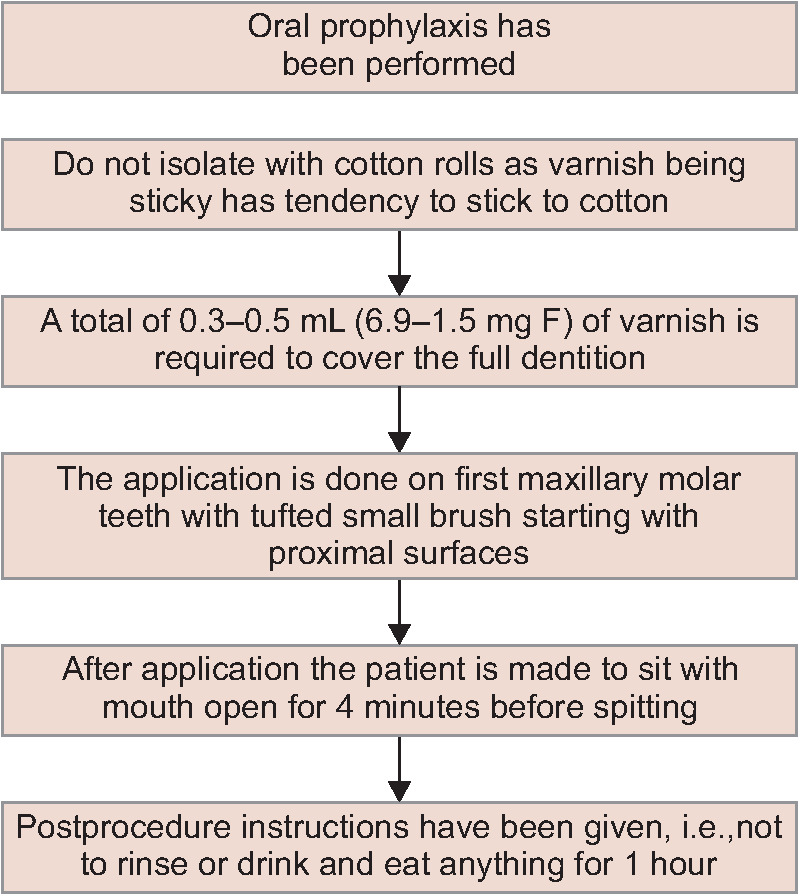
“Standardized application procedures (Fig. 1) for all varnishes were used to prevent unintentional unblinding.”
§ Effect of Three Different Topical Fluoride Varnishes on Streptococcus mutans Count in Biofilm Samples of Children Aged 6–10 Years: A Randomized Controlled Trial > Materials and Methods
plaindirect- Asserted: passes — The authors put it forward as true.
- Checkable: passes — It can be checked against evidence.
- Load-bearing: passes — The paper’s conclusions depend on it.
- Based: passes — The paper gives a reason why it holds.
Probably not a substantial claim.
None of the sources cited for this claim have been checked yet.
In the paper
“Shen et al.31 found MI Varnish's fluoride ion reached peak release at 24 hours, with nearly full release by 48 hours.”
§ Effect of Three Different Topical Fluoride Varnishes on Streptococcus mutans Count in Biofilm Samples of Children Aged 6–10 Years: A Randomized Controlled Trial > Discussion
What the sources say
- Not matchedcites Shen et al.
Couldn’t be matched to a paper in Crossref, so it can’t be checked.
- Not checked — no full text of the sourcecites [31] 31. Shen C, Autio-Gold J. Assessing fluoride concentration uniformity and fluoride release from three varnishes. J Am Dent Assoc 2002;133(2):176–182. source
plain- Asserted: passes — The authors put it forward as true.
- Checkable: passes — It can be checked against evidence.
- Load-bearing: fails — The paper’s conclusions may not depend on it.
- Based: passes — The paper gives a reason why it holds.
Probably not a substantial claim. The paper’s conclusions may not depend on it. It may state two separate claims as one.
- Not matched
The paper relies on this without support.
There is limited literature comparing the efficacy of different types of fluoride varnishes in reducing S. mutans counts in children, particularly with and without prophylactic procedures.
“There is limited literature comparing the efficacy of different types of fluoride varnishes in reducing S. mutans counts in children, particularly with and without prophylactic procedures.”
Self-check
Percentages, sums and reported differences re-computed from the paper’s own numbers.
Each contradiction between two passages listed here was confirmed by an independent check.
Rated major: it would touch a result — a value a result rests on, reported and recomputed p-values on opposite sides of the significance level, two passages that conflict with no sign which is right, or a cited work retracted before this paper was published.
In the paper
§ Effect of Three Different Topical Fluoride Varnishes on Streptococcus mutans Count in Biofilm Samples of Children Aged 6–10 Years: A Randomized Controlled Trial > Results
“Notably, GC MI Varnish showed a significant difference from both Ultradent and Fluor Protector S at 1 month (p < 0.0001) and 3 months (p = 0.01).”
§ Effect of Three Different Topical Fluoride Varnishes on Streptococcus mutans Count in Biofilm Samples of Children Aged 6–10 Years: A Randomized Controlled Trial > Results
“| Post hoc test | Group I | Group II | 0.45 | 0.0001* | 0.44 | 0.75 |”
Rated minor: it would not touch a result — a value no result rests on, a p-value that stays on the same side of the significance level, or a conflict that is clerical, resolved elsewhere in the paper, or outside its own findings.
In the paper
“| Fluor Protector S | 7.83 ± 0.17 | 6.14 ± 1.85 | 1.69 ± 1.46 | 21.5 |”
§ Effect of Three Different Topical Fluoride Varnishes on Streptococcus mutans Count in Biofilm Samples of Children Aged 6–10 Years: A Randomized Controlled Trial > Results
Reported 1.46 · recomputed 1.68
Rated minor: it would not touch a result — a value no result rests on, a p-value that stays on the same side of the significance level, or a conflict that is clerical, resolved elsewhere in the paper, or outside its own findings.
In the paper
“| GC MI Varnish | 7.64 ± 0.18 | 5.76 ± 2.05 | 1.88 ± 1.54 | 24.6 |”
§ Effect of Three Different Topical Fluoride Varnishes on Streptococcus mutans Count in Biofilm Samples of Children Aged 6–10 Years: A Randomized Controlled Trial > Results
Reported 1.54 · recomputed 1.87
Rated minor: it would not touch a result — a value no result rests on, a p-value that stays on the same side of the significance level, or a conflict that is clerical, resolved elsewhere in the paper, or outside its own findings.
In the paper
§ Effect of Three Different Topical Fluoride Varnishes on Streptococcus mutans Count in Biofilm Samples of Children Aged 6–10 Years: A Randomized Controlled Trial > Materials and Methods
“A total of 144 children, aged 6–10 years, who met the inclusion criteria for fluoride varnish application, were enrolled in the study following a screening process at the outpatient department of pediatric and preventive dentistry.”
§ Effect of Three Different Topical Fluoride Varnishes on Streptococcus mutans Count in Biofilm Samples of Children Aged 6–10 Years: A Randomized Controlled Trial > Results
“The study initially enrolled a total of 180 participants, who were equally divided into three groups of 60 each.”
Citations
Cites
The Biology of Streptococcus mutans
Lemos, J. A., Palmer, S. R., Zeng, L., Wen, Z. T., Kajfasz, J. K., Freires, I. A., Abranches, J., & Brady, L. J. (2019) · Microbiology Spectrum · doi:10.1128/microbiolspec.gpp3-0051-2018 · Cited by 794
Dental Plaque as a Microbial Biofilm
Marsh, P. D. (2004) · Caries Research · doi:10.1159/000077756 · Cited by 763
Reynolds, E. C. (1997) · Journal of Dental Research · doi:10.1177/00220345970760091101 · Cited by 619
Topical fluoride for caries prevention
Weyant, R. J., Tracy, S. L., Anselmo, T. (., Beltrán-Aguilar, E. D., Donly, K. J., Frese, W. A., Hujoel, P. P., Iafolla, T., Kohn, W., Kumar, J., et al. (2013) · The Journal of the American Dental Association · doi:10.14219/jada.archive.2013.0057 · Cited by 357
Evidence-based dentistry update on silver diamine fluoride
Crystal, Y. O., & Niederman, R. (2019) · Dental Clinics of North America · doi:10.1016/j.cden.2018.08.011 · Cited by 253
Biochemical Effects of Fluoride on Oral Bacteria
Hamilton, I. R. (1990) · Journal of Dental Research · doi:10.1177/00220345900690s128 · Cited by 239
D o W e N eed to be C oncerned about D ental C aries in the C oming M illennium ?
Bowen, W. H. (2002) · Critical Reviews in Oral Biology & Medicine · doi:10.1177/154411130201300203 · Cited by 234
Preventive Oral Health Intervention for Pediatricians
Health, S. O. P. D. A. O. (2008) · PEDIATRICS · doi:10.1542/peds.2008-2577 · Cited by 195
Shen, P., Cai, F., Nowicki, A., Vincent, J., & Reynolds, E. C. (2001) · Journal of Dental Research · doi:10.1177/00220345010800120801 · Cited by 192
Minimum intervention dentistry principles and objectives
Walsh, L. J., & Brostek, A. (2013) · Australian Dental Journal · doi:10.1111/adj.12045 · Cited by 159
Research works printed but not linked: 6
- 19. Bowen WH. Do we need to be concerned about dental caries in the coming millennium? Crit Rev Oral Biol Med 2002;13(2):126–131.
- 24. Fejerskov O, Ekstrand J, Burt BA. Fluoride in Dentistry, 2nd edition. Munksgaard: Copenhagen; 1996. pp. 311–327.
- 32. Pukallus ML, et al. Randomized controlled trial of MI varnish in children at high caries risk. Pediatr Dent 2013;35(7):47–51.
- 33. Kitasako Y, et al. Inhibitory effects of casein phosphopeptide amorphous calcium phosphate on the progression of enamel caries. Aust Dent J 2014;59(2):180–187.
- 34. Baysan A, Lynch E. Fluoride release from resin-based fissure sealants. J Dent Res 2005;84(3):243–248.
- 39. Seppä L. Resin-modified glass ionomer materials: fluoride release and cariostatic properties. Aust Dent J 1998;43(2):63–69.
Cited by
Still being checked.
Metadata
- Authors
- Baidya, D., Pathivada, L., Garg, N., Karthik, K. M., Jain, A. K., & Bhyri, P.
- Affiliations
- Rungta College (IN)
- Rajendra Institute of Medical Sciences (IN)
- Corresponding author
- Garg, Nishita
- Venue
- International Journal of Clinical Pediatric Dentistry
- Publisher
- Jaypee Brothers Medical Publishing
- Published
- 2026-03-02
- Volume
- 19
- Issue
- 3
- Pages
- 343-349
- ISSN
- 0974-7052 (ISSN-L)
- 0975-1904
- PMC
- PMC13280513
- OpenAlex
- W7133312010
- Cited by
- 0
- References
- 28
- FWCI
- 0.00
- Type
- journal article
- Language
- en
- Open access
- diamond
- doi.org
- Locations
- International Journal of Clinical Pediatric Dentistry (publishedVersion)
- PubMed (publishedVersion)
- PubMed Central (publishedVersion, cc-by-nc)
- Topics
- Health Sciences › Dentistry › General Dentistry › Dental Health and Care Utilization
- Health Sciences › Dentistry › Periodontics › Oral microbiology and periodontitis research
- Health Sciences › Dentistry › General Dentistry › Dental materials and restorations
- Keywords
- Streptococcus mutans, dental plaque, dental caries prevention, sodium fluoride, CPP-ACP, mutans streptococci
About these checks
Registry, retraction, Cites and statistics results are computed, not judged, with one exception: a printed reference that no index lists is read once by a model before it counts as a citation error. Claims are extracted by a model and kept only when their quote appears verbatim in the text; each cited source is then checked, with a model’s help, for whether it says what the claim relies on. Those verdicts can be wrong — read the claim’s quote and the cited source before relying on one.
A language model drew the claims from the paper on 2026-11-10, under version 3 of the claim definition (model deepseek-v4.1-flash, prompt extract-v3).
A second model labelled each claim on 2026-11-10 (model jev-1.13-20260917, definition revision gold-guideline-v0.2).
Cited sources are checked with a language model’s help (gpt-6-sol).
Statistics and arithmetic are recomputed, not judged.
Confidence bands are shown only for fields calibrated on our annotated test set. None is calibrated yet, so no band is shown.
What counts as a claim ›How we measure confidence ›How we check this ›
Are you an author, or do you see a problem with this page? Request a review
