

Evidence for greater oxygen decline rates in the coastal ocean than in the open ocean
Open accessPublished version of a preprint
The DOI matches its Crossref record; 72 of the 72 references it cites were found in a registry or an index.
Abstract
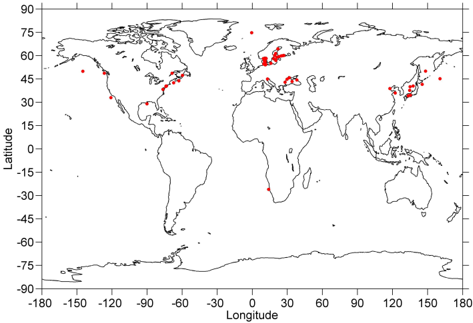
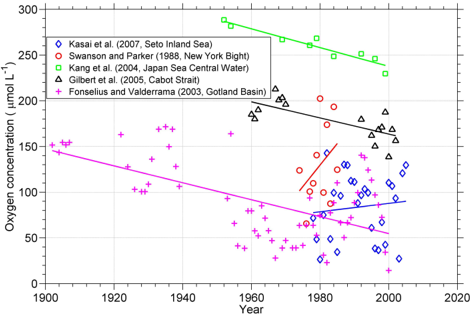
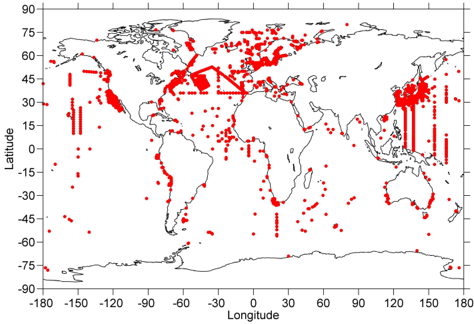
In the global ocean, the number of reported hypoxic sites (oxygen <30% saturation) is on the rise both near the coast and in the open ocean. But unfortunately, most of the papers on hypoxia only present oxygen data from one or two years, so that we often lack a long-term perspective on whether oxygen levels at these locations are decreasing, steady or increasing. Consequently, we cannot rule out the possibility that many of the newly reported hypoxic areas were hypoxic in the past, and that the increasing number of hypoxic areas partly reflects increased research and monitoring efforts. Here we address this shortcoming by computing oxygen concentration trends in the global ocean from published time series and from time series that we calculated using a global oxygen database. Our calculations reveal that median oxygen decline rates are more severe in a 30 km band near the coast than in the open ocean (>100 km from the coast). Percentages of oxygen time series with negative oxygen trends are also greater in the coastal ocean than in the open ocean. Finally, a significant difference between median published oxygen trends and median trends calculated from raw oxygen data suggests the existence of a publication bias in favor of negative trends in the open ocean.
Overview
The claims and statistics of this paper haven’t been checked yet.
Free: it reads the open-access text and checks the first 5 claims that cite a source we can check. Create a free account to check every claim.
Integrity signals
Registry
Cites
Statistics
Figures
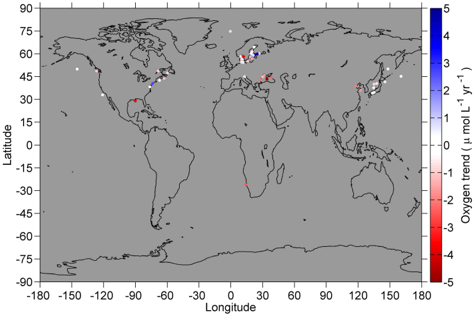
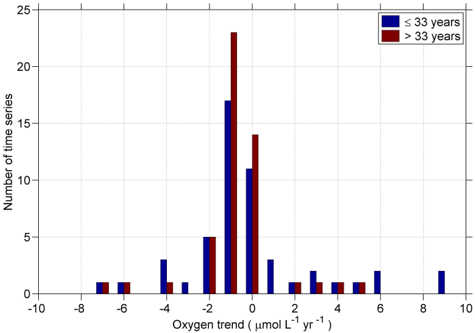
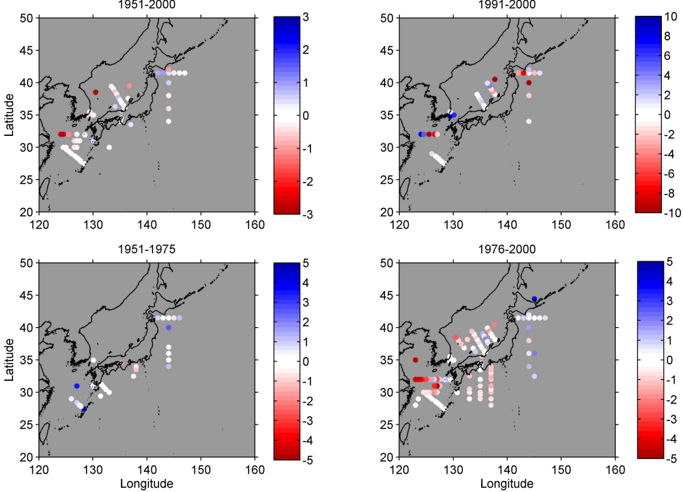
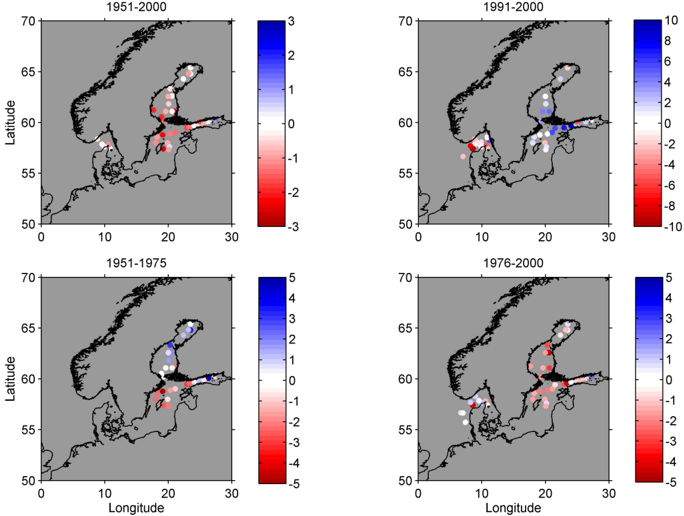
Verification
Claims the paper makes
The claims and statistics of this paper haven’t been checked yet.
Free: it reads the open-access text and checks the first 5 claims that cite a source we can check. Create a free account to check every claim.
Claims other papers make about this one
Each is checked against this paper’s own text: does it say what the citing paper says it does?
The source backs part of the claim, not all of it — or backs it for a different population, condition or comparison.
In the citing paper
“Large amounts of organic matter associated with algal blooms can stimulate microbial respiration that depletes dissolved oxygen and produces CO 2 , promoting hypoxia (Fig. 1; Diaz and Rosenberg, 2008;Gilbert et al., 2010;Breitburg et al., 2018) and acidification (Fig. 1; Cai et al., 2011;Waldbusser et al., 2011;Wallace et al., 2014;Baumann et al., 2015).”
From Harmful algal blooms: A climate change co-stressor in marine and freshwater ecosystems (2020) · cites this paper as Gilbert et al., 2010
Experimental — accuracy not yet measuredThe cited source says what the claim attributes to it.
In the citing paper
“In coastal aquatic systems, reported deoxygenation rates integrated over a decade or longer exceed those of the open ocean (Gilbert et al., 2010).”
From Warming and hypoxia reduce the performance and survival of northern bay scallops (Argopecten irradians irradians) amid a fishery collapse (2023) · cites this paper as Gilbert et al., 2010
Self-check
Percentages, sums and reported differences re-computed from the paper’s own numbers.
The self-check needs the paper’s full text.
Citations
Cites
(1999) · Wiley eBooks · doi:10.1002/9783527613984 · Cited by 7,730
Spreading dead zones and consequences for marine ecosystems
Diaz, R. J., & Rosenberg, R. (2008) · Science · doi:10.1126/science.1156401 · Cited by 6,626 · cited 2×
“Several studies suggest that oxygen levels are generally decreasing both in the coastal ocean (Dı́az and Rosenberg, 2008) and in the deep ocean (Keeling and Garcia, 2002).”
BackgroundSelf-citation(1982) · International Geophysics · doi:10.1016/s0074-6142(08)x6002-4 · Cited by 4,853 · cited 1×
“Due to the effect of Earth’s rotation, river plumes generally veer to the right (left) of river mouths in the Northern (Southern) Hemisphere, and then tend to flow parallel to the coastline within about one internal Rossby radius of deformation (Gill , 1982).”
BackgroundThe Pacific Decadal Oscillation
Mantua, N. J., & Hare, S. R. (2002) · Journal of Oceanography · doi:10.1023/a:1015820616384 · Cited by 2,773 · cited 2×
“Interdecadal changes in ocean ventilation can be caused b large scale changes in atmospheric and oceanic circulation patterns associated with the North Atlantic Oscillation (Johnson and Gruber, 2007), the Arctic Oscillation (Cui and Senjyu, 2010), the Pacific Decadal Oscillation (Frölisher et al., 2009) or the Southe…”
BackgroundCoastal marine eutrophication: A definition, social causes, and future concerns
Nixon, S. W. (1995) · Ophelia · doi:10.1080/00785236.1995.10422044 · Cited by 2,672 · cited 2×
“At some coastal sites, eutrophication ( Nixon, 1995) from nearby rivers appears to be the main cause of hypoxia ( Kemp et al.”
BackgroundENSO as an Integrating Concept in Earth Science
McPhaden, M. J., Zebiak, S. E., & Glantz, M. H. (2006) · Science · doi:10.1126/science.1132588 · Cited by 2,110
Ocean Deoxygenation in a Warming World
Keeling, R. F., Körtzinger, A., & Gruber, N. (2010) · Annual Review of Marine Science · doi:10.1146/annurev.marine.010908.163855 · Cited by 1,712 · cited 1×
“A greater level of observation and finer resolution models are needed to understand how and why oxygen appears to be changing at such a rapid rate at global scales (Keeling et al., 2010).”
BackgroundA global, self‐consistent, hierarchical, high‐resolution shoreline database
Wessel, P., & Smith, W. H. F. (1996) · Journal of Geophysical Research: Solid Earth · doi:10.1029/96jb00104 · Cited by 1,575 · cited 2×
“We evaluated distance from the coast for each station by using GSHHS (Global Self-consistent, Hierarchical, Highresolution Shoreline) shapefiles version 1.3 (Wessel and Smith, 1996), together with the functionsdeg2kmand distancefrom the Matlab mapping toolbox version 2.7.2.”
BackgroundMethodInfluentialGeographical Variability of the First Baroclinic Rossby Radius of Deformation
Chelton, D. B., deSzoeke, R. A., Schlax, M. G., El Naggar, K., & Siwertz, N. (1998) · Journal of Physical Oceanography · doi:10.1175/1520-0485(1998)028<0433:gvotfb>2.0.co;2 · Cited by 1,541
Expanding Oxygen-Minimum Zones in the Tropical Oceans
Stramma, L., Johnson, G. C., Sprintall, J., & Mohrholz, V. (2008) · Science · doi:10.1126/science.1153847 · Cited by 1,516 · cited 2×
“There are early indications that this may already be detectable (Stramma et al., 2008; Johnson and Gruber, 2007; Stramma et al., 2010), but interdecadal changes in ocean circulation could have played a role in these trends (Frölisher et al., 2009).”
Background
Research works printed but not linked: 1
- 16. Garcia, H. E., Locarnini, R. A., Boyer, T. P., and Antonov, J. I.: World Ocean Atlas 2005: Dissolved oxygen, apparent oxygen utilization, and oxygen saturation, Vol. 3 of NOAA Atlas NESDIS 63, US Government Printing Office, Washington, DC, 2006.
Cited by
Items 101–200 of 333
Johannessen, S. C., Macdonald, R. W., Burd, B. J., van Roodselaar, A., & Bertold, S. (2014) · The Science of The Total Environment · doi:10.1016/j.scitotenv.2014.11.096 · Cited by 33
“Subsurface oxygen is declining in coastal waters around the world (Gilbert et al., 2010).”
BackgroundBelanger, C. L. (2012) · PLoS ONE · doi:10.1371/journal.pone.0036290 · Cited by 31
“ocean settings [6–7].”
Carmack, E. C., McLaughlin, F. A., Vagle, S., Melling, H., & Williams, W. J. (2010) · ATMOSPHERE-OCEAN · doi:10.3137/oc324.2010 · Cited by 35
“…affect calcifying biota and therefore the composition of marine ecosystems in general (Cooley and Doney, 2009) and the Arctic food web in particular (Steinacher et al., 2009). k Hypoxia Concerns for hypoxia in waters around Canada are increasing (Gilbert et al., 2005, 2010; Whitney et al., 2007).”
BackgroundMarine species in ambient low‐oxygen regions subject to double jeopardy impacts of climate change
Stortini, C. H., Chabot, D., & Shackell, N. L. (2016) · Global Change Biology · doi:10.1111/gcb.13534 · Cited by 38
“…temperature, salinity, depth, nutrient input from agricultural run-off, primary productivity, respiration, mixing, and ocean current patterns (Gilbert et al., 2005; Thibodeau et al., 2006; Gilbert et al., 2010; Genovesi et al., 2011), the creation of downscaled projections for DO is no easy task.”
BackgroundSchmidt, S., Bernard, C., Escalier, J.-M., Etcheber, H., & Lamouroux, M. (2016) · Environmental Science and Pollution Research · doi:10.1007/s11356-016-7654-5 · Cited by 31
Suffocating Phytoplankton, Suffocating Waters—Red Tides and Anoxia
Pitcher, G. C., & Probyn, T. A. (2016) · Frontiers in Marine Science · doi:10.3389/fmars.2016.00186 · Cited by 35
Factors Contributing to Hypoxia in the Minjiang River Estuary, Southeast China
Zhang, P., Pang, Y., Pan, H., Shi, C., Huang, Y., & Wang, J. (2015) · International Journal of Environmental Research and Public Health · doi:10.3390/ijerph120809357 · Cited by 31
“had found the same phenomenon in the Gironde Estuary [5,11,39–41].”
BackgroundScaling laws explain foraminiferal pore patterns
Richirt, J., Champmartin, S., Schweizer, M., Mouret, A., Petersen, J., Ambari, A., & Jorissen, F. J. (2019) · Scientific Reports · doi:10.1038/s41598-019-45617-x · Cited by 30
Deoxygenation and Its Controls in a Semienclosed Shelf Ecosystem, Northern Yellow Sea
Wei, Q., Yao, Q., Wang, B., Xue, L., Fu, M., Sun, J., Liu, X., & Yu, Z. (2019) · Journal of Geophysical Research Oceans · doi:10.1029/2019jc015399 · Cited by 31
Lee, Y. G., Jeong, D. U., Lee, J. S., Choi, Y., & Lee, M. O. (2016) · Marine Pollution Bulletin · doi:10.1016/j.marpolbul.2016.01.024 · Cited by 32
“Although they have existed throughout geological time, hypoxic and anoxic environments have increased in occurrence in estuarine and coastal areas on a global scale (Diaz and Rosenberg, 2008; Gilbert et al., 2010).”
BackgroundCampanati, C., Yip, S., Lane, A., & Thiyagarajan, V. (2015) · ICES Journal of Marine Science · doi:10.1093/icesjms/fsv221 · Cited by 34
Foraminiferal community response to seasonal anoxia in Lake Grevelingen (the Netherlands)
Richirt, J., Riedel, B., Mouret, A., Schweizer, M., Langlet, D., Seitaj, D., Meysman, F. J. R., Slomp, C. P., & Jorissen, F. J. (2020) · Biogeosciences · doi:10.5194/bg-17-1415-2020 · Cited by 29
Jewett, L., & Romanou, A. (2017) · doi:10.7930/j0qv3jqb · Cited by 53
Spatial and Temporal Variability of Oceanic Oxygen Changes and Underlying Trends
Stramma, L., & Schmidtko, S. (2021) · ATMOSPHERE-OCEAN · doi:10.1080/07055900.2021.1905601 · Cited by 29
“There is evidence for larger rates of oxygen decline in the coastal ocean in a 30 km band near the coast than in the open ocean more than 100 km from the coast (Gilbert et al., 2010).”
BackgroundOptimal interpolation of global dissolved oxygen: 1965–2015
Ito, T. (2021) · Geoscience Data Journal · doi:10.1002/gdj3.130 · Cited by 31
Impacts and uncertainties of climate-induced changes in watershed inputs on estuarine hypoxia
Hinson, K. E., Friedrichs, M. A. M., Najjar, R. G., Herrmann, M., Bian, Z., Bhatt, G., St‐Laurent, P., Tian, H., & Shenk, G. W. (2023) · Biogeosciences · doi:10.5194/bg-20-1937-2023 · Cited by 29
Defining CO 2 and O 2 syndromes of marine biomes in the Anthropocene
Klein, S. G., Steckbauer, A., & Duarte, C. M. (2019) · Global Change Biology · doi:10.1111/gcb.14879 · Cited by 29
“…(2010) compiled long-term trends of O2 change in the open ocean (>100 km from the coast) and coastal zone ( 30 km from the coast), and revealed a greater prevalence of negative O2 trends in the coastal ocean (64.2 ± 9.3%, 95% CI) than in the open ocean (49.1 ± 4.1%, 95% CI, Gilbert et al., 2010).”
BackgroundInfluentialLi, C., Yang, D., & Zhai, W. (2022) · The Science of The Total Environment · doi:10.1016/j.scitotenv.2022.152935 · Cited by 28
Aerobic and anaerobic methane oxidation in a seasonally anoxic basin
Steinsdóttir, H. G. R., Schauberger, C., Mhatre, S., Thamdrup, B., & Bristow, L. A. (2022) · Limnology and Oceanography · doi:10.1002/lno.12074 · Cited by 30
“…the mid-20th century, declining oxygen levels have been recorded in coastal seas, bays, and estuaries such as the Baltic Sea, Chesapeake Bay, and the Danish coastal zone (Gilbert et al. 2010), where hypoxic and anoxic conditions are increasing in size, number, and frequency (Breitburg et al. 2018).”
BackgroundWeakened resilience of benthic microbial communities in the face of climate change
Seidel, L., Ketzer, M., Broman, E., Shahabi-Ghahfarokhi, S., Rahmati-Abkenar, M., Turner, S. J., Ståhle, M., Bergström, K., Manoharan, L., Ali, A., et al. (2022) · ISME Communications · doi:10.1038/s43705-022-00104-9 · Cited by 32
“Shallow coastal waters (0–200m) are more sensitive to atmospheric CO2 levels [14] and heat transfer to sediments will be more rapid, likely leading to longer periods of seasonal hypoxia [15].”
BackgroundMayol, E., Ruíz‐Halpern, S., Duarte, C. M., Castilla, J. C., & Pelegrí, J. L. (2012) · Biogeosciences · doi:10.5194/bg-9-1183-2012 · Cited by 31
Sub-lethal and lethal effects of chronic ammonia exposure and hypoxia on a New Zealand bivalve
Salmond, N. H., & Wing, S. R. (2022) · Journal of Experimental Marine Biology and Ecology · doi:10.1016/j.jembe.2022.151696 · Cited by 27
Zhang, J., & Gao, X. (2016) · Marine Pollution Bulletin · doi:10.1016/j.marpolbul.2016.06.095 · Cited by 26
Self-citationEerkes‐Medrano, D., Menge, B., Sislak, C. D., & Langdon, C. (2012) · Marine Ecology Progress Series · doi:10.3354/meps10130 · Cited by 29
“Oxygen concentrations have declined faster in coastal waters than in open oceans (Gilbert et al. 2010), a phenomenon that has been cited as one of the fastest and most drastically changing environmental variables of ecological importance (Díaz 2001).”
BackgroundBianucci, L., Fennel, K., Chabot, D., Shackell, N. L., & Lavoie, D. (2015) · ICES Journal of Marine Science · doi:10.1093/icesjms/fsv220 · Cited by 31
“Observations show that DO is declining both in the open ocean and on continental shelves (e.g. Gilbert et al., 2005, 2010; Stramma et al., 2008).”
BackgroundEffects of hypoxia on growth of the diatom Skeletonema costatum
Wu, R. S. S., Wo, K. T., & Chiu, J. (2012) · Journal of Experimental Marine Biology and Ecology · doi:10.1016/j.jembe.2012.04.003 · Cited by 26
Review of Artificial Downwelling for Mitigating Hypoxia in Coastal Waters
Liu, S., Zhao, L., Xiao, C., Fan, W., Cai, Y. P., Pan, Y., & Chen, Y. (2020) · Water · doi:10.3390/w12102846 · Cited by 26
“pointed out the importance of monitoring in the hypoxic area, the effectiveness, and ecological impact, and perhaps potential side effects of downwelling require comprehensive environmental monitoring and analysis of biochemical geophysics [84].”
BackgroundSeasonal hypoxia and temperature inversions in a tropical bay
Adelson, A. E., Altieri, A. H., Noriega, X. B., Collin, R., Davis, K. A., Gaul, A., Giddings, S. N., Reed, V., & Pawlak, G. R. (2022) · Limnology and Oceanography · doi:10.1002/lno.12196 · Cited by 26
“Hypoxia is particularly common in estuarine and coastal waters (Gilbert et al. 2010) where both biogeochemical processes including primary production and oxygen consumption (e.g., respiration and sediment uptake) and physical mechanisms (e.g., stratification, mixing, and advective transport) impact…”
BackgroundOcean Oxygen: the role of the Ocean in the oxygen we breathe and the threat of deoxygenation
Grégoire, M., Oschlies, A., Canfield, D. E., Castro, C., Ciglenečki, I., Croot, P. L., Salin, K., Schneider, B., Serret, P., Slomp, C. P., et al. (2023) · Helmholtz Centre for Ocean Research Kiel (GEOMAR) · doi:10.5281/zenodo.7941156 · Cited by 37
Oxygen – Dynamics and Biogeochemical Consequences
Testa, J. M., & Kemp, W. M. (2011) · Elsevier eBooks · doi:10.1016/b978-0-12-374711-2.00505-2 · Cited by 36
Independent Losses of the Hypoxia-Inducible Factor (HIF) Pathway within Crustacea
Graham, A. M., & Barreto, F. S. (2020) · Molecular Biology and Evolution · doi:10.1093/molbev/msaa008 · Cited by 25
Sediment Response to 25 Years of Persistent Hypoxia
Lefort, S., Mucci, A. O., & Sundby, B. (2012) · Aquatic Geochemistry · doi:10.1007/s10498-012-9173-4 · Cited by 23
“The number of reports of low oxygen bottom waters in the coastal ocean has increased at an alarming rate during the last decade, as has the extent of the area affected by low oxygen concentrations (Diaz 2001; Gilbert et al. 2010).”
BackgroundSankar, S., Polimene, L., Marin, L., Menon, N. N., Samuelsen, A., Pastres, R., & Ciavatta, S. (2018) · Ecological Modelling · doi:10.1016/j.ecolmodel.2018.01.016 · Cited by 24
“In the present ocean, OMZs are expanding as a 47 consequence of eutrophication and climate change, representing a serious threat for ecosystem 48 functioning and services such as fisheries (Oschlies et al., 2008; Stramma et al., 2008; Diaz and 49 Rosenberg, 2008; Gilbert et al., 2010; Rabalais et al., 2014; Duarte et…”
BackgroundRabouille, C., Lansard, B., Owings, S. M., Rabalais, N. N., Bombled, B., Metzger, É., Richirt, J., Eitel, E. M., Boever, A., Beckler, J., et al. (2021) · Frontiers in Marine Science · doi:10.3389/fmars.2021.604330 · Cited by 24
Self-citationTranscriptomic alterations in Daphnia magna embryos from mothers exposed to hypoxia
Lai, K. P., Li, J., Chan, C. Y. S., Chan, T., Yuen, K. W. Y., & Chiu, J. (2016) · Aquatic Toxicology · doi:10.1016/j.aquatox.2016.06.020 · Cited by 22
Oxygen decline in a temperate marginal sea: Contribution of warming and eutrophication
Wei, Q., Xue, L., Yao, Q., Wang, B., & Yu, Z. (2020) · The Science of The Total Environment · doi:10.1016/j.scitotenv.2020.143227 · Cited by 22
Latent effects of hypoxia on the gastropod Crepidula onyx
Li, L., & Chiu, J. (2013) · Marine Ecology Progress Series · doi:10.3354/meps10213 · Cited by 22
Effect of abalone farming on sediment geochemistry in the Shallow Sea near Wando, South Korea
Kang, J., Lee, Y. G., Jeong, D. U., Lee, J. S., Choi, Y., & Shin, Y. K. (2015) · Ocean Science Journal · doi:10.1007/s12601-015-0061-x · Cited by 22
“This process has received global attention due to the negative impact of eutrophication and hypoxia on coastal systems (Diaz and Rosenberg 2008; Doney 2010; Gilbert et al. 2010; Kalantzi et al. 2013).”
BackgroundSeidel, L., Broman, E., Ståhle, M., Nilsson, E., Turner, S. J., Hendrycks, W., Sachpazidou, V., Forsman, A., Hylander, S., & Dopson, M. (2022) · Frontiers in Microbiology · doi:10.3389/fmicb.2022.873281 · Cited by 24
“These will be especially exacerbated within coastal areas, as shallow waters exchange CO2 more rapidly compared with deeper open oceans (Gilbert et al., 2010; Pavia et al., 2019).”
BackgroundSeasonal controls on nearshore dissolved oxygen variability and hypoxia in a coastal embayment
Walter, R. K., Huie, S. A., Abraham, J. C. P., Pasulka, A. L., Davis, K. A., Connolly, T., Mazzini, P. L. F., & Robbins, I. (2022) · Estuarine Coastal and Shelf Science · doi:10.1016/j.ecss.2022.108123 · Cited by 22
“…and duration of hypoxic events in nearshore ecosystems, leading to direct mortality of and other significant non-lethal effects on economically and ecologically important fish and invertebrates (Grantham et al., 2004; Chan et al., 2008; Ekau et al., 2010; Gilbert et al., 2010; Booth et al., 2014).”
Lajaunie-Salla, K., Sottolichio, A., Schmidt, S., Litrico, X., Binet, G., & Abril, G. (2018) · Environmental Science and Pollution Research · doi:10.1007/s11356-018-3035-6 · Cited by 21
Temperature sensitivity of oxygen demand varies as a function of organic matter source
Szewczyk, C. J., Smith, E. M., & Benitez‐Nelson, C. R. (2023) · Frontiers in Marine Science · doi:10.3389/fmars.2023.1133336 · Cited by 21
“This is particularly true in coastal ecosystems where a combination of land use, population growth and rising temperatures are already leading to widespread hypoxia (Gilbert et al., 2010; Zhang et al., 2010).”
BackgroundMachain-Castillo, M. L., Ruíz-Fernández, A. C., Rodríguez, R. A., Sánchez-Cabeza, J.-A., Gío-Argáez, F. R., Rodríguez-Ramírez, A., Villegas-Hernández, R., Mora-García, A. I., Fuentes-Sánchez, A. P., Cardoso‐Mohedano, J. G., et al. (2020) · Marine Pollution Bulletin · doi:10.1016/j.marpolbul.2020.111245 · Cited by 20
Variability of Dissolved Oxygen in the Bottom Layer of the Southern Senegalese Shelf
Wahab, T. A., Machu, É., Échevin, V., Capet, X., Piétri, A., Correa, K., Sall, S. M., & Lazar, A. (2021) · Journal of Geophysical Research Oceans · doi:10.1029/2020jc016854 · Cited by 25
Chi, L., Song, X., Ding, Y. J., Yuan, Y., Wang, W., Cao, X., Wu, Z., & Yu, Z. (2021) · Marine Pollution Bulletin · doi:10.1016/j.marpolbul.2021.112920 · Cited by 20
Chapter 21 : Northeast. Fifth National Climate Assessment
Whitehead, J. C., Mecray, E. L., Lane, E. D., Kerr, L. A., Finucane, M. L., Reidmiller, D. R., Bove, M. C., Montalto, F. A., O'Rourke, S., Zarrilli, D., et al. (2023) · doi:10.7930/nca5.2023.ch21 · Cited by 30
Coastlines at Risk of Hypoxia From Natural Variability in the Northern Indian Ocean
Pearson, J., Resplandy, L., & Poupon, M. (2022) · Global Biogeochemical Cycles · doi:10.1029/2021gb007192 · Cited by 22
Jager, H. I., Novello, R. C., Dale, V. H., Villnäs, A., & Rose, K. A. (2018) · Ecosphere · doi:10.1002/ecs2.2408 · Cited by 22
“Already, hypoxic conditions have expanded in occurrence and duration in coastal waters worldwide (Diaz and Rosenberg 2008, Breitburg et al. 2018), with evidence of greater declines in oxic conditions in coastal areas than in marine systems (Gilbert et al. 2010).”
BackgroundIn Situ Phosphate Monitoring in Seawater: Today and Tomorrow
Jońca, J., Comtat, M., & Garcon, V. C. (2013) · Smart sensors, measurement and instrumentation · doi:10.1007/978-3-642-37006-9_2 · Cited by 19
Managed Nitrogen Load Decrease Reduces Chlorophyll and Hypoxia in Warming Temperate Urban Estuary
Codiga, D. L., Stoffel, H. E., Oviatt, C. A., & Schmidt, C. E. (2022) · Frontiers in Marine Science · doi:10.3389/fmars.2022.930347 · Cited by 18
Wang, H., Hu, X., Rabalais, N. N., & Brandes, J. A. (2018) · Geophysical Research Letters · doi:10.1029/2018gl078571 · Cited by 18
“…eutrophication results in excess production of organic carbon (OC) at surface as well as enhanced water column and benthic respiration, and ocean warming decreases oxygen solubility (Breitburg et al., 2018; Falkowski et al., 2011; Gilbert et al., 2010; Keeling et al., 2010; Rabalais et al., 2014).”
BackgroundSelf-citationEnvironmental Drivers of Seagrass-Associated Nekton Abundance Across the Northern Gulf of Mexico
Belgrad, B. A., Correia, K. M., Darnell, K. M., Darnell, M. Z., Hayes, C., Hall, M. O., Furman, B. T., Martin, C. W., & Smee, D. L. (2021) · Estuaries and Coasts · doi:10.1007/s12237-021-00927-0 · Cited by 17
Seidel, L., Sachpazidou, V., Ketzer, M., Hylander, S., Forsman, A., & Dopson, M. (2023) · Frontiers in Microbiology · doi:10.3389/fmicb.2023.1099445 · Cited by 19
“These changes will be even greater in coastal zones (Gilbert et al., 2010), emphasizing the need to understand how changes in the future will alter microbial communities and their nutrient cycling at the base of the food web.”
BackgroundEnvironmental drivers affecting the status of top commercial fish stocks in the Baltic Sea: review
Rościszewski-Dodgson, M. J., & Cirella, G. T. (2024) · Frontiers in Marine Science · doi:10.3389/fmars.2024.1399707 · Cited by 20
The seasonal use of small-scale space by benthic species in a transiently hypoxic area
Doya, C., Aguzzi, J., Chatzievangelou, D., Costa, C., & Tunnicliffe, V. (2015) · Journal of Marine Systems · doi:10.1016/j.jmarsys.2015.09.005 · Cited by 18
Annual hypoxia dynamics in a semi-enclosed Mediterranean gulf
Kountoura, K., & Zacharias, I. (2014) · Journal of Marine Systems · doi:10.1016/j.jmarsys.2014.07.007 · Cited by 19
Galli, G., Wakelin, S. L., Harle, J. D., Holt, J., & Artioli, Y. (2024) · Biogeosciences · doi:10.5194/bg-21-2143-2024 · Cited by 16
“In addition to that, marine ecosystems in the densely populated southern coastal regions of the NWES are”
BackgroundLee, Y. G., Choi, Y., Jeong, D. U., Lee, J. S., Kim, Y. W., Park, J. J., & Choi, J. U. (2016) · Marine Pollution Bulletin · doi:10.1016/j.marpolbul.2016.05.081 · Cited by 16
Sources and sinks of bottom water oxygen in a seasonally hypoxic fjord
Rakshit, S., Dale, A. W., Wallace, D. W. R., & Algar, C. K. (2023) · Frontiers in Marine Science · doi:10.3389/fmars.2023.1148091 · Cited by 15
“Several reports have identified an increase in the incidence of hypoxia (dissolved O2 < 63 mM) over the last half century (Diaz and Rosenberg, 2008; Gilbert et al., 2010; Schmidtko et al., 2017; Breitburg et al., 2018).”
BackgroundTian, D., Zhou, F., Zhang, W., Zhang, H., Ma, X., & Guo, X. (2021) · Journal of Oceanology and Limnology · doi:10.1007/s00343-021-0440-3 · Cited by 15
Spatio-temporal effects of fertilization in Anhui Province, China
Liu, Q., Guo, Y., & Giesy, J. P. (2014) · Environment Development and Sustainability · doi:10.1007/s10668-014-9600-3 · Cited by 15
Effects of hypoxia on biofilms and subsequently larval settlement of benthic invertebrates
Cheung, S. G., Chan, C. Y. S., Po, B. H. K., Li, L., Leung, J. Y. S., Qiu, J., Ang, P. O., Thiyagarajan, V., Shin, P. K. S., & Chiu, J. (2014) · Marine Pollution Bulletin · doi:10.1016/j.marpolbul.2014.04.051 · Cited by 17
“Although it is a naturally occurring phenomenon, it is increasingly caused by eutrophication of coastal waters due to anthropogenic activities, especially sewage discharge and the extensive use of agricultural fertilizers (Gilbert et al., 2010; Rabalais et al., 2010).”
BackgroundKinetic bottlenecks to respiratory exchange rates in the deep-sea – Part 1: Oxygen
Hofmann, A. F., Peltzer, E. T., & Brewer, P. G. (2013) · Biogeosciences · doi:10.5194/bg-10-5049-2013 · Cited by 18
Inter-annual variations in the hydrochemistry of Alappuzha mud banks, southwest coast of India
Mathew, D., Gireeshkumar, T. R., Udayakrishnan, P. B., Muraleedharan, K. R., Madhu, N. V., Nair, M., Revichandran, C., & Balachandran, K. K. (2019) · Continental Shelf Research · doi:10.1016/j.csr.2019.03.008 · Cited by 15
“Therefore, development of oxygen deficient zones in coastal areas are normally associated with major upwelling systems (Gilbert et al., 2010, Carstensen et al., 2014).”
BackgroundMn/Ca ratios of Ammonia tepida as a proxy for seasonal coastal hypoxia
Petersen, J., Barras, C., Bézos, A., La, C., Slomp, C. P., Meysman, F. J. R., Mouret, A., & Jorissen, F. J. (2019) · Chemical Geology · doi:10.1016/j.chemgeo.2019.04.002 · Cited by 15
“In coastal areas, the development of seasonally hypoxic zones (water bodies with O2 concentration < 63 μmol/L or 2 mg/L) has become a wide-spread phenomenon in response to increasing riverine nutrient input and rising temperatures (e.g., Rabalais et al., 2002; Gilbert et al., 2010; reviews in Diaz and Rosenberg, 2008;…”
BackgroundFuture climate projections in the global coastal ocean
Holt, J., Katavouta, A., Hopkins, J. E., Amoudry, L. O., Appendini, C. M., Arneborg, L., Arnold, A., Artioli, Y., Aucan, J. P., Berx, B., et al. (2025) · Progress In Oceanography · doi:10.1016/j.pocean.2025.103497 · Cited by 18
“Deoxygenation is manifest in the global coastal ocean (0 – 30 km from the coast) as the oxygen inventory here has been declining on average by (cid:0) 0.28 µ molL -1 yr (cid:0) 1 over 1976 – 2000 (Gilbert et al., 2010).”
InfluentialChen, B., Liu, J., Xu, G., & Li, G. (2021) · Microorganisms · doi:10.3390/microorganisms9122541 · Cited by 14
“Over the past five decades, the global oceans have had an estimated loss of ~2% of their oxygen [3]; the degree and area of O2-deficiency or O2-limitation have extended quickly [1,4].”
BackgroundLow oxygen events in the Laurentian Channel during the Holocene
Thibodeau, B., de Vernal, A., & Limoges, A. (2013) · Marine Geology · doi:10.1016/j.margeo.2013.08.004 · Cited by 21
“Gilbert et al. (2010) also noticed that most publications on hypoxia only report oxygen data from one or two years and that the long-term perspective of oxygen level change is often missing.”
BackgroundGilbert, D. (2017) · Nature · doi:10.1038/542303a · Cited by 14
Self-citationEstimating Hypoxic Volume in the Chesapeake Bay Using Two Continuously Sampled Oxygen Profiles
Bever, A. J., Friedrichs, M. A. M., Friedrichs, C. T., & Scully, M. E. (2018) · Journal of Geophysical Research Oceans · doi:10.1029/2018jc014129 · Cited by 14
Joshi, I. D., Ward, N. D., D’Sa, E. J., Osburn, C. L., Bianchi, T. S., & Oviedo‐Vargas, D. (2018) · Journal of Geophysical Research Biogeosciences · doi:10.1029/2018jg004391 · Cited by 15
“…showed reasonable performance during different seasons, several factors such as (1) microbial respiration in thewater column and bottom sediments (Gilbert et al., 2010; Hopkinson & Smith, 2005), (2) alkalinity of water which is a resistance to change in pH (Abril et al., 2015), (3) wind-induced…”
BackgroundThe Three Rs: Resolving Respiration Robotically in Shelf Seas
Williams, C. A. J., Davis, C. E., Palmer, M. R., Sharples, J., & Mahaffey, C. (2022) · Geophysical Research Letters · doi:10.1029/2021gl096921 · Cited by 13
Pratihary, A. K., Lavik, G., Naqvi, S. W. A., Shirodkar, G., Sarkar, A., Marchant, H. K., Ohde, T., Shenoy, D. M., Kurian, S., Uskaikar, H., et al. (2023) · Progress In Oceanography · doi:10.1016/j.pocean.2023.103075 · Cited by 14
Pizarro‐Koch, M., Pizarro, Ó., Dewitte, B., Montès, I., Paulmier, A., Garcon, V. C., Sepúlveda, H. H., Corredor‐Acosta, A., Aguirre, C., & Ramos, M. (2023) · Frontiers in Marine Science · doi:10.3389/fmars.2023.1155932 · Cited by 13
Consequences of climate-induced low oxygen conditions for commercially important fish
Townhill, B. L., van der Molen, J., Metcalfe, J., Simpson, S. D., Farcas, A., & Pinnegar, J. K. (2017) · Marine Ecology Progress Series · doi:10.3354/meps12291 · Cited by 17
“Dissolved oxygen levels are decreasing in the world’s oceans (Rabalais et al. 2010, Cocco et al. 2013, Levin & Breitburg 2015), driven in part by both climate variability and climate change (Gilbert et al. 2010, Levin & Breitburg 2015), alongside other anthropogenic effects.”
BackgroundKrogh, J., Ianson, D., Hamme, R. C., & Lowe, C. J. (2018) · Marine Pollution Bulletin · doi:10.1016/j.marpolbul.2018.05.018 · Cited by 15
Chan, Y., Li, L., Gopalakrishnan, S., Shin, P. K. S., Wu, R. S. S., Pointing, S. B., & Chiu, J. (2014) · Marine Pollution Bulletin · doi:10.1016/j.marpolbul.2014.04.052 · Cited by 13
“…may be a natural phenomenon, increasing eutrophication due to anthropogenic activities, especially sewage discharge and the wide-use of agricultural fertilizers, have exacerbated both the occurrence and severity of hypoxia in coastal waters worldwide (Gilbert et al., 2010; Rabalais et al., 2010).”
BackgroundLefort, S. (2012) · eScholarship@McGill (McGill) · doi:10.13140/2.1.2151.6165 · Cited by 15
Lévesque, D., Lebeuf, M., Maltais, D., Anderson, C., & Starr, M. (2023) · Frontiers in Marine Science · doi:10.3389/fmars.2022.1055384 · Cited by 12
Diaz, R., Eriksson-Hägg, H., & Rosenberg, R. (2013) · Elsevier eBooks · doi:10.1016/b978-0-12-407668-6.00004-5 · Cited by 14
Wang, B., Chen, J., Jin, H., Li, D., Gao, S., Tian, S., Sun, L., Zhang, H., & Li, L. (2023) · Frontiers in Marine Science · doi:10.3389/fmars.2022.1081975 · Cited by 13
Wallace, D. W. R., Jutras, M., Nesbitt, W. A., Donaldson, A., & Tanhua, T. (2023) · Mitigation and Adaptation Strategies for Global Change · doi:10.1007/s11027-023-10094-1 · Cited by 12
Identification of a Seasonal Subsurface Oxygen Minimum in Rivers Inlet, British Columbia
Jackson, J. M., Johannessen, S. C., Belluz, J. D. B., Hunt, B. P. V., & Hannah, C. G. (2021) · Estuaries and Coasts · doi:10.1007/s12237-021-00999-y · Cited by 13
Effect of Hypoxia on Photosystem II of Tropical Seagrass Enhalus acoroides in the Dark
Che, X., Zhang, T., Li, H., Zhang, L., & Liu, J. (2021) · Photochemistry and Photobiology · doi:10.1111/php.13522 · Cited by 16
Nighttime hypoxia effects on ATP availability for photosynthesis in seagrass
Che, X., Zhang, T., Li, H., Li, Y., Zhang, L., & Liu, J. (2023) · Plant Cell & Environment · doi:10.1111/pce.14654 · Cited by 11
Hardikar, R., Haridevi, C. K., Ram, A., Khandeparker, R. D. S., Amberkar, U., & Chauhan, M. (2019) · Environmental Monitoring and Assessment · doi:10.1007/s10661-019-7192-y · Cited by 11
“Dissolved oxygen depletion (hypoxia) is a widespread phenomenon and is reportedly growing globally (Gilbert et al. 2009; Ram et al. 2014).”
Stevens, S. W., Pawlowicz, R., Tanhua, T., Gerke, L., Nesbitt, W. A., Drozdowski, A., Chassé, J., & Wallace, D. W. R. (2024) · Communications Earth & Environment · doi:10.1038/s43247-024-01505-5 · Cited by 10
“Hypoxia is a growing issue in coastal seas globally 7,8 , and is approaching critical levels in some areas of the Gulf with adverse health effects for various organisms 9,10 .”
Liang, W., Li, P., Pan, Y., Zhang, Z., Yi, Y., Zhao, C., Zhao, C., Cai, R., Zhang, Z., Lønborg, C., et al. (2025) · Water Research · doi:10.1016/j.watres.2025.124210 · Cited by 12
Hidden seafloor hypoxia in coastal waters
Fredriksson, J., Attard, K. M., Stranne, C., Koszalka, I. M., Glud, R. N., Andersen, T. J., Humborg, C., & Brüchert, V. (2024) · Limnology and Oceanography · doi:10.1002/lno.12607 · Cited by 10
“…have been expanding over the last 60 yr in both shallow coastal and deeper offshore regions (Diaz and Rosenberg 2008; Conley et al. 2011; Breitburg et al. 2018), with a faster rate of decline and a higher percentage of locations with O 2 loss reported in coastal regions (Gilbert et al. 2010).”
Response of hypoxia to future climate change is sensitive to methodological assumptions
Hinson, K. E., Friedrichs, M. A. M., Najjar, R. G., Bian, Z., Herrmann, M., St‐Laurent, P., & Tian, H. (2024) · Scientific Reports · doi:10.1038/s41598-024-68329-3 · Cited by 11
An Overview of Atmospheric Reactive Nitrogen Research: South Asian Perspective
Naseem, M., & Kulshrestha, U. C. (2019) · Current World Environment · doi:10.12944/cwe.14.1.04 · Cited by 10
Maxey, J. D., Hartstein, N. D., Mujahid, A., & Müller, M. (2022) · Biogeosciences · doi:10.5194/bg-19-3131-2022 · Cited by 10
“Their location within mid- to high-latitude coastal margins and disproportionate role in geochemical cycling make these systems especially vulnerable to anthropogenic pressure (Walinsky et al., 2009; Gilbert et al., 2010; Bianchi et al., 2018, 2020).”
BackgroundDeep oxygen-depleted depressions in a Red Sea coral reef sustain resistant ecosystems
Klein, S. G., Frühe, L., Parry, A. J., Marchese, F. M., Nolan, M. K. B., Laiolo, E., Lim, K. K., Steckbauer, A., Breavington, J., Hempel, C. A., et al. (2025) · PNAS Nexus · doi:10.1093/pnasnexus/pgaf049 · Cited by 9
“Unlike typical coastal systems (18 – 20), the Difaht Farasan experiences little terrestrial input and precipitation (21).”
Kim, J., Lee, D., Kim, K., Jang, H. K., Kwon, J., Choi, J. Y., Joo, H., Kang, J. J., Park, S., & Lee, S. H. (2024) · Ocean & Coastal Management · doi:10.1016/j.ocecoaman.2024.107347 · Cited by 10
Organic carbon dynamics in the continental shelf waters of the eastern Arabian Sea
Shetye, S. S., Nandakumar, K., Kurian, S., Gauns, M., Shenoy, D. M., Naik, H., Vidya, P. J., & Karapurkar, S. G. (2022) · Environmental Monitoring and Assessment · doi:10.1007/s10661-022-10390-4 · Cited by 9
“Also, oxygen decline rates in the coastal waters are more severe than in the open ocean (Gilbert et al., 2010), which can play important role in TOC accumulation.”
BackgroundYoung, C. S., & Gobler, C. J. (2020) · Frontiers in Marine Science · doi:10.3389/fmars.2020.547276 · Cited by 10
“Beyond the open ocean, coastal ecosystems and estuaries can also be subjected to long-term and seasonal declines in oxygen and pH levels (Diaz and Rosenberg, 2008; Gilbert et al., 2010; Wallace et al., 2014; Breitburg et al., 2018).”
BackgroundDubosq, N., Schmidt, S., Sudre, J., Rigaud, S., Lamarque, B., Danilo, M., Grémare, A., & Deflandre, B. (2022) · Frontiers in Marine Science · doi:10.3389/fmars.2022.1006453 · Cited by 9
“Frontiers in Marine Science 08 respiration; physical transport; production by photosynthesis; Fennel and Testa, 2019) and is affected by different temporal cycles (e.g. daily and tidal, seasonal, decadal climatic cycles; Gilbert et al., 2010).”
BackgroundDutta, S., & Chattopadhyay, D. (2022) · Palaios · doi:10.2110/palo.2020.040 · Cited by 8
Ambiguous controls on simulated diazotrophs in the world oceans
Löptien, U., & Dietze, H. (2022) · Scientific Reports · doi:10.1038/s41598-022-22382-y · Cited by 9
Biogeochemical buffers in a eutrophic coastal lagoon along an oxic-hypoxic transition
Politi, T., Žilius, M., Forni, P., Zaiko, A., Daunys, D., & Bartoli, M. (2022) · Estuarine Coastal and Shelf Science · doi:10.1016/j.ecss.2022.108132 · Cited by 8
Metadata
- Authors
- Gilbert, D., Rabalais, N. N., Díaz, R. J., & Zhang, J.
- Affiliations
- Fisheries and Oceans Canada (CA)
- Louisiana Universities Marine Consortium (US)
- William & Mary (US)
- State Key Laboratory of Estuarine and Coastal Research (CN)
- Venue
- Biogeosciences
- Publisher
- Copernicus GmbH
- Published
- 2010-07-26
- Volume
- 7
- Issue
- 7
- Pages
- 2283-2296
- ISSN
- 1726-4170 (ISSN-L)
- 1726-4189
- OpenAlex
- W2149105527
- Cited by
- 306
- References
- 70
- Citations by year
- 2026: 14 · 2025: 19 · 2024: 18 · 2023: 39 · 2022: 33 · 2021: 22 · 2020: 16 · 2019: 18 · 2018: 17 · 2017: 12 · 2016: 16 · 2015: 8 · 2014: 14 · 2013: 20 · 2012: 17
- FWCI
- 13.83
- Type
- journal article
- Language
- en
- Open access
- gold
- doi.org
- Licence
- Locations
- Biogeosciences (publishedVersion, cc-by)
- Civil War Book Review (submittedVersion)
- W&M Publish (College of William & Mary) (submittedVersion, cc-by)
- DOAJ (DOAJ: Directory of Open Access Journals) (submittedVersion, cc-by-sa)
- Funders
- Fisheries and Oceans Canada
- Topics
- Physical Sciences › Earth and Planetary Sciences › Oceanography › Marine Plankton and Biogeochemistry
- Physical Sciences › Earth and Planetary Sciences › Oceanography › Oceanographic and Atmospheric Processes
- Physical Sciences › Earth and Planetary Sciences › Oceanography › Marine Biology and Ecology Research
- Keywords
- ocean deoxygenation, hypoxia, coastal waters, open ocean, publication bias
About these checks
Registry, retraction, Cites and statistics results are computed, not judged, with one exception: a printed reference that no index lists is read once by a model before it counts as a citation error. Claims are extracted by a model and kept only when their quote appears verbatim in the text; each cited source is then checked, with a model’s help, for whether it says what the claim relies on. Those verdicts can be wrong — read the claim’s quote and the cited source before relying on one.
Statistics and arithmetic are recomputed, not judged.
Confidence bands are shown only for fields calibrated on our annotated test set. None is calibrated yet, so no band is shown.
What counts as a claim ›How we measure confidence ›How we check this ›
Are you an author, or do you see a problem with this page? Request a review
Data sources
Bibliographic data: Semantic Scholar, OpenAlex, Crossref.
Contains information from the Semantic Scholar Academic Graph Datasets, made available under the ODC Attribution License (ODC-BY 1.0).
Semantic Scholar’s data is described in: Kinney, R., et al. (2023). The Semantic Scholar Open Data Platform. arXiv:2301.10140.
