

Evidence for greater oxygen decline rates in the coastal ocean than in the open ocean
Open accessPublished version of a preprint
The DOI matches its Crossref record; 72 of the 72 references it cites were found in a registry or an index.
Abstract
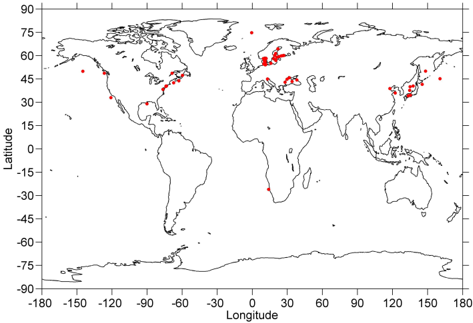
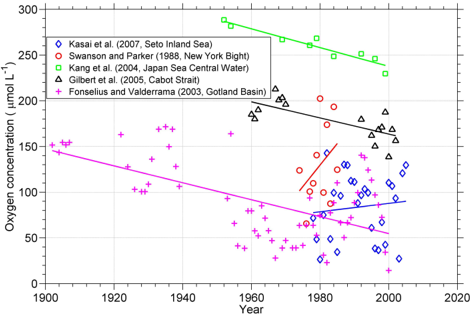
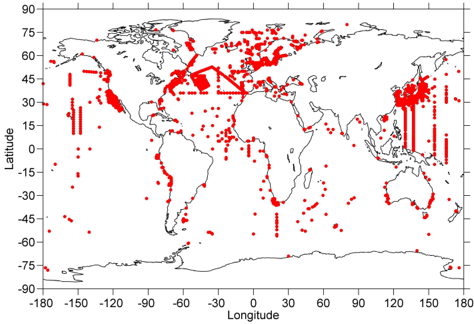
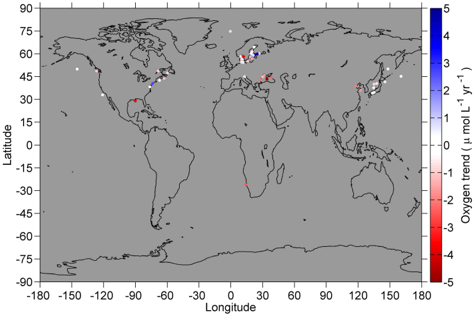
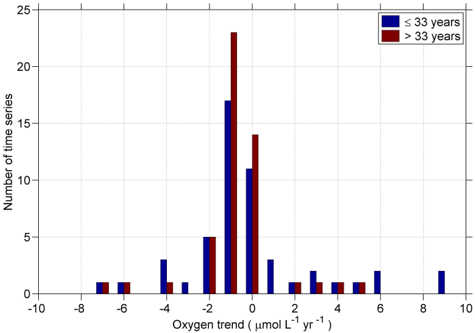
In the global ocean, the number of reported hypoxic sites (oxygen <30% saturation) is on the rise both near the coast and in the open ocean. But unfortunately, most of the papers on hypoxia only present oxygen data from one or two years, so that we often lack a long-term perspective on whether oxygen levels at these locations are decreasing, steady or increasing. Consequently, we cannot rule out the possibility that many of the newly reported hypoxic areas were hypoxic in the past, and that the increasing number of hypoxic areas partly reflects increased research and monitoring efforts. Here we address this shortcoming by computing oxygen concentration trends in the global ocean from published time series and from time series that we calculated using a global oxygen database. Our calculations reveal that median oxygen decline rates are more severe in a 30 km band near the coast than in the open ocean (>100 km from the coast). Percentages of oxygen time series with negative oxygen trends are also greater in the coastal ocean than in the open ocean. Finally, a significant difference between median published oxygen trends and median trends calculated from raw oxygen data suggests the existence of a publication bias in favor of negative trends in the open ocean.
Overview
The claims and statistics of this paper haven’t been checked yet.
Free: it reads the open-access text and checks the first 5 claims that cite a source we can check. Create a free account to check every claim.
Integrity signals
Registry
Cites
Statistics
Figures
Verification
Claims the paper makes
The claims and statistics of this paper haven’t been checked yet.
Free: it reads the open-access text and checks the first 5 claims that cite a source we can check. Create a free account to check every claim.
Claims other papers make about this one
Each is checked against this paper’s own text: does it say what the citing paper says it does?
The source backs part of the claim, not all of it — or backs it for a different population, condition or comparison.
In the citing paper
“Large amounts of organic matter associated with algal blooms can stimulate microbial respiration that depletes dissolved oxygen and produces CO 2 , promoting hypoxia (Fig. 1; Diaz and Rosenberg, 2008;Gilbert et al., 2010;Breitburg et al., 2018) and acidification (Fig. 1; Cai et al., 2011;Waldbusser et al., 2011;Wallace et al., 2014;Baumann et al., 2015).”
From Harmful algal blooms: A climate change co-stressor in marine and freshwater ecosystems (2020) · cites this paper as Gilbert et al., 2010
Experimental — accuracy not yet measuredThe cited source says what the claim attributes to it.
In the citing paper
“In coastal aquatic systems, reported deoxygenation rates integrated over a decade or longer exceed those of the open ocean (Gilbert et al., 2010).”
From Warming and hypoxia reduce the performance and survival of northern bay scallops (Argopecten irradians irradians) amid a fishery collapse (2023) · cites this paper as Gilbert et al., 2010
Self-check
Percentages, sums and reported differences re-computed from the paper’s own numbers.
The self-check needs the paper’s full text.
Citations
Cites
(1999) · Wiley eBooks · doi:10.1002/9783527613984 · Cited by 7,730
Spreading dead zones and consequences for marine ecosystems
Diaz, R. J., & Rosenberg, R. (2008) · Science · doi:10.1126/science.1156401 · Cited by 6,626 · cited 2×
“Several studies suggest that oxygen levels are generally decreasing both in the coastal ocean (Dı́az and Rosenberg, 2008) and in the deep ocean (Keeling and Garcia, 2002).”
BackgroundSelf-citation(1982) · International Geophysics · doi:10.1016/s0074-6142(08)x6002-4 · Cited by 4,853 · cited 1×
“Due to the effect of Earth’s rotation, river plumes generally veer to the right (left) of river mouths in the Northern (Southern) Hemisphere, and then tend to flow parallel to the coastline within about one internal Rossby radius of deformation (Gill , 1982).”
BackgroundThe Pacific Decadal Oscillation
Mantua, N. J., & Hare, S. R. (2002) · Journal of Oceanography · doi:10.1023/a:1015820616384 · Cited by 2,773 · cited 2×
“Interdecadal changes in ocean ventilation can be caused b large scale changes in atmospheric and oceanic circulation patterns associated with the North Atlantic Oscillation (Johnson and Gruber, 2007), the Arctic Oscillation (Cui and Senjyu, 2010), the Pacific Decadal Oscillation (Frölisher et al., 2009) or the Southe…”
BackgroundCoastal marine eutrophication: A definition, social causes, and future concerns
Nixon, S. W. (1995) · Ophelia · doi:10.1080/00785236.1995.10422044 · Cited by 2,672 · cited 2×
“At some coastal sites, eutrophication ( Nixon, 1995) from nearby rivers appears to be the main cause of hypoxia ( Kemp et al.”
BackgroundENSO as an Integrating Concept in Earth Science
McPhaden, M. J., Zebiak, S. E., & Glantz, M. H. (2006) · Science · doi:10.1126/science.1132588 · Cited by 2,110
Ocean Deoxygenation in a Warming World
Keeling, R. F., Körtzinger, A., & Gruber, N. (2010) · Annual Review of Marine Science · doi:10.1146/annurev.marine.010908.163855 · Cited by 1,712 · cited 1×
“A greater level of observation and finer resolution models are needed to understand how and why oxygen appears to be changing at such a rapid rate at global scales (Keeling et al., 2010).”
BackgroundA global, self‐consistent, hierarchical, high‐resolution shoreline database
Wessel, P., & Smith, W. H. F. (1996) · Journal of Geophysical Research: Solid Earth · doi:10.1029/96jb00104 · Cited by 1,575 · cited 2×
“We evaluated distance from the coast for each station by using GSHHS (Global Self-consistent, Hierarchical, Highresolution Shoreline) shapefiles version 1.3 (Wessel and Smith, 1996), together with the functionsdeg2kmand distancefrom the Matlab mapping toolbox version 2.7.2.”
BackgroundMethodInfluentialGeographical Variability of the First Baroclinic Rossby Radius of Deformation
Chelton, D. B., deSzoeke, R. A., Schlax, M. G., El Naggar, K., & Siwertz, N. (1998) · Journal of Physical Oceanography · doi:10.1175/1520-0485(1998)028<0433:gvotfb>2.0.co;2 · Cited by 1,541
Expanding Oxygen-Minimum Zones in the Tropical Oceans
Stramma, L., Johnson, G. C., Sprintall, J., & Mohrholz, V. (2008) · Science · doi:10.1126/science.1153847 · Cited by 1,516 · cited 2×
“There are early indications that this may already be detectable (Stramma et al., 2008; Johnson and Gruber, 2007; Stramma et al., 2010), but interdecadal changes in ocean circulation could have played a role in these trends (Frölisher et al., 2009).”
BackgroundEutrophication of Chesapeake Bay: historical trends and ecological interactions.
Kemp, W., Boynton, W., Adolf, J., Boesch, D., Boicourt, W., Brush, G., Cornwell, J., Fisher, T., Glibert, P., Hagy, J., et al. (2005) · Marine Ecology Progress Series · doi:10.3354/meps303001 · Cited by 1,468 · cited 1×
“At some coastal sites, eutrophication (Nixon, 1995) from nearby rivers appears to be the main cause of hypoxia (Kemp et al., 2005; Rabalais et al., 2002).”
BackgroundGulf of Mexico hypoxia, A.K.A. “The Dead Zone.”
Rabalais, N. N., Turner, R. E., & Wiseman, W. J. (2002) · Annual Review of Ecology and Systematics · doi:10.1146/annurev.ecolsys.33.010802.150513 · Cited by 1,330 · cited 1×
“At some coastal sites, eutrophication (Nixon, 1995) from nearby rivers appears to be the main cause of hypoxia (Kemp et al., 2005; Rabalais et al., 2002).”
BackgroundSelf-citationOxygen solubility in seawater: Better fitting equations
Garcia, H. E., & Gordon, L. I. (1992) · Limnology and Oceanography · doi:10.4319/lo.1992.37.6.1307 · Cited by 1,275
North Atlantic climate variability: The role of the North Atlantic Oscillation
Hurrell, J. W., & Deser, C. (2010) · Journal of Marine Systems · doi:10.1016/j.jmarsys.2009.11.002 · Cited by 1,008
Simulated response of the ocean carbon cycle to anthropogenic climate warming
Sarmiento, J. L., Hughes, T. M. C., Stouffer, R. J., & Manabe, S. (1998) · Nature · doi:10.1038/30455 · Cited by 899 · cited 2×
“A number of biogeochemical models embedded within ocean circulation models (Sarmiento et al., 1998; Matear et al., 2000; Bopp et al., 2002) predicted that as a consequence of global warming, oxygen levels in the ocean will decrease at a rate that is typically three to four times faster than one…”
BackgroundDie Bestimmung des im Wasser gelösten Sauerstoffes
Winkler, L. W. (1888) · Berichte der deutschen chemischen Gesellschaft · doi:10.1002/cber.188802102122 · Cited by 891
THE CHESAPEAKE BAY INSTITUTE TECHNIQUE FOR THE WINKLER DISSOLVED OXYGEN METHOD
CARPENTER, J. H. (1965) · Limnology and Oceanography · doi:10.4319/lo.1965.10.1.0141 · Cited by 827
Global ocean heat content 1955–2008 in light of recently revealed instrumentation problems
Levitus, S., Antonov, J. I., Boyer, T. P., Locarnini, R. A., Garcia, H. E., & Mishonov, A. V. (2009) · Geophysical Research Letters · doi:10.1029/2008gl037155 · Cited by 755 · cited 1×
“An alternative explanation might be that physical changes such as upper ocean warming (e.g.,Levitus et al., 2009) may cause changes in oxygen solubility and in subsurface ventilation that are the main drivers of the observed oxygen changes in the coastal ocean.”
BackgroundNorth Atlantic climate variability: The role of the North Atlantic Oscillation
Hurrell, J. W., & Deser, C. (2009) · Journal of Marine Systems · doi:10.1016/j.jmarsys.2008.11.026 · Cited by 670
Ocean oxygen minima expansions and their biological impacts
Stramma, L., Schmidtko, S., Levin, L. A., & Johnson, G. C. (2010) · Deep Sea Research Part I: Oceanographic Research Papers · doi:10.1016/j.dsr.2010.01.005 · Cited by 647 · cited 2×
“There are early indications that this may already be detectable (Stramma et al., 2008; Johnson and Gruber, 2007; Stramma et al., 2010), but interdecadal changes in ocean circulation could have played a role in these trends (Frölisher et al.”
BackgroundRabalais, N. N., Turner, R. E., Sen Gupta, B. K., Boesch, D. F., Chapman, P., & Murrell, M. C. (2007) · Estuaries and Coasts · doi:10.1007/bf02841332 · Cited by 445 · cited 2×
“…physics, we expect that most of the impacts of human-induced eutrophication should be felt within this coastal band of 30 km width; albeit, there are exceptions such as the Gulf of Mexico hypoxic zone associated with the Mississippi River plume that extends farther offshore (Rabalais et al., 2007).”
BackgroundSelf-citationOxygen declines and the shoaling of the hypoxic boundary in the California Current
Bograd, S. J., Castro, C. G., Di Lorenzo, E., Palacios, D. M., Bailey, H., Gilly, W., & Chavez, F. P. (2008) · Geophysical Research Letters · doi:10.1029/2008gl034185 · Cited by 420
Persistently declining oxygen levels in the interior waters of the eastern subarctic Pacific
Whitney, F. A., Freeland, H. J., & Robert, M. (2007) · Progress in Oceanography · doi:10.1016/j.pocean.2007.08.007 · Cited by 357 · cited 2×
“But at other sites on the continental shelf and in the deep ocean, changes in ocean circulation (Gilbert et al., 2005; Monteiro et al., 2006) or in winter ventilation (Whitney et al., 2007) also play a role in lowering oxygen concentrations.”
BackgroundClimate‐induced oceanic oxygen fluxes: Implications for the contemporary carbon budget
Bopp, L., Le Quéré, C., Heimann, M., Manning, A. C., & Monfray, P. (2002) · Global Biogeochemical Cycles · doi:10.1029/2001gb001445 · Cited by 339
LONG‐TERM CHANGES AND IMPACTS OF HYPOXIA IN DANISH COASTAL WATERS
Conley, D. J., Carstensen, J., Ærtebjerg, G., Christensen, P. B., Dalsgaard, T., Hansen, J. L. S., & Josefson, A. B. (2007) · Ecological Applications · doi:10.1890/05-0766.1 · Cited by 313
Annual Cycle and Variability of the North Brazil Current
Johns, W. E., Lee, T. N., Beardsley, R. C., Candela, J., Limeburner, R., & Castro, B. (1998) · Journal of Physical Oceanography · doi:10.1175/1520-0485(1998)028<0103:acavot>2.0.co;2 · Cited by 299
The change in oceanic O 2 inventory associated with recent global warming
Keeling, R. F., & Garcia, H. E. (2002) · Proceedings of the National Academy of Sciences · doi:10.1073/pnas.122154899 · Cited by 292
Environmental changes and the responses of the ecosystems of the Yellow Sea during 1976–2000
Lin, C., Ning, X., Su, J., Lin, Y., & Xu, B. (2005) · Journal of Marine Systems · doi:10.1016/j.jmarsys.2004.08.001 · Cited by 283 · cited 3×
“In one instance (Lin et al., 2005), we had to correct the originally published oxygen time series (with concentrations over 600 µmol L−1) by dividing the published concentrations by a factor of two.”
InfluentialGilbert, D., Sundby, B., Gobeil, C., Mucci, A., & Tremblay, G.-H. (2005) · Limnology and Oceanography · doi:10.4319/lo.2005.50.5.1654 · Cited by 265 · cited 2×
“But at other sites on the continental shelf and in the deep ocean, changes in ocean circulation (Gilbert et al., 2005; Monteiro et al., 2006) or in winter ventilation 25 (Whitney et al.”
BackgroundSelf-citationTemporal and spatial dynamics of diel-cycling hypoxia in estuarine tributaries
Tyler, R. M., Brady, D. C., & Targett, T. E. (2009) · Estuaries and Coasts · doi:10.1007/s12237-008-9108-x · Cited by 217 · cited 1×
“Being concerned with the large diurnal oxygen cycles that are characteristic of shallow estuaries (e.g., 2 m deep coastal lagoon estuary,Tyler et al., 2009), we also limited our attention to sites where the bottom was at least 10 m deep, because time of sampling during the day influences oxygen…”
BackgroundVariations in the chemistry of the Black Sea on a time scale of decades (1960–1995)
Konovalov, S. K., & Murray, J. W. (2001) · Journal of Marine Systems · doi:10.1016/s0924-7963(01)00054-9 · Cited by 212 · cited 3×
“In other cases, we had to estimate the climatological depth of isopycnal surfaces (Kang et al., 2004; Konovalov and Murray, 2001; Nakanowatari et al., 2007).”
BackgroundChanges in dissolved oxygen in the Southern Ocean with climate change
Matear, R. J., Hirst, A. C., & McNeil, B. I. (2000) · Geochemistry, Geophysics, Geosystems · doi:10.1029/2000gc000086 · Cited by 191 · cited 2×
“A number of biogeochemical models embedded within ocean circulation models (Sarmiento et al., 1998; Matear et al., 2000; Bopp et al., 2002) predicted that as a consequence of global warming, oxygen levels in the ocean will decrease at a rate that is typically three to four times faster than one…”
BackgroundPitkänen, H., Lehtoranta, J., & Räike, A. (2001) · AMBIO: A Journal of the Human Environment · doi:10.1579/0044-7447-30.4.195 · Cited by 182
Frölicher, T. L., Joos, F., Plattner, G. ‐., Steinacher, M., & Doney, S. C. (2009) · Global Biogeochemical Cycles · doi:10.1029/2008gb003316 · Cited by 175 · cited 1×
“More recently, Frölisher et al.(2009) predicted oxygen concentration trends of −0.”
BackgroundOne hundred years of hydrographic measurements in the Baltic Sea
Fonselius, S., & Valderrama, J. (2003) · Journal of Sea Research · doi:10.1016/s1385-1101(03)00035-2 · Cited by 168 · cited 5×
“14 48 Fonselius and Valderrama (2003) St. Lawrence Estuary 48.73, −68.59 320 1932–2003 84.4 −0.98 19 Gilbert et al.(2005) Cabot Strait 47.33, −59.77 250 1960–2002 177.9 −0.88 30 Gilbert et al.(2005) N Adriatic Sea 45, 13 30 1911–1984 245.0 −0.67 36 Justíc et al.(1987) East/Japan Sea 40, 135 800 1952–1999 260.2 −1.03 2…”
BackgroundInfluentialGutiérrez, D., Enríquez, E., Purca, S., Quipúzcoa, L., Marquina, R., Flores, G., & Graco, M. (2008) · Progress in Oceanography · doi:10.1016/j.pocean.2008.10.025 · Cited by 166
Trends in oxygen content 1911–1984 and occurrence of benthic mortality in the northern Adriatic Sea
Justić, D., Legović, T., & Rottini-Sandrini, L. (1987) · Estuarine, Coastal and Shelf Science · doi:10.1016/0272-7714(87)90035-7 · Cited by 165
Muller‐Karger, F., Varela, R., Thunell, R., Scranton, M., Bohrer, R., Taylor, G., Capelo, J., Astor, Y., Tappa, E., Ho, T., et al. (2001) · Journal of Geophysical Research: Oceans · doi:10.1029/1999jc000291 · Cited by 158
Yunev, O. A., Carstensen, J., Moncheva, S., Khaliulin, A., Ærtebjerg, G., & Nixon, S. W. (2007) · Estuarine Coastal and Shelf Science · doi:10.1016/j.ecss.2007.03.030 · Cited by 144
Nordberg, K. (2000) · Journal of Marine Systems · doi:10.1016/s0924-7963(99)00067-6 · Cited by 137
Monteiro, P. M. S., van der Plas, A. K., Mélice, J. L., & Florenchie, P. (2008) · Deep Sea Research Part I Oceanographic Research Papers · doi:10.1016/j.dsr.2007.12.010 · Cited by 128
Nakanowatari, T., Ohshima, K. I., & Wakatsuchi, M. (2007) · Geophysical Research Letters · doi:10.1029/2006gl028243 · Cited by 121
Summer hypoxia in the northern Gulf of Mexico and its prediction from 1978 to 1995
Turner, R. E., Rabalais, N. N., Swenson, E. M., Kasprzak, M., & Romaire, T. (2004) · Marine Environmental Research · doi:10.1016/j.marenvres.2003.09.002 · Cited by 120
Self-citationLaine, A. O., Sandler, H., Andersin, A.-B., & Stigzelius, J. (1997) · Journal of Sea Research · doi:10.1016/s1385-1101(97)00034-8 · Cited by 112
High Quality Oxygen Measurements from Profiling Floats: A Promising New Technique
Körtzinger, A., Schimanski, J., & Send, U. (2005) · Journal of Atmospheric and Oceanic Technology · doi:10.1175/jtech1701.1 · Cited by 110 · cited 2×
“Continuous, globally distributed in-situ oxygen measurements are required, such as those proposed on Argo profiling floats (Körtzinger et al., 2005; Gruber et al., 2010).”
BackgroundDecadal water mass variations along 20°W in the Northeastern Atlantic Ocean
Johnson, G. C., & Gruber, N. (2007) · Progress In Oceanography · doi:10.1016/j.pocean.2006.03.022 · Cited by 109 · cited 3×
“Interdecadal changes in ocean ventilation can be caused b large scale changes in atmospheric and oceanic circulation patterns associated with the North Atlantic Oscillation (Johnson and Gruber, 2007), the Arctic Oscillation (Cui and Senjyu, 2010), the Pacific Decadal Oscillation (Frölisher et al., 2009) or the Southe…”
BackgroundMonteiro, P. M. S., van der Plas, A., Mohrholz, V., Mabille, E., Pascall, A., & Joubert, W. (2006) · Geophysical Research Letters · doi:10.1029/2006gl026234 · Cited by 106 · cited 2×
“But at other sites on the continental shelf and in the deep ocean, changes in ocean circulation (Gilbert et al., 2005; Monteiro et al., 2006) or in winter ventilation 25 (Whitney et al.”
BackgroundWater-mass formation and distribution in the Nordic Seas during the 1990s
Blindheim, J., & Rey, F. (2004) · ICES Journal of Marine Science · doi:10.1016/j.icesjms.2004.05.003 · Cited by 104
Cronin, T. M., & Vann, C. D. (2003) · Estuaries · doi:10.1007/bf02695962 · Cited by 104
Gruber, N., Gruber, N., Gruber, N., Gruber, N., Gruber, N., Gruber, N., Gruber, N., Gruber, N., Gruber, N., & Gruber, N. (2010) · Proceedings of OceanObs'09: Sustained Ocean Observations and Information for Society · doi:10.5270/oceanobs09.cwp.39 · Cited by 86 · cited 1×
“Continuous, globally distributed in-situ oxygen measurements are required, such as those proposed on Argo profiling floats (Körtzinger et al., 2005; Gruber et al., 2010).”
BackgroundGarcia, H. E., Boyer, T. P., Levitus, S., Locarnini, R. A., & Antonov, J. (2005) · Geophysical Research Letters · doi:10.1029/2004gl022286 · Cited by 78 · cited 2×
“Because interannual oxygen variability is important in most marine systems (Garcia et al., 2005), we required that oxygen time series have a duration of at least 10 years.”
BackgroundNegative oxygen trends in Swedish coastal bottom waters
Rosenberg, R. (1990) · Marine Pollution Bulletin · doi:10.1016/0025-326x(90)90794-9 · Cited by 78
Yasuhara, M., Yamazaki, H., Tsujimoto, A., & Hirose, K. (2007) · Limnology and Oceanography · doi:10.4319/lo.2007.52.4.1633 · Cited by 77
Perspectives on long‐term variations in hypoxic conditions in western Long Island Sound
Wilson, R. E., Swanson, R. L., & Crowley, H. A. (2008) · Journal of Geophysical Research Atmospheres · doi:10.1029/2007jc004693 · Cited by 76 · cited 1×
“43 10 Wilson et al. (2008)”
Long-Term Variations of Potential Temperature and Dissolved Oxygen of the Japan Sea Proper Water
Minami, H., Kano, Y., & Ogawa, K. (1999) · Journal of Oceanography · doi:10.1023/a:1007889929187 · Cited by 71 · cited 1×
“32 182 Minami et al. (1999)”
Petrie, B. D., & Yeats, P. A. (2000) · Canadian Journal of Fisheries and Aquatic Sciences · doi:10.1139/f00-235 · Cited by 69
Laine, A. O., Andersin, A.-B., Leiniö, S., & Zuur, A. F. (2006) · Journal of Sea Research · doi:10.1016/j.seares.2006.08.003 · Cited by 67
Eutrophication in the Polish coastal zone: the past, present status and future scenarios
Łysiak-Pastuszak, E., Drgas, N., & Piątkowska, Z. (2004) · Marine Pollution Bulletin · doi:10.1016/j.marpolbul.2004.02.007 · Cited by 66 · cited 1×
“Some time series were eliminated from our analyses because they did not contain precise depth information (e.g., Lysiak-Pastuszak et al., 2004) for their measurements.”
BackgroundCarbon dioxide and oxygen fluxes in the Southern Ocean: Mechanisms of interannual variability
Verdy, A., Dutkiewicz, S., Follows, M. J., Marshall, J. C., & Czaja, A. (2007) · Global Biogeochemical Cycles · doi:10.1029/2006gb002916 · Cited by 65 · cited 3×
“Interdecadal changes in ocean ventilation can be caused b large scale changes in atmospheric and oceanic circulation patterns associated with the North Atlantic Oscillation (Johnson and Gruber, 2007), the Arctic Oscillation (Cui and Senjyu, 2010), the Pacific Decadal Oscillation (Frölisher et al., 2009) or the Southe…”
BackgroundThe northeastern Black Sea redox zone: Hydrochemical structure and its temporal variability
Yakushev, E. V., Часовников, В. К., Debolskaya, E. I., Егоров, А. В., Makkaveev, P. N., Pakhomova, S. V., Podymov, O. I., & Yakubenko, V. G. (2006) · Deep Sea Research Part II Topical Studies in Oceanography · doi:10.1016/j.dsr2.2006.05.019 · Cited by 39
Exact 95% confidence intervals for differences in binomial proportions
Fagan, T. (1999) · Computers in Biology and Medicine · doi:10.1016/s0010-4825(98)00047-x · Cited by 38 · cited 3×
“The percentage difference is between 9.9% and 20.1% at the 95% confidence level (Fagan, 1999).”
BackgroundMethodInfluentialPohl, C., & Hennings, U. (2004) · Journal of Marine Systems · doi:10.1016/j.jmarsys.2004.10.001 · Cited by 38
Oxygen, nutrients, carbon and water exchange in the Skagerrak Basin
Aure, J., & Dahl, E. (1994) · Continental Shelf Research · doi:10.1016/0278-4343(94)90059-0 · Cited by 34
Will the East/Japan Sea become an anoxic sea in the next century?
Kang, D., Kim, J., Lee, T., & Kim, K. (2004) · Marine Chemistry · doi:10.1016/j.marchem.2004.03.020 · Cited by 31 · cited 1×
“In other cases, we had to estimate the climatological depth of isopycnal surfaces (Kang et al., 2004; Konovalov and Murray, 2001; Nakanowatari et al., 2007).”
BackgroundInterdecadal oscillations in the Japan Sea proper water related to the arctic oscillation
Cui, Y., & Senjyu, T. (2010) · Journal of Oceanography · doi:10.1007/s10872-010-0030-z · Cited by 28
Flow structure and hypoxia in Hiuchi-nada, Seto Inland Sea, Japan
Kasai, A., Yamada, T., & Takeda, H. (2006) · Estuarine Coastal and Shelf Science · doi:10.1016/j.ecss.2006.08.001 · Cited by 26
Wong, G. T. F., & Li, K. (2009) · Marine Chemistry · doi:10.1016/j.marchem.2009.06.008 · Cited by 25 · cited 1×
“The titration method originally proposed byWinkler (1888) suffers from slight inaccuracies (Wong and Li, 2009) and has evolved over time (e.g.,Carpenter, 1965; Jones et al., 1992), but these changes in titration methods have negligible effects on our trend estimates.”
MethodPhysical Environmental Factors Contributing to Recurring Hypoxia in the New York Bight
Swanson, R. L., & Parker, C. A. (1988) · Transactions of the American Fisheries Society · doi:10.1577/1548-8659(1988)117<0336:eosffo>2.3.co;2 · Cited by 24
Physical Environmental Factors Contributing to Recurring Hypoxia in the New York Bight
Swanson, R. L., & Parker, C. A. (1988) · Transactions of the American Fisheries Society · Cited by 24
Peng, S., Dai, M., Hu, Y., Bai, Z., & Zhou, R. (2009) · Bulletin of Environmental Contamination and Toxicology · doi:10.1007/s00128-009-9680-1 · Cited by 15 · cited 1×
“For refereed journal papers in which near-bottom oxygen values were plotted, it was sometimes necessary to make an educated guess about the depth of the time series based on local bathymetry (Conley et al., 2007; Peng et al., 2009).”
BackgroundUncertainties in Data and Spurious Correlations Related to the Redfield Ratio
Håkanson, L., & Stenström‐Khalili, M. I. (2009) · International Review of Hydrobiology · doi:10.1002/iroh.200811110 · Cited by 8
A new concept for the assessment of the oxygen situation in a shelf sea area
Weichart, G., Heise, G., & Becker, G. A. (1994) · Ocean Dynamics · doi:10.1007/bf02226954 · Cited by 1
Research works printed but not linked: 1
- 16. Garcia, H. E., Locarnini, R. A., Boyer, T. P., and Antonov, J. I.: World Ocean Atlas 2005: Dissolved oxygen, apparent oxygen utilization, and oxygen saturation, Vol. 3 of NOAA Atlas NESDIS 63, US Government Printing Office, Washington, DC, 2006.
Cited by
Declining oxygen in the global ocean and coastal waters
Breitburg, D., Levin, L. A., Oschlies, A., Grégoire, M., Chavez, F. P., Conley, D. J., Garçon, V., Gilbert, D., Gutiérrez, D., Isensee, K., et al. (2018) · Science · doi:10.1126/science.aam7240 · Cited by 3,253
“The current rate of oxygen decline in coastal areas exceeds that of the open ocean ( 60 ), however, likely reflecting the combined effects of increased warming of shallow water and higher concentrations of nutrients.”
Self-citationMultiple stressors of ocean ecosystems in the 21st century: projections with CMIP5 models
Bopp, L., Resplandy, L., Orr, J. C., Doney, S. C., Dunne, J. P., Gehlen, M., Halloran, P., Heinze, C., Ilyina, T., Séférian, R., et al. (2013) · Biogeosciences · doi:10.5194/bg-10-6225-2013 · Cited by 1,649
“Reduced oceanic O 2 concentrations have been reported for coastal areas in response to human-induced eutrophication (Gilbert et al., 2010), and for the open ocean as a consequence of two major processes: a warming-induced reduction in solubility and increased stratification/reduced ventilation (Helm…”
BackgroundDynamics and distribution of natural and human-caused hypoxia
Rabalais, N. N., Díaz, R. J., Levin, L. A., Turner, R. E., Gilbert, D., & Zhang, J. (2010) · Biogeosciences · doi:10.5194/bg-7-585-2010 · Cited by 1,265
“There is evidence for a higher proportion of declining oxygen trends near coastlines ( <30 km distance) than in the open ocean, most probably due to runoff of nutrients in the coastal region (Gilbert et al., 2009).”
BackgroundSelf-citationAcidification of subsurface coastal waters enhanced by eutrophication
Cai, W.-J., Hu, X., Huang, W.-J., Murrell, M. C., Lehrter, J. C., Lohrenz, S. E., Chou, W.-C., Zhai, W., Hollibaugh, J. T., Wang, Y., et al. (2011) · Nature Geoscience · doi:10.1038/ngeo1297 · Cited by 1,203
“Microbial consumption of this organic matter lowers oxygen levels in the wate”
BackgroundHarmful algal blooms: A climate change co-stressor in marine and freshwater ecosystems
Griffith, A. W., & Gobler, C. J. (2020) · Harmful Algae · doi:10.1016/j.hal.2019.03.008 · Cited by 598
Metadata
- Authors
- Gilbert, D., Rabalais, N. N., Díaz, R. J., & Zhang, J.
- Affiliations
- Fisheries and Oceans Canada (CA)
- Louisiana Universities Marine Consortium (US)
- William & Mary (US)
- State Key Laboratory of Estuarine and Coastal Research (CN)
- Venue
- Biogeosciences
- Publisher
- Copernicus GmbH
- Published
- 2010-07-26
- Volume
- 7
- Issue
- 7
- Pages
- 2283-2296
- ISSN
- 1726-4170 (ISSN-L)
- 1726-4189
- OpenAlex
- W2149105527
- Cited by
- 306
- References
- 70
- Citations by year
- 2026: 14 · 2025: 19 · 2024: 18 · 2023: 39 · 2022: 33 · 2021: 22 · 2020: 16 · 2019: 18 · 2018: 17 · 2017: 12 · 2016: 16 · 2015: 8 · 2014: 14 · 2013: 20 · 2012: 17
- FWCI
- 13.83
- Type
- journal article
- Language
- en
- Open access
- gold
- doi.org
- Licence
- Locations
- Biogeosciences (publishedVersion, cc-by)
- Civil War Book Review (submittedVersion)
- W&M Publish (College of William & Mary) (submittedVersion, cc-by)
- DOAJ (DOAJ: Directory of Open Access Journals) (submittedVersion, cc-by-sa)
- Funders
- Fisheries and Oceans Canada
- Topics
- Physical Sciences › Earth and Planetary Sciences › Oceanography › Marine Plankton and Biogeochemistry
- Physical Sciences › Earth and Planetary Sciences › Oceanography › Oceanographic and Atmospheric Processes
- Physical Sciences › Earth and Planetary Sciences › Oceanography › Marine Biology and Ecology Research
- Keywords
- ocean deoxygenation, hypoxia, coastal waters, open ocean, publication bias
About these checks
Registry, retraction, Cites and statistics results are computed, not judged, with one exception: a printed reference that no index lists is read once by a model before it counts as a citation error. Claims are extracted by a model and kept only when their quote appears verbatim in the text; each cited source is then checked, with a model’s help, for whether it says what the claim relies on. Those verdicts can be wrong — read the claim’s quote and the cited source before relying on one.
Statistics and arithmetic are recomputed, not judged.
Confidence bands are shown only for fields calibrated on our annotated test set. None is calibrated yet, so no band is shown.
What counts as a claim ›How we measure confidence ›How we check this ›
Are you an author, or do you see a problem with this page? Request a review
Data sources
Bibliographic data: Semantic Scholar, OpenAlex, Crossref.
Contains information from the Semantic Scholar Academic Graph Datasets, made available under the ODC Attribution License (ODC-BY 1.0).
Semantic Scholar’s data is described in: Kinney, R., et al. (2023). The Semantic Scholar Open Data Platform. arXiv:2301.10140.
