

Evidence for greater oxygen decline rates in the coastal ocean than in the open ocean
Open accessPublished version of a preprint
The DOI matches its Crossref record; 72 of the 72 references it cites were found in a registry or an index.
Abstract
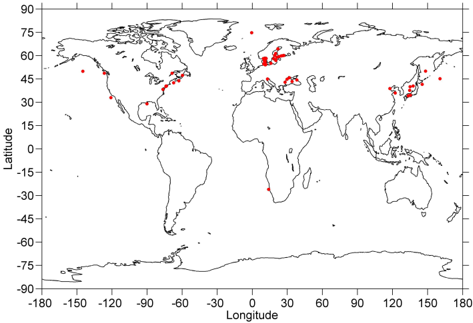
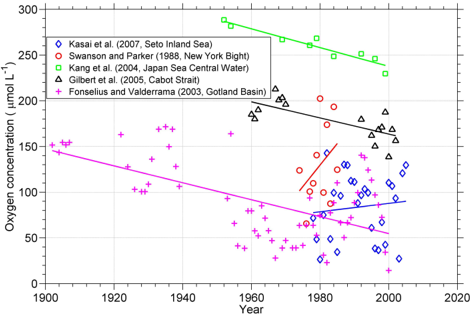
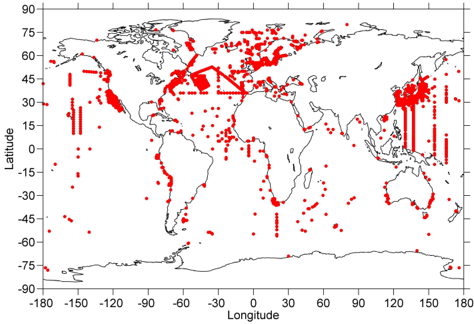
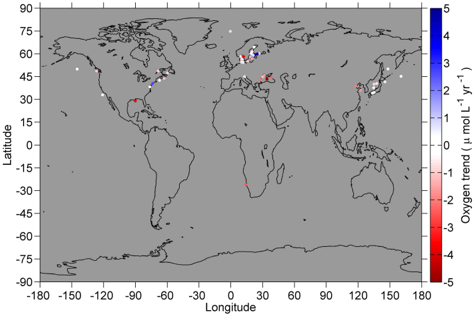
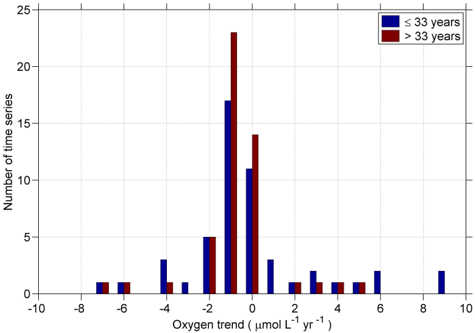
In the global ocean, the number of reported hypoxic sites (oxygen <30% saturation) is on the rise both near the coast and in the open ocean. But unfortunately, most of the papers on hypoxia only present oxygen data from one or two years, so that we often lack a long-term perspective on whether oxygen levels at these locations are decreasing, steady or increasing. Consequently, we cannot rule out the possibility that many of the newly reported hypoxic areas were hypoxic in the past, and that the increasing number of hypoxic areas partly reflects increased research and monitoring efforts. Here we address this shortcoming by computing oxygen concentration trends in the global ocean from published time series and from time series that we calculated using a global oxygen database. Our calculations reveal that median oxygen decline rates are more severe in a 30 km band near the coast than in the open ocean (>100 km from the coast). Percentages of oxygen time series with negative oxygen trends are also greater in the coastal ocean than in the open ocean. Finally, a significant difference between median published oxygen trends and median trends calculated from raw oxygen data suggests the existence of a publication bias in favor of negative trends in the open ocean.
Overview
The claims and statistics of this paper haven’t been checked yet.
Free: it reads the open-access text and checks the first 5 claims that cite a source we can check. Create a free account to check every claim.
Integrity signals
Registry
Cites
Statistics
Figures
Verification
Claims the paper makes
The claims and statistics of this paper haven’t been checked yet.
Free: it reads the open-access text and checks the first 5 claims that cite a source we can check. Create a free account to check every claim.
Claims other papers make about this one
Each is checked against this paper’s own text: does it say what the citing paper says it does?
The source backs part of the claim, not all of it — or backs it for a different population, condition or comparison.
In the citing paper
“Large amounts of organic matter associated with algal blooms can stimulate microbial respiration that depletes dissolved oxygen and produces CO 2 , promoting hypoxia (Fig. 1; Diaz and Rosenberg, 2008;Gilbert et al., 2010;Breitburg et al., 2018) and acidification (Fig. 1; Cai et al., 2011;Waldbusser et al., 2011;Wallace et al., 2014;Baumann et al., 2015).”
From Harmful algal blooms: A climate change co-stressor in marine and freshwater ecosystems (2020) · cites this paper as Gilbert et al., 2010
Experimental — accuracy not yet measuredThe cited source says what the claim attributes to it.
In the citing paper
“In coastal aquatic systems, reported deoxygenation rates integrated over a decade or longer exceed those of the open ocean (Gilbert et al., 2010).”
From Warming and hypoxia reduce the performance and survival of northern bay scallops (Argopecten irradians irradians) amid a fishery collapse (2023) · cites this paper as Gilbert et al., 2010
Self-check
Percentages, sums and reported differences re-computed from the paper’s own numbers.
The self-check needs the paper’s full text.
Citations
Cites
(1999) · Wiley eBooks · doi:10.1002/9783527613984 · Cited by 7,730
Spreading dead zones and consequences for marine ecosystems
Diaz, R. J., & Rosenberg, R. (2008) · Science · doi:10.1126/science.1156401 · Cited by 6,626 · cited 2×
“Several studies suggest that oxygen levels are generally decreasing both in the coastal ocean (Dı́az and Rosenberg, 2008) and in the deep ocean (Keeling and Garcia, 2002).”
BackgroundSelf-citation(1982) · International Geophysics · doi:10.1016/s0074-6142(08)x6002-4 · Cited by 4,853 · cited 1×
“Due to the effect of Earth’s rotation, river plumes generally veer to the right (left) of river mouths in the Northern (Southern) Hemisphere, and then tend to flow parallel to the coastline within about one internal Rossby radius of deformation (Gill , 1982).”
BackgroundThe Pacific Decadal Oscillation
Mantua, N. J., & Hare, S. R. (2002) · Journal of Oceanography · doi:10.1023/a:1015820616384 · Cited by 2,773 · cited 2×
“Interdecadal changes in ocean ventilation can be caused b large scale changes in atmospheric and oceanic circulation patterns associated with the North Atlantic Oscillation (Johnson and Gruber, 2007), the Arctic Oscillation (Cui and Senjyu, 2010), the Pacific Decadal Oscillation (Frölisher et al., 2009) or the Southe…”
BackgroundCoastal marine eutrophication: A definition, social causes, and future concerns
Nixon, S. W. (1995) · Ophelia · doi:10.1080/00785236.1995.10422044 · Cited by 2,672 · cited 2×
“At some coastal sites, eutrophication ( Nixon, 1995) from nearby rivers appears to be the main cause of hypoxia ( Kemp et al.”
BackgroundENSO as an Integrating Concept in Earth Science
McPhaden, M. J., Zebiak, S. E., & Glantz, M. H. (2006) · Science · doi:10.1126/science.1132588 · Cited by 2,110
Ocean Deoxygenation in a Warming World
Keeling, R. F., Körtzinger, A., & Gruber, N. (2010) · Annual Review of Marine Science · doi:10.1146/annurev.marine.010908.163855 · Cited by 1,712 · cited 1×
“A greater level of observation and finer resolution models are needed to understand how and why oxygen appears to be changing at such a rapid rate at global scales (Keeling et al., 2010).”
BackgroundA global, self‐consistent, hierarchical, high‐resolution shoreline database
Wessel, P., & Smith, W. H. F. (1996) · Journal of Geophysical Research: Solid Earth · doi:10.1029/96jb00104 · Cited by 1,575 · cited 2×
“We evaluated distance from the coast for each station by using GSHHS (Global Self-consistent, Hierarchical, Highresolution Shoreline) shapefiles version 1.3 (Wessel and Smith, 1996), together with the functionsdeg2kmand distancefrom the Matlab mapping toolbox version 2.7.2.”
BackgroundMethodInfluentialGeographical Variability of the First Baroclinic Rossby Radius of Deformation
Chelton, D. B., deSzoeke, R. A., Schlax, M. G., El Naggar, K., & Siwertz, N. (1998) · Journal of Physical Oceanography · doi:10.1175/1520-0485(1998)028<0433:gvotfb>2.0.co;2 · Cited by 1,541
Expanding Oxygen-Minimum Zones in the Tropical Oceans
Stramma, L., Johnson, G. C., Sprintall, J., & Mohrholz, V. (2008) · Science · doi:10.1126/science.1153847 · Cited by 1,516 · cited 2×
“There are early indications that this may already be detectable (Stramma et al., 2008; Johnson and Gruber, 2007; Stramma et al., 2010), but interdecadal changes in ocean circulation could have played a role in these trends (Frölisher et al., 2009).”
Background
Research works printed but not linked: 1
- 16. Garcia, H. E., Locarnini, R. A., Boyer, T. P., and Antonov, J. I.: World Ocean Atlas 2005: Dissolved oxygen, apparent oxygen utilization, and oxygen saturation, Vol. 3 of NOAA Atlas NESDIS 63, US Government Printing Office, Washington, DC, 2006.
Cited by
Items 201–300 of 333
Hypoxia also occurs in small highly turbid estuaries: the example of the Charente (Bay of Biscay)
Schmidt, S., & Diallo, I. I. (2024) · Biogeosciences · doi:10.5194/bg-21-1785-2024 · Cited by 9
“The objectives were to determine the occurrence and extent of a possible estuarine oxygen minimum zone (eOMZ) and whether hypoxia could be triggered there.”
BackgroundObservation of Ocean Biology on a Global Scale: Implementing Bio-GOOS
Gunn, J. T., Rogers, A. D., & Urban, E. (2010) · doi:10.5270/oceanobs09.pp.20 · Cited by 9
“ There is a growth in ―dead zones‖ from hypoxia/anoxia [6].”
A Plea for Temperature in Descriptions of the Oceanic Oxygen Status
Brewer, P. G., & Hofmann, A. F. (2014) · Oceanography · doi:10.5670/oceanog.2014.19 · Cited by 7
Oxygen dynamics in a deep‐silled fjord: Tight coupling to the open shelf
Hannah, C. G., Johannessen, S. C., Wright, C. A., & Page, S. J. (2024) · Limnology and Oceanography · doi:10.1002/lno.12522 · Cited by 7
Anticipating Ocean Deoxygenation in the Maritime Continent of Southeast Asia
Wulandari, I., Wahyudi, A. J., & Triana, K. (2021) · ASEAN Journal on Science and Technology for Development · doi:10.29037/ajstd.630 · Cited by 7
“There is little oxygenation research conducted that provides reliable data (Gilbert et al. 2009) andmost oxygen changes are predicted fromamodel based on global warming stressors (Breitburg et al. 2018).”
BackgroundKolesar, S. E., Rose, K. A., & Breitburg, D. L. (2017) · Springer eBooks · doi:10.1007/978-3-319-54571-4_11 · Cited by 9
Kwon, N., Kwon, H. K., Park, H., Han, H., Kim, K. T., Lee, J. S., Kim, S., & Kim, G. (2025) · Marine Pollution Bulletin · doi:10.1016/j.marpolbul.2025.119102 · Cited by 6
The Present‐Day Relation Between Observed Bottom Water Oxygenation and Marine Oxygen Proxies
Ferraro, M., Risebrobakken, B., Asteman, I. P., Darelius, E., Tisserand, A. A., Gallo, N. D., & Salvanes, A. G. V. (2025) · Global Biogeochemical Cycles · doi:10.1029/2024gb008334 · Cited by 6
“Both open ocean and coastal areas are impacted by the deoxygenation; however, the rate of deoxygenation is greater in coastal areas (Breitburg et al., 2018; Diaz & Rosenberg, 2008; Gilbert et al., 2010; Isensee et al., 2016; Pitcher et al., 2021).”
Vase, V. K., Raman, M., Sahay, A., Rahangdale, S., Rajan, K., Sreenath, K. R., Dash, G., Jayasankar, J., Rohit, P., & Ratheesh Kumar, R. (2023) · Environmental Monitoring and Assessment · doi:10.1007/s10661-023-11827-0 · Cited by 6
Coastal Acidification as Nutrients Over Enrichment Impact: A Case Study in Ambon Bay, Indonesia
Ikhsani, I. Y., Siahaya, D. M., Saputra, F. R. T., & Likumahua, S. (2017) · Omni-Akuatika · doi:10.20884/1.oa.2017.13.1.146 · Cited by 6
“A common phenomenon that was accompanying acidification by nutrients enrichment is oxygen depletion (Gilbert et al. 2010; Zhai et al., 2012; Wallace et al, 2014).”
BackgroundTian, D., Su, J., Zhou, F., Mayer, B., Sein, D., Zhang, H., Huang, D., & Pohlmann, T. (2019) · Climate Research · doi:10.3354/cr01579 · Cited by 6
Ye, S., Sivapalan, M., & Ran, Q. (2020) · Water Resources Research · doi:10.1029/2018wr024226 · Cited by 6
“Studies have also shown that global climate change could further exacerbate terrestrial nutrient loading to coastal waters (Gilbert et al., 2010; Sinha et al., 2017).”
BackgroundEffects of hypoxia and anoxia on the reproductive performance of the blue mussel Mytilus edulis
Kong, H., & Sokolova, I. M. (2025) · The Science of The Total Environment · doi:10.1016/j.scitotenv.2025.179103 · Cited by 5
Wahyudi, A. J., Prayitno, H. B., Afdal, Lestari, L., Puspitasari, R., Maslukah, L., Iskandar, M. R., Taufiqurrahman, E., Lastrini, S., & Rositasari, R. (2025) · Marine Environmental Research · doi:10.1016/j.marenvres.2025.107183 · Cited by 6
Seasonal near-surface hypoxia in a temperate fjord in Clayoquot Sound, British Columbia
Rosen, S., Bianucci, L., Jackson, J. M., Hare, A., Greengrove, C. L., Monks, R., Bartlett, M., & Dick, J. (2022) · Frontiers in Marine Science · doi:10.3389/fmars.2022.1000041 · Cited by 5
“, 2017) and subsurface dissolved oxygen (DO) concentrations are declining faster in coastal waters than in the open ocean (Gilbert et al., 2010).”
BackgroundVertical mixing alleviates autumnal oxygen deficiency in the central North Sea
Williams, C. A. J., Hull, T., Palmer, M., Mahaffey, C., Greenwood, N., Kaiser, J., & Palmer, M. R. (2024) · Biogeosciences · doi:10.5194/bg-21-1961-2024 · Cited by 5
Nitrous oxide (N 2 O) in Macquarie Harbour, Tasmania
Maxey, J. D., Hartstein, N. D., Bange, H. W., & Müller, M. (2024) · Biogeosciences · doi:10.5194/bg-21-5613-2024 · Cited by 7
“Estuarine systems often have disproportionately high biological productivity relative to other marine systems (Walin-sky et al., 2009; Gilbert et al., 2010; Bianchi et al., 2018, 2020 ).”
The tolerance of juvenile stone crabs to hypoxia: Size matters
Gravinese, P. M. (2019) · Journal of Experimental Marine Biology and Ecology · doi:10.1016/j.jembe.2019.151269 · Cited by 5
Yang, M., Guo, X., Zheng, J., & Sun, Q. (2022) · Water · doi:10.3390/w14172763 · Cited by 5
Jiang, Q., & McGaw, I. J. (2022) · Journal of Comparative Physiology B · doi:10.1007/s00360-022-01462-5 · Cited by 6
“In addition, anthropogenic increases in nutrient input (nitrogen and phosphate) and organic matter enhance primary and secondary production, which further reduces oxygen (Gilbert et al. 2010; Watson 2016; Schmidtko et al. 2017).”
BackgroundClimate Change and Its Impact on Depletion of Oxygen Levels on Coastal Waters and Shallow Seas
Alam, M. A. (2023) · Springer eBooks · doi:10.1007/978-3-031-21644-2_20 · Cited by 9
Stachowitsch, M., Riedel, B., & Zuschin, M. (2011) · Cellular origin and life in extreme habitats · doi:10.1007/978-94-007-1896-8_19 · Cited by 7
“Moreover, the phenomenon appears to be spreading beyond shallow, semi-enclosed seas (Gilbert et al. 2009).”
BackgroundSteckbauer, A., Díaz‐Gil, C., Alós, J., Catalán, I. A., & Duarte, C. M. (2018) · Frontiers in Marine Science · doi:10.3389/fmars.2018.00350 · Cited by 5
“Especially in a 30 km band along the coastline the decline in oxygen concentrations is more prevalent and acute (Gilbert et al., 2009).”
BackgroundYan, J., Sui, J., Xu, Y., Li, X., Wang, H., & Zhang, B. (2019) · Marine Pollution Bulletin · doi:10.1016/j.marpolbul.2019.05.001 · Cited by 5
Hypoxia-induced predation refuge for northern quahogs (Mercenaria mercenaria) in a temperate estuary
Galligan, B. P., Stuart, Y. E., McManus, M. C., & Stoffel, H. E. (2021) · Estuarine Coastal and Shelf Science · doi:10.1016/j.ecss.2021.107732 · Cited by 5
“Coastal hypoxia has increased globally since 1951, primarily from anthropogenic nutrient loading (especially nitrogen) and subsequent eutrophication of coastal waters (Altieri and Diaz 2019; Diaz and Rosenberg 2008; Gilbert et al. 2010).”
Burke, M., Grant, J., Filgueira, R., & Sheng, J. (2022) · Continental Shelf Research · doi:10.1016/j.csr.2022.104908 · Cited by 5
Masanori, E. N. D. O., Zhao, Y., Nakamura, W., & Sasaki, J. (2023) · Frontiers in Marine Science · doi:10.3389/fmars.2022.1016199 · Cited by 5
“However, the global trend of expansion of hypoxic waters due to climate change and the effects of upwelling of such waters are considered problematic; knowledge on CO2 emissions associated with the upwelling of hypoxic and anoxic waters is considered essential (Diaz and Rosenberg, 2008; Vaquer-Sunyer and Duarte, 2008;…”
BackgroundYengejeh, R. J., Morshedi, J., & Yazdizadeh, R. (2014) · DOAJ (DOAJ: Directory of Open Access Journals) · Cited by 8
Belanger, C. L. (2011) · Marine Micropaleontology · doi:10.1016/j.marmicro.2011.06.004 · Cited by 5
Hamzah, F., Triyulianti, I., Setiawan, A., Nurhati, I. S., Priyono, B., Berlianty, D., Fadli, M., Opier, R. D. A., Agustiadi, T., Rugebregt, M. J., et al. (2024) · doi:10.5194/egusphere-2024-451 · Cited by 6
Coastal Hypoxia in the Indian Ocean: Unraveling Drivers of Spatio‐Temporal Variability
Yang, F., Resplandy, L., Zhao, Y., & Ditkovsky, S. (2025) · Global Change Biology · doi:10.1111/gcb.70378 · Cited by 5
“The occurrence of coastal hypoxia, commonly known as “dead zones,” has increased worldwide in recent decades (Gilbert et al. 2010; Conley et al. 2011; Altieri and Gedan 2015; Deutsch et al. 2024; Breitburg et al. 2018; Barth et al. 2024).”
Zhao, L., Qin, H., Zhang, M., Xin, R., Liu, J., Wang, M., & Ma, Y. (2025) · Marine Environmental Research · doi:10.1016/j.marenvres.2025.106956 · Cited by 5
Relative phase between tidal and solar cycles influences the heating of a coral atoll lagoon
Merrigan, S. R., Pawlak, G. R., Sinnett, G., Fu, K., & Davis, K. A. (2025) · Limnology and Oceanography · doi:10.1002/lno.70013 · Cited by 4
“1 ; Vaquer-Sunyer and Duarte (2008)) events associated with fi sh kills, seagrass die-offs, and coral bleaching (Altieri et al. 2017; Gilbert et al. 2010; Zhang et al. 2010).”
Assessment of the effects of climate change on dissolved oxygen in the Gulf of Oman
Farkhani, S., & Zaker, N. H. (2025) · Deep Sea Research Part I Oceanographic Research Papers · doi:10.1016/j.dsr.2025.104487 · Cited by 4
Paradis-Hautcoeur, J., Gosselin, M., Villeneuve, V., Tremblay, J., Lévesque, D., Scarratt, M., & Starr, M. (2023) · Estuarine Coastal and Shelf Science · doi:10.1016/j.ecss.2023.108270 · Cited by 4
Hypoxia in Peter the Great Bay
Tishchenko, P. P., Zvalinsky, V. I., Михайлик, Т. А., & Tishchenko, P. Y. (2021) · Izvestiya TINRO · doi:10.26428/1606-9919-2021-201-600-639 · Cited by 4
Zhang, Y., Song, X., & Zhang, P. (2023) · Frontiers in Marine Science · doi:10.3389/fmars.2023.1029512 · Cited by 6
“Therefore, with this underlying trend of more frequent HAB occurrences and severe hypoxia (Gilbert et al., 2009; Lee et al., 2016; Breitburg et al., 2018), many coastal aquacultural areas have both a high incidence of HABs and hypoxia.”
BackgroundDa, B., Wu, Y., & Bao, W. (2024) · Sustainability · doi:10.3390/su16114697 · Cited by 4
Irby, I. D. (2017) · W&M Publish (College of William & Mary) · doi:10.21220/v5p15t · Cited by 3
Ocean deoxygenation dampens resistance of diatoms to ocean acidification in darkness
Sun, J., Zhang, D., Yi, X., Beardall, J., & Gao, K. (2024) · Frontiers in Marine Science · doi:10.3389/fmars.2024.1387552 · Cited by 3
“…has been more rapid and intensive in nearshore waters, resulting in the identi fi cation of over 500 hypoxic sites (de fi ned by dissolved O 2 < 63 m M) (Diaz and Rosenberg, 2008; Gilbert et al., 2010; Breitburg et al., 2018), with some even extending into the euphotic layer (Ye et al., 2016).”
Coral Reef Microbialization and Viralization Shape Ecosystem Health, Stability, and Resilience
Baer, J., & Rohwer, F. L. (2025) · Coral reefs of the world · doi:10.1007/978-3-031-76692-3_11 · Cited by 3
Choi, Y., Jeong, D. U., Lee, Y. G., Choi, J. U., Kim, S., & Lee, J. S. (2019) · Journal of Coastal Research · doi:10.2112/jcoastres-d-18-00057.1 · Cited by 4
Kontoyiannis, H., Pavlidou, A., Zeri, C., Krasakopoulou, Ε., Simboura, N., Hatzianestis, I., Papadopoulos, V. P., Rousselaki, E., Asimakopoulou, G., & Siokou, I. (2023) · The Science of The Total Environment · doi:10.1016/j.scitotenv.2023.166025 · Cited by 3
Liu, Q., Liu, C., Meng, Q., Su, B., Ye, H., Chen, B., Li, W., Cao, X., Nie, W., & Ma, N. (2024) · Continental Shelf Research · doi:10.1016/j.csr.2024.105348 · Cited by 3
Eom, S. H., Ok, J. H., You, J. H., Park, S. A., Kwon, M., Kang, H. C., & Jeong, H. J. (2025) · ALGAE · doi:10.4490/algae.2025.40.4.18 · Cited by 2
Wang, Z., Fu, W., Xue, C., & Wang, G. (2026) · Earth system science data · doi:10.5194/essd-18-3125-2026 · Cited by 2
Smart Microalgae Wastewater Treatment
Zafar, M., Pareek, A., Khan, T. A., Lakshminarayanan, R., & Dwivedi, N. (2023) · Wiley eBooks · doi:10.1002/9781119857839.ch1 · Cited by 4
Rościszewski-Dodgson, M. J., & Cirella, G. T. (2023) · doi:10.5194/essd-2023-185 · Cited by 2
Oxygen – Dynamics and Biogeochemical Consequences
Testa, J. M., & Malkin, S. Y. (2023) · Elsevier eBooks · doi:10.1016/b978-0-323-90798-9.00062-7 · Cited by 1
Wahab, T. A., Échevin, V., Capet, X., & Machu, É. (2025) · Deep Sea Research Part II Topical Studies in Oceanography · doi:10.1016/j.dsr2.2025.105464 · Cited by 3
Ainin, Q., Zhang, M., Zhang, X., Yu, D., & Chen, N. (2026) · Marine Environmental Research · doi:10.1016/j.marenvres.2026.108157 · Cited by 1
Poppeschi, C., Daniel, A., Charria, G., Répécaud, M., Caradec, F., & Rabiller, É. (2026) · Marine Environmental Research · doi:10.1016/j.marenvres.2026.108275 · Cited by 1
Ocean changes – warming, stratification, circulation, acidification, and deoxygenation
Jewett, L., & Romanou, A. (2017) · Lincoln (University of Nebraska) · Cited by 2
Muller, A. C., Muller, K. A., & Muller, D. L. (2024) · Water · doi:10.3390/w16172433 · Cited by 1
Trait Plasticity and Warming Vulnerability in a Structurally Diverse Seagrass Ecosystem
Lawrence, C. (2025) · Ecology and Evolution · doi:10.1002/ece3.72011 · Cited by 2
“Since nearshore environments receive a higher input of organic matter from fluvial and estuarine sources than the open ocean, local-scale variability in dissolved oxygen is higher in coastal compared with oceanic waters (Soetaert et al. 2006; Gilbert et al. 2010).”
Sedimentary lipid biomarkers and trace metals as indicators for past hypoxia and eutrophication
Naeher, S. (2012) · DORA Eawag (Swiss Federal Institute of Aquatic Science and Technology (Eawag)) · doi:10.3929/ethz-a-007599070 · Cited by 2
“1.1) (Diaz, 2001; Diaz and Rosenberg, 2008; Gooday et al., 2009; Gilbert et al., 2010; Zhang et al., 2010; Hofmann et al., 2011).”
InfluentialJeong, D. U., Lee, Y. G., Kim, Y. W., Park, J. J., & Lee, J. S. (2017) · doi:10.5194/bg-2017-383 · Cited by 1
Hudon, C. (2013) · Springer eBooks · doi:10.1007/978-94-007-5704-2_46 · Cited by 1
Environmental predictors of Seagrass Phenotype Variability in a Temperate Lagoon Ecosystem.Preprint
Lawrence, C. (2023) · Research Square · doi:10.21203/rs.3.rs-3097190/v1 · Cited by 1
White, M. M. (2013) · Woods Hole Open Access Server (WHOAS) · doi:10.1575/1912/5821
Gutknecht, E. (2011) · Thèses en ligne de l'Université Toulouse III (Université Toulouse III) · Cited by 2
Recent Publications in this Series
Juuri, E., Makkonen, M., & Liu, P. (2014)
Taheri, M. (2016) · Ghent University Academic Bibliography (Ghent University) · Cited by 1
Besnerais, C. D. L. (2017) · UPCommons institutional repository (Universitat Politècnica de Catalunya) · doi:10.5821/dissertation-2117-111502
“Hypoxia is increasing in coastal and oceanicwaters (Gilbert et al. 2010, Rabalais et al. 2010), due to eutrophication and global warming (Díaz and Rosenberg 2008, Zhang et al. 2010, Rabalais et al. 2014).”
BackgroundPeruzza, L. (2017) · ePrints Soton (University of Southampton) · Cited by 1
Implications of direct anthropogenic pressures on dissolved oxygen dynamics in a well-mixed estuary
Holzwarth, I. (2018) · Hydraulic Engineering Repository (HENRY) (Bundesanstalt für Wasserbau) · Cited by 1
Dutta, S., & Chattopadhyay, D. (2021) · bioRxiv (Cold Spring Harbor Laboratory) · doi:10.1101/2021.09.08.451389
Whitney, M. M. (2022) · Biogeosciences · doi:10.5194/bg-2021-285-rc1
Whitney, M. M. (2022) · Biogeosciences · doi:10.5194/bg-2021-285-ac1
Cronin, T. M. (2015) · Encyclopedia of earth sciences series/Encyclopedia of earth sciences · doi:10.1007/978-94-017-8801-4_37
(2022) · Biogeosciences · doi:10.5194/bg-2022-20-rc1
Maxey, J. D. (2022) · Biogeosciences · doi:10.5194/bg-2022-20-ac1
(2022) · Biogeosciences · doi:10.5194/bg-2022-20-rc2
(2022) · Biogeosciences · doi:10.5194/bg-2022-20-rc3
Maxey, J. D. (2022) · Biogeosciences · doi:10.5194/bg-2022-20-ac2
Triyulianti, I. (2022) · Aquacultura Indonesiana · doi:10.21534/ai.v23i1.279
Maxey, J. D. (2022) · Biogeosciences · doi:10.5194/bg-2022-20-ac3
Nations, U. (2017) · Cambridge University Press eBooks · doi:10.1017/9781108186148.042
Jutras, M. (2022) · doi:10.5194/egusphere-2022-1090-ac1
(2023) · Biogeosciences · doi:10.5194/bg-2023-100-rc1
(2023) · Biogeosciences · doi:10.5194/bg-2023-100-rc2
Williams, C. A. J. (2023) · Biogeosciences · doi:10.5194/bg-2023-100-ac2
Williams, C. A. J. (2023) · Biogeosciences · doi:10.5194/bg-2023-100-ac1
(2023) · Biogeosciences · doi:10.5194/bg-2023-150-rc1
Schmidt, S. (2023) · Biogeosciences · doi:10.5194/bg-2023-150-ac1
Final response on essd-2023-185
Cirella, G. T. (2023) · doi:10.5194/essd-2023-185-ac1
(2023) · Biogeosciences · doi:10.5194/bg-2023-150-rc2
Schmidt, S. (2023) · Biogeosciences · doi:10.5194/bg-2023-150-ac2
Metadata
- Authors
- Gilbert, D., Rabalais, N. N., Díaz, R. J., & Zhang, J.
- Affiliations
- Fisheries and Oceans Canada (CA)
- Louisiana Universities Marine Consortium (US)
- William & Mary (US)
- State Key Laboratory of Estuarine and Coastal Research (CN)
- Venue
- Biogeosciences
- Publisher
- Copernicus GmbH
- Published
- 2010-07-26
- Volume
- 7
- Issue
- 7
- Pages
- 2283-2296
- ISSN
- 1726-4170 (ISSN-L)
- 1726-4189
- OpenAlex
- W2149105527
- Cited by
- 306
- References
- 70
- Citations by year
- 2026: 14 · 2025: 19 · 2024: 18 · 2023: 39 · 2022: 33 · 2021: 22 · 2020: 16 · 2019: 18 · 2018: 17 · 2017: 12 · 2016: 16 · 2015: 8 · 2014: 14 · 2013: 20 · 2012: 17
- FWCI
- 13.83
- Type
- journal article
- Language
- en
- Open access
- gold
- doi.org
- Licence
- Locations
- Biogeosciences (publishedVersion, cc-by)
- Civil War Book Review (submittedVersion)
- W&M Publish (College of William & Mary) (submittedVersion, cc-by)
- DOAJ (DOAJ: Directory of Open Access Journals) (submittedVersion, cc-by-sa)
- Funders
- Fisheries and Oceans Canada
- Topics
- Physical Sciences › Earth and Planetary Sciences › Oceanography › Marine Plankton and Biogeochemistry
- Physical Sciences › Earth and Planetary Sciences › Oceanography › Oceanographic and Atmospheric Processes
- Physical Sciences › Earth and Planetary Sciences › Oceanography › Marine Biology and Ecology Research
- Keywords
- ocean deoxygenation, hypoxia, coastal waters, open ocean, publication bias
About these checks
Registry, retraction, Cites and statistics results are computed, not judged, with one exception: a printed reference that no index lists is read once by a model before it counts as a citation error. Claims are extracted by a model and kept only when their quote appears verbatim in the text; each cited source is then checked, with a model’s help, for whether it says what the claim relies on. Those verdicts can be wrong — read the claim’s quote and the cited source before relying on one.
Statistics and arithmetic are recomputed, not judged.
Confidence bands are shown only for fields calibrated on our annotated test set. None is calibrated yet, so no band is shown.
What counts as a claim ›How we measure confidence ›How we check this ›
Are you an author, or do you see a problem with this page? Request a review
Data sources
Bibliographic data: Semantic Scholar, OpenAlex, Crossref.
Contains information from the Semantic Scholar Academic Graph Datasets, made available under the ODC Attribution License (ODC-BY 1.0).
Semantic Scholar’s data is described in: Kinney, R., et al. (2023). The Semantic Scholar Open Data Platform. arXiv:2301.10140.
