

Hybrid forecasting: blending climate predictions with AI models
Open accessPublished version of a preprint
The DOI matches its Crossref record; 167 of the 167 references it cites were found in a registry or an index.
Abstract
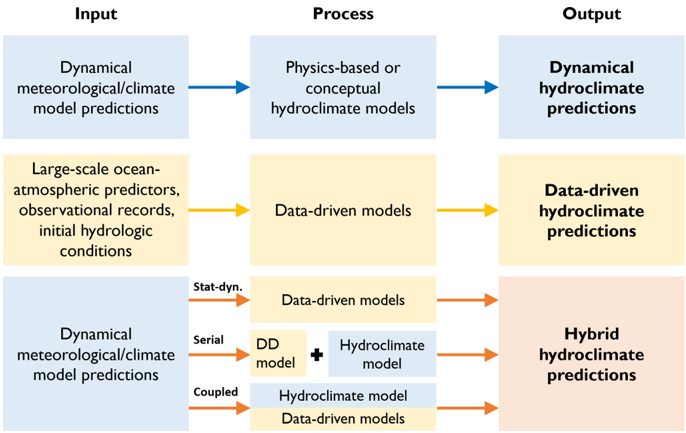
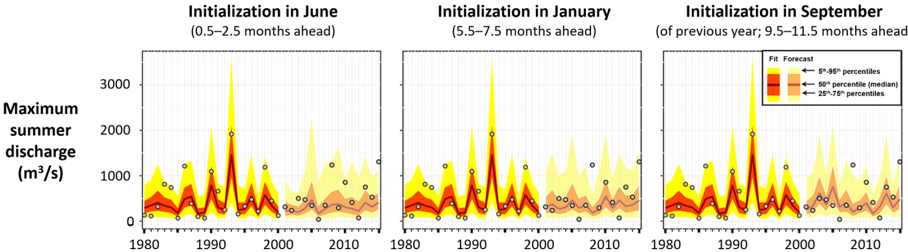
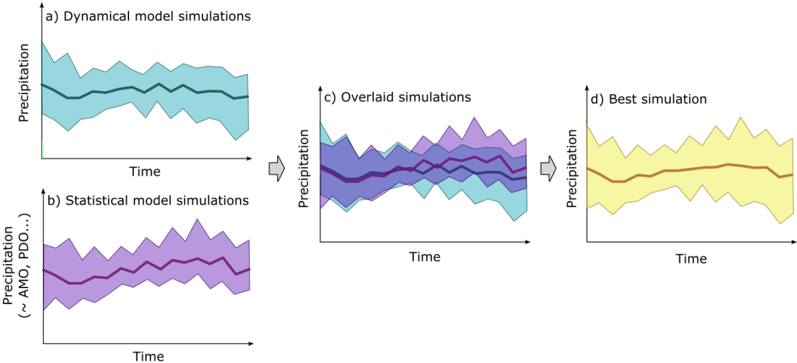
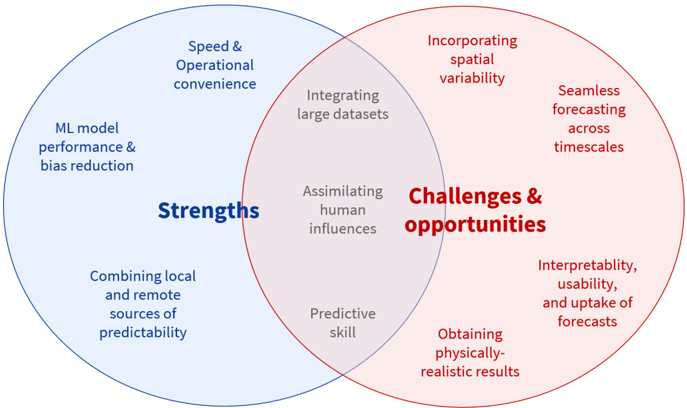
Hybrid hydroclimatic forecasting systems employ data-driven (statistical or machine learning) methods to harness and integrate a broad variety of predictions from dynamical, physics-based models – such as numerical weather prediction, climate, land, hydrology, and Earth system models – into a final prediction product. They are recognized as a promising way of enhancing the prediction skill of meteorological and hydroclimatic variables and events, including rainfall, temperature, streamflow, floods, droughts, tropical cyclones, or atmospheric rivers. Hybrid forecasting methods are now receiving growing attention due to advances in weather and climate prediction systems at subseasonal to decadal scales, a better appreciation of the strengths of AI, and expanding access to computational resources and methods. Such systems are attractive because they may avoid the need to run a computationally expensive offline land model, can minimize the effect of biases that exist within dynamical outputs, benefit from the strengths of machine learning, and can learn from large datasets, while combining different sources of predictability with varying time horizons. Here we review recent developments in hybrid hydroclimatic forecasting and outline key challenges and opportunities for further research. These include obtaining physically explainable results, assimilating human influences from novel data sources, integrating new ensemble techniques to improve predictive skill, creating seamless prediction schemes that merge short to long lead times, incorporating initial land surface and ocean/ice conditions, acknowledging spatial variability in landscape and atmospheric forcing, and increasing the operational uptake of hybrid prediction schemes.
Overview
The claims and statistics of this paper haven’t been checked yet.
Free: it reads the open-access text and checks the first 5 claims that cite a source we can check. Create a free account to check every claim.
Integrity signals
Registry
Cites
Statistics
Figures
Verification
Claims the paper makes
The claims and statistics of this paper haven’t been checked yet.
Free: it reads the open-access text and checks the first 5 claims that cite a source we can check. Create a free account to check every claim.
Self-check
Percentages, sums and reported differences re-computed from the paper’s own numbers.
The self-check needs the paper’s full text.
Citations
Cites
River flow forecasting through conceptual models part I — A discussion of principles
Nash, J. E., & Sutcliffe, J. V. (1970) · Journal of Hydrology · doi:10.1016/0022-1694(70)90255-6 · Cited by 23,674
Convolutional LSTM Network: A Machine Learning Approach for Precipitation Nowcasting
Shi, X., Chen, Z., Wang, H., Yeung, D.-Y., Wong, W.-K., & Woo, W.-C. (2015) · arXiv · doi:10.48550/arxiv.1506.04214 · Cited by 7,709
Deep learning and process understanding for data-driven Earth system science
Reichstein, M., Camps-Valls, G., Stevens, B., Jung, M., Denzler, J., Carvalhais, N., & Prabhat (2019) · Nature · doi:10.1038/s41586-019-0912-1 · Cited by 5,673
Stationarity Is Dead: Whither Water Management?
Milly, P. C. D., Betancourt, J., Falkenmark, M., Hirsch, R. M., Kundzewicz, Z. W., Lettenmaier, D. P., & Stouffer, R. J. (2008) · Science · doi:10.1126/science.1151915 · Cited by 4,537
The quiet revolution of numerical weather prediction
Bauer, P., Thorpe, A., & Brunet, G. (2015) · Nature · doi:10.1038/nature14956 · Cited by 2,729 · cited 1×
“been advancing by about one day per decade, such that ‘today’s 6-day forecast is as accurate as the 5-day forecast ten years ago’ (Bauer et al., 2015, p.47). Low flows may have skill up to 20 days in the case of Fundel et al. (2013) and even longer in other cases, especially with good information on initial conditions…”
BackgroundImprovement of a parsimonious model for streamflow simulation
Perrin, C., Michel, C., & Andréassian, V. (2003) · Journal of Hydrology · doi:10.1016/s0022-1694(03)00225-7 · Cited by 1,821 · cited 1×
“(2016) used a combination of historical observations and downscaled dynamical forecasts of rainfall and potential evapotranspiration in southern Australia from POAMA (Predictive Ocean Atmosphere Model for Australia) to drive the conceptual rainfall–runoff model GR4J (Perrin et al., 2003).”
MethodFlood Prediction Using Machine Learning Models: Literature Review
Mosavi, A., Ozturk, P., & Chau, K.-W. (2018) · Water · doi:10.3390/w10111536 · Cited by 1,672 · cited 2×
“Environment Agency, 2022), close co-operation is needed between the hydrology, forecasting, and ML communities to explore their potential either alone or in hybrid frameworks (Mosavi et al., 2018), build trust (Haupt et al.”
BackgroundMethodKratzert, F., Klotz, D., Shalev, G., Klambauer, G., Hochreiter, S., & Nearing, G. (2019) · Hydrology and Earth System Sciences · doi:10.5194/hess-23-5089-2019 · Cited by 1,223 · cited 1×
“Since long (50 year + ) hydroclimatic time series data are not available everywhere (Krabbenhoft, 2022), methods are required that can draw on pooled multi-site approaches with similar catchment and climate characteristics (Kratzert et al., 2019a .”
BackgroundSelf-citationThe CAMELS data set: catchment attributes and meteorology for large-sample studies
Addor, N., Newman, A. J., Mizukami, N., & Clark, M. P. (2017) · Hydrology and Earth System Sciences · doi:10.5194/hess-21-5293-2017 · Cited by 1,037 · cited 2×
“Such models may start to emerge with the growing availability of observational training datasets, such as the national CAMELS datasets (available for the USA, United Kingdom, Chile, Brazil, Australia, and soon France and Switzerland; e.g. Newman et al., 2015; Addor et al., 2017; Coxon et al., 2020) and international C…”
BackgroundSkilful precipitation nowcasting using deep generative models of radar
Ravuri, S., Lenc, K., Willson, M., Kangin, D., Lam, R., Mirowski, P., Fitzsimons, M., Athanassiadou, M., Kashem, S., Madge, S., et al. (2021) · Nature · doi:10.1038/s41586-021-03854-z · Cited by 1,024
Research works printed but not linked: 3
- Bisson, J. and Roberge, F.: Prévision des apports naturels: Ex- périence d'Hydro-Québec, workshop on flow predictions, in: IEEE Institute of Electrical and Electronics Engineers, Novem- ber 1983, Toronto, 1983.
- Fang, K. and Shen, C.: Near-real-time forecast of satellite-based soil moisture using long short-term memory with an adaptive data integration kernel, J. Hydrometeorol., 21, 399-413, 2020b. · DOI · Paper page
- Hoedt, P.-J., Kratzert, F., Klotz, D., Halmich, C., Holzleitner, M., Nearing, G. S., Hochreiter, S., and Klambauer, G.: Mc- lstm: Mass-conserving LSTM, Vol. 139, International Confer- ence on Machine Learning, 18-24 July 2021, Virtual, 4275- 4286, https://proceedings.mlr.press/v139/hoedt21a.html (last ac- cess: 6 May 2023), 2021.
Cited by
Items 301–342 of 342
Deep Learning Techniques in Climate Forecasting
Sharma, S., Rathore, K., Ghatak, S., & Sharma, N. K. (2026) · Climate change management · doi:10.1007/978-3-032-16804-7_4
The Black Mirror of AI-driven vulnerability, hazard, and risk research
Albulescu, A.-C., & Armaș, I. (2026) · iScience · doi:10.1016/j.isci.2026.116893
“Beyond applications situated within clearly defined AI domains (Appendix 1), DRR research also employs hybrid modeling approaches that integrate physics-based (dynamical) models with data-driven methods, including statistical and ML techniques (e.g., 25 ).”
Arrozik, M. T., Muhaimin, T. C. N., & Koibur, M. S. (2026) · CAUCHY Jurnal Matematika Murni dan Aplikasi · doi:10.18860/cauchy.v11i2.40192
İnce, K., & Erpul, G. (2026) · Research Square · doi:10.21203/rs.3.rs-10525957/v1
Maphutseng, M. (2025) · NUL Research and Publication
Suribabu, C. R., Sakthi, L., & Balaji, S. (2026) · Journal of Hydrologic Engineering · doi:10.1061/jhyeff.heeng-7002
Γκίλλας, Κ., & Halkiopoulos, C. (2026) · Springer proceedings in business and economics · doi:10.1007/978-3-032-17545-8_17
Comparative evaluation of deep learning and statistical models for wind speed downscaling
Kumari, J., Wadhvani, R., & Shukla, S. (2026) · Wind Engineering · doi:10.1177/0309524x261477588
Fabian, P. S., Cho, H., Ham, Y., & Kwon, H. (2026) · Journal of Hydrology · doi:10.1016/j.jhydrol.2026.136255
Effectiveness of machine learning and deep learning techniques for multi-horizon weather forecasting
Sami, A., Bilal, M., Habib, U., & Cheema, A. A. (2026) · Meteorology and Atmospheric Physics · doi:10.1007/s00703-026-01183-2
“Slater et al. ( 2023 ) suggested a hybrid framework combining numerical forecasting and statistical post-processing.”
Tung, P. V., Chung, N. T., Tinh, N. D., Thinh, P. N., & Mạnh, Đ. T. (2026) · Water Science & Technology · doi:10.2166/wst.2026.334
Fadillah, A., Pato, M., Latif, N., Panggabean, B. L. E., Muhammad Rizal, H., Mursalim, M., & Muhajirin, M. (2026) · Journal of System and Computer Engineering (JSCE) · doi:10.61628/jsce.v7i3.2741
“Slater et al. (2023) define hybrid hydroclimatic forecasting as the deliberate blending of data-driven methods with dynamical, statistical, or physics-based prediction systems to improve skill while acknowledging multiple sources of predictability.”
Muriithi, R., Gachoki, P., & Kilai, M. (2026) · International Journal of Data Science and Analysis · doi:10.11648/j.ijdsa.20261205.12
Mbuh, M. J. (2026) · SSRN Electronic Journal · doi:10.2139/ssrn.7439435
Bai, Z., Wen, J., Sun, X., & Sun, L. (2026) · Sustainability · doi:10.3390/su18189293
İnce, K., & Erpul, G. (2026) · SSRN Electronic Journal · doi:10.2139/ssrn.7459648
dos Reis, G. G., Astagneau, P. C., Bourgin, F., Andréassian, V., & Perrin, C. (2026) · Journal of Hydrology · doi:10.1016/j.jhydrol.2026.136402
Liu, H., Liu, F., Zhang, Y., Lopez, C., Yoosefdoost, I., & Li, B. (2026) · Algal Research · doi:10.1016/j.algal.2026.104971
刘全儒, Wang, Z., Bai, Y., Wang, K., Wan, W., Cheng, L., Du, H., Wang, W., Zhenzhu, Y., Ding, Q., et al. (2026) · Agricultural Water Management · doi:10.1016/j.agwat.2026.110798
Reproducible Hybrid Ensemble Learning for Drought ForecastingPreprint
Chilanga, M., Kalezhi, J., & Chaamwe, N. (2026) · Research Square · doi:10.21203/rs.3.rs-10781249/v1
A Hybrid Model based on Ensemble Learning from Residuals for Time Series Prediction
Anuradha, S. (2024) · Journal of Electrical Systems
Huang, Z., Shen, H., Im, E., & Kwon, H. (2026) · Stochastic Environmental Research and Risk Assessment · doi:10.1007/s00477-026-03381-1
“The effectiveness of statistical post-processing in improv - ing the skill of GCM forecasts has been extensively evaluated (Wang et al. 2019a ; Slater et al. 2023; Shi et al. 2026).”
Rillo, J. E. A., Panaligan, J. R. T., Lobete, G. K. O., Canoy, J. K. L., Castro, L. A. R., Cayabyab, C. B. A., Cipriano, M. J., Gomez, A. M. M., & -, M. S. G. D. R. (2025) · International Journal of Progressive Research in Science and Engineering
Jnr, E. O.-N., Akendola, F. A., & Ziggah, Y. Y. (2026) · Energy Conversion and Management X · doi:10.1016/j.ecmx.2026.102371
Salambue, R., Huspi, S. H., Hashim, S. Z. M., Sadita, L., Maryati, I., Indra, Z., Adnan, A., David Rinaldi, S., & Rachman, H. (2026) · International Conference on Computer, Control, Informatics and its Applications · doi:10.1109/ic3ina72033.2026.11714865
“The river discharge is determined by the interaction between these variables, especially in tropical watersheds, where the monsoon system and climate variability are important [7].”
Xie, S., Tian, Y., Wang, Y., Yang, Z., Yang, X., Liu, J., Yang, Y., & Ma, H. (2026) · Geosciences · doi:10.3390/geosciences16100414
Zhang, X., Li, Y., Xu, X., Tan, L., Peng, Y., Jiang, Z., & Qin, H. (2026) · Journal of Hydrology Regional Studies · doi:10.1016/j.ejrh.2026.104098
Local hydrological characteristics shape 1–14-day observation-driven soil moisture predictabilityPreprint
Huang, F., Li, Z., Wang, L., Camps‐Valls, G., Su, W., Piles, M., Zhang, R., Shangguan, W., & Dai, Y. (2026) · doi:10.5194/egusphere-2026-5166
What do machine learning models learn about floods?Preprint
Ford, E., Brunner, M. I., Christensen, H. M., Lewis, E., Moulds, S., Shires, L., & Slater, L. J. (2026) · doi:10.5194/egusphere-2026-5890
Self-citationNurwahid, A. (2026) · SSRN Electronic Journal · doi:10.2139/ssrn.7641892
İnce, K., Canaz, S., & Erpul, G. (2026) · SSRN Electronic Journal · doi:10.2139/ssrn.7642736
A National Scale Hybrid Machine Learning Model for Enhanced Groundwater Depth Estimation
Liu, J., Schneider, R. J. M., Troldborg, L., Ma, Y., Maxwell, R. M., & Koch, J. (2026) · Water Resources Research · doi:10.1029/2026wr043414
“Various approaches for hybridization strategies exist, as summarized by Slater et al. (2023), ranging from simple statistical‐dynamical hybrids to more complex serial and coupled hybrid structures.”
A general probabilistic framework for prediction of extreme flow events at river confluencesPreprint
Diakomopoulos, F., Ragno, E., Stancanelli, L. M., & Hrachowitz, M. (2026) · doi:10.5194/egusphere-2026-5737
ZHU, Y. X., & WEI, G. N. (2026) · Applied Ecology and Environmental Research · doi:10.15666/aeer/2404_87838810
A hybrid statistical–dynamical approach for seasonal prediction of the boreal winter stratosphere
Gargiulo, F., Ruggieri, P., Paolini, L. F., & Sabatino, S. D. (2026) · Climate Dynamics · doi:10.1007/s00382-026-08384-w · Cited by 1
“In this direction, hybrid frameworks blend dynamical model output with statistical post-processing, an approach increasingly shown to extract predictable signals more effectively than dynamical models alone (Slater et al. 2023).”
Paolini, L. F., Napoli, C. D., Wetterhall, F., Ruggieri, P., Pascale, S., Brattich, E., & Sabatino, S. D. (2026) · doi:10.5194/egusphere-2026-6640
Swarna, S. N., Asadullah, M., Tanni, A. S., Hossain, M. M., & Islam, M. S. (2026) · Meteorological Applications · doi:10.1002/met.70275
Samadi, S., Fowler, H. J., Ames, D., Borgomeo, E., Goodall, J. L., Horsburgh, J. S., Jakeman, A. J., Lakshmi, V., Merwade, V., Mishra, V. K., et al. (2026) · doi:10.5194/egusphere-2026-6531
Prédiction avancée des caractéristiques de crues avec les algorithmes de l’apprentissage automatique
Messouaf, Y. (2026) · Le dépôt institutionnel (Université du Québec à Trois-Rivières)
Gao, F., Wang, Y., Wang, J., Song, N., Zhong, Y., Zhao, Q., Kpalari, D. F., & Liu, H. (2026) · Journal of Integrative Agriculture · doi:10.1016/j.jia.2026.11.016
Razak, I. A. W. A., Nawi, N. S. M., Ahmad, A., & Zaini, F. A. (2026) · PaperAsia · doi:10.59953/paperasia.v42i5b.1803
Metadata
- Authors
- Slater, L. J., Arnal, L., Boucher, M.-A., Chang, A. Y.-Y., Moulds, S., Murphy, C., Nearing, G., Shalev, G., Shen, C., Speight, L., Villarini, G., Wilby, R. L., Wood, A., & Zappa, M.
- Affiliations
- University of Oxford (GB)
- University of Saskatchewan (CA)
- Université de Sherbrooke (CA)
- Swiss Federal Institute for Forest, Snow and Landscape Research (CH)
- National University of Ireland, Maynooth (IE)
- Google (United States) (US)
- Google (Israel) (IL)
- Pennsylvania State University (US)
- University of Iowa (US)
- Loughborough University (GB)
- NSF National Center for Atmospheric Research (US)
- Corresponding author
- Slater, Louise J.
- ORCID
- Venue
- Hydrology and Earth System Sciences
- Publisher
- Copernicus GmbH
- Published
- 2023-05-15
- Volume
- 27
- Issue
- 9
- Pages
- 1865-1889
- ISSN
- 1027-5606 (ISSN-L)
- 1607-7938
- OpenAlex
- W4387437512
- Semantic Scholar
- 70def1c9bdf053b526f5798935508cbb1ef1c214
- Cited by
- 281
- References
- 163
- Citations by year
- 2026: 89 · 2025: 94 · 2024: 66 · 2023: 28
- FWCI
- 23.08
- Type
- journal article
- Language
- en
- Open access
- gold
- doi.org
- Licence
- Locations
- Hydrology and earth system sciences (publishedVersion, cc-by)
- Maynooth University ePrints and eTheses Archive (Maynooth University) (acceptedVersion)
- DORA WSL (Swiss Federal Institute for Forest, Snow and Landscape Research) (submittedVersion, cc-by)
- HARVEST (University of Saskatchewan) (submittedVersion, cc-by)
- DOAJ (DOAJ: Directory of Open Access Journals) (submittedVersion, cc-by-sa)
- Loughborough University Research Repository (Loughborough University) (submittedVersion, cc-by)
- Edinburgh Research Explorer (University of Edinburgh) (submittedVersion, cc-by)
- Repository for Publications and Research Data (ETH Zurich) (submittedVersion, cc-by)
- ETH Zürich Research Collection
- Funders
- UK Research and Innovation (MR/V022008/1, NE/S015728/1)
- Swiss Federal Institute for Forest, Snow and Landscape Research (MaLeFix (Extremes))
- Canada First Research Excellence Fund (Global Water Futures programme)
- U.S. Army Corps of Engineers (USACE Institute for Water Resources)
- Science Foundation Ireland (SFI/17/CDA/4783)
- Topics
- Physical Sciences › Environmental Science › Environmental Engineering › Hydrological Forecasting Using AI
- Physical Sciences › Earth and Planetary Sciences › Atmospheric Science › Meteorological Phenomena and Simulations
- Physical Sciences › Environmental Science › Global and Planetary Change › Climate variability and models
- Keywords
- hybrid forecasting, machine learning, numerical weather prediction, ensemble forecasting, streamflow forecasting, flood forecasting, drought forecasting, tropical cyclones, atmospheric rivers, data assimilation, operational forecasting
About these checks
Registry, retraction, Cites and statistics results are computed, not judged, with one exception: a printed reference that no index lists is read once by a model before it counts as a citation error. Claims are extracted by a model and kept only when their quote appears verbatim in the text; each cited source is then checked, with a model’s help, for whether it says what the claim relies on. Those verdicts can be wrong — read the claim’s quote and the cited source before relying on one.
Statistics and arithmetic are recomputed, not judged.
Confidence bands are shown only for fields calibrated on our annotated test set. None is calibrated yet, so no band is shown.
What counts as a claim ›How we measure confidence ›How we check this ›
Are you an author, or do you see a problem with this page? Request a review
Data sources
Bibliographic data: Semantic Scholar, OpenAlex, Crossref.
Contains information from the Semantic Scholar Academic Graph Datasets, made available under the ODC Attribution License (ODC-BY 1.0).
Semantic Scholar’s data is described in: Kinney, R., et al. (2023). The Semantic Scholar Open Data Platform. arXiv:2301.10140.
