

Hybrid forecasting: blending climate predictions with AI models
Open accessPublished version of a preprint
The DOI matches its Crossref record; 167 of the 167 references it cites were found in a registry or an index.
Abstract
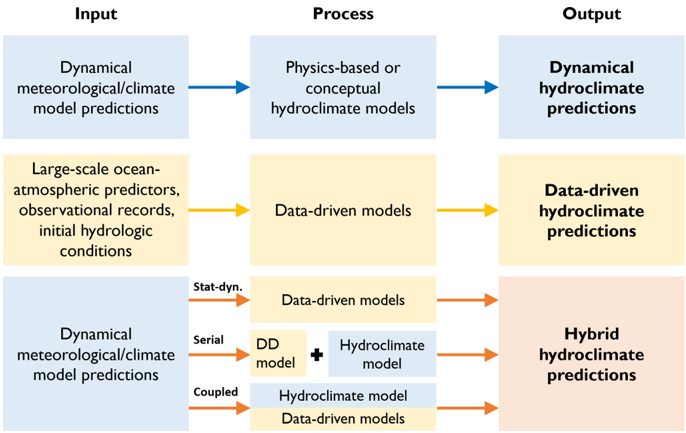
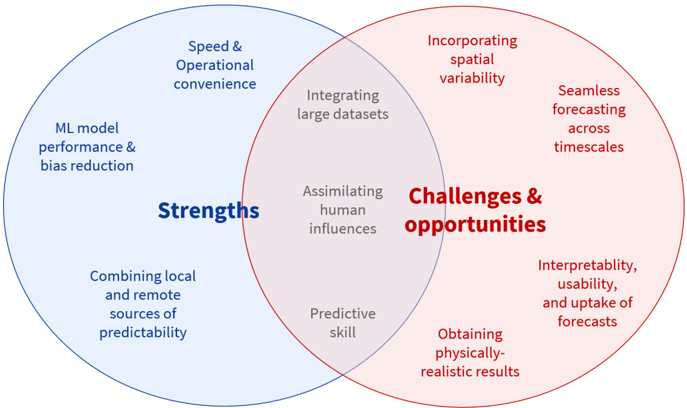
Hybrid hydroclimatic forecasting systems employ data-driven (statistical or machine learning) methods to harness and integrate a broad variety of predictions from dynamical, physics-based models – such as numerical weather prediction, climate, land, hydrology, and Earth system models – into a final prediction product. They are recognized as a promising way of enhancing the prediction skill of meteorological and hydroclimatic variables and events, including rainfall, temperature, streamflow, floods, droughts, tropical cyclones, or atmospheric rivers. Hybrid forecasting methods are now receiving growing attention due to advances in weather and climate prediction systems at subseasonal to decadal scales, a better appreciation of the strengths of AI, and expanding access to computational resources and methods. Such systems are attractive because they may avoid the need to run a computationally expensive offline land model, can minimize the effect of biases that exist within dynamical outputs, benefit from the strengths of machine learning, and can learn from large datasets, while combining different sources of predictability with varying time horizons. Here we review recent developments in hybrid hydroclimatic forecasting and outline key challenges and opportunities for further research. These include obtaining physically explainable results, assimilating human influences from novel data sources, integrating new ensemble techniques to improve predictive skill, creating seamless prediction schemes that merge short to long lead times, incorporating initial land surface and ocean/ice conditions, acknowledging spatial variability in landscape and atmospheric forcing, and increasing the operational uptake of hybrid prediction schemes.
Overview
The claims and statistics of this paper haven’t been checked yet.
Free: it reads the open-access text and checks the first 5 claims that cite a source we can check. Create a free account to check every claim.
Integrity signals
Registry
Cites
Statistics
Figures
Verification
Claims the paper makes
The claims and statistics of this paper haven’t been checked yet.
Free: it reads the open-access text and checks the first 5 claims that cite a source we can check. Create a free account to check every claim.
Self-check
Percentages, sums and reported differences re-computed from the paper’s own numbers.
The self-check needs the paper’s full text.
Citations
Cites
River flow forecasting through conceptual models part I — A discussion of principles
Nash, J. E., & Sutcliffe, J. V. (1970) · Journal of Hydrology · doi:10.1016/0022-1694(70)90255-6 · Cited by 23,674
Convolutional LSTM Network: A Machine Learning Approach for Precipitation Nowcasting
Shi, X., Chen, Z., Wang, H., Yeung, D.-Y., Wong, W.-K., & Woo, W.-C. (2015) · arXiv · doi:10.48550/arxiv.1506.04214 · Cited by 7,709
Deep learning and process understanding for data-driven Earth system science
Reichstein, M., Camps-Valls, G., Stevens, B., Jung, M., Denzler, J., Carvalhais, N., & Prabhat (2019) · Nature · doi:10.1038/s41586-019-0912-1 · Cited by 5,673
Stationarity Is Dead: Whither Water Management?
Milly, P. C. D., Betancourt, J., Falkenmark, M., Hirsch, R. M., Kundzewicz, Z. W., Lettenmaier, D. P., & Stouffer, R. J. (2008) · Science · doi:10.1126/science.1151915 · Cited by 4,537
The quiet revolution of numerical weather prediction
Bauer, P., Thorpe, A., & Brunet, G. (2015) · Nature · doi:10.1038/nature14956 · Cited by 2,729 · cited 1×
“been advancing by about one day per decade, such that ‘today’s 6-day forecast is as accurate as the 5-day forecast ten years ago’ (Bauer et al., 2015, p.47). Low flows may have skill up to 20 days in the case of Fundel et al. (2013) and even longer in other cases, especially with good information on initial conditions…”
BackgroundImprovement of a parsimonious model for streamflow simulation
Perrin, C., Michel, C., & Andréassian, V. (2003) · Journal of Hydrology · doi:10.1016/s0022-1694(03)00225-7 · Cited by 1,821 · cited 1×
“(2016) used a combination of historical observations and downscaled dynamical forecasts of rainfall and potential evapotranspiration in southern Australia from POAMA (Predictive Ocean Atmosphere Model for Australia) to drive the conceptual rainfall–runoff model GR4J (Perrin et al., 2003).”
MethodFlood Prediction Using Machine Learning Models: Literature Review
Mosavi, A., Ozturk, P., & Chau, K.-W. (2018) · Water · doi:10.3390/w10111536 · Cited by 1,672 · cited 2×
“Environment Agency, 2022), close co-operation is needed between the hydrology, forecasting, and ML communities to explore their potential either alone or in hybrid frameworks (Mosavi et al., 2018), build trust (Haupt et al.”
BackgroundMethodKratzert, F., Klotz, D., Shalev, G., Klambauer, G., Hochreiter, S., & Nearing, G. (2019) · Hydrology and Earth System Sciences · doi:10.5194/hess-23-5089-2019 · Cited by 1,223 · cited 1×
“Since long (50 year + ) hydroclimatic time series data are not available everywhere (Krabbenhoft, 2022), methods are required that can draw on pooled multi-site approaches with similar catchment and climate characteristics (Kratzert et al., 2019a .”
BackgroundSelf-citationThe CAMELS data set: catchment attributes and meteorology for large-sample studies
Addor, N., Newman, A. J., Mizukami, N., & Clark, M. P. (2017) · Hydrology and Earth System Sciences · doi:10.5194/hess-21-5293-2017 · Cited by 1,037 · cited 2×
“Such models may start to emerge with the growing availability of observational training datasets, such as the national CAMELS datasets (available for the USA, United Kingdom, Chile, Brazil, Australia, and soon France and Switzerland; e.g. Newman et al., 2015; Addor et al., 2017; Coxon et al., 2020) and international C…”
BackgroundSkilful precipitation nowcasting using deep generative models of radar
Ravuri, S., Lenc, K., Willson, M., Kangin, D., Lam, R., Mirowski, P., Fitzsimons, M., Athanassiadou, M., Kashem, S., Madge, S., et al. (2021) · Nature · doi:10.1038/s41586-021-03854-z · Cited by 1,024
Research works printed but not linked: 3
- Bisson, J. and Roberge, F.: Prévision des apports naturels: Ex- périence d'Hydro-Québec, workshop on flow predictions, in: IEEE Institute of Electrical and Electronics Engineers, Novem- ber 1983, Toronto, 1983.
- Fang, K. and Shen, C.: Near-real-time forecast of satellite-based soil moisture using long short-term memory with an adaptive data integration kernel, J. Hydrometeorol., 21, 399-413, 2020b. · DOI · Paper page
- Hoedt, P.-J., Kratzert, F., Klotz, D., Halmich, C., Holzleitner, M., Nearing, G. S., Hochreiter, S., and Klambauer, G.: Mc- lstm: Mass-conserving LSTM, Vol. 139, International Confer- ence on Machine Learning, 18-24 July 2021, Virtual, 4275- 4286, https://proceedings.mlr.press/v139/hoedt21a.html (last ac- cess: 6 May 2023), 2021.
Cited by
Items 201–300 of 342
Abozweita, O. A., Sidek, L. B., Sherif, M. M., Sham, F. A. F., El‐Shafie, A., & Ahmed, A. N. (2026) · Archives of Computational Methods in Engineering · doi:10.1007/s11831-026-10630-7 · Cited by 1
Mazuruse, G., Chifurira, R., Zewotir, T. T., & Chinhamu, K. (2026) · Frontiers in Environmental Science · doi:10.3389/fenvs.2026.1828162 · Cited by 1
Artificial intelligence in seafood: enhancing logistics management for a smarter supply chain
Sasidharan, A., Jims, A., Philip, F. M., Ajay, A., Joshy, A. M., Sabu, S., & Sunooj, K. V. (2026) · Frontiers in Ocean Sustainability · doi:10.3389/focsu.2026.1716480 · Cited by 1
Sadiq, M. A. (2026) · Journal of Thermal Analysis and Calorimetry · doi:10.1007/s10973-026-15939-w · Cited by 1
“Hybrid models combine artificial intelligence methods and physical knowledge, numerical simulations, or optimization algorithms, which enhance the prediction accuracy while maintaining the physical consistency [41].”
Ellis, J. L., Bode, J., Sahar, M., You, J., Tulpan, D., Aldenhoven, N., & Tedeschi, L. O. (2026) · Journal of Animal Science · doi:10.1093/jas/skag311 · Cited by 1
“…et al. 2021), systems biology (Procopio et al. 2023; Noordijk et al. 2024), chemical engineering (Venkatasubramanian 2019), climate science (Slater et al. 2023), and human health research (Wong et al. 2024), and a number of useful reviews of the topic across these other field have been…”
Cheng, G., Huang, G., Tan, Q., Dong, C., & Zhou, X. (2023) · Journal of Hydrology · doi:10.1016/j.jhydrol.2023.130246 · Cited by 1
Ren, J., Liu, Y., & Liu, J. (2024) · Communications Earth & Environment · doi:10.1038/s43247-024-01801-0 · Cited by 1
A Survey on Remote Sensing-Based Climate Change Prediction Using Artificial Intelligence Techniques
Suhana, S., & Karthiga, M. (2024) · International Conference on Sustainable Expert Systems (ICSES) · doi:10.1109/icses63445.2024.10763234 · Cited by 2
“AI , by engaging the public, assisting policymakers, quantifying uncertainties, increasing data assimilation techniques and refining previous climate models, provides an insightful and more comprehensive knowledge of climate change[12].”
Modelling for Improved Flood Forecasting in the Bow River Basin Using Prophet
Dash, A. A., Castro, K., & McBean, E. A. (2024) · Journal of Environmental Informatics Letters · doi:10.3808/jeil.202400143 · Cited by 1
Amalgamation of Artificial Intelligence and Climate Change
Chauhan, B. V. S., Vedrtnam, A., Wyche, K. P., & Verma, S. (2025) · Springer eBooks · doi:10.1007/978-981-96-6863-2_4 · Cited by 1
Hybrid forecasting methods across varied domains-a systematic review
Xhabafti, M., & Sinaj, V. (2025) · IAES International Journal of Artificial Intelligence · doi:10.11591/ijai.v14.i4.pp2601-2612 · Cited by 1
Advances in artificial intelligence for plant biology and crop breeding: An overview
Boutagayout, A., Ezzouggari, R., Kouighat, M., Adiba, A., Laasli, S., Farhaoui, A., & Lahlali, R. (2025) · Elsevier eBooks · doi:10.1016/b978-0-443-33633-1.00002-2 · Cited by 2
Shafei, A., & Cioffi, F. (2024) · Preprints.org · doi:10.20944/preprints202408.1322.v1 · Cited by 1
Resolving the cascade of uncertainty in global flood projectionsPreprint
Zhang, B., Slater, L. J., Moulds, S., Wortmann, M., Hart, N. C. G., Liu, Y., Yin, J., Gu, X., Nearing, G., Brunner, M. I., et al. (2025) · Research Square · doi:10.21203/rs.3.rs-6718520/v1 · Cited by 2
Self-citationExploring Hybrid Forecasting Frameworks for Subseasonal Low Flow Predictions in the European AlpsPreprint
Chang, A. Y.-Y., Harrigan, S., Ramos, M., Zappa, M., Grams, C. M., Domeisen, D. I. V., & Bogner, K. (2025) · doi:10.5194/egusphere-2025-3411 · Cited by 1
Self-citationQuels apports d'une approche multi-modèle semi-distribuée pour la prévision des débits ?
Thébault, C. (2023) · theses.fr (ABES) · doi:10.70675/ed6127f6z0afdz48e9zb40ezc93cf5dadad3 · Cited by 5
Slater, L. J. (2022) · Earth System Dynamics · doi:10.5194/esd-2021-92-ac1
Self-citation(2022) · Earth System Dynamics · doi:10.5194/esd-2021-92-rc1
(2022) · Hydrology and earth system sciences · doi:10.5194/hess-2022-334-rc1
(2023) · Natural hazards and earth system sciences · doi:10.5194/nhess-2023-63-rc1
(2023) · Hydrology and earth system sciences · doi:10.5194/hess-2023-116-rc1
Zellou, B. (2023) · Natural hazards and earth system sciences · doi:10.5194/nhess-2023-63-ac2
(2023) · Hydrology and earth system sciences · doi:10.5194/hess-2023-111-rc1
(2023) · Hydrology and earth system sciences · doi:10.5194/hess-2023-111-rc2
Wu, Z. (2023) · Hydrology and earth system sciences · doi:10.5194/hess-2023-111-ac2
Wu, Z. (2023) · Hydrology and earth system sciences · doi:10.5194/hess-2023-111-ac1
(2024) · Hydrology and earth system sciences · doi:10.5194/hess-2023-235-rc3
Yu, Q. (2024) · Hydrology and earth system sciences · doi:10.5194/hess-2023-237-ac2
Shahvar, M. P., Marsella, G., Collura, A., & Farina, V. (2024) · SSRN Electronic Journal · doi:10.2139/ssrn.4684364
Comment on egusphere-2023-3040
Arnal, L., Clark, M. P., Pietroniro, A., et al. (2024) · doi:10.5194/egusphere-2023-3040-rc2
Hybrid approach for vegetable price forecasting in electronic commerce platform
Choong, K. Y., Sudin, S., Raof, R. A. A., & Ong, R. J. (2024) · IAES International Journal of Artificial Intelligence · doi:10.11591/ijai.v13.i2.pp1858-1867
Skillful land and marine heatwave forecasting through hybrid statistical dynamical modellingPreprint
Zhao, T., Huang, Z., & Wang, H. E. (2024) · Research Square · doi:10.21203/rs.3.rs-4605484/v1
Юрьевич, Г. П., Таволжанский, А. В., Zolnikov, V., & Deniskina, A. (2024) · BIO Web of Conferences · doi:10.1051/bioconf/202414504019
Deep learning fοr the simulatiοn, recοnstructiοn & prοjectiοn οf grοundwater level variatiοns
Chidepudi, S. K. R. (2024) · theses.fr (ABES) · doi:10.70675/000473c4z5803z4412z96bfz292a815efc1d
Exploring Diverse Modeling Schemes for Runoff Prediction: An Application to 544 Basins in ChinaPreprint
Hu, Y., Li, H., Zhang, C., Shen, D., Xu, B., Chen, M., Chu, W., & Li, R. (2025) · doi:10.5194/egusphere-2025-1161
Kravets, O. (2025) · Науковий вісник НЛТУ України · doi:10.36930/40350313
Mearns, L. O., & Wilby, R. L. (2025) · Springer eBooks · doi:10.1007/978-3-031-85542-9_26
Self-citationQuizhpi, G. C. Q., & Balseca, C. L. I. (2025) · ASCE MAGAZINE · doi:10.70577/asce/622.642/2025
Optimizing Climate Forecasting Via Reduced Time Series from Change Point Detection MethodsPreprint
Santos, B. Z., Lira, M. F. A., Cerri, R., & Prudêncio, R. B. C. (2025) · SSRN Electronic Journal · doi:10.2139/ssrn.5397393
Cuaran, G. A., Ponce, L. G. L., Delgado, J. L. H., & Cuaichar, D. A. M. (2025) · Ingeniería y Competitividad · doi:10.25100/iyc.v27i2.14876
Wu, J., Yang, W., Liu, B., & Weijia Jia, B. (2025) · ACM International Conference on Information and Knowledge Management (CIKM) · doi:10.1145/3746252.3761410
Rasul, A. (2026) · Journal of Geoscience and Earth Observation · doi:10.62762/jgeo.2026.171666
Yaghi, M. A., Al-Omari, H., & AlNawaiseh, S. (2025) · World sustainability series · doi:10.1007/978-3-032-00098-9_13
Hybrid Models and Causal Inference Techniques for Optimizing Climate Science: A Comprehensive Review
Geetanjali, R., & Geetha, E. (2025) · International Conference on New Frontiers in Communication, Automation, Management and Security (ICCAMS) · doi:10.1109/iccams65118.2025.11234618
Emissions Impossible: Five AI “What If” Scenarios for Emission Reduction
Soneji, S., & Neve, S. (2025) · doi:10.1109/temsconglobal64363.2025.11238310
Indicators and predictions of climate change
Goodwin, P. B. (2025) · Elsevier eBooks · doi:10.1016/b978-0-443-32838-1.00005-9
Doi, T., Yasunaka, S., & Kurihara, H. (2025) · Scientific Reports · doi:10.1038/s41598-025-27161-z
“A dynamical-statistical hybrid prediction systems could be a promising approach for more accurate forecasts and societal applications 30 .”
Nandhitha, B., & Christopher Columbus, C. (2025) · International Conference on Industry 4.0 Technology (I4Tech) · doi:10.1109/i4tech64670.2025.11277479
“Louise J. Slater et al. [16] introduced hybrid hydroclimatic forecasting systems that combine data-driven techniques with dynamic, physics-based models to improve predictions of meteorological and hydroclimatic variables.”
The Role of AI in Climate Change Adaptation and Resilience
Poornima, G., & A., S. G. M. (2025) · IGI Global eBooks · doi:10.4018/979-8-3693-8866-2.ch014
Data driven application for hydro generation
Domingo Torremorell, J. (2024) · UPCommons institutional repository (Universitat Politècnica de Catalunya)
Exploring the use of Artificial Intelligence for flood forecasting in Scotland
White, C., Bertram, D., Atkinson, R., Usman, M., Nieradzinska, K., & Barclay, V. M. (2025) · Strathprints: The University of Strathclyde institutional repository (University of Strathclyde)
Enhancing river flow predictions with machine learning and data assimilation
Ahmed, M. (2025) · Spectrum Research Repository (Concordia University)
Transforming Climate Change Understanding: Harnessing The Power of Data and Machine Learning
Khurana, H., & Thakur, M. (2025) · Springer eBooks · doi:10.1007/978-981-97-9859-9_87
Katambo, J., Ribbe, L., & Kongo, V. (2025) · International Conference on Emerging Trends in Networks and Computer Communications (ETNCC) · doi:10.1109/etncc66224.2025.11299720
“However, in extensive areas of Southern Africa, long-term, high-quality observational datasets are often sparse and incomplete, primarily owing to constrained station networks, inconsistent data collection practices, and historical data loss [1], [2], [3].”
Rahmah, S. M., Dani, A. T. R., & Wahyuningsih, S. (2025) · Euler Jurnal Ilmiah Matematika Sains dan Teknologi · doi:10.37905/euler.v13i3.34268
RH-GNN: Regional Heterogeneity Enabled GNN for Agricultural Fertilization Prediction
Qian, J., Zhang, Y., Bi, G., Qi, J., Yang, Y., & Yang, P. (2025) · IEEE International Conference on Industrial Informatics (INDIN) · doi:10.1109/indin64977.2025.11279182
“Hybrid approaches can overcome the limitations of individual models, enhancing both prediction accuracy and interpretability [11], and are therefore considered a promising direction for future research on fertilizer amount prediction.”
Elkabtane, K., Benazzouz, T., & Dahbi, S. (2026) · Lecture notes in networks and systems · doi:10.1007/978-3-032-18548-8_16
Rainfall Forecasting: A Review of Current Practice
Shuvo, S., Afrin, N., Pan, X., Yildirim, G., & Rahman, A. (2026) · Lecture notes in civil engineering · doi:10.1007/978-3-032-18708-6_22
Spatially Aware Deep Learning for Microclimate Prediction from High-Resolution Geospatial ImageryPreprint
Sulami, I., Itzkovitch, A., Kearney, M., Shahar, M., & Levy, O. (2026) · SSRN Electronic Journal · doi:10.2139/ssrn.6304934
Rapson, J., Stephens, E., Maidment, R., & Bonifácio, R. (2026) · doi:10.5194/egusphere-2026-66
Sabilao, K. A. P., & Jarito, E. L. (2026) · Global Journal of Engineering and Technology Research · doi:10.65150/ep-gjetr/v2e3/2026-01
Li, R., Feng, Q., & Cui, Y. (2026) · Journal of Hydrology Regional Studies · doi:10.1016/j.ejrh.2026.103355 · Cited by 1
Hao, R., Zhao, Y., & Deng, X. (2026) · Remote Sensing · doi:10.3390/rs18070997
Baishemirov, Z. D., Ospanova, D., Amirgaliyev, B., & MUKHAMBETZHANOV, S. T. (2026) · Journal of problem in computer science and information technologies · doi:10.26577/jpcsit4120264
Artificial intelligence methods for rainy season forecasting: a comprehensive analysis
Sonon, B., Gbemavo, D. S. J. C., & Kakaï, R. G. (2026) · Modeling Earth Systems and Environment · doi:10.1007/s40808-026-02769-w
Astagneau, P. C. (2022) · theses.fr (ABES) · doi:10.70675/22bed6a8z0080z491czb3bcze82b69a4fc4e · Cited by 3
Intelligence artificielle pour des services moraux : Concilier équité et confidentialité
Aalmoes, J. (2024) · theses.fr (ABES) · doi:10.70675/5ed1a0f0z741fz498bz868az5810aa0fe530
A Spatially Robust and Interpretable Machine Learning Framework for Rainfall Erosivity PredictionPreprint
İnce, K. (2026) · SSRN Electronic Journal · doi:10.2139/ssrn.6568405
Advancing aquifer recharge forecasting through hybrid explainable AI and hydrological modeling
Sharma, C., Başağaoğlu, H., Schmidt, L. M., Yoosefdoost, I., Wootten, A., Bertetti, F. P., ŞAHİNLİ, M. A., Arshad, A., Samimi, M., Sharp, J. M., et al. (2026) · Geoscience Frontiers · doi:10.1016/j.gsf.2026.102336 · Cited by 1
İnce, K., & Erpul, G. (2026) · SSRN Electronic Journal · doi:10.2139/ssrn.6580155
Aditama, F. Y., Jeung, M., Kim, S. H., Yun, D., & Baek, S.-S. (2026) · Urban Water Journal · doi:10.1080/1573062x.2026.2660919
Degni, B. F., Lamah, L., Yao, Y. H., Fanny, A. K., & Haba, C. T. (2026) · Modern Applied Science · doi:10.5539/mas.v20n1p42
“Approaches integrating SHAP clustering for anomaly detection may further enhance predictive system transparency and reliability (Slater et al., 2023; Antwarg, Miller, Shapira, & Rokach, 2019).”
Integrated AI System for Flood Prediction, Migration Forecasting, and Safe Zone Management
Chavan, P. S., Bora, D. D., Gaikwad, R., Gupta, Y., & Sayyad, T. (2026) · International Conference on Emerging Technologies and Future Innovations (ETFI) · doi:10.1109/etfi68128.2026.11484598
“Similarly, recent works on hybrid forecasting frameworks [11], [12], and systematic reviews on flood prediction techniques [13] conclude that multi-model integration and real-time data utilization represent the future direction of flood risk management systems.”
Deep Learning for PM2.5 Prediction under Zero-Inflated Tropical Rainfall: RNN vs GRU
Yuliyono, I., & Supriyanto, A. (2026) · EDUMATIC Jurnal Pendidikan Informatika · doi:10.29408/edumatic.v10i1.34418
“The urgency is clear: context-specific predictive models are needed, but most existing work has been developed for and tested on temperate climates (Slater et al., 2023).”
Obiri-Yeboah, S., Frimpong, E., Li, P., & Darko, G. (2026) · Springer hydrogeology · doi:10.1007/978-3-032-18853-3_4
Data-driven subgrid-scale turbulence parameterization: methods for improving model efficiency
Zhu, X., Qu, Y., Wu, N., Zhang, H., & Shi, X. (2026) · Machine Learning Earth · doi:10.1088/3049-4753/ae6dbe
“Thus, hybrid models, which combine physics-based numerical models with DL models, become another development direction and are thought to be useful for enhancing the model performance in comparison with pure DL models [25, 28, 33].”
Zhou, F., Ren, H., Gao, L., Li, Y., Wang, L., & Liu, M. (2026) · Geophysical Research Letters · doi:10.1029/2026gl122773
“Given the complementary strengths and weaknesses of statistical and dynamical approaches, hybrid models that merge circulation information from dynamical forecasts with statistically derived circulation‐precipitation coupling offer a promising path forward (Slater et al., 2023).”
A Study on the Mountainous Merging Precipitation Model and Effective Covariates
Xing, M., Qu, S., Jiang, P., CHEN, X., & Ji, W. (2026) · Water Resources Management · doi:10.1007/s11269-026-04638-8
“Meanwhile, it retains the accuracy of rain-gauge data and significantly improves the precipi - tation accuracy (Slater et al. 2023).”
Wu, J., Wang, Z., Yu, H., & Song, S. (2026) · Journal of Geophysical Research Machine Learning and Computation · doi:10.1029/2025jh000998 · Cited by 1
Flood modelling in a montane basin using machine learning, deep learning and sensor network data
Ba, D., & Langhammer, J. (2026) · Journal of Hydroinformatics · doi:10.2166/hydro.2026.175
Performance Evaluation of GraphCast for Medium-Range Weather Forecasting over BrazilPreprint
Rowell, W. R., & Kupssinskü, L. S. (2026) · arXiv (Cornell University) · doi:10.48550/arxiv.2606.06348
“…the physics-based paradigm faces well-documented limitations in computational cost, the parameterization of subgrid processes, and the chaotic predictability horizon BUIZZA (2002), with these constraints further amplified by the non-stationarity of a warming climate Slater et al. (2023).”
Mbuh, M. (2026) · SSRN Electronic Journal · doi:10.2139/ssrn.6904017
Hou, P., Wang, J., Qiu, S., Li, S., Jia, X., Li, Y., He, D., Ma, Y., Zhang, D., & Du, J. (2026) · ISPRS International Journal of Geo-Information · doi:10.3390/ijgi15060263
“These cases expose the fundamental limitations of existing predictive methodologies under non-stationary forcing [19].”
Managing Water Resources Using Machine Learning and Spatial Optimization
Choudhary, R., Kumar, A., Bhardwaj, L., & Praveen, B. (2026) · BENTHAM SCIENCE PUBLISHERS eBooks · doi:10.2174/9798898813789126010007
Zhao, Z., Zhang, R., Guo, H., Zhang, J., Liu, Y., Chen, X., & Wang, C. (2026) · ISPRS International Journal of Geo-Information · doi:10.3390/ijgi15070279
Shahid, M. B., Jiang, Z., Sarkar, S. K. N. S. R., & Fleming, C. H. (2026) · SSRN Electronic Journal · doi:10.2139/ssrn.7019801
Huang, H. G., Jiang, Y., Xu, X., Ouyang, X., Guo, Z., Ning, S., Zhou, Y., Luo, L., & Jin, J. (2026) · Remote Sensing · doi:10.3390/rs18132120
Feng, H. (2026) · Theoretical and Natural Science · doi:10.54254/2753-8818/2026.34972
Eight Questions About Effects of Global Warming on Soil and Landscape Processes
Mueller, L., Eulenstein, F., Kersebaum, C., Jörgensen, R. G., Ahl, C., Mirschel, W., Hennings, V., Schindler, U., Behrendt, A., & Thielicke, M. (2026) · Innovations in landscape research · doi:10.1007/978-3-032-09836-8_12
Yin, H., Liu, Z., Wu, Z., & He, H. (2026) · Journal of Geophysical Research Atmospheres · doi:10.1029/2026jd047260
Ibebuchi, C. C. (2026) · Machine Learning Science and Technology · doi:10.1088/2632-2153/ae8a13 · Cited by 1
“In climate and hydroclimate science, machine-learning methods have been applied to streamflow prediction [4], drought forecasting [5], climate teleconnection analysis [3], precipitation downscaling [6], wildfire risk assessment [7], and climate-impact modeling [8].”
Inteligencia artificial y sustentabilidad climática: un análisis de su impacto y regulación
Escalante, Á. G. (2026) · BUIYYA TIERRA · doi:10.62457/w6gbm618
“Investigaciones recientes sugieren que trabajar con algoritmos de aprendizaje automático pueden mejorar significativamente la precisión de los modelos climáticos, per-34 mitiendo una mejor planificación y respuesta ante fenómenos extremos (Slater et al., 2023).”
Learning geometry-aware streamflow forecast models from a large-scale river graph dataset
Sun, A. Y., & Sun, A. A. (2026) · Journal of Hydrology · doi:10.1016/j.jhydrol.2026.136059
Alahmari, S., Alkharashi, A., Altamimi, S. N., Malwi, W. A., & Alabduljabbar, A. (2026) · PeerJ Computer Science · doi:10.7717/peerj-cs.3766
Naresh, C., & Mathew, A. (2026) · Water Resources Management · doi:10.1007/s11269-026-04843-5
“⎫ The robustness of ensemble models makes them valuable tools for policymakers and stakeholders in making informed decisions regarding drought preparedness and management (Slater et al. 2023 ).”
InfluentialFeng, L. (2026) · Regional Studies in Marine Science · doi:10.1016/j.rsma.2026.105290
Modelling Future Evolution of the Antarctic Ice Sheet With Explainable Machine Learning
Maddigan, P., Nguyen, B. H., Siew, P. Y. F., Xue, B., Golledge, N. R., & Zhang, M. (2026) · Journal of the Royal Society of New Zealand · doi:10.1002/snz2.70067
Kotharkar, V., & Stein, M. (2026) · arXiv (Cornell University) · doi:10.48550/arxiv.2607.27160
“In that literature, dynamical output is combined with statistical structure to improve robustness, calibration, or long-range skill (Slater et al., 2023).”
Mohamed, R., Yang, C., Zainudin, M., Muhammad, S., Mustapha, N., & Yamaguchi, S. (2026) · SSRN Electronic Journal · doi:10.2139/ssrn.7212598
Metadata
- Authors
- Slater, L. J., Arnal, L., Boucher, M.-A., Chang, A. Y.-Y., Moulds, S., Murphy, C., Nearing, G., Shalev, G., Shen, C., Speight, L., Villarini, G., Wilby, R. L., Wood, A., & Zappa, M.
- Affiliations
- University of Oxford (GB)
- University of Saskatchewan (CA)
- Université de Sherbrooke (CA)
- Swiss Federal Institute for Forest, Snow and Landscape Research (CH)
- National University of Ireland, Maynooth (IE)
- Google (United States) (US)
- Google (Israel) (IL)
- Pennsylvania State University (US)
- University of Iowa (US)
- Loughborough University (GB)
- NSF National Center for Atmospheric Research (US)
- Corresponding author
- Slater, Louise J.
- ORCID
- Venue
- Hydrology and Earth System Sciences
- Publisher
- Copernicus GmbH
- Published
- 2023-05-15
- Volume
- 27
- Issue
- 9
- Pages
- 1865-1889
- ISSN
- 1027-5606 (ISSN-L)
- 1607-7938
- OpenAlex
- W4387437512
- Semantic Scholar
- 70def1c9bdf053b526f5798935508cbb1ef1c214
- Cited by
- 281
- References
- 163
- Citations by year
- 2026: 89 · 2025: 94 · 2024: 66 · 2023: 28
- FWCI
- 23.08
- Type
- journal article
- Language
- en
- Open access
- gold
- doi.org
- Licence
- Locations
- Hydrology and earth system sciences (publishedVersion, cc-by)
- Maynooth University ePrints and eTheses Archive (Maynooth University) (acceptedVersion)
- DORA WSL (Swiss Federal Institute for Forest, Snow and Landscape Research) (submittedVersion, cc-by)
- HARVEST (University of Saskatchewan) (submittedVersion, cc-by)
- DOAJ (DOAJ: Directory of Open Access Journals) (submittedVersion, cc-by-sa)
- Loughborough University Research Repository (Loughborough University) (submittedVersion, cc-by)
- Edinburgh Research Explorer (University of Edinburgh) (submittedVersion, cc-by)
- Repository for Publications and Research Data (ETH Zurich) (submittedVersion, cc-by)
- ETH Zürich Research Collection
- Funders
- UK Research and Innovation (MR/V022008/1, NE/S015728/1)
- Swiss Federal Institute for Forest, Snow and Landscape Research (MaLeFix (Extremes))
- Canada First Research Excellence Fund (Global Water Futures programme)
- U.S. Army Corps of Engineers (USACE Institute for Water Resources)
- Science Foundation Ireland (SFI/17/CDA/4783)
- Topics
- Physical Sciences › Environmental Science › Environmental Engineering › Hydrological Forecasting Using AI
- Physical Sciences › Earth and Planetary Sciences › Atmospheric Science › Meteorological Phenomena and Simulations
- Physical Sciences › Environmental Science › Global and Planetary Change › Climate variability and models
- Keywords
- hybrid forecasting, machine learning, numerical weather prediction, ensemble forecasting, streamflow forecasting, flood forecasting, drought forecasting, tropical cyclones, atmospheric rivers, data assimilation, operational forecasting
About these checks
Registry, retraction, Cites and statistics results are computed, not judged, with one exception: a printed reference that no index lists is read once by a model before it counts as a citation error. Claims are extracted by a model and kept only when their quote appears verbatim in the text; each cited source is then checked, with a model’s help, for whether it says what the claim relies on. Those verdicts can be wrong — read the claim’s quote and the cited source before relying on one.
Statistics and arithmetic are recomputed, not judged.
Confidence bands are shown only for fields calibrated on our annotated test set. None is calibrated yet, so no band is shown.
What counts as a claim ›How we measure confidence ›How we check this ›
Are you an author, or do you see a problem with this page? Request a review
Data sources
Bibliographic data: Semantic Scholar, OpenAlex, Crossref.
Contains information from the Semantic Scholar Academic Graph Datasets, made available under the ODC Attribution License (ODC-BY 1.0).
Semantic Scholar’s data is described in: Kinney, R., et al. (2023). The Semantic Scholar Open Data Platform. arXiv:2301.10140.
