

Hybrid forecasting: blending climate predictions with AI models
Open accessPublished version of a preprint
The DOI matches its Crossref record; 167 of the 167 references it cites were found in a registry or an index.
Abstract
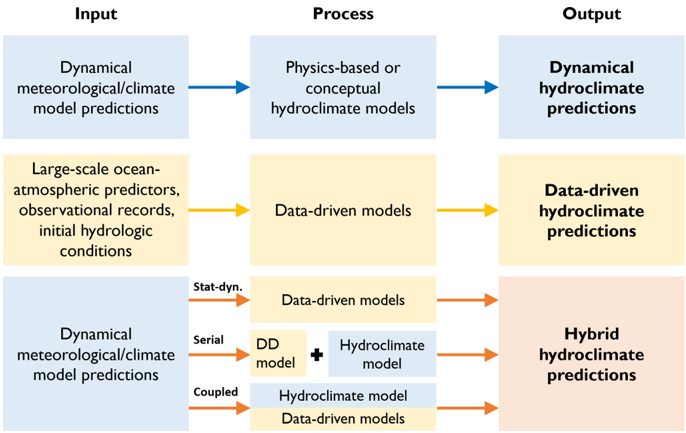
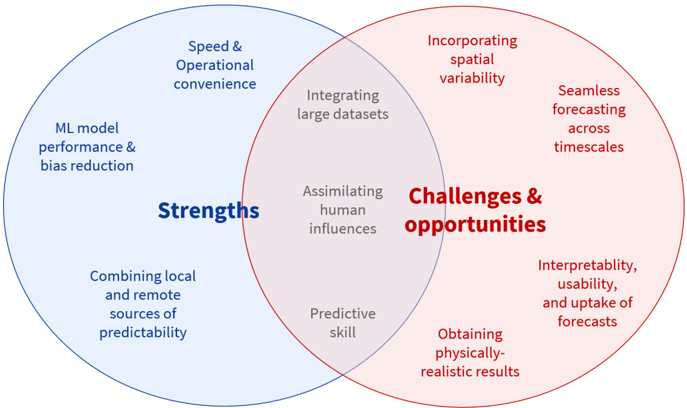
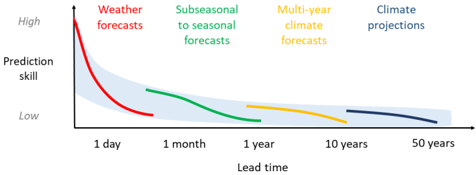
Hybrid hydroclimatic forecasting systems employ data-driven (statistical or machine learning) methods to harness and integrate a broad variety of predictions from dynamical, physics-based models – such as numerical weather prediction, climate, land, hydrology, and Earth system models – into a final prediction product. They are recognized as a promising way of enhancing the prediction skill of meteorological and hydroclimatic variables and events, including rainfall, temperature, streamflow, floods, droughts, tropical cyclones, or atmospheric rivers. Hybrid forecasting methods are now receiving growing attention due to advances in weather and climate prediction systems at subseasonal to decadal scales, a better appreciation of the strengths of AI, and expanding access to computational resources and methods. Such systems are attractive because they may avoid the need to run a computationally expensive offline land model, can minimize the effect of biases that exist within dynamical outputs, benefit from the strengths of machine learning, and can learn from large datasets, while combining different sources of predictability with varying time horizons. Here we review recent developments in hybrid hydroclimatic forecasting and outline key challenges and opportunities for further research. These include obtaining physically explainable results, assimilating human influences from novel data sources, integrating new ensemble techniques to improve predictive skill, creating seamless prediction schemes that merge short to long lead times, incorporating initial land surface and ocean/ice conditions, acknowledging spatial variability in landscape and atmospheric forcing, and increasing the operational uptake of hybrid prediction schemes.
Overview
The claims and statistics of this paper haven’t been checked yet.
Free: it reads the open-access text and checks the first 5 claims that cite a source we can check. Create a free account to check every claim.
Integrity signals
Registry
Cites
Statistics
Figures
Verification
Claims the paper makes
The claims and statistics of this paper haven’t been checked yet.
Free: it reads the open-access text and checks the first 5 claims that cite a source we can check. Create a free account to check every claim.
Self-check
Percentages, sums and reported differences re-computed from the paper’s own numbers.
The self-check needs the paper’s full text.
Citations
Cites
River flow forecasting through conceptual models part I — A discussion of principles
Nash, J. E., & Sutcliffe, J. V. (1970) · Journal of Hydrology · doi:10.1016/0022-1694(70)90255-6 · Cited by 23,674
Convolutional LSTM Network: A Machine Learning Approach for Precipitation Nowcasting
Shi, X., Chen, Z., Wang, H., Yeung, D.-Y., Wong, W.-K., & Woo, W.-C. (2015) · arXiv · doi:10.48550/arxiv.1506.04214 · Cited by 7,709
Deep learning and process understanding for data-driven Earth system science
Reichstein, M., Camps-Valls, G., Stevens, B., Jung, M., Denzler, J., Carvalhais, N., & Prabhat (2019) · Nature · doi:10.1038/s41586-019-0912-1 · Cited by 5,673
Stationarity Is Dead: Whither Water Management?
Milly, P. C. D., Betancourt, J., Falkenmark, M., Hirsch, R. M., Kundzewicz, Z. W., Lettenmaier, D. P., & Stouffer, R. J. (2008) · Science · doi:10.1126/science.1151915 · Cited by 4,537
The quiet revolution of numerical weather prediction
Bauer, P., Thorpe, A., & Brunet, G. (2015) · Nature · doi:10.1038/nature14956 · Cited by 2,729 · cited 1×
“been advancing by about one day per decade, such that ‘today’s 6-day forecast is as accurate as the 5-day forecast ten years ago’ (Bauer et al., 2015, p.47). Low flows may have skill up to 20 days in the case of Fundel et al. (2013) and even longer in other cases, especially with good information on initial conditions…”
BackgroundImprovement of a parsimonious model for streamflow simulation
Perrin, C., Michel, C., & Andréassian, V. (2003) · Journal of Hydrology · doi:10.1016/s0022-1694(03)00225-7 · Cited by 1,821 · cited 1×
“(2016) used a combination of historical observations and downscaled dynamical forecasts of rainfall and potential evapotranspiration in southern Australia from POAMA (Predictive Ocean Atmosphere Model for Australia) to drive the conceptual rainfall–runoff model GR4J (Perrin et al., 2003).”
MethodFlood Prediction Using Machine Learning Models: Literature Review
Mosavi, A., Ozturk, P., & Chau, K.-W. (2018) · Water · doi:10.3390/w10111536 · Cited by 1,672 · cited 2×
“Environment Agency, 2022), close co-operation is needed between the hydrology, forecasting, and ML communities to explore their potential either alone or in hybrid frameworks (Mosavi et al., 2018), build trust (Haupt et al.”
BackgroundMethodKratzert, F., Klotz, D., Shalev, G., Klambauer, G., Hochreiter, S., & Nearing, G. (2019) · Hydrology and Earth System Sciences · doi:10.5194/hess-23-5089-2019 · Cited by 1,223 · cited 1×
“Since long (50 year + ) hydroclimatic time series data are not available everywhere (Krabbenhoft, 2022), methods are required that can draw on pooled multi-site approaches with similar catchment and climate characteristics (Kratzert et al., 2019a .”
BackgroundSelf-citationThe CAMELS data set: catchment attributes and meteorology for large-sample studies
Addor, N., Newman, A. J., Mizukami, N., & Clark, M. P. (2017) · Hydrology and Earth System Sciences · doi:10.5194/hess-21-5293-2017 · Cited by 1,037 · cited 2×
“Such models may start to emerge with the growing availability of observational training datasets, such as the national CAMELS datasets (available for the USA, United Kingdom, Chile, Brazil, Australia, and soon France and Switzerland; e.g. Newman et al., 2015; Addor et al., 2017; Coxon et al., 2020) and international C…”
BackgroundSkilful precipitation nowcasting using deep generative models of radar
Ravuri, S., Lenc, K., Willson, M., Kangin, D., Lam, R., Mirowski, P., Fitzsimons, M., Athanassiadou, M., Kashem, S., Madge, S., et al. (2021) · Nature · doi:10.1038/s41586-021-03854-z · Cited by 1,024
Research works printed but not linked: 3
- Bisson, J. and Roberge, F.: Prévision des apports naturels: Ex- périence d'Hydro-Québec, workshop on flow predictions, in: IEEE Institute of Electrical and Electronics Engineers, Novem- ber 1983, Toronto, 1983.
- Fang, K. and Shen, C.: Near-real-time forecast of satellite-based soil moisture using long short-term memory with an adaptive data integration kernel, J. Hydrometeorol., 21, 399-413, 2020b. · DOI · Paper page
- Hoedt, P.-J., Kratzert, F., Klotz, D., Halmich, C., Holzleitner, M., Nearing, G. S., Hochreiter, S., and Klambauer, G.: Mc- lstm: Mass-conserving LSTM, Vol. 139, International Confer- ence on Machine Learning, 18-24 July 2021, Virtual, 4275- 4286, https://proceedings.mlr.press/v139/hoedt21a.html (last ac- cess: 6 May 2023), 2021.
Cited by
Items 101–200 of 342
Moulds, S., Slater, L. J., Arnal, L., & Wood, A. W. (2025) · Hydrology and earth system sciences · doi:10.5194/hess-29-2393-2025 · Cited by 9
“Like other forms of regression, the ML model implicitly performs bias correction by relating the raw climate inputs to observed streamflow (e.g. Slater et al., 2023; Slater and Villarini, 2018) We compared three model structures to predict Q max in each catchment (Table 1 .”
Self-citationIntegrating AI in plant science: A review of applications and future prospects
Khan, I., & Khare, B. K. (2025) · Plant Gene · doi:10.1016/j.plgene.2025.100542 · Cited by 8
An extension of WeatherBench 2 to binary hydroclimatic forecasts
Zhao, T., Li, Q., Tu, T., & Chen, X. (2025) · Geoscientific model development · doi:10.5194/gmd-18-5781-2025 · Cited by 10
“In operational applications, binary forecasts of extreme precipitation events and heat waves can respectively be derived from precipitation and temperature forecasts (Huang and Zhao, 2022; Lang et al., 2014; Zhao et al., 2022; Slater et al., 2023 .”
Prediction of unsaturated zone soil moisture using an LSTM model driven by a physics-based model
Lv, X., Nurmemet, I., Yu, X., Aili, Y., Li, S., Aihaiti, A., Qin, Y., & Xiang, Y. (2025) · Agricultural Water Management · doi:10.1016/j.agwat.2025.109863 · Cited by 8
Bohl, J. P., Wood, R. R., Frank, C., Astagneau, P. C., Peters, J., & Brunner, M. I. (2026) · Hydrology and earth system sciences · doi:10.5194/hess-30-4667-2026 · Cited by 9
“For snow-dominated catchments, all models suffer from similar reductions in accuracy when simulating streamflow under unseen climate conditions and the LSTM”
Shokri, A., Bennett, J. C., Robertson, D. E., Perraud, J., Frost, A. J., & Lehmann, E. (2026) · Hydrology and earth system sciences · doi:10.5194/hess-30-757-2026 · Cited by 9
Fusion of data-driven models with a knowledge-guided loss function for flood forecasting
Malik, H., Feng, J., Abdallah, M., Zhang, J., Shao, P., & Abduljabbar, Z. A. (2025) · Applied Soft Computing · doi:10.1016/j.asoc.2025.113742 · Cited by 8
Empowering Smart Cities: SARIMA Forecasting of Power Consumption in Tetouan's Urban Grid
Bensalah, M., & Haïr, A. (2024) · International Conference on Innovative Research in Applied Science, Engineering and Technology (IRASET) · doi:10.1109/iraset60544.2024.10548574 · Cited by 10
Fan, Y., Lyu, Y., Zhu, S., Yin, Z., Duan, M., Zhi, X., & Zhou, B. (2024) · Earth and Space Science · doi:10.1029/2024ea003926 · Cited by 7
“In an effort to address the deficiencies inherent in dynamical models for monthly precipitation prediction, hybrid approaches that combine dynamical and statistical methods are employed in a bunch of studies (e.g., Ren et al., 2020; Slater et al., 2023).”
Xu, L., Yu, H., Chen, Z., Du, W., Chen, N., & Zhang, C. (2023) · Remote Sensing · doi:10.3390/rs15051417 · Cited by 8
Gao, H., Fan, S., He, M., Wang, Y., Hong, W., & Ding, W. (2025) · Renewable Energy · doi:10.1016/j.renene.2025.124549 · Cited by 6
JCM v1.1: a differentiable, intermediate-complexity atmospheric model
Davenport, E., Madan, J. V., Gjini, R., Brzenski, J., Crawford, B., Ho, N., Hsu, T., Liang, Y., Liu, Z., Manivannan, V., et al. (2026) · Geoscientific model development · doi:10.5194/gmd-19-6451-2026 · Cited by 10
“Furthermore, programs written in Python and JAX can be deployed on central, graphics and tensor processing units (CPUs, GPUs and TPUs respectively) without modifications to the code.”
Maniyar, C., Yan, X., Mai, G.-C., Srivastava, D., Samiappan, S., Oliazadeh, A., Kumar, A., Kumar, K. M. C., & Mishra, D. R. (2025) · Progress in Environmental Geography · doi:10.1177/27539687251357020 · Cited by 8
“Understanding these dynamics is particularly important in the context of climate change, sea-level rise, and extreme weather events, which can alter salinity patterns and, consequently, the structure and function of marine ecosystems (Slater et al. 2023; Wang et al. 2022).”
Chittaragi, A., Patil, B., Kumar, M. K. P., & Pramesh, D. (2025) · Smart Agricultural Technology · doi:10.1016/j.atech.2025.101477 · Cited by 6
Wang, J., Li, Z., Zhou, L., Ma, C., & Sun, W. (2025) · Remote Sensing · doi:10.3390/rs17060967 · Cited by 6
Downscaling Future Climate Projections: Compounding Uncertainty But Adding Value?
Fowler, H. J., Mearns, L. O., & Wilby, R. L. (2025) · Springer eBooks · doi:10.1007/978-3-031-85542-9_18 · Cited by 7
Self-citationUK Hydrological Outlook using Historic Weather Analogues
Chan, W., Facer-Childs, K., Tanguy, M., Magee, E., Bulut, B., Stringer, N., Knight, J., & Hannaford, J. (2026) · Hydrology and earth system sciences · doi:10.5194/hess-30-905-2026 · Cited by 5
“…as machine learning models to simulate river flows (e.g. LSTMs – Kratzert et al., 2019 and Lees et al., 2021 for Great Britain) are emerging and hybrid approaches combining traditional hydrological models with machine learning post-processing (e.g. Slater et al., 2023) are also increasingly used.”
Short-Term Photovoltaic Power Forecasting Based on CNN–LSTM–Attention Mechanism
Lei, M., Chen, T., Xiao, Y., Yang, C., Sa-Ngiamvibool, W., Wattana, S., & Wattana, B. (2026) · Energies · doi:10.3390/en19071747 · Cited by 5
Deng, L., Zhang, X., & Slater, L. J. (2025) · Journal of Hydrology · doi:10.1016/j.jhydrol.2025.132895 · Cited by 6
Self-citationVerma, R., & Pandiya, D. K. (2024) · International Journal of Global Innovations and Solutions (IJGIS) · doi:10.21428/e90189c8.d3f08d5f · Cited by 5
Mitigating Climate Change: AI and the Revolution of Environmental Regulatory Frameworks
Sahu, S., Mallick, N., & Patnaik, S. (2024) · Practice, progress, and proficiency in sustainability · doi:10.4018/979-8-3693-6336-2.ch007 · Cited by 5
Mir, M. N. H., Biswas, A. K., Bhuiyan, M. S. A., Abir, M. G. R., Mridha, M. F., & Hossen, M. J. (2025) · IEEE Open Journal of the Computer Society · doi:10.1109/ojcs.2025.3579522 · Cited by 4
Sensitivity analysis of flood frequency on choice of data threshold limit
Eslamian, S., Sabzevari, Y., & Farizi, E. (2025) · Results in Engineering · doi:10.1016/j.rineng.2025.105929 · Cited by 4
Supto, S. T. J. (2025) · International Electronic Conference on Atmospheric Sciences (ECAS) · doi:10.3390/eesp2025034015 · Cited by 9
“While modern AI methods operate as “black boxes” that identify patterns without relying on physical principles, this creates challenges in maintaining interpretability and physical consistency [12,13].”
Human Versus Natural Influences on Climate and Biodiversity: The Carbon Dioxide Connection
Davis, W. J. (2025) · Sci · doi:10.3390/sci7040152 · Cited by 4
Çiftçi, H. Ç., Gümüş, M. G., & Gümüş, K. (2025) · Modeling Earth Systems and Environment · doi:10.1007/s40808-025-02690-8 · Cited by 4
Combining physical models and machine learning for enhanced soil moisture estimation
Li, M., Sun, H., & Zhao, R. (2026) · Computers and Electronics in Agriculture · doi:10.1016/j.compag.2026.111480 · Cited by 4
Senjaliya, J., Vaghasia, V. V., & Shah, S. M. (2026) · Theoretical and Applied Climatology · doi:10.1007/s00704-026-06051-y · Cited by 4
“Another notable development is the integration of intel - ligent data fusion techniques with AI models (Slater et al. 2023 ).”
Combining AI with urban resilience planning: A bibliometric analysis of literature
Praharaj, S. (2026) · City and Environment Interactions · doi:10.1016/j.cacint.2026.100342 · Cited by 7
Naresh, C., & Mathew, A. (2026) · Environmental Modeling & Assessment · doi:10.1007/s10666-026-10131-8 · Cited by 4
“By incorporating both historical observations and future climate projections, hybrid mod - els support drought prediction across short-, medium, and long-term timescales, enabling adaptive responses to evolving hydroclimatic conditions (Slater et al) [304].”
Shoko, C., Moroke, N. D., & Makatjane, K. D. (2024) · Advances in environmental engineering and green technologies book series · doi:10.4018/979-8-3693-2355-7.ch003 · Cited by 4
Advancing AI Models for Drought Forecasting, Challenges and Future Directions
Shaikh, A., Patil, U. N., Shelar, V. V., & Pathak, U. (2024) · Disaster Advances · doi:10.25303/1712da058071 · Cited by 4
Advancing Subseasonal Extreme Rainfall Forecasting in Vietnam Using Machine Learning
Cong, T., Ha, T.-H.-G., Vu, G.-L., Bui, H.-N., Dao, N.-Q.-H., Le, M.-H., Cong-Minh, D., Minh-Phu, C., & Doan, Q. (2025) · SOLA · doi:10.2151/sola.2025-034 · Cited by 4
A Distributional Regression Network With Data Transformation for Calibrating Rainfall Forecasts
Huang, Z., Schepen, A., Bennett, J., Robertson, D., Zhao, T., Im, E., & Wang, Q. J. (2025) · Journal of Geophysical Research Machine Learning and Computation · doi:10.1029/2025jh000635 · Cited by 7
Nguyen, D. H., ELSHORBAGY, A. A., Khaliq, M. N., Shen, C., Akhtar, M. K., Moghairib, M., Unduche, F. S., Razavi, S., & Lamontagne, P. (2025) · Results in Engineering · doi:10.1016/j.rineng.2025.106345 · Cited by 5
Self-citationClimate-induced changes in streamflow and nitrogen loading to Long Island Sound
Duvall, M. S., & Hagy, J. D. (2025) · The Science of The Total Environment · doi:10.1016/j.scitotenv.2025.179957 · Cited by 4
Mghouchi, Y. E., & Udriștioiu, M. T. (2025) · Applied Sciences · doi:10.3390/app15116348 · Cited by 6
Abdi, E., Vahid, T., Ibrahim, O. R., & Alizadeh, M. (2025) · Modeling Earth Systems and Environment · doi:10.1007/s40808-025-02514-9 · Cited by 5
Ghosh, R., Çela, E., Chakraborty, S., Gupta, B., Dutta, G., Chakraborty, S., & Roy, S. (2025) · IGI Global eBooks · doi:10.4018/979-8-3373-1295-8.ch007 · Cited by 4
Chahid, M., Messari, J. E. S. E., Hilal, I., Dichane, Z., Chakrabortty, R., Purohit, S., & Aqnouy, M. (2025) · Earth Systems and Environment · doi:10.1007/s41748-025-00857-y · Cited by 3
“(Slater et al. 2023) demonstrated that incorporating hourly meteorological variables such as temperature, humidity, and precipitation significantly improves climate classi - fication through advanced clustering techniques.”
Henriquez-Dole, L., Gironás, J., Meza, F. J., Salazar, E., & Henríquez, C. (2025) · Frontiers in Environmental Science · doi:10.3389/fenvs.2025.1569574 · Cited by 3
Neupane, A., Raj, N., & Deo, R. C. (2025) · Energies · doi:10.3390/en18246390 · Cited by 3
Evaluation of climate prediction models in Yunnan, China: traditional methods and AI approaches
Zhao, J., Zhao, F., & Deng, H. (2025) · Scientific Reports · doi:10.1038/s41598-025-27326-w · Cited by 3
Sun, M., Tangdamrongsub, N., Sun, Y., Dong, J., Sutanudjaja, E. H., & Smilovic, M. (2026) · Journal of Hydrology · doi:10.1016/j.jhydrol.2026.135122 · Cited by 3
Houssein, E. H., Dirar, M., Ali, A. A., Mohamed, W. M., & Hamed, K. (2026) · Discover Artificial Intelligence · doi:10.1007/s44163-026-01262-8 · Cited by 4
Chang, A. Y.-Y., Ramos, M., Harrigan, S., Prudhomme, C., Tilmant, F., Domeisen, D. I. V., & Zappa, M. (2024) · Journal of Hydrology Regional Studies · doi:10.1016/j.ejrh.2024.102056 · Cited by 4
Self-citationEvaluating ARIMA Models for Short-Term Rainfall Forecasting in Polewali Mandar Regency
Ahmar, A. S., & Mokhtar, A. (2024) · JINAV Journal of Information and Visualization · doi:10.35877/454ri.jinav3266 · Cited by 3
A Hybrid Approach to Physical and Deep Learning Models for Radar-Based Precipitation Nowcasting
Kim, H.-J., Yoon, S.-S., Gu, Y. H., Kim, S. H., Choi, Y.-D., & Kwon, H. (2025) · IEEE Transactions on Geoscience and Remote Sensing · doi:10.1109/tgrs.2025.3560454 · Cited by 5
“Numerous studies have explored hybrid techniques that extend beyond the existing framework, motivated by the growing availability of computational meth-ods as well as advances in weather and climate prediction systems [42].”
Zhao, Y., Dong, N., Ma, C., & Wang, H. (2025) · Journal of Hydrology · doi:10.1016/j.jhydrol.2025.133614 · Cited by 3
Tang, H., Yang, H., & Zhang, W. (2025) · Information · doi:10.3390/info16110946 · Cited by 3
Anusha, G., Deshmukh, R., & Sudhakar, A. V. V. (2025) · IGI Global eBooks · doi:10.4018/979-8-3373-3321-2.ch008 · Cited by 3
Najafi, M. S., & Alizadeh, O. (2025) · Theoretical and Applied Climatology · doi:10.1007/s00704-025-05731-5 · Cited by 3
A Hybrid Machine Learning Framework for Improved Short-Term Peak-Flow ForecastingPreprint
Bertoli, G., Schroeter, K., Arcucci, R., & Caporali, E. (2026) · arXiv · doi:10.48550/arxiv.2601.09336 · Cited by 4
Short-term rainfall forecasting using multi-task learning and Weibull based postprocessing technique
Miri, S. M., Kavianpour, M. R., & Alizadeh, M. J. (2025) · International Journal of Environmental Science and Technology · doi:10.1007/s13762-025-06690-0 · Cited by 2
Chaka, L., Elbasit, M. A. M. A., & Jombo, S. (2025) · Scientific African · doi:10.1016/j.sciaf.2025.e02924 · Cited by 3
A Mamba-Based Hierarchical Partitioning Framework for Upper-Level Wind Field Reconstruction
Chen, W., Zhang, Y., Liu, R., Sun, S., & Feng, Q. (2025) · Aerospace · doi:10.3390/aerospace12090842 · Cited by 2
“Hybrid hydroclimatic forecasting systems that couple dynamical model outputs with machine learning have also been shown to improve the prediction of rainfall and streamflow extremes [22].”
Enhancing the capabilities of large language models for API calls through knowledge graphs
Yang, Y., Xue, X., Yin, P., Xie, T., & Ye, Y. (2026) · Scientific Reports · doi:10.1038/s41598-026-47696-z · Cited by 2
Scheuerer, M., Byermoen, E., de Oliveira, J. R., Roksvåg, T., & Schuler, D. V. (2025) · Hydrology and earth system sciences · doi:10.5194/hess-29-5099-2025 · Cited by 2
Giannopoulos, A., Karditsa, A., Hatzaki, M., & Trakadas, P. T. (2025) · Journal of Marine Science and Engineering · doi:10.3390/jmse13122375 · Cited by 2
Future water stress in arid landscapes projected with GeoAI
Rahman, M., Hossain, M. A., Rahman, M., Patwary, A. I., Rahman, M. M., Benaafi, M., & Aljundi, I. H. (2026) · Theoretical and Applied Climatology · doi:10.1007/s00704-025-05976-0 · Cited by 2
“This architecture effectively captures both temporal dynamics and nonlin - ear dependencies within hydroclimatic variables, enabling robust estimation of water-balance components across variable environmental conditions (Alsumaiei 2025; Slater et al. 2023; Tosan et al. 2025).”
Groundwater depth prediction based on CNN-GRU-attention model
Wei, H., Qiao, S., Liu, J., Cao, Y., Wang, C., & Shi, Y. (2026) · Environmental Monitoring and Assessment · doi:10.1007/s10661-026-14993-z · Cited by 2
“To fully leverage the advantages of each individual model and enhance the overall prediction performance, it is recommended to integrate multiple prediction models in series to form a hybrid model (Slater et al., 2023).”
Simulación del caudal en España utilizando redes neuronales Long Short-Term Memory
Casado-Rodríguez, J., Ramos-Gomes, G., & Salamon, P. (2026) · Ingeniería del agua · doi:10.4995/ia.25084 · Cited by 3
“Con la idea de extraer el potencial de ambos tipos de modelos surgen los modelos híbridos (Slater et al. , 2023).”
Gualdi, S., García‐Serrano, J., Ardilouze, C., Terzago, S., Torralba, V., Badi, W., Batté, L., Driouech, F., Fröhlich, K., Camino, E. R., et al. (2026) · International Journal of Climatology · doi:10.1002/joc.70274 · Cited by 2
Hybrid Intelligence: The Fusion of Science-Based and Machine Learning Models
Lavasa, E., Chrysoula, T., Gkolemis, V., Sinnis, C., Dalamagas, T., Koussouris, S., Bountouni, N., Perakis, Κ., Daropoulos, V., Keranidis, S. D., et al. (2026) · Springer eBooks · doi:10.1007/978-3-032-10561-5_7 · Cited by 2
Rahman, M., Hossain, M. A., Benaafi, M., Rahman, M., Patwary, M. A. I., Odey, G., & Aljundi, I. H. (2026) · Environment Development and Sustainability · doi:10.1007/s10668-026-07689-4 · Cited by 2
Mirpulatov, I., Gasanov, M. E., & Matveev, S. A. (2023) · Agronomy · doi:10.3390/agronomy13082185 · Cited by 2
Okkan, U., Ersoy, Z. B., & Fıstıkoğlu, O. (2024) · Journal of Hydroinformatics · doi:10.2166/hydro.2024.010 · Cited by 2
GraphCast-Qtf: An improved weather prediction model based on uncertainty quantification methods
Zheng, L., Xing, R., & Wang, Y. (2024) · International Conference on Agro-Geoinformatics · doi:10.1109/agro-geoinformatics262780.2024.10660789 · Cited by 2
“Uncertainty in deep neural networks is usually divided into two categories: uncertainty in the data and uncertainty in the model itself[8].”
BackgroundImproving Time Series Forecasting Accuracy With Hybrid Radial Basis Function Networks
Azariya, S. D. S., Mohanraj, V., Sathiyamoorthi, V., Janakiraman, S., & Vijayagopal, V. (2024) · Advances in computational intelligence and robotics book series · doi:10.4018/979-8-3693-4326-5.ch019 · Cited by 2
Hammond, J. C., Goodling, P., Diaz, J., Corson-Dosch, H. R., Heldmyer, A. J., Hamshaw, S. D., McShane, R. R., Ross, J. C., Sando, R., Simeone, C. E., et al. (2026) · Frontiers in Water · doi:10.3389/frwa.2025.1709138 · Cited by 6
Editorial: Data-driven machine learning for advancing hydrological and hydraulic predictability
Lu, D., Yang, T., & Liu, X. (2023) · Frontiers in Water · doi:10.3389/frwa.2023.1215966 · Cited by 2
“, 2023), including both data-driven ML and hybrid modeling that integrates physics-based numerical and ML models (Slater et al., 2023).”
BackgroundMachine learning corrects climate model biases in global flood projectionsPreprint
Zhang, B., Slater, L. J., Moulds, S., Wortmann, M., Hart, N. C. G., Liu, Y., Yin, J., Gu, X., Nearing, G., Brunner, M. I., et al. (2024) · Research Square · doi:10.21203/rs.3.rs-5493546/v1 · Cited by 2
Self-citationBlending machine learning and physics-based approaches for weather and climate: a typologyPreprint
Shipway, B. J., Bain, C. L., Walters, D., Booth, B. B. B., Boutle, I., Clark, R. T., Hill, K. L., Kendon, E., & Vosper, S. (2026) · arXiv (Cornell University) · doi:10.48550/arxiv.2605.20925 · Cited by 2
Mallikarjuna, B., & Tiwari, V. (2024) · Communications in computer and information science · doi:10.1007/978-3-031-73494-6_6 · Cited by 1
Prognosticators for precipitation variability adopting principal component regression analysis
Aamir, E., & Ghumman, A. R. (2024) · Arabian Journal of Geosciences · doi:10.1007/s12517-024-12111-2 · Cited by 1
“However, correlation among predicting variables gives rise to inaccurate and incorrect results (Stacey et al. 2023; Slater et al. 2023; Le et al. 2023).”
Global Temperature Forecasting Incrementally Improved by Model Output Statistics
Zhao, T., Huang, Z., Chen, X., & Wang, H. E. (2025) · Journal of Geophysical Research Atmospheres · doi:10.1029/2024jd042461 · Cited by 2
“The MOS methods have played a critical part in exploiting the information of raw forecasts to improve forecast skill (Glahn & Lowry, 1972; Hewson & Pillosu, 2021; Slater et al., 2023).”
Chang, J., Sang, X., Qu, J., Jia, Y., Lei, Q., Ding, H., & Lyu, X. (2025) · Sustainability · doi:10.3390/su17094046 · Cited by 3
Liu, L., Peng, Z., Xu, Y., Zheng, C., Wang, L., Liang, X., & Guo, Y. (2025) · Journal of Hydrology Regional Studies · doi:10.1016/j.ejrh.2025.102427 · Cited by 1
Skill-informed seamless communication of European S2S hydrological forecasts
Pechlivanidis, I. G., & Crochemore, L. (2025) · Environmental Research Letters · doi:10.1088/1748-9326/ade0d7 · Cited by 2
“…approach is well-positioned to evolve alongside advances in computational power, modeling capabilities and analytical tools—including artificial intelligence, hybrid modeling frameworks, and optimally weighted ensemble combinations (Chang et al 2023, Slater et al 2023, Du and Pechlivanidis 2025).”
Swift-LaPointe, T., White, R. H., & Radić, V. (2025) · Frontiers in Water · doi:10.3389/frwa.2025.1595898 · Cited by 2
Lentswe, G. B., & Molwalefhe, L. N. (2025) · Geocarto International · doi:10.1080/10106049.2025.2545911 · Cited by 1
“To mitigate these limitations, Slater et al. (2023) have emphasised the need for future modelling efforts to integrate AI–sensor hybrid frameworks, combined remote sensing with in-situ data to enhance predictive accuracy and real-time monitoring.”
Hourly streamflow forecasting across diverse climate zones on Oʻahu Island, Hawaiʻi
Parisouj, P., Jun, C., & Bateni, S. M. (2025) · Journal of Hydrology · doi:10.1016/j.jhydrol.2025.134225 · Cited by 1
Sepaspour, R., Hajikarimi, P., & Nejad, F. M. (2025) · Theoretical and Applied Climatology · doi:10.1007/s00704-025-05795-3 · Cited by 1
Awode, A. E., Adewumi, J. R., Obiora-Okeke, O. A., & Komolafe, A. A. (2025) · Water Practice & Technology · doi:10.2166/wpt.2025.134 · Cited by 1
Random Forest-Based Multi-Objective Optimization Design Method of Relief Wells for Levee Safety
An, A.-W., Tian, M., & Wang, W. P. X. X. F. G. B. (2025) · Applied Sciences · doi:10.3390/app152111494 · Cited by 1
Poyam, A., Vidyarthi, V. K., & Verma, M. (2025) · Acta Geophysica · doi:10.1007/s11600-025-01717-z · Cited by 2
“…projections of local climatic and hydrological features such as rainfall prediction, runoff estimation in a channel, groundwater estimation, reservoir operations, irrigation and municipal water management, these data are primarily required (Qiu et al. 2017; Slater et al. 2023; Varun et al. 2023).”
Gentile, E. S., Hunt, K. M. R., Tomassini, L., Harvey, B. J., & Martínez‐Alvarado, O. (2026) · Geophysical Research Letters · doi:10.1029/2025gl120961 · Cited by 1
“…simulations with the computational efficiency of AI (Das et al., 2024; Driscoll et al., 2025; Schneider et al., 2023; Shamekh & Gentine, 2023; Slater et al., 2023; Wang et al., 2025) offer a promising route for improving precipitation timing, amplitude, and spatial variability across…”
Xia, R., Chen, S., Ding, Y., Sun, M., Wu, Y., Shi, K., Cai, Y., Zhang, K., Chen, Y., & Zou, L. (2026) · Ecological Modelling · doi:10.1016/j.ecolmodel.2026.111498 · Cited by 1
Liu, R., Wang, L., Zeng, L., Wang, D., & Li, X. (2026) · Sustainability · doi:10.3390/su18042096 · Cited by 1
Smart Irrigation Systems: Leveraging AI and Weather Forecasting for Water Efficiency
Kamal, M. B., Utsho, M. R., Ahmed, A., Akand, A. R. H., Hosen, A., & Rashid, M. M. (2025) · International Conference on Intelligent Computing, Information and Control Systems (ICOIICS) · doi:10.1109/icoiics67115.2025.11390340 · Cited by 1
“…weather big data with ensemble classifiers and reported 95 % accuracy at 1-h horizons, emphasising speed for operational farming, whereas [11] advocated hybrid climate-AI fusion to blend sub-seasonal climate forecasts with machine learning for longer lead times, arguing that pure…”
InfluentialAkıner, M. E. (2026) · Pure and Applied Geophysics · doi:10.1007/s00024-026-03941-0 · Cited by 1
“The hybrid modeling techniques not just demonstrate the efficacy of the integration of physical models and AI but also highlight the influence of AI and climate forecasting, as seen in the case made by Slater et al. (2023).”
Filling the Gaps: Creating a Consistent Rainfall Dataset for Maranhão State, Brazil (1987–2023)
Reschke, G. D. A., Dias, C. W. S., de Menezes, R. H. N., Chagas, F. P., & Silva, C. H. L. (2026) · Climate · doi:10.3390/cli14030063 · Cited by 2
Hybrid and Physics-Informed AI Models in Earth System Analysis
Kaif, M., Halder, P., Mittu, S., Sarangi, A., & Pandey, N. K. (2026) · Advances in computational intelligence and robotics book series · doi:10.4018/979-8-2600-0778-5.ch003 · Cited by 1
Bovermann, Z. E., Dietrich, J., & Koessler, A. (2026) · International Journal of Disaster Risk Science · doi:10.1007/s13753-026-00712-2 · Cited by 1
Jeong, J., Goodall, J. L., & Quinn, J. D. (2026) · Journal of Hydrology Regional Studies · doi:10.1016/j.ejrh.2026.103405 · Cited by 1
Machine learning and deep learning in river-basin modeling: A comprehensive review
Waqas, M., & Nawaz, M. (2026) · Applied Soft Computing · doi:10.1016/j.asoc.2026.115295 · Cited by 1
VELUSAMY, G., Akasapu, D. R., Kopparthi, N., Satyanarayana, G. C., Goroshi, S., & Afandi, G. E. (2026) · Earth Systems and Environment · doi:10.1007/s41748-026-01220-5 · Cited by 1
“By integrating ensemble coherence with interpretability tools such as SHAP (SHapley Additive exPlanations) and incorporating bias-aware correction layers, we can refine climate predictions and enhance our assessments of associated climatic risks (Slater et al. 2023).”
Shahin, M., Malhi, A. K., Khorasani, M., Palu, R., Kim, A., Bauk, S. I., & Soe, R.-M. (2026) · IEEE Access · doi:10.1109/access.2026.3694764 · Cited by 1
“Hybrid physics– ML frameworks, transformers, and sequence models improve fuel and ETA predictions [22], [50].”
Liu, Z., Yang, H., & Yang, D. (2026) · Natural hazards and earth system sciences · doi:10.5194/nhess-26-2353-2026 · Cited by 1
“However, lacking explicit representation of physical hydrological processes, these data-driven methods are fundamentally limited in capturing non-stationary environmental impacts thereby hindering the prediction of unprecedented hydrological hazards (Reichstein et al., 2019; Shen, 2018 .”
Waqas, M., & Kim, S. K. (2026) · Ecohydrology & Hydrobiology · doi:10.1016/j.ecohyd.2026.100772 · Cited by 1
Metadata
- Authors
- Slater, L. J., Arnal, L., Boucher, M.-A., Chang, A. Y.-Y., Moulds, S., Murphy, C., Nearing, G., Shalev, G., Shen, C., Speight, L., Villarini, G., Wilby, R. L., Wood, A., & Zappa, M.
- Affiliations
- University of Oxford (GB)
- University of Saskatchewan (CA)
- Université de Sherbrooke (CA)
- Swiss Federal Institute for Forest, Snow and Landscape Research (CH)
- National University of Ireland, Maynooth (IE)
- Google (United States) (US)
- Google (Israel) (IL)
- Pennsylvania State University (US)
- University of Iowa (US)
- Loughborough University (GB)
- NSF National Center for Atmospheric Research (US)
- Corresponding author
- Slater, Louise J.
- ORCID
- Venue
- Hydrology and Earth System Sciences
- Publisher
- Copernicus GmbH
- Published
- 2023-05-15
- Volume
- 27
- Issue
- 9
- Pages
- 1865-1889
- ISSN
- 1027-5606 (ISSN-L)
- 1607-7938
- OpenAlex
- W4387437512
- Semantic Scholar
- 70def1c9bdf053b526f5798935508cbb1ef1c214
- Cited by
- 281
- References
- 163
- Citations by year
- 2026: 89 · 2025: 94 · 2024: 66 · 2023: 28
- FWCI
- 23.08
- Type
- journal article
- Language
- en
- Open access
- gold
- doi.org
- Licence
- Locations
- Hydrology and earth system sciences (publishedVersion, cc-by)
- Maynooth University ePrints and eTheses Archive (Maynooth University) (acceptedVersion)
- DORA WSL (Swiss Federal Institute for Forest, Snow and Landscape Research) (submittedVersion, cc-by)
- HARVEST (University of Saskatchewan) (submittedVersion, cc-by)
- DOAJ (DOAJ: Directory of Open Access Journals) (submittedVersion, cc-by-sa)
- Loughborough University Research Repository (Loughborough University) (submittedVersion, cc-by)
- Edinburgh Research Explorer (University of Edinburgh) (submittedVersion, cc-by)
- Repository for Publications and Research Data (ETH Zurich) (submittedVersion, cc-by)
- ETH Zürich Research Collection
- Funders
- UK Research and Innovation (MR/V022008/1, NE/S015728/1)
- Swiss Federal Institute for Forest, Snow and Landscape Research (MaLeFix (Extremes))
- Canada First Research Excellence Fund (Global Water Futures programme)
- U.S. Army Corps of Engineers (USACE Institute for Water Resources)
- Science Foundation Ireland (SFI/17/CDA/4783)
- Topics
- Physical Sciences › Environmental Science › Environmental Engineering › Hydrological Forecasting Using AI
- Physical Sciences › Earth and Planetary Sciences › Atmospheric Science › Meteorological Phenomena and Simulations
- Physical Sciences › Environmental Science › Global and Planetary Change › Climate variability and models
- Keywords
- hybrid forecasting, machine learning, numerical weather prediction, ensemble forecasting, streamflow forecasting, flood forecasting, drought forecasting, tropical cyclones, atmospheric rivers, data assimilation, operational forecasting
About these checks
Registry, retraction, Cites and statistics results are computed, not judged, with one exception: a printed reference that no index lists is read once by a model before it counts as a citation error. Claims are extracted by a model and kept only when their quote appears verbatim in the text; each cited source is then checked, with a model’s help, for whether it says what the claim relies on. Those verdicts can be wrong — read the claim’s quote and the cited source before relying on one.
Statistics and arithmetic are recomputed, not judged.
Confidence bands are shown only for fields calibrated on our annotated test set. None is calibrated yet, so no band is shown.
What counts as a claim ›How we measure confidence ›How we check this ›
Are you an author, or do you see a problem with this page? Request a review
Data sources
Bibliographic data: Semantic Scholar, OpenAlex, Crossref.
Contains information from the Semantic Scholar Academic Graph Datasets, made available under the ODC Attribution License (ODC-BY 1.0).
Semantic Scholar’s data is described in: Kinney, R., et al. (2023). The Semantic Scholar Open Data Platform. arXiv:2301.10140.
