

The DOI matches its Crossref record; 71 of the 71 references it cites were found in a registry or an index; 6 of the 53 sources its claims cite were checked for support.
The Moderating Role of Self-Concept Clarity in the Relationship between Susceptibility to Interpersonal Influence and Conspicuous Consumption
Open accessAbstract
This study analyses the relationship between susceptibility to interpersonal influence (SII) and conspicuous consumption (CC), and the moderating effect of self-concept clarity (SCC) in this relationship. The participants (n=427) responded to the online questionnaire in this cross-sectional survey research. In addition to correlation analysis, we tested the moderation effect via the Hayes Process Macro. Results indicated a positive, significant, and strong relationship between SII and CC. SCC was negatively related to both SII and CC. The study revealed that SCC moderates the relationship between SII and CC. Therefore, as the level of SII increases, the tendency to CC also increases, but SCC negatively affects this positive relationship. DOI: https://doi.org/10.54663/2182-9306.2026.v.14.n.26.204-227
Overview
AI snapshot
Written from the paper’s full text.
TL;DR
This cross-sectional survey of 427 participants in Türkiye tests whether susceptibility to interpersonal influence (SII) predicts conspicuous consumption (CC) and whether self-concept clarity (SCC) moderates that relationship. It finds a positive SII–CC link, negative SCC–SII and SCC–CC links, and a significant moderation effect in which higher SCC weakens the positive SII–CC relationship.
Key findings
- SII was positively, significantly, and strongly related to CC (r = .607); SII was negatively, significantly, and strongly related to SCC (r = -.514); CC was negatively, significantly, and moderately related to SCC (r = -.466). H1, H2, and H3 were accepted.
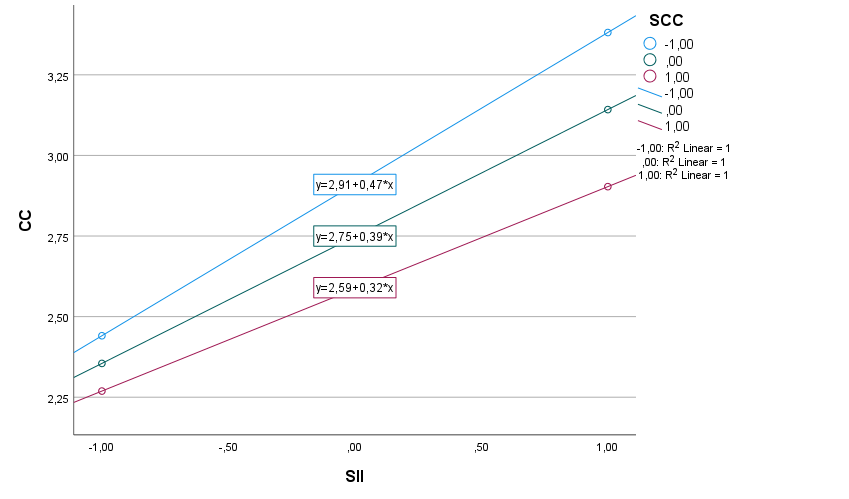
- SCC significantly moderated the SII–CC relationship: interaction B = -.0766, SE = .0230, t = -3.33, p = .0009; the model explained R² = .4164, or 41.6% of variance in CC. H4 was accepted.
- Conditional effects of SII on CC were strongest at low SCC (B = .4703, p = .0000), significant at average SCC (B = .3937, p = .0000), and weaker but still significant at high SCC (B = .3171, p = .0000).
- Main effects showed SII positively predicted CC (B = .3937, SE = .0363, t = 10.85, p = .0000), while SCC negatively predicted CC (B = -.1624, SE = .0359, t = -4.52, p = .0000).
Methods
- Cross-sectional quantitative online survey; participants were individuals over 18 years old, recruited via convenience sampling; n = 427. The sample was predominantly young (320 aged 18–29) and relatively well-educated (39.6% bachelor’s degree).
- Measures: SII adapted from Bearden et al. (1989), 12 statements; CC adapted from Roy Chaudhuri et al. (2011), 11 statements; SCC adapted from Campbell et al. (1996), 12 items (10 reverse-coded); all 5-point Likert. A pilot study with 50 participants yielded Cronbach’s alphas of .889, .877, and .833, respectively.
- Analysis: SPSS; Pearson correlations; exploratory factor analysis for SII; Hayes Process Macro Model 1 for moderation; conditional effects at -1 SD, mean, and +1 SD of SCC. Harman’s single-factor test accounted for 31.566% of variance, below the 50% threshold.
Limitations
- Stated: convenience sampling limits generalizability of findings; cross-sectional design restricts causal interpretations; future qualitative, experimental, and cross-cultural studies are recommended.
- Evident: the sample is predominantly young and relatively well-educated, which may limit broader population inference.
- Evident: data came from self-report surveys, and although common method bias was assessed with Harman’s test, the design remains vulnerable to self-report and common-method concerns; the Turkish collectivist/high-power-distance context may also limit generalization to other cultural settings.
Model-written summary. Check it against the paper before relying on it.
Integrity signals
Registry
Cites
Statistics
Figures
Verification
Claims the paper makes
24 Own result · 23 Own interpretation · 19 Sources not found · 10 No full text of the sources · 8 Not checked yet · 7 Own method · 5 Supported · 1 Partly supported · 1 No basis given · accuracy not yet measured
Every source the paper cites for this claim was checked and supports it.
In the paper
“Considering that external (social) influences play a role in conspicuous consumption (Eastman & Eastman, 2015), the role of interpersonal influence in this tendency will be more evident.”
§ The Moderating Role of Self-Concept Clarity in the Relationship between Susceptibility to Interpersonal Influence and Conspicuous Consumption > 1. INTRODUCTION
What the sources say
- Supportedcites Eastman & Eastman, 2015 source
The External Antecedents section says interpersonal influences play a significant role in the external dimensions of luxury consumption and identifies conspicuous consumption as one such dimension. The Veblen Effect section describes conspicuous consumption as a public display of wealth intended to indicate status. Together, these passages support the claim that social influences play a role. (LLM, conf=0.92)
plaincorrelational- Asserted: passes — The authors put it forward as true.
- Checkable: passes — It can be checked against evidence.
- Load-bearing: passes — The paper’s conclusions depend on it.
- Based: passes — The paper gives a reason why it holds.
- Supported
The cited sources support only part of this claim — read each source’s verdict below.
In the paper
“SCC was negatively related to both SII and CC.”
- Also stated in: § 1. INTRODUCTION · hedged
“Previous research suggests that self-concept clarity is negatively related to conspicuous consumption, as it is with susceptibility to interpersonal influence (Chakraborty & Chattaraman, 2025).”
- Also stated in: § 1. INTRODUCTION · plain
“In other words, low self-concept clarity increases the tendency towards conspicuous consumption (Wang et al., 2023).”
§ The Moderating Role of Self-Concept Clarity in the Relationship between Susceptibility to Interpersonal Influence and Conspicuous Consumption > Abstract
What the sources say
- Not checked — no full text of the sourcecites Chakraborty & Chattaraman, 2025 source
- Partly supportedcites Wang et al., 2023 sourceExperimental — accuracy not yet measured
The Introduction defines self-uncertainty as doubts about one’s self-concept, and the General discussion reports that greater self-uncertainty motivated conspicuous consumption. That supports the claimed direction indirectly, but the paper does not report a measured relationship between self-concept clarity and conspicuous consumption. (LLM, conf=0.78)
plaincorrelationaln = 427- Asserted: passes — The authors put it forward as true.
- Checkable: passes — It can be checked against evidence.
- Load-bearing: passes — The paper’s conclusions depend on it.
- Based: passes — The paper gives a reason why it holds.
- Also stated in: § 1. INTRODUCTION · hedged
Every source the paper cites for this claim was checked and supports it.
In the paper
“Since external (social) influences play a role in conspicuous consumption (Eastman & Eastman, 2015), the evaluations of others are important for consumers with high susceptibility to interpersonal influence.”
§ The Moderating Role of Self-Concept Clarity in the Relationship between Susceptibility to Interpersonal Influence and Conspicuous Consumption > 2.4 Research model and hypotheses
What the sources say
- Supportedcites Eastman & Eastman, 2015 source
The citation supports the opening clause about external social influences in conspicuous consumption. In “External Antecedents,” the paper says interpersonal influences play a significant role in externally motivated status consumption and identifies conspicuous consumption as one of its external impacts. The sentence’s further point about consumers with high susceptibility to interpersonal influence is not directly attributed to this source. (LLM, conf=0.91)
plaincorrelational- Asserted: passes — The authors put it forward as true.
- Checkable: passes — It can be checked against evidence.
- Load-bearing: passes — The paper’s conclusions depend on it.
- Based: passes — The paper gives a reason why it holds.
- Supported
A result the paper reports from its own data — it cites no other source for it, so there is none to check. The quote shows it is in the paper.
In the paper
“The study revealed that SCC moderates the relationship between SII and CC.”
- Also stated in: § 4.4. Moderation test · hedged
“The results indicated that SCC moderates the relationship between SII and CC.”
- Also stated in: § 4.4. Moderation test · plain
“The interaction between SII and SCC was statistically significant, B = -.0766,SE = .0230,t = -3.33,p = .0009,asserting that SCC moderates the relationship between SII and CC.”
- Also stated in: § 5. DISCUSSION · plain
“The study revealed that self-concept clarity moderates the relationship between susceptibility to interpersonal influence and conspicuous consumption.”
§ The Moderating Role of Self-Concept Clarity in the Relationship between Susceptibility to Interpersonal Influence and Conspicuous Consumption > Abstract
plaincorrelationaln = 427- Asserted: passes — The authors put it forward as true.
- Checkable: passes — It can be checked against evidence.
- Load-bearing: passes — The paper’s conclusions depend on it.
- Based: passes — The paper gives a reason why it holds.
- Also stated in: § 4.4. Moderation test · hedged
A result the paper reports from its own data — it cites no other source for it, so there is none to check. The quote shows it is in the paper.
In the paper
“Results indicated a positive, significant, and strong relationship between SII and CC.”
§ The Moderating Role of Self-Concept Clarity in the Relationship between Susceptibility to Interpersonal Influence and Conspicuous Consumption > Abstract
boostedcorrelationaln = 427- Asserted: passes — The authors put it forward as true.
- Checkable: passes — It can be checked against evidence.
- Load-bearing: passes — The paper’s conclusions depend on it.
- Based: passes — The paper gives a reason why it holds.
A claim is checked only against the cited paper’s full text, never its abstract, and none is available for its sources.
In the paper
“SCC was negatively related to both SII and CC.”
§ The Moderating Role of Self-Concept Clarity in the Relationship between Susceptibility to Interpersonal Influence and Conspicuous Consumption > Abstract
What the sources say
plaincorrelationaln = 427- Asserted: passes — The authors put it forward as true.
- Checkable: passes — It can be checked against evidence.
- Load-bearing: passes — The paper’s conclusions depend on it.
- Based: passes — The paper gives a reason why it holds.
A result the paper reports from its own data — it cites no other source for it, so there is none to check. The quote shows it is in the paper.
In the paper
“SII had a significant main effect on CC, B = .3937,SE = .0363,t = 10.85,p = .0000,suggesting that higher SII was associated with higher CC levels.”
§ The Moderating Role of Self-Concept Clarity in the Relationship between Susceptibility to Interpersonal Influence and Conspicuous Consumption > 4.4. Moderation test
hedgedcorrelational- Asserted: passes — The authors put it forward as true.
- Checkable: passes — It can be checked against evidence.
- Load-bearing: passes — The paper’s conclusions depend on it.
- Based: passes — The paper gives a reason why it holds.
A result the paper reports from its own data — it cites no other source for it, so there is none to check. The quote shows it is in the paper.
In the paper
“At low SCC levels, the effect of SII on CC was strongest and most significant, B = .4703,SE = .0396,t = 11.86,p = .0000,CI [.3923, .5482].”
§ The Moderating Role of Self-Concept Clarity in the Relationship between Susceptibility to Interpersonal Influence and Conspicuous Consumption > 4.4. Moderation test
plaincorrelational- Asserted: passes — The authors put it forward as true.
- Checkable: passes — It can be checked against evidence.
- Load-bearing: passes — The paper’s conclusions depend on it.
- Based: passes — The paper gives a reason why it holds.
A result the paper reports from its own data — it cites no other source for it, so there is none to check. The quote shows it is in the paper.
In the paper
“On the other hand, the Bartlett Test result was found X2: 2056.008;df: 45; p: 000 (p<0.005), and this finding emphasizes that the correlations between the items are sufficiently large for EFA.”
§ The Moderating Role of Self-Concept Clarity in the Relationship between Susceptibility to Interpersonal Influence and Conspicuous Consumption > SII
plaincorrelational- Asserted: passes — The authors put it forward as true.
- Checkable: passes — It can be checked against evidence.
- Load-bearing: passes — The paper’s conclusions depend on it.
- Based: passes — The paper gives a reason why it holds.
A result the paper reports from its own data — it cites no other source for it, so there is none to check. The quote shows it is in the paper.
In the paper
“At the average SCC level, the effect was significant, B = .3937,SE = .0363,t = 10.85,p = .0000,CI [.3224, .4649].”
§ The Moderating Role of Self-Concept Clarity in the Relationship between Susceptibility to Interpersonal Influence and Conspicuous Consumption > 4.4. Moderation test
plaincorrelational- Asserted: passes — The authors put it forward as true.
- Checkable: passes — It can be checked against evidence.
- Load-bearing: passes — The paper’s conclusions depend on it.
- Based: passes — The paper gives a reason why it holds.
- Probably not a substantial claim. 48
- It may state two separate claims as one. 30
- The quote only partly states this claim. 2
Every source the paper cites for this claim was checked and supports it.
In the paper
“The extent of the potential influence depends on individuals' susceptibility to interpersonal influence (Hoffmann & Broekhuizen, 2009).”
§ The Moderating Role of Self-Concept Clarity in the Relationship between Susceptibility to Interpersonal Influence and Conspicuous Consumption > 2.1. Susceptibility to interpersonal influence (SII)
What the sources say
- Supportedcites Hoffmann & Broekhuizen, 2009 source
The Introduction states that the extent to which social information affects consumers’ decisions depends on their susceptibility to interpersonal influence. This directly supports the citing sentence, in the paper’s consumer investment context. (LLM, conf=0.93)
plaincorrelational- Asserted: passes — The authors put it forward as true.
- Checkable: passes — It can be checked against evidence.
- Load-bearing: fails — The paper’s conclusions may not depend on it.
- Based: passes — The paper gives a reason why it holds.
Probably not a substantial claim. The paper’s conclusions may not depend on it.
- Supported
Every source the paper cites for this claim was checked and supports it.
In the paper
“The realization of such influence depends on susceptibility to interpersonal influence, which explains how individuals are affected by others (Hoffmann & Broekhuizen, 2009).”
§ The Moderating Role of Self-Concept Clarity in the Relationship between Susceptibility to Interpersonal Influence and Conspicuous Consumption > 1. INTRODUCTION
What the sources say
- Supportedcites Hoffmann & Broekhuizen, 2009 source
The Introduction states that the extent to which social information affects consumers’ decisions depends on their susceptibility to interpersonal influence. The Conceptual model also describes susceptibility as a situation-specific trait that leads to behavioral outcomes. These passages support the citing sentence’s general paraphrase. (LLM, conf=0.91)
plaindirect- Asserted: passes — The authors put it forward as true.
- Checkable: passes — It can be checked against evidence.
- Load-bearing: fails — The paper’s conclusions may not depend on it.
- Based: passes — The paper gives a reason why it holds.
Probably not a substantial claim. The paper’s conclusions may not depend on it. It may state two separate claims as one.
- Supported
Every source the paper cites for this claim was checked and supports it.
In the paper
“We can infer from previous studies that self-concept clarity negatively affects conspicuous consumption (Chakraborty & Chattaraman, 2025), social comparison increases the tendency of consumers with low self-concept clarity to engage in conspicuous consumption (Zheng et al., 2018), self-uncertainty increases the tendency towards conspicuous consumption (Wang et al., 2023), and individuals with low”
§ The Moderating Role of Self-Concept Clarity in the Relationship between Susceptibility to Interpersonal Influence and Conspicuous Consumption > 2.4 Research model and hypotheses
What the sources say
- Supportedcites Wang et al., 2023 source
The General discussion reports that experiments 1–3 found moral, cognitive, and interpersonal self-uncertainty all motivated conspicuous consumption. The Experiment 2 Results also report a significantly higher conspicuous-consumption tendency in the self-uncertainty group than in controls. (LLM, conf=0.94)
hedgeddirect- Asserted: passes — The authors put it forward as true.
- Checkable: passes — It can be checked against evidence.
- Load-bearing: passes — The paper’s conclusions depend on it.
- Based: passes — The paper gives a reason why it holds.
Probably not a substantial claim.
- Supported
A result the paper reports from its own data — it cites no other source for it, so there is none to check. The quote shows it is in the paper.
In the paper
“The results indicated that the single factor accounted for 31.566% of the total variance, which is below the 50% threshold.”
§ The Moderating Role of Self-Concept Clarity in the Relationship between Susceptibility to Interpersonal Influence and Conspicuous Consumption > 3. METHODOLOGY
hedgedn = 50- Asserted: passes — The authors put it forward as true.
- Checkable: passes — It can be checked against evidence.
- Load-bearing: passes — The paper’s conclusions depend on it.
- Based: passes — The paper gives a reason why it holds.
It may state two separate claims as one.
A result the paper reports from its own data — it cites no other source for it, so there is none to check. The quote shows it is in the paper.
In the paper
“Bachelor's degree ranked first in the distribution of education with 39.6%.”
§ The Moderating Role of Self-Concept Clarity in the Relationship between Susceptibility to Interpersonal Influence and Conspicuous Consumption > 4.1. Demographics
plain- Asserted: passes — The authors put it forward as true.
- Checkable: passes — It can be checked against evidence.
- Load-bearing: fails — The paper’s conclusions may not depend on it.
- Based: passes — The paper gives a reason why it holds.
Probably not a substantial claim. The paper’s conclusions may not depend on it.
A result the paper reports from its own data — it cites no other source for it, so there is none to check. The quote shows it is in the paper.
In the paper
“However, the normative (value-expressive) dimension, which is the first sub-dimension, explains 45.633% of the variance, while the second, which is informational, explains 18.272% of the variance.”
§ The Moderating Role of Self-Concept Clarity in the Relationship between Susceptibility to Interpersonal Influence and Conspicuous Consumption > SII
plain- Asserted: passes — The authors put it forward as true.
- Checkable: passes — It can be checked against evidence.
- Load-bearing: unclear — It is unclear whether the paper’s conclusions depend on it.
- Based: passes — The paper gives a reason why it holds.
It may state two separate claims as one.
A result the paper reports from its own data — it cites no other source for it, so there is none to check. The quote shows it is in the paper.
In the paper
“Although the values of susceptibility to interpersonal influence in the sample of this study were slightly above the average, particularly the values in the informational dimension of the scale were high.”
§ The Moderating Role of Self-Concept Clarity in the Relationship between Susceptibility to Interpersonal Influence and Conspicuous Consumption > 5. DISCUSSION
plain- Asserted: passes — The authors put it forward as true.
- Checkable: passes — It can be checked against evidence.
- Load-bearing: unclear — It is unclear whether the paper’s conclusions depend on it.
- Based: passes — The paper gives a reason why it holds.
It may state two separate claims as one.
A result the paper reports from its own data — it cites no other source for it, so there is none to check. The quote shows it is in the paper.
In the paper
“The EFA results revealed that SII consists of two sub-dimensions (factors) comprising 10 itemsfoot_1 and explains 63.905% of the total variance.”
§ The Moderating Role of Self-Concept Clarity in the Relationship between Susceptibility to Interpersonal Influence and Conspicuous Consumption > SII
plain- Asserted: passes — The authors put it forward as true.
- Checkable: passes — It can be checked against evidence.
- Load-bearing: unclear — It is unclear whether the paper’s conclusions depend on it.
- Based: passes — The paper gives a reason why it holds.
It may state two separate claims as one.
A result the paper reports from its own data — it cites no other source for it, so there is none to check. The quote shows it is in the paper.
In the paper
“susceptibility to interpersonal influence (2.88, SD=.79194), conspicuous consumption (2.78, SD=.82638), self-concept clarity (3.17, SD=.69756).”
§ The Moderating Role of Self-Concept Clarity in the Relationship between Susceptibility to Interpersonal Influence and Conspicuous Consumption > 3. METHODOLOGY
plainn = 50- Asserted: passes — The authors put it forward as true.
- Checkable: passes — It can be checked against evidence.
- Load-bearing: fails — The paper’s conclusions may not depend on it.
- Based: passes — The paper gives a reason why it holds.
Probably not a substantial claim. The paper’s conclusions may not depend on it. It may state two separate claims as one.
None of the sources cited for this claim have been checked yet.
In the paper
“There was a positive, significant, and strong (r=.607)relationship between susceptibility to interpersonal influence and conspicuous consumption.”
- Also stated in: § Pearson Correlation 1 · hedged
“This indicates that higher levels of interpersonal influence are associated with stronger tendencies toward conspicuous consumption.”
- Also stated in: § 5. DISCUSSION · boosted
“The research, which revealed a positive, significant, and strong relationship between susceptibility to interpersonal influence and conspicuous consumption, is consistent with previous studies (O 'Cass & McEwen, 2004;Lertwannawit & Mandhachitara, 2012).”
§ The Moderating Role of Self-Concept Clarity in the Relationship between Susceptibility to Interpersonal Influence and Conspicuous Consumption > Pearson Correlation 1
What the sources say
- Not checked — no full text of the sourcecites O 'Cass & McEwen, 2004 source
- Not matchedcites Lertwannawit & Mandhachitara, 2012
Couldn’t be matched to a paper in Crossref, so it can’t be checked.
boostedcorrelational- Asserted: passes — The authors put it forward as true.
- Checkable: passes — It can be checked against evidence.
- Load-bearing: passes — The paper’s conclusions depend on it.
- Based: passes — The paper gives a reason why it holds.
The quote only partly states this claim.
- Also stated in: § Pearson Correlation 1 · hedged
A result the paper reports from its own data — it cites no other source for it, so there is none to check. The quote shows it is in the paper.
In the paper
“On the other hand, there was a negative, significant, and strong relationship between susceptibility to interpersonal influence and self-concept clarity (r=-.514).”
- Also stated in: § Pearson Correlation 1 · plain
“As individuals' levels of self-concept clarity decrease, their levels of susceptibility to interpersonal influence increase inversely.”
- Also stated in: § Pearson Correlation 1 · plain
“In other words, individuals with high levels of self-concept clarity have low levels of susceptibility to interpersonal influence.”
§ The Moderating Role of Self-Concept Clarity in the Relationship between Susceptibility to Interpersonal Influence and Conspicuous Consumption > Pearson Correlation 1
boostedcorrelational- Asserted: passes — The authors put it forward as true.
- Checkable: passes — It can be checked against evidence.
- Load-bearing: passes — The paper’s conclusions depend on it.
- Based: passes — The paper gives a reason why it holds.
The quote only partly states this claim.
- Also stated in: § Pearson Correlation 1 · plain
A result the paper reports from its own data — it cites no other source for it, so there is none to check. The quote shows it is in the paper.
In the paper
“susceptibility to interpersonal influence (2.88, SD=.79194), conspicuous consumption (2.78, SD=.82638), self-concept clarity (3.17, SD=.69756).”
§ The Moderating Role of Self-Concept Clarity in the Relationship between Susceptibility to Interpersonal Influence and Conspicuous Consumption > 3. METHODOLOGY
plainn = 50- Asserted: passes — The authors put it forward as true.
- Checkable: passes — It can be checked against evidence.
- Load-bearing: fails — The paper’s conclusions may not depend on it.
- Based: passes — The paper gives a reason why it holds.
Probably not a substantial claim. The paper’s conclusions may not depend on it. It may state two separate claims as one.
A result the paper reports from its own data — it cites no other source for it, so there is none to check. The quote shows it is in the paper.
In the paper
“Of the participants, 274 were female and 153 were male.”
§ The Moderating Role of Self-Concept Clarity in the Relationship between Susceptibility to Interpersonal Influence and Conspicuous Consumption > 4.1. Demographics
plain- Asserted: passes — The authors put it forward as true.
- Checkable: passes — It can be checked against evidence.
- Load-bearing: fails — The paper’s conclusions may not depend on it.
- Based: passes — The paper gives a reason why it holds.
Probably not a substantial claim. The paper’s conclusions may not depend on it.
A result the paper reports from its own data — it cites no other source for it, so there is none to check. The quote shows it is in the paper.
In the paper
“320 of the participants were between the ages of 18-29, 56 between 30-39, 40 between 40-49, and 6 between 50-59.”
§ The Moderating Role of Self-Concept Clarity in the Relationship between Susceptibility to Interpersonal Influence and Conspicuous Consumption > 4.1. Demographics
plainn = 320- Asserted: passes — The authors put it forward as true.
- Checkable: passes — It can be checked against evidence.
- Load-bearing: fails — The paper’s conclusions may not depend on it.
- Based: passes — The paper gives a reason why it holds.
Probably not a substantial claim. The paper’s conclusions may not depend on it. It may state two separate claims as one.
A result the paper reports from its own data — it cites no other source for it, so there is none to check. The quote shows it is in the paper.
In the paper
“Skewness and kurtosis values were between -1 and +1, so the data were normally distributed, and evaluated in line with parametric analyses.”
§ The Moderating Role of Self-Concept Clarity in the Relationship between Susceptibility to Interpersonal Influence and Conspicuous Consumption > 3. METHODOLOGY
plainn = 50- Asserted: passes — The authors put it forward as true.
- Checkable: passes — It can be checked against evidence.
- Load-bearing: passes — The paper’s conclusions depend on it.
- Based: passes — The paper gives a reason why it holds.
It may state two separate claims as one.
A result the paper reports from its own data — it cites no other source for it, so there is none to check. The quote shows it is in the paper.
In the paper
“The Cronbach's Alpha values of the Susceptibility to Interpersonal Influence, Conspicuous Consumption, and Self-Concept Clarity Scales were .889,.877,and .833,respectively.”
§ The Moderating Role of Self-Concept Clarity in the Relationship between Susceptibility to Interpersonal Influence and Conspicuous Consumption > 3. METHODOLOGY
plainn = 50- Asserted: passes — The authors put it forward as true.
- Checkable: passes — It can be checked against evidence.
- Load-bearing: passes — The paper’s conclusions depend on it.
- Based: passes — The paper gives a reason why it holds.
It may state two separate claims as one.
A conclusion the paper draws from its own results — it cites no other source for it, so there is none to check. The quote shows it is in the paper.
In the paper
“In this framework, conspicuous consumption can be a way of reflecting identity and status.”
§ The Moderating Role of Self-Concept Clarity in the Relationship between Susceptibility to Interpersonal Influence and Conspicuous Consumption > 2.2. Conspicuous consumption (CC)
plaincorrelational- Asserted: passes — The authors put it forward as true.
- Checkable: passes — It can be checked against evidence.
- Load-bearing: passes — The paper’s conclusions depend on it.
- Based: passes — The paper gives a reason why it holds.
Probably not a substantial claim.
A conclusion the paper draws from its own results — it cites no other source for it, so there is none to check. The quote shows it is in the paper.
In the paper
“Therefore, as the level of SII increases, the tendency to CC also increases, but SCC negatively affects this positive relationship.”
§ The Moderating Role of Self-Concept Clarity in the Relationship between Susceptibility to Interpersonal Influence and Conspicuous Consumption > Abstract
plaindirectn = 427- Asserted: passes — The authors put it forward as true.
- Checkable: passes — It can be checked against evidence.
- Load-bearing: passes — The paper’s conclusions depend on it.
- Based: passes — The paper gives a reason why it holds.
It may state two separate claims as one.
A conclusion the paper draws from its own results — it cites no other source for it, so there is none to check. The quote shows it is in the paper.
In the paper
“High involvement products both reflect status and are a means of acquiring status.”
§ The Moderating Role of Self-Concept Clarity in the Relationship between Susceptibility to Interpersonal Influence and Conspicuous Consumption > 2.2. Conspicuous consumption (CC)
plain- Asserted: passes — The authors put it forward as true.
- Checkable: passes — It can be checked against evidence.
- Load-bearing: fails — The paper’s conclusions may not depend on it.
- Based: passes — The paper gives a reason why it holds.
Probably not a substantial claim. The paper’s conclusions may not depend on it. It may state two separate claims as one.
In the paper
“Informational influence refers to requesting information or obtaining it through observation, while normative influence refers to individuals using others' norms, values, and behaviors as models (Mourali et al., 2005, 165).”
§ The Moderating Role of Self-Concept Clarity in the Relationship between Susceptibility to Interpersonal Influence and Conspicuous Consumption > 2.1. Susceptibility to interpersonal influence (SII)
What the sources say
- Not checked — no full text of the sourcecites Mourali et al., 2005 source
plain- Asserted: passes — The authors put it forward as true.
- Checkable: passes — It can be checked against evidence.
- Load-bearing: fails — The paper’s conclusions may not depend on it.
- Based: passes — The paper gives a reason why it holds.
Probably not a substantial claim. The paper’s conclusions may not depend on it. It may state two separate claims as one.
In the paper
“Witt (2010) claims that the expression of status is based on the symbolic value that some products have.”
§ The Moderating Role of Self-Concept Clarity in the Relationship between Susceptibility to Interpersonal Influence and Conspicuous Consumption > 2.2. Conspicuous consumption (CC)
What the sources say
- Not matchedcites Witt, 2010
Couldn’t be matched to a paper in Crossref, so it can’t be checked.
plaindirect- Asserted: passes — The authors put it forward as true.
- Checkable: passes — It can be checked against evidence.
- Load-bearing: fails — The paper’s conclusions may not depend on it.
- Based: passes — The paper gives a reason why it holds.
Probably not a substantial claim. The paper’s conclusions may not depend on it.
- Not matched
In the paper
“Interpersonal influence has two dimensions: informational and normative (Schroeder, 1996, 585).”
§ The Moderating Role of Self-Concept Clarity in the Relationship between Susceptibility to Interpersonal Influence and Conspicuous Consumption > 2.1. Susceptibility to interpersonal influence (SII)
What the sources say
- Not matchedcites Schroeder, 1996
Couldn’t be matched to a paper in Crossref, so it can’t be checked.
plain- Asserted: passes — The authors put it forward as true.
- Checkable: passes — It can be checked against evidence.
- Load-bearing: fails — The paper’s conclusions may not depend on it.
- Based: passes — The paper gives a reason why it holds.
Probably not a substantial claim. The paper’s conclusions may not depend on it.
- Not matched
In the paper
“Interpersonal influence is an important determinant of consumer behavior (Calder & Burnkrant, 1977).”
§ The Moderating Role of Self-Concept Clarity in the Relationship between Susceptibility to Interpersonal Influence and Conspicuous Consumption > 1. INTRODUCTION
What the sources say
- Not matchedcites Calder & Burnkrant, 1977
Couldn’t be matched to a paper in Crossref, so it can’t be checked.
plaindirect- Asserted: passes — The authors put it forward as true.
- Checkable: passes — It can be checked against evidence.
- Load-bearing: passes — The paper’s conclusions depend on it.
- Based: passes — The paper gives a reason why it holds.
Probably not a substantial claim.
- Not matched
A conclusion the paper draws from its own results — it cites no other source for it, so there is none to check. The quote shows it is in the paper.
In the paper
“Therefore, conspicuous consumption is also a form of status consumption.”
§ The Moderating Role of Self-Concept Clarity in the Relationship between Susceptibility to Interpersonal Influence and Conspicuous Consumption > 2.2. Conspicuous consumption (CC)
plain- Asserted: passes — The authors put it forward as true.
- Checkable: passes — It can be checked against evidence.
- Load-bearing: fails — The paper’s conclusions may not depend on it.
- Based: passes — The paper gives a reason why it holds.
Probably not a substantial claim. The paper’s conclusions may not depend on it.
In the paper
“Schiffman et al. (2014) argue that products that are visually striking and reflect status are more likely to be purchased based on the reactions of others.”
§ The Moderating Role of Self-Concept Clarity in the Relationship between Susceptibility to Interpersonal Influence and Conspicuous Consumption > 2.2. Conspicuous consumption (CC)
What the sources say
- Not matchedcites Schiffman et al., 2014
Couldn’t be matched to a paper in Crossref, so it can’t be checked.
hedgedcorrelational- Asserted: passes — The authors put it forward as true.
- Checkable: passes — It can be checked against evidence.
- Load-bearing: passes — The paper’s conclusions depend on it.
- Based: passes — The paper gives a reason why it holds.
Probably not a substantial claim.
- Not matched
In the paper
“Since entities play an important role in the formation and reflection of identity (Belk, 1988), individuals reflect their identities through consumption practices.”
§ The Moderating Role of Self-Concept Clarity in the Relationship between Susceptibility to Interpersonal Influence and Conspicuous Consumption > 2.2. Conspicuous consumption (CC)
What the sources say
- Not matchedcites Belk, 1988
Couldn’t be matched to a paper in Crossref, so it can’t be checked.
plaindirect- Asserted: passes — The authors put it forward as true.
- Checkable: passes — It can be checked against evidence.
- Load-bearing: passes — The paper’s conclusions depend on it.
- Based: passes — The paper gives a reason why it holds.
Probably not a substantial claim.
- Not matched
A claim is checked only against the cited paper’s full text, never its abstract, and none is available for its sources.
In the paper
“Accordingly, susceptibility to interpersonal influence is an important variable in understanding consumer behavior (Bearden et al., 1989) and refers to how individuals are influenced by others regarding their consumption decisions (Kropp et al., 2005).”
§ The Moderating Role of Self-Concept Clarity in the Relationship between Susceptibility to Interpersonal Influence and Conspicuous Consumption > 2.1. Susceptibility to interpersonal influence (SII)
What the sources say
plain- Asserted: passes — The authors put it forward as true.
- Checkable: passes — It can be checked against evidence.
- Load-bearing: fails — The paper’s conclusions may not depend on it.
- Based: passes — The paper gives a reason why it holds.
Probably not a substantial claim. The paper’s conclusions may not depend on it.
A conclusion the paper draws from its own results — it cites no other source for it, so there is none to check. The quote shows it is in the paper.
In the paper
“Accordingly, consumption objects have two roles: reflecting status and acquiring status.”
§ The Moderating Role of Self-Concept Clarity in the Relationship between Susceptibility to Interpersonal Influence and Conspicuous Consumption > 2.2. Conspicuous consumption (CC)
plain- Asserted: passes — The authors put it forward as true.
- Checkable: fails — It may be too vague to check against evidence.
- Load-bearing: fails — The paper’s conclusions may not depend on it.
- Based: passes — The paper gives a reason why it holds.
Probably not a substantial claim. It may be too vague to check against evidence. The paper’s conclusions may not depend on it. It may state two separate claims as one.
A conclusion the paper draws from its own results — it cites no other source for it, so there is none to check. The quote shows it is in the paper.
In the paper
“These studies indicate that conspicuous consumption is inherently social and evaluative, making it strongly dependent on interpersonal influence and external validation.”
§ The Moderating Role of Self-Concept Clarity in the Relationship between Susceptibility to Interpersonal Influence and Conspicuous Consumption > 2.2. Conspicuous consumption (CC)
hedgeddirect- Asserted: passes — The authors put it forward as true.
- Checkable: passes — It can be checked against evidence.
- Load-bearing: passes — The paper’s conclusions depend on it.
- Based: passes — The paper gives a reason why it holds.
It may state two separate claims as one.
None of the sources cited for this claim have been checked yet.
In the paper
“individuals with low self-concept clarity are open to interpersonal influence (Isaksen & Roper, 2008).”
§ The Moderating Role of Self-Concept Clarity in the Relationship between Susceptibility to Interpersonal Influence and Conspicuous Consumption > 2.4 Research model and hypotheses
What the sources say
- Not matchedcites Servidio et al., 2021
Couldn’t be matched to a paper in Crossref, so it can’t be checked.
- Not matchedcites Wang & Yu, 2023
Couldn’t be matched to a paper in Crossref, so it can’t be checked.
- Not checked — no full text of the sourcecites Isaksen & Roper, 2008 source
plaincorrelational- Asserted: passes — The authors put it forward as true.
- Checkable: passes — It can be checked against evidence.
- Load-bearing: passes — The paper’s conclusions depend on it.
- Based: passes — The paper gives a reason why it holds.
It may state two separate claims as one.
- Not matched
None of the sources cited for this claim have been checked yet.
In the paper
“Interpersonal influence, an important determinant of consumer behavior (Calder & Burnkrant, 1977), involves persuading and influencing others (Cheah & Phau, 2011) and plays a role in consumer decision-making processes through reference groups (Rosen & Olshavsky, 1987).”
§ The Moderating Role of Self-Concept Clarity in the Relationship between Susceptibility to Interpersonal Influence and Conspicuous Consumption > 2.1. Susceptibility to interpersonal influence (SII)
What the sources say
- Not checked — no full text of the sourcecites Cheah & Phau, 2011 source
- Not matchedcites Rosen & Olshavsky, 1987
Couldn’t be matched to a paper in Crossref, so it can’t be checked.
plaincorrelational- Asserted: passes — The authors put it forward as true.
- Checkable: passes — It can be checked against evidence.
- Load-bearing: fails — The paper’s conclusions may not depend on it.
- Based: passes — The paper gives a reason why it holds.
Probably not a substantial claim. The paper’s conclusions may not depend on it. It may state two separate claims as one.
A conclusion the paper draws from its own results — it cites no other source for it, so there is none to check. The quote shows it is in the paper.
In the paper
“This distinction suggests that interpersonal influence operates both as a source of information and as a mechanism of social conformity, shaping not only what consumers know but also how they wish to be perceived.”
§ The Moderating Role of Self-Concept Clarity in the Relationship between Susceptibility to Interpersonal Influence and Conspicuous Consumption > 2.1. Susceptibility to interpersonal influence (SII)
hedgeddirect- Asserted: passes — The authors put it forward as true.
- Checkable: passes — It can be checked against evidence.
- Load-bearing: fails — The paper’s conclusions may not depend on it.
- Based: passes — The paper gives a reason why it holds.
Probably not a substantial claim. The paper’s conclusions may not depend on it. It may state two separate claims as one.
In the paper
“While normative influence involves obtaining the approval of others, informational influence involves consulting others (Bone, 1995, 216).”
§ The Moderating Role of Self-Concept Clarity in the Relationship between Susceptibility to Interpersonal Influence and Conspicuous Consumption > 2.1. Susceptibility to interpersonal influence (SII)
What the sources say
- Not checked — no full text of the sourcecites Bone, 1995 source
plain- Asserted: passes — The authors put it forward as true.
- Checkable: passes — It can be checked against evidence.
- Load-bearing: fails — The paper’s conclusions may not depend on it.
- Based: passes — The paper gives a reason why it holds.
Probably not a substantial claim. The paper’s conclusions may not depend on it. It may state two separate claims as one.
In the paper
“The concept of self-concept clarity, which comes to the fore in this context, explains the status in which individuals' beliefs about their selves are internally consistent and stable (Campbell et al., 1996, 141).”
§ The Moderating Role of Self-Concept Clarity in the Relationship between Susceptibility to Interpersonal Influence and Conspicuous Consumption > 1. INTRODUCTION
What the sources say
- Not checked — no full text of the sourcecites Campbell et al., 1996 source
plain- Asserted: passes — The authors put it forward as true.
- Checkable: passes — It can be checked against evidence.
- Load-bearing: fails — The paper’s conclusions may not depend on it.
- Based: passes — The paper gives a reason why it holds.
Probably not a substantial claim. The paper’s conclusions may not depend on it.
In the paper
“Products and services can be consumed ostentatiously as an indicator of social status (Edgell, 1999).”
§ The Moderating Role of Self-Concept Clarity in the Relationship between Susceptibility to Interpersonal Influence and Conspicuous Consumption > 2.2. Conspicuous consumption (CC)
What the sources say
- Not matchedcites Edgell, 1999
Couldn’t be matched to a paper in Crossref, so it can’t be checked.
plain- Asserted: passes — The authors put it forward as true.
- Checkable: passes — It can be checked against evidence.
- Load-bearing: fails — The paper’s conclusions may not depend on it.
- Based: passes — The paper gives a reason why it holds.
Probably not a substantial claim. The paper’s conclusions may not depend on it.
- Not matched
None of the sources cited for this claim have been checked yet.
In the paper
“According to Veblen, conspicuous consumption plays a role in determining consumer behavior not only for the rich but also for all social classes (Trigg, 2001), and status concerns are at the forefront of conspicuous consumption (Chaudhuri & Majumdar, 2010).”
§ The Moderating Role of Self-Concept Clarity in the Relationship between Susceptibility to Interpersonal Influence and Conspicuous Consumption > 2.2. Conspicuous consumption (CC)
What the sources say
- Not checked — no full text of the sourcecites Trigg, 2001 source
- Not matchedcites Chaudhuri & Majumdar, 2010
Couldn’t be matched to a paper in Crossref, so it can’t be checked.
plain- Asserted: passes — The authors put it forward as true.
- Checkable: passes — It can be checked against evidence.
- Load-bearing: fails — The paper’s conclusions may not depend on it.
- Based: passes — The paper gives a reason why it holds.
Probably not a substantial claim. The paper’s conclusions may not depend on it.
A conclusion the paper draws from its own results — it cites no other source for it, so there is none to check. The quote shows it is in the paper.
In the paper
“In this framework, while consumers' online or offline search for information about a brand is related to the informational dimension of interpersonal influence, the reference to the norms of others in consumption practice is related to the normative dimension.”
§ The Moderating Role of Self-Concept Clarity in the Relationship between Susceptibility to Interpersonal Influence and Conspicuous Consumption > 2.1. Susceptibility to interpersonal influence (SII)
plaincorrelational- Asserted: passes — The authors put it forward as true.
- Checkable: passes — It can be checked against evidence.
- Load-bearing: fails — The paper’s conclusions may not depend on it.
- Based: passes — The paper gives a reason why it holds.
Probably not a substantial claim. The paper’s conclusions may not depend on it. It may state two separate claims as one.
In the paper
“Conspicuous consumption is considered to be higher in individualistic cultures, but in collectivistic cultures as well, social status plays an important role in influencing consumers' self-esteem (Souiden et al., 2011).”
§ The Moderating Role of Self-Concept Clarity in the Relationship between Susceptibility to Interpersonal Influence and Conspicuous Consumption > 5. DISCUSSION
What the sources say
- Not matchedcites Souiden et al., 2011
Couldn’t be matched to a paper in Crossref, so it can’t be checked.
plaincorrelational- Asserted: passes — The authors put it forward as true.
- Checkable: passes — It can be checked against evidence.
- Load-bearing: fails — The paper’s conclusions may not depend on it.
- Based: passes — The paper gives a reason why it holds.
Probably not a substantial claim. The paper’s conclusions may not depend on it. It may state two separate claims as one.
- Not matched
A conclusion the paper draws from its own results — it cites no other source for it, so there is none to check. The quote shows it is in the paper.
In the paper
“These studies suggest that self-concept clarity is negatively associated with both susceptibility to interpersonal influence and conspicuous consumption, as individuals with a less clear sense of self are more likely to rely on external evaluations and social comparison processes.”
§ The Moderating Role of Self-Concept Clarity in the Relationship between Susceptibility to Interpersonal Influence and Conspicuous Consumption > 2.4 Research model and hypotheses
hedgedcorrelational- Asserted: passes — The authors put it forward as true.
- Checkable: passes — It can be checked against evidence.
- Load-bearing: passes — The paper’s conclusions depend on it.
- Based: passes — The paper gives a reason why it holds.
Probably not a substantial claim. It may state two separate claims as one.
What the paper did — it cites no source for this, so there is none to check. The quote shows it is in the paper.
In the paper
“Although this method is widely used in consumer research, it may limit the generalizability of the findings beyond the sampled population.”
§ The Moderating Role of Self-Concept Clarity in the Relationship between Susceptibility to Interpersonal Influence and Conspicuous Consumption > 3. METHODOLOGY
hedgedconditional- Asserted: passes — The authors put it forward as true.
- Checkable: passes — It can be checked against evidence.
- Load-bearing: fails — The paper’s conclusions may not depend on it.
- Based: passes — The paper gives a reason why it holds.
Probably not a substantial claim. The paper’s conclusions may not depend on it.
A conclusion the paper draws from its own results — it cites no other source for it, so there is none to check. The quote shows it is in the paper.
In the paper
“The cultural context may shape not only the level of conspicuous consumption but also the mechanisms through which it occurs.”
§ The Moderating Role of Self-Concept Clarity in the Relationship between Susceptibility to Interpersonal Influence and Conspicuous Consumption > 5. DISCUSSION
hedgedconditional- Asserted: passes — The authors put it forward as true.
- Checkable: passes — It can be checked against evidence.
- Load-bearing: fails — The paper’s conclusions may not depend on it.
- Based: passes — The paper gives a reason why it holds.
Probably not a substantial claim. The paper’s conclusions may not depend on it. It may state two separate claims as one.
In the paper
“We can infer from previous studies that self-concept clarity negatively affects conspicuous consumption (Chakraborty & Chattaraman, 2025), social comparison increases the tendency of consumers with low self-concept clarity to engage in conspicuous consumption (Zheng et al., 2018), self-uncertainty increases the tendency towards conspicuous consumption (Wang et al., 2023), and individuals with low”
§ The Moderating Role of Self-Concept Clarity in the Relationship between Susceptibility to Interpersonal Influence and Conspicuous Consumption > 2.4 Research model and hypotheses
What the sources say
- Not checked — no full text of the sourcecites Zheng et al., 2018 source
plaindirect- Asserted: passes — The authors put it forward as true.
- Checkable: passes — It can be checked against evidence.
- Load-bearing: passes — The paper’s conclusions depend on it.
- Based: passes — The paper gives a reason why it holds.
Probably not a substantial claim.
In the paper
“Independent and interdependent social orientations are associated with individualism and collectivism across cultures (Kitayama & Salvador, 2024).”
§ The Moderating Role of Self-Concept Clarity in the Relationship between Susceptibility to Interpersonal Influence and Conspicuous Consumption > 2.4 Research model and hypotheses
What the sources say
- Not matchedcites Kitayama & Salvador, 2024
Couldn’t be matched to a paper in Crossref, so it can’t be checked.
plaincorrelational- Asserted: passes — The authors put it forward as true.
- Checkable: passes — It can be checked against evidence.
- Load-bearing: fails — The paper’s conclusions may not depend on it.
- Based: passes — The paper gives a reason why it holds.
Probably not a substantial claim. The paper’s conclusions may not depend on it.
- Not matched
What the paper did — it cites no source for this, so there is none to check. The quote shows it is in the paper.
In the paper
“We also applied a normality test to examine the compliance of the research data with the normality assumption.”
§ The Moderating Role of Self-Concept Clarity in the Relationship between Susceptibility to Interpersonal Influence and Conspicuous Consumption > 3. METHODOLOGY
plain- Asserted: passes — The authors put it forward as true.
- Checkable: passes — It can be checked against evidence.
- Load-bearing: passes — The paper’s conclusions depend on it.
- Based: passes — The paper gives a reason why it holds.
Probably not a substantial claim.
A conclusion the paper draws from its own results — it cites no other source for it, so there is none to check. The quote shows it is in the paper.
In the paper
“Susceptibility to interpersonal influence emphasizes the role of others in consumer decisions.”
§ The Moderating Role of Self-Concept Clarity in the Relationship between Susceptibility to Interpersonal Influence and Conspicuous Consumption > 2.4 Research model and hypotheses
plain- Asserted: passes — The authors put it forward as true.
- Checkable: fails — It may be too vague to check against evidence.
- Load-bearing: passes — The paper’s conclusions depend on it.
- Based: passes — The paper gives a reason why it holds.
Probably not a substantial claim. It may be too vague to check against evidence.
A conclusion the paper draws from its own results — it cites no other source for it, so there is none to check. The quote shows it is in the paper.
In the paper
“In this regard, the findings also highlight the relevance of cultural context, as collectivist orientations may further strengthen susceptibility to interpersonal influence and its impact on consumption behavior.”
§ The Moderating Role of Self-Concept Clarity in the Relationship between Susceptibility to Interpersonal Influence and Conspicuous Consumption > 5. DISCUSSION
hedgedconditional- Asserted: passes — The authors put it forward as true.
- Checkable: passes — It can be checked against evidence.
- Load-bearing: unclear — It is unclear whether the paper’s conclusions depend on it.
- Based: passes — The paper gives a reason why it holds.
It may state two separate claims as one.
In the paper
“Accordingly, 0.01-0.20 emphasizes a weak relationship, 0.21-0.50 a moderate relationship, 0.51-0.70 a strong relationship, and 0.71-1.00 a very strong relationship (Urdan, 2017, 166).”
§ The Moderating Role of Self-Concept Clarity in the Relationship between Susceptibility to Interpersonal Influence and Conspicuous Consumption > 4.3. Correlation analyses
What the sources say
- Not matchedcites Urdan, 2017
Couldn’t be matched to a paper in Crossref, so it can’t be checked.
plaincorrelational- Asserted: passes — The authors put it forward as true.
- Checkable: passes — It can be checked against evidence.
- Load-bearing: fails — The paper’s conclusions may not depend on it.
- Based: passes — The paper gives a reason why it holds.
Probably not a substantial claim. The paper’s conclusions may not depend on it. It may state two separate claims as one.
- Not matched
What the paper did — it cites no source for this, so there is none to check. The quote shows it is in the paper.
In the paper
“Given that the data were collected using a self-report survey, common method bias was assessed.”
§ The Moderating Role of Self-Concept Clarity in the Relationship between Susceptibility to Interpersonal Influence and Conspicuous Consumption > 3. METHODOLOGY
plain- Asserted: passes — The authors put it forward as true.
- Checkable: passes — It can be checked against evidence.
- Load-bearing: passes — The paper’s conclusions depend on it.
- Based: passes — The paper gives a reason why it holds.
Probably not a substantial claim.
In the paper
“The conspicuous consumption tendencies of consumers with high power distance are mediated by status needs (Park et al., 2023).”
§ The Moderating Role of Self-Concept Clarity in the Relationship between Susceptibility to Interpersonal Influence and Conspicuous Consumption > 5. DISCUSSION
What the sources say
- Not matchedcites Park et al., 2023
Couldn’t be matched to a paper in Crossref, so it can’t be checked.
plaindirect- Asserted: passes — The authors put it forward as true.
- Checkable: passes — It can be checked against evidence.
- Load-bearing: fails — The paper’s conclusions may not depend on it.
- Based: passes — The paper gives a reason why it holds.
Probably not a substantial claim. The paper’s conclusions may not depend on it.
- Not matched
A conclusion the paper draws from its own results — it cites no other source for it, so there is none to check. The quote shows it is in the paper.
In the paper
“In this context, susceptibility to interpersonal influence reflects the extent to which individuals rely on external inputs, whereas self-concept clarity may determine how strongly these inputs are internalized.”
§ The Moderating Role of Self-Concept Clarity in the Relationship between Susceptibility to Interpersonal Influence and Conspicuous Consumption > 2.4 Research model and hypotheses
hedgedconditional- Asserted: passes — The authors put it forward as true.
- Checkable: fails — It may be too vague to check against evidence.
- Load-bearing: passes — The paper’s conclusions depend on it.
- Based: fails — The paper may give no reason why it holds.
Probably not a substantial claim. It may be too vague to check against evidence. The paper may give no reason why it holds. It may state two separate claims as one.
What the paper did — it cites no source for this, so there is none to check. The quote shows it is in the paper.
In the paper
“We conducted a pilot study with 50 participants to test the statements in the scales and to conduct reliability analyses.”
§ The Moderating Role of Self-Concept Clarity in the Relationship between Susceptibility to Interpersonal Influence and Conspicuous Consumption > 3. METHODOLOGY
plainn = 50- Asserted: passes — The authors put it forward as true.
- Checkable: passes — It can be checked against evidence.
- Load-bearing: fails — The paper’s conclusions may not depend on it.
- Based: passes — The paper gives a reason why it holds.
Probably not a substantial claim. The paper’s conclusions may not depend on it.
What the paper did — it cites no source for this, so there is none to check. The quote shows it is in the paper.
In the paper
“The scales were first translated into Turkish by three researchers and then back-translated into English to check the meaning, for creating the final Turkish equivalents of the scales.”
§ The Moderating Role of Self-Concept Clarity in the Relationship between Susceptibility to Interpersonal Influence and Conspicuous Consumption > 3. METHODOLOGY
plain- Asserted: passes — The authors put it forward as true.
- Checkable: passes — It can be checked against evidence.
- Load-bearing: fails — The paper’s conclusions may not depend on it.
- Based: passes — The paper gives a reason why it holds.
Probably not a substantial claim. The paper’s conclusions may not depend on it.
In the paper
“Duan et al. (2021) state that individuals who do not have a clear sense of self feel unconfident in their judgments and, as a result, they engage in more advice-seeking and receiving behaviors.”
§ The Moderating Role of Self-Concept Clarity in the Relationship between Susceptibility to Interpersonal Influence and Conspicuous Consumption > 2.4 Research model and hypotheses
What the sources say
- Not matchedcites Duan et al., 2021
Couldn’t be matched to a paper in Crossref, so it can’t be checked.
plaindirect- Asserted: passes — The authors put it forward as true.
- Checkable: passes — It can be checked against evidence.
- Load-bearing: passes — The paper’s conclusions depend on it.
- Based: passes — The paper gives a reason why it holds.
Probably not a substantial claim. It may state two separate claims as one.
- Not matched
A conclusion the paper draws from its own results — it cites no other source for it, so there is none to check. The quote shows it is in the paper.
In the paper
“This suggests that individuals with lower SCC are more susceptible to interpersonal influence and, consequently, more likely to engage in CC.”
- Also stated in: § 4.4. Moderation test · plain
“In other words, when SCC is low, SII has a stronger effect on conspicuous consumption.”
§ The Moderating Role of Self-Concept Clarity in the Relationship between Susceptibility to Interpersonal Influence and Conspicuous Consumption > 4.4. Moderation test
plaindirect- Asserted: passes — The authors put it forward as true.
- Checkable: passes — It can be checked against evidence.
- Load-bearing: passes — The paper’s conclusions depend on it.
- Based: passes — The paper gives a reason why it holds.
It may state two separate claims as one.
- Also stated in: § 4.4. Moderation test · plain
What the paper did — it cites no source for this, so there is none to check. The quote shows it is in the paper.
In the paper
“Second, the cross-sectional design restricts causal interpretations.”
§ The Moderating Role of Self-Concept Clarity in the Relationship between Susceptibility to Interpersonal Influence and Conspicuous Consumption > 6. CONCLUSION
plain- Asserted: passes — The authors put it forward as true.
- Checkable: passes — It can be checked against evidence.
- Load-bearing: fails — The paper’s conclusions may not depend on it.
- Based: passes — The paper gives a reason why it holds.
Probably not a substantial claim. The paper’s conclusions may not depend on it.
What the paper did — it cites no source for this, so there is none to check. The quote shows it is in the paper.
In the paper
“First, the use of convenience sampling limits the generalizability of the findings.”
§ The Moderating Role of Self-Concept Clarity in the Relationship between Susceptibility to Interpersonal Influence and Conspicuous Consumption > 6. CONCLUSION
plain- Asserted: passes — The authors put it forward as true.
- Checkable: passes — It can be checked against evidence.
- Load-bearing: fails — The paper’s conclusions may not depend on it.
- Based: passes — The paper gives a reason why it holds.
Probably not a substantial claim. The paper’s conclusions may not depend on it.
In the paper
“Previous literature suggests that consumers who are open to interpersonal influence are more likely to purchase products that they think will lead others to make positive evaluations about them (Netemeyer et al., 1992), are attentive to the opinions of others (Cheng et al., 2013), and interpersonal influence is an antecedent of status consumption (Lertwannawit & Mandhachitara, 2012).”
§ The Moderating Role of Self-Concept Clarity in the Relationship between Susceptibility to Interpersonal Influence and Conspicuous Consumption > 2.4 Research model and hypotheses
What the sources say
- Not matchedcites Lertwannawit & Mandhachitara, 2012
Couldn’t be matched to a paper in Crossref, so it can’t be checked.
hedgeddirect- Asserted: passes — The authors put it forward as true.
- Checkable: passes — It can be checked against evidence.
- Load-bearing: passes — The paper’s conclusions depend on it.
- Based: passes — The paper gives a reason why it holds.
Probably not a substantial claim.
- Not matched
In the paper
“Turkish society is generally collectivist and has a high power distance (Hofstede, 2025).”
§ The Moderating Role of Self-Concept Clarity in the Relationship between Susceptibility to Interpersonal Influence and Conspicuous Consumption > 5. DISCUSSION
What the sources say
- Not matchedcites Hofstede, 2025
Couldn’t be matched to a paper in Crossref, so it can’t be checked.
plain- Asserted: passes — The authors put it forward as true.
- Checkable: passes — It can be checked against evidence.
- Load-bearing: passes — The paper’s conclusions depend on it.
- Based: passes — The paper gives a reason why it holds.
It may state two separate claims as one.
- Not matched
In the paper
“If the KMO value is .60 or above, the sample size is considered sufficient (Dimitrov, 2012).”
§ The Moderating Role of Self-Concept Clarity in the Relationship between Susceptibility to Interpersonal Influence and Conspicuous Consumption > SII
What the sources say
- Not matchedcites Dimitrov, 2012
Couldn’t be matched to a paper in Crossref, so it can’t be checked.
plain- Asserted: passes — The authors put it forward as true.
- Checkable: passes — It can be checked against evidence.
- Load-bearing: passes — The paper’s conclusions depend on it.
- Based: passes — The paper gives a reason why it holds.
Probably not a substantial claim.
- Not matched
In the paper
“Previous literature suggests that consumers who are open to interpersonal influence are more likely to purchase products that they think will lead others to make positive evaluations about them (Netemeyer et al., 1992), are attentive to the opinions of others (Cheng et al., 2013), and interpersonal influence is an antecedent of status consumption (Lertwannawit & Mandhachitara, 2012).”
§ The Moderating Role of Self-Concept Clarity in the Relationship between Susceptibility to Interpersonal Influence and Conspicuous Consumption > 2.4 Research model and hypotheses
What the sources say
- Not matchedcites Netemeyer et al., 1992
Couldn’t be matched to a paper in Crossref, so it can’t be checked.
hedgedcorrelational- Asserted: passes — The authors put it forward as true.
- Checkable: passes — It can be checked against evidence.
- Load-bearing: passes — The paper’s conclusions depend on it.
- Based: passes — The paper gives a reason why it holds.
Probably not a substantial claim.
- Not matched
A conclusion the paper draws from its own results — it cites no other source for it, so there is none to check. The quote shows it is in the paper.
In the paper
“Overall, the sample is predominantly composed of young and relatively well-educated individuals.”
§ The Moderating Role of Self-Concept Clarity in the Relationship between Susceptibility to Interpersonal Influence and Conspicuous Consumption > 4.1. Demographics
plain- Asserted: passes — The authors put it forward as true.
- Checkable: passes — It can be checked against evidence.
- Load-bearing: fails — The paper’s conclusions may not depend on it.
- Based: passes — The paper gives a reason why it holds.
Probably not a substantial claim. The paper’s conclusions may not depend on it.
The paper relies on this without support.
Türkiye is a non-Western, collectivist cultural context.
“and providing empirical evidence from a non-Western, collectivist cultural context.”
The paper relies on this without support.
The relationships observed between susceptibility to interpersonal influence, conspicuous consumption, and self-concept clarity are causal.
“Therefore, as the level of SII increases, the tendency to CC also increases, but SCC negatively affects this positive relationship.”
Citations
Cites
Possessions and the Extended Self
Belk, R. W. (1988) · Journal of Consumer Research · doi:10.1086/209154 · Cited by 9,064
Measurement of Consumer Susceptibility to Interpersonal Influence
Bearden, W. O., Netemeyer, R. G., & Teel, J. E. (1989) · Journal of Consumer Research · doi:10.1086/209186 · Cited by 2,320
Status Consumption in Consumer Behavior: Scale Development and Validation
Eastman, J. K., Goldsmith, R. E., & Flynn, L. R. (1999) · The Journal of Marketing Theory and Practice · doi:10.1080/10696679.1999.11501839 · Cited by 958
Consumer Self-Concept, Symbolism and Market Behavior: A Theoretical Approach
Grubb, E. L., & Grathwohl, H. L. (1967) · Journal of Marketing · doi:10.1177/002224296703100405 · Cited by 947
Exploring consumer status and conspicuous consumption
O'Cass, A., & McEwen, H. (2004) · Journal of Consumer Behaviour · doi:10.1002/cb.155 · Cited by 936
Word-of-mouth effects on short-term and long-term product judgments
Bone, P. F. (1995) · Journal of Business Research · doi:10.1016/0148-2963(94)00047-i · Cited by 716
Subtle Signals of Inconspicuous Consumption
Berger, J., & Ward, M. (2010) · Journal of Consumer Research · doi:10.1086/655445 · Cited by 652
Veblen, Bourdieu, and Conspicuous Consumption
Trigg, A. B. (2001) · Journal of Economic Issues · doi:10.1080/00213624.2001.11506342 · Cited by 584
Peacocks, Porsches, and Thorstein Veblen: Conspicuous consumption as a sexual signaling system.
Sundie, J. M., Kenrick, D. T., Griskevicius, V., Tybur, J. M., Vohs, K. D., & Beal, D. J. (2010) · Journal of Personality and Social Psychology · doi:10.1037/a0021669 · Cited by 540
Fundamental motives: How evolutionary needs influence consumer behavior
Griskevicius, V., & Kenrick, D. T. (2013) · Journal of Consumer Psychology · doi:10.1016/j.jcps.2013.03.003 · Cited by 479
Research works printed but not linked: 11
- Coopersmith, S., & Feldman, R. (1974). Fostering a positive self-concept and high self-esteem in the classroom. In R. H. Coop and K. White (Eds.), Psychological concepts in the classroom (pp. 192-225). New York: Harper & Row.
- Dumont, K. (2008). Research methods and statistics. In L. Nicholas (Ed.), Introduction to psychology (pp. 9-48). Cape Town: UCT Press.
- Hayes, A. F. (2018). Introduction to mediation, moderation, and conditional process analysis: A Regression-Based Approach. New York: The Guilford Press.
- Kabir, T., & Sarker, B. C. (2015). Effect of cultural dimensions on customers' susceptibility to interpersonal influence in the context of Bangladesh. Prime University Journal, 9(1), 77-108.
- Kirmani, A., & Ferraro, R. (2017). Social influence in marketing: How other people influence consumer information processing and decision making. In S. G. Harkins, K. D. Williams and J. M. Burger (Eds.), The Oxford handbook of social influence (415-430). New York: Oxford University Press.
- Sarstedt, M. & Mooi, E. (2014). A concise guide to market research: The process, data, and methods using IBM SPSS statistics. Heidelberg: Springer.
- Schiffman, L., O'Cass, A., Paladino, A., & Carlson, J. (2014). Consumer behaviour. Australia: Pearson.
- Schroeder, J. E. (1996). An analysis of the consumer susceptibility to interpersonal influence scale. Journal of Social Behavior and Personality, 11(3), 585-599.
- Stebbins, R. A. (2009). Conspicuous consumption: Common ground / separate worlds. London: Palgrave Macmillan.
- Urdan, T. C. (2017). Statistics in plain English. New York: Routledge.
- Vigneron, F., & Johnson, L. W. (1999). A review and a conceptual framework of prestige-seeking consumer behavior. Academy of Marketing Science Review, 1(1), 1-15.
Cited by
Still being checked.
Metadata
- Authors
- KILINÇ, Ö., Yıldızb, S., & ARICI, A.
- Affiliations
- Inonu University (TR)
- Venue
- International Journal of Marketing, Communication and New Media
- Published
- 2026-06-30
- Volume
- 14
- Issue
- 26
- ISSN
- 2182-9306 (ISSN-L)
- OpenAlex
- W7202134083
- Semantic Scholar
- 75de724677cc122576af516c349fcfbbb70a7314
- Cited by
- 0
- References
- 49
- FWCI
- 0.00
- Type
- journal article
- Language
- en
- Open access
- hybrid
- doi.org
- Licence
- cc-by-nc
- Locations
- International Journal of Marketing Communication and New Media (publishedVersion, cc-by-nc)
- Portuguese National Funding Agency for Science, Research and Technology (RCAAP Project by FCT) (submittedVersion, cc-by-nc)
- Topics
- Social Sciences › Business, Management and Accounting › Marketing › Consumer Behavior in Brand Consumption and Identification
- Social Sciences › Business, Management and Accounting › Marketing › Consumer Perception and Purchasing Behavior
- Social Sciences › Business, Management and Accounting › Marketing › Consumer Retail Behavior Studies
- Keywords
- conspicuous consumption, self-concept clarity, moderating effect, consumer behavior, social influence
About these checks
Registry, retraction, Cites and statistics results are computed, not judged, with one exception: a printed reference that no index lists is read once by a model before it counts as a citation error. Claims are extracted by a model and kept only when their quote appears verbatim in the text; each cited source is then checked, with a model’s help, for whether it says what the claim relies on. Those verdicts can be wrong — read the claim’s quote and the cited source before relying on one.
A language model drew the claims from the paper on 2026-11-07, under version 3 of the claim definition (model deepseek-v4.1-flash, prompt extract-v3).
A second model labelled each claim on 2026-11-07 (model jev-1.13-20260917, definition revision gold-guideline-v0.2).
Cited sources are checked with a language model’s help (gpt-6-sol).
Statistics and arithmetic are recomputed, not judged.
Confidence bands are shown only for fields calibrated on our annotated test set. None is calibrated yet, so no band is shown.
What counts as a claim ›How we measure confidence ›How we check this ›
Are you an author, or do you see a problem with this page? Request a review
