

Ecosystem services, social interdependencies, and collective action: a conceptual framework
Open accessThe DOI matches its Crossref record; 108 of the 108 references it cites were found in a registry or an index.
Abstract
Barnaud, C., E. Corbera, R. Muradian, N. Salliou, C. Sirami, A. Vialatte, J.-P. Choisis, N. Dendoncker, R. Mathevet, C. Moreau, V. Reyes-García, M. Boada, M. Deconchat, C. Cibien, S. Garnier, R. Maneja, and M. Antona. 2018. Ecosystem services, social interdependencies, and collective action: a conceptual framework. Ecology and Society 23(1):15. https://doi.org/10.5751/ES-09848-230115
Overview
The claims and statistics of this paper haven’t been checked yet.
Free: it reads the open-access text and checks the first 5 claims that cite a source we can check. Create a free account to check every claim.
Integrity signals
Registry
Cites
Statistics
Figures
Verification
Claims the paper makes
The claims and statistics of this paper haven’t been checked yet.
Free: it reads the open-access text and checks the first 5 claims that cite a source we can check. Create a free account to check every claim.
Claims other papers make about this one
Each is checked against this paper’s own text: does it say what the citing paper says it does?
The source backs part of the claim, not all of it — or backs it for a different population, condition or comparison.
In the citing paper
“As shown in Barnaud et al. (2018), methods like the one we presented not only create awareness of mutual interdependencies between people and the ecological processes that shape their activities, but are also key for researchers' reflexivity on their role in the action arena.”
From Scenarios for an agroecological transition of smallholder family farmers: a case study in Guadeloupe (2022) · cites this paper as Barnaud et al. (2018)
Experimental — accuracy not yet measuredThe cited source says what the claim attributes to it.
In the citing paper
“We followed the operational proposition developed by Barnaud et al. (2018).It allows one to highlight existing interdependencies between actors involved in the provision and use of ecosystem services and disservices in order to guide collective decision-making.”
From Scenarios for an agroecological transition of smallholder family farmers: a case study in Guadeloupe (2022) · cites this paper as Barnaud et al. 2018
Self-check
Percentages, sums and reported differences re-computed from the paper’s own numbers.
The self-check needs the paper’s full text.
Citations
Cites
Yaşlı Kadınlarda Üreme Sağlığı
Kokanalı, D., & Engin Üstün, Y. (n.d.) · DergiPark (Istanbul University) · Cited by 170,090
Yaşlı Kadınlarda Üreme Sağlığı
Kokanalı, D., & Üstün, Y. E. (2019) · Jinekoloji-Obstetrik ve Neonatoloji Tıp Dergisi · Cited by 169,629
Two new Later Stone Age sites from the Final Pleistocene in the Falémé Valley, eastern Senegal
Ndiaye, M., Lespez, L., Tribolo, C., Rassé, M., Hadjas, I., Davidoux, S., Huysecom, É., & Douze, K. (2024) · Monash University Research Portal (Monash University) · doi:10.3929/ethz-b-000667478 · Cited by 23,868
Governing the Commons: The Evolution of Institutions for Collective Action
Ostrom, E. (1990) · doi:10.1017/cbo9780511807763 · Cited by 20,653
The Logic of Collective Action: Public Goods and the Theory of Groups.
Sufrin, S. C., & Olson, M. (1966) · Industrial and Labor Relations Review · doi:10.2307/2521228 · Cited by 11,518
A General Framework for Analyzing Sustainability of Social-Ecological Systems
Ostrom, E. (2009) · Science · doi:10.1126/science.1172133 · Cited by 8,656 · cited 1×
“This implies understanding the existing formal and informal rules governing social interdependencies and regulating the provisioning and sharing of ES, i.e., market mechanisms (e.g., supply chains), state-based instruments (e.g., subsidies), and/or local collective actions (Ostrom 2009).”
BackgroundUnderstanding Institutional Diversity
Ostrom, E. (2006) · Princeton University Press eBooks · doi:10.1515/9781400831739 · Cited by 5,140
Beyond Markets and States: Polycentric Governance of Complex Economic Systems
Ostrom, E. (2010) · American Economic Review · doi:10.1257/aer.100.3.641 · Cited by 4,529
Science for the post-normal age
Funtowicz, S. O., & Ravetz, J. R. (1993) · Futures · doi:10.1016/0016-3287(93)90022-l · Cited by 4,255 · cited 1×
“Although such expert approaches are effective in many situations, Funtowicz and Ravetz (1993) have suggested that, when scientific uncertainties or social stakes are high, scientists should rather engage in dialogue with decision makers and stakeholders.”
BackgroundRules, Games, and Common-Pool Resources
Ostrom, E., Gardner, R., & Walker, J. (1994) · University of Michigan Press eBooks · doi:10.3998/mpub.9739 · Cited by 3,732
de Groot, R. S., Alkemade, R., Braat, L., Hein, L., & Willemen, L. (2010) · Ecological Complexity · doi:10.1016/j.ecocom.2009.10.006 · Cited by 3,464 · cited 1×
“On the operational side, numerous frameworks have been developed to incorporate the ES concept into management and decision-making spheres (Cowling et al. 2008, Daily et al. 2009, de Groot et al. 2010).”
MethodResilience and Sustainable Development: Building Adaptive Capacity in a World of Transformations
Folke, C., Carpenter, S., Elmqvist, T., Gunderson, L., Holling, C. S., & Walker, B. (2002) · AMBIO: A Journal of the Human Environment · doi:10.1579/0044-7447-31.5.437 · Cited by 3,136 · cited 1×
“…is needed, combining a diversity of coordination mechanisms, relying not only on market and statebased mechanisms, but also on collective action mechanisms involving local stakeholders (Ostrom et al. 1994, Agrawal and Ostrom 2001, Folke et al. 2002, Meinzen-Dick et al. 2004, Ostrom 2010).”
BackgroundWho's in and why? A typology of stakeholder analysis methods for natural resource management
Reed, M. S., Graves, A., Dandy, N., Posthumus, H., Hubacek, K., Morris, J., Prell, C., Quinn, C. H., & Stringer, L. C. (2009) · Journal of Environmental Management · doi:10.1016/j.jenvman.2009.01.001 · Cited by 2,659
The IPBES Conceptual Framework — connecting nature and people
Díaz, S., Demissew, S., Carabias, J., Joly, C., Lonsdale, M., Ash, N., Larigauderie, A., Adhikari, J. R., Arico, S., Báldi, A., et al. (2015) · Current Opinion in Environmental Sustainability · doi:10.1016/j.cosust.2014.11.002 · Cited by 2,617
Latour, B. (2004) · Harvard University Press eBooks · doi:10.4159/9780674039964 · Cited by 2,465
Ecosystem services in decision making: time to deliver
Daily, G. C., Polasky, S., Goldstein, J., Kareiva, P., Mooney, H. A., Pejchar, L., Ricketts, T. H., Salzman, J., & Shallenberger, R. J. (2009) · Frontiers in Ecology and the Environment · doi:10.1890/080025 · Cited by 2,351 · cited 2×
“• Evaluating the effects of a participatory process is challenging because these effects can range from learning to decision making and action, individually and collectively (Daré et al. 2014).”
BackgroundPolitical ecology: a critical introduction
(2005) · Choice Reviews Online · doi:10.5860/choice.42-5341 · Cited by 2,246
Bianchi, F. J. J. A., Booij, C. J. H., & Tscharntke, T. (2006) · Proceedings of the Royal Society B: Biological Sciences · doi:10.1098/rspb.2006.3530 · Cited by 2,022
Ecosystem Services in Decision Making: Time to Deliver
Salzman, J., Daily, G. C., Polasky, S., Goldstein, J., Kareiva, P., Mooney, H. A., Pejchar, L., Ricketts, T. H., & Shallenberger, R. J. (2009) · Duke Law Scholarship Repository (Duke University) · Cited by 1,990
Ecosystem services and dis-services to agriculture
Zhang, W., Ricketts, T. H., Kremen, C., Carney, K., & Swinton, S. M. (2007) · Ecological Economics · doi:10.1016/j.ecolecon.2007.02.024 · Cited by 1,590
Rethinking ecosystem services to better address and navigate cultural values
Chan, K. M. A., Satterfield, T., & Goldstein, J. (2012) · Ecological Economics · doi:10.1016/j.ecolecon.2011.11.011 · Cited by 1,563
Trade-offs across Space, Time, and Ecosystem Services
Rodríguez, J. P., Beard, Jr., Bennett, E. M., Cumming, G. S., Cork, S. J., Agard, J., Dobson, A. P., & Peterson, G. D. (2006) · Ecology and Society · doi:10.5751/es-01667-110128 · Cited by 1,430
Social Learning and Water Resources Management
Pahl-Wostl, C., Craps, M., Dewulf, A., Mostert, E., Tabara, D., & Taillieu, T. (2007) · Ecology and Society · doi:10.5751/es-02037-120205 · Cited by 1,314
Spatial scales, stakeholders and the valuation of ecosystem services
Hein, L., van Koppen, K., de Groot, R. S., & van Ierland, E. C. (2006) · Ecological Economics · doi:10.1016/j.ecolecon.2005.04.005 · Cited by 1,291 · cited 1×
“…at micro-habitat level to climate regulation at global level, and their beneficiaries are located at diverse levels of organization, from individual farmers benefiting from pollination to global society benefiting from biodiversity conservation (Hein et al. 2006, Gómez-Baggethun et al. 2013).”
BackgroundMuradian, R., Corbera, E., Pascual, U., Kosoy, N., & May, P. H. (2010) · Ecological Economics · doi:10.1016/j.ecolecon.2009.11.006 · Cited by 1,174
Self-citationCollective Action, Property Rights, and Decentralization in Resource Use in India and Nepal
AGRAWAL, A., & OSTROM, E. (2001) · Politics & Society · doi:10.1177/0032329201029004002 · Cited by 943
The logic of collective action public goods and the theory of groups
Olson, M. 1.-1. (1971) · Cited by 925
Politics of Nature: How to Bring the Sciences into Democracy
Moore, K. (2005) · Contemporary Sociology: A Journal of Reviews · doi:10.1177/009430610503400236 · Cited by 919
Grimble, R., & Wellard, K. (1997) · Agricultural Systems · doi:10.1016/s0308-521x(97)00006-1 · Cited by 915 · cited 1×
“…analysis, and in particular stakeholder analysis, is an important preliminary step to design and conduct a participatory process, e.g., to select the participants, or to choose the appropriate methodologies (Grimble and Wellard 1997, Barnaud et al. 2008, Reed et al. 2009b, Mathevet et al. 2014).”
BackgroundPayments for ecosystem services as commodity fetishism
Kosoy, N., & Corbera, E. (2010) · Ecological Economics · doi:10.1016/j.ecolecon.2009.11.002 · Cited by 840 · cited 1×
“We acknowledge that the concept should not be taken for granted and that the abovementioned fears and critiques should be taken seriously (Kosoy and Corbera 2010, Barnaud and Antona 2014).”
BackgroundSelf-citationCommon property resources: ecology and community-based sustainable development
(1990) · Trends in Ecology & Evolution · doi:10.1016/0169-5347(90)90075-o · Cited by 838
Bennett, E. M., Cramer, W., Begossi, A., Cundill, G., Díaz, S., Egoh, B. N., Geijzendorffer, I. R., Krug, C. B., Lavorel, S., Lazos, E., et al. (2015) · Current Opinion in Environmental Sustainability · doi:10.1016/j.cosust.2015.03.007 · Cited by 820
Scott, J., & Marshall, G. (2009) · Oxford University Press eBooks · doi:10.1093/acref/9780199533008.001.0001 · Cited by 784
Multi-agent simulations and ecosystem management: a review
Bousquet, F., & Le Page, C. (2004) · Ecological Modelling · doi:10.1016/j.ecolmodel.2004.01.011 · Cited by 736 · cited 1×
“…on the coconstruction of simulation models (such as roleplaying games and computer agent-based models) integrating the various stakeholders’ representations of the SES, and the use of these simulation models to collectively explore possible future management scenarios (Bousquet and Le Page 2004).”
MethodAn operational model for mainstreaming ecosystem services for implementation
Cowling, R. M., Egoh, B., Knight, A. T., O'Farrell, P. J., Reyers, B., Rouget, M., Roux, D. J., Welz, A., & Wilhelm-Rechman, A. (2008) · Proceedings of the National Academy of Sciences · doi:10.1073/pnas.0706559105 · Cited by 649 · cited 1×
“A recent study has shown in particular that researchers can adopt different stances and have different roles in ES research (Crouzat et al. 2018).”
ResultDAW, T., BROWN, K., ROSENDO, S., & POMEROY, R. (2011) · Environmental Conservation · doi:10.1017/s0376892911000506 · Cited by 612
Trade-offs across value-domains in ecosystem services assessment
Martín-López, B., Gómez-Baggethun, E., García-Llorente, M., & Montes, C. (2014) · Ecological Indicators · doi:10.1016/j.ecolind.2013.03.003 · Cited by 569 · cited 1×
“…systems in ES valuation, to go beyond economic and monetary valuations based on utilitarian rationalities (Chan et al. 2012, Dendoncker et al. 2014, Martín-López et al. 2014, Raymond et al. 2014), or toward an understanding of the diversity of metaphors framing people’s relation to nature,…”
BackgroundDesigning agroecological transitions; A review
Duru, M., Therond, O., & Fares, M. (2015) · Agronomy for Sustainable Development · doi:10.1007/s13593-015-0318-x · Cited by 542 · cited 1×
“Agroecology, defined as biodiversity-based agriculture, requires indeed socio-technical innovations that use, coprovide, and preserve ES linked to ecological processes that occur not only at field and farm levels, but also at the landscape level (Duru et al. 2015).”
BackgroundThe Political Economy of Cross-Scale Networks in Resource Co-Management
Adger, W. N., Brown, K., & Tompkins, E. L. (2005) · Ecology and Society · doi:10.5751/es-01465-100209 · Cited by 524
Reflections on participatory research
Pain, R., & Francis, P. (2003) · Area · doi:10.1111/1475-4762.00109 · Cited by 413
Coulthard, S., Johnson, D., & McGregor, J. A. (2011) · Global Environmental Change · doi:10.1016/j.gloenvcha.2011.01.003 · Cited by 396 · cited 2×
“On the operational side, numerous frameworks have been developed to incorporate the ES concept into management and decision-making spheres (Cowling et al. 2008, Daily et al. 2009, de Groot et al. 2010).”
BackgroundMethodSummers, J. K., Smith, L. M., Case, J. L., & Linthurst, R. A. (2012) · AMBIO · doi:10.1007/s13280-012-0256-7 · Cited by 390
Reconceptualizing Participation for Sustainable Rural Development: Towards a Negotiation Approach
Leeuwis, C. (2000) · Development and Change · doi:10.1111/1467-7660.00184 · Cited by 384 · cited 3×
“Furthermore, power asymmetries and conflicts of interest can impede collective action, which requires not only social learning, trust building, and mutual understanding (Pahl-Wostl et al. 2007), but also negotiation and conflict resolution processes (Leeuwis 2000, Barnaud et al. 2010).”
BackgroundInfluentialDuke, R. D. (2014) · doi:10.3278/6004424w · Cited by 359
Methods for studying collective action in rural development
Meinzen-Dick, R., DiGregorio, M., & McCarthy, N. (2004) · Agricultural Systems · doi:10.1016/j.agsy.2004.07.006 · Cited by 345 · cited 1×
“…is needed, combining a diversity of coordination mechanisms, relying not only on market and statebased mechanisms, but also on collective action mechanisms involving local stakeholders (Ostrom et al. 1994, Agrawal and Ostrom 2001, Folke et al. 2002, Meinzen-Dick et al. 2004, Ostrom 2010).”
BackgroundRaymond, C. M., Singh, G. G., Benessaiah, K., Bernhardt, J. R., Levine, J., Nelson, H., Turner, N. J., Norton, B., Tam, J., & Chan, K. M. A. (2013) · BioScience · doi:10.1525/bio.2013.63.7.7 · Cited by 335
Managing Tragedies: Understanding Conflict over Common Pool Resources
Adams, W. M., Brockington, D., Dyson, J., & Vira, B. (2003) · Science · doi:10.1126/science.1087771 · Cited by 332
Navigating coastal values: Participatory mapping of ecosystem services for spatial planning
Klain, S. C., & Chan, K. M. A. (2012) · Ecological Economics · doi:10.1016/j.ecolecon.2012.07.008 · Cited by 318 · cited 1×
“Such approaches are increasingly advocated in ES research (Reyers et al. 2010, Spangenberg et al. 2015), in particular to assess the social and cultural values of ES (Pereira et al. 2005, Kenter et al. 2011, Berbés-Blázquez 2012, Klain and Chan 2012).”
BackgroundKenter, J. O., Hyde, T., Christie, M., & Fazey, I. (2011) · Global Environmental Change · doi:10.1016/j.gloenvcha.2011.01.001 · Cited by 273 · cited 1×
“Such approaches are increasingly advocated in ES research (Reyers et al. 2010, Spangenberg et al. 2015), in particular to assess the social and cultural values of ES (Pereira et al. 2005, Kenter et al. 2011, Berbés-Blázquez 2012, Klain and Chan 2012).”
BackgroundReview of decision support tools to operationalize the ecosystem services concept
Grêt-Regamey, A., Sirén, E., Brunner, S. H., & Weibel, B. (2017) · Ecosystem Services · doi:10.1016/j.ecoser.2016.10.012 · Cited by 272
Towards an ecosystem services approach that addresses social power relations
Berbés-Blázquez, M., González, J. A., & Pascual, U. (2016) · Current Opinion in Environmental Sustainability · doi:10.1016/j.cosust.2016.02.003 · Cited by 267
Our companion modelling approach
Barreteau, O., Antona, M., D’Aquino, P., Aubert, S., Boissau, S., Bousquet, F., Daré, W., Etienne, M. L., Page, C. L., Mathevet, R., et al. (2003) · Journal of Artificial Societies and Social Simulation · Cited by 256
Self-citationHave Ecosystem Services Been Oversold?
Silvertown, J. (2015) · Trends in Ecology & Evolution · doi:10.1016/j.tree.2015.08.007 · Cited by 255 · cited 1×
“Such approaches are increasingly advocated in ES research (Reyers et al. 2010, Spangenberg et al. 2015), in particular to assess the social and cultural values of ES (Pereira et al. 2005, Kenter et al. 2011, Berbés-Blázquez 2012, Klain and Chan 2012).”
BackgroundBetween markets and hierarchies: The challenge of governing ecosystem services
Muradian, R., & Rival, L. (2012) · Ecosystem Services · doi:10.1016/j.ecoser.2012.07.009 · Cited by 250
Self-citationBarreteau, O., Bots, P. W. G., & Daniell, K. A. (2010) · Ecology and Society · doi:10.5751/es-03186-150201 · Cited by 244
ARDI: A Co-construction Method for Participatory Modeling in Natural Resources Management
Etienne, M., Du Toit, D. R., & Pollard, S. (2011) · Ecology and Society · doi:10.5751/es-03748-160144 · Cited by 238
Ecosystem Services Flows: Why Stakeholders’ Power Relationships Matter
Felipe-Lucia, M. R., Martín-López, B., Lavorel, S., Berraquero-Díaz, L., Escalera-Reyes, J., & Comín, F. A. (2015) · PLOS ONE · doi:10.1371/journal.pone.0132232 · Cited by 235 · cited 1×
“Such an approach has been increasingly permeating the ES literature (Felipe-Lucia et al. 2015, BerbésBlázquez et al. 2016), and it involves identifying the stakeholders in the action arena who are able to impose their views on specific issues related to ES management, elucidating their sources of…”
MethodRaymond, C. M., Kenter, J. O., Plieninger, T., Turner, N. J., & Alexander, K. A. (2014) · Ecological Economics · doi:10.1016/j.ecolecon.2014.07.033 · Cited by 214 · cited 2×
“…go beyond economic and monetary valuations based on utilitarian rationalities (Chan et al. 2012, Dendoncker et al. 2014, Martín-López et al. 2014, Raymond et al. 2014), or toward an understanding of the diversity of metaphors framing people’s relation to nature, acknowledging that the ES concept…”
Background(2009) · BIROn (Birkbeck, University of London) · Cited by 200
Spangenberg, J. H., Görg, C., Truong, D. T., Tekken, V., Bustamante, J. V., & Settele, J. (2014) · International Journal of Biodiversity Science, Ecosystem Services & Management · doi:10.1080/21513732.2014.884166 · Cited by 198
Shapiro-Garza, E. (2013) · Geoforum · doi:10.1016/j.geoforum.2012.11.018 · Cited by 197
Framework for participative reflection on the accomplishment of transdisciplinary research programs
Roux, D. J., Stirzaker, R. J., Breen, C. M., Lefroy, E. C., & Cresswell, H. P. (2010) · Environmental Science & Policy · doi:10.1016/j.envsci.2010.08.002 · Cited by 197
Ecosystem services and biodiversity conservation: concepts and a glossary
Harrington, R., Anton, C., Dawson, T. P., de Bello, F., Feld, C. K., Haslett, J. R., Kluvánkova-Oravská, T., Kontogianni, A., Lavorel, S., Luck, G. W., et al. (2010) · Biodiversity and Conservation · doi:10.1007/s10531-010-9834-9 · Cited by 194
Ecosystem Services and Human Well-Being: a Participatory Study in a Mountain Community in Portugal
Pereira, E., Queiroz, C., Pereira, H. M., & Vicente, L. (2005) · Ecology and Society · doi:10.5751/es-01353-100214 · Cited by 193
A social–ecological approach to managing multiple agro-ecosystem services
Lescourret, F., Magda, D., Richard, G., Adam-Blondon, A.-F., Bardy, M., Baudry, J., Doussan, I., Dumont, B., Lefèvre, F., Litrico, I., et al. (2015) · Current Opinion in Environmental Sustainability · doi:10.1016/j.cosust.2015.04.001 · Cited by 182 · cited 3×
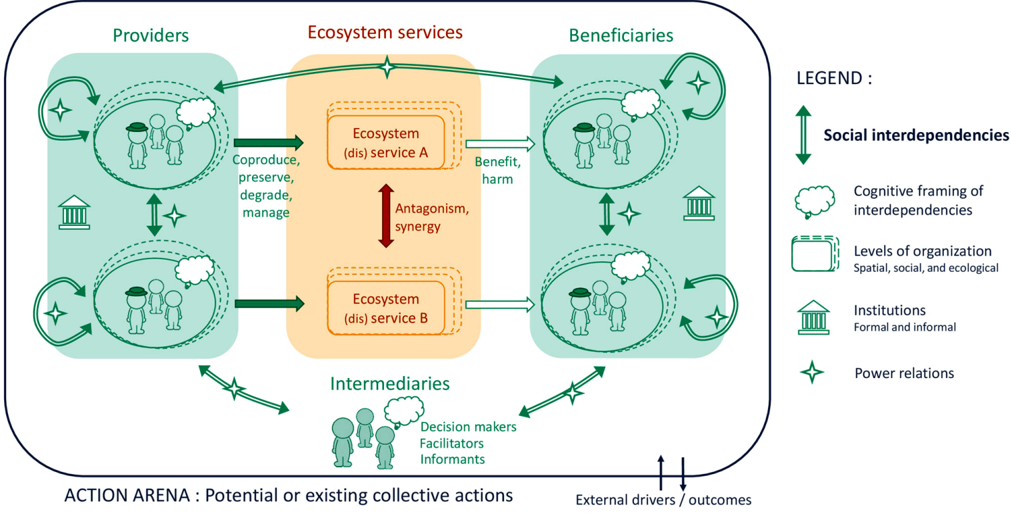
“A farmer is typically both a coprovider and a beneficiary of provisioning ES such as agricultural production and regulating ES such as insect pest control (Lescourret et al. 2015).”
BackgroundInfluentialMarket mechanism or subsidy in disguise? Governing payment for environmental services in Costa Rica
Fletcher, R., & Breitling, J. (2012) · Geoforum · doi:10.1016/j.geoforum.2011.11.008 · Cited by 181
Payments for Ecosystem Services as Incentives for Collective Action
Muradian, R. S. (2013) · Society & Natural Resources · doi:10.1080/08941920.2013.820816 · Cited by 178
Self-citationBarnaud, C., & Antona, M. (2014) · Geoforum · doi:10.1016/j.geoforum.2014.07.003 · Cited by 178
Self-citationCommon property resources: Ecology and community-based sustainable development
Harrison, A. (1990) · Food Chemistry · doi:10.1016/0308-8146(90)90061-8 · Cited by 175
Pelosi, C., Goulard, M., & Balent, G. (2010) · Agriculture Ecosystems & Environment · doi:10.1016/j.agee.2010.09.004 · Cited by 174
Becu, N., Neef, A., Schreinemachers, P., & Sangkapitux, C. (2008) · Land Use Policy · doi:10.1016/j.landusepol.2007.11.002 · Cited by 169
Equity, Power Games, and Legitimacy: Dilemmas of Participatory Natural Resource Management
Barnaud, C., & Van Paassen, A. (2013) · Ecology and Society · doi:10.5751/es-05459-180221 · Cited by 160
Self-citationFlint, C. G., Kunze, I., Muhar, A., Yoshida, Y., & Penker, M. (2013) · Landscape and Urban Planning · doi:10.1016/j.landurbplan.2013.09.002 · Cited by 159
Ecosystem services in agriculture: Determining suitability for provision by collective management
Stallman, H. R. (2011) · Ecological Economics · doi:10.1016/j.ecolecon.2011.08.016 · Cited by 148
Incentives, conditionality and collective action in payment for environmental services
Kerr, J. M., Vardhan, M., & Jindal, R. (2014) · International Journal of the Commons · doi:10.18352/ijc.438 · Cited by 143 · cited 2×
“Comparatively, ES governance based on collective action remains rarely explored, whether theoretically or empirically (Muradian et al. 2010, Stallman 2011, Muradian 2013, Kerr et al. 2014).”
BackgroundBerbés‐Blázquez, M. (2012) · Environmental Management · doi:10.1007/s00267-012-9822-9 · Cited by 129
Duraiappah, A. K., Asah, S. T., Brondízio, E. S., Kosoy, N., O’Farrell, P. J., Prieur‐Richard, A., Subramanian, S. M., & Takeuchi, K. (2013) · Current Opinion in Environmental Sustainability · doi:10.1016/j.cosust.2013.11.031 · Cited by 128
Reed, M. S., Bonn, A., Slee, W., Beharry-Borg, N., Birch, J. W., Brown, I. M., Burt, T., Chapman, D. S., Chapman, P. J., Clay, G. D., et al. (2009) · Land Use Policy · doi:10.1016/j.landusepol.2009.09.013 · Cited by 127
Mathevet, R., Thompson, J. D., Folke, C., & Chapin, F. S. (2016) · Ecological Applications · doi:10.1890/14-0421 · Cited by 124 · cited 3×
“We believe that this is worth trying, and with this paper we attempt to go in this direction, echoing recent ideas and approaches such as empathy across scales[3] and ecological solidarity (Mathevet et al. 2016).”
BackgroundInfluentialSelf-citationRescia, A. J., Pons, A., Lomba, I., Esteban, C., & Dover, J. W. (2008) · Landscape and Urban Planning · doi:10.1016/j.landurbplan.2008.08.001 · Cited by 110
Villamor, G. B., Palomo, I., Santiago, C. A. L., Oteros-Rozas, E., & Hill, J. (2014) · Ecological Processes · doi:10.1186/s13717-014-0022-9 · Cited by 105
Barreteau, O., Giband, D., Schoon, M., Cerceau, J., DeClerck, F., Ghiotti, S., James, T., Masterson, V. A., Mathevet, R., Rode, S., et al. (2016) · Ecology and Society · doi:10.5751/es-08834-210442 · Cited by 104
Self-citationInclusive Ecosystem Services Valuation
Dendoncker, N., Keune, H., Jacobs, S., & Gómez‐Baggethun, E. (2013) · Elsevier eBooks · doi:10.1016/b978-0-12-419964-4.00001-9 · Cited by 95
Self-citationBarnaud, C., Page, C. L., Dumrongrojwatthana, P., & Trébuil, G. (2011) · Environmental Modelling & Software · doi:10.1016/j.envsoft.2011.11.016 · Cited by 94
Self-citationWater Management in the Camargue Biosphere Reserve: Insights from Comparative Mental Models Analysis
Mathevet, R., Etienne, M., Lynam, T., & Calvet, C. (2011) · Ecology and Society · doi:10.5751/es-04007-160143 · Cited by 91 · cited 1×
“• Eliciting stakeholders’ representations of the SES through individual or collective mapping methods enables the sharing of diverse representations and/or the coconstruction of a shared representation of the system (Becu et al. 2008, Etienne et al. 2011, Mathevet et al. 2011).”
BackgroundSelf-citationPluralism and the less powerful: accommodating multiple interests in local forest management
Wollenberg, E., Anderson, J., & Edmunds, D. (2001) · International Journal of Agricultural Resources, Governance and Ecology · doi:10.1504/ijarge.2001.000012 · Cited by 90
Spangenberg, J. H., Görg, C., & Settele, J. (2015) · Ecosystem Services · doi:10.1016/j.ecoser.2015.10.006 · Cited by 89 · cited 1×
“Such approaches are increasingly advocated in ES research (Reyers et al. 2010, Spangenberg et al. 2015), in particular to assess the social and cultural values of ES (Pereira et al. 2005, Kenter et al. 2011, Berbés-Blázquez 2012, Klain and Chan 2012).”
BackgroundResearchers must be aware of their roles at the interface of ecosystem services science and policy
Crouzat, É., Arpin, I., Brunet, L., Colloff, M. J., Turkelboom, F., & Lavorel, S. (2017) · AMBIO · doi:10.1007/s13280-017-0939-1 · Cited by 87 · cited 1×
“On the operational side, numerous frameworks have been developed to incorporate the ES concept into management and decision-making spheres (Cowling et al. 2008, Daily et al. 2009, de Groot et al. 2010).”
MethodScale Misfit in Ecosystem Service Governance as a Source of Environmental Conflict
Gómez‐Baggethun, E., Kelemen, E., Martín‐López, B., Palomo, I., & Montes, C. (2013) · Society & Natural Resources · doi:10.1080/08941920.2013.820817 · Cited by 83 · cited 1×
“…at micro-habitat level to climate regulation at global level, and their beneficiaries are located at diverse levels of organization, from individual farmers benefiting from pollination to global society benefiting from biodiversity conservation (Hein et al. 2006, Gómez-Baggethun et al. 2013).”
BackgroundBUTORSTAR: A role-playing game for collective awareness of wise reedbed use
Mathevet, R., Page, C. L., Etienne, M., Lefebvre, G., Poulin, B., Gigot, G., Proréol, S., & Mauchamp, A. (2007) · Simulation & Gaming · doi:10.1177/1046878107300665 · Cited by 76 · cited 1×
“They increase people’s awareness of the multiple interdependencies of the system of which they are part (Barnaud et al. 2007, Mathevet et al. 2007, Daré et al. 2014).”
BackgroundSelf-citationCan ecosystem services lead ecology on a transdisciplinary pathway?
Reyers, B., Roux, D. J., & O’Farrell, P. J. (2010) · Environmental Conservation · doi:10.1017/s0376892910000846 · Cited by 68
Barnaud, C., Promburom, T., Trébuil, G., & Bousquet, F. (2007) · Simulation & Gaming · doi:10.1177/1046878107300670 · Cited by 67
Self-citationLandscape and biodiversity as new resources for agro-ecology? Insights from farmers’ perspectives
Salliou, N., & Barnaud, C. (2017) · Ecology and Society · doi:10.5751/es-09249-220216 · Cited by 61
Self-citationTerrible Economics, Ecosystems and Banking
Spash, C. L. (2011) · Environmental Values · doi:10.3197/096327111x12997574391562 · Cited by 60 · cited 1×
“Comparatively, ES governance based on collective action remains rarely explored, whether theoretically or empirically (Muradian et al. 2010, Stallman 2011, Muradian 2013, Kerr et al. 2014).”
BackgroundBarnaud, C., van Paassen, A., Trébuil, G., Promburom, T., & Bousquet, F. (2010) · The Journal of Agricultural Education and Extension · doi:10.1080/13892240903533152 · Cited by 60
Self-citationContracting for Environmental Property Rights: The Case of Vittel
DEPRES, C., Grolleau, G., & Mzoughi, N. (2007) · Economica · doi:10.1111/j.1468-0335.2007.00620.x · Cited by 55 · cited 1×
“Some programs of payments for ES actually rely on collective action, for example when payments are given to groups rather than to individuals (Kerr et al. 2014) or when there are direct negotiations between ES providers and beneficiaries to find mutual agreement (Depres et al. 2008).”
BackgroundSalliou, N., Barnaud, C., Vialatte, A., & Monteil, C. (2017) · Environmental Modelling & Software · doi:10.1016/j.envsoft.2017.06.050 · Cited by 55
Self-citationDoes information on landscape benefits influence collective action in landscape governance?
Opdam, P. F. M., Coninx, I., Dewulf, A. R. P. J., Steingröver, E. G., Vos, C. C., & van der Wal, M. M. (2016) · Current Opinion in Environmental Sustainability · doi:10.1016/j.cosust.2015.12.006 · Cited by 48
Ruoso, L., Plant, R. A. J., Maurel, P., Dupaquier, C., Roche, P. K., & Bonin, M. (2015) · Ecology and Society · doi:10.5751/es-07694-200311 · Cited by 42
Barnaud, C., Trébuil, G., Dumrongrojwatthana, P., & Marie, J. (2008) · Japanese Journal of Southeast Asian Studies · doi:10.20495/tak.45.4_559 · Cited by 30
Self-citationMathevet, R., & Mesleárd, F. (2002) · Land Use Policy · doi:10.1016/s0264-8377(02)00025-x · Cited by 28 · cited 1×
“…not in a stakeholder’s interest to reveal an existing dependency, because this can lead to the collapse of previous alliances that were efficient and robust only because this dependency was passed over in silence, as, for example, in the case of illegal hunting systems (Mathevet and Mesléard 2002).”
BackgroundSelf-citationSocial-ecological Functions and Vulnerability Framework to Analyze Forest Policy Reforms
Rives, F., Antona, M., & Aubert, S. (2012) · Ecology and Society · doi:10.5751/es-05182-170421 · Cited by 19
Self-citationLearning About Interdependencies and Dynamics
Daré, W., van Paassen, A., Ducrot, R., Mathevet, R., Queste, J., Trébuil, G., Barnaud, C., & Lagabrielle, E. (2013) · Springer eBooks · doi:10.1007/978-94-017-8557-0_10 · Cited by 14
Self-citationContexts and Dependencies in the ComMod Processes
Mathevet, R., Antona, M., Barnaud, C., Fourage, C., Trébuil, G., & Aubert, S. (2013) · Springer eBooks · doi:10.1007/978-94-017-8557-0_5 · Cited by 14 · cited 1×
“…analysis, and in particular stakeholder analysis, is an important preliminary step to design and conduct a participatory process, e.g., to select the participants, or to choose the appropriate methodologies (Grimble and Wellard 1997, Barnaud et al. 2008, Reed et al. 2009b, Mathevet et al. 2014).”
BackgroundSelf-citationAttention aux loups ! L'ambivalence de la menace et de sa mesure
Doré, A. (2014) · Ethnologie française · doi:10.3917/ethn.151.0045 · Cited by 10 · cited 1×
“…areas can be regarded as a cultural ES and as a sign of biodiversity conservation success by many, but sheep farmers from these areas might regard them as a disservice, because wolves can attack their sheep and impact their livelihoods negatively (Boitani 2000, Rescia et al. 2008, Doré 2015).”
Antona, M., & Babin, D. (2001) · International Journal of Agricultural Resources Governance and Ecology · doi:10.1504/ijarge.2001.000016 · Cited by 8
Self-citationBarbero (2014) · doi:10.1016/j · Cited by 1
(2018) · Digital Commons@Becker (Washington University School of Medicine) · doi:10.1371/journal
Research works printed but not linked: 4
- [7]7. Barnaud, C., L. Theil, J.-P. Choisis, and C. Eychenne. 2015. Les services écosystémiques: une notion savante déconnectée des représentations locales? Une analyse des représentations locales de l'élevage en zone agricole défavorisée. Pages 27-50 in P. Beringuier, F. Blot, B. Desailly, and M. Saqalli, editors. Environnement, politiques publiques et pratiques locales. L'Harmattan, Paris, France.
- [24]24. Cornwall, A. 2004. Spaces for transformation? Reflections on issues of power and difference in participation in development. Pages 75-91 in S. Hickey and G. Mohan, editors. Participation: from tyranny to transformation? Exploring approaches to participation in development. Zed Books, London, UK.
- [40]40. Etienne, M., editor. 2014. Companion modelling. A participatory approach to support sustainable development. Springer, Dordrecht, The Netherlands.
- [60]60. Maris, V. 2014. Nature à vendre. Les limites des services écosystémiques. Quae, Versailles, France. http://dx.doi.org/10.3917/ quae.maris.2014.01
Cited by
Towards common ground in the biodiversity–disease debate
Rohr, J. R., Civitello, D. J., Halliday, F. W., Hudson, P. J., Lafferty, K. D., Wood, C. L., & Mordecai, E. A. (2019) · Nature Ecology & Evolution · doi:10.1038/s41559-019-1060-6 · Cited by 270
Weaving notions of justice into urban ecosystem services research and practice
Langemeyer, J., & Connolly, J. J. T. (2020) · Environmental Science & Policy · doi:10.1016/j.envsci.2020.03.021 · Cited by 217
Blanco, J., Dendoncker, N., Barnaud, C., & Sirami, C. (2019) · Ecosystem Services · doi:10.1016/j.ecoser.2019.100913 · Cited by 160
“, 2016), a given management choice may therefore benefit certain stakeholders and be detrimental to others (Barnaud et al., 2018).”
BackgroundInfluentialSelf-citationJeanneret, P., Aviron, S., Alignier, A., Lavigne, C., Helfenstein, J., Herzog, F., Kay, S., & Petit, S. (2021) · Landscape Ecology · doi:10.1007/s10980-021-01248-0 · Cited by 180
“Such approaches have led to the development of frameworks and tools that fully acknowledge the complex ecological, economic and social interactions that drive the decision-making of stakeholders in the landscape, individually or collectively (Collins et al. 2011; Barnaud et al. 2018; Salliou et al. 2019).”
BackgroundAgroecological crop protection for sustainable agriculture
Deguine, J., Aubertot, J., Bellon, S., Côté, F., Lauri, P., Lescourret, F., Ratnadass, A., Scopel, É., Andrieu, N., Bàrberi, P., et al. (2023) · Advances in agronomy · doi:10.1016/bs.agron.2022.11.002 · Cited by 204
Self-citation
Metadata
- Authors
- Barnaud, C., Corbera, E., Muradian, R., Salliou, N., Sirami, C., Vialatte, A., Choisis, J.-P., Dendoncker, N., Mathevet, R., Moreau, C., Reyes-García, V., Boada, M., Deconchat, M., Cibien, C., Garnier, S., Maneja, R., & Antona, M.
- Affiliations
- Universitat Autònoma de Barcelona (ES)
- Universidade Federal Fluminense (BR)
- Institut National Polytechnique de Toulouse (FR)
- Centre National de la Recherche Scientifique (FR)
- University of Namur (BE)
- Centre de Coopération Internationale en Recherche Agronomique pour le Développement (FR)
- Parc national des Cévennes (FR)
- ORCID
- Venue
- Ecology and Society
- Publisher
- Resilience Alliance, Inc.
- Published
- 2018
- Volume
- 23
- Issue
- 1
- Pages
- 15 p.
- ISSN
- 1708-3087 (ISSN-L)
- OpenAlex
- W2787130365
- Cited by
- 180
- References
- 107
- Citations by year
- 2026: 8 · 2025: 16 · 2024: 12 · 2023: 18 · 2022: 21 · 2021: 37 · 2020: 27 · 2019: 32 · 2018: 9
- FWCI
- 15.36
- Type
- journal article
- Language
- en
- Open access
- gold
- doi.org
- Licence
- cc-by-nc
- Locations
- Ecology and Society (publishedVersion, cc-by-nc)
- Open Archive Toulouse Archive Ouverte (University of Toulouse) (acceptedVersion, other-oa)
- HAL (submittedVersion, cc-by-nc)
- Agritrop (Cirad) (submittedVersion, cc-by)
- DOAJ (DOAJ: Directory of Open Access Journals) (submittedVersion, cc-by-sa)
- Repository of the University of Namur (submittedVersion, cc-by-nc)
- Greater South Information System
- Funders
- Institut National de la Recherche Agronomique
- Universitat Autònoma de Barcelona
- Topics
- Physical Sciences › Environmental Science › Global and Planetary Change › Land Use and Ecosystem Services
- Physical Sciences › Environmental Science › Global and Planetary Change › Conservation, Biodiversity, and Resource Management
- Physical Sciences › Environmental Science › Global and Planetary Change › Sustainability and Climate Change Governance
- Keywords
- ecosystem services, social interdependencies, collective action, conceptual framework, social-ecological systems, community-based natural resource management
About these checks
Registry, retraction, Cites and statistics results are computed, not judged, with one exception: a printed reference that no index lists is read once by a model before it counts as a citation error. Claims are extracted by a model and kept only when their quote appears verbatim in the text; each cited source is then checked, with a model’s help, for whether it says what the claim relies on. Those verdicts can be wrong — read the claim’s quote and the cited source before relying on one.
Statistics and arithmetic are recomputed, not judged.
Confidence bands are shown only for fields calibrated on our annotated test set. None is calibrated yet, so no band is shown.
What counts as a claim ›How we measure confidence ›How we check this ›
Are you an author, or do you see a problem with this page? Request a review
Data sources
Bibliographic data: Semantic Scholar, OpenAlex, Crossref.
Contains information from the Semantic Scholar Academic Graph Datasets, made available under the ODC Attribution License (ODC-BY 1.0).
Semantic Scholar’s data is described in: Kinney, R., et al. (2023). The Semantic Scholar Open Data Platform. arXiv:2301.10140.
