

E-HRM: Innovation or Irritation. An Explorative Empirical Study in Five Large Companies on Web-based HRM
Open accessThe DOI matches its Crossref record; 18 of the 19 references it cites were found in a registry or an index; none of the 16 sources its claims cite is checked for support yet.
Abstract
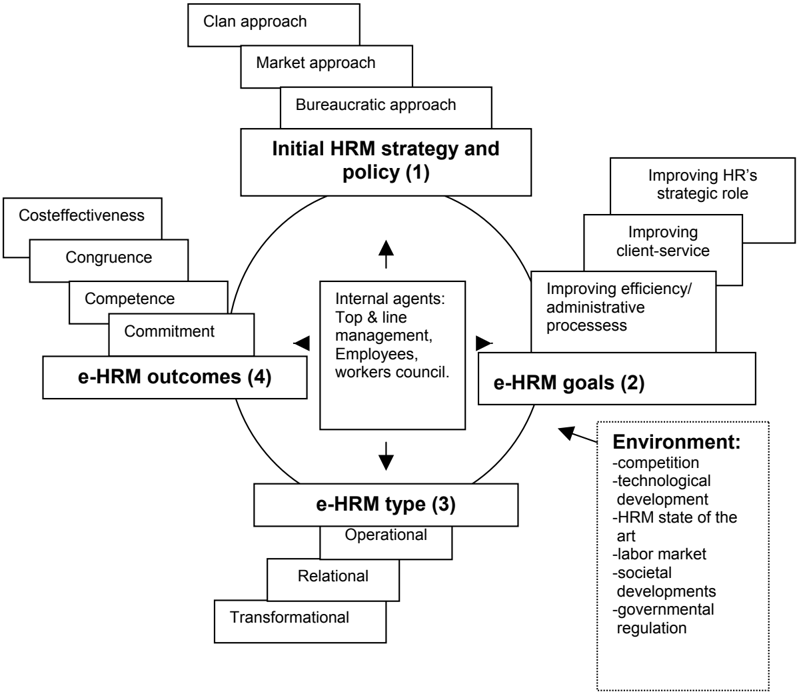
Technological optimistic voices assume that, from a technical perspective, the IT possibilities for HRM are endless: in principal all HR processes can be supported by IT. E-HRM is the relatively new term for this IT supported HRM, especially through the use of web technology. This paper aims at demystifying e-HRM by answering the following questions: what actually is e-HRM?, what are the goals of starting with e-HRM?, what types can be distinguished? and what are the outcomes of e-HRM? Based upon the literature, an e-HRM research model is developed and, guided by this model, five organizations have been studied that have already been on the 'e-HR road' for a number of years. We conclude that the goals of e-HRM are mainly to improve HR's administrative efficiency/to achieve cost reduction. Next to this goals, international companies seem to use the introduction of e-HRM to standardize/harmonize HR policies and processes. Further, there is a 'gap' between e-HRM in a technical sense and e-HRM in a practical sense in the five companies involved in our study. Finally, e-HRM hardly helped to improve employee competences, but resulted in cost reduction and a reduction of the administrative burden.
Overview
CoChat Summary
## TL;DR
This explorative case study examines web-based HRM (e-HRM) in five large companies and argues that e-HRM is less a technical upgrade than a shift in how HR work is done and by whom. Across the cases, the main reported effects were cost reduction and lower administrative burden, while improvements in employee competences were limited.
## Key findings
- The study’s five cases were Dow Chemicals, ABN AMRO, Ford Motor Company, IBM, and Belgacom; all had been on the “e-HR road” for several years and all were large firms with more than 15,000 employees.
- The authors identify three main e-HRM goals from the literature and cases: improving HR’s strategic orientation, reducing costs/raising efficiency, and improving client service for managers and employees; they also add a fourth goal based on the cases: improving a company’s global orientation.
- In the cases, e-HRM was associated mainly with cost reduction and a reduction of the administrative burden; the paper says no exact figures existed for these reductions.
- The paper reports a persistent gap between e-HRM in a technical sense and e-HRM in practice: at Dow Chemicals, adoption by users lagged behind technical possibilities by around three years.
- Reported outcomes varied by company, including “67% of all HR data entries” through employee self-service at one firm, employee satisfaction with HR service rising from 4.39 to 4.93 on a five-point scale in one year at another, and “80%” considering HR-online the primary source for HR at IBM.
## Methods
- Explorative qualitative multiple-case study design, with the organization as the unit of analysis.
- Sample: five large companies (>10,000 employees; in fact each >15,000), selected because they had a good reputation in e-HRM and had been using it for years.
- Data collection and analysis: conversational interviews as the dominant method, plus participant observations and documents; the data were categorized using indicators from the research model, then conclusions were drawn within and across cases.
## Limitations
- The paper states that the study is not intended to generalize statistically across all companies; it aims only at theoretical generalization.
- It explicitly notes that the study is exploratory and that the authors are still at a “preliminary stage” in understanding the relationship between IT and HRM, and that further research is needed.
- Evident from the text: the study relies on retrospective interviews and short observation periods, so recall bias and limited observation depth are plausible constraints, though these are not stated explicitly in the paper.
Model-written summary. Check it against the paper before relying on it.
Integrity signals
Registry
Cites
Statistics
Figures
Verification
Claims the paper makes
0 Valid · 1 Not valid · 14 Not checked · 75 Own results and interpretations
A result the paper reports from its own data — it cites no other source for it, so there is none to check. The quote shows it is in the paper.
In the paper
“Next to this goals, international companies seem to use the introduction of e-HRM to standardize/harmonize HR policies and processes.”
hedgedstates an association- Asserted: passes — The authors put it forward as true.
- Checkable: passes — It can be checked against evidence.
- Load-bearing: passes — The paper’s conclusions depend on it.
- Based: passes — The paper gives a reason why it holds.
A result the paper states — it cites no source for it, so there is none to check. The quote shows it is in the paper.
In the paper
“The fifth company involved, Belgacom, is not yet an international company, and therefore would not make this connection.”
- Also stated in: § 4.1 Commencing with e-HRM at our five case companies: an overall assessment · plain
“The fifth company involved, Belgacom, is not yet an international company”
plainSingle case- Asserted: passes — The authors put it forward as true.
- Checkable: passes — It can be checked against evidence.
- Load-bearing: passes — The paper’s conclusions depend on it.
- Based: passes — The paper gives a reason why it holds.
- Also stated in: § 4.1 Commencing with e-HRM at our five case companies: an overall assessment · plain
A result the paper states — it cites no source for it, so there is none to check. The quote shows it is in the paper.
In the paper
“In fact this suggests the first conclusion: there does not seem to be 'one natural way' to get on the 'e-HR road'.”
hedged- Asserted: passes — The authors put it forward as true.
- Checkable: passes — It can be checked against evidence.
- Load-bearing: passes — The paper’s conclusions depend on it.
- Based: passes — The paper gives a reason why it holds.
A result the paper reports from its own data — it cites no other source for it, so there is none to check. The quote shows it is in the paper.
In the paper
“Four of them operated internationally, and all of these linked their e-HRM plans with their aim of becoming a global company rather than an internationally dispersed one.”
plainstates an associationn = 4- Asserted: passes — The authors put it forward as true.
- Checkable: passes — It can be checked against evidence.
- Load-bearing: unclear — It is unclear whether the paper’s conclusions depend on it.
- Based: passes — The paper gives a reason why it holds.
A result the paper reports from its own data — it cites no other source for it, so there is none to check. The quote shows it is in the paper.
In the paper
“Starting to work with e-HRM seems to be connected with the process and globalization aims of the companies. This is one of the more interesting points to emerge from our look at the five companies.”
hedgedstates an associationn = 5- Asserted: passes — The authors put it forward as true.
- Checkable: passes — It can be checked against evidence.
- Load-bearing: unclear — It is unclear whether the paper’s conclusions depend on it.
- Based: passes — The paper gives a reason why it holds.
31 more claims
Create a free account to see all 90 claims and every source verdict.
- It may state two separate claims as one. 27
- Probably not a substantial claim. 32
Claims other papers make about this one
Each is checked against this paper’s own text: does it say what the citing paper says it does?
The source backs part of the claim, not all of it — or backs it for a different population, condition or comparison.
In the citing paper
“relational consequences emphasise the interactions and networking of different actors in sustaining the relationships with an employee by improving HR services and empowering employees”
From AI-augmented HRM: Antecedents, assimilation and multilevel consequences (2023) · cites this paper as Ruel et al., 2004
Experimental — accuracy not yet measuredThe source backs part of the claim, not all of it — or backs it for a different population, condition or comparison.
In the citing paper
“This proposed standardisation across different units in an organisation can help managers use the shared HR services to be HR compliant and improve the management process, resulting in strategic contribution and competitive advantage (Parry, 2011; Ruel et al., 2004).”
From AI-augmented HRM: Antecedents, assimilation and multilevel consequences (2023) · cites this paper as Ruel et al., 2004
Experimental — accuracy not yet measuredThe cited source says what the claim attributes to it.
In the citing paper
“the strategic orientation of HRM”
From AI-augmented HRM: Antecedents, assimilation and multilevel consequences (2023) · cites this paper as Ruel et al., 2004
The cited source says what the claim attributes to it.
In the citing paper
“Cost reduction/efficiency gains”
From AI-augmented HRM: Antecedents, assimilation and multilevel consequences (2023) · cites this paper as Ruel et al., 2004
The cited source says what the claim attributes to it.
In the citing paper
“Client service improvement/facilitating management and employees”
From AI-augmented HRM: Antecedents, assimilation and multilevel consequences (2023) · cites this paper as Ruel et al., 2004
Citations
Cites
(1993) · Cited by 7,856
Using Qualitative Methods in Organizational Research
Lee, T. (1998) · Medical Entomology and Zoology · Cited by 1,123
Degenne, A., & Forse, M. (1999) · SAGE Publications Ltd eBooks · doi:10.4135/9781849209373 · Cited by 886
Beatty, R. W., McEvoy, G. M., Beer, M., Spector, B., Lawrence, P. R., Mills, D. Q., & Walton, R. E. (1986) · Industrial and Labor Relations Review · doi:10.2307/2523277 · Cited by 731
Ulrich, D. (1996) · Cited by 641
Virtual HR: Strategic human resource management in the 21st century
Lepak, D. P., & Snell, S. A. (1998) · Human Resource Management Review · doi:10.1016/s1053-4822(98)90003-1 · Cited by 454 · cited 5×
“Interestingly, in all of these companies, ‘globalizing’ HR produced a tendency to centralize HR policy responsibilities at the company headquarters, while responsibilities for applying HR responsibilities were actually decentralized, placed in the hands of line managers and employees.”
BackgroundMethodInfluentialThompson, K. R. (1997) · Organizational Dynamics · doi:10.1016/s0090-2616(97)90039-5 · Cited by 374
Human Resource Information Systems: A Current Assessment
DeSanctis, G. (1986) · MIS Quarterly · doi:10.2307/248875 · Cited by 281 · cited 2×
“Keywords: e-HRM, HRM, IT, explorative case studies.”
MethodConditions for successful human resource information systems
Haines, V. Y., & Petit, A. (1997) · Human Resource Management · doi:10.1002/(sici)1099-050x(199722)36:2<261::aid-hrm7>3.0.co;2-v · Cited by 156
Schlevogt, K.-A. (2002) · Art of Chinese Management · doi:10.1093/oso/9780195136449.005.0002 · Cited by 141
Research works printed but not linked: 1
- Greengard, S. (1995): Using internal web sites to automate HR. In: Personnel Journal, June.
Cited by
Items 101–200 of 435
Role of E- HRM in Organizational Effectiveness and Sustainability
Deshwal, P. (2015) · International journal of applied research · Cited by 19
Meijerink, J., Boons, M., Keegan, A. E., & Marler, J. H. (2018) · The International Journal of Human Resource Management · doi:10.1080/09585192.2018.1503845 · Cited by 31
Fayoumi, A., & Loucopoulos, P. (2021) · Enterprise Information Systems · doi:10.1080/17517575.2021.2005149 · Cited by 19
Hamidianpour, F., Esmaeilpour, M., & Firoozi, H. (2016) · Asian Social Science · doi:10.5539/ass.v12n7p105 · Cited by 28
Patterns for Visual Management in Industry 4.0
Fenza, G., Loia, V., & Nota, G. (2021) · Sensors · doi:10.3390/s21196440 · Cited by 29
“Scholars have studied HRM in small firms [49] and large companies [50,51], as well as studying perspectives of HRM that range from the project-oriented companies [52] to international HRM [51,53].”
BackgroundInfluentialUser Characteristics as Antecedents of Techno Stress towards EHRM: From Experts’ Views
Ibrahim, H. B., & Yusoff, Y. M. (2015) · Procedia - Social and Behavioral Sciences · doi:10.1016/j.sbspro.2015.01.346 · Cited by 25
Alam, S. M. S., & Islam, K. M. Z. (2021) · IEEE Engineering Management Review · doi:10.1109/emr.2021.3114034 · Cited by 23
Alan, H. (2023) · Journal of Chinese Human Resource Management · doi:10.47297/wspchrmwsp2040-800502.20231401 · Cited by 21
Contreras, F., Jáuregui, K., & Rank, S. (2024) · Journal of Engineering and Technology Management · doi:10.1016/j.jengtecman.2024.101829 · Cited by 48
Rogiers, P., Viaene, S., & Leysen, J. (2020) · Intelligent systems in accounting, finance and management/Intelligent systems in accounting, finance & management · doi:10.1002/isaf.1481 · Cited by 26
Electronic Human Resource Management (e-HRM) of Hotel Business in Phuket
Choochote, K., & Chochiang, K. (2015) · International Journal of Advanced Computer Science and Applications · doi:10.14569/ijacsa.2015.060410 · Cited by 26
“The e-HRM plays a vital role in human resources management [1] where procedures and processes can be less complicated [2] while ensuring accuracy [3] and timeliness of communication between both organizations and employees with unlimited distance of message transmission.”
BackgroundPoba‐Nzaou, P., Uwizeyemunugu, S., Gaha, K., & Laberge, M. (2020) · Business Process Management Journal · doi:10.1108/bpmj-06-2018-0150 · Cited by 30
Bissola, R., & Imperatori, B. (2013) · Emerald Group Publishing Limited eBooks · doi:10.1108/s1877-6361(2013)0000012007 · Cited by 16
Manresa, A., Bikfalvi, A., Ligthart, P. E. M., & Kok, R. A. W. (2024) · Production Planning & Control · doi:10.1080/09537287.2024.2303344 · Cited by 18
Identity ambiguity and the promises and practices of hybrid e-HRM project teams
Tansley, C., Huang, J., & Foster, C. (2013) · The Journal of Strategic Information Systems · doi:10.1016/j.jsis.2013.01.002 · Cited by 21
“…in the implementation of electronic HRM (e-HRM) systems, which are comprised of web-based systems designed to support the implementation of human resourcing (HR) strategies, policies and practices in organisat ions (Ruel et al., 2004 ) by a variety of organisational actors (Strohmeier, 2007 ).”
BackgroundZarqan, I. A. (2017) · Jurnal Manajemen Teori dan Terapan | Journal of Theory and Applied Management · doi:10.20473/jmtt.v10i3.5967 · Cited by 15
“Source: Hendrickson, 2003, pp. 391 – 392; Ruel et al., 2004, pp. 367 – 378; Sushi, 2008; Parry, Tyson, 2007, p. 242”
Al-Dmour, R., & Al-Zu’bi, Z. M. F. (2014) · International Business Research · doi:10.5539/ibr.v7n7p139 · Cited by 28
“Using HRIS (Human Resource Information System) technology is a way of putting into practice these HR strategies, policies, and practices by complying with the HR requirements of an organization more efficiently, through web-technology-based channels (Ruël et al., 2004).”
MethodKey Issues in E-Government and Public Administration
Joseph, R. C., & Kitlan, D. P. (2008) · IGI Global eBooks · doi:10.4018/978-1-59904-857-4.ch001 · Cited by 16
Amoako, R., Jiang, Y., Adu-Yeboah, S. S., Frempong, M. F., & Tetteh, S. (2023) · South African Journal of Business Management · doi:10.4102/sajbm.v54i1.2937 · Cited by 35
Parry, E., & Olivas‐Luján, M. R. (2011) · Advanced series in management · doi:10.1108/s1877-6361(2011)0000008013 · Cited by 21
Chapter 8 e-Recruitment: From Transaction-Based Practices to Relationship-Based Approaches
Girard, A., & Fallery, B. (2011) · Advanced series in management · doi:10.1108/s1877-6361(2011)0000008012 · Cited by 23
“HRIS focus on the HR department itself in order to improve the processes within the function, whereas e-HRMalso focuses on the employees and management (Ruël et al., 2004). e-HRM can be defined as ‘‘a way of implementing HR strategies, policies, and practices in organizations through a conscious and directed support o…”
BackgroundMethodInfluentialInnovative HRM. A Review of the Literature
Koster, F. (2019) · Journal of technology management & innovation · doi:10.4067/s0718-27242019000200097 · Cited by 33
“E-HRM refers to the use of information technology to enable organizations to manage their human resources, for example by using web technology (Ruël, Bondarouk and Looise 2004).”
e-HRM in a Cloud Environment: Implementation and its Adoption: A Literature Review
Ziebell, R.-C., Garrigós, J. A., Schoeneberg, K.-P., & Perello-Marin, M. R. (2019) · International Journal of Human Capital and Information Technology Professionals · doi:10.4018/ijhcitp.2019100102 · Cited by 29
Literature Review on Primary Organizational Recruitment Sources
Shenoy, V., & Aithal, P. S. (2018) · International Journal of Management Technology and Social Sciences · doi:10.47992/ijmts.2581.6012.0035 · Cited by 24
“(2004) ascertained the gaps between e-HRM in a technical sense and eHRM in a practical sense in the five companies involved in their study [29].”
BackgroundSaeed, M. E., Maarouf, H., & Younis, R. A. A. (2025) · Future Business Journal · doi:10.1186/s43093-024-00415-4 · Cited by 39
“According to Bandarouk and Ruël [3, 19], which is the most prevalent definition adopted [20].”
HR technology goal realization: predictors and consequences
Florkowski, G. W. (2020) · Personnel Review · doi:10.1108/pr-10-2019-0557 · Cited by 16
Artificial Intelligence In Talent Acquisition, Do we Trust It?
Hmoud, B., & Várallyai, L. (2022) · Journal of Agricultural Informatics · doi:10.17700/jai.2021.12.1.594 · Cited by 23
“The old order Changeth!” Building sustainable knowledge management post COVID-19 pandemic
Dutta, D., Vedak, C., & Sawant, H. (2022) · VINE Journal of Information and Knowledge Management Systems · doi:10.1108/vjikms-05-2022-0169 · Cited by 17
Jooss, S., & Burbach, R. (2017) · Emerald Group Publishing Limited eBooks · doi:10.1108/978-1-78714-315-920161002 · Cited by 16
Adoption of E-HRM in Large New Zealand Organizations
Lau, G., & Hooper, V. A. (2009) · IGI Global eBooks · doi:10.4018/978-1-59904-883-3.ch006 · Cited by 18
Muriithi, J. G., Gachunga, H. G., & Mburugu, C. K. (2014) · European Journal of Business and Management · Cited by 22
Esen, M., & Özbağ, G. K. (2014) · International Journal of Human Resource Studies · doi:10.5296/ijhrs.v4i1.5643 · Cited by 22
“…Resource Management (e-HRM) Electronic human resource management (e-HRM) is used interchangeably with virtual human resource management, human resource intranet, web-based human resource management, computer-based human resource management systems and human resource portals (Ruel et al., 2004).”
BackgroundMethodInfluentialTransitioning from a Proprietary to Vanilla HRIS: The Resulting Implications for Talent
Wiblen, S. L., Dery, K., & Grant, D. (2010) · Research Online (University of Wollongong) · Cited by 16
Tomanna, T., Gerbi, D. Y., Hossin, M. A., & Zhang, S. (2018) · Journal of Human Resource and Sustainability Studies · doi:10.4236/jhrss.2018.61025 · Cited by 16
“HRIS is conducted towards the HR department itself [27].”
MethodE- Human Resource Management (E-HRM): A Growing Role in Organizations
Girisha, M. C., & Nagendrababu, K. (2019) · International Journal of Management Studies · doi:10.18843/ijms/v6i1(5)/11 · Cited by 21
Anjum, N., & Islam, M. A. (2020) · International Journal of Academic Research in Accounting Finance and Management Sciences · doi:10.6007/ijarafms/v10-i3/8140 · Cited by 15
“Organizational Innovativeness (OIN) Organizational innovativeness refers to accept new ideas or doing something unique or receptive about new way of doing things or transferring and applying a new thought to business activities (Ruel et al., 2004; Hurley and Hult, 1998).”
BackgroundUse of human resources information system in agricultural companies in the Czech Republic
Vrabcová, P., & Urbancová, H. (2021) · Agricultural Economics (Zemědělská ekonomika) · doi:10.17221/452/2020-agricecon · Cited by 12
“On the other hand, Ruël et al. (2004), Schramm (2006), Nagendra and Deshpande (2014) have shown that planning through staff information systems saves both time and money (due to lower administrative demands).”
BackgroundGeneration Y at Work: The Role of e-HRM in Building Positive Work Attitudes
Bissola, R., & Imperatori, B. (2010) · Archivio istituzionale della Ricerca - Bocconi · Cited by 14
Innovative HRM. A Review of the LiteraturePreprint
Koster, F. (2018) · SSRN Electronic Journal · doi:10.2139/ssrn.3263343 · Cited by 14
Aiming for Strategic e-HRM: Motives and Consequences of e-HRM Implementation in an MNC
Heikkilä, J.-P., Rentto, O., & Feng, Y. (2017) · Emerald Group Publishing Limited eBooks · doi:10.1108/978-1-78714-315-920161007 · Cited by 19
Renkema, M. (2021) · Emerald Group Publishing Limited eBooks · doi:10.1108/978-1-80071-298-020211011 · Cited by 16
Digitalization and its Impact on Employee’s Performance: A Case Study on Greater Tafila Municipality
Alobidyeen, B. Z., Al-Edainat, S., Al-Shabatat, S., & Al-Shabatat, S. (2022) · International Journal of Business and Administrative Studies · doi:10.20469/ijbas.8.10004-1 · Cited by 21
Technology in Human Resource Functions: Core Systems, Emerging Trends and Algorithmic Management
Jooss, S., Duggan, J., & Parry, E. (2022) · Emerald Group Publishing Limited eBooks · doi:10.1108/978-1-80071-779-420221006 · Cited by 16
Phahlane, M. M., & Kekwaletswe, R. M. (2017) · Conference on Information Communications Technology and Society (ICTAS) · doi:10.1109/ictas.2017.7920654 · Cited by 15
“Authors such as [39] refer to HRIS as a, e-HRM or electronic human resource management, [31] HRIT or Human resource information technology[40], web-based HRM], [5] call it intranet-based HRM, HRIS by [29], virtual HRM [26], HR-ICT by [12] and HR-ERP by [10] There are many names that can be used to…”
Rahman, M., & Aydın, E. (2019) · Uluslararası İktisadi ve İdari İncelemeler Dergisi · doi:10.18092/ulikidince.516443 · Cited by 19
Use of Relational eHRM Tools in Gig Worker Platforms
Fisher, S. L., & Cassady, E. A. (2019) · Emerald Group Publishing Limited eBooks · doi:10.1108/s1877-636120190000023007 · Cited by 15
Exploring Perceptions about the Use of e-HRM Tools in Medium Sized Organizations
Bondarouk, T. V., ter Horst, V., & Engbers, S. (2009) · IGI Global eBooks · doi:10.4018/978-1-60566-304-3.ch018 · Cited by 16
Self-citationYusliza, M. Y., & Ramayah, T. (2012) · International Journal of Information and Communication Technology · doi:10.1504/ijict.2012.045746 · Cited by 11
Human Resource Information Systems in Health Care: Protocol for a Systematic Review
Tursunbayeva, A., Pagliari, C., Bunduchi, R., & Franco, M. (2015) · JMIR Research Protocols · doi:10.2196/resprot.4922 · Cited by 13
“…environment” [32]) or, more recently, as an electronic human resource management or e-HRM system (eg, defined as “a way of implementing HR strategies, policies, and practices in organizations through conscious and directed support of and/or with the full use of web-technology-based channels” [33]).”
BackgroundIslam, M. S. (2016) · SSRN Electronic Journal · doi:10.2139/ssrn.2958055 · Cited by 17
“There are circumstances for combination of HR role (Ruël et al. 2004) as expected that the acceptance of e-HRM involves the construction of HR purpose.”
IT-Based Integration of HRM in a Foreign MNC Subsidiary: A Micro-Political Perspective
Smale, A., & Heikkilä, J.-P. (2009) · IGI Global eBooks · doi:10.4018/978-1-60566-304-3.ch009 · Cited by 10
Rehman, H. M., Yong, H. N. A., & Choong, Y. O. (2022) · International Journal of Asian Business and Information Management · doi:10.4018/ijabim.297847 · Cited by 14
“The researcher believes that by applying E-HRM, the managers can be more focused on the strategic side of the business and do better decision-making that is helpful for the organizations’ long-run (Ruël et al., 2004).”
MethodBhuiyan, F., & Gani, M. O. (2015) · iBusiness · doi:10.4236/ib.2015.73013 · Cited by 12
“Almost all HR processes can be done by using HRIS on a daily basis which facilitates the organization in several ways, like; automate the business and its processes, reduce the use of resources, such as; financial, material and human [11].”
BackgroundEvaluating major human resource information systems design characteristics – an empirical study
Strohmeier, S., & Kabst, R. (2012) · International Journal of Business Information Systems · doi:10.1504/ijbis.2012.045721 · Cited by 13
“As the third and, maybe, the most influential innovation of recent years is the ongoing web-enablement of HRIS during the last decade – broadly discussed and researched under the label ‘electronic HRM’ (Ruël et al., 2004; Strohmeier, 2007; Stone and Lukaszewski, 2009).”
BackgroundHuman Resource Information System and Work Stress during COVID-19 PandemicPreprint
Munir, M., Amaliyah, A., & Pandin, M. G. R. (2020) · Preprints.org · doi:10.20944/preprints202012.0469.v1 · Cited by 14
Factors Affecting the Acceptance of E-HRM in Iraq
Azhar Naima, M. (2019) · International Journal of Academic Research in Business and Social Sciences · doi:10.6007/ijarbss/v9-i2/5542 · Cited by 11
The Scope of e-HRM and its Effectiveness
Siam, M. R. A., & Alhaderi, S. M. (2019) · Polish Journal of Management Studies · doi:10.17512/pjms.2019.19.2.30 · Cited by 12
“According to (Ruël et al., 2004, p. 281), “e-HRM can be characterized as a method for actualizing HR systems, approaches and practices in the firms through the conscious and coordinated help of web technology based mediums so as to consent to the HR needs of the firms.””
MethodIbrahim, H. A. (2021) · Journal of Humanities Insights · doi:10.22034/jhi.2021.122571 · Cited by 10
Electronic HR Practices as a Critical Factor of Employee Satisfaction in Private Hospitals in Jordan
Alolayyan, M. N., Almomani, R. Z. Q., Al-Qudah, S. H., Al-Hawary, S. I. S., Mohammad, A. A. S., Al-hawajreh, K. M., Ababneh, R. I., Alshurideh, M. T., & Mohammad, A. I. (2023) · Studies in computational intelligence · doi:10.1007/978-3-031-12382-5_54 · Cited by 12
İŞLETMELERİN E- İNSAN KAYNAKLARI YÖNETİMİ VE E-İŞE ALIM SÜREÇLERİNDEKİ GELİŞMELER
Güler, E. (2006) · RePEc: Research Papers in Economics · Cited by 9
Ficapal‐Cusí, P., & Torrent‐Sellens, J. (2014) · Modern Economy · doi:10.4236/me.2014.52016 · Cited by 12
“Since the mid 90’s, the consolidation and productive use of IT, improved HRM, especially e-HRM [7-9], and organisational redesign have developed in parallel, and together require workers who are better trained and more highly motivated [10,11].”
BackgroundDigitalization of Human Resources
Baykal, E. (2021) · IGI Global eBooks · doi:10.4018/978-1-6684-3873-2.ch012 · Cited by 12
Batenburg, R. S., & Koopman, G. (2009) · International Journal of Business Information Systems · doi:10.1504/ijbis.2010.030627 · Cited by 13
Audrin, B., & Davoine, E. F. G. (2017) · Management & Avenir · doi:10.3917/mav.092.0015 · Cited by 17
Editorial: Electronic Human Resource Management: Transformation of HRM?
Strohmeier, S., Bondarouk, T. V., & Konradt, U. (2012) · German Journal of Human Resource Management Zeitschrift für Personalforschung · doi:10.1177/239700221202600301 · Cited by 10
“Conceptually, there is a sound basis for believing that e-HRM should facilitate the transformation of HRM (Bondarouk & Ruël, 2009; Ruël et al., 2004).”
BackgroundSelf-citationChapter 5 A Framework for the ComparativeAnalysis of HR Shared Services Models
Bondarouk, T. V. (2011) · Advanced series in management · doi:10.1108/s1877-6361(2011)0000008009 · Cited by 10
Self-citationIyer, S., Pani, A. K., & Gurunathan, L. (2020) · IFIP advances in information and communication technology · doi:10.1007/978-3-030-64849-7_21 · Cited by 12
Existing Research on HRIS in Public Organizations
Valcik, N. A., Sabharwal, M., & Benavides, T. J. (2021) · Management for professionals · doi:10.1007/978-3-030-75111-1_3 · Cited by 11
Construction Workforce Management in the Fourth Industrial Revolution
Aghimien, L. M., Aigbavboa, C. O., & Aghimien, D. O. (2024) · Emerald Group Publishing Limited eBooks · doi:10.1108/978-1-83797-018-620241003 · Cited by 12
Ziebell, R.-C., Schoeneberg, K.-P., Schultz, M., Garrigós, J. A., & Perello-Marin, M. R. (2018) · Edition HMD · doi:10.1007/978-3-658-20967-4_9 · Cited by 13
The Impact of e-HRM on Efficiency in the Public Institution – Case Study of Local Government
Pyszka, A. (2018) · International Journal of Contemporary Management · doi:10.4467/24498939ijcm.18.022.8546 · Cited by 10
“This is because e-HRM takes three different forms (Ruël et al., 2004) i.e. operational HRM (basic HR activities in the administrative area – payroll and personnel data administration), relational HRM (HR tools – such as recruiting and the selection of new personnel, training, performance management…”
BackgroundMethodInfluentialOnline E-Campus Interview Training MOOC Framework for Graduates
Shenoy, V., Archarya, P. S., & Aithal, P. S. (2018) · International Journal of Case Studies in Business IT and Education · doi:10.47992/ijcsbe.2581.6942.0041 · Cited by 8
“Papers examined on E-HRM also fortified the positive mileage of technology based HR processes [10-11].”
BackgroundELECTRONIC HUMAN RESOURCE MANAGEMENT(e-HRM): GROWING ROLE IN ORGANISATIONS
Gupta, A., & Saxena, S. (2014) · Cited by 12
A Delphi Study on E-HRM: Future Directions
Heikkilä, J.-P. (2010) · Cited by 18
HRM, Technology and Innovation: New HRM Competences for Old Business Challenges?
Bondarouk, T. V., Marsman, E., & Rekers, M. (2014) · Emerald Group Publishing Limited eBooks · doi:10.1108/s1877-636120140000014016 · Cited by 15
Self-citationQteishat, M. K. (2014) · International Journal of Computer Applications · Cited by 9
FACTORS INFLUENCING ATTITUDE TOWARDS USING ELECTRONIC HRMPreprint
Ramayah, T. (2011) · RePEc: Research Papers in Economics · Cited by 10
Gürol, Y. D., Wolff, R., & Ertemsir, E. (2010) · IGI Global eBooks · doi:10.4018/978-1-61520-611-7.ch052 · Cited by 20
William, A., & Singh, K. (2023) · The Electronic Journal of Information Systems in Developing Countries · doi:10.1002/isd2.12267 · Cited by 26
“This allows HR professionals to concentrate on strategic issues (Ruel et al., 2004).”
BackgroundInfluentialA Survey on Electronic Human Resource Management Consequences, Its Outcomes and Performances
Adli, M., Gharib, S., Hakami, M., & Pourmahdi, K. (2014) · Åbo Akademi University Research Portal · Cited by 11
Adoption of HRIS in the Public Organizations: Institutional Logics Perspective
Naveed, S., Suhail, A., & Rana, N. S. (2021) · Pakistan Journal of Information Management and Libraries · doi:10.47657/2208 · Cited by 8
The Many Sides of Human Resource Information Systems
Poutanen, H., & Puhakka, V. J. (2010) · International Journal of Technology and Human Interaction · doi:10.4018/jthi.2010100101 · Cited by 7
e-HR Systems Implementation: A Conceptual Framework
Pant, S., & Chatterjee, A. (2008) · AIS Electronic Library (AISeL) · Cited by 8
Esen, M., & Erdoğmuş, N. (2014) · Bilgi Ekonomisi ve Yönetimi Dergisi · Cited by 36
Electronic human resource management and its functions
Doğan, A. (2011) · İnternet uygulamaları ve yönetimi/internet uygulamalarý ve yönetimi · doi:10.5505/iuyd.2011.22932 · Cited by 53
Suen, H.-Y., Hsiao, H.-E., & Yang, J.-M. (2011) · doi:10.1109/ijcss.2011.23 · Cited by 8
E-Government and E-HRM in the Public Sector
Joseph, R. C., & Ezzedeen, S. R. (2009) · IGI Global eBooks · doi:10.4018/978-1-59904-883-3.ch041 · Cited by 7
Aggarwal, V., & Stanley, D. S. (2024) · Psychological Studies · doi:10.1007/s12646-024-00811-4 · Cited by 19
“Operational consequences of e-HRM relate to reducing HR staff, faster processes, cost reduction and a release from administrative burdens resulting from automation (Ruël et al., 2004; Ruta, 2005).”
InfluentialStudy of Employee Satisfaction towards e-HRM system
Sareen, P. (2015) · European Journal of Applied Business and Management · Cited by 8
Leveraging Information Technology (IT) in Recruitment and Selection Processes- A Comparative Study
Owusu-Ansah, S., & Nyarko, S. K. (2014) · Cited by 10
Parry, E., & Tyson, S. (2009) · IGI Global eBooks · doi:10.4018/978-1-60566-304-3.ch012 · Cited by 12
Kasemsap, K. (2018) · Advances in logistics, operations, and management science book series · doi:10.4018/978-1-5225-7362-3.ch066 · Cited by 7
Ruël, H. J. M., & Bondarouk, T. V. (2018) · Edward Elgar Publishing eBooks · doi:10.4337/9781784711139.00025 · Cited by 10
Self-citationThe Investigation of Employer Adoption of Human Resource Information Systems at University Using TAM
Göktaş, P., & Akgül, Y. (2019) · Advances in marketing, customer relationship management, and e-services book series · doi:10.4018/978-1-5225-8015-7.ch001 · Cited by 7
Human Resource Information System Use, Satisfaction, and Success
Srivastava, S., Dev, S., & Bajaj, B. (2020) · International Journal of Enterprise Information Systems · doi:10.4018/ijeis.2021010106 · Cited by 16
Peng, H. (2018) · GRH · doi:10.3917/grh.173.0077 · Cited by 6
Zarządzanie talentami w przedsiębiorstwie
Kopeć, J. (2012) · Cited by 20
Determinants of the implementation of HRIS applications in business organisations in Jordan
Al-Dmour, R., & Love, S. (2015) · International Journal of Human Resources Development and Management · doi:10.1504/ijhrdm.2015.069974 · Cited by 10
“These HRIS goals could be directed to justification for the adoption and implementation of HRIS, could relate to the desired ‘complexity’ of HRIS, could be directed towards more easiness regarding user application or could be directed towards an increase of efficiency and effectiveness (Ruël et al., 2004; Strohmeier,…”
BackgroundMethodMaking Sense of e-HRM: Technological Frames, Value Creation and Competitive Advantage
Foster, S. (2010) · University of Hertfordshire Research Archive (University of Hertfordshire) · Cited by 21
Metadata
- Authors
- Ruël, H., Bondarouk, T., & Looise, J. K.
- Affiliations
- University of Twente (NL)
- Utrecht University (NL)
- ORCID
- Bondarouk, Tanya
- Venue
- management revu
- Publisher
- IMR Press
- Published
- 2004
- Volume
- 15
- Issue
- 3
- Pages
- 364-380
- ISSN
- 0935-9915 (ISSN-L)
- OpenAlex
- W1562646680
- Cited by
- 441
- References
- 19
- Citations by year
- 2026: 4 · 2025: 17 · 2024: 47 · 2023: 33 · 2022: 33 · 2021: 38 · 2020: 26 · 2019: 33 · 2018: 25 · 2017: 15 · 2016: 23 · 2015: 25 · 2014: 24 · 2013: 20 · 2012: 18
- FWCI
- 3.60
- Type
- journal article
- Language
- en
- Open access
- hybrid
- doi.org
- Licence
- cc-by
- Locations
- management revue (publishedVersion, cc-by)
- University of Twente Research Information (submittedVersion)
- RePEc: Research Papers in Economics (submittedVersion)
- Econstor (Econstor) (submittedVersion)
- University of Twente Research Information (submittedVersion, other-oa)
- Topics
- Social Sciences › Business, Management and Accounting › Organizational Behavior and Human Resource Management › Employer Branding and e-HRM
- Social Sciences › Business, Management and Accounting › Organizational Behavior and Human Resource Management › AI and HR Technologies
- Social Sciences › Business, Management and Accounting › Organizational Behavior and Human Resource Management › Human Resource and Talent Management
- Keywords
- e-HRM, human resource management, large corporations, HRM innovation
About these checks
Registry, retraction, Cites and statistics results are computed, not judged, with one exception: a printed reference that no index lists is read once by a model before it counts as a citation error. Claims are extracted by a model and kept only when their quote appears verbatim in the text; each cited source is then checked, with a model’s help, for whether it says what the claim relies on. Those verdicts can be wrong — read the claim’s quote and the cited source before relying on one.
A language model drew the claims from the paper on 2026-10-10, under version 3 of the claim definition (model deepseek-v4.1-flash, prompt extract-v3).
A second model labelled each claim on 2026-10-10 (model jev-1.13-20260917, definition revision gold-guideline-v0.2).
Statistics and arithmetic are recomputed, not judged.
Confidence bands are shown only for fields calibrated on our annotated test set. None is calibrated yet, so no band is shown.
What counts as a claim ›How we measure confidence ›How we check this ›
Are you an author, or do you see a problem with this page? Request a review
Data sources
Bibliographic data: Semantic Scholar, OpenAlex, Crossref.
Contains information from the Semantic Scholar Academic Graph Datasets, made available under the ODC Attribution License (ODC-BY 1.0).
Semantic Scholar’s data is described in: Kinney, R., et al. (2023). The Semantic Scholar Open Data Platform. arXiv:2301.10140.
