

E-HRM: Innovation or Irritation. An Explorative Empirical Study in Five Large Companies on Web-based HRM
Open accessThe DOI matches its Crossref record; 18 of the 19 references it cites were found in a registry or an index; none of the 16 sources its claims cite is checked for support yet.
Abstract
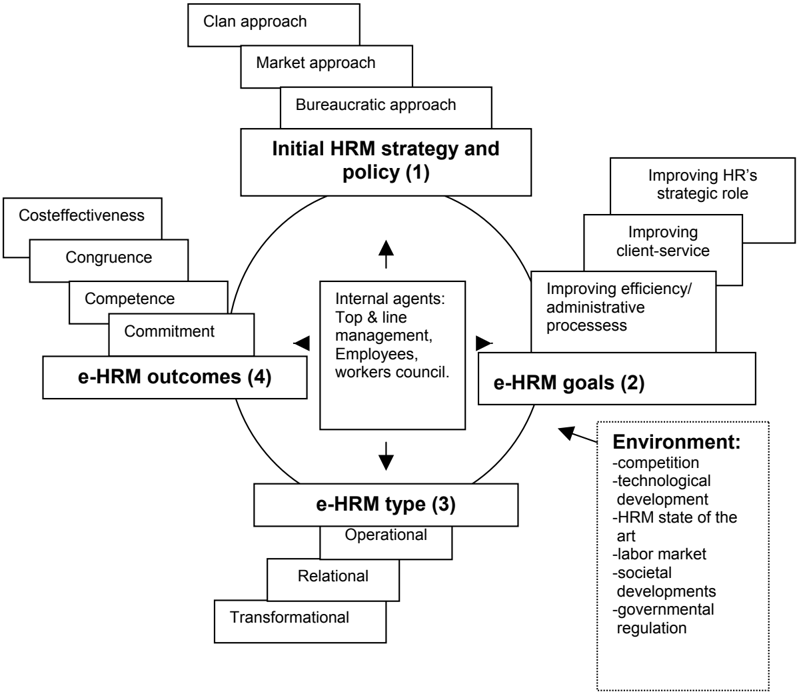
Technological optimistic voices assume that, from a technical perspective, the IT possibilities for HRM are endless: in principal all HR processes can be supported by IT. E-HRM is the relatively new term for this IT supported HRM, especially through the use of web technology. This paper aims at demystifying e-HRM by answering the following questions: what actually is e-HRM?, what are the goals of starting with e-HRM?, what types can be distinguished? and what are the outcomes of e-HRM? Based upon the literature, an e-HRM research model is developed and, guided by this model, five organizations have been studied that have already been on the 'e-HR road' for a number of years. We conclude that the goals of e-HRM are mainly to improve HR's administrative efficiency/to achieve cost reduction. Next to this goals, international companies seem to use the introduction of e-HRM to standardize/harmonize HR policies and processes. Further, there is a 'gap' between e-HRM in a technical sense and e-HRM in a practical sense in the five companies involved in our study. Finally, e-HRM hardly helped to improve employee competences, but resulted in cost reduction and a reduction of the administrative burden.
Overview
CoChat Summary
## TL;DR
This explorative case study examines web-based HRM (e-HRM) in five large companies and argues that e-HRM is less a technical upgrade than a shift in how HR work is done and by whom. Across the cases, the main reported effects were cost reduction and lower administrative burden, while improvements in employee competences were limited.
## Key findings
- The study’s five cases were Dow Chemicals, ABN AMRO, Ford Motor Company, IBM, and Belgacom; all had been on the “e-HR road” for several years and all were large firms with more than 15,000 employees.
- The authors identify three main e-HRM goals from the literature and cases: improving HR’s strategic orientation, reducing costs/raising efficiency, and improving client service for managers and employees; they also add a fourth goal based on the cases: improving a company’s global orientation.
- In the cases, e-HRM was associated mainly with cost reduction and a reduction of the administrative burden; the paper says no exact figures existed for these reductions.
- The paper reports a persistent gap between e-HRM in a technical sense and e-HRM in practice: at Dow Chemicals, adoption by users lagged behind technical possibilities by around three years.
- Reported outcomes varied by company, including “67% of all HR data entries” through employee self-service at one firm, employee satisfaction with HR service rising from 4.39 to 4.93 on a five-point scale in one year at another, and “80%” considering HR-online the primary source for HR at IBM.
## Methods
- Explorative qualitative multiple-case study design, with the organization as the unit of analysis.
- Sample: five large companies (>10,000 employees; in fact each >15,000), selected because they had a good reputation in e-HRM and had been using it for years.
- Data collection and analysis: conversational interviews as the dominant method, plus participant observations and documents; the data were categorized using indicators from the research model, then conclusions were drawn within and across cases.
## Limitations
- The paper states that the study is not intended to generalize statistically across all companies; it aims only at theoretical generalization.
- It explicitly notes that the study is exploratory and that the authors are still at a “preliminary stage” in understanding the relationship between IT and HRM, and that further research is needed.
- Evident from the text: the study relies on retrospective interviews and short observation periods, so recall bias and limited observation depth are plausible constraints, though these are not stated explicitly in the paper.
Model-written summary. Check it against the paper before relying on it.
Integrity signals
Registry
Cites
Statistics
Figures
Verification
Claims the paper makes
0 Valid · 1 Not valid · 14 Not checked · 75 Own results and interpretations
A result the paper reports from its own data — it cites no other source for it, so there is none to check. The quote shows it is in the paper.
In the paper
“Next to this goals, international companies seem to use the introduction of e-HRM to standardize/harmonize HR policies and processes.”
hedgedstates an association- Asserted: passes — The authors put it forward as true.
- Checkable: passes — It can be checked against evidence.
- Load-bearing: passes — The paper’s conclusions depend on it.
- Based: passes — The paper gives a reason why it holds.
A result the paper states — it cites no source for it, so there is none to check. The quote shows it is in the paper.
In the paper
“The fifth company involved, Belgacom, is not yet an international company, and therefore would not make this connection.”
- Also stated in: § 4.1 Commencing with e-HRM at our five case companies: an overall assessment · plain
“The fifth company involved, Belgacom, is not yet an international company”
plainSingle case- Asserted: passes — The authors put it forward as true.
- Checkable: passes — It can be checked against evidence.
- Load-bearing: passes — The paper’s conclusions depend on it.
- Based: passes — The paper gives a reason why it holds.
- Also stated in: § 4.1 Commencing with e-HRM at our five case companies: an overall assessment · plain
A result the paper states — it cites no source for it, so there is none to check. The quote shows it is in the paper.
In the paper
“In fact this suggests the first conclusion: there does not seem to be 'one natural way' to get on the 'e-HR road'.”
hedged- Asserted: passes — The authors put it forward as true.
- Checkable: passes — It can be checked against evidence.
- Load-bearing: passes — The paper’s conclusions depend on it.
- Based: passes — The paper gives a reason why it holds.
A result the paper reports from its own data — it cites no other source for it, so there is none to check. The quote shows it is in the paper.
In the paper
“Four of them operated internationally, and all of these linked their e-HRM plans with their aim of becoming a global company rather than an internationally dispersed one.”
plainstates an associationn = 4- Asserted: passes — The authors put it forward as true.
- Checkable: passes — It can be checked against evidence.
- Load-bearing: unclear — It is unclear whether the paper’s conclusions depend on it.
- Based: passes — The paper gives a reason why it holds.
A result the paper reports from its own data — it cites no other source for it, so there is none to check. The quote shows it is in the paper.
In the paper
“Starting to work with e-HRM seems to be connected with the process and globalization aims of the companies. This is one of the more interesting points to emerge from our look at the five companies.”
hedgedstates an associationn = 5- Asserted: passes — The authors put it forward as true.
- Checkable: passes — It can be checked against evidence.
- Load-bearing: unclear — It is unclear whether the paper’s conclusions depend on it.
- Based: passes — The paper gives a reason why it holds.
31 more claims
Create a free account to see all 90 claims and every source verdict.
- It may state two separate claims as one. 27
- Probably not a substantial claim. 32
Claims other papers make about this one
Each is checked against this paper’s own text: does it say what the citing paper says it does?
The source backs part of the claim, not all of it — or backs it for a different population, condition or comparison.
In the citing paper
“relational consequences emphasise the interactions and networking of different actors in sustaining the relationships with an employee by improving HR services and empowering employees”
From AI-augmented HRM: Antecedents, assimilation and multilevel consequences (2023) · cites this paper as Ruel et al., 2004
Experimental — accuracy not yet measuredThe source backs part of the claim, not all of it — or backs it for a different population, condition or comparison.
In the citing paper
“This proposed standardisation across different units in an organisation can help managers use the shared HR services to be HR compliant and improve the management process, resulting in strategic contribution and competitive advantage (Parry, 2011; Ruel et al., 2004).”
From AI-augmented HRM: Antecedents, assimilation and multilevel consequences (2023) · cites this paper as Ruel et al., 2004
Experimental — accuracy not yet measuredThe cited source says what the claim attributes to it.
In the citing paper
“the strategic orientation of HRM”
From AI-augmented HRM: Antecedents, assimilation and multilevel consequences (2023) · cites this paper as Ruel et al., 2004
The cited source says what the claim attributes to it.
In the citing paper
“Cost reduction/efficiency gains”
From AI-augmented HRM: Antecedents, assimilation and multilevel consequences (2023) · cites this paper as Ruel et al., 2004
The cited source says what the claim attributes to it.
In the citing paper
“Client service improvement/facilitating management and employees”
From AI-augmented HRM: Antecedents, assimilation and multilevel consequences (2023) · cites this paper as Ruel et al., 2004
Citations
Cites
(1993) · Cited by 7,856
Using Qualitative Methods in Organizational Research
Lee, T. (1998) · Medical Entomology and Zoology · Cited by 1,123
Degenne, A., & Forse, M. (1999) · SAGE Publications Ltd eBooks · doi:10.4135/9781849209373 · Cited by 886
Beatty, R. W., McEvoy, G. M., Beer, M., Spector, B., Lawrence, P. R., Mills, D. Q., & Walton, R. E. (1986) · Industrial and Labor Relations Review · doi:10.2307/2523277 · Cited by 731
Ulrich, D. (1996) · Cited by 641
Virtual HR: Strategic human resource management in the 21st century
Lepak, D. P., & Snell, S. A. (1998) · Human Resource Management Review · doi:10.1016/s1053-4822(98)90003-1 · Cited by 454 · cited 5×
“Interestingly, in all of these companies, ‘globalizing’ HR produced a tendency to centralize HR policy responsibilities at the company headquarters, while responsibilities for applying HR responsibilities were actually decentralized, placed in the hands of line managers and employees.”
BackgroundMethodInfluentialThompson, K. R. (1997) · Organizational Dynamics · doi:10.1016/s0090-2616(97)90039-5 · Cited by 374
Human Resource Information Systems: A Current Assessment
DeSanctis, G. (1986) · MIS Quarterly · doi:10.2307/248875 · Cited by 281 · cited 2×
“Keywords: e-HRM, HRM, IT, explorative case studies.”
MethodConditions for successful human resource information systems
Haines, V. Y., & Petit, A. (1997) · Human Resource Management · doi:10.1002/(sici)1099-050x(199722)36:2<261::aid-hrm7>3.0.co;2-v · Cited by 156
Schlevogt, K.-A. (2002) · Art of Chinese Management · doi:10.1093/oso/9780195136449.005.0002 · Cited by 141
Research works printed but not linked: 1
- Greengard, S. (1995): Using internal web sites to automate HR. In: Personnel Journal, June.
Cited by
The influence of technology on the future of human resource management
Stone, D. L., Deadrick, D. L., Lukaszewski, K. M., & Johnson, R. (2015) · Human Resource Management Review · doi:10.1016/j.hrmr.2015.01.002 · Cited by 618
Research in e-HRM: Review and implications
Strohmeier, S. (2007) · Human Resource Management Review · doi:10.1016/j.hrmr.2006.11.002 · Cited by 571
Conceptualising the future of HRM and technology research
Bondarouk, T., & Brewster, C. (2016) · The International Journal of Human Resource Management · doi:10.1080/09585192.2016.1232296 · Cited by 438
“It involves almost all employees (Ruël et al., 2004) and even people outside of ‘ employment ’ .”
BackgroundSelf-citationElectronic HRM: four decades of research on adoption and consequences
Bondarouk, T., Parry, E., & Furtmueller, E. (2017) · The International Journal of Human Resource Management · doi:10.1080/09585192.2016.1245672 · Cited by 423
“In view of that trend Ruël et al. (2004) observed that effectively adopting e-HRM in an organization requires a change in employees’ mindsets, since it requires them to do their work differently.”
BackgroundMethodInfluentialSelf-citationAn evidence-based review of e-HRM and strategic human resource management
Marler, J. H., & Fisher, S. L. (2013) · Human Resource Management Review · doi:10.1016/j.hrmr.2012.06.002 · Cited by 398
“Organizational goals for e-HRM investments include cost reduction through streamlining HRM operations [22], improved effectiveness through providing better delivery of HRM services [34] and transformation of the HRM function to a strategic business partner [20].”
BackgroundDigital human resource management: A conceptual clarification
Strohmeier, S. (2020) · German Journal of Human Resource Management: Zeitschrift für Personalforschung · doi:10.1177/2397002220921131 · Cited by 358
“This change is regularly understood as “transformational” (Bondarouk et al., 2016; Ruël et al., 2004).”
BackgroundHuman resource management, strategic involvement and e-HRM technology
Marler, J. H., & Parry, E. (2016) · The International Journal of Human Resource Management · doi:10.1080/09585192.2015.1091980 · Cited by 315
“…complex regulatory and institutionally mandated employment practices, information technology can also result in the reduction of this administrative burden, therefore open up the potential for HR professionals to improve their strategic orientation (Parry & Tyson, 2011; Ruel et al., 2004).”
BackgroundDesired goals and actual outcomes of e-HRM: e-HRM goals and outcomes
Parry, E., & Tyson, S. (2011) · Human Resource Management Journal · doi:10.1111/j.1748-8583.2010.00149.x · Cited by 268
“This provides some support for previous work suggesting a strategic impact of e-HRM (Ruel et al., 2004; Olivas-Lujan et al., 2007; Parry, forthcoming).”
BackgroundMethodResultInfluentialAlraja, M. N., Imran, R., Khashab, B. M., & Shah, M. (2022) · Information Systems Frontiers · doi:10.1007/s10796-022-10250-z · Cited by 252
“For implementing green HRM, these factors play an important role (Rahman et al., 2018; Ruël et al., 2004).”
MethodAI-augmented HRM: Antecedents, assimilation and multilevel consequences
Prikshat, V., Malik, A., & Budhwar, P. (2023) · Human Resource Management Review · doi:10.1016/j.hrmr.2021.100860 · Cited by 200
The benefits of eHRM and AI for talent acquisition
Johnson, R. D., Stone, D. L., & Lukaszewski, K. M. (2021) · Journal of Tourism Futures · doi:10.1108/jtf-02-2020-0013 · Cited by 192
“…resource management (eHRM) and is defined as the use of internet or intranet technology to facilitate human resource management (HRM) processes including recruitment, selection, training, performance management, compensation and HR planning (Lengnick-Hall and Moritz, 2003; Ruël et al., 2004).”
BackgroundAlgorithmic management in the gig economy: A systematic review and research integration
Kadolkar, I., Kepes, S., & Subramony, M. (2025) · Journal of Organizational Behavior · doi:10.1002/job.2831 · Cited by 183
Concepts of e-HRM consequences: a categorisation, review and suggestion
Strohmeier, S. (2009) · The International Journal of Human Resource Management · doi:10.1080/09585190802707292 · Cited by 159
AI redefining the hospitality industry
Ruël, H. J. M., & Njoku, E. (2020) · Journal of Tourism Futures · doi:10.1108/jtf-03-2020-0032 · Cited by 223
“As operational e-HRM supports HRM transactions and administrative activities (Snell et al., 1995; Alleyne, 2002; Ruel et al., 2004), while transformational e-HRM, digital data analytics and AI-enhanced e-HRM is concerned with innovating HRM to a more strategic oriented function, by providing HR…”
BackgroundMethodSelf-citationAn Investigation of the Effects of Technology Readiness on Technology Acceptance in e-HRM
Erdoğmuş, N., & Esen, M. (2011) · Procedia - Social and Behavioral Sciences · doi:10.1016/j.sbspro.2011.09.131 · Cited by 183
“E-HRM is also defined as a way of implementing HR strategies, policies, and practices in organizations through a conscious and directed support and/or with the full use of web-technology-based channels (Ruel et al. (2004).”
BackgroundMethodOrganizational adoption of e‐HRM in Europe: An empirical exploration of major adoption factors
Strohmeier, S., & Kabst, R. (2009) · Journal of Managerial Psychology · doi:10.1108/02683940910974099 · Cited by 142
Making human resources strategic by going to the Net: reality or myth?
Marler, J. H. (2009) · The International Journal of Human Resource Management · doi:10.1080/09585190802707276 · Cited by 138
“In this literature, HR becomes more strategic when the HR function moves from being primarily administrative to being ‘more strategic’ where the phrase ‘being more strategic’ reduces the HR function to supporting the organization's external business strategy (Lepak and Snell 1998 ; Snell, Stueber and Lepak 2001 ; Leng…”
Backgrounde‐HRM in Mexico: adapting innovations for global competitiveness
Olivas‐Lujan, M. R., Ramirez, J., & Zapata‐Cantu, L. (2007) · International Journal of Manpower · doi:10.1108/01437720710778402 · Cited by 131
The link between e-HRM use and HRM effectiveness: an empirical study
Obeidat, S. M. (2016) · Personnel Review · doi:10.1108/pr-04-2015-0111 · Cited by 124
State University of New York, Johnson, R. D., Lukaszewski, K. M., Wright State University, Stone, D. L., & State University of New York & Virginia Tech (2016) · Communications of the Association for Information Systems · doi:10.17705/1cais.03828 · Cited by 121
“Conversely, those discussing eHRM have tended to take a more strategic focus by discussing how these systems transform HR processes (Ruël et al., 2004; Gueutal & Stone, 2005; Lengnick-Hall & Moritz, 2003).”
BackgroundHeikkilä, J.-P., & Smale, A. (2010) · Journal of World Business · doi:10.1016/j.jwb.2010.07.004 · Cited by 130
When less is more: The effect of devolution on HR's strategic role and construed image
Kulik, C. T., & Perry, E. L. (2008) · Human Resource Management · doi:10.1002/hrm.20231 · Cited by 94
The impact of HRM digitalization on firm performance: investigating three‐way interactions
Zhou, Y., Liu, G., Chang, X., & Li-jun, W. (2020) · Asia Pacific Journal of Human Resources · doi:10.1111/1744-7941.12258 · Cited by 134
How strategic considerations influence decision making on e-HRM applications
Schalk, R., Timmerman, V., & van den Heuvel, S. (2012) · Human Resource Management Review · doi:10.1016/j.hrmr.2012.06.008 · Cited by 111
“…can seek to (1) improve the strategic orientation of HRM, (2) reduce costs or increase efficiency, (3) improve client service or facilitate management and employees and/or (4) improve the organization's global orientation by standardizing and harmonizing the HR function (Ruël et al., 2004).”
BackgroundMethodE-recruitment: Towards an Ubiquitous Recruitment Process and Candidate Relationship Management
Holm, A. B. (2012) · German Journal of Human Resource Management Zeitschrift für Personalforschung · doi:10.1177/239700221202600303 · Cited by 184
“These suggest a transformational role of e-recruitment when introduced to the recruitment process, which, on a general e-HRM level, adds new knowledge and insights to the contributions by Ruël, Bondarouk and Looise (2004), and, specifically for recruitment, to those by Parry and Tyson (2009).”
BackgroundE-HRM Usage and Value Creation. Does a Facilitating Context Matter?
Ruël, H., & van der Kaap, H. (2012) · German Journal of Human Resource Management: Zeitschrift für Personalforschung · doi:10.1177/239700221202600304 · Cited by 78
“The latter, however, have been addressed by researchers as the more important and more useful advantage and consequence of e-HRM (e.g. Ruël et al., 2004).”
BackgroundMethodInfluentialSelf-citationConfigurations of e-HRM-an empirical exploration
Strohmeier, S., & Kabst, R. (2014) · Employee Relations · doi:10.1108/er-07-2013-0082 · Cited by 73
The unexpected side of relational e-HRM: Developing trust in the HR department
Bissola, R., & Imperatori, B. (2014) · Employee Relations · doi:10.1108/er-07-2013-0078 · Cited by 73
Adoption of Human Resource Information System: A Theoretical Analysis
Chakraborty, A. R., & Mansor, N. N. A. (2013) · Procedia - Social and Behavioral Sciences · doi:10.1016/j.sbspro.2013.04.051 · Cited by 109
Lost in translation? An actor-network approach to HRIS implementation
Dery, K., Hall, R., Wailes, N., & Wiblen, S. L. (2013) · The Journal of Strategic Information Systems · doi:10.1016/j.jsis.2013.03.002 · Cited by 87
“Second, HRIS’s can help drive the ‘modernization’ of HR departments (Bondarouk & Ruël, 2009) and the implementation of ‘transformational’ (i.e. strategic) HR practices (Bondarouk, Ruël, & van der Heijden, 2009; Ruël, Bondarouk, & Looise, 2004a).”
BackgroundElectronic human resource management (e-HRM): A new concept for digital age
Berber, N., Đorđević, B., & Milanović, S. (2018) · Strategic Management · doi:10.5937/straman1802022b · Cited by 117
The Role of Electronic Human Resource Management in Contemporary Human Resource Management
Ma, L., & Ye, M. (2015) · Open Journal of Social Sciences · doi:10.4236/jss.2015.34009 · Cited by 92
“They also found that international companies seem to use the introduction of E-HRM to standardize HR policies and processes [7].”
BackgroundMethodInfluentialFactors influencing E-HRM implementation in government organisations: Case studies from Bangladesh
Rahman, M., Mordi, C., & Nwagbara, U. (2018) · Journal of Enterprise Information Management · doi:10.1108/jeim-05-2017-0066 · Cited by 96
Torres, E. N., & Mejia, C. (2016) · International Journal of Hospitality Management · doi:10.1016/j.ijhm.2016.10.012 · Cited by 94
Transitioning to a New Hris: The Reshaping of Human Resources and Information Technology Talent
Wiblen, S. L., Grant, D., & Dery, K. (2010) · Research Online (University of Wollongong) · Cited by 88
Maximizing e-HRM outcomes: a moderated mediation path
Panos, S., & Bellou, V. (2016) · Management Decision · doi:10.1108/md-07-2015-0269 · Cited by 79
Bal, Y., Bozkurt, S., & Ertemsir, E. (2022) · River Publishers eBooks · doi:10.1201/9781003357223-11 · Cited by 60
Unveiling the relationship between e-HRM, impersonal trust and employee productivity
Iqbal, N., Ahmad, M., & Allen, M. M. C. (2019) · Management Research Review · doi:10.1108/mrr-02-2018-0094 · Cited by 99
Adoption of electronic systems in HRM: is national background of the firm relevant?
Panayotopoulou, L., Galanaki, E., & Papalexandris, N. (2010) · New Technology Work and Employment · doi:10.1111/j.1468-005x.2010.00252.x · Cited by 72
“More specifically e-HRM is an innovation in terms of HRM, first because it creates opportunities to put employee-management relations in the hands of employees and line managers and second, because it creates possibilities to design HRM tools that would not be possible without IT (Ruel et al., 2004).”
InfluentialAl-Harazneh, Y. M., & Sila, I. (2021) · Journal of Global Information Management · doi:10.4018/jgim.2021030107 · Cited by 80
“An e-HRM system is also defined as “a way of implementing HR strategies, policies and practices in organisations through conscious and directed support of and/ or with the full use of web-technology-based channels” (Ruël, Bondarouk, & Looise, 2004, p.281).”
BackgroundMethodInfluentialLinking e-hrm practices and organizational outcomes: empirical analysis of line manager’s perception
Iqbal, N., Ahmad, M., Raziq, M. M., & Borini, F. M. (2019) · Review of Business Management · doi:10.7819/rbgn.v21i1.3964 · Cited by 86
“Bondarouk, Harms, and Lepak (2017) and Ruël et al. (2004) suggest that one year of e-HRM system maturity creates a comfortable research zone.”
BackgroundBondarouk, T. V., Schilling, D., & Ruël, H. J. M. (2016) · Canadian Journal of Administrative Sciences / Revue Canadienne des Sciences de l Administration · doi:10.1002/cjas.1376 · Cited by 66
Self-citationBeyond the ‘e-’ in e-HRM: integrating a sociomaterial perspective
Myllymäki, D. (2021) · The International Journal of Human Resource Management · doi:10.1080/09585192.2021.1913624 · Cited by 52
“…as a tool that allows for relational consequences through information collection and distribution (Arjomandy, 2016; Lin, 2011; Parry & Tyson, 2011; Ruël et al., 2004), which improve HR services within the organisation through better availability of information about HR policies (Bondarouk et al.,…”
BackgroundInfluentialLi-jun, W., Zhou, Y., & Zheng, G. (2022) · Sustainability · doi:10.3390/su14021003 · Cited by 91
“In contrast, without maturity and the appropriation of HRM processes, digital HRM practices cannot operate effectively and may not be able to exploit fully the efficacy of digital HRM, potentially creating confusion [40,60].”
BackgroundDeterminants of Attitude Towards E-HRM: an Empirical Study Among HR Professionals
Yusliza, M. Y., & Ramayah, T. (2012) · Procedia - Social and Behavioral Sciences · doi:10.1016/j.sbspro.2012.09.1191 · Cited by 67
“[5] conducted an explorative empirical study in five large companies on web-based HRM.”
MethodGalanaki, E., Lazazzara, A., & Parry, E. (2018) · Lecture notes in information systems and organisation · doi:10.1007/978-3-319-90500-6_20 · Cited by 79
The Digitalization of Human Resource Management: Present and Future
Zavyalova, E. K., Sokolov, D., Kucherov, D., & Lisovskaia, A. Y. (2022) · Foresight-Russia · doi:10.17323/2500-2597.2022.2.42.51 · Cited by 106
“Though technology does relieve HR managers of much of the routine tasks (Ruel et al., 2004) and makes it easier for front-line employees to manage HR (Malik et al.”
E-HRM: A proposed model based on technology acceptance model
Yusoff, Y. M., Ramayah, T., & Ibrahim, H. (2010) · AFRICAN JOURNAL OF BUSINESS MANAGEMENT · doi:10.5897/ajbm.9000230 · Cited by 68
Exploring the Outcomes of Electronic Human Resource Management (E-HRM)?
Fındıklı, M. A., & Bayarçelik, E. B. (2015) · Procedia - Social and Behavioral Sciences · doi:10.1016/j.sbspro.2015.10.112 · Cited by 85
“…number of researchers state that e-HRM is becoming common and may lead to remarkable changes in the organizational cores (Hopkins & Markham, 2003; Ruël et al., 2004; Strohmeier, 2007; Marler & Fisher, 2010; Dulebohn & Marler, 2005; Ruël & Kaap, 2012; Kaur, 2013, Strohmeier & Kabst, 2014;…”
BackgroundBechter, B., Brandl, B., & Lehr, A. (2022) · New Technology, Work and Employment · doi:10.1111/ntwe.12239 · Cited by 45
HR technologies and HR-staff technostress: an unavoidable or combatable effect?
Florkowski, G. W. (2019) · Employee Relations · doi:10.1108/er-08-2018-0214 · Cited by 59
An institutional theory perspective on e-HRM’s strategic potential in MNC subsidiaries
Heikkilä, J.-P. (2013) · The Journal of Strategic Information Systems · doi:10.1016/j.jsis.2013.07.003 · Cited by 65
“In broader terms, e-HRM has also been referred to HR Information Systems (HRIS) (Ngai and Wat, 2006), web-based HRM (Ruël et al., 2004), intranet-based HRM (Bondarouk and Ruël, 2009a) and HRIT (Florkowski and Olivas-Luján, 2006).”
BackgroundMethodInfluentialJani, A., Muduli, A., & Kishore, K. (2021) · International journal of organizational analysis · doi:10.1108/ijoa-08-2021-2886 · Cited by 74
Wiblen, S. L. (2016) · Canadian Journal of Administrative Sciences / Revue Canadienne des Sciences de l Administration · doi:10.1002/cjas.1378 · Cited by 58
“Put another way, it is the way that practices are formed through the appropriation of e-HRM capabilities that processes of identifying talent are formalized, structured, and standardized (Parry & Tyson, 2011; Ruël et al., 2004; Schalk et al., 2013).”
BackgroundMethodRawashdeh, A. M., Elayan, M. B., Alhyasat, W. M. K., & Shamout, M. D. (2021) · International Journal for Quality Research · doi:10.24874/ijqr15.02-20 · Cited by 65
Arjomandy, D. (2016) · Canadian Journal of Administrative Sciences / Revue Canadienne des Sciences de l Administration · doi:10.1002/cjas.1380 · Cited by 64
Khashman, A. M., & Alryalat, H. (2015) · Journal of Management Research · doi:10.5296/jmr.v7i3.7462 · Cited by 76
Innovative Trends in Human Resources Management
Bilevičienė, T., Bilevičiūtė, E., & Paražinskaitė, G. (2015) · Economics & Sociology · doi:10.14254/2071-789x.2015/8-4/7 · Cited by 49
“The support for the user should be ensure (Ruël et al., 2004; Orlikowski, 2000).”
BackgroundPoulose, S., Bhattacharjee, B., & Chakravorty, A. (2024) · Management Review Quarterly · doi:10.1007/s11301-024-00423-2 · Cited by 101
“(Muhammad et al. 2024; Ruël et al. 2004 ; Voermans and van Veldhoven 2007; Premkumar and Roberts 1999 ; Panayotopoulou et al. 2007; Thong 1999).”
e-HRM Research and Practice: Facing the Challenges Ahead
Ruël, H. J. M., & Bondarouk, T. V. (2013) · Progress in IS · doi:10.1007/978-3-642-39747-9_26 · Cited by 53
Self-citationCritical Success Factors of the E-Recruitment System
Ghazzawi, K., & Accoumeh, A. (2014) · Cited by 38
Bissola, R., & Imperatori, B. (2013) · European J of International Management · doi:10.1504/ejim.2013.055282 · Cited by 55
“(2002) suggest placing within this category all the practices that enable people to communicate across boundaries and share information such as data networks, blended education and training, performance support systems and 360 degree diagnostics, which other authors consider as either relational or operational practic…”
BackgroundInfluentialEvaluating E-HRM success: A Validation of the Information Systems Success Model
Alshibly, H. H. (2014) · International Journal of Human Resource Studies · doi:10.5296/ijhrs.v4i3.5929 · Cited by 59
“The difference between HRIS and e HRM can be identified as the switch from the automation of HR services towards technological support of information on HR services. e-HR e-HR is the technical unlocking of HRIS for all employees of an organization (Ruël et al., 2004).”
BackgroundSmale, A., Björkman, I., & Sumelius, J. (2012) · Journal of World Business · doi:10.1016/j.jwb.2012.07.007 · Cited by 47
Met the expectations? A meta-analysis of the performance consequences of digital HRM
Theres, C., & Strohmeier, S. (2023) · The International Journal of Human Resource Management · doi:10.1080/09585192.2022.2161324 · Cited by 68
“Multiple factors such as a country’s government regulations, political factors, and cultural factors may all influence the relationships between digital HRM usage and associated consequences (Bondarouk et al., 2019; Ruël et al., 2004).”
BackgroundUllah, Z., Ahmad, N., Scholz, M., Ahmed, B., Ahmad, I., & Usman, M. (2021) · Sustainability · doi:10.3390/su13042109 · Cited by 56
“Researchers investigating the impact of IT on HRM defined e-HRM as ‘the planning, implementation, and application of information technology for both connecting and supporting at least two persons or collective actors in their collective performing HR practices [10], and recently as ‘the use of computers and telecommun…”
BackgroundHRM 4.0 and New Managerial Competences Profile: The COMAU Case
Fregnan, E., Ivaldi, S., & Scaratti, G. (2020) · Frontiers in Psychology · doi:10.3389/fpsyg.2020.578251 · Cited by 34
“In the literature, the connection between new technologies and HRM is described as electronic HRM (e-HRM), which is what Ruël et al. (2004, p. 368) have defined as “a way of implementing HRM strategies, policies, and practices in organizations through the conscious and direct support of and/or with…”
BackgroundElectronic human resource management: Enhancing or entrancing?
Poisat, P., & Mey, M. R. (2017) · SA Journal of Human Resource Management · doi:10.4102/sajhrm.v15i0.858 · Cited by 49
“…review, it seems apparent that e-HRM is regarded as being mostly concerned with cost reduction and efficiency increases in the provision of HR services, rather than on improving the strategic orientation of HRM (Gardner, Lepak & Bartol, 2003; Parry & Tyson, 2011; Ruël et al., 2004; Ruta, 2005).”
BackgroundMethodInfluentialDeterminants that Influencing the Adoption of E-HRM: An Empirical Study on Bangladesh
Masum, A. K. M., Kabir, M. J., & Chowdhury, M. M. (2015) · Asian Social Science · doi:10.5539/ass.v11n21p117 · Cited by 39
“…Teo et al., 2007), top level management support (Teo et al., 2007; Altarawneh & Al-Shqairat, 2010; Troshani et al., 2011; Masum, 2015); Industry pressure (Thong, 1999; Teo et al., 2007; Kittipong, 2009; Masum, 2015), and IT expertise (van Veldhoven & Ruël et al., 2004; Voermans, 2007; Masum, 2015).”
BackgroundTipping the scales: ambidexterity practices on e-HRM projects
Tansley, C., Kirk, S., Williams, H., & Barton, H. (2014) · Employee Relations · doi:10.1108/er-07-2013-0090 · Cited by 45
“…administrative functions to play a more genuine strategic business-partnering role, thereby driving the ‘modernization‟ of HR departments (Bondarouk & Ruël, 2009) and the implementation of "transformational‟ (i.e. strategic) HR practices (Bondarouk,et al., 2009a; Ruël et al., 2004; Marler, 2009).”
BackgroundUnderstanding the HRD Role in MNCs:The Imperatives of Social Capital and Networking
Gubbins, C., & Garavan, T. N. (2009) · Human Resource Development Review · doi:10.1177/1534484309334583 · Cited by 33
Identifying Innovations in Human Resources
Singh, A., & Kumar, S. (2020) · Advances in human resources management and organizational development book series · doi:10.4018/978-1-7998-4180-7.ch006 · Cited by 32
Kerdawy, M. M. A. A. (2016) · International Business Research · doi:10.5539/ibr.v9n6p80 · Cited by 46
Integration of Social Media in Recruitment: A Delphi Study
Girard, A., Fallery, B., & Rodhain, F. (2013) · Emerald Group Publishing Limited eBooks · doi:10.1108/s1877-6361(2013)0000012009 · Cited by 59
“…media can enable a greater internalisation of recruitment through the development of social media HR strategy and the involvement of employees in the sourcing (which is in line with the management decentralization phenomena through the implementation of e-HRM stressed by Ruël et al. (2004) ).”
MethodQuaosar, G. M. A. A., & Rahman, M. S. (2021) · Journal of Human Resource and Sustainability Studies · doi:10.4236/jhrss.2021.93030 · Cited by 42
Martin, G., & Reddington, M. (2009) · Employee Relations · doi:10.1108/01425450910979266 · Cited by 35
AI in Human Resource Management: Literature Review and Research Implications
Zhai, Y., Zhang, L., & Yu, M. (2024) · Journal of the Knowledge Economy · doi:10.1007/s13132-023-01631-z · Cited by 48
“The positive effects include decision support systems (Bera et al., 2019); staff scheduling and dispatching (Guner et al., 2016), e-recruitment, e-training, or e-competence management (Ruël et al., 2004); and personnel appointments and removals (Leonardi & Contractor, 2018).”
An Evidence-Based Review of e-HRM and Its Impact on Strategic Human Resource Management
Almashyakhi, A. M. (2022) · Journal of Human Resource and Sustainability Studies · doi:10.4236/jhrss.2022.103033 · Cited by 58
E-HRM in MNCs: what can be learned from a review of the IS literature?
Geffen, C. V., Ruël, H., & Bondarouk, T. (2013) · European J. of International Management · doi:10.1504/ejim.2013.055278 · Cited by 28
Self-citationGarcía, M. V., López, M. F. B., & Castillo, M. Á. S. (2019) · Technological Forecasting and Social Change · doi:10.1016/j.techfore.2019.119783 · Cited by 34
Adoption Factors of Electronic Human Resource Management (e-HRM) in Banking Industry of Bangladesh
Masum, A. K. M. (2015) · Journal of Social Sciences · doi:10.3844/jssp.2015.1.6 · Cited by 26
“…infrastructure (Kwon and Zmud, 1987; Oliveira and Martins, 2010), compatibility (Rogers, 2003; Teo et al ., 2007), complexity (Rogers, 2003; Thong, 1999), IT expertise (Ruël et al ., 2004; Voermans and van Veldhoven, 2007) and competitive pressure (Kittipong, 2009; Teo et al ., 2007; Thong, 1999).”
BackgroundShah, N., Michael, F., & Chalu, H. Z. (2020) · Asian Journal of Business and Management · doi:10.24203/ajbm.v8i4.6066 · Cited by 36
“The E-HRM technology supports the HR function to stand by the HR requirements of the organization based on the system (Ruel et al., 2004).”
MethodAbuhantash, A. (2023) · European Journal of Business Management and Research · doi:10.24018/ejbmr.2023.8.3.1992 · Cited by 64
“…Vol 8 | Issue 3 | June 2023 241 B. HRIS Components and Functions Modern HRIS consist of several components, such as recruitment and talent management, training and development, performance management, and compensation management (Hendrickson, 2003; Ruël et al., 2014).”
BackgroundObeidat, S. M. (2017) · Evidence-based HRM a Global Forum for Empirical Scholarship · doi:10.1108/ebhrm-11-2015-0046 · Cited by 32
Digital Era and New Methods for Employee Recruitment
Baykal, E. (2019) · Advances in e-business research series · doi:10.4018/978-1-7998-1125-1.ch018 · Cited by 38
A dark side of e-HRM: mediating role of HR service delivery and HR socialization on HR effectiveness
Talukdar, A., & Ganguly, A. (2021) · International Journal of Manpower · doi:10.1108/ijm-01-2021-0038 · Cited by 40
e-Recruitment: New Practices, New Issues An Exploratory Study
Girard, A., & Fallery, B. (2009) · doi:10.5220/0002174100390048 · Cited by 25
“Both parts, give us the possibility to develop an e-recruitment model based on Ruël et al .’s (2004) [36] e-HRM model.”
MethodMcDonald, K., Fisher, S. L., & Connelly, C. E. (2017) · Emerald Group Publishing Limited eBooks · doi:10.1108/978-1-78714-315-920161004 · Cited by 42
HR Technology Systems: An Evidence-Based Approach to Construct Measurement
Florkowski, G. W. (2018) · Emerald Group Publishing Limited eBooks · doi:10.1108/s0742-730120180000036006 · Cited by 33
Sareen, P., & Subramanian, K. V. (2012) · International Journal of Human Resource Studies · doi:10.5296/ijhrs.v2i3.2100 · Cited by 34
Calluso, C., & Devetag, M. G. (2024) · International journal of organizational analysis · doi:10.1108/ijoa-06-2024-4562 · Cited by 38
Theres, C., & Strohmeier, S. (2023) · Management Review Quarterly · doi:10.1007/s11301-023-00367-z · Cited by 61
“…DeSanctis 1986; Mathys and LaVan 1982; Mayer 1971; Tomeski and Lazarus 1974) and Electronic Human Resource Management (e-HRM) as well as its subsets such as e-recruiting or organizational e-learning (e.g., Lengnick-Hall and Moritz 2003; Lepak and Snell 1998; Ruël et al. 2004; Strohmeier 2007).”
Digitalization of Human Resources
Baykal, E. (2019) · Advances in e-business research series · doi:10.4018/978-1-7998-0035-4.ch013 · Cited by 39
Chapter 1 Theoretical Approaches to e-HRM Implementations
Bondarouk, T. V. (2011) · Advanced series in management · doi:10.1108/s1877-6361(2011)0000008005 · Cited by 34
Self-citationE-HRM Adoption and Usage: A Cross-National Analysis of Enabling Factors
Lazazzara, A., & Galanaki, E. (2017) · Lecture notes in information systems and organisation · doi:10.1007/978-3-319-62051-0_11 · Cited by 24
The implementation of human resources information system and it’s benefit for organizations
Suharti, L., & Sulistyo, P. R. (2018) · Diponegoro International Journal of Business · doi:10.14710/dijb.1.1.2018.1-7 · Cited by 34
Exploring types, drivers and outcomes of social e-HRM
Martini, M., Cavenago, D., & Marafioti, E. (2020) · Employee Relations · doi:10.1108/er-10-2019-0404 · Cited by 40
E-HRM: PAIN OR GAIN FOR HRM EFFECTIVENESS
(2019) · Jurnal TAM (Technology Acceptance Model) · doi:10.56327/jurnaltam.v10i1.732 · Cited by 21
New technologies in HR: bridging efficiency and ethical considerations
Sposato, M., Dittmar, E. C., & Portillo, J. P. V. (2025) · International journal of organizational analysis · doi:10.1108/ijoa-09-2024-4814 · Cited by 30
The Importance of e-Recruitment within a Smart Government Framework
Koman, G., Toman, D., Jankal, R., & Boršoš, P. (2024) · Systems · doi:10.3390/systems12030071 · Cited by 39
Metadata
- Authors
- Ruël, H., Bondarouk, T., & Looise, J. K.
- Affiliations
- University of Twente (NL)
- Utrecht University (NL)
- ORCID
- Bondarouk, Tanya
- Venue
- management revu
- Publisher
- IMR Press
- Published
- 2004
- Volume
- 15
- Issue
- 3
- Pages
- 364-380
- ISSN
- 0935-9915 (ISSN-L)
- OpenAlex
- W1562646680
- Cited by
- 441
- References
- 19
- Citations by year
- 2026: 4 · 2025: 17 · 2024: 47 · 2023: 33 · 2022: 33 · 2021: 38 · 2020: 26 · 2019: 33 · 2018: 25 · 2017: 15 · 2016: 23 · 2015: 25 · 2014: 24 · 2013: 20 · 2012: 18
- FWCI
- 3.60
- Type
- journal article
- Language
- en
- Open access
- hybrid
- doi.org
- Licence
- cc-by
- Locations
- management revue (publishedVersion, cc-by)
- University of Twente Research Information (submittedVersion)
- RePEc: Research Papers in Economics (submittedVersion)
- Econstor (Econstor) (submittedVersion)
- University of Twente Research Information (submittedVersion, other-oa)
- Topics
- Social Sciences › Business, Management and Accounting › Organizational Behavior and Human Resource Management › Employer Branding and e-HRM
- Social Sciences › Business, Management and Accounting › Organizational Behavior and Human Resource Management › AI and HR Technologies
- Social Sciences › Business, Management and Accounting › Organizational Behavior and Human Resource Management › Human Resource and Talent Management
- Keywords
- e-HRM, human resource management, large corporations, HRM innovation
About these checks
Registry, retraction, Cites and statistics results are computed, not judged, with one exception: a printed reference that no index lists is read once by a model before it counts as a citation error. Claims are extracted by a model and kept only when their quote appears verbatim in the text; each cited source is then checked, with a model’s help, for whether it says what the claim relies on. Those verdicts can be wrong — read the claim’s quote and the cited source before relying on one.
A language model drew the claims from the paper on 2026-10-10, under version 3 of the claim definition (model deepseek-v4.1-flash, prompt extract-v3).
A second model labelled each claim on 2026-10-10 (model jev-1.13-20260917, definition revision gold-guideline-v0.2).
Statistics and arithmetic are recomputed, not judged.
Confidence bands are shown only for fields calibrated on our annotated test set. None is calibrated yet, so no band is shown.
What counts as a claim ›How we measure confidence ›How we check this ›
Are you an author, or do you see a problem with this page? Request a review
Data sources
Bibliographic data: Semantic Scholar, OpenAlex, Crossref.
Contains information from the Semantic Scholar Academic Graph Datasets, made available under the ODC Attribution License (ODC-BY 1.0).
Semantic Scholar’s data is described in: Kinney, R., et al. (2023). The Semantic Scholar Open Data Platform. arXiv:2301.10140.
