

E-HRM: Innovation or Irritation. An Explorative Empirical Study in Five Large Companies on Web-based HRM
Open accessThe DOI matches its Crossref record; 18 of the 19 references it cites were found in a registry or an index; none of the 16 sources its claims cite is checked for support yet.
Abstract
Technological optimistic voices assume that, from a technical perspective, the IT possibilities for HRM are endless: in principal all HR processes can be supported by IT. E-HRM is the relatively new term for this IT supported HRM, especially through the use of web technology. This paper aims at demystifying e-HRM by answering the following questions: what actually is e-HRM?, what are the goals of starting with e-HRM?, what types can be distinguished? and what are the outcomes of e-HRM? Based upon the literature, an e-HRM research model is developed and, guided by this model, five organizations have been studied that have already been on the 'e-HR road' for a number of years. We conclude that the goals of e-HRM are mainly to improve HR's administrative efficiency/to achieve cost reduction. Next to this goals, international companies seem to use the introduction of e-HRM to standardize/harmonize HR policies and processes. Further, there is a 'gap' between e-HRM in a technical sense and e-HRM in a practical sense in the five companies involved in our study. Finally, e-HRM hardly helped to improve employee competences, but resulted in cost reduction and a reduction of the administrative burden.
Overview
CoChat Summary
## TL;DR
This explorative case study examines web-based HRM (e-HRM) in five large companies and argues that e-HRM is less a technical upgrade than a shift in how HR work is done and by whom. Across the cases, the main reported effects were cost reduction and lower administrative burden, while improvements in employee competences were limited.
## Key findings
- The study’s five cases were Dow Chemicals, ABN AMRO, Ford Motor Company, IBM, and Belgacom; all had been on the “e-HR road” for several years and all were large firms with more than 15,000 employees.
- The authors identify three main e-HRM goals from the literature and cases: improving HR’s strategic orientation, reducing costs/raising efficiency, and improving client service for managers and employees; they also add a fourth goal based on the cases: improving a company’s global orientation.
- In the cases, e-HRM was associated mainly with cost reduction and a reduction of the administrative burden; the paper says no exact figures existed for these reductions.
- The paper reports a persistent gap between e-HRM in a technical sense and e-HRM in practice: at Dow Chemicals, adoption by users lagged behind technical possibilities by around three years.
- Reported outcomes varied by company, including “67% of all HR data entries” through employee self-service at one firm, employee satisfaction with HR service rising from 4.39 to 4.93 on a five-point scale in one year at another, and “80%” considering HR-online the primary source for HR at IBM.
## Methods
- Explorative qualitative multiple-case study design, with the organization as the unit of analysis.
- Sample: five large companies (>10,000 employees; in fact each >15,000), selected because they had a good reputation in e-HRM and had been using it for years.
- Data collection and analysis: conversational interviews as the dominant method, plus participant observations and documents; the data were categorized using indicators from the research model, then conclusions were drawn within and across cases.
## Limitations
- The paper states that the study is not intended to generalize statistically across all companies; it aims only at theoretical generalization.
- It explicitly notes that the study is exploratory and that the authors are still at a “preliminary stage” in understanding the relationship between IT and HRM, and that further research is needed.
- Evident from the text: the study relies on retrospective interviews and short observation periods, so recall bias and limited observation depth are plausible constraints, though these are not stated explicitly in the paper.
Model-written summary. Check it against the paper before relying on it.
Integrity signals
Registry
Cites
Statistics
Figures
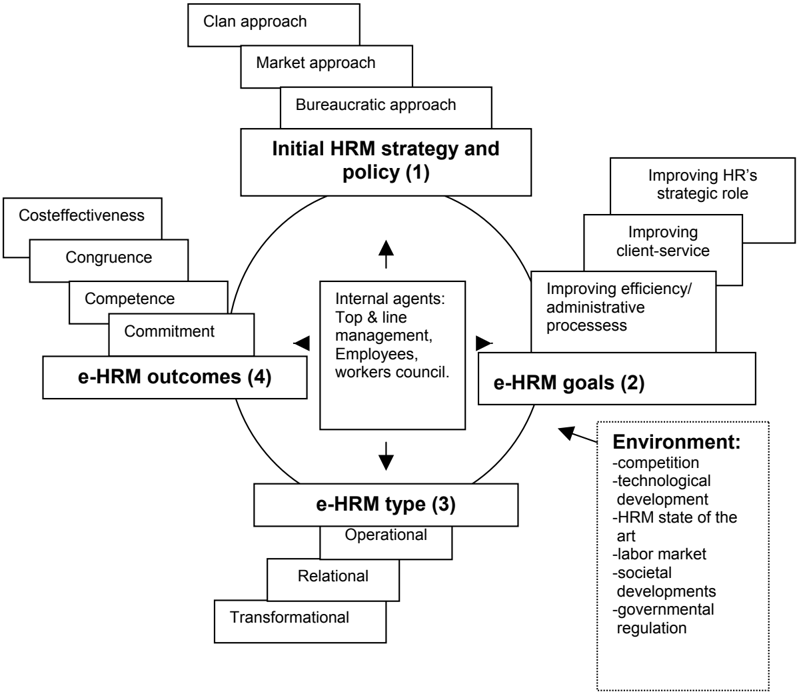
Verification
Claims the paper makes
0 Valid · 1 Not valid · 14 Not checked · 75 Own results and interpretations
A result the paper reports from its own data — it cites no other source for it, so there is none to check. The quote shows it is in the paper.
In the paper
“Next to this goals, international companies seem to use the introduction of e-HRM to standardize/harmonize HR policies and processes.”
hedgedstates an association- Asserted: passes — The authors put it forward as true.
- Checkable: passes — It can be checked against evidence.
- Load-bearing: passes — The paper’s conclusions depend on it.
- Based: passes — The paper gives a reason why it holds.
A result the paper states — it cites no source for it, so there is none to check. The quote shows it is in the paper.
In the paper
“The fifth company involved, Belgacom, is not yet an international company, and therefore would not make this connection.”
- Also stated in: § 4.1 Commencing with e-HRM at our five case companies: an overall assessment · plain
“The fifth company involved, Belgacom, is not yet an international company”
plainSingle case- Asserted: passes — The authors put it forward as true.
- Checkable: passes — It can be checked against evidence.
- Load-bearing: passes — The paper’s conclusions depend on it.
- Based: passes — The paper gives a reason why it holds.
- Also stated in: § 4.1 Commencing with e-HRM at our five case companies: an overall assessment · plain
A result the paper states — it cites no source for it, so there is none to check. The quote shows it is in the paper.
In the paper
“In fact this suggests the first conclusion: there does not seem to be 'one natural way' to get on the 'e-HR road'.”
hedged- Asserted: passes — The authors put it forward as true.
- Checkable: passes — It can be checked against evidence.
- Load-bearing: passes — The paper’s conclusions depend on it.
- Based: passes — The paper gives a reason why it holds.
A result the paper reports from its own data — it cites no other source for it, so there is none to check. The quote shows it is in the paper.
In the paper
“Four of them operated internationally, and all of these linked their e-HRM plans with their aim of becoming a global company rather than an internationally dispersed one.”
plainstates an associationn = 4- Asserted: passes — The authors put it forward as true.
- Checkable: passes — It can be checked against evidence.
- Load-bearing: unclear — It is unclear whether the paper’s conclusions depend on it.
- Based: passes — The paper gives a reason why it holds.
A result the paper reports from its own data — it cites no other source for it, so there is none to check. The quote shows it is in the paper.
In the paper
“Starting to work with e-HRM seems to be connected with the process and globalization aims of the companies. This is one of the more interesting points to emerge from our look at the five companies.”
hedgedstates an associationn = 5- Asserted: passes — The authors put it forward as true.
- Checkable: passes — It can be checked against evidence.
- Load-bearing: unclear — It is unclear whether the paper’s conclusions depend on it.
- Based: passes — The paper gives a reason why it holds.
31 more claims
Create a free account to see all 90 claims and every source verdict.
- It may state two separate claims as one. 27
- Probably not a substantial claim. 32
Claims other papers make about this one
Each is checked against this paper’s own text: does it say what the citing paper says it does?
The source backs part of the claim, not all of it — or backs it for a different population, condition or comparison.
In the citing paper
“relational consequences emphasise the interactions and networking of different actors in sustaining the relationships with an employee by improving HR services and empowering employees”
From AI-augmented HRM: Antecedents, assimilation and multilevel consequences (2023) · cites this paper as Ruel et al., 2004
Experimental — accuracy not yet measuredThe source backs part of the claim, not all of it — or backs it for a different population, condition or comparison.
In the citing paper
“This proposed standardisation across different units in an organisation can help managers use the shared HR services to be HR compliant and improve the management process, resulting in strategic contribution and competitive advantage (Parry, 2011; Ruel et al., 2004).”
From AI-augmented HRM: Antecedents, assimilation and multilevel consequences (2023) · cites this paper as Ruel et al., 2004
Experimental — accuracy not yet measuredThe cited source says what the claim attributes to it.
In the citing paper
“the strategic orientation of HRM”
From AI-augmented HRM: Antecedents, assimilation and multilevel consequences (2023) · cites this paper as Ruel et al., 2004
The cited source says what the claim attributes to it.
In the citing paper
“Cost reduction/efficiency gains”
From AI-augmented HRM: Antecedents, assimilation and multilevel consequences (2023) · cites this paper as Ruel et al., 2004
The cited source says what the claim attributes to it.
In the citing paper
“Client service improvement/facilitating management and employees”
From AI-augmented HRM: Antecedents, assimilation and multilevel consequences (2023) · cites this paper as Ruel et al., 2004
Citations
Cites
(1993) · Cited by 7,856
Using Qualitative Methods in Organizational Research
Lee, T. (1998) · Medical Entomology and Zoology · Cited by 1,123
Degenne, A., & Forse, M. (1999) · SAGE Publications Ltd eBooks · doi:10.4135/9781849209373 · Cited by 886
Beatty, R. W., McEvoy, G. M., Beer, M., Spector, B., Lawrence, P. R., Mills, D. Q., & Walton, R. E. (1986) · Industrial and Labor Relations Review · doi:10.2307/2523277 · Cited by 731
Ulrich, D. (1996) · Cited by 641
Virtual HR: Strategic human resource management in the 21st century
Lepak, D. P., & Snell, S. A. (1998) · Human Resource Management Review · doi:10.1016/s1053-4822(98)90003-1 · Cited by 454 · cited 5×
“Interestingly, in all of these companies, ‘globalizing’ HR produced a tendency to centralize HR policy responsibilities at the company headquarters, while responsibilities for applying HR responsibilities were actually decentralized, placed in the hands of line managers and employees.”
BackgroundMethodInfluentialThompson, K. R. (1997) · Organizational Dynamics · doi:10.1016/s0090-2616(97)90039-5 · Cited by 374
Human Resource Information Systems: A Current Assessment
DeSanctis, G. (1986) · MIS Quarterly · doi:10.2307/248875 · Cited by 281 · cited 2×
“Keywords: e-HRM, HRM, IT, explorative case studies.”
MethodConditions for successful human resource information systems
Haines, V. Y., & Petit, A. (1997) · Human Resource Management · doi:10.1002/(sici)1099-050x(199722)36:2<261::aid-hrm7>3.0.co;2-v · Cited by 156
Schlevogt, K.-A. (2002) · Art of Chinese Management · doi:10.1093/oso/9780195136449.005.0002 · Cited by 141
Research works printed but not linked: 1
- Greengard, S. (1995): Using internal web sites to automate HR. In: Personnel Journal, June.
Cited by
Items 201–300 of 435
Digitization of Human Resource Practices- An Emerging TrendPreprint
Rana, T. (2019) · SSRN Electronic Journal · doi:10.2139/ssrn.3323740 · Cited by 11
Omran, K. A. M., & Anan, N. (2019) · International Journal of Academic Research in Business and Social Sciences · doi:10.6007/ijarbss/v9-i3/5754 · Cited by 5
The Investigation of Employer Adoption of Human Resource Information Systems at University Using TAM
Göktaş, P., & Akgül, Y. (2021) · IGI Global eBooks · doi:10.4018/978-1-6684-3873-2.ch057 · Cited by 4
The evolution of HR practices: An analytical review of trends in the USA and Nigeria
Ucha, B. D., Ajayi, F. A., & Olawale, O. (2024) · International Journal of Science and Research Archive · doi:10.30574/ijsra.2024.12.1.0914 · Cited by 14
e-HRM: A Catalyst for Changing the HR Function?
Parry, E. (2013) · Progress in IS · doi:10.1007/978-3-642-39747-9_24 · Cited by 8
eHR Cloud Transformation: Implementation Approach and Success Factors
Ziebell, R.-C., Garrigós, J. A., Schultz, M., Schoeneberg, K. P., & Perello-Marin, M. R. (2019) · International Journal of Intelligent Information Technologies · doi:10.4018/ijiit.2019010101 · Cited by 6
ASSESSMENT OF E-HRM PRACTICES AND ITS FUNCTIONS AMONG BANKING SECTOR OF EMERGING ECONOMIES
Sohail, A., Hussain, A., & Riaz, A. (2020) · Journal of Social Research Development · doi:10.53664/jsrd/01-02-2020-03-144-154 · Cited by 11
Digital Human Resource Management in Egypt
El‐Kot, G., Leat, M., & Masry, S. (2022) · Springer eBooks · doi:10.1007/978-3-030-98309-3_14 · Cited by 10
INFLUENCE OF HUMAN RESOURCE INFORMATION SYSTEMS ON PERFORMANCE OF THE BANKING INDUSTRY IN KENYA
WAIRIMU, C. (2016) · Strategic Journal of Business & Change Management · doi:10.61426/sjbcm.v3i4.312 · Cited by 7
Nyeko, S. J., & Angundaru, G. (2017) · Zenodo (CERN European Organization for Nuclear Research) · doi:10.5281/zenodo.21575381 · Cited by 5
Ibrahim, H. B., Yusoff, Y. M., & Othman, N. Z. (2014) · Information Management and Business Review · doi:10.22610/imbr.v6i2.1101 · Cited by 7
Impact of Human Resource Information System (HRIS): Substituting or Enhancing HR FunctionPreprint
Hanif, F. (2015) · SSRN Electronic Journal · doi:10.2139/ssrn.1425905 · Cited by 5
E-HRM IN SOFTWARE ORGANIZATIONSPreprint
Antony, V. T., Raja, J., & Balasubramanian, S. (2011) · SSRN Electronic Journal · Cited by 5
Cross-Border Standardisation and Reorganisation in European Multinational CompaniesPreprint
Dörrenbächer, C., Geppert, M., Pastuh, D., & Tomenendal, M. (2018) · SSRN Electronic Journal · doi:10.2139/ssrn.3258337 · Cited by 4
Technology and Human Resource Management
Adisa, T. A., Ogbonnaya, C. N., & Courtney, R. (2024) · Springer eBooks · doi:10.1007/978-3-031-58912-6_2 · Cited by 9
Existing Research on HRIS in Public Organizations
Valcik, N. A., Sabharwal, M., & Benavides, T. J. (2023) · Professional practice in governance and public organizations · doi:10.1007/978-3-031-30862-8_3 · Cited by 6
Exploring e-HCM Systems' Benefits in Organizations from Private Sector and Public Administration
Micu, A., Căpățînă, A., Micu, A. E., & Schin, G. (2017) · Journal of Promotion Management · doi:10.1080/10496491.2017.1294885 · Cited by 5
“…on administrative HR tasks, relational, which involves HR processes regarding the recruitment, training, performance assessment etc. and transformational, which covers all the strategic HR issues, e.g. organizational changes, business process reengineering etc. (Ruel, Bondarouk, & Looise, 2004).”
BackgroundPeng, H. (2016) · GRH · doi:10.3917/grh.161.0077 · Cited by 4
Understanding the eHRM Promise and Adoption Imperatives
Iyer, S. (2019) · NHRD Network Journal · doi:10.1177/2631454119873204 · Cited by 4
Human Resource Information System Adoption and Implementation Factors: A Theoretical Analysis
Srivastava, S., Bajaj, B., & Dev, S. (2020) · International Journal of Human Capital and Information Technology Professionals · doi:10.4018/ijhcitp.2020100105 · Cited by 7
Psychological Contracts in the Era of HRM 4.0
Raeder, S. (2021) · Springer eBooks · doi:10.1007/978-3-030-63864-1_8 · Cited by 10
Digitization in Human Resource - Literature Review and Future Research Agenda
Parkar, A., Srivastava, A., Kaur, A., Geo, A., Bandopadhyay, S., & Sinha, P. (2021) · SAMVAD · doi:10.53739/samvad/2021/v22/164043 · Cited by 4
Amoako, R., Jiang, Y., Adu-Yeboah, S. S., Frempong, M. F., & Tetteh, S. (2022) · South African Journal of Business Management · doi:10.4102/sajbm.v53i1.2937 · Cited by 12
“Automating administrative activities has improved the processing speed of HR-related data resulting in enhancing people management decision-making (Poisat & Mey, 2017; Ruël, Bondarouk, & Looise, 2004).”
BackgroundMethodA user acceptance model for e-HRM system implemented in IT and Non-IT business organizations
Nasar, N., & Ray, S. (2023) · Human Systems Management · doi:10.3233/hsm-220177 · Cited by 12
“Through web-technology-based channels, the e-HRM technology supports the HR function in complying with the HR needs of the organizations [5].”
ȘTEF, A. L., & Crișan, E. L. (2024) · IIMT Journal of Management · doi:10.1108/iimtjm-02-2024-0023 · Cited by 15
Perrault, E. K., & Hildenbrand, G. M. (2019) · Knowledge Management Research & Practice · doi:10.1080/14778238.2019.1609342 · Cited by 7
“Examples of e-HRM include interactive voice response, web pages, and online portals. e-HRM is often seen as useful because it saves money, can be efficient, and can enhance the quality and delivery of services (Lengnick-Hall & Moritz, 2003; Parry & Tyson, 2011; Ruel et al., 2004; Strohmeier, 2009).”
BackgroundNazari, S., & Naghavi, M. A. S. (2015) · European Journal of Business and Management · Cited by 6
ICT introduction in the city councils. A regional analysis
Ponce, A. L., Durán, L. F., & Rech, G. C. D. S. (2009) · Service Business · doi:10.1007/s11628-009-0063-9 · Cited by 4
A Study on Developing the Role of Human Resource Information Systems for Good Leadership
Methuku, H., & Ramadan, H. (2013) · American Journal of Industrial and Business Management · doi:10.4236/ajibm.2013.35057 · Cited by 5
“Therefore, there is not an explicit definition of e-HRM but following the available initial definition e-HRM is “a way of implementing HR strategies, policies, and practices in organizations through a conscious and directed support of and/or with the full use of webtechnology-based channels”, by [18] “the, as a rule,…”
MethodKaur, P. (2013) · Cited by 23
E-Recruitment: The Move towards a Virtually Organized Recruitment Process1
Holm, A. B. (2012) · Advances in human resources management and organizational development book series · doi:10.4018/978-1-61350-207-5.ch005 · Cited by 6
Perspectives on e-HRM in the multinational setting
Heikkilä, J.-P. (2016) · Osuva (University of Vaasa) · Cited by 15
Determining Employeess Perception Through Effective HRIS: An Empirical StudyPreprint
Sanjeev, R. (2016) · SSRN Electronic Journal · doi:10.2139/ssrn.2762089 · Cited by 4
Identifying Innovations in Human Resources: Academia and Industry Perspectives
Singh, A., & Kumar, S. (2021) · IGI Global eBooks · doi:10.4018/978-1-6684-3873-2.ch013 · Cited by 4
Bilušić, M. R., & Vokić, N. P. (2024) · Strategic Management · doi:10.5937/straman2400011b · Cited by 12
Suen, H.-Y. (2012) · AFRICAN JOURNAL OF BUSINESS MANAGEMENT · doi:10.5897/ajbm11.577 · Cited by 5
“Implementing IT can have an operational, relational, or transformational impact on the HR function, depending on the expectation of the primary HR role in the organization (Marler, 2009; Ruël et al., 2004).”
BackgroundThe eHRM Value Proposition: Introduction to the Special Section
Marler, J. H., & Fisher, S. L. (2016) · Canadian Journal of Administrative Sciences / Revue Canadienne des Sciences de l Administration · doi:10.1002/cjas.1388 · Cited by 5
The Importance of Psychological Contracts in Human Resource Management within the New Global Economy
León, I. M. M. (2012) · Advances in human resources management and organizational development book series · doi:10.4018/978-1-61350-207-5.ch006 · Cited by 3
Human Resource Information System (HRIS): An Important Element of Modern Organization
Lina, M. A. (2019) · Global Disclosure of Economics and Business · doi:10.18034/gdeb.v8i2.98 · Cited by 14
Innovations in HRM Practices in Indian Companies: A Review-Based Study
Gupta, M. (2021) · IGI Global eBooks · doi:10.4018/978-1-6684-3873-2.ch058 · Cited by 5
Human Resource Information System Use, Satisfaction, and Success
Srivastava, S., Dev, S., & Bajaj, B. (2021) · IGI Global eBooks · doi:10.4018/978-1-6684-3873-2.ch026 · Cited by 4
Khan, S. K., Sohail, A., & Ali, R. (2022) · Academic Journal of Social Sciences (AJSS ) · doi:10.54692/ajss.2022.06041842 · Cited by 14
THE EVOLUTION OF HUMAN RESOURCE MANAGEMENT IN MANAGERIAL THINKING
Yılmaz, A. (2023) · Toplum Ekonomi ve Yönetim Dergisi · doi:10.58702/teyd.1289550 · Cited by 8
THE EFFECT OF DIGITALIZATION ON HUMAN RESOURCE MANAGEMENT PRACTICES: A BIBLIOMETRIC ANALYSIS
Çoban, H. (2024) · Marmara Üniversitesi İktisadi ve İdari Bilimler Dergisi · doi:10.14780/muiibd.1513054 · Cited by 8
Using of human capital management in small and medium-sized enterprises in context of Industry 4.0
Štaffenová, N., Kucharčíková, A., & Falát, L. (2025) · PLoS ONE · doi:10.1371/journal.pone.0320568 · Cited by 13
Social Media in HRM: A Humanistic Management Perspective
Dossena, C., Mizzau, L., & Mochi, F. (2019) · Emerald Group Publishing Limited eBooks · doi:10.1108/s1877-636120190000023015 · Cited by 7
Employees Perception on Recruitment and Selection Process in Banking Sector of Bangladesh
Subat, A., Rahman, M. M., & Rahman, M. R. (2020) · The Journal of Management Theory and Practice (JMTP) · doi:10.37231/jmtp.2020.1.3.41 · Cited by 4
“So, e-recruitment is the best solution to hire the right person in the right places in this modern era (Huub et al., 2004).”
BackgroundE-HRM and Motivation: A Case of Manufacturing Companies in Tanzania
Shah, N., Michael, F., & Chalu, H. Z. (2020) · East African Journal of Business and Economics · doi:10.37284/eajbe.2.1.241 · Cited by 5
Ibrahim, H. B., & Yusoff, Y. M. (2013) · Cited by 4
Electronic commercial diplomacy: a research model and an empirical analysis of embassy websites
Ruël, H. J. M., Gesink, T., & Bondarouk, T. V. (2015) · International Journal of Diplomacy and Economy · doi:10.1504/ijdipe.2015.073933 · Cited by 4
“Ruël et al. (2004) used the elements strategy, goals, type, and outcomes to describe e-HRM in companies.”
MethodSelf-citationKokkinakis, A. K., & Andreopoulou, Z. S. (2011) · IGI Global eBooks · doi:10.4018/978-1-60960-621-3.ch017 · Cited by 3
E-HRM Tools: An Empirical Study in Select Indian Organisations
Invention, J., & Bhagawan, C. S. D. M. M. (2015) · doi:10.6084/m9.figshare.1297653.v1 · Cited by 6
HUMAN RESOURCE MANAGEMENT STRATEGIES FOR MANAGING THE AGING WORKFORCE IN INDIAN HOSPITALITY FIRMS
Chand, M. (2009) · Asean Journal on Hospitality and Tourism · doi:10.5614/ajht.2009.8.1.01 · Cited by 3
Recruitment Management System and Employee Procurement in the Oil and Gas Sector in Nigeria
Kalio, N., & TJPRC (2018) · International journal of human resource management and research · doi:10.24247/ijhrmrapr20182 · Cited by 3
Tursunbayeva, A., Bunduchi, R., Franco, M., & Pagliari, C. (2018) · Lecture notes in information systems and organisation · doi:10.1007/978-3-319-90500-6_4 · Cited by 3
Strategic Potential of e-HRM in Outsourcing HR Functions
Fouji, M. H., Hoque, M. A., & Khan, M. B. H. (2019) · International Journal of Business and Social Research · doi:10.18533/ijbsr.v9i2.1161 · Cited by 3
Adoption and impact of electronic Human Resource Management: A systematic literature review
Idrissi, F. E. H. E., Benabdelhadi, A., & Kabaili, H. (2021) · Technium Social Sciences Journal · doi:10.47577/tssj.v21i1.3744 · Cited by 14
INNOVATIVE e-HRM PRACTICES IN IT ORGANIZATIONS
Associate Professor, D., Rathee, R., & Bhuntel, R. (2022) · YMER Digital · doi:10.37896/ymer21.01/54 · Cited by 6
An Empirical Reseaech of Various Factors Influencing Digital Access Towards HRM
(2019) · International Journal of Innovative Technology and Exploring Engineering · doi:10.35940/ijitee.k1057.09811s19 · Cited by 3
Human Resource Management and the Rise of Social Media
Jeske, D., & Shultz, K. S. (2022) · Emerald Group Publishing Limited eBooks · doi:10.1108/978-1-80071-779-420221048 · Cited by 4
Using technology for global recruitment : why HR/OB scholars need is knowledge?
Furtmueller, E. (2012) · doi:10.3990/1.9789036533843 · Cited by 12
Kasemsap, K. (2017) · IGI Global eBooks · doi:10.4018/978-1-5225-2255-3.ch377 · Cited by 3
Exploring the Impact of ICT on Human Resources Management Performance
Yousifi, D. (2024) · Perspectives on development in the Middle East and North Africa (MENA) region · doi:10.1007/978-981-97-7725-9_9 · Cited by 5
Geleceğin Dünyasında Dijital Bir Pazarlama Aracı: Avatar Pazarlama
Aksoy, M., & Yılmaz, Ö. (2024) · Özgür Yayınları eBooks · doi:10.58830/ozgur.pub587.c2432 · Cited by 4
Chitambala, C., & Kabubi, M. (2025) · Journal of exceptional multidisciplinary research. · doi:10.69739/jemr.v2i1.301 · Cited by 9
Integrating E-HRM for Building Resilient and Adaptable Organizations in Pursuit of Sustainability
Sheikh, R., Mukherji, R. K., Sharma, R., & Bahuguna, P. C. (2025) · Approaches to global sustainability, markets, and governance · doi:10.1007/978-981-96-0843-0_20 · Cited by 3
Evidence-based bibliometric analysis of the journey of E-HRM research across nations
Pradhan, R. K., & Roy, A. (2025) · Cogent Business & Management · doi:10.1080/23311975.2025.2495860 · Cited by 8
“From its inception, e-hRM remained vague, as researchers didn’t agree on a single definition (Ruel et al., 2004). three different perspectives on e-hRM remained prominent in the literature (Berber et al., 2018). even e-hRM practices were non-uniform across nations (Obeidat, 2016). scholars have…”
Talent Acquisition in the Age of Artificial Intelligence
Akduman, G., & Hatipoğlu, Z. (2025) · Emerald Group Publishing Limited eBooks · doi:10.1108/978-1-83662-906-120251011 · Cited by 2
Elayan, M. B. (2022) · IGI Global eBooks · doi:10.4018/978-1-6684-4503-7.ch039 · Cited by 2
The Acceptance and Practicality of Digital HRM in Nigeria
Adisa, T. A., Adekoya, O. D., Abdulraheem, I., & Mordi, C. (2022) · Springer eBooks · doi:10.1007/978-3-030-98309-3_13 · Cited by 4
Implementasi Teknologi Untuk Pengembangan Sumber Daya Manusia pada Korporasi
Sinaga, K. (2022) · Jurnal Ilmiah Universitas Batanghari Jambi · doi:10.33087/jiubj.v22i1.2007 · Cited by 8
THE USAGE OF E-HRM AND HRM EFFECTIVENESS: EMPIRICAL EVIDENCE FROM THE INDONESIAN BANKING SECTOR
Pangeran, & Ismayani, I. (2023) · International Journal of Educational Review Law And Social Sciences (IJERLAS) · doi:10.54443/ijerlas.v3i4.971 · Cited by 5
Concept, Theory, and Classification of Electronic-HRM: A Conceptual Study
Qatamin, L., & Alkoud, S. (2023) · International Journal of Academic Research in Business and Social Sciences · doi:10.6007/ijarbss/v13-i7/17173 · Cited by 3
“…through managing their relationships with the managers and through training, recruitment, and performance management ensure that work is supported (Ruel et al., 2004), Lastly, transformational E-HRM aims at improving the strategic aspects of human resource management by transforming human…”
BackgroundMethodWhat prevents organisations from achieving e-HRM potential?
Cerić, A., & Parton, K. A. (2024) · AJIS. Australasian journal of information systems/AJIS. Australian journal of information systems/Australian journal of information systems · doi:10.3127/ajis.v28.3877 · Cited by 9
“…from an administrative focus to becoming a strategic business partner (Reddick, 2009; Panayotopoulou et al., 2007) by allowing HRM professionals to spend more time on strategic activities (Gardner et al., 2003) and organisational issues such as risk management and innovation (Ruël et al., 2004).”
BackgroundPETRESCU, G.-M., ȘTEF, A. L., Cîmpan, I., Crișan, E. L., Salanță, I.-I., & SRL, P. I. S. (2023) · Annals of Faculty of Economics · doi:10.47535/1991auoes32(1)058 · Cited by 3
Yiyecek İçecek Sektöründe Teknoloji Tabanlı Yenilikçi Uygulamalar
Akgül, V. (2024) · Özgür Yayınları eBooks · doi:10.58830/ozgur.pub587.c2436 · Cited by 5
Rehman, S. U., & Ali, M. H. (2022) · Contemporary Issues in Social Sciences and Management Practices · doi:10.61503/cissmp.v1i1.7 · Cited by 2
“The Human Resources department's business processes are one of the primary areas that will benefit from the implementation of an HR management system (HRMS), which will ultimately lead to improved business process outcomes (Ruël et al., 2004).”
BackgroundMethodKoopman, G., & Batenburg, R. S. (2009) · IGI Global eBooks · doi:10.4018/978-1-60566-304-3.ch004 · Cited by 6
“In this paper we focus on Employee Self-Service (ESS) systems that represent one of the fast developing trends in the domain of e-HRM (Strohmeier, 2007; Ruël et al, 2004).”
MethodIn-House vs. Off-the-Shelf e-HRM Applications
Al-Ibraheem, N., & Ruël, H. J. M. (2009) · IGI Global eBooks · doi:10.4018/978-1-60566-304-3.ch006 · Cited by 2
“Ruël et al (2004) define e-HRM as a way of consciously implementing HRM practices, policies and strategies supported by or fully delivered through internet-technology based applications.”
BackgroundSelf-citationUsage of HR technology: A future trend for HR professionals
Long, C. S., & Ismail, W. K. W. (2011) · AUSTRALIAN JOURNAL OF BASIC AND APPLIED SCIENCES · Cited by 2
Behavior of e-HRM adoption: empirical evidence form organizations in developing context
Galhena, B. L. (2015) · International Symposium on Partial Least Squares Path Modeling · doi:10.3990/2.360 · Cited by 5
“Operational e-HRM includes e-personal record keeping and administration, epayroll, e-time attendance and management and e-access control (Ruël et al., 2004).”
BackgroundEffectiveness of Human Resource Information System (HRIS) in Banking Industry in India
Kumar, N. (2021) · International Conference on Computing, Communication and Control System (I3CAC) · doi:10.4108/eai.7-6-2021.2308771 · Cited by 2
“As a matter of fact, HRIS is coordinated towards the HR division itself (Ruël, Bondarouk and Looise, 2004) [4], yet the utilization of HRIS can give various advantages not exclusively to the HR work, yet in addition line managers, and the more extensive organization.”
BackgroundAlnidawi, A. A. B., Abdulrahman, M., & Omran, F. M. (2022) · Studies in computational intelligence · doi:10.1007/978-3-031-05258-3_19 · Cited by 2
Design of a SWOT Analysis Model and Suggestions for E-HRM Adoption
Shi, H. (2023) · Advances in information quality and management · doi:10.4018/978-1-6684-7366-5.ch022 · Cited by 3
Galindo, G., & Leon, E. A. (2023) · Revue de gestion des ressources humaines · doi:10.3917/grhu.127.0003 · Cited by 10
Zavyalova, E. K., & Bordunos, A. (2024) · Social Psychology and Society · doi:10.17759/sps.2024150211 · Cited by 5
Human Resource Information System Adoption and Implementation Factors: A Theoretical Analysis
Srivastava, S., Bajaj, B., & Dev, S. (2021) · IGI Global eBooks · doi:10.4018/978-1-6684-3873-2.ch006 · Cited by 5
New E-Technologies and Practices Adoption Framework (Ne-TPAF) Dealing with the Crucial Times
Namabira, J. (2022) · Texila international journal of academic research · doi:10.21522/tijar.2014.09.02.art006 · Cited by 2
Implementation Analysis on the Advertising Information System
Riasti, B. K., Sudalyo, R. A. T., A’la, F. Y., & Pratisto, E. H. (2022) · International Conference on Smart Technology, Applied Informatics, and Engineering (APICS) · doi:10.1109/apics56469.2022.9918745 · Cited by 2
“According to some scholars, using technology might make it possible to accomplish these objectives [12]–[14].”
BackgroundHuman resource leaders as strategic business partners in state-owned enterprises in Laos
Phasathane, V. (2014) · Unitec Research Bank (Unitec Institute of Technology) · Cited by 4
E-HRM as a Reality in Virtual World
Yamamoto, G. T., & Özbek, A. (2009) · IGI Global eBooks · doi:10.4018/978-1-59904-883-3.ch042 · Cited by 2
Vidal, M., López, M. F. B., & Sastre, M. A. (2018) · SSRN Electronic Journal · doi:10.2139/ssrn.3225078 · Cited by 4
Emerging Role of Electronic Human Resources Management Functions in Bangladesh - A Critical ReviewPreprint
Islam, M. S., & Azad, M. A. S. (2018) · SSRN Electronic Journal · doi:10.2139/ssrn.3387802 · Cited by 4
Implementing E-HRM in Cross-Country Environment: The Key to Organizational GrowthPreprint
Basu, M. (2019) · SSRN Electronic Journal · doi:10.2139/ssrn.3309284 · Cited by 2
Digital Era and New Methods for Employee Recruitment
Baykal, E. (2021) · IGI Global eBooks · doi:10.4018/978-1-6684-3873-2.ch096 · Cited by 4
Jawad, M., & Naz, M. (2023) · Journal of the Knowledge Economy · doi:10.1007/s13132-023-01574-5 · Cited by 4
“(Ruël et al., 2004).”
Teknolojik Yeniliklerin Türk Bankacılık Sektörüne Yansımaları
Özaydin, M. E. (2024) · Özgür Yayınları eBooks · doi:10.58830/ozgur.pub587.c2431 · Cited by 3
Boz, B., & Boz, H. (2024) · Özgür Yayınları eBooks · doi:10.58830/ozgur.pub587.c2435 · Cited by 4
Khan, Z., Amin, M. A., Talha, & Ahmad, G. (2025) · Journal of Organizational and Human Resource Development Strategies · doi:10.56741/ohds.v2i02.1143 · Cited by 5
“The psychological dimension of HRM has gained importance as organizations strive to maintain a human-centric approach amid digitalization [13]-[16].”
An Investigation into Diverse Use Systems of Global HRM Integration
Arazm, M. (2014) · Kuwait Chapter of Arabian Journal of Business and Management Review · doi:10.12816/0018362 · Cited by 1
Metadata
- Authors
- Ruël, H., Bondarouk, T., & Looise, J. K.
- Affiliations
- University of Twente (NL)
- Utrecht University (NL)
- ORCID
- Bondarouk, Tanya
- Venue
- management revu
- Publisher
- IMR Press
- Published
- 2004
- Volume
- 15
- Issue
- 3
- Pages
- 364-380
- ISSN
- 0935-9915 (ISSN-L)
- OpenAlex
- W1562646680
- Cited by
- 441
- References
- 19
- Citations by year
- 2026: 4 · 2025: 17 · 2024: 47 · 2023: 33 · 2022: 33 · 2021: 38 · 2020: 26 · 2019: 33 · 2018: 25 · 2017: 15 · 2016: 23 · 2015: 25 · 2014: 24 · 2013: 20 · 2012: 18
- FWCI
- 3.60
- Type
- journal article
- Language
- en
- Open access
- hybrid
- doi.org
- Licence
- cc-by
- Locations
- management revue (publishedVersion, cc-by)
- University of Twente Research Information (submittedVersion)
- RePEc: Research Papers in Economics (submittedVersion)
- Econstor (Econstor) (submittedVersion)
- University of Twente Research Information (submittedVersion, other-oa)
- Topics
- Social Sciences › Business, Management and Accounting › Organizational Behavior and Human Resource Management › Employer Branding and e-HRM
- Social Sciences › Business, Management and Accounting › Organizational Behavior and Human Resource Management › AI and HR Technologies
- Social Sciences › Business, Management and Accounting › Organizational Behavior and Human Resource Management › Human Resource and Talent Management
- Keywords
- e-HRM, human resource management, large corporations, HRM innovation
About these checks
Registry, retraction, Cites and statistics results are computed, not judged, with one exception: a printed reference that no index lists is read once by a model before it counts as a citation error. Claims are extracted by a model and kept only when their quote appears verbatim in the text; each cited source is then checked, with a model’s help, for whether it says what the claim relies on. Those verdicts can be wrong — read the claim’s quote and the cited source before relying on one.
A language model drew the claims from the paper on 2026-10-10, under version 3 of the claim definition (model deepseek-v4.1-flash, prompt extract-v3).
A second model labelled each claim on 2026-10-10 (model jev-1.13-20260917, definition revision gold-guideline-v0.2).
Statistics and arithmetic are recomputed, not judged.
Confidence bands are shown only for fields calibrated on our annotated test set. None is calibrated yet, so no band is shown.
What counts as a claim ›How we measure confidence ›How we check this ›
Are you an author, or do you see a problem with this page? Request a review
Data sources
Bibliographic data: Semantic Scholar, OpenAlex, Crossref.
Contains information from the Semantic Scholar Academic Graph Datasets, made available under the ODC Attribution License (ODC-BY 1.0).
Semantic Scholar’s data is described in: Kinney, R., et al. (2023). The Semantic Scholar Open Data Platform. arXiv:2301.10140.
