

E-HRM: Innovation or Irritation. An Explorative Empirical Study in Five Large Companies on Web-based HRM
Open accessThe DOI matches its Crossref record; 18 of the 19 references it cites were found in a registry or an index; none of the 16 sources its claims cite is checked for support yet.
Abstract
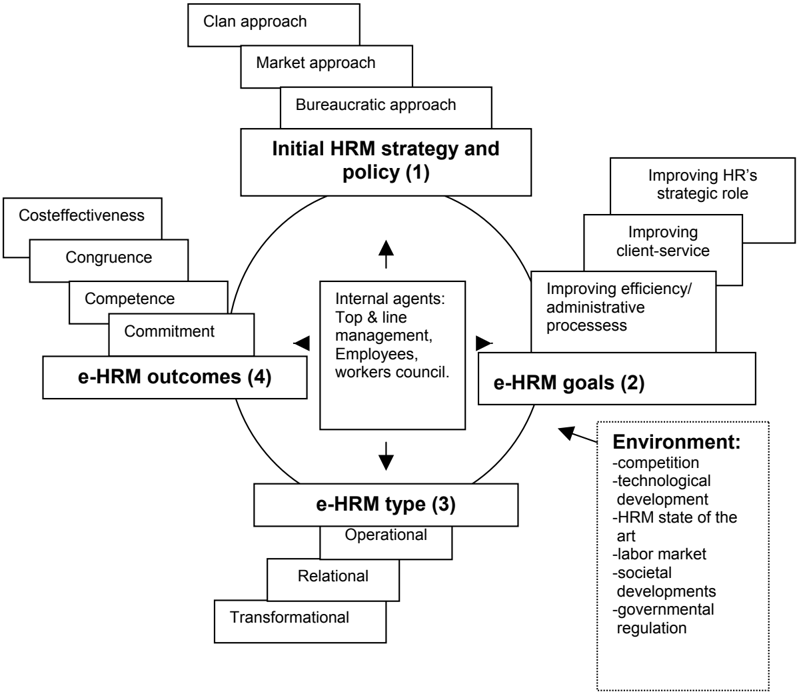
Technological optimistic voices assume that, from a technical perspective, the IT possibilities for HRM are endless: in principal all HR processes can be supported by IT. E-HRM is the relatively new term for this IT supported HRM, especially through the use of web technology. This paper aims at demystifying e-HRM by answering the following questions: what actually is e-HRM?, what are the goals of starting with e-HRM?, what types can be distinguished? and what are the outcomes of e-HRM? Based upon the literature, an e-HRM research model is developed and, guided by this model, five organizations have been studied that have already been on the 'e-HR road' for a number of years. We conclude that the goals of e-HRM are mainly to improve HR's administrative efficiency/to achieve cost reduction. Next to this goals, international companies seem to use the introduction of e-HRM to standardize/harmonize HR policies and processes. Further, there is a 'gap' between e-HRM in a technical sense and e-HRM in a practical sense in the five companies involved in our study. Finally, e-HRM hardly helped to improve employee competences, but resulted in cost reduction and a reduction of the administrative burden.
Overview
CoChat Summary
## TL;DR
This explorative case study examines web-based HRM (e-HRM) in five large companies and argues that e-HRM is less a technical upgrade than a shift in how HR work is done and by whom. Across the cases, the main reported effects were cost reduction and lower administrative burden, while improvements in employee competences were limited.
## Key findings
- The study’s five cases were Dow Chemicals, ABN AMRO, Ford Motor Company, IBM, and Belgacom; all had been on the “e-HR road” for several years and all were large firms with more than 15,000 employees.
- The authors identify three main e-HRM goals from the literature and cases: improving HR’s strategic orientation, reducing costs/raising efficiency, and improving client service for managers and employees; they also add a fourth goal based on the cases: improving a company’s global orientation.
- In the cases, e-HRM was associated mainly with cost reduction and a reduction of the administrative burden; the paper says no exact figures existed for these reductions.
- The paper reports a persistent gap between e-HRM in a technical sense and e-HRM in practice: at Dow Chemicals, adoption by users lagged behind technical possibilities by around three years.
- Reported outcomes varied by company, including “67% of all HR data entries” through employee self-service at one firm, employee satisfaction with HR service rising from 4.39 to 4.93 on a five-point scale in one year at another, and “80%” considering HR-online the primary source for HR at IBM.
## Methods
- Explorative qualitative multiple-case study design, with the organization as the unit of analysis.
- Sample: five large companies (>10,000 employees; in fact each >15,000), selected because they had a good reputation in e-HRM and had been using it for years.
- Data collection and analysis: conversational interviews as the dominant method, plus participant observations and documents; the data were categorized using indicators from the research model, then conclusions were drawn within and across cases.
## Limitations
- The paper states that the study is not intended to generalize statistically across all companies; it aims only at theoretical generalization.
- It explicitly notes that the study is exploratory and that the authors are still at a “preliminary stage” in understanding the relationship between IT and HRM, and that further research is needed.
- Evident from the text: the study relies on retrospective interviews and short observation periods, so recall bias and limited observation depth are plausible constraints, though these are not stated explicitly in the paper.
Model-written summary. Check it against the paper before relying on it.
Integrity signals
Registry
Cites
Statistics
Figures
Verification
Claims the paper makes
0 Valid · 1 Not valid · 14 Not checked · 75 Own results and interpretations
A result the paper reports from its own data — it cites no other source for it, so there is none to check. The quote shows it is in the paper.
In the paper
“Next to this goals, international companies seem to use the introduction of e-HRM to standardize/harmonize HR policies and processes.”
hedgedstates an association- Asserted: passes — The authors put it forward as true.
- Checkable: passes — It can be checked against evidence.
- Load-bearing: passes — The paper’s conclusions depend on it.
- Based: passes — The paper gives a reason why it holds.
A result the paper states — it cites no source for it, so there is none to check. The quote shows it is in the paper.
In the paper
“The fifth company involved, Belgacom, is not yet an international company, and therefore would not make this connection.”
- Also stated in: § 4.1 Commencing with e-HRM at our five case companies: an overall assessment · plain
“The fifth company involved, Belgacom, is not yet an international company”
plainSingle case- Asserted: passes — The authors put it forward as true.
- Checkable: passes — It can be checked against evidence.
- Load-bearing: passes — The paper’s conclusions depend on it.
- Based: passes — The paper gives a reason why it holds.
- Also stated in: § 4.1 Commencing with e-HRM at our five case companies: an overall assessment · plain
A result the paper states — it cites no source for it, so there is none to check. The quote shows it is in the paper.
In the paper
“In fact this suggests the first conclusion: there does not seem to be 'one natural way' to get on the 'e-HR road'.”
hedged- Asserted: passes — The authors put it forward as true.
- Checkable: passes — It can be checked against evidence.
- Load-bearing: passes — The paper’s conclusions depend on it.
- Based: passes — The paper gives a reason why it holds.
A result the paper reports from its own data — it cites no other source for it, so there is none to check. The quote shows it is in the paper.
In the paper
“Four of them operated internationally, and all of these linked their e-HRM plans with their aim of becoming a global company rather than an internationally dispersed one.”
plainstates an associationn = 4- Asserted: passes — The authors put it forward as true.
- Checkable: passes — It can be checked against evidence.
- Load-bearing: unclear — It is unclear whether the paper’s conclusions depend on it.
- Based: passes — The paper gives a reason why it holds.
A result the paper reports from its own data — it cites no other source for it, so there is none to check. The quote shows it is in the paper.
In the paper
“Starting to work with e-HRM seems to be connected with the process and globalization aims of the companies. This is one of the more interesting points to emerge from our look at the five companies.”
hedgedstates an associationn = 5- Asserted: passes — The authors put it forward as true.
- Checkable: passes — It can be checked against evidence.
- Load-bearing: unclear — It is unclear whether the paper’s conclusions depend on it.
- Based: passes — The paper gives a reason why it holds.
31 more claims
Create a free account to see all 90 claims and every source verdict.
- It may state two separate claims as one. 27
- Probably not a substantial claim. 32
Claims other papers make about this one
Each is checked against this paper’s own text: does it say what the citing paper says it does?
The source backs part of the claim, not all of it — or backs it for a different population, condition or comparison.
In the citing paper
“relational consequences emphasise the interactions and networking of different actors in sustaining the relationships with an employee by improving HR services and empowering employees”
From AI-augmented HRM: Antecedents, assimilation and multilevel consequences (2023) · cites this paper as Ruel et al., 2004
Experimental — accuracy not yet measuredThe source backs part of the claim, not all of it — or backs it for a different population, condition or comparison.
In the citing paper
“This proposed standardisation across different units in an organisation can help managers use the shared HR services to be HR compliant and improve the management process, resulting in strategic contribution and competitive advantage (Parry, 2011; Ruel et al., 2004).”
From AI-augmented HRM: Antecedents, assimilation and multilevel consequences (2023) · cites this paper as Ruel et al., 2004
Experimental — accuracy not yet measuredThe cited source says what the claim attributes to it.
In the citing paper
“the strategic orientation of HRM”
From AI-augmented HRM: Antecedents, assimilation and multilevel consequences (2023) · cites this paper as Ruel et al., 2004
The cited source says what the claim attributes to it.
In the citing paper
“Cost reduction/efficiency gains”
From AI-augmented HRM: Antecedents, assimilation and multilevel consequences (2023) · cites this paper as Ruel et al., 2004
The cited source says what the claim attributes to it.
In the citing paper
“Client service improvement/facilitating management and employees”
From AI-augmented HRM: Antecedents, assimilation and multilevel consequences (2023) · cites this paper as Ruel et al., 2004
Citations
Cites
(1993) · Cited by 7,856
Using Qualitative Methods in Organizational Research
Lee, T. (1998) · Medical Entomology and Zoology · Cited by 1,123
Degenne, A., & Forse, M. (1999) · SAGE Publications Ltd eBooks · doi:10.4135/9781849209373 · Cited by 886
Beatty, R. W., McEvoy, G. M., Beer, M., Spector, B., Lawrence, P. R., Mills, D. Q., & Walton, R. E. (1986) · Industrial and Labor Relations Review · doi:10.2307/2523277 · Cited by 731
Ulrich, D. (1996) · Cited by 641
Virtual HR: Strategic human resource management in the 21st century
Lepak, D. P., & Snell, S. A. (1998) · Human Resource Management Review · doi:10.1016/s1053-4822(98)90003-1 · Cited by 454 · cited 5×
“Interestingly, in all of these companies, ‘globalizing’ HR produced a tendency to centralize HR policy responsibilities at the company headquarters, while responsibilities for applying HR responsibilities were actually decentralized, placed in the hands of line managers and employees.”
BackgroundMethodInfluentialThompson, K. R. (1997) · Organizational Dynamics · doi:10.1016/s0090-2616(97)90039-5 · Cited by 374
Human Resource Information Systems: A Current Assessment
DeSanctis, G. (1986) · MIS Quarterly · doi:10.2307/248875 · Cited by 281 · cited 2×
“Keywords: e-HRM, HRM, IT, explorative case studies.”
MethodConditions for successful human resource information systems
Haines, V. Y., & Petit, A. (1997) · Human Resource Management · doi:10.1002/(sici)1099-050x(199722)36:2<261::aid-hrm7>3.0.co;2-v · Cited by 156
Schlevogt, K.-A. (2002) · Art of Chinese Management · doi:10.1093/oso/9780195136449.005.0002 · Cited by 141
Research works printed but not linked: 1
- Greengard, S. (1995): Using internal web sites to automate HR. In: Personnel Journal, June.
Cited by
Items 301–400 of 435
Strohmeier, S., & Kabst, R. (2007) · International Workshop on Human Resource Information Systems (HRIS) · doi:10.5220/0002418500310044 · Cited by 2
Yousifi, D., & Khayyat, N. T. (2019) · UKH Journal of Social Sciences · doi:10.25079/ukhjss.v3n1y2019.pp36-49 · Cited by 3
“Ruël et al. (2004) have added the fourth goal (4) E-HRM to improve the overall global orientation of human resources management.”
BackgroundResultImportance of ICT in Human Resources Management and Evaluation in Terms of Events
Uçar, P. (2020) · Advances in marketing, customer relationship management, and e-services book series · doi:10.4018/978-1-7998-4954-4.ch006 · Cited by 1
Pesha, A. V. (2020) · Вестник Омского университета. Серия «Экономика» · doi:10.24147/1812-3988.2020.18(3).98-108 · Cited by 5
Innovations in HRM Practices in Indian Companies: A Review-Based Study
Gupta, M. (2020) · Advances in human resources management and organizational development book series · doi:10.4018/978-1-7998-4180-7.ch003 · Cited by 1
Teachers as Human Resources in Educational Organization of Transitional Societies, Indonesia
Sari, D. W., & Rahyasih, Y. (2021) · Advances in Social Science, Education and Humanities Research/Advances in social science, education and humanities research · doi:10.2991/assehr.k.210212.066 · Cited by 1
Elayan, M. B. (2021) · IGI Global eBooks · doi:10.4018/978-1-6684-3873-2.ch038 · Cited by 1
Digitalization and its Impact on Employee’s Performance: A Case Study on Greater Tafila Municipality
Alobidyeen, B. Z., Al-Edainat, S., Al-Shabatat, S., & Al-Shabatat, S. (2021) · International Journal of Business and Administrative Studies · doi:10.20469/ijbas.7.10002-5 · Cited by 1
“In recent years, the digital economy has gotten much attention (Amladi, 2017; Calvard & Jeske, 2018; Ruël, Bondarouk, & Looise, 2004; Wang, Kung, & Byrd, 2018), and human resource management techniques are becoming increasingly digital (Bondarouk, Parry, & Furtmueller, 2017).”
BackgroundResilience as a Moderator Between Perceived HR Digitalization and Positive Employee Outcomes
Baykara, R., & Kantur, D. (2022) · Advances in logistics, operations, and management science book series · doi:10.4018/978-1-6684-5864-8.ch012 · Cited by 4
Future Human Resources, Technologically Engaged
Prifti, K., Koli, Z., & Bushi, J. (2023) · Journal of Production Operations Management and Economics · doi:10.55529/jpome.31.34.43 · Cited by 4
HR digitization: The main directions of development and influencing factors
Tatevosian, S. A. (2023) · Vestnik of Saint Petersburg University Management · doi:10.21638/11701/spbu08.2023.103 · Cited by 11
A Review on Effect of E-Hrm Practices on Msme Productivity
Dasari, K., & Sujatha, K. (2023) · Journal Of Advanced Zoology · doi:10.17762/jaz.v44is-5.1162 · Cited by 4
Electronic Human Resource Management (e-HRM) in a South African Organization
Phahlane, M. M. (2023) · Advances in human resources management and organizational development book series · doi:10.4018/978-1-6684-9172-0.ch007 · Cited by 1
Adoption of Human Resource Information Systems
N.A., M. A. M., Riyadi, R., Riza, M. F., & Albab, U. (2024) · KnE Social Sciences · doi:10.18502/kss.v9i11.15763 · Cited by 2
“[1, 2].”
Shishkin, D. S. (2024) · Scientific Research of Faculty of Economics Electronic Journal · doi:10.38050/2078-3809-2024-16-1-80-103 · Cited by 2
Muchsam, Y., Arafah, W., Aseanty, D., & Usman, B. (2024) · International Journal Of Humanities Education and Social Sciences (IJHESS) · doi:10.55227/ijhess.v3i5.974 · Cited by 15
“Other sources state that e-HRM creates and implements quality human resource management (hrm) based on information and communication technology (Ruël, Bondarouk, & Looise, 2004).”
BackgroundWhen and how does e-HRM optimize communication pace and processing time?
Aslam, M. S., & Akram, A. (2024) · Journal of economic and administrative sciences. · doi:10.1108/jeas-01-2024-0037 · Cited by 4
Mwangi, G., & Kamau, G. N. (2024) · International Journal Of Science Technology & Management · doi:10.46729/ijstm.v5i3.1090 · Cited by 5
“For example, Ruël, Bondarouk, and Looise, (2004) described e-HRM as “the implementation of HRM strategies, policies, and practices within organizations by actively utilizing web-based technologies” (p. 368).”
BackgroundDemystifying People Analytics Adoption: Insights from Italy
Lauro, S. D., Tursunbayeva, A., Sarti, D., Antonelli, G., & Torre, T. (2024) · Springer eBooks · doi:10.1007/978-3-031-58912-6_9 · Cited by 2
Artificial Intelligence and Human Resource Management
Tursunbayeva, A. (2024) · Contributions to management science · doi:10.1007/978-3-031-75266-7_1 · Cited by 3
Ahmed, F., Hakim, H., Shakoor, A., & Shoaib, Q. (2025) · JISR management and social sciences & economics · doi:10.31384/jisrmsse/2024.30.6.2 · Cited by 1
Yogatama, A. N., Thoyib, A., & Troena, E. A. (2015) · Jurnal Aplikasi Manajemen · Cited by 2
Internal Environmental Factors and the Level of Adoption of HRIS
Alwis, D., Andrlić, B., & Šoštar, M. (2019) · Annals of DAAAM for ... & proceedings of the ... International DAAAM Symposium · doi:10.2507/30th.daaam.proceedings.168 · Cited by 1
Hadiana, A. I., & Renaldi, F. (2019) · JUMANJI (Jurnal Masyarakat Informatika Unjani) · doi:10.26874/jumanji.v2i2.38 · Cited by 1
HRM in the Digital Age: Consequences and Performance
Barboza, C. (2018) · International Journal of Engineering and Management Research · doi:10.5281/zenodo.3361150 · Cited by 5
Elayan, M. B. (2021) · Advances in business information systems and analytics book series · doi:10.4018/978-1-7998-4501-0.ch010 · Cited by 1
Namasaka, D. B., Koech, C. S., & Monari, F. (2020) · The International Journal of Business & Management · doi:10.24940/theijbm/2020/v8/i11/bm2011-042 · Cited by 2
The Many Sides of Human Resource Information Systems
Poutanen, H., & Puhakka, V. J. (2011) · IGI Global eBooks · doi:10.4018/978-1-61350-465-9.ch013 · Cited by 1
Information technology for the management of human resourses of educational projects
Zhou, H. (2023) · Management of Development of Complex Systems · doi:10.32347/2412-9933.2023.55.128-132
Congruent HRM frames and employees' trust in HRM: results of the case study at Philips
Polman, J. (2014) · Cited by 2
Administrative efficiency in theory and practice at PT. Sarandi
Spenkelink, H. (2012) · Cited by 1
e-HR TRANSFORMATION PROJECTS WITHIN THE UK PUBLIC SECTOR: CRITICAL SUCCESS FACTORS
Nicholas, A. (2010) · ChesterRep (University of Chester)
Pramuditha, C. A. (2013) · UUM Electronic Theses and Dissertation [eTheses] (Northern University of Malaysia) · Cited by 1
Strategic human resource management in the knowledge-based economy
Slavković, M. (2013) · doi:10.2298/kg20130606slavkovic · Cited by 2
Rekers, N. (2013) · Cited by 4
Human Resources as Manager of the Human Imprint
Härtel, C. E. J. (2009) · IGI Global eBooks · doi:10.4018/978-1-59904-883-3.ch067 · Cited by 1
Organizational Factors for Implementing E-Democracy in Organizations
Forcadell, F. J. (2009) · IGI Global eBooks · doi:10.4018/978-1-59904-883-3.ch099 · Cited by 1
WITHDRAWN: A comprehensive Review of Innovative Human Resources ManagementPreprint
Atallah, A. M. (2022) · Research Square · doi:10.21203/rs.3.rs-2371187/v1 · Cited by 1
Innovative HRM and Organizational PerformancePreprint
Andrew, S., & Somerville, E. (2022) · Preprints.org · doi:10.20944/preprints202212.0477.v1 · Cited by 2
HRM frames and trust in HRM: a case study in an international airline
Hesselink, X. (2014) · Cited by 1
A Corporate Social Capital View on E-HRM Implementation
Sasovova, Z., & Leenders, R. (2009) · IGI Global eBooks · doi:10.4018/978-1-59904-883-3.ch032
Electronic Human Resource Management Strategies for Atypical Employment
Stein, V., & Scholz, T. M. (2013) · International Conference on Data Communication Networking, e-Business and Optical Communication Systems (DCNET/ICE-B/OPTICS) · doi:10.5220/0004497201290136 · Cited by 1
Notice of Retraction: Radical changes and challenges for the implementation of E-HR
Yang, J. (2011) · International Conference on E-Business and E-Government · doi:10.1109/icebeg.2011.5881559
“New concepts and systems such as e-learning, e-recruitment, performance management, knowledge management not only enhance HR’ administrative efficiency and reduce cost but also improve the employee relations and build the good organizational prestige [4].”
BackgroundInfluentialRetractedDiedrichsen, A. (2011) · Universitätsbibliothek Tübingen - Open Journals - Theologie Geschichte · doi:10.22028/d291-32173
Nura, A. A. (2014) · UUM Electronic Theses and Dissertation [eTheses] (Northern University of Malaysia) · Cited by 6
Allumi, N. A., & Tabiu, A. (2013) · Zenodo (CERN European Organization for Nuclear Research) · doi:10.5281/zenodo.15208182
Exploratory Learners, HR Ambidexterity and e-HRM Projects
Tansley, C., & Kirk, S. (2016) · Palgrave Macmillan UK eBooks · doi:10.1057/9781137465191_9
Chapter 7 Language Issues in e-HRM Implementation in the Multinational Firm
Heikkilä, J.-P., & Smale, A. (2011) · Advanced series in management · doi:10.1108/s1877-6361(2011)0000008011 · Cited by 3
The Planning Fallacy and Utilization of Human Resources Information Systems
Othman, S. Z. (2009) · IGI Global eBooks · doi:10.4018/978-1-59904-883-3.ch102
Supporting Work-Family Amalgamation through E-HRM
Lekoko, R. N. (2009) · IGI Global eBooks · doi:10.4018/978-1-59904-883-3.ch120
Impulsion of Information Technology on Human Resource Practices
Patro, C. S. (2016) · Advances in business strategy and competitive advantage book series · doi:10.4018/978-1-5225-1886-0.ch013 · Cited by 1
Adoption of Human Resource Information System: An Exploratory Study of Bangladesh
Mursalin, J. A. (2015) · Cited by 2
Mattila, J., & Oy, S. (2013) · Osuva (University of Vaasa)
Silva, R. (2016) · SSRN Electronic Journal · doi:10.2139/ssrn.2853255
“Further it is being recognised as a way of implementing HR policies and procedures in an organisation with the support of various web based technologies (Ruel et al., 2004). Another definition of e-HRM is usage of technology and media to fulfil HR functions of an organisation (Strohmeier, 2007). A study conducted by H…”
BackgroundMitsakis, F. (2015) · Nottingham Trent University's Institutional Repository (Nottingham Trent Repository)
Occasioning Change through HR Sourcing
van Balen, M., & Bondarouk, T. (2010) · University of Twente Research Information
Self-citatione-HRM Challenges: An Australian Perspective
Cerić, A. (2017) · Emerald Group Publishing Limited eBooks · doi:10.1108/978-1-78714-315-920161008 · Cited by 4
Considering Call Center Developments in E-HRM
Carroll, W. R. (2009) · IGI Global eBooks · doi:10.4018/978-1-59904-883-3.ch029
Personeelsbeleid in de platformeconomie
Koster, F. (2018) · Mens en Maatschappij · doi:10.5117/mem2018.3.005.kost · Cited by 1
“Een voorbeeld daarvan is onderzoek op het gebied van eHRM (Ruël, Bondarouk & Looise, 2004).”
BackgroundTHE USE OF MODERN TECHNOLOGIES IN THE DECRUITMENT PROCESS
Krasnova, A. (2018) · Prace Naukowe Uniwersytetu Ekonomicznego we Wrocławiu · doi:10.15611/pn.2018.511.11
“…personelem [Gainey, Klaas 2006, s. 51; Strohmeier 2012, s. 293], a możliwości jej wykorzystania w zarządzaniu ludźmi są niemalże nieograniczone [Rüel, Bondarouk, Kees 2004, s. 364]. technologii w trakcie i po przeprowadzeniu procesu derekrutacji w świetle literatury oraz wyników badań…”
BackgroundFACTORSAFFECTING SUCCESSFUL IMPLEMENTATION OF E-HRM– EVIDENCE FROM INDIAN INDUSTRIES
Prasad, R. S. R., & Chakravarthy, V. (2015)
Employees’ Attitude Towards E-HRM Practices At Maruti Suzuki India Limited (MSIL), India
Vijayran, M. (2019) · INTERNATIONAL JOURNAL OF RESEARCH IN MANAGEMENT · doi:10.26808/rs.rm.i9v2.01
Ziebell, R.-C. (2019) · RiuNet (Universitat Politècnica de València) · doi:10.4995/thesis/10251/117608 · Cited by 1
Elektronik İnsan Kaynakları Yönetimi: Kavramsal Bir Çerçeve
Uçar, P. (2019) · Journal of Business Management and Economic Research · doi:10.29226/tr1001.2019.151 · Cited by 3
Unlocking Social Innovation with HRM and Technology
Bondarouk, T. V., & Olivas‐Luján, M. R. (2014) · Emerald Group Publishing Limited eBooks · doi:10.1108/s1877-636120140000014017
Self-citation蕭新耀, & Hsiao, S.-Y. (2014) · Cited by 1
Innovative HRM. A Review of the LiteraturePreprint
Koster, F. (2016) · SSRN Electronic Journal · doi:10.2139/ssrn.2831409
Business Legitimacy and Adoption of Human Resource Information Systems in Danish SMEs
Scupola, A., & Pullich, Z. (2020) · Springer eBooks · doi:10.1007/978-3-319-68845-9_116-1 · Cited by 3
جمعه, ا. ع. ا. ع. م. (2019) · المجلة العلمية للبحوث التجارية (جامعة المنوفية) · doi:10.21608/sjsc.2019.110606
Govindappa, D. (2021) · Journal of Emerging Technologies and Innovative Research · Cited by 1
ELECTRONIC HUMAN RESOURCES MANAGEMENT: A RESEARCH IN SYRIAN REFUGEE COMPANIES IN TURKEY
Uygur, N. G., Gunaltay, A., & Rudnák, I. (2021) · Zeszyty Naukowe Wyższej Szkoły Humanitas Zarządzanie · doi:10.5604/01.3001.0014.8745 · Cited by 1
Bissola, R., Colombo, B., & Imperatori, B. (2021) · RICERCHE DI PSICOLOGIA · doi:10.3280/rip2021oa11896
e-HRM in a Cloud Environment: Implementation and its Adoption: A Literature Review
Ziebell, R.-C., Garrigós, J. A., Schoeneberg, K.-P., & Perello-Marin, M. R. (2021) · IGI Global eBooks · doi:10.4018/978-1-6684-3873-2.ch101
eHR Cloud Transformation: Implementation Approach and Success Factors
Ziebell, R.-C., Garrigós, J. A., Schultz, M., Schoeneberg, K. P., & Perello-Marin, M. R. (2021) · IGI Global eBooks · doi:10.4018/978-1-6684-3873-2.ch039
نجم, ع. ا. أ. ر., & السعيد, أ. س. (2017) · Al-Maǧallaẗ Al-Miṣriyyaẗ Lil Dirāsāt Al-Tiǧāriyyaẗ /Al-Maǧallaẗ Al-Miṣriyyaẗ Lil Dirāsāt Al-Tiǧāriyyaẗ · doi:10.21608/alat.2017.209644
(2016) · Emerald Group Publishing Limited eBooks · doi:10.1108/978-1-78635-696-320161010
Gender and Perceived Usefulness of e-HRM Technologies. A Case of the Bankers’ Experience in Tanzania
Namabira, J. (2022) · Texila international journal of management · doi:10.21522/tijmg.2015.08.01.art010 · Cited by 1
Importance of ICT in Human Resources Management and Evaluation in Terms of Events
Uçar, P. (2021) · IGI Global eBooks · doi:10.4018/978-1-6684-3873-2.ch085
UTAUT2 Model to Investigate the Adoption of E-HRM in the Telecommunication Sector
Fraij, J. (2022) · WSEAS TRANSACTIONS on COMMUNICATIONS archive · doi:10.37394/23204.2022.21.12 · Cited by 2
E- HRM – A MEAN TO INCREASE HRM ROLEIN ORGANIZATIONS – A COMPREHENSIVE LITERATURE REVIEW
(2020) · Proccedings of the International Management Conference · doi:10.24818/imc/2020/04.10 · Cited by 1
The Importance of Psychological Contracts in Human Resource Management within the New Global Economy
León, I. M. M. (2012) · IGI Global eBooks · doi:10.4018/978-1-4666-1601-1.ch069 · Cited by 1
Chmielarz, W. S., Zborowski, M., & Atasever, M. (2022) · Energies · doi:10.3390/en15218301
Dawsari, F., & Mukhtar1, N. (2022) · Research Square · doi:10.21203/rs.3.rs-2401501/v1 · Cited by 1
Hernández, R. A. E., Darós, L. C., & López, J. A. C. (2012) · Revista de Trabajo y Seguridad Social CEF · doi:10.51302/rtss.2012.3289 · Cited by 1
WITHDRAWN: A comprehensive Review of Innovative Human Resources ManagementPreprint
(2023) · Research Square · doi:10.21203/rs.3.rs-2371187/v2
HRIS adoption in organizations: A meta-analytic test of competing theoretical models
Ivanaj, S. (2023) · GRH · doi:10.3917/grh.046.0095 · Cited by 1
Irmak, R., Demirkaya, H., & Çekmecelioğlu, H. G. (2023) · Journal of Business Research - Turk · doi:10.20491/isarder.2023.1641 · Cited by 1
Impact of e-Recruiting and e-Selecting on Employees' Performance in Five-Star Hotels
Abdelrehim, A. (2023) · International Journal for Tourism, Archaeology and Hospitality · doi:10.21608/ijtah.2023.187739.1063 · Cited by 2
Hassan, N. A., Azmi, A. C., & Mustamil, N. M. (2023) · International Journal of Business and Management · doi:10.26666/rmp.ijbm.2023.2.4
Shahid, M. N., Malik, A., Azhar, T., & Iqbal, M. S. (2023) · Pakistan Journal of Humanities and Social Sciences · doi:10.52131/pjhss.2023.1102.0572
Contribution de l'e-GRH à la qualité de service: Cas d’un hopital public au Maroc
ERRACHIDI, D. B. A. (2023) · Humanitarian and Natural Sciences Journal · doi:10.53796/hnsj41021
Human Resource Management and Development in New Normal after COVID-19
Ma, F., Naksrisungb, S., Chamchoic, N., & Thammachart, C. (2023) · International Journal of Management Studies and Social Science Research · doi:10.56293/ijmsssr.2022.4617
Human resource management shaped in a platform: a literature review
Ottolenghi, C. (2023) · Sinergie Italian Journal of Management · doi:10.7433/s122.2023.09 · Cited by 3
Implementation of E-HRM (Electronic Human Resource Management) with Zoho Application: A Case Study
Krisnadinatha, I. G. A., Suarjaya, I. M. A. D., & Pratama, I. P. A. E. (2024) · JITTER Jurnal Ilmiah Teknologi dan Komputer · doi:10.24843/jtrti.2023.v04.i03.p08
“The rules and practices of companies that consciously and fully support the use of web-based [8].”
Background“STUDY OF ICICI E- RECRUITMENT”
Agarwal, S. (2024) · INTERANTIONAL JOURNAL OF SCIENTIFIC RESEARCH IN ENGINEERING AND MANAGEMENT · doi:10.55041/ijsrem32819
Metadata
- Authors
- Ruël, H., Bondarouk, T., & Looise, J. K.
- Affiliations
- University of Twente (NL)
- Utrecht University (NL)
- ORCID
- Bondarouk, Tanya
- Venue
- management revu
- Publisher
- IMR Press
- Published
- 2004
- Volume
- 15
- Issue
- 3
- Pages
- 364-380
- ISSN
- 0935-9915 (ISSN-L)
- OpenAlex
- W1562646680
- Cited by
- 441
- References
- 19
- Citations by year
- 2026: 4 · 2025: 17 · 2024: 47 · 2023: 33 · 2022: 33 · 2021: 38 · 2020: 26 · 2019: 33 · 2018: 25 · 2017: 15 · 2016: 23 · 2015: 25 · 2014: 24 · 2013: 20 · 2012: 18
- FWCI
- 3.60
- Type
- journal article
- Language
- en
- Open access
- hybrid
- doi.org
- Licence
- cc-by
- Locations
- management revue (publishedVersion, cc-by)
- University of Twente Research Information (submittedVersion)
- RePEc: Research Papers in Economics (submittedVersion)
- Econstor (Econstor) (submittedVersion)
- University of Twente Research Information (submittedVersion, other-oa)
- Topics
- Social Sciences › Business, Management and Accounting › Organizational Behavior and Human Resource Management › Employer Branding and e-HRM
- Social Sciences › Business, Management and Accounting › Organizational Behavior and Human Resource Management › AI and HR Technologies
- Social Sciences › Business, Management and Accounting › Organizational Behavior and Human Resource Management › Human Resource and Talent Management
- Keywords
- e-HRM, human resource management, large corporations, HRM innovation
About these checks
Registry, retraction, Cites and statistics results are computed, not judged, with one exception: a printed reference that no index lists is read once by a model before it counts as a citation error. Claims are extracted by a model and kept only when their quote appears verbatim in the text; each cited source is then checked, with a model’s help, for whether it says what the claim relies on. Those verdicts can be wrong — read the claim’s quote and the cited source before relying on one.
A language model drew the claims from the paper on 2026-10-10, under version 3 of the claim definition (model deepseek-v4.1-flash, prompt extract-v3).
A second model labelled each claim on 2026-10-10 (model jev-1.13-20260917, definition revision gold-guideline-v0.2).
Statistics and arithmetic are recomputed, not judged.
Confidence bands are shown only for fields calibrated on our annotated test set. None is calibrated yet, so no band is shown.
What counts as a claim ›How we measure confidence ›How we check this ›
Are you an author, or do you see a problem with this page? Request a review
Data sources
Bibliographic data: Semantic Scholar, OpenAlex, Crossref.
Contains information from the Semantic Scholar Academic Graph Datasets, made available under the ODC Attribution License (ODC-BY 1.0).
Semantic Scholar’s data is described in: Kinney, R., et al. (2023). The Semantic Scholar Open Data Platform. arXiv:2301.10140.
