

A statistical test suite for random and pseudorandom number generators for cryptographic applications
Open accessThe DOI matches its Crossref record; 33 of the 34 references it cites were found in a registry or an index; none of the 14 sources its claims cite is checked for support yet.
Abstract
The Information Technology Laboratory (ITL) at the National Institute of Standards and Technology (NIST) promotes the U.S. economy and public welfare by providing technical leadership for the nation's measurement and standards infrastructure. ITL develops tests, test methods, reference data, proof of concept implementations, and technical analysis to advance the development and productive use of information technology. ITL's responsibilities include the development of technical, physical, administrative, and management standards and guidelines for the cost-effective security and privacy of sensitive unclassified information in Federal computer systems.
Overview
CoChat Summary
TL;DR
This NIST Special Publication 800-22 Revision 1a presents a suite of 15 statistical tests for evaluating whether binary sequences produced by random or pseudorandom number generators are suitable for cryptographic applications. It provides test purposes, mathematical descriptions, examples, and guidance for interpreting P-values, while cautioning that statistical testing is only a first step and cannot replace cryptanalysis.
Key findings
- The suite consists of 15 tests: Frequency (Monobit), Frequency within a Block, Runs, Longest Run of Ones, Binary Matrix Rank, Discrete Fourier Transform (Spectral), Non-overlapping Template Matching, Overlapping Template Matching, Maurer’s “Universal Statistical,” Linear Complexity, Serial, Approximate Entropy, Cumulative Sums, Random Excursions, and Random Excursions Variant. The Frequency test is recommended first because it supplies the most basic evidence of non-randomness.
- Each test uses the null hypothesis \(H_0\) that the sequence is random; if P-value \(\ge \alpha\), the sequence is accepted as random, and if P-value \(<\alpha\), it is rejected. Examples use \(\alpha=0.01\), and NIST recommends \(\alpha\) in the range [0.001, 0.01].
- The document states that no finite set of statistical tests is “complete,” that statistical testing cannot absolutely certify a generator, and that statistical testing cannot serve as a substitute for cryptanalysis.
- Sample data files are 1,000,000 bits (binary expansions of \(e\), \(\pi\), \(\sqrt{2}\), \(\sqrt{3}\), and a G-SHA-1 sequence); reported example P-values include Frequency for \(\pi\) = 0.578211, for \(e\) = 0.953749, and for G-SHA-1 = 0.604458.
Methods
- Design: The NIST Statistical Test Suite is an ANSI C reference implementation of 15 tests; each test defines a test statistic, a reference distribution (e.g., normal, half-normal, chi-square), a P-value, and a decision rule at the 1% level.
- Data or sample: Tests apply to binary sequences from hardware or software RNGs/PRNGs; sample files are 1,000,000 bits, while many worked examples use small illustrative lengths such as \(n=100\).
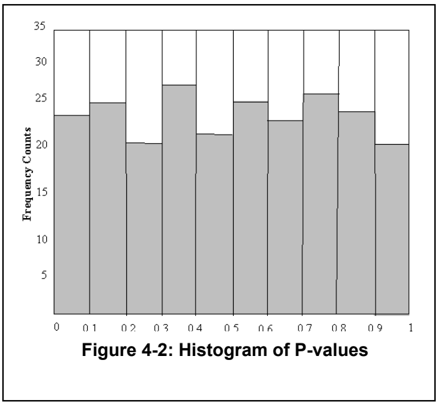
- Main analysis: For each sequence, P-values are computed and compared to \(\alpha\); empirical interpretation examines the proportion of sequences passing a test and the uniformity of P-values. A multiple-test dependence study applied 161 test P-values to Blum-Blum-Shub sequences of length 1,000,000 and used principal components/factor analysis, concluding there was no large redundancy among tests.
Limitations
- The paper states that no set of statistical tests can absolutely certify a generator as appropriate, that statistical testing cannot substitute for cryptanalysis, and that generator design and cryptanalysis are outside its scope.
- The paper states that many examples use small sample sizes for illustration only, e.g., \(n=10\), where the normal approximation is not really applicable; many tests rely on asymptotic reference distributions for large \(n\) (order \(10^3\) to \(10^7\)), and input parameter constraints apply.
- The text makes evident additional limitations: numerical precision can degrade for large incomplete gamma parameter \(a\); Maurer’s variance approximation can make the test 2.67 times more permissive than theoretically admitted; Random Excursions is discontinued if \(J<500\); and multiple tests can yield contradictory conclusions, as in the Random Excursions example where one state gave a non-random result while seven states gave random results.
Model-written summary. Check it against the paper before relying on it.
Integrity signals
Registry
Cites
Statistics
Figures

Verification
Claims the paper makes
0 Valid · 1 Not valid · 11 Not checked · 13 Own results and interpretations
A result the paper reports from its own data — it cites no other source for it, so there is none to check. The quote shows it is in the paper.
In the paper
“The asymptotic distribution of ( Ln -µ n ) / σ n along the sequence of even or odd values of n is that of a discrete random variable obtained via a mixture of two geometric random variables (one of them taking only negative values). Strictly speaking, the asymptotic distribution as such does not exist.”
A result the paper reports from its own data — it cites no other source for it, so there is none to check. The quote shows it is in the paper.
In the paper
“However, no set of statistical tests can absolutely certify a generator as appropriate for usage in a particular application, i.e., statistical testing cannot serve as a substitute for cryptanalysis.”
A result the paper reports from its own data — it cites no other source for it, so there is none to check. The quote shows it is in the paper.
In the paper
“This graph showed that there is no large redundancy among our tests.”
In the paper
“Ueli Maurer of the Department of Computer Science at Princeton University introduced this test in 1992. Maurer's test statistic relates closely to the per-bit entropy of the stream, which its author asserts is 'the correct quality measure for a secret-key source in a cryptographic application.'”
What the sources say
- Not matchedcites Maurer
This doesn’t read as a citation we can look up.
- Not matched
What the paper did — it cites no source for this, so there is none to check. The quote shows it is in the paper.
In the paper
“The test rejects the randomness hypothesis immediately if J is too small, i.e., if the following P-value is small:”
20 more claims
Create a free account to see all 25 claims and every source verdict.
Claims other papers make about this one
Each is checked against this paper’s own text: does it say what the citing paper says it does?
The source backs part of the claim, not all of it — or backs it for a different population, condition or comparison.
In the citing paper
“However, the latest version 2.1.2 [1], released in 2014, does not incorporate several modifications.”
From Checking the quality of approximation of p-values in statistical tests for random number generators by using a three-level test (2019) · cites this paper as [1]
Experimental — accuracy not yet measuredThe source backs part of the claim, not all of it — or backs it for a different population, condition or comparison.
In the citing paper
“The NIST test suite consists of 15 statistical tests for randomness of bit sequences, and its result is a list of 188 p -values.”
From Checking the quality of approximation of p-values in statistical tests for random number generators by using a three-level test (2019) · cites this paper as [1]
Experimental — accuracy not yet measuredThe cited source says what the claim attributes to it.
In the citing paper
“Note that the current implementation of the NIST test suite uses one-level or two-level tests, differently from the above experiments”
From Checking the quality of approximation of p-values in statistical tests for random number generators by using a three-level test (2019) · cites this paper as [1]
The cited source says what the claim attributes to it.
In the citing paper
“NIST SP-800.22 statistical test suite [90] and Die-hard test suite [91] and Test U01 [92] and AIS31 [93] are most common statistical test suites to evaluate their RNGs by researchers.”
From True Random Number Generators Using Electrical Noise (2019) · cites this paper as [90]
Self-check
Percentages, sums and reported differences re-computed from the paper’s own numbers.
Each contradiction between two passages listed here was confirmed by an independent check.
Rated minor: it would not touch a result — a value no result rests on, a p-value that stays on the same side of the significance level, or a conflict that is clerical, resolved elsewhere in the paper, or outside its own findings.
In the paper
§ 2.3.8 Example
“(input) τ = 0.02 (processing) π = 0.42 (processing) Vn(obs) = 52 (output) P-value = 0.500798 (conclusion) Since P-value ≥ 0.01 , accept the sequence as random.”
§ 2.3.4 Test Description
“If it can be shown that π -1 ≥τ , then the 2 Runs test need not be performed (i.e., the test should not have been run because of a failure to pass test 1, the Frequency (Monobit) test). If the test is not applicable, then the P-value is set to 0.0000.”
Rated minor: it would not touch a result — a value no result rests on, a p-value that stays on the same side of the significance level, or a conflict that is clerical, resolved elsewhere in the paper, or outside its own findings.
In the paper
§ 2.7.4 Test Description
“| 8-10 | 010 (hit) | 2 | 110 | 1 |”
§ 2.7.4 Test Description
“For the above example, if m = 3 and the template B = 001, then the examination proceeds as follows:”
Rated minor: it would not touch a result — a value no result rests on, a p-value that stays on the same side of the significance level, or a conflict that is clerical, resolved elsewhere in the paper, or outside its own findings.
In the paper
§ 2.9.3 Test Statistic and Reference Distribution
“f n : The sum of the log2 distances between matching Lbit templates, i.e., the sum of the number of digits in the distance between Lbit templates.”
§ 3.9 Maurer's 'Universal Statistical' Test
“Then it averages over all the expansion lengths by the number of test blocks.”
Rated minor: it would not touch a result — a value no result rests on, a p-value that stays on the same side of the significance level, or a conflict that is clerical, resolved elsewhere in the paper, or outside its own findings.
In the paper
§ Input Parameters:
“The parameters p , q and s are not fixed in code; thus, the user will not be able to reconstruct the original sequence because these values will vary (i.e., they are dependent on the system time).”
§ Input Parameters:
“The input parameters have been fixed so the code will reproduce the same results.”
Rated minor: it would not touch a result — a value no result rests on, a p-value that stays on the same side of the significance level, or a conflict that is clerical, resolved elsewhere in the paper, or outside its own findings.
In the paper
§ 5.5.2 Global Parameters
“| MAXNUMOFTEMPLATES | 40 | Non-overlapping Templates Test | | NUMOFTESTS | 16 | Max number of tests | | NUMOFGENERATORS | 12 | Max number of PRNGs |”
§ A.2 Configuration Information
“| 2. | #define MAXNUMOFTEMPLATES | 148 | | 3. | #define NUMOFTESTS | 15 | | 4. | #define NUMOFGENERATORS | 10 |”
2 more findings
Create a free account to see every finding of this check.
Citations
Cites
Handbook of Mathematical Functions
McQuarrie, D. A. (1966) · American Journal of Physics · doi:10.1119/1.1972842 · Cited by 40,433
Numerical recipes in C: the art of scientific computing
(1993) · Choice Reviews Online · doi:10.5860/choice.30-5638 · Cited by 17,933
Rayward-Smith, V. J. (1991) · Journal of the Operational Research Society · doi:10.1057/jors.1991.155 · Cited by 16,821
Handbook of applied cryptography
(1997) · Choice Reviews Online · doi:10.5860/choice.34-4512 · Cited by 10,357
Handbook of Mathematical Functions
(2018) · A Century of Excellence in MEASUREMENTS, STANDARDS, and TECHNOLOGY · doi:10.1201/9781351069397-39 · Cited by 9,062
A universal algorithm for sequential data compression
Ziv, J., & Lempel, A. (1977) · IEEE Transactions on Information Theory · doi:10.1109/tit.1977.1055714 · Cited by 5,456
The Art of Computer Programming
Worlton, W. J. (1968) · Nuclear Science and Engineering · doi:10.13182/nse68-a19548 · Cited by 2,251
Handbook of Applied Cryptography
Menezes, A. J., van Oorschot, P. C., & Vanstone, S. A. (2018) · CRC Press eBooks · doi:10.1201/9780429466335 · Cited by 1,770
Numerical Recipes in C-The Art of Scientific Computing.
G., W., Press, W. H., Flannery, B. P., Teukolsky, S. A., & Vetterling, W. T. (1989) · Mathematics of Computation · doi:10.2307/2008673 · Cited by 1,513
The Fourier Transform and its Applications
Cattermole, K. W. (1965) · Electronics and Power · doi:10.1049/ep.1965.0268 · Cited by 1,417
Cited by
Items 1,901–2,000 of 3,620
Towards Self-testing Quantum Random Number Generators in Integrated Design
Chernov, P. S., Volkov, V. S., & Surovtsev, D. A. (2018) · IOP Conference Series Materials Science and Engineering · doi:10.1088/1757-899x/454/1/012087 · Cited by 5
Suryadi, M., Satria, Y., Melvina, V., Prawadika, L. N., & Solihat, I. M. (2020) · Journal of Physics Conference Series · doi:10.1088/1742-6596/1490/1/012024 · Cited by 8
Khan, N. A., Akbar, S., Hameed, T., et al. (2021) · Integration · doi:10.1016/j.vlsi.2021.03.006 · Cited by 5
Real-Time Compressed Video Encryption: Based on Quasigroup on System on Chip (SOC)
Haridas, D., Kiran, D. S., Patel, S., Raghavendra, K., Sarma, V., & Venkatraman, R. (2021) · SN Computer Science · doi:10.1007/s42979-021-00793-4 · Cited by 7
“The null hypothesis is given binary sequence is random [33].”
BackgroundKanak, A., Ergün, S., Yazıcı, A. T., Özkan, M., Çokünlü, G., Yayan, U., Karaca, M., & Arslan, A. T. (2021) · Open Research Europe · doi:10.12688/openreseurope.13627.1 · Cited by 9
An image encryption based on hybrid PRESENT-SPECK algorithm
noori, D. M., Hoomod, H. K., & Yousif, I. A. (2023) · Materials Today Proceedings · doi:10.1016/j.matpr.2021.07.011 · Cited by 8
Evaluation of a True Random Number Generator Utilizing Timing Jitters in RSFQ Logic Circuits
Kenta, S. A. T. O., Sega, N., Somei, Y., Shimada, H., Onomi, T., & Mizugaki, Y. (2022) · IEICE Transactions on Electronics · doi:10.1587/transele.2021ses0001 · Cited by 5
“Notably, the FIPS 140-2 testing has ended, and other improved tests such as NIST SP800-22[24] and TestU01[25] are now available.”
Alresheedi, M. T., Al-Moliki, Y. M., Al‐Harthi, Y., et al. (2022) · IEEJ Transactions on Electrical and Electronic Engineering · doi:10.1002/tee.23557 · Cited by 5
ENT Randomness Test on DM-PRESENT-80 and DM-PRESENT-128-based Pseudorandom Number Generator
Susanti, B. H., Jimmy, J., & Ardyani, M. W. (2021) · International Seminar on Research of Information Technology and Intelligent Systems (ISRITI) · doi:10.1109/isriti54043.2021.9702862 · Cited by 5
RUDBA: Reusable User-Device Biometric Authentication Scheme for Multi-service Systems
Liao, Z., & Guan, Y. (2021) · IEEE International Symposium on Hardware Oriented Security and Trust (HOST) · doi:10.1109/host49136.2021.9702289 · Cited by 5
Crytographical primitive for blockchain: a secure random DNA encoded key generation technique
Sanober, A., & Anwar, S. (2022) · Multimedia Tools and Applications · doi:10.1007/s11042-022-13063-z · Cited by 5
An Improvised Algorithm for a Dynamic Key Generation Model
Saran, D. V. G., & Jain, K. (2023) · Lecture notes in networks and systems · doi:10.1007/978-981-19-7402-1_43 · Cited by 5
A Secured LSB-Based Image Steganography using Modified Collatz Conjecture
Molato, A. D., & Calanda, F. B. (2023) · International Conference on Advanced Computing and Communication Systems (ICACCS) · doi:10.1109/icaccs57279.2023.10113029 · Cited by 5
“This package determines the random behavior of binary string generated by pseudorandom number generator[16].”
MethodA Real-time Chaos-based Audio Encryption Scheme
Kafetzis, I. S., VOLOS, C. K., Nistazakis, H. E., et al. (2023) · International Conference on Modern Circuits and Systems Technologies · doi:10.1109/mocast57943.2023.10176599 · Cited by 5
“and implemented by the National Institute of Standards and Technology (NIST) [22].”
MethodInfluentialSome Security Aspects of Batteries and Power Electronic Converters in a Microgrid
Matić, L., Draženović, K., Šunde, V., & Ban, Ž. (2023) · IEEE Access · doi:10.1109/access.2023.3327164 · Cited by 5
Al-Moliki, Y. M., Alresheedi, M. T., Al‐Harthi, Y., & Alqahtani, A. H. (2023) · Vehicular Communications · doi:10.1016/j.vehcom.2023.100706 · Cited by 6
Parallel Symbiotic Random Number Generator for Training Tsetlin Machines on FPGA
Rahman, T., Mao, G., Maheshwari, S., et al. (2023) · doi:10.1109/istm58889.2023.10455073 · Cited by 5
Hyperchaos-based cryptosytem to secure WSN data transfer for smart home application
Benzegane, S., Bouhedda, M., & Batel, N. (2024) · International Journal of Information Technology · doi:10.1007/s41870-024-01787-0 · Cited by 6
SDR-PUF: Sequence-Dependent Reconfigurable SRAM PUF with an Exponential CRP Space
Prasad, K., Shah, N., Dagli, J., & Mekie, J. (2024) · International Conference on VLSI Design · doi:10.1109/vlsid60093.2024.00095 · Cited by 6
CryptoHHO: a bio-inspired cryptosystem for data security in Fog–Cloud architecture
Jawed, M. S., & Sajid, M. (2024) · The Journal of Supercomputing · doi:10.1007/s11227-024-06055-3 · Cited by 8
Design, Implementation and Analysis of HIBRI Cipher on IoT Platforms
Nagesh, H. R., Poojari, A., & G, K. K. V. (2024) · Journal of The Institution of Engineers (India) Series B · doi:10.1007/s40031-024-01067-2 · Cited by 5
Comparing pseudo- and quantum-random number generators with Monte Carlo simulations
Cirauqui, D., García-March, M. Á., Corominas, G. G. I., Graß, T., Grzybowski, P. R., Muñoz-Gil, G., Saavedra, J. R. M., & Lewenstein, M. (2024) · APL Quantum · doi:10.1063/5.0199568 · Cited by 7
Statistical Properties of Pseudo Random Sequences and Experiments with PHP and Debian OpenSSL
Wang, Y., & Nicol, T. (2014) · Lecture notes in computer science · doi:10.1007/978-3-319-11203-9_26 · Cited by 5
“The law of large numbers states that, for a pseudo random sequence ξ, the limit of S (ξ |̀ n) n is 1 2 , which corresponds to the frequency (Monobit) test in NIST SP800-22 [12].”
BackgroundInfluentialMeasuring Random Tests by Conditional Entropy and Optimal Execution Order
Huang, J., & Lai, X. (2011) · Lecture notes in computer science · doi:10.1007/978-3-642-25283-9_10 · Cited by 5
“In this paper, we focus on the test suite developed by NIST [2].”
MethodZheng, J., & Li, J. (2013) · Lecture notes in computer science · doi:10.1007/978-3-642-37119-6_3 · Cited by 5
Parallel implementation of the TestU01 statistical test suite
Suciu, A., Toma, R. A., & Marton, K. (2012) · IEEE International Conference on Intelligent Computer Communication and Processing (ICCP) · doi:10.1109/iccp.2012.6356206 · Cited by 5
Randomness analysis on LED block ciphers
Isa, H., & Z’aba, M. R. (2012) · International Conference on Security of Information and Networks (SIN) · doi:10.1145/2388576.2388584 · Cited by 5
“All randomness testing was based on the application of the NIST Statistical Suite [10].”
BackgroundMethodInfluentialSuitable representation of values on the logistic map with finite precision
Araki, S., Kakizaki, K., Miyazaki, T., & Uehara, S. (2010) · International Symposium on Information Theory and its Applications · doi:10.1109/isita.2010.5649601 · Cited by 5
“…random bit sequences TABLE IV THE AVERAGES OF #S (n) Fp (·) AND #S (n) B:Fp (·) FOR n = 32 AND 64 precision [0] [1] [ 3 4 , 1] We suppose that a pseudorandom number generator with the logistic map with finite precision generates an output whose size is 1G bit required by the NIST random tests [12].”
BackgroundAhmad, T., & Younis, U. (2014) · Journal of Network and Computer Applications · doi:10.1016/j.jnca.2013.11.007 · Cited by 5
“Typically α is chosen in range of 0.001 and 0.01 (Rukhin et al., 2010).”
BackgroundInfluentialMaehara, S., Kawakami, K., Arai, H., Nakano, K., Doi, K., Sato, T. G., Ohdaira, Y., Sakamoto, S., & Ohkawa, M. (2013) · Optical Engineering · doi:10.1117/1.oe.52.1.014302 · Cited by 7
Built-in hardware pseudo-random test module for Physical Unclonable Functions
Lee, J. S., Choi, P., Kim, S.-J., Choi, B., & Kim, D. K. (2014) · Nonlinear Theory and Its Applications IEICE · doi:10.1587/nolta.5.101 · Cited by 5
Random number generation using field programmable analog array implementation of logistic map
Çiçek, İ., Pusane, A. E., & Dündar, G. (2013) · Signal Processing and Communications Applications Conference (SIU) · doi:10.1109/siu.2013.6531560 · Cited by 6
Application of data compression methods to hypothesis testing for ergodic and stationary processes
Ryabko, B. Y., & Astola, J. T. (2005) · Discrete Mathematics & Theoretical Computer Science · doi:10.46298/dmtcs.3380 · Cited by 5
Construction of Markov Partitions in PL1D Maps
Stojanovski, T., & Kocarev, L. (2013) · IEEE Transactions on Circuits & Systems II Express Briefs · doi:10.1109/tcsii.2013.2278106 · Cited by 5
IMPLEMENTATION OF AN ENCRYPTED WIRELESS COMMUNICATION SYSTEM USING NESTED CHAOTIC MAPS
ABID, A. M., Nasir, Q., & Elwakil, A. S. (2010) · International Journal of Bifurcation and Chaos · doi:10.1142/s0218127410027957 · Cited by 5
The use of physical unclonable functions for true random number sequences generation
Заливако, С. С., & Ivaniuk, A. A. (2013) · Automatic Control and Computer Sciences · doi:10.3103/s0146411613030085 · Cited by 5
Hardware Platform for Testing Performance of TRNGs Embedded in Actel Fusion FPGA
Varchola, M., Drutarovský, M., Fouquet, R., et al. (2008) · International Conference Radioelektronika · doi:10.1109/radioelek.2008.4542712 · Cited by 5
Enhancement of A5/1: Using variable feedback polynomials of LFSR
Bajaj, N. (2011) · International Conference on Emerging Trends in Networks and Computer Communications (ETNCC) · doi:10.1109/etncc.2011.5958486 · Cited by 5
Design of a Random Number Generator from Fingerprint
Liu, Y., Wang, S., Jing, Y., et al. (2010) · International Conference on Computational and Information Sciences · doi:10.1109/iccis.2010.74 · Cited by 5
“The way to calculate P-Value is described in [9].”
MethodHigh-Speed FPGA-Based Pseudorandom Generators with Extremely Long Periods
Jessa, M., & Jaworski, M. (2010) · International Conference on ReConFigurable Computing and FPGAs (ReConFig) · doi:10.1109/reconfig.2010.32 · Cited by 5
Generation of Reliable Randomness via Social Phenomena
Virgilio, R. D., & Maccioni, A. (2013) · Lecture notes in computer science · doi:10.1007/978-3-642-41366-7_6 · Cited by 4
“It comprises both the Marsaglia's tests (e.g., the birthday spacings test that, based on the birthday paradox, checks if the spacings between the numbers are asymptotically exponentially distributed) and some of the NIST tests (e.g., the serial tests that check if the overlappings of patterns across a sequence are equ…”
BackgroundMethodInfluentialSome Illustrations of Information Geometry in Biology and Physics
Dodson, C. T. J. (2011) · Advances in computer and electrical engineering book series · doi:10.4018/978-1-61350-116-0.ch013 · Cited by 5
“Tests for randomness of such sequences have been studied extensively and the NIST Suite of tests [Rushkin, Soto et al, 2001] for cryptological purposes is widely employed.”
MethodA novel chaotic generator based on weakly-coupled discrete skewtent maps
Jallouli, O., Assad, S. E., Chetto, M., Lozi, R., & Caragata, D. (2015) · International Conference for Internet Technology and Secured Transactions · doi:10.1109/icitst.2015.7412052 · Cited by 7
Construction of pseudo-random functions based on generalized cellular automata
Klyucharev, P. G. (2012) · Science and Education of the Bauman MSTU · doi:10.7463/0113.0517543 · Cited by 4
A Quasigroup Based Random Number Generator for Resource Constrained Environments.
Battey, M., & Parakh, A. (2012) · Cited by 5
An Energy-Efficient PUF Design
Gu, H., Xu, T., & Potkonjak, M. (2016) · International Symposium on Low Power Electronics and Design (ISLPED) · doi:10.1145/2934583.2934604 · Cited by 5
“We quantify the statistical randomness of our design by applying the industry-standard National Institute of Standards and Technology (NIST) Statistical Test Suite to post-processed outputs [14].”
MethodShah, T., Upadhyay, D., & Sharma, P. (2016) · Springer eBooks · doi:10.1007/978-81-322-2638-3_35 · Cited by 5
Two-dimensional coupled electro-optic delayed feedback system with varying parameters
Liu, L., Miao, S., Cheng, M., et al. (2016) · Journal of Modern Optics · doi:10.1080/09500340.2016.1249973 · Cited by 5
Chugunkov, I. V., Prokofiev, A. O., Strelchenko, P. A., & Matriukhina, Y. A. (2016) · International Scientific-Technical Conference on Actual Problems of Electronic Instrument Engineering (APEIE) · doi:10.1109/apeie.2016.7806399 · Cited by 5
Design of efficient CMOS ring oscillator-based random number generator
Güler, Ü., Pusane, A. E., & Dündar, G. (2017) · International Journal of Electronics · doi:10.1080/00207217.2017.1312704 · Cited by 7
Stationary Randomness of Quantum Cryptographic Sequences on Variant Maps
Zheng, J., & Zheng, C. (2017) · IEEE/ACM International Conference on Advances in Social Networks Analysis and Mining (ASONAM) · doi:10.1145/3110025.3110151 · Cited by 5
A true random number generator based on meta-stable state
Fan, L., Long, Y., Luo, J., Zhu, L., & Liu, H. (2017) · IEICE Electronics Express · doi:10.1587/elex.14.20171122 · Cited by 5
Dynamic control of entropy and power consumption in TRNGs for IoT applications
Martín, H., Millán, E. S., & Entrena, L. (2017) · IEICE Electronics Express · doi:10.1587/elex.14.20171157 · Cited by 5
COZMO - A New Lightweight Stream Cipher
Bonnerji, R., Sarkar, S., Rarhi, K., et al. (2018) · International Conference on Green Computing and Internet of Things (ICGCIoT) · doi:10.1109/icgciot.2018.8752965 · Cited by 5
Cryptographic adaptation of the middle square generator
Ali-Pacha, H., Hadj-Said, N., Ali‐Pacha, A., Mohamed, M. A., & Mamat, M. (2019) · International Journal of Electrical and Computer Engineering (IJECE) · doi:10.11591/ijece.v9i6.pp5615-5627 · Cited by 6
“In practice, a random generator produces a sequence of numbers with properties of unpredictability [20-22] and independence, and follows a certain distribution (uniform in cryptography, Gaussian in telecommunications, etc.”
BackgroundRandom Number Generators Based on Discrete-time Chaotic Maps
Ergün, S., & Tanrıseven, S. (2019) · IEEE EUROCON - International Conference on Computer as a Tool (EUROCON) · doi:10.1109/eurocon.2019.8861859 · Cited by 5
Ortiz‐Martin, L., Picazo‐Sanchez, P., & Lopez, P. P. (2019) · Future Generation Computer Systems · doi:10.1016/j.future.2019.12.002 · Cited by 6
Statistical Analysis of Enhanced SDEx Encryption Method Based on SHA-256 Hash Function
Hłobaż, A. (2019) · Conference on Local Computer Networks · doi:10.1109/lcn44214.2019.8990714 · Cited by 5
“The quality of the generated string of bits is similar to the quality of strings of bits generated by static generators based on hash functions developed by NIST [12], [13].”
MethodDetecting Temporal Correlation via Quantum Random Number Generation
Shikano, Y., Tamura, K., & Raymond, R. (2020) · Electronic Proceedings in Theoretical Computer Science · doi:10.4204/eptcs.315.2 · Cited by 8
“gnificance, and it is the Y. Shikano, K. Tamura & R. Raymond 21 0 25 50 75 100125150175200225250275300325350375400425450475500525550575 Job number 20 40 60 80 100 120 140 T 1 [ s ] q[0] q[1] q[2] q[3] q[4] q[5] q[6] q[7] q[8] q[9] q[10] q[11] q[12] q[13] q[14] q[15] q[16] q[17] q[18] q[19] Figure 1: T 1 time of eac…”
MethodAutocorrelation criterion for quality assessment of random number sequences
Фауре, Е. В., Миронець, І. В., & Lavdanskyi, A. (2020) · doi:10.32782/cmis/2608-52 · Cited by 6
“The most famous test suits are: the Donald Knuth’s statistical tests set [1]; George Marsaglia’s DIEHARD tests [2]; NIST Statistical Test Suite [3]; TestU01[4].”
MethodXu, S.-R., Jia, X.-H., Ma, H.-L., Lin, J.-B., Liang, W.-Y., & Yang, Y.-L. (2020) · Chinese Physics B · doi:10.1088/1674-1056/abb228 · Cited by 5
An Iteration-Time Combination Method to Reduce the Dynamic Degradation of Digital Chaotic Maps
Wu, Y., & Liu, L. (2020) · Complexity · doi:10.1155/2020/5707983 · Cited by 6
“At present, the most popular statistical tests for PRBG are as follows: (1) NIST suite of statistical tests [22, 23], (2) Donald Knuth’s statistical tests [24], (3) Crypt-XS suite of statistical tests [25], and (4) DIEHARD suite of statistical tests [26].”
MethodKumar, D., Anand, R., Singh, S. V., Misra, P. K., Srivastava, A. K., & Goswami, M. (2020) · IET Circuits Devices & Systems · doi:10.1049/iet-cds.2019.0318 · Cited by 5
The Technique for Testing Short Sequences as a Component of Cryptography on the Internet of Things.
Popereshnyak, S. (2019) · Cited by 5
A Proficient Mechanism for Cloud Security Supervision in Distributive Computing Environment
Mishra, K. N. (2020) · International Journal of Computer Network and Information Security · doi:10.5815/ijcnis.2020.06.05 · Cited by 5
DTRNG: Low Cost and Robust True Random Number Generator Using DRAM Weak Write Scheme
Humood, K., Mohammad, B. S., & Abunahla, H. (2021) · IEEE International Symposium on Circuits and Systems proceedings · doi:10.1109/iscas51556.2021.9401156 · Cited by 6
Asymptotically most powerful tests for random number generators
Ryabko, B. Y. (2021) · Journal of Statistical Planning and Inference · doi:10.1016/j.jspi.2021.07.007 · Cited by 6
ERÖZ, E., Tanyıldızı, E., & Özkaynak, F. (2021) · IEEE EUROCON - International Conference on Computer as a Tool (EUROCON) · doi:10.1109/eurocon52738.2021.9535616 · Cited by 6
Dynamically Configurable Physical Unclonable Function based on RRAM Crossbar
Li, J., Cui, Y., Gu, C., Wang, C., & Liu, W. (2021) · IEEE/ACM International Symposium on Nanoscale Architectures (NANOARCH) · doi:10.1109/nanoarch53687.2021.9642245 · Cited by 5
FPGA Implementation of Chaos based Pseudo Random Number Generator
Singh, V., & Sarawadekar, K. P. (2021) · IEEE Uttar Pradesh Section International Conference on Electrical, Electronics and Computer Engineering (UPCON) · doi:10.1109/upcon52273.2021.9667611 · Cited by 5
CurIAs: Current-Based IC Authentication by Exploiting Supply Current Variations
Paul, S. D., & Bhunia, S. (2022) · IEEE Transactions on Computers · doi:10.1109/tc.2022.3158075 · Cited by 5
Chhabra, S., & Lata, K. (2022) · SN Computer Science · doi:10.1007/s42979-022-01194-x · Cited by 5
“The NIST 800-22 statistical test suite [52] is used to assess the randomness of the bit sequence.”
MethodSecret-Key Agreement by Asynchronous EEG over Authenticated Public Channels
Galis, M., Milosavljević, M., Jevremović, A., et al. (2021) · Vide Leaf, Hyderabad eBooks · doi:10.37247/etni2ed.2.22.4 · Cited by 5
Evaluation of a Random Number Generator based on an Internal Linear Feedback Shift Register
Kamogari, H., & Ichikawa, S. (2023) · IEEJ Transactions on Industry Applications · doi:10.1541/ieejias.143.87 · Cited by 5
An AES Implementation with Improved PDL Based PUF Key Generator for IoT Devices
Boke, A. K., Nakhate, S., & Rajawat, A. (2023) · IETE Technical Review · doi:10.1080/02564602.2023.2192001 · Cited by 5
Blood-inspired random bit generation using microfluidics system
Yoon, I., Han, J. H., Park, B. U., & Jeon, H. (2024) · Scientific Reports · doi:10.1038/s41598-024-58088-6 · Cited by 6
“The purpose of the NIST tests is to validate the security and unpredictability of digital encryption methods 25,29 .”
MethodLiteHash: Hash Functions for Resource-Constrained Hardware
Achar, S. D., Thejaswini, P., Nandi, S., & Nandi, S. K. (2024) · ACM Transactions on Embedded Computing Systems · doi:10.1145/3677181 · Cited by 7
Disk drive generates high speed real random numbers
Schreck, E., & Ertel, W. (2005) · Microsystem Technologies · doi:10.1007/s00542-005-0532-6 · Cited by 5
Comparing randomness on various video and Audio Media File types
Omerasevic, D., Behlilović, N., Mrdović, S., et al. (2013) · Telecommunications Forum Telfor (TELFOR) · doi:10.1109/telfor.2013.6716249 · Cited by 5
Analyzing Directional Modulation Techniques as Block Encryption Ciphers for Physical Layer Security
Ahmad, A., Amin, M., & Farooq, M. (2017) · IEEE Wireless Communications and Networking Conference · doi:10.1109/wcnc.2017.7925525 · Cited by 5
“NIST suite consists of 15 tests mentioned in [9], accordingly their p-values”
MethodEfficient key generation leveraging channel reciprocity and balanced gray code
Zhan, F., Yao, N., Gao, Z., et al. (2017) · Wireless Networks · doi:10.1007/s11276-017-1579-x · Cited by 5
“Furthermore, the NIST randomness test suite [12] is available to evaluate whether a bit sequence can be used as secret key.”
MethodThe entropy of a distributed computation random number generation from memory interleaving
Antoniadis, K., Blanchard, P., Guerraoui, R., & Stainer, J. (2017) · Distributed Computing · doi:10.1007/s00446-017-0311-5 · Cited by 7
A pseudo-random sequence generation scheme based on RNS and permutation polynomials
Ma, S., Liu, J., Yang, Z., et al. (2018) · Science China Information Sciences · doi:10.1007/s11432-017-9279-3 · Cited by 5
“01, the corresponding test item is regarded as having passed the test [17].”
BackgroundHurley-Smith, D., & Hernandez-Castro, J. C. (2018) · Lecture notes in computer science · doi:10.1007/978-3-030-04762-7_8 · Cited by 5
Experimental Quantum-enhanced Cryptographic Remote Control
Pang, X.-L., Qiao, L., Sun, K., Liu, Y., Yang, A.-L., & Jin, X. (2019) · Scientific Reports · doi:10.1038/s41598-019-42278-8 · Cited by 7
“We use NIST suites to perform statistical tests [26], and the final results are shown in Figure 2(b).”
MethodTsou, Y.-T., Zhen, H., Kuo, S., Chang, C., Fukushima, A., & Rong, B.-D. (2020) · Computer Communications · doi:10.1016/j.comcom.2020.01.001 · Cited by 5
A Combination of Two-Dimensional Hénon Map and Two-Dimensional Rational Map as Key Number Generator
Ghayad, N. H., & Albahrani, E. A. (2019) · doi:10.1109/cas47993.2019.9075731 · Cited by 5
Selection of random number generators in GATE Monte Carlo toolkit
Sepehri, F., Hajivaliei, M., & Rajabi, H. (2020) · Nuclear Instruments and Methods in Physics Research Section A Accelerators Spectrometers Detectors and Associated Equipment · doi:10.1016/j.nima.2020.164172 · Cited by 5
Shrinking generators based on σ -LFSRs
Bishoi, S. K., Senapati, K., & Shankar, B. R. (2020) · Discrete Applied Mathematics · doi:10.1016/j.dam.2020.06.010 · Cited by 5
Entropy as a Service: A Lightweight Random Number Generator for Decentralized IoT Applications
Ullah, I., Meratnia, N., & Havinga, P. (2020) · IEEE International Conference on Pervasive Computing and Communications Workshops (PerCom Workshops) · doi:10.1109/percomworkshops48775.2020.9156205 · Cited by 6
Attacking Hardware Random Number Generators in a Multi-Tenant Scenario
Koyen, Y., Peetermans, A., Rožić, V., & Verbauwhede, I. M. R. (2020) · Workshop on Fault Detection and Tolerance in Cryptography (FDTC) · doi:10.1109/fdtc51366.2020.00010 · Cited by 7
“Schematic of the TERO TRNG architecture NIST SP 800-22 [17] statistical test suite.”
MethodHybrid Chaotic Method for Medical Images Ciphering
Ebrahim, S. M. A. (2020) · International Journal of Network Security & Its Applications · doi:10.5121/ijnsa.2020.12601 · Cited by 5
Sarkar, A. (2021) · Complex & Intelligent Systems · doi:10.1007/s40747-021-00301-4 · Cited by 5
“[4] test suite, introduces two simple structures and tests their power as PRNGs.”
BackgroundProtocol Independent Identification of Encrypted Traffic Based on Weighted Cumulative Sum Test
Bo, Z., Guo, H. M., Liu, Q., et al. (2013) · Cited by 5
A Stochastic Algorithm to Design Min-Entropy Tuning Controllers for True Random Number Generators
Addabbo, T., Fort, A., Moretti, R., Mugnaini, M., Papini, D., & Vignoli, V. (2022) · IEEE Transactions on Circuits and Systems I Regular Papers · doi:10.1109/tcsi.2022.3151794 · Cited by 5
Encrypted Traffic Identification Based on Sparse Logistical Regression and Extreme Learning Machine
Meng, J., Yang, L., Zhou, Y., & Pan, Z. (2014) · Proceedings in adaptation, learning and optimization · doi:10.1007/978-3-319-14066-7_7 · Cited by 5
Multichannel Protocols for User-Friendly and Scalable Initialization of Sensor Networks
Perković, T., Stančić, I., Mališa, L., et al. (2009) · Lecture notes of the Institute for Computer Sciences, Social Informatics and Telecommunications Engineering · doi:10.1007/978-3-642-05284-2_13 · Cited by 5
“NIST STS [13] contains 15 tests out of which only 8 were performed due to the minimum bitstream requirement (3 × 10(6) bits were produced) for each test.”
MethodGenerating Random and Pseudorandom Sequences in Mobile Devices
Krhovják, J., Matyáš, V., & Zizkovsky, J. (2009) · Lecture notes of the Institute for Computer Sciences, Social Informatics and Telecommunications Engineering · doi:10.1007/978-3-642-04434-2_11 · Cited by 5
“CRYPT-X, DIEHARD, and NIST) for verification of the statistical quality of random data by detecting deviations from true randomness (for details see [ 10 ]).”
BackgroundEnhanced Cryptography by Multiple Chaotic Dynamics
Chen, J., Zhou, J., Wong, K., & Ji, Z. (2011) · Mathematical Problems in Engineering · doi:10.1155/2011/938454 · Cited by 5
Deterministic Chaos in Digital Cryptography
Ptitsyn, N., Blackledge, J., & Chernenky, V. (2002) · Elsevier eBooks · doi:10.1533/9780857099594.189 · Cited by 8
Metadata
- Authors
- Bassham, L. E., Rukhin, A. L., Soto, J., Nechvatal, J. R., Smid, M. E., Barker, E. B., Leigh, S. D., Levenson, M., Vangel, M., Banks, D. L., Heckert, N. A., Dray, J. F., & Vo, S.
- Affiliations
- National Institute of Standards and Technology (US)
- Venue
- NIST Special Publication 800-22 Revision 1a
- Published
- 2010
- OpenAlex
- W1517403092
- Semantic Scholar
- 961fc0f6c68303cde94a28fdb24e6eaf3ef040b4
- Cited by
- 3,617
- References
- 34
- Citations by year
- 2026: 128 · 2025: 205 · 2024: 192 · 2023: 208 · 2022: 166 · 2021: 291 · 2020: 290 · 2019: 250 · 2018: 254 · 2017: 207 · 2016: 183 · 2015: 184 · 2014: 201 · 2013: 155 · 2012: 139
- Type
- report
- Language
- en
- Open access
- gold
- doi.org
- Topics
- Physical Sciences › Computer Science › Artificial Intelligence › Cryptographic Implementations and Security
- Physical Sciences › Mathematics › Discrete Mathematics and Combinatorics › Coding theory and cryptography
- Physical Sciences › Computer Science › Computer Vision and Pattern Recognition › Chaos-based Image/Signal Encryption
- Keywords
- random number generators, pseudorandom number generators, cryptographic randomness, NIST SP 800-22, randomness testing
About these checks
Registry, retraction, Cites and statistics results are computed, not judged, with one exception: a printed reference that no index lists is read once by a model before it counts as a citation error. Claims are extracted by a model and kept only when their quote appears verbatim in the text; each cited source is then checked, with a model’s help, for whether it says what the claim relies on. Those verdicts can be wrong — read the claim’s quote and the cited source before relying on one.
A language model drew the claims from the paper on 2026-09-27 (prompt extract-v2).
Statistics and arithmetic are recomputed, not judged.
Confidence bands are shown only for fields calibrated on our annotated test set. None is calibrated yet, so no band is shown.
What counts as a claim ›How we measure confidence ›How we check this ›
Are you an author, or do you see a problem with this page? Request a review
Data sources
Bibliographic data: Semantic Scholar, OpenAlex, Crossref.
Contains information from the Semantic Scholar Academic Graph Datasets, made available under the ODC Attribution License (ODC-BY 1.0).
Semantic Scholar’s data is described in: Kinney, R., et al. (2023). The Semantic Scholar Open Data Platform. arXiv:2301.10140.
