

A statistical test suite for random and pseudorandom number generators for cryptographic applications
Open accessThe DOI matches its Crossref record; 33 of the 34 references it cites were found in a registry or an index; none of the 14 sources its claims cite is checked for support yet.
Abstract
The Information Technology Laboratory (ITL) at the National Institute of Standards and Technology (NIST) promotes the U.S. economy and public welfare by providing technical leadership for the nation's measurement and standards infrastructure. ITL develops tests, test methods, reference data, proof of concept implementations, and technical analysis to advance the development and productive use of information technology. ITL's responsibilities include the development of technical, physical, administrative, and management standards and guidelines for the cost-effective security and privacy of sensitive unclassified information in Federal computer systems.
Overview
CoChat Summary
TL;DR
This NIST Special Publication 800-22 Revision 1a presents a suite of 15 statistical tests for evaluating whether binary sequences produced by random or pseudorandom number generators are suitable for cryptographic applications. It provides test purposes, mathematical descriptions, examples, and guidance for interpreting P-values, while cautioning that statistical testing is only a first step and cannot replace cryptanalysis.
Key findings
- The suite consists of 15 tests: Frequency (Monobit), Frequency within a Block, Runs, Longest Run of Ones, Binary Matrix Rank, Discrete Fourier Transform (Spectral), Non-overlapping Template Matching, Overlapping Template Matching, Maurer’s “Universal Statistical,” Linear Complexity, Serial, Approximate Entropy, Cumulative Sums, Random Excursions, and Random Excursions Variant. The Frequency test is recommended first because it supplies the most basic evidence of non-randomness.
- Each test uses the null hypothesis \(H_0\) that the sequence is random; if P-value \(\ge \alpha\), the sequence is accepted as random, and if P-value \(<\alpha\), it is rejected. Examples use \(\alpha=0.01\), and NIST recommends \(\alpha\) in the range [0.001, 0.01].
- The document states that no finite set of statistical tests is “complete,” that statistical testing cannot absolutely certify a generator, and that statistical testing cannot serve as a substitute for cryptanalysis.
- Sample data files are 1,000,000 bits (binary expansions of \(e\), \(\pi\), \(\sqrt{2}\), \(\sqrt{3}\), and a G-SHA-1 sequence); reported example P-values include Frequency for \(\pi\) = 0.578211, for \(e\) = 0.953749, and for G-SHA-1 = 0.604458.
Methods
- Design: The NIST Statistical Test Suite is an ANSI C reference implementation of 15 tests; each test defines a test statistic, a reference distribution (e.g., normal, half-normal, chi-square), a P-value, and a decision rule at the 1% level.
- Data or sample: Tests apply to binary sequences from hardware or software RNGs/PRNGs; sample files are 1,000,000 bits, while many worked examples use small illustrative lengths such as \(n=100\).
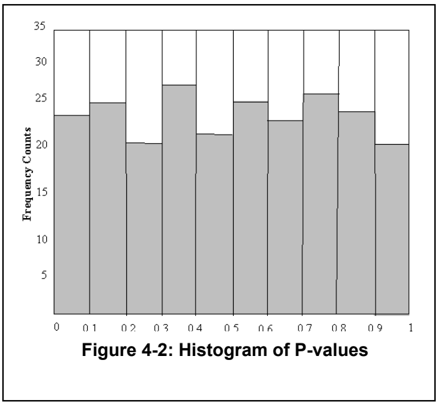
- Main analysis: For each sequence, P-values are computed and compared to \(\alpha\); empirical interpretation examines the proportion of sequences passing a test and the uniformity of P-values. A multiple-test dependence study applied 161 test P-values to Blum-Blum-Shub sequences of length 1,000,000 and used principal components/factor analysis, concluding there was no large redundancy among tests.
Limitations
- The paper states that no set of statistical tests can absolutely certify a generator as appropriate, that statistical testing cannot substitute for cryptanalysis, and that generator design and cryptanalysis are outside its scope.
- The paper states that many examples use small sample sizes for illustration only, e.g., \(n=10\), where the normal approximation is not really applicable; many tests rely on asymptotic reference distributions for large \(n\) (order \(10^3\) to \(10^7\)), and input parameter constraints apply.
- The text makes evident additional limitations: numerical precision can degrade for large incomplete gamma parameter \(a\); Maurer’s variance approximation can make the test 2.67 times more permissive than theoretically admitted; Random Excursions is discontinued if \(J<500\); and multiple tests can yield contradictory conclusions, as in the Random Excursions example where one state gave a non-random result while seven states gave random results.
Model-written summary. Check it against the paper before relying on it.
Integrity signals
Registry
Cites
Statistics
Figures

Verification
Claims the paper makes
0 Valid · 1 Not valid · 11 Not checked · 13 Own results and interpretations
A result the paper reports from its own data — it cites no other source for it, so there is none to check. The quote shows it is in the paper.
In the paper
“The asymptotic distribution of ( Ln -µ n ) / σ n along the sequence of even or odd values of n is that of a discrete random variable obtained via a mixture of two geometric random variables (one of them taking only negative values). Strictly speaking, the asymptotic distribution as such does not exist.”
A result the paper reports from its own data — it cites no other source for it, so there is none to check. The quote shows it is in the paper.
In the paper
“However, no set of statistical tests can absolutely certify a generator as appropriate for usage in a particular application, i.e., statistical testing cannot serve as a substitute for cryptanalysis.”
A result the paper reports from its own data — it cites no other source for it, so there is none to check. The quote shows it is in the paper.
In the paper
“This graph showed that there is no large redundancy among our tests.”
In the paper
“Ueli Maurer of the Department of Computer Science at Princeton University introduced this test in 1992. Maurer's test statistic relates closely to the per-bit entropy of the stream, which its author asserts is 'the correct quality measure for a secret-key source in a cryptographic application.'”
What the sources say
- Not matchedcites Maurer
This doesn’t read as a citation we can look up.
- Not matched
What the paper did — it cites no source for this, so there is none to check. The quote shows it is in the paper.
In the paper
“The test rejects the randomness hypothesis immediately if J is too small, i.e., if the following P-value is small:”
20 more claims
Create a free account to see all 25 claims and every source verdict.
Claims other papers make about this one
Each is checked against this paper’s own text: does it say what the citing paper says it does?
The source backs part of the claim, not all of it — or backs it for a different population, condition or comparison.
In the citing paper
“However, the latest version 2.1.2 [1], released in 2014, does not incorporate several modifications.”
From Checking the quality of approximation of p-values in statistical tests for random number generators by using a three-level test (2019) · cites this paper as [1]
Experimental — accuracy not yet measuredThe source backs part of the claim, not all of it — or backs it for a different population, condition or comparison.
In the citing paper
“The NIST test suite consists of 15 statistical tests for randomness of bit sequences, and its result is a list of 188 p -values.”
From Checking the quality of approximation of p-values in statistical tests for random number generators by using a three-level test (2019) · cites this paper as [1]
Experimental — accuracy not yet measuredThe cited source says what the claim attributes to it.
In the citing paper
“Note that the current implementation of the NIST test suite uses one-level or two-level tests, differently from the above experiments”
From Checking the quality of approximation of p-values in statistical tests for random number generators by using a three-level test (2019) · cites this paper as [1]
The cited source says what the claim attributes to it.
In the citing paper
“NIST SP-800.22 statistical test suite [90] and Die-hard test suite [91] and Test U01 [92] and AIS31 [93] are most common statistical test suites to evaluate their RNGs by researchers.”
From True Random Number Generators Using Electrical Noise (2019) · cites this paper as [90]
Self-check
Percentages, sums and reported differences re-computed from the paper’s own numbers.
Each contradiction between two passages listed here was confirmed by an independent check.
Rated minor: it would not touch a result — a value no result rests on, a p-value that stays on the same side of the significance level, or a conflict that is clerical, resolved elsewhere in the paper, or outside its own findings.
In the paper
§ 2.3.8 Example
“(input) τ = 0.02 (processing) π = 0.42 (processing) Vn(obs) = 52 (output) P-value = 0.500798 (conclusion) Since P-value ≥ 0.01 , accept the sequence as random.”
§ 2.3.4 Test Description
“If it can be shown that π -1 ≥τ , then the 2 Runs test need not be performed (i.e., the test should not have been run because of a failure to pass test 1, the Frequency (Monobit) test). If the test is not applicable, then the P-value is set to 0.0000.”
Rated minor: it would not touch a result — a value no result rests on, a p-value that stays on the same side of the significance level, or a conflict that is clerical, resolved elsewhere in the paper, or outside its own findings.
In the paper
§ 2.7.4 Test Description
“| 8-10 | 010 (hit) | 2 | 110 | 1 |”
§ 2.7.4 Test Description
“For the above example, if m = 3 and the template B = 001, then the examination proceeds as follows:”
Rated minor: it would not touch a result — a value no result rests on, a p-value that stays on the same side of the significance level, or a conflict that is clerical, resolved elsewhere in the paper, or outside its own findings.
In the paper
§ 2.9.3 Test Statistic and Reference Distribution
“f n : The sum of the log2 distances between matching Lbit templates, i.e., the sum of the number of digits in the distance between Lbit templates.”
§ 3.9 Maurer's 'Universal Statistical' Test
“Then it averages over all the expansion lengths by the number of test blocks.”
Rated minor: it would not touch a result — a value no result rests on, a p-value that stays on the same side of the significance level, or a conflict that is clerical, resolved elsewhere in the paper, or outside its own findings.
In the paper
§ Input Parameters:
“The parameters p , q and s are not fixed in code; thus, the user will not be able to reconstruct the original sequence because these values will vary (i.e., they are dependent on the system time).”
§ Input Parameters:
“The input parameters have been fixed so the code will reproduce the same results.”
Rated minor: it would not touch a result — a value no result rests on, a p-value that stays on the same side of the significance level, or a conflict that is clerical, resolved elsewhere in the paper, or outside its own findings.
In the paper
§ 5.5.2 Global Parameters
“| MAXNUMOFTEMPLATES | 40 | Non-overlapping Templates Test | | NUMOFTESTS | 16 | Max number of tests | | NUMOFGENERATORS | 12 | Max number of PRNGs |”
§ A.2 Configuration Information
“| 2. | #define MAXNUMOFTEMPLATES | 148 | | 3. | #define NUMOFTESTS | 15 | | 4. | #define NUMOFGENERATORS | 10 |”
2 more findings
Create a free account to see every finding of this check.
Citations
Cites
Handbook of Mathematical Functions
McQuarrie, D. A. (1966) · American Journal of Physics · doi:10.1119/1.1972842 · Cited by 40,433
Numerical recipes in C: the art of scientific computing
(1993) · Choice Reviews Online · doi:10.5860/choice.30-5638 · Cited by 17,933
Rayward-Smith, V. J. (1991) · Journal of the Operational Research Society · doi:10.1057/jors.1991.155 · Cited by 16,821
Handbook of applied cryptography
(1997) · Choice Reviews Online · doi:10.5860/choice.34-4512 · Cited by 10,357
Handbook of Mathematical Functions
(2018) · A Century of Excellence in MEASUREMENTS, STANDARDS, and TECHNOLOGY · doi:10.1201/9781351069397-39 · Cited by 9,062
A universal algorithm for sequential data compression
Ziv, J., & Lempel, A. (1977) · IEEE Transactions on Information Theory · doi:10.1109/tit.1977.1055714 · Cited by 5,456
The Art of Computer Programming
Worlton, W. J. (1968) · Nuclear Science and Engineering · doi:10.13182/nse68-a19548 · Cited by 2,251
Handbook of Applied Cryptography
Menezes, A. J., van Oorschot, P. C., & Vanstone, S. A. (2018) · CRC Press eBooks · doi:10.1201/9780429466335 · Cited by 1,770
Numerical Recipes in C-The Art of Scientific Computing.
G., W., Press, W. H., Flannery, B. P., Teukolsky, S. A., & Vetterling, W. T. (1989) · Mathematics of Computation · doi:10.2307/2008673 · Cited by 1,513
The Fourier Transform and its Applications
Cattermole, K. W. (1965) · Electronics and Power · doi:10.1049/ep.1965.0268 · Cited by 1,417
Cited by
Items 2,201–2,300 of 3,620
An MMCM-based high-speed true random number generator for Xilinx FPGA
Fujieda, N., & Takashima, S. (2021) · International Journal of Networking and Computing · doi:10.15803/ijnc.11.2_154 · Cited by 4
“We conduct a more detailed statistical test, NIST SP 800-22 test suite [17], to random numbers generated by the proposed method with a simple post-processing.”
MethodNull hypothesis significance testing in simulation
Hofmann, M. A. (2016) · Winter Simulation Conference · doi:10.1109/wsc.2016.7822118 · Cited by 4
Enumeration of maximal cycles generated by orthogonal cellular automata
Mariot, L. (2022) · Natural Computing · doi:10.1007/s11047-022-09930-1 · Cited by 4
Low-Cost Self-Test of Crypto Devices
Natale, G. D., Doulcier, M., Flottes, M.-L., et al. (2008) · Cited by 4
Sudarsono, A., Yuliana, M., Kristalina, P., et al. (2019) · International Electronics Symposium (IES) · doi:10.1109/elecsym.2019.8901624 · Cited by 4
“The combination of some techniques of RSS values reciprocity, quantization, information reconciliation and privacy amplification is able to improve KGR, reduce KDR, and achieve good entropy coefficient on NIST pseudorandomness test suite [3].”
MethodInfluentialA Regression-Based Entropy Distiller for RO PUFs
Yin, C.-E. (2011) · University Libraries (University of Maryland) · Cited by 4
Non-uniformity in the Quantis Random Number Generator
Abbott, A., Bienvenu, L., & Senno, G. (2014) · ResearchSpace (University of Auckland) · Cited by 4
On ZK-Crypt, Book Stack, and Statistical Tests.Preprint
Doroshenko, S., Fionov, A., Lubkin, A., et al. (2006) · IACR Cryptology ePrint Archive · Cited by 4
Nano-Intrinsic True Random Number GenerationPreprint
Kim, J., Ahmed, T., Nili, H., Truong, N. D., Yang, J., Jeong, D. S., Sriram, S., Ranasinghe, D. C., & Kavehei, O. (2017) · arXiv (Cornell University) · doi:10.48550/arxiv.1701.06020 · Cited by 7
“The test suite includes a total of 15 different tests with two similar tests running on different directions of bit-stream; hence, 17 tests [54].”
Chizari, H., & Lupu, E. (2018) · arXiv (Cornell University) · doi:10.48550/arxiv.1806.10984 · Cited by 4
“tical tests have been proposed. A combination of randomness test algorithms is called a randomness suite or a battery of tests. The most used batteries of tests in randomness assessment are: NIST STS [38] and Dieharder [43]. A randomness suite usually needs a large set of random numbers for its tests. For instance, in…”
MethodInfluentialDifferential cryptanalysis of image cipher using block-based scrambling and image filteringPreprint
Yu, F. Q., Gong, X., Li, H., et al. (2018) · arXiv (Cornell University) · doi:10.48550/arxiv.1812.11693 · Cited by 4
“Test Suite [28, 15].”
The measures of pseudorandomness and the NIST testsPreprint
Mérai, L., Rivat, J., & S\'ark\"ozy, A. (2018) · arXiv (Cornell University) · Cited by 4
Generating High Quality Random Numbers: A High Throughput Parallel Bitsliced ApproachPreprint
Monfared, S. K., Hajihassani, O., Zanjani, S. M., Kiarostami, M. S., Rahmati, D., & Gorgin, S. (2019) · arXiv (Cornell University) · doi:10.48550/arxiv.1909.04750 · Cited by 5
“[18]”
Hussain, I., Anees, A., Al-Maadeed, T. A., et al. (2020) · arXiv (Cornell University) · doi:10.48550/arxiv.2004.12264 · Cited by 4
“Apart from visually analyzing the randomness of these ranges, we have tested the sequence using the NIST statistical analysis suite [18] which contains 15 statistical tests.”
MethodMind control of a distant electronic device: A proof-of-concept pre-registered studyPreprint
Tressoldi, P. E., Pederzoli, L., Prati, E., et al. (2019) · doi:10.31234/osf.io/s7uad · Cited by 4
“…study we applied the Frequency Test and the Runs Test present in the suite of tests provided by the National Institute of Standards and Technology (Bassham et al., 2010), as well as a calculation of the mean of the absolute difference between the ones and zer0s in each sample (see Methods…”
MethodInfluentialUsing the random number generator with a hardware entropy source for symmetric cryptography problems
Dolotii, M. H., & Merzlykin, P. V. (2018) · doi:10.31812/123456789/2883 · Cited by 4
Pseudo-Random Generator based on a Photonic Neuromorphic Physical Unclonable Function
Dermanis, D., Rizomiliotis, P., Bogris, A., & Mesaritakis, C. (2024) · arXiv · doi:10.48550/arxiv.2402.14876 · Cited by 4
Generation of correlated quantum random number sequences with bright twin beams
Shekar, A., Patel, C. R., Thachil, J. A., & Kumar, A. (2025) · Applied Physics Letters · doi:10.1063/5.0279909 · Cited by 3
Certified random number generation using quantum computers
Nath, P. P., Sinha, A., & Sinha, U. (2025) · Frontiers in Quantum Science and Technology · doi:10.3389/frqst.2025.1661544 · Cited by 8
“While statistical tests [42–44] can assess the uniformity of generated bits, certifying the randomness of the source remains a challenging problem.”
Secure chaos-based PRNG for low-power and resource-constrained devices
Abdelkrim, S., Merah, H., Merah, L., Özer, Ö., Talbi, L., & Ali‐Pacha, A. (2025) · Nonlinear Dynamics · doi:10.1007/s11071-025-11804-x · Cited by 7
Secure and energy–efficient TRNG and NV–SRAM design using VGSOT–MTJ/CNTFET hybrid integration
Gudisa, G., Japa, A., & Kumbhare, V. R. (2025) · Journal of Magnetism and Magnetic Materials · doi:10.1016/j.jmmm.2025.173607 · Cited by 3
Yıldız, T. A., Kiremitler, N. B., Kayacı, N., Kalay, M., Özcan, E., Deneme, İ., Coşkun, Z., Önses, M. S., Çoşut, B., & Usta, H. (2025) · ACS Applied Materials & Interfaces · doi:10.1021/acsami.5c13228 · Cited by 3
Physically Unclonable Surfaces Enabled by Cold Spray Deposition
Jeon, J., & Akin, S. (2026) · ACS Applied Materials & Interfaces · doi:10.1021/acsami.5c17570 · Cited by 3
Quantum secure image encryption using hybrid QTRNG and QPRNG
Gururaja, T. S., & Praveenkumar, P. (2026) · Scientific Reports · doi:10.1038/s41598-026-35111-6 · Cited by 5
“The Table 23 presents a comparative evaluation of the proposed quantum-enhanced encryption scheme against existing methods.”
Nujumudeen, F., Mubarak, M., Sharma, Y. K., Lilhore, U. K., Aldossary, S. M., Hussien, S. A., Ghith, E. S., & Khan, M. M. (2026) · Peer-to-Peer Networking and Applications · doi:10.1007/s12083-025-02188-1 · Cited by 7
Two-Dimensional Multivalued Chaotic Map With a Zynq-Based Parallel PRNG Design
Zhang, Y., Liu, Y., Chen, H., Bao, H., Shen, T., & Hua, Z. (2026) · IEEE Transactions on Industrial Electronics · doi:10.1109/tie.2026.3672855 · Cited by 3
Üstün, D., & Şahinkaya, S. (2026) · Applied Soft Computing · doi:10.1016/j.asoc.2026.115346 · Cited by 3
Offset-control grid coexistence hyperchaos and application in multi-channel data encryption
Fan, J., Bao, H., Shi, Z., Zhang, Y., Wang, N., & Bao, B. (2026) · Nonlinear Dynamics · doi:10.1007/s11071-026-12590-w · Cited by 3
Fast pipelined pseudo-random number generator in programmable SoC device
Dąbal, P., & Pelka, R. (2014) · International Conference on Signals and Electronic Systems · doi:10.1109/icses.2014.6948738 · Cited by 3
“We focused on achieving the highest possible operating frequency of the PRNG and meeting the requirements of standard statistical test NIST SP800-22 [6].”
MethodA novel key generation algorithm from twitter data stream for secure communication in IoT
Majumder, P., & Sinha, K. (2017) · IEEE International Conference on Pervasive Computing and Communications Workshops (PerCom Workshops) · doi:10.1109/percomw.2017.7917638 · Cited by 3
“There are a good number of statistical test suites in the literature [13], [14], each of which defines different sets of test statistic parameters for examining different randomness properties of a pseudo-random number generation algorithm.”
BackgroundMethodOpto-Radio Noise based True Random Number Generator
Kumar, D., Jadhav, C. D., Misra, P. K., & Goswami, M. (2020) · International Symposium on VLSI Design and Test (VDAT) · doi:10.1109/vdat50263.2020.9190346 · Cited by 5
Khan, M., & Chen, Y. (2021) · IEEE International Symposium on Parallel and Distributed Processing with Applications (ISPA) · doi:10.1109/ispa-bdcloud-socialcom-sustaincom52081.2021.00238 · Cited by 3
Directional lifting wavelet transform domain image steganography with deep-based compressive sensing
Chen, Z., Ma, C., Feng, Y., Hou, X., & Qian, X. (2023) · Multimedia Tools and Applications · doi:10.1007/s11042-023-14939-4 · Cited by 3
H2B: Crypto Hash Functions Based on Hybrid Ring Generators
Rajski, J., Trawka, M., Tyszer, J., & Włodarczak, B. (2023) · IEEE Transactions on Computer-Aided Design of Integrated Circuits and Systems · doi:10.1109/tcad.2023.3320633 · Cited by 5
“NIST Test Suite SP800-22: It consists of 15 test cases [5] that capture various types of nonrandomness in a tested sequence.”
BackgroundMethodGenerating random numbers for a cryptographic key based on smartphone sensors
Nurullaev, M. (2024) · AIP conference proceedings · doi:10.1063/5.0199570 · Cited by 3
A Survey on Complexity Measures for Pseudo-Random Sequences
Li, C. (2024) · Cryptography · doi:10.3390/cryptography8020025 · Cited by 3
“Finally, conclusive remarks and discussion are given in Section 7.”
OOBKey: Key Exchange with Implantable Medical Devices Using Out-Of-Band Channels
Zhang, M., Marin, E., Ryan, M. D., Kostakos, V., Murray, T., Tag, B., & Oswald, D. (2024) · International Conference on Availability, Reliability and Security (ARES) · doi:10.1145/3664476.3670876 · Cited by 4
“We concatenate the six least significant bits of the time intervals from all participant runs (maintaining experiment order) and examine if the resulting bitstring of 21.6k bits is randomly distributed according to the NIST statistical test suite [7].”
InfluentialRaimondo, E., Grimaldi, A., Giordano, A., Chiappini, M., Carpentieri, M., & Finocchio, G. (2024) · IEEE International Conference on Nanotechnology (IEEE-NANO) · doi:10.1109/nano61778.2024.10628878 · Cited by 5
“The quality of this random sequence of bits is evaluated with the National Institute of Standards and Technology Statistical Test Suite (NIST STS) [21].”
MethodEnhancing Syslog Message Security and Reliability over Unidirectional Fiber Optics
Anton, A., Csereoka, P., Capota, E. A., & Cioargă, R.-D. (2024) · Sensors · doi:10.3390/s24206537 · Cited by 3
Quantum random number generation using Quandela photonic quantum computer
de Souza, M. A., Agostini, F. P., & Tarelho, L. V. G. (2024) · Quantum Information Processing · doi:10.1007/s11128-024-04593-6 · Cited by 5
Maxwell, C. L., Wang, Z., Yu, D., Pástor, M., Yu, S. S., & Alkahtani, M. (2024) · IET Power Electronics · doi:10.1049/pel2.12827 · Cited by 4
Weight equalization algorithm for tree parity machines
Stypiński, M., & Niemiec, M. (2024) · Computer Networks · doi:10.1016/j.comnet.2024.110988 · Cited by 5
Scalable Nonlinear Sequence Generation using Composite Mersenne Product Registers
Gordon, D., Allahverdi, A., Abrelat, S., Hemingway, A., Farooq, A., Smith, I., Arora, N., Chang, A., Qiang, Y., & Mooney, V. J., III (2025) · IACR Communications in Cryptology · doi:10.62056/a3tx11zn4 · Cited by 4
A generic cryptographic algorithm identification scheme based on ciphertext features
Li, J., Sun, H.-L., Du, Z., Wang, Y., Yuan, K., & Jia, C. (2025) · Journal of Information Security and Applications · doi:10.1016/j.jisa.2025.103984 · Cited by 5
A novel non-autonomous hyperchaotic map based on discrete memristor parallel connection
吴, W. 伟. W., Wang, M., & Yang, Q. (2025) · Chinese Physics B · doi:10.1088/1674-1056/adb8bc · Cited by 3
A Weak-PUF-Assisted Strong PUF with Inherent Security Using Metastability Implemented on FPGAs
He, J., Song, G., Zhang, Q., Wang, X., Liu, Y., Li, Y., Ye, M., & Zhao, Y. (2025) · Electronics · doi:10.3390/electronics14051007 · Cited by 5
Efficient Design and Implementation of High-Speed TRNG Using Ring Oscillators
Patel, R., Gupta, R., & Jain, P. (2025) · IETE Journal of Research · doi:10.1080/03772063.2025.2501178 · Cited by 4
A High-Entropy Physical Layer Key Generation Scheme for 5G Systems
Guo, S., Zhang, Y., Guo, J., et al. (2025) · IEEE Transactions on Information Forensics and Security · doi:10.1109/tifs.2025.3588684 · Cited by 3
Kemdoum, F. N., Kuete, G. P. A., Naoussi, S. R. D., Pone, J. R. M., & Mbasso, W. F. (2025) · Engineering Reports · doi:10.1002/eng2.70319 · Cited by 3
Evaluation of ASIC Implementation of Physical Random Number Generators Using RS Latches
Kokubo, H., Yamamoto, D., Takenaka, M., Itoh, K., & Torii, N. (2014) · Lecture notes in computer science · doi:10.1007/978-3-319-08302-5_1 · Cited by 6
Can Dynamic Neural Filters Produce Pseudo-Random Sequences?
Elyada, Y. M., & Horn, D. (2005) · Lecture notes in computer science · doi:10.1007/11550822_34 · Cited by 3
“gov/rng/) [16,17] as a means of detecting non-randomness in binary bit sequences generated by pseudo-random generators for cryptographic applications.”
MethodRosenfeld, K., & Karri, R. (2011) · Springer eBooks · doi:10.1007/978-1-4419-8080-9_17 · Cited by 6
“Standard suites of tests have been developed for the purpose of comparatively evaluating cryptographic systems [4].”
BackgroundAnalysis of random number generator from texas instrument in MSP430 x5xx families
Fujdiak, R., Mišurec, J., Mlýnek, P., & Rášo, O. (2015) · International Conference on Telecommunications and Signal Processing (TSP) · doi:10.1109/tsp.2015.7296344 · Cited by 3
Random patterns of secret keys from sampled IR-UWB channel responses
Tunaru, I., Denis, B., & Uguen, B. (2014) · IEEE International Conference on Ultra-Wideband (ICUWB) · doi:10.1109/icuwb.2014.6958954 · Cited by 3
“64-bit key agreement defined as key agreement ratio with an additional constraint on the minimum key length; • mean bit agreement ratio between the two parties after the extraction phase and before correction; • random nature of the extracted keys, tested with periodicity tests or with the NIST test suite [19];”
MethodCoelho, T. B., Wesselius, M., & Papakonstantinou, C. (2010) · doi:10.1145/1823818.1823837 · Cited by 3
“Considering that sequence lengths of more than a thousand bits are typical for professional applications like cryptography [8], the randomness estimates for one creature having a sequence length of around 60 bits are clearly inaccurate.”
BackgroundA new source of secure pseudorandom numbers exploiting IMCGs implemented in an FPGA
Jessa, M., & Jaworski, M. (2011) · International Symposium on Integrated Circuits · doi:10.1109/isicir.2011.6131930 · Cited by 3
“…MCG described by the formula [3] ( ) 1 mod , 1, 2,... n n p a p M n − = ⋅ = .. (1) Improvements mean that sequences at the output of the CMCG pass all statistical tests described in " A Statistical Test Suit for Random and Pseudorandom Number Generators for Cryptographic Applications " [4].”
Radwan, A. G., Mansingka, A. S., Zidan, M. A., et al. (2013) · IEEE International Conference on Electronics, Circuits and Systems (ICECS) · doi:10.1109/icecs.2013.6815432 · Cited by 3
“800-22 tests [7] without post-processing.”
Hardware Implementation of Quasigroup Encryption for SCADA Networks
Mahoney, W., Parakh, A., & Battey, M. (2014) · IEEE International Symposium on Network Computing and Applications (NCA) · doi:10.1109/nca.2014.52 · Cited by 3
“A " P value " is the result of each individual test in the NIST-STS suite.”
MethodInfluentialA simple procedure for effective secret key sharing from wireless channel estimation
Pinchera, D., & Migliore, M. D. (2013) · Digest - IEEE Antennas and Propagation Society. International Symposium · doi:10.1109/aps.2013.6710937 · Cited by 3
Random Number Generator Designed by the Divergence of Scaling Functions
Tzeng, J., Chen, I.-T., & Tsai, J.-M. (2009) · International Conference on Intelligent Information Hiding and Multimedia Signal Processing (IIH-MSP) · doi:10.1109/iih-msp.2009.206 · Cited by 3
A secure and anonymous cooperative sensing protocol for cognitive radio networks
Rifà-Pous, H., & Garrigues, C. (2011) · International Conference on Security of Information and Networks (SIN) · doi:10.1145/2070425.2070446 · Cited by 3
P-adic Shrinking-Multiplexing Generator
Tasheva, Z., Bedzhev, B. Y., & Stoyanov, B. P. (2005) · doi:10.1109/idaacs.2005.283020 · Cited by 3
“N° Statistical Test 3-adic SMG 5 -adic SMG Notes”
InfluentialNKalpha: Non-uniform epistatic interactions in an extended NK model
Hebbron, T., Bullock, S., & Cliff, D. (2008) · ePrints Soton (University of Southampton) · Cited by 7
A Sticker-Based Model Using DNA Computing for Generating Real Random Numbers
Hedayatpour, S., Kama, N., & Chuprat, S. B. (2014) · International Journal of Security and Its Applications · doi:10.14257/ijsia.2014.8.4.11 · Cited by 3
Statistical and spectral analysis of a new weakly coupled maps system
Hénaff, S., Taralova, I., & Lozi, R. (2009) · HAL (Le Centre pour la Communication Scientifique Directe) · Cited by 3
GPU Parallel Statistical and Cube Test Analysis of the SHA-3 Finalist Candidate Hash Functions
Kaminsky, A. (2012) · Cited by 6
True Random Number Generators Secure in a Changing Environment: Improved Security Bounds
Skórski, M. (2015) · Lecture notes in computer science · doi:10.1007/978-3-662-46078-8_49 · Cited by 3
Chaos and bifurcations in chaotic maps with parameter q: Numerical and analytical studies
Zhang, H., Wang, X. Y., & Lin, X. H. H. (2015) · Nonlinear Analysis Modelling and Control · doi:10.15388/na.2015.2.7 · Cited by 3
Method for Improving Randomness of Tent Chaotic Sequences
Liu, J., Zhang, W., & Shui-sheng, Q. (2012) · Jisuanji gongcheng · Cited by 3
Mass Serialization Method for Document Encryption Policy Enforcement
Sturgill, M., & Simske, S. J. (2016) · ACM Symposium on Document Engineering (DocEng) · doi:10.1145/2960811.2967166 · Cited by 3
“There are several approaches to detecting encrypted streams, especially using stream entropy [3][5][10] and statistical test suites like Die Hard or NIST Statistical Suite[2][6].”
MethodA memory optimized mersenne-twister random number generator
Saraf, N., & Bazargan, K. (2017) · IEEE International Midwest Symposium on Circuits and Systems (MWSCAS) · doi:10.1109/mwscas.2017.8053004 · Cited by 4
“numbers generated by our out-of-order implementation of the MT-19937 PRNG using the NIST test suite [8], and determined the random numbers to pass the randomness tests.”
MethodA random number generation method based on discrete time chaotic maps
Boyaci, O., & Tantug, A. C. (2017) · IEEE International Midwest Symposium on Circuits and Systems (MWSCAS) · doi:10.1109/mwscas.2017.8053147 · Cited by 3
The Research of Cryptosystem Recognition Based on Randomness Test’s Return Value
Zhao, Z., Zhao, Y., & Liu, F. (2018) · Lecture notes in computer science · doi:10.1007/978-3-030-00015-8_1 · Cited by 3
Quantum systems for Monte Carlo methods and applications to fractional stochastic processes
Tudor, S. F., Chatterjee, R., Nguyen, L., & Huang, Y. (2019) · Physica A Statistical Mechanics and its Applications · doi:10.1016/j.physa.2019.121901 · Cited by 3
“07732758 × 10 8 random integers in the set The NIST tests [25] and Dieharder tests 1,2 were applied to our QRNs.”
MethodDesign of Secure and Reliable MU-MIMO Transceiver System for Vehicular Networks
Manikandan, C., Neelamegam, P., Kumar, R., et al. (2019) · International journal of Computer Networks & Communications · doi:10.5121/ijcnc.2019.11202 · Cited by 3
An All-Digital True Random Number Generator Based on Chaotic Cellular Automata Topology
Best, S., & Xu, X. (2019) · doi:10.1109/iccad45719.2019.8942050 · Cited by 5
“Without the need for post-processing, the generated random number sequences pass all test statistics of two test suites from the national institute of standards and technology (NIST): SP800-22, and SP800-90B.”
BackgroundMethodInfluentialDesign and Implementation on FPGA Board of a Chaos-based Stream Cipher
Dridi, F., Assad, S. E., Atamech, C., et al. (2020) · International Conference for Internet Technology and Secured Transactions · doi:10.23919/icitst51030.2020.9351328 · Cited by 3
“In this regard, firstly we used the standard NIST SP 800-22 tests [10] to evaluate the statistical properties of the proposed PCNG.”
MethodChallenges in Certifying Small-Scale (IoT) Hardware Random Number Generators
Hurley-Smith, D., & Hernandez-Castro, J. C. (2021) · Springer eBooks · doi:10.1007/978-3-030-10591-4_10 · Cited by 4
Ring Oscillator-Based Physical Unclonable Functions
Sakhare, S., & Sakhare, D. Y. (2021) · Lecture notes in electrical engineering · doi:10.1007/978-981-15-8391-9_11 · Cited by 3
Anikin, I. V., & Alnajjar, K. (2021) · Studies in systems, decision and control · doi:10.1007/978-3-030-67892-0_27 · Cited by 3
Enhancement of Non-Linear Generators and Calculate the Randomness Test for Autocorrelation Property
Alsaadi, A. A., & Al-Shammari, A. G. N. (2019) · Iraqi Journal of Science · doi:10.24996/ijs.2019.60.10.17 · Cited by 3
“The run, frequency and auto correlation test are called the Main Binary Standard Randomness Tests [16].”
MethodStatistical Analysis of Pseudorandom Sequences and Stegocontainers
Sharipov, B. R., Perukhin, M. Y., & Mullayanov, B. I. (2021) · International Conference on Industrial Engineering, Applications and Manufacturing (ICIEAM) · doi:10.1109/icieam51226.2021.9446328 · Cited by 3
“[18] With the development of methods for generating PS, various options for their validation were proposed.”
MethodThree counter value based ROPUFs on FPGA and their properties
Kodýtek, F., Lórencz, R., & Buček, J. (2021) · Microprocessors and Microsystems · doi:10.1016/j.micpro.2021.104375 · Cited by 3
Understanding Generated RTN as an Entropy Source for True Random Number Generators
Ji, Z., & Zhang, J. (2021) · IEEE International Conference on IC Design and Technology (ICICDT) · doi:10.1109/icicdt51558.2021.9626499 · Cited by 4
A Novel SNOW3G-M Algorithm and Medical
Zaki, R. M. H., & Wahab, H. B. A. (2022) · International Journal of Online and Biomedical Engineering (iJOE) · doi:10.3991/ijoe.v18i03.28013 · Cited by 3
Benkhaddra, I., Senouci, M. R., Madoune, S. A., Senouci, A., Tanougast, C., Sadoudi, S., & Lei, H. (2022) · Displays · doi:10.1016/j.displa.2022.102274 · Cited by 5
Ning, H., Zhao, G., Dong, Y., & Ma, Y. (2022) · Applied Sciences · doi:10.3390/app122312399 · Cited by 4
Generating Even More Chaotic Instances in Hardware
de la Fraga, L. G., & Ovilla-Martínez, B. (2023) · Electronics · doi:10.3390/electronics12020332 · Cited by 3
Meitei, H. B., & Kumar, M. (2023) · Indonesian Journal of Electrical Engineering and Computer Science · doi:10.11591/ijeecs.v30.i2.pp982-992 · Cited by 4
Design and Implementation of a Configurable Encryption System for Power-Constrained Devices
Rosa, J. D. J. D. L. R.-D. L., Murguía, J. S., Mejía-Carlos, M., & Lastras-Montaño, M. Á. (2023) · IEEE Access · doi:10.1109/access.2023.3255779 · Cited by 3
“From each test, we obtained a p-value that represents the probability that a perfect random number generator would have produced a sequence that was less random than the tested sequence [48].”
MethodSaraswathy, P. G., & Siddaiah, R. (2023) · International Journal of Power Electronics and Drive Systems/International Journal of Electrical and Computer Engineering · doi:10.11591/ijece.v13i4.pp4369-4378 · Cited by 3
StringENT test suite: ENT battery revisited for efficient P value computation
Luengo, E. A., Olivares, B. A., Villalba, L. J. G., Hernandez-Castro, J. C., & Hurley-Smith, D. (2023) · Journal of Cryptographic Engineering · doi:10.1007/s13389-023-00313-5 · Cited by 5
Theory and application of reversible cellular automata in cryptography
Stănică, G. C., & Anghelescu, P. (2023) · International Conference on Electronics, Computers and Artificial Intelligence (ECAI) · doi:10.1109/ecai58194.2023.10194047 · Cited by 3
“To test this, we employed the statistical test suite provide by National Institute of Standards and Technology [NIST] [8].”
MethodAlmeida, L. E., Fernández, B. A., Zambrano, D., et al. (2023) · Communications in computer and information science · doi:10.1007/978-3-031-40852-6_4 · Cited by 3
Lee, J., Lee, J. H., Kim, J. S., Yu, J., & Kim, J. (2023) · Advanced Optical Materials · doi:10.1002/adom.202301125 · Cited by 4
“[32] The dataset passed all the tests with a high pass rate of 0.992 or above ( Table 1 ).”
MethodInfluentialWang, L., Wei, Z., & Guo, W. (2023) · doi:10.1109/icsip57908.2023.10271026 · Cited by 3
“01 and all generated keys pass the NIST test, which concludes that FD2K is efficient to extract common features of physical signals for key generation.”
BackgroundInfluentialRandom Number Generator Based on Hopfield Neural Network with Xorshift and Genetic Algorithms
Lecca, C., Zegarra, A., & Santisteban, J. (2023) · Lecture notes in computer science · doi:10.1007/978-3-031-47765-2_21 · Cited by 3
Pixel-based Visual Secret Sharing Using Lorenz System
Sharobim, B. K., Abd–El–Hafiz, S. K., Sayed, W. S., et al. (2023) · International Conference on Cloud Computing and Internet of Things (CCIOT) · doi:10.1145/3627345.3627351 · Cited by 3
“NIST SP 800-22 is a group of 15 tests of randomness [3].”
BackgroundVerifying the Reliability of Quantum Random Number Generator: A Comprehensive Testing Approach
Biswas, R., Talukdar, D. R., & Roy, U. (2024) · SN Computer Science · doi:10.1007/s42979-023-02323-w · Cited by 3
“The NIST provides a statistical test suite for random and pseudo-random number generators to evaluate the quality of a given sequence [6].”
FPGA Latch Primitive based Efficient True Random Number Generators
Esen, M. M., Uzun, Ş., & Göncü, E. (2023) · IEEE International Conference on Electronics, Circuits and Systems (ICECS) · doi:10.1109/icecs58634.2023.10382907 · Cited by 3
“Furthermore, the designs pass all the statistical tests of NIST 800-22 [19], NIST 800-90B [20] and, AIS-20/31 [21] tests, without any post-processing.”
Method
Metadata
- Authors
- Bassham, L. E., Rukhin, A. L., Soto, J., Nechvatal, J. R., Smid, M. E., Barker, E. B., Leigh, S. D., Levenson, M., Vangel, M., Banks, D. L., Heckert, N. A., Dray, J. F., & Vo, S.
- Affiliations
- National Institute of Standards and Technology (US)
- Venue
- NIST Special Publication 800-22 Revision 1a
- Published
- 2010
- OpenAlex
- W1517403092
- Semantic Scholar
- 961fc0f6c68303cde94a28fdb24e6eaf3ef040b4
- Cited by
- 3,617
- References
- 34
- Citations by year
- 2026: 128 · 2025: 205 · 2024: 192 · 2023: 208 · 2022: 166 · 2021: 291 · 2020: 290 · 2019: 250 · 2018: 254 · 2017: 207 · 2016: 183 · 2015: 184 · 2014: 201 · 2013: 155 · 2012: 139
- Type
- report
- Language
- en
- Open access
- gold
- doi.org
- Topics
- Physical Sciences › Computer Science › Artificial Intelligence › Cryptographic Implementations and Security
- Physical Sciences › Mathematics › Discrete Mathematics and Combinatorics › Coding theory and cryptography
- Physical Sciences › Computer Science › Computer Vision and Pattern Recognition › Chaos-based Image/Signal Encryption
- Keywords
- random number generators, pseudorandom number generators, cryptographic randomness, NIST SP 800-22, randomness testing
About these checks
Registry, retraction, Cites and statistics results are computed, not judged, with one exception: a printed reference that no index lists is read once by a model before it counts as a citation error. Claims are extracted by a model and kept only when their quote appears verbatim in the text; each cited source is then checked, with a model’s help, for whether it says what the claim relies on. Those verdicts can be wrong — read the claim’s quote and the cited source before relying on one.
A language model drew the claims from the paper on 2026-09-27 (prompt extract-v2).
Statistics and arithmetic are recomputed, not judged.
Confidence bands are shown only for fields calibrated on our annotated test set. None is calibrated yet, so no band is shown.
What counts as a claim ›How we measure confidence ›How we check this ›
Are you an author, or do you see a problem with this page? Request a review
Data sources
Bibliographic data: Semantic Scholar, OpenAlex, Crossref.
Contains information from the Semantic Scholar Academic Graph Datasets, made available under the ODC Attribution License (ODC-BY 1.0).
Semantic Scholar’s data is described in: Kinney, R., et al. (2023). The Semantic Scholar Open Data Platform. arXiv:2301.10140.
