

A statistical test suite for random and pseudorandom number generators for cryptographic applications
Open accessThe DOI matches its Crossref record; 33 of the 34 references it cites were found in a registry or an index; none of the 14 sources its claims cite is checked for support yet.
Abstract
The Information Technology Laboratory (ITL) at the National Institute of Standards and Technology (NIST) promotes the U.S. economy and public welfare by providing technical leadership for the nation's measurement and standards infrastructure. ITL develops tests, test methods, reference data, proof of concept implementations, and technical analysis to advance the development and productive use of information technology. ITL's responsibilities include the development of technical, physical, administrative, and management standards and guidelines for the cost-effective security and privacy of sensitive unclassified information in Federal computer systems.
Overview
CoChat Summary
TL;DR
This NIST Special Publication 800-22 Revision 1a presents a suite of 15 statistical tests for evaluating whether binary sequences produced by random or pseudorandom number generators are suitable for cryptographic applications. It provides test purposes, mathematical descriptions, examples, and guidance for interpreting P-values, while cautioning that statistical testing is only a first step and cannot replace cryptanalysis.
Key findings
- The suite consists of 15 tests: Frequency (Monobit), Frequency within a Block, Runs, Longest Run of Ones, Binary Matrix Rank, Discrete Fourier Transform (Spectral), Non-overlapping Template Matching, Overlapping Template Matching, Maurer’s “Universal Statistical,” Linear Complexity, Serial, Approximate Entropy, Cumulative Sums, Random Excursions, and Random Excursions Variant. The Frequency test is recommended first because it supplies the most basic evidence of non-randomness.
- Each test uses the null hypothesis \(H_0\) that the sequence is random; if P-value \(\ge \alpha\), the sequence is accepted as random, and if P-value \(<\alpha\), it is rejected. Examples use \(\alpha=0.01\), and NIST recommends \(\alpha\) in the range [0.001, 0.01].
- The document states that no finite set of statistical tests is “complete,” that statistical testing cannot absolutely certify a generator, and that statistical testing cannot serve as a substitute for cryptanalysis.
- Sample data files are 1,000,000 bits (binary expansions of \(e\), \(\pi\), \(\sqrt{2}\), \(\sqrt{3}\), and a G-SHA-1 sequence); reported example P-values include Frequency for \(\pi\) = 0.578211, for \(e\) = 0.953749, and for G-SHA-1 = 0.604458.
Methods
- Design: The NIST Statistical Test Suite is an ANSI C reference implementation of 15 tests; each test defines a test statistic, a reference distribution (e.g., normal, half-normal, chi-square), a P-value, and a decision rule at the 1% level.
- Data or sample: Tests apply to binary sequences from hardware or software RNGs/PRNGs; sample files are 1,000,000 bits, while many worked examples use small illustrative lengths such as \(n=100\).
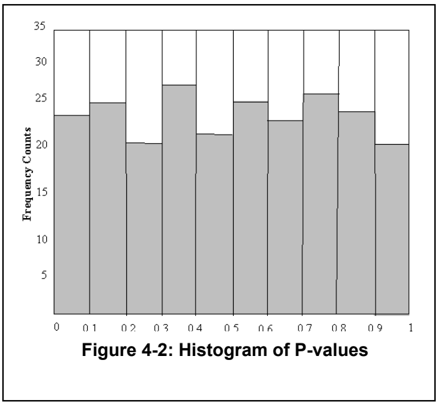
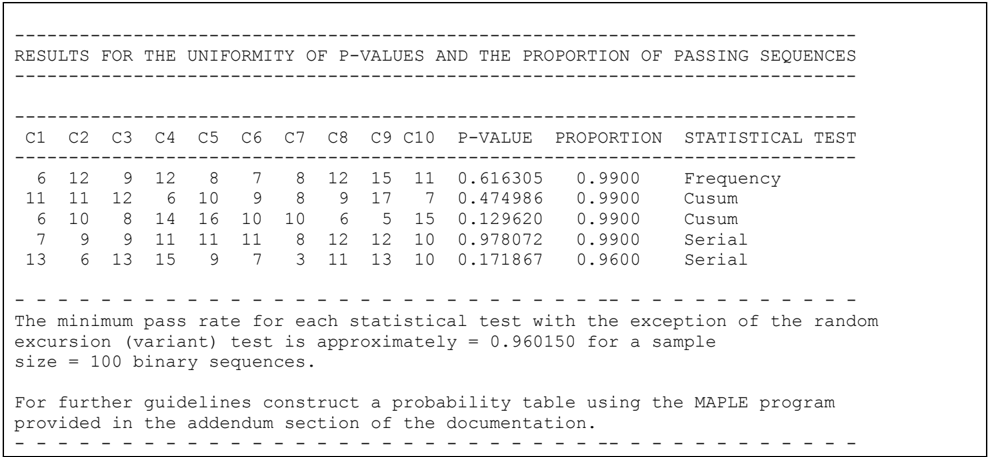
- Main analysis: For each sequence, P-values are computed and compared to \(\alpha\); empirical interpretation examines the proportion of sequences passing a test and the uniformity of P-values. A multiple-test dependence study applied 161 test P-values to Blum-Blum-Shub sequences of length 1,000,000 and used principal components/factor analysis, concluding there was no large redundancy among tests.
Limitations
- The paper states that no set of statistical tests can absolutely certify a generator as appropriate, that statistical testing cannot substitute for cryptanalysis, and that generator design and cryptanalysis are outside its scope.
- The paper states that many examples use small sample sizes for illustration only, e.g., \(n=10\), where the normal approximation is not really applicable; many tests rely on asymptotic reference distributions for large \(n\) (order \(10^3\) to \(10^7\)), and input parameter constraints apply.
- The text makes evident additional limitations: numerical precision can degrade for large incomplete gamma parameter \(a\); Maurer’s variance approximation can make the test 2.67 times more permissive than theoretically admitted; Random Excursions is discontinued if \(J<500\); and multiple tests can yield contradictory conclusions, as in the Random Excursions example where one state gave a non-random result while seven states gave random results.
Model-written summary. Check it against the paper before relying on it.
Integrity signals
Registry
Cites
Statistics
Figures

Verification
Claims the paper makes
0 Valid · 1 Not valid · 11 Not checked · 13 Own results and interpretations
A result the paper reports from its own data — it cites no other source for it, so there is none to check. The quote shows it is in the paper.
In the paper
“The asymptotic distribution of ( Ln -µ n ) / σ n along the sequence of even or odd values of n is that of a discrete random variable obtained via a mixture of two geometric random variables (one of them taking only negative values). Strictly speaking, the asymptotic distribution as such does not exist.”
A result the paper reports from its own data — it cites no other source for it, so there is none to check. The quote shows it is in the paper.
In the paper
“However, no set of statistical tests can absolutely certify a generator as appropriate for usage in a particular application, i.e., statistical testing cannot serve as a substitute for cryptanalysis.”
A result the paper reports from its own data — it cites no other source for it, so there is none to check. The quote shows it is in the paper.
In the paper
“This graph showed that there is no large redundancy among our tests.”
In the paper
“Ueli Maurer of the Department of Computer Science at Princeton University introduced this test in 1992. Maurer's test statistic relates closely to the per-bit entropy of the stream, which its author asserts is 'the correct quality measure for a secret-key source in a cryptographic application.'”
What the sources say
- Not matchedcites Maurer
This doesn’t read as a citation we can look up.
- Not matched
What the paper did — it cites no source for this, so there is none to check. The quote shows it is in the paper.
In the paper
“The test rejects the randomness hypothesis immediately if J is too small, i.e., if the following P-value is small:”
20 more claims
Create a free account to see all 25 claims and every source verdict.
Claims other papers make about this one
Each is checked against this paper’s own text: does it say what the citing paper says it does?
The source backs part of the claim, not all of it — or backs it for a different population, condition or comparison.
In the citing paper
“However, the latest version 2.1.2 [1], released in 2014, does not incorporate several modifications.”
From Checking the quality of approximation of p-values in statistical tests for random number generators by using a three-level test (2019) · cites this paper as [1]
Experimental — accuracy not yet measuredThe source backs part of the claim, not all of it — or backs it for a different population, condition or comparison.
In the citing paper
“The NIST test suite consists of 15 statistical tests for randomness of bit sequences, and its result is a list of 188 p -values.”
From Checking the quality of approximation of p-values in statistical tests for random number generators by using a three-level test (2019) · cites this paper as [1]
Experimental — accuracy not yet measuredThe cited source says what the claim attributes to it.
In the citing paper
“Note that the current implementation of the NIST test suite uses one-level or two-level tests, differently from the above experiments”
From Checking the quality of approximation of p-values in statistical tests for random number generators by using a three-level test (2019) · cites this paper as [1]
The cited source says what the claim attributes to it.
In the citing paper
“NIST SP-800.22 statistical test suite [90] and Die-hard test suite [91] and Test U01 [92] and AIS31 [93] are most common statistical test suites to evaluate their RNGs by researchers.”
From True Random Number Generators Using Electrical Noise (2019) · cites this paper as [90]
Self-check
Percentages, sums and reported differences re-computed from the paper’s own numbers.
Each contradiction between two passages listed here was confirmed by an independent check.
Rated minor: it would not touch a result — a value no result rests on, a p-value that stays on the same side of the significance level, or a conflict that is clerical, resolved elsewhere in the paper, or outside its own findings.
In the paper
§ 2.3.8 Example
“(input) τ = 0.02 (processing) π = 0.42 (processing) Vn(obs) = 52 (output) P-value = 0.500798 (conclusion) Since P-value ≥ 0.01 , accept the sequence as random.”
§ 2.3.4 Test Description
“If it can be shown that π -1 ≥τ , then the 2 Runs test need not be performed (i.e., the test should not have been run because of a failure to pass test 1, the Frequency (Monobit) test). If the test is not applicable, then the P-value is set to 0.0000.”
Rated minor: it would not touch a result — a value no result rests on, a p-value that stays on the same side of the significance level, or a conflict that is clerical, resolved elsewhere in the paper, or outside its own findings.
In the paper
§ 2.7.4 Test Description
“| 8-10 | 010 (hit) | 2 | 110 | 1 |”
§ 2.7.4 Test Description
“For the above example, if m = 3 and the template B = 001, then the examination proceeds as follows:”
Rated minor: it would not touch a result — a value no result rests on, a p-value that stays on the same side of the significance level, or a conflict that is clerical, resolved elsewhere in the paper, or outside its own findings.
In the paper
§ 2.9.3 Test Statistic and Reference Distribution
“f n : The sum of the log2 distances between matching Lbit templates, i.e., the sum of the number of digits in the distance between Lbit templates.”
§ 3.9 Maurer's 'Universal Statistical' Test
“Then it averages over all the expansion lengths by the number of test blocks.”
Rated minor: it would not touch a result — a value no result rests on, a p-value that stays on the same side of the significance level, or a conflict that is clerical, resolved elsewhere in the paper, or outside its own findings.
In the paper
§ Input Parameters:
“The parameters p , q and s are not fixed in code; thus, the user will not be able to reconstruct the original sequence because these values will vary (i.e., they are dependent on the system time).”
§ Input Parameters:
“The input parameters have been fixed so the code will reproduce the same results.”
Rated minor: it would not touch a result — a value no result rests on, a p-value that stays on the same side of the significance level, or a conflict that is clerical, resolved elsewhere in the paper, or outside its own findings.
In the paper
§ 5.5.2 Global Parameters
“| MAXNUMOFTEMPLATES | 40 | Non-overlapping Templates Test | | NUMOFTESTS | 16 | Max number of tests | | NUMOFGENERATORS | 12 | Max number of PRNGs |”
§ A.2 Configuration Information
“| 2. | #define MAXNUMOFTEMPLATES | 148 | | 3. | #define NUMOFTESTS | 15 | | 4. | #define NUMOFGENERATORS | 10 |”
2 more findings
Create a free account to see every finding of this check.
Citations
Cites
Handbook of Mathematical Functions
McQuarrie, D. A. (1966) · American Journal of Physics · doi:10.1119/1.1972842 · Cited by 40,433
Numerical recipes in C: the art of scientific computing
(1993) · Choice Reviews Online · doi:10.5860/choice.30-5638 · Cited by 17,933
Rayward-Smith, V. J. (1991) · Journal of the Operational Research Society · doi:10.1057/jors.1991.155 · Cited by 16,821
Handbook of applied cryptography
(1997) · Choice Reviews Online · doi:10.5860/choice.34-4512 · Cited by 10,357
Handbook of Mathematical Functions
(2018) · A Century of Excellence in MEASUREMENTS, STANDARDS, and TECHNOLOGY · doi:10.1201/9781351069397-39 · Cited by 9,062
A universal algorithm for sequential data compression
Ziv, J., & Lempel, A. (1977) · IEEE Transactions on Information Theory · doi:10.1109/tit.1977.1055714 · Cited by 5,456
The Art of Computer Programming
Worlton, W. J. (1968) · Nuclear Science and Engineering · doi:10.13182/nse68-a19548 · Cited by 2,251
Handbook of Applied Cryptography
Menezes, A. J., van Oorschot, P. C., & Vanstone, S. A. (2018) · CRC Press eBooks · doi:10.1201/9780429466335 · Cited by 1,770
Numerical Recipes in C-The Art of Scientific Computing.
G., W., Press, W. H., Flannery, B. P., Teukolsky, S. A., & Vetterling, W. T. (1989) · Mathematics of Computation · doi:10.2307/2008673 · Cited by 1,513
The Fourier Transform and its Applications
Cattermole, K. W. (1965) · Electronics and Power · doi:10.1049/ep.1965.0268 · Cited by 1,417
Cited by
Items 2,001–2,100 of 3,620
Cipher image damage and decisions in real time
Silva-García, V. M., Flores-Carapia, R., Rentería-Márquez, C., Luna-Benoso, B., Jiménez-Vázquez, C. A., & González-Ramírez, M. D. (2015) · Journal of Electronic Imaging · doi:10.1117/1.jei.24.1.013012 · Cited by 5
“Several methods have been utilized to measure the randomness degree.(21) In this work, the following are used: correlation coefficients; horizontal, vertical, and diagonal,(22)”
BackgroundMethodSingle-Scale Measures for Randomness and Complexity
Kinsner, W. (2007) · IEEE International Conference on Cognitive Informatics · doi:10.1109/coginf.2007.4341936 · Cited by 5
Research on a Novel Hashing Stream Cipher
Li, J.-C., & Li, C.-M. (2007) · Lecture notes in computer science · doi:10.1007/978-3-540-74377-4_51 · Cited by 5
Evaluation of Encrypted Data Identification Methods Based on Randomness Test
Zhao, B., Liu, Q., & Liu, X. (2011) · IEEE/ACM International Conference on Green Computing and Communications (GreenCom) · doi:10.1109/greencom.2011.41 · Cited by 6
“The NIST statistical test-suite is highly regarded among the list of batteries of tests.”
InfluentialA New Type of Attacks on Block Ciphers
Ryabko, B. Y., Александрович, М. В., & Shokin, Y. I. (2005) · Problems of Information Transmission · doi:10.1007/s11122-006-0006-1 · Cited by 7
“Thus, the US National Institute of Standards and Technology (NIST) has recently analyzed known test for the randomness hypothesis testing and recommended 16 methods for practical application in cryptography (see [ 11 ]).”
MethodResultSearch for Optimal Five-Neighbor FPGA-Based Cellular Automata Random Number Generators
Santoro, R., Roy, S., & Sentieys, O. (2007) · International Symposium on Signals, Systems and Electronics · doi:10.1109/issse.2007.4294483 · Cited by 6
Secure TCP/IP communications over DVB-S/DVB-RCS using chaotic sequences
Caragata, D., Assad, S. E., Tutănescu, I., et al. (2009) · International Conference for Internet Technology and Secured Transactions · doi:10.1109/icitst.2009.5402591 · Cited by 5
Secure Implementation of Stream Cipher: Trivium
Shanmugam, D., & Annadurai, S. (2015) · Lecture notes in computer science · doi:10.1007/978-3-319-27179-8_18 · Cited by 5
Statistical test on lightweight block cipher-based PRNG
Risqi, Y. S. S., & Windarta, S. (2017) · International Conference on Telecommunication Systems, Services, and Applications · doi:10.1109/tssa.2017.8272925 · Cited by 5
“The randomness of the binary sequence that formed is very important in order to ensure an algorithm has a good random mapping [5] [6].”
BackgroundTowards inter-vendor compatibility of true random number generators for FPGAs
Grujić, M., Yang, B., Rožić, V., & Verbauwhede, I. M. R. (2018) · Design, Automation, and Test in Europe · doi:10.23919/date.2018.8342256 · Cited by 7
“Additionally, random bits should pass statistical tests – NIST SP 800-22 [2] and AIS-31 [1].”
BackgroundMethodSpin Dice Based on Orthogonal Spin-Transfer Devices With Planar Polarizer
Li, X., Luo, S., Qin, H., Hong, J., & You, L. (2018) · IEEE Transactions on Magnetics · doi:10.1109/tmag.2018.2832194 · Cited by 8
SRAM Physically Unclonable Functions Implemented on Silicon Germanium
Trujillo, J., Merino, C., & Zarkesh-Ha, P. (2019) · IEEE International Symposium on Circuits and Systems proceedings · doi:10.1109/iscas.2019.8702437 · Cited by 5
“The NIST Frequency Test within a Block searches for significant runs of zeros or ones.”
MethodInfluentialLightweight Internet of Things Encryption Using Galois Extension Field Arithmetic
McGinthy, J. M., & Michaels, A. J. (2018) · IEEE International Conference on Internet of Things (iThings) and IEEE Green Computing and Communications (GreenCom) and IEEE Cyber, Physical and Social Computing (CPSCom) and IEEE Smart Data (SmartData) · doi:10.1109/cybermatics_2018.2018.00046 · Cited by 6
A novel memristive true random number generator design
Taşkıran, Z. G. Ç., Taşkıran, M., Kıllıoğlu, M., Kahraman, N., & Sedef, H. (2019) · COMPEL The International Journal for Computation and Mathematics in Electrical and Electronic Engineering · doi:10.1108/compel-11-2018-0463 · Cited by 5
A Novel Chaotic Image Encryption using Generalized Threshold Function
Ahadpour, S., Sadra, Y., & Fard, Z. A. (2012) · International Journal of Computer Applications · doi:10.5120/5793-8110 · Cited by 5
Gomez, H., Arenas, J., & Roa, E. (2020) · IET Circuits Devices & Systems · doi:10.1049/iet-cds.2019.0535 · Cited by 6
Bedekar, N., & Shee, C. (2015) · Lecture notes in computer science · doi:10.1007/978-3-319-16745-9_29 · Cited by 5
Security analysis of a binary image permutation scheme based on Logistic mapPreprint
Li, C., & Lo, K. (2009) · arXiv (Cornell University) · Cited by 6
CHAOS-BASED ADVANCED ENCRYPTION STANDARD
Abdulwahed, N. B. (2013) · King Abdullah University of Science and Technology Repository (King Abdullah University of Science and Technology) · doi:10.25781/kaust-46ih9 · Cited by 9
A taxonomy for grid applications
Suciu, A., & Potolea, R. (2008) · IEEE International Conference on Automation, Quality and Testing, Robotics (AQTR) · doi:10.1109/aqtr.2008.4588945 · Cited by 5
Mandal, K. (2013) · UWSpace (University of Waterloo) · Cited by 6
Observations on NIST SP 800-90B entropy estimators
Aslan, M., Doğanaksoy, A., Saygı, Z., Turan, M. S., & Sulak, F. (2025) · Cryptography and Communications · doi:10.1007/s12095-025-00778-7 · Cited by 14
Yüksel, İ. E., Olgun, A., Bostanci, F. N., Canpolat, O., Junior, G. F. D. O., Sadrosadati, M., Yağlıkçı, A. G., & Mutlu, O. (2025) · IEEE International Conference on Computer Design: VLSI in Computers and Processors (ICCD) · doi:10.1109/iccd65941.2025.00130 · Cited by 9
“We show that the random bitstreams generated by SiMRA-TRNG pass all the standard NIST statistical test suite randomness tests [59].”
Using Gate Tunneling in Bulk CMOS to Create a PUF
Camilleri, P., Mossayebi, S., Paterson, K. G., et al. (2023) · IEEE Internet of Things Journal · doi:10.1109/jiot.2023.3291872 · Cited by 4
“We use standardized tests, such as those defined by National Institute of Standards and Technology (NIST) [37], and commonly used measures, such as hamming distance (HD) and auto-correlation.”
BackgroundMethodWang, J., Hu, A., Tian, W., et al. (2024) · Physical Communication · doi:10.1016/j.phycom.2024.102508 · Cited by 4
Symmetric Grayscale Image Encryption Based on Quantum Operators with Dynamic Matrices
Olvera-Martinez, L. A., Cedillo-Hernández, M., Diaz-Rodriguez, C. A., Faustinos-Morales, L., Cedillo-Hernández, A., & Garcia-Ugalde, F. J. (2025) · Mathematics · doi:10.3390/math13060982 · Cited by 8
A novel fuzzy system design for data-adaptive secret key generation and robust audio encryption
Venkatesan, C., Rebekka, B., Amirtharajan, R., et al. (2025) · Nonlinear Dynamics · doi:10.1007/s11071-025-11565-7 · Cited by 4
24.86 Gb/s Full-Digital Chaos Random Number 1.53 GSamples/s Noise Generator in 40nm CMOS
Chen, C.-B., Chen, T., & Huang, Y.-H. (2025) · IEEE Solid-State Circuits Letters · doi:10.1109/lssc.2025.3605369 · Cited by 4
A Security Analysis of TrueCrypt: Detecting hidden volumes and operating systems
Davies, A. (2014) · Cited by 4
Secure digital communication based on Lorenz stream cipher
Alshammari, A. S., Sobhy, M. I., & Lee, P. D. (2017) · IEEE International System-on-Chip Conference (SOCC) · doi:10.1109/socc.2017.8225999 · Cited by 4
“The test statistics is used to calculate a P-value which summaries the strength of the indication against the null hypothesis [20].”
MethodPseudo Random Number Generation through Reinforcement Learning and Recurrent Neural Networks
Pasqualini, L., & Parton, M. (2020) · Algorithms · doi:10.3390/a13110307 · Cited by 8
Silvério, T., Figueiredo, G., Ferreira, R. A. S., et al. (2021) · Optics Communications · doi:10.1016/j.optcom.2021.127538 · Cited by 4
Testing and Reliability Enhancement of Security Primitives
Anik, T. H., Danger, J., Diankha, O., Ebrahimabadi, M., Frisch, C., Guilley, S., Karimi, N., Pehl, M., & Takarabt, S. (2021) · Proceedings · doi:10.1109/dft52944.2021.9568297 · Cited by 5
“The NIST SP 800-22 [7] compares the TRNG output against the expected behaviour of an ideal randomness.”
BackgroundDesign and Simulation of Physical Layer Security for Next Generation Intelligent Optical Networks
Marudhai, V., Prince, S., & Kumari, S. (2022) · Wireless Personal Communications · doi:10.1007/s11277-022-09913-6 · Cited by 4
Scrambling additive lagged-Fibonacci generators
Aldossari, H., & Mascagni, M. (2022) · Monte Carlo Methods and Applications · doi:10.1515/mcma-2022-2115 · Cited by 4
Gupta, A., & Sampalli, S. (2022) · Proceedings of the Annual International Conference of the IEEE Engineering in Medicine and Biology Society · doi:10.1109/embc48229.2022.9871499 · Cited by 4
“PRNGs use mathematical formulae to produce seemingly random sequences of numbers, with the ability to re-generate the same sequence using an identical “seed” value [11].”
MethodLETRNG—A Lightweight and Efficient True Random Number Generator for GNU/Linux Systems
Chen, Y., Zhu, F., Tian, Y., Xu, S., Han, L., Zhou, Q., & Ling, N. (2022) · Tsinghua Science & Technology · doi:10.26599/tst.2022.9010005 · Cited by 5
Real-time post-processing for physical-layer secure key distribution in fiber networks
Cao, Y., Zhang, L., Huang, X., et al. (2022) · Optics Communications · doi:10.1016/j.optcom.2022.129068 · Cited by 4
Accelerating Operations on Permutations Using Graphics Processing Units
Lavdanskyi, A., Фауре, Е. В., Skutskyi, A., & Bazilo, C. (2023) · Lecture notes on data engineering and communications technologies · doi:10.1007/978-3-031-35467-0_1 · Cited by 5
True Random Number Generator Prototype Implemented in an FPGA
Oliveira, R., Cabacinho, J., Oliveira, L. B., & Casaleiro, J. C. F. D. A. (2023) · International Young Engineers Forum (YEF-ECE) · doi:10.1109/yef-ece58420.2023.10209297 · Cited by 9
“In this Section, the NIST STS [13] tests are applied, and the histogram of the generated bitstream and resource utilization are analyzed to evaluate the proposed architecture.”
MethodMindCrypt: The Brain as a Random Number Generator for SoC-Based Brain-Computer Interfaces
Eichler, G., Seyoum, B. B., Chiu, K.-L., & Carloni, L. P. (2023) · IEEE International Conference on Computer Design: VLSI in Computers and Processors (ICCD) · doi:10.1109/iccd58817.2023.00021 · Cited by 4
Xiao, S., Xu, S., & Chen, Z. (2024) · Multimedia Tools and Applications · doi:10.1007/s11042-023-17970-7 · Cited by 4
“The randomness of the number sequences in the ciphertext image was evaluated using the NIST SP 800-22 test suites [56].”
Arbekov, I. M., & Molotkov, S. N. (2024) · Physics-Uspekhi · doi:10.3367/ufne.2024.02.039658 · Cited by 4
Highly Reliable PUF Circuits Using Efficient Post-Processing Stabilization Technique
Tseng, Y.-H., Yang, S.-H., & Liu, T.-T. (2024) · IEEE International Symposium on Circuits and Systems proceedings · doi:10.1109/iscas58744.2024.10558347 · Cited by 4
Analysing All-Optical Random Bit Sequences Using Gap-Based Approaches
Lange, C., Ahrens, A., Singh, J., & Grote, O. (2024) · Sensors · doi:10.3390/s24144474 · Cited by 4
Chen, L., Chen, L., Song, Y., et al. (2024) · EURASIP Journal on Wireless Communications and Networking · doi:10.1186/s13638-024-02384-2 · Cited by 4
Oumouss, L., Younes, A., Asimi, A., et al. (2024) · International Conference on Circuit, Systems and Communication (ICCSC) · doi:10.1109/iccsc62074.2024.10616798 · Cited by 4
“Additionally, they must successfully pass a battery of statistical tests recommended by the National Institute of Standards and Technology (NIST) [7] to be considered secure for use in cryptographic systems such as hashing, digital signatures, and digital encryption.”
MethodDeep Learning-Based Security Analysis of Quantum Random Numbers Generated by Imperfect Devices
Cao, J., Zhang, M., Liu, W., Wang, L., & Peng, J. (2024) · IEEE Transactions on Information Forensics and Security · doi:10.1109/tifs.2024.3445169 · Cited by 6
“An official standard for statistical randomness tests is the statistical test suite NISP SP 800-22 [32] published by the National Institute of Standards and Technology (NIST), which contains 15 sub-statistical test items.”
BackgroundMethodA Secure and Efficient Software Random Number Generator Applicable to Internet of Things
He, D., Huang, W., Chen, L., & Chan, S. (2024) · IEEE Internet of Things Journal · doi:10.1109/jiot.2024.3468451 · Cited by 4
“2) NIST SP80022 Test [49]: The National Institute of Standards and Technology (NIST) has released a series of standards related to information security, which have been widely recognized by the international security community.”
Pseudo-Random Generator Based on a Photonic Neuromorphic Physical Unclonable Function
Dermanis, D., Rizomiliotis, P., Bogris, A., & Mesaritakis, C. (2024) · IEEE Journal of Quantum Electronics · doi:10.1109/jqe.2024.3471951 · Cited by 6
“This effect can be attributed to the fact that if there are quantization noise induced variations at the RC’s states (low ADC bit-accuracy), these in turn are translated to significant W out variations.”
BackgroundMethodInfluentialPattern transition and bifurcation analysis of ELU-type memristive FitzHugh-Nagumo neuron
Xiao, W., Min, F., Lu, J., et al. (2024) · Chaos Solitons & Fractals · doi:10.1016/j.chaos.2024.115915 · Cited by 4
Design and Implementation of Multiple Ring Oscillator-Based TRNG Architecture by Using ADPLL
Meitei, H. B., & Kumar, M. (2025) · IEEE Access · doi:10.1109/access.2025.3527507 · Cited by 11
Covert Secret Key Agreement Scheme Based on the Underwater Acoustic Dynamic Hypergraph
Xu, M., & Hao, M. (2025) · IEEE Internet of Things Journal · doi:10.1109/jiot.2025.3529425 · Cited by 4
“The tools employed for the simulation experiments include the MATLAB R2016a simulation platform, the Bellhop underwater acoustic toolbox [24], and the NIST SP800-22 randomness testing platform [25].”
Machine Learning Predictors for Min-Entropy Estimation
Blanco-Romero, J., Lorenzo, V., Mendoza, F. A., & Díaz-Sánchez, D. (2025) · Entropy · doi:10.3390/e27020156 · Cited by 6
“…role that RNGs play in the context of cybersecurity, it becomes evident that rigorous criteria are necessary for evaluating the reliability and performance of an RNG. Multiple approaches are commonly employed to assess the quality of the output of an RNG (cf. [1], [2], [3], [4], [5], [6], etc.).”
Unveiling Samsung Quantum Galaxy: Securing Smartphones With Quantum and Post-Quantum Cryptography
Alibrahim, O. (2025) · IEEE Access · doi:10.1109/access.2025.3563826 · Cited by 9
Quantum Phase True Random Number Generation for Secure Sustainable 6G Communication
Gururaja, T. S., & Praveenkumar, P. (2025) · International Conference on Wireless Communications, Signal Processing and Networking (WiSPNET) · doi:10.1109/wispnet64060.2025.11005305 · Cited by 6
Cryptosystem with One Dimensional Chaotic Maps
Martínez-Ñonthe, J. A., Díaz-Méndez, A., Cruz‐Irisson, M., et al. (2011) · Lecture notes in computer science · doi:10.1007/978-3-642-21323-6_24 · Cited by 4
“The randomness of the produced cryptograms has been evaluated using the NIST random tests [ 10 ].”
MethodGemstone: A New Stream Cipher Using Coupled Map Lattice
Yin, R., Yuan, J., Yang, Q., Shan, X., & Wang, X. (2010) · Lecture notes in computer science · doi:10.1007/978-3-642-16342-5_15 · Cited by 5
“For our cipher, the key stream bits are tested by using the NIST Statistical Test Suite [ 16 ] and the Diehard Battery of Tests [17].”
MethodChaotic generator synthesis: Dynamical and statistical analysis
Taralova, I., Lozi, R., & Assad, S. E. (2012) · HAL (Le Centre pour la Communication Scientifique Directe) · Cited by 4
A new type of keystream generator based on chaotic maps: Illustration on a Hénon generalized map
Sava, D., Vlad, A., & Tataru, R.-L. (2014) · International Conference on Communications (COMM) · doi:10.1109/iccomm.2014.6866726 · Cited by 7
Assessing the Quality of Pseudo-Random Number Generators
Luizi, P. C. S., Cruz, F. R. B., & van de Graaf, J. (2010) · Computational Economics · doi:10.1007/s10614-010-9210-6 · Cited by 4
“For the sake of conciseness, details about these statistical tests are not given here, as they can easily be found elsewhere (Rukhin et al., 2001).”
BackgroundMethodInfluentialPasserat‐Palmbach, J., Mazel, C., & Hill, D. R. C. (2012) · International Conference on High Performance Computing & Simulation (HPCS) · doi:10.1109/hpcsim.2012.6266971 · Cited by 3
“Please note that this enumeration does not take into account testing suites targeting cryptographic applications, which leading tool is rather the NIST STS proposal [15].”
MethodStoyanov, B. P., & Kordov, K. (2013) · AIP conference proceedings · doi:10.1063/1.4827249 · Cited by 4
Grayscale image encryption using a hyperchaotic unstable dissipative system
Ontañon-García, L. J., García-Martínez, M., Campos-Cantón, E., & Čelikovský, S. (2013) · International Conference for Internet Technology and Secured Transactions · doi:10.1109/icitst.2013.6750252 · Cited by 4
Empirical tests for statistical properties of some pseudorandom number generators
Цветков, Е. А. (2011) · Mathematical Models and Computer Simulations · doi:10.1134/s207004821106010x · Cited by 4
IC Postprocessing Stage for Random Number Generators and an Alternative Design Methodology
Ergün, S. (2011) · International Conference on Intelligent Information Hiding and Multimedia Signal Processing (IIH-MSP) · doi:10.1109/iihmsp.2011.25 · Cited by 4
A new matrix test for randomness
Grošek, O., Vojvoda, M., & Krchnavý, R. (2009) · Computing · doi:10.1007/s00607-009-0033-z · Cited by 6
A Novel Method of Chaotic Image Encryption Based on LFSR
Lv, Y., & Tong, X. (2009) · International Conference on Management and Service Science (MASS) · doi:10.1109/icmss.2009.5302775 · Cited by 5
Feng, J., Chen, Y., Ku, W., et al. (2010) · International Conference on Communications · doi:10.1109/icc.2010.5502417 · Cited by 4
Implementation of a Chaotically Encrypted Wireless Communication System
Abid, A. M., Nasir, Q., & Elwakil, A. S. (2009) · International Conference on Communications · doi:10.1109/icc.2009.5199069 · Cited by 4
“In this paper the NIST test suite [5] is used which consists of fifteen different tests.”
MethodSimplification of Frequency Test for Random Number Generation Based on Chi-Square
Wongpanya, K., Sripimanwat, K., & Jenjerapongvej, K. (2008) · Advanced International Conference on Telecommunications (AICT) · doi:10.1109/aict.2008.42 · Cited by 4
“This procedure is divided into six steps as those in [ 1 ].”
BackgroundMethodInfluentialOn the security of a double-scroll based "true" random bit generator
Ergün, S. (2015) · European Signal Processing Conference (EUSIPCO) · doi:10.1109/eusipco.2015.7362746 · Cited by 4
Chang, Y.-T., & Lin, Y.-C. (2015) · International Carnahan Conference on Security Technology · doi:10.1109/ccst.2015.7389692 · Cited by 4
“Here, NIST testing suite is effectively applied to prove the randomness and aperiodicity of binary sequence generated by pseudo random number generators (PRNG) [8].”
MethodAsc – A Stream Cipher With Built – In Mac Functionality
Wirt, K.-T. (2007) · Zenodo (CERN European Organization for Nuclear Research) · doi:10.5281/zenodo.1081188 · Cited by 4
RunFein: a rapid prototyping framework for Feistel and SPN-based block ciphers
Khalid, A., Hassan, M., Paul, G., & Chattopadhyay, A. (2016) · Journal of Cryptographic Engineering · doi:10.1007/s13389-016-0116-7 · Cited by 4
Digital Bimodal Functions and Digital Physical Unclonable Functions: Architecture and Applications
Xu, T., & Potkonjak, M. (2015) · Springer eBooks · doi:10.1007/978-3-319-14971-4_3 · Cited by 4
A High-Speed Digital True Random Number Generator Based on Cross Ring Oscillator
Wang, Y., & Li, S. (2016) · IEICE Transactions on Fundamentals of Electronics Communications and Computer Sciences · doi:10.1587/transfun.e99.a.806 · Cited by 5
Memory Carving in Embedded Devices: Separate the Wheat from the Chaff
Gougeon, T., Barbier, M., Lacharme, P., et al. (2016) · Lecture notes in computer science · doi:10.1007/978-3-319-39555-5_32 · Cited by 4
“, NIST’s statistical tests [19]) that usually require several kilobytes of data to make the statistical tests relevant.”
BackgroundInfluentialShah, T., & Upadhyay, D. (2016) · Advances in intelligent systems and computing · doi:10.1007/978-981-10-0755-2_64 · Cited by 4
Improving randomness characterization through Bayesian model selection
Rojas, R. D. H., Solís, A., Angulo, A., U’Ren, A. B., Hirsch, J. G., Marsili, M., & Castillo, I. P. (2017) · Scientific Reports · doi:10.1038/s41598-017-03185-y · Cited by 5
A shift column different offset for better Rijndael security
Mahmod, R., Ali, S. A., & Ghani, A. (2009) · Universiti Putra Malaysia Institutional Repository (Universiti Putra Malaysia) · Cited by 3
Cryptanalysis of a random number generator based on a double-scroll chaotic oscillator
Ergün, S. (2016) · International Symposium on Intelligent Signal Processing and Communication Systems (ISPACS) · doi:10.1109/ispacs.2016.7824723 · Cited by 4
“However, although at least 1000000-bit long sequences are recommended in [8], the statistical test does not assure reliable results covering valid parameters of input such as the sequence length.”
BackgroundMethodAnalyzing efficiency of Pseudo-Random Number Generators using Machine Learning
Kumar, S. (2016) · International Conference on Information and Network Security (ICINS) · doi:10.1145/3026724.3026730 · Cited by 5
“1 Existing Tests on PRNG There are a number of statistical tests on PRNG to determine their efficiency in generating random numbers [10][11].”
MethodIntegrated circuit identification and true random numbers using 1.5-transistor flash memory
Clark, L. T., Adams, J. W., & Holbert, K. E. (2017) · International Symposium on Quality Electronic Design (ISQED) · doi:10.1109/isqed.2017.7918323 · Cited by 4
An Architecture for Learning Stream Distributions with Application to RNG Testing
Althoff, A., & Kastner, R. (2017) · Proceedings - ACM IEEE Design Automation Conference · doi:10.1145/3061639.3062199 · Cited by 4
“The method of [7] implements several of the NIST [8] tests using dynamic reconfiguration due to the large hardware requirements of all 15 implementations of these tests.”
BackgroundMethodNote: A 10 Gbps real-time post-processing free physical random number generator chip
Qian, Y., Liang, F., Wang, X., Li, F., Chen, L., & Jin, G. (2017) · Review of Scientific Instruments · doi:10.1063/1.4993494 · Cited by 4
Exploiting Oscillator Arrays As Randomness Sources for Cryptographic Applications
Maffezzoni, P., & Daniel, L. (2017) · IEEE Transactions on Computer-Aided Design of Integrated Circuits and Systems · doi:10.1109/tcad.2017.2783298 · Cited by 4
“The randomness of the simulated bit streams has been investigated with the NIST tool sets, while considering the effects of the number N of stages, extremely high thermal noise levels and uncertainty in oscillating frequencies and coupling strengths due to manufacturing variability and device mismatches.”
MethodInfluentialCellular Automaton-Based Pseudorandom Number Generator
Zarezadeh, Z. (2017) · Complex Systems · doi:10.25088/complexsystems.26.4.373 · Cited by 7
A new randomness-enhancement method for chaos-based cryptosystem
Garcia-Bosque, M., Pérez-Resa, A., Sánchez‐Azqueta, C., et al. (2018) · IEEE Latin American Symposium on Circuits and Systems (LASCAS) · doi:10.1109/lascas.2018.8399959 · Cited by 4
“In order to test the randomness of the sequences generated for each case, 100 sequences have been generated and have been subjected to the National Institute of Standards and Technology (NIST) randomness test [12] with a significance level of 0.”
MethodVorobets, G., Vorobets, O., Horditsa, V., Tarasenko, V., & Vorobets, O. (2018) · International Conference on Dependable Systems, Services and Technologies (DESSERT) · doi:10.1109/dessert.2018.8409118 · Cited by 4
“2 programs package [15], [16], created for investigating the cryptographic stability of pseudorandom sequence generators.”
BackgroundCryptographically Secure Diffusion Sequences—An Attempt to Prove Sequences Are Random
Parvees, M. Y. M., Samath, J. A., & Bose, B. P. (2018) · Advances in intelligent systems and computing · doi:10.1007/978-981-13-1882-5_37 · Cited by 4
High Level Synthesis for Symmetric Key Cryptography
Khalid, A., Paul, G., & Chattopadhyay, A. (2019) · Computer architecture and design methodologies · doi:10.1007/978-981-10-1070-5_4 · Cited by 4
Ouattara, F., Nejat, A., Torres, L., & Mackay, K. (2019) · IEEE Access · doi:10.1109/access.2019.2907186 · Cited by 5
“For instance, the National Institute of Standard and Technology (NIST) has developed a suite of tools available online that can statistically test the randomness of any RNG [24].”
A New Trend of Pseudo Random Number Generation using QKD
Mohammad, O. K. J., Abbas, S., El-Horbaty, E.-S. M., & Salem, A.-B. M. (2014) · International Journal of Computer Applications · doi:10.5120/16773-6344 · Cited by 4
Implementation of modified additive lagged Fibonacci generator
Mandrona, M., Maksymovych, V., Harasymchuk, O., et al. (2016) · Challenges of Modern Technology · Cited by 4
Beletsky, A. (2019) · Radio Electronics Computer Science Control · doi:10.15588/1607-3274-2019-3-10 · Cited by 4
Implementation and Statistical Tests of a Block Cipher Algorithm MISTY1*
Moussaoui, S., Zeghdoud, S., & Allailou, B. (2019) · Malaysian Journal of Computing and Applied Mathematics · doi:10.37231/myjcam.2019.2.2.35 · Cited by 4
“Uniformity can also be determined by applying the test χ 2 (Bassham et al., 2010).”
MethodInfluentialImran, M., Sorianello, V., Fresi, F., et al. (2020) · Optical Fiber Communication Conference · doi:10.1364/ofc.2020.m1d.5 · Cited by 4
“The extracted data successfully passed all NIST randomness tests [7] and achieved random number generation rate of 12.”
MethodA Lightweight Message Authentication Code for Virtual Work in Future Smart Cities
Pindar, Z. A., Fayomi, J. O., Waziri, N. H., et al. (2020) · IEEE European Technology and Engineering Management Summit (E-TEMS) · doi:10.1109/e-tems46250.2020.9111859 · Cited by 4
“Therefore, a statistical test was conducted using the NIST statistical test suite [24] in order to determine the randomness of data generated by the MAC.”
MethodHolographically controlled random numbers from entangled twisted photons
Oliveira, M. D., Bornman, N., & Forbes, A. (2020) · Physical Review A · doi:10.1103/physreva.102.032620 · Cited by 4
Metadata
- Authors
- Bassham, L. E., Rukhin, A. L., Soto, J., Nechvatal, J. R., Smid, M. E., Barker, E. B., Leigh, S. D., Levenson, M., Vangel, M., Banks, D. L., Heckert, N. A., Dray, J. F., & Vo, S.
- Affiliations
- National Institute of Standards and Technology (US)
- Venue
- NIST Special Publication 800-22 Revision 1a
- Published
- 2010
- OpenAlex
- W1517403092
- Semantic Scholar
- 961fc0f6c68303cde94a28fdb24e6eaf3ef040b4
- Cited by
- 3,617
- References
- 34
- Citations by year
- 2026: 128 · 2025: 205 · 2024: 192 · 2023: 208 · 2022: 166 · 2021: 291 · 2020: 290 · 2019: 250 · 2018: 254 · 2017: 207 · 2016: 183 · 2015: 184 · 2014: 201 · 2013: 155 · 2012: 139
- Type
- report
- Language
- en
- Open access
- gold
- doi.org
- Topics
- Physical Sciences › Computer Science › Artificial Intelligence › Cryptographic Implementations and Security
- Physical Sciences › Mathematics › Discrete Mathematics and Combinatorics › Coding theory and cryptography
- Physical Sciences › Computer Science › Computer Vision and Pattern Recognition › Chaos-based Image/Signal Encryption
- Keywords
- random number generators, pseudorandom number generators, cryptographic randomness, NIST SP 800-22, randomness testing
About these checks
Registry, retraction, Cites and statistics results are computed, not judged, with one exception: a printed reference that no index lists is read once by a model before it counts as a citation error. Claims are extracted by a model and kept only when their quote appears verbatim in the text; each cited source is then checked, with a model’s help, for whether it says what the claim relies on. Those verdicts can be wrong — read the claim’s quote and the cited source before relying on one.
A language model drew the claims from the paper on 2026-09-27 (prompt extract-v2).
Statistics and arithmetic are recomputed, not judged.
Confidence bands are shown only for fields calibrated on our annotated test set. None is calibrated yet, so no band is shown.
What counts as a claim ›How we measure confidence ›How we check this ›
Are you an author, or do you see a problem with this page? Request a review
Data sources
Bibliographic data: Semantic Scholar, OpenAlex, Crossref.
Contains information from the Semantic Scholar Academic Graph Datasets, made available under the ODC Attribution License (ODC-BY 1.0).
Semantic Scholar’s data is described in: Kinney, R., et al. (2023). The Semantic Scholar Open Data Platform. arXiv:2301.10140.
